

Hebrews 12:13
Greek (Tischendorf 8th ed.) Hebrews 12:13 appears in the Greek New Testament. The text above is from the Tischendorf 8th edition. Each word links to its Strong’s number and a concise gloss. Click any word for its full Thayer’s Greek Lexicon entry.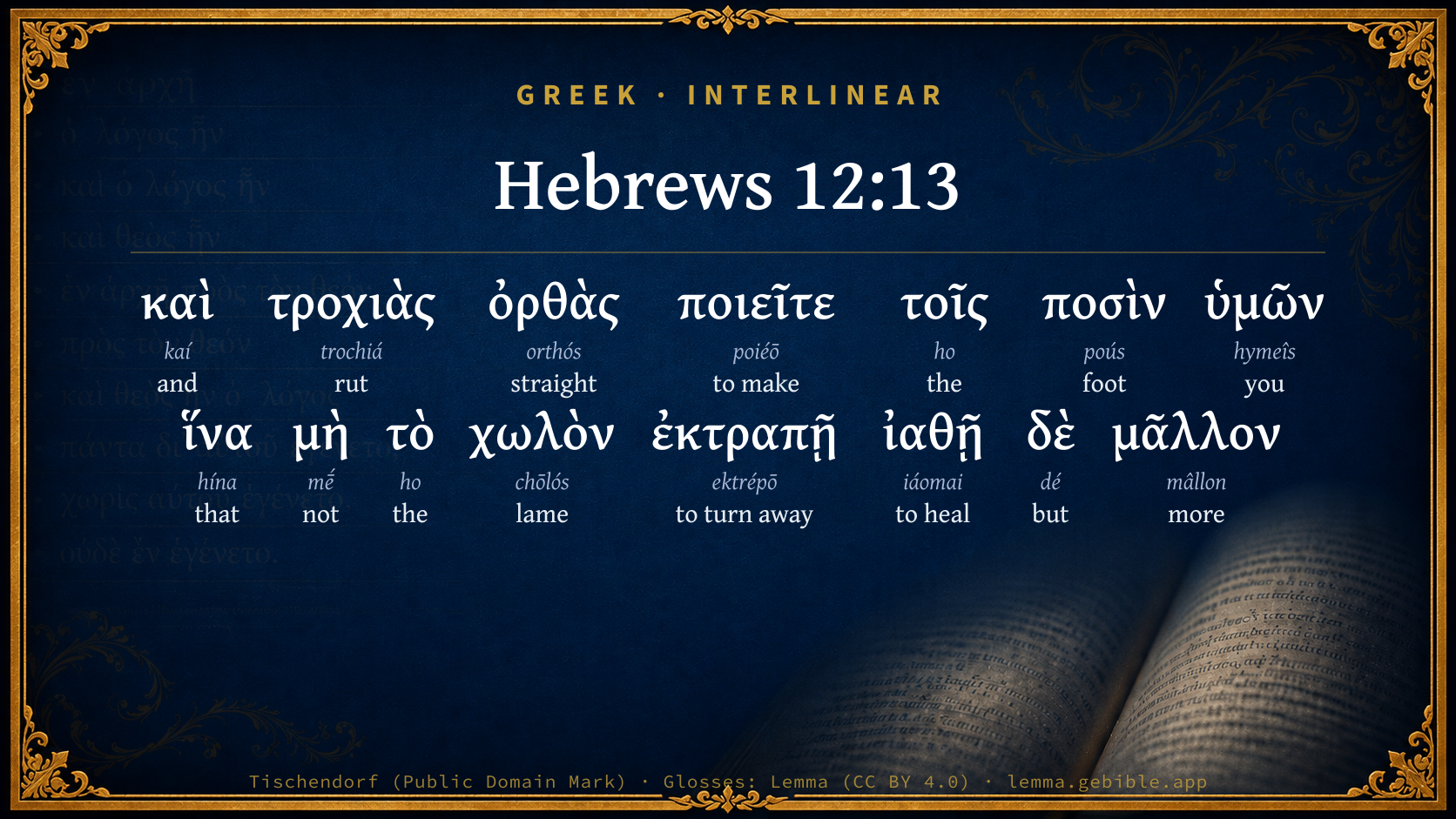
and make straight paths for your feet, so that which is lame may not be dislocated, but rather be healed.
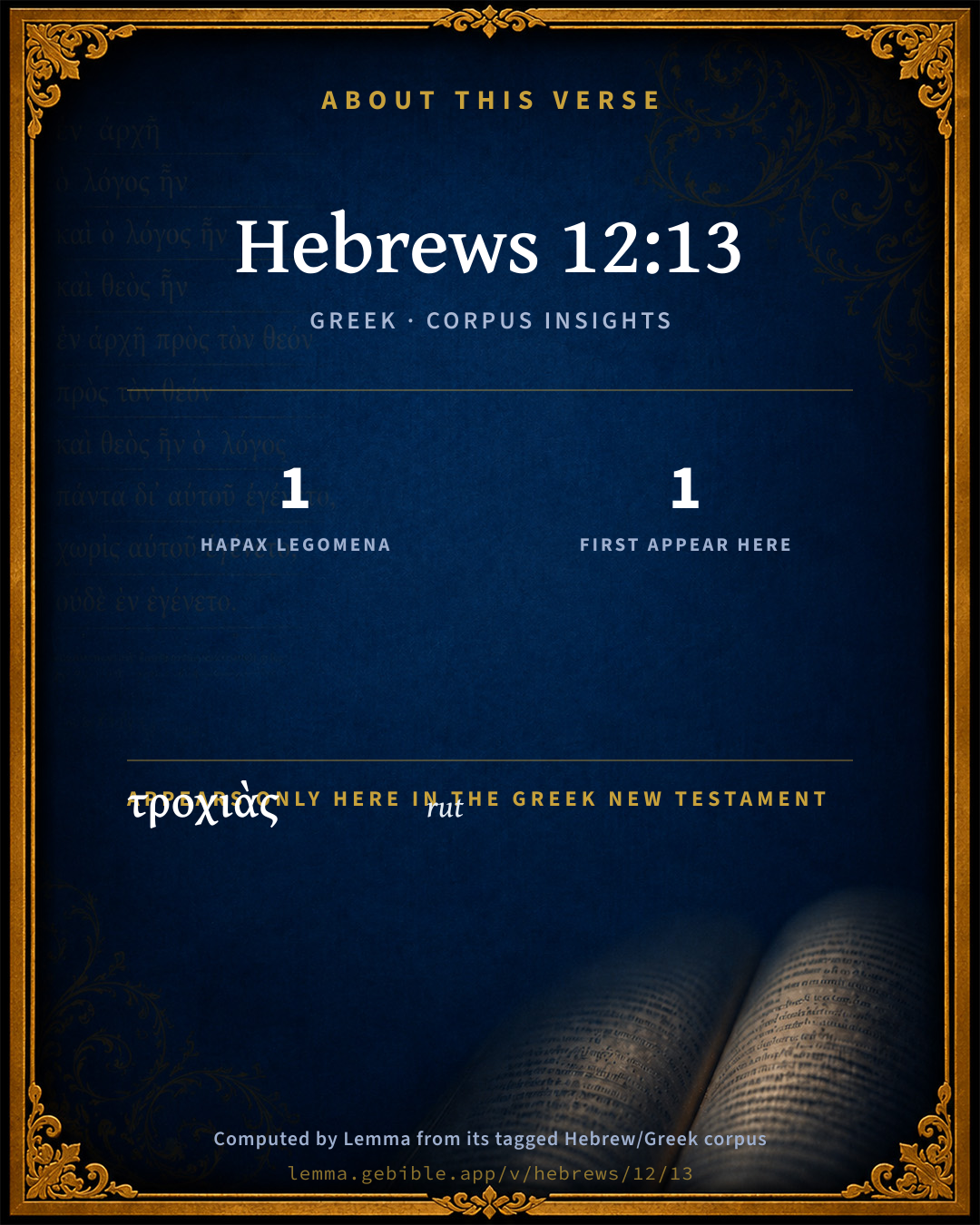
- 1 hapax legomenon — only here in the Greek New Testament
- 1 first appearance in the Greek New Testament
Download a study sheet
One document with this verse’s original text, its word-by-word gloss line, the meaning frame, cross-references with their text, attributed commentary, and full source and license credits — printable, and it pastes into notes with its structure intact.
This verse Autodidact and up
A passage Seminary Student
Up to 50 verses in one chapter. A passage sheet keeps up to 6 commentary sources and 12 cross-references per verse, in the order this page ranks them, and says so on the sheet whenever that leaves anything out. Ask for a single verse and you get the Autodidact verse sheet above.
Everything on this page stays free to read, with no account — the sheet is a download of what is already on screen, not access to it.
Compare translations 3
The same verse in 3 English versions, stacked beneath the original-language interlinear above. Click any original word for its lexicon entry.
Each is an independent rendering of the whole verse — the interlinear is not word-aligned to these translations.
Highlighted words mark where these versions differ — a whole-verse word diff, not a word-by-word alignment.
-
World English Bible Public Domain
and make straight paths for your feet, so that which is lame may not be dislocated, but rather be healed.
-
King James Version Public Domain
And make straight paths for your feet, lest that which is lame be turned out of the way; but let it rather be healed.
-
unfoldingWord Literal Text CC BY-SA 4.0
and make straight paths for your feet, so that the lame might not be dislocated, but rather might be healed.
unfoldingWord Literal Text — © unfoldingWord, licensed CC BY-SA 4.0. Word-aligned USFM3 via Door43 (git.door43.org/unfoldingWord/en_ult).
Show all 19 translations
Every available English version of this verse, each an independent rendering of the whole verse.
-
World English Bible Public Domain
and make straight paths for your feet, so that which is lame may not be dislocated, but rather be healed.
-
Berean Standard Bible Public Domain
Make straight paths for your feet, so that the lame may not be disabled, but rather healed.
-
Majority Standard Bible Public Domain
Make straight paths for your feet, so that the lame may not be disabled, but rather healed.
-
King James Version Public Domain
And make straight paths for your feet, lest that which is lame be turned out of the way; but let it rather be healed.
-
American Standard Version (1901) Public Domain
and make straight paths for your feet, that that which is lame be not turned out of the way, but rather be healed.
-
Revised Version (1885) Public Domain
and make straight paths for your feet, that that which is lame be not turned out of the way, but rather be healed.
-
Geneva Bible (1599) Public Domain
And make straight steppes vnto your feete, lest that which is halting, be turned out of the way, but let it rather be healed.
-
Douay-Rheims (1899) Public Domain
And make straight steps with your feet: that no one, halting, may go out of the way; but rather be healed.
-
Young's Literal Translation Public Domain
and straight paths make for your feet, that that which is lame may not be turned aside, but rather be healed;
-
Literal Standard Version CC BY-SA 4.0
and make straight paths for your feet, so that which is lame may not be turned aside, but rather be healed;
-
Unlocked Literal Bible CC BY-SA 4.0
Make straight paths for your feet, so that what is lame will not be sprained but rather be healed.
-
unfoldingWord Literal Text CC BY-SA 4.0
and make straight paths for your feet, so that the lame might not be dislocated, but rather might be healed.
-
Darby Bible Public Domain
and make straight paths for your feet, that that which is lame be not turned aside; but that rather it may be healed.
-
World Messianic Bible Public Domain
and make straight paths for your feet, so what is lame may not be dislocated, but rather be healed.
-
Webster's Bible Public Domain
And make straight paths for your feet, lest that which is lame be turned out of the way; but let it rather be healed.
-
Free Bible Version CC BY-SA 4.0
Make straight paths to walk on, so that those who are crippled won't lose their way, but will be healed.
-
Bible in Basic English Public Domain
And make straight roads for your feet, so that the feeble may not be turned out of the way, but may be made strong.
-
Text-Critical English NT CC BY 4.0
Make straight paths for your feet, so that what is lame may not be put out of joint but healed instead.
-
Tyndale New Testament (1534) Public Domain
and se that ye have strayght steppes vnto youre fete lest eny haltinge turne out of the waye: yee let it rather be healed.
Literal Standard Version (2020), Covenant Press — licensed CC BY-SA 4.0. Text via the HelloAO Bible API (eBible.org). Unlocked Literal Bible (unfoldingWord) — licensed CC BY-SA 4.0. Text via the HelloAO Bible API (eBible.org). unfoldingWord Literal Text — © unfoldingWord, licensed CC BY-SA 4.0. Word-aligned USFM3 via Door43 (git.door43.org/unfoldingWord/en_ult). Free Bible Version, Dr. Jonathan Gallagher — licensed CC BY-SA 4.0. Text via the HelloAO Bible API (eBible.org).
Word by word
More ways to search: Search by grammar → Find every occurrence → Compare this word →
Practice this passage: Drill this verse → Learn its vocabulary →
- Appears 1× in the Greek New Testament
- First appears here
- Part of Speech
- Noun
- Case
- Accusative
- Number
- Plural
- Gender
- Feminine
Full Thayer's Definition
- καὶ kaí G2532 “and” Conjunction
- τροχιὰς trochiá G5163 “rut” Noun, Accusative, Plural, Feminine
- ὀρθὰς orthós G3717 “straight” Adjective, Accusative, Plural, Feminine
- ποιεῖτε poiéō G4160 “to make” Verb, Present, Active, Imperative, 2nd person, Plural
- τοῖς ho G3588 “the” Article, Dative, Plural, Masculine
- ποσὶν poús G4228 “foot” Noun, Dative, Plural, Masculine
- ὑμῶν hymeîs G5210 “you” Personal pronoun, 2nd person, Genitive, Plural
- ἵνα hína G2443 “that” Conjunction
- μὴ mḗ G3361 “not” Particle, Negative
- τὸ ho G3588 “the” Article, Nominative, Singular, Neuter
- χωλὸν chōlós G5560 “lame” Adjective, Nominative, Singular, Neuter
- ἐκτραπῇ ektrépō G1624 “to turn away” Verb, Aorist, Passive, Subjunctive, 3rd person, Singular
- ἰαθῇ iáomai G2390 “to heal” Verb, Aorist, Passive, Subjunctive, 3rd person, Singular
- δὲ dé G1161 “but” Conjunction
- μᾶλλον mâllon G3123 “more” Adverb
About this verse
These counts appear in no published source. They are computed here, from the morphology-tagged text and Lemma’s own curated glosses. What Lemma adds →
- 15
- words
- 14
- distinct lemmas
- General Epistles
- section
Notable vocabulary
1 hapax legomenon — a word that appears only here in the entire Greek New Testament:
- τροχιὰς rut G5163
First appearance in Scripture
This word makes its first canonical appearance in the Greek New Testament here:
- τροχιὰς rut G5163
Shared distinctive vocabulary
ὀρθὰς straight G3717 occurs in 2 verses of the Greek New Testament. Also found in:
Repetition
A word recurs within this verse:
- τοῖς the G3588 ×2
Cross-references
13Topical passages linked to Hebrews 12:13 in the Treasury of Scripture Knowledge — connected by theme and wording, ordered by reader-vote popularity; previews shown in the World English Bible.
- Proverbs 4:26–27 Make the path of your feet level. Let all of your ways be established.
- Galatians 6:1 Brothers, even if a man is caught in some fault, you who are spiritual must restore such a one in a spirit of gentleness; looking to yourself so that you also aren't tempted.
- Isaiah 35:3 Strengthen you the weak hands, and confirm the feeble knees.
- Isaiah 35:6 Then shall the lame man leap as a hart, and the tongue of the mute shall sing; for in the wilderness shall waters break out, and streams in the desert.
- Isaiah 40:3–4 The voice of one who cries, Prepare you in the wilderness the way of Yahweh; make level in the desert a highway for our God.
- James 5:16 Confess your offenses to one another, and pray one for another, that you may be healed. The effective, earnest prayer of a righteous man is powerfully effective.
- Jude 1:22–23 On some have compassion, making a distinction,
- Jeremiah 31:8–9 Behold, I will bring them from the north country, and gather them from the uttermost parts of the earth, [and] with them the blind and the lame, the woman with child and her who travails with child together: a great company shall they return here.
- Luke 3:5 Every valley will be filled. Every mountain and hill will be brought low. The crooked will become straight, And the rough ways smooth.
- Isaiah 35:8–10 A highway shall be there, and a way, and it shall be called The way of holiness. The unclean shall not pass over it, but is shall be for for him who walks in the Way. Wicked fools will not go there.
- Isaiah 42:16 I will bring the blind by a way that they don't know; in paths that they don't know will I lead them; I will make darkness light before them, and crooked places straight. These things will I do, and I will not forsake them.
- Jeremiah 18:15 For my people have forgotten me, they have burned incense to false [gods]; and they have been made to stumble in their ways, in the ancient paths, to walk in byways, in a way not built up;
- Isaiah 58:12 Those who shall be of you shall build the old waste places; you shall raise up the foundations of many generations; and you shall be called The repairer of the breach, The restorer of paths to dwell in.
Cross-references courtesy of OpenBible.info (CC BY 4.0).
Lesson kit
Teaching starters — assembled from the data on this page, not authored interpretation. Every prompt links to the verse data it draws on. Edit before teaching.
Hebrews, in the General Epistles, opens this verse with 15 words (14 distinct Greek lemmas). Its most distinctive word is trochiá (“rut”). A historical commentator’s framing appears above. Read the whole chapter for the surrounding context.
Discussion questions
- What does “rut” (trochiá) contribute to the verse as a whole?
- 1 word here appears nowhere else in the Greek New Testament. Why might the author reach for such rare wording?
- This is the first place “rut” appears in Scripture (first appears here). What does its debut here establish?
- How does Acts 14:10, which shares the word «straight», read alongside this verse?
- What does the repetition of “the” (2× in this one verse) do in this verse?
- These translations render this verse differently; the difference is in the English rendering, not the original. What questions does that raise?
- Compare how Bengel's Gnomon and Meyer's Critical & Exegetical Commentary read this verse. Where do they agree or differ?
Things to notice
- 1 word in this verse appears nowhere else in the Greek New Testament.
- 1 word makes its first canonical appearance in Scripture here.
- These translations choose different wording for 9 words in this verse.
- “the” occurs 2× in this single verse.
- 14 distinct Greek lemmas span 15 words in this verse.
Commentary
Notes on Hebrews 12:13 from classic Christian and Jewish commentators (each source and its license shown beneath its notes). The classic Christian expositions comment on the surrounding passage and are grouped to its opening verse, so a note may address several verses; the Jewish commentaries on the Tanakh (Rashi and others) are per-verse, so they appear only where the commentator wrote on this verse.
Lemma curates 59 commentaries, every one of them public domain or Creative Commons licensed, each selected and text-cleaned for this edition rather than reprinted as found. About our sources →
Bengel's Gnomon
Johann Albrecht Bengel
Bengel's Gnomon of the New Testament — English translation (T&T Clark, Edinburgh, 1860) — public domain. Text from a community e-Sword module.
Meyer's Critical & Exegetical Commentary
Heinrich August Wilhelm Meyer
Meyer — Critical and Exegetical Commentary on the New Testament — English translation by Peter Christie, edited by Frederick Crombie (T&T Clark, 1880) — public domain. Text from a community e-Sword module.
Geneva Bible (1599)
Geneva Bible translators
Geneva Bible (1599) marginal notes — public domain. Text via Bolls.life.
Jamieson, Fausset & Brown
Robert Jamieson, A. R. Fausset & David Brown
Jamieson, Fausset & Brown — Commentary Critical and Explanatory on the Whole Bible (1871) — public domain (CC PDM 1.0). Text via the HelloAO Bible API.
Adam Clarke's Commentary
Adam Clarke's Commentary on the Bible (1810–1826) — public domain. Text from a community e-Sword/MySword module.
John Calvin's Commentaries
John Calvin's Commentaries (1540-1563) — public domain. Text from the Calvin Translation Society English edition (1840s-50s) via the Christian Classics Ethereal Library (ccel.org). Calvin's coverage is partial (roughly two-thirds of the Bible); uncommented books and verses are honest gaps, never fabricated. The 19th-century editor's footnotes and remarks are omitted so the notes are faithfully Calvin's own voice.
Ellicott's Commentary for English Readers
A Bible Commentary for English Readers, edited by Charles John Ellicott (1878–1897) — public domain. Text from a community e-Sword module.
The Cambridge Bible for Schools and Colleges
gen. ed. J. J. S. Perowne
The Cambridge Bible for Schools and Colleges (gen. ed. J. J. S. Perowne; Cambridge University Press, 1878–1918) — public domain. Text from a community e-Sword module.
John Gill's Exposition
John Gill's Exposition of the Whole Bible (1746–1763) — public domain (CC PDM 1.0). Text via the HelloAO Bible API.
Trapp's Complete Commentary
John Trapp
John Trapp, A Commentary or Exposition upon All the Books of the Old and New Testament (1647–1656) — public domain. Text from a community e-Sword module.
Albert Barnes' Notes on the Bible
Albert Barnes' Notes on the Bible (1834–1885) — public domain. Text from a community e-Sword/MySword module.
Matthew Poole's English Annotations
Matthew Poole's English Annotations on the Holy Bible (1683–1685) — public domain. Text from a community e-Sword/MySword module.
The Pulpit Commentary
The Pulpit Commentary (1880–1919), ed. H.D.M. Spence-Jones & Joseph S. Exell — public domain. Text from a community e-Sword module.
John Wesley's Explanatory Notes
John Wesley, Explanatory Notes Upon the Whole Bible (1754–1765) — public domain. Text via the GEBible commentary corpus.
Cambridge Greek Testament for Schools and Colleges
Cambridge Greek Testament for Schools and Colleges (Cambridge University Press, 1896; 21 vols, various authors incl. Carr, Maclear, Plummer, Farrar, Lumby, Moule, M. R. James, Simcox) — public domain. Text from a community e-Sword module.
Alford’s Greek Testament
Henry Alford
Henry Alford, The Greek Testament (1849–1861) — public domain. Text from a community e-Sword module.
Vincent's Word Studies in the New Testament
Marvin R. Vincent
Marvin R. Vincent, Word Studies in the New Testament (1887–1900) — public domain. Text from a community e-Sword/MySword module.
Westcott on Hebrews & the Epistles of John
Brooke Foss Westcott
Brooke Foss Westcott (1825–1901), The Epistle to the Hebrews (1889) and The Epistles of St John (1883) — public domain (pre-1929). Text recovered from Internet Archive / Google Books OCR scans. Westcott’s Gospel of John commentary is not included (its OCR lost the chapter running-heads required for reliable verse-keying). Some Greek quoted in the Hebrews volume is imperfectly rendered by the OCR.