
Hebrews 10:27

Greek (Tischendorf 8th ed.) Hebrews 10:27 appears in the Greek New Testament. The text above is from the Tischendorf 8th edition. Each word links to its Strong’s number and a concise gloss. Click any word for its full Thayer’s Greek Lexicon entry.
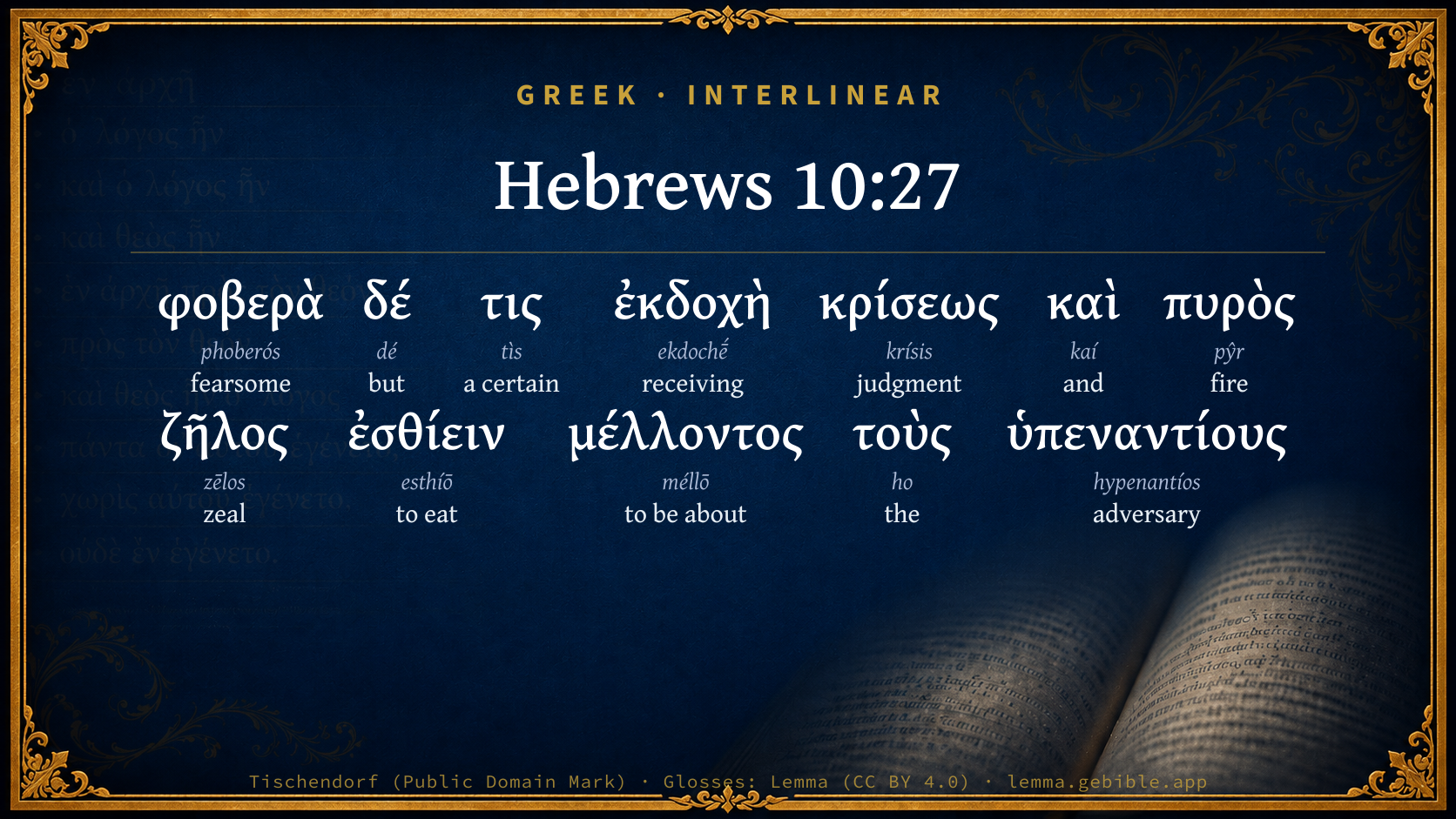
Download image
Cite this verse

Hebrews 10:27 (World English Bible). Public Domain. Lemma interlinear Bible study tool, https://lemma.gebible.app/v/hebrews/10/27.

Show BibTeX & RIS
BibTeX
RIS
English Translation
but a certain fearful expectation of judgment, and a fierceness of fire which will devour the adversaries.
World English Bible · Public Domain
Highlights
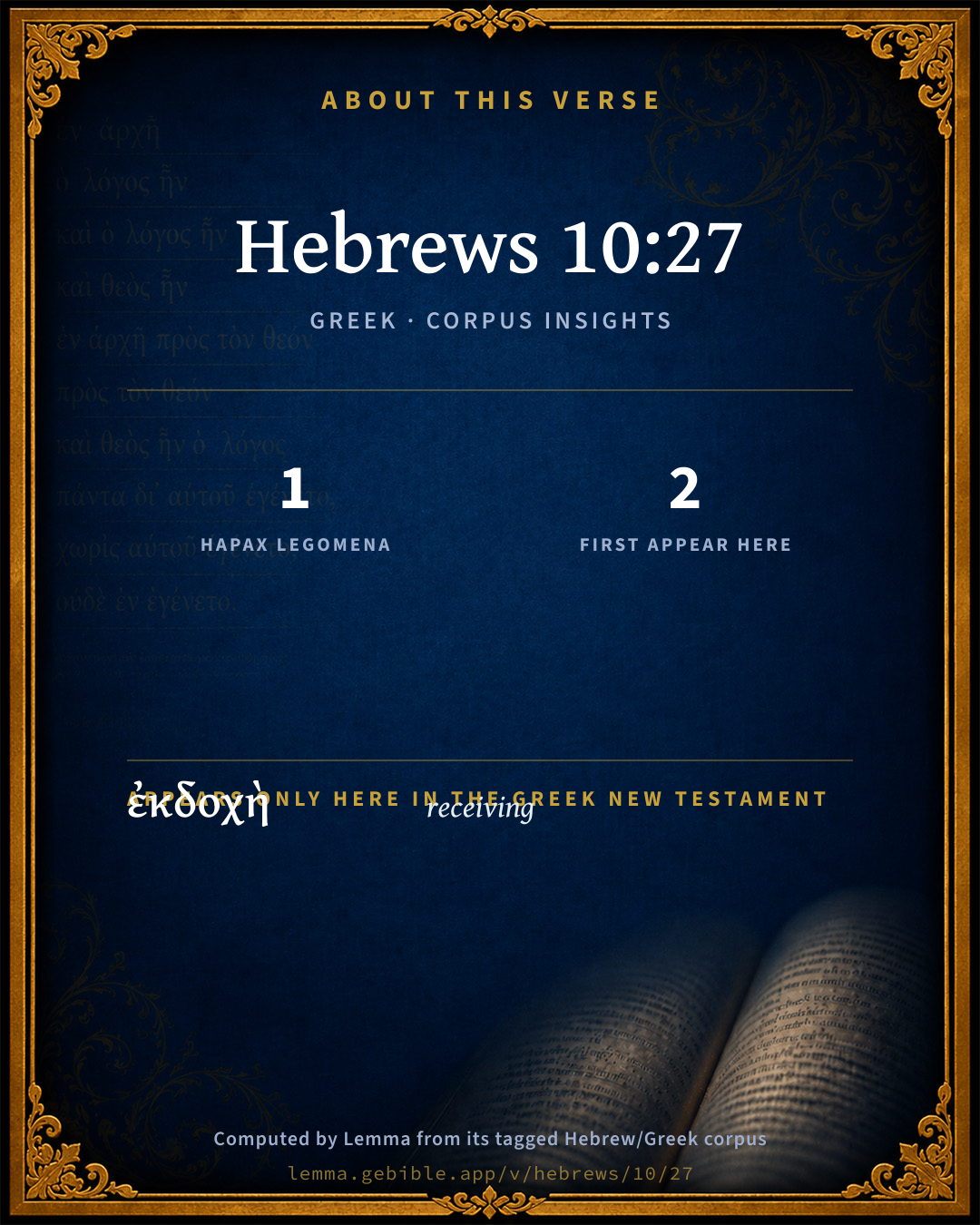
  • 1 hapax legomenon — only here in the Greek New Testament
  • 2 first appearances in the Greek New Testament
Full analysis ↓
Download a study sheet

One document with this verse’s original text, its word-by-word gloss line, the meaning frame, cross-references with their text, attributed commentary, and full source and license credits — printable, and it pastes into notes with its structure intact.

This verse Autodidact and up

Study sheet (.html) Plain text (.txt)

A passage Seminary Student

Up to 50 verses in one chapter. A passage sheet keeps up to 6 commentary sources and 12 cross-references per verse, in the order this page ranks them, and says so on the sheet whenever that leaves anything out. Ask for a single verse and you get the Autodidact verse sheet above.

Everything on this page stays free to read, with no account — the sheet is a download of what is already on screen, not access to it.

Want to remove ads? Support Godless Engineer
Compare translations 3

The same verse in 3 English versions, stacked beneath the original-language interlinear above. Click any original word for its lexicon entry.

Each is an independent rendering of the whole verse — the interlinear is not word-aligned to these translations.

Highlighted words mark where these versions differ — a whole-verse word diff, not a word-by-word alignment.

  • World English Bible Public Domain
    but a certain fearful expectation of judgment, and a fierceness of fire which will devour the adversaries.
  • King James Version Public Domain
    But a certain fearful looking for of judgment and fiery indignation, which shall devour the adversaries.
  • unfoldingWord Literal Text CC BY-SA 4.0
    but a certain fearful expectation of judgment and of fire of zeal going to consume the adversaries.

unfoldingWord Literal Text — © unfoldingWord, licensed CC BY-SA 4.0. Word-aligned USFM3 via Door43 (git.door43.org/unfoldingWord/en_ult).

Versions to compare (up to 4)

3 of 4 selected

Show all 19 translations

Every available English version of this verse, each an independent rendering of the whole verse.

  • World English Bible Public Domain
    but a certain fearful expectation of judgment, and a fierceness of fire which will devour the adversaries.
  • Berean Standard Bible Public Domain
    but only a fearful expectation of judgment and of raging fire that will consume all adversaries.
  • Majority Standard Bible Public Domain
    but only a fearful expectation of judgment and of raging fire that will consume all adversaries.
  • King James Version Public Domain
    But a certain fearful looking for of judgment and fiery indignation, which shall devour the adversaries.
  • American Standard Version (1901) Public Domain
    but a certain fearful expectation of judgment, and a fierceness of fire which shall devour the adversaries.
  • Revised Version (1885) Public Domain
    but a certain fearful expectation of judgment, and a fierceness of fire which shall devour the adversaries.
  • Geneva Bible (1599) Public Domain
    But a fearefull looking for of iudgement, and violent fire, which shall deuoure the aduersaries.
  • Douay-Rheims (1899) Public Domain
    But a certain dreadful expectation of judgment, and the rage of a fire which shall consume the adversaries.
  • Young's Literal Translation Public Domain
    but a certain fearful looking for of judgment, and fiery zeal, about to devour the opposers;
  • Literal Standard Version CC BY-SA 4.0
    but a certain fearful looking for of judgment, and fiery zeal, about to devour the opposers;
  • Unlocked Literal Bible CC BY-SA 4.0
    Instead, there is only a certain fearful expectation of judgment, and a fury of fire that will consume God's enemies.
  • unfoldingWord Literal Text CC BY-SA 4.0
    but a certain fearful expectation of judgment and of fire of zeal going to consume the adversaries.
  • Darby Bible Public Domain
    but a certain fearful expectation of judgment, and heat of fire about to devour the adversaries.
  • World Messianic Bible Public Domain
    but a certain fearful expectation of judgment, and a fierceness of fire which will devour the adversaries.
  • Webster's Bible Public Domain
    But a certain fearful apprehension of judgment and fiery indignation, which shall devour the adversaries.
  • Free Bible Version CC BY-SA 4.0
    All that's left is fear, expecting the impending judgment and the terrible fire that destroys those who are hostile to God.
  • Bible in Basic English Public Domain
    But only a great fear of being judged, and of the fire of wrath which will be the destruction of the haters of God.
  • Text-Critical English NT CC BY 4.0
    but only a fearful expectation of judgment, and a fury of fire that will consume God's adversaries.
  • Tyndale New Testament (1534) Public Domain
    but a fearfull lokynge for iudgement and violent fyre which shall devoure the adversaries

Literal Standard Version (2020), Covenant Press — licensed CC BY-SA 4.0. Text via the HelloAO Bible API (eBible.org). Unlocked Literal Bible (unfoldingWord) — licensed CC BY-SA 4.0. Text via the HelloAO Bible API (eBible.org). unfoldingWord Literal Text — © unfoldingWord, licensed CC BY-SA 4.0. Word-aligned USFM3 via Door43 (git.door43.org/unfoldingWord/en_ult). Free Bible Version, Dr. Jonathan Gallagher — licensed CC BY-SA 4.0. Text via the HelloAO Bible API (eBible.org).

Word by word

More ways to search: Search by grammar → Find every occurrence → Compare this word →

Practice this passage: Drill this verse → Learn its vocabulary →

About this verse

These counts appear in no published source. They are computed here, from the morphology-tagged text and Lemma’s own curated glosses. What Lemma adds →

12
words
12
distinct lemmas
General Epistles
section

Notable vocabulary

1 hapax legomenon — a word that appears only here in the entire Greek New Testament:

  • ἐκδοχὴ receiving G1561

First appearance in Scripture

These words make their first canonical appearance in the Greek New Testament here:

  • φοβερὰ fearsome G5398
  • ἐκδοχὴ receiving G1561

Shared distinctive vocabulary

ὑπεναντίους adversary G5227 occurs in 2 verses of the Greek New Testament. Also found in:
Cross-references

38

Topical passages linked to Hebrews 10:27 in the Treasury of Scripture Knowledge — connected by theme and wording, ordered by reader-vote popularity; previews shown in the World English Bible.

  • Isaiah 26:11 Yahweh, your hand is lifted up, yet they don't see: but they shall see [your] zeal for the people, and be disappointed; yes, fire shall devour your adversaries.
  • Zephaniah 1:18 Neither their silver nor their gold will be able to deliver them in the day of Yahweh's wrath, but the whole land will be devoured by the fire of his jealousy; for he will make an end, yes, a terrible end, of all those who dwell in the land.
  • Hebrews 2:3 how will we escape if we neglect so great a salvation-- which at the first having been spoken through the Lord, was confirmed to us by those who heard;
  • Hebrews 9:27 Inasmuch as it is appointed for men to die once, and after this, judgment,
  • Hebrews 12:25 See that you don't refuse him who speaks. For if they didn't escape when they refused him who warned on the Earth, how much more will we not escape who turn away from him who warns from heaven,
  • Nahum 1:2 Yahweh is a jealous God and avenges. Yahweh avenges and is full of wrath. Yahweh takes vengeance on his adversaries, and he maintains wrath against his enemies.
  • Matthew 13:50 and will cast them into the furnace of fire. There will be the weeping and the gnashing of teeth."
  • Jeremiah 4:4 Circumcise yourselves to Yahweh, and take away the foreskins of your heart, you men of Judah and inhabitants of Jerusalem; lest my wrath go forth like fire, and burn so that none can quench it, because of the evil of your doings.
  • Nahum 1:8–10 But with an overflowing flood, he will make a full end of her place, and will pursue his enemies into darkness.
  • Zephaniah 3:8 "Therefore wait for me," says Yahweh, "until the day that I rise up to the prey, for my determination is to gather the nations, that I may assemble the kingdoms, to pour on them my indignation, even all my fierce anger, for all the earth will be devoured with the fire of my jealousy.
  • Malachi 4:1 "For, behold, the day comes, it burns as a furnace; and all the proud, and all who work wickedness, will be stubble; and the day that comes will burn them up," says Yahweh of Hosts, "that it shall leave them neither root nor branch.
  • Matthew 3:12 His winnowing fork is in his hand, and he will thoroughly cleanse his threshing floor. He will gather his wheat into the barn, but the chaff he will burn up with unquenchable fire."
  • Matthew 8:29 Behold, they cried out, saying, "What do we have to do with you, Jesus, Son of God? Have you come here to torment us before the time?"
  • Luke 19:27 But bring those enemies of mine who didn't want me to reign over them here, and kill them before me.'"
  • Revelation 20:15 If anyone was not found written in the book of life, he was cast into the lake of fire.
  • Numbers 16:35 Fire came forth from Yahweh, and devoured the two hundred fifty men who offered the incense.
  • Deuteronomy 32:43 Rejoice, you nations, [with] his people: For he will avenge the blood of his servants, Will render vengeance to his adversaries, Will make expiation for his land, for his people.
  • 1 Samuel 28:19–20 Moreover Yahweh will deliver Israel also with you into the hand of the Philistines; and tomorrow shall you and your sons be with me: Yahweh will deliver the host of Israel also into the hand of the Philistines.
  • Psalms 21:9 You will make them as a fiery furnace in the time of your anger. Yahweh will swallow them up in his wrath. The fire shall devour them.
  • Psalms 68:1–2 Let God arise! Let his enemies be scattered! Let them who hate him also flee before him.
  • Isaiah 33:14 The sinners in Zion are afraid; trembling has seized the godless ones: Who among us can dwell with the devouring fire? who among us can dwell with everlasting burning?
  • Ezekiel 36:5 therefore thus says the Lord Yahweh: Surely in the fire of my jealousy have I spoken against the residue of the nations, and against all Edom, that have appointed my land to themselves for a possession with the joy of all their heart, with despite of soul, to cast it out for a prey.
  • Ezekiel 38:19 For in my jealousy and in the fire of my wrath have I spoken, Surely in that day there shall be a great shaking in the land of Israel;
  • Daniel 5:6 Then the king's face was changed in him, and his thoughts troubled him; and the joints of his loins were loosened, and his knees struck one against another.
  • Joel 2:30 I will show wonders in the heavens and in the earth: Blood, fire, and pillars of smoke.
  • Nahum 1:5–6 The mountains quake before him, and the hills melt away. The earth trembles at his presence, yes, the world, and all who dwell in it.
  • Matthew 3:10 "Even now the axe lies at the root of the trees. Therefore, every tree that doesn't bring forth good fruit is cut down, and cast into the fire.
  • Matthew 13:42 and will cast them into the furnace of fire. There will be weeping and the gnashing of teeth.
  • Matthew 25:41 Then he will say also to those on the left hand, 'Depart from me, you cursed, into the eternal fire which is prepared for the devil and his angels;
  • Mark 9:43–49 If your hand causes you to stumble, cut it off. It is better for you to enter into life maimed, rather than having your two hands to go into Gehenna, into the unquenchable fire,
  • James 5:3 Your gold and your silver are corroded, and their corrosion will be for a testimony against you, and will eat your flesh like fire. You have laid up your treasure in the last days.
  • Hosea 10:8 The high places also of Aven, the sin of Israel, will be destroyed. The thorn and the thistle will come up on their altars. They will tell the mountains, "Cover us!" and the hills, "Fall on us!"
  • Luke 16:24 He cried and said, 'Father Abraham, have mercy on me, and send Lazarus, that he may dip the tip of his finger in water, and cool my tongue! For I am in anguish in this flame.'
  • Luke 21:26 men fainting for fear, and for expectation of the things which are coming on the world: for the powers of the heavens will be shaken.
  • Luke 23:30 Then they will begin to tell the mountains, 'Fall on us!' and tell the hills, 'Cover us.'
  • 2 Thessalonians 1:7–8 and to give relief to you that are afflicted with us, when the Lord Jesus is revealed from heaven with his mighty angels in flaming fire,
  • Hebrews 12:29 for our God is a consuming fire.
  • Revelation 6:15–17 The kings of the earth, the princes, the commanding officers, the rich, the strong, and every slave and free person, hid themselves in the caves and in the rocks of the mountains.

Cross-references courtesy of OpenBible.info (CC BY 4.0).

Commentary

Notes on Hebrews 10:27 from classic Christian and Jewish commentators (each source and its license shown beneath its notes). The classic Christian expositions comment on the surrounding passage and are grouped to its opening verse, so a note may address several verses; the Jewish commentaries on the Tanakh (Rashi and others) are per-verse, so they appear only where the commentator wrote on this verse.

Lemma curates 59 commentaries, every one of them public domain or Creative Commons licensed, each selected and text-cleaned for this edition rather than reprinted as found. About our sources →

Bengel's Gnomon

Johann Albrecht Bengel

Heb 10:27. Φοβερὰ, fearful) A very bad hope.—ἐκδοχὴ, looking for) quite different from what is described, Heb 10:13.—πυρὸς—τοὺς ὑπεναντίους) Isa 64:1 (rather 2), LXX., κατακαύσει πὺρ ὑπεναντίους, fire will consume the adversaries. We must not seek any particular meaning in ὑπὸ, under, [as if the meaning were, underhand enemies]: in Exo 15:7, ὑπεναντίοι is applied to the most open enemies.—πυρὸς, of fire) Deu 32:22; comp. Psa 106:18.—ζῆλος, zeal) indignation, Deu 29:20.—ἐσθίειν, to devour) ch. Heb 12:29; Isa 26:11.

Bengel's Gnomon of the New Testament — English translation (T&T Clark, Edinburgh, 1860) — public domain. Text from a community e-Sword module.

Meyer's Critical & Exegetical Commentary

Heinrich August Wilhelm Meyer

Heb_10:27. Φοβερὰ δέ τις ἐκδοχὴ κρίσεως] sc. ἀπολείπεται: but there remains indeed, etc. The ἀπολειπόμενον is of two kinds, something subjective (φοβερὰ … κρίσεως) and something objective (πυρὸς … ὑπεναντίους).

φοβερὰ ἐκδοχὴ κρίσεως] denotes not a terrible banquet of judgment, as Ewald strangely translates it, nor is it any hypallage in the sense of ἐκδοχὴ κρίσεως φοβερᾶς, as Jac. Cappellus, Heinrichs, and Stengel suppose, and to which the choice is left open by Wolf. The terribleness is transferred to the subjective domain of the expectation. For one who has sinned against better light and knowledge, even the expectation of the divine judgment is something terrible.

φοβερά τις] an exceedingly terrible one. On the τις, added with rhetorical emphasis to adjectives of quality or quantity, comp. Kühner, II. p. 331; Winer, Gramm., 7 Aufl. p. 160.

κρίσις] is used here, too, as Heb_9:27, quite without restriction, of the divine judgment in general. That this will be a punitive judgment is not indicated by the word; it only follows from the connection.

In the second member the emphasis rests upon the preposed πυρός, on which account also the case of the following participle conforms itself to this, not to ζῆλος. We cannot, therefore, with Luther and others, combine together πυρὸς ζῆλος in a single notion (fiery zeal, sc. of the divine wrath). The πῦρ is personified, and in such way a ζῆλος, a fury, ascribed to the same. There was probably present to the mind of the author in connection with the last member, LXX. Isa_26:11 : ζῆλος λήψεται λαὸν ἀπαίδευτον καὶ νῦν πῦρ τοὺς ὑπεναντίους ἔδεται.

τοὺς ὑπεναντίους] the adversaries. The empiric usage of the term forbids our attaching to it, with Braun and Paulus, on account of the ὑπό, the notion of secret foes. See Meyer on Col. ii.14, 4 Aufl. p. 331.

Meyer — Critical and Exegetical Commentary on the New Testament — English translation by Peter Christie, edited by Frederick Crombie (T&T Clark, 1880) — public domain. Text from a community e-Sword module.

Geneva Bible (1599)

Geneva Bible translators

For it is another matter to sin through the frailty of man’s nature, and another thing to proclaim war as it were to God as to an enemy.

Geneva Bible (1599) marginal notes — public domain. Text via Bolls.life.

Jamieson, Fausset & Brown

Robert Jamieson, A. R. Fausset & David Brown

a certain--an extraordinary and indescribable. The indefiniteness, as of something peculiar of its kind, makes the description the more terrible (compare Greek, Jam 1:18).

looking for--"expectation": a later sense of the Greek. ALFORD strangely translates, as the Greek usually means elsewhere, "reception." The transition is easy from "giving a reception to" something or someone, to "looking for." Contrast the "expecting" (the very same Greek as here), Heb 10:13, which refutes ALFORD.

fiery indignation--literally, "zeal of fire." Fire is personified: glow or ardor of fire, that is, of Him who is "a consuming fire."

devour--continually.

Jamieson, Fausset & Brown — Commentary Critical and Explanatory on the Whole Bible (1871) — public domain (CC PDM 1.0). Text via the HelloAO Bible API.

Adam Clarke's Commentary

Verse 27. A certain fearful looking for of judgment] From this it is evident that God will pardon no man without a sacrifice for sin; for otherwise, as Dr. Macknight argues, it would not follow, from there remaining to apostates no more sacrifice for sin, that there must remain to them a dreadful expectation of judgment.

And fiery indignation] και πυρος ζηλος. A zeal, or fervour of fire; something similar to the fire that came down from heaven and destroyed Korah and his company; Nu 16:35.

Probably the apostle here refers to the case of the unbelieving Jews in general, as in chap. 6: to the dreadful judgment that was coming upon them, and the burning up their temple and city with fire. These people had, by the preaching of Christ and his apostles, received the knowledge of the truth. It was impossible that they could have witnessed his miracles and heard his doctrine without being convinced that he was the Messiah, and that their own system was at an end; but they rejected this only sacrifice at a time when God abolished their own: to that nation, therefore, there remained no other sacrifice for sin; therefore the dreadful judgment came, the fiery indignation was poured out, and they, as adversaries, were devoured by it.

Adam Clarke's Commentary on the Bible (1810–1826) — public domain. Text from a community e-Sword/MySword module.

John Calvin's Commentaries

27. But a certain fearful looking for, etc. He means the torment of an evil conscience which the ungodly feel, who not only have no grace, but who also know that having tasted grace they have lost it forever through their own fault; such must not only be pricked and bitten, but also tormented and lacerated in a dreadful manner. Hence it is that they war rebelliously against God, for they cannot endure so strict a Judge. They indeed try in every way to remove the sense of God’s wrath, but all in vain; for when God allows them a short respite, he soon draws them before his tribunal, and harasses them with the torments which they especially shun.

He adds, fiery indignation, or the heat of fire; by which he means, as I think, a vehement impulse or a violent ardor. The word fire is a common metaphor; for as the ungodly are now in a heat through dread of divine wrath, so they shall then burn through the same feeling. Nor is it unknown to me, that the sophists have refinedly speculated as to this fire; but I have no regard of their glosses, since it is evident that it is the same mode of speaking as when Scripture connects fire with worm. (Isaiah 66:24.) But no man doubts but that worm is used metaphorically to designate that dreadful torment of conscience by which the ungodly are gnawed.

Which shall devour the adversaries. It shall so devour them as to destroy, but not to consume them; for it will be inextinguishable. And thus he reminds us, that they are all to be counted the enemies of Christ who have refused to hold the place granted them among the faithful; for there is no intermediate state, as they who depart from the Church give themselves up to Satan.

John Calvin's Commentaries (1540-1563) — public domain. Text from the Calvin Translation Society English edition (1840s-50s) via the Christian Classics Ethereal Library (ccel.org). Calvin's coverage is partial (roughly two-thirds of the Bible); uncommented books and verses are honest gaps, never fabricated. The 19th-century editor's footnotes and remarks are omitted so the notes are faithfully Calvin's own voice.

Ellicott's Commentary for English Readers

(27) But a certain fearful looking for.—Better, But a fearful awaiting of judgment, and a jealousy of fire that shall devour the adversaries. For Christ’s “waiting” servants the thought of “judgment” is lost in that of “salvation” (Heb_9:27-28); to these sinners nothing is left but the awaiting of judgment. The next words are a partial quotation, or an adaptation, of Isa_26:11 : “Let them see (and be ashamed) the zeal for the people; yea, fire shall devour Thine adversaries.” (The Greek translation gives the second clause correctly, but not the former part of the sentence.) In the prophetic imagery of the Old Testament the destruction of the enemies of Jehovah is but the other aspect of His zeal or jealousy for His people. This imagery was familiar to every Hebrew; and no words could show more powerfully than these that to forsake Christ for Judaism was (not to join, but) to abandon “the people of God.” For such apostates there remaineth the zeal, the jealous wrath, of a devouring fire. (Comp. Heb_12:29; Malachi 4)

A Bible Commentary for English Readers, edited by Charles John Ellicott (1878–1897) — public domain. Text from a community e-Sword module.

The Cambridge Bible for Schools and Colleges

gen. ed. J. J. S. Perowne

27. but a certain fearful looking for of judgment …] All that is left for willing apostates when they have turned their backs on the sole means of grace is “some fearful expectance of a judgment.” They are “heaping up to themselves wrath against the day of wrath” (Rom_2:5).

and fiery indignation] Lit., “and a jealousy of fire.” He is thinking of God “as a consuming fire” (Heb_12:29) and of the question “Shall thy jealousy burn like fire?” Psa_79:5 (comp. Eze_35:5).

which shall devour the adversaries] “Yea let fire devour thine enemies” (Isa_26:11). It has so long been the custom to interpret such passages of “eternal torments” that we lose sight of the fact that such a meaning, if we may interpret Scripture historically, was in most cases not consciously present to the mind of the writers. The constant repetition of the same metaphor by the Prophets with no reference except to temporal calamities and the overthrow of cities and nations made it familiar in this sense to the N.T. writers. By “the adversaries” here are not meant “sinners,” but impenitent Jews and wilful apostates who would perish in the Day of the Lord (2Th_1:8). It is at least doubtful whether the writer meant to imply anything beyond that prophecy of doom to the heirs of the Old Covenant which was fulfilled a few years later when the fire of God’s wrath consumed the whole system of a Judaism which had rejected its own Messiah. The word for “adversaries” only occurs in the N.T. in Col_2:14.

The Cambridge Bible for Schools and Colleges (gen. ed. J. J. S. Perowne; Cambridge University Press, 1878–1918) — public domain. Text from a community e-Sword module.

John Gill's Exposition

Of how much sorer punishment,.... Than a mere corporeal death, which was the punishment inflicted on the transgressors of the law of Moses.

Suppose ye; the apostle appeals to the Hebrews themselves, and makes them judges of what punishment

shall he be thought worthy; who is described as follows:

who hath trodden under foot the Son of God: this seems to be a stronger expression than crucifying him again, Heb 6:6 and is to be understood, not of what was in fact committed, but in will by persons; who, could they have had their will of him, would have pulled him from his throne, and trampled upon him: it is a phrase expressive of the utmost scorn, contempt, and ill usage; and which such are guilty of, who deny his deity, and eternal sonship; who render him useless in his offices, undervalue his sacrifice, despise his righteousness, and strip him of the glory of his person, office, and grace. And this is aggravated by his being the Son of God who is thus used, who became the son of man for the sake of men, is superior to men, and equal with God:

and hath counted the blood of the covenant, wherewith he was sanctified, an unholy thing; or "common thing"; putting it upon a level with the blood of a bullock, or at most counting it , "as that of another man"; as the Syriac version renders it; yea, reckoning it as unclean and abominable, as the blood of a very wicked man: this is aggravated by its being "the blood of the covenant"; of the covenant of grace, because that is ratified and confirmed by it, and the blessings of it come through it; and from sanctification by it: either of the person, the apostate himself, who was sanctified or separated from others by a visible profession of religion; having given himself up to a church, to walk with it in the ordinances of the Gospel; and having submitted to baptism, and partook of the Lord's supper, and drank of the cup, "the blood of the New Testament", or "covenant": though he did not spiritually discern the body and blood of Christ in the ordinance, but counted the bread and wine, the symbols of them, as common things; or who professed himself, and was looked upon by others, to be truly sanctified by the Spirit, and to be justified by the blood of Christ, though he was not really so: or rather the Son of God himself is meant, who was sanctified, set apart, hallowed, and consecrated, as Aaron and his sons were sanctified by the sacrifices of slain beasts, to minister in the priest's office: so Christ, when he had offered himself, and shed his precious blood, by which the covenant of grace was ratified, by the same blood he was brought again from the dead, and declared to be the Son of God with power; and being set down at God's right hand, he ever lives to make intercession, which is the other part of his priestly office he is sanctified by his own blood to accomplish. This clause, "wherewith he was sanctified", is left out in the Alexandrian copy:

and hath done despite unto the spirit of grace; by denying his being, deity, and personality; despising his powerful operations as enthusiasm; treating his extraordinary gifts as illusions; and ascribing his miracles to Satan, and representing the Gospel dictated by him as a fable, or a lie: and this is aggravated by his being "the spirit of grace"; the author, giver, and applier of all grace to the saints; and who therefore ought not to be in the least slighted, but highly esteemed and honoured; nor will such affronts go unpunished.

John Gill's Exposition of the Whole Bible (1746–1763) — public domain (CC PDM 1.0). Text via the HelloAO Bible API.

Trapp's Complete Commentary

John Trapp

27 But a certain fearful looking for of judgment and fiery indignation, which shall devour the adversaries.

Ver. 27. Fearful looking for] Though judgment be not speedily executed, yet it is certainly to be expected. Winter never rots in the air, or dies in the dam’s belly, as they say. Could but men foresee what an evil and a bitter thing sin is, they durst not but be innocent.

John Trapp, A Commentary or Exposition upon All the Books of the Old and New Testament (1647–1656) — public domain. Text from a community e-Sword module.

Albert Barnes' Notes on the Bible

But a certain fearful looking for of judgment - The word “certain” here does not mean “fixed, sure, inevitable,” as our translation would seem to imply. The Greek is the same as “a (τις tis) fearful expectation,” etc. So it is rendered by Tyndale. The idea is, that if there was voluntary apostasy after having embraced the Christian religion, there could be nothing but an expectation of the judgment to come. There could be no other hope but that through the gospel, and as this would have been renounced, it would follow that the soul must perish. The “fearful apprehension” or expectation here does not refer so much to what would be in the mind itself, or what would be experienced, as to what must follow. It might be that the person referred to would have no realizing sense of all this, and still his situation be that of one who had nothing to expect but the terrors of the judgment to come.

And fiery indignation - Fire is often used in the Scriptures as an emblem of fierce punishment. The idea is, that the person referred to could expect nothing but the wrath of God.

Which shall devour the adversaries - All who become the adversaries or enemies of the Lord. Fire is often said to devour, or consume, and the meaning here is, that those who should thus become the enemies of the Lord must perish.

Albert Barnes' Notes on the Bible (1834–1885) — public domain. Text from a community e-Sword/MySword module.

Haydock's Catholic Bible Commentary

===============================

[BIBLIOGRAPHY]

Ignis æmulatio, Greek: puros zelos, thus attibuting zeal and rage to an inanimate thing.

George Leo Haydock (1774–1849), Haydock's Catholic Family Bible and Commentary, 1859 edition — public domain. Excludes Psalms (Douay-Rheims chapter numbering differs from Protestant) and Deuterocanonical books (Catholic canon only).

Matthew Poole's English Annotations

But a certain fearful looking for of judgment: But, is introducing the terrible evil asserted to be expected when sacrifice cannot hetp such sinners, especial and certain, terrible and dreadful (such as fills the soul with fears and horrors) expectation of judgment by their awakened consciences, not knowing how soon it may come; as a malefactor under sentence, in daily expectation of execution, how doth he suffer it over and over! So will this worm gnaw them: to which is synonymous, Mar 9:44. How must the execution of the sentence of the just Judge terrify them!

And fiery indignation; when it must be by burning, or heat of fire; wrath of fire proceeding from an injured and wronged God, Eze 36:5; 38:19; Zep 1:18; 3:8. As in execution of just vengeance, which like fire devours and eateth them up, not putting an end to their being by consumption, but perpetual piercing, searching, torturing, and this for eternity.

Which shall devour the adversaries; these underhand adversaries, υτεναντιους, who are the most bitter enemies of Christ and his church, because secret ones, and seem to be by profession otherwise, Mat 25:41; Mar 9:43,44; 2Th 1:8,9.

Matthew Poole's English Annotations on the Holy Bible (1683–1685) — public domain. Text from a community e-Sword/MySword module.

Whedon's Commentary on the Bible

Daniel D. Whedon

27. But there remains, persistently and forever, a certain fearful looking for. The word certain implies a peculiar but indescribable awfulness in the looking for.

Fearful—Not only terrible to us contemplating it, but including fear in the apostate’s heart. So fully has divine truth once pervaded his conscience that he can never be truly at ease. He may become the greatest, but he will seldom be the tranquillest, infidel in town.

Looking for—A term suggested, perhaps, by the expectation of Jerusalem’s doom as predicted by Jesus; an expectation very typical of the presentiment of doom in the conscience of the apostate.

Fiery indignation—Literally, a fervor of fire which will devour; where commentators think that fire is personified as having an earnestness and as devouring. It is the living fire of divine retribution that will devour or consume the adversaries, as Jerusalem was consumed.

Daniel D. Whedon (gen. ed.), Commentary on the Old and New Testaments (1874–1909) — public domain. Text from a community e-Sword module.

The People's New Testament

B. W. Johnson

27. There remains instead a looking for of judgment. Cut off from hope of salvation by rejecting Christ, one has only judgment and punishment to look forward to.

B. W. Johnson's The People's New Testament with Notes (1889–1891) — public domain. Electronic text from the Christian Classics Ethereal Library (CCEL) ThML edition.

Cambridge Greek Testament for Schools and Colleges

27. φοβερὰ δέ τις ἐκδοχή. All that is left for willing apostates when they have turned their backs on the sole means of grace is “some terror-causing expectance of a judgement.” They are “heaping up to themselves wrath against the day of wrath” (Rom 2:5). φοβερὸς means “inspiring fear,” not “feeling fear.” Ἐκδοχὴ is a ἄπαξ λεγόμενον in the N. T. The τις adds strong emphasis to the expression = “a very terrible.” Comp. Lucian φοβερόν τι θέαμα. Diod. Sic. ἐπίπονός τις βίος.

καὶ πυρὸς ζῆλος. Lit., “and a jealousy of fire.” He is thinking of God “as a consuming fire” (Heb 12:29) and of the question “Shall thy jealousy burn like fire?” Psa 79:5 (comp. Eze 36:5).

ἐσθίειν μέλλοντος τοὺς ὑπεναντίους. “Destined” (by prophecy) “to devour opponents.” “Yea, let fire devour thine enemies” (Isa 26:11). It has so long been the custom to interpret such passages of “eternal torments” that we lose sight of the fact that such a meaning, if we may interpret Scripture historically, was in most cases not consciously present to the mind of the writers. The constant repetition of the same metaphor by the Prophets with no reference except to temporal calamities and the overthrow of cities and nations made it familiar in this sense to the N. T. writers. By “the adversaries” here are not meant “sinners,” but impenitent Jews and wilful apostates who would perish in the Day of the Lord (2Th 1:8). It is at least doubtful whether the writer meant to imply anything beyond that prophecy of doom to the heirs of the Old Covenant which was fulfilled a few years later when the fire of God’s wrath consumed the whole system of a Judaism which had rejected its own Messiah. The word for “adversaries” only occurs besides in the N. T. in Col 2:14.

Cambridge Greek Testament for Schools and Colleges (Cambridge University Press, 1896; 21 vols, various authors incl. Carr, Maclear, Plummer, Farrar, Lumby, Moule, M. R. James, Simcox) — public domain. Text from a community e-Sword module.

Alford’s Greek Testament

Henry Alford

27.] but (there is left remaining: ἀπολείπεται is common to both clauses) a certain (this attaching of τις to an adjective is an elegance belonging to the more polished style of our Writer, and often found in the classics: e. g. ἐπίπονόν τινα βίον, Diod. Sic. v. 39: ὅτι μικρόν τι μέρος εἴη στρατηγικῆς τὰ τακτικά, Xen. Cyr. i. 6. 14: καὶ Κύρῳ δὲ μεγάλην τινὰ δοκῶ ἡμᾶς χάριν ὀφείλειν, ibid. vi. 4. 7: see also ref. Acts, and cf. Winer, § 25. 2. c. Bernhardy’s account of the usage, Syntax, p. 442. seems to be the true one, that it has the power of a doubled adjectival sense, and generalizes the quality predicated, indicating some one of that kind, it may be any one. This is exemplified where numerals, or the like of numerals are joined with τις,—e. g. πᾶς τις, ἕκαστός τις, οὐδείς τις, τισὶν οὐ πολλοῖς (Thuc. vi. 94), τινὲς δύο νῆες (id. viii. 100), ἑκατόν τι (Arr. Ind. 7), ταύτας τινὰς τρεῖς (Plato, Rep. x. p. 601 d), as Cicero, “tres aliqui.” So here, some one φοβερὰ ἐκδοχή out of all that might befall various men and dispositions. The indefiniteness makes the declaration more awful) fearful (objective,—‘tremendus,’ not ‘timidus,’ surchtbar, not surchtsam: fearful to think of, frightful. No figure of hypallage must be thought of, as if φοβερὰ ἐκδοχὴ κρίσεως = ἐκδοχὴ κρίσεως φοβερᾶς, as Jac. Cappellus, Heinrichs, al., and Wolf, alt.) reception (i. e. meed, doom: not, as I believe universally interpreted without remark, expectation. ἐκδοχή appears never to have this sense, and this is the only place where it occurs in the N. T. Its meanings are, 1. reception, principally by succession from another: e. g. Æschin. παραπρεσβ. p. 32. 18, οὐκ ὤκνουν κατʼ αὐτοῦ λέγειν Φιλίππου, ἐπιτιμῶν ὅτι τὴν ἐκδοχὴν ἐποιήσατο πρὸς τὴν πόλιν τοῦ πολέμου: Æschyl. Agam. 299, ἤγειρεν ἄλλην ἐκδοχὴν πόμπου πυρός: Eur. Hippol. 866, νεοχμὸν ἐκδοχαῖς ἐπεισφέρει κακόν: 2. peculiar to later Greek, and principally found in Polybius, interpretation, acceptation, e. g. of the sense of a sentence: so καθάπερ ἐποιοῦντο τὴν ἐκδοχὴν οἱ Καρχηδόνιοι, Polyb. iii. 29. 4: ἐξ ὧν ἀνάγκη ποιεῖσθαι τὴν ἐκδοχὴν ὅτι κ.τ.λ., “quibus ex rebus intelligi debet” &c., id. xii. 18.7. And so Origen, comm. in Joann. tom. v. 4, vol. iv. p. 98, διὰ τὴν πρόχειρον αὐτῆς (τῆς γραφῆς) ἐκδοχήν. But of the subjective sense, derived from the later meaning of ἐκδέχομαι, I find no hint or example, except the mere assertion in our N. T. lexicons, that it has that meaning in this place. From what follows, it is much better to take it objectively; all which ἀπολείπεται is, the reception of the doom of judgment, and the πυρὸς ζῆλος, &c.) of judgment (i. e. by the context, unfavourable judgment), and fervour of fire (the stress is on πυρός, and πῦρ is personified. It is the fire of God’s presence, identified with Himself, exactly as in ch. 12:29, ὁ θεὸς ἡμῶν πῦρ καταναλίσκον: and it is the zeal, the fervour, the excandescence of this consuming fire, which awaits the apostate from Christ. τὸ πῦρ ἐκεῖνο, καθάπερ τις ὑπὸ ζήλου κεντούμενος, ὃν ἂν ἐπιλάβηται, οὐκ ἀφίησιν, ἀλλὰ τρώγει καὶ δαπανᾷ. Chrys. ὅρα, says Thl., πῶς οἷον ἐψύχωσε τὸ πῦρ) which shall (in μέλλοντος the Writer tranfers himself again to the present time: q. d. the fire which is destined to …) devour (οὐκ εἶπε φαγεῖν μόνον ἀλλʼ ἐσθίειν, ἀϊδίως δηλαδή. Thl. The same expression is found in Il. ψ. 182, τοὺς ἅμα σοι πάντας πῦρ ἐσθίει) the adversaries (some have supposed the sense of secret enemies to be conveyed by ὑπεναντίους. But as Bl. remarks, the word is good Greek, and is constantly found, without any such further sense, representing merely an enemy, e. g. Xen. Cyr. i. 6. 38, where ἐξαπατᾶν τοὺς πολεμίους and ἐξαπατᾶν τοὺς ὑπεναντίους are used as synonymous: Herod. iii. 80, where τὸ ὑπεναντίον τούτου is simply ‘the opposite of this:’ see Lexx. The ὑπό is simply what may be called the ‘subjectio rei secundariæ:’ the prime agent is ever supposed to be highest, and his accidents come up from beneath: thus ὑπέρχεταί μοί τι,—cf. ἵνα σφι γένεα ὑπογίνηται, Herod. iii. 159, &c. It is probable that the Writer has throughout this clause had in his mind ref. Isa., ζῆλος λήψεται λαὸν ἀπαίδευτον, καὶ νῦν πῦρ τοὺς ὑπεναντίους ἔδεται).

28,

Henry Alford, The Greek Testament (1849–1861) — public domain. Text from a community e-Sword module.

Vincent's Word Studies in the New Testament

Marvin R. Vincent

But a certain fearful looking for [φοβερα δε τις εκδοχη] . Rend. "a kind of fearful expectation." jEkdoch N. T. o, o LXX

Fiery indignation [πυρος ζηλος] . For zhlov see on Jas 3:14. The radical idea of the word is ferment of spirit (zein to boil; see Act 18:25; Rom 12:11). This idea takes on different aspects in zhlov, as indignation, Act 5:17; zeal, Joh 2:17; Rom 10:2; 2Co 7:7; 2Co 11:2; Phi 3:6; envy, Rom 13:13; 1Co 3:3; Gal 5:20. In the last sense often with epiv strife. The phrase fiery indignation, lit. indignation of fire (N. T. o) is an adaptation from Isa 26:11. The adversaries [τους υπεναντιους] . Only here and Col 2:14. Often in LXX

Marvin R. Vincent, Word Studies in the New Testament (1887–1900) — public domain. Text from a community e-Sword/MySword module.

Westcott on Hebrews & the Epistles of John

Brooke Foss Westcott

27. φοβερὰ δέ ris...) but there is

..there abideth... (comp. John iit. 36). This issue is represented on its two sidos, ns man’s oxpoctation (ἐκδοχὴ xp.), and God’s provision (πυρὸς (Aros).

The rhetorical use of the indefinite τις gives a solemn awe to the statement. The fact that the expectation cannot be exactly defined necessarily makes i¢ more impressive. Comp. Acts viii. 9; v. 36.

ἐκδοχὴ xploews] The noun ἐκδοχή occurs here only in the N.T. Oompare Ὁ. 13 ἐκδεχόμενος, 6. xi. 10.

Such a judgment (c. ix. 27) would be, for those whom the Apostle deacribes, condemnation. Comp. John v. 24, 29.

πυρὸς ζῆλος] Latt. ignis emulation, a jealousy (flerceness) of fire. The words are adapted from Is. xxvi. 11 (LXX.) ὥλος λήψεται λαὸν ἀπαίδευτον καὶ νῦν πῦρ τοὺς ὑπεναντίους κατέδεται, The word ζῆλος suggests the thought of love which has been wronged, just as πῦρ describes one aspect of the Divine καταναλίσκον.

Ὅρα says Theophylact πῶς οἷον ἐψύχωσε τὸ πῦρ. It is the fire which consumes.

The word ὑπεναντίος, which is not unfrequent in the Lxx., occurs again Col. ii. 14.

For the thought of oo. 236—7 compare a striking passage of ria quod Deus immut. ὃ 37 (i. 299

28, 29. The ” Michstion. of fatal punishment for apostasy is confirmed by the consideration of the enactment for a similar offence under the Old Covenant. The same form of argument from the less to the greater occurs Ο. ii. 2 f.; ix. 13 f.; xii. 25.

The thought finds a striking illustration in Philo de Prof. § 16, i. γορήσαντες γονεῖς ἀπάγονται τὴν ἐπὶ θανάτῳ (Ex. xxi. 15) τίνος ἀξίους χρὴ νομίζειν τιμωρίας τοὺς [τὸν] τῶν ὅλων πατέρα καὶ ποιητὴν βλασφημεῖν ὑπο-

Brooke Foss Westcott (1825–1901), The Epistle to the Hebrews (1889) and The Epistles of St John (1883) — public domain (pre-1929). Text recovered from Internet Archive / Google Books OCR scans. Westcott’s Gospel of John commentary is not included (its OCR lost the chapter running-heads required for reliable verse-keying). Some Greek quoted in the Hebrews volume is imperfectly rendered by the OCR.

Lesson kit

Teaching starters — assembled from the data on this page, not authored interpretation. Every prompt links to the verse data it draws on. Edit before teaching.

Hebrews, in the General Epistles, opens this verse with 12 words (12 distinct Greek lemmas). Its most distinctive word is ekdochḗ (“receiving”). A historical commentator’s framing appears above. Read the whole chapter for the surrounding context.

Discussion questions

  1. How does “receiving” (ekdochḗ) shape what this verse is saying?
  2. This verse holds 1 word here found nowhere else in the Greek New Testament. What might the rare word draw attention to?
  3. 2 words here appear for the first time in Scripture. What is being introduced at this debut?
  4. Colossians 2:14 shares the word «adversary» with this verse. How do the two illuminate each other?
  5. These translations render this verse differently. What is at stake in choosing one wording over another?
  6. Reading how Bengel's Gnomon and Meyer's Critical & Exegetical Commentary read this verse, where do the two commentators agree and where do they part?

Things to notice

  • 1 word in this verse appears nowhere else in the Greek New Testament.
  • 2 words make their first canonical appearance in Scripture here.
  • These translations choose different wording for 13 words in this verse.
  • 12 distinct Greek lemmas span 12 words in this verse.

Reading settings

Reading text

Shown beneath each verse's original-language words.

Old Testament
Old Testament edition

Read the OT as the Masoretic Hebrew (MT) or the Greek Septuagint (LXX).

English shown for the Greek Septuagint (in the Hebrew ↔ Greek comparison).

Comparing translations? Open the Compare panel on any verse page to stack up to four side by side.