
Hebrews 7:2

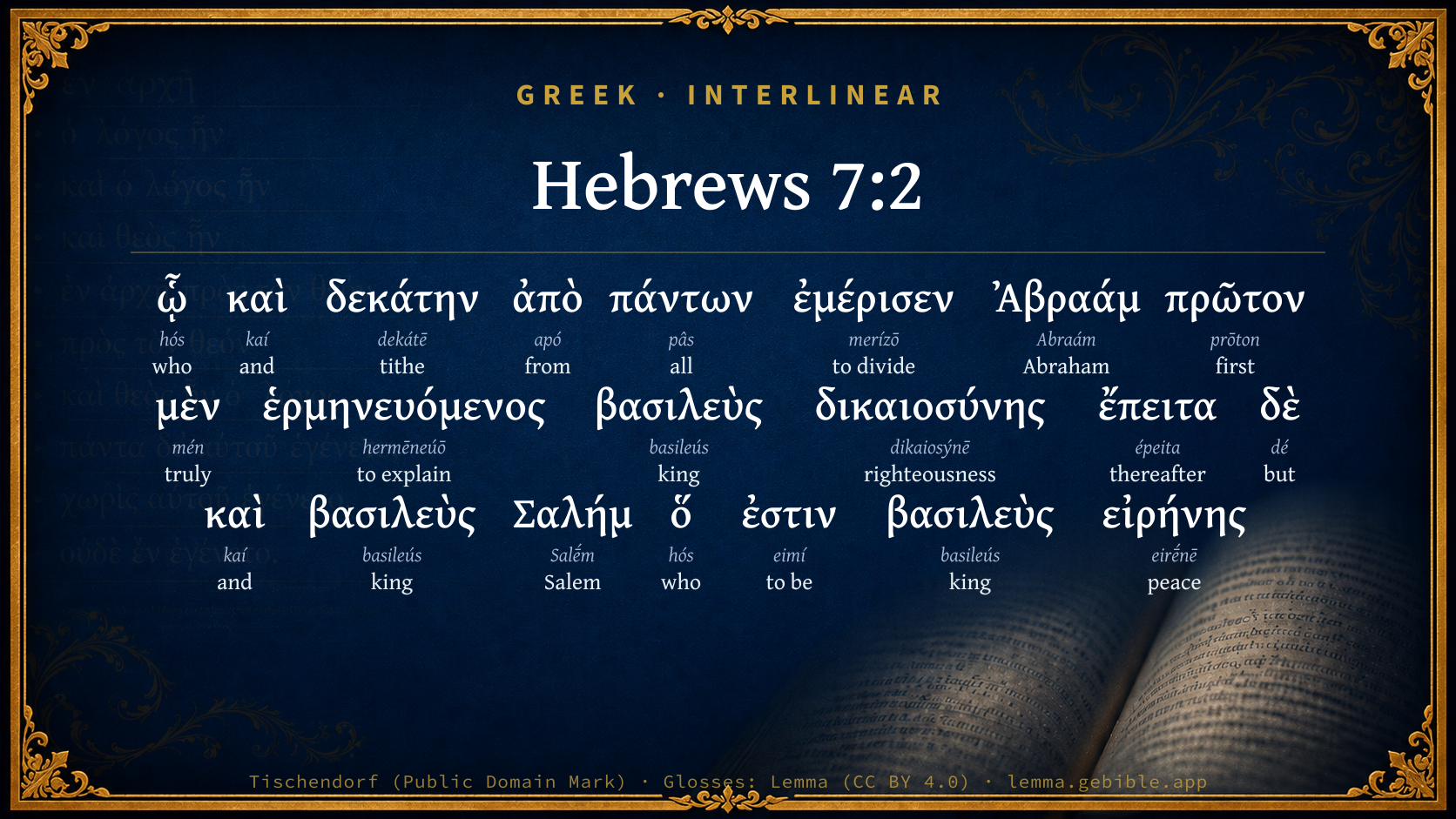
Greek (Tischendorf 8th ed.) Hebrews 7:2 appears in the Greek New Testament. The text above is from the Tischendorf 8th edition. Each word links to its Strong’s number and a concise gloss. Click any word for its full Thayer’s Greek Lexicon entry.
Download image
Cite this verse

Hebrews 7:2 (World English Bible). Public Domain. Lemma interlinear Bible study tool, https://lemma.gebible.app/v/hebrews/7/2.

Show BibTeX & RIS
BibTeX
RIS
English Translation
to whom also Abraham divided a tenth part of all (being first, by interpretation, king of righteousness, and then also king of Salem, which is king of peace;
World English Bible · Public Domain
Highlights
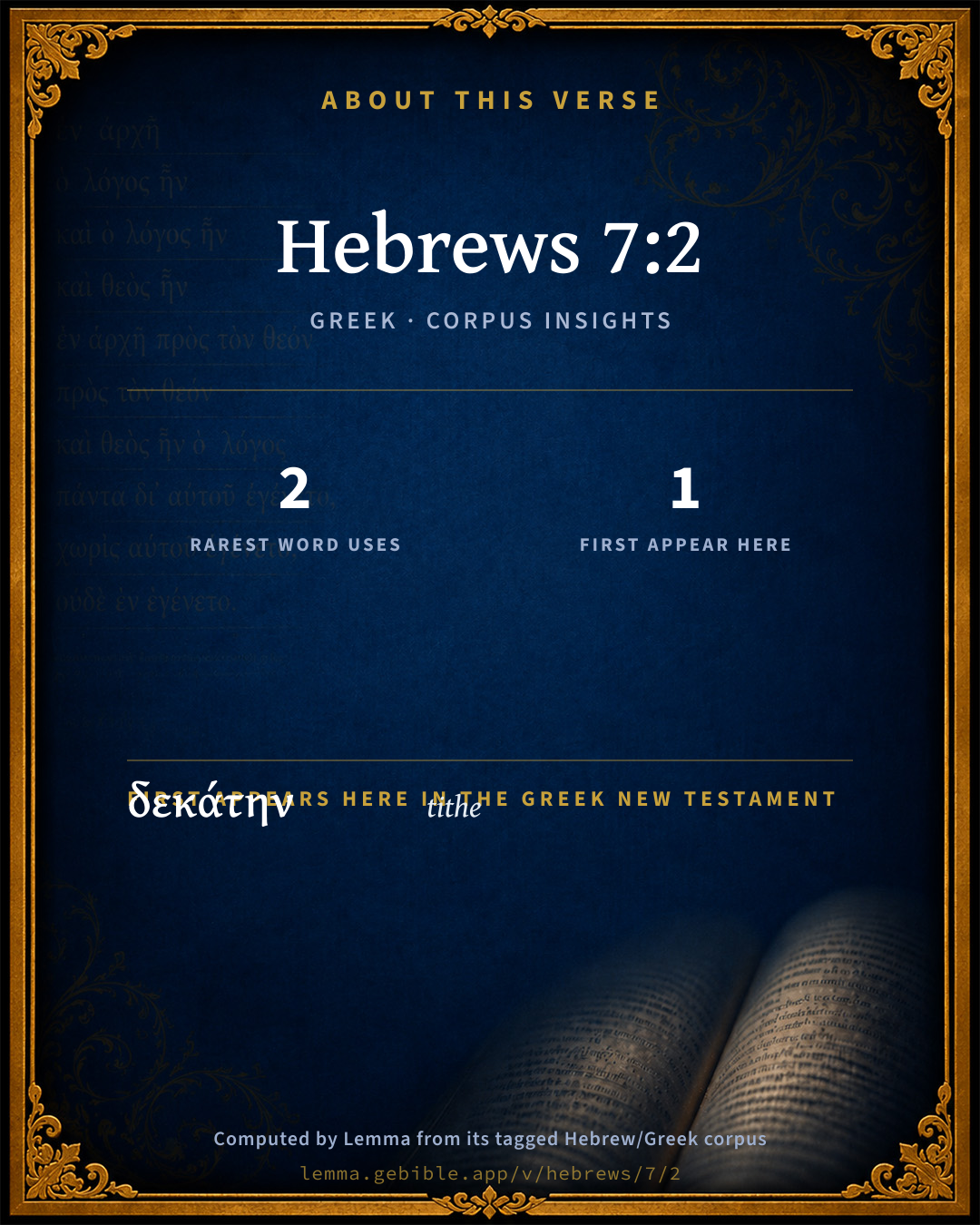
  • 1 first appearance in the Greek New Testament
Full analysis ↓
Download a study sheet

One document with this verse’s original text, its word-by-word gloss line, the meaning frame, cross-references with their text, attributed commentary, and full source and license credits — printable, and it pastes into notes with its structure intact.

This verse Autodidact and up

Study sheet (.html) Plain text (.txt)

A passage Seminary Student

Up to 50 verses in one chapter. A passage sheet keeps up to 6 commentary sources and 12 cross-references per verse, in the order this page ranks them, and says so on the sheet whenever that leaves anything out. Ask for a single verse and you get the Autodidact verse sheet above.

Everything on this page stays free to read, with no account — the sheet is a download of what is already on screen, not access to it.

Want to remove ads? Support Godless Engineer
Compare translations 3

The same verse in 3 English versions, stacked beneath the original-language interlinear above. Click any original word for its lexicon entry.

Each is an independent rendering of the whole verse — the interlinear is not word-aligned to these translations.

Highlighted words mark where these versions differ — a whole-verse word diff, not a word-by-word alignment.

  • World English Bible Public Domain
    to whom also Abraham divided a tenth part of all (being first, by interpretation, king of righteousness, and then also king of Salem, which is king of peace;
  • King James Version Public Domain
    To whom also Abraham gave a tenth part of all; first being by interpretation King of righteousness, and after that also King of Salem, which is, King of peace;
  • unfoldingWord Literal Text CC BY-SA 4.0
    to whom also Abraham apportioned a tenth from all things, first indeed translated as “king of righteousness,” and then also “king of Salem,” that is, “king of peace,”

unfoldingWord Literal Text — © unfoldingWord, licensed CC BY-SA 4.0. Word-aligned USFM3 via Door43 (git.door43.org/unfoldingWord/en_ult).

Versions to compare (up to 4)

3 of 4 selected

Show all 19 translations

Every available English version of this verse, each an independent rendering of the whole verse.

  • World English Bible Public Domain
    to whom also Abraham divided a tenth part of all (being first, by interpretation, king of righteousness, and then also king of Salem, which is king of peace;
  • Berean Standard Bible Public Domain
    and Abraham apportioned to him a tenth of everything. First, his name means “king of righteousness.” Then also, “king of Salem” means “king of peace.”
  • Majority Standard Bible Public Domain
    and Abraham apportioned to him a tenth of everything. First, his name means “king of righteousness.” Then also, “king of Salem” means “king of peace.”
  • King James Version Public Domain
    To whom also Abraham gave a tenth part of all; first being by interpretation King of righteousness, and after that also King of Salem, which is, King of peace;
  • American Standard Version (1901) Public Domain
    to whom also Abraham divided a tenth part of all (being first, by interpretation, King of righteousness, and then also King of Salem, which is King of peace;
  • Revised Version (1885) Public Domain
    to whom also Abraham divided a tenth part of all (being first, by interpretation, King of righteousness, and then also King of Salem, which is, King of peace;
  • Geneva Bible (1599) Public Domain
    To whom also Abraham gaue the tithe of all things: who first is by interpretation King of righteousnes: after that, he is also King of Salem, that is, King of peace,
  • Douay-Rheims (1899) Public Domain
    To whom also Abraham divided the tithes of all: who first indeed by interpretation, is king of justice: and then also king of Salem, that is, king of peace:
  • Young's Literal Translation Public Domain
    to whom also a tenth of all did Abraham divide, (first, indeed, being interpreted, `King of righteousness,' and then also, King of Salem, which is, King of Peace,)
  • Literal Standard Version CC BY-SA 4.0
    to whom also Abraham divided a tenth of all (first, indeed, being interpreted, “King of righteousness,” and then also, “King of Salem,” which is, King of Peace),
  • Unlocked Literal Bible CC BY-SA 4.0
    It was to him that Abraham gave a tenth of everything. His name “Melchizedek” means “king of righteousness.” His other title is “king of Salem,” that is, “king of peace.”
  • unfoldingWord Literal Text CC BY-SA 4.0
    to whom also Abraham apportioned a tenth from all things, first indeed translated as “king of righteousness,” and then also “king of Salem,” that is, “king of peace,”
  • Darby Bible Public Domain
    to whom Abraham gave also the tenth portion of all; first being interpreted King of righteousness, and then also King of Salem, which is King of peace;
  • World Messianic Bible Public Domain
    to whom also Abraham divided a tenth part of all (being first, by interpretation, “king of righteousness”, and then also “king of Salem”, which means “king of peace”,
  • Webster's Bible Public Domain
    To whom also Abraham gave a tenth part of all; first being by interpretation King of righteousness, and after that also King of Salem, which is, King of peace;
  • Free Bible Version CC BY-SA 4.0
    Abraham gave him a tithe of all that he had won. Melchizedek's name means “king of right” while king of Salem means “king of peace.”
  • Bible in Basic English Public Domain
    And to whom Abraham gave a tenth part of everything which he had, being first named King of righteousness, and then in addition, King of Salem, that is to say, King of peace;
  • Text-Critical English NT CC BY 4.0
    and Abraham gave him a tenth of all the spoils. His name means “king of righteousness,” but he is also “king of Salem,” which means, “king of peace.”
  • Tyndale New Testament (1534) Public Domain
    to whom also Abraham gave tythes of all thynges) fyrst is by interpretacion kynge of rightewesnes: after that he is kynge of Sale that is to saye kynge of peace

Literal Standard Version (2020), Covenant Press — licensed CC BY-SA 4.0. Text via the HelloAO Bible API (eBible.org). Unlocked Literal Bible (unfoldingWord) — licensed CC BY-SA 4.0. Text via the HelloAO Bible API (eBible.org). unfoldingWord Literal Text — © unfoldingWord, licensed CC BY-SA 4.0. Word-aligned USFM3 via Door43 (git.door43.org/unfoldingWord/en_ult). Free Bible Version, Dr. Jonathan Gallagher — licensed CC BY-SA 4.0. Text via the HelloAO Bible API (eBible.org).

Word by word

More ways to search: Search by grammar → Find every occurrence → Compare this word →

Practice this passage: Drill this verse → Learn its vocabulary →

Σαλήμ
Salḗm
G4532
“Salem”
Noun, Proper, indeclinable
Part of Speech
Noun · Proper, indeclinable
Full Thayer's Definition

Origin: of hebrew origin H8004

TDNT: None

Salem = "peace" 1. the place where Melchizedek was king and thought to be the ancient name of Jerusalem
  1. ᾧ hós G3739 “who” Relative pronoun, Dative, Singular, Masculine
  2. καὶ kaí G2532 “and” Conjunction
  3. δεκάτην dekátē G1181 “tithe” Adjective, Accusative, Singular, Feminine
  4. ἀπὸ apó G575 “from” Preposition
  5. πάντων pâs G3956 “all” Adjective, Genitive, Plural, Neuter
  6. ἐμέρισεν merízō G3307 “to divide” Verb, Aorist, Active, Indicative, 3rd person, Singular
  7. Ἀβραάμ Abraám G11 “Abraham” Noun, Proper, indeclinable
  8. πρῶτον prōton G4412 “first” Adverb, Superlative
  9. μὲν mén G3303 “truly” Particle
  10. ἑρμηνευόμενος hermēneúō G2059 “to explain” Verb, Present, Passive, Participle, Nominative, Singular, Masculine
  11. βασιλεὺς basileús G935 “king” Noun, Nominative, Singular, Masculine
  12. δικαιοσύνης dikaiosýnē G1343 “righteousness” Noun, Genitive, Singular, Feminine
  13. ἔπειτα épeita G1899 “thereafter” Adverb
  14. δὲ dé G1161 “but” Conjunction
  15. καὶ kaí G2532 “and” Conjunction
  16. βασιλεὺς basileús G935 “king” Noun, Nominative, Singular, Masculine
  17. ὅ hós G3739 “who” Relative pronoun, Nominative, Singular, Neuter
  18. ἐστιν eimí G1510 “to be” Verb, Present, Active, Indicative, 3rd person, Singular
  19. βασιλεὺς basileús G935 “king” Noun, Nominative, Singular, Masculine
  20. εἰρήνης eirḗnē G1515 “peace” Noun, Genitive, Singular, Feminine

About this verse

These counts appear in no published source. They are computed here, from the morphology-tagged text and Lemma’s own curated glosses. What Lemma adds →

21
words
17
distinct lemmas
General Epistles
section

Notable vocabulary

The rarest word here is Σαλήμ Salem G4532 — appearing just 2 times in the whole Greek New Testament.

First appearance in Scripture

This word makes its first canonical appearance in the Greek New Testament here:

  • δεκάτην tithe G1181

Shared distinctive vocabulary

Σαλήμ Salem G4532 occurs in 2 verses of the Greek New Testament. Also found in:
Repetition

Words recur within this verse:

  • βασιλεὺς king G935 ×3
  • ᾧ who G3739 ×2
  • καὶ and G2532 ×2

Cross-references

23

Topical passages linked to Hebrews 7:2 in the Treasury of Scripture Knowledge — connected by theme and wording, ordered by reader-vote popularity; previews shown in the World English Bible.

  • Numbers 18:21 To the children of Levi, behold, I have given all the tithe in Israel for an inheritance, in return for their service which they serve, even the service of the tent of meeting.
  • Genesis 28:22 then this stone, which I have set up for a pillar, will be God's house. Of all that you will give me I will surely give the tenth to you."
  • 1 Samuel 8:15 He will take the tenth of your seed, and of your vineyards, and give to his officers, and to his servants.
  • 1 Samuel 8:17 He will take the tenth of your flocks: and you shall be his servants.
  • 2 Samuel 8:15 David reigned over all Israel; and David executed justice and righteousness to all his people.
  • 2 Samuel 23:3 The God of Israel said, The Rock of Israel spoke to me: One who rules over men righteously, Who rules in the fear of God,
  • 1 Chronicles 22:9 Behold, a son shall be born to you, who shall be a man of rest; and I will give him rest from all his enemies round about; for his name shall be Solomon, and I will give peace and quietness to Israel in his days:
  • Psalms 45:4–7 In your majesty ride on victoriously on behalf of truth, humility, and righteousness. Let your right hand display awesome deeds.
  • Psalms 85:10–11 Mercy and truth meet together. Righteousness and peace have kissed each other.
  • Leviticus 27:32 All the tithe of the herds or the flocks, whatever passes under the rod, the tenth shall be holy to Yahweh.
  • 1 Kings 4:24–25 For he had dominion over all [the region] on this side the River, from Tiphsah even to Gaza, over all the kings on this side the River: and he had peace on all sides round about him.
  • Psalms 72:1–3 God, give the king your justice; Your righteousness to the royal son.
  • Psalms 72:7 In his days, the righteous shall flourish, And abundance of peace, until the moon is no more.
  • Isaiah 9:6–7 For to us a child is born, to us a son is given; and the government shall be on his shoulder: and his name shall be called Wonderful, Counselor, Mighty God, Everlasting Father, Prince of Peace.
  • Isaiah 32:1–2 Behold, a king shall reign in righteousness, and princes shall rule in justice.
  • Isaiah 45:22–25 Look to me, and be you saved, all the ends of the earth; for I am God, and there is none else.
  • Jeremiah 23:5–6 Behold, the days come, says Yahweh, that I will raise to David a righteous Branch, and he shall reign as king and deal wisely, and shall execute justice and righteousness in the land.
  • Jeremiah 33:15–16 In those days, and at that time, will I cause a Branch of righteousness to grow up to David; and he shall execute justice and righteousness in the land.
  • Micah 5:5 He will be our peace when Assyria invades our land, And when he marches through our fortresses, Then we will raise against him seven shepherds, And eight leaders of men.
  • Romans 3:26 to demonstrate his righteousness at this present time; that he might himself be just, and the justifier of him who has faith in Jesus.
  • Romans 5:1–2 Being therefore justified by faith, we have peace with God through our Lord Jesus Christ;
  • Ephesians 2:14–18 For he is our peace, who made both one, and broke down the middle wall of partition,
  • Luke 2:14 "Glory to God in the highest, On earth peace, good will toward men."

Cross-references courtesy of OpenBible.info (CC BY 4.0).

Commentary

Notes on Hebrews 7:2 from classic Christian and Jewish commentators (each source and its license shown beneath its notes). The classic Christian expositions comment on the surrounding passage and are grouped to its opening verse, so a note may address several verses; the Jewish commentaries on the Tanakh (Rashi and others) are per-verse, so they appear only where the commentator wrote on this verse.

Lemma curates 59 commentaries, every one of them public domain or Creative Commons licensed, each selected and text-cleaned for this edition rather than reprinted as found. About our sources →

Joseph Benson's Commentary

Heb 7:2-3. To whom also Abraham gave a tenth of all — Namely, of all the spoils of the vanquished kings, (Heb 7:4,) but not a tenth also of the goods that had been taken from the king of Sodom and from Lot; for of these Abraham took nothing to himself. By paying tithes to Melchisedec, Abraham acknowledged him to be a priest of the true God. It seems, indeed, his being supernaturally appointed a priest by God, was known through all that country. Being first — According to the meaning of his own name; king of righteousness; and after that also — According to the name of his city; king of peace — So that in him, as in Christ, righteousness and peace were joined. And so they are in all that believe in him. “In ancient times, it was usual to give names to persons and places expressive of their qualities, or in commemoration of some remarkable events. Thus Abram’s name was changed into Abraham, to signify that he was made the father of many nations; and Sarai was named Sarah, because she was made the mother of nations; and Jacob obtained the name of Israel, because he had power with God. Viewed in the light of this ancient practice, the apostle’s argument, from these names, is conclusive, to show what an excellent person Melchisedec was, and how fit to be made a type of the Son of God. Without father, without mother — Without any mention of his parents; without descent — Or rather, without genealogy, or pedigree, recorded; for so the word here used, αγενεαλογητος, signifies; not a person who hath no descent or genealogy, but one whose descent and pedigree is nowhere entered on record. This was the case with Melchisedec. He was assuredly born, and did no less certainly die than other men; but neither his birth nor his death are recorded. Or the apostle’s principal meaning may be, that there is no account of his being descended from any ancestors of the priestly order, and that therefore he did not derive his priesthood from his parents, but was a priest of the most high God by a particular appointment. Having neither beginning of days nor end of life — Mentioned by Moses. But whence was it that Moses should introduce so great and excellent a person as Melchisedec, without making any mention of his race or stock, of his parents or progenitors, of his rise or fall, contrary to his own custom in other cases, and contrary to all rules of useful history? The true cause of the omission of all these things was the same with that of the institution of his priesthood, and the introduction of his person in the story. And this was that he might be a more express and signal representative of the Lord Christ in his priesthood. But in all these respects, made like the Son of God — Who was really without father as to his human nature, without mother as to his divine; and in this also, without pedigree; and not descending, even in human nature, from any ancestors of the priestly order; abideth a priest continually — That is, no mention is made of the end of the priesthood of his order, nor of the termination of his own personal administration of his office by death; and so he stands in the story as a kind of immortal priest, without any successor being mentioned. And this is that which the apostle chiefly designed to confirm from hence, namely, that there was in the Scripture, before the institution of the Aaronical priesthood, a representation of an eternal, unchangeable one, namely, that of Christ, who, as he was without beginning of days, alone does really remain without death and without successor.

Joseph Benson's Commentary on the Old and New Testaments (1811–1818) — public domain. Text from a community e-Sword module.

MacLaren's Expositions of Holy Scripture

Alexander MacLaren

Hebrews

RIGHTEOUSNESS FIRST, PEACE SECOND

Heb 7:2.

THAT mysterious, shadowy figure of the priest-king Melchizedec has been singularly illuminated and solidi-fled by recent discovery. You can see now in Berlin and London, letters written fourteen centuries before Christ, by a king of Jerusalem who describes himself almost in the very words which the Old and the New Testaments apply to Melchizedec. He says that he is a royal priest or a priestly king. He says that he derived his royalty neither from father nor mother, nor by genealogical descent; and he says that he owes it to ‘the great King’ - possibly an equivalent to the ‘Most High God’; of whom Melchizedec is in Scripture said to have been a worshipper. The name of the letter-writer is not Melehizedec, but the fact that his royalty was not hereditary, like a Pharaoh’s, may explain how each monarch bore his own personal appellation, and not one common to successive members of a dynasty.

And are not the names of King and city significant - ‘King of righteousness... King of peace’? It sounds like a yearning, springing up untimely in those dim ages of oppression and strife, for a royalty founded on something better than the sword, and wielded for something higher than personal ambition. Such an ideal at such a date is like a summer day that has wandered into a cold March.

But the writer of the Epistle to the Hebrews imposes a meaning not only on the titles, but on their sequence, of course therein he is letting a sanctified imagination play round a fact, and giving to it a meaning which is not in it. None the less in that emphatic expression ‘first King of righteousness, and after that also King of peace,’ he penetrated very deeply into the heart of Christ’s reign and work, and echoed a sentiment that runs all through Scripture. Hearken to one psalmist: ‘The mountains shall bring peace to the people, and the little hills, by righteousness.’ Hearken to another: ‘Righteousness and peace have kissed each other.’ Hearken to a prophet: ‘The work of righteousness shall be peace; and the effect of righteousness, quietness and assurance for ever.’ Hearken to the most Hebraistic of New Testament writers: ‘The fruit of righteousness is sown in peace.’ Hearken to the central teaching of the most Evangelical, if I may so say, of New Testament writers: ‘Being justified’ - made righteous ‘by faith, we have peace with God.’ So the ‘first’ and the ‘after that’ reveal to us the very depth of Christ’s work, and carry in them not only important teaching as to that, but equally important directions and guides for Christian conduct; and it is to this aspect of my text, and this only, that I ask your attention now.

The order which we have here, ‘first of all King of righteousness, and after that King of peace,’ is the order which I shall try to illustrate in two ways. First, in reference to Christ’s work on the individual soul; second, in reference to Christ’s work on society and communities.

First, then, here we have laid down the sequence in which

I. Christ comes with His operations and His gifts to the soul that clings to Him.

First ‘righteousness... after... peace.’ Now I need not do more than in a sentence remind you of the basis upon which the thoughts in the text, and all right understanding of Christ’s work on an individual, repose, and that is that without righteousness no man can either be at peace with God or with himself. Not with God - for however shallow experience may talk effusively and gushingly about a God who is all mercy, and who loves and takes to His heart the sinner and the saint alike; such a God drapes the universe in darkness, and if there are no moral distinctions which determine whether a man is in amity or hostility with God, then ‘the pillared firmament itself is rottenness, and earth’s base built on stubble.’ No, no, brethren; it sounds very tender and kindly; at bottom it is the cruellest thing that you can say, to say that without righteousness a man can please God. The sun is in the heavens, and whether there be mist and fog down here, or the bluest of summer skies, the sun is above. But its rays coming through the ethereal blue are warmth and blessedness, and its rays cut off by mists are dim, and itself turned into a lurid ball of fire. It cannot be - and thank God that it cannot - that it is all the same to Him whether a man is saint

or sinner.

I do not need to remind you that in like manner righteousness must underlie peace with oneself. For it is true to-day, as it was long generations ago, according to the prophet, that ‘the wicked is like the troubled sea which cannot rest, whose waters throw up mire and dirt,’ and, on the other hand, the promise is true still and for ever; ‘O that thou hadst hearkened unto me, then had thy peace been like a river,’ because ‘thy righteousness’ will be ‘like the waves of the sea.’ For ever and ever it stands true that for peace with God, and for a quiet heart, and a nature at harmony with itself, there must be righteousness.

Well, then, Jesus Christ comes to bring to a man the righteousness without which there can he no peace in his life. And that is the meaning of the great word which, having been taken for a shibboleth and ‘test of a falling or a standing Church,’ has been far too much ossified into a mere theological dogma, and has been weakened and misunderstood in the process. Justification by faith; that is the battle-cry of Protestant communities. And what does it mean? That I shall be treated as righteous, not being sop That I shall be forgiven and acquitted? Yes, thank God! But is that all that it means, or is that the main thing that it means? No, thank God! for the very heart of the Christian doctrine of righteousness is this, that if, and as soon as, a man puts his trembling trust in Jesus Christ as his Saviour, then he receives not merely pardon, which is the uninterrupted flow of the divine love in spite of his sin, nor an accrediting him with a righteousness which does not belong to him, but an imparting to him of that new life, a spark from the central fire of Christ’s life, ‘the new man which, after God, is created in righteousness and true holiness.’ Do not suppose that the great message of the gospel is merely forgiveness. Do not suppose that its blessed gift is only that a man is acquitted because Christ has died. All that is true. But there is something more than that which is the basis of that other, and that is that by faith in Jesus Christ, I am so knit to Him - ‘He that is joined to the Lord’ being ‘one spirit’ - as that there passes into me, by His gift, a life which is created after His life, and is in fact cognate and kindred with it.

No doubt it is a mere germ, no doubt it needs cultivating, development, carefully guarding against gnawing insects and blighting frosts. But the seed which is implanted, though it be less than the least of all seeds, has in itself the promise and the potency of triumphant growth, when it will tower above all the poisonous shrubs and undergrowth of the forest, and have the light of heaven resting on its aspiring top. Here is the great blessing and distinctive characteristic of Christian morality, that it does not say to a man: ‘First aim after good deeds and so grow up into goodness,’ but it starts with a gift, and says,’ Work from that, and by the power of that. "I make the tree good,"‘ says Jesus to us, ‘do you see to it that the fruit is good.’ No doubt the vegetable metaphor is inadequate, because the leaf is wooed from out the bud, and ‘grows green and broad, and takes no care,’ but that effortless growth is not how righteousness increases in men. The germ is given them, and they have to cultivate it. First, there must be the impartation of righteousness, and then there comes to the man’s heart the sweet assurance of peace with God, and he has within him ‘a conscience like a sea at rest, imaginations calm and fair.’ ‘First, King of righteousness; after that, King of peace.’

Now if we keep firm hold of this sequence, a great many of the popular objections to the gospel, as if it were merely a means of forgiveness and escape, and a system of reconciliation by some kind of forensic expedient, fall away of themselves, and a great many of the popular blunders that Christian people make fall away too. For there are good folks to whom the great truth that ‘God is in Christ reconciling the world to Himself, not imputing to them their trespasses,’ and welcoming them to all the fulness of an overflowing love, has obscured the other truth that there is no peace for a Christian man continuous through his life, unless equally continuous through his life are his efforts to work out in acts the new nature which he has received.

Thus my text, by the order in which it places righteousness and peace, not only illuminates the work of Christ upon each individual soul, but comes with a very weighty and clear direction to Christian people as to their course of conduct. Are you looking for comfort? Is what you want to get out of your religion mainly the assurance that you will not go to hell? Is the great blessing that Christ brings to you only the blessing of pardon, which you degrade to mean immunity from punishment? You are wrong. ‘First of all, King of righteousness’ - let that which is first of all in His gifts be first of all in your efforts too; and do not seek so much for comfort as for grace to know and to do your duty, and strength to ‘cast off the unfruitful works of darkness,’ and to ‘put on the armour of light.’ The order which is laid down in my text was laid down with a different application, by our Lord Himself, and ought to be in both forms the motto for all Christian people.

‘Seek ye first the Kingdom of God and His righteousness, and all these things’ - comfort, sense of reconciliation, assurance of forgiveness, joyful hope, and the like, as well as needful material good - ‘shall be added unto you.’

And now, secondly, my text gives the order of.

II. Christ’s work in the world, and of His servant’s work after Him.

Of course, our Lord’s work in the world is simply the aggregate of HIS work on individual souls. But for the sake of clearness we may consider these two aspects of it somewhat apart. In regard to this second part of my subject, I would begin, as I began in the former section, by reminding you that the only basis on which harmonious relations between men in communities, great or small, can be built, is righteousness, in the narrowest sense of the word, meaning thereby justice, equal dealing as between man and man, without partiality or class favouritism. Wherever you get an unjustly treated section or order of men, there you get the beginnings of war and strife. A social order built upon injustice, just in the measure in which it is so built, is based upon a quicksand which will suck it down, or on a volcano which will blow it to pieces. Injustice is the grit in the machine; you may oil it as much as you like with philanthropy and benevolence, but until you get the grit out, it will not work smoothly.

There is no harmony amongst men unless their association is based and bottomed upon righteousness.

Jesus Christ comes into the world to bring peace at the far end, but righteousness at the near end, and therefore strife. The herald angels sang peace upon earth. They were looking to the deepest and ultimate issues of His mission, but when He contemplated its immediate results He had to say, ‘Suppose ye that I bring peace on earth? I tell you nay, but rather division.’ He rode into Jerusalem ‘the King, meek, and having salvation,’ throned upon the beast of burden which symbolised peace. But He will come forth in the last fight, as He has been coming forth through all the ages, mounted on the white horse, with the sword girt upon His thigh in behalf of meekness and righteousness and truth. Christ, and Christianity when it keeps close to Christ, is a ferment, not an emollient. The full and honest application of Christ’s teaching and principles to any society on the face of the earth at this day is bound to result in agitation and strife. There is no help for it. When a pure jet of water is discharged into a foul ditch, there will be much uprising of mud. Effervescence will always follow when Christ’s principles are applied to existing institutions. And so it comes to pass that Christian men, in the measure in which they are true to their Master, turn the world upside down. There will follow, of course, the tranquillity that does follow on righteousness; but that is far ahead, and there is many a weary mile to be trod, and many a sore struggle to be undertaken, before the kingdoms of this world become the Kingdom of our Lord and of His Christ, and strife ends for ever.

Now, if this be so, then in this necessary characteristic of Christ’s operation on the world, viz., disturbance arising from the endeavour to enthrone righteousness where its opposite has ruled ‘there results very plainly important teaching as to the duties of Christ’s servants to take their full share in the fight, to be the knights of the Holy Ghost, the champions of righteousness. The Church ought to lead in the van of all assaults on hoary wrongs or modern forms of unrighteousness in municipal, political, national life. And it is the disgrace of the Church that so largely it leaves that contest to be waged by men who make no pretence to be Christians. There is, unfortunately, a type of Christian thinking and life, of which in many respects one would speak with all sympathy and admiration, which warns the Christian Church against casting itself into this contest, in the alleged interest of a superior spirituality and a loftier conception of Evangelical truth. I believe, as heartily as any man can - and I venture to appeal to those who hear me Sunday by Sunday, and from year to year, whether it is not so - that the preaching of Jesus Christ is the cure for all the world’s miseries, and the banishment of all the world’s unrighteousness; but am I to be told that the endeavour to apply the person and the principles of Jesus Christ, in His life and death, to existing institutions and evils, is not preaching Christ? I believe that it is, and that the one thing that the Church wants to-day is not less of holding up the Cross and the Sacrifice, but more of pointing to the Cross and the Sacrifice as the cure of all the world’s evils, and the pattern for all righteousness.

It is difficult to do, it is made difficult by our own desire to be what the prophet did not think a very reputable position, ‘at ease in Zion.’ It is also made difficult by the way in which, as is most natural, the world, meaning thereby godless, organised society, regards an active Church that desires to bring its practices to the test of Christ’s word- Muzzled watchdogs that can neither bark nor bite are much admired by burglars. And a Church that confines itself to theory, to what it calls religion, and leaves the world to go to the devil as it likes, suits both the world and the devil. There was once a Prime Minister of England who came out of church one Sunday morning in a state of towering indignation because the clergyman had spoken about conduct. And that is exactly how the world feels about an intrusive Church that will push its finger into all social arrangements, and say about each of them, ‘This must be as Christ commanded.’

Brethren! would God that all Christian men deserved the name of ‘troublers of Israel.’ There was once a prophet to whom the men of his day indignantly said, ‘O sword of the Lord, how long will it be ere thou be quiet? Put up thyself in thy scabbard, rest and be still.’ And the answer was the only possible one, ‘How can it be quiet, seeing that the Lord hath appointed it?’ If you and I are Christ’s servants, we shall follow the sequence of His operations, and seek to establish righteousness first and then peace. The true Salem is above.

‘My soul, there is a country

Afar beyond the stars.’

There ‘sweet peace sits crowned with smiles.’ The swords will then be wreathed with laurel and men ‘shall learn war no more,’ for the King has fought the great fight, ‘and of the increase of His government and peace there shall be no end... in righteousness and justice, from henceforth even for ever.’ Let us take Him for ‘the Lord our righteousness,’ and we shall blessedly find that ‘this Man is our peace.’ Let us take arms in the Holy War which He wages, and we shall have peace in our hearts whilst the fight is sorest. Let us labour to ‘be found in Him... having the righteousness which is of God by faith,’ and then we shall ‘be found in Him in peace, without spot, blameless.’

Alexander MacLaren, Expositions of Holy Scripture (1904–1910) — public domain. Text from a community e-Sword module.

Tyndale Open Study Notes

Tyndale Open Resources

7:2 Abraham was giving a tenth to the Lord by giving it to Melchizedek, his priest. This act anticipates the giving of tithes under the law (Lev 27:30, 32) and becomes a key point in the author’s argument (Heb 7:4). • Melchi- (Hebrew melek) means king. • -zedek (Hebrew tsedeq) means justice or righteousness. • Salem (Hebrew shalom) means peace. It was common for rabbis to bring out the theological significance of a biblical figure’s name by making associations between the name and other Hebrew terms.

Tyndale Open Study Notes — © Tyndale Open Resources, licensed CC BY-SA 4.0. Text via the HelloAO Bible API.

Bengel's Gnomon

Johann Albrecht Bengel

Heb 7:2. Δεκάτην ἀπὸ πάντων—4. ἔδωκεν) LXX. ἔδωκεν αὐτῷ δεκάτην ἀπὸ πάντων.—πρῶτον, first) from his own name: ἔπερτα, then, from the name of the place. There are often mysteries even in the proper names of men and places.—δικαιοσύνης· εἰρήνης) So righteousness and peace are often mentioned together by Paul, Rom 5:1.—δὲ καὶ) viz. ὤν: for ὅ ἐστι corresponds to ἑρμηνευόμενος.

Bengel's Gnomon of the New Testament — English translation (T&T Clark, Edinburgh, 1860) — public domain. Text from a community e-Sword module.

Meyer's Critical & Exegetical Commentary

Heinrich August Wilhelm Meyer

Heb_7:2. To whom also Abraham portioned out the tenth of all (sc. that he had gained as booty; comp. ἐκ τῶν ἀκροθινίων, Heb_7:4).

πρῶτον μὲν ἑρμηνευόμενος βασιλεὺς δικαιοσύνης] he who first, interpreted (i.e. if one translates his Hebrew name מַלְכִּי־צֶדֶק into Greek), is King of Righteousness. Comp. Josephus, Antiq. i. 10. 2 : Μελχισεδέκης, σημαίνει δὲ τοῦτο βασιλεὺς δίκαιος.

Bell. Jud. vi. 10 : ὁ δὲ πρῶτος κτίσας (Ἱεροσόλυμα) ἦν Χαναναίων δυνάστης, ὁ τῇ πατρίῳ γλώσσῃ κληθεὶς βασιλεὺς δίκαιος· ἦν γὰρ δὴ τοιοῦτος. The author of the epistle, however, following more closely the sense of the Hebrew words, renders the name by βασιλεὺς δικαιοσύνης (instead of rendering it βασιλεὺς δίκαιος, as Josephus does), and thereby brings out more clearly the part sustained by Melchisedec as a type of Christ, inasmuch as the latter is not only Himself righteous (comp. Zec_9:9; Jer_23:5), but also the mediatorial author of righteousness for others. Comp. 1Co_1:30; Jer_23:6; Mal_4:2; Dan_9:24.

ἔπειτα δὲ καὶ βασιλεὺς Σαλήμ, ὅ ἐστιν βασιλεὺς εἰρήνης] and then also king of Salem, which is (denotes) king of peace. Comp. with regard to Christ as our peace and peace-bringer, Eph_2:14-15; Eph_2:17; Rom_5:1; also Isa_9:6-7.

ὅ ἐστιν] corresponds to the ἑρμηνευόμενος of the previous clause.

There is no reason for taking Salem, with Böhme and Bleek, after the precedent given by Petrus Cunaeus, de Rep. Hebraeorum, Heb_3:3, as not being the name of a place at all, but βασιλεὺς Σαλήμ together as forming the further name of the man, since the author of the epistle might discover a typical reference to Christ not only in the personal name of Melchisedec, but also in the name of the state over which he ruled as king and prophet. The author, for the rest, interprets the name of the place as though not שָׁלֵם (peaceful) but שָׁלו̇ם (peace) had been written in the Hebrew,a mode of rendering in which Philo had already preceded him. Comp. Legg. allegor. iii. 25, p. 75 (with Mangey, I. p. 102 f.): καὶ Μελχισεδὲκ βασιλέα τε τῆς εἰρήνης

Σαλὴμ τοῦτο γὰρ ἑρμηνεύεται

ἱερέα ἑαυτοῦ πεποίηκεν ὁ θεός.

Meyer — Critical and Exegetical Commentary on the New Testament — English translation by Peter Christie, edited by Frederick Crombie (T&T Clark, 1880) — public domain. Text from a community e-Sword module.

Expositor's Greek Testament

ed. W. Robertson Nicoll

Heb 7:2 . ᾧ καὶ δεκάτην … “to whom also Abraham divided a tenth of all” [the spoil]. The startling conclusion which this act carried with it is specified in Heb 7:4-10 . The offering of a tithe of the spoils to the gods was a custom of antiquity. See Wetstein for examples and especially Arnold’s note on Thucydides, 3:50. “Frequently the ἀναθήματα were of the nature of ἀπάρχαι , or the divine share of what was won in peace or war.… The colossal statue of Athena Promachos on the Athenian Acropolis hill was a votive offering from a tithe of the booty taken at Marathon” (Gardner and Jevon’s Greek Ant. , 181.) For the O.T. law of tithe see Num 18:21-24 ; Lev 27:30-32 . In offering to Melchizedek a tithe Abraham acknowledged him as priest.

The following clauses ought not to be in brackets, because they are inserted as indicating the ground of the main affirmation, μένει εἰς τὸ διηνεκές . The name and description of Melchizedek already given are now interpreted, and are so interpreted as to illustrate the clause ἀφωμοιωμένος τῷ υἱῷ τοῦ Θεοῦ and thus prepare for the closing statement. πρῶτον μὲν ἑρμηνευόμενος … “being first, by interpretation, King of righteousness and then also King of Salem, which is King of peace”. The form of the sentence is significant. [ Cf. Plutarch, Timoleon , iv. 4, τοῦ δὲ Τιμοφάνους πρῶτον μὲν αὐτῶν καταγελῶντος , ἔπειτα δὲ πρὸς ὀργὴν ἐκφερομένου ] “first” by his very name, “then” by his actual position; probably the peace of his kingdom is considered as a consequence of its righteousness. Righteousness and peace are characteristic properties of the Messianic Kingdom. “In his days shall the righteous flourish; and abundance of peace so long as the moon endureth,” Psa 72:7 ; similarly Isa 9:6-7 ; Zec 9:9 ; cf. Rom 5:1 ; Eph 2:4 ; Eph 2:15 ; Eph 2:17 . In Gen 14:18 the name and title occur together מַלְכִּי־צֶדֶק מֶלֶךְ שָׁלֵם . The chief point in this is that the priest is also a king. ἀπάτωρ , ἀμήτωρ , ἀγενεαλόγητος “without father, without mother, without genealogy,” that is, he stands in Scripture alone, no mention is made of an illustrious father or mother from whom he could have inherited power and dignity, still less can his priestly office and service be ascribed to his belonging to a priestly family. It is by virtue of his own personality he is what he is; his office derives no sanction from priestly lineage or hereditary rights; and in this respect he is made like to the Son of God. Of course it is not meant that in point of fact he had neither father nor mother, but that as he appears in Scripture he is without father. [ τὸ δὲ ἀπάτωρ κ . τ . λ . οὐ διὰ τὸ μὴ ἔχειν αὐτὸν πατέρα ἢ μητέρα , ἀλλὰ διὰ τὸ μὴ ἐν τῇ θείᾳ γραφῇ κατὰ τὸ φανερώτατον ἐπωνομάσθαι . Epiphanius in Wetstein.] On Philo’s use of the silence of Scrip see Siegfried’s Philo. , p. 179. Philo is quite aware that this kind of interpretation will be said γλισχρολογίαν μᾶλλον ἢ ὠφέλειάν τινα ἐμφαίνειν ( De Somn. , ii. 45). ἀπάτωρ , Wetstein quotes from Pollux.: ὁ μὴ ἔχων μητέρα , ἀμήτωρ , ὥσπερ ἡ Ἀθηνᾶ · καὶ ἀπάτωρ , ὁ μὴ πατέρα ἔχων , ὡς ὁ Ἥφαιστος . So Appollo was αὐτοφυὴς , ἀμήτωρ . Other examples in Wetstein. In a slightly different sense the word occurs in Iph, in Taur. , 863; in Soph, Elec. , 1154 we have μήτηρ ἀμήτωρ ; and Ion (Eur. Ion , 109) says of himself ὡς γὰρ ἀμήτωρ ἀπάτωρ τε γεγώς .

The Expositor's Greek Testament, edited by W. Robertson Nicoll (1897–1910) — public domain. Text from a community e-Sword module.

Jamieson, Fausset & Brown

Robert Jamieson, A. R. Fausset & David Brown

gave--Greek, "apportioned"; assigned as his portion.

tenth . . . of all--namely, the booty taken. The tithes given are closely associated with the priesthood: the mediating priest received them as a pledge of the giver's whole property being God's; and as he conveyed God's gifts to man (Heb 7:1, "blessed him"), so also man's gifts to God. Melchisedec is a sample of how God preserves, amidst general apostasy, an elect remnant. The meeting of Melchisedec and Abraham is the connecting link between to two dispensations, the patriarchal, represented by Melchisedec, who seems to have been specially consecrated by God as a KING-PRIEST, the highest form of that primitive system in which each father of a household was priest in it, and the Levitical, represented by Abraham, in which the priesthood was to be limited to one family of one tribe and one nation. The Levitical was parenthetical, and severed the kingdom and priesthood; the patriarchal was the true forerunner of Christ's, which, like Melchisedec's, unites the kingship and priesthood, and is not derived from other man, or transmitted to other man; but derived from God, and is transmitted in God to a never-ending perpetuity. Melchisedec's priesthood continueth in Christ for ever. For other points of superiority, see Heb 7:16-21. Melchisedec must have had some special consecration above the other patriarchs, as Abraham, who also exercised the priesthood; else Abraham would not have paid tithe to him as to a superior. His peculiar function seems to have been, by God's special call, KING-priest whereas no other "patriarch-priest" was also a God-consecrated king.

first being--Paul begins the mystical explanation of the historical fact (allegorical explanations being familiar to JEWS), by mentioning the significancy of the name.

righteousness--not merely righteous: so Christ. Hebrew "Malchi" means king: "Tzedek," righteousness.

King of Salem--not only his own name, but that of the city which he ruled, had a typical significance, namely, peace. Christ is the true Prince of peace. The peace which He brings is the fruit of righteousness.

Jamieson, Fausset & Brown — Commentary Critical and Explanatory on the Whole Bible (1871) — public domain (CC PDM 1.0). Text via the HelloAO Bible API.

Adam Clarke's Commentary

Verse 2. Gave a tenth part of all] It was an ancient custom, among all the nations of the earth, to consecrate a part or tenth of the spoils taken in war to the objects of their worship. Many examples of this kind occur. This however was not according to any provision in law, but merely ad libitum, and as a eucharistic offering to those to whom they imagined they owed the victory. But neither Abraham's decimation, nor theirs, had any thing to do, either with tithes as prescribed under the Mosaic dispensation, or as claimed under the Christian.

Adam Clarke's Commentary on the Bible (1810–1826) — public domain. Text from a community e-Sword/MySword module.

Ellicott's Commentary for English Readers

(2) Gave a tenth part.—Literally, divided a tenth. This point is fully treated of in Heb_7:4-9.

King of righteousness.—Josephus notes the significance of this name: “The first founder of Jerusalem was a chief of the Canaanites, who in our tongue is called Righteous King; for indeed such he was.” Philo also interprets King of Salem as “King of Peace.” The special interest of these titles for the writer lies in the application to Jesus the Messiah. (See Heb_1:8-9; Isa_9:6-7; Isa_32:1; Jer_23:5-6; Zec_9:9; Eph_2:14.) On this, as obvious to every Christian reader, he does not further dwell.

A Bible Commentary for English Readers, edited by Charles John Ellicott (1878–1897) — public domain. Text from a community e-Sword module.

The Cambridge Bible for Schools and Colleges

gen. ed. J. J. S. Perowne

2. first being] This seems to imply that of his two names or titles “Melchisedec,” and “King of Salem,” the first means “King of Righteousness” and the second “King of Peace.” In a passage of mystic interpretation like this, however, the writer may intend to suggest that there is a direct connexion between the two titles, and that “Righteousness” is the necessary antecedent to “Peace,” as is intimated in Psa_72:7; Psa_85:10. Comp. Rom_5:1.

by interpretation King of righteousness] The name Melchisedek may mean “King of Righteousness.” This is the paraphrase of the Targums, perhaps with tacit reference to Isa_32:1, where it is said of the Messiah “Behold a king shall reign in righteousness.” (Comp. Zec_9:9; Jer_23:5.) In the Bereshith Rabba Tzedek is explained to mean Jerusalem with reference to Isa_1:21, “Righteousness lodged in it.” Josephus (Antt. i. 19 § 12; B. J. vi. 10) and Philo, however, render it “Righteous King.” Later on in Jewish history (Jos_10:3) we read of Adonizedek (“Lord of righteousness”) who was a king of Jerusalem. Apart from any deeper meaning “Righteousness” or “Justice” was one of the most necessary qualifications of Eastern Kings who are also Judges. In the mystic sense the interpretation of the names Melchizedek and Salem made him a fit type of “the Lord our Righteousness” (Jer_23:6) and “the Prince of Peace” (Isa_9:6): and he was also a fit type of Christ because he was a Kingly Priest; a Priest who blessed Abraham; a Priest who, so far as we are told, offered no animal-sacrifices; and a Priest over whom Scripture casts “the shadow of Eternity.” See Bishop Wordsworth’s note on this passage.

King of peace] “The work of Righteousness shall be Peace, and the effect of Righteousness quietness and assurance for ever” (Isa_32:17; Eph_2:14-15; Eph_2:17; Rom_5:1. Comp. Philo Leg. Alleg. iii. 25, Opp. i. 102).

The Cambridge Bible for Schools and Colleges (gen. ed. J. J. S. Perowne; Cambridge University Press, 1878–1918) — public domain. Text from a community e-Sword module.

John Gill's Exposition

To whom also Abraham gave a tenth part of all,.... Or tithes, as in Gen 14:20. Philo the Jew (b) renders the Hebrew phrase, , just as the apostle does , "a tenth part of all", or "out of all"; not of all that he brought back, as Lot's goods, or the king of Sodom's, or any others; only of the spoils of the enemy, as in Heb 7:4 which is no proof of any obligation on men to pay tithes now to any order of men; for this was a voluntary act, and not what any law obliged to; it was done but once, and not constantly, or every year; it was out of the spoils of the enemy, and not out of his own substance, or of the increase of the earth; nor was it for the maintenance of Melchizedek, as a priest, who also was a king, and was richly provided for; but to testify his gratitude to God, for the victory obtained, and his reverence of, and subjection to the priest of God.

First being by interpretation king of righteousness; or a "righteous king", as Melchizedek was; not the king of a righteous place, as Aben Ezra thought, a place wherein dwelt righteousness, or righteous persons; but it was his proper name, which so signifies, and in which he was a type of Christ; who is righteous, not only as God, and as man, and as Mediator, but particularly in the administration of his kingly office: his kingdom lies in righteousness, as well as peace; the subjects of it are righteous persons, and all his ways are just and true; his Gospel, by which he rules, is a declaration of righteousness; and he himself is the author of righteousness to all his people:

and after that also king of Salem, which is king of peace; and may respect his peaceable government; and is very applicable to Christ, the Prince of peace; whose kingdom is a kingdom of peace; his sceptre is a sceptre of peace; his royal proclamation is the Gospel of peace; and his subjects are the sons of peace; and he himself is the author of peace, not only between Jew and Gentile, but between God and his people; and he is the donor of peace, external, internal, and eternal. So Philo the Jew (c) interprets this name, "king of peace", just as the apostle does.

(b) De Congressu, p. 438. (c) Leg. Alleg. l. 2. p. 75.

John Gill's Exposition of the Whole Bible (1746–1763) — public domain (CC PDM 1.0). Text via the HelloAO Bible API.

Trapp's Complete Commentary

John Trapp

2 To whom also Abraham gave a tenth part of all; first being by interpretation King of righteousness, and after that also King of Salem, which is, King of peace;

Ver. 2. Gave a tenth part of all] So to set forth his thankfulness to God for the victory. The Lord is the man of war, Exo 15:3; the Lord and victor of wars, as the Chaldee there expresseth it. Conquerors should send to him, as Joab to David, to take the honour of the day, 2Sa 12:28. The very heathens, after a victory, would consecrate something to their gods. The Romans had a custom, when they had received any great victory, the conqueror in his triumphant chariot rode to the Capitol, where in all humility he did present a palm to Jupiter, and offer in sacrifice a white bullock; so acknowledging it was his power whereby the conquest was achieved. {a}

{a} ... laurumque superbam in gremio Iovis abscissis deponere Poenis. Et taurum album Iovi mactabant. Livy.

John Trapp, A Commentary or Exposition upon All the Books of the Old and New Testament (1647–1656) — public domain. Text from a community e-Sword module.

Albert Barnes' Notes on the Bible

To whom also Abraham gave a tenth part of all - That is, a tenth part of all the spoils which he had taken Gen 14:20, thus acknowledging that in dignity of office Melchizedek was greatly his superior; Heb 7:4, Heb 7:6, Heb 7:8. This does not appear to have been on the part of Abraham so much designed as a present to Melchizedek personally, as an act of pious thankfulness to God. He doubtless recognized in Melchizedek one who was a minister of God, and to him as such he devoted the tenth of all which he had taken, as a proper acknowledgment of the goodness of God and of his claims. From this it is evident that the propriety of devoting a tenth part of what was possessed to God, was regarded as a duty before the appointment of the Levitical law. “Some” expression of this kind is obviously demanded, and piety seems early to have fixed on the “tenth” part as being no more than a proper proportion to consecrate to the service of religion. For the propriety of the use which the apostle makes of this fact, see the notes on Heb 7:4, Heb 7:6, Heb 7:8.

First being - The “first” idea in the interpretation of his name and office, etc. First being mentioned as king of righteousness, and then as king of peace.

King of righteousness - The literal translation of the name Melchizedek; see the notes on ver. 1. The “argument” implied in this by the remarks of the apostle is, that he bore a name which made him a proper emblem of the Messiah. There was a propriety that one in whose “order” the Messiah was to be found, should have such a name. It would be exactly descriptive of him, and it was “worthy of observation” that he of whose “order” it was said the Messiah would be, should have had such a name. Paul does not say that this name was given to him with any such reference; or that it was “designed” to be symbolical of what the Messiah would be, but that there was a “remarkable coincidence;” that it was a fact which was worth at least “a passing thought.” This is a kind of remark that might occur to anyone to make, and where the slight use which Paul makes of it would not be improper anywhere; but it cannot be denied that to one accustomed to the Jewish mode of reasoning - accustomed to dwell much on hidden meanings, and to trace out concealed analogies, it would be much more obvious and striking than it is with us.

We are to place ourselves in the situation of those to whom Paul wrote - trained up with Jewish feelings, and Jewish modes of thought, and to ask how this would strike “their” minds. And this is no more unreasonable than it would be in interpreting a Greek classic, or a work of a Hindu philosopher, that we should endeavor to place ourselves in the situation of the writer and of those for whom he wrote, and ascertain what ideas would be conveyed to them by certain expressions. It is not meant by these observations that there was really no intrinsic force in what Paul here said respecting the import of the “name.” There was force; and all the use which he makes of it is proper. His meaning appears to be merely that it was a fact worthy of remark, that the “name” had a meaning which corresponded so entirely with the character of him who was to be a high priest of the same “order.” “And after that.” He is mentioned after that with another appellation equally significant.

King of peace - A literal translation of the appellation “king of Salem;” Heb 7:1. The idea of Paul is, that it was “worthy of remark” that the appellation which he bore was appropriate to one whose ministry it was said the priesthood of the Messiah would resemble.

Albert Barnes' Notes on the Bible (1834–1885) — public domain. Text from a community e-Sword/MySword module.

Haydock's Catholic Bible Commentary

King of justice, according to the signification of the word Melchisedech, and of peace, signified by the place Salem, of which he was king. By Salem is commonly expounded Jerusalem, though St. Jerome thinks it was a town in Samaria afterwards called Sichem. This king was also a priest of the Most High; i.e. of the true God. He blessed Abraham, after he had defeated Chodorlahomor and the other kings; (Genesis xiv.) and Abraham gave him the tithes of all things which he had taken from his enemies. He is said (ver. 3.) to have been without father, without mother, without any genealogy, without beginning of days or end of life, inasmuch as we have no account in the Scripture of these particulars. He is said in Genesis to have brought out, inasmuch as he was a priest, that is, to have offered up a sacrifice to God of bread and wine. The apostle here shews two things, that Melchisedech was greater than Abraham, and that he is a figure of Christ, who is a priest for ever, according to the order of Melchisedech. (Psalm cix. 4.) (Witham)

George Leo Haydock (1774–1849), Haydock's Catholic Family Bible and Commentary, 1859 edition — public domain. Excludes Psalms (Douay-Rheims chapter numbering differs from Protestant) and Deuterocanonical books (Catholic canon only).

Matthew Poole's English Annotations

To whom also Abraham gave a tenth part of all; by which tithing to him. Abraham owns him to be God’s priest. As he had received blessing from God by him, so he returns to God, through him, his acknowledgments; he divided, shared, and gave out his part to him, even the tenth part of all the spoils, Heb 7:4. This is the first scripture, Gen 14:20, that gives us any account of paying the tenths of goods to God in his priests; which custom afterwards obtained among most nations, to give the tenths of the spoils after victory to God. And this Abraham did, as due to the office by Divine institution, having received a blessing from it.

First being by interpretation King of righteousness: the mystery of his name, title, and descent, the Holy Ghost now opens to them. His name is a compound of מיך or מלכי which signifieth a king or governor, or my king, and צוך righteousness. A supreme governor, not only formally righteous in his own disposition, but efficiently by just and excellent laws making his subjects righteous; a king working righteousness in a Canaan, and in such a time of universal degeneracy from it. This God ordered for some special use, viz. to type out his own Son, God-man, the great gospel minister, to be the King of righteousness, who purchased it for, imputeth it to, and infuseth it into, sinners; who is so fully the Lord our righteousness, that we are made the righteousness of God in him, Isa 32:1; Jer 23:6; 33:16; Zec 9:9; 2Co 5:21.

And after that also King of Salem, which is, King of peace: the mystery of his title of office, King of Salem. The due order of this is observable; he is first King of righteousness, and after that he is King of Salem, that is, of peace; the fruit of whose righteous government was peace. He kept this among his people, and round about him, while others were wasting and destroying their kingdoms by lusts and wars. This is eminently true of Christ The Prince of Peace, Isa 9:6,7, who gave some signal of his government, and begun his priesthood, in the same Salem, or Jerusalem, where Melchisedec reigned, Mat 21:5,9,10. He is eminently the royal purchaser, maker, and distributer of peace, reconciling all things to God, angels and men in heaven and in earth, and all persons, Jews and Gentiles, and the creation itself to recovered man, Col 1:20,21; compare Eph 2:13-17. The Prince and price of our peace, setting peace within souls, giving it to them without, peace spiritual, temporal, and eternal: his kingdom aboundeth in it, Psa 72:1,3,7; Isa 54:10,13; Joh 14:27; Jam 3:18.

Matthew Poole's English Annotations on the Holy Bible (1683–1685) — public domain. Text from a community e-Sword/MySword module.

Whedon's Commentary on the Bible

Daniel D. Whedon

2. Tenth part of all—That is, of all the spoils he had taken. The tithes were, no doubt, a confession by Abraham of the priestly character of Melchizedek, offered as by a layman. It is a marked proof of the authenticity of this narrative that the father of Hebraism is described as doing sacred homage to the Hamite.

By interpretation—That is, interpretation of his name Melchizedek, which signifies, in Hebrew, king of righteousness.

After that—For righteousness precedes peace, as, without it, there can be no real peace.

Daniel D. Whedon (gen. ed.), Commentary on the Old and New Testaments (1874–1909) — public domain. Text from a community e-Sword module.

John Wesley's Explanatory Notes

Being first - According to the meaning of his own name. King of righteousness, then - According to the name of his city. King of peace - So in him, as in Christ, righteousness and peace were joined. And so they are in all that believe in him.

John Wesley, Explanatory Notes Upon the Whole Bible (1754–1765) — public domain. Text via the GEBible commentary corpus.

The People's New Testament

B. W. Johnson

2. To whom also Abraham gave a tenth part of all. Tithes were paid to him as priest of the Most High. King of righteousness. Such is the meaning of Melchizedek. The word may not be the name, but a title. King of Salem. This means “King of Peace.” It will be observed that the payment of tithes for religious purposes is at least 400 years older than the Jewish law. See also Gen. 28:22.

B. W. Johnson's The People's New Testament with Notes (1889–1891) — public domain. Electronic text from the Christian Classics Ethereal Library (CCEL) ThML edition.

Cambridge Greek Testament for Schools and Colleges

2. πρῶτον. This seems to imply that of his two names or titles “Melchisedek,” and “King of Salem,” the first means “King of Righteousness” and the second “King of Peace.” In a passage of mystic interpretation like this, however, the writer may intend to suggest that there is a direct connexion between the two titles, and that “Righteousness” is the necessary antecedent to “Peace,” as is intimated in Psa 72:7; Psa 85:10. Comp. Rom 5:1.

ἑρμηνευόμενος. The name Melchisedek may mean “King of Righteousness.” This is the paraphrase of the Targums, perhaps with tacit reference to Isa 32:1, where it is said of the Messiah “Behold a king shall reign in righteousness.” (Comp. Zec 9:9; Jer 23:5.) In the Bereshith Rabba Tzedek is explained to mean Jerusalem with reference to Isa 1:21, “Righteousness lodged in it.” Josephus (Antt. I. 19, § 12; B. J. VI. 10) and Philo, however, render it Βασιλεὺς δίκαιος. Later on in Jewish history (Jos 10:3) we read of Adonizedek (“Lord of righteousness”) who was a king of Jerusalem. Apart from any deeper meaning “Righteousness” or “Justice” was one of the most necessary qualifications of Eastern Kings, who are also Judges. In the mystic sense the interpretation of the names Melchizedek and Salem made him a fit type of “the Lord our Righteousness” (Jer 23:6) and “the Prince of Peace” (Isa 9:6): and he was also a fit type of Christ because he was a Kingly Priest; a Priest who blessed Abraham; a Priest who, so far as we are told, offered no animal-sacrifices; and a Priest over whom Scripture casts “the shadow of Eternity.” See Bishop Wordsworth’s note on this passage.

βασιλεὺς εἰρήνης. “The work of Righteousness shall be Peace, and the effect of Righteousness quietness and assurance for ever” (Isa 32:17; Eph 2:14-15; Eph 2:17; Rom 5:1. Comp. Philo Leg. Alleg. III. 25, Opp. I. 102).

Cambridge Greek Testament for Schools and Colleges (Cambridge University Press, 1896; 21 vols, various authors incl. Carr, Maclear, Plummer, Farrar, Lumby, Moule, M. R. James, Simcox) — public domain. Text from a community e-Sword module.

Vincent's Word Studies in the New Testament

Marvin R. Vincent

First being by interpretation King of righteousness [πρωτον μεν ερμηνευομενος βασιλευς δικαιοσυνης] . The first designation is the literal interpretation of the Hebrew name. Being interpreted belongs only to this designation. So Joseph Ant 1:10, 2 shmainei de touto basileuv dikaiov "and this (the name Melchisedec) signifies righteous king." And after that also [επειτα δε και] . Then follows a designation derived from his character, king of peace. Supply being; not being interpreted. Salem. Commonly regarded as the site of Jerusalem. It has also been supposed to represent Saleim Salim, mentioned in Joh 3:23. Jerome says that the place retained that name in his day, and that the ruins of Melchisedec's palace were shown there. 200 The ancient name of Jerusalem was Jebus. Others, again, suppose that Salem is not the name of a place, but is merely the appellation of Melchisedec. The passage in Genesis, however, points to a place, and the writer might naturally have desired to indicate the typical meaning of the city over which Melchisedec reigned.

Marvin R. Vincent, Word Studies in the New Testament (1887–1900) — public domain. Text from a community e-Sword/MySword module.

Lesson kit

Teaching starters — assembled from the data on this page, not authored interpretation. Every prompt links to the verse data it draws on. Edit before teaching.

Hebrews, in the General Epistles, opens this verse with 21 words (17 distinct Greek lemmas). Its most distinctive word is Salḗm (“Salem”). A historical commentator’s framing appears above. Read the whole chapter for the surrounding context.

Discussion questions

  1. How does “Salem” (Salḗm) shape what this verse is saying?
  2. This is the first place “tithe” appears in Scripture (first appears here). What does its debut here establish?
  3. How does Hebrews 7:1, which shares the word «Salem», read alongside this verse?
  4. What does the repetition of “king” (3× in this one verse) do in this verse?
  5. The translations on this page render this verse differently — a whole-verse word diff, not a word-by-word alignment. What might account for the different wordings?
  6. Compare how Joseph Benson's Commentary and MacLaren's Expositions of Holy Scripture read this verse. Where do they agree or differ?

Things to notice

  • 1 word makes its first canonical appearance in Scripture here.
  • These translations choose different wording for 11 words in this verse.
  • “king” occurs 3× in this single verse.
  • 17 distinct Greek lemmas span 21 words in this verse.

Reading settings

Reading text

Shown beneath each verse's original-language words.

Old Testament
Old Testament edition

Read the OT as the Masoretic Hebrew (MT) or the Greek Septuagint (LXX).

English shown for the Greek Septuagint (in the Hebrew ↔ Greek comparison).

Comparing translations? Open the Compare panel on any verse page to stack up to four side by side.