
Hebrews 7:22

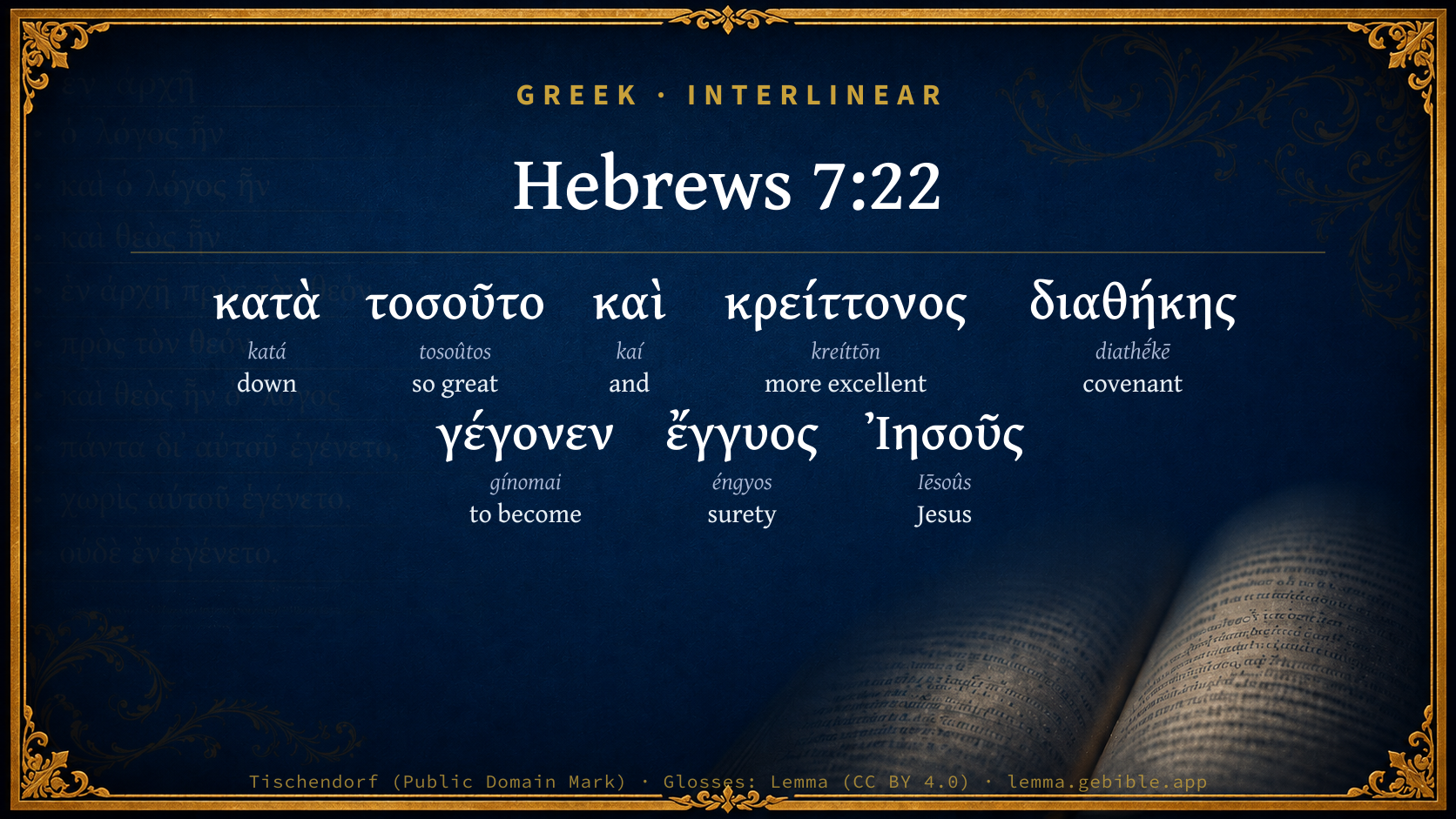
Greek (Tischendorf 8th ed.) Hebrews 7:22 appears in the Greek New Testament. The text above is from the Tischendorf 8th edition. Each word links to its Strong’s number and a concise gloss. Click any word for its full Thayer’s Greek Lexicon entry.
Download image
Cite this verse

Hebrews 7:22 (World English Bible). Public Domain. Lemma interlinear Bible study tool, https://lemma.gebible.app/v/hebrews/7/22.

Show BibTeX & RIS
BibTeX
RIS
English Translation
By so much has Jesus become the collateral of a better covenant.
World English Bible · Public Domain
Highlights
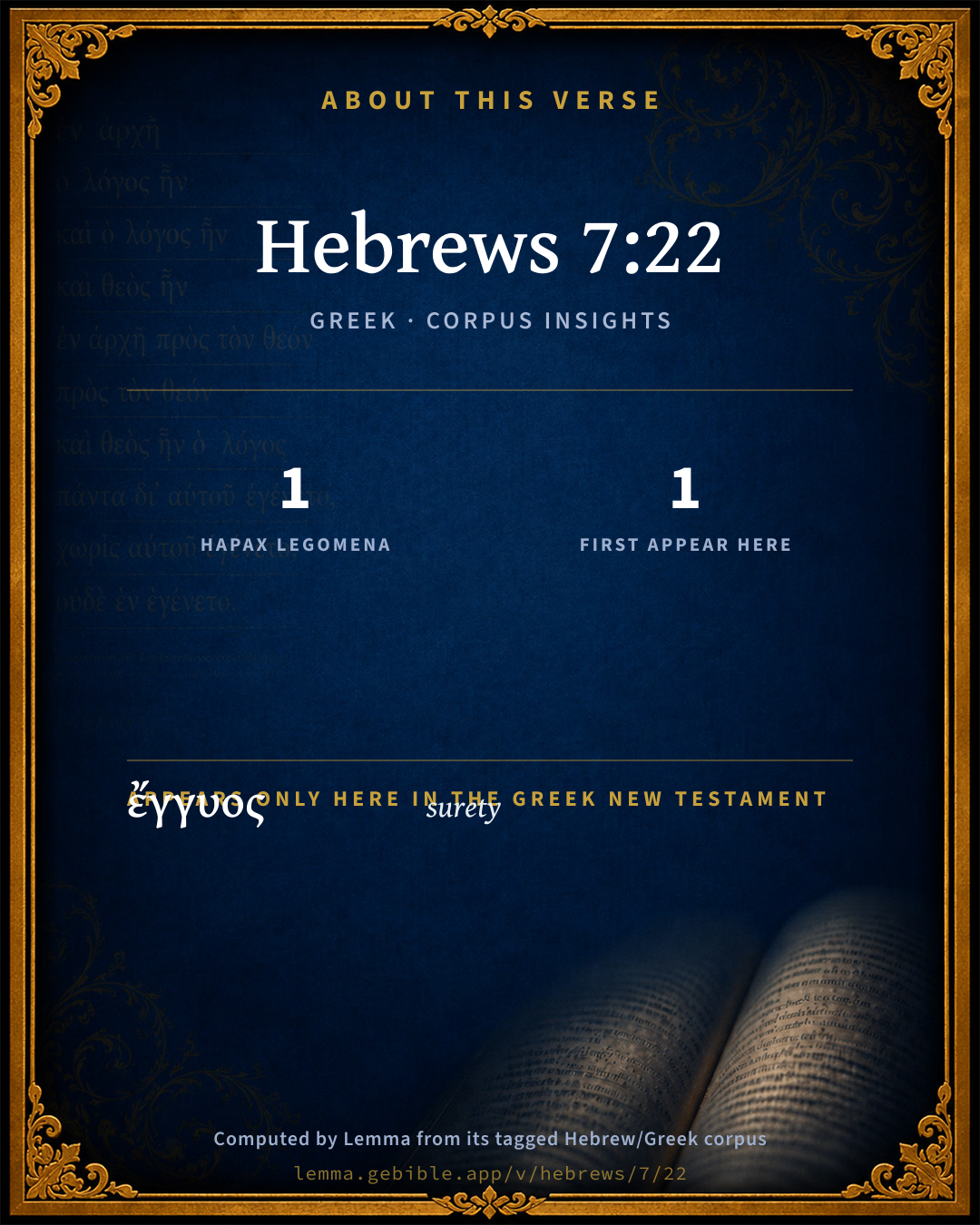
  • 1 hapax legomenon — only here in the Greek New Testament
  • 1 first appearance in the Greek New Testament
Full analysis ↓
Download a study sheet

One document with this verse’s original text, its word-by-word gloss line, the meaning frame, cross-references with their text, attributed commentary, and full source and license credits — printable, and it pastes into notes with its structure intact.

This verse Autodidact and up

Study sheet (.html) Plain text (.txt)

A passage Seminary Student

Up to 50 verses in one chapter. A passage sheet keeps up to 6 commentary sources and 12 cross-references per verse, in the order this page ranks them, and says so on the sheet whenever that leaves anything out. Ask for a single verse and you get the Autodidact verse sheet above.

Everything on this page stays free to read, with no account — the sheet is a download of what is already on screen, not access to it.

Want to remove ads? Support Godless Engineer
Compare translations 3

The same verse in 3 English versions, stacked beneath the original-language interlinear above. Click any original word for its lexicon entry.

Each is an independent rendering of the whole verse — the interlinear is not word-aligned to these translations.

Highlighted words mark where these versions differ — a whole-verse word diff, not a word-by-word alignment.

  • World English Bible Public Domain
    By so much has Jesus become the collateral of a better covenant.
  • King James Version Public Domain
    By so much was Jesus made a surety of a better testament.
  • unfoldingWord Literal Text CC BY-SA 4.0
    and according to so much more, Jesus has become a guarantor of a better covenant.

unfoldingWord Literal Text — © unfoldingWord, licensed CC BY-SA 4.0. Word-aligned USFM3 via Door43 (git.door43.org/unfoldingWord/en_ult).

Versions to compare (up to 4)

3 of 4 selected

Show all 19 translations

Every available English version of this verse, each an independent rendering of the whole verse.

  • World English Bible Public Domain
    By so much has Jesus become the collateral of a better covenant.
  • Berean Standard Bible Public Domain
    Because of this oath, Jesus has become the guarantee of a better covenant.
  • Majority Standard Bible Public Domain
    Because of this oath, Jesus has become the guarantee of a better covenant.
  • King James Version Public Domain
    By so much was Jesus made a surety of a better testament.
  • American Standard Version (1901) Public Domain
    by so much also hath Jesus become the surety of a better covenant.
  • Revised Version (1885) Public Domain
    by so much also hath Jesus become the surety of a better covenant.
  • Geneva Bible (1599) Public Domain
    By so much is Iesus made a suretie of a better Testament.
  • Douay-Rheims (1899) Public Domain
    By so much is Jesus made a surety of a better testament.
  • Young's Literal Translation Public Domain
    by so much of a better covenant hath Jesus become surety,
  • Literal Standard Version CC BY-SA 4.0
    by so much also has Jesus become guarantee of a better covenant,
  • Unlocked Literal Bible CC BY-SA 4.0
    By this also Jesus has given the guarantee of a better covenant.
  • unfoldingWord Literal Text CC BY-SA 4.0
    and according to so much more, Jesus has become a guarantor of a better covenant.
  • Darby Bible Public Domain
    by so much Jesus became surety of a better covenant.
  • World Messianic Bible Public Domain
    By so much, Yeshua has become the guarantee of a better covenant.
  • Webster's Bible Public Domain
    By so much was Jesus made a surety of a better testament.
  • Free Bible Version CC BY-SA 4.0
    This is how Jesus became the guarantee of an agreed relationship with God that is so much better.
  • Bible in Basic English Public Domain
    By so much is it a better agreement which we have through Jesus.
  • Text-Critical English NT CC BY 4.0
    Accordingly, Jesus has become the guarantor of a better covenant.
  • Tyndale New Testament (1534) Public Domain
    And for that cause was Iesus a stablyssher of a better testament.

Literal Standard Version (2020), Covenant Press — licensed CC BY-SA 4.0. Text via the HelloAO Bible API (eBible.org). Unlocked Literal Bible (unfoldingWord) — licensed CC BY-SA 4.0. Text via the HelloAO Bible API (eBible.org). unfoldingWord Literal Text — © unfoldingWord, licensed CC BY-SA 4.0. Word-aligned USFM3 via Door43 (git.door43.org/unfoldingWord/en_ult). Free Bible Version, Dr. Jonathan Gallagher — licensed CC BY-SA 4.0. Text via the HelloAO Bible API (eBible.org).

Word by word

More ways to search: Search by grammar → Find every occurrence → Compare this word →

Practice this passage: Drill this verse → Learn its vocabulary →

About this verse

These counts appear in no published source. They are computed here, from the morphology-tagged text and Lemma’s own curated glosses. What Lemma adds →

8
words
8
distinct lemmas
General Epistles
section

Notable vocabulary

1 hapax legomenon — a word that appears only here in the entire Greek New Testament:

  • ἔγγυος surety G1450

First appearance in Scripture

This word makes its first canonical appearance in the Greek New Testament here:

  • ἔγγυος surety G1450

Shared distinctive vocabulary

κρείττονος more excellent G2909 occurs in 12 verses of the Greek New Testament. Also found in:
Cross-references

13

Topical passages linked to Hebrews 7:22 in the Treasury of Scripture Knowledge — connected by theme and wording, ordered by reader-vote popularity; previews shown in the World English Bible.

  • 1 Corinthians 11:25 In the same way he also took the cup, after supper, saying, "This cup is the new covenant in my blood. Do this, as often as you drink, in memory of me."
  • Hebrews 8:6–12 But now he has obtained a more excellent ministry, by so much as he is also the mediator of a better covenant, which has been enacted on better promises.
  • Genesis 44:32 For your servant became collateral for the boy to my father, saying, 'If I don't bring him to you, then I will bear the blame to my father forever.'
  • Luke 22:20 Likewise, he took the cup after supper, saying, "This cup is the new covenant in my blood, which is poured out for you.
  • Hebrews 9:15–23 For this reason he is the mediator of a new covenant, since a death has occurred for the redemption of the transgressions that were under the first covenant, that those who have been called may receive the promise of the eternal inheritance.
  • Hebrews 12:24 to Jesus, the mediator of a new covenant, and to the blood of sprinkling that speaks better than that of Abel.
  • Hebrews 13:20 Now may the God of peace, who brought again from the dead the great shepherd of the sheep with the blood of an eternal covenant, our Lord Jesus,
  • Genesis 43:9 I will be collateral for him. From my hand will you require him. If I don't bring him to you, and set him before you, then let me bear the blame forever,
  • Matthew 26:28 for this is my blood of the new covenant, which is poured out for many for the remission of sins.
  • Mark 14:24 He said to them, "This is my blood of the new covenant, which is poured out for many.
  • Proverbs 6:1 My son, if you have become collateral for your neighbor, If you have struck your hands in pledge for a stranger;
  • Proverbs 20:16 Take the garment of one who puts up collateral for a stranger; And hold him in pledge for a wayward woman.
  • Daniel 9:27 He shall make a firm covenant with many for one week: and in the midst of the week he shall cause the sacrifice and the offering to cease; and on the wing of abominations [shall come] one who makes desolate; and even to the full end, and that determined, shall [wrath] be poured out on the desolate.

Cross-references courtesy of OpenBible.info (CC BY 4.0).

Commentary

Notes on Hebrews 7:22 from classic Christian and Jewish commentators (each source and its license shown beneath its notes). The classic Christian expositions comment on the surrounding passage and are grouped to its opening verse, so a note may address several verses; the Jewish commentaries on the Tanakh (Rashi and others) are per-verse, so they appear only where the commentator wrote on this verse.

Lemma curates 59 commentaries, every one of them public domain or Creative Commons licensed, each selected and text-cleaned for this edition rather than reprinted as found. About our sources →

Albert Barnes' Notes on the Bible

By so much - Inasmuch as an oath is more solemn than a mere appointment. The meaning is, that there is all the additional security in the suretyship of Jesus which arises from the solemnity of an oath. It is not implied that God would not be true to his mere promise, but the argument here is derived from the custom of speaking among people. An oath is regarded as much more sacred and binding than a mere promise, and the fact that God has sworn in a given case furnishes the highest security that what he has promised will be performed.

Was Jesus made a surety - The word “surety” - ἐγγυος enguos - occurs nowhere else in the New Testament nor is it found in the Septuagint. It properly means, a bondsman; one who pledges his name, property, or influence, that a certain thing shall be done. When a contract is made, debt contracted, or a note given, a friend often becomes the “security” in the case, and is himself responsible if the terms of the contract are not complied with. In the case of the new covenant between God and man, Jesus is the “security” or the bondsman. But of what, and to whom, is he the surety? It cannot be that he is a bondsman for God that he will maintain the covenant, and be true to the promise which he makes, as Crellius supposes, for we need no such “security” of the divine faithfulness and veracity. It cannot be that he becomes responsible for the divine conduct in any way - for no such responsibility is needed or possible.

But it must mean that he is the security or bondsman on the part of man. He is the pledge that we shall be saved. He becomes responsible, so to speak, to law and justice, that no injury shall be done by our salvation, though we are sinners. He is not a security that we shall be saved at any rate, without holiness, repentance, faith, or true religion - for he never could enter into a suretyship of that kind: but his suretyship extends to this point, that the law shall be honored; that all its demands shall be met; that we may be saved though we have violated it, and that its terrific penalty shall not fall upon us. The case is this. A sinner becomes a true penitent and enters heaven. It might be said that he does this over a broken law; that God treats the good and bad alike, and that no respect has been paid to the law or the penalty in his salvation. Here the Great Surety comes in, and says that it is not so.

He has become responsible for this; he the surety, the pledge, that all proper honor shall be paid to justice, and that the same good effects shall ensue as if the penalty of the law had been fully borne. He himself has died to honor the law, and to open a way by which its penalty may be fully remitted consistently with justice, and he becomes “the everlasting pledge or security” to law, to justice, to the universe, that no injury shall result from the pardon and salvation of the sinner. According to this view, no man can rely on the suretyship of Jesus but he who expects salvation on the terms of the gospel. The suretyship is not at all that he shall be saved in his sins, or that he shall enter heaven no matter what life he leads; it is only that if he believes, repents, and is saved, no injury shall be done to the universe; no dishonor to the law. For this the Lord Jesus is responsible.

Of a better testament - Rather, “of a better covenant.” The former covenant was what God made with his people under the Mosaic dispensation; the new covenant is that made by means of Christ. This is “better” because:

(1)The terms are more simple and easy;

(2)The observances and rites are much less onerous and hard;

(3)It relates to all people, not being confined to the Jewish people;

(4)It is now sure. The former was administered through the instrumentality of the Levitical priesthood, this by the Son of God; that was transitory and changing, this is permanent and eternal.

(The word rendered “Surety,” is εγγυος enguos. It occurs indeed here only in the New Testament, nor is it found in the Septuagint, i, e. the very word is not. Yet its derivatives occur there, and bear the sense that is ordinarily, and everywhere expressed by suretyship, Pro 17:18; Pro 22:26, and other places. The word itself, too, is found in the Apocrypha Ecclesiasticus 29:15; 2 Macc. 10:28, on which last passage a recent and distinguished writer observes, “we find the word (here) conveying the idea of a covenant engagement, and that too on the part of the Most High. When the Jews joined battle with Timotheus, they are said to have had the Great God for their εγγυος enguos, assuring them of victory. They had prostrated themselves before the altar; they had spread ashes upon their heads, and covered themselves with sackcloth; they had poured out their hearts in prayer, pleading with the Most High, and putting him in mind of his promise - the promise in which he had said that he would be an enemy to their enemies - then seizing their arms and advancing to meet Timotheus, they rushed into the fight, we are told, εγγυον εχοντες ευημεριας και νικης enguon echontes euēmerias kai nikēs.” Indeed, about the meaning of the word, and the accuracy of our English translation, there can be no doubt. Critics who are very far from admitting the doctrine of Christ’s suretyship in the covenant of redemption, have freely admitted this. “See Peirce on the place.”

What then is the sense of the word here? Applied to Christ will it bear its ordinary sense or not? Is he a surety in a sense analogous to that in which people are sureties? Hesitating to answer these questions in the affirmative, a host of commentators, following the Greeks, have observed, that εγγυος enguos is substituted for, and equivalent to, μεσιτης mesitēs, occurring at Heb 8:6; Heb 9:15; Heb 12:24. But because Christ is called, in these places, the μεσιτης mesitēs or mediator of the covenant, it does not follow that εγγυος enguos here has “precisely” the same sense. Or, if so, how shall we account for the introduction of this singular word at all? Why was not μεσιτης mesitēs employed here, as, in other places, in the Epistle? This has, indeed been accounted for by observing, that as the apostle, in the Heb 7:19, had used the word εγγιζομεν engizomen, we draw near, he employed εγγυος enguos in the Heb 7:22, for the sake of the “paronomasia,” to which figure he is alleged to have been much attached. But in whatever way the apostle may have been led to the use of the word (and the above account is probable enough), he never would have used it, in a sense altogether different from what ordinarily is attached to it, out of fondness for any figure whatever. “A surety has to pay what they owe, for whom he is engaged; to do, what is to be done by them, which they cannot perform. ‘And if this be not the notion of a surety in this place, the apostle makes use of a word, nowhere else used in the whole scripture, to teach us what it doth never signify among people, which is improbable and absurd.’ For the sole reason why he did make use of it was, that from the nature and notion of it among people, in other cases, we may understand the signification of it, and what, under that name, he ascribes unto the Lord Jesus” - Owen.

Having thus proved that εγγυος enguos is properly translated “surety,” and that Christ is so styled, in a sense not widely different from what is usually attached to the word - let us next inquire, how Christ discharges this suretyship, or what he does in his capacity of surety? Is he surety to us for God? This last question, by orthodox writers, is for the most part, answered in the negative on the ground that there can be no need of security for God, his promise and his oath being sufficient guarantee that he will fulfil his engagement; on the ground also, that a surety must be some one greater than the party for whom he engages, which, in the case of God, renders the thing impossible, since there is none greater than Heb. Thus, Dr. Owen has argued at great length, and is followed by Guyse, Boston, and many others. Yet there are not wanting writers of great reputation for learning and orthodoxy, who scruple not to say that Christ is surety “for God;” (see Mr. Scott on this place).

He undertook, on the part of the Father. that all the promises should be made good to the seed. He acts in the behalf of God toward us, and assures us of the divine favor. “If it be asked, what need was there of a Mediator to assure us of the fulfillment of the promises made by the God of truth, who cannot lie or deceive us, I answer, the same objection might be made against God’s adding his oath to his promise, whereby he intended to give us the greater security of accomplishment? - Pierce. The exclusion of this idea from the suretyship of Christ, on the part of so many divines, doubtless arose from the improper use made of it by Socinians, who unwilling to admit that Christ had become bound for our debt of suffering and obedience, and, in this sense, was surety “for us,” resolved the suretyship into a mere engagement “in behalf of God.” They could not allow more, without allowing the atonement.

While, however, we see no necessity for discarding this idea, because it has been used for bad purposes, we maintain, that this is neither all, nor even the principal part, of the suretyship of Christ. Revert to the original notion of a surety. He is one who engages, in behalf of another, to pay a debt or discharge a duty, which that other may fail to pay or discharge. Christ engaged to stand in that relation toward us, and therefore he is the “surety for us God,” that our debt shall be discharged. God the Father, on his part, engages, that Christ shall see his seed, that they shall be saved; and the Son of God, on his part, becomes bound for the debt of penalty and obedience. This is the covenant of redemption, “the counsel of peace” between the Father and the Son, before all worlds; Zec 6:13; Isa 53:10, Isa 53:12. It is unnecessary further to observe, that Christ, in his capacity of surety, has nobly redeemed his pledge, endured the penalty, and honored the precept of the broken law, and thereby secured for his people the blessings of the covenant.

Before concluding this note, we may remark that some difference of opinion exists among those who hold the suretyship of Christ, in reference to another question. Namely, Whether he became surety for the faith, repentance, and evangelical obedience of his people? “I answer,” says Thomas Boston. “though the elect’s believing, repenting, and sincere obedience are infallibly secured in the covenant, yet I judge, that Christ did not become surety in the covenant, in way of caution to his Father, that the elect should perform these deeds, or any other. These belong rather to the promissory part of the covenant. “They are benefits promised in the covenant” by God unto Christ, the surety, as a reward of his fulfilling the condition of the covenant. And so they are, by the unchangeable truth of God, and his exact justice, ensured beyond all possibility of failure; Psa 22:27, Psa 22:30-31; Psa 110:3; Isa 53:10, with Heb 7:1; Eze 34:26-27, Eze 34:31; Heb 8:10-11.” - Boston on the Covenant of Grace; see also Dr. Dick’s admirable lectures on the same subject.

It will be seen from this review of the suretyship of Christ, that the sentiments of our author on the subject are not materially different from those of evangelical divines in Scotland. He may not use the same phraseology, but “security to the law, to justice, to the universe, that no injury shall result from the pardon of the sinner,” is much the same with “surety to God for us, that our debt shall be discharged, that is, that none of these interests shall suffer.)

Albert Barnes' Notes on the Bible (1834–1885) — public domain. Text from a community e-Sword/MySword module.

Tyndale Open Study Notes

Tyndale Open Resources

7:22 Legally, the one who guarantees (literally the guarantee or the guarantor) refers to the person who bears the risk of another person’s investment or debt. Because of God’s oath, Jesus’ priesthood is unassailable, so our covenant relationship with God is secure. Having Jesus as the guarantor makes the new covenant better.

Tyndale Open Study Notes — © Tyndale Open Resources, licensed CC BY-SA 4.0. Text via the HelloAO Bible API.

Bengel's Gnomon

Johann Albrecht Bengel

Heb 7:22. Κρείττονος, of a better) testament or covenant, not to be repented of, eternal, ch. Heb 13:20.—διαθήκης, testament) After this passage this word is of frequent occurrence, ch. 8, 9, 10, likewise ch. Heb 12:24, Heb 13:20. Paul also uses it often in other places. It denotes a divine appointment, comprising the relations and bearings, partly of a covenant, partly of a testament.—ἔγγυος, surety) Hesychius, ἔγγυος, ἀνάδοχος. Its synonym is μεσίτης, mediator, ch. Heb 8:6.

Bengel's Gnomon of the New Testament — English translation (T&T Clark, Edinburgh, 1860) — public domain. Text from a community e-Sword module.

Meyer's Critical & Exegetical Commentary

Heinrich August Wilhelm Meyer

Heb_7:22. The apodosis: Jesus has become the surety of a so much more excellent covenant, i.e. so much more excellent is the covenant of which Jesus has become surety.

ἔγγυος] in the N. T. only here. Comp. however, 2Ma_10:28; Sir_29:15-16.

Surety of a better covenant has Jesus become, i.e. in the person of Jesus pledge and guarantee is given that a better covenant has been established by God. For Christ, the Son of God, had become man in order to proclaim this covenant upon earth, had sealed it by His sufferings and death, and had been mightily accredited by His resurrection from the dead as a Founder of the Covenant who had been sent by God.

Incorrectly do Piscator, Owen, Calov, Wittich, Braun, and others find the thought expressed that Christ became surety to God for men, in that He vicariously took upon Himself the guilt which they must have borne; while, just as erroneously, Limborch, Baumgarten, Chr. Fr. Schmid, and others contend that a reciprocal suretyship, for God with men and for men with God, is meant. Each of these views has the context against it; since there respect is had only to that which has been guaranteed to men by the new order of things. Comp. Heb_7:19 : κρείττονος ἐλπίδος, δι ̓ ἧς ἐγγίζομεν τῷ θεῷ; Heb_7:25-26.

Ἰησοῦς] with emphasis placed at the end.

Meyer — Critical and Exegetical Commentary on the New Testament — English translation by Peter Christie, edited by Frederick Crombie (T&T Clark, 1880) — public domain. Text from a community e-Sword module.

Expositor's Greek Testament

ed. W. Robertson Nicoll

Heb 7:22 . διαθήκη in classical Greek means a disposition ( διατίθημι ) of one’s goods by will; frequent in the orators and sometimes as in Aristoph., Birds , 439, a covenant. In the LXX it occurs nearly 280 times and in all but four passages it is the translation of בְּרִיח “covenant”. (See Hatch, Essays in Bibl. Greek , 47.) It is used indifferently of agreements between men and of contracts or engagements between God and man. See Introduction and on Heb 9:16 and Thayer s.v . Of this “better covenant” Jesus “has become and is” [ γέγονεν ] ἔγγυος “surety”. ἔγγυος is explained in the Greek commentators by ἐγγυητής , which is the commoner of the two forms, at least in later Greek. ἔγγυος occurs several times in the fragments from the second century B.C. given in Grenfell and Hunt’s Greek Papyri , series ii.; also in the fragments from first century A.D. given in the Oxyrhynchus Papyri . It is not the exact equivalent of μεσίτης (found in a similar connection Heb 8:6 , Heb 9:15 , Heb 12:24 ) which is a more comprehensive term. It has been questioned why in this place ἔγγυος is used, and Peirce answers: “I am apt to think he was led to this by his having just before used the word ἐγγίζομεν , and that he did it for the sake of the paronomasia”. And Bruce says: “There is literary felicity in the use of the word as playfully alluding to the foregoing word ἐγγίζομεν . There is more than literary felicity, for the two words probably have the same root, so that we might render ἔγγυος ., the one who insures permanently near relations with God .” More likely he chose the word because his purpose was not to exhibit Jesus as negotiating the covenant, but especially as securing that it should achieve its end. It has been debated whether it is meant that Jesus was surety for men to God, as was held by both Lutheran and Reformed writers, or with others (Grotius, Peirce, etc.), that He was surety for God to men [“His being a surety relates to His acting in the behalf of God towards us and to His assuring us of the divine favour, and to His bestowing the benefits promised by God” (Peirce)] or, with Limborch, Baumgarten and Schmid (see Bleek) that he was surety for both parties. There is no reason to suppose that the writer particularised in any of these directions. He merely wished to express the thought that by the appointment of Jesus to the priestoood, the covenant based upon this priesthood was secured against all failure of any of the ends for which it was established.

The Expositor's Greek Testament, edited by W. Robertson Nicoll (1897–1910) — public domain. Text from a community e-Sword module.

Jamieson, Fausset & Brown

Robert Jamieson, A. R. Fausset & David Brown

surety--ensuring in His own person the certainty of the covenant to us. This He did by becoming responsible for our guilt, by sealing the covenant with His blood, and by being openly acknowledged as our triumphant Saviour by the Father, who raised Him from the dead. Thus He is at once God's surety for man, and man's surety for God, and so Mediator between God and man (Heb 8:6).

better-- Heb 8:6; Heb 13:20, "everlasting."

testament--sometimes translated, "covenant." The Greek term implies that it is appointed by God, and comprises the relations and bearings partly of a covenant, partly of a testament: (1) the appointment made without the concurrence of a second party, of somewhat concerning that second party; a last will or testament, so in Heb 9:16-17; (2) a mutual agreement in which both parties consent.

Jamieson, Fausset & Brown — Commentary Critical and Explanatory on the Whole Bible (1871) — public domain (CC PDM 1.0). Text via the HelloAO Bible API.

Adam Clarke's Commentary

Verse 22. By so much] This solemn, unchangeable oath of God, was Jesus made a surety, εγγυος, a mediator, one who brings the two parties together, witnesses the contract, and offers the covenant sacrifice on the occasion. See at the end of the chapter.

A better testament.] κρειττονος διατηκης. A better covenant; called, in the title to the sacred books which contain the whole Christian code, η καινη διαθηκη, THE NEW COVENANT, thus contradistinguished from the Mosaic, which was the old covenant; and this is called the new and better covenant, because God has in it promised other blessings, to other people, on other conditions, than the old covenant did. The new covenant is better than the old in the following particulars:

1. God promised to the Jewish nation certain secular blessings, peculiar to that nation, on condition of their keeping the law of Moses; but under the new covenant he promises pardon of sin, and final salvation to all mankind, on condition of believing on Jesus Christ, and walking in his testimonies.

2. The Jewish priests, fallible, dying men, were mediators of the old covenant, by means of their sacrifices, which could not take away sin, nor render the comers thereunto perfect. But Jesus Christ, who liveth for ever, who is infinite in wisdom and power, by the sacrifice of himself has established this new covenant, and by the shedding of his blood has opened the kingdom of heaven to all believers.

Adam Clarke's Commentary on the Bible (1810–1826) — public domain. Text from a community e-Sword/MySword module.

Ellicott's Commentary for English Readers

(22) By so much was Jesus made.—Better, by so much also hath Jesus become surety of a better covenant. The form of the sentence recalls Heb_1:4. As the priest whose appointment is confirmed by the oath of God is raised above all former priests, in the same proportion is the covenant of which Jesus is surety higher, better, than the former covenant. For the “better hope” of Heb_7:19 we now read “better covenant”; the new idea is not different in substance, but is more definite and clear. The very promise of the “other priest” brought with it a “better hope”; the recollection of the divine oath is fitly succeeded by the mention of a “covenant.”

This is the first occurrence in this Epistle of a very interesting word (diathçkç) which hereafter will occupy an important place in the argument. Throughout the Greek translation of the Old Testament it is used to represent a Hebrew word which is (more than 200 times) rightly rendered covenant in our version; and, like the Hebrew word, it is applied both to mutual agreements between man and man, and to “covenants” or engagements into which God enters in regard to man. In classical writers diathçkç commonly denotes a testament; and hence in the old Latin translation of the Scriptures testamentum became the common rendering of the word. As, however, this rendering is very often found where it is impossible to think of such a meaning as will (for example, in Psa_83:5, where no one will suppose the Psalmist to say that the enemies of God “have arranged a testament against Him”), it is plain that the Latin testamentum was used with an extended meaning, answering to the wide application of the Greek word. St. Paul’s designation of the Jewish Scriptures as “the Old Covenant” (2Co_3:14) thus became familiarly known as The Old Testament. In the New Testament the Authorised version more commonly presents the better rendering; but, through the influence of the Latin, testament is retained in several places—viz., in the various accounts of the institution of the Lord’s Supper; in 2Co_3:6; 2Co_3:14; in Rev_11:19 (“the ark of His testament,” a very strange translation); in the present verse; and especially in the very important passage, Heb_9:15-20. There is a very general agreement of opinion that “covenant” must be the true meaning in all passages of the New Testament except the one last mentioned; and even in that place there are strong reasons for retaining the same rendering. (See the Note on Heb_9:15.) In this verse, at all events, we cannot doubt that the writer is thinking of a covenant. (See Heb_8:6; Heb_8:8.) Here only is Jesus spoken of as Surety, elsewhere as Mediator (Heb_8:6; Heb_9:15; Heb_12:24). As through the Son of Man the covenant becomes established, so in Him it remains secure; the words addressed by God to Him as Priest and King contain the pledge of its validity and permanence.

A Bible Commentary for English Readers, edited by Charles John Ellicott (1878–1897) — public domain. Text from a community e-Sword module.

The Cambridge Bible for Schools and Colleges

gen. ed. J. J. S. Perowne

22. of a better testament] A clearer rendering would be “By so much better was the covenant of which Jesus has been made surety.” The words—which might be taken as the keynote of the whole Epistle—should undoubtedly be rendered “of a better covenant” The Greek word diathçkç is the rendering of the Hebrew Berîth, which means a covenant. Of “testaments” the Hebrews knew nothing until they learnt the custom of “making a will” from the Romans. So completely was this the case that there is no word in Hebrew which means “a will,” and when a writer in the Talmud wants to speak of a “will,” he has to put the Greek word diathçkç in Hebrew letters. The Hebrew berîth is rendered diathçkç in the LXX., and “covenant” by our translators at least 200 times. When we speak of the “Old” or the “New Testament” we have borrowed the word from the Vulgate or Latin translation of St Jerome in 2Co_3:6. The only exception to this meaning of diathçkç is in Heb_9:15-17. Of the way in which Jesus is “a pledge of this “better covenant,” see Heb_7:25 and Heb_8:1; Heb_8:6, Heb_9:15, Heb_12:24. The word for “pledge” (ἔγγυος) occurs here alone in the N.T., but is found in Sir_29:15.

The Cambridge Bible for Schools and Colleges (gen. ed. J. J. S. Perowne; Cambridge University Press, 1878–1918) — public domain. Text from a community e-Sword module.

John Gill's Exposition

But this man, because he continueth ever,.... Though he died, death did not forbid him to continue, as it does other men; he was not forced to die, he died voluntarily; and he continued but for a small time under the power of death; besides, his death was a branch of his priestly office: so that he not only continued in his divine nature, which still had the human nature in union with it, but he continued in his office as a priest, and quickly rose from the dead; and the virtue of his sacrifice always remains, and he himself ever lives as an intercessor: wherefore he

hath an unchangeable priesthood; which will never be antiquated, and give place to another; nor does it, or ever will it pass from him to another, for it is needless, seeing he lives, and no other is sufficient for it; and it would be injustice to pass it to another; the glory of it is due to him; and this is matter of comfort to the saints, that he sits a priest upon his throne, and that his priesthood always continues.

John Gill's Exposition of the Whole Bible (1746–1763) — public domain (CC PDM 1.0). Text via the HelloAO Bible API.

Trapp's Complete Commentary

John Trapp

22 By so much was Jesus made a surety of a better testament.

Ver. 22. Jesus was made a surety] As he was our surety to God for the discharge of our debt (the surety and debtor in law are reputed as one person), so he is God’s surety to us, for the performance of his promises. Christ was the surety of the first covenant (saith one), to pay the debt; of the second covenant, to perform the duty.

John Trapp, A Commentary or Exposition upon All the Books of the Old and New Testament (1647–1656) — public domain. Text from a community e-Sword module.

Matthew Poole's English Annotations

This brings in the consequent on Heb 7:20.

As much excellency as was in God’s oath constituting,

so much there must be in the office constituted. The Aaronical priesthood, by God’s constitution, was excellent; but Christ’s is much more so, being by God’s oath made personal and everlasting, relating to the best covenant; so as the Hebrews had the greatest reason to renounce Aaron’s, and to cleave to Christ’s for salvation. He being God-man, is a Surety, one that bindeth himself for another, to see something paid or performed, to give security for another; and is proper to him as a Priest, Job 17:3; Psa 119:122; Pro 6:1. In the Mossical economy the priests were typical sureties, or undertakers for the people; so Aaron, as a surety, was sent by Moses to stand between the living and the dead, when God was cutting off those sinners, Num 16:46,48. The Spirit interprets this

Surety to be a Mediator, Heb 8:6, which is the general comprehensive name of all his offices: as he gives all from God to us in and by his promises, he is the Testator fulfilling them, Heb 9:15,16; as he gives satisfaction to God for us, and returns our duty performed with the incense of his merits, he is our Surety; which merit of his resulted from his perfect obedience to the whole law and will of God, and from the full satisfaction he made to God by his death for our sins, Rom 5:19; 2Co 5:21; Gal 3:13.

A better testament; the gospel covenant, described Heb 8:10-12, and referreth to what the Lord foretold of it, Jer 31:33,34, which is better than the Mosaical for perspicuity, freeness, fulness, spirituality, and the Spirit promised in it for its ratification by the death of Christ, and its perpetuity: see Heb 8:8,9,11.

Matthew Poole's English Annotations on the Holy Bible (1683–1685) — public domain. Text from a community e-Sword/MySword module.

Whedon's Commentary on the Bible

Daniel D. Whedon

22. By so much—By the measure of the unmeasurable veracity of God.

Better testament—Covenant or dispensation.

Daniel D. Whedon (gen. ed.), Commentary on the Old and New Testaments (1874–1909) — public domain. Text from a community e-Sword module.

John Wesley's Explanatory Notes

Of so much better a covenant - Unchangeable, eternal. Was Jesus made a surety - Or mediator. The word covenant frequently occurs in the remaining part of this epistle. The original word means either a covenant or a last will and testament. St. Paul takes it sometimes in the former, sometimes in the latter, sense; sometimes he includes both.

John Wesley, Explanatory Notes Upon the Whole Bible (1754–1765) — public domain. Text via the GEBible commentary corpus.

The People's New Testament

B. W. Johnson

22. By so much. By such solemn means was Jesus made a surety, the pledge and firm assurance. A surety is intended to secure absolute certainty. A better testament. Rather, covenant. Jesus became the pledge of the new covenant, the Gospel. God has established him as its high priest forever, by the sanctity of an oath. This is the line of argument.

B. W. Johnson's The People's New Testament with Notes (1889–1891) — public domain. Electronic text from the Christian Classics Ethereal Library (CCEL) ThML edition.

unfoldingWord translationNotes

Door43 World Missions Community

Connecting Statement:

The writer then assures these Jewish believers that Christ has the better priesthood because he lives forever and the priests that descended from Aaron all died.

has given the guarantee of a better covenant

"has told us that we can be sure that there will be a better covenant"

he has a permanent priesthood

A priest's work is spoken of as if it were an object that Jesus possesses. This can be worded to avoid the abstract noun. AT: "he is a priest permanently" (See: Abstract Nouns)

translationWords

covenant

priest

die

eternity

unfoldingWord translationNotes — © Distant Shores Media and the Door43 World Missions Community, licensed CC BY-SA 4.0. Source: git.door43.org/Door43/en_tn.

Cambridge Greek Testament for Schools and Colleges

22. κρείττονος διαθήκης. “By so much better was the covenant of which Jesus has been made surety.” The words—which might be taken as the keynote of the whole Epistle—should undoubtedly be rendered “of a better covenant.” The Greek word διαθήκη is the rendering of the Hebrew Berîth, which means a covenant. Of “testaments” the Hebrews knew nothing until they learnt the custom of “making a will” from the Romans. So completely was this the case that there is no word in Hebrew which means “a will,” and when a writer in the Talmud wants to speak of a “will,” he has to put the Greek word διαθήκη in Hebrew letters. The Hebrew berîth is rendered διαθήκη in the LXX., and “covenant” by our translators at least 200 times. When we speak of the “Old” or the “New Testament” we have borrowed the word from the Vulgate or Latin translation of St Jerome in 2Co 3:6. The only exception to this meaning of διαθήκη in the N. T. is in Heb 9:15-17. Of the way in which Jesus is “a pledge” (ἔγγυος) of this “better covenant,” see Heb 7:25 and Heb 8:1; Heb 8:6, Heb 9:15, Heb 12:24. The word ἔγγυος occurs here alone in the N. T., but is found in Sir 29:15.

Cambridge Greek Testament for Schools and Colleges (Cambridge University Press, 1896; 21 vols, various authors incl. Carr, Maclear, Plummer, Farrar, Lumby, Moule, M. R. James, Simcox) — public domain. Text from a community e-Sword module.

Vincent's Word Studies in the New Testament

Marvin R. Vincent

Was Jesus made a surety of a better testament [κρειττονος διαθηκης γεγονεν εγγυος ιησους] . Egguov surety, N. T. o. Comp. Sir. 29 15, 16; 2 Macc. 10 28. Occasionally in Class., where also occur ejgguan to give as a pledge, ejgguh surety, ejgguhsiv giving in surety, ejgguhthv one who gives security, and ejgghtov plighted, always of a wife. The idea underlying all these words is that of putting something into one's hand (ejn in gualon hollow of the hand) as a pledge. For testament rend. covenant and see on ch. Heb 9:16. The thought of a covenant is introduced for the first time, and foreshadows ch. 8 6 - 13. It adds to the thought of the inferiority of the Levitical priesthood that of the inferiority of the dispensation which it represented.

Marvin R. Vincent, Word Studies in the New Testament (1887–1900) — public domain. Text from a community e-Sword/MySword module.

Westcott on Hebrews & the Epistles of John

Brooke Foss Westcott

22. κρείττονος... Ἰησοῦς] Jesus hath become surety of a better covenant (Vulg. meliorise testamenti sponsor Jactus est Jesus) in that He has shown in His own Person the fact of the establishment of a Now Oovenant between God and man. This Ho has done by Ilis Incarnation, issuing in His Life, Nis Death, His Resurroction, Ilis otornal Pricsthood. But inasmuch as the immediate subject here is Christ’s Pricsthood, the reference is especially to this, the consummation of the Incarnation. Jesus—the Son of man—having entered into the Presence of God for men is the sure pledge of the validity of the New Covenant.

In later passages of the Epistle (viij. 6 note) Christ is spoken of as the Mediator of the New Oovenant. He Himeelf brought about the Covenant; and He is the adequato surety of its onduranco.

Ἰησοῦε The human name of the Lord stands emphatically at the end. (Comp. vi. 20; fi. 9 note.) Jesus,

the Son of man, has been exalted to the right hand of God, whore He is seated as King and Priest. In His divine humanity He assuros us that God has potentially accomplished the purpose of Creation, and will accomplish it.

The word ἔγγυος does not occur elsewhere in N.T. See Ecclus. xxix. καὶ νίκης.

A surety for the most part pledges himself that something will be: but here the Ascended Ohrist witnesses that something is: the assurance is not simply of the future but of that which is present though unseen.

It must be noticed that Ohrist is not said here to be a surety for man to God, but a surety of a covenant of God with man.

Theodoret interprets the phrase too ἐβεβαίωσε τῆς ἡμετέρας ἀναστάσεως τὴν ἐλπίδα.

For διαθήκη seo Additional Note on ix, 16.

23—25. A second fact establishes the pre-eminence of Christ’s Priesthood. It is held uninterruptedly by One Ever-living Priest.

Brooke Foss Westcott (1825–1901), The Epistle to the Hebrews (1889) and The Epistles of St John (1883) — public domain (pre-1929). Text recovered from Internet Archive / Google Books OCR scans. Westcott’s Gospel of John commentary is not included (its OCR lost the chapter running-heads required for reliable verse-keying). Some Greek quoted in the Hebrews volume is imperfectly rendered by the OCR.

Lesson kit

Teaching starters — assembled from the data on this page, not authored interpretation. Every prompt links to the verse data it draws on. Edit before teaching.

Hebrews, in the General Epistles, opens this verse with 8 words (8 distinct Greek lemmas). Its most distinctive word is éngyos (“surety”). A historical commentator’s framing appears above. Read the whole chapter for the surrounding context.

Discussion questions

  1. How does “surety” (éngyos) shape what this verse is saying?
  2. 1 word here appears nowhere else in the Greek New Testament. Why might the author reach for such rare wording?
  3. This is the first place “surety” appears in Scripture (first appears here). What does its debut here establish?
  4. How does 1 Corinthians 7:9, which shares the word «more excellent», read alongside this verse?
  5. These translations render this verse differently. What is at stake in choosing one wording over another?
  6. Compare how Albert Barnes' Notes on the Bible and Tyndale Open Study Notes read this verse. Where do they agree or differ?

Things to notice

  • 1 word in this verse appears nowhere else in the Greek New Testament.
  • 1 word makes its first canonical appearance in Scripture here.
  • These translations choose different wording for 10 words in this verse.
  • 8 distinct Greek lemmas span 8 words in this verse.

Reading settings

Reading text

Shown beneath each verse's original-language words.

Old Testament
Old Testament edition

Read the OT as the Masoretic Hebrew (MT) or the Greek Septuagint (LXX).

English shown for the Greek Septuagint (in the Hebrew ↔ Greek comparison).

Comparing translations? Open the Compare panel on any verse page to stack up to four side by side.