Hebrews 7:4

Greek (Tischendorf 8th ed.) Hebrews 7:4 appears in the Greek New Testament. The text above is from the Tischendorf 8th edition. Each word links to its Strong’s number and a concise gloss. Click any word for its full Thayer’s Greek Lexicon entry.
Download image
Cite this verse

Hebrews 7:4 (World English Bible). Public Domain. Lemma interlinear Bible study tool, https://lemma.gebible.app/v/hebrews/7/4.

Show BibTeX & RIS
BibTeX
RIS
English Translation
Now consider how great this man was, to whom even Abraham, the patriarch, gave a tenth out of the best spoils.
World English Bible · Public Domain
Highlights
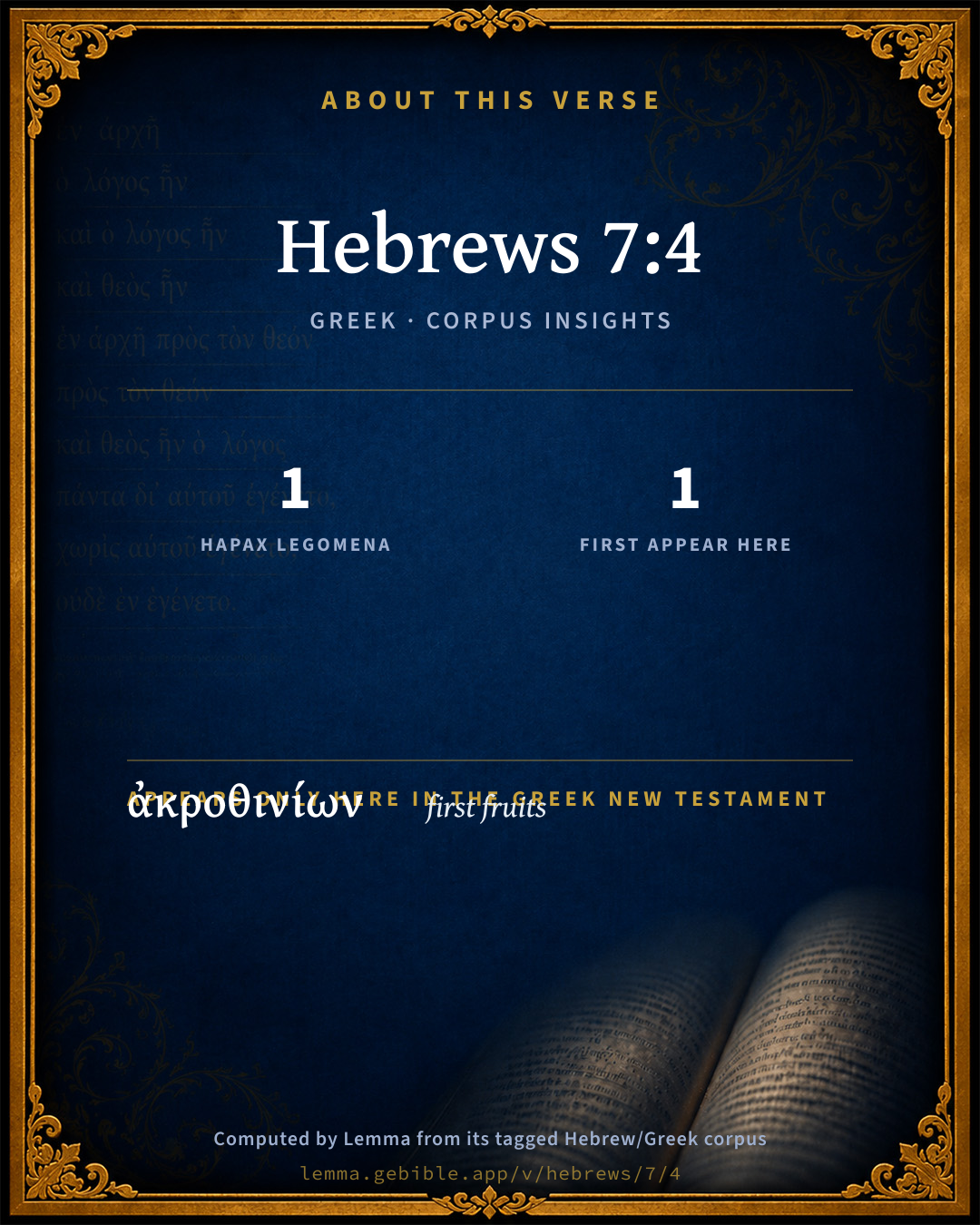
  • 1 hapax legomenon — only here in the Greek New Testament
  • 1 first appearance in the Greek New Testament
Full analysis ↓
Download a study sheet

One document with this verse’s original text, its word-by-word gloss line, the meaning frame, cross-references with their text, attributed commentary, and full source and license credits — printable, and it pastes into notes with its structure intact.

This verse Autodidact and up

Study sheet (.html) Plain text (.txt)

A passage Seminary Student

Up to 50 verses in one chapter. A passage sheet keeps up to 6 commentary sources and 12 cross-references per verse, in the order this page ranks them, and says so on the sheet whenever that leaves anything out. Ask for a single verse and you get the Autodidact verse sheet above.

Everything on this page stays free to read, with no account — the sheet is a download of what is already on screen, not access to it.

Want to remove ads? Support Godless Engineer
Compare translations 3

The same verse in 3 English versions, stacked beneath the original-language interlinear above. Click any original word for its lexicon entry.

Each is an independent rendering of the whole verse — the interlinear is not word-aligned to these translations.

Highlighted words mark where these versions differ — a whole-verse word diff, not a word-by-word alignment.

  • World English Bible Public Domain
    Now consider how great this man was, to whom even Abraham, the patriarch, gave a tenth out of the best spoils.
  • King James Version Public Domain
    Now consider how great this man was, unto whom even the patriarch Abraham gave the tenth of the spoils.
  • unfoldingWord Literal Text CC BY-SA 4.0
    But notice how great this one, to whom the patriarch Abraham gave a tenth from the best plunder.

unfoldingWord Literal Text — © unfoldingWord, licensed CC BY-SA 4.0. Word-aligned USFM3 via Door43 (git.door43.org/unfoldingWord/en_ult).

Versions to compare (up to 4)

3 of 4 selected

Show all 19 translations

Every available English version of this verse, each an independent rendering of the whole verse.

  • World English Bible Public Domain
    Now consider how great this man was, to whom even Abraham, the patriarch, gave a tenth out of the best spoils.
  • Berean Standard Bible Public Domain
    Consider how great Melchizedek was: Even the patriarch Abraham gave him a tenth of the plunder.
  • Majority Standard Bible Public Domain
    Consider how great Melchizedek was: Even the patriarch Abraham gave him a tenth of the plunder.
  • King James Version Public Domain
    Now consider how great this man was, unto whom even the patriarch Abraham gave the tenth of the spoils.
  • American Standard Version (1901) Public Domain
    Now consider how great this man was, unto whom Abraham, the patriarch, gave a tenth out of the chief spoils.
  • Revised Version (1885) Public Domain
    Now consider how great this man was, unto whom Abraham, the patriarch, gave a tenth out of the chief spoils.
  • Geneva Bible (1599) Public Domain
    Nowe consider how great this man was, vnto whome euen the Patriarke Abraham gaue the tithe of the spoyles.
  • Douay-Rheims (1899) Public Domain
    Now consider how great this man is, to whom also Abraham the patriarch gave tithes out of the principal things.
  • Young's Literal Translation Public Domain
    And see how great this one `is', to whom also a tenth Abraham the patriarch did give out of the best of the spoils,
  • Literal Standard Version CC BY-SA 4.0
    And see how great this one [is], to whom Abraham the patriarch also gave a tenth out of the best of the spoils,
  • Unlocked Literal Bible CC BY-SA 4.0
    See how great this man was to whom the patriarch Abraham gave a tenth of the things that he had taken in battle.
  • unfoldingWord Literal Text CC BY-SA 4.0
    But notice how great this one, to whom the patriarch Abraham gave a tenth from the best plunder.
  • Darby Bible Public Domain
    Now consider how great this [personage] was, to whom [even] the patriarch Abraham gave a tenth out of the spoils.
  • World Messianic Bible Public Domain
    Now consider how great this man was, to whom even Abraham the patriarch gave a tenth out of the best plunder.
  • Webster's Bible Public Domain
    Now consider how great this man was, to whom even the patriarch Abraham gave the tenth of the spoils.
  • Free Bible Version CC BY-SA 4.0
    Think how great this man was for Abraham the patriarch to give him a tithe of what was won in battle.
  • Bible in Basic English Public Domain
    Now see how great this man was, to whom our father Abraham gave a tenth part of what he had got in the fight.
  • Text-Critical English NT CC BY 4.0
    Consider how great this man must be, that even Abraham the patriarch gave him a tenth of the spoils.
  • Tyndale New Testament (1534) Public Domain
    Consyder what a man this was vnto who the patriarke Abraham gave tythes of the spoyles.

Literal Standard Version (2020), Covenant Press — licensed CC BY-SA 4.0. Text via the HelloAO Bible API (eBible.org). Unlocked Literal Bible (unfoldingWord) — licensed CC BY-SA 4.0. Text via the HelloAO Bible API (eBible.org). unfoldingWord Literal Text — © unfoldingWord, licensed CC BY-SA 4.0. Word-aligned USFM3 via Door43 (git.door43.org/unfoldingWord/en_ult). Free Bible Version, Dr. Jonathan Gallagher — licensed CC BY-SA 4.0. Text via the HelloAO Bible API (eBible.org).

Word by word

More ways to search: Search by grammar → Find every occurrence → Compare this word →

Practice this passage: Drill this verse → Learn its vocabulary →

ἀκροθινίων
akrothínion
G205
“first fruits”
Noun, Genitive, Plural, Neuter
Part of Speech
Noun
Case
Genitive
Number
Plural
Gender
Neuter
Full Thayer's Definition

Origin: from G206 and this (a heap)

TDNT: None

1. top of the heap, the first fruits a. best of the spoils or crops 2. the Greeks customarily selected from the topmost part of the heaps and offered this to the gods
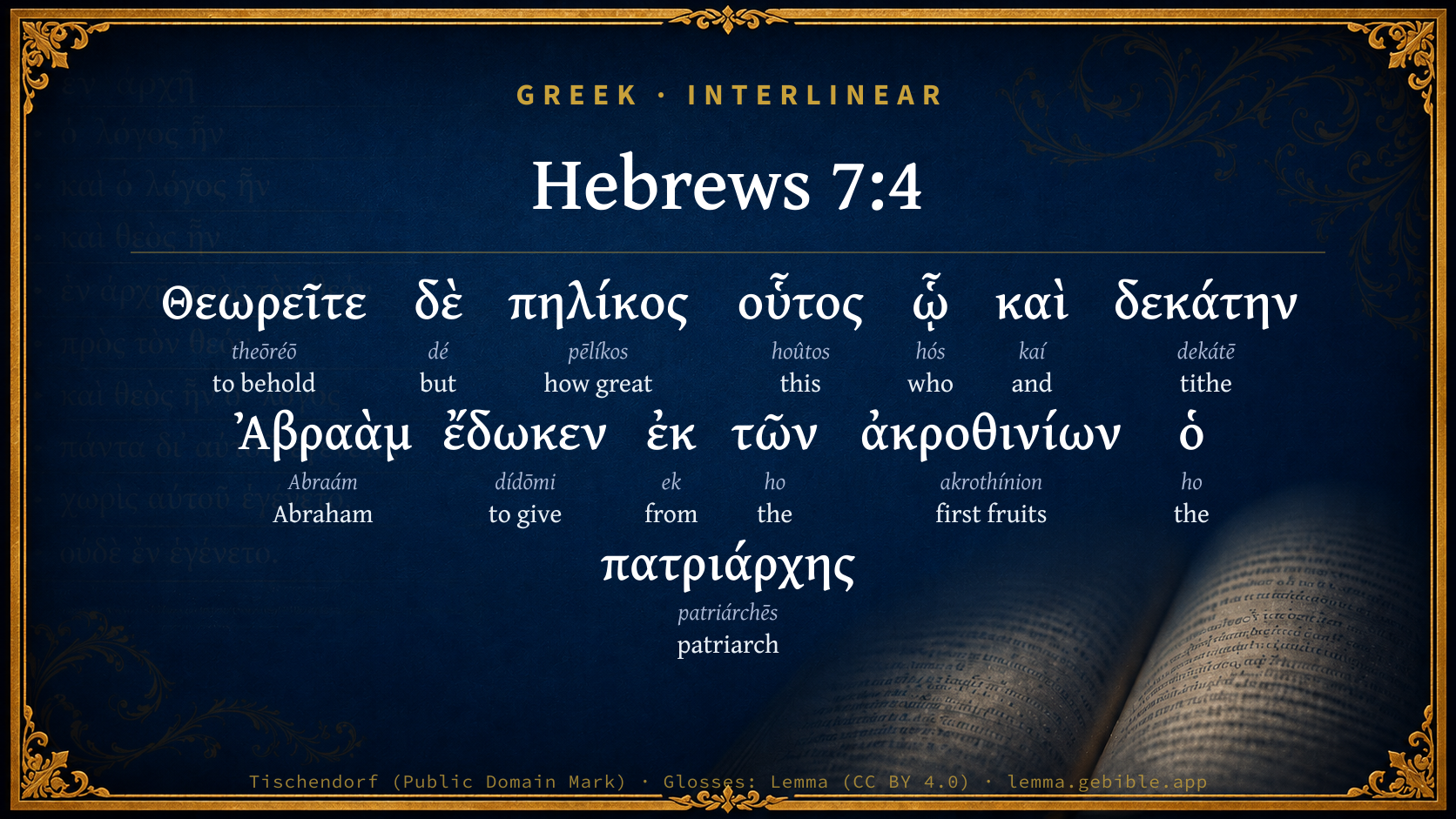
  1. Θεωρεῖτε theōréō G2334 “to behold” Verb, Present, Active, Indicative, 2nd person, Plural
  2. δὲ dé G1161 “but” Conjunction
  3. πηλίκος pēlíkos G4080 “how great” Adjective, Nominative, Singular, Masculine
  4. οὗτος hoûtos G3778 “this” Demonstrative pronoun, Nominative, Singular, Masculine
  5. ᾧ hós G3739 “who” Relative pronoun, Dative, Singular, Masculine
  6. καὶ kaí G2532 “and” Conjunction
  7. δεκάτην dekátē G1181 “tithe” Adjective, Accusative, Singular, Feminine
  8. Ἀβραὰμ Abraám G11 “Abraham” Noun, Proper, indeclinable
  9. ἔδωκεν dídōmi G1325 “to give” Verb, Aorist, Active, Indicative, 3rd person, Singular
  10. ἐκ ek G1537 “from” Preposition
  11. τῶν ho G3588 “the” Article, Genitive, Plural, Neuter
  12. ὁ ho G3588 “the” Article, Nominative, Singular, Masculine
  13. πατριάρχης patriárchēs G3966 “patriarch” Noun, Nominative, Singular, Masculine

About this verse

These counts appear in no published source. They are computed here, from the morphology-tagged text and Lemma’s own curated glosses. What Lemma adds →

14
words
13
distinct lemmas
General Epistles
section

Notable vocabulary

1 hapax legomenon — a word that appears only here in the entire Greek New Testament:

  • ἀκροθινίων first fruits G205

First appearance in Scripture

This word makes its first canonical appearance in the Greek New Testament here:

  • ἀκροθινίων first fruits G205

Shared distinctive vocabulary

πηλίκος how great G4080 occurs in 2 verses of the Greek New Testament. Also found in:

Repetition

A word recurs within this verse:

Cross-references

9

Topical passages linked to Hebrews 7:4 in the Treasury of Scripture Knowledge — connected by theme and wording, ordered by reader-vote popularity; previews shown in the World English Bible.

  • Genesis 14:20 and blessed be God Most High, who has delivered your enemies into your hand." Abram gave him a tenth of all.
  • Acts 2:29 "Brothers, I may tell you freely of the patriarch David, that he both died and was buried, and his tomb is with us to this day.
  • Genesis 12:2 I will make of you a great nation. I will bless you, and make your name great. You will be a blessing.
  • Genesis 17:5–6 Neither will your name any more be called Abram, but your name will be Abraham; for the father of a multitude of nations have I made you.
  • Acts 7:8–9 He gave him the covenant of circumcision. So Abraham became the father of Isaac, and circumcised him the eighth day. Isaac became the father of Jacob, and Jacob became the father of the twelve patriarchs.
  • Galatians 3:28–29 There is neither Jew nor Greek, there is neither slave nor free man, there is neither male nor female; for you are all one in Christ Jesus.
  • Romans 4:11–13 He received the sign of circumcision, a seal of the righteousness of the faith which he had while he was in uncircumcision, that he might be the father of all those who believe, though they be in uncircumcision, that righteousness might also be accounted to them.
  • Romans 4:17–18 As it is written, "I have made you a father of many nations." This is in the presence of him whom he believed: God, who gives life to the dead, and calls the things that are not, as though they were.
  • James 2:23 and the Scripture was fulfilled which says, "Abraham believed God, and it was accounted to him as righteousness;" and he was called the friend of God.

Cross-references courtesy of OpenBible.info (CC BY 4.0).

Commentary

Notes on Hebrews 7:4 from classic Christian and Jewish commentators (each source and its license shown beneath its notes). The classic Christian expositions comment on the surrounding passage and are grouped to its opening verse, so a note may address several verses; the Jewish commentaries on the Tanakh (Rashi and others) are per-verse, so they appear only where the commentator wrote on this verse.

Lemma curates 59 commentaries, every one of them public domain or Creative Commons licensed, each selected and text-cleaned for this edition rather than reprinted as found. About our sources →

Joseph Benson's Commentary

Heb 7:4-7. Consider how great this man was — The greatness of Melchisedec is described in all the preceding and following particulars. But the most manifest proof of it was, that Abraham gave him tithes as a priest of God, and a superior; though he was himself a patriarch, greater than a king, and a progenitor of many kings. The sons of Levi take tithes of their brethren — Sprung from Abraham as well as themselves. The Levites, therefore, are greater than they; but the priests are greater than the Levites; the patriarch Abraham than the priests, and Melchisedec than him. But he whose descent is not counted from them — From that people who come out of the loins of Abraham, not only received tithes of Abraham, but blessed him — Another proof of Melchisedec’s superiority; even him that had the promises — With whom God made the covenant of grace, as with the Father of all the blessed seed. Thus Gal 3:16 : To Abraham and his seed were the promises made. And without all contradiction — Without all question; the less is blessed authoritatively of the better — Or greater; that is, when a man does, in God’s name and stead, and by his authority, declare and pronounce another to be blessed, he that gives the blessing is, in that respect, greater than he who receives it.

Joseph Benson's Commentary on the Old and New Testaments (1811–1818) — public domain. Text from a community e-Sword module.

The Preacher's Complete Homiletical Commentary

Joseph S. Exell (gen. ed.)

CRITICAL AND EXEGETICAL NOTES

Heb_7:4. How great.—Lit. “of what exalted rank.” Jesus had shown great reverence for Abraham. Spoils.—Lit. “the top part of a heap of grain.” Then firstfruits. “As offerings were made to their gods, by the Greeks, from spoils taken in war, ἀκροθίνια came at last to signify, in the Greek language, any kind of spoils from which an offering for the gods was taken.

Heb_7:5. Take tithes.—See Num_18:28-30; Deu_14:22; Deu_14:27-29. Tithe-giving was a recognition of superior dignity. Out of the loins.—A Hebrew figure (Gen_35:11): descendants from Abraham.

Heb_7:6. Descent.—R.V. “genealogy”; margin, “pedigree.” Received.—R.V. “hath taken.” δεδεκάτωκε is Hellenistic; found only in the New Testament and the LXX. Blessed.—The act of a superior.

Heb_7:7. Less.—Simply inferior in rank or office. Lit. “Inferiority is blessed by superiority.”

Heb_7:8. That die.—Not natural death; whose term of ministry ends. The writer has in mind the limitation of the Levitical priestly office, as a sign of its inferiority. There.—In the Scripture narrative of Melchizedek. Liveth.—No mention being made of his priesthood ending, it is taken as continuing. The writer is raising an argument to prove the perpetuity of Christ’s priesthood.

Heb_7:9. May so say.—Or, “If I may be allowed the expression.” The apology indicates a fear that what he was about to say would seem far-fetched and exaggerated; and it is a kind of argument that Western minds are very imperfectly able to appreciate. Note that Isaac was not born until fourteen years after the incident of the tithe-paying. The writer’s suggestion must be taken as popular and rhetorical, not as logical or scientific. Payed tithes.—The whole race, according to Eastern ideas, may be spoken of as paying tithes, representatively, in Abraham, its head; and Levi is included in the race. “The descendants of Abraham cannot but occupy a lower position in presence of one who appears as Abraham’s superior.” Only “in a certain sense” was Levi then potentially existent. The argument depends on patriarchal and tribal notions and sentiments.

MAIN HOMILETICS OF THE PARAGRAPH.—Heb_7:4-10

The Greatness of Melchizedek.—Not as a man, or as a king, but as the remarkable representative of an order of priesthood antecedent to the Aaronic, independent of the Aaronic, continuous in a line outside of Jewish exclusiveness, and coming into world-prominence once again in the priesthood of the Son of God. “We have long looked upon Abram as the one witness to monotheism among an idolatrous people, and to see him holding a position inferior to this hitherto unknown chieftain is an unexpected difficulty.” Abraham was himself a king-priest in his tribe, and yet he at once acknowledged a supremacy in Melchizedek. He did not look on him as one tribal patriarch would look upon another, who stood in a position of equality. Abraham distinctly recognised a superior person, one in a higher standing with the same God whom He served.

I. The greatness of Melchizedek is seen in his receiving tithes from Abraham.—It is not that Abraham made certain handsome presents to the supreme king of the country; it is that he “paid tithes,” which are distinctly religious dues, the proper claim of the priests. Jewish priests claimed tithes of their brethren by the authority of God; and Abraham must have realised that Melchizedek was priest by Divine authority, or he would never have given him the priest’s portion. The argument is, that Abraham’s act shows him to have recognised in Melchizedek one greater than himself; but Abraham was a race-father, and by his act represented his race. None of his descendants could be greater than himself, and none of them, therefore, could be greater than Melchizedek. The conclusion to which the writer would lead is this: Jesus is priest of the order of Melchizedek; therefore, if his priesthood is superior to the Aaronic, the priesthood of Jesus must also be superior. Abraham’s descendants may be required to pay tithes to the descendant—or, if you will, the continuance—of Melchizedek.

II. The greatness of Melchizedek is seen in his blessing Abraham.—The blessing given by a priest is the assurance of the acceptance and approval of God. The blessing of Melchizedek was the Divine recognition of Abraham’s prompt and decisive action in the overthrow of the invaders, and recovery of the spoil. But Abraham would never have cared to receive a blessing from a smaller man, and a man in a lower office than himself. “Without any dispute the less is blessed of the better.” The suggestion is, that Christ, as of the order of Melchizedek, wants no blessing from the house of Aaron. The bigoted Jews exaggerated the dignity and authority of the Jewish priests. The truth is, that they needed to seek the blessing of Him who represented the superior order of Melchizedek.

III. The greatness of Melchizedek as the type of an undying priest.—It was a distinct stamp of inferiority that the Levitical priests only held office for a fixed term of years. It was not for them an office belonging to their lives. Melchizedek’s office was continuous with his life. It is suggested that Christ’s office is also continuous with His life, and He lives for ever. It is not natural life, or future immortality, that is dealt with in Heb_7:8, but an enduring, unlimited time of priesthood. “So far as the letter of Scripture is concerned, Melchizedek stands in a perpetuity of mystic life.” And Christ, having risen from the dead, dieth no more, but “abideth a priest continually.”

IV. The greatness of Melchizedek as receiving tithes from Levi.—In a representative way Abraham’s act included that of his race, and therefore that of Levi. The writer presents this point in a way which would be more impressive on those who made much of genealogies than it is upon us. The representative act may be used to impress yet again the independence and superiority of Christ’s priesthood.

In conclusion show that Christ’s priesthood is—

1. For humanity, not for a section of it.

2. That it is spiritual, and concerns men’s primary, not merely ceremonial, relations with God. Therefore men need not fear to let formal, Aaronic priesthoods pass away, and satisfy themselves with the great, the true Melchizedek.

ILLUSTRATIONS TO CHAPTER 7

Heb_7:5. Tithes in the Christian Church.—The revenue of the Church was increased by tithes or firstfruits. The primitive Church might be expected to have introduced this ordinance of the Jews from the beginning; but it was wholly unknown until the fourth or fifth century. Irenæus, indeed, speaks of firstfruits at an earlier period, but it is a disputed passage, and only relates to the wine and bread of the Eucharist as the firstfruits of Christ. Besides Irenæus, Chrysostom, Gregory Nazianzen, Hilary, Augustine, and others, all enjoin the paying of tithes as a duty, and not in imitation of the Jews. These tithes and firstfruits the primitive Christians gave as a free-will offering, and not by constraint of law, of which there appears no indication in the first five centuries. The Council of Maçon, in the year 585, ordered the payment of tithes in the Church, as the restoration of an ancient and venerable custom. This, it will be observed, was merely an ecclesiastical law. No mention is made of any enactment of the State. Charlemagne first required the payment of tithes by statute law, and enforced the duty by severe penalties. That emperor himself paid tithes from his private property and his Saxon possessions. His successors confirmed and completed the system of tithe by law, which was subsequently introduced into England and Sweden.—L. Coleman.

The Preacher's Complete Homiletical Commentary (gen. ed. Joseph S. Exell; Funk & Wagnalls, c. 1892) — public domain (pre-1929). A full-Bible homiletical/sermon-outline anthology covering 65 of 66 books (2 John is absent from the source module). Text from a community e-Sword module.

Tyndale Open Study Notes

Tyndale Open Resources

7:4 The point of this section (7:1-10) is to have the readers consider . . . how great this Melchizedek was by comparing him to the descendants of Levi. Melchizedek was so great that Abraham gave him a tenth of the spoils of battle (Gen 14:20).

Tyndale Open Study Notes — © Tyndale Open Resources, licensed CC BY-SA 4.0. Text via the HelloAO Bible API.

Bengel's Gnomon

Johann Albrecht Bengel

Heb 7:4. Θεωρεῖτε) you see; comp. Act 25:24, note; or rather see, consider. For Paul begins to teach in this passage, and at the same time excites our admiration: οὗτος, this man, accords with this view.—ᾧ, to whom) as greater, and as a priest.—καὶ) even. The greatness of Melchisedec is described in all those things which precede and follow this clause; but the principal thing is receiving the tithes. For this is the privilege of a superior.—ἐκ τῶν ἀκροθινίων) of the spoils, which had properly belonged to Abraham as the conqueror. Hesychius explains: ἀκροθινίον, ἀπαρχὴ καρπῶν, ἢ σκῦλα, λαφύρων ἀπαρχαί. Ἀκροθινίον, ἀπαρχὴ τῶν θινῶν, θίνες δὲ εἰσιν οἱ σωροὶ τῶν πυρῶν ἢ κριθῶν· ἢ πᾶσα ἀπαρχή: “ἀκροθινίον is first fruits, or arms, clothes, the first fruits of spoils: ἀκροθινίον, the first fruits of θίνες, and θίνες are heaps of wheat or barley; or any first fruits whatever.”—ὁ πατριάρχης, the patriarch) He highly praises Abraham, that Melchisedec may be made the greater. The patriarch is even greater than a king, as being the progenitor of kings.

Bengel's Gnomon of the New Testament — English translation (T&T Clark, Edinburgh, 1860) — public domain. Text from a community e-Sword module.

Meyer's Critical & Exegetical Commentary

Heinrich August Wilhelm Meyer

Heb_7:4. Θεωρεῖτε] is imperative, whereby a strain is to be put on the attention for that which follows: but behold, namely, inwardly, i.e. consider.

πηλίκος] how great, i.e. how high and exalted.

οὗτος ᾧ καὶ δεκάτην Ἀβραὰμ ἔδωκεν κ.τ.λ.] Resuming of the historic notice already adduced at the beginning of Heb_7:2, in order then further to argue from the same. By the choice and position of the words, however, the author brings out the πηλίκος in its truth and inner justice. (Choice of the words ἁκροθίνια and πατριάρχης,the latter in place of the elsewhere more usual ὁ πατήρ in regard to Abraham,and effective placing of the characterizing title ὁ πατριάρχης at the close of the proposition at a far remove from the name Ἀβραάμ.)

καὶ δεκάτην] καί is not the merely copulative also, as Heb_7:2 (Hofmann), but is used as giving intensity. It gives intensity, however, not to the subject (so Luther, Grotius, Owen, Carpzov: Abraham himself also),for then ᾧ καὶ Ἀβραὰμ δεκάτην ἔδωκεν must have been written,but the predicate: to whom Abraham gave even the tenth.

ἀκροθίνια] composed of ἄκρος and θίν, in the N. T. a ἅπαξ λεγόμενον, denotes the uppermost of the heap, the choice or best thereof. The expression is most current with regard to the first-fruits of the harvest presented to the Godhead; not seldom, however, is it used of the best, which was selected out of the spoils of war as an offering consecrated to the Godhead. In our passage, too, ἀκροθίνια denotes not simply the spoils acquired by Abraham (so Chrysostom: τὰ λάφυρα; Oecumenius: ἐκ τῶν σκύλων καὶ λαφύρων, Erasmus, Luther, Vatablus, Calvin, Schlichting, Böhme, Kuinoel, Stuart, Bloomfield, and the majority), but the choicest, most valuable articles thereof. Theophylact: ἐκ τῶν λαφύρων τῶν κρειττόνων καὶ τιμιωτέρων. Not that the meaning of the author is, that Abraham gave to Melchisedec the tenth part of the most choice objects among the booty acquired, but that the tithes which he presented to Melchisedec consisted of the choicest, most excellent portions of the booty.

ὁ πατριάρχης] he, the patriarch. The sonorous name of honour πατριάρχης, composed of πατριά and ἀρχή, designates Abraham as the father of the chosen race, and ancestor of the people of Israel. Comp. Act_2:29, where David is distinguished by the same title of honour, and Act_7:8-9, where the twelve sons of Jacob are so distinguished.

Meyer — Critical and Exegetical Commentary on the New Testament — English translation by Peter Christie, edited by Frederick Crombie (T&T Clark, 1880) — public domain. Text from a community e-Sword module.

Expositor's Greek Testament

ed. W. Robertson Nicoll

Heb 7:4-10 . Superiority of Melchizedek to Levitical priests. The argument is: he was greater than Abraham, the great fountain of the people and of blessing. How much more is he greater than the descendants of Abraham, the Levitical priests?

Heb 7:4 . Θεωρεῖτε δὲ πηλίκος οὗτος . “But observe how great this man was.” His greatness is recognisable in his receiving tithes of Abraham, and in giving him his blessing, cf. Heb 7:1-2 . These points are emphasised by several details. The first evidence of greatness is that it was no less a man than Abraham who gave him a tithe of the spoils ᾦ δεκάτην , κ . τ . λ . Ἀβραὰμ is in emphatic place, but the emphasis is multiplied by the position of ὁ πατριάρχης . It is as if he heard some of his readers saying, “He must be mistaken, or must refer to some other Abraham and not the fountain of all our families and of Levi and Aaron”. He adds ὁ πατρ . to indicate that it is precisely this greatest of men to whom the people owe even their being, of whom he says that Melchizedek was greater. ἀκροθινίων is perhaps chosen also for the purpose of magnifying the gift. The Greeks after a victory gathered the spoils in a heap, θῖνι , and the top or best part of the heap, ἄκρον , was presented to the gods. Cf. Frazer’s Pausanias , ver. 281.

The Expositor's Greek Testament, edited by W. Robertson Nicoll (1897–1910) — public domain. Text from a community e-Sword module.

Geneva Bible (1599)

Geneva Bible translators

Another figure: Melchizedek in consideration of his Priesthood was above Abraham, for he took tenths of him, and blessed him as a Priest: Such an one indeed is Christ, upon whom dependeth even Abraham’s sanctification, and all the believers, and whom all men ought to worship and reverence as the author of all.

Geneva Bible (1599) marginal notes — public domain. Text via Bolls.life.

Jamieson, Fausset & Brown

Robert Jamieson, A. R. Fausset & David Brown

consider--not merely see, but weigh with attentive contemplation, the fact.

even--"to whom (as his superior) Abraham even paid tithe (went so far as to pay tithe) of (consisting of, literally, 'from') the best of the spoils (literally, 'the top of the heap"; whether of corn, the first-fruits of which, taken from the top, used to be consecrated to God; or of spoils, from the top of which the general used to take some portion for consecration to God, or for his own use)." He paid "tithes of ALL," and those tithes were taken out of the topmost and best portion of the whole spoils.

the patriarch--in the Greek emphatically standing at the end of the whole sentence: And this payer of tithe being no less a personage than "the patriarch," the first forefather and head of our Jewish race and nation See on Heb 7:3, on Melchisedec's superiority as specially consecrated king-priest, above the other patriarch-priests.

Jamieson, Fausset & Brown — Commentary Critical and Explanatory on the Whole Bible (1871) — public domain (CC PDM 1.0). Text via the HelloAO Bible API.

Adam Clarke's Commentary

Verse 4. Consider how great this man was] There is something exceedingly mysterious in the person and character of this king of Salem; and to find out the whole is impossible. He seems to have been a sort of universal priest, having none superior to him in all that region; and confessedly superior even to Abraham himself, the father of the faithful, and the source of the Jewish race. See Heb 7:7.

The patriarch Abraham] ο πατριαρχης. Either from πατηρ, a father, and αρχη, a chief or head; or from πατριας αρχη, the head of a family.' But the title is here applied, by way of eminence, to him who was the head or chief of all the fathers-or patriarch of the patriarchs, and father of the faithful. The Syriac translates it [Syriac] Rish Abahatha, "head of the fathers." The character and conduct of Abraham place him, as a man, deservedly at the head of the human race.

Adam Clarke's Commentary on the Bible (1810–1826) — public domain. Text from a community e-Sword/MySword module.

John Calvin's Commentaries

4. Now consider, etc. This is the fourth comparison between Christ and Melchisedec, that Abraham presented tithes to him. But though tithes were instituted for several reasons, yet the Apostle here refers only to what serves his present purpose. One reason why tithes were paid to the Levites was, because they were the children of Abraham, to whose seed the land was promised. It was, then, by a hereditary right that a portion of the land was allotted to them; for as they were not allowed to possess land, a compensation was made to them in tithes. There was also another reason, — that as they were occupied in the service of God and the public ministry of the Church, it was right that they should be supported at the public cost of the people. Then the rest of the Israelites owed them tithes as a remuneration for their work. But these reasons bear not at all on the present subject; therefore, the Apostle passes them by. The only reason now alleged is, that as the people offered the tithes as a sacred tribute to God, the Levites only received them. It hence appears that it was no small honor that God in a manner substituted them for himself. Then Abraham, being one of the chief sergeants of God and a prophet, having offered tithes to Melchisedec the priest, thereby confessed that Melchisedec excelled him in dignity. If, then, the patriarch Abraham owned him more honourable than himself, his dignity must have been singular and extraordinary. The word patriarch is mentioned for the sake of setting forth his dignity; for it was in the highest degree honourable to him to have been called a father in the Church of God.

Then the argument is this, — Abraham, who excelled all others, was yet inferior to Melchisedec; then Melchisedec had the highest place of honor, and is to be regarded as superior to all the sons of Levi. The first part is proved, for what Abraham owed to God he gave to Melchisedec: then by paying him the tenth he confessed himself to be inferior.

John Calvin's Commentaries (1540-1563) — public domain. Text from the Calvin Translation Society English edition (1840s-50s) via the Christian Classics Ethereal Library (ccel.org). Calvin's coverage is partial (roughly two-thirds of the Bible); uncommented books and verses are honest gaps, never fabricated. The 19th-century editor's footnotes and remarks are omitted so the notes are faithfully Calvin's own voice.

Ellicott's Commentary for English Readers

(4) How great this man was.—Better, is: the greatness abides, set forth in the words of Scripture. In the rest of the verse (where the best MSS. omit the word “even”) it is well to follow the literal rendering, unto whom Abraham gave a tenth out of the chief spoils—(Abraham) the patriarch. “He gave him tithes of all” (Gen_14:20), but the tenth was selected from the choicest part of the spoils. “Patriarch” is a word used in the LXX. (in Chronicles only) for the head of a family or chief of a clan. In the New Testament it is used of David in Act_2:29, and twice in Acts 7 of Jacob’s sons.

The next verse deals with the same subject, but under a new aspect. Here the thought is, Melchizedek received tithes even from Abraham the patriarch; there, He has been thus honoured, though no enactment of law invested him with superior rights.

A Bible Commentary for English Readers, edited by Charles John Ellicott (1878–1897) — public domain. Text from a community e-Sword module.

The Cambridge Bible for Schools and Colleges

gen. ed. J. J. S. Perowne

4. Now consider] The verb means “to contemplate spiritually.”

how great this man was] Here begin the seven particulars of the typical superiority of Melchisedek’s Priesthood over that of Aaron. First. Even Abraham gave him tithes.

the patriarch Abraham] There is great rhetoric force in the order of the original “to whom even Abraham gave a tithe out of his best spoils—he the patriarch.” Here not only is the ear of the writer gratified by the sonorous conclusion of the sentence with an Ionicus a minore pãtriarchçs; but a whole argument about the dignity of Abraham is condensed into the position of one emphatic word. The word in the N. T. occurs only here and in Act_2:29; Act_7:8-9.

of the spoils] The word rendered “spoils” properly means that which is taken from the top of a heap (ἄκρος θίς); hence some translate it “the best of the spoils,” and Philo describes the tithe given by Abraham in similar terms.

The Cambridge Bible for Schools and Colleges (gen. ed. J. J. S. Perowne; Cambridge University Press, 1878–1918) — public domain. Text from a community e-Sword module.

John Gill's Exposition

Now consider how great this man was,.... Melchizedek, of whom so many great and wonderful things are said in the preceding verses: and as follows,

unto whom the patriarch Abraham gave the tenth of the spoils; of Abraham's giving tithes to him; see Gill on Heb 7:2 and Melchizedek's greatness is aggravated, not only from this act of Abraham's, but from Abraham's being a "patriarch", who did it; he was the patriarch of patriarchs, as the sons of Jacob are called, Act 7:8 he is the patriarch of the whole Jewish nation, and of many nations, and of all believers, the friend of God, and heir of the world; how great then must Melchizedek be, to whom he paid tithes? and how much greater must Christ, the antitype of Melchizedek, be?

John Gill's Exposition of the Whole Bible (1746–1763) — public domain (CC PDM 1.0). Text via the HelloAO Bible API.

Trapp's Complete Commentary

John Trapp

4 Now consider how great this man was, unto whom even the patriarch Abraham gave the tenth of the spoils.

Ver. 4. How great this man was] It is goodness that renders a man great, and the grace of God that ennobleth, Isa 43:4; Heb 11:2. Keep close to God, and then ye shall be some of God’s Rabbis, as Daniel calls them, Dan 9:27. See Job 32:9. Great men indeed, not with a belline (war-like), but with a genuine, greatness.

The tenth of the spoils] Gr. ακροθινια, the top of the heap.

John Trapp, A Commentary or Exposition upon All the Books of the Old and New Testament (1647–1656) — public domain. Text from a community e-Sword module.

Albert Barnes' Notes on the Bible

Now consider how great this man was - The object of the apostle was to exalt the rank and dignity of Melchizedek. The Jews had a profound veneration for Abraham, and if it could be shown that Melchizedek was superior to Abraham, then it would be easy to demonstrate the superiority of Christ as a priest to all who descended from Abraham. Accordingly he argues, that he to whom even the patriarch Abraham showed so much respect, must have had an exalted rank. Abraham, according to the views of the East, the illustrious ancestor of the Jewish nation, was regarded as superior to any of his posterity, and of course was to be considered as of higher rank and dignity than the Levitical priests who were descended from him.

Even the patriarch Abraham - One so great as he is acknowledged to have been. On the word “patriarch,” see the notes on Act 2:29. It occurs only in Act 2:29; Act 7:8-9, and in this place.

Gave the tenth of the spoils - see the notes, Heb 7:2. The argument here is, that Abraham acknowledged the superiority of Melchizedek by thus devoting the usual part of the spoils of war, or of what was possessed, to God by his hands, as the priest of the Most High. Instead of making a direct consecration by himself, he brought them to him as a minister of religion, and recognized in him one who had a higher official standing in the matter of religion than himself. The Greek word rendered here “spoils” - ἀκροθίνιον akrothinion - means literally, “the top of the heap,” from ἄκρον akron, “top,” and θίν thin, “heap.” The Greeks were accustomed, after a battle, to collect the spoils together, and throw them into a pile, and then, before they were distributed, to take off a portion from the top, and devote it to the gods; Xen. Cyro. 7, 5, 35; Herod. i. 86, 90; 8:121, 122; Dion. Hal. ii. In like manner it was customary to place the harvest in a heap, and as the first thing to take off a portion from the top to consecrate as a thank-offering to God. The word then came to denote the “first-fruits” which were offered to God, and then the best of the spoils of battle. It has that sense here, and denotes the spoils or plunder which Abraham had taken of the discomfited kings.

Albert Barnes' Notes on the Bible (1834–1885) — public domain. Text from a community e-Sword/MySword module.

Haydock's Catholic Bible Commentary

Consider how great this man (Melchisedech) was, and greater than our great patriarch, Abraham: 1. Because Abraham, of his own accord, paid tithes to this priest of all the chief things he had: which was to own himself inferior to him: as the rest of the Jewish people are inferior to the sons of Levi, the descendants of Aaron, who being raised to the dignity of the priesthood by the command of God, have a right to take tithes or tenths of the people; and so are honoured above the rest. 2. This Melchisedech blessed, or gave a benediction to our great father Abraham, to whom the promises of blessing all nations was made. Now he that gives a blessing to another, must be better or greater than he to whom the blessing is given; therefore Melchisedech was greater than Abraham. 3. To shew another pre-eminence of the priesthood of Melchisedech (which was a figure of the eternal priesthood of Christ) above the priesthood of Aaron, the apostle takes notice that the sons of Levi, the priests of the ancient law, to whom tithes were to be paid, were no more than mortal men, always dying, whereas the Scripture only witnesseth of Melchisedech that he liveth; he is represented as one that hath neither beginning nor end of his days. This agrees chiefly with Christ, who by the psalmist is called, a priest for ever. And, though Christ also died for us, for it was chiefly by his death that he offered his sacrifice, yet he presently rose again, and continues for ever a priest, without a successor as to his priesthood, and as to the sacrifice of expiation for the sins of mankind. His priesthood, his sacrifice, and oblation for our redemption, lasts for ever. 4. Another reason that shews the priesthood of Melchisedech (and of our Saviour, Christ) to be above the Aaronical priesthood, is, that not only Abraham, but even Aaron and Levi, and all their successors, may be said in the person of Abraham to have paid tithes to Melchisedech, because we may consider them as yet in the loins of Abraham, from whom they descended; though it cannot be said, in like manner, that Christ himself was in the loins of Abraham, because though he was Son of Abraham, yet his conception was not in the ordinary way of human generation, but by the operation of the Holy Ghost. See St. Augustine, lib. x. de Gen. ad lit. chap. 20. tom. 3. p. 270. nov. edit. 5. St. Paul (ver. 11.) brings another reason to shew that the priesthood according to the order of Melchisedech was more perfect, because true justice and sanctification could not be given either by the priesthood of Aaron or by the law of Moses, which began as it were together; for if the former law and sacrifices offered by the priests of Aaron, had been sufficient for man’s justification and salvation, there would have been no necessity of a new priesthood according to the order of Melchisedech. Of this St. Paul speaks elsewhere to the Romans. And, as there is a new priesthood, so there is a new law, by which the former is no longer in force. 6. He takes notice of this difference from the former priesthood, that they were priests of the tribe of Levi, but that Christ, the priest according to the order of Melchisedech, is of the tribe of Juda. 7. Another difference is, that the former law, and all belonging to it, consisted of carnal precepts, (ver. 16) in outward ceremonies and sacrifices, with promises of temporal blessings and a long life in this world; but the new law and sacrifice of Christ, is according to the power of an indissoluble and never-ending life, conferring inward graces, with the remission of sins, by which men are justified and saved, with promises of eternal happiness. 8. He tells us that Christ’s priesthood was confirmed by God himself with an oath: not so the priesthood of Aaron. This second testament therefore is much better, and more excellent. 9. The former testament brought nothing to perfection. (ver. 19.) It had nothing but types and figures of what was to be fulfilled under the priesthood of Christ. The priests died, and succeeded one to another; and there was need of different sacrifices, which they were to offer daily for their own sins and for the sins of the people; but Christ was innocent, undefiled, separated from sinners, (ver. 26) could not sin, but by suffering once has redeemed all, has satisfied for the sins of all mankind, and by this one sacrifice can save all that come to him by faith, hope, and love; he lives for ever to make intercession for us, as our Mediator and Redeemer. As he remains for ever, he is a priest for ever; and by virtue of that one sacrifice on the cross, all that believe in him and obey him may be may be saved, and be happy for eternity. Christ’s sacrifice and oblation on the cross, is that one sacrifice of the new law which remains and will be continued by his ministers, the priest of the new law, to the end of the world, the manner only being different, but not the sacrifice. This is the doctrine of the Catholic Church, delivered to the faithful in the Council of Trent,[1] (session 22. cap. 2.) where it is declared, that in the Mass is continued the same sacrifice and oblation which Christ offered, who is still the chief priest, in whose name only his ministers, the bishops and priests, speak and act as his instruments. The Victim that is offered is also the same, to wit, the body and blood of Christ, after a spiritual and unbloody manner, according to his command at his last supper. The oblation at the Mass is indeed a true and proper sacrifice, yet not a new or different sacrifice of expiation for the sins of mankind, but an application of Christ’s satisfactions and merits, which, though of infinite value, and more than sufficient to satisfy for the sins of the whole world, yet by the will of God are to be applied to us by faith, by the sacraments, by the same sacrifice of Christ’s body and blood, offered at the mass, &c. (Witham)

===============================

[BIBLIOGRAPHY]

Una eademque est Hostia, idem nunc offerens sacerdotum ministerio, qui seipsum tunc in cruce obtulit, sola offerendi ratione diversa. (Sess. 22. cap. 2.) Canon 1. Si quis dixerit in missa non offerri verum et proprium sacrificium, &c. anathema. Canon 3. Si quis dixerit missæ sacrificium tantum esse laudis, et gratiarum actionis, aut nudam commemorationem sacrificii in cruce peracti, non autem propitiatorium, vel soli prodesse sumenti, &c. Anathema sit.

====================

George Leo Haydock (1774–1849), Haydock's Catholic Family Bible and Commentary, 1859 edition — public domain. Excludes Psalms (Douay-Rheims chapter numbering differs from Protestant) and Deuterocanonical books (Catholic canon only).

Matthew Poole's English Annotations

Now consider how great this man was: the Spirit compares with, and prefers, Melchisedec before Abraham, as he was God’s high priest; he introduces it with pressing these Hebrews to exercise an act of judgment under the metaphor of seeing, denoting it to be such a serious and intent act, as calls for the utmost exercise of the discerning faculty; a carelessness in it, or an oversight, might make the proposal to be to no purpose. The greatness of this high priest is what he sets in their view, and that indefinitely: How great is this officer! Intimating him to be somewhat excessive to other great ones: and how much greater then must be Christ, if his type be so great! Beyond not only Abraham, Levi, and his posterity, but this great Melchisedec, as to his sacerdotal power and dignity.

Unto whom even the patriarch Abraham gave the tenth of the spoils: this greatness is evinced by Abraham’s (the patriarch, chief of all the fathers of Israel, whom the Hebrews esteemed above all others, Joh 8:53, and God owns as his friend, and sets all believers under his fatherhood) giving, as a due to Melchisedec, being the greater person in office, the tenth of all the spoils, that which was due to God, and paid to him as God’s high priest: ακροθινιων notes either the first or choicest of the heaps of grains, especially the first-fruits dedicated to God; but here signifieth that part of the spoils which, according to the custom of war in most nations, after the victory, were offered to God as his part, whether they did consist of persons or things: the tenth part of these were given by him to Melchisedec, as the greatest priest of God in the world, and superior to himself.

Matthew Poole's English Annotations on the Holy Bible (1683–1685) — public domain. Text from a community e-Sword/MySword module.

Whedon's Commentary on the Bible

Daniel D. Whedon

4. Patriarch—Derived from patria, a tribe or lineal house or family, and arche, origin, founder. Abraham was the acknowledged founder of the Hebrew race. Hence great must Melchizedek be if greater than he.

Tenth—Even among patriarchal peoples the custom of tithes, that is, of devoting one tenth of an income to religious purposes, had existence. Abraham performed sacrifices, and is called a prophet, but nowhere a priest.

Spoils—The spolia opima, or chief and best spoils, selected for the leaders in the war.

According to our analysis, in 5-28 our writer makes six successive points showing how great the typical superiority of the Melchizedekian priesthood was over the Aaronic, the consequent permanence of the former as antityped in Christ, and its transcendency over the latter.

Daniel D. Whedon (gen. ed.), Commentary on the Old and New Testaments (1874–1909) — public domain. Text from a community e-Sword module.

The Pulpit Commentary

Now consider how great this man was, unto whom Abraham, the patriarch, even gave a tenth of the spoils. The typical significance of Melchizedek is now further seen in what passed between him and Abraham, in respect to tithe and blessing. Alford"s inference, that phlikov outov , referring as it does, not to the antitype, but to the man himself, implies some mysterious greatness beyond what appears in the original record, does not follow. Of one who simply blessed and received tithes from the great patriarch, the expression is not too strong. Observe the emphatic position, at the end of the Greek sentence, of oo pariarchv , equivalent to "he, the patriarch." Abraham"s being this, the father and representative of the chosen race, is what is shown in what follows to give peculiar significance to the transaction. The word akroyinia (properly, "the chief spoils"), which is not in the LXX, seems introduced to enhance the picture: "Quae Abrahami proprie fuerant, ut victoris" (Bengel).

Vers. 4-10.

I THE GREATNESS OF OUR LORD IS FORESHADOWED BY MELCHIZEDEK"S RECEIVING TITHES FROM ABRAHAM. As the representative of Jehovah, Abraham paid tithes to this distinguished priest. There is here an instance of that corporate principle which appears in the writings of Paul, who affirms that by the sin of Adam there came upon the race spiritual loss and exposure to death; and by the appearance and glorious work of our Lord many are made righteous now, and obtain grace which reigns unto eternal life. Abraham here represents the Jewish people and the Jewish priesthood, who in the person of their illustrious ancestor acknowledges the authority of Melchizedek, who was the type of the Son of God. It was an impressive argument for the unrivalled glory of Christ as a Priest that the tribe of Levi paid tithes to him who foreshadowed him whose name is above every name. Reverting to the absence of all mention of Melchizedek"s death on the sacred page, there is a contrast supplied between the Levites who receive tithes and die, but, as they pass through their ministry, pay tithes representatively to him of whom "it is witnessed that he liveth." Being once upon the right track, the writer discovers abundant proofs of the superiority of Christ to all the priesthood of the earthly temple, and finds the fulfillment of the words of him who promised the gift of the Holy Spirit in those memorable words, "He shall glorify me: for he shall receive of mine, and shall show it unto you". (Joh_16:14)

II THE SUPERIORITY OF CHRIST TYPIFIED BY MELCHIZEDEK"S OFFICIAL ACT OF BLESSING ABRAHAM. The object of this branch of the argument is to show the preeminence of the type, and consequently the glory of the Antitype. Melchizedek blessed Abraham (Gen_14:19, Gen_14:20) in an act of solemn prayer to the most high God. There is one ritual form of blessing which was pronounced by Aaron and his sons in these words: "The Lord bless thee, and keep thee: the Lord make his face shine upon thee, and be gracious unto thee: the Lord lift up his countenance upon thee, and give thee peace". (Num_6:24-26) The word "to bless," in Hebrew, is derived from a root which signifies" to bend the knee," and therefore to bow before him who invokes the blessing of Jehovah, which "maketh rich, and addeth no sorrow therewith." The less is blessed of the better in office, spiritual dignity, and connection with the resources of Heaven. The Hebrew Christians must see, as we may see, how arguments, illustrations, and typical events multiply to increase our confidence in him upon whose head are the many crowns of realized type, fulfilled prediction, and official glory. The last glimpse of our Lord"s earthly life seems to give the finishing touch to this subject. "For it came to pass, while he blessed his disciples, he was parted from them, and carried up into heaven". B. (Luk_24:51)

The Pulpit Commentary (1880–1919), ed. H.D.M. Spence-Jones & Joseph S. Exell — public domain. Text from a community e-Sword module.

John Wesley's Explanatory Notes

The greatness of Melchisedec is described in all the preceding and following particulars. But the most manifest proof of it was, that Abraham gave him tithes as to a priest of God and a superior; though he was himself a patriarch, greater than a king, and a progenitor of many kings.

John Wesley, Explanatory Notes Upon the Whole Bible (1754–1765) — public domain. Text via the GEBible commentary corpus.

Kretzmann's Popular Commentary

Paul E. Kretzmann

The superiority of Melchizedek over the Levitical priests:

v. 4. Now, consider how great this man was, unto whom even the Patriarch Abraham gave the tenth of the spoils.

v. 5. And, verily, they that are of the sons of Levi, who receive the office of the priesthood, have a commandment to take tithes of the people according to the Law, that is, of their brethren, though they come out of the loins of Abraham;

v. 6. but he whose descent is not counted from them received tithes of Abraham, and blessed him that had the promises.

v. 7. And without all contradiction the less is blessed of the better.

v. 8. And here men that die receive tithes; but there he receiveth them of whom it is witnessed that he liveth.

v. 9. And as I may so say, Lev. also, who receiveth tithes, paid tithes in Abraham.

v. 10. For he was yet in the loins of his father when Melchizedek met him.

In this second argument of the series the inspired author shows that Melchizedek was greater than the patriarch Abraham, from whom the Jewish nation descended, to whom was entrusted God’s blessing. How much more, then, is he greater than the members of the Levitical priesthood who descended from Abraham! The author purposely calls the attention of the Jewish Christian readers to this point: But observe how great this man was, to whom even Abraham the patriarch gave the tenth of the spoils. The dignity, the excellence, the superiority of Melchizedek appears here, if anywhere. All misunderstandings are avoided by designating the Abraham here spoken of as the patriarch, the forefather of the Jewish race. If even this man, who was looked upon as almost superhuman, paid to Melchizedek the tenth, the best part of the spoils which he brought back from battle, the latter must be the possessor of a greatness and dignity of a most extraordinary rank.

This fact is further emphasized by a comparison between the tithes paid to the priests and that paid by Abraham in the instance referred to: And they, indeed, of the sons of Lev. that receive the priestly service are ordered to tithe the people in accordance with the Law, that is, their brethren, although these have come out of the loins of Abraham; but he whose genealogy is not recorded among them tithed Abraham and blessed him that had the promises. The descendants of Aaron, the members of the Levitical priesthood, Exo 28:1-3; Num 3:10-38; Num 13:14-15, were ordered by a commandment of God to receive tithes from the people, their brethren, for their maintenance. There is no question of personal superiority or inferiority, but only of complying with the Law, both parties being sons of Abraham, both tracing their descent to the same illustrious ancestor. But the matter was decidedly different with regard to Abraham and Melchizedek. For the latter, whose genealogy is not known, is not reckoned, tithed, received the tenth from, Abraham. There was no special law, no special commandment of God in this case, and yet Abraham paid. What is more, although Abraham was the bearer of God’s blessings and promises, having been assured of the fact that the Messiah of the world would be among his descendants, Gen 12:2-3; Gen 13:14-15, yet Melchizedek pronounced his blessing upon this possessor of the Messianic promises. Abraham, great and high and distinguished by God as he was, yet was glad to receive the blessing of the king of Salem.

The conclusion therefore seems clear: Without all contradiction the inferior is blessed by the superior. And here men that die receive tithes; there, however, he of whom it is testified that he lives. There can be no question, no argument about the first statement; it is the universal rule that he who holds the superior position pronounces the blessing upon him that holds a station beneath him. It follows that Melchizedek was better, higher, than Abraham, superior to him, since his blessing was not only the expression of his personal good will, but an imparting of results backed up by God’s almighty power. In addition to this significant fact, the incident of Melchizedek teaches that, whereas in the Jewish Church mortal men, men subject to death, received tithes, in the case of this priest of Salem it was a man concerning whom we have the testimony that he is living, Psa 110:4. The members of the Levitical priesthood passed away one by one and gave place to successors, being also in this respect inferior to Melchizedek, for whom Scriptures record no successor.

This argument the writer now amplifies by fixing the position of Levi in his relation to Melchizedek through Abraham: And, I might almost say, through Abraham also Levi, who receives tithes, was tithed, for he was still in the loins of his father when Melchizedek met him. In the person of Abraham, who paid the tenth part of the spoils to Melchizedek, even Levi, whose descendants received the tithes of their brethren for their support, was tithed. It is true that Lev. was as yet unborn, Abraham being his great-grandfather, as appeared later. But this argument from heredity was one which readily appealed to Jewish readers and had an excellent application in this case. From the fact that the great-grandfather of Lev. and the forefather of all the men in the Levitical priesthood paid tithes to Melchizedek it is clear that the latter was in every way superior to the Levitical priesthood.

Paul E. Kretzmann, Popular Commentary of the Bible (1921–1924) — public domain. Text from a community e-Sword module.

Burkitt's Expository Notes on the New Testament

William Burkitt

These words are the apostle’s application of what was before discoursed; by comparing Melchizedek’s excellency with Abraham’s; he shews Christ’s excellency above Melchizedek’s, and he calls upon them to consider this, consider how grat this man was. It will be fruitless, and to no advantage, to propose and declare the most important truths of the gospel, if those unto whom they are proposed do not diligently inquire into them, and duly ponder and consider of them. The Hebrews are here called upon to consider: But what? And whom? Why, who Melchizedek was, and how great a man he was?

Note here, That the greatness of Melchizedek did not respect either the endowments of his person, of the largeness of his dominion, or his riches and wealth, in which sense some are said to be great in Scripture: but he is pronounced great with respect to his office, and in regard of his nearness to God on that account, as also in his representing our Lord Jesus Christ.

Observe farther, The proof here given of the greatness of Melchizedek, in that no meaner person than Abraham, than Abraham the Patriarch, did give the tenth part of the spoils unto him.

Here remark, That notwithstanding the highest advantages and privileges which Abraham was possessed of, which rendered him almost adored by his posterity, yet when the meanest duty was presented to him, he readily complied with it. The highest privileges neither can nor ought to exempt any person from the performance of the meanest duty. Duty is our highest honour, and chiefest advantage; but privileges, promotions, dignities, and exaltations, may become snares, and end in the ruin of men’s souls. When a person is dignified and advanced in the church, if thereby he thinks himself exempted from the ordinary service of the ministry, he is guilty of horrid pride and in gratitude: But if he farther indulges himself in a course of idleness, sloth, sensuality, and worldliness, these are crimes unpardonable, and want a name to express them.

William Burkitt's Expository Notes on the New Testament (1700–1703) — public domain. Text from a community e-Sword module.

The People's New Testament

B. W. Johnson

4–10. How great this man was. When one so great as Abraham recognized his superiority by paying him tithes.

B. W. Johnson's The People's New Testament with Notes (1889–1891) — public domain. Electronic text from the Christian Classics Ethereal Library (CCEL) ThML edition.

unfoldingWord translationNotes

Door43 World Missions Community

Connecting Statement:

The writer states that the priesthood of Melchizedek is better than Aaron's priesthood and then reminds them that the priesthood of Aaron did not make anything perfect.

this man was

"Melchizedek was"

The sons of Levi who receive the priesthood

The author says this because not all of Levi's sons became priests. AT: "The descendants of Levi who became priests" (See: Distinguishing versus Informing or Reminding)

from the people

"from the people of Israel"

from their brothers

Here "brothers" means they are all related to each other through Abraham. AT: "from their relatives"

they, too, have come from Abraham's body

This is a way of saying that they were descendants of Abraham. AT: "they, too, are descendants of Abraham" (See: Metaphor)

whose descent was not traced from them

"who was not a descendant of Levi"

the one who had the promises

The things that God promised to do for Abraham are spoken of as if they were objects that he could possess. AT: the one to whom God had spoken his promises" (See: Metaphor)

translationWords

ancestor

tenth

Levi

command

law

descend

unfoldingWord translationNotes — © Distant Shores Media and the Door43 World Missions Community, licensed CC BY-SA 4.0. Source: git.door43.org/Door43/en_tn.

Cambridge Greek Testament for Schools and Colleges

4–6. BECAUSE EVEN ABRAHAM GAVE HIM TITHES

4. Θεωρεῖτε δέ, “Now contemplate spiritually.”

πηλίκος οὗτος. Here begin the seven particulars of the typical superiority of Melchisedek’s Priesthood over that of Aaron. FIRST. Even Abraham gave him tithes.

ᾧ καὶ δεκάτην κ.τ.λ. The καὶ must not be connected with Ἀβραὰμ by trajection (hyperbaton), but emphasises the act of giving or tithe. See Winer, p. 701.

ὁ πατριάρχης. There is great rhetorical force in the order of the original, “to whom even Abraham gave a tithe out of his best spoils—he the patriarch.” Here not only is the ear of the writer gratified by the sonorous conclusion of the sentence with an Ionicus a minore pătrĭârchçs; but a whole argument about the dignity of Abraham is condensed into the position of one emphatic word. The word in the N. T. occurs only here and in Act 2:29; Act 7:8-9.

ἐκ τῶν ἀκροθινίων, “from the spoils.” The word properly means that which is taken from the top of a heap (ἄκρος, θίς); hence some translate it “the best of the spoils,” and Philo describes the tithe given by Abraham in similar terms. But this is to press too much the derivation of the word.

Cambridge Greek Testament for Schools and Colleges (Cambridge University Press, 1896; 21 vols, various authors incl. Carr, Maclear, Plummer, Farrar, Lumby, Moule, M. R. James, Simcox) — public domain. Text from a community e-Sword module.

Alford’s Greek Testament

Henry Alford

4-10.] See summary at ver. 1. The Melchisedek priesthood greater than the Levitical, shewn by the fact that Melchisedek received tithes of Abraham and blessed him (4-8), and potentially, in Abraham, Levi (9, 10).

4.] But observe (some take θεωρεῖτε indicative, but the imperative seems far better, both with regard to the sense of the verb, and the requirements of the context. The δέ also tends to sharpen up the verb. The distinction between θεωρέω and ὁράω, as behold and see, is, it is true, not always observed (see Luk 24:39: Joh 4:19; Joh 12:19: Act 17:22), still less that laid down in Phavorinus, ὁρῶ μὲν ἐπὶ σώματος, θεωρῶ δὲ ἐπὶ ψυχῆς: but where the context plainly allows of the distinction, it ought to be borne in mind: so Demosth. p. 19. 23, θεωρῶν καὶ σκοπῶν εὑρίσκω: 93. 9, θεωρεῖτε γὰρ τὸ παρὸν πρῶτον ὃ γίνεται: Ceb. Tab. 38, σὺ τοίνυν οὕτω θεώρησον: and other examples in Bleek) how great (‘quantus qualisque,’ of what dignity and personal excellence) this man (was) (let it be noticed that the argument still puts forward the personal dignity of Melchisedek, in a way quite inconsistent with the commonly received interpretation of the predicates above), to whom Abraham paid tithes also (went so far as to pay tithes, the καί belonging to δεκάτην ἔδωκεν, and of these, rather to δεκάτην, separated as it is from its verb), from the best (of the spoil) (τὰ ἀκροθίνια, neut. plur. from ἀκροθίνιος,—literally that which comes from the top of an heap, and so the first-fruits, usually of spoils: Bl. quotes from the Schol. on Eur. Phœn. 213, ἀκροθίνια κυρίως αἱ τῶν καρπῶν ἀπαρχαί, παρὰ τὸν θῖνα, ὅ ἐστι, τὸν σῶρον τῆς ἅλω, καταχρηστικῶς δὲ λέγονται καὶ αἱ ἀπαρχαὶ τῆς λείας. So Herod. viii. 121, πρῶτα μὲν νῦν τοῖσι θεοῖσι ἐξεῖλον ἀκροθίνια ἄλλα τε καὶ τριήρεας τρεῖς Φοινίσσας, and 122, πέμψαντες δὲ ἀκροθίνια οἱ Ἕλληνες ἐς Δελφούς. See many more examples in Wetst., Elsner, and Kypke. And in consequence, some have pressed here the proper meaning, and understood, that Abraham gave to Melchisedek the tenth of that portion of the spoil which was already set apart for God. But, considering that these words merely take up δεκάτην ἀπὸ πάντων of ver. 2 and of Genesis, it is more natural to understand τὰ ἀκροθίνια in a wider and less proper sense, of the booty itself, as indeed all booty brought away might be considered as the primitiæ, the choice part, in contradistinction to the more worthless portion which was left behind. This general sense does not indeed appear in classic Greek, nor elsewhere in Hellenistic: and when Hesych. and Phavorinus give as alternative meanings, σκῦλα, and τὰ ἀπὸ τῶν πολέμων λάφυρα, it is probable that this passage was before them. So that Bleek, with Hammond and Grotius, would understand, after Thl., ἐκ τῶν ἀκροθινίων, τουτέστιν ἐκ τῶν λαφύρων τῶν κρειττόνων καὶ τιμιωτέρων. This he thinks is favoured by the ἐκ, which rather indicates that whereof the tithe consisted, than that of which (ἀπό) it was the tithe), the patriarch (added at the end of the sentence to emphasize the title: ‘and he, the illustrious patriarch:’ οὐχ ὁ τυχὼν ἄνθρωπος, ἀλλʼ ὁ Ἀβραάμ, ὁ τοσοῦτος, ὁ πατριάρχης· οὐκ ἀλόγως γὰρ τὸ πατριάρχης προσέθηκεν, ἀλλʼ ἵνʼ ἐξάρῃ τὸ πρόσωπον. Thl. Tholuck has noticed the full rhythm of the word itself, as forming the foot called Ionicus a minore, with which, and the Pæon tertius, orators love to end their sentences. “The word πατριάρχης is Hellenistic: formed from ἀρχή and πατριά, the last in the Hellenistic sense denoting single families and lines of descent, the minor subdivisions of races. It is often found in the LXX version of the Chronicles for the heads of these families. Later however it was used to signify also the head and originator of a race; in Act 7:8, Act 7:9, it is used of the twelve sons of Jacob, as heads of the tribes; in 4 Macc. 7:19, of Abraham, Isaac, and Jacob; in Act 2:29, of David.” Bleek).

Henry Alford, The Greek Testament (1849–1861) — public domain. Text from a community e-Sword module.

Vincent's Word Studies in the New Testament

Marvin R. Vincent

The superiority of the Melchisedec priesthood to the Levitical. Consider [θεωρειτε] . Only here in Hebrews and o P. Except this passage, confined to the Synoptic Gospels, Acts, and Johannine writings. See on Luk 10:18; Joh 1:18.

How great [πηλικος] . Only here and Gal 6:11.

The patriarch [ο πατριαρχης] . Only here and in Acts.

The tenth [δεκατην] . Properly an adjective, but used as a noun for tithe. Only in Hebrews, as is the kindred verb dekatoun to impose or take tithes. jApodekatoin to exact tithes, Heb 7:5. Comp. Mt 23:23; Luk 11:42.

Of the spoils [εκ των ακροθινιων] . The noun N. T. o, from arkon topmost point, and qiv a heap. The top of the pile : the "pick" of the spoil.

Marvin R. Vincent, Word Studies in the New Testament (1887–1900) — public domain. Text from a community e-Sword/MySword module.

Lesson kit

Teaching starters — assembled from the data on this page, not authored interpretation. Every prompt links to the verse data it draws on. Edit before teaching.

Hebrews, in the General Epistles, opens this verse with 14 words (13 distinct Greek lemmas). Its most distinctive word is akrothínion (“first fruits”). A historical commentator’s framing appears above. Read the whole chapter for the surrounding context.

Discussion questions

  1. How does “first fruits” (akrothínion) shape what this verse is saying?
  2. 1 word here appears nowhere else in the Greek New Testament. Why might the author reach for such rare wording?
  3. This is the first place “first fruits” appears in Scripture (first appears here). What does its debut here establish?
  4. How does Galatians 6:11, which shares the word «how great», read alongside this verse?
  5. What does the repetition of “the” (2× in this one verse) do in this verse?
  6. These translations render this verse differently; the difference is in the English rendering, not the original. What questions does that raise?
  7. Compare how Joseph Benson's Commentary and The Preacher's Complete Homiletical Commentary read this verse. Where do they agree or differ?

Things to notice

  • 1 word in this verse appears nowhere else in the Greek New Testament.
  • 1 word makes its first canonical appearance in Scripture here.
  • These translations choose different wording for 10 words in this verse.
  • “the” occurs 2× in this single verse.
  • 13 distinct Greek lemmas span 14 words in this verse.

Reading settings

Reading text

Shown beneath each verse's original-language words.

Old Testament
Old Testament edition

Read the OT as the Masoretic Hebrew (MT) or the Greek Septuagint (LXX).

English shown for the Greek Septuagint (in the Hebrew ↔ Greek comparison).

Comparing translations? Open the Compare panel on any verse page to stack up to four side by side.