

Hebrews 7:11
Greek (Tischendorf 8th ed.) Hebrews 7:11 appears in the Greek New Testament. The text above is from the Tischendorf 8th edition. Each word links to its Strong’s number and a concise gloss. Click any word for its full Thayer’s Greek Lexicon entry.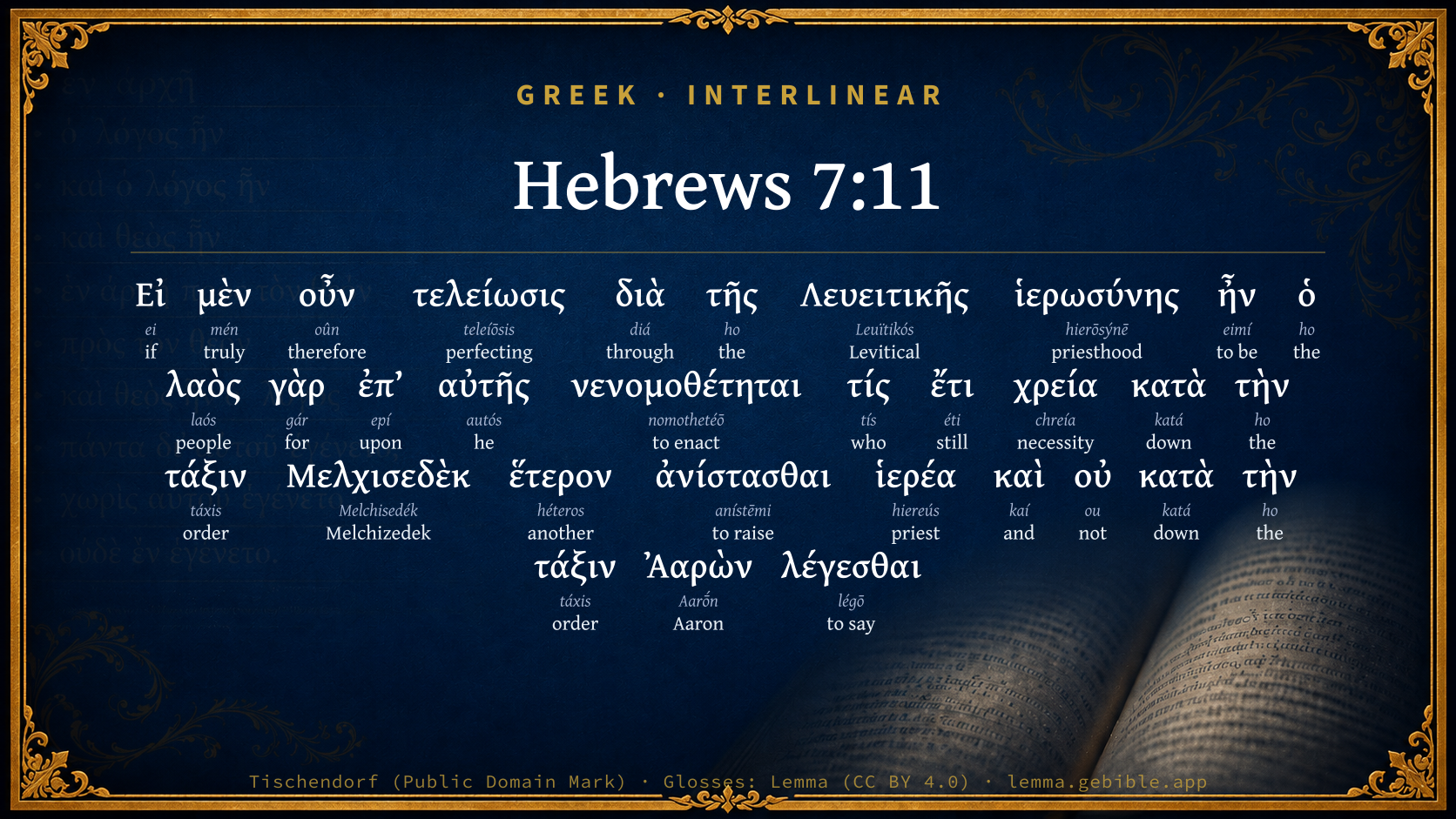
Now if there was perfection through the Levitical priesthood (for under it the people have received the law), what further need was there for another priest to arise after the order of Melchizedek, and not be called after the order of Aaron?
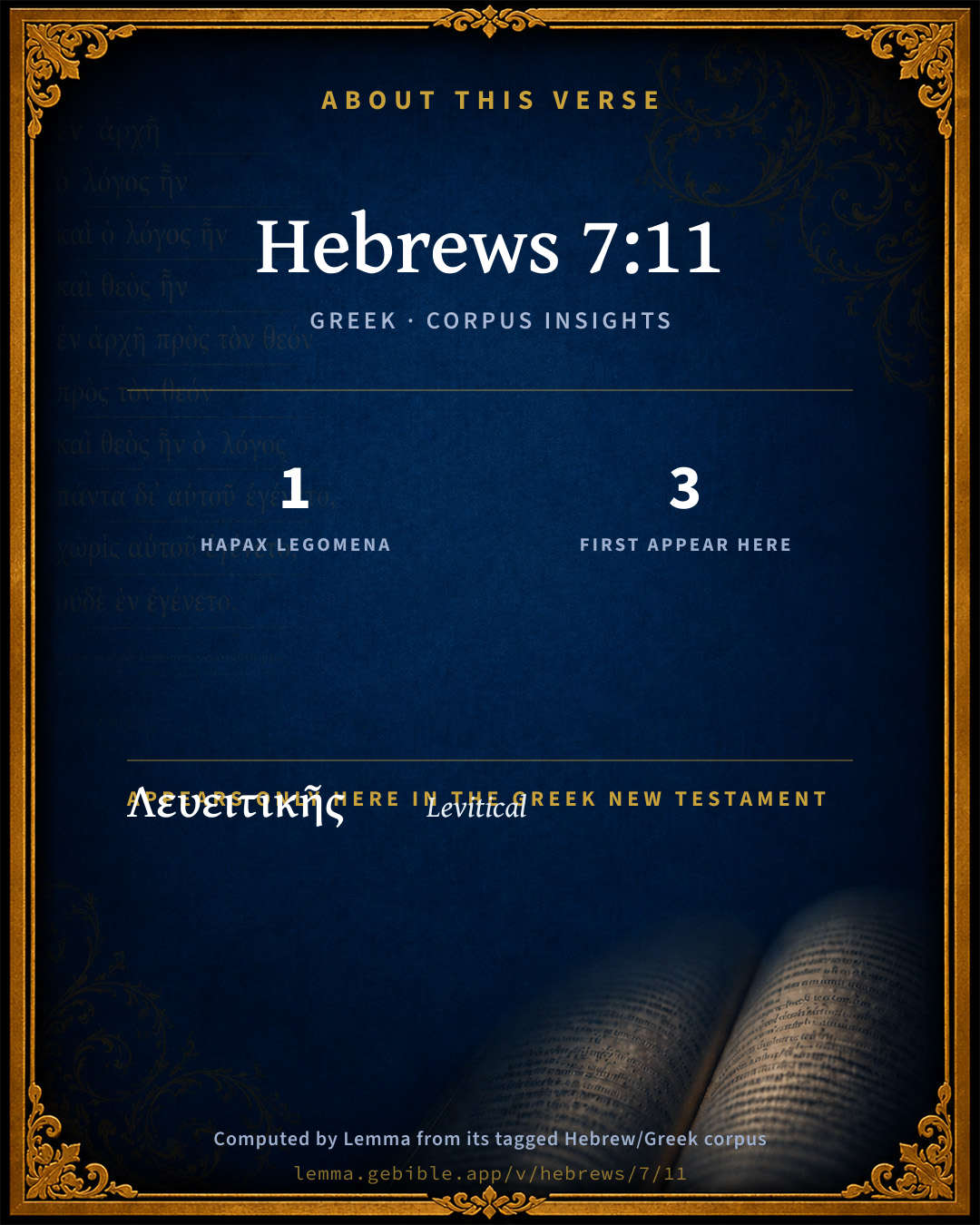
- 1 hapax legomenon — only here in the Greek New Testament
- 3 first appearances in the Greek New Testament
Download a study sheet
One document with this verse’s original text, its word-by-word gloss line, the meaning frame, cross-references with their text, attributed commentary, and full source and license credits — printable, and it pastes into notes with its structure intact.
This verse Autodidact and up
A passage Seminary Student
Up to 50 verses in one chapter. A passage sheet keeps up to 6 commentary sources and 12 cross-references per verse, in the order this page ranks them, and says so on the sheet whenever that leaves anything out. Ask for a single verse and you get the Autodidact verse sheet above.
Everything on this page stays free to read, with no account — the sheet is a download of what is already on screen, not access to it.
Compare translations 3
The same verse in 3 English versions, stacked beneath the original-language interlinear above. Click any original word for its lexicon entry.
Each is an independent rendering of the whole verse — the interlinear is not word-aligned to these translations.
Highlighted words mark where these versions differ — a whole-verse word diff, not a word-by-word alignment.
-
World English Bible Public Domain
Now if there was perfection through the Levitical priesthood (for under it the people have received the law), what further need was there for another priest to arise after the order of Melchizedek, and not be called after the order of Aaron?
-
King James Version Public Domain
If therefore perfection were by the Levitical priesthood, (for under it the people received the law,) what further need was there that another priest should rise after the order of Melchisedec, and not be called after the order of Aaron?
-
unfoldingWord Literal Text CC BY-SA 4.0
If indeed then, perfection was through the Levitical priesthood (for on the basis of it the people had been given ), what further need for another priest to arise according to the order of Melchizedek and to not be said according to the order of Aaron?
unfoldingWord Literal Text — © unfoldingWord, licensed CC BY-SA 4.0. Word-aligned USFM3 via Door43 (git.door43.org/unfoldingWord/en_ult).
Show all 19 translations
Every available English version of this verse, each an independent rendering of the whole verse.
-
World English Bible Public Domain
Now if there was perfection through the Levitical priesthood (for under it the people have received the law), what further need was there for another priest to arise after the order of Melchizedek, and not be called after the order of Aaron?
-
Berean Standard Bible Public Domain
Now if perfection could have been attained through the Levitical priesthood (for on this basis the people received the law), why was there still need for another priest to appear—one in the order of Melchizedek and not in the order of Aaron?
-
Majority Standard Bible Public Domain
Now if perfection could have been attained through the Levitical priesthood (for on this basis the people received the law), why was there still need for another priest to appear—one in the order of Melchizedek and not in the order of Aaron?
-
King James Version Public Domain
If therefore perfection were by the Levitical priesthood, (for under it the people received the law,) what further need was there that another priest should rise after the order of Melchisedec, and not be called after the order of Aaron?
-
American Standard Version (1901) Public Domain
Now if there was perfection through the Levitical priesthood (for under it hath the people received the law), what further need `was there' that another priest should arise after the order of Melchizedek, and not be reckoned after the order of Aaron?
-
Revised Version (1885) Public Domain
Now if there was perfection through the Levitical priesthood (for under it hath the people received the law), what further need was there that another priest should arise after the order of Melchizedek, and not be reckoned after the order of Aaron?
-
Geneva Bible (1599) Public Domain
If therefore perfection had bene by the Priesthoode of the Leuites (for vnder it the Lawe was established to the people) what needed it furthermore, that another Priest should rise after the order of Melchi-sedec, and not to be called after the order of Aaron?
-
Douay-Rheims (1899) Public Domain
If then perfection was by the Levitical priesthood, (for under it the people received the law,) what further need was there that another priest should rise according to the order of Melchisedech, and not be called according to the order of Aaron?
-
Young's Literal Translation Public Domain
If indeed, then, perfection were through the Levitical priesthood -- for the people under it had received law -- what further need, according to the order of Melchisedek, for another priest to arise, and not to be called according to the order of Aaron?
-
Literal Standard Version CC BY-SA 4.0
If indeed, then, perfection were through the Levitical priesthood—for the people under it had received law—what further need, according to the order of Melchizedek, for another priest to arise, and not to be called according to the order of Aaron?
-
Unlocked Literal Bible CC BY-SA 4.0
Now if perfection were possible through the Levitical priesthood (for under it the people received the law), what further need would there have been for another priest to arise after the manner of Melchizedek, and not be considered to be after the manner of Aaron?
-
unfoldingWord Literal Text CC BY-SA 4.0
If indeed then, perfection was through the Levitical priesthood (for on the basis of it the people had been given ), what further need for another priest to arise according to the order of Melchizedek and to not be said according to the order of Aaron?
-
Darby Bible Public Domain
If indeed then perfection were by the Levitical priesthood, for the people had their law given to them in connexion with *it*, what need [was there] still that a different priest should arise according to the order of Melchisedec, and not be named after the order of Aaron?
-
World Messianic Bible Public Domain
Now if perfection was through the Levitical priesthood (for under it the people have received the law), what further need was there for another priest to arise after the order of Melchizedek, and not be called after the order of Aaron?
-
Webster's Bible Public Domain
If therefore perfection were by the Levitical priesthood (for under it the people received the law) what further need was there that another priest should rise after the order of Melchisedec, and not be called after the order of Aaron?
-
Free Bible Version CC BY-SA 4.0
Now if perfection could have been achieved through the priesthood of Levi (for that's how the law was received), what was the need for another priest to come following the order of Melchizedek, and not following the order of Aaron?
-
Bible in Basic English Public Domain
Now if it was possible for things to be made complete through the priests of the house of Levi (for the law was given to the people in connection with them), what need was there for another priest who was of the order of Melchizedek and not of the order of Aaron?
-
Text-Critical English NT CC BY 4.0
Now if perfection had been attainable through the Levitical priesthood (for under this priesthood the people received the law), what further need would there have been for another priest to arise according to the order of Melchizedek rather than the order of Aaron?
-
Tyndale New Testament (1534) Public Domain
Yf now therfore perfeccion came by the presthod of the levites (for vnder that presthod the people recaved the lawe) what neded it furthermore that an other prest shuld ryse after the order of Melchisedech and not after the order of Aaron?
Literal Standard Version (2020), Covenant Press — licensed CC BY-SA 4.0. Text via the HelloAO Bible API (eBible.org). Unlocked Literal Bible (unfoldingWord) — licensed CC BY-SA 4.0. Text via the HelloAO Bible API (eBible.org). unfoldingWord Literal Text — © unfoldingWord, licensed CC BY-SA 4.0. Word-aligned USFM3 via Door43 (git.door43.org/unfoldingWord/en_ult). Free Bible Version, Dr. Jonathan Gallagher — licensed CC BY-SA 4.0. Text via the HelloAO Bible API (eBible.org).
Word by word
More ways to search: Search by grammar → Find every occurrence → Compare this word →
Practice this passage: Drill this verse → Learn its vocabulary →
- Appears 1× in the Greek New Testament
- First appears here
- Part of Speech
- Adjective
- Case
- Genitive
- Number
- Singular
- Gender
- Feminine
Full Thayer's Definition
- Εἰ ei G1487 “if” Conditional
- μὲν mén G3303 “truly” Particle
- οὖν oûn G3767 “therefore” Conjunction
- τελείωσις teleíōsis G5050 “perfecting” Noun, Nominative, Singular, Feminine
- διὰ diá G1223 “through” Preposition
- τῆς ho G3588 “the” Article, Genitive, Singular, Feminine
- Λευειτικῆς Leuïtikós G3020 “Levitical” Adjective, Genitive, Singular, Feminine
- ἱερωσύνης hierōsýnē G2420 “priesthood” Noun, Genitive, Singular, Feminine
- ἦν eimí G1510 “to be” Verb, Imperfect, Active, Indicative, 3rd person, Singular
- ὁ ho G3588 “the” Article, Nominative, Singular, Masculine
- λαὸς laós G2992 “people” Noun, Nominative, Singular, Masculine
- γὰρ gár G1063 “for” Conjunction
- ἐπ’ epí G1909 “upon” Preposition
- αὐτῆς autós G846 “he” Personal pronoun, Genitive, Singular, Feminine
- νενομοθέτηται nomothetéō G3549 “to enact” Verb, Perfect, Passive, Indicative, 3rd person, Singular
- τίς tís G5101 “who” Interrogative pronoun, Nominative, Singular, Feminine
- ἔτι éti G2089 “still” Adverb
- χρεία chreía G5532 “necessity” Noun, Nominative, Singular, Feminine
- κατὰ katá G2596 “down” Preposition
- τὴν ho G3588 “the” Article, Accusative, Singular, Feminine
- τάξιν táxis G5010 “order” Noun, Accusative, Singular, Feminine
- Μελχισεδὲκ Melchisedék G3198 “Melchizedek” Noun, Proper, indeclinable
- ἕτερον héteros G2087 “another” Adjective, Accusative, Singular, Masculine
- ἀνίστασθαι anístēmi G450 “to raise” Verb, Present, Middle, Infinitive
- ἱερέα hiereús G2409 “priest” Noun, Accusative, Singular, Masculine
- καὶ kaí G2532 “and” Conjunction
- οὐ ou G3756 “not” Particle, Negative
- κατὰ katá G2596 “down” Preposition
- τὴν ho G3588 “the” Article, Accusative, Singular, Feminine
- τάξιν táxis G5010 “order” Noun, Accusative, Singular, Feminine
- Ἀαρὼν Aarṓn G2 “Aaron” Noun, Proper, indeclinable
- λέγεσθαι légō G3004 “to say” Verb, Present, Passive, Infinitive
About this verse
These counts appear in no published source. They are computed here, from the morphology-tagged text and Lemma’s own curated glosses. What Lemma adds →
- 32
- words
- 27
- distinct lemmas
- General Epistles
- section
Notable vocabulary
1 hapax legomenon — a word that appears only here in the entire Greek New Testament:
- Λευειτικῆς Levitical G3020
First appearance in Scripture
These words make their first canonical appearance in the Greek New Testament here:
Shared distinctive vocabulary
τελείωσις perfecting G5050 occurs in 2 verses of the Greek New Testament. Also found in:
Cross-references
13Topical passages linked to Hebrews 7:11 in the Treasury of Scripture Knowledge — connected by theme and wording, ordered by reader-vote popularity; previews shown in the World English Bible.
- Hebrews 8:7 For if that first covenant had been faultless, then no place would have been sought for a second.
- Galatians 2:21 I don't make void the grace of God. For if righteousness is through the law, then Christ died for nothing!"
- Galatians 4:9 But now that you have come to know God, or rather to be known by God, why do you turn back again to the weak and miserable elements, to which you desire to be in bondage all over again?
- Hebrews 7:17–19 for it is testified, "You are a priest forever, According to the order of Melchizedek."
- Hebrews 5:6 As he says also in another place, "You are a priest forever, After the order of Melchizedek."
- Hebrews 7:15 This is yet more abundantly evident, if after the likeness of Melchizedek there arises another priest,
- Hebrews 7:21 (for they indeed have been made priests without an oath), but he with an oath by him that says of him, "The Lord swore and will not change his mind, 'You are a priest forever, According to the order of Melchizedek'".
- Hebrews 8:10–13 "For this is the covenant that I will make with the house of Israel. After those days," says the Lord; "I will put my laws into their mind, I will also write them on their heart. I will be to them a God, And they will be to me a people.
- Galatians 4:3 So we also, when we were children, were held in bondage under the elements of the world.
- Colossians 2:10–17 and in him you are made full, who is the head of all principality and power;
- Hebrews 5:10 named by God a high priest after the order of Melchizedek.
- Hebrews 6:20 where as a forerunner Jesus entered for us, having become a high priest forever after the order of Melchizedek.
- Hebrews 10:1–4 For the law, having a shadow of the good to come, not the very image of the things, can never with the same sacrifices year by year, which they offer continually, make perfect those who draw near.
Cross-references courtesy of OpenBible.info (CC BY 4.0).
Lesson kit
Teaching starters — assembled from the data on this page, not authored interpretation. Every prompt links to the verse data it draws on. Edit before teaching.
Hebrews, in the General Epistles, opens this verse with 32 words (27 distinct Greek lemmas). Its most distinctive word is Leuïtikós (“Levitical”). A historical commentator’s framing appears above. Read the whole chapter for the surrounding context.
Discussion questions
- The word Leuïtikós carries the sense “Levitical.” How does it shape the verse?
- 1 word here appears nowhere else in the Greek New Testament. Why might the author reach for such rare wording?
- 3 words make their first appearance in Scripture here. What does this debut establish?
- How does Luke 1:45, which shares the word «perfecting», read alongside this verse?
- What does the repetition of “down” (2× in this one verse) do in this verse?
- These translations render this verse differently. What is at stake in choosing one wording over another?
- Compare how Matthew Henry's Commentary and The Biblical Illustrator read this verse. Where do they agree or differ?
Things to notice
- 1 word in this verse appears nowhere else in the Greek New Testament.
- 3 words make their first canonical appearance in Scripture here.
- These translations choose different wording for 22 words in this verse.
- “down” occurs 2× in this single verse.
- 27 distinct Greek lemmas span 32 words in this verse.
Commentary
Notes on Hebrews 7:11 from classic Christian and Jewish commentators (each source and its license shown beneath its notes). The classic Christian expositions comment on the surrounding passage and are grouped to its opening verse, so a note may address several verses; the Jewish commentaries on the Tanakh (Rashi and others) are per-verse, so they appear only where the commentator wrote on this verse.
Lemma curates 59 commentaries, every one of them public domain or Creative Commons licensed, each selected and text-cleaned for this edition rather than reprinted as found. About our sources →
Matthew Henry's Commentary
Matthew Henry's Commentary on the Whole Bible (1708–1710) — public domain (CC PDM 1.0). Text via the HelloAO Bible API.
The Biblical Illustrator
Joseph S. Exell
The Biblical Illustrator, edited by Joseph S. Exell (c. 1880s–1900s) — public domain. Text from a community e-Sword module.
Joseph Benson's Commentary
Joseph Benson's Commentary on the Old and New Testaments (1811–1818) — public domain. Text from a community e-Sword module.
The Preacher's Complete Homiletical Commentary
Joseph S. Exell (gen. ed.)
The Preacher's Complete Homiletical Commentary (gen. ed. Joseph S. Exell; Funk & Wagnalls, c. 1892) — public domain (pre-1929). A full-Bible homiletical/sermon-outline anthology covering 65 of 66 books (2 John is absent from the source module). Text from a community e-Sword module.
Lange's Commentary on the Holy Scriptures
Lange's Commentary on the Holy Scriptures (Critical, Doctrinal, and Homiletical), ed. John Peter Lange, English translation edited by Philip Schaff (1864–1880) — public domain. Text from a community e-Sword module.
Tyndale Open Study Notes
Tyndale Open Resources
Tyndale Open Study Notes — © Tyndale Open Resources, licensed CC BY-SA 4.0. Text via the HelloAO Bible API.
Bengel's Gnomon
Johann Albrecht Bengel
Bengel's Gnomon of the New Testament — English translation (T&T Clark, Edinburgh, 1860) — public domain. Text from a community e-Sword module.
Meyer's Critical & Exegetical Commentary
Heinrich August Wilhelm Meyer
Meyer — Critical and Exegetical Commentary on the New Testament — English translation by Peter Christie, edited by Frederick Crombie (T&T Clark, 1880) — public domain. Text from a community e-Sword module.
Expositor's Greek Testament
ed. W. Robertson Nicoll
The Expositor's Greek Testament, edited by W. Robertson Nicoll (1897–1910) — public domain. Text from a community e-Sword module.
Geneva Bible (1599)
Geneva Bible translators
Geneva Bible (1599) marginal notes — public domain. Text via Bolls.life.
Jamieson, Fausset & Brown
Robert Jamieson, A. R. Fausset & David Brown
Jamieson, Fausset & Brown — Commentary Critical and Explanatory on the Whole Bible (1871) — public domain (CC PDM 1.0). Text via the HelloAO Bible API.
Adam Clarke's Commentary
Adam Clarke's Commentary on the Bible (1810–1826) — public domain. Text from a community e-Sword/MySword module.
John Calvin's Commentaries
John Calvin's Commentaries (1540-1563) — public domain. Text from the Calvin Translation Society English edition (1840s-50s) via the Christian Classics Ethereal Library (ccel.org). Calvin's coverage is partial (roughly two-thirds of the Bible); uncommented books and verses are honest gaps, never fabricated. The 19th-century editor's footnotes and remarks are omitted so the notes are faithfully Calvin's own voice.
Ellicott's Commentary for English Readers
A Bible Commentary for English Readers, edited by Charles John Ellicott (1878–1897) — public domain. Text from a community e-Sword module.
The Cambridge Bible for Schools and Colleges
gen. ed. J. J. S. Perowne
The Cambridge Bible for Schools and Colleges (gen. ed. J. J. S. Perowne; Cambridge University Press, 1878–1918) — public domain. Text from a community e-Sword module.
John Gill's Exposition
John Gill's Exposition of the Whole Bible (1746–1763) — public domain (CC PDM 1.0). Text via the HelloAO Bible API.
Trapp's Complete Commentary
John Trapp
John Trapp, A Commentary or Exposition upon All the Books of the Old and New Testament (1647–1656) — public domain. Text from a community e-Sword module.
Albert Barnes' Notes on the Bible
Albert Barnes' Notes on the Bible (1834–1885) — public domain. Text from a community e-Sword/MySword module.
Matthew Poole's English Annotations
Matthew Poole's English Annotations on the Holy Bible (1683–1685) — public domain. Text from a community e-Sword/MySword module.
Whedon's Commentary on the Bible
Daniel D. Whedon
Daniel D. Whedon (gen. ed.), Commentary on the Old and New Testaments (1874–1909) — public domain. Text from a community e-Sword module.
The Pulpit Commentary
The Pulpit Commentary (1880–1919), ed. H.D.M. Spence-Jones & Joseph S. Exell — public domain. Text from a community e-Sword module.
John Wesley's Explanatory Notes
John Wesley, Explanatory Notes Upon the Whole Bible (1754–1765) — public domain. Text via the GEBible commentary corpus.
Kretzmann's Popular Commentary
Paul E. Kretzmann
Paul E. Kretzmann, Popular Commentary of the Bible (1921–1924) — public domain. Text from a community e-Sword module.
Burkitt's Expository Notes on the New Testament
William Burkitt
William Burkitt's Expository Notes on the New Testament (1700–1703) — public domain. Text from a community e-Sword module.
The People's New Testament
B. W. Johnson
B. W. Johnson's The People's New Testament with Notes (1889–1891) — public domain. Electronic text from the Christian Classics Ethereal Library (CCEL) ThML edition.
unfoldingWord translationNotes
Door43 World Missions Community
unfoldingWord translationNotes — © Distant Shores Media and the Door43 World Missions Community, licensed CC BY-SA 4.0. Source: git.door43.org/Door43/en_tn.
Cambridge Greek Testament for Schools and Colleges
Cambridge Greek Testament for Schools and Colleges (Cambridge University Press, 1896; 21 vols, various authors incl. Carr, Maclear, Plummer, Farrar, Lumby, Moule, M. R. James, Simcox) — public domain. Text from a community e-Sword module.
Alford’s Greek Testament
Henry Alford
Henry Alford, The Greek Testament (1849–1861) — public domain. Text from a community e-Sword module.
Vincent's Word Studies in the New Testament
Marvin R. Vincent
Marvin R. Vincent, Word Studies in the New Testament (1887–1900) — public domain. Text from a community e-Sword/MySword module.
Westcott on Hebrews & the Epistles of John
Brooke Foss Westcott
Brooke Foss Westcott (1825–1901), The Epistle to the Hebrews (1889) and The Epistles of St John (1883) — public domain (pre-1929). Text recovered from Internet Archive / Google Books OCR scans. Westcott’s Gospel of John commentary is not included (its OCR lost the chapter running-heads required for reliable verse-keying). Some Greek quoted in the Hebrews volume is imperfectly rendered by the OCR.