Hebrews 11:10

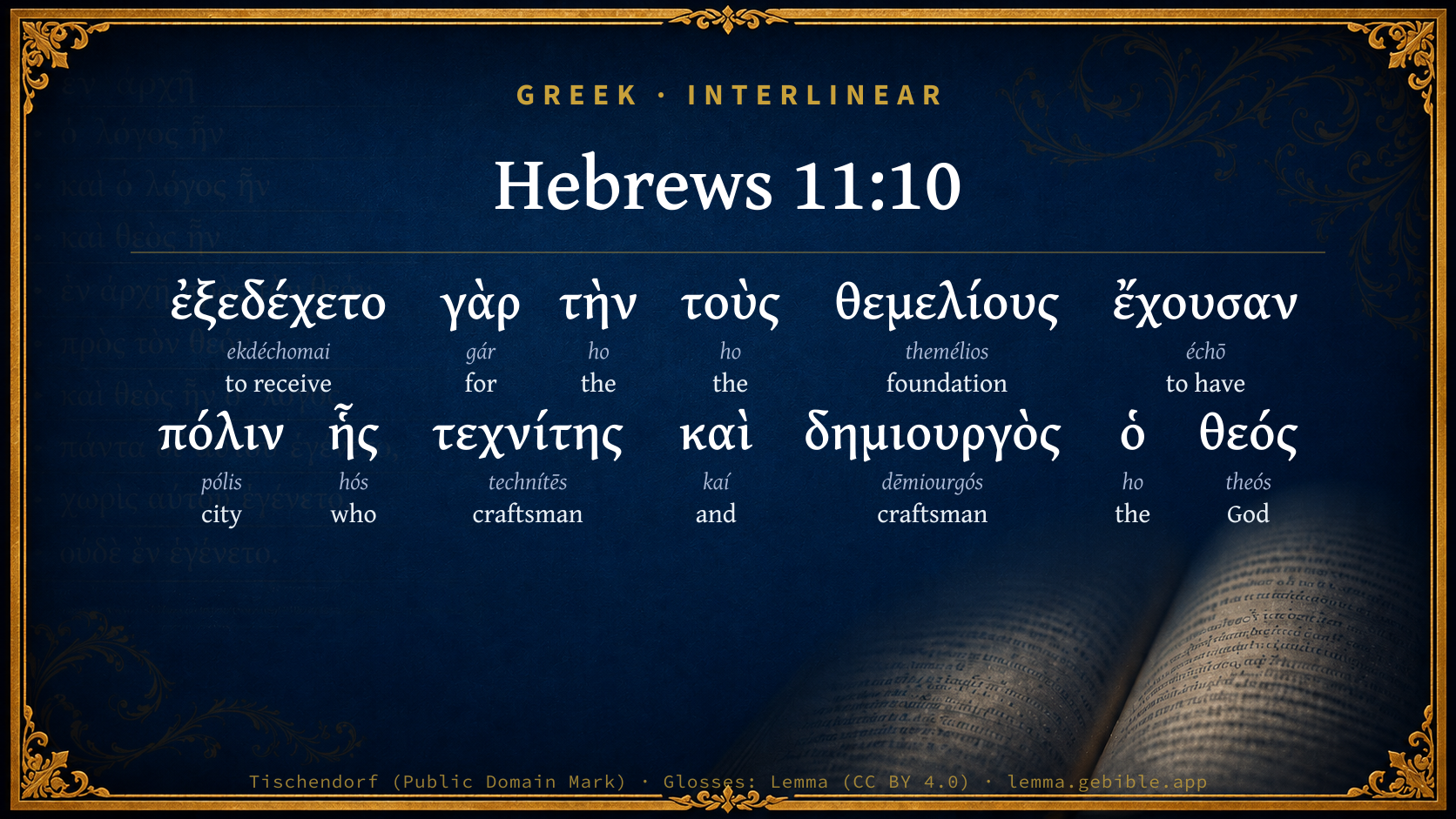
Greek (Tischendorf 8th ed.) Hebrews 11:10 appears in the Greek New Testament. The text above is from the Tischendorf 8th edition. Each word links to its Strong’s number and a concise gloss. Click any word for its full Thayer’s Greek Lexicon entry.
Download image
Cite this verse

Hebrews 11:10 (World English Bible). Public Domain. Lemma interlinear Bible study tool, https://lemma.gebible.app/v/hebrews/11/10.

Show BibTeX & RIS
BibTeX
RIS
English Translation
For he looked for the city which has the foundations, whose builder and maker is God.
World English Bible · Public Domain
Highlights
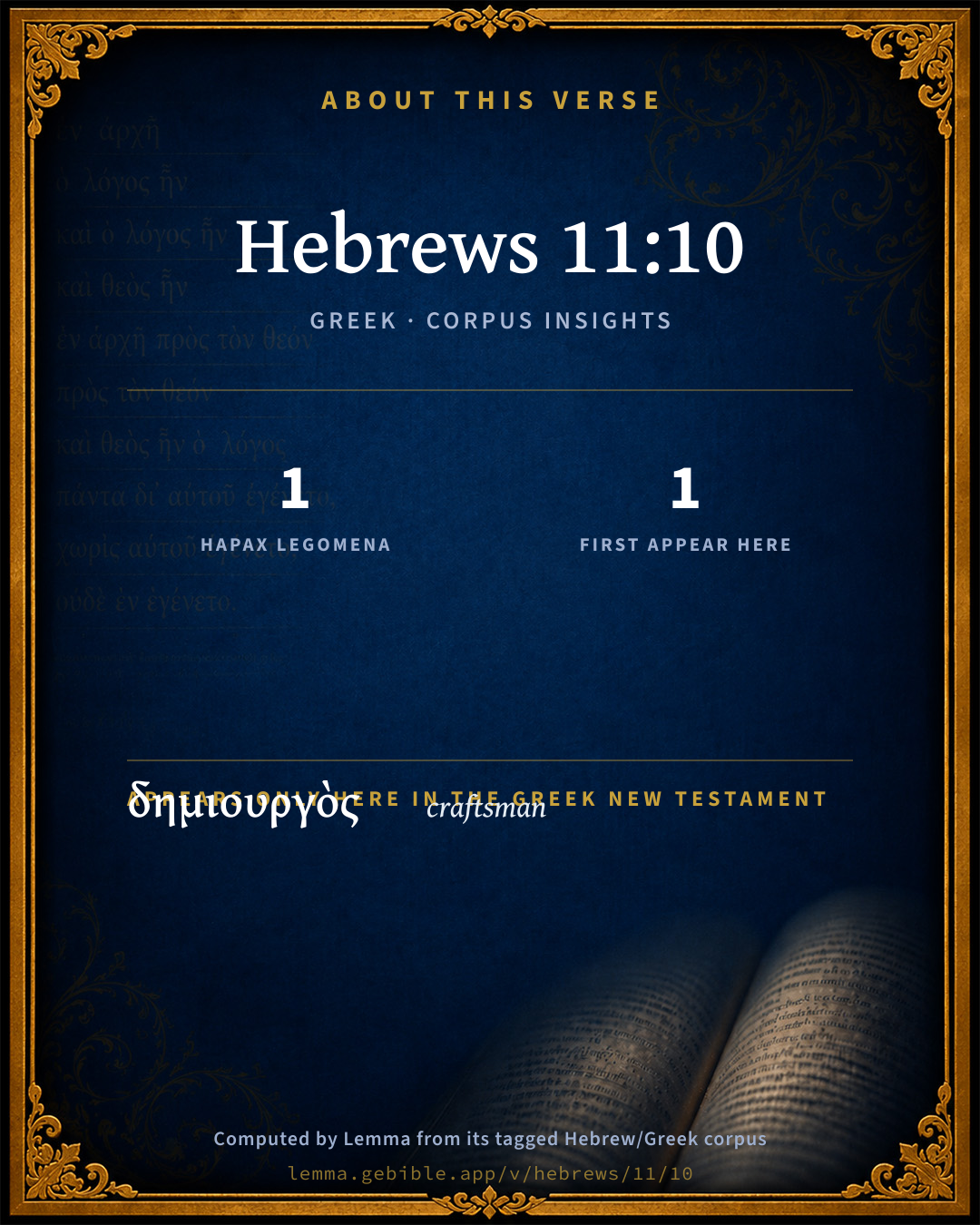
  • 1 hapax legomenon — only here in the Greek New Testament
  • 1 first appearance in the Greek New Testament
Full analysis ↓
Download a study sheet

One document with this verse’s original text, its word-by-word gloss line, the meaning frame, cross-references with their text, attributed commentary, and full source and license credits — printable, and it pastes into notes with its structure intact.

This verse Autodidact and up

Study sheet (.html) Plain text (.txt)

A passage Seminary Student

Up to 50 verses in one chapter. A passage sheet keeps up to 6 commentary sources and 12 cross-references per verse, in the order this page ranks them, and says so on the sheet whenever that leaves anything out. Ask for a single verse and you get the Autodidact verse sheet above.

Everything on this page stays free to read, with no account — the sheet is a download of what is already on screen, not access to it.

Want to remove ads? Support Godless Engineer
Compare translations 3

The same verse in 3 English versions, stacked beneath the original-language interlinear above. Click any original word for its lexicon entry.

Each is an independent rendering of the whole verse — the interlinear is not word-aligned to these translations.

Highlighted words mark where these versions differ — a whole-verse word diff, not a word-by-word alignment.

  • World English Bible Public Domain
    For he looked for the city which has the foundations, whose builder and maker is God.
  • King James Version Public Domain
    For he looked for a city which hath foundations, whose builder and maker is God.
  • unfoldingWord Literal Text CC BY-SA 4.0
    for he was waiting for the city having foundations, whose architect and builder God.

unfoldingWord Literal Text — © unfoldingWord, licensed CC BY-SA 4.0. Word-aligned USFM3 via Door43 (git.door43.org/unfoldingWord/en_ult).

Versions to compare (up to 4)

3 of 4 selected

Show all 19 translations

Every available English version of this verse, each an independent rendering of the whole verse.

  • World English Bible Public Domain
    For he looked for the city which has the foundations, whose builder and maker is God.
  • Berean Standard Bible Public Domain
    For he was looking forward to the city with foundations, whose architect and builder is God.
  • Majority Standard Bible Public Domain
    For he was looking forward to the city with foundations, whose architect and builder is God.
  • King James Version Public Domain
    For he looked for a city which hath foundations, whose builder and maker is God.
  • American Standard Version (1901) Public Domain
    for he looked for the city which hath the foundations, whose builder and maker is God.
  • Revised Version (1885) Public Domain
    for he looked for the city which hath the foundations, whose builder and maker is God.
  • Geneva Bible (1599) Public Domain
    For he looked for a citie hauing a foundation, whose builder and maker is God.
  • Douay-Rheims (1899) Public Domain
    For he looked for a city that hath foundations; whose builder and maker is God.
  • Young's Literal Translation Public Domain
    for he was looking for the city having the foundations, whose artificer and constructor `is' God.
  • Literal Standard Version CC BY-SA 4.0
    for he was looking for the city having the foundations, whose craftsman and constructor [is] God.
  • Unlocked Literal Bible CC BY-SA 4.0
    For he was looking forward to the city with foundations, whose architect and builder is God.
  • unfoldingWord Literal Text CC BY-SA 4.0
    for he was waiting for the city having foundations, whose architect and builder God.
  • Darby Bible Public Domain
    for he waited for the city which has foundations, of which God is [the] artificer and constructor.
  • World Messianic Bible Public Domain
    For he was looking for the city which has foundations, whose builder and maker is God.
  • Webster's Bible Public Domain
    For he looked for a city which hath foundations, whose builder and maker is God.
  • Free Bible Version CC BY-SA 4.0
    For Abraham was looking forward to a city built on foundations that last, with God as its builder and maker.
  • Bible in Basic English Public Domain
    For he was looking for the strong town, whose builder and maker is God.
  • Text-Critical English NT CC BY 4.0
    For he was looking forward to the city that has foundations, whose designer and builder is God.
  • Tyndale New Testament (1534) Public Domain
    For he loked for a citie havinge a foundacion whose bylder and maker is God.

Literal Standard Version (2020), Covenant Press — licensed CC BY-SA 4.0. Text via the HelloAO Bible API (eBible.org). Unlocked Literal Bible (unfoldingWord) — licensed CC BY-SA 4.0. Text via the HelloAO Bible API (eBible.org). unfoldingWord Literal Text — © unfoldingWord, licensed CC BY-SA 4.0. Word-aligned USFM3 via Door43 (git.door43.org/unfoldingWord/en_ult). Free Bible Version, Dr. Jonathan Gallagher — licensed CC BY-SA 4.0. Text via the HelloAO Bible API (eBible.org).

Word by word

More ways to search: Search by grammar → Find every occurrence → Compare this word →

Practice this passage: Drill this verse → Learn its vocabulary →

δημιουργὸς
dēmiourgós
G1217
“craftsman”
Noun, Nominative, Singular, Masculine
Part of Speech
Noun
Case
Nominative
Number
Singular
Gender
Masculine
Full Thayer's Definition

Origin: from G1218 and G2041

TDNT: 03:02,1

1. a workman for the public 2. the author of any work, an artisan, framer, builder
  1. ἐξεδέχετο ekdéchomai G1551 “to receive” Verb, Imperfect, Middle or Passive deponent, Indicative, 3rd person, Singular
  2. γὰρ gár G1063 “for” Conjunction
  3. τὴν ho G3588 “the” Article, Accusative, Singular, Feminine
  4. τοὺς ho G3588 “the” Article, Accusative, Plural, Masculine
  5. θεμελίους themélios G2310 “foundation” Noun, Accusative, Plural, Masculine
  6. ἔχουσαν échō G2192 “to have” Verb, Present, Active, Participle, Accusative, Singular, Feminine
  7. πόλιν pólis G4172 “city” Noun, Accusative, Singular, Feminine
  8. ἧς hós G3739 “who” Relative pronoun, Genitive, Singular, Feminine
  9. τεχνίτης technítēs G5079 “craftsman” Noun, Nominative, Singular, Masculine
  10. καὶ kaí G2532 “and” Conjunction
  11. ὁ ho G3588 “the” Article, Nominative, Singular, Masculine
  12. θεός theós G2316 “God” Noun, Nominative, Singular, Masculine

About this verse

These counts appear in no published source. They are computed here, from the morphology-tagged text and Lemma’s own curated glosses. What Lemma adds →

13
words
11
distinct lemmas
General Epistles
section

Notable vocabulary

1 hapax legomenon — a word that appears only here in the entire Greek New Testament:

  • δημιουργὸς craftsman G1217

First appearance in Scripture

This word makes its first canonical appearance in the Greek New Testament here:

  • δημιουργὸς craftsman G1217

Shared distinctive vocabulary

τεχνίτης craftsman G5079 occurs in 4 verses of the Greek New Testament. Also found in:

Repetition

A word recurs within this verse:

Cross-references

10

Topical passages linked to Hebrews 11:10 in the Treasury of Scripture Knowledge — connected by theme and wording, ordered by reader-vote popularity; previews shown in the World English Bible.

  • Hebrews 13:14 For we don't have here an enduring city, but we seek that which is to come.
  • Philippians 3:20 For our citizenship is in heaven, from where we also wait for a Savior, the Lord Jesus Christ;
  • 2 Corinthians 5:1 For we know that if the earthly house of our tent is dissolved, we have a building from God, a house not made with hands, eternal, in the heavens.
  • Hebrews 12:22 But you have come to Mount Zion, and to the city of the living God, the heavenly Jerusalem, and to innumerable hosts of angels,
  • John 14:2 In my Father's house are many mansions. If it weren't so, I would have told you. I am going to prepare a place for you.
  • Hebrews 3:4 For every house is built by someone; but he who built all things is God.
  • Revelation 21:2 I saw the holy city, New Jerusalem, coming down out of heaven from God, made ready like a bride adorned for her husband.
  • Revelation 21:10–27 He carried me away in the Spirit to a great and high mountain, and showed me the holy city, Jerusalem, coming down out of heaven from God,
  • Hebrews 12:28 Therefore, receiving a Kingdom that can't be shaken, let us have grace, through which we serve God acceptably, with reverence and awe,
  • Isaiah 14:32 What then shall one answer the messengers of the nation? That Yahweh has founded Zion, and in her shall the afflicted of his people take refuge.

Cross-references courtesy of OpenBible.info (CC BY 4.0).

Commentary

Notes on Hebrews 11:10 from classic Christian and Jewish commentators (each source and its license shown beneath its notes). The classic Christian expositions comment on the surrounding passage and are grouped to its opening verse, so a note may address several verses; the Jewish commentaries on the Tanakh (Rashi and others) are per-verse, so they appear only where the commentator wrote on this verse.

Lemma curates 59 commentaries, every one of them public domain or Creative Commons licensed, each selected and text-cleaned for this edition rather than reprinted as found. About our sources →

Bengel's Gnomon

Johann Albrecht Bengel

Heb 11:10. Τοὺς θεμελίους, the foundations) which the tents had not. Of these foundations, see Rev 21:14.—πόλιν, a city) which is not removed (as a tent is): v. 16.—ἧς, whose) which is worthy of GOD, its founder.—τεχνίτης καὶ δημιουργὸς, [builder and maker] contriver and founder) The synonymous terms intimate, that the whole city was founded and completed by Him alone: He not only made it, but also found it [ch. Heb 9:12, εὑράμενος].

Bengel's Gnomon of the New Testament — English translation (T&T Clark, Edinburgh, 1860) — public domain. Text from a community e-Sword module.

Meyer's Critical & Exegetical Commentary

Heinrich August Wilhelm Meyer

Heb_11:10. Inner motive for the πίστει παρῴκησεν, Heb_11:9. His believing expectation was directed not so much to earthly possession, as to the possession of that which was higher and heavenly. His true home he thought not to find upon earth, but only in heaven.

τὴν τοὺς θεμελίους ἔχουσαν πόλιν] the city which has the foundations, firm and enduring city. The opposite to the tents, which form only a temporary lodging, and may be easily broken up and carried away. What is meant is not the earthly Jerusalem (Grotius, Clericus, Dindorf), to which the author, considering the excessive attachment of his readers to the earthly city of God and the earthly sanctuary, could only have alluded most unsuitably, but the archetype of the same: the heavenly city of God, the heavenly Jerusalem, of which the possession for the Christians also is as yet something future, since they will obtain a dwelling therein only at the epoch of the consummation of the Messianic kingdom. The idea of a heavenly Jerusalem was already current among the Jews; its descent to earth was expected on the arising of the Messiah. See Schöttgen, de Hieros. coelesti, in his Hor. Hebr. p. 1205 ff.; Wetstein, N. T. II. p. 229 ff.; Ewald, Comm. in Apocal. pp. 11, 307. From the Jews this conception passed over to the Christians, in so far as that which the Jews expected at the first arising of the Messiah was placed by the latter in the time of the return of Christ. Comp. further Heb_10:13-16, Heb_12:22, Heb_13:14; Gal_4:26; Rev_3:12; Rev_21:2 ff., Rev_21:10 ff.

ἧς τεχνίτης καὶ δημιουργὸς ὁ θεός] of which the designer and artificer (creator) is God. δημιουργός in the N. T. only here, as in the O. T. only 2Ma_4:1.

Meyer — Critical and Exegetical Commentary on the New Testament — English translation by Peter Christie, edited by Frederick Crombie (T&T Clark, 1880) — public domain. Text from a community e-Sword module.

Geneva Bible (1599)

Geneva Bible translators

This foundation is set against their tabernacle.

Geneva Bible (1599) marginal notes — public domain. Text via Bolls.life.

Jamieson, Fausset & Brown

Robert Jamieson, A. R. Fausset & David Brown

looked for--Greek, "he was expecting"; waiting for with eager expectation (Rom 8:19).

a city--Greek, "the city," already alluded to. Worldly Enoch, son of the murderer Cain, was the first to build his city here: the godly patriarchs waited for their city hereafter (Heb 11:16; Heb 12:22; Heb 13:14).

foundations--Greek, "the foundations" which the tents had not, nor even men's present cities have.

whose builder and maker--Greek, "designer [Eph 1:4, Eph 1:11] and master-builder," or executor of the design. The city is worthy of its Framer and Builder (compare Heb 11:16; Heb 8:2). Compare Note, see on Heb 9:12, on "found."

Jamieson, Fausset & Brown — Commentary Critical and Explanatory on the Whole Bible (1871) — public domain (CC PDM 1.0). Text via the HelloAO Bible API.

Adam Clarke's Commentary

Verse 10. For he looked for a city which hath foundations] He knew that earth could afford no permanent residence for an immortal mind, and he looked for that heavenly building of which God is the architect and owner; in a word, he lost sight of earth, that he might keep heaven in view. And all who are partakers of his faith possess the same spirit, walk by the same rule, and mind the same thing.

Whose builder and maker is God.] The word τεχνιτης signifies an architect, one who plans, calculates, and constructs a building. The word δημιουργος signifies the governor of a people; one who forms them by institutions and laws; the framer of a political constitution. God is here represented the Maker or Father of all the heavenly inhabitants, and the planner of their citizenship in that heavenly country. See Macknight.

Adam Clarke's Commentary on the Bible (1810–1826) — public domain. Text from a community e-Sword/MySword module.

John Calvin's Commentaries

10. For he looked for, etc. He gives a reason why he ascribes their patience to faith, even because they looked forward to heaven. This was indeed to see things invisible. It was no doubt a great thing to cherish in their hearts the assurance given them by God respecting the possession of the land until it was after some ages realized; yet as they did not confine their thoughts, no, not to that land, but penetrated even into heaven, it was still a clearer evidence of their faith.

He calls heaven a city that has foundations, because of its perpetuity; for in the world there is nothing but what is transitory and fading. It may indeed appear strange that he makes God the Maker of heavens as though he did not also create the earth; to this I answer, that as in earthly buildings, the hands of men make use of materials, the workmanship of God is not unfitly set in opposition to them. Now, whatever is formed by men is like its authors in instability; so also is the perpetuity of the heavenly life, it corresponds with the nature of God its founder. Moreover, the Apostle teaches us that all weariness is relieved by expectation, so that we ought never to be weary in following God.

John Calvin's Commentaries (1540-1563) — public domain. Text from the Calvin Translation Society English edition (1840s-50s) via the Christian Classics Ethereal Library (ccel.org). Calvin's coverage is partial (roughly two-thirds of the Bible); uncommented books and verses are honest gaps, never fabricated. The 19th-century editor's footnotes and remarks are omitted so the notes are faithfully Calvin's own voice.

Ellicott's Commentary for English Readers

(10) A city which hath foundations.—Rather, the city which hath the foundations. The general thought is that which we find expressed in Heb_11:14-16. There, the strangers and pilgrims are seeking for a country of their own; here, the dweller in tents is waiting for the city that hath the foundations. All these verses clearly teach that the promise as apprehended by the patriarchs was not bounded by the gift of Canaan. Of what nature their expectations of the future life may have been we cannot tell; but this they knew, that their fellowship with God and their interest in His promises would not cease with this transient life. What they saw of earthly blessing was but the earnest of some greater gift still future, and yet present through the power of their faith. The shifting tent might be Abraham’s home now, but he waited for that city which should never know change—of which alone it could be said that it hath “the foundations,” and whose Architect and Maker is God. (Comp. Psa_87:1; Revelation 21)

A Bible Commentary for English Readers, edited by Charles John Ellicott (1878–1897) — public domain. Text from a community e-Sword module.

The Cambridge Bible for Schools and Colleges

gen. ed. J. J. S. Perowne

10. a city which hath foundations] Rather, “the city which hath the foundations,” namely, “the Jerusalem above” (Gal_4:26; Heb_12:22; Heb_13:14; Rev_21:2; Rev_21:14). The same thought is frequently found in Philo. The tents of the Patriarchs had no foundations; the foundations of the City of God are of pearl and precious stone (Rev_21:14; Rev_21:19.)

builder and maker] Rather, “architect and builder.” This is the only place in the N.T. where the word demiourgos occurs. It is found also in 2Ma_4:1, and plays a large part in the vocabulary of Gnostic heretics. But God is called the “Architect” of the Universe in Philo and in Wis_13:1, “neither by considering the works did they acknowledge the workmaster.”

The Cambridge Bible for Schools and Colleges (gen. ed. J. J. S. Perowne; Cambridge University Press, 1878–1918) — public domain. Text from a community e-Sword module.

John Gill's Exposition

Through faith also Sarah herself,.... Some copies add "being barren"; and so read the Vulgate Latin, and all the Oriental versions; which is a circumstance which makes her faith appear the greater: but it is a question whether the apostle speaks of the faith of Sarah, or of Abraham; some think he speaks of Abraham's faith; and that it was through his faith that Sarah conceived; and observe, that the last clause may be rendered, "because he judged him faithful", &c. and the rather, because the apostle, both before and after, is speaking of Abraham's faith, Heb 11:8. And in Heb 11:12 mention is made only of one, even of Abraham; and in Rom 4:17 only notice is taken of Abraham's faith, respecting this matter; nor is Sarah's faith observed in the history of it, but her diffidence: but why may not Sarah be joined with Abraham, in this commendation, as well as Isaac and Jacob? and though, at first, she distrusted, yet she afterwards feared, and believed: other women are mentioned in this catalogue of believers; and they share in the same grace and privileges as men: and Sarah, being a believer, as well as Abraham,

received strength to conceive seed: sometimes "strength" itself signifies seed, as in Pro 31:3 and so to receive strength is to receive seed; which the female does from the male; hence that saying of the Jews (t), the male does not receive strength from another, but the female "receiveth strength" from another; but here it is to be understood of receiving power from God to retain seed, received from men, and conceive by it; which Sarah, in her circumstances, without the interposition of the almighty power, could never have done. The nymph Anobret is so called, in imitation of this conception of Sarah's; or as she is called in the Phoenician language, , which signifies "conceiving by grace": as this conception must be entirely ascribed to the power and grace of God:

and was delivered of a child when she was past age; of bearing and bringing forth children, being ninety years of age, Gen 17:17. Now though the conception, bearing, and bringing forth of children are things natural, ordinary, and common, yet here was a particular promise respecting this matter; and there were great difficulties in nature attending it, and such as to reason were insuperable; but these were got over, through the power and grace of God, and which is ascribed to faith in the faithfulness of a promising God:

because she judged him faithful who had promised; that she should have a son at the time of life; See Gill on Heb 10:23.

(t) Caphtor, fol. 21. 2.

John Gill's Exposition of the Whole Bible (1746–1763) — public domain (CC PDM 1.0). Text via the HelloAO Bible API.

Trapp's Complete Commentary

John Trapp

10 For he looked for a city which hath foundations, whose builder and maker is God.

Ver. 10. Which hath foundations] Heaven hath a foundation, earth hath none; but is hanged upon nothing, as Job speaketh. Hence things are said to be on earth, but in heaven.

Whose builder and maker] Gr. Whose cunning artificer and public workman. God hath bestowed a great deal of skill and workmanship upon the third heaven.

John Trapp, A Commentary or Exposition upon All the Books of the Old and New Testament (1647–1656) — public domain. Text from a community e-Sword module.

Albert Barnes' Notes on the Bible

For he looked for a city which hath foundations - It has been doubted to what the apostle here refers. Grotius and some others suppose, that he refers to Jerusalem, as a permanent dwelling for his posterity, in contradistinction from the unsettled mode of life which Abraham, Isaac, and Jacob led. But there is no evidence that Abraham looked forward to the building of such a city, for no promise was made to him of this kind; and this interpretation falls evidently below the whole drift of the passage; compare Heb 11:14-16; Heb 12:22; Heb 13:14. Phrases like that of “the city of God,” “a city with foundations,” “the new Jerusalem,” and “the heavenly Jerusalem” in the time of the apostle, appear to have acquired a kind of technical signification. They referred to “heaven” - of which Jerusalem, the seat of the worship of God, seems to have been regarded as the emblem. Thus, in Heb 12:22, the apostle speaks of the “heavenly Jerusalem,” and in Heb 13:14, he says, “here have we no continuing city, but we seek one to come.”

In Rev 21:2, John says that he “saw the holy city, new Jerusalem, coming down from God, out of heaven,” and proceeds in that chapter and the following to give a most beautiful description of it. Even so early as the time of Abraham, it would seem that the future blessedness of the righteous was foretold under the image of a splendid city reared on permanent foundations. It is remarkable that Moses does not mention this as an object of the faith of Abraham, and it is impossible to ascertain the degree of distinctness which this had in his view. It is probable that the apostle in speaking of his faith in this particular did not rely on any distinct record, or even any tradition, but spoke of his piety in the language which he would use to characterize religion of any age, or in any individual. He was accustomed, in common with others of his time, to contemplate the future blessedness of the righteous under the image of a beautiful city; a place where the worship of God would be celebrated for ever - a city of which Jerusalem was the most striking representation to the mind of a Jew. It was natural for him to speak of strong piety in this manner wherever it existed, and especially in such a case as that of Abraham, who left his own habitation to wander in a distant land,

This fact showed that he regarded himself as a stranger and sojourner, and yet he had a strong expectation of a fixed habitation, and a permanent inheritance. He must, therefore, have looked on to the permanent abodes of the righteous; the heavenly city; and though he had an undoubted confidence that the promised land would be given to his posterity, yet as he did not possess it himself, he must have looked for his own permanent abode to the fixed residence of the just in heaven. This passage seems to me to prove that Abraham had an expectation of future happiness after death. There is not the slightest evidence that he supposed there would be a magnificent and glorious capital where the Messiah would personally reign, and where the righteous dead, raised from their graves, would dwell in the second advent of the Redeemer. All that the passage fairly implies is, that while Abraham. expected the possession of the promised land for his posterity, yet his faith looked beyond this for a permanent home in a future world.

Whose builder and maker is God - Which would not be reared by the agency of man, but of which God was the immediate and direct architect. This shows conclusively, I think, that the reference in this allusion to the “city” is not to Jerusalem, as Grotius supposes; but the language is just such as will appropriately describe heaven, represented as a city reared without human hands or art, and founded and fashioned by the skill and power of the Deity; compare the notes on 2Co 5:1. The language here applied to God as the “architect” or framer of the universe, is often used in the classic writers. See Kuinoel and Wetstein. The apostle here commends the faith of Abraham as eminently strong. The following “hints” will furnish topics of reflection to those who are disposed to inquire more fully into its strength:

(1) The journey which he undertook was then a long and dangerous one. The distance from Haran to Palestine by a direct route was not less than four hundred miles, and this journey lay across a vast desert - a part of Arabia Deserta. That journey has always been tedious and perilous; but to see its real difficulty, we must put ourselves into the position in which the world was four thousand years ago. There was no knowledge of the way; no frequented path; no facility for traveling; no turnpike or rail-way; and such a journey then must have appeared incomparably more perilous than almost any which could now be undertaken.

(2) He was going among strangers. Who they were he knew not; but the impression could not but have been made on his mind that they were strangers to religion, and that a residence among them would be anything but desirable.

(3) He was leaving country, and home, and friends; the place of his birth and the graves of his fathers, with the moral certainty that he would see them no more.

(4) He had no right to the country which he went to receive. He could urge no claim on the ground of discovery, or inheritance, or conquest at any former period; but though he went in a peaceful manner, and with no power to take it, and could urge no claim to it whatever, yet he went with the utmost confidence that it would be his. He did not even expect to buy it - for he had no means to do this, and it seems never to have entered his mind to bargain for it in any way, except for the small portion that be needed for a burying-ground.

(5) He had no means of obtaining possession. He had no wealth to purchase it; no armies to conquer it; no title to it which could be enforced before the tribunals of the land. The prospect of obtaining it must have been distant, and probably he saw no means by which it was to be done. In such a case, his only hope could be in God.

(6) It is not impossible that the enterprise in that age might have been treated by the friends of the patriarch as perfectly wild and visionary. The prevailing religion evidently was idolatry, and the claim which Abraham set up to a special call from the Most High, might have been deemed entirely fanatical. To start off on a journey through a pathless desert; to leave his country and home, and all that he held dear, when he himself knew not whither he went; to go with no means of conquest, but with the expectation that the distant and unknown land would be given him, could not but have been regarded as a singular instance of visionary hope. The whole transaction, therefore, was in the highest degree an act of simple confidence in God, where there was no human basis of calculation, and where all the principles on which people commonly act would have led him to pursue just the contrary course. It is, therefore, not without reason that the faith of Abraham is so commended.

Albert Barnes' Notes on the Bible (1834–1885) — public domain. Text from a community e-Sword/MySword module.

Haydock's Catholic Bible Commentary

The Patriarchs, who lived to a great age, dwelt not in fixed dwellings, but in moveable tents, as pilgrims; whereas their descendants, the period of whose existence is greatly curtailed, pass their time in building and planning as if they were never to die. This earth is a place of our exile, heaven is our true country: let us then live here as strangers and pilgrims, looking forward with anxious desires for our true country, the land of the living, in the bosom of our God.

George Leo Haydock (1774–1849), Haydock's Catholic Family Bible and Commentary, 1859 edition — public domain. Excludes Psalms (Douay-Rheims chapter numbering differs from Protestant) and Deuterocanonical books (Catholic canon only).

Matthew Poole's English Annotations

The reason of this contented pilgrimage was the excellent end of it, the place and state to which it brought him; he did really discern by the Spirit’s work in him, and promise to him, his title to it, and vehemently did desire and long for, and yet patiently waited for, a better place and state than this earthly; and was daily making his approaches to it, Rom 8:19; 2Co 5:1,2,8,9.

For he looked for a city which hath foundations: πολις notes both a place made up and constituted of buildings and houses, such was the earthly Jerusalem; and a state, polity, or community. Here it must be understood spiritually, for such a place and state as is not to be shadowed out by any in this world; it being for nature, mansions, society, condition, such as no earthly can decipher, or set out. This city is heaven itself, often so styled in this Epistle, as Heb 11:16; 12:22; 13:14; Rev 3:12. It is not movable, as a tent fastened by stakes and cords; nor as creature buildings, perishable. Histories tell us of the rise and fall of the best earthly cities; this city is built on the Rock of ages, as well as by him, whose immutability, almightiness, and eternity hath laid and settled its foundations, the basis and ground work, firm and incorruptible, 1Pe 1:4.

Whose builder and maker is God; the happy fabric, with persons and state, endures for ever, because of its Raiser and Founder. The great Architect, that cast the plot and model of it in his own mind, and the publicly declared Operator and Raiser of it, who laid the foundations, reared the mansions, and finished the whole, is no less person than the infinitely wise, almighty, and eternal God. It all became him alone, and doth as far exceed other cities as God doth men. No human art or power was fit or capable for such a work, but only God.

Matthew Poole's English Annotations on the Holy Bible (1683–1685) — public domain. Text from a community e-Sword/MySword module.

Whedon's Commentary on the Bible

Daniel D. Whedon

10. For—Reason for his adventurous movement; he had a higher land in view, which regulated his course in this earthly land.

A city—Unlike this rural earthly land.

Foundations—Unlike these tents, so soon to be taken up, and so easily blown away. The city was not, as Grotius understood, the future earthly Jerusalem; but that higher and heavenly Jerusalem, the antitype of the lower. See note on Gal_4:22; Gal_4:26.

Builder— Τεχνιτης, artist, or architect. Herbert Spencer ridicules feebly the doctrine of creation by divine mind and power; styling it, wittily, as he seems to think, “the carpenter theory of creation,” as if a carpenter were a very low thing. Yet poetry, oratory, and the Bible, delight to style God the architect, builder, and maker, of the worlds.

Daniel D. Whedon (gen. ed.), Commentary on the Old and New Testaments (1874–1909) — public domain. Text from a community e-Sword module.

John Wesley's Explanatory Notes

He looked for a city which hath foundations - Whereas a tent has none. Whose builder and former is God - Of which God is the sole contriver, former, and finisher.

John Wesley, Explanatory Notes Upon the Whole Bible (1754–1765) — public domain. Text via the GEBible commentary corpus.

The People's New Testament

B. W. Johnson

10. For he looked for a city which hath foundations. Not only for a permanent home for his seed in Canaan, but for a home above in the eternal city, the New Jerusalem. Builder and maker. Architect and maker. God not only projected the plans of the eternal city but has executed them.

B. W. Johnson's The People's New Testament with Notes (1889–1891) — public domain. Electronic text from the Christian Classics Ethereal Library (CCEL) ThML edition.

Cambridge Greek Testament for Schools and Colleges

10. τὴν τοὺς θεμελίους ἔχουσαν. “The city which hath the foundations,” namely, “the Jerusalem above” (Gal 4:26; Heb 12:22; Heb 13:14; Rev 21:2; Rev 21:14). The same thought is frequently found in Philo. The tents of the Patriarchs had no foundations; the foundations of the City of God are of pearl and precious stone (Rev 21:14; Rev 21:19). There is perhaps a reference to Psa 87:1, “Her foundations are upon the holy hills.” Mr Rendall too precariously infers a contrast with the foundations of the earthly Jerusalem, shaken by the Roman engines of war.

τεχνίτης καὶ δημιουργός. “Architect and builder.” This is the only place in the N. T. where the word δημιουργὸς occurs. It is found also in 2Ma 4:1, and plays a large part in the vocabulary of Gnostic heretics, who believing in the inherent evil of matter spoke of the Demiurge as the Evil creator. But God is called the “Architect” of the Universe in Philo and in Wis 13:1, “neither by considering the works did they acknowledge the workmaster.”

Cambridge Greek Testament for Schools and Colleges (Cambridge University Press, 1896; 21 vols, various authors incl. Carr, Maclear, Plummer, Farrar, Lumby, Moule, M. R. James, Simcox) — public domain. Text from a community e-Sword module.

Alford’s Greek Testament

Henry Alford

10.] for (reason of his παροικία in the land of promise as in a strange land) he waited for (the prep. in ἐκδέχομαι, as in ἐκζητέω above, ver. 6, intensifies the expectation) the city which has the foundations (beyond doubt, the heavenly city, the ἄνω Ἱερουσαλήμ, thus contrasted with the frail and moveable tents in which the patriarchs dwelt. Delitzsch shews that the idea was an Old Testament one; and no other interpretation will suit the language here used. The πόλις θεοῦ ζῶντος of ch. 12:22, and the μέλλουσα πόλις of ch. 13:14, must be here meant also. Of the earthly Jerusalem indeed it is said, ref. Ps., οἱ θεμέλιοι αὐτοῦ ἐν τοῖς ὄρεσι τοῖς ἁγίοις: but it is impossible that the earthly Jerusalem can be meant here. The lives of the dwellers in her rather corresponded to the precarious dwelling in tents than to the abiding in a permanent city: and the true reference of τοὺς θεμελίους ἔχουσα is to be found in ref. Rev., τὸ τεῖχος τῆς πόλεως ἔχων θεμελίους δώδεκα. As having these foundations, it forms a contrast to the tent, placed on the ground, and easily transported. Ebrard objects to this view, that it is unhistoric to say that the patriarchs looked for the heavenly city: but Del. well answers, that it is not the mere historic question, what they knew and expected, with which our Writer is concerned, but the question what it was that their faith, breaking through this knowledge in its yearnings for the future, framed to itself as matter of hope. The expectation of the literal fulfilment of a promise is one thing: the hopes and prospects and surmises built upon the character of that promise, another. The one is mere belief: the other is faith), of which the architect and master-builder is God (very similarly, ch. 8:2, ἣν ἔπηξεν ὁ κύριος, οὐκ ἄνθρωπος: cf. also ver. 16 below. τεχνίτης, so ref. Wisd., οὔτε τοῖς ἔργοις προσσχόντες ἐπέγνωσαν τὸν τεχνίτην. And Philo, Leg. Alleg. i. 7, vol. i. p. 47, οὐ τεχνίτης μόνον ἀλλὰ καὶ πατὴρ ὢν τῶν γιγνομένων: De Mut. Nom. § 4, p. 583, ὁ γεννήσας καὶ τεχνιτεύσας πατήρ: ib. (of men), δημιούργημα τοῦ τῶν καλῶν καὶ ἀγαθῶν μόνου τεχνίτου. In Xen. Mem. i. 4. 7, it is said of the world, πάνυ ἔοικε ταῦτα σοφοῦ τινος δημιουργοῦ καὶ φιλοζώου τεχνήματι: and Plato, Tim. § 9, calls God δημιουργὸν τοῦ κόσμου καὶ τεκταινόμενον αὐτόν. See Wetst.).

Henry Alford, The Greek Testament (1849–1861) — public domain. Text from a community e-Sword module.

Vincent's Word Studies in the New Testament

Marvin R. Vincent

For he looked for a city which hath foundations [εξεδεχετο γαρ την τους θεμελιους εξουσαν πολιν] . The sense is impaired in A. V. by the omission of the articles, the city, the foundations. Passing over the immediate subject of God 's promise to Abraham - his inheritance of the land in which he sojourns - the writer fastens the patriarch 's faith upon the heavenly fulfillment of the promise - the perfected community of God, which, he assumes, was contained in the original promise. By the city he means the heavenly Jerusalem, and his statement is that Abraham 's faith looked forward to that. The idea of the new or heavenly Jerusalem was familiar to the Jews. See ch. Heb 12:22, Heb 13:14; Gal 4:26; Rev 3:12; Rev 21:2. The Rabbins regarded it as an actual city. For the foundations comp. Rev 21:14. In ascribing to the patriarchs an assured faith in heaven as the end and reward of their wanderings, the writer oversteps the limits of history; but evidently imports into the patriarchal faith the contents of a later and more developed faith - that of himself and his readers.

Builder and maker [τεχνιτησ και δημιουργος] Tecnithv artificer, architect. Comp. Act 19:24 (note), 38; Rev 18:22, and LXX, 1Ch 29:5; Son 7:1; Wisd. 8 6; 14 2; Sir. 9 17 Dhmiourgov N. T o, originally a workman for the public [δημος] ; generally, framer, builder. It is used by Xenophon and Plato of the maker of the world (Xen. Mem 1 4, 9; Plato, Tim 40 C; Repub. 530 A). It was appropriated by the Neo Platonists as the designation of God. To the Gnostics, the Demiurge was a limited, secondary God, who created the world; since there was no possibility of direct contact between the supreme, incommunicable God and the visible world.

Marvin R. Vincent, Word Studies in the New Testament (1887–1900) — public domain. Text from a community e-Sword/MySword module.

Lesson kit

Teaching starters — assembled from the data on this page, not authored interpretation. Every prompt links to the verse data it draws on. Edit before teaching.

Hebrews, in the General Epistles, opens this verse with 13 words (11 distinct Greek lemmas). Its most distinctive word is dēmiourgós (“craftsman”). A historical commentator’s framing appears above. Read the whole chapter for the surrounding context.

Discussion questions

  1. What does “craftsman” (dēmiourgós) contribute to the verse as a whole?
  2. 1 word here appears nowhere else in the Greek New Testament. Why might the author reach for such rare wording?
  3. This is the first place “craftsman” appears in Scripture (first appears here). What does its debut here establish?
  4. How does Acts 19:24, which shares the word «craftsman», read alongside this verse?
  5. What does the repetition of “the” (3× in this one verse) do in this verse?
  6. These translations render this verse differently; the difference is in the English rendering, not the original. What questions does that raise?
  7. Compare how Bengel's Gnomon and Meyer's Critical & Exegetical Commentary read this verse. Where do they agree or differ?

Things to notice

  • 1 word in this verse appears nowhere else in the Greek New Testament.
  • 1 word makes its first canonical appearance in Scripture here.
  • These translations choose different wording for 7 words in this verse.
  • “the” occurs 3× in this single verse.
  • 11 distinct Greek lemmas span 13 words in this verse.

Reading settings

Reading text

Shown beneath each verse's original-language words.

Old Testament
Old Testament edition

Read the OT as the Masoretic Hebrew (MT) or the Greek Septuagint (LXX).

English shown for the Greek Septuagint (in the Hebrew ↔ Greek comparison).

Comparing translations? Open the Compare panel on any verse page to stack up to four side by side.