Hebrews 13:22

Greek (Tischendorf 8th ed.) Hebrews 13:22 appears in the Greek New Testament. The text above is from the Tischendorf 8th edition. Each word links to its Strong’s number and a concise gloss. Click any word for its full Thayer’s Greek Lexicon entry.
Download image
Cite this verse

Hebrews 13:22 (World English Bible). Public Domain. Lemma interlinear Bible study tool, https://lemma.gebible.app/v/hebrews/13/22.

Show BibTeX & RIS
BibTeX
RIS
English Translation
But I exhort you, brothers, endure the word of exhortation, for I have written to you in few words.
World English Bible · Public Domain
Download a study sheet

One document with this verse’s original text, its word-by-word gloss line, the meaning frame, cross-references with their text, attributed commentary, and full source and license credits — printable, and it pastes into notes with its structure intact.

This verse Autodidact and up

Study sheet (.html) Plain text (.txt)

A passage Seminary Student

Up to 50 verses in one chapter. A passage sheet keeps up to 6 commentary sources and 12 cross-references per verse, in the order this page ranks them, and says so on the sheet whenever that leaves anything out. Ask for a single verse and you get the Autodidact verse sheet above.

Everything on this page stays free to read, with no account — the sheet is a download of what is already on screen, not access to it.

Want to remove ads? Support Godless Engineer
Compare translations 3

The same verse in 3 English versions, stacked beneath the original-language interlinear above. Click any original word for its lexicon entry.

Each is an independent rendering of the whole verse — the interlinear is not word-aligned to these translations.

Highlighted words mark where these versions differ — a whole-verse word diff, not a word-by-word alignment.

  • World English Bible Public Domain
    But I exhort you, brothers, endure the word of exhortation, for I have written to you in few words.
  • King James Version Public Domain
    And I beseech you, brethren, suffer the word of exhortation: for I have written a letter unto you in few words.
  • unfoldingWord Literal Text CC BY-SA 4.0
    Now I encourage you, brothers, bear with the word of exhortation, for only through a few I have written to you.

unfoldingWord Literal Text — © unfoldingWord, licensed CC BY-SA 4.0. Word-aligned USFM3 via Door43 (git.door43.org/unfoldingWord/en_ult).

Versions to compare (up to 4)

3 of 4 selected

Show all 19 translations

Every available English version of this verse, each an independent rendering of the whole verse.

  • World English Bible Public Domain
    But I exhort you, brothers, endure the word of exhortation, for I have written to you in few words.
  • Berean Standard Bible Public Domain
    I urge you, brothers, to bear with my word of exhortation, for I have only written to you briefly.
  • Majority Standard Bible Public Domain
    I urge you, brothers, to bear with my word of exhortation, for I have only written to you briefly.
  • King James Version Public Domain
    And I beseech you, brethren, suffer the word of exhortation: for I have written a letter unto you in few words.
  • American Standard Version (1901) Public Domain
    But I exhort you, brethren, bear with the word of exhortation, for I have written unto you in few words.
  • Revised Version (1885) Public Domain
    But I exhort you, brethren, bear with the word of exhortation: for I have written unto you in few words.
  • Geneva Bible (1599) Public Domain
    I beseeche you also, brethren, suffer the wordes of exhortation: for I haue written vnto you in fewe wordes.
  • Douay-Rheims (1899) Public Domain
    And I beseech you, brethren, that you suffer this word of consolation. For I have written to you in a few words.
  • Young's Literal Translation Public Domain
    And I entreat you, brethren, suffer the word of the exhortation, for also through few words I have written to you.
  • Literal Standard Version CC BY-SA 4.0
    And I beg you, brothers, endure the word of the exhortation, for I have also written to you through few words.
  • Unlocked Literal Bible CC BY-SA 4.0
    Now I encourage you, brothers, to bear with the word of encouragement that I have briefly written to you.
  • unfoldingWord Literal Text CC BY-SA 4.0
    Now I encourage you, brothers, bear with the word of exhortation, for only through a few I have written to you.
  • Darby Bible Public Domain
    But I beseech you, brethren, bear the word of exhortation, for it is but in few words that I have written to you.
  • World Messianic Bible Public Domain
    But I exhort you, brothers, endure the word of exhortation, for I have written to you in few words.
  • Webster's Bible Public Domain
    And I beseech you, brethren, suffer the word of exhortation: for I have written a letter to you in few words.
  • Free Bible Version CC BY-SA 4.0
    I want to encourage you, brothers and sisters, to pay attention to what I've written to you in this short letter.
  • Bible in Basic English Public Domain
    But, brothers, take kindly the words which I have said for your profit; for I have not sent you a long letter.
  • Text-Critical English NT CC BY 4.0
    Now I urge you, brothers, to bear with this brief word of exhortation that I have written to you.
  • Tyndale New Testament (1534) Public Domain
    I beseche you brethren suffre the wordes of exhortacio: For we have written vnto you in feawe wordes:

Literal Standard Version (2020), Covenant Press — licensed CC BY-SA 4.0. Text via the HelloAO Bible API (eBible.org). Unlocked Literal Bible (unfoldingWord) — licensed CC BY-SA 4.0. Text via the HelloAO Bible API (eBible.org). unfoldingWord Literal Text — © unfoldingWord, licensed CC BY-SA 4.0. Word-aligned USFM3 via Door43 (git.door43.org/unfoldingWord/en_ult). Free Bible Version, Dr. Jonathan Gallagher — licensed CC BY-SA 4.0. Text via the HelloAO Bible API (eBible.org).

Word by word

More ways to search: Search by grammar → Find every occurrence → Compare this word →

Practice this passage: Drill this verse → Learn its vocabulary →

ἐπέστειλα
epistéllō
G1989
“to write”
Verb, Aorist, Active, Indicative, 1st person, Singular
Part of Speech
Verb
Tense
Aorist
Voice
Active
Mood
Indicative
Person
1st person
Number
Singular
Full Thayer's Definition

Origin: from G1909 and G4724

TDNT: 16:53,1

1. to send one a message, command 2. to write a letter 3. to enjoin by letter, to write instructions
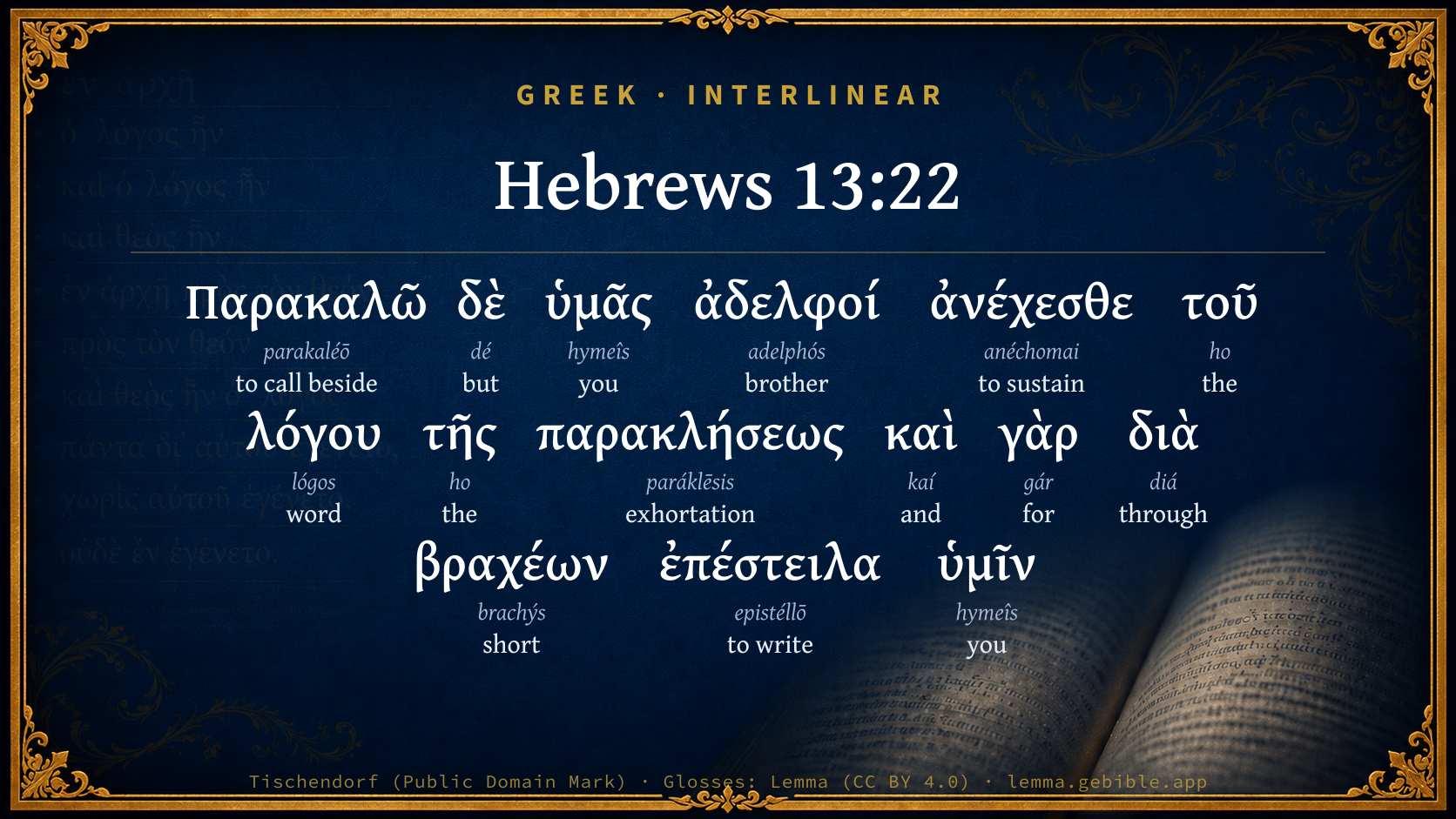
  1. Παρακαλῶ parakaléō G3870 “to call beside” Verb, Present, Active, Indicative, 1st person, Singular
  2. δὲ dé G1161 “but” Conjunction
  3. ὑμᾶς hymeîs G5210 “you” Personal pronoun, 2nd person, Accusative, Plural
  4. ἀδελφοί adelphós G80 “brother” Noun, Vocative, Plural, Masculine
  5. ἀνέχεσθε anéchomai G430 “to sustain” Verb, Present, Middle or Passive deponent, Imperative, 2nd person, Plural
  6. τοῦ ho G3588 “the” Article, Genitive, Singular, Masculine
  7. λόγου lógos G3056 “word” Noun, Genitive, Singular, Masculine
  8. τῆς ho G3588 “the” Article, Genitive, Singular, Feminine
  9. παρακλήσεως paráklēsis G3874 “exhortation” Noun, Genitive, Singular, Feminine
  10. καὶ kaí G2532 “and” Conjunction
  11. γὰρ gár G1063 “for” Conjunction
  12. διὰ diá G1223 “through” Preposition
  13. βραχέων brachýs G1024 “short” Adjective, Genitive, Plural, Neuter
  14. ὑμῖν hymeîs G5210 “you” Personal pronoun, 2nd person, Dative, Plural

About this verse

These counts appear in no published source. They are computed here, from the morphology-tagged text and Lemma’s own curated glosses. What Lemma adds →

15
words
13
distinct lemmas
General Epistles
section

Notable vocabulary

The rarest word here is ἐπέστειλα to write G1989 — appearing just 3 times in the whole Greek New Testament.

Shared distinctive vocabulary

ἐπέστειλα to write G1989 occurs in 3 verses of the Greek New Testament. Also found in:

Repetition

Words recur within this verse:

Cross-references

18

Topical passages linked to Hebrews 13:22 in the Treasury of Scripture Knowledge — connected by theme and wording, ordered by reader-vote popularity; previews shown in the World English Bible.

  • 2 Corinthians 6:1 Working together, we entreat also that you not receive the grace of God in vain,
  • Hebrews 3:1 Therefore, holy brothers, partakers of a heavenly calling, consider the Apostle and High Priest of our confession, Jesus;
  • 1 Peter 5:12 Through Silvanus, our faithful brother, as I consider him, I have written to you briefly, exhorting, and testifying that this is the true grace of God in which you stand.
  • Galatians 6:11 See with what large letters I write to you with my own hand.
  • 2 Corinthians 5:20 We are therefore ambassadors on behalf of Christ, as though God were entreating by us. We beg you on behalf of Christ, be reconciled to God.
  • Hebrews 10:19–39 Having therefore, brothers, boldness to enter into the holy place by the blood of Jesus,
  • Hebrews 12:1–2 Therefore let us also, seeing we are surrounded by so great a cloud of witnesses, lay aside every weight and the sin which so easily entangles us, and let us run with patience the race that is set before us,
  • Hebrews 13:1–3 Let brotherly love continue.
  • 2 Corinthians 10:1 Now I Paul, myself, entreat you by the humility and gentleness of Christ; I who in your presence am lowly among you, but being absent am of good courage toward you.
  • Philemon 1:8–9 Therefore, though I have all boldness in Christ to command you that which is appropriate,
  • Hebrews 2:1 Therefore we ought to pay greater attention to the things that were heard, lest perhaps we drift away.
  • Hebrews 3:12–13 Beware, brothers, lest perhaps there be in any one of you an evil heart of unbelief, in falling away from the living God;
  • Hebrews 4:1 Let us fear therefore, lest perhaps a promise being left of entering into his rest, anyone of you should seem to have come short of it.
  • Hebrews 4:11 Let us therefore give diligence to enter into that rest, lest anyone fall after the same example of disobedience.
  • Hebrews 6:11–12 We desire that each one of you may show the same diligence to the fullness of hope even to the end,
  • Hebrews 12:12–16 Therefore, lift up the hands that hang down and the feeble knees,
  • Hebrews 12:25–28 See that you don't refuse him who speaks. For if they didn't escape when they refused him who warned on the Earth, how much more will we not escape who turn away from him who warns from heaven,
  • Hebrews 13:12–16 Therefore Jesus also, that he might sanctify the people through his own blood, suffered outside of the gate.

Cross-references courtesy of OpenBible.info (CC BY 4.0).

Commentary

Notes on Hebrews 13:22 from classic Christian and Jewish commentators (each source and its license shown beneath its notes). The classic Christian expositions comment on the surrounding passage and are grouped to its opening verse, so a note may address several verses; the Jewish commentaries on the Tanakh (Rashi and others) are per-verse, so they appear only where the commentator wrote on this verse.

Lemma curates 59 commentaries, every one of them public domain or Creative Commons licensed, each selected and text-cleaned for this edition rather than reprinted as found. About our sources →

Joseph Benson's Commentary

Heb 13:22-25. I beseech you, brethren — He subjoins this tender address to his epistle to caution them against losing, through negligence or prejudice, the benefit they might otherwise derive from it; suffer the word of exhortation — Or, consolation, (for the word παρακλησις signifies either,) addressed to you in this letter, which is contained in few words — Considering the copiousness of the subject. Know ye — That is, I give you the joy of knowing; that our brother Timothy — Whose zeal for me had for a while made him a partner in my confinement; is set at liberty; with whom, if he return to me shortly, I will see you — Will pay you a visit. From this it is evident that the apostle, when he wrote this, was set at liberty. They of Italy salute you — The salutations from the Christians of Italy show that the writer of this letter was either in Italy, or had some of the brethren of Italy with him when he wrote it; which agrees with the supposition that Paul was the author of it. For he had been two years a prisoner at Rome, but had now obtained his liberty, (Heb 13:23,) by means, as is supposed, of the persons he had converted in the emperor’s family, Php 4:22. Grace be with you all — St. Paul’s usual benediction. God apply it to our hearts!

Joseph Benson's Commentary on the Old and New Testaments (1811–1818) — public domain. Text from a community e-Sword module.

Whedon's Commentary on the Bible

Daniel D. Whedon

6. Postscript, Heb_13:22-25.

22. Paul here makes earnest request for a considerate reception by the Hebrews of this epistle.

I beseech you—His letter is full of solemn warnings and deep rebukes, and now, retracting nothing, he implores a patient acceptance.

Exhortation—Though full of argument, the whole is exhortation—exhortation to persevere in Christian faith.

Few words— Few, not as compared with his other epistles, but few in comparison with the vastness of the subject.

Written a letter in few words—A reference to the brevity of his letter, characteristic of St. Paul alone of all the New Testament writers. Comp. Eph_3:3; Gal_6:11.

Daniel D. Whedon (gen. ed.), Commentary on the Old and New Testaments (1874–1909) — public domain. Text from a community e-Sword module.

Tyndale Open Study Notes

Tyndale Open Resources

13:22 this brief exhortation: This probably indicates that Hebrews was a sermon (cp. the same term in Acts 13:14-15, translated “encouragement”).

Tyndale Open Study Notes — © Tyndale Open Resources, licensed CC BY-SA 4.0. Text via the HelloAO Bible API.

Bengel's Gnomon

Johann Albrecht Bengel

Heb 13:22. Παρακαλῶ· παρακλήσεως, I exhort: of exhortation) Conjugates, sweetly used.—τοῦ λόγου, the word) with which your ministers abundantly exhort you face to face. The antithesis is, ἐπέστειλα, I have sent, I have written: comp. Act 15:27; Act 15:32.—διὰ βραχέων) in few words, considering that the subject was copious.—ἐπέστειλα, I have sent) namely, this epistle, which abounds in παράκλησις, or exhortation.

Bengel's Gnomon of the New Testament — English translation (T&T Clark, Edinburgh, 1860) — public domain. Text from a community e-Sword module.

Meyer's Critical & Exegetical Commentary

Heinrich August Wilhelm Meyer

Heb_13:22. Request for friendly reception of the epistle.

ἀνέχεσθε τοῦ λόγου τῆς παρακλήσεως] bear with the word of the exhortation, grant it entrance with you, close not your hearts against it. Mistakenly do the Vulgate, Stein, and Kluge make παράκλησις here have the signification of consolation. Neither the verb ἀνέχεσθε nor the tenor of the epistle is in keeping therewith.

ὁ λόγος τῆς παρακλήσεως] Comp. Act_13:15. Not merely the admonitions scattered here and there in the epistle (Dindorf, Kuinoel) are to be understood under this expression; and just as little is merely chap. 13. (Semler), or the last specially hortatory sections, chap. 10.1913. (Grotius, Calov, and others), thought of in connection therewith. Rather is there intended by it, as also the following ἐπέστειλα proves, the epistle in its full extent.

καὶ γὰρ διὰ βραχέων ἐπέστειλα ὑμῖν] Argument for the reasonableness of the request on the ground of the brevity of the epistle: for I have also (i.e. apart from the fact that, by reason of your perilous wavering in the Christian faith, the admonishing of you was laid as a duty upon my conscience), as you see, written to you only with brief words. Theophylact: Τοσαῦτα εἰπών, ὅμως βραχέα ταῦτά φησιν, ὅσον πρὸς ἃ ἐπεθύμει λέγειν. Quite remote from the meaning is that sense which Kurtz would put upon the words: the readers were also to take into account the fact that the epistle has, owing to its brief compass, often assumed a harsher and severer form of expression, than would be the case in connection with a more detailed amplification and a more careful limitation.

διὰ βραχέων] of the same import as διʼ ὀλίγων, 1Pe_5:12.

ἐπιστέλλειν] in the signification to write a letter, elsewhere in the N. T. only Act_15:20; Act_21:25.

Meyer — Critical and Exegetical Commentary on the New Testament — English translation by Peter Christie, edited by Frederick Crombie (T&T Clark, 1880) — public domain. Text from a community e-Sword module.

Expositor's Greek Testament

ed. W. Robertson Nicoll

Heb 13:22 . The writer adds, in closing, a request that the Hebrews would take in good part his “word of exhortation” a request which implies that they were in an irritable state of mind, if not against the writer, then because their own conscience was uneasy. As a reason for their bearing with his exhortation he urges its brevity “for indeed ( καὶ γὰρ ) I have written ( ἐπέστειλα as in Act 15:20 ) to you with brevity” ( διὰ βραχέων , cf. διʼ ὀλίγων ἔγραψα , 1Pe 5:12 ). To them it might seem that he had said too much; his own feeling was that he had been severely cramped by the limits of a letter.

The Expositor's Greek Testament, edited by W. Robertson Nicoll (1897–1910) — public domain. Text from a community e-Sword module.

Jamieson, Fausset & Brown

Robert Jamieson, A. R. Fausset & David Brown

suffer the word--The Hebrews not being the section of the Church assigned to Paul (but the Gentiles), he uses gentle entreaty, rather than authoritative command.

few words--compared with what might be said on so important a subject. Few, in an Epistle which is more of a treatise than an Epistle (compare Pe1 5:12). On the seeming inconsistency with Gal 6:11, compare Note, see on Gal 6:11.

Jamieson, Fausset & Brown — Commentary Critical and Explanatory on the Whole Bible (1871) — public domain (CC PDM 1.0). Text via the HelloAO Bible API.

Adam Clarke's Commentary

Verse 22. Suffer the word of exhortation] Bear the word or doctrine of this exhortation. This seems to be an epithet of this whole epistle: and as the apostle had in it shown the insufficiency of the Levitical system to atone for sin and save the soul; and had proved that it was the design of God that it should be abolished; and had proved also that it was now abolished by the coming of Christ, whom he had shown to be a greater priest than Aaron, higher than all the angels, the only Son of God as to his human nature, and the Creator, Governor, and Judge of all; and that their city was shortly to be destroyed; he might suppose that they would feel prejudiced against him, and thus lose the benefit of his kind intentions toward them; therefore he entreats them to bear the exhortation which, notwithstanding the great extent of the subject, he had included in a short compass.

I have written a letter unto you in few words.] Perhaps it would be better to translate διαβραχεωνεπεστειλαυμιν, I have written to you briefly, as επιστελλειν often signifies simply to write, and this appears to be its meaning here.

Adam Clarke's Commentary on the Bible (1810–1826) — public domain. Text from a community e-Sword/MySword module.

John Calvin's Commentaries

22. And I beseech you, etc. Some understand this as though he was soliciting them to hear him; but I take another view; for he mentions, as I think, that he had written in a few words, or briefly, in order that he might not appear as though he wished to lessen in any degree the ordinary practice of teaching. Let us hence learn that the Scripture has not been committed to us in order to silence the voice of pastors, and that we are not to be fastidious when the same exhortations often sound in our ears; for the holy Spirit has so regulated the writings which he has dictated to the Prophets and the Apostles, that he detracts nothing from the order instituted by himself; and the order is, that constant exhortations should be heard in the Church from the mouth of pastors. And probably he recommends the word of exhortation for this reason, that though men are by nature anxious to learn, they yet prefer to hear something new rather than to be reminded of things known and often heard before. Besides, as they indulge themselves in sloth, they can ill bear to be stimulated and reproved.

John Calvin's Commentaries (1540-1563) — public domain. Text from the Calvin Translation Society English edition (1840s-50s) via the Christian Classics Ethereal Library (ccel.org). Calvin's coverage is partial (roughly two-thirds of the Bible); uncommented books and verses are honest gaps, never fabricated. The 19th-century editor's footnotes and remarks are omitted so the notes are faithfully Calvin's own voice.

Ellicott's Commentary for English Readers

(22) And I beseech you.—Rather, Bui I exhort you, brethren, bear with the word of exhortation; for indeed it is in few words that I have written unto you. How fitly the whole Epistle may be spoken of as an “exhortation” is obvious. (See Note on Heb_5:11.) And if we take into account the subjects with which the writer has been dealing, we shall not wonder that a Letter which might have been read to the assembled church in less than an hour should be described as brief. (Comp. 1Pe_5:12.)

A Bible Commentary for English Readers, edited by Charles John Ellicott (1878–1897) — public domain. Text from a community e-Sword module.

The Cambridge Bible for Schools and Colleges

gen. ed. J. J. S. Perowne

22. suffer the word of exhortation] “Bear with the word of my exhortation.” Comp. Act_13:15. This is a courteous apology for the tone of severity and authority which he has assumed.

for] “for indeed,” as in Heb_12:29.

I have written a letter] This is the only place in the N. T. (except Act_15:20; Act_21:25) where epistello has this sense. Usually it means “I enjoin.”

in few words] “briefly,” considering the breadth and dignity of the subject, which has left him no room for lengthened apologies, and for anything but a direct and compressed appeal. Or the force of the words may be “bear with my exhortation, for I have not troubled you at any great length” (comp. δι' ὀλίγων, 1Pe_5:12). Could more meaning have been compressed into a letter which could be read aloud in less than an hour, but which was to have a very deep influence on many centuries?

The Cambridge Bible for Schools and Colleges (gen. ed. J. J. S. Perowne; Cambridge University Press, 1878–1918) — public domain. Text from a community e-Sword module.

John Gill's Exposition

And I beseech you, brethren,.... The apostle closes his epistle to the Hebrews in a very tender and affectionate manner, calling them "brethren", as he often does; and speaking to them, not in an authoritative way, nor by way of advice, but by entreaty: the reason may be, because he was the apostle of the Gentiles, and because the Jews were not so well pleased with him, on account of his preaching down the ceremonies of the law; though such language is used by him in other epistles; he became all things to all, that he might gain some. The subject matter of his entreaty is, that they would

suffer the word of exhortation; either from one another, as to prayer, to attendance on the word and ordinances, to a regard to their lives and conversations, and to a close adherence to the Gospel, and the profession of it; or from their ministers, their guides, and governors, whose business it was to exhort them to the several duties of religion; or rather from himself; and it designs either the particular exhortation in Heb 12:5 or the continued exhortation to various duties in this chapter; or any, and everyone throughout the epistle: and this shows that the children of God are sometimes heavy and sluggish, and need stirring up; and that there are some things often in exhortations and reproofs which are not so agreeable to the flesh, and yet ought to be taken kindly, and patiently endured: the word may be rendered "consolation", or "solace", as it is by the Vulgate Latin, Syriac, and Arabic versions; and may refer to the whole of this epistle, which is of a consolatory nature: this may suggest that these Hebrews were under afflictions, and needed comfort; and yet through unbelief might be tempted to refuse the comfort administered to them; which is too often the case with God's people:

for I have written a letter unto you in few words; or, "I have sent, or, wrote to you in brief"; meaning either the exhortatory part of the epistle, which lay in few words, and chiefly in this chapter; or the whole of the epistle, which was but short in comparison of the length he might have carried it, and as the subject matter of it might seem to require; it treating on the great doctrines of the Gospel, and mysteries of grace; things of the greatest moment and importance, and which might have been largely insisted on; but he had contracted things, and had wrote much in a little; and this he makes a reason why they should suffer or bear with the exhortation given, since it was not pressed with a multitude of words, wearing out their patience.

John Gill's Exposition of the Whole Bible (1746–1763) — public domain (CC PDM 1.0). Text via the HelloAO Bible API.

Trapp's Complete Commentary

John Trapp

22 And I beseech you, brethren, suffer the word of exhortation: for I have written a letter unto you in few words.

Ver. 22. Suffer the word] Sharp though it be, and to the flesh tiresome, yet suffer it. Better it is that the vine should bleed than die. But many are like the nettle, touch it never so gently, it will sting you. Tange montes et fumigabunt. Offer to wake men out of their sleep, and they will brawl in that case with their best friends; yea, though it be with them here, as once it was with those that had the sweating sickness, if they slept they died. Few are now-a-days of Vespasian’s mind, of whom Quintilian reporteth that he was patientissimus veri, very patient of truth, though never so tart. Or of Gerson’s temper, who delighted in nothing more than a friendly reproof. This is now become as stronger physic, not fit for every complexion and state, &c.

John Trapp, A Commentary or Exposition upon All the Books of the Old and New Testament (1647–1656) — public domain. Text from a community e-Sword module.

Albert Barnes' Notes on the Bible

Suffer the word of exhortation - Referring to the arguments and counsels in this whole Epistle, which is in fact a practical exhortation to perseverance in adhering to the Christian religion amidst all the temptations which existed to apostasy.

For I have written a letter unto you in few words - This does not mean that this Epistle is short compared with the others that the author had written, for most of the Epistles of Paul are shorter than this. But it means, that it was brief compared with the importance and difficulty of the subjects of which he had treated. The topics introduced would have allowed a much more extended discussion; but in handling them he had made use of as few words as possible. No one can deny this who considers the sententious manner of this Epistle. As an illustration of this, perhaps we may remark that it is easy to expand the thoughts of this Epistle into ample volumes of exposition, and that in fact it is difficult to give an explanation of it without a commentary that shall greatly surpass in extent the text. None can doubt, also, that the author of this Epistle could have himself greatly expanded the thoughts and the Illustrations if he had chosen. It is with reference to such considerations, probably, that he says that the Epistle was brief.

Albert Barnes' Notes on the Bible (1834–1885) — public domain. Text from a community e-Sword/MySword module.

Haydock's Catholic Bible Commentary

Bear with the word of consolation, with what I have written to exhort and comfort you in a very few words, considering the importance of the subject, and the sublime mysteries. (Witham)

George Leo Haydock (1774–1849), Haydock's Catholic Family Bible and Commentary, 1859 edition — public domain. Excludes Psalms (Douay-Rheims chapter numbering differs from Protestant) and Deuterocanonical books (Catholic canon only).

Matthew Poole's English Annotations

The apostle now drawing to a close, desires them candidly to accept his Epistle; that, considering their relation to him as Christians and Hebrews, he doth affectionately entreat them, that they would fully receive, entertain, and hold fast, as well as bear with, or suffer, all the doctrine, reproof, exhortation, and consolation, even his whole discourse to them in this Epistle, which

the word implies. He had so comprised, summed up, and delivered the revelation of the doctrine of Christ, testified by Moses and the prophets, in a very few words, and sent them kindly and affectionately, in the form of an epistle or letter to them, that it might not be burdensome, either for its matter or length: though how weary are most professing Christians of the shortest heavenly discourse!

Matthew Poole's English Annotations on the Holy Bible (1683–1685) — public domain. Text from a community e-Sword/MySword module.

The Pulpit Commentary

But I beseech you, brethren, suffer the word of exhortation: for I have written a letter unto you in few words. This and the following verse are in the manner of a postscript, such as is usual with St. Paul. Some little apprehension is implied (of. ver. 18) of the admonitions not being taken well by all. Though the Epistle is not short as compared with others, yet it has been compressed with as "few words" as the subject would allow (cf. ver. 11). If, however, this concluding portion of the Epistle was written or dictated by St. Paul himself, as suggested under ver. 19, the "few words" may possibly refer to it only.

Vers. 22-25. Last words. If the previous part of this chapter is of the nature of a postscript, these closing verses seem to be a second and briefer postscript appended to the first. The apostle"s loving heart lingers fondly over the close of the letter, and prolongs its last words.

I HE CRAVES A KINDLY RECEPTION FOR THE EPISTLE. (Ver. 22.) Although his book is an inspired message, he does not urge its Divine authority as the reason why it should be carefully studied. He rather solicits the Hebrews as his "brethren," and "for love"s sake," to "bear with the word of exhortation." It is interesting to mark the description of the book which is thus given by its author. The theologian deals with it as a profound theological treatise; the expositor regards it as the New Testament counterpart of the Book of Leviticus; but the writer himself calls it simply a "word of exhortation." But when we study the structure of the Epistle, we find that this description, although modest, is most appropriate. What is often spoken of as the doctrinal part (Heb 1:1-10:18) is itself full also of earnest expostulations and warnings; and these but prepare the way for the prolonged and solemn practical appeal of the closing chapters. (Heb_10:19-39) The Epistle was written for the purpose of pressing upon its readers the duty of unflinching loyalty to Christ. "The key-note of it is struck and heard throughout in the hortatory parts, to which the doctrinal elements are subservient" (Dr. A. B. Davidson). The apostle might have enforced his request in this verse by many weighty reasons; but he mentions only one, viz. the brevity of the Epistle. He had written "in few words few, as compared with

(1) the extent and importance of the subject;

(2) his own burning interest in it, which would have made it easy for him to dilate;

(3) the gravity of the crisis in relation to the spiritual life of the Hebrews. But he had rigorously condensed his matter, that his readers might not be deterred from the study of the Epistle, or their patience exhausted before the close of the argument. It was desirable that when it should be read aloud in their Churches a task which would occupy less than an hour the last words of it should leave the people longing rather than loathing. And what a marvel of condensation is this book to the Hebrews! During the preparation of these homilies, the writer has had his conviction of the plenary inspiration of the Epistle greatly deepened, especially in view of its wealth of holy thought, its lucid expositions and arguments, its rhetorical splendor, its singular spiritual elevation, and its living power to pierce the heart and conscience. What a blank there would have been in Holy Scripture had this book, which is the key to the entire Levitical system, been excluded from the canon! Had such a calamity been allowed to happen, the New Testament would have been utterly silent about the priesthood of Christ this great theme being dealt with exclusively in the Epistle to the Hebrews.

II HE SENDS KINDLY TIDINGS AND GREETINGS. (Vers. 23, 24) Cheering news is given about Timothy; he "hath been set at liberty." The expression seems to imply that this beloved spiritual "son" of Paul had been in prison and had been discharged. It was the writer"s intention, should Timothy and he meet, that the two should together visit the Hebrews. (This reference to Timothy, as well as the salutations in ver. 24, have been eagerly canvassed by commentators, in their vain endeavors to arrive at certainty regarding the author of the Epistle, the place of its composition, and the Churches to which it was addressed.) The apostle"s greetings are sent through the members to the spiritual rulers, as if to remind us that it is the members of congregations that constitute the Church, and not their pastors alone. Still, the apostle is careful to give honor to the office-bearers: he has already exhorted the people to "obey" them (ver. 17), and now he sends his farewell salutation first to them. "They of Italy" refers to the greetings of Italian brethren; but it cannot be determined from the words whether the Epistle was sent from Italy or to Italy. Such Christian courtesies as those of ver. 24 are not to be dismissed as mere formalities. They remind us of the duty of loving our brethren in the Lord everywhere. Spiritual love is international. It is cosmopolitan. Wherever Christians are, our hearts should warm to them. Salutations like those before us derive their value

(1) from the character of the sender, and

(2) from their substance. Here we have the affectionate messages of a great apostle, or at least of an eminent apostolical man the author of one of the noblest of the Epistles of the New Testament. And his greetings are not empty compliments. He has shown himself on every page of his letter to be deeply in earnest, and to have a heart brimful of loving solicitude for the souls of those to whom he writes. Let us learn, accordingly, the duty of courtesy and kindliness in our Christian intercourse. "As ye enter into the house, salute it". (Mat_10:12)

III HE CLOSES WITH THE, PAULINE BENEDICTION. (Ver. 25) The same form of blessing is used by Paul at the close of every one of his thirteen letters; and, apparently because Paul had already appropriated this form, none of the other writers of New Testament Epistles conclude with any expression which is at all similar. This fact seems to corroborate the opinion that this anonymous Epistle is to be ascribed to the Apostle Paul, so far as regards the authorship of its thoughts, and although it may have received its literary form from another mind and hand. The final adieu is brief; but it could not be richer or more comprehensive. The word "grace" expresses the sum of all blessing, both temporal and spiritual. The author desires for his dear readers grace of every kind efficacious grace, preventing grace, co-operating grace, habitual grace. For grace blesses with pardon. It purifies from sin. It comforts amid sorrow. It strengthens for duty. And it will at length ripen into glory.

Suffering the word of exhortation.

The writer wishes to be prepared for every state of mind in those to whom he writes. He knows very well that much of what he has said will not be welcome upon the first reading of it. He may seem not to be sufficiently sympathetic, not sufficiently alive to the present troubles of others. More than that, in the midst of their troubles he calls them to exercises of thought and feeling which run counter to old hopes and old associations. And now, in conclusion, he lets them know how he quite understands their attitude of mind towards his letter. He does not expect his exhortations to commend themselves at first. But, knowing the word of truth to be in them, he knows they will guide his friends to higher duties and higher hopes, if only they will consider them. Thus he shows at the same time regard for the feelings of his friends, and anxiety that truth may not be repelled because at first it does not look serviceable. Y.

The Pulpit Commentary (1880–1919), ed. H.D.M. Spence-Jones & Joseph S. Exell — public domain. Text from a community e-Sword module.

John Wesley's Explanatory Notes

Suffer the word of exhortation - Addressed to you in this letter, which, though longer than my usual letters, is yet contained in few words, considering the copiousness of the subject.

John Wesley, Explanatory Notes Upon the Whole Bible (1754–1765) — public domain. Text via the GEBible commentary corpus.

Kretzmann's Popular Commentary

Paul E. Kretzmann

Greetings and benediction:

v. 22. And I beseech you, brethren, suffer the word of exhortation; for I have written a letter unto you in few words.

v. 23. Know ye that our brother Timothy is set at liberty; with whom, if he come shortly, I will see you.

v. 24. Salute all them that have the rule over you, and all the saints. They of Italy salute you.

v. 25. Grace be with you all! Amen.

The writer now closes his letter. Tactfully he appeals to the Hebrew readers: But I beseech you, brethren, bear with the word of exhortation. Some of them might be inclined to resent his open, frank way of putting the matter before them, especially since their conscience was somewhat uneasy. His letter, he explains, had surely been brief enough; he had purposely refrained from wearying them. Note that he does not apologize for a single word, but that his plea is rather an admonition for them to be sensible about taking his words in good grace.

Concerning Timothy he informs them that he is now set free, having been imprisoned for some time, probably at Rome, and it is his intention to come to Palestine with Timothy and visit them all. He intimates that this event will take place soon. He sends greetings to their leaders, their pastors or ministers, the letter being intended for all the congregations of Judea or of Palestine, and includes all the saints, all the believers that have been consecrated to God by faith. He sends greetings from the Christian brethren in Italy, the fellowship between the believers in those days being much more cordial than it is in our days. The very last words of the letter are the common, but by no means meaningless formula: Grace be with you all! Every person that is assured of the mercy and love of God in Jesus Christ and accepts this message in simple faith is a partaker of that grace and of all the blessings which it transmits, here in time and hereafter in eternity.

Summary

The inspired author adds to the doctrinal part of his letter some exhortations of a general character, an admonition to stand firm, to bear the reproach of Christ, and to include him in their intercessory prayer; he closes with some personal remarks and greetings.

Paul E. Kretzmann, Popular Commentary of the Bible (1921–1924) — public domain. Text from a community e-Sword module.

Burkitt's Expository Notes on the New Testament

William Burkitt

Our apostle had shut up and closed his epistle before: he adds these verses by way of postscript. Now he begs of them kindly to accept, and wisely to improve, the exhortations given them in this epistle, wherein he has handled many weighty matters in few words. He lets them know that Timothy was set at liberty, and probably gone forth to preach the gospel, with whom if he returned shortly, he hoped to come unto them, being desirous to see them.

And thus with salutations to them all in general and church governors in particular, both from himself and them an increase of all grace, and an abundant sense of the love and favour of God in Christ, saying, Grace be with you all, Amen.

William Burkitt's Expository Notes on the New Testament (1700–1703) — public domain. Text from a community e-Sword module.

The People's New Testament

B. W. Johnson

22–25. Suffer the word of exhortation. Though the epistle in part is argumentative, even the argument is used to point the exhortation. Written … in a few words. Few with what might be said on such great themes.

B. W. Johnson's The People's New Testament with Notes (1889–1891) — public domain. Electronic text from the Christian Classics Ethereal Library (CCEL) ThML edition.

unfoldingWord translationNotes

Door43 World Missions Community

Now

This marks a new section of the letter. Here the author gives his final comments to his audience.

brothers

This refers to all the believers to whom he is writing whether male or female. AT: "fellow believers" (See: When Masculine Words Include Women)

bear with the word of encouragement

"patiently consider what I have just written to encourage you"

the word of encouragement

Here "word" stands for a message. AT: "the encouraging message" (See: Metonymy)

has been set free

This can be stated in active form. AT: "is no longer in prison" (See: Active or Passive)

translationWords

courage

brother

word

Timothy

free

unfoldingWord translationNotes — © Distant Shores Media and the Door43 World Missions Community, licensed CC BY-SA 4.0. Source: git.door43.org/Door43/en_tn.

Cambridge Greek Testament for Schools and Colleges

22. ἀνέχεσθε. “Bear with the word of my exhortation.” Comp. Act 13:15. This is a courteous apology for the tone of severity and authority which he has assumed.

καὶ γάρ. “For indeed,” as in Heb 12:29.

διὰ βραχέων. “In paucis.” “Briefly,” considering the breadth and dignity of the subject, which has left him no room for lengthened apologies, and for anything but a direct and compressed appeal. Or the force of the words may be “bear with my exhortation, for I have not troubled you at any great length” (comp. διʼ ὀλίγων, 1Pe 5:12). Could more meaning have been compressed into a letter which could be read aloud in less than an hour, but which was to have a very deep influence on many centuries?

ἐπέστειλα. This is the epistolary aorist, and is therefore equivalent to our perfect “I have written you a letter.” This is the only place in the N. T. (except Act 15:20; Act 21:25) where ἐπιστέλλω has this sense. Usually it means “I enjoin.”

Cambridge Greek Testament for Schools and Colleges (Cambridge University Press, 1896; 21 vols, various authors incl. Carr, Maclear, Plummer, Farrar, Lumby, Moule, M. R. James, Simcox) — public domain. Text from a community e-Sword module.

Alford’s Greek Testament

Henry Alford

22.] But (‘claudendi,’ see above, ver. 20) I beseech you, brethren, endure (reff.) the word of my exhortation (or, of exhortation. ἀσμένως δέξασθε τὰ παρʼ ἐμοῦ γράμματα, Schol.-Matth. Cf. Philo, Quod Omn. Prob. Liber, § 6, vol. ii. p. 451, καὶ πῶς πατρὸς μὲν ἢ μητρὸς ἐπιταγυάτων παῖδες ἀνέχονται; I may observe, that παράκλησις is rendered by the vulg. wrongly “solatium.” In that case no ἀνέχεσθε would have been needed. The expression λόγος παρακλήσεως applies without doubt to the whole Epistle, from what follows: not as Beza, Calov., al., to the few exhortations preceding, nor as Grot. to ch. 10-13 only: nor as Kuinoel, al., to the exhortations scattered up and down in the Epistle. It is St. Luke’s expression, see reff.): for also (besides other reasons, there is this) in (by means of, in the material of) few (words) (few in comparison of what might have been said on such a subject. τοσαῦτα εἰπὼν ὅμως βραχέα ταῦτά φησιν, ὅσον πρὸς ἃ ἐπεθύμει λέγειν. Thl.: for the expression, see reff.) I have written (the epistolary aorist, as ‘dabam,’ ἔγραψα, freq. in St. Paul, al. The word is elsewhere peculiar to St. Luke in N. T., see reff.) to you.

Henry Alford, The Greek Testament (1849–1861) — public domain. Text from a community e-Sword module.

Vincent's Word Studies in the New Testament

Marvin R. Vincent

Suffer the word of exhortation [ανεχεσθε του λογου της παρακλησεως] . For "suffer," rend. "bear with." See Act 18:14; 2Co 11:1; 2Ti 4:3. Do not become impatient at my counsels in this letter. The word of exhortation refers to the entire epistle which he regards as hortatory rather than didactic or consolatory. The phrase only in Act 13:15.

I have written a letter unto you [επεστειλα υμιν] . A. V. supplies a letter. Rend. "I have written unto you." The verb only here, Act 14:20; Act 21:25. Lit. to send, not letters only. Sometimes with ejpistolai or ejpistolav letters added, as Neh 6:19; 1 Macc. 12 7. In N. T. always of sending a letter.

In a few words [δια βραχεων] . There is a suggestion of apology. Do not grow impatient. The letter is short. The phrase N. T. o, but comp. dij ojligwn, 1Pe 5:12, and ejn ojligw briefly, Eph 3:3.

Marvin R. Vincent, Word Studies in the New Testament (1887–1900) — public domain. Text from a community e-Sword/MySword module.

Westcott on Hebrews & the Epistles of John

Brooke Foss Westcott

22, παρακαλῶ δέ...) But I exhort you, brethren, bear with the word of exhortation.... The words come as ἃ postacript after the close of the letter,

om. γάρ &*,

when the writer has reviewed what he has said. As he looks back he feels that the very brevity of his argument on such themes as he has touched upon pleads for considoration.

ἀνέχεσθε] bear with that which makes demands on your self-control aud your eudurance. 2 Tim. iv. 3 ὑγιαινούσης διδασκαλίας οὐκ ἀνέξονται.

The word is frequently used in regard to persons: Matt. xvii. 17; 2

τ. Ady. +. wapaxr.} the word of exhortation (Vulg. verbum sclacii) with which the writer had encoaragod them to faco their trials. Acts xiii. 15 εἰ ἔστιν λόγος ἐν ὑμῖν παρακλήσεως, λέγετε.

Οὐ λέγει παρακαλῶ ὑμᾶς ἀνέχεσθε τοῦ λόγου τῆς παραινέσεως, ἀλλὰ τοῦ λόγον τῆς παρακλήσεως" τουτέστι, τῆς παραμυθίας, τῆς προτροπῆς (Chrys.).

καὶ γάρ... ο. iv. 2 note. ‘I ask for patient attention, for in fact (Vulg. etenitm...) I havo written little when I might have extended my arguments to far greater length if I had not feared to weary you.’ This appears to be the natural scnse of the words. It is less likely that the writer wishes to apologise for any obscurity or harshness in what ho has written on the ground of his brevity.

ἐπέστειλα] I have written, Vulg. scripsi. The word ἐκιστέλλειν is used in a similar connexion in Olem. 1 ad Cor. 62 περὶ τῶν ἀνηκόντων τῇ θρησκείᾳ ἡμῶν... ἱκανῶς ἐπεστεΐλαμεν ὑμῖν, ἄνδρες ἀδελφοί. Compare also oc. 7; 47; Ign. Mart. o 4. Iron. iii 3, 3 ἐπέστειλεν ἡ ἐν Ῥώμῃ ἐκκλησία ἱκανωτάτην γραφὴν τοῖς Κορινθίοιε.

Brooke Foss Westcott (1825–1901), The Epistle to the Hebrews (1889) and The Epistles of St John (1883) — public domain (pre-1929). Text recovered from Internet Archive / Google Books OCR scans. Westcott’s Gospel of John commentary is not included (its OCR lost the chapter running-heads required for reliable verse-keying). Some Greek quoted in the Hebrews volume is imperfectly rendered by the OCR.

Lesson kit

Teaching starters — assembled from the data on this page, not authored interpretation. Every prompt links to the verse data it draws on. Edit before teaching.

Hebrews, in the General Epistles, opens this verse with 15 words (13 distinct Greek lemmas). Its most distinctive word is epistéllō (“to write”). A historical commentator’s framing appears above. Read the whole chapter for the surrounding context.

Discussion questions

  1. What does “to write” (epistéllō) contribute to the verse as a whole?
  2. Acts 15:20 shares the word «to write» with this verse. How do the two illuminate each other?
  3. “you” occurs 2× in this one verse. What is the effect of the repetition?
  4. These translations render this verse differently. What is at stake in choosing one wording over another?
  5. Reading how Joseph Benson's Commentary and Whedon's Commentary on the Bible read this verse, where do the two commentators agree and where do they part?

Things to notice

Reading settings

Reading text

Shown beneath each verse's original-language words.

Old Testament
Old Testament edition

Read the OT as the Masoretic Hebrew (MT) or the Greek Septuagint (LXX).

English shown for the Greek Septuagint (in the Hebrew ↔ Greek comparison).

Comparing translations? Open the Compare panel on any verse page to stack up to four side by side.