Hebrews 5:9

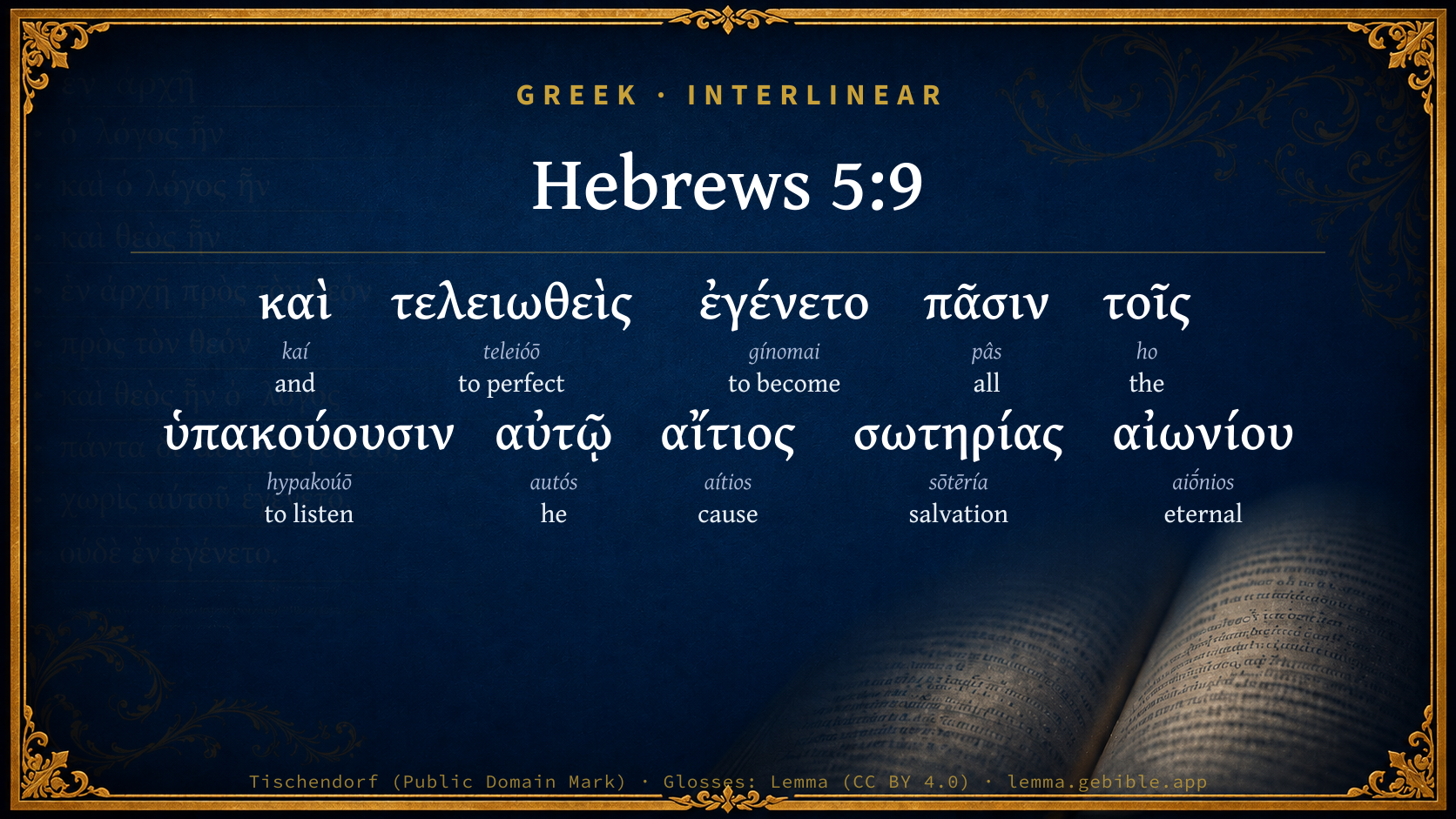
Greek (Tischendorf 8th ed.) Hebrews 5:9 appears in the Greek New Testament. The text above is from the Tischendorf 8th edition. Each word links to its Strong’s number and a concise gloss. Click any word for its full Thayer’s Greek Lexicon entry.
Download image
Cite this verse

Hebrews 5:9 (World English Bible). Public Domain. Lemma interlinear Bible study tool, https://lemma.gebible.app/v/hebrews/5/9.

Show BibTeX & RIS
BibTeX
RIS
English Translation
Having been made perfect, he became to all of those who obey him the author of eternal salvation,
World English Bible · Public Domain
Download a study sheet

One document with this verse’s original text, its word-by-word gloss line, the meaning frame, cross-references with their text, attributed commentary, and full source and license credits — printable, and it pastes into notes with its structure intact.

This verse Autodidact and up

Study sheet (.html) Plain text (.txt)

A passage Seminary Student

Up to 50 verses in one chapter. A passage sheet keeps up to 6 commentary sources and 12 cross-references per verse, in the order this page ranks them, and says so on the sheet whenever that leaves anything out. Ask for a single verse and you get the Autodidact verse sheet above.

Everything on this page stays free to read, with no account — the sheet is a download of what is already on screen, not access to it.

Want to remove ads? Support Godless Engineer
Compare translations 3

The same verse in 3 English versions, stacked beneath the original-language interlinear above. Click any original word for its lexicon entry.

Each is an independent rendering of the whole verse — the interlinear is not word-aligned to these translations.

Highlighted words mark where these versions differ — a whole-verse word diff, not a word-by-word alignment.

  • World English Bible Public Domain
    Having been made perfect, he became to all of those who obey him the author of eternal salvation,
  • King James Version Public Domain
    And being made perfect, he became the author of eternal salvation unto all them that obey him;
  • unfoldingWord Literal Text CC BY-SA 4.0
    And having been made perfect, he became, for all the ones obeying him, the source of eternal salvation,

unfoldingWord Literal Text — © unfoldingWord, licensed CC BY-SA 4.0. Word-aligned USFM3 via Door43 (git.door43.org/unfoldingWord/en_ult).

Versions to compare (up to 4)

3 of 4 selected

Show all 19 translations

Every available English version of this verse, each an independent rendering of the whole verse.

  • World English Bible Public Domain
    Having been made perfect, he became to all of those who obey him the author of eternal salvation,
  • Berean Standard Bible Public Domain
    And having been made perfect, He became the source of eternal salvation to all who obey Him
  • Majority Standard Bible Public Domain
    And having been made perfect, He became the source of eternal salvation to all who obey Him
  • King James Version Public Domain
    And being made perfect, he became the author of eternal salvation unto all them that obey him;
  • American Standard Version (1901) Public Domain
    and having been made perfect, he became unto all them that obey him the author of eternal salvation;
  • Revised Version (1885) Public Domain
    and having been made perfect, he became unto all them that obey him the author of eternal salvation;
  • Geneva Bible (1599) Public Domain
    And being consecrate, was made the authour of eternall saluation vnto all them that obey him:
  • Douay-Rheims (1899) Public Domain
    And being consummated, he became, to all that obey him, the cause of eternal salvation.
  • Young's Literal Translation Public Domain
    and having been made perfect, he did become to all those obeying him a cause of salvation age-during,
  • Literal Standard Version CC BY-SA 4.0
    and having been made perfect, He became the cause of continuous salvation to all those obeying Him,
  • Unlocked Literal Bible CC BY-SA 4.0
    He was made perfect and became, for everyone who obeys him, the cause of eternal salvation.
  • unfoldingWord Literal Text CC BY-SA 4.0
    And having been made perfect, he became, for all the ones obeying him, the source of eternal salvation,
  • Darby Bible Public Domain
    and having been perfected, became to all them that obey him, author of eternal salvation;
  • World Messianic Bible Public Domain
    Having been made perfect, he became to all of those who obey him the author of eternal salvation,
  • Webster's Bible Public Domain
    And being made perfect, he became the author of eternal salvation to all them that obey him;
  • Free Bible Version CC BY-SA 4.0
    When his experience was complete, he became the source of eternal salvation to everyone who does what he says,
  • Bible in Basic English Public Domain
    And when he had been made complete, he became the giver of eternal salvation to all those who are under his orders;
  • Text-Critical English NT CC BY 4.0
    And having been made perfect, he became the source of eternal salvation to all who obey him
  • Tyndale New Testament (1534) Public Domain
    and was made parfaite and the cause of eternall saluacion vnto all them that obey him:

Literal Standard Version (2020), Covenant Press — licensed CC BY-SA 4.0. Text via the HelloAO Bible API (eBible.org). Unlocked Literal Bible (unfoldingWord) — licensed CC BY-SA 4.0. Text via the HelloAO Bible API (eBible.org). unfoldingWord Literal Text — © unfoldingWord, licensed CC BY-SA 4.0. Word-aligned USFM3 via Door43 (git.door43.org/unfoldingWord/en_ult). Free Bible Version, Dr. Jonathan Gallagher — licensed CC BY-SA 4.0. Text via the HelloAO Bible API (eBible.org).

Word by word

More ways to search: Search by grammar → Find every occurrence → Compare this word →

Practice this passage: Drill this verse → Learn its vocabulary →

About this verse

These counts appear in no published source. They are computed here, from the morphology-tagged text and Lemma’s own curated glosses. What Lemma adds →

10
words
10
distinct lemmas
General Epistles
section

Notable vocabulary

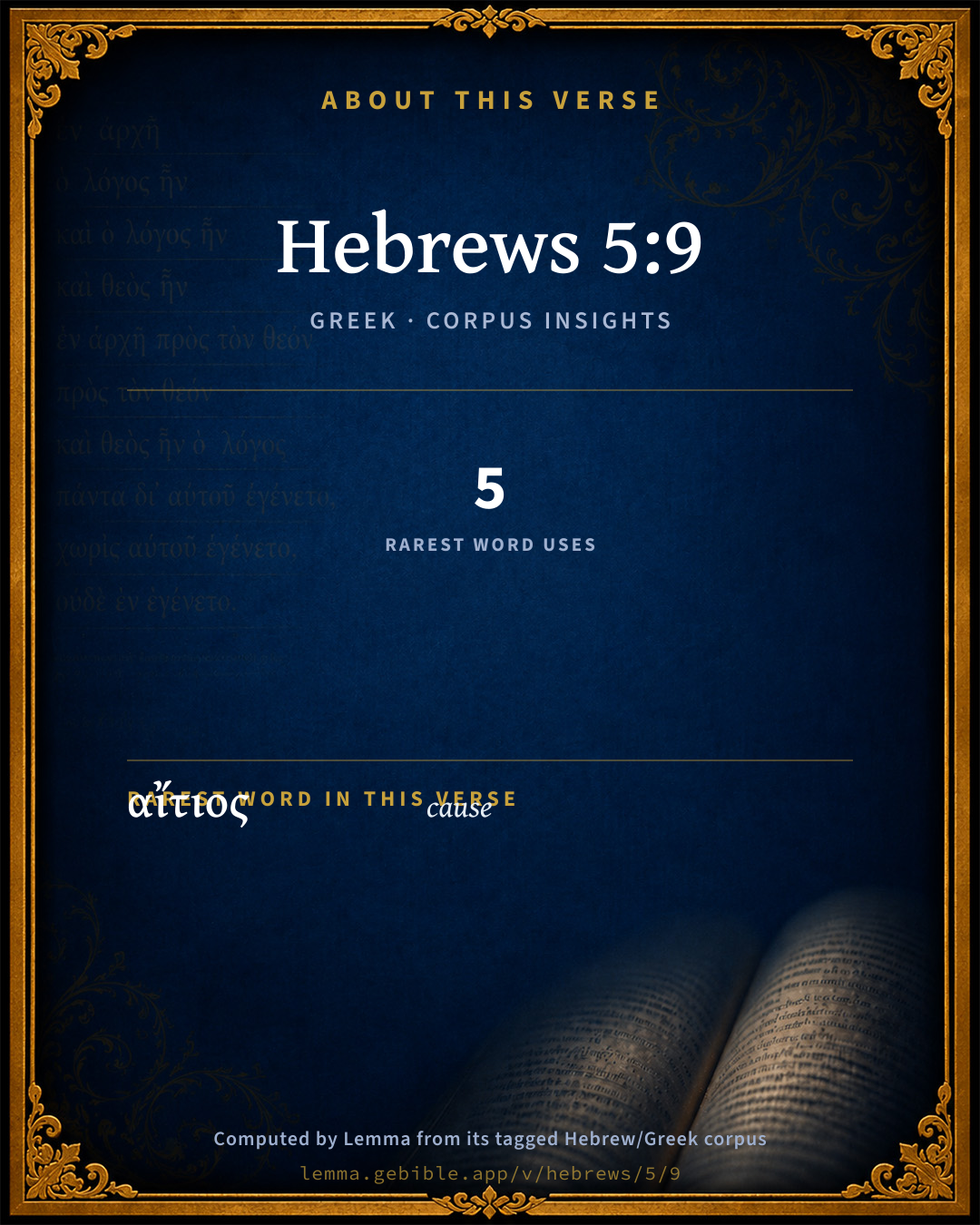
The rarest word here is αἴτιος cause G159 — appearing just 5 times in the whole Greek New Testament.

Shared distinctive vocabulary

αἴτιος cause G159 occurs in 5 verses of the Greek New Testament. Also found in:

Cross-references

34

Topical passages linked to Hebrews 5:9 in the Treasury of Scripture Knowledge — connected by theme and wording, ordered by reader-vote popularity; previews shown in the World English Bible.

  • Hebrews 2:10 For it became him, for whom are all things, and through whom are all things, in bringing many children to glory, to make the author of their salvation perfect through sufferings.
  • Hebrews 9:12 nor yet through the blood of goats and calves, but through his own blood, entered in once for all into the Holy Place, having obtained eternal redemption.
  • Hebrews 9:15 For this reason he is the mediator of a new covenant, since a death has occurred for the redemption of the transgressions that were under the first covenant, that those who have been called may receive the promise of the eternal inheritance.
  • Hebrews 12:2 looking to Jesus, the author and perfecter of faith, who for the joy that was set before him endured the cross, despising shame, and has sat down at the right hand of the throne of God.
  • Acts 5:32 We are His witnesses of these things; and so also is the Holy Spirit, whom God has given to those who obey him."
  • 2 Thessalonians 1:8 giving vengeance to those who don't know God, and to those who don't obey the Gospel of our Lord Jesus,
  • 1 Peter 1:22 Seeing you have purified your souls in your obedience to the truth through the Spirit in sincere brotherly affection, love one another from the heart fervently:
  • Isaiah 50:10 Who is among you who fears Yahweh, who obeys the voice of his servant? He who walks in darkness, and has no light, let him trust in the name of Yahweh, and rely on his God.
  • Daniel 9:24 Seventy weeks are decreed on your people and on your holy city, to finish disobedience, and to make an end of sins, and to make reconciliation for iniquity, and to bring in everlasting righteousness, and to seal up vision and prophecy, and to anoint the most holy.
  • Romans 1:5 through whom we received grace and apostleship, for obedience of faith among all the nations, for his name's sake;
  • Romans 2:8 but to those who are self-seeking, and don't obey the truth, but obey unrighteousness, will be wrath and indignation,
  • Hebrews 11:8 By faith, Abraham, when he was called, obeyed to go out to the place which he was to receive for an inheritance. He went out, not knowing where he went.
  • Romans 15:18 For I will not dare to speak of any things except those which Christ worked through me, for the obedience of the Gentiles, by word and deed,
  • 2 Corinthians 10:5 throwing down imaginations and every high thing that is exalted against the knowledge of God, and bringing every thought into captivity to the obedience of Christ;
  • Romans 6:17 But thanks be to God, that, whereas you were bondservants of sin, you became obedient from the heart to that form of teaching whereunto you were delivered.
  • Romans 10:16 But they didn't all listen to the glad news. For Isaiah says, "Lord, who has believed our report?"
  • 2 Timothy 2:10 Therefore I endure all things for the chosen ones' sake, that they also may obtain the salvation which is in Christ Jesus with eternal glory.
  • Psalms 51:6 Behold, you desire truth in the inward parts. You teach me wisdom in the inmost place.
  • Psalms 68:18–20 You have ascended on high. You have led away captives. You have received gifts among men, Yes, among the rebellious also, that Yah God might dwell there.
  • Isaiah 45:22 Look to me, and be you saved, all the ends of the earth; for I am God, and there is none else.
  • Zechariah 6:15 Those who are far off shall come and build in the temple of Yahweh; and you shall know that Yahweh of hosts has sent me to you. This will happen, if you will diligently obey the voice of Yahweh your God."'"
  • Matthew 17:5 While he was still speaking, behold, a bright cloud overshadowed them. Behold, a voice came out of the cloud, saying, "This is my beloved Son, in whom I am well pleased. Listen to him."
  • John 19:30 When Jesus therefore had received the vinegar, he said, "It is finished." He bowed his head, and gave up his spirit.
  • Jude 1:21 Keep yourselves in the love of God, looking for the mercy of our Lord Jesus Christ to eternal life.
  • Psalms 45:17 I will make your name to be remembered in all generations. Therefore the peoples shall give you thanks forever and ever.
  • Psalms 51:8 Let me hear joy and gladness, That the bones which you have broken may rejoice.
  • Isaiah 49:6 yes, he says, It is too light a thing that you should be my servant to raise up the tribes of Jacob, and to restore the preserved of Israel: I will also give you for a light to the Gentiles, that you may be my salvation to the end of the earth.
  • Matthew 7:24–27 "Everyone therefore who hears these words of mine, and does them, I will liken him to a wise man, who built his house on a rock.
  • Luke 13:32 He said to them, "Go and tell that fox, 'Behold, I cast out demons and perform cures today and tomorrow, and the third day I complete my mission.
  • Acts 3:15 and killed the Prince of life, whom God raised from the dead, to which we are witnesses.
  • 2 Thessalonians 2:16 Now our Lord Jesus Christ himself, and God our Father, who loved us and gave us eternal comfort and good hope through grace,
  • Hebrews 2:3 how will we escape if we neglect so great a salvation-- which at the first having been spoken through the Lord, was confirmed to us by those who heard;
  • Hebrews 11:40 God having provided some better thing concerning us, so that apart from us they should not be made perfect.
  • 1 John 5:20 We know that the Son of God has come, and has given us an understanding, that we know him who is true, and we are in him who is true, in his Son Jesus Christ. This is the true God, and eternal life.

Cross-references courtesy of OpenBible.info (CC BY 4.0).

Commentary

Notes on Hebrews 5:9 from classic Christian and Jewish commentators (each source and its license shown beneath its notes). The classic Christian expositions comment on the surrounding passage and are grouped to its opening verse, so a note may address several verses; the Jewish commentaries on the Tanakh (Rashi and others) are per-verse, so they appear only where the commentator wrote on this verse.

Lemma curates 59 commentaries, every one of them public domain or Creative Commons licensed, each selected and text-cleaned for this edition rather than reprinted as found. About our sources →

Joseph Benson's Commentary

Heb 5:9. And being made perfect, &c. — Many of the difficulties which we meet with in Scripture, are entirely owing to our ignorance: some to our ignorance of the subjects under consideration, and others of the meaning of the terms made use of to express these subjects. This is peculiarly the case here: there would be no difficulty in conceiving how Christ could be said to be made perfect, if we observed, 1st, That he was very man, and that his human nature, before his resurrection, was in a state of infirmity, and not of perfection, his body being subject to various weaknesses, and the faculties of his soul, of course, being influenced thereby. While in his childhood he is said to have increased in wisdom as well as in stature, namely, as the powers of his mind were gradually unfolded, and subjects, through the medium of his senses, were presented to his contemplation. And if he increased in wisdom, he must, of course, have increased in love to God and man, and all other graces and virtues, though always perfectly free from every defilement of sin, internal or external: but when he was raised from the dead, and exalted to his Father’s right hand, his human nature was fully and for ever freed from this state of infirmity, and was rendered completely perfect. This, however, does not appear to be the meaning of the word perfect here, but the expression rather refers, 2d, To his having fully accomplished the work he had to do, and the sufferings he had to endure in order to his being a perfect Mediator and Saviour. Accordingly the expression here used by the apostle, τελειωθεις, is literally being perfected, answering directly to the word used Heb 2:10, τελειωσαι, to perfect by sufferings; only there it is used actively, it became him (God the Father) to make perfect the Captain of our salvation; here it is used passively, with respect to the effect of that act, and signifies his being consummated, or having finished his whole process, from his leaving the celestial glory to his returning to it; which process it was absolutely necessary he should accomplish, that his character, as a High-Priest, might be completed, and he might be consecrated as such. This, 3d, Is another meaning of the term, and a meaning given it by our translators at the close of the seventh chapter, where they have rendered τετελειωμενων, (another participle of the same verb,) consecrated or dedicated to his high office. The priests under the law were consecrated by the death and oblation of the beasts offered in sacrifice at their consecration, (Exodus 29.,) but it belonged to the perfection of Christ as a high-priest, that he should be consecrated by his own sufferings. This was necessary both from the nature of the office, to which he was to be solemnly set apart, and to answer the types of the Aaronical priesthood. This, however, was only the external means of his consecration, and an evidence thereof. He was really consecrated by the act of God the Father, who said, Thou art my Son, &c., and by his own act when he said, Lo, I come to do thy will, O God. He became the author — Αιτιος, the cause, both the meritorious and efficient cause; of eternal salvation — As procuring it for us by his obedience unto death, and conferring it upon us in all its branches, in consequence of his ascension and exaltation; to all those that obey him — The expression is emphatical: the salvation belongs only to those that obey him, and it belongs to all such. And as the Greek term here used imports to obey upon hearing, the obedience intended Isaiah , 1 st, Faith, which cometh by hearing. 2d, The subjection of the heart, of the will and affections to him, in consequence of faith; and, 3d, A uniform complying with the will of God as far as it is known to us, (Mat 7:21,) or a conscientious, steady, and persevering obedience to all the precepts of the gospel. For only blessed are they that do his commandments, because they, and only they, shall have a right to the tree of life, Rev 22:14. Thus, as Macknight observes, “in this verse three things are clearly stated: 1st, That obedience to Christ is equally necessary to salvation with believing on him. 2d, That he was made perfect as a high-priest, by offering himself a sacrifice for sin; and, 3d, That by the merit of that sacrifice he hath obtained pardon and eternal life for them who obey him.”

Joseph Benson's Commentary on the Old and New Testaments (1811–1818) — public domain. Text from a community e-Sword module.

Tyndale Open Study Notes

Tyndale Open Resources

5:9 God qualified him as a perfect High Priest: As used in Hebrews, perfect means “complete” or “mature” (see 2:10; 5:14; 7:11; 9:9-11). Jesus, through his sufferings, was qualified to be the source of eternal salvation for all those who obey him. • High Priest is not in the Greek text, but it is implied. • As the Son obeyed the Father (5:8), submitting completely to the Father’s will, so those who come to him for salvation must obey him.

Tyndale Open Study Notes — © Tyndale Open Resources, licensed CC BY-SA 4.0. Text via the HelloAO Bible API.

Bengel's Gnomon

Johann Albrecht Bengel

Heb 5:9. Καὶ τελειωθεὶς, and being made perfect) by sufferings, ch. Heb 2:10.—τοῖς ὑπακούουσιν αὐτῷ, to them that obey Him) 2Co 10:5. We must obey likewise through sufferings and death [as Christ obeyed the Father.—V. g.] and chiefly by faith, ch. Heb 11:8.—πᾶσιν, to all) Great power, ch. Heb 2:10-11; Heb 2:15.—αἴτιος σωτηρίας αἰωνίου, the author of eternal salvation) Dessen habe der liebe Herr Jesu Dank von uns in Ewigkeit. “For which the beloved Lord Jesus may have thanks from us in eternity.” E. Schmidius, piously. Moreover αἴτιος is a word extremely worthy of Him and (comp. 1Sa 22:22, αἴτιος ψυχῶν) one by which it is intimated, that Christ, being made perfect, pleads the cause of the brethren, from this circumstance, because it now evidently belongs to Him to accomplish [to make good] their salvation; for He is able: comp. δυνάμενον, who was able, Heb 5:7, ch. Heb 7:25: and ought (it behoved Him) to do so, comp. ὤφειλε, He ought, ch. Heb 2:17. [Der für Etwas stehet, an der man sich halten kann. He stands for something to which one can cling.—V. g.] We must also observe the epithet, eternal salvation, which is opposed to the shortness of the days of Jesus’ flesh, and flows (is derived) from Heb 5:6, for ever. Concerning this salvation, look back to ch. Heb 2:10; Heb 2:14, etc. The eternity of salvation is mentioned, Isa 45:17. Ἰσραήλ σώζεται ὑπὸ Κυρὶου σωτηρίαν αἰώνιον, Israel is saved by the Lord with an eternal salvation.

Bengel's Gnomon of the New Testament — English translation (T&T Clark, Edinburgh, 1860) — public domain. Text from a community e-Sword module.

Meyer's Critical & Exegetical Commentary

Heinrich August Wilhelm Meyer

Heb_5:9. Καὶ τελειωθείς] and being brought to consummation, i.e. being crowned with glory by His exaltation to heaven (comp. Heb_2:9-10), sc. in consequence of the obedience to God proved by His sufferings and death.

ἐγένετο] He became. Author and Mediator of everlasting blessedness for His believers, Christ certainly was even during His earthly life. But in an eminent manner, because formally and manifestly accredited by God as such, He became so first by His resurrection and exaltation.

πᾶσιν] perhaps added in order to indicate the equal claim of the believing Gentiles also, to the salvation in Christ.

τοῖς ὑπακούουσιν αὐτῷ] The expression attaches itself in point of form to τὴν ὑπακοήν, Heb_5:8, with which it forms a paronomasia; in point of subject-matter it is not different from τοῖς πιστεύουσιν (Heb_4:3). Comp. Rom_10:16; 2Th_1:8, al.

The mode of expression: αἴτιόν τινι εἶναι σωτηρίας (comp. τὸν ἀρχηγὸν τῆς σωτηρίας αὐτῶν, Heb_2:10), is also often met with in Philo, Josephus, and the classical writers. Instances in Wetstein, Kypke, and Bleek.

The adjective αἰώνιος with σωτηρία in the N. T. only here. Comp., however, LXX. Isa_45:17.

Meyer — Critical and Exegetical Commentary on the New Testament — English translation by Peter Christie, edited by Frederick Crombie (T&T Clark, 1880) — public domain. Text from a community e-Sword module.

Expositor's Greek Testament

ed. W. Robertson Nicoll

Heb 5:9 . καὶ τελειωθεὶς … αἰωνίου “and having [thus] been perfected became to all who obey Him the source [originator] of eternal salvation”. τελειωθείς (v. Heb 2:10 ) having been perfectly equipped with every qualification for the priestly office by the discipline already described. Several interpreters (Theodoret, Bleek, Westcott) include in the word the exaltation of Christ, but illegitimately. The word must be interpreted by its connection with ἔμαθεν ὑπακοήν ; and here it means the completion of Christ’s moral discipline, which ended in His death. He thus became αἴτιος σωτηρίας αἰωνίου author, or cause of eternal salvation, in fulfilment of the call to an eternal priesthood, Heb 5:6 εἰς τὸν αἰῶνα and Heb 5:10 . αἴτιος frequently used in a similar sense from Homer downwards, as in Diod. Sic., iv. 82, αἴτιος ἐγένετο τῆς σωτηρίας . Aristoph., Clouds , 85, οὗτος γὰρ ὁ θεὸς αἴτιός μοι τῶν κακῶν . Philo, De Agri. , 22, πᾶσι τοῖς ὑπακούουσιναὐτῷ with a reference to τὴν ὑπακ . of Heb 5:8 . The saved must pass through an experience similar to the Saviour’s. Their salvation is in learning to obey. Thus they are harmonised to the one supreme and perfect will. This is reversely given in Heb 2:10 .

The Expositor's Greek Testament, edited by W. Robertson Nicoll (1897–1910) — public domain. Text from a community e-Sword module.

Geneva Bible (1599)

Geneva Bible translators

See Heb. 2:10.

The other part of the first comparison: Christ was consecrate of God the Father as the author of our salvation, and an high Priest forever, and therefore he is so a man that notwithstanding he is far above all men.

Geneva Bible (1599) marginal notes — public domain. Text via Bolls.life.

Jamieson, Fausset & Brown

Robert Jamieson, A. R. Fausset & David Brown

made perfect--completed, brought to His goal of learning and suffering through death (Heb 2:10) [ALFORD], namely, at His glorious resurrection and ascension.

author--Greek, "cause."

eternal salvation--obtained for us in the short "days of Jesus' flesh" (Heb 5:7; compare Heb 5:6, "for ever," Isa 45:17).

unto all . . . that obey him--As Christ obeyed the Father, so must we obey Him by faith.

Jamieson, Fausset & Brown — Commentary Critical and Explanatory on the Whole Bible (1871) — public domain (CC PDM 1.0). Text via the HelloAO Bible API.

Adam Clarke's Commentary

Verse 9. And being made perfect] και τελειωθεις. And having finished all-having died and risen again. τελειωθηναι signifies to have obtained the goal; to have ended one's labour, and enjoyed the fruits of it. Heb 12:23: The spirits of just men made perfect, πνευμασι δικαιων τετελειωμενων, means the souls of those who have gained the goal, and obtained the prize. So, when Christ had finished his course of tremendous sufferings, and consummated the whole by his death and resurrection, he became αιτιος σωτηριας αιωνιος, the cause of eternal salvation unto all them who obey him. He was consecrated both highs priest and sacrifice by his offering upon the cross.

"In this verse," says Dr. Macknight, "three things are clearly stated:

1. That obedience to Christ is equally necessary to salvation with believing on him.

2. That he was made perfect as a high priest by offering himself a sacrifice for sin, Heb 8:3.

3. That, by the merit of that sacrifice, he hath obtained pardon and eternal life for them who obey him."

He tasted death for every man; but he is the author and cause of eternal salvation only to them who obey him. It is not merely believers, but obedient believers, that shall be finally saved. Therefore this text is an absolute, unimpeachable evidence, that it is not the imputed obedience of Christ that saves any man. Christ has bought men by his blood; and by the infinite merit of his death he has purchased for them an endless glory; but, in order to be prepared for it, the sinner must, through that grace which God withholds from no man, repent, turn from sin, believe on Jesus as being a sufficient ransom and sacrifice for his soul, receive the gift of the Holy Ghost, be a worker together with him, walk in conformity to the Divine will through this Divine aid, and continue faithful unto death, through him, out of whose fulness he may receive grace upon grace.

Adam Clarke's Commentary on the Bible (1810–1826) — public domain. Text from a community e-Sword/MySword module.

John Calvin's Commentaries

9. And being made perfect, or sanctified, etc. Here is the ultimate or the remoter end, as they call it, why it was necessary for Christ to suffer: it was that he might thus become initiated into his priesthood, as though the Apostle had said that the enduring of the cross and death were to Christ a solemn kind of consecration, by which he intimates that all his sufferings had a regard to our salvation. It hence follows, that they are so far from being prejudicial to his dignity that they are on the contrary his glory; for if salvation be highly esteemed by us, how honorably ought we to think of its cause or author? For he speaks not here of Christ only as an example, but he ascends higher, even that he by his obedience has blotted out our transgressions. He became then the cause of salvation, because he obtained righteousness for us before God, having removed the disobedience of Adam by an act of an opposite kind, even obedience.

Sanctified suits the passage better than “made perfect.” The Greek word τελειωθεὶς means both; but as he speaks here of the priesthood, he fitly and suitably mentions sanctification. And so Christ himself speaks in another place, “For their sakes I sanctify myself.” (John 17:19.) It hence appears that this is to be properly applied to his human nature, in which he performed the office of a priest, and in which he also suffered.

To all them that obey him. If then we desire that Christ’s obedience should be profitable to us, we must imitate him; for the Apostle means that its benefit shall come to none but to those who obey. But by saying this he recommends faith to us; for he becomes not ours, nor his blessings, except as far as we receive them and him by faith. He seems at the same time to have adopted a universal term, all, for this end, that he might show that no one is precluded from salvation who is but teachable and becomes obedient to the Gospel of Christ.

John Calvin's Commentaries (1540-1563) — public domain. Text from the Calvin Translation Society English edition (1840s-50s) via the Christian Classics Ethereal Library (ccel.org). Calvin's coverage is partial (roughly two-thirds of the Bible); uncommented books and verses are honest gaps, never fabricated. The 19th-century editor's footnotes and remarks are omitted so the notes are faithfully Calvin's own voice.

Ellicott's Commentary for English Readers

(9) And being . . .—Rather, and having been made perfect. This was the mode in which He who “glorified Him to be made High Priest” (Heb_5:5) led Him into the possession of this office. The thought of this verse and the last is closely analogous to Heb_2:9-10 (see Notes), and to Php_2:6-13. The transition from the obedience manifested by our Lord to that which must be rendered by all who seek from Him salvation, strikingly recalls Heb_5:8; Heb_5:12 of the last-named chapter. He presents to all the model of the obedience to be rendered to Him, and through Him to the Father. “Eternal” salvation,—for He is a priest “for ever” (Heb_5:6). On the connection of “salvation” with His priesthood, see the Note on Heb_7:25.

A Bible Commentary for English Readers, edited by Charles John Ellicott (1878–1897) — public domain. Text from a community e-Sword module.

The Cambridge Bible for Schools and Colleges

gen. ed. J. J. S. Perowne

9. and being made perfect] Having been brought to the goal and consummation in the glory which followed this mediatorial work. See Heb_2:10 and comp. Luk_13:32, “the third day I shall be perfected.”

he became the author] Literally, “the cause.”

of eternal salvation] It is remarkable that the epithet aionios is here alone applied to the substantive “salvation.”

salvation unto all them that obey him] In an author so polished and rhetorical there seems to be an intentional force and beauty in the repetition in this verse of the two leading words in the last. Christ prayed to God who was able to “save” Him out of death, and He became the cause of “eternal salvation” from final death; Christ learnt “obedience” by His life of self-sacrifice, and He became a Saviour to them that “obey” Him.

The Cambridge Bible for Schools and Colleges (gen. ed. J. J. S. Perowne; Cambridge University Press, 1878–1918) — public domain. Text from a community e-Sword module.

John Gill's Exposition

And being made perfect,.... In his obedience, through sufferings; having completed his obedience, gone through his sufferings, and finished his sacrifice, and being perfectly glorified in heaven:

he became the author of eternal salvation unto all them that obey him; the salvation Christ is the author of is "eternal"; it was resolved upon from eternity, and contrived in it; it was secured in the everlasting covenant, in which not only a Saviour was provided, but blessings both of grace and glory: and it is to eternity; and stands distinguished from a temporal salvation, and is opposed to eternal damnation; it is the salvation of the soul, which is immortal; and it takes in both grace and glory, which are of a durable nature; and the continuance of it is owing to the abiding and lasting virtue of Christ's person, blood, and righteousness: and Christ is the cause or author of this salvation, by his obedience and sufferings; by obeying the precept, and bearing the penalty of the law; by the price of his blood, and by the power of his arm; by his death and by his life; by his sacrifice on the cross, and by his intercession in heaven; by bestowing grace here, and glory hereafter: this shows that salvation is done, and that Christ is the sole author of it, and that all the glory of it should be given to him; and those to whom he is the author of salvation, are such as hearken to the voice of his Gospel, and obey hin in his ordinances. Christ is not the author of salvation to all men; all men do not obey him; all those whom Christ saves, he brings them to an obedience to himself; for his obedience for them does not exempt them from obedience to him, though their obedience is no cause of their salvation; Christ himself is the alone author of that.

John Gill's Exposition of the Whole Bible (1746–1763) — public domain (CC PDM 1.0). Text via the HelloAO Bible API.

Trapp's Complete Commentary

John Trapp

9 And being made perfect, he became the author of eternal salvation unto all them that obey him;

Ver. 9. And being made perfect] τελειωθεις. Or, being offered up in sacrifice; or, being completed by this experimental knowledge of passive obedience also.

The author] And finisher too, Heb 12:2. Gr. αιτιος, The cause, viz. by his merit and efficacy.

John Trapp, A Commentary or Exposition upon All the Books of the Old and New Testament (1647–1656) — public domain. Text from a community e-Sword module.

Albert Barnes' Notes on the Bible

And being made perfect - That is, being made a “complete” Saviour - a Saviour suited in all respects to redeem people. Sufferings were necessary to the “completeness” or the “finish” of his character as a Saviour, not to his moral perfection, for he was always without sin; see this explained in the notes on Heb 2:10.

He became the author - That is, he was the procuring cause (αἴτιος aitios) of salvation. It is to be traced wholly to his sufferings and death; see the note, Heb 2:10. “Unto all them that obey him.” It is not to save those who live in sin. Only those who “obey” him have any evidence that they will be saved; see the note, Joh 14:15.

Albert Barnes' Notes on the Bible (1834–1885) — public domain. Text from a community e-Sword/MySword module.

Haydock's Catholic Bible Commentary

And being consummated, or perfected as man in all kinds of virtues, and at the same time true God by his divine person, became the author of salvation to all those who both believe in him and obey him. (Witham)

George Leo Haydock (1774–1849), Haydock's Catholic Family Bible and Commentary, 1859 edition — public domain. Excludes Psalms (Douay-Rheims chapter numbering differs from Protestant) and Deuterocanonical books (Catholic canon only).

Matthew Poole's English Annotations

And being made perfect: as to the powerful execution of his office, this God-man exceeds his types; for having consummated all the work to which he was designed, by his doing, suffering, dying, rising, and ascending into heaven in the human nature, he perfected the work of redemption, and consecrated himself to his office.

He became the author of eternal salvation unto all them that obey him: by this was he constituted, made, and declared by his Father to be, not an instrument, as all his types were, but the cause efficient, meritorious, and exemplar of salvation; by his sacrifice satisfying God’s justice, meriting and effecting reconciliation and justification for sinners; and on his ascension sends forth the Holy Ghost, to qualify them for the reception of his benefits, by working in them what he requires; and on their application to him, he, as their High Priest, pleads the merit of his blood, and intercedes for their justification and salvation, which is the freeing them from all evil, criminal and penal, sin, and whatever it subjecteth them to in this world, or that which is to come; and insisting them into all the heavenly privileges promised in the covenant of grace, righteousness, holiness, heirship to, and life and glory with, God, and to be safe in the possession of them all, not for time only, but for eternity. This efficient cause produceth this only to the duty qualified subject: mankind is rendered salvable by the obedience and sacrifice of this High Priest; but it is only to penitent believing sinners that he doth communicate this, and for whom he effects it; those who will entirely submit themselves to Christ as a Lord and King, and be loyal to him and obey him, as well as to a Priest or a Saviour, continuing his faithful subjects to the end, Joh 3:16,18,36; compare Mat 10:22.

Matthew Poole's English Annotations on the Holy Bible (1683–1685) — public domain. Text from a community e-Sword/MySword module.

Whedon's Commentary on the Bible

Daniel D. Whedon

9. Made perfect—An incomplete Saviour would he have been without Gethsemane and the cross. And from this deep perfecting springs all his glory and power to save.

Obey him—Mark the accord between his obedience in last verse and the obey in this. He was perfected by his obedience to God, they by their obedience, after the sure model, to him.

Daniel D. Whedon (gen. ed.), Commentary on the Old and New Testaments (1874–1909) — public domain. Text from a community e-Sword module.

The Pulpit Commentary

Vers. 9, 10. And being made perfect, he became unto all them that obey him the Author of eternal salvation; called (or rather so addressed) of God a High Priest after the order of Melchizedek. Here teleiwyeiv (translated "being made perfect") refers to the time of his resurrection, when the sufferings were over and the atonement complete. (cf. Luk_13:32, th trith teleioumai) The word may be used in its general sense of perfected, i.e. "being made perfectly that which he was intended to become" (Delitzsch). In such sense St. Paul uses the word of himself, Ouk oti hdh teteleiwmai . (Php_3:12) Or the specific sense of priestly consecration may be here, as well as in Heb_2:10 and Heb_7:28, intended. In Heb_7:28 the A.V renders eiv tonon by "consecrated for evermore." And this view is supported by passages in the LXX, where the word teleiwsiv is used with special reference to the consecration of the high priest. Cf. esti gawsiv auth ; (Exo_29:22) tou kriou thv teleiwsewv, o estin Aarwn , (vers. 26, 27, 31); teleiwsai ta (vers. 29, 33, 35); thv yusiav thv teleiwsewv (ver. 34) toteron kriosewv ; (Lev_8:22, Lev_8:29) apo tou kanou thv teleiwsewv (ver. 26); to olokautwma thv teleiwsewv (ver. 28); ewv hmera plhrwyh, hmera teleiwsewv umwn (ver. 33); Lev_21:10, where the high priest o iereugav apo twn adelfwn autouis described as tou epikecumenou epi thn kefalhou sou Cristou kai teteleiwmenou endusasyai ta imatia . See also Gesenius on the Hebrew word Hence, and in view of the drift of the passage before us, Jackson very decidedly regards teleiwyei in ver. 9 as a verbum solenne, denoting specifically Christ"s consecration to his eternal office of High Priest. So also Hammond and Whitby. Being thus perfected, or consecrated, he became, for ever afterwards, the Author, not of mere ceremonial cleansing or temporary remission of guilt, but of eternal salvation; potentially to all mankind, (cf. upev , Heb_2:9) and effectively to all them that obey him;" being addressed, in tiffs his consummated position (the reference being to Ps 110) as "High Priest for ever," etc. Here again we perceive that it is not till after the Resurrection that the prophetic ideal of the SON at God"s right hand, and of the eternal High Priest, are regarded as fully realized. If it be objected that his high priesthood must have begun before the Resurrection for his death upon the cross to be a true atonement, it may be replied that his one oblation of himself upon the cross at once consummated his consecration and effected the atonement. Doubtless, as a true High Priest on earth, he thus "offered one sacrifice for sins for ever"; (Heb_10:12) all that is meant above is that it was not till after the Resurrection that he entered on his eternal office of mediation in virtue of that one accomplished sacrifice.

Salvation its Author and its recipients.

"And being made perfect, he became the Author," etc. The subject of the writer in this part of his Epistle is the high priesthood of Jesus Christ. In treating this subject he dwells upon the sufferings of Christ in his priestly office, and a certain perfection which resulted from his sufferings. He was God"s only and well-beloved Son, yet he was not exempt from suffering. "He learned obedience by the things which he suffered." We must not suppose that he was not perfectly acquainted with the nature of obedience, or that he did not fully recognize the duty of it, or that he was in any way indisposed to render it, before he suffered. The meaning is that though he was so highly exalted in his relationship to the Father, yet "he was subjected to learn experimentally what it is to obey in the midst of suffering." He learned the lesson perfectly. He "became obedient unto death, even the death of the cross." Our text leads us to consider three things.

I THE PERFECTION WHICH CHRIST ATTAINED THROUGH SUFFERING. "And having been made perfect." Having assumed human nature, Christ was capable of suffering; and in that nature he did indeed suffer. His entire life upon earth was one of humiliation and sacrifice. Being sympathetic, the sufferings of men were a constant grief to him. Being holy, the sins of men constantly stung his soul with pain. At the last his sufferings deepened into awful intensity. In Gethsemane his sorrow and conflict almost brought down his human nature unto death. And on the cross his pain and woe were unutterable, and to us inconceivably severe. Of all sufferers Christ is the Sufferer. In all these sufferings he was obedient. He endured them voluntarily. Through his obedience in suffering he became perfect. The author of our salvation was made perfect through sufferings". (Heb_2:10) This acquired perfection was not personal As God he is eternally perfect; as man he was perfect without suffering. The perfection of our text is relative. By suffering he Became perfect in his relation to us as our Savior, our Intercessor, our great High Priest. By suffering:

1. He made a perfect atonement for sin.

2. He became perfectly qualified to sympathize with and to succor his suffering people. (Cf. Heb_4:14-16)

3. He became a perfect example for his people in their sufferings.

4. He entered upon his perfect triumph and glory. (Cf. Heb_2:9 Php_2:5-11)

II THE GREAT END BOTH OF CHRIST"S SUFFERING AND OF HIS PERFECTION ACQUIRED THROUGH HIS SUFFERING. This end was that he might Be the Author, or the great procuring cause, of a perfect salvation for men. "Being made perfect, he became the Author of eternal salvation." Here are three points.

1. The salvation. Forgiveness of sin, freedom from condemnation, deliverance from the sovereignty of sin, the awakening of a new ruling principle and power in man, conversion into a condition of holiness, peace and joy, entrance into heaven, blessed union with God.

2. The perpetuity of salvation. "Eternal salvation." No partial, incomplete, temporary Blessing; but "eternal salvation salvation which is in Christ Jesus with eternal glory." Does not this, at least, suggest that there is no falling back from the hand of Christ into the power of Satan? Doubtless man always can do so, inasmuch as he is morally free; but this "eternal salvation" establishes man"s freedom, yet binds it to holiness, and leads him to cry, "I delight to do thy will, O my God." This Blessing shall continue when bonds and banks, estates and fortunes, coronets and crowns, shall have perished. Blessed Be the Lord for his "eternal salvation"!

3. The Author of salvation. Our salvation is owing to Jesus Christ. The ministry of providence, of religious ordinances, and of good men, may assist us in availing ourselves of this salvation; but they cannot save us; they are not "the cause of salvation." Our salvation originated in the infinite love of God. "God so loved the world," etc. Our salvation was effected by his Son, our Savior. He became man, taught, labored, suffered, lived, died, and ever lives to save us. He is our only Savior. The great end of his sufferings was our "eternal salvation.

III THE RECIPIENTS OF THIS SALVATION. Unto all them that obey him." This, of course, does not mean that we merit salvation by obeying the Savior. But those who have merely some doctrinal knowledge of Christ and his salvation, those who have only a dead. faith in him, a mere intellectual assent to the great facts of his history and teaching, are not partakers of his salvation. As he attained his mediatorial perfection and glory by complete and hearty obedience to his Father, so must man obey him if we would attain unto "eternal salvation." Salvation is found in obedience to him, because:

1. True and saving faith inspires the life and shapes the conduct. (Of. Act_15:9 Rom_16:26 Gal_5:6 Jam_2:17-26)

2. Christ saves men from their sins. He is a Prince to rule us, as well as a Savior to deliver us.

3. All who are being saved by Christ love him, and the loving heart delights to obey the loved One.

4. The disobedient cannot enter heaven. Heaven is a realm of perfect obedience to the supreme will, of loyal and loving devotion to God"s service. Unless the spirit of hearty obedience be ours, we are out of sympathy with heaven.

CONCLUSION.

1. Trust this perfect Savior.

2. Obey him. Copy his own obedience. W.J.

The Pulpit Commentary (1880–1919), ed. H.D.M. Spence-Jones & Joseph S. Exell — public domain. Text from a community e-Sword module.

John Wesley's Explanatory Notes

And being perfected - By sufferings, chap. ii, 10; brought through all to glory. He became the author - The procuring and efficient cause. Of eternal salvation to all that obey him - By doing and suffering his whole will.

John Wesley, Explanatory Notes Upon the Whole Bible (1754–1765) — public domain. Text via the GEBible commentary corpus.

Scofield Reference Notes

C. I. Scofield

salvation

(See Scofield "Rom 1:16").

The Scofield Reference Bible (1917 edition), notes by C. I. Scofield — public domain. Text from a community e-Sword module.

Burkitt's Expository Notes on the New Testament

William Burkitt

Observe here, 1. A choice and singular blessing and benefit spoken of, and that is, eternal salvation; which implies not only deliverance from hell, and redemption from eternal misery, but the obtaining of eternal life had happiness.

Observe, 2. The author of this great blessing and benefit to mankind, namely, Jesus Christ our great High Priest, who, by making atonement for us, and reconciling us to God, is said to be the author of eternal salvation to mankind.

Observe, 3. The way and means whereby he became the author of our salvation, and that was by being mad perfect; the original word is an allusion to one that runs in a race, where he that wins receives the crown. Thus Christ having finished his course of sufferings, and received the reward of them, by being raised from the dead, and exalted to the right hand of God, he is said to be made perfect.

Observe, 4. The qualification of the persons who are made partakers of this great benefit, or the condition upon which it is offered and tendered, and that is obedience, He became the author of eternal salvation to them that obey him.

Question, 1. How does Christ become the author of eternal salvation?

Answer, As a rule and pattern, as a prince and propitiation, and as an advocate and patron: By the purity of his doctrine, as a rule: by the piety of his example, as a pattern; by the merit of his obedience and sufferings, as a propitiation: and by his prevailing intercession, as our Advocate now in heaven.

Where note, That the virtue of his intercession in heaven is founded on his satisfaction here on earth, in shedding of his blood for us.

Question, 2. What obedience does the gospel require as a condition, and is pleased to accept as a qualificaton, in those who hope for eternal salvation?

Answer, Negatively, Not a bare external profession of obedience, though accompanied with prophesying and working miracles, but an hearty and universal conforming to the precepts of the gospel in sincerity and uprightness; allowing our selves in the neglect of no known duty, nor in the practice of any known sin.

Question, 3. But is fallen man under a possibility now of performing this obedience?

Answer, We are no more sufficient of ourselves, and by any power of our own, to perform the conditions of the gospel, than we are able to answer the demands of the law.

But the face of God is offered to us, and stands ready to assist us to perform the condition which the gospel requires.

Consequently, what the grace of God stands ready to enable us to do, if we be not wanting to ourselves, that may properly be said to be possible to us, and in some sense in our power to perform.

Question, 4. But is not making our obedience the condition of our salvaton prejudicial to the freeness of God’s grace, and the law of faith?

Answer, In no wise; seeing it is acknowledged, that faith is the root of all true holiness and evangelical obedience; that we stand continually in need of assistance of God’s grace, to enable us to perform that obedience which the gospel requires, and is pleased to accept; and that God confers eternal life upon us, not for the merit of our obedience, but only for the sake of Christ.

The sum of all is this, That it is indispensibly necessary for a man to be a good man, that he may get to heaven; and that it is the greatest presumption in the world for any man to hope to attain salvation without obedience, and an holy life. For though our obedience cannot merit heaven; yet it does qualify and fit us for heaven; though it doth not make us worthy, yet doth it make us meet to be partakers of the inheritance of the saints in light. And whosoever finds fault with this doctrine, finds fault with the gospel itself.

William Burkitt's Expository Notes on the New Testament (1700–1703) — public domain. Text from a community e-Sword module.

The People's New Testament

B. W. Johnson

9. Being made perfect. Fitted in all points to be our high priest by his suffering; made, not a perfect man, for he was that already, but a perfect high priest. He became the author. Was able to offer the gospel to all nations, and thus to save all them that obey him. He does not save men in disobedience.

B. W. Johnson's The People's New Testament with Notes (1889–1891) — public domain. Electronic text from the Christian Classics Ethereal Library (CCEL) ThML edition.

unfoldingWord translationNotes

Door43 World Missions Community

Connecting Statement:

In verse 11 the writer begins his third warning. He warns these believers that they are still not mature and encourages them to learn God's word so they can understand right from wrong.

He was made perfect

This can be stated in active form. AT: "God made him perfect" (See: Active or Passive)

made perfect

Here this means being made mature, able to honor God in all aspects of life.

became, for everyone who obeys him, the cause of eternal salvation

The abstract noun "salvation" can be stated as a verb. AT: "now he saves all who obey him and causes them to live forever" (See: Abstract Nouns)

He was designated by God

This can be stated in active form. AT: "God designated him" or "God appointed him" (See: Active or Passive)

after the manner of Melchizedek

This means that Christ as a priest has things in common with Melchizedek as a priest. AT: "to be the sort of high priest that Melchizedek was"

We have much to say

Even though the author uses the plural pronoun "we," he is most likely referring only to himself. AT: "I have much to say" (See: Pronouns)

you have become dull in hearing

The ability to understand and obey is spoken of as if it were the ability to listen. And the ability to listen is spoken of as if it were a metal tool that becomes dull with use. AT: "you have trouble understanding it" (See: Metaphor)

translationWords

perfect

eternity

save

high priest

Melchizedek

Jesus

unfoldingWord translationNotes — © Distant Shores Media and the Door43 World Missions Community, licensed CC BY-SA 4.0. Source: git.door43.org/Door43/en_tn.

Cambridge Greek Testament for Schools and Colleges

9. τελειωθείς. Having been brought to the goal and consummation in the glory which followed this mediatorial work. See Heb 2:10, and comp. Luk 13:32, “the third day I shall be perfected.”

αἴτιος. “The cause.”

σωτηρίας αἰωνίου. It is remarkable that the epithet αἰώνιος is here alone applied to the substantive “salvation.”

ὑπακούουσιν … σωτηρίας. In an author so polished and rhetorical there seems to be an intentional force and beauty in the repetition in this verse of the two leading words in the last. Christ prayed to God who was able to “save” Him out of death, and He became the cause of “eternal salvation” from final death; Christ learnt “obedience” by His life of self-sacrifice, and He became a Saviour to them that “obey” Him.

Cambridge Greek Testament for Schools and Colleges (Cambridge University Press, 1896; 21 vols, various authors incl. Carr, Maclear, Plummer, Farrar, Lumby, Moule, M. R. James, Simcox) — public domain. Text from a community e-Sword module.

Vincent's Word Studies in the New Testament

Marvin R. Vincent

And being made perfect [και τελεωθεις] . Comp. ch. Heb 2:10. The fundamental idea in teleioun is the bringing of a person or thing to the goal fixed by God. Comp. ch. Heb 7:11, 19; Heb 9:9; Heb 10:1, 14; Heb 11:40; Heb 12:23. Here of Christ 's having reached the end which was contemplated in his divinely - appointed discipline for the priesthood. The consummation was attained in his death, Phi 2:8 : his obedience extended even unto death.

The author of eternal salvation [αιτιος σωτηριας αιωνιου] . jAitiov, N. T. o, an adjective, causing. Comp. captain of salvation, Heb 2:10. The phrase swthria aojwniov eternal salvation N. T. o, but see LXX, Isa 14:17. Not everlasting salvation, but a salvation of which all the conditions, attainments, privileges, and rewards transcend the conditions and limitations of time.

Unto all them that obey him (pasin toiv uJpkouousin aujtw). Obey points to obedience, ver. 8, and salvation to save, ver. 7. If the captain of salvation must learn obedience, so must his followers. Comp. 2Th 1:8.

Marvin R. Vincent, Word Studies in the New Testament (1887–1900) — public domain. Text from a community e-Sword/MySword module.

Westcott on Hebrews & the Epistles of John

Brooke Foss Westcott

9. καὶ τελειωθείς...] and having been made perfect... Vulg. ef consummatus... ὅγε. and thus was perfected and... Comp. ii. 10 note.

This perfection was seen on the one side in the complote fulfilment of man’s destiny by Christ through absolute self-sacrifice, and on the other in His exaltation to the right hand of God, which was in the divine order ite due consequence. Comp. c. il. 9 διὰ τὸ πάθημα. Phil. fi.9. Thus the word, which carries with it the conception of Christ's complete preparation for the execution of His priestly office, suggests the contrast between His priestly action and that of Aaron.

ἐγένετο] became in the fulfilment of what we conceive of as a natural law. It is said ‘became’ and not ‘becomes’ or ‘is,’ because on the divine side ‘and in the eternal order the issue of Christ's work is complete. For γενέσ22, 26.

Comp. Rom. viii. 29 f.; Col. iff. 1 ff.

πᾶσιν τοῖς ὑπακούουσιν] to all that obey Him, Gentiles as well as Jews. Comp. John i. 7. In this connexion

continuous active obedience is the sign of real faith (contrast iv. 3 of swtorevcavres), The obedience of the believer to Christ answers to tho obedience of the Son to the Father. By obedience fellowship is made complete. 8i obedientia Filii causa eat salutis humans, quanta nobis necessitas est obedire Doo, ut digni invoniamur ejus salutis quam nobis per Filium proprium donavit (Atto). αἴτιος oor. alov.] the cause of eternal salvation, Latt. causa salutie aterna. In fi. 10 the word corresponding to αἴτιος is ἀρχηγός. Thore the thought was of Christ going before the ‘many sons’ with whom He unites Himself. Here the thought is of that which He alone does for them. In the former He is the great Leader who identifies Himself with His people: in this He is the High-priest who offers Himself as an effectual sacrifice on their behalf.

The word airtos does not oocur elsewhere in N.T. Comp. 1 Sam. xxii. 22; 2 Mace. xiii. 4; Bel 42.

Tho phrase αἴτιος σωτηρίας is used by Philo of the brazen serpent (De agric. ἃ 22, i. 315), and of Noah in relation to his sons (De nobil. § 3, fi. 440). Oomp. De vit. cont. § 11 (ii. 485 M.). Itis found not unfrequently in classical writers: eg. Demosth. De Rhod. libert. § 4 (p. 191) - μόνοι τῶν πάντων τῆς σωτηρίας αὐτοῖς αἴτιοι.

cer, alov.) This spiritual, eternal, divine deliverance answers to the external and temporal deliverance which Moses wrought. The phrase is not found elsewhere in N. T.

Comp. Is. xlv. 17 Ἰσραὴλ σώζεται ὑπὸ κυρίου σωτηρίαν αἰώνιον (nyawn poy).

The phrase corresponds with ζωὴ αἰώνιος (comp. 1 John v. 20, Addit. Note). Compare also c. vi. 2 κρίμα

li. Progress in patient effort (Υ. 11—vi. 20). |

The general view which has been — givon of tho Divino High-priost, of His office and of His qualifications, of His power of sympathy and of His direct appointment by God, leads naturally to a consideration of the obligations which this rovelation im-

upon those to whom it is made. The highost truth is not ty bo mustored at once, nor without serious and continuous effort. It can ouly be grasped in virtue of a corresponding growth in those to whom it is addressed. There is always, in the case of those who havo learnt somewhat, the danger of resting in their attainment, which is a fatal relapse. Yet we are encouraged by past expori-- ence to hold our hope firmly; and the promise of God remains sure beyond the possibility of failure.

These general thoughts are unfolded in four sections. (1) Tho mention of Melchizedek calls up the difficulties connected with his pricsthood which ἢ the Hebrews were nut propared to meet. They had become stationary and therefore had lost the power of receiving bighor teaching (v. 11—14). (2) Such a condition illustrates the paramount duty of Christian progress, and tho perils of relapso (vi. 1—8). (3)

The reference to Melchizedek simply appears to be too limited. Although Melchizodek is afterwards spoken of in detail (vii. 1 ff), the mysteries to which the apostlo refers do not lie properly in his person, but in Him whom he foreshadowed ; and, again, the reference to Christ gene-

Sood... There has been much discussion as to what should be understood by these terms respectively. The early commentators generally supposed that ‘milk, the food of young converts, was the teaching on ‘the Lord’s

τροφῆς (Dissert. ii. 16, 39).

(Ὁ) Each ago has its appropriate support (13, 14).

13 f. The consequences of the fault of the Hebrews are indicated by the statement of a goneral law. Each age has its proper food. But spiritual matarity comes through discipline and not through years only.

Brooke Foss Westcott (1825–1901), The Epistle to the Hebrews (1889) and The Epistles of St John (1883) — public domain (pre-1929). Text recovered from Internet Archive / Google Books OCR scans. Westcott’s Gospel of John commentary is not included (its OCR lost the chapter running-heads required for reliable verse-keying). Some Greek quoted in the Hebrews volume is imperfectly rendered by the OCR.

Lesson kit

Teaching starters — assembled from the data on this page, not authored interpretation. Every prompt links to the verse data it draws on. Edit before teaching.

Hebrews, in the General Epistles, opens this verse with 10 words (10 distinct Greek lemmas). Its most distinctive word is aítios (“cause”). A historical commentator’s framing appears above. Read the whole chapter for the surrounding context.

Discussion questions

  1. What does “cause” (aítios) contribute to the verse as a whole?
  2. Luke 23:4 shares the word «cause» with this verse. How do the two illuminate each other?
  3. The translations on this page render this verse differently — a whole-verse word diff, not a word-by-word alignment. What might account for the different wordings?
  4. Reading how Joseph Benson's Commentary and Tyndale Open Study Notes read this verse, where do the two commentators agree and where do they part?

Things to notice

Reading settings

Reading text

Shown beneath each verse's original-language words.

Old Testament
Old Testament edition

Read the OT as the Masoretic Hebrew (MT) or the Greek Septuagint (LXX).

English shown for the Greek Septuagint (in the Hebrew ↔ Greek comparison).

Comparing translations? Open the Compare panel on any verse page to stack up to four side by side.