
Hebrews 11:36

Greek (Tischendorf 8th ed.) Hebrews 11:36 appears in the Greek New Testament. The text above is from the Tischendorf 8th edition. Each word links to its Strong’s number and a concise gloss. Click any word for its full Thayer’s Greek Lexicon entry.
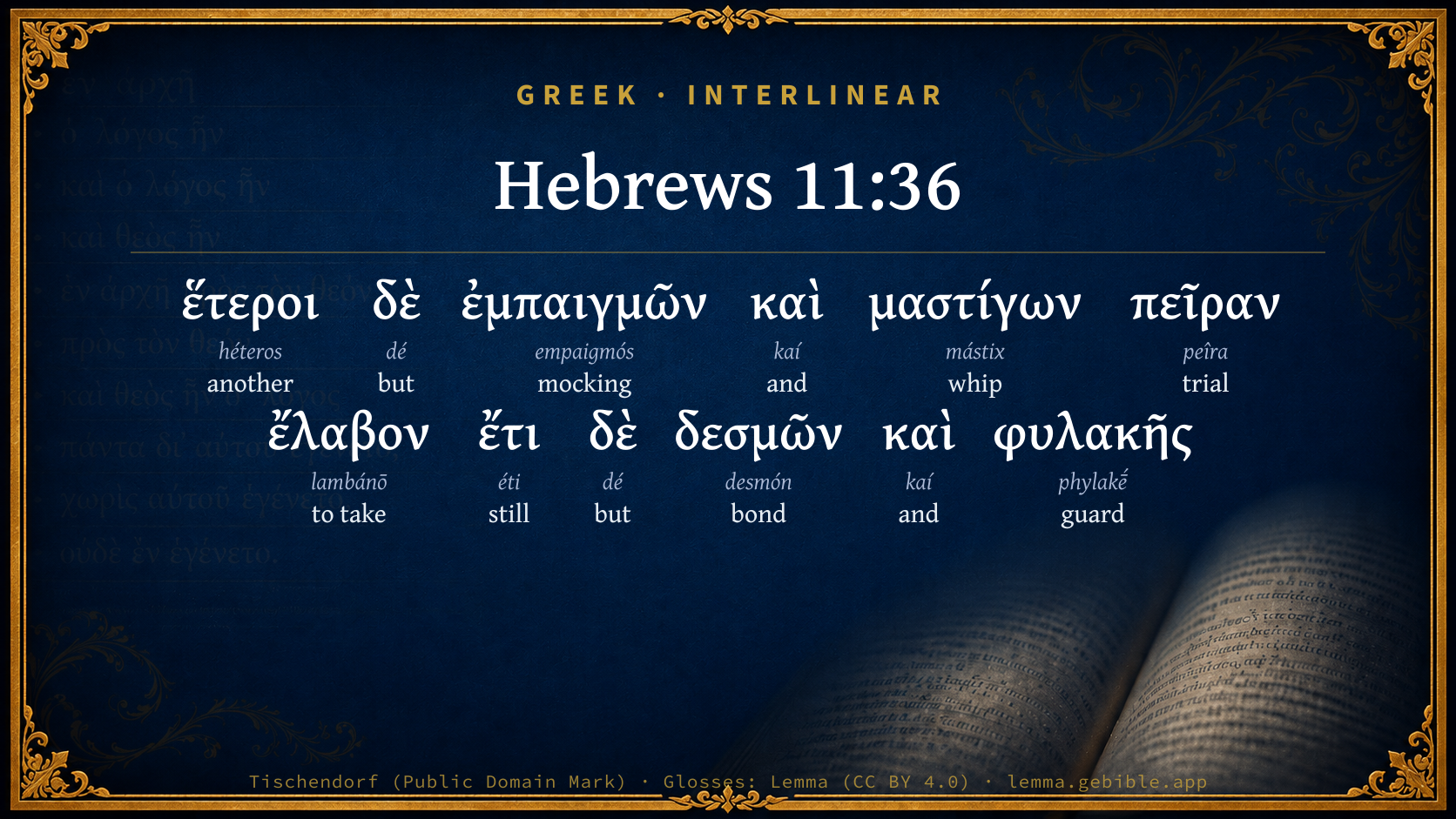
Download image
Cite this verse

Hebrews 11:36 (World English Bible). Public Domain. Lemma interlinear Bible study tool, https://lemma.gebible.app/v/hebrews/11/36.

Show BibTeX & RIS
BibTeX
RIS
English Translation
Others were tried by mocking and scourging, yes, moreover by bonds and imprisonment.
World English Bible · Public Domain
Highlights
  • 1 first appearance in the Greek New Testament
Full analysis ↓
Download a study sheet

One document with this verse’s original text, its word-by-word gloss line, the meaning frame, cross-references with their text, attributed commentary, and full source and license credits — printable, and it pastes into notes with its structure intact.

This verse Autodidact and up

Study sheet (.html) Plain text (.txt)

A passage Seminary Student

Up to 50 verses in one chapter. A passage sheet keeps up to 6 commentary sources and 12 cross-references per verse, in the order this page ranks them, and says so on the sheet whenever that leaves anything out. Ask for a single verse and you get the Autodidact verse sheet above.

Everything on this page stays free to read, with no account — the sheet is a download of what is already on screen, not access to it.

Want to remove ads? Support Godless Engineer
Compare translations 3

The same verse in 3 English versions, stacked beneath the original-language interlinear above. Click any original word for its lexicon entry.

Each is an independent rendering of the whole verse — the interlinear is not word-aligned to these translations.

Highlighted words mark where these versions differ — a whole-verse word diff, not a word-by-word alignment.

  • World English Bible Public Domain
    Others were tried by mocking and scourging, yes, moreover by bonds and imprisonment.
  • King James Version Public Domain
    And others had trial of cruel mockings and scourgings, yea, moreover of bonds and imprisonment:
  • unfoldingWord Literal Text CC BY-SA 4.0
    and others received a trial of mockings and of whippings, and even more of chains and of imprisonment.

unfoldingWord Literal Text — © unfoldingWord, licensed CC BY-SA 4.0. Word-aligned USFM3 via Door43 (git.door43.org/unfoldingWord/en_ult).

Versions to compare (up to 4)

3 of 4 selected

Show all 19 translations

Every available English version of this verse, each an independent rendering of the whole verse.

  • World English Bible Public Domain
    Others were tried by mocking and scourging, yes, moreover by bonds and imprisonment.
  • Berean Standard Bible Public Domain
    Still others endured mocking and flogging, and even chains and imprisonment.
  • Majority Standard Bible Public Domain
    Still others endured mocking and flogging, and even chains and imprisonment.
  • King James Version Public Domain
    And others had trial of cruel mockings and scourgings, yea, moreover of bonds and imprisonment:
  • American Standard Version (1901) Public Domain
    and others had trial of mockings and scourgings, yea, moreover of bonds and imprisonment:
  • Revised Version (1885) Public Domain
    and others had trial of mockings and scourgings, yea, moreover of bonds and imprisonment:
  • Geneva Bible (1599) Public Domain
    And others haue bene tryed by mockings and scourgings, yea, moreouer by bondes and prisonment.
  • Douay-Rheims (1899) Public Domain
    And others had trial of mockeries and stripes, moreover also of bands and prisons.
  • Young's Literal Translation Public Domain
    and others of mockings and scourgings did receive trial, and yet of bonds and imprisonment;
  • Literal Standard Version CC BY-SA 4.0
    and others received trial of mockings and scourgings, and yet of bonds and imprisonment;
  • Unlocked Literal Bible CC BY-SA 4.0
    Others had testing in mocking and whippings, and even chains and imprisonment.
  • unfoldingWord Literal Text CC BY-SA 4.0
    and others received a trial of mockings and of whippings, and even more of chains and of imprisonment.
  • Darby Bible Public Domain
    and others underwent trial of mockings and scourgings, yea, and of bonds and imprisonment.
  • World Messianic Bible Public Domain
    Others were tried by mocking and scourging, yes, moreover by bonds and imprisonment.
  • Webster's Bible Public Domain
    And others had trial of cruel mockings and scourgings, and, moreover of bonds and imprisonment:
  • Free Bible Version CC BY-SA 4.0
    Yet others suffered insults and whippings; they were put in chains and imprisoned.
  • Bible in Basic English Public Domain
    And others were tested by being laughed at or by blows, and even with chains and prisons:
  • Text-Critical English NT CC BY 4.0
    Others endured mocking and flogging, as well as chains and imprisonment.
  • Tyndale New Testament (1534) Public Domain
    Other tasted of mockynges and scourginginges morover of bondes and presonment:

Literal Standard Version (2020), Covenant Press — licensed CC BY-SA 4.0. Text via the HelloAO Bible API (eBible.org). Unlocked Literal Bible (unfoldingWord) — licensed CC BY-SA 4.0. Text via the HelloAO Bible API (eBible.org). unfoldingWord Literal Text — © unfoldingWord, licensed CC BY-SA 4.0. Word-aligned USFM3 via Door43 (git.door43.org/unfoldingWord/en_ult). Free Bible Version, Dr. Jonathan Gallagher — licensed CC BY-SA 4.0. Text via the HelloAO Bible API (eBible.org).

Word by word

More ways to search: Search by grammar → Find every occurrence → Compare this word →

Practice this passage: Drill this verse → Learn its vocabulary →

About this verse

These counts appear in no published source. They are computed here, from the morphology-tagged text and Lemma’s own curated glosses. What Lemma adds →

12
words
10
distinct lemmas
General Epistles
section

Notable vocabulary

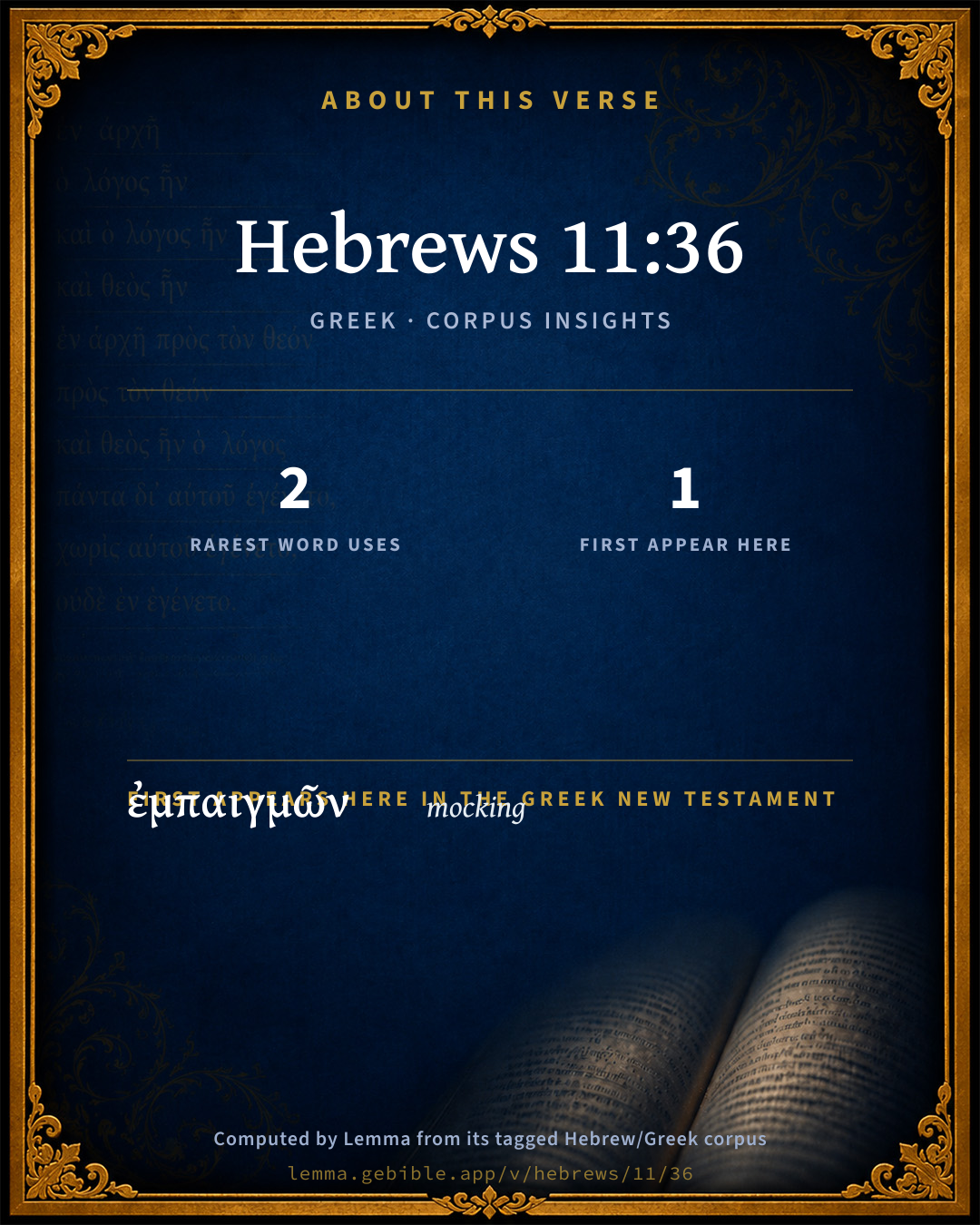
The rarest word here is ἐμπαιγμῶν mocking G1701 — appearing just 2 times in the whole Greek New Testament.

First appearance in Scripture

This word makes its first canonical appearance in the Greek New Testament here:

  • ἐμπαιγμῶν mocking G1701

Shared distinctive vocabulary

ἐμπαιγμῶν mocking G1701 occurs in 2 verses of the Greek New Testament. Also found in:
Repetition

Words recur within this verse:

Cross-references

42

Topical passages linked to Hebrews 11:36 in the Treasury of Scripture Knowledge — connected by theme and wording, ordered by reader-vote popularity; previews shown in the World English Bible.

  • Jeremiah 20:2 Then Pashhur struck Jeremiah the prophet, and put him in the stocks that were in the upper gate of Benjamin, which was in the house of Yahweh.
  • Genesis 39:20 Joseph's master took him, and put him into the prison, the place where the king's prisoners were bound, and he was there in custody.
  • Jeremiah 37:15–21 The princes were angry with Jeremiah, and struck him, and put him in prison in the house of Jonathan the scribe; for they had made that the prison.
  • 2 Chronicles 30:10 So the posts passed from city to city through the country of Ephraim and Manasseh, even to Zebulun: but they ridiculed them, and mocked them.
  • 2 Chronicles 16:10 Then Asa was angry with the seer, and put him in the prison-house; for he was in a rage with him because of this thing. Asa oppressed some of the people at the same time.
  • Jeremiah 20:7 Yahweh, you have persuaded me, and I was persuaded; you are stronger than I, and have prevailed: I am become a laughing-stock all the day, every one mocks me.
  • Jeremiah 32:2–3 Now at that time the king of Babylon's army was besieging Jerusalem; and Jeremiah the prophet was shut up in the court of the guard, which was in the king of Judah's house.
  • Lamentations 3:52–55 They have chased me sore like a bird, those who are my enemies without cause.
  • Matthew 23:34 Therefore, behold, I send to you prophets, wise men, and scribes. Some of them you will kill and crucify; and some of them you will scourge in your synagogues, and persecute from city to city;
  • Hebrews 10:34 For you both had compassion on me in my chains, and joyfully accepted the plundering of your possessions, knowing that you have for yourselves a better possession and an enduring one in the heavens.
  • Judges 16:25 It happened, when their hearts were merry, that they said, Call for Samson, that he may make us sport. They called for Samson out of the prison-house; and he made sport before them. They set him between the pillars:
  • 1 Kings 22:24 Then Zedekiah the son of Chenaanah came near, and struck Micaiah on the cheek, and said, Which way went the Spirit of Yahweh from me to speak to you?
  • 1 Kings 22:27 and say, Thus says the king, Put this fellow in the prison, and feed him with bread of affliction and with water of affliction, until I come in peace.
  • 2 Kings 2:23 He went up from there to Bethel; and as he was going up by the way, there came forth young lads out of the city, and mocked him, and said to him, Go up, you baldy; go up, you baldhead.
  • 2 Chronicles 36:16 but they mocked the messengers of God, and despised his words, and scoffed at his prophets, until the wrath of Yahweh arose against his people, until there was no remedy.
  • Psalms 105:17–18 He sent a man before them. Joseph was sold for a slave.
  • Jeremiah 29:26 Yahweh has made you priest in the place of Jehoiada the priest, that there may be officers in the house of Yahweh, for every man who is mad, and makes himself a prophet, that you should put him in the stocks and in shackles.
  • Jeremiah 36:6 therefore go you, and read in the scroll, which you have written from my mouth, the words of Yahweh in the ears of the people in Yahweh's house on the fast-day; and also you shall read them in the ears of all Judah who come out of their cities.
  • Jeremiah 38:6–13 Then took they Jeremiah, and cast him into the dungeon of Malchijah the king's son, that was in the court of the guard: and they let down Jeremiah with cords. In the dungeon there was no water, but mire; and Jeremiah sank in the mire.
  • Jeremiah 38:28 So Jeremiah abode in the court of the guard until the day that Jerusalem was taken.
  • Matthew 20:19 and will hand him over to the Gentiles to mock, to scourge, and to crucify; and the third day he will be raised up."
  • Matthew 21:35 The farmers took his servants, beat one, killed another, and stoned another.
  • Matthew 27:26 Then he released to them Barabbas, but Jesus he flogged and delivered to be crucified.
  • Mark 10:34 They will mock him, spit on him, scourge him, and kill him. On the third day he will rise again."
  • Luke 18:32 For he will be delivered up to the Gentiles, will be mocked, treated shamefully, and spit on.
  • Luke 23:11 Herod with his soldiers humiliated him and mocked him. Dressing him in luxurious clothing, they sent him back to Pilate.
  • Luke 23:36 The soldiers also mocked him, coming to him and offering him vinegar,
  • Acts 4:3 They laid hands on them, and put them in custody until the next day, for it was now evening.
  • Acts 5:18 and laid hands on the apostles, and put them in public custody.
  • Acts 5:40 They agreed with him. Summoning the apostles, they beat them and charged them not to speak in the name of Jesus, and let them go.
  • Acts 8:3 But Saul ravaged the assembly, entering into every house, and dragged both men and women off to prison.
  • Acts 12:4–19 When he had arrested him, he put him in prison, and delivered him to four squads of four soldiers each to guard him, intending to bring him out to the people after the Passover.
  • Acts 16:22–40 The multitude rose up together against them, and the magistrates tore their clothes off of them, and commanded them to be beaten with rods.
  • Acts 21:33 Then the commanding officer came near, arrested him, commanded him to be bound with two chains, and inquired who he was and what he had done.
  • Acts 24:27 But when two years were fulfilled, Felix was succeeded by Porcius Festus, and desiring to gain favor with the Jews, Felix left Paul in bonds.
  • 2 Corinthians 11:23–25 Are they servants of Christ? (I speak as one beside himself) I am more so; in labors more abundantly, in prisons more abundantly, in stripes above measure, in deaths often.
  • Ephesians 4:1 I therefore, the prisoner in the Lord, beg you to walk worthily of the calling with which you were called,
  • 2 Timothy 1:16 May the Lord grant mercy to the house of Onesiphorus, for he often refreshed me, and was not ashamed of my chain,
  • 2 Timothy 2:9 in which I suffer hardship to the point of chains as a criminal. But God's word isn't chained.
  • Revelation 2:10 Don't be afraid of the things which you are about to suffer. Behold, the devil is about to throw some of you into prison, that you may be tested; and you will have oppression for ten days. Be faithful to death, and I will give you the crown of life.
  • Jeremiah 32:8 So Hanamel my uncle's son came to me in the court of the guard according to the word of Yahweh, and said to me, Please buy my field that is in Anathoth, which is in the land of Benjamin; for the right of inheritance is yours, and the redemption is yours; buy it for yourself. Then I knew that this was the word of Yahweh.
  • Ephesians 3:1 For this cause I, Paul, am the prisoner of Christ Jesus on behalf of you Gentiles,

Cross-references courtesy of OpenBible.info (CC BY 4.0).

Commentary

Notes on Hebrews 11:36 from classic Christian and Jewish commentators (each source and its license shown beneath its notes). The classic Christian expositions comment on the surrounding passage and are grouped to its opening verse, so a note may address several verses; the Jewish commentaries on the Tanakh (Rashi and others) are per-verse, so they appear only where the commentator wrote on this verse.

Lemma curates 59 commentaries, every one of them public domain or Creative Commons licensed, each selected and text-cleaned for this edition rather than reprinted as found. About our sources →

The Biblical Illustrator

Joseph S. Exell

Heb_11:36

Cruel mockings and scourgings

Cruelty

I.

THE EVILS WERE

1. Mockings. The parties mocked were Gods saints and prophets; the parties mocking were their enemies and persecutors, which proved to be sometimes their own brethren, of the same nation, language, kindred, religion--and amongst these sometimes the basest of the people, sometimes the priests and princes. These mockings issue out of contempt, and tend unto the disgrace of the party mocked, and makes it a sport to abuse them, so as to rejoice in their misery. These mockings are sometimes in words, sometimes in signs, sometimes in both. And because to a grave, serious person, of eminent worth, some of these mockings are very bitter, cutting, cruel, not only in respect of the matter, but also of the circumstances, this made the sufferings more glorious.

2. Scourgings. This is a punishment also of great disgrace and sometimes of cruel pain, when by whips, either of cords or wires, not only the skin is broken, but the very flesh torn. And this was the more grievous because it was an usual punishment of slaves, of vilest persons, and of such as were of worst behaviour; and by it they were not only put to pain, but to open shame.

3. Bonds and imprisonment. Both these were restraints of liberty, which is so precious and desirable. The end of them was the reservation of malefactors or suspected persons till the time of trial and judgment; and close imprisonment was so much the more grievous when they were deprived of all comfortable society, and no friends suffered to relieve them.

II. THESE THEY SUFFERED. Some endured one of them, some more, some all; for they had trial or experience of these things, so some understand it, as though the sense were that they did not fear them threatened but feel them inflicted. Though their enemies did afflict and vex them unjustly and wickedly, yet they suffered them patiently, and resolved that though God should kill them, yet they would trust in Him.

III. THEY THUS SUFFERED THESE THINGS BY FAITH. For they knew the way to heaven was rough and troublesome, and that these sufferings could not separate them from the love of God nor deprive them of the great reward, but prepare them for eternal glory. For they verily believed that there was eternal life, that God had promised it, and that constancy in the covenant and perseverance in the way of righteousness was the only means to obtain possession; and they knew that though their sufferings were grievous, yet the reward would infinitely recompense all. (G. Lawson.)

Man as a persecutor:

Some creatures are unquestionably used as scourges; but perhaps the less we mortals say about such animated pests the better. They act up to their own organisation, but never beyond; whilst it is far otherwise with mankind. The serpent employs its poisoned fangs to procure food or avert peril, real or fancied; the jaguar uses its terrible incisors in the destruction of its prey; and the shark avails itself of its dental apparatus to assuage its appetite. But man, says Hugh Miller, must surely have become an immensely worse animal than his teeth show him to have been designed for; his teeth give no evidence regarding his real character. Of our racks and thumbscrews, our inquisitions and oubliettes, our noyades at Nantes and our mitraillades at Lyons and Toulons, there is no prophetic intimation in our dentology. (Scientific Illustrations and Symbols.)

Cruelty of persecutors:

As a specimen of the fierce cruelty of Queen Marys officers, Mr. Froude writes: The persecution degenerated into wholesale atrocity. On the 23rd of April six men were burnt at Smithfield; on the 28th, six more were burnt at Colchester; on the 15th of May an old lame man and a blind man were burnt at Stratford-le-Bow. In the same month three women suffered at Smithfield, and a blind boy was burnt at Gloucester. In Guernsey, a mother and two daughters were brought to the stake. One of the latter, a married woman with child, was delivered in the midst of her torments, and the infant just rescued was tossed back into the flames. Reason, humanity, even common prudence, were cast to the winds. Along the river bank stood rows of gibbets, with bodies of pirates swinging from them in the wind. Ferocity in the Government and lawlessness in the people went hand in hand. (Tinlings Illustrations.)

The Biblical Illustrator, edited by Joseph S. Exell (c. 1880s–1900s) — public domain. Text from a community e-Sword module.

Bengel's Gnomon

Johann Albrecht Bengel

Heb 11:36. Ἐμπαιγμῶν καὶ μαστίγων) The same words occur, 2Ma 7:7; 2Ma 7:1.—πεῖραν ἔλαβον, had trial) This phrase increases the praise of constancy. The bitterness of experience showed many their weakness, who thought themselves strong. The same form of expression occurs at Deu 28:56. The delicate and refined (the prosperous) are unacquainted with this experience, only let them not (it is well if they do not) flee from it.—ἔτι δὲ, yea, moreover) An increment in force (αὔξησις, advancing from weaker to stronger expressions); comp. Luk 14:26.—δεσμῶν, κ.τ.λ., of bonds, etc.) The apostle here seems to descend to recent examples, although these are also found in the canonical books.

Bengel's Gnomon of the New Testament — English translation (T&T Clark, Edinburgh, 1860) — public domain. Text from a community e-Sword module.

Meyer's Critical & Exegetical Commentary

Heinrich August Wilhelm Meyer

Heb_11:36. Others endured mockings and scourges, yea, moreover, bonds and prison. Ἕτεροι, in accordance with its verbal signification, introduces a heterogeneous class of heroes of the faith, i.e. a particular species of the ἄλλοι, mentioned as the genus Heb_11:35. As regards the subject itself, indeed, inexact, since, Heb_11:35, with ἄλλοι δὲ ἐτυμπανίσθησαν κ.τ.λ. reference was made not merely to 2 Maccabees 6., butas the addition ἵνα κρείττονος ἀναστάσεως τύχωσιν clearly showsat the same time to 2 Maccabees 7; the mention, however, of the scourging along with the mocking seems to admit of explanation only from the authors referring to 2Ma_6:30 (μαστιγούμενος) and Heb_7:1 (μάστιξι καὶ νευραῖς αἰκιζομένους), as indeed the enduring of public mockery is expressly mentioned (in addition to 1Ma_9:26) at 2Ma_7:7 (τὸν δεύτερον ἦγον ἐπὶ τὸν ἐμπαιγμόν), and again 2Ma_7:10 (μετὰ δὲ τοῦτον ὁ τρίτος ἐνεπαίζετο). On the other hand, however, it seems evident that it was the intention of the writer at Heb_11:36 in reality to draw attention to a dissimilar class of men; from the fact, even apart from the choice of the expression ἕτεροι, that in the case of the previous ἄλλοι δὲ ἐτυμπανίσθησαν κ.τ.λ. we are constrained to think of a death by martyrdom, while at Heb_11:36 the enhancing ἔτι δέ forbids our thinking of the martyrs death, since, according to this, bonds and dungeon were a more severe trial than mocking and scourging. We must therefore suppose that the author designed further to refer to those, as forming a special category, who, without suffering actual death, were exposed to other kinds of tortures and miseries; that he still derived, however, the main colours for this new picture from the historic figure which but just now had been present to his mind in connection with the ἐτυμπανίσθησαν κ.τ.λ.

The enhancing ἔτι δέ is to be explained from the fact that ἐμπαιγμοὶ καὶ μάστιγες denotes the more transient suffering, in point of time more brief; δεσμοὶ καὶ φυλακή, on the other hand, the longer enduring sufferings.

πεῖραν λαμβάνειν] here in the passive sense: to have experience of something. Otherwise Heb_11:29.

δεσμῶν καὶ φυλακῆς] Comp. 1Ma_13:12; 1Ki_22:27; Jeremiah 37, 38., al.

Meyer — Critical and Exegetical Commentary on the New Testament — English translation by Peter Christie, edited by Frederick Crombie (T&T Clark, 1880) — public domain. Text from a community e-Sword module.

Expositor's Greek Testament

ed. W. Robertson Nicoll

Heb 11:36 . ἕτεροι δέ … introducing a different class of victories achieved by faith, although ἐμπαιγμῶν καὶ μαστίγων , “mockings and scourgings” were endured by the martyrs who have just been mentioned ( 2Ma 7:7 ; 2Ma 7:1 ). πεῖραν ἔλαβον , see Heb 11:29 . ἔτι δὲ δεσμῶν … “yea, moreover of bonds and prison”; as the examples in Bleek prove, ἔτι δὲ is commonly used to express a climax ( cf. Luk 14:26 ); and such imprisonment as was inflicted, e.g. , on Jeremiah (Jer 38:9 ) was certainly even more to be dreaded than scourging. ἐλιθάσθησαν , “they were stoned,” as was Zechariah, son of Johoiada, 2Ch 24:20 (Luk 11:51 ). There was also a tradition that Jeremiah was stoned at Daphne in Egypt. ἐπρίσθησαν , “they were sawn asunder,” a cruel death sometimes inflicted on prisoners of war (2Sa 12:31 ; Amo 1:3 , ἔπριζον πρίοσι σιδηροῖς ). The reference is probably to Isaiah who according to the Ascensio Is . (Heb 1:9 , Heb 5:1 ) was sawn asunder by Manasseh with a wooden saw. Cf. Justin, Trypho , 120, ( πρίονι ξυλίνῳ ἐπρίσατε ) and Charles’ Ascension of Isaiah . Within our own memory some of the followers of the Bâb suffered the same death. ἐπειράσθησαν , “were tempted”. Alford says, “I do not see how any appropriate meaning can be given to the mere enduring of temptation, placed as it is between being sawn asunder and dying by the sword”. He would therefore either omit the word as a gloss on ἐπρίσθησαν or substitute ἐπρήσθησαν . That is a tempting reading because not only was one of the seven brothers (2 Maccabees 6; 2Ma 7:5 ) fried, but those who sought to keep the Sabbath in a cave ( 2Ma 6:11 ) were all burned together by order of Philip, Antiochus’ governor in Jerusalem. At the same time, the reading, “were tempted” gives quite a good sense, for certainly the most fiendish element in the torture of the seven brothers was the pressure put on each individually to recant. ἐν φόνῳ μαχαίρης ἀπέθανον , “died by sword-slaughter,” for ἐν φ . μαχ . see Exo 17:13 ; Num 21:24 , etc.; and for ἀπεθ . ἐν see Jer 11:22 ; Jer 21:9 . Examples of this death abounded in the Maccabean period. περιῆλθον ἐν μηλωταῖς , “they wandered about in sheepskins,” (as the mantle of Elijah is called in 2Ki 2:8 , ἔλαβεν Ἠλιοὺ τὴν μηλωτὴν αὐτοῦ ), or even “in goatskins,” a still rougher material. This dress they wore not as a professional uniform, but because “destitute,” ὑστερούμενοι as in Luk 15:14 . ἤρξατο ὑστερεῖσθαι , Phi 4:12 καὶ περισσεύειν καὶ ὑστερεἷσθαι , “hard-pressed,” θλιβόμενοι , as in 2Co 4:8 θλιβόμενοι ἀλλʼ οὐ στενοχωρούμενοι , κακουχούμενοι , “maltreated,” see Heb 11:25 . ὧν οὐκ ἦν ἄξιος ὁ κόσμος , “of whom the world was not worthy”. “The world drove them out, thinking them unworthy to live in it, while in truth it was unworthy to have them living in it” (Davidson). Vaughan aptly compares Act 22:22 . After this parenthetical remark the description is closed with another participial clause, ἐπὶ ἐρημίαις πλανώμενοι … “wandering over deserts and mountains, and in caves and in the holes of the earth,” verified 1Ki 18:4 ; 2Ma 5:27 where it is related of Judas and nine others, ἀναχωρήσας εἰς τὴν ἔρημον , θηρίων τρόπον ἐν τοῖς ὄρεσι διέζη . Cf. also 2Ma 10:6 , ἐν τοῖς ὄρεσι καὶ ἐν τοῖς σπηλαίοις θηρίων τρόπον ἦσαν νεμόμενοι . In the Ascensio Isaiae , ii. 7, 12, Isaiah and his companions are said to have spent two years among the mountains naked and eating only herbage.

The Expositor's Greek Testament, edited by W. Robertson Nicoll (1897–1910) — public domain. Text from a community e-Sword module.

Jamieson, Fausset & Brown

Robert Jamieson, A. R. Fausset & David Brown

others--of a different class of confessors for the truth (the Greek is different from that for "others," Heb 11:35, alloi, heteroi).

trial--testing their faith.

imprisonment--as Hanani (Ch2 16:10), imprisoned by Asa. Micaiah, the son of Imlah, by Ahab (Kg1 22:26-27).

Jamieson, Fausset & Brown — Commentary Critical and Explanatory on the Whole Bible (1871) — public domain (CC PDM 1.0). Text via the HelloAO Bible API.

Adam Clarke's Commentary

Verse 36. Had trial of cruel mockings and scourgings] We do not know the cases to which the apostle refers. The mockings here can never mean such as those of Ishmael against Isaac, or the youths of Bethel against Elisha. It is more probable that it refers to public exhibitions of the people of God at idol feasts and the like; and Samson's case before Dagon, when the Philistines had put out his eyes, is quite in point. As to scourgings, this was a common way of punishing minor culprits: and even those who were to be punished capitally were first scourged. See the case of our Lord.

Bond's and imprisonment] Joseph was cast into prison; Jeremiah was cast into a dungeon full of mire, Jer 37:16, and Jer 38:6; and the Prophet Micaiah was imprisoned by Ahab, 1Kg 22:27.

Adam Clarke's Commentary on the Bible (1810–1826) — public domain. Text from a community e-Sword/MySword module.

Ellicott's Commentary for English Readers

(36) The language becomes more general, but still chiefly refers to the same troublous times.

Yea, moreover of bonds.—Lasting and cruel captivity, a worse fate even than “mockings and scourgings.”

A Bible Commentary for English Readers, edited by Charles John Ellicott (1878–1897) — public domain. Text from a community e-Sword module.

The Cambridge Bible for Schools and Colleges

gen. ed. J. J. S. Perowne

36. mockings and scourgings] “Seven brethren and their mother … being tormented with scourges and whips … and they brought the second for a mocking-stock … And after him was the third made a mocking-stock … And … they tortured and tormented the fourth in like manner” (2Ma_7:1; 2Ma_7:7; 2Ma_7:10; 2Ma_7:13, &c.). “And they sought out … Judas’ friends … and he took vengeance on them and mocked them” (1Ma_9:26).

of bonds and imprisonment] Joseph (Gen_39:20), Micaiah (1Ki_22:26-27), Jeremiah (Jer_20:2; Jer_37:15), Hanani (2Ch_16:10).

The Cambridge Bible for Schools and Colleges (gen. ed. J. J. S. Perowne; Cambridge University Press, 1878–1918) — public domain. Text from a community e-Sword module.

John Gill's Exposition

Of whom the world was not worthy,.... These words are inserted in a parenthesis, to remove or prevent such objections as these; that they were restless and unquiet persons, that made disturbance in the world, and so unfit to live in it; and that they were deservedly punished for crimes they were guilty of; and to show the great worth and inestimable value of the people of God, which exceeds that of the whole world; and to intimate the removal of them out of the world, or from dwelling among the men of it, is by way of punishment to it:

they wandered in deserts, and in mountains, and in dens and caves of the earth; as Elijah did; Kg1 18:4, and many in the times of the Maccabees;

"And they kept the eight days with gladness, as in the feast of the tabernacles, remembering that not long afore they had held the feast of the tabernacles, when as they wandered in the mountains and dens like beasts'' (2 Maccabees 10:6).

John Gill's Exposition of the Whole Bible (1746–1763) — public domain (CC PDM 1.0). Text via the HelloAO Bible API.

Trapp's Complete Commentary

John Trapp

36 And others had trial of cruel mockings and scourgings, yea, moreover of bonds and imprisonment:

Ver. 36. Of cruel mockings] As Jeremiah, Amos, Elisha, "Go up, bald head, go up," so. "To heaven, as they say" (but who will believe it?) "that your master Elijah did." So they mewed at David, mocked at Isaiah, Isa 28:10; (the sound of the words, as they are in the original, carries a taunt), jeered our Saviour, Luk 16:14. See these Hebrews upon the stage, as mocking stocks, Heb 10:33.

John Trapp, A Commentary or Exposition upon All the Books of the Old and New Testament (1647–1656) — public domain. Text from a community e-Sword module.

Albert Barnes' Notes on the Bible

And others had trial of cruel mockings - Referring to the scorn and derision which the ancient victims of persecution experienced. This has been often experienced by martyrs, and doubtless it was the case with those who suffered on account of their religion, before the advent of the Saviour as well as afterward. Some instances of this kind are mentioned in the Old Testament 2Ki 2:23; 1Ki 22:24; and it was frequent in the time of the Maccabees.

And scourging - Whipping. This was a common mode of punishment, and was usually inflicted before a martyr was put to death; see the notes on Mat 10:17; Mat 27:26. For instances of this, see Jer 20:2; 2 Macc. 7:1; 5:17. “Of bonds.” Chains. Gen 39:20.

And imprisonment - see 1Ki 22:27; Jer 20:2.

Albert Barnes' Notes on the Bible (1834–1885) — public domain. Text from a community e-Sword/MySword module.

Matthew Poole's English Annotations

And others had trial of cruel mockings; the same gospel faith enabled others than those mentioned before, prophets and saints, as Micaiah, 1Ki 22:24, Elisha, 2Ki 2:23; Isa 8:18; Amo 7:10, readily, cheerfully, and patiently to accept and receive the experience and trials of mocking, from the insulting, cruel enemies of God and his church, both national and aliens; being exposed and made a laughing-stock by reproaches, sarcasms, and nick-names, to aggravate their afflictions; and these inflicted on them by words and external signs, trials which, to an ingenuous spirit, bears harder than external torments, and which they more deeply sense and resent; yet faith makes them to receive all humbly, and carrieth them above them, as Psa 31:20; 52:1-5; 120:3,4; 140:3.

And scourgings; they felt the scourges and whips of their enemies smart on them, such as were excessively shameful and painful, being inflicted on the vilest persons, as slaves; such as was the matter of these scourges, such their smartings, whether of thongs, cords, or wires, Jer 20:2; 37:15. This torment was commonly inflicted on them, not in Antiochus’s time only, and those before, but commonly in Christ’s and the apostles’ days, 2Co 6:5; 11:23.

Yea, moreover of bonds and imprisonment: they cheerfully and patiently submitted to the cruel treating of their persecutors, who put them in the stocks, places of little ease, dungeons, loading them with iron shackles and fetters, which the wickedness of man had invented to torment them with; stern and cruel usage by their gaolers, restraining society from them, and of comfortable relief, feeding them with the bread and water of affliction, 2Ch 18:26; Act 16:24.

Matthew Poole's English Annotations on the Holy Bible (1683–1685) — public domain. Text from a community e-Sword/MySword module.

The Pulpit Commentary

Vers. 36-38. And others had trial of mockings and scourgings, yea, moreover of bonds and imprisonment: they were stoned, they were sawn asunder, were tempted, were slain with the sword: they wandered about in sheepskins and goatskins; being destitute, afflicted, tormented (rather, evil-entreated); (of whom the world was not worthy:) wandering in deserts, and mountains, and dens, and the eaves of the earth. In this general review particular cases may again have suggested some of the expressions used. The mention of "mockings" is prominent in the Maccabean history; "bonds and imprisonments" recall Hanani, Micaiah, and Jeremiah; "they were stoned" recalls Zachariah son of Jehoiada. (2Ch_24:20; cf. Mat_23:35 Luk_11:51 Mat_23:37 Luk_13:34) "They wandered in sheepskins (mhlwtaiv) and in deserts" peculiarly suggests Elijah. (his mantle being called mhlwthv in the LXX, 2Ki_2:13, 2Ki_2:14) though the Maccabean heroes also took refuge in "deserts and mountains". (RAPC 1Ma 2) "Sawn asunder" (denoting a mode of executing martyrs of which there is no instance in the Old Testament or Apocrypha) most probably refers to a well-known tradition about Isaiah, who is said to have so suffered under Manasseh. Alford thus gives the notices found elsewhere of this tradition: "Justin Martyr "Trypho," Tertullian, "Cont. Guest. Scorpiac.," 8, and "De Patient.," 14; Origen, "Ep. ad African.;" Lactantius, "Inst.," 4:11; Psalm-Epiphanius, "Vit. Proph.; "Augustine, "De Cir. Dei," 18:24; Jerome, Isa_57:1." Jerome calls it a "certissima traditio apud Judaeos," and says that this passage in the Epistle was by most referred to the passion of Isaiah. The tameness and apparent inappropriateness of the verb epeirasyhsan ("were tempted") in ver. 36, in the midst of an enumeration of cruel modes of death, has led to a prevalent view that it is a corruption of the original text. Various conjectures have been made, the most tenable being

(1) that it is an interpolation, arising from the repetition by some copyist of eprisyhsan , which was afterwards altered to epwirasyhsan : or

(2) that it is a substitution for some other word through error in transcription, the most likely conjecture as to the word originally written being eprhsyhsan or epurasyhsan , equivalent to "were burnt." Either form, especially the latter, might easily be changed to epeirasyhsan : and thus death by fire would have been originally included in the enumeration, which was likely to have been the ease, especially since it is mentioned prominently in the account of the martyrdom of the seven sons. But, as there is no authority of any manuscript for a different word, this is mere conjecture; though the omission of the word altogether in some few manuscripts and versions, and variations of reading in others, suggest some uncertainty as to the original text. The word epeirasyhsan if genuine, may possibly have been suggested by alliteration, and by thought of the temptations to apostatize prominent in the account both of Eleazar and of the seven sons.

The Pulpit Commentary (1880–1919), ed. H.D.M. Spence-Jones & Joseph S. Exell — public domain. Text from a community e-Sword module.

John Wesley's Explanatory Notes

And others - The apostle seems here to pass on to recent examples.

John Wesley, Explanatory Notes Upon the Whole Bible (1754–1765) — public domain. Text via the GEBible commentary corpus.

Burkitt's Expository Notes on the New Testament

William Burkitt

Our apostle having in the foregoing verses acquainted the Hebrews with the great things which faith enabled the Old Testament saints to do, he now lays before them an account of the hard and difficult things which faith enabled them to suffer, and here reckons up the sharpest and bitterest sufferings that human nature perhaps can be exposed to; but to do the greatest things, and to suffer the hardest, is all one to faith. Faith stands ready for both, as God shall call.

Observe here in general, that the evils enumerated are of such various sorts and kinds, as to comprise ever thing that may befal believers on the account of their Christian profession: Do we meet with temptations, scorns, mockings, scourgings, bonds, imprisonments, yea, death itself, by all sorts of tortures and extremities? THis is our encouragement, that others in the cause of God, have undergone them, and been carried victoriously through them: but the particulars in this little book of martyrs follow.

Others were tortured, not accepting deliverance. In this passage, and several others here following, the apostle is concluded to refer too the story in the Maccabees, whic though written after the closing of the canon of the scripture, when there was no extraordinary prophet in the church, yet the matters of fact were then fresh in memory, and are here alluded to, particularly Eleazar, , who was beaten to death, when he had been persuaded and allured to accept deliverance by transgressing the law; and also the mother and her seven sons, they expected a better resurrection, better than what their persecutors offered them, even a glorious resurreciton of their bodies at the last day.

Others had trials of cruel mockings, as Micaiah, 1Ki 22:24, and others’ and scourgings, as Jer 20:2; Jer 20:15.

Also bonds and imprisonments, as Joseph in Egypt, and Jeremy in the dungeon; some were stoned, as Zachharias the son of Johoiada, 2Ch 24:21.

Others sawn asunder, as Isaiah under the tyranny of Manesseh; others were tempted with fair promises and great rewards, but refusing, were slain with the sword.

Learn hence, That torments in the case of religion have been a very old invention of the devil and the world, and they have placed great hopes of prevailing by them; but no instruments of cruelty, no endeavours of hell, shall ever prevail against the faith of God’s elect. They wandered about in sheep-skins, and goat-skins; destitute, afflicted, tormented. This some refer to Elijah, who was destitute and fed by ravens, 1Ki 17:4, but it has been the portion of many of God’s faithful servants to be driven from their habitations, sometimes by the cruelty of the laws, sometimes by force and violence.

Of whom the world was not worthy; that is, the men of the world think the saints of God not worthy of to live amongst them, whereas the world is not worthy of such excellent company; and therefore, as soon as their work is done, God removes them.

Learn hence, 1. That God’s esteem of his people is never the less because of their outward sufferings and calamities, whatever the world judgeth of them; they esteem them the filth of the world, and the off-scouring of all things; but God is of another mind.

Learn, 2. Let the world think as highly and as proudly of itself as it pleases, God thinks it at all times, but especially when it persecute his people, base, and unworthy of their society. They wandered in deserts and mountains: Behold here the state and condition of some of the servants of the Living God, who, when driven from all inhabited places, took up their lodgings in deserts and mountains, in dens and caves of the earth.

Learn hence, That oft-times it is much better, and more safe for the saints of God to be in a wilderness, among the beasts of the fields, than in a savage world inflamed by the devil into rage and persecution.

William Burkitt's Expository Notes on the New Testament (1700–1703) — public domain. Text from a community e-Sword module.

Godbey's Commentary on the New Testament

William B. Godbey

ARGUMENT 15

THE BETTER RESURRECTION.

“Better” is not antithetical to bad, but to good. Hence the logical sequence follows that while there is a bad resurrection for the wicked, there are also two resurrections for the righteous — the good and the better, the first and the last. It is stated positively

“Blessed and holy is he that hath part in the first resurrection: over these the second death hath no power, they shall be priests of God and Christ, and shall reign with Him a thousand years.” (Rev 20:6)

This Scripture, as well as others, settles the question of the two resurrections without the possibility of cavil. I am sorry this important revelation has been obscured by the spiritualization of the first resurrection. This is a gross and flagrant error, utterly untenable, as it breaks up and destroys the antithesis, doing away with the corporeal resurrection altogether, and plunging headlong into the Swedenborgian heresy. The Greek is ezeean in both cases, which simply means, “they lived.” If it is spiritual in one sense it is in the other, and physical resurrection is forever gone. Hence we see the utter untenability of this construction and receive unequivocally the doctrine of the two resurrections. In the rapture described by Paul (1Th 4:13-18), we have another graphic account of the first resurrection, when the Lord shall come after His bride, preparatory to His millennial kingdom. Php 3:11,

“If perchance I may attain unto the resurrection which is out from among the dead.”

The Old Testament saints were not ignorant of the glorious reality of the Lord’s bridehood. Therefore they suffered the most terrible tortures of martyrdom that they might have a place in the first resurrection; which will take place before the millennium, the last resurrection being postponed till the final judgment. It is certainly a glorious privilege to rise and shout o my grave a thousand years before the general resurrection, especially when we consider the glorious privileges of the bridehood to reign with Christ during the millennial ages.

36-38. Here the Holy Ghost describes the terrible tortures inflicted by a wicked world and a fallen Church on the Old Testament martyrs. They shouted in the fires anticipating the glories awaiting them in the Lord’s bridehood and the first resurrection.

39. “All these having received the witness of the Spirit through faith, obtained not the promise.”... While the Bible is flooded with thousands of promises, especially considering the synonymy of promise and commandment in the Greek and Hebrew, by which the number is doubled, the great Messianic promise of the Lord’s incarnation and the world’s literal and actual redemption by the bleeding Christ on the cross, his triumphant resurrection, glorious ascension and mediatorial coronation and intercession throughout the Bible is magnified as “the promise” by way of pre-eminence and exaltation. While the saints of all ages lived in glowing anticipation of this wonderful prophetical fulfillment, and the realization of the Messianic promise, yet they all died without the sight. Contrastively with the verification of this promise, theirs was a dispensation of Christian imperfection. Yet their stalwart and sanguine hope swept onward through the lights of type and prophecy into the personal experience of Christian perfection. This grand faith brigade lived, testified and shouted, in the realization of Gospel experiences many centuries in advance of their age and generation, while the rank and file of the Church barely reached perfection in the article of death, passing into eternity in a state of spiritual infancy, like the great bulk of the Gospel Church of the present day. Their case was apologizable, as they were in harmony with their dispensation, while the unsanctified millions of the Church of the present day, both clerical and laic, are blundering along amid the fogs of carnality, three thousand years behind the age.

William B. Godbey, Commentary on the New Testament (1896–1900) — public domain. Text from a community e-Sword module.

The People's New Testament

B. W. Johnson

36. Others had trial of, etc. This was true of many persecutions recorded in Jewish history.

B. W. Johnson's The People's New Testament with Notes (1889–1891) — public domain. Electronic text from the Christian Classics Ethereal Library (CCEL) ThML edition.

Cambridge Greek Testament for Schools and Colleges

36. ἐμπαιγμῶν καὶ μαστίγων. “Seven brethren and their mother … being tormented with scourges and whips … and they brought the second for a mocking-stock … And after him was the third made a mocking-stock … And … they tortured and tormented the fourth in like manner” (2Ma 7:1; 2Ma 7:7; 2Ma 7:10; 2Ma 7:13, &c.). “And they sought out … Judas’ friends … and he took vengeance on them and mocked them” (1Ma 9:26).

δεσμῶν καὶ φυλακῆς. Joseph (Gen 39:20), Micaiah (1Ki 22:26-27), Jeremiah (Jer 20:2; Jer 37:15), Hanani (2Ch 16:10).

Cambridge Greek Testament for Schools and Colleges (Cambridge University Press, 1896; 21 vols, various authors incl. Carr, Maclear, Plummer, Farrar, Lumby, Moule, M. R. James, Simcox) — public domain. Text from a community e-Sword module.

Alford’s Greek Testament

Henry Alford

36.] others again (no further contrast need be brought out; ἄλλοι μέν, ἕτεροι δέ, is common enough in recounting various classes) had trial (the passive sense of πεῖραν λαμβάνειν, as we had the active before, ver. 29, where see examples of that use. The passive signification is found Polyb. xxviii. 9. 7, πολλοὺς ἄν ἐποίησε τῆς αὐτῆς τύχης πεῖραν αὐτῷ λαβεῖν: Diod. Sic. xii. 24, τὴν θυγατέρα ἀπέκτεινεν, ἵνα μὴ τῆς ὕβρεως λάβῃ πεῖραν: Jos. Antt. ii. 5. 1, οὗ (τοῦ θεοῦ) πεῖραν τῆς προνοίας εὐθὺς ἐλάμβανον. See more in Bleek on ver. 29) of cruel mockings (so the E. V. well: for the word must mean insult accompanied with cruelty, judging from its use in the place here referred to, viz. 2 Macc. 7:7, τὸν δεύτερον ἦγον ἐπὶ τὸν ἐμπαιγμόν: and 10, μετὰ δὲ τοῦτον ὁ τρίτος ἐνεπαίζετο. See also 1 Macc. 9:26) and of scourgings (see reff. 2 Macc.), yea moreover (ἔτι δέ rises in climax: so out of many examples in Bleek, Xen. Œcon. v. 12, ἔτι δὲ ἡ γῆ θέλουσα … διδάσκει, “and moreover the earth of herself teaches,” &c.) of bonds and prison (so Jonathan, 1 Macc. 13:12. But perhaps he now speaks more generally, e. g. of Hanani, 2Ch 16:10, Micaiah, the son of Imlah, 1Ki 22:26, and Jeremiah, Jer 32:2, Jer 32:3 al.):

Henry Alford, The Greek Testament (1849–1861) — public domain. Text from a community e-Sword module.

Westcott on Hebrews & the Epistles of John

Brooke Foss Westcott

36. ἕτεροι δέ] The apostle goes on to notice a second class among those (ἄλλοι) who shewed their faith not in conquering but in bearing. Some endured death, some endured afilic-

tions less in immediate extent, yet no leas terrible as trials of endurance. Gal. i. 6f. with Lightfoot’s note. πεῖραν ἔλαβον] v. 29. They oxperienced sufferings which wore sharp and direct (dys. «al pacr....2 Macc. vii, 7, 1), strokes on soul and body; and sufferings also which were dull xxii 27; Jorem. xxxvii.; xxix. 26; 1 Macc. xiii. 12; 2 Maco. vii. 7, 10. The ἔτι δέ marks a climax (Acta ii 26 [Luke xiv. 26, ἔτι τε]. Tho sharp, short trial is easier to bear. The phrase πεῖρ. ἔλαβεν occurs in Luxx. Deut. xxviii. 56 (Aqu. ἐπείρασεν). 37, 38. A fresh summary is given of sufferings to death (if ἐπειράσθησαν be corrupt) (v. 37); and of sufforings short of doath (v. 38). ἐλιθάσθησαν) Stoning was a characteristic Jewish punishment: 2 Chron. xxiv. 20f. (Zechariah son of Jehoiada); (Lk. xi. 51); Matt. xxi. 35; xxiii. 37. Ut Naboth; Jeremias in Agypto a roliquiis transmigratorum (comp. Tertull. Scurp.i.8); Ezochiel in Babylone; aliique quamplures in Novo Testamento (Primas.), Ὁ ἐπειράσθησαν) This word seems to be foreign to the context. The reference to Job (Primas.,, Gicum.) is not satisfactory. Of tho many conjectures which havo boon suggosted tho most plausible are, ἐπρήσθησαν or ἐνεπρήσM., ζῶντες ol μὲν ἐνεπρήσθησαν οἱ δὲ διὰ μέσης κατεσύρησαν ἀγορᾶς ἕως ὅλα τὰ σώματα αὐτῶν ¢ λ

in the Lxx. for NTW, the characteristic prophet’s dress: 1 K. xix. 13, 19; 2 K. fi. 8,13, 14. This was of sheep (or goat) akin (compnre WWW N}IK Zech. xiii. 4; Gen. xxv. 25); and was afterwards adopted as a monastic dress. See Suicer 8. 9.

vor. θλιβ. xaxovy.] in want of the ordinary means of life (Ecchus. xi. 11; Luke xv. 14; Phil. iv. 12; 2 Cor, xi. 9), afflicted by pressuro (Valg. anguetiati) from without (2 Thess. i 6 f.), in evil plight generally (xili. 3; ©. 25).

Brooke Foss Westcott (1825–1901), The Epistle to the Hebrews (1889) and The Epistles of St John (1883) — public domain (pre-1929). Text recovered from Internet Archive / Google Books OCR scans. Westcott’s Gospel of John commentary is not included (its OCR lost the chapter running-heads required for reliable verse-keying). Some Greek quoted in the Hebrews volume is imperfectly rendered by the OCR.

Lesson kit

Teaching starters — assembled from the data on this page, not authored interpretation. Every prompt links to the verse data it draws on. Edit before teaching.

Hebrews, in the General Epistles, opens this verse with 12 words (10 distinct Greek lemmas). Its most distinctive word is empaigmós (“mocking”). A historical commentator’s framing appears above. Read the whole chapter for the surrounding context.

Discussion questions

  1. How does “mocking” (empaigmós) shape what this verse is saying?
  2. This is the first place “mocking” appears in Scripture (first appears here). What does its debut here establish?
  3. How does 2 Peter 3:3, which shares the word «mocking», read alongside this verse?
  4. What does the repetition of “but” (2× in this one verse) do in this verse?
  5. The translations on this page render this verse differently — a whole-verse word diff, not a word-by-word alignment. What might account for the different wordings?
  6. Compare how The Biblical Illustrator and Bengel's Gnomon read this verse. Where do they agree or differ?

Things to notice

  • 1 word makes its first canonical appearance in Scripture here.
  • These translations choose different wording for 17 words in this verse.
  • “but” occurs 2× in this single verse.
  • 10 distinct Greek lemmas span 12 words in this verse.

Reading settings

Reading text

Shown beneath each verse's original-language words.

Old Testament
Old Testament edition

Read the OT as the Masoretic Hebrew (MT) or the Greek Septuagint (LXX).

English shown for the Greek Septuagint (in the Hebrew ↔ Greek comparison).

Comparing translations? Open the Compare panel on any verse page to stack up to four side by side.