Hebrews 5:6

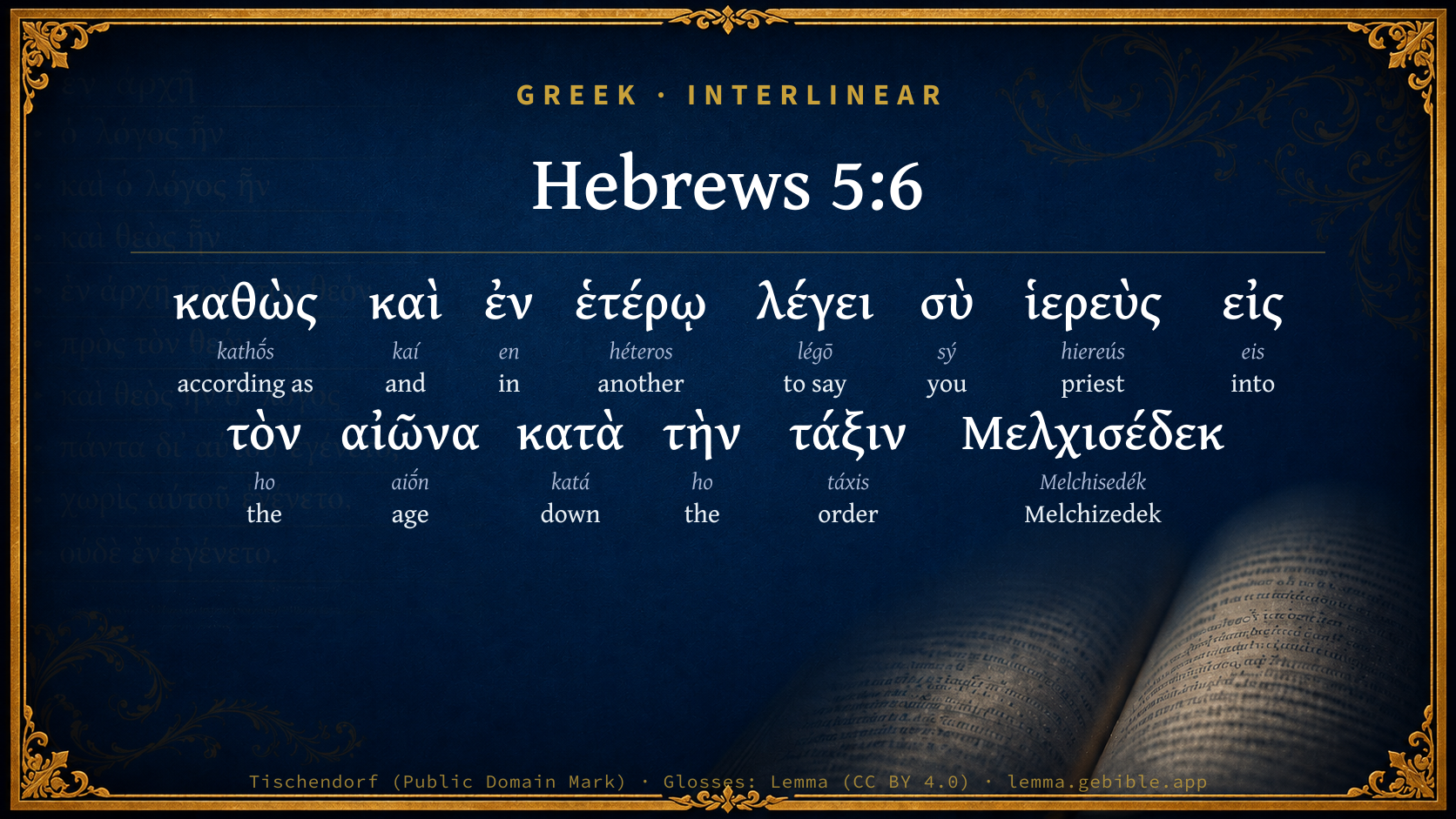
Greek (Tischendorf 8th ed.) Hebrews 5:6 appears in the Greek New Testament. The text above is from the Tischendorf 8th edition. Each word links to its Strong’s number and a concise gloss. Click any word for its full Thayer’s Greek Lexicon entry.
Download image
Cite this verse

Hebrews 5:6 (World English Bible). Public Domain. Lemma interlinear Bible study tool, https://lemma.gebible.app/v/hebrews/5/6.

Show BibTeX & RIS
BibTeX
RIS
English Translation
As he says also in another place, "You are a priest forever, After the order of Melchizedek."
World English Bible · Public Domain
Highlights
  • 1 first appearance in the Greek New Testament
Full analysis ↓
Download a study sheet

One document with this verse’s original text, its word-by-word gloss line, the meaning frame, cross-references with their text, attributed commentary, and full source and license credits — printable, and it pastes into notes with its structure intact.

This verse Autodidact and up

Study sheet (.html) Plain text (.txt)

A passage Seminary Student

Up to 50 verses in one chapter. A passage sheet keeps up to 6 commentary sources and 12 cross-references per verse, in the order this page ranks them, and says so on the sheet whenever that leaves anything out. Ask for a single verse and you get the Autodidact verse sheet above.

Everything on this page stays free to read, with no account — the sheet is a download of what is already on screen, not access to it.

Want to remove ads? Support Godless Engineer
Compare translations 3

The same verse in 3 English versions, stacked beneath the original-language interlinear above. Click any original word for its lexicon entry.

Each is an independent rendering of the whole verse — the interlinear is not word-aligned to these translations.

Highlighted words mark where these versions differ — a whole-verse word diff, not a word-by-word alignment.

  • World English Bible Public Domain
    As he says also in another place, "You are a priest forever, After the order of Melchizedek."
  • King James Version Public Domain
    As he saith also in another place, Thou art a priest for ever after the order of Melchisedec.
  • unfoldingWord Literal Text CC BY-SA 4.0
    just as he also says in another, “You a priest forever, after the order of Melchizedek.”

unfoldingWord Literal Text — © unfoldingWord, licensed CC BY-SA 4.0. Word-aligned USFM3 via Door43 (git.door43.org/unfoldingWord/en_ult).

Versions to compare (up to 4)

3 of 4 selected

Show all 19 translations

Every available English version of this verse, each an independent rendering of the whole verse.

  • World English Bible Public Domain
    As he says also in another place, "You are a priest forever, After the order of Melchizedek."
  • Berean Standard Bible Public Domain
    And in another passage God says: “You are a priest forever in the order of Melchizedek.”
  • Majority Standard Bible Public Domain
    And in another passage God says: “You are a priest forever in the order of Melchizedek.”
  • King James Version Public Domain
    As he saith also in another place, Thou art a priest for ever after the order of Melchisedec.
  • American Standard Version (1901) Public Domain
    as he saith also in another `place,' Thou art a priest for ever After the order of Melchizedek.
  • Revised Version (1885) Public Domain
    as he saith also in another place, Thou art a priest for ever After the order of Melchizedek.
  • Geneva Bible (1599) Public Domain
    As he also in another place speaketh, Thou art a Priest for euer, after ye order of Melchi-sedec.
  • Douay-Rheims (1899) Public Domain
    As he saith also in another place: Thou art a priest for ever, according to the order of Melchisedech.
  • Young's Literal Translation Public Domain
    as also in another `place' He saith, `Thou `art' a priest -- to the age, according to the order of Melchisedek;'
  • Literal Standard Version CC BY-SA 4.0
    just as He also says in another [place], “You [are] a priest throughout the age, according to the order of Melchizedek”;
  • Unlocked Literal Bible CC BY-SA 4.0
    It is just as he also says in another place, “You are a priest forever after the manner of Melchizedek.”
  • unfoldingWord Literal Text CC BY-SA 4.0
    just as he also says in another, “You a priest forever, after the order of Melchizedek.”
  • Darby Bible Public Domain
    Even as also in another [place] he says, *Thou* [art] a priest for ever according to the order of Melchisedec.
  • World Messianic Bible Public Domain
    As he says also in another place, “You are a priest forever, after the order of Melchizedek.”
  • Webster's Bible Public Domain
    As he saith also in another place, Thou art a priest for ever after the order of Melchisedec.
  • Free Bible Version CC BY-SA 4.0
    In another verse, God says, “You are a priest forever, following the order of Melchizedek.”
  • Bible in Basic English Public Domain
    As he says in another place, You are a priest for ever after the order of Melchizedek.
  • Text-Critical English NT CC BY 4.0
    And in another passage he says, “Yoʋ are a priest forever according to the order of Melchizedek.”
  • Tyndale New Testament (1534) Public Domain
    As he also in another place speaketh: Thou arte a prest for ever after the order of Melchisedech.

Literal Standard Version (2020), Covenant Press — licensed CC BY-SA 4.0. Text via the HelloAO Bible API (eBible.org). Unlocked Literal Bible (unfoldingWord) — licensed CC BY-SA 4.0. Text via the HelloAO Bible API (eBible.org). unfoldingWord Literal Text — © unfoldingWord, licensed CC BY-SA 4.0. Word-aligned USFM3 via Door43 (git.door43.org/unfoldingWord/en_ult). Free Bible Version, Dr. Jonathan Gallagher — licensed CC BY-SA 4.0. Text via the HelloAO Bible API (eBible.org).

Word by word

More ways to search: Search by grammar → Find every occurrence → Compare this word →

Practice this passage: Drill this verse → Learn its vocabulary →

About this verse

These counts appear in no published source. They are computed here, from the morphology-tagged text and Lemma’s own curated glosses. What Lemma adds →

14
words
13
distinct lemmas
General Epistles
section

Notable vocabulary

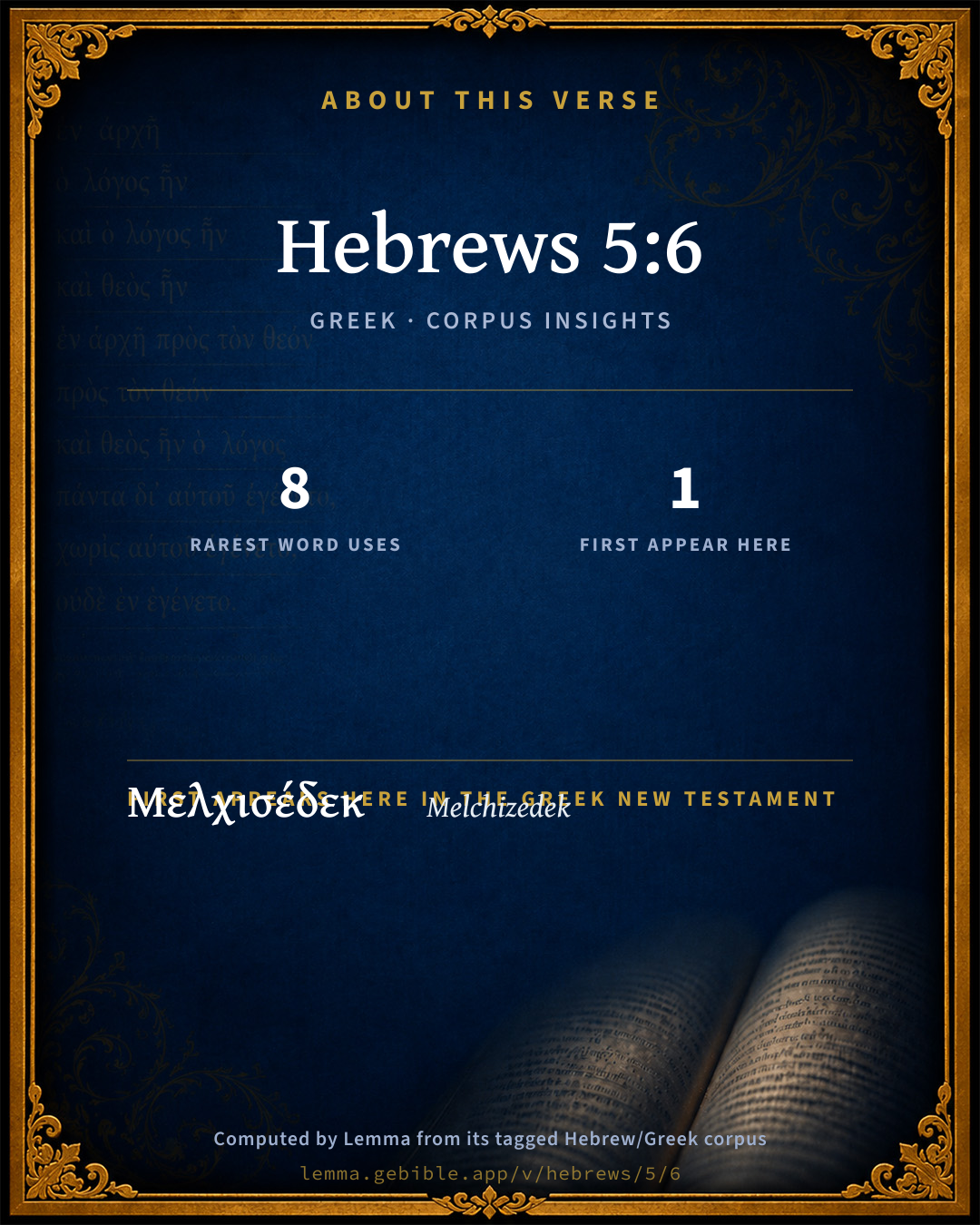
The rarest word here is Μελχισέδεκ Melchizedek G3198 — appearing just 8 times in the whole Greek New Testament.

First appearance in Scripture

This word makes its first canonical appearance in the Greek New Testament here:

  • Μελχισέδεκ Melchizedek G3198

Shared distinctive vocabulary

Μελχισέδεκ Melchizedek G3198 occurs in 8 verses of the Greek New Testament. Also found in:

Repetition

A word recurs within this verse:

Cross-references

8

Topical passages linked to Hebrews 5:6 in the Treasury of Scripture Knowledge — connected by theme and wording, ordered by reader-vote popularity; previews shown in the World English Bible.

  • Psalms 110:4 Yahweh has sworn, and will not change his mind: "You are a priest forever in the order of Melchizedek."
  • Hebrews 7:17 for it is testified, "You are a priest forever, According to the order of Melchizedek."
  • Hebrews 7:21 (for they indeed have been made priests without an oath), but he with an oath by him that says of him, "The Lord swore and will not change his mind, 'You are a priest forever, According to the order of Melchizedek'".
  • Hebrews 7:3 without father, without mother, without genealogy, having neither beginning of days nor end of life, but made like the Son of God), remains a priest continually.
  • Genesis 14:18–19 Melchizedek king of Salem brought forth bread and wine: and he was priest of God Most High.
  • Hebrews 5:10 named by God a high priest after the order of Melchizedek.
  • Hebrews 6:20 where as a forerunner Jesus entered for us, having become a high priest forever after the order of Melchizedek.
  • Hebrews 7:15 This is yet more abundantly evident, if after the likeness of Melchizedek there arises another priest,

Cross-references courtesy of OpenBible.info (CC BY 4.0).

Commentary

Notes on Hebrews 5:6 from classic Christian and Jewish commentators (each source and its license shown beneath its notes). The classic Christian expositions comment on the surrounding passage and are grouped to its opening verse, so a note may address several verses; the Jewish commentaries on the Tanakh (Rashi and others) are per-verse, so they appear only where the commentator wrote on this verse.

Lemma curates 59 commentaries, every one of them public domain or Creative Commons licensed, each selected and text-cleaned for this edition rather than reprinted as found. About our sources →

Bengel's Gnomon

Johann Albrecht Bengel

Heb 5:6. Ἐν ἑτέρῳ, in another) So Paul also, Act 13:35.—λέγει, He says) GOD.—σὺ) Psa 110:4, where the LXX. have it in as many words.—Μελχισεδὲκ, Melchisedec) It is of no importance to know in other respects who Melchisedec was, beyond what is mentioned of him; nay, the very silence respecting the other parts of his history contains mysteries. He was certainly a king and priest at that time, and of the human race.

Bengel's Gnomon of the New Testament — English translation (T&T Clark, Edinburgh, 1860) — public domain. Text from a community e-Sword module.

Meyer's Critical & Exegetical Commentary

Heinrich August Wilhelm Meyer

Heb_5:6 now introduces the proof from Scripture that Christ, the Son of God, has also been appointed High Priest.

καθὼς καὶ ἐν ἑτέρῳ λέγει] as He (sc. God) accordingly speaks in another place of Scripture (namely Psa_110:4; comp. Heb_1:13).

καί] belongs not to ἐν ἐτέρῳ, so that we should have to assume that the author has already found in the citation, Heb_5:5, a Scripture proof for the high-priesthood of Christ, and now in Heb_5:6 is adding thereto a second Scripture proof for the same thing (Schlichting, Ebrard, and others), but it belongs to the whole relative clause καθὼς λέγει, and is just the ordinary καί after a particle of comparison; comp. Heb_5:4. By means of this correct apprehension of the force of καί the objection is further set aside, that Heb_5:6, if a Scripture proof was first to be given in this place, must have been joined on to that which precedes simply with λέγων, as Heb_2:6, Heb_4:7, or with μαρτυρεῖ γάρ, as Heb_7:17 (Abresch), or with λέγει γάρ, or at least with καθώς without καί (Ebrard).

ἐν ἑτέρῳ] See on ἐν τούτῳ, Heb_4:5.

ἱερεύς] for the author equivalent to ἀρχιερεύς; comp. Heb_5:10; Heb_6:20. This equalization is likewise warranted. For Melchisedec (Gen_14:18 ff.), with whom the person addressed is compared, was at the same time king and priest; but with the attributes of a king the attributes of an ordinary priest are irreconcilable; the character sustained by a superior or high priest alone comports therewith.

κατὰ τὴν τάξιν Μελχισεδέκ] not: in the time of succession (Schulz), but: after the order or manner (עַל־דִּבְרָתִי) of Melchisedec, in such wise that thou obtainest the same position, the same character, as he possessed. Comp. Heb_7:15 : κατὰ τὴν ὁμοιότητα Μελχισεδέκ.

εἰς τὸν αἰῶνα] the author combines (contrary to the sense of the original) with ἱερεύς into a single idea, comp. Heb_7:3; Heb_7:8.

Meyer — Critical and Exegetical Commentary on the New Testament — English translation by Peter Christie, edited by Frederick Crombie (T&T Clark, 1880) — public domain. Text from a community e-Sword module.

Geneva Bible (1599)

Geneva Bible translators

After the likeness or manner as it is afterward declared, Heb. 7:15.

Geneva Bible (1599) marginal notes — public domain. Text via Bolls.life.

Jamieson, Fausset & Brown

Robert Jamieson, A. R. Fausset & David Brown

He is here called simply "Priest"; in Heb 5:5, "High Priest." He is a Priest absolutely, because He stands alone in that character without an equal. He is "High Priest" in respect of the Aaronic type, and also in respect to us, whom He has made priests by throwing open to us access to God [BENGEL]. "The order of Melchisedec" is explained in Heb 7:15, "the similitude of Melchisedec." The priesthood is similarly combined with His kingly office in Zac 6:13. Melchisedec was at once man, priest, and king. Paul's selecting as the type of Christ one not of the stock of Abraham, on which the Jews prided themselves, is an intimation of Messianic universalism.

Jamieson, Fausset & Brown — Commentary Critical and Explanatory on the Whole Bible (1871) — public domain (CC PDM 1.0). Text via the HelloAO Bible API.

Adam Clarke's Commentary

Verse 6. He saith also in another place] That is, in Ps 110:4, a psalm of extraordinary importance, containing a very striking prediction of the birth, preaching, suffering, death, and conquests of the Messiah. See the notes there. For the mode of quotation here, See the note on "He 2:6".

Thou art a priest for ever] As long as the sun and moon endure, Jesus will continue to be high priest to all the successive generations of men, as he was the lamb slain from the foundation of the world. If he be a priest for ever, there can be no succession of priests; and if he have all power in heaven and in earth, and if he be present wherever two or three are gathered together in his name, he can have no vicars; nor can the Church need one to act in his place, when he, from the necessity of his nature, fills all places, and is everywhere present. This one consideration nullifies all the pretensions of the Romish pontiff, and proves the whole to be a tissue of imposture.

After the order of Melchisedec.] Who this person was must still remain a secret. We know nothing more of him than is written in Ge 14:18, &c., where see the notes, and particularly the observations at the end of that chapter, in which this very mysterious person is represented as a type of Christ.

Adam Clarke's Commentary on the Bible (1810–1826) — public domain. Text from a community e-Sword/MySword module.

John Calvin's Commentaries

6 As he saith in another place, or, elsewhere, etc. Here is expressed more clearly what the Apostle intended. This is a remarkable passage, and indeed the whole Psalm from which it is taken; for there is scarcely anywhere a clearer prophecy respecting Christ’s eternal priesthood and his kingdom. And yet the Jews try all means to evade it, in order that they might obscure the glory of Christ; but they cannot succeed. They apply it to David, as though he was the person whom God bade to sit on his right hand; but this is an instance of extreme effrontery; for we know that it was not lawful for kings to exercise the priesthood. On this account, Uzziah, that is, for the sole crime of intermeddling with an office that did not belong to him, so provoked God that he was smitten with leprosy. (2 Chronicles 26:18.) It is therefore certain that neither David nor any one of the kings is intended here.

If they raise this objection and say, that princes are sometimes called כהניםcohenim, priests, I indeed allow it, but I deny that the word can be so understood here. For the comparison here made leaves nothing doubtful: Melchisedec was God’s priest; and the Psalmist testifies that that king whom God has set on his right hand would be a |kohen| according to the order of Melchisedec. Who does not see that this is to be understood of the priesthood? For as it was a rare and almost a singular thing for the same person to be a priest and a king, at least an unusual thing among God’s people, hence he sets forth Melchisedec as the type of the Messiah, as though he had said, “The royal dignity will not prevent him to exercise the priesthood also, for a type of such a thing has been already presented in Melchisedec.” And indeed all among the Jews, possessed of any modesty, have conceded that the Messiah is the person here spoken of, and that his priesthood is what is commended.

What is in Greek, κατὰ τάξιν according to the order, is in Hebrew, על-דברתי ol-deberti, and means the same, and may be rendered, “according to the way” or manner: and hereby is confirmed what I have already said, that as it was an unusual thing among the people of God for the same person to bear the office of a king and of a priest, an ancient example was brought forward, by which the Messiah was represented. The rest the Apostle himself will more minutely set forth in what follows.

John Calvin's Commentaries (1540-1563) — public domain. Text from the Calvin Translation Society English edition (1840s-50s) via the Christian Classics Ethereal Library (ccel.org). Calvin's coverage is partial (roughly two-thirds of the Bible); uncommented books and verses are honest gaps, never fabricated. The 19th-century editor's footnotes and remarks are omitted so the notes are faithfully Calvin's own voice.

Ellicott's Commentary for English Readers

(6) Thou art a priest for ever . . .—On Psalms 110 see the Note on Heb_1:13. The fourth verse, here quoted, is the kernel of the Psalm, and supplies the theme for a large portion of this Epistle, especially Hebrews 7. As the promise of 2 Samuel 7 was the prelude to the revelation of the second Psalm, the divine declaration recorded in Exo_19:6 may have prepared the way for the promise of Psa_110:4. The king of Israel was the type of the Son of David; and in the consecrated people, who, had they been faithful, would have remained the representatives of all nations before God, was dimly foreshadowed the Anointed Priest.

A Bible Commentary for English Readers, edited by Charles John Ellicott (1878–1897) — public domain. Text from a community e-Sword module.

The Cambridge Bible for Schools and Colleges

gen. ed. J. J. S. Perowne

6. in another place] Psa_110:4. This Psalm was so universally accepted as Messianic that the Targum of Jonathan paraphrases the first verse of it “The Lord said to His Word:”

after the order] al-dibhrathi, “according to the style of.” Comp. Heb_7:15, “after the likeness of Melchisedek.

after the order of Melchisedec] The writer here with consummate literary skill introduces the name Melchisedek, to prepare incidentally for the long argument which is to follow in chapter 7; just as he twice introduces the idea of High-Priesthood (Heb_2:17, Heb_3:1) before directly dealing with it. The reason why the Psalmist had spoken of his ideal Theocratic king as a Priest after the order of Melchisedek, and not after the order of Aaron, lies in the words “for ever,” as subsequently explained. In Zec_4:14, the Jews explained “the two Anointed ones (sons of oil) who stand by the Lord of the whole earth “to be Aaron and Messiah, and from Psa_110:4, they agreed that Messiah was the nearer to God.

The Cambridge Bible for Schools and Colleges (gen. ed. J. J. S. Perowne; Cambridge University Press, 1878–1918) — public domain. Text from a community e-Sword module.

John Gill's Exposition

As he saith also in another place,.... Or psalm; namely, in Psa 110:4 that is, the same person, even God the Father; who spake the words before cited, also expressed the following:

thou art a priest for ever, after the order of Melchisedec; that the psalm, from whence these words are taken, belongs to the Messiah; see Gill on Mat 22:44 and this very passage is applied unto him by the Jewish writers (c); and had not this been the general sense of the Jewish church at this time, the apostle writing to Hebrews would not have produced it; and it very clearly expresses the priesthood of Christ, the eternity of it, and the order according to which it was; and it being not according to the order of Aaron, but of another, shows the change of the priesthood, and so of the law; of Melchizedek; see Gill on Heb 7:1.

(c) Moses Hadarsan apud Galatin. l. 10. c. 6. Abot R. Nathan, c. 34.

John Gill's Exposition of the Whole Bible (1746–1763) — public domain (CC PDM 1.0). Text via the HelloAO Bible API.

Trapp's Complete Commentary

John Trapp

6 As he saith also in another place, Thou art a priest for ever after the order of Melchisedec.

Ver. 6. Thou art a high priest, &c.] The former proof was not so evident; but this puts the matter out of all question. A minister should use sound speech that cannot be contradicted; that he that is of the contrary part may be ashamed, having nothing reasonably to oppose, Tit 2:8. The Jew would object that Christ was not of the tribe of Levi, therefore no priest. The apostle answers; Yes, a priest, but after another order, and proves it. This is συμβιβαζειν, collatis testimoniis demonstrare, as Paul did, Act 9:22, to confirm and assert.

John Trapp, A Commentary or Exposition upon All the Books of the Old and New Testament (1647–1656) — public domain. Text from a community e-Sword module.

Albert Barnes' Notes on the Bible

As he saith also in another place - Psa 110:4. “Thou art a priest forever.” It is evident here that the apostle means to be understood as saying that the Psalm referred to Christ, and this is one of the instances of quotation from the Old Testament respecting which there can be no doubt. Paul makes much of this argument in a subsequent part of this Epistle, Heb. 7 and reasons as if no one would deny that the Psalm had a reference to the Messiah. It is clear from this that the Psalm was understood by the Jews at that time to have such a reference, and that it was so universally admitted that no one would call it in question. That the Psalm refers to the Messiah has been the opinion of nearly all Christian commentators, and has been admitted by the Jewish Rabbis in general also. The “evidence” that it refers to the Messiah is such as the following:

It is a Psalm of David, and yet is spoken of one who was superior to him, and whom he calls his “Lord;” Heb 5:1.

(2)It cannot be referred to Jehovah himself, for he is expressly Heb 5:1 distinguished from him who is here addressed.

(3)It cannot be referred to anyone in the time of David, for there was no one to whom he would attribute this character of superiority but God.

(4)For the same reason there was no one among his posterity, except the Messiah, to whom he would apply this language.

(5)It is expressly ascribed by the Lord Jesus to himself; Mat 22:43-44.

(6)The scope of the Psalm is such as to be applicable to the Messiah, and there is no part of it which would be inconsistent with such a reference. Indeed, there is no passage of the Old Testament of which it would be more universally conceded that there was a reference to the Messiah, than this Psalm.

Thou art a priest - He is not here called a “high priest,” for Melchizedek did not bear that title, nor was the Lord Jesus to be a high priest exactly in the sense in which the name was given to Aaron and his successors. A word is used, therefore, in a general sense to denote that he would be a “priest” simply, or would sustain the priestly office. This was all that was needful to the present argument which was, that he was “designated by God” to the priestly office, and that he had not intruded himself into it.

For ever - This was an important circumstance, of which the apostle makes much use in another part of the Epistle; see the notes at Heb 7:8, Heb 7:23-24. The priesthood of the Messiah was not to change from hand to hand; it was not to be laid down at death; it was to remain unchangeably the same.

After the order - The word rendered “order” - τάξις taxis - means “a setting in order - hence, “arrangement” or “disposition.” It may be applied to ranks of soldiers; to the gradations of office; or to any rank which men sustain in society. To say that he was of the same “order” with Melchizedek, was to say that he was of the same “rank” or “stations.” He was like him in his designation to the office. In what respects he was like him the apostle shows more fully in Heb. 7. “One” particular in which there was a striking resemblance, which did not exist between Christ and any other high priest, was, that Melchizedek was both a “priest” and a “king.” None of the kings of the Jews were priests; nor were any of the priests ever elevated to the office of king. But in Melchizedek these offices were united, and this fact constituted a striking resemblance between him and the Lord Jesus. It was on this principle that there was such pertinency in quoting here the passage from the second Psalm; see Heb 5:5. The meaning is, that Melchizedek was of a special rank or order; that he was not numbered with the Levitical priests, and that there were important features in his office which differed from theirs. In those features it was distinctly predicted that the Messiah would resemble him.

Melchisedek - see the notes on Heb 7:1 ff.

Albert Barnes' Notes on the Bible (1834–1885) — public domain. Text from a community e-Sword/MySword module.

Haydock's Catholic Bible Commentary

Some may perhaps wonder why St. Paul does not dwell more in this epistle on the eucharistic sacrifice; but until the Hebrews understood the bloody sacrifice on the cross, they could not be supposed to understand the unbloody sacrifice of the altar. The holy Fathers observe, that the sacrifice of Melchisedech, (Genesis xiv. 18.) offered in bread and wine, prefigured the unbloody sacrifice offered by Jesus Christ at his last supper. See Clement of Alexandria, lib. 4. Strom. chap. viii.; St. Cyprian, lib. 2. ep. 3. ad Cæul.; Eusebius of Cæsarea, lib. 5. Dem. Evang. chap. iii.; St. Jerome, ad Marcel.; St. Augustine, ep. 95. ad Inn. Pap.; St. Ambrose; St. Epiphanius; St. John Chrysostom; &c. apud Bellarmine, lib. 1. de missa. chap. vi. Hence it follows, that the holy Eucharist is truly and properly a sacrifice as well as a sacrament, as the paschal lamb or passover of the old law was both a sacrament and sacrifice. For either our Saviour offered sacrifice at his last supper under the forms of bread and wine, or he cannot be called a priest forever according to the order of Melchisedech. For the different orders of priests are chiefly distinguished by their sacrifice; (see ver. 1.) and if it be supposed that our Saviour only offered a bloody sacrifice, he would with more propiety have been called a priest according to the order of Aaron, and not of Melchisedech. See St. Augustine, lib. 16. de Civitat. Dei. chap. xxii.

George Leo Haydock (1774–1849), Haydock's Catholic Family Bible and Commentary, 1859 edition — public domain. Excludes Psalms (Douay-Rheims chapter numbering differs from Protestant) and Deuterocanonical books (Catholic canon only).

Matthew Poole's English Annotations

As he saith also in another place, Thou art a Priest for ever: the Spirit proves his call and investiture into this office, its confirmation to him for ever, by another testimony of the Father about it, penned by David, Psa 110:4, and ratified to be so by the Lord himself, Mat 22:41-45; that he as man was David’s Son: as God-man, David’s Lord, and the grand officer to atone God by his sacrifice for sinners, and to intercede for them. By this word of God to him was he invested with the most glorious priesthood, and settled in that which he must execute for ever, Heb 7:24, having no successor in it.

After the order of Melchisedec; which order was a singular and most excellent one, such as Aaron’s did but imperfectly shadow to us. It was a royal priesthood God installed him in, such as was Melchisedec’s, largely described, Heb 7:1-28. This was by God the Father revealed to David, and prophesied by him to the church, but actually fulfilled as to proclamation and inauguration at his ascension into the holy of holiest in heaven, where he actually in the flesh doth officiate and minister in it.

Matthew Poole's English Annotations on the Holy Bible (1683–1685) — public domain. Text from a community e-Sword/MySword module.

Whedon's Commentary on the Bible

Daniel D. Whedon

6. After the order of Melchizedek—Christ was no descendant of Aaron, and so could be no high priest in the hereditary Jewish line. High priest he can be only by an origination high, at least, as Aaron’s own origination at first was. For this the inspired precedent is found in the most memorable words of Psa_110:4, (a psalm quoted as Messianic by the Messiah himself, Mat_22:44,) where the Messiah is addressed by God as priest, not in the line of Aaron, but after the order of Melchizedek. And here first occurs the name of that primeval and typical priest-king, which figures largely in our author’s future argument.

Daniel D. Whedon (gen. ed.), Commentary on the Old and New Testaments (1874–1909) — public domain. Text from a community e-Sword module.

John Wesley's Explanatory Notes

Psalm cx, 4.

John Wesley, Explanatory Notes Upon the Whole Bible (1754–1765) — public domain. Text via the GEBible commentary corpus.

Scofield Reference Notes

C. I. Scofield

Melchisedec

(See Scofield "Gen 14:18").

Melchisedec was a suitable type of Christ as High Priest, because:

(1) he was a king-priest Gen 14:18; Zec 6:12; Zec 6:13

(2) his name means, "my king is righteous" (cf) Isa 11:5 and he was king of Salem (i.e. "peace," cf Isa 11:6-9.)

(3) he had no (recorded) "beginning of days" (cf) Joh 1:1 nor "end of life" (cf); Rom 6:9; Heb 7:23-25, nor

(4) was he made a high priest by human appointment Psa 110:4. But the contrast between the high priesthood of Melchisedec and Aaron is only as to person, "order" (or appointment), and duration. In His work Christ follows the Aaronic pattern, the "shadow" of which Christ was the substance.; Heb 8:1-6; Heb 9:1-28.

The Scofield Reference Bible (1917 edition), notes by C. I. Scofield — public domain. Text from a community e-Sword module.

The People's New Testament

B. W. Johnson

6. A priest forever after the order of Melchisedec. Christ's priesthood continues while time endures. He is not of the order of Aaron, but of Melchizedek, a king as well as a priest. See Gen. 14:18, 19. For a fuller discussion of the priesthood of Melchizedek, see notes on chapter 7:1–10.

B. W. Johnson's The People's New Testament with Notes (1889–1891) — public domain. Electronic text from the Christian Classics Ethereal Library (CCEL) ThML edition.

unfoldingWord translationNotes

Door43 World Missions Community

General Information:

This prophecy is from a Psalm of David.

he also says

To whom God is speaking can be stated clearly. AT: "he also says to Christ" (See: Ellipsis)

in another place

"in another place in the scriptures"

after the manner of Melchizedek

This means that Christ as a priest has things in common with Melchizedek as a priest. AT: "in the same way that Melchizedek was a priest"

translationWords

priest

eternity

Melchizedek

unfoldingWord translationNotes — © Distant Shores Media and the Door43 World Missions Community, licensed CC BY-SA 4.0. Source: git.door43.org/Door43/en_tn.

Cambridge Greek Testament for Schools and Colleges

6. ἐν ἑτέρῳ. The phrase is adverbial—“elsewhere.” There is no need to understand τόπῳ. The quotation is from Psa 110:4. This Psalm was so universally accepted as Messianic that the Targum of Jonathan paraphrases the first verse of it “The Lord said to His Word.”

κατὰ τὴν τάξιν, עַל־רּבְרָתִי, “according to the style of.” Comp. Heb 7:15, “after the likeness (ὁμοιότητα) of Melchisedek.”

Μελχισεδέκ. The writer here with consummate literary skill introduces the name Melchisedek, to prepare incidentally for the long argument which is to follow in chapter 7.; just as he twice introduces the idea of High Priesthood (Heb 2:17, Heb 3:1) before directly dealing with it. The reason why the Psalmist had spoken of his ideal Theocratic king as a Priest after the order of Melchisedek, and not after the order of Aaron, lies in the words “for ever,” as subsequently explained. In Zec 4:14, the Jews explained “the two Anointed ones (sons of oil) who stand by the Lord of the whole earth” to be Aaron and Messiah, and, from Psa 110:4, they agreed that Messiah was the nearer to God.

Cambridge Greek Testament for Schools and Colleges (Cambridge University Press, 1896; 21 vols, various authors incl. Carr, Maclear, Plummer, Farrar, Lumby, Moule, M. R. James, Simcox) — public domain. Text from a community e-Sword module.

Alford’s Greek Testament

Henry Alford

6.] even as also he saith in another (place) (see on ref., ἐν τούτῳ), Thou art a priest for ever after the order of Melchisedek (on the relation of this Psalm to Christ, see generally on ch. 1:13. I may add to what was there said, that it is thus declared, that He, in whom all the theocratic promises find their fulfilment, in whom the true Kingdom of God comes and is summed up, was to be, as in Zec 6:12 ff., “a priest upon His throne,” and such a priest (i. e. necessarily High Priest, if a King; as indeed the word is given in ver. 10 and ch. 6:20) as should be after the order of Melchisedek. In examining this last predication, we find that κατὰ τὴν τάξιν, according to the ordinary meaning of τάξις, imports, according to the office or order, the rank which Melchisedek held. So Jos. Antt. vii. 11. 6, David appointed Amasa commander, καὶ τὴν τάξιν αὐτῷ ἐφʼ ἧς Ἰωάβος ἦν, δίδωσιν: Polyb. ii. 24. 9, ἐφεδρείας ἔχοντες τάξιν: Demosth. 313. 13, οἰκέτου τάξιν, οὐκ ἐλευθέρου παιδός, ἔχων. See many other examples in Bleek. So that κατὰ τὴν τάξιν will be very nearly the same as κατὰ τὴν ὁμοιότητα, ch. 7:15: and the Peschito has this latter expression both in the Psalm, and throughout our Epistle. On εἰς τὸν αἰῶνα, as indeed on the detailed application of the several expressions to Christ, see on ch. 7:20 ff.).

Henry Alford, The Greek Testament (1849–1861) — public domain. Text from a community e-Sword module.

Vincent's Word Studies in the New Testament

Marvin R. Vincent

Thou art a priest forever, etc. According to this verse Christ is prophetically pointed out in Psalm 110 as an eternal priest, independent of fleshly descent, a king, and superior in dignity to the Levitical priests. According to the order [κατα την ταξιν] . According to the rank which Melchisedec held. Almost = like. For Melchisedec see ch. 7.

Marvin R. Vincent, Word Studies in the New Testament (1887–1900) — public domain. Text from a community e-Sword/MySword module.

Westcott on Hebrews & the Epistles of John

Brooke Foss Westcott

6. καθὼς καί...) The absolute declaration of tho Sonship of Ohrist found a special application in these words of another Psalm. The definite office of Priesthood is a partial interpretation of the glory of the Son. ‘The Fathor glorifiod tho Son to become High-priest, even as in fact (καῇ He expressly declares.’ This glorifying was not a matter of general deduction only but definitely foreshewn.

Twofoaturesin Melchizodek’s pricethood appear to be specially present to the mind of the writer, (1) that it was connected with the kingly office, and (2) that it was not made dependent on any fleshly descent, or limited by conditions of timo. Molchizodok had no recorded ancestry and no priviloged lino of doscendantse. He represonted a non-Jewish, a universal priesthood. In relation to the Pricethood he occupies the position which Abraham occupies in relation to the Covenant. Oomp. Zech. vi. 13.

No early Jewish writer applies this promise of the priesthood to Messiah. Justin (Dial. co. 33, 83) and Tertullian (adv. Mare. v. 9) mention that the Psalm was referred by the Jews to Hezekiah. Oompare Schoettgen, ii. 645. The <Aboth R. Nathan from which he quotes an application of the words to Messiah is in its present form probably of post-Talmudical date (Zunz Gottesd. Vort. 108 f.; Steinschneider Jewish Literature, 40).

The Chaldee paraphrase of tho verse (referring it to David) is remarkable : ‘The Lord has determined that thou

shalt bo set Princo (N37) ovor the

world to come, for thy desert, because thou art an innocent king.’

els τὸν αἰῶνα] Ohrist is a Priest for ever, because He has no successor, nor any need ofasuccessor. His High-

THE EPISTLE ΤῸ THE HEBREWS.

unique nature (καίπερ ὧν vids) Of these the firat is again elaborated in detail. Tho character (δεή. καὶ Ixer.),

the object (πρὸς τὸν ὃ. o. av. ἐκ 9.),

and the manner (μ. xp. 2. «. &) of

Christ's prayers are vividly given ;

and the answer to them is referred to

its moral cause (ἀπὸ τῆς evA.).

If the words are arranged in a ‘tabular form their symmetrical structure is at once evident:

Who,

7in Llis days of fcsh,

having offered up, with etrong crying and tears, prayers und supplications unto Him that waa able to save Him out of death, and having been heard Jor His godly fear, 8 though He was Son, yet (1) learned obedience by the things which He suffered; 9and, having been made perfect,

(2) He became to all them that obey Him, the cause of eternal salvation,

το being addressed by God, ae

High-priest after the order of Molchizedek.

7,8. Christ—the Son, the priest ‘after the order of Melchizedek—has been ahewn to have fulfilled one condition of true iligh-pricsthood by His _ divino appointment: Ilo is now shown to have fulfillod the othor, ay having learnt through actual experience the uttermost noeds of human weakness.

Brooke Foss Westcott (1825–1901), The Epistle to the Hebrews (1889) and The Epistles of St John (1883) — public domain (pre-1929). Text recovered from Internet Archive / Google Books OCR scans. Westcott’s Gospel of John commentary is not included (its OCR lost the chapter running-heads required for reliable verse-keying). Some Greek quoted in the Hebrews volume is imperfectly rendered by the OCR.

Lesson kit

Teaching starters — assembled from the data on this page, not authored interpretation. Every prompt links to the verse data it draws on. Edit before teaching.

Hebrews, in the General Epistles, opens this verse with 14 words (13 distinct Greek lemmas). Its most distinctive word is Melchisedék (“Melchizedek”). A historical commentator’s framing appears above. Read the whole chapter for the surrounding context.

Discussion questions

  1. How does “Melchizedek” (Melchisedék) shape what this verse is saying?
  2. This is the first place “Melchizedek” appears in Scripture (first appears here). What does its debut here establish?
  3. How does Hebrews 5:10, which shares the word «Melchizedek», read alongside this verse?
  4. What does the repetition of “the” (2× in this one verse) do in this verse?
  5. These translations render this verse differently; the difference is in the English rendering, not the original. What questions does that raise?
  6. Compare how Bengel's Gnomon and Meyer's Critical & Exegetical Commentary read this verse. Where do they agree or differ?

Things to notice

  • 1 word makes its first canonical appearance in Scripture here.
  • These translations choose different wording for 8 words in this verse.
  • “the” occurs 2× in this single verse.
  • 13 distinct Greek lemmas span 14 words in this verse.

Reading settings

Reading text

Shown beneath each verse's original-language words.

Old Testament
Old Testament edition

Read the OT as the Masoretic Hebrew (MT) or the Greek Septuagint (LXX).

English shown for the Greek Septuagint (in the Hebrew ↔ Greek comparison).

Comparing translations? Open the Compare panel on any verse page to stack up to four side by side.