

Hebrews 12:28
Greek (Tischendorf 8th ed.) Hebrews 12:28 appears in the Greek New Testament. The text above is from the Tischendorf 8th edition. Each word links to its Strong’s number and a concise gloss. Click any word for its full Thayer’s Greek Lexicon entry.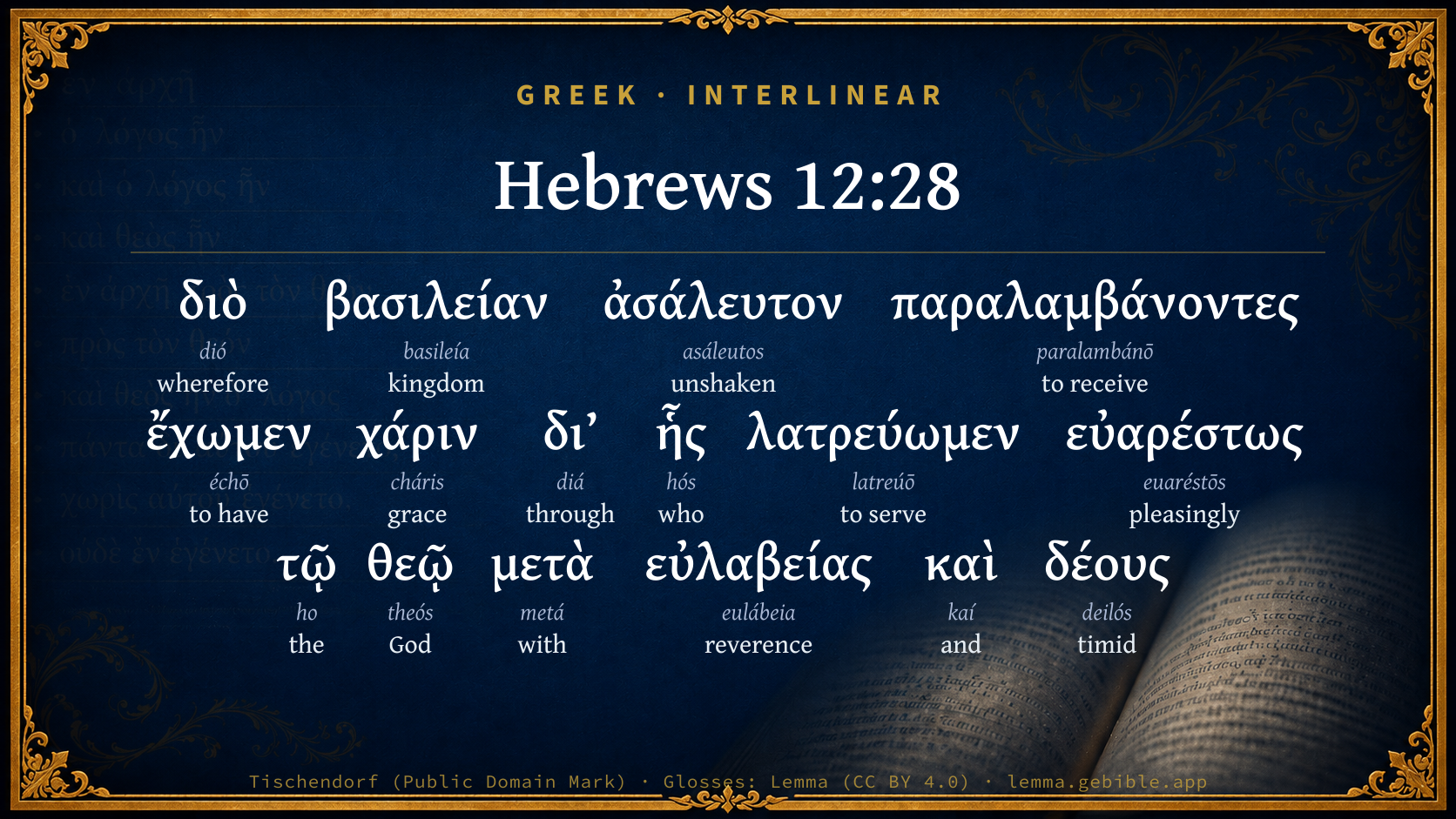
Therefore, receiving a Kingdom that can't be shaken, let us have grace, through which we serve God acceptably, with reverence and awe,
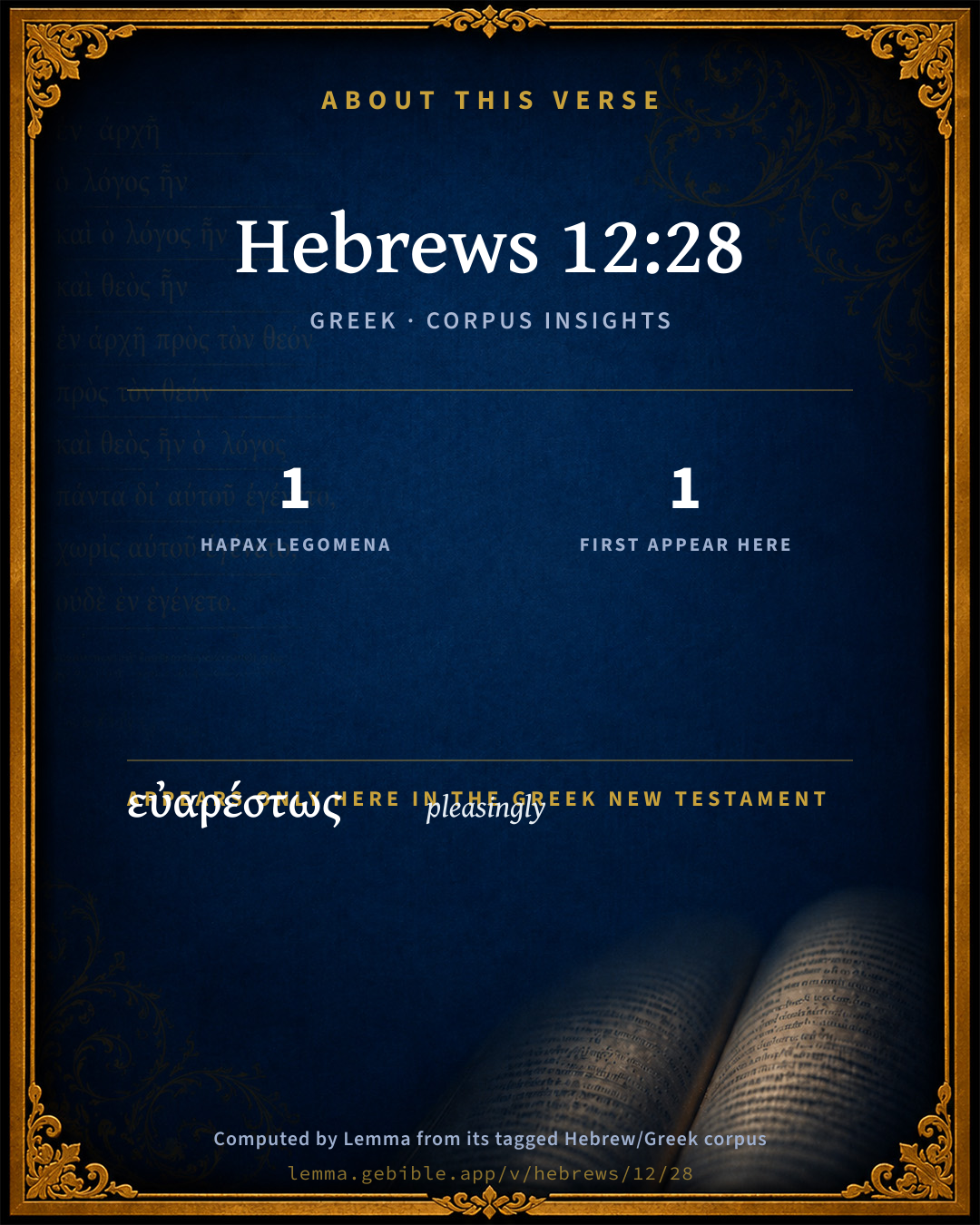
- 1 hapax legomenon — only here in the Greek New Testament
- 1 first appearance in the Greek New Testament
Download a study sheet
One document with this verse’s original text, its word-by-word gloss line, the meaning frame, cross-references with their text, attributed commentary, and full source and license credits — printable, and it pastes into notes with its structure intact.
This verse Autodidact and up
A passage Seminary Student
Up to 50 verses in one chapter. A passage sheet keeps up to 6 commentary sources and 12 cross-references per verse, in the order this page ranks them, and says so on the sheet whenever that leaves anything out. Ask for a single verse and you get the Autodidact verse sheet above.
Everything on this page stays free to read, with no account — the sheet is a download of what is already on screen, not access to it.
Compare translations 3
The same verse in 3 English versions, stacked beneath the original-language interlinear above. Click any original word for its lexicon entry.
Each is an independent rendering of the whole verse — the interlinear is not word-aligned to these translations.
Highlighted words mark where these versions differ — a whole-verse word diff, not a word-by-word alignment.
-
World English Bible Public Domain
Therefore, receiving a Kingdom that can't be shaken, let us have grace, through which we serve God acceptably, with reverence and awe,
-
King James Version Public Domain
Wherefore we receiving a kingdom which cannot be moved, let us have grace, whereby we may serve God acceptably with reverence and godly fear:
-
unfoldingWord Literal Text CC BY-SA 4.0
Therefore, receiving an unshakeable kingdom, let us have gratitude, through which let us serve well-pleasingly to God, with reverence and awe,
unfoldingWord Literal Text — © unfoldingWord, licensed CC BY-SA 4.0. Word-aligned USFM3 via Door43 (git.door43.org/unfoldingWord/en_ult).
Show all 19 translations
Every available English version of this verse, each an independent rendering of the whole verse.
-
World English Bible Public Domain
Therefore, receiving a Kingdom that can't be shaken, let us have grace, through which we serve God acceptably, with reverence and awe,
-
Berean Standard Bible Public Domain
Therefore, since we are receiving an unshakable kingdom, let us be filled with gratitude, and so worship God acceptably with reverence and awe.
-
Majority Standard Bible Public Domain
Therefore, since we are receiving an unshakable kingdom, let us be filled with gratitude, and so worship God acceptably with reverence and godly fear.
-
King James Version Public Domain
Wherefore we receiving a kingdom which cannot be moved, let us have grace, whereby we may serve God acceptably with reverence and godly fear:
-
American Standard Version (1901) Public Domain
Wherefore, receiving a kingdom that cannot be shaken, let us have grace, whereby we may offer service well-pleasing to God with reverence and awe:
-
Revised Version (1885) Public Domain
Wherefore, receiving a kingdom that cannot be shaken, let us have grace, whereby we may offer service well-pleasing to God with reverence and awe:
-
Geneva Bible (1599) Public Domain
Wherefore seeing we receiue a kingdome, which cannot be shaken, let vs haue grace whereby we may so serue God, that we may please him with reuerence and feare.
-
Douay-Rheims (1899) Public Domain
Therefore receiving an immoveable kingdom, we have grace; whereby let us serve, pleasing God, with fear and reverence.
-
Young's Literal Translation Public Domain
wherefore, a kingdom that cannot be shaken receiving, may we have grace, through which we may serve God well-pleasingly, with reverence and religious fear;
-
Literal Standard Version CC BY-SA 4.0
for this reason, receiving a kingdom that cannot be shaken, may we have grace, through which we may serve God well-pleasingly, with reverence and fear,
-
Unlocked Literal Bible CC BY-SA 4.0
Therefore, receiving a kingdom that cannot be shaken, let us be grateful and in this manner worship God with reverence and awe.
-
unfoldingWord Literal Text CC BY-SA 4.0
Therefore, receiving an unshakeable kingdom, let us have gratitude, through which let us serve well-pleasingly to God, with reverence and awe,
-
Darby Bible Public Domain
Wherefore let us, receiving a kingdom not to be shaken, have grace, by which let us serve God acceptably with reverence and fear.
-
World Messianic Bible Public Domain
Therefore, receiving a Kingdom that can’t be shaken, let’s have grace, through which we serve God acceptably, with reverence and awe,
-
Webster's Bible Public Domain
Wherefore we receiving a kingdom which cannot be moved, let us have grace, by which we may serve God acceptably, with reverence and godly fear.
-
Free Bible Version CC BY-SA 4.0
Since we're receiving a kingdom that cannot be shaken, let us have a gracious attitude, so we can serve God in a way that pleases him, with reverence and respect.
-
Bible in Basic English Public Domain
If then, we have a kingdom which will never be moved, let us have grace, so that we may give God such worship as is pleasing to him with fear and respect:
-
Text-Critical English NT CC BY 4.0
Therefore, since we are receiving a kingdom that cannot be shaken, let us be thankful. It is by our thankfulness that we offer God acceptable worship, with reverence and godly fear.
-
Tyndale New Testament (1534) Public Domain
Wherfore if we receave a kyngdom which is not moved we have grace wherby we maye serve god and please him with reverence and godly feare.
Literal Standard Version (2020), Covenant Press — licensed CC BY-SA 4.0. Text via the HelloAO Bible API (eBible.org). Unlocked Literal Bible (unfoldingWord) — licensed CC BY-SA 4.0. Text via the HelloAO Bible API (eBible.org). unfoldingWord Literal Text — © unfoldingWord, licensed CC BY-SA 4.0. Word-aligned USFM3 via Door43 (git.door43.org/unfoldingWord/en_ult). Free Bible Version, Dr. Jonathan Gallagher — licensed CC BY-SA 4.0. Text via the HelloAO Bible API (eBible.org).
Word by word
More ways to search: Search by grammar → Find every occurrence → Compare this word →
Practice this passage: Drill this verse → Learn its vocabulary →
- Appears 1× in the Greek New Testament
- First appears here
- Part of Speech
- Adverb
Full Thayer's Definition
- διὸ dió G1352 “wherefore” Conjunction
- βασιλείαν basileía G932 “kingdom” Noun, Accusative, Singular, Feminine
- ἀσάλευτον asáleutos G761 “unshaken” Adjective, Accusative, Singular, Feminine
- παραλαμβάνοντες paralambánō G3880 “to receive” Verb, Present, Active, Participle, Nominative, Plural, Masculine
- ἔχωμεν échō G2192 “to have” Verb, Present, Active, Subjunctive, 1st person, Plural
- χάριν cháris G5485 “grace” Noun, Accusative, Singular, Feminine
- δι’ diá G1223 “through” Preposition
- ἧς hós G3739 “who” Relative pronoun, Genitive, Singular, Feminine
- λατρεύωμεν latreúō G3000 “to serve” Verb, Present, Active, Subjunctive, 1st person, Plural
- εὐαρέστως euaréstōs G2102 “pleasingly” Adverb
- τῷ ho G3588 “the” Article, Dative, Singular, Masculine
- θεῷ theós G2316 “God” Noun, Dative, Singular, Masculine
- μετὰ metá G3326 “with” Preposition
- εὐλαβείας eulábeia G2124 “reverence” Noun, Genitive, Singular, Feminine
- καὶ kaí G2532 “and” Conjunction
- δέους deilós G1169 “timid” Noun, Genitive, Singular, Neuter
About this verse
These counts appear in no published source. They are computed here, from the morphology-tagged text and Lemma’s own curated glosses. What Lemma adds →
- 16
- words
- 16
- distinct lemmas
- General Epistles
- section
Notable vocabulary
1 hapax legomenon — a word that appears only here in the entire Greek New Testament:
- εὐαρέστως pleasingly G2102
First appearance in Scripture
This word makes its first canonical appearance in the Greek New Testament here:
- εὐαρέστως pleasingly G2102
Shared distinctive vocabulary
ἀσάλευτον unshaken G761 occurs in 2 verses of the Greek New Testament. Also found in:
Cross-references
29Topical passages linked to Hebrews 12:28 in the Treasury of Scripture Knowledge — connected by theme and wording, ordered by reader-vote popularity; previews shown in the World English Bible.
- Romans 12:1–2 Therefore I urge you, brothers, by the mercies of God, to present your bodies a living sacrifice, holy, acceptable to God, which is your spiritual service.
- Psalms 2:11 Serve Yahweh with fear, And rejoice with trembling.
- Hebrews 13:15 Through him, then, let us offer up a sacrifice of praise to God continually, that is, the fruit of lips which make confession to his name.
- Daniel 2:44 In the days of those kings shall the God of heaven set up a kingdom which shall never be destroyed, nor shall the sovereignty of it be left to another people; but it shall break in pieces and consume all these kingdoms, and it shall stand forever.
- Hebrews 4:16 Let us therefore draw near with boldness to the throne of grace, that we may receive mercy, and may find grace for help in time of need.
- Hebrews 10:22–23 let's draw near with a true heart in fullness of faith, having our hearts sprinkled from an evil conscience, and having our body washed with pure water,
- Revelation 1:6 and he made us to be a Kingdom, priests to his God and Father; to him be the glory and the dominion forever and ever. Amen.
- Psalms 19:14 Let the words of my mouth and the meditation of my heart Be acceptable in your sight, Yahweh, my rock, and my redeemer.
- 1 Peter 2:5 You also, as living stones, are built up as a spiritual house, to be a holy priesthood, to offer up spiritual sacrifices, acceptable to God through Jesus Christ.
- Daniel 7:27 The kingdom and the dominion, and the greatness of the kingdoms under the whole the sky, shall be given to the people of the saints of the Most High: his kingdom is an everlasting kingdom, and all dominions shall serve and obey him.
- 1 Peter 1:4–5 to an incorruptible and undefiled inheritance that doesn't fade away, reserved in heaven for you,
- 1 Peter 1:17 If you call on him as Father, who without respect of persons judges according to each man's work, pass the time of your living as strangers here in reverent fear:
- Romans 11:20 True; by their unbelief they were broken off, and you stand by your faith. Don't be conceited, but fear;
- Isaiah 56:7 even them will I bring to my holy mountain, and make them joyful in my house of prayer: their burnt offerings and their sacrifices shall be accepted on my altar; for my house shall be called a house of prayer for all peoples.
- Matthew 25:34 Then the King will tell those on his right hand, 'Come, blessed of my Father, inherit the Kingdom prepared for you from the foundation of the world;
- Hebrews 3:6 but Christ is faithful as a Son over his house; whose house we are, if we hold fast our confidence and the glorying of our hope firm to the end.
- 1 Peter 2:20 For what glory is it if, when you sin, you patiently endure beating? But if, when you do well, you patiently endure suffering, this is commendable with God.
- Revelation 5:10 And made them kings and priests to our God, And they reign on earth."
- Revelation 15:4 Who wouldn't fear you, Lord, And glorify your name? For you only are holy. For all the nations will come and worship before you. For your righteous acts have been revealed."
- Leviticus 10:3 Then Moses said to Aaron, "This is what Yahweh spoke of, saying, "'I will show myself holy to those who come near me, And before all the people I will be glorified.'" Aaron held his peace.
- Luke 17:20–21 Being asked by the Pharisees when the Kingdom of God would come, he answered them, "The Kingdom of God doesn't come with observation;
- Hebrews 10:19 Having therefore, brothers, boldness to enter into the holy place by the blood of Jesus,
- Daniel 7:14 There was given him dominion, and glory, and a kingdom, that all the peoples, nations, and languages should serve him: his dominion is an everlasting dominion, which shall not pass away, and his kingdom that which shall not be destroyed.
- Psalms 89:7 A very awesome God in the council of the holy ones, To be feared above all those who are around him?
- Isaiah 9:7 Of the increase of his government and of peace there shall be no end, on the throne of David, and on his kingdom, to establish it, and to uphold it with justice and with righteousness from henceforth even forever. The zeal of Yahweh of Hosts will perform this.
- Ephesians 1:6 to the praise of the glory of his grace, by which he freely bestowed favor on us in the Beloved,
- Philippians 4:18 But I have all things, and abound. I am filled, having received from Epaphroditus the things that came from you, a sweet-smelling fragrance, an acceptable and well-pleasing sacrifice to God.
- Ephesians 5:10 proving what is well-pleasing to the Lord.
- Hebrews 5:7 He, in the days of his flesh, having offered up prayers and petitions with strong crying and tears to him who was able to save him from death, and having been heard for his godly fear,
Cross-references courtesy of OpenBible.info (CC BY 4.0).
Lesson kit
Teaching starters — assembled from the data on this page, not authored interpretation. Every prompt links to the verse data it draws on. Edit before teaching.
Hebrews, in the General Epistles, opens this verse with 16 words (16 distinct Greek lemmas). Its most distinctive word is euaréstōs (“pleasingly”). A historical commentator’s framing appears above. Read the whole chapter for the surrounding context.
Discussion questions
- What does “pleasingly” (euaréstōs) contribute to the verse as a whole?
- 1 word here appears nowhere else in the Greek New Testament. Why might the author reach for such rare wording?
- This is the first place “pleasingly” appears in Scripture (first appears here). What does its debut here establish?
- How does Acts 27:41, which shares the word «unshaken», read alongside this verse?
- These translations render this verse differently. What is at stake in choosing one wording over another?
- Compare how Joseph Benson's Commentary and Scofield Reference Notes read this verse. Where do they agree or differ?
Things to notice
- 1 word in this verse appears nowhere else in the Greek New Testament.
- 1 word makes its first canonical appearance in Scripture here.
- These translations choose different wording for 18 words in this verse.
- 16 distinct Greek lemmas span 16 words in this verse.
Commentary
Notes on Hebrews 12:28 from classic Christian and Jewish commentators (each source and its license shown beneath its notes). The classic Christian expositions comment on the surrounding passage and are grouped to its opening verse, so a note may address several verses; the Jewish commentaries on the Tanakh (Rashi and others) are per-verse, so they appear only where the commentator wrote on this verse.
Lemma curates 59 commentaries, every one of them public domain or Creative Commons licensed, each selected and text-cleaned for this edition rather than reprinted as found. About our sources →
Joseph Benson's Commentary
Joseph Benson's Commentary on the Old and New Testaments (1811–1818) — public domain. Text from a community e-Sword module.
Scofield Reference Notes
C. I. Scofield
The Scofield Reference Bible (1917 edition), notes by C. I. Scofield — public domain. Text from a community e-Sword module.
Tyndale Open Study Notes
Tyndale Open Resources
Tyndale Open Study Notes — © Tyndale Open Resources, licensed CC BY-SA 4.0. Text via the HelloAO Bible API.
Bengel's Gnomon
Johann Albrecht Bengel
Bengel's Gnomon of the New Testament — English translation (T&T Clark, Edinburgh, 1860) — public domain. Text from a community e-Sword module.
Meyer's Critical & Exegetical Commentary
Heinrich August Wilhelm Meyer
Meyer — Critical and Exegetical Commentary on the New Testament — English translation by Peter Christie, edited by Frederick Crombie (T&T Clark, 1880) — public domain. Text from a community e-Sword module.
Geneva Bible (1599)
Geneva Bible translators
Geneva Bible (1599) marginal notes — public domain. Text via Bolls.life.
Jamieson, Fausset & Brown
Robert Jamieson, A. R. Fausset & David Brown
Jamieson, Fausset & Brown — Commentary Critical and Explanatory on the Whole Bible (1871) — public domain (CC PDM 1.0). Text via the HelloAO Bible API.
Adam Clarke's Commentary
Adam Clarke's Commentary on the Bible (1810–1826) — public domain. Text from a community e-Sword/MySword module.
Ellicott's Commentary for English Readers
A Bible Commentary for English Readers, edited by Charles John Ellicott (1878–1897) — public domain. Text from a community e-Sword module.
The Cambridge Bible for Schools and Colleges
gen. ed. J. J. S. Perowne
The Cambridge Bible for Schools and Colleges (gen. ed. J. J. S. Perowne; Cambridge University Press, 1878–1918) — public domain. Text from a community e-Sword module.
John Gill's Exposition
John Gill's Exposition of the Whole Bible (1746–1763) — public domain (CC PDM 1.0). Text via the HelloAO Bible API.
Trapp's Complete Commentary
John Trapp
John Trapp, A Commentary or Exposition upon All the Books of the Old and New Testament (1647–1656) — public domain. Text from a community e-Sword module.
Albert Barnes' Notes on the Bible
Albert Barnes' Notes on the Bible (1834–1885) — public domain. Text from a community e-Sword/MySword module.
Matthew Poole's English Annotations
Matthew Poole's English Annotations on the Holy Bible (1683–1685) — public domain. Text from a community e-Sword/MySword module.
Whedon's Commentary on the Bible
Daniel D. Whedon
Daniel D. Whedon (gen. ed.), Commentary on the Old and New Testaments (1874–1909) — public domain. Text from a community e-Sword module.
The Pulpit Commentary
The Pulpit Commentary (1880–1919), ed. H.D.M. Spence-Jones & Joseph S. Exell — public domain. Text from a community e-Sword module.
John Wesley's Explanatory Notes
John Wesley, Explanatory Notes Upon the Whole Bible (1754–1765) — public domain. Text via the GEBible commentary corpus.
Burkitt's Expository Notes on the New Testament
William Burkitt
William Burkitt's Expository Notes on the New Testament (1700–1703) — public domain. Text from a community e-Sword module.
The People's New Testament
B. W. Johnson
B. W. Johnson's The People's New Testament with Notes (1889–1891) — public domain. Electronic text from the Christian Classics Ethereal Library (CCEL) ThML edition.
Cambridge Greek Testament for Schools and Colleges
Cambridge Greek Testament for Schools and Colleges (Cambridge University Press, 1896; 21 vols, various authors incl. Carr, Maclear, Plummer, Farrar, Lumby, Moule, M. R. James, Simcox) — public domain. Text from a community e-Sword module.
Alford’s Greek Testament
Henry Alford
Henry Alford, The Greek Testament (1849–1861) — public domain. Text from a community e-Sword module.
Westcott on Hebrews & the Epistles of John
Brooke Foss Westcott
Brooke Foss Westcott (1825–1901), The Epistle to the Hebrews (1889) and The Epistles of St John (1883) — public domain (pre-1929). Text recovered from Internet Archive / Google Books OCR scans. Westcott’s Gospel of John commentary is not included (its OCR lost the chapter running-heads required for reliable verse-keying). Some Greek quoted in the Hebrews volume is imperfectly rendered by the OCR.