

Hebrews 11:7
Greek (Tischendorf 8th ed.) Hebrews 11:7 appears in the Greek New Testament. The text above is from the Tischendorf 8th edition. Each word links to its Strong’s number and a concise gloss. Click any word for its full Thayer’s Greek Lexicon entry.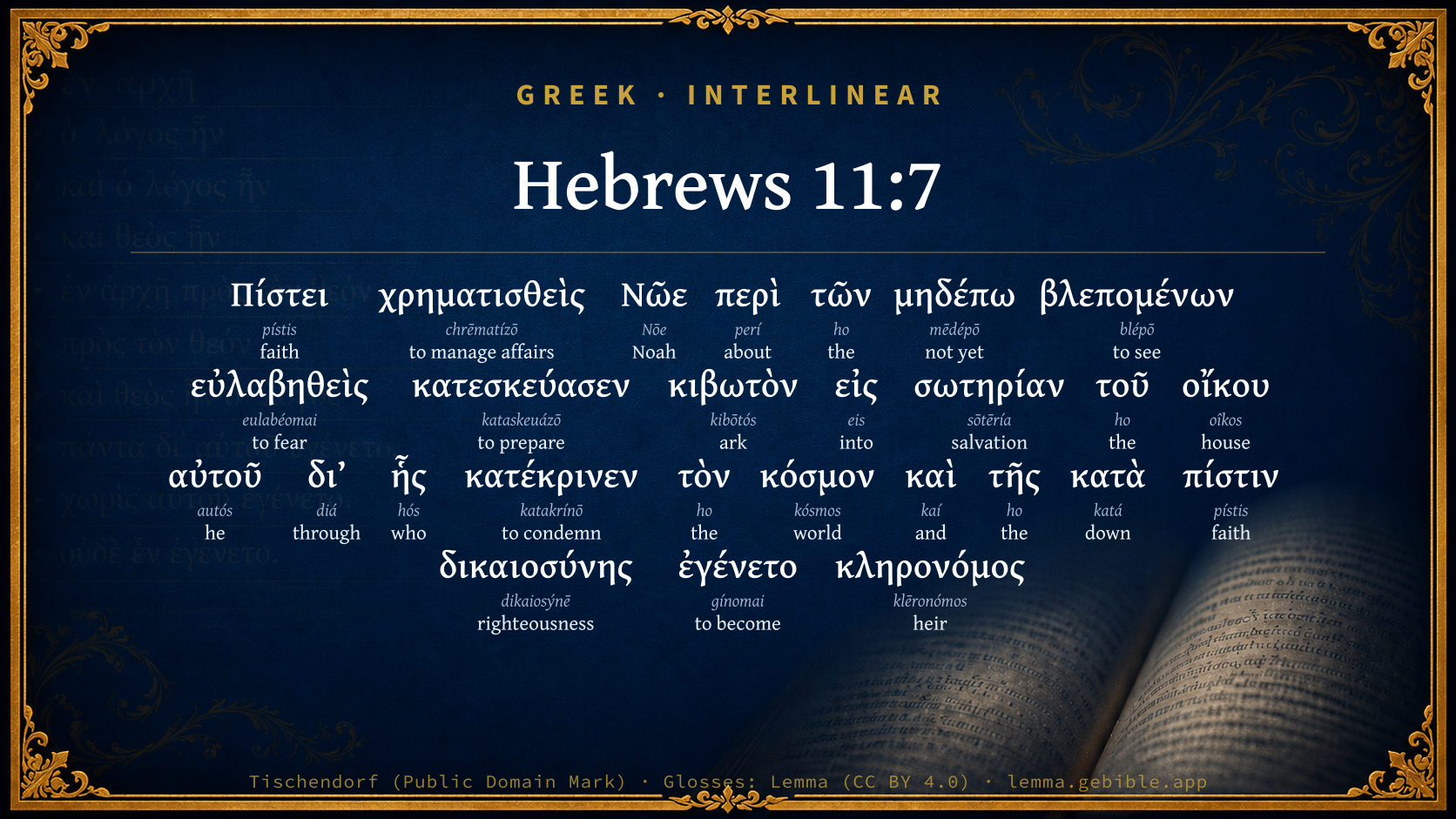
By faith, Noah, being warned about things not yet seen, moved with godly fear, prepared an ark for the saving of his house, through which he condemned the world, and became heir of the righteousness which is according to faith.
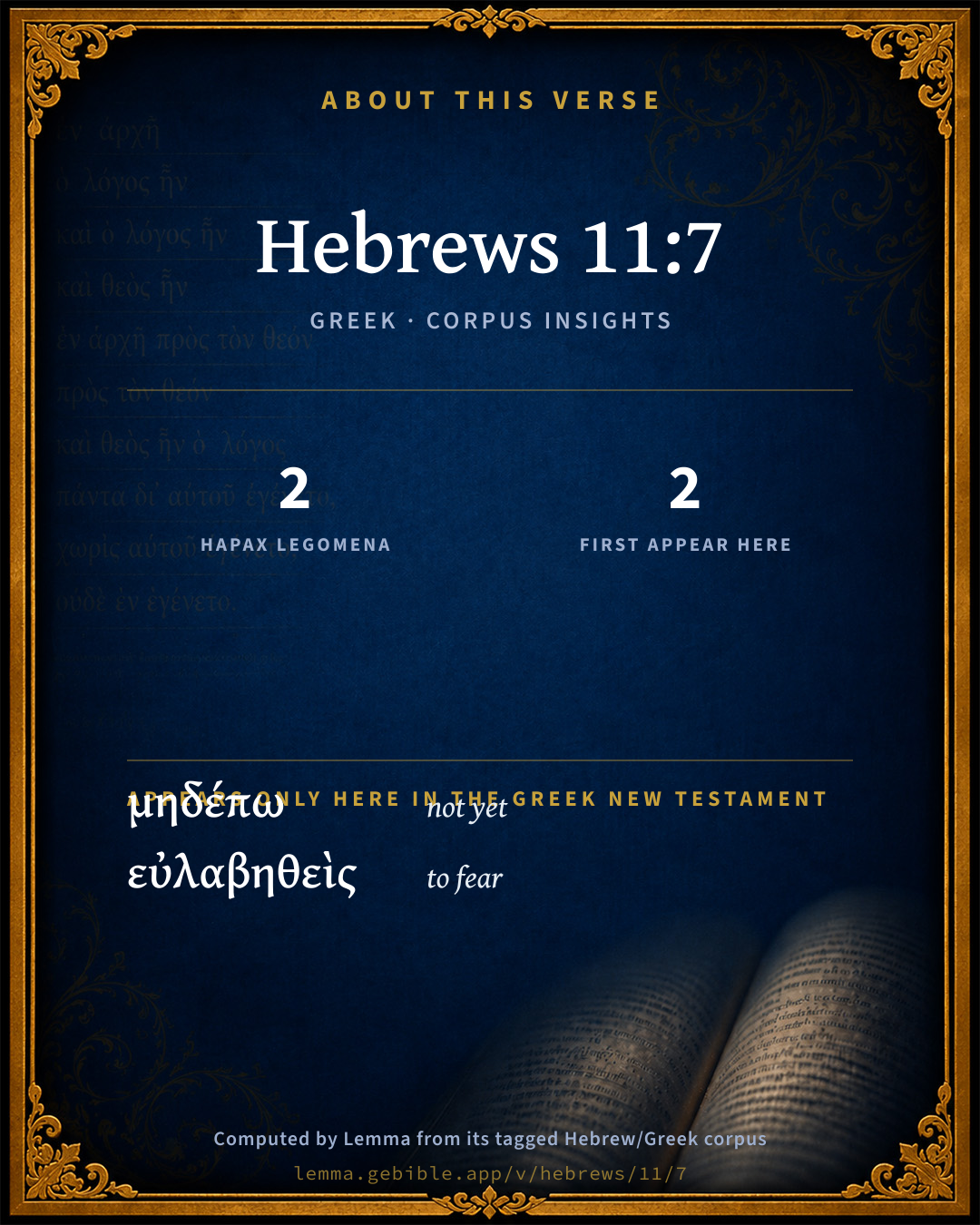
- 2 hapax legomena — only here in the Greek New Testament
- 2 first appearances in the Greek New Testament
Download a study sheet
One document with this verse’s original text, its word-by-word gloss line, the meaning frame, cross-references with their text, attributed commentary, and full source and license credits — printable, and it pastes into notes with its structure intact.
This verse Autodidact and up
A passage Seminary Student
Up to 50 verses in one chapter. A passage sheet keeps up to 6 commentary sources and 12 cross-references per verse, in the order this page ranks them, and says so on the sheet whenever that leaves anything out. Ask for a single verse and you get the Autodidact verse sheet above.
Everything on this page stays free to read, with no account — the sheet is a download of what is already on screen, not access to it.
Compare translations 3
The same verse in 3 English versions, stacked beneath the original-language interlinear above. Click any original word for its lexicon entry.
Each is an independent rendering of the whole verse — the interlinear is not word-aligned to these translations.
Highlighted words mark where these versions differ — a whole-verse word diff, not a word-by-word alignment.
-
World English Bible Public Domain
By faith, Noah, being warned about things not yet seen, moved with godly fear, prepared an ark for the saving of his house, through which he condemned the world, and became heir of the righteousness which is according to faith.
-
King James Version Public Domain
By faith Noah, being warned of God of things not seen as yet, moved with fear, prepared an ark to the saving of his house; by the which he condemned the world, and became heir of the righteousness which is by faith.
-
unfoldingWord Literal Text CC BY-SA 4.0
By faith Noah, having been warned about the things not yet being seen, having become reverent, built an ark for salvation of his household, through which he condemned the world and became an heir of the righteousness according to faith.
unfoldingWord Literal Text — © unfoldingWord, licensed CC BY-SA 4.0. Word-aligned USFM3 via Door43 (git.door43.org/unfoldingWord/en_ult).
Show all 19 translations
Every available English version of this verse, each an independent rendering of the whole verse.
-
World English Bible Public Domain
By faith, Noah, being warned about things not yet seen, moved with godly fear, prepared an ark for the saving of his house, through which he condemned the world, and became heir of the righteousness which is according to faith.
-
Berean Standard Bible Public Domain
By faith Noah, when warned about things not yet seen, in godly fear built an ark to save his family. By faith he condemned the world and became heir of the righteousness that comes by faith.
-
Majority Standard Bible Public Domain
By faith Noah, when warned about things not yet seen, in godly fear built an ark to save his family. By faith he condemned the world and became heir of the righteousness that comes by faith.
-
King James Version Public Domain
By faith Noah, being warned of God of things not seen as yet, moved with fear, prepared an ark to the saving of his house; by the which he condemned the world, and became heir of the righteousness which is by faith.
-
American Standard Version (1901) Public Domain
By faith Noah, being warned `of God' concerning things not seen as yet, moved with godly fear, prepared an ark to the saving of his house; through which he condemned the world, and became heir of the righteousness which is according to faith.
-
Revised Version (1885) Public Domain
By faith Noah, being warned of God concerning things not seen as yet, moved with godly fear, prepared an ark to the saving of his house; through which he condemned the world, and became heir of the righteousness which is according to faith.
-
Geneva Bible (1599) Public Domain
By faith Noe being warned of God of the things which were as yet not seene, mooued with reuerence, prepared the Arke to the sauing of his housholde, through the which Arke hee condemned the world, and was made heire of the righteousnes, which is by faith.
-
Douay-Rheims (1899) Public Domain
By faith Noe, having received an answer concerning those things which as yet were not seen, moved with fear, framed the ark for the saving of his house, by the which he condemned the world; and was instituted heir of the justice which is by faith.
-
Young's Literal Translation Public Domain
By faith Noah, having been divinely warned concerning the things not yet seen, having feared, did prepare an ark to the salvation of his house, through which he did condemn the world, and of the righteousness according to faith he became heir.
-
Literal Standard Version CC BY-SA 4.0
By faith Noah, having been divinely warned concerning the things not yet seen, having feared, prepared an ark to the salvation of his house, through which he condemned the world, and he became heir of the righteousness according to faith.
-
Unlocked Literal Bible CC BY-SA 4.0
It was by faith that Noah, having been given a divine message about things not yet seen, with godly reverence built a ship to save his household. By doing this, he condemned the world and became an heir of the righteousness that is according to faith.
-
unfoldingWord Literal Text CC BY-SA 4.0
By faith Noah, having been warned about the things not yet being seen, having become reverent, built an ark for salvation of his household, through which he condemned the world and became an heir of the righteousness according to faith.
-
Darby Bible Public Domain
By faith, Noah, oracularly warned concerning things not yet seen, moved with fear, prepared an ark for the saving of his house; by which he condemned the world, and became heir of the righteousness which [is] according to faith.
-
World Messianic Bible Public Domain
By faith Noah, being warned about things not yet seen, moved with godly fear, prepared a ship for the saving of his house, through which he condemned the world and became heir of the righteousness which is according to faith.
-
Webster's Bible Public Domain
By faith Noah, being warned by God of things not seen as yet, moved with fear, prepared an ark to the saving of his house; by which he condemned the world, and became heir of the righteousness which is by faith.
-
Free Bible Version CC BY-SA 4.0
Noah trusted God, and was warned by him about things that had never happened before. Because Noah paid serious attention to what God said, he constructed an ark to save his family. By trusting God, Noah showed that the world was wrong, and received the reward of being set right by God.
-
Bible in Basic English Public Domain
By faith Noah, being moved by the fear of God, made ready an ark for the salvation of his family, because God had given him news of things which were not seen at the time; and through it the world was judged by him, and he got for his heritage the righteousness which is by faith.
-
Text-Critical English NT CC BY 4.0
By faith Noah, when he was warned about things not yet seen, was moved with reverent fear and built an ark to save his household. By faith he condemned the world and became an heir of the righteousness that comes by faith.
-
Tyndale New Testament (1534) Public Domain
By fayth Noe honored God after that he was warned of thinges which were not sene and prepared the arcke to the savinge of his houssholde thorowe the which arcke he condempned the worlde and became heyre of the rightewesnes which commeth by fayth.
Literal Standard Version (2020), Covenant Press — licensed CC BY-SA 4.0. Text via the HelloAO Bible API (eBible.org). Unlocked Literal Bible (unfoldingWord) — licensed CC BY-SA 4.0. Text via the HelloAO Bible API (eBible.org). unfoldingWord Literal Text — © unfoldingWord, licensed CC BY-SA 4.0. Word-aligned USFM3 via Door43 (git.door43.org/unfoldingWord/en_ult). Free Bible Version, Dr. Jonathan Gallagher — licensed CC BY-SA 4.0. Text via the HelloAO Bible API (eBible.org).
Word by word
More ways to search: Search by grammar → Find every occurrence → Compare this word →
Practice this passage: Drill this verse → Learn its vocabulary →
- Appears 1× in the Greek New Testament
- First appears here
- Part of Speech
- Adverb
- Degree
- Negative
Full Thayer's Definition
- Πίστει pístis G4102 “faith” Noun, Dative, Singular, Feminine
- χρηματισθεὶς chrēmatízō G5537 “to manage affairs” Verb, Aorist, Passive, Participle, Nominative, Singular, Masculine
- Νῶε Nōe G3575 “Noah” Noun, Proper, indeclinable
- περὶ perí G4012 “about” Preposition
- τῶν ho G3588 “the” Article, Genitive, Plural, Neuter
- μηδέπω mēdépō G3369 “not yet” Adverb, Negative
- βλεπομένων blépō G991 “to see” Verb, Present, Passive, Participle, Genitive, Plural, Neuter
- εὐλαβηθεὶς eulabéomai G2125 “to fear” Verb, Aorist, Passive deponent, Participle, Nominative, Singular, Masculine
- κατεσκεύασεν kataskeuázō G2680 “to prepare” Verb, Aorist, Active, Indicative, 3rd person, Singular
- κιβωτὸν kibōtós G2787 “ark” Noun, Accusative, Singular, Feminine
- εἰς eis G1519 “into” Preposition
- σωτηρίαν sōtēría G4991 “salvation” Noun, Accusative, Singular, Feminine
- τοῦ ho G3588 “the” Article, Genitive, Singular, Masculine
- οἴκου oîkos G3624 “house” Noun, Genitive, Singular, Masculine
- αὐτοῦ autós G846 “he” Personal pronoun, Genitive, Singular, Masculine
- δι’ diá G1223 “through” Preposition
- ἧς hós G3739 “who” Relative pronoun, Genitive, Singular, Feminine
- κατέκρινεν katakrínō G2632 “to condemn” Verb, Aorist, Active, Indicative, 3rd person, Singular
- τὸν ho G3588 “the” Article, Accusative, Singular, Masculine
- κόσμον kósmos G2889 “world” Noun, Accusative, Singular, Masculine
- καὶ kaí G2532 “and” Conjunction
- τῆς ho G3588 “the” Article, Genitive, Singular, Feminine
- κατὰ katá G2596 “down” Preposition
- πίστιν pístis G4102 “faith” Noun, Accusative, Singular, Feminine
- δικαιοσύνης dikaiosýnē G1343 “righteousness” Noun, Genitive, Singular, Feminine
- ἐγένετο gínomai G1096 “to become” Verb, Aorist, Middle deponent, Indicative, 3rd person, Singular
- κληρονόμος klēronómos G2818 “heir” Noun, Nominative, Singular, Masculine
About this verse
These counts appear in no published source. They are computed here, from the morphology-tagged text and Lemma’s own curated glosses. What Lemma adds →
- 27
- words
- 23
- distinct lemmas
- General Epistles
- section
Notable vocabulary
2 hapax legomena — words that appear only here in the entire Greek New Testament:
First appearance in Scripture
These words make their first canonical appearance in the Greek New Testament here:
Shared distinctive vocabulary
κιβωτὸν ark G2787 occurs in 6 verses of the Greek New Testament. Also found in:
Cross-references
33Topical passages linked to Hebrews 11:7 in the Treasury of Scripture Knowledge — connected by theme and wording, ordered by reader-vote popularity; previews shown in the World English Bible.
- Genesis 6:13–7:1 God said to Noah, "The end of all flesh has come before me, for the earth is filled with violence through them. Behold, I will destroy them with the earth.
- 1 Peter 3:20 who before were disobedient, when God waited patiently in the days of Noah, while the ark was being built. In it, few, that is, eight souls, were saved through water.
- Ezekiel 14:14 though these three men, Noah, Daniel, and Job, were in it, they should deliver but their own souls by their righteousness, says the Lord Yahweh.
- Luke 17:26 As it happened in the days of Noah, even so will it be also in the days of the Son of Man.
- Romans 4:13 For the promise to Abraham and to his seed that he should be heir of the world wasn't through the law, but through the righteousness of faith.
- Genesis 7:23 Every living thing was destroyed that was on the surface of the ground, including man, cattle, creeping things, and birds of the sky. They were destroyed from the earth. Only Noah was left, and those who were with him in the ark.
- Ezekiel 14:20 though Noah, Daniel, and Job, were in it, as I live, says the Lord Yahweh, they should deliver neither son nor daughter; they should but deliver their own souls by their righteousness.
- Romans 3:22 even the righteousness of God through faith in Jesus Christ to all and on all those who believe. For there is no distinction,
- Galatians 5:5 For we, through the Spirit, by faith wait for the hope of righteousness.
- Philippians 3:9 and be found in him, not having a righteousness of my own, that which is of the law, but that which is through faith in Christ, the righteousness which is from God by faith;
- Proverbs 27:12 A prudent man sees danger and takes refuge; But the simple pass on, and suffer for it:
- Matthew 3:7 But when he saw many of the Pharisees and Sadducees coming for his baptism, he said to them, "You offspring of vipers, who warned you to flee from the wrath to come?
- Romans 1:17 For in it is revealed God's righteousness from faith to faith. As it is written, "But the righteous shall live by faith."
- Hebrews 5:7 He, in the days of his flesh, having offered up prayers and petitions with strong crying and tears to him who was able to save him from death, and having been heard for his godly fear,
- Genesis 6:9 This is the history of the generations of Noah. Noah was a righteous man, blameless among the people of his time. Noah walked with God.
- Genesis 7:5 Noah did everything that Yahweh commanded him.
- Genesis 19:14 Lot went out, and spoke to his sons-in-law, who were pledged to marry his daughters, and said, "Get up! Get out of this place, for Yahweh will destroy the city." But he seemed to his sons-in-law to be joking.
- Exodus 9:18–21 Behold, tomorrow about this time I will cause it to rain a very grievous hail, such as has not been in Egypt since the day it was founded even until now.
- Ezekiel 3:17–19 Son of man, I have made you a watchman to the house of Israel: therefore hear the word at my mouth, and give them warning from me.
- Matthew 12:41–42 The men of Nineveh will stand up in the judgment with this generation, and will condemn it, for they repented at the preaching of Jonah; and behold, someone greater than Jonah is here.
- Matthew 24:25 "Behold, I have told you beforehand.
- Matthew 24:38 For as in those days which were before the flood they were eating and drinking, marrying and giving in marriage, until the day that Noah entered into the ark,
- Luke 11:31–32 The Queen of the South will rise up in the judgment with the men of this generation, and will condemn them: for she came from the ends of the earth to hear the wisdom of Solomon; and behold, one greater than Solomon is here.
- Romans 4:11 He received the sign of circumcision, a seal of the righteousness of the faith which he had while he was in uncircumcision, that he might be the father of all those who believe, though they be in uncircumcision, that righteousness might also be accounted to them.
- Romans 10:6 But the righteousness which is of faith says this, "Don't say in your heart, 'Who will ascend into heaven?' (that is, to bring Christ down);
- Hebrews 11:1 Now faith is assurance of things hoped for, proof of things not seen.
- 2 Peter 1:1 Simon Peter, a servant and apostle of Jesus Christ, to those who have obtained a like precious faith with us in the righteousness of our God and Savior, Jesus Christ:
- 2 Peter 2:5 and didn't spare the ancient world, but preserved Noah with seven others, a preacher of righteousness, when he brought a flood on the world of the ungodly;
- 2 Peter 3:6 by which means the world that then was, being overflowed with water, perished.
- Proverbs 22:3 A prudent man sees danger, and hides himself; But the simple pass on, and suffer for it.
- Romans 9:30 What shall we say then? That the Gentiles, who didn't follow after righteousness, attained to righteousness, even the righteousness which is of faith;
- Genesis 8:16 "Go forth from the ark, you, and your wife, and your sons, and your sons' wives with you.
- Matthew 24:15 "When, therefore, you see the abomination of desolation, which was spoken of through Daniel the prophet, standing in the holy place (let the reader understand),
Cross-references courtesy of OpenBible.info (CC BY 4.0).
Lesson kit
Teaching starters — assembled from the data on this page, not authored interpretation. Every prompt links to the verse data it draws on. Edit before teaching.
Hebrews, in the General Epistles, opens this verse with 27 words (23 distinct Greek lemmas). Its most distinctive word is mēdépō (“not yet”). A historical commentator’s framing appears above. Read the whole chapter for the surrounding context.
Discussion questions
- The word mēdépō carries the sense “not yet.” How does it shape the verse?
- 2 words here appear nowhere else in the Greek New Testament. Why might the author reach for such rare wording?
- 2 words make their first appearance in Scripture here. What does this debut establish?
- How does Matthew 24:38, which shares the word «ark», read alongside this verse?
- What does the repetition of “faith” (2× in this one verse) do in this verse?
- These translations render this verse differently; the difference is in the English rendering, not the original. What questions does that raise?
- Compare how The Biblical Illustrator and Joseph Benson's Commentary read this verse. Where do they agree or differ?
Things to notice
- 2 words in this verse appear nowhere else in the Greek New Testament.
- 2 words make their first canonical appearance in Scripture here.
- These translations choose different wording for 17 words in this verse.
- “faith” occurs 2× in this single verse.
- 23 distinct Greek lemmas span 27 words in this verse.
Commentary
Notes on Hebrews 11:7 from classic Christian and Jewish commentators (each source and its license shown beneath its notes). The classic Christian expositions comment on the surrounding passage and are grouped to its opening verse, so a note may address several verses; the Jewish commentaries on the Tanakh (Rashi and others) are per-verse, so they appear only where the commentator wrote on this verse.
Lemma curates 59 commentaries, every one of them public domain or Creative Commons licensed, each selected and text-cleaned for this edition rather than reprinted as found. About our sources →
The Biblical Illustrator
Joseph S. Exell
The Biblical Illustrator, edited by Joseph S. Exell (c. 1880s–1900s) — public domain. Text from a community e-Sword module.
Joseph Benson's Commentary
Joseph Benson's Commentary on the Old and New Testaments (1811–1818) — public domain. Text from a community e-Sword module.
The Preacher's Complete Homiletical Commentary
Joseph S. Exell (gen. ed.)
The Preacher's Complete Homiletical Commentary (gen. ed. Joseph S. Exell; Funk & Wagnalls, c. 1892) — public domain (pre-1929). A full-Bible homiletical/sermon-outline anthology covering 65 of 66 books (2 John is absent from the source module). Text from a community e-Sword module.
MacLaren's Expositions of Holy Scripture
Alexander MacLaren
Alexander MacLaren, Expositions of Holy Scripture (1904–1910) — public domain. Text from a community e-Sword module.
Tyndale Open Study Notes
Tyndale Open Resources
Tyndale Open Study Notes — © Tyndale Open Resources, licensed CC BY-SA 4.0. Text via the HelloAO Bible API.
Bengel's Gnomon
Johann Albrecht Bengel
Bengel's Gnomon of the New Testament — English translation (T&T Clark, Edinburgh, 1860) — public domain. Text from a community e-Sword module.
Meyer's Critical & Exegetical Commentary
Heinrich August Wilhelm Meyer
Meyer — Critical and Exegetical Commentary on the New Testament — English translation by Peter Christie, edited by Frederick Crombie (T&T Clark, 1880) — public domain. Text from a community e-Sword module.
Expositor's Greek Testament
ed. W. Robertson Nicoll
The Expositor's Greek Testament, edited by W. Robertson Nicoll (1897–1910) — public domain. Text from a community e-Sword module.
Geneva Bible (1599)
Geneva Bible translators
Geneva Bible (1599) marginal notes — public domain. Text via Bolls.life.
Jamieson, Fausset & Brown
Robert Jamieson, A. R. Fausset & David Brown
Jamieson, Fausset & Brown — Commentary Critical and Explanatory on the Whole Bible (1871) — public domain (CC PDM 1.0). Text via the HelloAO Bible API.
Adam Clarke's Commentary
Adam Clarke's Commentary on the Bible (1810–1826) — public domain. Text from a community e-Sword/MySword module.
John Calvin's Commentaries
John Calvin's Commentaries (1540-1563) — public domain. Text from the Calvin Translation Society English edition (1840s-50s) via the Christian Classics Ethereal Library (ccel.org). Calvin's coverage is partial (roughly two-thirds of the Bible); uncommented books and verses are honest gaps, never fabricated. The 19th-century editor's footnotes and remarks are omitted so the notes are faithfully Calvin's own voice.
Ellicott's Commentary for English Readers
A Bible Commentary for English Readers, edited by Charles John Ellicott (1878–1897) — public domain. Text from a community e-Sword module.
The Cambridge Bible for Schools and Colleges
gen. ed. J. J. S. Perowne
The Cambridge Bible for Schools and Colleges (gen. ed. J. J. S. Perowne; Cambridge University Press, 1878–1918) — public domain. Text from a community e-Sword module.
John Gill's Exposition
John Gill's Exposition of the Whole Bible (1746–1763) — public domain (CC PDM 1.0). Text via the HelloAO Bible API.
Trapp's Complete Commentary
John Trapp
John Trapp, A Commentary or Exposition upon All the Books of the Old and New Testament (1647–1656) — public domain. Text from a community e-Sword module.
Albert Barnes' Notes on the Bible
Albert Barnes' Notes on the Bible (1834–1885) — public domain. Text from a community e-Sword/MySword module.
Haydock's Catholic Bible Commentary
George Leo Haydock (1774–1849), Haydock's Catholic Family Bible and Commentary, 1859 edition — public domain. Excludes Psalms (Douay-Rheims chapter numbering differs from Protestant) and Deuterocanonical books (Catholic canon only).
Matthew Poole's English Annotations
Matthew Poole's English Annotations on the Holy Bible (1683–1685) — public domain. Text from a community e-Sword/MySword module.
Whedon's Commentary on the Bible
Daniel D. Whedon
Daniel D. Whedon (gen. ed.), Commentary on the Old and New Testaments (1874–1909) — public domain. Text from a community e-Sword module.
The Pulpit Commentary
The Pulpit Commentary (1880–1919), ed. H.D.M. Spence-Jones & Joseph S. Exell — public domain. Text from a community e-Sword module.
John Wesley's Explanatory Notes
John Wesley, Explanatory Notes Upon the Whole Bible (1754–1765) — public domain. Text via the GEBible commentary corpus.
Scofield Reference Notes
C. I. Scofield
The Scofield Reference Bible (1917 edition), notes by C. I. Scofield — public domain. Text from a community e-Sword module.
Burkitt's Expository Notes on the New Testament
William Burkitt
William Burkitt's Expository Notes on the New Testament (1700–1703) — public domain. Text from a community e-Sword module.
The People's New Testament
B. W. Johnson
B. W. Johnson's The People's New Testament with Notes (1889–1891) — public domain. Electronic text from the Christian Classics Ethereal Library (CCEL) ThML edition.
unfoldingWord translationNotes
Door43 World Missions Community
unfoldingWord translationNotes — © Distant Shores Media and the Door43 World Missions Community, licensed CC BY-SA 4.0. Source: git.door43.org/Door43/en_tn.
Cambridge Greek Testament for Schools and Colleges
Cambridge Greek Testament for Schools and Colleges (Cambridge University Press, 1896; 21 vols, various authors incl. Carr, Maclear, Plummer, Farrar, Lumby, Moule, M. R. James, Simcox) — public domain. Text from a community e-Sword module.
Alford’s Greek Testament
Henry Alford
Henry Alford, The Greek Testament (1849–1861) — public domain. Text from a community e-Sword module.
Westcott on Hebrews & the Epistles of John
Brooke Foss Westcott
Brooke Foss Westcott (1825–1901), The Epistle to the Hebrews (1889) and The Epistles of St John (1883) — public domain (pre-1929). Text recovered from Internet Archive / Google Books OCR scans. Westcott’s Gospel of John commentary is not included (its OCR lost the chapter running-heads required for reliable verse-keying). Some Greek quoted in the Hebrews volume is imperfectly rendered by the OCR.