
Hebrews 11:32

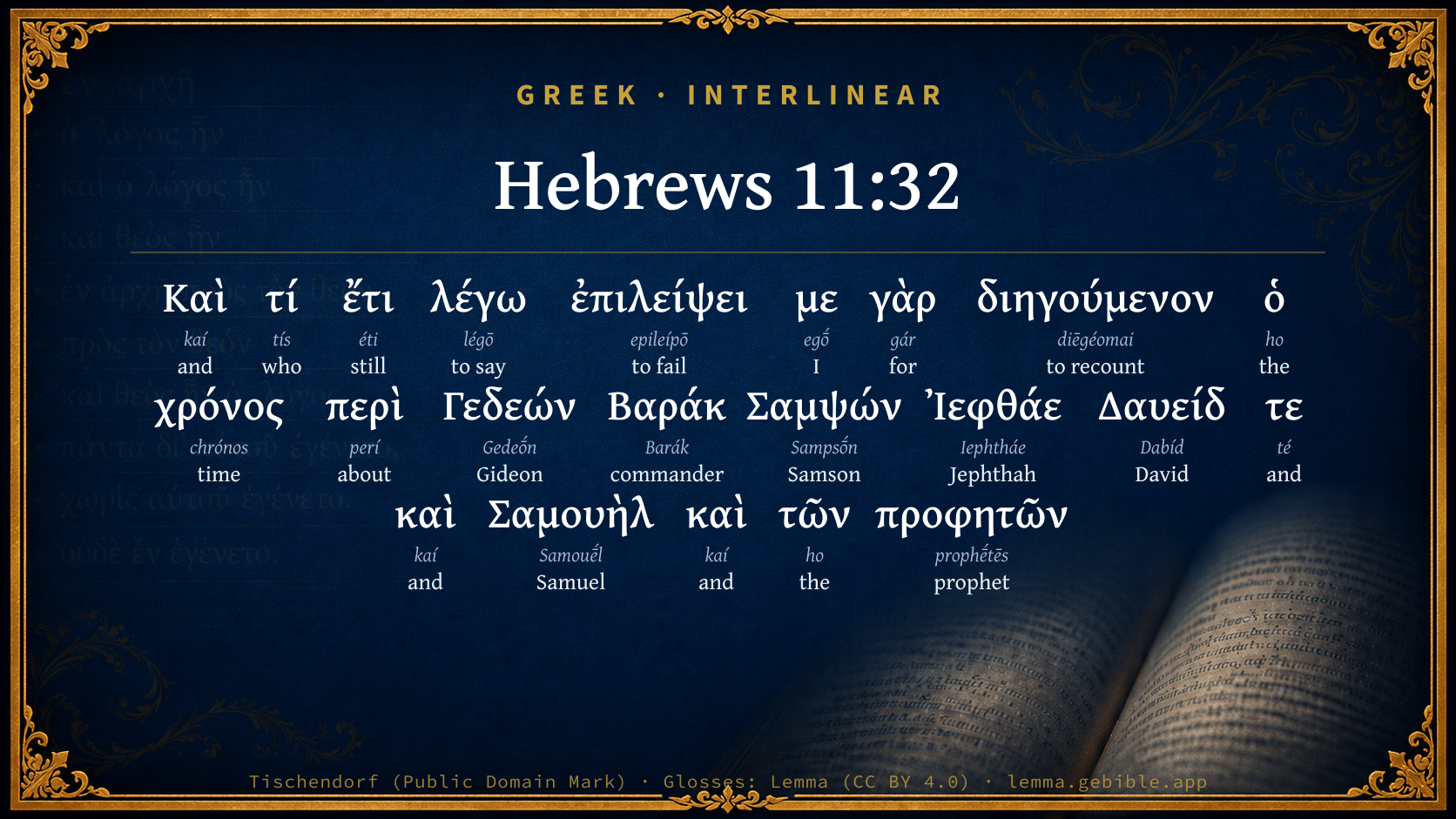
Greek (Tischendorf 8th ed.) Hebrews 11:32 appears in the Greek New Testament. The text above is from the Tischendorf 8th edition. Each word links to its Strong’s number and a concise gloss. Click any word for its full Thayer’s Greek Lexicon entry.
Download image
Cite this verse

Hebrews 11:32 (World English Bible). Public Domain. Lemma interlinear Bible study tool, https://lemma.gebible.app/v/hebrews/11/32.

Show BibTeX & RIS
BibTeX
RIS
English Translation
What more shall I say? For the time would fail me if I told of Gideon, Barak, Samson, Jephthah, David, Samuel, and the prophets;
World English Bible · Public Domain
Highlights
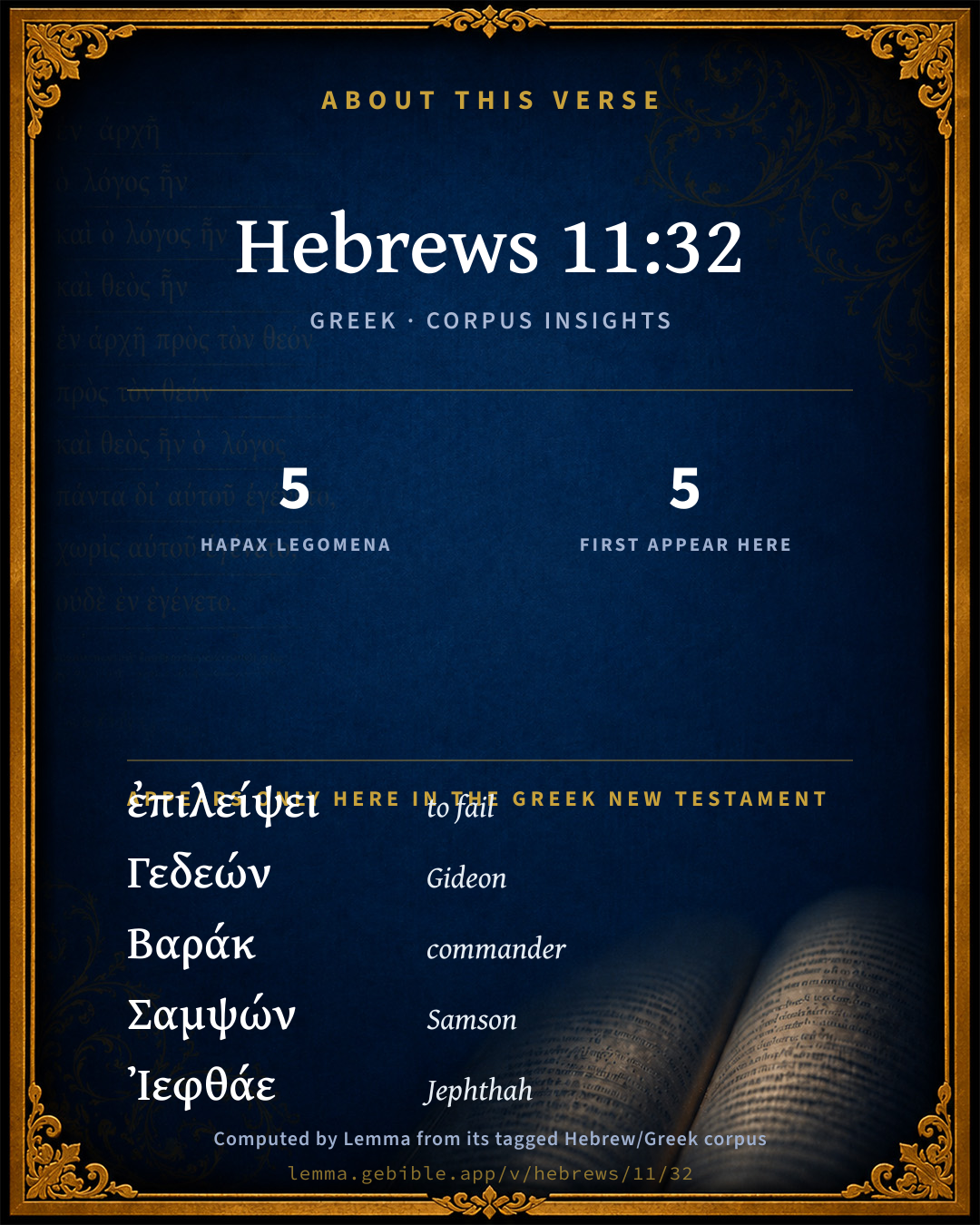
  • 5 hapax legomena — only here in the Greek New Testament
  • 5 first appearances in the Greek New Testament
Full analysis ↓
Download a study sheet

One document with this verse’s original text, its word-by-word gloss line, the meaning frame, cross-references with their text, attributed commentary, and full source and license credits — printable, and it pastes into notes with its structure intact.

This verse Autodidact and up

Study sheet (.html) Plain text (.txt)

A passage Seminary Student

Up to 50 verses in one chapter. A passage sheet keeps up to 6 commentary sources and 12 cross-references per verse, in the order this page ranks them, and says so on the sheet whenever that leaves anything out. Ask for a single verse and you get the Autodidact verse sheet above.

Everything on this page stays free to read, with no account — the sheet is a download of what is already on screen, not access to it.

Want to remove ads? Support Godless Engineer
Compare translations 3

The same verse in 3 English versions, stacked beneath the original-language interlinear above. Click any original word for its lexicon entry.

Each is an independent rendering of the whole verse — the interlinear is not word-aligned to these translations.

Highlighted words mark where these versions differ — a whole-verse word diff, not a word-by-word alignment.

  • World English Bible Public Domain
    What more shall I say? For the time would fail me if I told of Gideon, Barak, Samson, Jephthah, David, Samuel, and the prophets;
  • King James Version Public Domain
    And what shall I more say? for the time would fail me to tell of Gedeon, and of Barak, and of Samson, and of Jephthae; of David also, and Samuel, and of the prophets:
  • unfoldingWord Literal Text CC BY-SA 4.0
    And what more might I say? For the time will fail me, fully relating about Gideon, Barak, Samson, Jephthah, David, and also Samuel and the prophets,

unfoldingWord Literal Text — © unfoldingWord, licensed CC BY-SA 4.0. Word-aligned USFM3 via Door43 (git.door43.org/unfoldingWord/en_ult).

Versions to compare (up to 4)

3 of 4 selected

Show all 19 translations

Every available English version of this verse, each an independent rendering of the whole verse.

  • World English Bible Public Domain
    What more shall I say? For the time would fail me if I told of Gideon, Barak, Samson, Jephthah, David, Samuel, and the prophets;
  • Berean Standard Bible Public Domain
    And what more shall I say? Time will not allow me to tell of Gideon, Barak, Samson, Jephthah, David, Samuel, and the prophets,
  • Majority Standard Bible Public Domain
    And what more shall I say? Time will not allow me to tell of Gideon, Barak, Samson, Jephthah, David, Samuel, and the prophets,
  • King James Version Public Domain
    And what shall I more say? for the time would fail me to tell of Gedeon, and of Barak, and of Samson, and of Jephthae; of David also, and Samuel, and of the prophets:
  • American Standard Version (1901) Public Domain
    And what shall I more say? for the time will fail me if I tell of Gideon, Barak, Samson, Jephthah; of David and Samuel and the prophets:
  • Revised Version (1885) Public Domain
    And what shall I more say? for the time will fail me if I tell of Gideon, Barak, Samson, Jephthah; of David and Samuel and the prophets:
  • Geneva Bible (1599) Public Domain
    And what shall I more say? for the time would be too short for me to tell of Gedeon, of Barac, and of Sampson, and of Iephte, also of Dauid, and Samuel, and of the Prophets:
  • Douay-Rheims (1899) Public Domain
    And what shall I yet say? For the time would fail me to tell of Gedeon, Barac, Samson, Jephthe, David, Samuel, and the prophets:
  • Young's Literal Translation Public Domain
    And what shall I yet say? for the time will fail me recounting about Gideon, Barak also, and Samson, and Jephthah, David also, and Samuel, and the prophets,
  • Literal Standard Version CC BY-SA 4.0
    And what yet will I say? For the time will fail me recounting about Gideon, also Barak, and Samson, and Jephthah, also David, and Samuel, and the prophets,
  • Unlocked Literal Bible CC BY-SA 4.0
    What more can I say? For the time will fail me if I tell about Gideon, Barak, Samson, Jephthah, David, Samuel, and about the prophets.
  • unfoldingWord Literal Text CC BY-SA 4.0
    And what more might I say? For the time will fail me, fully relating about Gideon, Barak, Samson, Jephthah, David, and also Samuel and the prophets,
  • Darby Bible Public Domain
    And what more do I say? For the time would fail me telling of Gideon, and Barak, and Samson, and Jephthah, and David and Samuel, and of the prophets:
  • World Messianic Bible Public Domain
    What more shall I say? For the time would fail me if I told of Gideon, Barak, Samson, Jephthah, David, Samuel, and the prophets—
  • Webster's Bible Public Domain
    And what shall I say more? for the time would fail me to tell of Gideon, and of Barak, and of Samson, and of Jephthah, of David also, and Samuel, and of the prophets:
  • Free Bible Version CC BY-SA 4.0
    What other examples should I give? I don't have time to talk about Gideon, Barak, Samson, Jephthah; about David, Samuel, and the prophets.
  • Bible in Basic English Public Domain
    What more am I to say? For there would not be time to give the stories of Gideon, Barak, Samson, and Jephthah, of David and Samuel and the prophets:
  • Text-Critical English NT CC BY 4.0
    And what more shall I say? For time will fail me if I tell of Gideon, Barak, Samson, Jephthah, David, Samuel, and the prophets,
  • Tyndale New Testament (1534) Public Domain
    And what shall I more saye the tyme wold be to short for me to tell of Gedeo of Barach and of Samson and of Iephthae: also of David and Samuel and of the Prophetes:

Literal Standard Version (2020), Covenant Press — licensed CC BY-SA 4.0. Text via the HelloAO Bible API (eBible.org). Unlocked Literal Bible (unfoldingWord) — licensed CC BY-SA 4.0. Text via the HelloAO Bible API (eBible.org). unfoldingWord Literal Text — © unfoldingWord, licensed CC BY-SA 4.0. Word-aligned USFM3 via Door43 (git.door43.org/unfoldingWord/en_ult). Free Bible Version, Dr. Jonathan Gallagher — licensed CC BY-SA 4.0. Text via the HelloAO Bible API (eBible.org).

Word by word

More ways to search: Search by grammar → Find every occurrence → Compare this word →

Practice this passage: Drill this verse → Learn its vocabulary →

ἐπιλείψει
epileípō
G1952
“to fail”
Verb, Future, Active, Indicative, 3rd person, Singular
Part of Speech
Verb
Tense
Future
Voice
Active
Mood
Indicative
Person
3rd person
Number
Singular
Full Thayer's Definition

Origin: from G1909 and G3007

TDNT: None

1. to fail, not to suffer for (any purpose, for the attainment of an end)
  1. Καὶ kaí G2532 “and” Conjunction
  2. τί tís G5101 “who” Interrogative pronoun, Accusative, Singular, Neuter
  3. ἔτι éti G2089 “still” Adverb
  4. λέγω légō G3004 “to say” Verb, Present, Active, Subjunctive, 1st person, Singular
  5. με egṓ G1473 “I” Personal pronoun, 1st person, Accusative, Singular
  6. γὰρ gár G1063 “for” Conjunction
  7. διηγούμενον diēgéomai G1334 “to recount” Verb, Present, Middle or Passive deponent, Participle, Accusative, Singular, Masculine
  8. ὁ ho G3588 “the” Article, Nominative, Singular, Masculine
  9. χρόνος chrónos G5550 “time” Noun, Nominative, Singular, Masculine
  10. περὶ perí G4012 “about” Preposition
  11. Γεδεών Gedeṓn G1066 “Gideon” Noun, Proper, indeclinable
  12. Βαράκ Barák G913 “commander” Noun, Proper, indeclinable
  13. Σαμψών Sampsṓn G4546 “Samson” Noun, Proper, indeclinable
  14. Ἰεφθάε Iephtháe G2422 “Jephthah” Noun, Proper, indeclinable
  15. Δαυείδ Dabíd G1138 “David” Noun, Proper, indeclinable
  16. τε té G5037 “and” Particle
  17. καὶ kaí G2532 “and” Conjunction
  18. Σαμουὴλ Samouḗl G4545 “Samuel” Noun, Proper, indeclinable
  19. καὶ kaí G2532 “and” Conjunction
  20. τῶν ho G3588 “the” Article, Genitive, Plural, Masculine
  21. προφητῶν prophḗtēs G4396 “prophet” Noun, Genitive, Plural, Masculine

About this verse

These counts appear in no published source. They are computed here, from the morphology-tagged text and Lemma’s own curated glosses. What Lemma adds →

22
words
19
distinct lemmas
General Epistles
section

Notable vocabulary

5 hapax legomena — words that appear only here in the entire Greek New Testament:

  • ἐπιλείψει to fail G1952
  • Γεδεών Gideon G1066
  • Βαράκ commander G913
  • Σαμψών Samson G4546
  • Ἰεφθάε Jephthah G2422

First appearance in Scripture

These words make their first canonical appearance in the Greek New Testament here:

  • ἐπιλείψει to fail G1952
  • Γεδεών Gideon G1066
  • Βαράκ commander G913
  • Σαμψών Samson G4546
  • Ἰεφθάε Jephthah G2422

Shared distinctive vocabulary

Σαμουὴλ Samuel G4545 occurs in 3 verses of the Greek New Testament. Also found in:
Repetition

Words recur within this verse:

Cross-references

33

Topical passages linked to Hebrews 11:32 in the Treasury of Scripture Knowledge — connected by theme and wording, ordered by reader-vote popularity; previews shown in the World English Bible.

  • 1 Samuel 1:20 It happened, when the time was come about, that Hannah conceived, and bore a son; and she named him Samuel, [saying], Because I have asked him of Yahweh.
  • 1 Samuel 16:1 Yahweh said to Samuel, How long will you mourn for Saul, seeing I have rejected him from being king over Israel? fill your horn with oil, and go: I will send you to Jesse the Bethlehemite; for I have provided me a king among his sons.
  • 1 Samuel 16:13 Then Samuel took the horn of oil, and anointed him in the midst of his brothers: and the Spirit of Yahweh came mightily on David from that day forward. So Samuel rose up, and went to Ramah.
  • Judges 11:1–12 Now Jephthah the Gileadite was a mighty man of valor, and he was the son of a prostitute: and Gilead became the father of Jephthah.
  • Judges 13:1–16 The children of Israel again did that which was evil in the sight of Yahweh; and Yahweh delivered them into the hand of the Philistines forty years.
  • John 21:25 There are also many other things which Jesus did, which if they would all be written, I suppose that even the world itself wouldn't have room for the books that would be written.
  • 1 Samuel 3:1–12 The child Samuel ministered to Yahweh before Eli. The word of Yahweh was precious in those days; there was no frequent vision.
  • 1 Samuel 12:11 Yahweh sent Jerubbaal, and Bedan, and Jephthah, and Samuel, and delivered you out of the hand of your enemies on every side; and you lived in safety.
  • Acts 2:29–31 "Brothers, I may tell you freely of the patriarch David, that he both died and was buried, and his tomb is with us to this day.
  • Acts 3:24 Yes, and all the prophets from Samuel and those who followed after, as many as have spoken, they also told of these days.
  • Acts 10:43 All the prophets testify about him, that through his name everyone who believes in him will receive remission of sins."
  • Acts 13:20 After these things he gave them judges until Samuel the prophet.
  • Romans 3:5 But if our unrighteousness commends the righteousness of God, what will we say? Is God unrighteous who inflicts wrath? I speak like men do.
  • Romans 4:1 What then will we say that Abraham, our forefather, has found according to the flesh?
  • Romans 7:7 What shall we say then? Is the law sin? May it never be! However, I wouldn't have known sin, except through the law. For I wouldn't have known coveting, unless the law had said, "You shall not covet."
  • 1 Peter 1:10–12 Concerning this salvation, the prophets sought and searched diligently, who prophesied of the grace that would come to you,
  • 2 Peter 1:21 For no prophecy ever came by the will of man: but holy men of God spoke, being moved by the Holy Spirit.
  • Judges 4:1–6:8 The children of Israel again did that which was evil in the sight of Yahweh, when Ehud was dead.
  • Judges 6:11 The angel of Yahweh came, and sat under the oak which was in Ophrah, that pertained to Joash the Abiezrite: and his son Gideon was beating out wheat in the winepress, to hide it from the Midianites.
  • Judges 13:24 The woman bore a son, and named him Samson: and the child grew, and Yahweh blessed him.
  • 1 Samuel 2:11 Elkanah went to Ramah to his house. The child did minister to Yahweh before Eli the priest.
  • 1 Samuel 2:18 But Samuel ministered before Yahweh, being a child, girded with a linen ephod.
  • 1 Samuel 17:1–18 Now the Philistines gathered together their armies to battle; and they were gathered together at Socoh, which belongs to Judah, and encamped between Socoh and Azekah, in Ephesdammim.
  • 1 Samuel 28:3–25 Now Samuel was dead, and all Israel had lamented him, and buried him in Ramah, even in his own city. Saul had put away those who had familiar spirits, and the wizards, out of the land.
  • Psalms 99:6 Moses and Aaron were among his priests, Samuel among those who call on his name; They called on Yahweh, and he answered them.
  • Jeremiah 15:1 Then said Yahweh to me, Though Moses and Samuel stood before me, yet my mind would not be toward this people: cast them out of my sight, and let them go forth.
  • Matthew 5:12 Rejoice, and be exceedingly glad, for great is your reward in heaven. For that is how they persecuted the prophets who were before you.
  • Luke 13:28 There will be weeping and gnashing of teeth, when you see Abraham, Isaac, Jacob, and all the prophets, in the Kingdom of God, and yourselves being thrown outside.
  • Luke 16:31 "He said to him, 'If they don't listen to Moses and the prophets, neither will they be persuaded if one rises from the dead.'"
  • Acts 13:22–36 When he had removed him, he raised up David to be their king, to whom he also testified, 'I have found David the son of Jesse, a man after my heart, who will do all my will.'
  • Romans 6:1 What shall we say then? Shall we continue in sin, that grace may abound?
  • James 5:10 Take, brothers, for an example of suffering and of patience, the prophets who spoke in the name of the Lord.
  • 2 Peter 3:2 that you should remember the words which were spoken before by the holy prophets, and the commandments of us, the apostles of the Lord and Savior:

Cross-references courtesy of OpenBible.info (CC BY 4.0).

Commentary

Notes on Hebrews 11:32 from classic Christian and Jewish commentators (each source and its license shown beneath its notes). The classic Christian expositions comment on the surrounding passage and are grouped to its opening verse, so a note may address several verses; the Jewish commentaries on the Tanakh (Rashi and others) are per-verse, so they appear only where the commentator wrote on this verse.

Lemma curates 59 commentaries, every one of them public domain or Creative Commons licensed, each selected and text-cleaned for this edition rather than reprinted as found. About our sources →

The Biblical Illustrator

Joseph S. Exell

Heb_11:32-40

And what shall I more say?

A bevy of heroes

I. HEROIC NAMES (Heb_11:32). The men of faith. Six names are given. Some of them are names that few would have selected to occupy such a position as is here assigned to them. Note in this list

(1) A disregard of chronological order. Gideon is put before Barak, and Samson before Jephthah. There will be a Divine re-arrangement of the order of all names soon, and there are first which shall be last (Luk_13:30).

(2) The men of pious parentage. Samsons father and mother appear to have feared God (Jdg_13:1-25.), Jesse, Davids father, was, we may well believe, a godly man (1Sa_16:1-3), and the mother of Samuel was a woman of prayer (1Sa_2:1). Samsons strength, Davids piety, and Samuels wisdom were doubtless begotten in answer to prayers of faith presented by their revered progenitors (cf. 2Ti_1:5)

.

(3) Heroes from the ranks of the lowly. Gideon was an agricultural labourer (Jdg_6:11), David a shepherd lad (1Sa_17:34), and Samuel a servitor in the Temple of God (1Sa_3:1), but all were exalted to honour. Some of the grandest revelations of God have been made to the humblest of men (cf. Luk_2:8-9, and Mat_11:25).

(4) The dignity of faith springing from the dust of shame. Jephthah was the son of a harlot, but he came to be a judge in Israel (Jdg_11:1; Rom_5:20).

(5) Faith conspicuous in men of conspicuous failings. Gideon put an if against the solemn promise of God (Jdg_6:36). Barak trusted too much to Deborah (Jdg_4:9). Samson was bound by the wiles of Delilah Jdg_16:16-17). Jephthah sinned in making a rash vow, and added to his folly by observing it (Jdg_11:30-32). David was guilty of murder and adultery (2Sa_12:9), Samuel failed to correct his sons 1Sa_3:13). They fell, but rose again, and all died in faith. We should be patient with the erring, and though we have erred ourselves we should not despair. For illustrations of the faith of these men see Barak in pursuit (Jdg_4:16), Gideon giving glory to God (Jdg_7:15), Samson acknowledging the help of God (Jdg_15:18), Jephthah realising dependence upon God (Jdg_11:9), David expressing

474 confidence in God (1Sa_17:37), and Samuel rehearsing the goodness of God (1Sa_12:1-25.).

II. HEROIC DEEDS (Heb_11:33-35). Faith often finds utterance in words 2Co_4:13), but most frequently in acts. See here faith on the battle-field (kingdoms--cf. world, 1Jn_5:4; flesh, Gal_2:20; devil, 1Pe_5:9); in the workshop (wrought Mar_14:6); taking hold of Gods word (obtained, Greek, ἐπιτυχάνω, to happen or come upon); in the lions den (Dan_6:21-22); in the furnace (Dan_3:25) eluding violence (escaped, Greek, φεύγω, to flee. Faith is prudent to avoid danger 1Sa_19:18; Gen_39:12); recruiting strength (Samson was weak but was made strong, Jdg_16:28-30); routing foes (note the alliance of valour and victory), and raising the dead (2Ki_4:35).

III. HEROIC ENDURANCE (Heb_11:35-38). See here

1. The worlds estimate of its best friends (cf. 1Jn_3:13).

2. The believers refusal of the worlds help (not accepting).

3. The worlds unworthiness of the believers mission (not worthy).

4. The believer sustained by the hope of a future world (better resurrection).

5. The coming union of all believers in that world (verses 39, 40). (H. Thorne.)

The moral meaning of human history

I. THE INHUMANITY OF MAN TO MAN. Mans cruelty argues

1. His unnaturalness.

2. His need of the gospel.

II. THE FORCE OF FAITH IN HUMAN LIFE.

1. Power to conquer enemies.

2. Power to work out the right.

3. Power to realise the invisible.

4. Power to endure the overwhelming.

III. THE CHARITY OF HEAVEN IN ITS TREATMENT OF CHARACTER. Not a man mentioned in this paragraph was perfect. Falsehood, adultery, greed, cruelty, profanity, attached to most of them; to some in a pre-eminent degree, Yet here is no mention of their sins; they are put among the saints, canonised in the roll of heavens illustrious heroes. The Great Father is more charitable in His treatment of human character than men in treatment of each other.

IV. THE UNWORTHINESS OF THE WORLD AS A SCENE FOR TRUE HEROES.

1. The worlds ideas of true heroes.

2. Gods idea of the worthiness of the world. (Homilist.)

Faith victorious by the prospect of future blessing

I. THE FAITH OF OLD TESTAMENT SAINTS, AND ITS IMPERFECT REWARDS.

1. This faith was the secret of most wonderful victories (Heb_11:32-38).

2. This was inspired by the promise of certain future blessings. The promise.

3. They did not receive those blessings in this life. Their faith was rewarded here in the victories it secured, but its great reward was unbestowed when their earthly course ended. So with faith always; its best blessings are to come.

II. THE FAITH OF NEW TESTAMENT SAINTS, AND ITS MORE PERFECT HELP,

1. a contrast. God having provided some better thing for us.

Then what should not our faith accomplish!

2. A resemblance. The object of our faith, like theirs, is still future.

III. THE FAITH OF OLD AND NEW TESTAMENT SAINTS IN ITS PERFECT CONSUMMATION.

1. The present imperfection of the saints in heaven.

2. Their perfection and ours is to be simultaneous.

3. The present waiting of the redeemed in glory must then involve profound interest in the affairs of earth. (C. New.)

Illustrations of faith

1. Has your faith subdued kingdoms? Here is the subduing power of faith declared. If final judgment were to-night, is your heart subdued? I do not mean, is the inclination for sin no longer existing? but I mean, are you able to overcome it by Gods grace?

2. Have you by faith wrought righteousness? Behold the man without faith working; he works all uncleanness with greediness; he works for self and despises the command of God.

3. Has your faith obtained promises? The Lord Jesus Christ, before He left this world, at the ascension, left us certain promises, which on certain conditions we should obtain. If we abide in Him that we should bring forth fruit. Do you do it? If we pray that we should receive the gift of the Spirit. Do you receive it? If we love Him that we should have peace. Have you peace? If we serve Him that we should be hated by the world. Are you hated by it?

4. Have you stopped the mouths of lions? The devil is the roaring lion, going about seeking whom he may devour, and when we stand before God to be judged, the devil will be there to accuse us, and to bring against us the charge of every sin we have committed at his instigation.

5. Have yon quenched the violence of fire? There is a fire now preparing for the lost in which Satan and his angels are making ready an abode for their miserable victims. None shall be able to quench its violence and escape its fury save those who have lived by faith. Have you thought of that fire, feared it, shunned it? If not, you are not prepared to meet the Judge.

6. Out of weakness were made strong. Have you been weak and are now strong? Faith gives strength to every feeling and principle in us.

7. Has your faith led you to bear the trial of cruel mockings?

There are many mockings we meet with from the world if we live by faith.

1. There is the open opposition, an unbridled, undisguised hatred of the world, more exactly cruel mockings, which led men in times of yore to drive families from their quiet homes.

2. There is the cruel mocking, more difficult, perhaps, to bear, and which we are more called to bear--the silent and significant remarks made in a general way, yet intended personally; the mocking of sacred and holy subjects in our presence, when we know it is intended for and directed at ourselves; the laugh of open ridicule, or the smile of half-concealed contempt; the attacks on the faults and inconsistencies of religious characters, which we well know to be intended for our own. (E. Monro.)

The heroes of faith:

Mark the characteristics of that faith, in virtue of which the writer brings together these honoured names, and by the power of which they were enabled to be Gods instruments and deputies in carrying forward on the earth His great purposes of salvation. There are certain marks common to their faith, which will be found also to characterise those who have succeeded them in New Testament times.

I. The first is, that THEIR FAITH IS IN A LIVING GOD--a true believing that He is, and that He is the rewarder of them that diligently seek Him. That is no very distinguishing characteristic, you may think; most men believe in God. Most men profess to believe in Him, but in how many does their conduct show that the profession is worth much? They believe in forms of words, in current opinion, in worldly maxims, in the conventions of society, in the fashions of the church; but genuine faith in a living God, whose righteous laws ought to be obeyed, whose promises are true and ought to be acted on, whose loving care guards and guides their lives, so that they have only to do His will and fear no evil--that is a Tare thing yet, and makes men more or less strange where it is seen. It was found in all these heroes of faith, so that they had strength and courage to do the will of God, when it seemed not only difficult, but utterly impossible.

II. A second characteristic of the faith of these heroes is that ITS GOAL IS IN THE FUTURE, its eye is fixed on the invisible. They felt the evil of the present state, its disorder, its degradation, its wrong, its misery; but they knew by the vision of faith that this visible world is girt about with the invisible, that there is a higher order of things, a kingdom of truth, of righteousness, of peace, of purity above, and that its powers and laws shall yet penetrate and rule this earth, and the kingdom of God be established among men. And though the promises, whose fulfilment bounded the horizon of pre-Christian believers, have now been accomplished, and faith has now that fulfilment to rest upon, it still looks forward to the future, to promises yet to be fulfilled of a better day and a better kingdom. But still it confidently lays hold of the invisible, and works towards an end which seems a mere will-o-the-wisp in the judgment of ordinary men.

III. Again, the faith of these true heroes is marked by INSIGHT INTO PRESENT NEEDS AND DUTIES. Faith has a prophetic glance. Discerning God and Gods holy order, it has an understanding of the times and the seasons, knows when to cast in the seed, and to put in the sickle, sees the fruit in the flower, and the great tree in the little germ. Hence the wonderful variety, for instance, in the work of these leaders of faith recorded in this chapter. They were not guided by custom, nor ruled merely by traditions of the past, but holding and living by the truth already given, they were led into fresh applications of it. The new time brought its new duties, and they obeyed Gods call to face them; it disclosed fresh light, and they dared to open their eyes to let it in. (W. Stevenson, M. A.)

Faith a Arc de Triomphe:

In the eleventh chapter of the Epistle to the Hebrews, the apostle Paul erects a triumphal arch to the honour of faith. It did not require much labour to make a selection of brave deeds to be engraven upon the monument; for faiths prowess has been shown in so many fields, and it has wrought such varied marvels, that when long lists of its deeds are mentioned far more are left. Time would fail to tell of the achievements of faith, but its record will never come to an end for lack of matter. It is somewhat striking that no such trophy has ever been raised to unbelief! None such could be raised, for it has done nothing worthy of remembrance. Subduing kingdoms, working righteousness, stopping the mouths of lions, and so forth, are quite out of its line, and it knows nothing of a better resurrection. But it might have tried its hand at founding hospitals, erecting orphanages, and other ordinary fruits of a belief in Christianity. Why has it not done so? It is altogether negative, destructive, sterile; and is therefore by no means the principle upon which to build a life if a man designs to make it useful and honourable. Show us the value of your scepticism by its purifying influence upon the characters of sceptics, and the fruitfulness of atheism by the beneficence which has proceeded from its constraint, and we will consider the matter. But as yet we question whether any one of the human race was ever raised to anything noble, spiritual, or unselfish by the force of unbelief. The doubt which is nowadays cried up with as much noise as that of the craftsmen of Demetrius when they shouted for the space of two hours, Great is Diana of the Ephesians, is a dead idol as far as any working out of good is concerned. Be it ours to be actuated by a principle tried and proved in all ages by the saintly and the heroic. Let those who prefer it choose to doubt; be it ours to believe. No man has ever had the hardihood to preach Doubt and live; but Believe and live is the essence of the message from heaven. (C. H.Spurgeon.)

Importance of noble living

Life and not death is the all-important part of human history. We test the strength of the vessel not by the way in which she entered the sheltered harbour but by how she wrestled with the storm out in the defenceless ocean. We estimate the prowess of the warrior, not as he returns at the close of conflict, weak and weary, but as he bore himself up amid the fray, in the heat of battle. It is the opening and middle chapters of a mans biography that are the momentous ones, and which, in ninety-nine cases out of a hundred, determine the character of the closing scene. (J. R. Macduff.)

Troubles made beautiful

Most of the shells of the oyster are pearly in the interior; and as the true pearls are merely morbid growths, they may all produce pearls of various qualities. The formation of pearls is caused by the introduction of irritating substances, such as grain of sand, between the mantle and the shell. The irritation causes the animal to cover the obnoxious objects with layers of pearl, which generally attach the foreign body to the interior of the shell. The Chinese produce pearls artificially by placing substances in the position just described; and we have seen some shells, to the interior of which small metal images were attached in this manner by the pearly secretion. When we look at a pearl we look at an annoyance which has been ennobled. The oyster by itself is of merely nominal value. But the result of the oysters own treatment of its irritations in this world--the pearl--is something of great price. Apart from its pecuniary worth, this gem has a moral significance. It suggests that troubles may be made beautiful, and reminds us that amongst mankind some martyrs are more remembered by the glory with which they invested their sorrows than by any other portion of their lives. Biography has its moral pearls, which are treasured long after the creators of them have perished, just as material pearls are valued long years after the oysters have been discarded. (J. Dallas.)

Gideon

Gideons excellencies

The excellencies noted of Gideon m his history are these:

1. His providence in time of extremity (Jdg_6:11). The point of providence is commended in Joseph (Gen_41:48), and pressed by the wise man (Pro_6:8).

2. His valour (Jdg_6:12). It is of excellent use for the managing of weighty works.

3. His acknowledgment of God to be the disposer of all (Jdg_6:13).

4. His humble, lowly mind (Jdg_6:15).

5. His desire to have his faith strengthened in Gods promise (Jdg_6:17).

6. His gratitude to him that brought him the glad tidings of his delivering Israel (Jdg_6:18).

7. His liberal hospitality (Jdg_6:19).

8. His fear and trembling at Gods presence (Jdg_6:22).

9. His piety towards God, manifested both by building an altar to God (which was in those days a solemn rite of worshipping God thereby), and also by the name he gave to the altar.

10. His obedience to Gods charge, and that both in the general substance, and particular circumstances thereof (Jdg_6:27-28).

11. His prudence in making preparation for that work whereunto God had called him (Jdg_6:34-35). This care of preparing means may well stand with true faith: yea, it is a fruit thereof,

12. His care to encourage others to that whereof himself was confident Jdg_7:15).

13. His care to raise up the hearts of his soldiers to God (Jdg_7:18).

14. His meek spirit, and soft answer, whereby he pacified the furious rage of the Ephraimites (Jdg_8:1-3).

15. His constancy in pursuing a victory well begun (Jdg_8:4; Jdg_8:11-12).

16. His care to refresh his soldiers, weary with pursuing their enemies Jdg_8:5; Jdg_8:8). Jonathan doth set out the benefit hereof (1Sa_14:27).

17. His just revenge on the inhuman, and scornful men of Succoth and Penuel (Jdg_8:15, dec.).

18. His modesty in refusing that honour which the people would have conferred upon him (Jdg_8:23). How few are of that mind?

19. His care to preserve peace after he had got full conquest upon his enemies; for it is noted, that after the conquest the country was in quietness all his days (Jdg_18:28). This is the most proper end of war.

20. His contentedness with his own private means (Jdg_8:29). In which respect he is said to dwell in his own house. The principal observation concerning Gideons faith is, that it made him with three hundred unarmed men, upon Gods command, set upon an army of many thousands (Jdg_7:7). So as faith resteth on God with small means as confidently as with great (1Sa_14:6; 2Ch_14:11). (W. Gouge.)

Barak

The faith of Barak

I. THERE WAS FAITH IN ONE OF SO OBSCURE POSITION UNDERTAKING THE LEADERSHIP OF THE HOST OF ISRAEL. We read nothing of him previously, and after his service was rendered he seemed to have retired into the obscurity out of which he had emerged. It was not self-confidence or ambition that brought him forward, it was faith in the summons of Jehovah.

II. THERE WAS FAITH IN HIS OBEYING THE VOICE OF THE LORDS PROPHETESS. Deborah, whether sitting under her palm-tree to administer justice, or standing upon the heights of Tabor, and giving the word of command to the warriors of the north, or singing praises to the Lord for the avenging of Israel, is a grand poetic figure. And it was Baraks faith that discerned, in this womans voice the voice of the Lord that led him to exclaim, If thou wilt go with me, then I will go.

III. THERE WAS FAITH IN HIS DISREGARD FOR HIS OWN FAME. Deborah warned him that, though the devotion, the daring, the danger were his, he should not have the honour of Siseras death, which should be the work of a woman. It is the part of selfishness to toil, to fight, to suffer, for honour and applause. Faith rises above such motive, loses self in duty, in obedience to God.

IV. THERE WAS FAITH IN HIS ATTACKING A FORMIDABLE FOE IN THE NAME AND WITH THE HELP OF THE LORD. Had Barak thought of the mighty army of the Canaanites, and their nine hundred chariots, his heart might well have failed him. But when he heard the appeal of Deborah: Is not the Lord gone out before thee? his courage rose, and he put to flight the armies of the aliens.

V. THERE WAS FAITH IN HIS ASCRIPTION OF VICTORY TO THE GOD OF HOSTS. He rehearsed the righteous acts of the Lord, who had made him have dominion over the mighty. (Family Churchman.)

Baraks name, infirmities, and virtues

1. Baraks name signifies lightning (Eze_1:13). He was a terrible lightning to Sisera, and his host. He was chosen general against the army of Jabin, king of Canaan, who had oppressed Israel twenty years (Jdg_4:2-3).

2. One infirmity is noted of him which was this, that being called of God he refused to go except Deborah went with him (Jdg_4:8). This showed both diffidence in Gods power and truth, and also disobedience to Gods charge. But it seemeth that these came rather from the weakness of his flesh than from the obstinancy of his disposition. For he quickly recovered himself.

3. His virtues were these:

(1) Prudence, in preparing an army out of those among whom he dwelt, and whom he might best command, and in whom he might best confide.

(2) Obedience, in ordering matters according to the charge given unto him.

(3) Courage, in setting upon a huge host well prepared, with so few as he did.

(4) Constancy, in pursuing the victory.

(5) Piety, in returning the praise to God.

4. In Baraks example we have a proof that such as are weak in faith may become strong. (W. Gouge.)

Samson

Samsons faith:

Whether the faith attributed to Samson was a faith that purified and saved his soul, or only a faith that made him an efficient and conspicuous actor in the Churchs external history, is a question not easy to solve. Faith is an element of power sometimes where it is not saving. Any strong persuasion, any earnest belief, nerves the heart and strengthens the arm; and thus a deep and firm conviction may make a mighty and effective actor of one on whose character it exerts no salutary influence. The Crusaders are a striking instance of the power of a belief to produce labour and self-denial in men for an end, while yet they remain full of worldly passion, and are carried by it into gross crimes and excesses. They were not holy men because they went to a holy war, and were actuated by a lively and energetic faith in the object it contemplated, even though that faith was one which filled them with a certain sort of religious zeal and enthusiasm. Perhaps Samsons faith was of this sort. (R A. Hallam, D. D.)

The nobility of Samsons character

I am astonished at those rationalistic critics who mock at the story of Samson, and ridicule it as base and ignoble. If it was such a poor and vulgar affair, how came it that he occupies a place among the saints and sages of the Old Testament, and that his story is preserved while so much else is thrown aside? And how was it that every Hebrew was proud of Samson, and that he was loved more than all the other judges? Ah there must have been something grand and noble in the man, we feel his strange attractiveness. He was such a real man; his wit, humour, irony, his very sins and weaknesses bring him near to us. Remember how, when the Philistines demanded him, and the men of Judah made the cowardly proposition that he should give himself up to save their property from being plundered, the big-souled man replies, Yes; make me your sacrifice. There is a touch of Samsons nobility. (Prof. W. G. Elmslie.)

Jephthae

Jephthahs excellencies

1. His valour (Jdg_11:1). That phrase implieth that he was a man of a strong body and courageous mind.

2. His improvement of his valour against enemies (though he were disgracefully thrust out by his countrymen), as is implied in this phrase, Went out (Jdg_11:3).

3. His care of others like himself. He went out with them that were gathered to him; (Jdg_11:3), so dealt David with his (1Sa_22:1-2).

4. His providence in securing himself and his country for the future, which was manifested by binding them to make him their head (Jdg_11:9-11), so long as he was head he had power to order matters; and he was privy to his own purpose and the integrity thereof.

5. His fear dealing with his enemies (Jdg_11:12-13, &c.). He expostulates their wrongs; he adviseth them to desist; he manifesteth the equity and necessity of the engagements. (W. Gouge.)

The Biblical Illustrator, edited by Joseph S. Exell (c. 1880s–1900s) — public domain. Text from a community e-Sword module.

Joseph Benson's Commentary

Heb 11:32. And what shall I more say — On this copious, this inexhaustible subject? For the time would fail me — If I should attempt to discourse at large; of Gideon — Who with a small band of men cut off so many thousands of the Midianites; and Barak — Who, through faith in the prophecy of Deborah, freed Israel from the oppression of Jabin, and routed Sisera his general; and Samson — Who, through faith in the power of God, slew so many thousands of the Philistines with the jaw-bone of an ass, and performed many other astonishing achievements; and of Jephthae — Who, through believing God’s promise to Abraham, that his posterity should possess the land of Canaan, (see Jdg 11:24,) and through obeying the divine impulse, which moved him to fight against the Ammonites, obtained a great victory over these enemies of God’s people. Of David also — Whose faith was manifested, as in his many other heroic acts, so especially in his combat with Goliath: and even of Samuel — Who, though a prophet and a judge, yet led on the armies of the Lord on a remarkable occasion, to an illustrious victory: and of the prophets — After Samuel, the prophets are properly mentioned: David also was a prophet, but he was a king too. By the prophets he especially intended Elijah, Elisha, Isaiah, &c., including likewise the believers who lived in their days.

Joseph Benson's Commentary on the Old and New Testaments (1811–1818) — public domain. Text from a community e-Sword module.

Whedon's Commentary on the Bible

Daniel D. Whedon

32. More say—After the arrival in Canaan the cloud of witnesses becomes too dense to particularize, and our writer first (Heb_11:32) gives a list of heroes without naming their exploits; then (33-39) a list of exploits and sufferings without naming the heroes; and closes (Heb_11:40) with placing us as the true successors in the whole line of heroes and sufferers. First are named four of the judges, rather in the order of eminence than of chronology. Then David as prophet-king, and Samuel as most eminent of prophets, introduces the prophets.

Daniel D. Whedon (gen. ed.), Commentary on the Old and New Testaments (1874–1909) — public domain. Text from a community e-Sword module.

The Preacher's Complete Homiletical Commentary

Joseph S. Exell (gen. ed.)

CRITICAL AND EXEGETICAL NOTES

Heb_11:37. Sawn asunder.—The traditional mode of Isaiah’s death. Tempted.—I.e. severely tested. A conjecture has been made that the word should be ἐπρήσθησαν, they were burned, instead of ἐπειράσθησαν. But it may mean that every effort was made to induce them to apostatise. Illustrate from the efforts to induce the last of the seven Maccabean brothers to apostatise. See 2 Maccabees 7.

MAIN HOMILETICS OF THE PARAGRAPH.—Heb_11:32-40

A Summary of the Triumphs of Faith.—The list given abundantly illustrates how faith may be shown in

(1) doing;

(2) bearing; and

(3) suffering. But the faith which the writer presents in every case found its expression in the material spheres, in outward and earthly relations. It is true that we can learn from them, and be inspired by them to show a similar faith in those similar earthly spheres in which we too have to take our place and part. And yet it must be seen that an altogether higher faith—a spiritual faith bearing relation to spiritual things—is required of us. And in its application to us the persuasion of the writer is this—If faith in these lower ranges gained for them such splendid triumphs, what triumphs ought our higher faith, in the higher range, to gain for us?” The ancient worthies persevered in their faith, although the Messiah was known to them only by promise. We are under greater obligations to persevere; for God has fulfilled His promise respecting the Messiah, and thus placed us in a condition better adapted to perseverance than theirs. So much is our condition preferable to theirs, that we may even say, without the blessing which we enjoy, their happiness could not be completed” (Heb_11:40).

I. The sublime decision of persecuted believers in primitive times.—

1. The dangers with which they were threatened.

2. The determination with which they were sustained.

II. The various considerations which this heroism suggests.—

1. Thankfulness for religious liberty afforded to us.

2. Excitement; their faith and constancy should stimulate us.

3. Expectation.

SUGGESTIVE NOTES AND SERMON SKETCHES

Heb_11:32. What to find in Scripture and Christian History.—The apostle having given us a classis of many eminent believers, whose names are mentioned, and the particular trials and actings of their faith recorded, now concludes his narrative with a more summary account of another set of believers, where the particular acts are not ascribed to particular persons by name, but left to be applied by those who are well acquainted with the sacred story; and, like a Divine orator, he prefaces this part of his narrative with an elegant expostulation—“What shall I say more? Time would fail me”: as if he had said, “It is in vain to attempt to exhaust this subject. Should I not restrain my pen, it would soon run beyond the bounds of an epistle; and therefore I shall but just mention a few more, and leave you to enlarge upon them.” Observe—

1. After all our researches into the Scriptures, there is still more to be learned from them.

2. We must well consider in Divine matters what we should say, and suit it well to the time.

3. We should be pleased to think how great the number of believers was under the Old Testament, and how strong their faith, though the objects thereof were not then so fully revealed.

4. And we should lament it, that now, in gospel times, when the rule of faith is more clear and perfect, the number of believers should be so small, and their faith so weak.—Matthew Henry.

Heb_11:35. The Better Resurrection.—This chapter is the roll-book of a noble army. Human history records the triumphs of knowledge and courage and energy; the Divine history records the triumphs of faith. Among the “cloud of witnesses” are two groups mentioned in text. The ancient saints were believers in a resurrection to eternal life—a better resurrection. One kind of resurrection was a restoration to the life of this world. There is another and superior resurrection—to the life of the eternal world. “Women received their dead again by resurrection; and others, that they might obtain a better resurrection, were tortured, not accepting deliverance.”

I. Consider the better resurrection.—This is more to be desired than the resurrection of loved ones to us here.

1. Think of the place of it. Better than Bethany or Jerusalem—soon to be the marching-ground of Roman armies. Here the curse, the pain, the disease, the torturing agonies, and the depressions which cloud the soul. The place of the better resurrection is described, “There shall be no more curse, no night, need no candle,” etc.

2. The company in the place. In this world our dearest friends become at times more dear to us. In that heavenly world we shall have the best at their best. No distrust or selfishness, but deep and true love.

3. The essence of this eternal love. Its entire freedom from sin. The presence of sin in our nature is at the root of every other evil, and deliverance from suffering in heaven is connected with perfect deliverance from sin. This is an ideal which it never entered into man’s heart to conceive, and which the gospel alone has taught us.

4. Think also of the security of this state. The resurrections of earth were a return to a world of change and death—to part again. Once to be raised to this world is twice to die. In heaven the last fight is over. “O thou enemy, destructions are come to a perpetual end.”

5. The presence to which it introduces. The best of these other resurrections brought their subjects into the earthly presence of the Son of God, but this into His heavenly fellowship.

II. The higher faith required for this resurrection.—

1. It needs more of the patience of faith. The faith of the sisters of Bethany demanded one great effort, and the battle was gained. But ours cannot be so compressed. “Till the heavens be no more.” This needs patience. The scorn of unbelievers, taunts of the materialist, the murmurs of our hearts, are well-nigh unbearable.

2. The sanctified imagination of faith. There is an imagination of faith, not unbridled, nor unscriptural, which has formed for itself a true and real world beyond death, which gives substance to things hoped for, and thereby helps to the evidence of things not seen.

3. It needs more of the spiritual insight of faith. It must seek to live as seeing Him who is invisible. It must rest on the nature of God Himself, and the life He infuses into the soul. Christ Himself must be known to us in His ever-living spiritual power.

III. Some of the ways in which we may strengthen ourselves in this higher faith.—

1. The first thought is addressed to the reason. Here are men tortured, not accepting deliverance, that they might obtain a better resurrection. Can you imagine that the self-devotion of the noble army of martyrs was founded on delusion? They loved truth more than life. They believed in a better resurrection.

2. To the heart. “Their dead.” God intended that our deepest heart affections should be the helpers of our highest hopes, and the instinctive guarantees of a life to come.

3. To our spirit. Certainty comes from union with the dying and risen and living Son of God. There is a spring of immortality ready to rise up in every heart that will admit Him who is the true God and eternal life. The martyr’s spirit descends upon him when the fire is kindled, and the Christian’s willingness to depart comes when his Master calls.—J. Ker, D.D.

Heb_11:39. What Men of Faith gain and fail to gain.—It is an absolute law in all earthly relations that gain and loss go together. “There are no gains without pains.” To reach the higher is to leave the lower. If faith puts us into the atmosphere of God, it puts us out of the atmosphere of the world. But the gain always more than compensates for the loss.

Heb_11:40. The Material draws on to the Spiritual.—The spiritual is climactic; it absolutely satisfies man. The material can never be presented under any conceivable form that satisfies. Man would not be his spiritual self if it did. In the old time perfection was only reached by the faith realisation of the spiritual.

ILLUSTRATIONS TO CHAPTER 11

Heb_11:34. Power of Faith.—Julius Palmer, in Queen Mary’s days, had life and preferment offered him, if he would recant his faith in Christ. His answer was, that he had resigned his living in two places for the sake of the gospel, and was now ready to yield his life on account of Christ.—William Hunter, when urged by Bonner to recant, replied, he could only be moved by the Scriptures, for he reckoned the things of earth but dross for Christ; and when the sheriff offered him a pardon at the stake, if he would renounce his faith, he firmly rejected it.—Antonius Riceto, a Venetian, was offered his life, and considerable wealth, if he would concede but a little; and when his son with weeping entreated him to do so, he answered, that he resolved to lose both children and estate for Christ.—The Prince of Condé, at the massacre of Paris, when the king assured him that he should die within three days if he did not renounce his religion, told the monarch that his life and estate were in his hand, and that he would give up both rather than renounce the truth.—Bradford said to his fellow-sufferer at the stake, “Be of good comfort, for we shall this night have a merry supper with the Lord.”—Sanders, in similar circumstances, said, “Welcome the cross of Christ, welcome everlasting life!”—Elizabeth Folks, embracing the stake, cried, “Farewell world, farewell faith and hope, and welcome love!”—Algerius, an Italian martyr, thus wrote from his prison, a little before his death: “Who would believe that in this dungeon I should find a paradise so pleasant; in a place of sorrow and death, tranquillity and hope and life; where others weep, I rejoice.”—Wishart, when in the fire which removed him from the world, exclaimed, “The flame doth torment my body, but no whit abates my spirits.”—In ancient history there is a story told of a valiant captain whose banner was almost always first in the fight, whose sword was dreaded by his enemies, for it was the herald of slaughter and of victory. His monarch once asked to see the sword. He took it, quietly examined it, and sent it back with this message: “I see nothing wonderful in the sword. I cannot understand why any man should be afraid of it.” The captain sent back another message: “Your majesty has been pleased to examine the sword, but I did not send the arm that wielded it; if you had examined that, and the heart that guided the arm, you would have understood the mystery.” We look at men and see what great things they have done, and we cannot understand it. But we only see the sword; we do not see God, whose arm wields it.—C. H. Spurgeon.

Heb_11:35. Persecutions of the Faithful.—Literally this reads, “they were bastinadoed,” or beaten to death with batons or sticks, a mode of punishment still used in the East, and which is capable of taking away the life of the real or supposed criminal, if it be continued for a long time. Some have thought this refers to the tortures thus inflicted upon Eleazar by Antiochus, as described in 2 Maccabees 6. Doddridge, from the fact that the Greek verb is used to express the beating of a drum, argues that in this particular kind of punishment all the limbs were put upon the stretch, and then beaten in such a way as to cause intense pain.

Heb_11:37. Sheepskins and Goatskins.—Some writers see in this an allusion to the prophets of the Jewish era. Much of a prophet’s life, also, was spent in wandering from place to place. In 2Ki_1:8 it is obvious that Elijah wore a garment of undressed hair, and a reference to the clothing of the prophets in Zec_13:4 indicates that rough skins were their usual dress. We find this remark in Clement’s epistle to the Corinthians: “Let us be imitators of those who went about in sheepskins and goatskins, preaching the coming of Christ.”

Treatment of the Prophets.—In the parable of the wicked husbandman the outrage reaches unto the killing of some of the subordinate messengers; these are true to historical fact, seeing that not a few of the prophets were not merely maltreated, but actually put to death. Thus, if we may trust Jewish tradition, Jeremiah was stoned by the exiles in Egypt, Isaiah sawn asunder by King Manasseh; and we have abundant historical justification of this description, showing that the past ingratitude of the Jews is not painted in colours too dark; of which treatment this passage in the Hebrews is the best commentary. The patience of God under these extraordinary provocations is wonderful, sending as He does, messenger after messenger to win men to Him.—Archbishop Trench.

Dwellers in Caves.—Few of the caves of Western Asia are now occupied as permanent places of abode; they are mostly the resort of shepherds, who make them the stables of their flocks. It not unfrequently occurs at the present day that a people oppressed by war, or the tyranny of their rulers, forsake the towns and villages and take up their abode for a time in these wild and solitary places, in the hope of escaping from their oppressors. Fugitives from the battle-field, leaders of armies, and even princes and royal personages, have repeatedly, in modern as in ancient times, concealed themselves from their pursuers within these dark recesses. Bandits and outlaws have also made these caverns their abode, whence they sallied forth to commit robbery and murder, and in times of persecution on account of religion, men, women, and even children have been forced to abandon their homes and wait for better times in “dens and caves of the earth.” The deacon of the present Armenian Church of Sivas, in Asia Minor, was compelled to leave his home in Divrik, for fear of death on account of his faith, and abode for several months in a cave in the mountains, where he was secretly furnished with provisions.—Van Lennep.

Heb_11:39. A Good Report.—As in the motions of the heavens there is one common revolution, which carries the whole frame daily unto one point, from east to west, though each several sphere hath a several cross-way of its own, wherein some move swifter and others with slower motion—so, though saints may have their several corruptions, and these likewise stronger in some than in others, yet, being animated by one and the same Spirit, they all agree in a steady and uniform motion unto Christ. If a stone were placed under the concave of the moon, though there be air and fire and water between, yet through them all it would hasten to its own place; so be the obstacles never so many, or the conditions never so various, through which a man must pass, through terrors and temptations, and a sea and wilderness, and fiery serpents, and sons of Anak; yet if the heart love Christ indeed, having obtained a good report through faith, he concludes that heaven is his home, to which he is hastening, whither Christ the forerunner is gone before.—H. G. Salter.

The Preacher's Complete Homiletical Commentary (gen. ed. Joseph S. Exell; Funk & Wagnalls, c. 1892) — public domain (pre-1929). A full-Bible homiletical/sermon-outline anthology covering 65 of 66 books (2 John is absent from the source module). Text from a community e-Sword module.

Tyndale Open Study Notes

Tyndale Open Resources

11:32-40 In a rapid series of examples, the author gives an overview of other faithful people through the rest of the old covenant era. In 11:32-35a, the outcome of faith is deliverance and victory. In 11:35b-38, however, faith brought severe persecution and even martyrdom. The result for both groups was that God honored them with a good reputation because of their faith (11:39).

11:32 How much more do I need to say? The author makes a transition to his concluding summary, which begins with six heroes of faith from the time of the judges and the united monarchy. Gideon defeated the Midianites with torches and jars (Judg 7:7-25). Barak routed Sisera and the Canaanites (Judg 4:8-16). Samson, though weak in moral fiber, was used by God to fight the Philistines on behalf of Israel (Judg 13–16). Jephthah won victory over the Amorites and Ammonites (Judg 10:6–12:7). David, the only king in the group, loved God and, for the most part, led an exemplary life of faith (1 Sam 16—1 Kgs 1). Samuel was an important transitional leader between the judges and the monarchy; he heard God’s voice and obeyed his will (1 Sam 1–15). • The statement all the prophets includes Elijah, Elisha, and the “writing prophets” from Isaiah to Malachi. The prophets often exhibited great faith in the face of hostility.

Tyndale Open Study Notes — © Tyndale Open Resources, licensed CC BY-SA 4.0. Text via the HelloAO Bible API.

unfoldingWord translationNotes

Door43 World Missions Community

Connecting Statement:

The writer continues to speak of what God did for the ancestors of the people of Israel.

What more can I say?

The author uses a question to emphasize that there are many examples that he could have quoted. This can be expressed as a statement. AT: "And there are many more examples." (See: Rhetorical Question)

the time will fail me

"I will not have enough time"

Barak

This is the name of a man. (See: How to Translate Names)

It was through faith that they

Here "they" does not mean that each person listed in Heb 11:32 did all the things the author is about to mention. The author means in general these are the kinds of things that those with faith were able to do. AT: "It was through faith that men like these"

they conquered kingdoms

Here "kingdoms" refers to the people who lived there. AT: "they defeated the people of foreign kingdoms"

They stopped the mouths of lions, extinguished the power of fire, escaped the edge of the sword

These are some of the ways God saved believers from death. AT: "Lions did not eat them, fire did not burn them, their enemies did not kill them. They" (See: Metaphor and Metonymy)

were healed of illnesses

This can be stated in active form. AT: "received healing from God" (See: Active or Passive)

became mighty in battle, and defeated

"and they became mighty in battle and defeated"

translationWords

Gideon

Samson

Jephthah

David

Samuel

prophet

faith

kingdom

just

promise

lions

quench

fire

sword

might

alien

unfoldingWord translationNotes — © Distant Shores Media and the Door43 World Missions Community, licensed CC BY-SA 4.0. Source: git.door43.org/Door43/en_tn.

Bengel's Gnomon

Johann Albrecht Bengel

Heb 11:32. Περὶ, concerning) Συναθροισμὸς and a remarkable congeries,[71] first Subjects, then Predicates.—Γεδεὼν, κ.τ.λ.) The order of time is Barak, Gideon, Jephthah, Samson, Samuel, David, the prophets; and the reason of the change may be gathered from the note on the following verse. The Greek orthography is the same as in the LXX., יפתח, Ἰεφθάε, ε for χ, as in Νῶε.—Σαμουὴλ, Samuel) The mention of the prophets is properly put after Samuel. David was also a prophet; but Samuel was a prophet, not a king.—τῶν προφητῶν, of the prophets) Elijah, Isaiah, etc. Other believers are also intended, who were in any way connected with the prophets.

[71] Congeries, when several words, signifying things differing in species, are brought together in one heap or accumulation. See Append, on Symperasma.—ED.

Bengel's Gnomon of the New Testament — English translation (T&T Clark, Edinburgh, 1860) — public domain. Text from a community e-Sword module.

Meyer's Critical & Exegetical Commentary

Heinrich August Wilhelm Meyer

Heb_11:32. Καὶ τί ἔτι λέγω;] And to what end do I still speak? i.e. what need is there yet, after that which has already been mentioned, of a further description in detail? and what end can it serve, since, considering the abundance of the historic material, an exhaustive presentation is surely impossible?

λέγω] is indicative. See Winer, Gramm., 7 Aufl. p. 267.

ἐπιλείπειν] only here in the N. T.

ἐπιλείψει με γὰρ διηγούμενου ὁ χρόνος περὶ Γεδεὼν κ.τ.λ.] for the time will not suffice me for relating of Gideon, etc. Comp. Demosth. de Corona, ed. Reisk. p. 324: ἐπιλείψει με λέγοντα ἡ ἡμέρα τὰ τῶν προδοτῶν ὀνόματα; Julian. Orat. 1, p. 341 B: ἐπιλείψει με τἀκείνον διηγούμενον ὁ χρόνος. Parallel is also the Latin: deficit me dies, tempus, e.g. Liv. 28:41: Dies me deficiat, si … numerare velim; Cic. pro Rosc. Amer. c. 32, init.: tempus, hercule, te citius, quam oratio deficeret. Further instances (also from Philo) see in Wetstein and Bleek.

ὁ χρόνος] Oecumenius: ὁ χρόνος ὁ τῇ ἐπιστολῇ, φησίν, ἁρμόδιος καὶ οἷον ἡ συμμετρία; Theophylact: ποῖος; ἢ ὁ πᾶς· εἴρηται δὲ τοῦτο, ὡς σύνηθες ἡμῖν λέγειν, ὑπερβολικῶς· ἢ ὁ τῇ· ἐπιστολῇ σύμμετρος.

περὶ Γεδεὼν καὶ Βαρὰκ κ.τ.λ.] of Gideon, as well as of Barak, etc. That here too, in connection with the correct text, the regard to chronology is not lost sight of, see in the critical remark.

On Gideon, comp. Judges 6-8; on Barak, Judges 4, 5; on Samson, Judges 13-14; on Jephthah, Jdg_11:1 to Jdg_12:7.

The last double member is yet enlarged by the addition καὶ τῶν προφητῶν to Σαμουήλ, because Samuel opened the series of the prophets; cf. Act_3:24.

Heb_11:32-40. On account of the multitude of models of faith which are still to be found in the O. T., the author must abandon the attempt of presenting them singly to the readers. He relinquishes, therefore, the previous description in detail, and briefly sums up that to which he could further call attention. He mentions first, at Heb_11:32, another series of heroes of the faith; and then portrays in general rubrics their deeds of faith, and that in such form that Heb_11:33 … ἄλλοι, Heb_11:35, deeds of victorious faith are brought into relief, and thence to the end of Heb_11:38 deeds of suffering faith.

Meyer — Critical and Exegetical Commentary on the New Testament — English translation by Peter Christie, edited by Frederick Crombie (T&T Clark, 1880) — public domain. Text from a community e-Sword module.

Expositor's Greek Testament

ed. W. Robertson Nicoll

Heb 11:32-40 . Summary of the achievements of faith in the times subsequent to Joshua.

Heb 11:32 . At this point the writer sees that he cannot pursue the method he has been following and give in detail all the signal manifestations of faith, which are recorded in the annals of his people. τί ἔτι λέγω , “what shall I further say?” deliberative subjunctive ( cf. Rom 1:15 , etc.) the writer questioning how he is to handle the numberless instances that rise before his mind. He cannot give them all, ἐπιλείψει με γὰρ … “for time will fail me if I recount in detail”. (Julian, Orat. , i. p. 341 B. ἐπιλείψει με τἀκείνου διηγούμενον ὁ χρόνος ). ἐπιλείψει με ἡ ἡμέρα is frequent, see many examples in Wetstein. Cf. Virgil, Æn. , vi. 121, quid Thesea magnum, quid memorem Alciden? “a favourite device for cutting short a long list” (Page). διηγούμενον means to relate with particularity, see Luk 8:39 ; Luk 9:10 ; Act 12:17 ; Gen 29:13 . On Gideon see Judges 6-8; Barak chronologically earlier, chap. 4, 5; Samson, 13 16; Jephthah, who also preceded Samson, 11, 12. Samuel is considered as the first of the prophets as in Act 3:24 ; Act 13:20 . οἳ covers Heb 11:33-34 , although not every particular cited, while διὰ πίστεως refers to all the verbs to end of 38. This expression supplants the persistent πίστει of Heb 11:3-31 , mainly for euphony. κατηγωνίσαντο βασιλείας , “subdued kingdoms,” as is recorded of the Judges and David, who also ἠργάσαντο δικαιοσύνην , which seems to refer to their righteous rule, although the same expression is never used in the LXX except of personal righteousness (Psa 15:2 ) but of David it is thrice said that he was f1ποιῶν κρίμα καὶ δικαιοσύνην , 2Sa 8:15 ; 1Ch 18:14 ; Jer 23:5 ; and of Samuel testimony is borne that he judged righteously, 1Sa 12:3 . ἐπέτυχον ἐπαγγελιῶν , “obtained promises” not “ the promise” of Messianic salvation ( cf. Heb 11:39 ) but promises given on special occasions, cf. Jos 21:45 ; Jdg 7:7 ; Jdg 13:5 ; 1Ki 8:56 . ἔφραξαν στόματα λεόντων , cf. Dan 6:22 , ἐνέφραξε τὰ στόματα τῶν λεόντων , also Jdg 14:5-6 ; 1Sa 17:34 ; 1Sa 23:20 . ἔσβεσαν δύναμιν πυρός , probably the rescue of Shadrach, Meshach and Abednego was suggested by the allusion to Daniel. δύναμιν is explained by the words of Dan 3:22 , ἡ κάμινος ἐξεκαύθη ἐκ περισσοῦ . ἔφυγον στόματα μαχαίρης , “escaped the edge of the sword” of which there are many instances recorded, as 1Sa 18:11 ; 1Ki 19:2 ; 1Ma 2:28 . ἐδυναμώθησαν ἀπὸ ἀσθενείας … “out of weakness became strong, waxed mighty in battle, routed the armies of aliens,” having in view, possibly, the deliverance recorded in Jdg 4 by Deborah, where παρεμβολή (Heb 11:16 , etc.) is used of the army. Reference may also be made, as von Soden suggests, to the Maccabean deliverances. [ παρεμβολή , Mal 3:3Mal 3:3 ; 1Ma 3:15 ; Mal 3:17Mal 3:17 , etc.; ἀλλοτρ . Heb 2:7 .] On several occasions in Israel’s history the three clauses received abundant illustration.

The Expositor's Greek Testament, edited by W. Robertson Nicoll (1897–1910) — public domain. Text from a community e-Sword module.

Geneva Bible (1599)

Geneva Bible translators

Gideon, Barak and other Judges and Prophets.

Geneva Bible (1599) marginal notes — public domain. Text via Bolls.life.

Matthew Henry's Commentary

The apostle having given us a classis of many eminent believers, whose names are mentioned and the particular trials and actings of their faith recorded, now concludes his narrative with a more summary account of another set of believers, where the particular acts are not ascribed to particular persons by name, but left to be applied by those who are well acquainted with the sacred story; and, like a divine orator, he prefaces his part of the narrative with an elegant expostulation: What shall I say more? Time would fail me; as if he had said, "It is in vain to attempt to exhaust this subject; should I not restrain my pen, it would soon run beyond the bounds of an epistle; and therefore I shall but just mention a few more, and leave you to enlarge upon them." Observe, 1. After all our researches into the scripture, there is still more to be learned from them. 2. We must well consider in divine matters what we should say, and suit it as well as we can to the time. 3. We should be pleased to think how great the number of believers was under the Old Testament, and how strong their faith, though the objects thereof were not then so fully revealed. And, 4. We should lament it, that now, in gospel times, when the rule of faith is more clear and perfect, the number of believers should be so small and their faith so weak.

I. In this summary account the apostle mentions,

1. Gideon, whose story we have in Jdg 6:11, etc. He was an eminent instrument raised up of God to deliver his people from the oppression of the Midianites; he was a person of mean tribe and family, called from a mean employment (threshing wheat), and saluted by an angel of God in this surprising manner, The Lord is with thee, thou mighty man of war. Gideon could not at first receive such honours, but humbly expostulates with the angel about their low and distressed state. The angel of the Lord delivers him his commission, and assures him of success, confirming the assurance by fire out of the rock. Gideon is directed to offer sacrifice, and, instructed in his duty, goes forth against the Midianites, when his army is reduced from thirty-two thousand to three hundred; yet by these, with their lamps and pitchers, God put the whole army of the Midianites to confusion and ruin: and the same faith that gave Gideon so much courage and honour enabled him to act with great meekness and modesty towards his brethren afterwards. It is the excellency of the grace of faith that, while it helps men to do great things, it keeps them from having high and great thoughts of themselves.

2. Barak, another instrument raised up to deliver Israel out of the hand of Jabin, king of Canaan, Judges 4, where we read, (1.) Though he was a soldier, yet he received his commission and instructions from Deborah, a prophetess of the Lord; and he insisted upon having this divine oracle with him in his expedition. (2.) He obtained a great victory by his faith over all the host of Sisera. (3.) His faith taught him to return all the praise and glory to God: this is the nature of faith; it has recourse unto God in all dangers and difficulties, and then makes grateful returns to God for all mercies and deliverances.

3. Samson, another instrument that God raised up to deliver Israel from the Philistines: his story we have in Judges 13, 14, 15, and 16, and from it we learn that the grace of faith is the strength of the soul for great service. If Samson had not had a strong faith as well as a strong arm, he had never performed such exploits. Observe, (1.) By faith the servants of God shall overcome even the roaring lion. (2.) True faith is acknowledged and accepted, even when mingled with many failings. (3.) The believer's faith endures to the end, and, in dying, gives him victory over death and all his deadly enemies; his greatest conquest he gains by dying.

4. Jephthah, whose story we have, Judges 11, before that of Samson. He was raised up to deliver Israel from the Ammonites. As various and new enemies rise up against the people of God, various and new deliverers are raised up for them. In the story of Jephthah observe, (1.) The grace of God often finds out, and fastens upon, the most undeserving and ill-deserving persons, to do great things for them and by them. Jephthah was the son of a harlot. (2.) The grace of faith, wherever it is, will put men upon acknowledging God in all their ways (Jdg 11:11): Jephthah rehearsed all his words before the Lord in Mizpeh. (3.) The grace of faith will make men bold and venturous in a good cause. (4.) Faith will not only put men upon making their vows to God, but paying their vows after the mercy received; yea, though they have vowed to their own great grief, hurt, and loss, as in the case of Jephthah and his daughter.

5. David, that great man after God's own heart. Few ever met with greater trials, and few ever discovered a more lively faith. His first appearance on the stage of the world was a great evidence of his faith. Having, when young, slain the lion and the bear, his faith in God encouraged him to encounter the great Goliath, and helped him to triumph over him. The same faith enabled him to bear patiently the ungrateful malice of Saul and his favourites, and to wait till God should put him into possession of the promised power and dignity. The same faith made him a very successful and victorious prince, and, after a long life of virtue and honour (though not without some foul stains of sin), he died in faith, relying upon the everlasting covenant that God had made with him and his, ordered in all things and sure; and he has left behind him such excellent memoirs of the trials and acts of faith in the book of Psalms as will ever be of great esteem and use, among the people of God.

6. Samuel, raised up to be a most eminent prophet of the Lord to Israel, as well as a ruler over them. God revealed himself to Samuel when he was but a child, and continued to do so till his death. In his story observe, (1.) Those are likely to grow up to some eminency in faith who begin betimes in the exercise of it. (2.) Those whose business it is to reveal the mind and will of God to others had need to be well established in the belief of it themselves.

7. To Samuel he adds, and of the prophets, who were extraordinary ministers of the Old Testament church, employed of God sometimes to denounce judgment, sometimes to promise mercy, always to reprove sin; sometimes to foretell remarkable events, known only to God; and chiefly to give notice of the Messiah, his coming, person, and offices; for in him the prophets as well as the law center. Now a true and strong faith was very requisite for the right discharge of such an office as this.

II. Having done naming particular persons, he proceeds to tell us what things were done by their faith. He mentions some things that easily apply themselves to one or other of the persons named; but he mentions other things that are not so easy to be accommodated to any here named, but must be left to general conjecture or accommodation.

1. By faith they subdued kingdoms, Heb 11:33. Thus did David, Joshua, and many of the judges. Learn hence, (1.) The interests and powers of kings and kingdoms are often set up in opposition to God and his people. (2.) God can easily subdue all those kings and kingdoms that set themselves to oppose him. (3.) Faith is a suitable and excellent qualification of those who fight in the ways of the Lord; it makes them just, bold, and wise.

2. They wrought righteousness, both in their public and personal capacities; they turned many from idolatry to the ways of righteousness; they believed God, and it was imputed to them for righteousness; they walked and acted righteously towards God and man. It is a greater honour and happiness to work righteousness than to work miracles; faith is an active principle of universal righteousness.

3. They obtained promises, both general and special. It is faith that gives us an interest in the promises; it is by faith that we have the comfort of the promises; and it is by faith that we are prepared to wait for the promises, and in due time to receive them.

4. They stopped the mouths of lions; so did Samson, Jdg 14:5, Jdg 14:6, and David, Sa1 17:34, Sa1 17:35, and Daniel, Dan 6:22. Here learn, (1.) The power of God is above the power of the creature. (2.) Faith engages the power of God for his people, whenever it shall be for his glory, to overcome brute beasts and brutish men.

5. They quenched the violence of the fire, Heb 11:34. So Moses, by the prayer of faith, quenched the fire of God's wrath that was kindled against the people of Israel, Num 11:1, Num 11:2. So did the three children, or rather mighty champions, Dan 3:17-27. Their faith in God, refusing to worship the golden image, exposed them to the fiery furnace which Nebuchadnezzar had prepared for them, and their faith engaged for them that power and presence of God in the furnace which quenched the violence of the fire, so that not so much as the smell thereof passed on them. Never was the grace of faith more severely tried, never more nobly exerted, nor ever more gloriously rewarded, than theirs was.

6. They escaped the edge of the sword. Thus David escaped the sword of Goliath and of Saul; and Mordecai and the Jews escaped the sword of Haman. The swords of men are held in the hand of God, and he can blunt the edge of the sword, and turn it away from his people against their enemies when he pleases. Faith takes hold of that hand of God which has hold of the swords of men; and God has often suffered himself to be prevailed upon by the faith of his people.

7. Out of weakness they were made strong. From national weakness, into which the Jews often fell by their unbelief; upon the revival of their faith, all their interest and affairs revived and flourished. From bodily weakness; thus Hezekiah, believing the word of God, recovered out of a mortal distemper, and he ascribed his recovery to the promise and power of God (Isa 38:15, Isa 38:16), What shall I say? He hath spoken it, and he hath also done it. Lord by these things men live, and in these is the life of my spirit. And it is the same grace of faith that from spiritual weakness helps men to recover and renew their strength.

8. They grew valiant in fight. So did Joshua, the judges, and David. True faith gives truest courage and patience, as it discerns the strength of God, and thereby the weakness of all his enemies. And they were not only valiant, but successful. God, as a reward and encouragement of their faith, put to flight the armies of the aliens, of those who were aliens to their commonwealth, and enemies to their religion; God made them flee and fall before his faithful servants. Believing and praying commanders, at the head of believing and praying armies, have been so owned and honoured of God that nothing could stand before them.

9. Women received their dead raised to life again, Heb 11:35. So did the widow of Zarepath (Kg1 17:23), and the Shunamite, Kg2 4:36. (1.) In Christ there is neither male nor female; many of the weaker sex have been strong in faith. (2.) Though the covenant of grace takes in the children of believers, yet it leaves them subject to natural death. (3.) Poor mothers are loth to resign up their interest in their children, though death has taken them away. (4.) God has sometimes yielded so far to the tender affections of sorrowful women as to restore their dead children to life again. Thus Christ had compassion on the widow of Nain, Luk 7:12, etc. (5.) This should confirm our faith in the general resurrection.

III. The apostle tells us what these believers endured by faith. 1. They were tortured, not accepting deliverance, Heb 11:35. They were put upon the rack, to make them renounce their God, their Saviour, and their religion. They bore the torture, and would not accept of deliverance upon such vile terms; and that which animated them thus to suffer was the hope they had of obtaining a better resurrection, and deliverance upon more honourable terms. This is thought to refer to that memorable story, 2 Macc. 7, etc. 2. They endured trials of cruel mockings and scourgings, and bonds and imprisonment, Heb 11:36. They were persecuted in their reputation by mockings, which are cruel to an ingenuous mind; in their persons by scourging, the punishment of slaves; in their liberty by bonds and imprisonment. Observe how inveterate is the malice that wicked men have towards the righteous, how far it will go, and what a variety of cruelties it will invent and exercise upon those against whom they have no cause of quarrel, except in the matters of their God. 3. They were put to death in the most cruel manner; some were stoned, as Zechariah (Ch2 24:21), sawn asunder, as Isaiah by Manasseh. They were tempted; some read it, burnt, 2 Macc. 7:5. They were slain with the sword. All sorts of deaths were prepared for them; their enemies clothed death in all the array of cruelty and terror, and yet they boldly met it and endured it. 4. Those who escaped death were used so ill that death might seem more eligible than such a life. Their enemies spared them, only to prolong their misery, and wear out all their patience; for they were forced to wander about in sheep-skins and goat-skins, being destitute, afflicted, and tormented; they wandered about in deserts, and on mountains, and in dens and caves of the earth, Heb 11:37, Heb 11:38. They were stripped of the conveniences of life, and turned out of house and harbour. They had not raiment to put on, but were forced to cover themselves with the skins of slain beasts. They were driven out of all human society, and forced to converse with the beasts of the field, to hide themselves in dens and caves, and make their complaint to rocks and rivers, not more obdurate than their enemies. Such sufferings as these they endured then for their faith; and such they endured through the power of the grace of faith: and which shall we most admire, the wickedness of human nature, that is capable of perpetrating such cruelties on fellow creatures, or the excellency of divine grace, that is able to bear up the faithful under such cruelties, and to carry them safely through all?

IV. What they obtained by their faith. 1. A most honourable character and commendation from God, the true Judge and fountain of honour - that the world was not worthy of such men; the world did not deserve such blessings; they did not know how to value them, nor how to use them. Wicked men! The righteous are not worthy to live in the world, and God declares the world is not worthy of them; and, though they widely differ in their judgment, they agree in this, that it is not fit that good men should have their rest in this world; and therefore God receives them out of it, to that world that is suitable to them, and yet far beyond the merit of all their services and sufferings. 2. They obtained a good report (Heb 11:39) of all good men, and of the truth itself, and have the honour to be enrolled in this sacred calendar of the Old Testament worthies, God's witnesses; yea, they had a witness for them in the consciences of their enemies, who, while they thus abused them, were condemned by their own consciences, as persecuting those who were more righteous than themselves. 3. They obtained an interest in the promises, though not the full possession of them. They had a title to the promises, though they received not the great things promised. This is not meant of the felicity of the heavenly state, for this they did receive, when they died, in the measure of a part, in one constituent part of their persons, and the much better part; but it is meant of the felicity of the gospel-state: they had types, but not the antitype; they had shadows, but had not seen the substance; and yet, under this imperfect dispensation, they discovered this precious faith. This the apostle insists upon to render the faith more illustrious, and to provoke Christians to a holy jealousy and emulation; that they should not suffer themselves to be outdone in the exercise of faith by those who came so short of them in all the helps and advantages for believing. He tells the Hebrews that God had provided some better things for them (Heb 11:40), and therefore they might be assured that he expected at least as good things from them; and that since the gospel is the end and perfection of the Old Testament, which had no excellency but in its reference to Christ and the gospel, it was expected that their faith should be as much more perfect than the faith of the Old Testament saints; for their state and dispensation were more perfect than the former, and were indeed the perfection and completion of the former, for without the gospel-church the Jewish church must have remained in an incomplete and imperfect state. This reasoning is strong, and should be effectually prevalent with us all.

Matthew Henry's Commentary on the Whole Bible (1708–1710) — public domain (CC PDM 1.0). Text via the HelloAO Bible API.

Jamieson, Fausset & Brown

Robert Jamieson, A. R. Fausset & David Brown

the time--suitable for the length of an Epistle. He accumulates collectively some out of many examples of faith.

Gideon--put before Barak, not chronologically, but as being more celebrated. Just as Samson for the same reason is put before Jephthæ. The mention of Jephthæ as an example of "faith," makes it unlikely he sacrificed the life of his daughter for a rash vow. David, the warrior king and prophet, forms the transition from warrior chiefs to the "prophets," of whom "Samuel" is mentioned as the first.

Jamieson, Fausset & Brown — Commentary Critical and Explanatory on the Whole Bible (1871) — public domain (CC PDM 1.0). Text via the HelloAO Bible API.

Adam Clarke's Commentary

Verse 32. Time would fail me] με διηγουμενον ο χρονος. A very usual mode of expression with the best Greek writers, when they wish to intimate that much important intelligence remains to be communicated on the subject already in hand, which must be omitted because of other points which have not yet been handled.

Gedeon] Who by faith in God, with 300 men, destroyed a countless multitude of Midianites and Amalekites, and delivered Israel from oppression and slavery. Jdg 6, Jdg 7, Jdg 8.

Barak] Who overthrew Jabin, king of Canaan, and delivered Israel from servitude. Jdg 4.

Samson] Who was appointed by God to deliver Israel from the oppressive yoke of the Philistines; and, by extraordinary assistance, discomfited them on various occasions. Jdg 13, Jdg 14, Jdg 15, Jdg 16.

Jephthae] Who, under the same guidance, defeated the Ammonites, and delivered Israel. Jdg 11, Jdg 12.

David] King of Israel, whose whole life was a life of faith and dependence on God; but whose character will be best seen in those books which contain an account of his reign, and the book of Psalms, to which, and the notes there, the reader must be referred. It is probable he is referred to here for that act of faith and courage which he showed in his combat with Goliah. See 1Sa 17.

Samuel] The last of the Israelitish judges, to whom succeeded a race of kings, of whom Saul and David were the two first, and were both anointed by this most eminent man. See his history in the first book of Samuel.

All these are said to have performed their various exploits through faith.

1. The faith of Gideon consisted in his throwing down the altar of Baal, and cutting down his grove, in obedience to the command of God.

2. The faith of Barak consisted in his believing the revelation made to Deborah, and the command to go against Jabin's numerous army.

3. Samson's faith consisted in his obeying the various impulses produced by the Spirit of God in his own mind.

4. Jephthae's faith consisted particularly in his believing the promise made to Abraham and his posterity, that they should possess the land of Canaan; and in his resolutely fighting against the Ammonites, that they might not deprive the Israelites of the land between Arnon and Jabbok.

It may be observed, here, that the apostle does not produce these in chronological order; for Barak lived before Gideon, and Jephthae before Samson, and Samuel before David. He was not producing facts in their chronological order, but instances of the power of God exerted in the behalf of men who had strong confidence in him.

Adam Clarke's Commentary on the Bible (1810–1826) — public domain. Text from a community e-Sword/MySword module.

John Calvin's Commentaries

32. And what shall I say more? etc. As it was to be feared, that by referring to a few examples, he should appear to confine the praises of faith to a few men; he anticipates this, and says, that there would be no end if he was to dwell on every instance; for what he had said of a few extended to the whole Church of God.

He first refers to the time that intervened between Joshua and David, when the Lord raised up judges to govern the people; and such were the four he now mentions, Gideon, Barak, Samson, and Jephthah.

It seemed indeed strange in Gideon, with three hundred men to attack an immense host of enemies, and to shake pitchers appeared like a sham alarm. Barak was far inferior to his enemies, and was guided only by the counsel of a woman. Samson was a mere countryman, and had never used any other arms than the implements of husbandry: what could he do against such proved conquerors, by whose power the whole people had been subdued? Who would not at first have condemned the rashness of Jephthah, who avowed himself the avenger of a people already past hope? But as they all followed the guidance of God, and being animated by his promise, undertook what was commanded them, they have been honored with the testimony of the Holy Spirit.

Then the Apostle ascribes all that was praiseworthy in them to faith; though there was not one of them whose faith did not halt. Gideon was slower to take up arms than what he ought to have been; nor did he venture without some hesitation to commit himself to God. Barak at first trembled, so that he was almost forced by the reproofs of Deborah. Samson being overcome by the blandishments of a concubine, inconsiderately betrayed the safety of the whole people. Jephthah, hasty in making a foolish vow, and too obstinate in performing it, marred the finest victory by the cruel death of his own daughter. Thus, in all the saints, something reprehensible is ever to be found; yet faith, though halting and imperfect, is still approved by God. There is, therefore, no reason why the faults we labor under should break us down, or dishearten us, provided we by faith go on in the race of our calling.

Of David, etc. Under David’s name he includes all the pious kings, and to them he adds Samuel and the Prophets. He therefore means in short to teach us, that the kingdom of Judah was founded in faith; and that it stood to the last by faith. The many victories of David, which he had gained over his enemies, were commonly known. Known also, was the uprightness of Samuel, and his consummate wisdom in governing the people. Known too were the great favors conferred by God on prophets and kings. The Apostle declares that there are none of these things which ought not to be ascribed to faith.

But it is to some only of these innumerable benefits of God that he refers, in order that the Jews might from them draw a general conclusion, — that as the Church has always been preserved by God’s hand through faith, so at this day there is no other way by which we may know his kindness towards us.

It was by faith that David so many times returned home as a conqueror; that Hezekiah recovered from his sickness; that Daniel came forth safe and untouched from the lions’ den, and that his friends walked in a burning furnace as cheerfully as on a pleasant meadow. Since all these things were done by faith, we must feel convinced, that in no other way than by faith is God’s goodness and bounty to be communicated to us. And that clause ought especially to be noticed by us, where it is said that they obtained the promises by faith; for though God continues faithful, were we all unbelieving, yet our unbelief makes the promises void, that is, ineffectual to us.

John Calvin's Commentaries (1540-1563) — public domain. Text from the Calvin Translation Society English edition (1840s-50s) via the Christian Classics Ethereal Library (ccel.org). Calvin's coverage is partial (roughly two-thirds of the Bible); uncommented books and verses are honest gaps, never fabricated. The 19th-century editor's footnotes and remarks are omitted so the notes are faithfully Calvin's own voice.

Ellicott's Commentary for English Readers

(32) The sacred writer has lingered over the life and deeds of the greatest of the patriarchs and of Moses the legislator of the nation: two examples only—differing in kind from those which have preceded, and peculiarly suggestive and important—have been taken from the history of the people after the death of Moses. Enough has now been said to guide all who are willing to search the Scriptures for themselves. With a brief mention of names which would call up before the minds of his readers achievements almost as wonderful as those on which he has been dwelling, he passes from the elders who received witness from God by their faith, and (Heb_11:33-38) speaks in general terms, but all the more distinctly, of the triumphs which faith has won.

The time would fail me.—The slight changes of text required by our best evidence give increased vividness: For the time will fail me if I tell of Gideon, Barak, Samson, Jephthah. To the exploits of Barak (Judges 4, 5), Gideon (Judges 6-8), Samson (Judges 13-16), Jephthah (Judges 11, 12), there is manifest reference in the words of later verses (Heb_11:33-34). There seems to be no design in this arrangement of the names. In the following clause also, “of David and Samuel and the prophets,” there is a similar departure from the order of time.

A Bible Commentary for English Readers, edited by Charles John Ellicott (1878–1897) — public domain. Text from a community e-Sword module.

The Cambridge Bible for Schools and Colleges

gen. ed. J. J. S. Perowne

32. the time would fail me] The phrase is also found in Philo, De Somniis. The names of “the heroes of faith” here mentioned are drawn from the Books of Judges and Samuel, with a reference to the Books of Kings and Chronicles, and what is known of the history of the Prophets. There does not seem to be any special design in the arrangement of the pairs of names, though it is a curious circumstance that, in each pair, the hero who came earlier in time is placed after the other. In 32–34 we have instances of active, and in 35–38 of passive faith.

The Cambridge Bible for Schools and Colleges (gen. ed. J. J. S. Perowne; Cambridge University Press, 1878–1918) — public domain. Text from a community e-Sword module.

John Gill's Exposition

Quenched the violence of fire,.... Which may be said to be done, when a believer, or a righteous man, is delivered out of it, as Lot from Sodom, when God rained fire and brimstone on it; when, by prayer, it is stopped, as by Moses, at Taberah, Num 11:1 when persons are not hurt by it, as Shadrach, Meshach, and Abednego, when cast into Nebuchadrezzar's fiery furnace; and many of the martyrs have triumphed in the flames: so believers are delivered out of the fire of afflictions, and are not consumed thereby; and quench the fiery darts of Satan, thrown at them; and are untouched by the fire of God's wrath, in every state and case; and shall not be hurt of the second death, which is a lake of fire, burning with brimstone.

Escaped the edge of the sword; and were not destroyed by it; as Lot, Abraham, Moses, Joshua, the Judges, David, Elijah, Elisha, and others.

Out of weakness were made strong; being recovered from bodily diseases, as David, Hezekiah, &c. by an increase of bodily strength, as Samson; by being filled with courage, and strength of mind; when before timorous, as Barak, &c. so believers, when they have been weak in the exercise of grace, have been made strong:

waxed valiant in fight; as Barak, Gideon, David, &c. so believers, in the spiritual fight of faith, have waxed valiant; being engaged in a good cause, and under a good Captain; being well provided with armour, and assured of victory, and a crown.

Turned to fight the armies of the aliens: such as the Canaanites, the Moabites, Ammonites, Philistines, and others; who were put to flight by Joshua, the Judges, David, and others.

John Gill's Exposition of the Whole Bible (1746–1763) — public domain (CC PDM 1.0). Text via the HelloAO Bible API.

Trapp's Complete Commentary

John Trapp

32 And what shall I more say? for the time would fail me to tell of Gedeon, and of Barak, and of Samson, and of Jephthae; of David also, and Samuel, and of the prophets:

Ver. 32. Of Gideon, of Barak, &c.] Here the names only of various worthies of old time per praeteritionem conglobantur, are artificially wound up together for brevity’ sake. All these were mot alike eminent, and some of them such as, but that we find them here enrolled, we should scarce have taken them for honest men; yet by faith, &c. Christ carries all his, of what size or sort soever, to the haven of heaven, upon his own bottom, as a ship doth all the passengers that are therein to the desired shore.

John Trapp, A Commentary or Exposition upon All the Books of the Old and New Testament (1647–1656) — public domain. Text from a community e-Sword module.

Albert Barnes' Notes on the Bible

And what shall I more say? - There are numerous other instances showing the strength of faith which there is not time to mention.

For the time would fail me to tell - To recount all that they did; all the illustrations of the strength and power of faith evinced in their lives.

Of Gedeon - The history of Gideon is detailed at length in Judges 6–7, and there can be no doubt that in his wars he was sustained and animated by strong confidence in God.

And of Barak - Judges 4. Barak, at the command of Deborah the prophetess, who summoned him to war in the name of the Lord, encountered and overthrew the hosts of Sisera. His yielding to her summons, and his valour in battle against the enemies of the Lord, showed that he was animated by faith.

And of Samson - see the history of Samson in Judges 14–16. It is not by any means necessary to suppose that in making mention of Samson, the apostle approved of all that he did. All that he commands is his faith, and though he was a very imperfect man, and there were many things in his life which neither sound morality nor religion can approve, yet it was still true that he evinced, on some occasions, remarkable confidence in God, by relying on the strength which he gave him. This was particularly true in the instance where he made a great slaughter of the enemies of the Lord, and of his country; see Jdg 15:16; Jdg 16:30.

And of Jephthae - The story of Jephtha is recorded in Judges 11. The mention of his name among those who were distinguished for faith, has given occasion to much perplexity among expositors. That a man of so harsh and severe a character, a man who sacrificed his own daughter, in consequence of a rash vow, should be numbered among those who were eminent for piety, as if he were one distinguished for piety also, has seemed to be wholly inconsistent and improper. The same remark, however, may be made respecting Jephtha which has been made of Samson and others. The apostle does not commend all which they did. He does not deny that they were very imperfect men, nor that they did many things which cannot be approved or vindicated. He commends only one thing - their faith; and in these instances he particularly alludes, doubtless, to their remarkable valour and success in delivering their country from their foes and from the foes of God. In this it is implied that they regarded themselves as called to this work by the Lord, and as engaged in his service; and that they went forth to battle, depending on his protection and nerved by confidence in him as the God of their country.

Their views of God himself might be very erroneous; their notions of religion - as was the case with Jephtha - very imperfect and obscure; many things in their lives might be wholly inconsistent with what we should now regard as demanded by religion, and still it might be true that in their efforts to deliver their country, they relied on the aid of God, and were animated to put forth extraordinary efforts, and were favoured with extraordinary success from their confidence in him. In the case of Jephtha, all that it is necessary to suppose, in order to see the force of the illustration of the apostle is, that he had strong confidence in God - the God of his nation, and that, under the influence of this, he made extraordinary efforts in repelling his foes. And this is not unnatural or improbable, even on the supposition that he was not a pious man. How many a Greek, and Roman, and Goth, and Muslim, has been animated’ to extraordinary courage in battle, by confidence in the gods which they worshipped! That Jephtha had this, no one can doubt; see Jdg 11:29-32.

(It is not likely that Jephtha’s faith would have found a record here, had it been of no higher kind than this. Peirce admits his unnatural crime, but supposes him to have repented. “It must be owned,” says he, “that if Jephtha had not repented of this very heinous wickedness, he could not have been entitled to salvation. The apostle, therefore, who has assured us of his salvation, must undoubtedly have gone upon the supposition that Jephtha actually repented of it before he died. That he had time to repent is beyond dispute, because he lived near six years after this. For it is expressly said he judged Israel six years, Jdg 12:7, and it is as certain he made this vow in the beginning of his government. What evidence the apostle had of Jephtha’s repentance I cannot say. He might know it by the help of old Jewish histories, or by inspiration.”)

Even in the great and improper sacrifice of his only daughter which the obvious interpretation of the record respecting him in Jdg 11:39, leads us to suppose he made, he did it as an offering to the Lord, and under these mistaken views of duty, he showed by the greatest sacrifice which a man could make - that of an only child that he was disposed to do what he believed was required by religion. A full examination of the case of Jephtha, and of the question whether he really sacrificed his daughter, may be found in Warburton’s Divine Legation of Moses, book 9, notes, in Bush’s Notes on Judges 11; and in the Biblical Repository for January 1843. It is not necessary to go into the much litigated inquiry here whether he really put his daughter to death, for whether he did or not, it is equally true that he evinced strong confidence in God. If he did do it, in obedience as he supposed to duty and to the divine command, no higher instance of faith in God as having a right to dispose of all that he had, could be furnished; if he did not, his eminent valour and success in battle show that he relied for strength and victory on the arm of Yahweh. The single reason why the piety of Jephtha has ever been called in question has been the fact that he sacrificed his own daughter. If he did not do that, no one will doubt his claims to an honored rank among those who have evinced faith in God.

Of David also - Commended justly as an eminent example of a man who had faith in, God, though it cannot be supposed that all that he did was approved.

And Samuel - In early youth distinguished for his piety, and manifesting it through his life; see 1 Sam.

And of the prophets - They were men who had strong confidence in the truth of what God directed them to foretell, and who were ever ready, depending on him, to make known the most unwelcome truths to their fellow man, even at the peril of their lives.

Albert Barnes' Notes on the Bible (1834–1885) — public domain. Text from a community e-Sword/MySword module.

Matthew Poole's English Annotations

And what shall I more say? Here the Spirit puts a period to the induction by an expostulation, as if he had said: Why do I speak of so many examples of faith? the Old Testament is full of them; but here is proof enough, I will say no more.

For the time would fail me to tell, &c.; for time of life and writing would be sooner gone, than a full account can be given of all the notable effects of faith by all these worthies who might be named; yet he would give some general hints of persons, and of the works of faith, which he judgeth sufficient, and so nameth promiscuously, and not in order of time wherein they existed. He nameth four judges, one king, and one prophet, and extraordinary prophets in a bulk, whose histories you have; of

Gideon, Jdg 6:11, &c., Barak, Jdg 4:5, &c., Samson, Jdg 13:1-16:31, Jephthah, Jdg 11:1-12:15, David’s history and Samuel’s in the First and Second Books of Samuel, and the First of Chronicles; the excellent exploits of whose faith are, as their names, enumerated promiscuously; some of them agreeing to particular persons, others to them all.

Matthew Poole's English Annotations on the Holy Bible (1683–1685) — public domain. Text from a community e-Sword/MySword module.

The Pulpit Commentary

Vers. 32-34. And what shall I more say? For the time would fail me to tell of Gideon, and of Barak and Samson and Jephthah; and of David and Samuel and the prophets: who through faith subdued kingdoms, wrought righteousness, obtained promises, stopped the months of lions, quenched the power (dunamin) of fire, escaped the edge of the sword, out of weakness were made strong, waxed valiant in fight (literally, were made strong in war) , turned to flight armies of aliens. The names thus mentioned are meant as prominent specimens of the long array of Israel"s heroes to the end of the sacred history, though, for the avoidance of prolixity, the list is not continued beyond the foundation of the kingdom under David and Samuel. Among the judges, Gideon is mentioned first, though he came after Barak, probably as being the most famous hero, as well as more remarkable in the history for faith and heroism. "The day of Midian" is referred to by Isaiah (Isa_9:4 Isa_10:26) as the memorable triumph of ancient days. Hence (the arrangement of the tev and kai of the Textus Receptus being retained) Gideon is first mentioned singly, and is succeeded by two groups viz. Barak, Samson, and Jephthah, representing the period of the judges generally; then David and Samuel, representing that of the kings and prophets. The deeds enumerated in the following verses need not be appropriated exclusively to particular heroes, but may be rather taken as denoting generally the kind of exploits by which faith was evidenced throughout the history. Some, however, seem to have special references, as the stopping of lions" mouths, and quenching the power of fire, to the incidents recorded in the Book of Daniel. "Escaped the edge of the sword," though peculiarly applicable to Elijah, (cf. 1Ki_19:10, 1Ki_19:14, "have slain thy prophets with the sword, and I, even I, only am left," etc.) has, of course, many other applications. Some see in "out of weakness were made strong" a special allusion to Samson"s recovery of his strength, but it is better taken in general reference to the frequent instances of the weak things of this world being enabled through faith to confound the strong, and the few to prevail against the many. Numerous expressions to this effect in the Psalms, when the psalmist rises out of the depths of humiliation and weakness into confident reliance on Divine aid, will suggest themselves at once; and the instances of Gideon, Jonathan, David, and others, will occur readily to the mind. In the four concluding clauses of ver. 34, Delitzsch supposes the Maccabean heroes to be specifically alluded to partly because of the word parembolh being used here, as it is also frequently in 1 Maccabees, in the sense of "encamped army," instead of its proper and usual one of "camp" as in Heb_13:11, 13 (cf. Act_21:10 Act_23:10) This coincidence of usage does add to the probability that the Maccabean history, to which all the expressions are very suitable, was at any rate included in the writer"s view. But in the history of Gideon too (Jud_1:7:2) the LXX has parembolh for the host encamped; kai edramen pasa h parembolh . Allusion to Maccabees is more distinctly evident; in ver. 35, as will be seen. The expression, "obtained promises (epetucon epaggeliwn)," surely expresses having promises fulfilled to them, not merely having promise made to them. "Promises" being in the plural, and without an article, so as to include all prophetic promises even of a temporal character, such as that to David that he should reign instead of Saul, there is no need here to reconcile the assertion with that of ver. 39, "received not the promise (ouk ekomisanto than);" on which expression, however, see below.

Vers. 32-38. A summary of the sufferings and trials of believers. Note

I HOW THIS WRITER SPEAKS FROM FULLNESS OF KNOWLEDGE. AS one might think, he has already been tolerably copious, but he hints that there is really much more to tell. He has looked through all the records of God"s people, and he finds faith everywhere. Thus has been produced in his mind a strong conviction of what man can do when he believes in the right way. And might we not attain to a similar fullness of knowledge? Reading ecclesiastical history, in the widest sense of the term, we should see how much stronger is the man of simple faith than the man of this world, with all his resources and ingenuity. As knowledge and experience of the right things grow, so must convictions with respect to them deepen.

II HOW HE CLASSIFIES THE EXAMPLES OF FAITH. He shows us faith active and passive what it can do and what it can bear. By his function the prophet had to be a man of action, and as the result of his action he had also to be a man of suffering. God sent him out to do special deeds deeds beyond ordinary resources and then he had also to make ready for sufferings out of the ordinary way. He who would do great things in the sight of God must be ready also to suffer great things. Live on the level of the world, and you may escape much in the way of toil and strain; but try to achieve the things which Christ sets before you, and then you will find you must not only have strong hands, but a brave and patient heart.

III THERE IS PLENTY OF WORK FOR FAITH YET TO DO. There are kingdoms to be overcome, not by physical force, not by disciplined armies, but by those who, having yielded first of all to truth, know its claims and its power, and believe in persistent pressing of that truth on others. Righteousness has to be worked out, promises have to be appropriated; and if we would inherit the promises, we must accept the conditions of faith and patience. Our faith can achieve great things, and therefore great things are set before it. The faith of a simple, humble Christian has far greater things within its reach than anything to be attained by the unaided human intellect even at its best.

IV SIMILARLY THERE IS PLENTY OF TRIAL FOR FAITH YET TO ENDURE. The more there is to be done, the more there is to be suffered. Ingenious torments and cruel deaths there may not be, but the spirit of the world is unchanging. Let a man persevere as seeing the invisible one, and he will have to suffer. He may not be stoned, but he will be pelted with the sneers of thoughtless and ignorant men. Those who through mere self-respect would refrain from a blow with the fist yet delight in the most cutting words. Y.

The Pulpit Commentary (1880–1919), ed. H.D.M. Spence-Jones & Joseph S. Exell — public domain. Text from a community e-Sword module.

John Wesley's Explanatory Notes

After Samuel, the prophets are properly mentioned. David also was a prophet; but he was a king too. The prophets - Elijah, Elisha, &c., including likewise the believers who lived with them.

John Wesley, Explanatory Notes Upon the Whole Bible (1754–1765) — public domain. Text via the GEBible commentary corpus.

Burkitt's Expository Notes on the New Testament

William Burkitt

In these and the following verses, our apostle sums up the remaining testimonies which he might have produced to show the great things which faith had assisted persons to do, and also enabled them to suffer the hardest and most terrible things that could be encountered with; in the verses now before us, an account is given us, of the great things of all sorts, which faith has enabled to do; particularly, it was faith that made them fearless whom God raised up, in the days of the judges, to conflict with the enemies of the church; it was faith that assisted them in the combat, and rendered them victorious in the conflict; it was faith rendered Gideon successful over the Midianites, Barak over the Canaanites, Samson ever the Philistines, Jephthah over the Amorites, David over the Jebusites and Moabites: it was faith in the promise of God that made them courageous, and rendered them victorious; there is nothing so great, so difficult, or seemingly insuperable, that should hinder us from acting faith in all things, even things more great and excellent than the conquest of earthly kingdoms.

Observe next, Our apostle having enumerated the persons believing, he now reckons up the noble acts and honourable achievements of their faith, Through faith they subdued kingdoms: So did Joshua subdue all the kingdoms in Canaan, and David all the kingdoms about it, viz. Moab, Ammon, Edom, Syria, and the Philistines: thse were subdued by faith because what they did was in obedience to God’s command, and in the accomplishment of his promises, for he has given all those kingdoms by promise to the Israelite, before they were subdued by them; thus they are said to subdue kingdoms by faith.

Yet note, That they made use of all their heroic virtues besides faith; courage valour, military skill, and military statagems; faith excites all graces and virtues, and puts them in motion.

Wrought righteousness; they executed the judgments of God on the enemies of the church, and administered justice impartially to all that were under their rule and government; and this working righteousness is a fruit of faith, for unbelief is the cause of all the injustice and oppression that is in the world.

Obtained promises; that is, the good things promised: so did Abraham by faith obtain a promised son, Joshua a promised Canaan, David a promised kingdom; but there was a great space of time between the promise and the performance, which put their faith sometimes hard to it.

Stopped the mouths of lions; thus Daniel, chap. 6 because he believed in his God, Heb 11:23 Deu 6:23 and the faith which heretofore stopped the mouths of lions, can stop the rage of the most savage oppressors and persecutors, whenever God pleases.

Quenched the violence of fire; so did the three children’s faith, Deuteronomy 3. In Daniel, chapter 3, we discover, through faith, that, not a hair of their head was singed. They knew not which way God would deliver them, but they committed themselves to the omnipotency and sovereignty of God in the discharge of their duty, with a full persuasion that one way or other he would deliver them.

Escaped the edge of the sword; as did David the sword of Goliath and Saul, though sometimes his fear prevailed that he should one day perish by the sword of Saul. Fear may be in cases of danger, and yet faith at the same time have the principal conduct of the soul; by faith David escaped the edge of the sword; so did the Jews the sword of Haman, and Elijah the sword of Jezabel, Out of weakness were made strong; some apply this to Gideon and his three hundred men, Jdg 7:15, others to Hezekiah, who by the power of faith was, in a wonderful manner recovered, and restored from a desperate sickness to perfect health, Isa 38:1-21. Waxed valiant in fight; so did Joshua.

Gideon, Barak, Jephthah, and David, who through faith in the promise, and of the presence of God with them, feared neither the number nor strength of their enemies. David often declares, that God girded him with strength to the battle, and taught his hands to war, and his fingers to fight; so that though an host encamped against him yet his heart was not afraid.

Turned to flight the armies of the aliens; those aliens were the Heathens and Idolaters, Philistines and the Midianites, who were enemies to Israel, and the the God of Israel, and they made them fly, and turned their backs; for as they fought for God out of a principle of faith, so God fought for them, according to the faithfulness of his promise, which was the ground of their confidence and courage.

Women received their dead raised to life again; this is applied to the widow of Zerephath, and the Shunamite, 2Ki 4:36; 1Ki 17:23. They were raised by the prophet’s faith, and received by their mothers, when raised, with joy and thankfulness.

These ten instances did the apostle select and choose out of many, to give, of the great things that had been done through faith, thereby to assure the Hebrews, and us with them, that there is nothing too hard nor difficult for faith to effect, when it is set on work, and managed according to the power of God.

William Burkitt's Expository Notes on the New Testament (1700–1703) — public domain. Text from a community e-Sword module.

The People's New Testament

B. W. Johnson

32–38. What shall we more say? All these cases are examples of heroic deeds and holy lives of faith. And the Scriptures are full of them; of such examples as Gideon (Judges 6:11); Barak (Judges 4:1); Samson (Judges 13:1); Jephthae (Judges 11:1); of David also (1 Sam. 16:1); Samuel (1 Sam. 1:20); The prophets. Many of these were illustrious examples of the power of faith.

B. W. Johnson's The People's New Testament with Notes (1889–1891) — public domain. Electronic text from the Christian Classics Ethereal Library (CCEL) ThML edition.

Cambridge Greek Testament for Schools and Colleges

32. Γεδεών, Βαράκ, Σαμψών, Ἰεφθάε, Δαυείδ τε καὶ Σαμουήλ א. The MSS. vary considerably. The reading, if correct, pays no attention to chronology.

32. τί ἔτι λέγω; The sense is the same whether we regard λέγω as the indicative (comp. Joh 11:47), or the deliberative subjunctive.

ἐπιλείψει με … ὁ χρόνος. The future is sometimes used of a case merely conceivable, as in ἐρεῖ τις, dicat aliquis, 1Co 15:35. Comp. the Latin “longum est narrare.” The phrase is also found in Philo, De Somniis. The names of “the heroes of faith” here mentioned are drawn from the Books of Judges and Samuel, with a reference to the Books of Kings and Chronicles, and what is known of the history of the Prophets. There does not seem to be any special design in the arrangement of the pairs of names, though it is a curious circumstance that, in each pair, the hero who came earlier in time is placed after the other. In 32–34 we have instances of active, and in 35–38 of passive faith.

Cambridge Greek Testament for Schools and Colleges (Cambridge University Press, 1896; 21 vols, various authors incl. Carr, Maclear, Plummer, Farrar, Lumby, Moule, M. R. James, Simcox) — public domain. Text from a community e-Sword module.

Alford’s Greek Testament

Henry Alford

32-40.] The Writer breaks off, feeling that such an illustration of faith by examples would be endless, and gathers up those many which remain in one,—ξυλλήβδην τῶν λοιπῶν μνημονεύει, as Thdrt.

32.] And what say I (λέγω is most probably indicative, not subjunctive: cf. ref.: and see Winer, 41. a. 3: Bernhardy, p. 396. The sense is the same: ‘What am I saying, going to say, more,’ is tantamount to ‘what shall I say more’) yet (more, any further)? for the time (ὁ χρόνος ὁ τῇ ἐπιστολῇ, φησίν, ἁρμόδιος καὶ οἷον ἡ συμμετρία, Œc.: ποῖος; ἢ ὁ πᾶς· εἴρηται δὲ τοῦτο, ὡς συνηθὲς ἡμῖν λέγειν, ὑπερβολικῶς· ἤ, ὁ τῇ ἐπιστολῇ σύμμετρος, Thl. The latter is the more probable) will fail me (ἐπιλίποι ἄν με would imply, if I undertook it,—the hypothesis affecting the whole clause: the ind. future states the failure of the time as a positive certainty, the hypothesis now lying in the pres. part. διηγούμενον. The phrase is a common one, and the construction regular: cf. Demosth. p. 324. 17, ἐπιλείψει με λέγοντα ἡ ἡμέρα τὰ τῶν προδοτῶν ὀνόματα: Julian, Orat. i. p. 341 b, ἐπιλείψει με τἀκείνου διηγούμενον ὁ χρόνος: Philo de Merc. Meretr. § 3, vol. ii. p. 167, ἐπιλείψει με ἡ ἡμέρα λέγοντα τὰ τῶν κατʼ εἶδος ἀρετῶν ὀνόματα: and many other examples, Greek and Latin, in Wetst. and Bleek) narrating (if I narrate) concerning (so we have in Plato, Euthyd. p. 6 c, πολλὰ περὶ τῶν θείων διηγήσομαι) Gideon (it is almost impossible to determine satisfactorily the arrangement of the copula from the manuscript evidence: and if once we allow subjectivities to creep in, there is no end to the varieties which different men may find suitable. I have left the rec. text, which though against , has the great body of manuscripts with it. And thus standing, the names form two groups: 1. Γεδεών, Βαράκ τε καὶ Σάμψων, καὶ Ἰεφθάε, … 2. Δαυείδ τε καὶ Σαμουὴλ καὶ τῶν προφητῶν: the former, the Judges: the latter, the Prophets, David and Samuel at the head of them, the former as a king, the latter as a judge, being exceptional and transitional. The order is not chronological: Gideon, the first mentioned, is posterior in time to Barak, the second; Samson, the third, to Jephthah, the fourth; and David, the first of the second group, posterior to Samuel, the second. The reason for this may be the greater celebrity of Gideon as a champion of the faith than of Barak, and of Samson than of Jephthah: and in the second group, it is natural to put David, for his eminence, first, and besides, Samuel thus becomes the first in the rank of the Prophets properly so called, Act 3:24. Delitzsch’s arrangement, which makes Γεδεὼν Βαράκ τε καὶ Σάμψων the first group, Ἰεφθάε, Δαυείδ τε καὶ Σαμουὴλ the second, and the Prophets a third, suits indeed the strictly pressing of the τε καί in the two places, which is a trifling matter,—but by placing Jephthah with David, and separating Samuel from the Prophets, breaks up the real and far more important classification. The τε καί is in fact no more than the simple copula in sense, but a little varied: and as De Wette has remarked, Gideon and Barak, David and Jephthah are not more nearly connected by it, than the other names by καί. On Gideon, see Judg. 6-8) and Barak (Jdg 4:5 Barak was not so strong in faith as he might have been, though he did believe, and go to the fight, and triumph: see Jdg 4:8, Jdg 4:9) and Samson (Judg. 13-16) and Jephthah (Jdg 11:1-7) and David and Samuel and the prophets;

Henry Alford, The Greek Testament (1849–1861) — public domain. Text from a community e-Sword module.

Westcott on Hebrews & the Epistles of John

Brooke Foss Westcott

32. καὶ si...) Vulg. of quid adhuc dicam (dico ad)? The verb may be conj. And what shall I more say f or indic. And why (or what)say I more f The sonse scems to be ‘ Why do I go on farther?’ ‘What can I say more?’ as if the writer saw already stretching before him the long record on which he is entering. The pres. indic. occurs Matt. xxvi. 65, and in Jobn xi. pres, conj. occurs John vi. 28; the aor. conj. ia common: Acts ii. 37; vi. 16 &o,

ἐπιλ. Suzy. ὁ xp....] time will (I see) Jail me as I tell of... Vulg. defciet ἡμῖν ὑπερβολικῶς’ ἣ ὁ τῇ ἐπιστολῇ σύμμετρος (Theophict).

The phrase is common in classical at ἐκτίθεσθαι βουληθείην τὰς σεμνὰς τῶν φιλοσόφων μέμψεις (Athona. v. § 63, p. 220 Pp): tempus hercale te citius quam oratio deficeret (Cic. pro Sazt. Rosc. 32 ὃ 890) Philo de somn. an. ΟΝ, 667) ἐπιλείψει με ἡ ἡμέρα τὰς διαφορὰς τοῦ ἀνθρωπείον βίον διεξιόντα. καίτοι

The persons are named first, and then types of achiovement. The persons fall into two groups, the representatives of the theocracy and the represontatives of the monarchy.

Ted. Bap. Zapp. Ieh6.}] These representative heroes of the y are

the thought here on the religious contrast between the children of the kingdom and strangers (Matt. xvii. 25 f.). This sense of κλίνειν (inclinare aciem), which is found in classical Greek from Homer downwards, does not ocour elsowhore in the N. T. or LXX.

Tho word παρεμβολή (liko 1300, which it represents in the Lxx.) is usod for an armed force as well as for a camp, the position which it occupios: Jud. iv. 16; viii. 10; Ezek. i. 24 (A); 1 Mace, v. 28.

35a. The triple triplet of victorious faith is followed by a single, abrupt

leaded scourges. It appears to deecribe a punishment like breaking on the wheel. The extremities of the sufferer were fastened to a frame, and his limbs thon broken by heavy cluba, The original reading of D,

ζωὴν αἰώνιον (Theophict).

Brooke Foss Westcott (1825–1901), The Epistle to the Hebrews (1889) and The Epistles of St John (1883) — public domain (pre-1929). Text recovered from Internet Archive / Google Books OCR scans. Westcott’s Gospel of John commentary is not included (its OCR lost the chapter running-heads required for reliable verse-keying). Some Greek quoted in the Hebrews volume is imperfectly rendered by the OCR.

Lesson kit

Teaching starters — assembled from the data on this page, not authored interpretation. Every prompt links to the verse data it draws on. Edit before teaching.

Hebrews, in the General Epistles, opens this verse with 22 words (19 distinct Greek lemmas). Its most distinctive word is epileípō (“to fail”). A historical commentator’s framing appears above. Read the whole chapter for the surrounding context.

Discussion questions

  1. What does “to fail” (epileípō) contribute to the verse as a whole?
  2. 5 words here appear nowhere else in the Greek New Testament. Why might the author reach for such rare wording?
  3. 5 words make their first appearance in Scripture here. What does this debut establish?
  4. How does Acts 3:24, which shares the word «Samuel», read alongside this verse?
  5. What does the repetition of “and” (3× in this one verse) do in this verse?
  6. The translations on this page render this verse differently — a whole-verse word diff, not a word-by-word alignment. What might account for the different wordings?
  7. Compare how The Biblical Illustrator and Joseph Benson's Commentary read this verse. Where do they agree or differ?

Things to notice

  • 5 words in this verse appear nowhere else in the Greek New Testament.
  • 5 words make their first canonical appearance in Scripture here.
  • These translations choose different wording for 14 words in this verse.
  • “and” occurs 3× in this single verse.
  • 19 distinct Greek lemmas span 22 words in this verse.

Reading settings

Reading text

Shown beneath each verse's original-language words.

Old Testament
Old Testament edition

Read the OT as the Masoretic Hebrew (MT) or the Greek Septuagint (LXX).

English shown for the Greek Septuagint (in the Hebrew ↔ Greek comparison).

Comparing translations? Open the Compare panel on any verse page to stack up to four side by side.