

Hebrews 2:10
Greek (Tischendorf 8th ed.) Hebrews 2:10 appears in the Greek New Testament. The text above is from the Tischendorf 8th edition. Each word links to its Strong’s number and a concise gloss. Click any word for its full Thayer’s Greek Lexicon entry.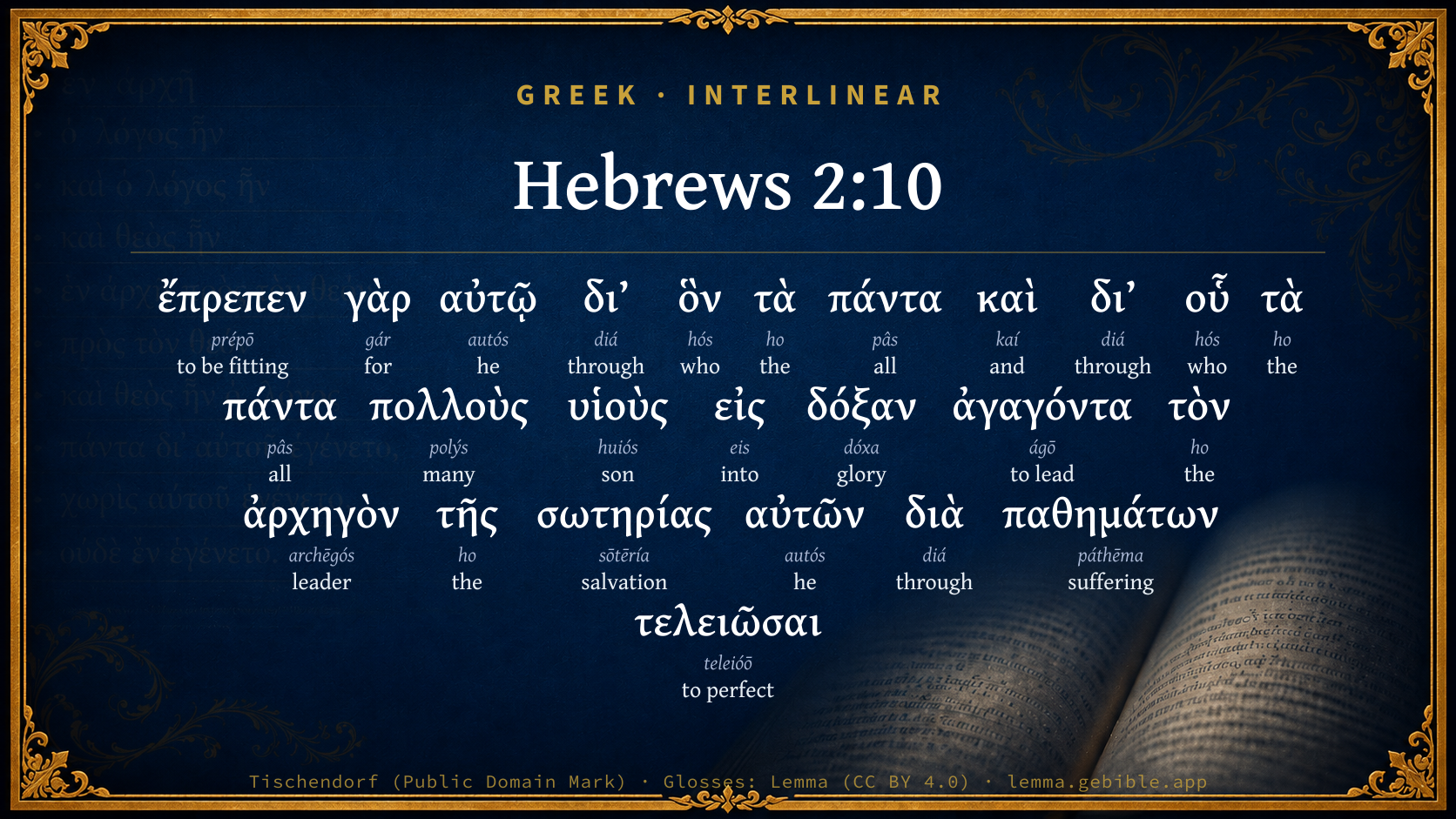
For it became him, for whom are all things, and through whom are all things, in bringing many children to glory, to make the author of their salvation perfect through sufferings.
Download a study sheet
One document with this verse’s original text, its word-by-word gloss line, the meaning frame, cross-references with their text, attributed commentary, and full source and license credits — printable, and it pastes into notes with its structure intact.
This verse Autodidact and up
A passage Seminary Student
Up to 50 verses in one chapter. A passage sheet keeps up to 6 commentary sources and 12 cross-references per verse, in the order this page ranks them, and says so on the sheet whenever that leaves anything out. Ask for a single verse and you get the Autodidact verse sheet above.
Everything on this page stays free to read, with no account — the sheet is a download of what is already on screen, not access to it.
Compare translations 3
The same verse in 3 English versions, stacked beneath the original-language interlinear above. Click any original word for its lexicon entry.
Each is an independent rendering of the whole verse — the interlinear is not word-aligned to these translations.
Highlighted words mark where these versions differ — a whole-verse word diff, not a word-by-word alignment.
-
World English Bible Public Domain
For it became him, for whom are all things, and through whom are all things, in bringing many children to glory, to make the author of their salvation perfect through sufferings.
-
King James Version Public Domain
For it became him, for whom are all things, and by whom are all things, in bringing many sons unto glory, to make the captain of their salvation perfect through sufferings.
-
unfoldingWord Literal Text CC BY-SA 4.0
For it was proper for him, because of whom all the things and through whom all the things, having brought many sons into glory, to perfect the founding leader of their salvation through sufferings.
unfoldingWord Literal Text — © unfoldingWord, licensed CC BY-SA 4.0. Word-aligned USFM3 via Door43 (git.door43.org/unfoldingWord/en_ult).
Show all 19 translations
Every available English version of this verse, each an independent rendering of the whole verse.
-
World English Bible Public Domain
For it became him, for whom are all things, and through whom are all things, in bringing many children to glory, to make the author of their salvation perfect through sufferings.
-
Berean Standard Bible Public Domain
In bringing many sons to glory, it was fitting for God, for whom and through whom all things exist, to make the author of their salvation perfect through suffering.
-
Majority Standard Bible Public Domain
In bringing many sons to glory, it was fitting for God, for whom and through whom all things exist, to make the author of their salvation perfect through suffering.
-
King James Version Public Domain
For it became him, for whom are all things, and by whom are all things, in bringing many sons unto glory, to make the captain of their salvation perfect through sufferings.
-
American Standard Version (1901) Public Domain
For it became him, for whom are all things, and through whom are all things, in bringing many sons unto glory, to make the author of their salvation perfect through sufferings.
-
Revised Version (1885) Public Domain
For it became him, for whom are all things, and through whom are all things, in bringing many sons unto glory, to make the author of their salvation perfect through sufferings.
-
Geneva Bible (1599) Public Domain
For it became him, for whome are all these thinges, and by whome are all these things, seeing that hee brought many children vnto glory, that he should consecrate the Prince of their saluation through afflictions.
-
Douay-Rheims (1899) Public Domain
For it became him, for whom are all things, and by whom are all things, who had brought many children into glory, to perfect the author of their salvation, by his passion.
-
Young's Literal Translation Public Domain
For it was becoming to Him, because of whom `are' the all things, and through whom `are' the all things, many sons to glory bringing, the author of their salvation through sufferings to make perfect,
-
Literal Standard Version CC BY-SA 4.0
For it was fitting to Him, because of whom [are] all things, and through whom [are] all things, bringing many sons to glory, to make the author of their salvation perfect through sufferings,
-
Unlocked Literal Bible CC BY-SA 4.0
For it was proper for God, because everything exists for him and through him, to bring many sons to glory. It was proper for him to make the leader of their salvation complete through his sufferings.
-
unfoldingWord Literal Text CC BY-SA 4.0
For it was proper for him, because of whom all the things and through whom all the things, having brought many sons into glory, to perfect the founding leader of their salvation through sufferings.
-
Darby Bible Public Domain
For it became him, for whom [are] all things, and by whom [are] all things, in bringing many sons to glory, to make perfect the leader of their salvation through sufferings.
-
World Messianic Bible Public Domain
For it became him, for whom are all things and through whom are all things, in bringing many children to glory, to make the author of their salvation perfect through sufferings.
-
Webster's Bible Public Domain
For it became him, for whom are all things, and by whom are all things, in bringing many sons to glory, to make the Captain of their salvation perfect through sufferings.
-
Free Bible Version CC BY-SA 4.0
It was appropriate that God, who creates and maintains everything, should bring many of his children to glory, and to completely prepare through suffering the one who leads them to salvation.
-
Bible in Basic English Public Domain
Because it was right for him, for whom and through whom all things have being, in guiding his sons to glory, to make the captain of their salvation complete through pain.
-
Text-Critical English NT CC BY 4.0
For in bringing many sons to glory, it was fitting that God, for whom and through whom all things exist, should make the author of their salvation perfect through suffering.
-
Tyndale New Testament (1534) Public Domain
For it became him for whom are all thynges and by whom are all thynges after that he had brought many sonnes vnto glory that he shuld make the lorde of their saluacion parfect thorow sofferynge.
Literal Standard Version (2020), Covenant Press — licensed CC BY-SA 4.0. Text via the HelloAO Bible API (eBible.org). Unlocked Literal Bible (unfoldingWord) — licensed CC BY-SA 4.0. Text via the HelloAO Bible API (eBible.org). unfoldingWord Literal Text — © unfoldingWord, licensed CC BY-SA 4.0. Word-aligned USFM3 via Door43 (git.door43.org/unfoldingWord/en_ult). Free Bible Version, Dr. Jonathan Gallagher — licensed CC BY-SA 4.0. Text via the HelloAO Bible API (eBible.org).
Word by word
More ways to search: Search by grammar → Find every occurrence → Compare this word →
Practice this passage: Drill this verse → Learn its vocabulary →
- Appears 4× in the Greek New Testament
- First appears at Acts 3:15
- Part of Speech
- Noun
- Case
- Accusative
- Number
- Singular
- Gender
- Masculine
Full Thayer's Definition
- ἔπρεπεν prépō G4241 “to be fitting” Verb, Imperfect, Active, Indicative, 3rd person, Singular
- γὰρ gár G1063 “for” Conjunction
- αὐτῷ autós G846 “he” Personal pronoun, Dative, Singular, Masculine
- δι’ diá G1223 “through” Preposition
- ὃν hós G3739 “who” Relative pronoun, Accusative, Singular, Masculine
- τὰ ho G3588 “the” Article, Nominative, Plural, Neuter
- πάντα pâs G3956 “all” Adjective, Nominative, Plural, Neuter
- καὶ kaí G2532 “and” Conjunction
- δι’ diá G1223 “through” Preposition
- οὗ hós G3739 “who” Relative pronoun, Genitive, Singular, Masculine
- τὰ ho G3588 “the” Article, Nominative, Plural, Neuter
- πάντα pâs G3956 “all” Adjective, Nominative, Plural, Neuter
- πολλοὺς polýs G4183 “many” Adjective, Accusative, Plural, Masculine
- υἱοὺς huiós G5207 “son” Noun, Accusative, Plural, Masculine
- εἰς eis G1519 “into” Preposition
- δόξαν dóxa G1391 “glory” Noun, Accusative, Singular, Feminine
- ἀγαγόντα ágō G71 “to lead” Verb, Aorist, Active, Participle, Accusative, Singular, Masculine
- τὸν ho G3588 “the” Article, Accusative, Singular, Masculine
- ἀρχηγὸν archēgós G747 “leader” Noun, Accusative, Singular, Masculine
- τῆς ho G3588 “the” Article, Genitive, Singular, Feminine
- σωτηρίας sōtēría G4991 “salvation” Noun, Genitive, Singular, Feminine
- αὐτῶν autós G846 “he” Personal pronoun, Genitive, Plural, Masculine
- διὰ diá G1223 “through” Preposition
- παθημάτων páthēma G3804 “suffering” Noun, Genitive, Plural, Neuter
- τελειῶσαι teleióō G5048 “to perfect” Verb, Aorist, Active, Infinitive
About this verse
These counts appear in no published source. They are computed here, from the morphology-tagged text and Lemma’s own curated glosses. What Lemma adds →
- 25
- words
- 17
- distinct lemmas
- General Epistles
- section
Cross-references
45Topical passages linked to Hebrews 2:10 in the Treasury of Scripture Knowledge — connected by theme and wording, ordered by reader-vote popularity; previews shown in the World English Bible.
- Romans 11:36 For of him, and through him, and to him, are all things. To him be the glory for ever! Amen.
- Colossians 1:16–17 For by him were all things created, in the heavens and on the earth, things visible and things invisible, whether thrones or dominions or principalities or powers; all things have been created through him, and for him.
- Hebrews 5:8–9 though he was a Son, yet learned obedience by the things which he suffered.
- Luke 24:26 Didn't the Christ have to suffer these things and to enter into his glory?"
- Luke 24:46 He said to them, "Thus it is written, and thus it was necessary for the Christ to suffer and to rise from the dead the third day,
- Acts 5:31 God exalted him with his right hand to be a Prince and a Savior, to give repentance to Israel, and remission of sins.
- 1 Corinthians 8:6 yet to us there is one God, the Father, of whom are all things, and we for him; and one Lord, Jesus Christ, through whom are all things, and we live through him.
- Hebrews 6:20 where as a forerunner Jesus entered for us, having become a high priest forever after the order of Melchizedek.
- Hebrews 12:2 looking to Jesus, the author and perfecter of faith, who for the joy that was set before him endured the cross, despising shame, and has sat down at the right hand of the throne of God.
- 1 Peter 5:10 But may the God of all grace, who called you to his eternal glory by Christ Jesus, after you have suffered a little while, perfect, establish, strengthen, and settle you.
- 1 John 3:1–2 Behold, how great a love the Father has bestowed on us, that we should be called children of God! For this cause the world doesn't know us, because it didn't know him.
- Romans 9:25–26 As he says also in Hosea, "I will call them 'my people,' which were not my people; And her 'beloved,' who was not beloved."
- Ephesians 3:10 to the intent that now through the assembly the manifold wisdom of God might be made known to the principalities and the powers in the heavenly places,
- Hebrews 7:28 For the law appoints men as high priests who have weakness, but the word of the oath which came after the law appoints a Son forever who has been perfected.
- Joshua 5:14–15 He said, No; but [as] prince of the host of Yahweh am I now come. Joshua fell on his face to the earth, and did worship, and said to him, What says my lord to his servant?
- Proverbs 16:4 Yahweh has made everything for its own end-- Yes, even the wicked for the day of evil.
- Acts 3:15 and killed the Prince of life, whom God raised from the dead, to which we are witnesses.
- Romans 8:29–30 For whom he foreknew, he also predestined to be conformed to the image of his Son, that he might be the firstborn among many brothers.
- Romans 9:23 and that he might make known the riches of his glory on vessels of mercy, which he prepared beforehand for glory,
- 2 Corinthians 3:18 But we all, with unveiled face beholding as in a mirror the glory of the Lord, are transformed into the same image from glory to glory, even as from the Lord, the Spirit.
- Galatians 3:26 For you are all children of God, through faith in Christ Jesus.
- Ephesians 1:5–8 having predestined us for adoption as children through Jesus Christ to himself, according to the good pleasure of his desire,
- Ephesians 2:7 that in the ages to come he might show the exceeding riches of his grace in kindness toward us in Christ Jesus;
- Colossians 3:4 When Christ, our life, is revealed, then you will also be revealed with him in glory.
- 2 Timothy 2:10 Therefore I endure all things for the chosen ones' sake, that they also may obtain the salvation which is in Christ Jesus with eternal glory.
- Revelation 4:11 "Worthy are you, our Lord and God, the Holy One, to receive the glory, the honor, and the power, for you created all things, and because of your desire they existed, and were created!"
- Genesis 18:25 Be it far from you to do things like that, to kill the righteous with the wicked, that so the righteous should be as the wicked. May that be far from you. Shouldn't the Judge of all the earth do right?"
- Isaiah 43:21 the people which I formed for myself, that they might set forth my praise.
- Isaiah 55:4 Behold, I have given him for a witness to the peoples, a leader and commander to the peoples.
- Hosea 8:10 But although they sold themselves among the nations, I will now gather them; and they begin to waste away because of the oppression of the king of mighty ones.
- Micah 2:13 He who breaks open the way goes up before them. They break through the gate, and go out. And their king passes on before them, With Yahweh at their head."
- Luke 2:14 "Glory to God in the highest, On earth peace, good will toward men."
- Luke 13:32 He said to them, "Go and tell that fox, 'Behold, I cast out demons and perform cures today and tomorrow, and the third day I complete my mission.
- John 11:52 and not for the nation only, but that he might also gather together into one the children of God who are scattered abroad.
- John 19:30 When Jesus therefore had received the vinegar, he said, "It is finished." He bowed his head, and gave up his spirit.
- Romans 8:14–18 For as many as are led by the Spirit of God, these are children of God.
- 1 Corinthians 2:7 But we speak God's wisdom in a mystery, the wisdom that has been hidden, which God foreordained before the worlds for our glory,
- 2 Corinthians 4:17 For our light affliction, which is for the moment, works for us more and more exceedingly an eternal weight of glory;
- 2 Corinthians 5:18 But all things are of God, who reconciled us to himself through Jesus Christ, and gave to us the ministry of reconciliation;
- 2 Corinthians 6:18 I will be to you a Father. You will be to me sons and daughters,' says the Lord Almighty."
- 1 Peter 1:12 To them it was revealed, that not to themselves, but to you, did they minister these things, which now have been announced to you through those who preached the Gospel to you by the Holy Spirit sent out from heaven; which things angels desire to look into.
- 1 Peter 5:1 I exhort the elders among you, as a fellow elder, and a witness of the sufferings of Christ, and who will also share in the glory that will be revealed.
- Revelation 7:9 After these things I looked, and behold, a great multitude, which no man could number, out of every nation and of all tribes, peoples, and languages, standing before the throne and before the Lamb, dressed in white robes, with palm branches in their hands.
- Romans 3:25–26 whom God set forth to be an atoning sacrifice, through faith in his blood, for a demonstration of his righteousness through the passing over of prior sins, in God's forbearance;
- Hebrews 7:26 For such a high priest was fitting for us: holy, guiltless, undefiled, separated from sinners, and made higher than the heavens;
Cross-references courtesy of OpenBible.info (CC BY 4.0).
Lesson kit
Teaching starters — assembled from the data on this page, not authored interpretation. Every prompt links to the verse data it draws on. Edit before teaching.
Hebrews, in the General Epistles, opens this verse with 25 words (17 distinct Greek lemmas). Its most distinctive word is archēgós (“leader”). A historical commentator’s framing appears above. Read the whole chapter for the surrounding context.
Discussion questions
- The word archēgós carries the sense “leader.” How does it shape the verse?
- How does Acts 3:15, which shares the word «leader», read alongside this verse?
- What does the repetition of “through” (3× in this one verse) do in this verse?
- The translations on this page render this verse differently — a whole-verse word diff, not a word-by-word alignment. What might account for the different wordings?
- Compare how Matthew Henry's Commentary and Jamieson, Fausset & Brown read this verse. Where do they agree or differ?
Things to notice
- These translations choose different wording for 14 words in this verse.
- “through” occurs 3× in this single verse.
- 17 distinct Greek lemmas span 25 words in this verse.
Commentary
Notes on Hebrews 2:10 from classic Christian and Jewish commentators (each source and its license shown beneath its notes). The classic Christian expositions comment on the surrounding passage and are grouped to its opening verse, so a note may address several verses; the Jewish commentaries on the Tanakh (Rashi and others) are per-verse, so they appear only where the commentator wrote on this verse.
Lemma curates 59 commentaries, every one of them public domain or Creative Commons licensed, each selected and text-cleaned for this edition rather than reprinted as found. About our sources →
Matthew Henry's Commentary
Matthew Henry's Commentary on the Whole Bible (1708–1710) — public domain (CC PDM 1.0). Text via the HelloAO Bible API.
Jamieson, Fausset & Brown
Robert Jamieson, A. R. Fausset & David Brown
Jamieson, Fausset & Brown — Commentary Critical and Explanatory on the Whole Bible (1871) — public domain (CC PDM 1.0). Text via the HelloAO Bible API.
Joseph Benson's Commentary
Joseph Benson's Commentary on the Old and New Testaments (1811–1818) — public domain. Text from a community e-Sword module.
MacLaren's Expositions of Holy Scripture
Alexander MacLaren
Alexander MacLaren, Expositions of Holy Scripture (1904–1910) — public domain. Text from a community e-Sword module.
F. W. Grant's Numerical Bible
F. W. Grant, The Numerical Bible (4th ed., 1903) — public domain. Text from a community e-Sword module.
Tyndale Open Study Notes
Tyndale Open Resources
Tyndale Open Study Notes — © Tyndale Open Resources, licensed CC BY-SA 4.0. Text via the HelloAO Bible API.
Bengel's Gnomon
Johann Albrecht Bengel
Bengel's Gnomon of the New Testament — English translation (T&T Clark, Edinburgh, 1860) — public domain. Text from a community e-Sword module.
Meyer's Critical & Exegetical Commentary
Heinrich August Wilhelm Meyer
Meyer — Critical and Exegetical Commentary on the New Testament — English translation by Peter Christie, edited by Frederick Crombie (T&T Clark, 1880) — public domain. Text from a community e-Sword module.
Expositor's Greek Testament
ed. W. Robertson Nicoll
The Expositor's Greek Testament, edited by W. Robertson Nicoll (1897–1910) — public domain. Text from a community e-Sword module.
Vincent's Word Studies in the New Testament
Marvin R. Vincent
Marvin R. Vincent, Word Studies in the New Testament (1887–1900) — public domain. Text from a community e-Sword/MySword module.
Geneva Bible (1599)
Geneva Bible translators
Geneva Bible (1599) marginal notes — public domain. Text via Bolls.life.
Adam Clarke's Commentary
Adam Clarke's Commentary on the Bible (1810–1826) — public domain. Text from a community e-Sword/MySword module.
John Calvin's Commentaries
John Calvin's Commentaries (1540-1563) — public domain. Text from the Calvin Translation Society English edition (1840s-50s) via the Christian Classics Ethereal Library (ccel.org). Calvin's coverage is partial (roughly two-thirds of the Bible); uncommented books and verses are honest gaps, never fabricated. The 19th-century editor's footnotes and remarks are omitted so the notes are faithfully Calvin's own voice.
Ellicott's Commentary for English Readers
A Bible Commentary for English Readers, edited by Charles John Ellicott (1878–1897) — public domain. Text from a community e-Sword module.
The Cambridge Bible for Schools and Colleges
gen. ed. J. J. S. Perowne
The Cambridge Bible for Schools and Colleges (gen. ed. J. J. S. Perowne; Cambridge University Press, 1878–1918) — public domain. Text from a community e-Sword module.
John Gill's Exposition
John Gill's Exposition of the Whole Bible (1746–1763) — public domain (CC PDM 1.0). Text via the HelloAO Bible API.
Trapp's Complete Commentary
John Trapp
John Trapp, A Commentary or Exposition upon All the Books of the Old and New Testament (1647–1656) — public domain. Text from a community e-Sword module.
Albert Barnes' Notes on the Bible
Albert Barnes' Notes on the Bible (1834–1885) — public domain. Text from a community e-Sword/MySword module.
Haydock's Catholic Bible Commentary
George Leo Haydock (1774–1849), Haydock's Catholic Family Bible and Commentary, 1859 edition — public domain. Excludes Psalms (Douay-Rheims chapter numbering differs from Protestant) and Deuterocanonical books (Catholic canon only).
Matthew Poole's English Annotations
Matthew Poole's English Annotations on the Holy Bible (1683–1685) — public domain. Text from a community e-Sword/MySword module.
Whedon's Commentary on the Bible
Daniel D. Whedon
Daniel D. Whedon (gen. ed.), Commentary on the Old and New Testaments (1874–1909) — public domain. Text from a community e-Sword module.
The Pulpit Commentary
The Pulpit Commentary (1880–1919), ed. H.D.M. Spence-Jones & Joseph S. Exell — public domain. Text from a community e-Sword module.
John Wesley's Explanatory Notes
John Wesley, Explanatory Notes Upon the Whole Bible (1754–1765) — public domain. Text via the GEBible commentary corpus.
Scofield Reference Notes
C. I. Scofield
The Scofield Reference Bible (1917 edition), notes by C. I. Scofield — public domain. Text from a community e-Sword module.
Kretzmann's Popular Commentary
Paul E. Kretzmann
Paul E. Kretzmann, Popular Commentary of the Bible (1921–1924) — public domain. Text from a community e-Sword module.
Burkitt's Expository Notes on the New Testament
William Burkitt
William Burkitt's Expository Notes on the New Testament (1700–1703) — public domain. Text from a community e-Sword module.
Godbey's Commentary on the New Testament
William B. Godbey
William B. Godbey, Commentary on the New Testament (1896–1900) — public domain. Text from a community e-Sword module.
The People's New Testament
B. W. Johnson
B. W. Johnson's The People's New Testament with Notes (1889–1891) — public domain. Electronic text from the Christian Classics Ethereal Library (CCEL) ThML edition.
Cambridge Greek Testament for Schools and Colleges
Cambridge Greek Testament for Schools and Colleges (Cambridge University Press, 1896; 21 vols, various authors incl. Carr, Maclear, Plummer, Farrar, Lumby, Moule, M. R. James, Simcox) — public domain. Text from a community e-Sword module.
Alford’s Greek Testament
Henry Alford
Henry Alford, The Greek Testament (1849–1861) — public domain. Text from a community e-Sword module.
Westcott on Hebrews & the Epistles of John
Brooke Foss Westcott
Brooke Foss Westcott (1825–1901), The Epistle to the Hebrews (1889) and The Epistles of St John (1883) — public domain (pre-1929). Text recovered from Internet Archive / Google Books OCR scans. Westcott’s Gospel of John commentary is not included (its OCR lost the chapter running-heads required for reliable verse-keying). Some Greek quoted in the Hebrews volume is imperfectly rendered by the OCR.