Hebrews 11:20

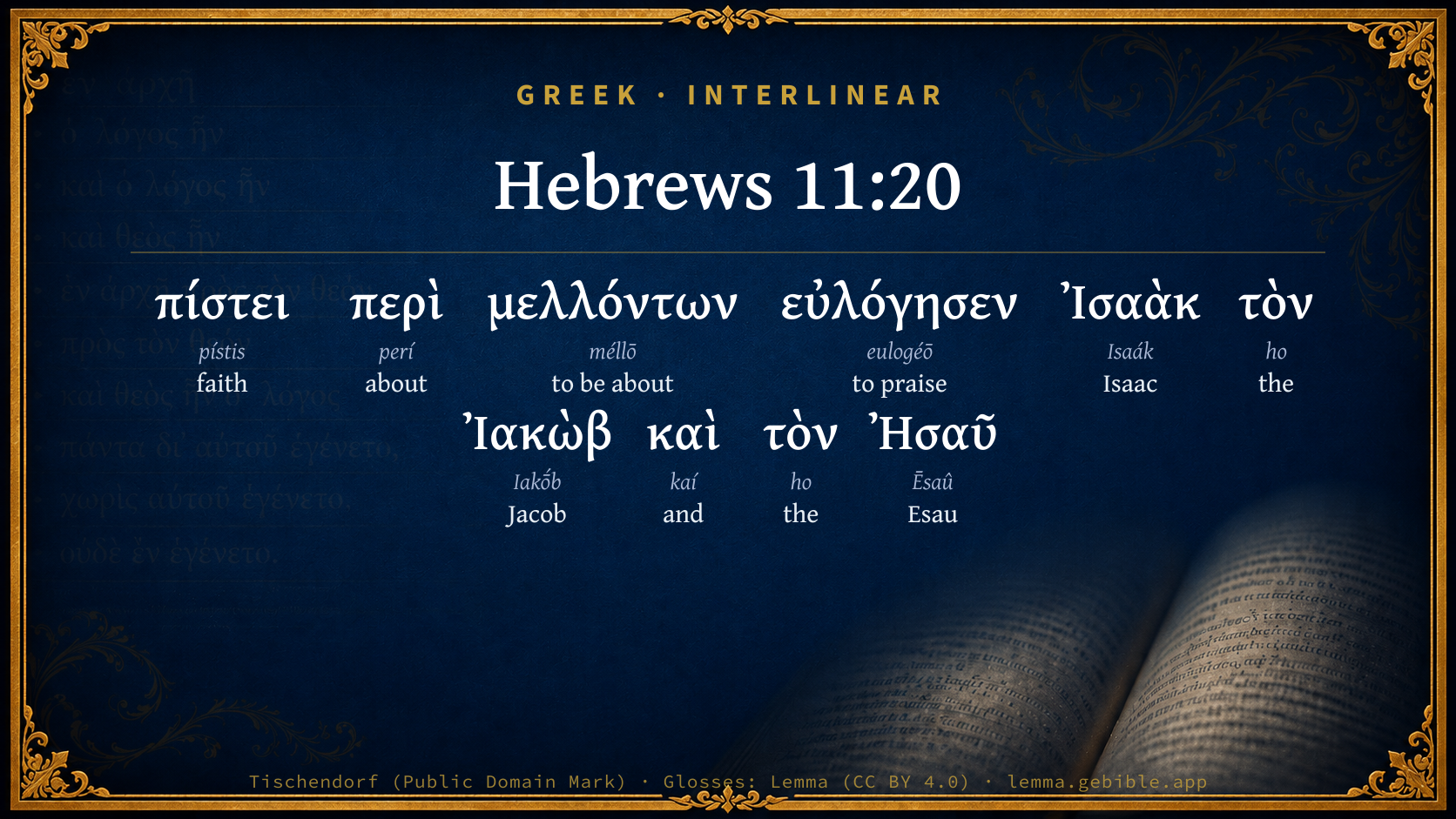
Greek (Tischendorf 8th ed.) Hebrews 11:20 appears in the Greek New Testament. The text above is from the Tischendorf 8th edition. Each word links to its Strong’s number and a concise gloss. Click any word for its full Thayer’s Greek Lexicon entry.
Download image
Cite this verse

Hebrews 11:20 (World English Bible). Public Domain. Lemma interlinear Bible study tool, https://lemma.gebible.app/v/hebrews/11/20.

Show BibTeX & RIS
BibTeX
RIS
English Translation
By faith, Isaac blessed Jacob and Esau, even concerning things to come.
World English Bible · Public Domain
Download a study sheet

One document with this verse’s original text, its word-by-word gloss line, the meaning frame, cross-references with their text, attributed commentary, and full source and license credits — printable, and it pastes into notes with its structure intact.

This verse Autodidact and up

Study sheet (.html) Plain text (.txt)

A passage Seminary Student

Up to 50 verses in one chapter. A passage sheet keeps up to 6 commentary sources and 12 cross-references per verse, in the order this page ranks them, and says so on the sheet whenever that leaves anything out. Ask for a single verse and you get the Autodidact verse sheet above.

Everything on this page stays free to read, with no account — the sheet is a download of what is already on screen, not access to it.

Want to remove ads? Support Godless Engineer
Compare translations 3

The same verse in 3 English versions, stacked beneath the original-language interlinear above. Click any original word for its lexicon entry.

Each is an independent rendering of the whole verse — the interlinear is not word-aligned to these translations.

Highlighted words mark where these versions differ — a whole-verse word diff, not a word-by-word alignment.

  • World English Bible Public Domain
    By faith, Isaac blessed Jacob and Esau, even concerning things to come.
  • King James Version Public Domain
    By faith Isaac blessed Jacob and Esau concerning things to come.
  • unfoldingWord Literal Text CC BY-SA 4.0
    By faith also, concerning coming things, Isaac blessed Jacob and Esau.

unfoldingWord Literal Text — © unfoldingWord, licensed CC BY-SA 4.0. Word-aligned USFM3 via Door43 (git.door43.org/unfoldingWord/en_ult).

Versions to compare (up to 4)

3 of 4 selected

Show all 19 translations

Every available English version of this verse, each an independent rendering of the whole verse.

  • World English Bible Public Domain
    By faith, Isaac blessed Jacob and Esau, even concerning things to come.
  • Berean Standard Bible Public Domain
    By faith Isaac blessed Jacob and Esau concerning the future.
  • Majority Standard Bible Public Domain
    By faith Isaac blessed Jacob and Esau concerning the future.
  • King James Version Public Domain
    By faith Isaac blessed Jacob and Esau concerning things to come.
  • American Standard Version (1901) Public Domain
    By faith Isaac blessed Jacob and Esau, even concerning things to come.
  • Revised Version (1885) Public Domain
    By faith Isaac blessed Jacob and Esau, even concerning things to come.
  • Geneva Bible (1599) Public Domain
    By faith Isaac blessed Iacob and Esau, concerning things to come.
  • Douay-Rheims (1899) Public Domain
    By faith also of things to come, Isaac blessed Jacob and Esau.
  • Young's Literal Translation Public Domain
    By faith, concerning coming things, Isaac did bless Jacob and Esau;
  • Literal Standard Version CC BY-SA 4.0
    By faith, concerning coming things, Isaac blessed Jacob and Esau.
  • Unlocked Literal Bible CC BY-SA 4.0
    It was also by faith about things to come that Isaac blessed Jacob and Esau.
  • unfoldingWord Literal Text CC BY-SA 4.0
    By faith also, concerning coming things, Isaac blessed Jacob and Esau.
  • Darby Bible Public Domain
    By faith Isaac blessed Jacob and Esau concerning things to come.
  • World Messianic Bible Public Domain
    By faith Isaac blessed Jacob and Esau, even concerning things to come.
  • Webster's Bible Public Domain
    By faith Isaac blessed Jacob and Esau concerning things to come.
  • Free Bible Version CC BY-SA 4.0
    Trusting in God, Isaac blessed Jacob and Esau in regard to what the future would bring.
  • Bible in Basic English Public Domain
    By faith Isaac, blessing Jacob and Esau, gave news of things to come.
  • Text-Critical English NT CC BY 4.0
    By faith Isaac blessed Jacob and Esau concerning things to come.
  • Tyndale New Testament (1534) Public Domain
    In fayth Isaac blessed Iacob and Esau concerninge thinges to come.

Literal Standard Version (2020), Covenant Press — licensed CC BY-SA 4.0. Text via the HelloAO Bible API (eBible.org). Unlocked Literal Bible (unfoldingWord) — licensed CC BY-SA 4.0. Text via the HelloAO Bible API (eBible.org). unfoldingWord Literal Text — © unfoldingWord, licensed CC BY-SA 4.0. Word-aligned USFM3 via Door43 (git.door43.org/unfoldingWord/en_ult). Free Bible Version, Dr. Jonathan Gallagher — licensed CC BY-SA 4.0. Text via the HelloAO Bible API (eBible.org).

Word by word

More ways to search: Search by grammar → Find every occurrence → Compare this word →

Practice this passage: Drill this verse → Learn its vocabulary →

About this verse

These counts appear in no published source. They are computed here, from the morphology-tagged text and Lemma’s own curated glosses. What Lemma adds →

10
words
9
distinct lemmas
General Epistles
section

Notable vocabulary

The rarest word here is Ἠσαῦ Esau G2269 — appearing just 3 times in the whole Greek New Testament.

Shared distinctive vocabulary

Ἠσαῦ Esau G2269 occurs in 3 verses of the Greek New Testament. Also found in:

Repetition

A word recurs within this verse:

Cross-references

2

Topical passages linked to Hebrews 11:20 in the Treasury of Scripture Knowledge — connected by theme and wording, ordered by reader-vote popularity; previews shown in the World English Bible.

  • Genesis 27:27–40 He came near, and kissed him. He smelled the smell of his clothing, and blessed him, and said, "Behold, the smell of my son Is as the smell of a field which Yahweh has blessed.
  • Genesis 28:2–3 Arise, go to Paddan Aram, to the house of Bethuel your mother's father. Take a wife from there from the daughters of Laban, your mother's brother.

Cross-references courtesy of OpenBible.info (CC BY 4.0).

Commentary

Notes on Hebrews 11:20 from classic Christian and Jewish commentators (each source and its license shown beneath its notes). The classic Christian expositions comment on the surrounding passage and are grouped to its opening verse, so a note may address several verses; the Jewish commentaries on the Tanakh (Rashi and others) are per-verse, so they appear only where the commentator wrote on this verse.

Lemma curates 59 commentaries, every one of them public domain or Creative Commons licensed, each selected and text-cleaned for this edition rather than reprinted as found. About our sources →

The Biblical Illustrator

Joseph S. Exell

Heb_11:20

Isaac blessed Jacob and Esau

Character and faith of Isaac:

Isaac was a devout man.

Mention is made in his history of positive acts of worship by which devotion is expressed; and in his walking out to meditate at eventide, we have a beautiful picture of an act by which devotion is sustained. The good man left his tents, and forsook his associates, and walked out, thoughtful and alone, to admire the affluence of Providence, and to look upon the works and the wonders of nature. His faith was sometimes overcome by the force of temptation, but it speedily acquired its wonted ascendancy; it was, at others, darkened by defects in his character; but upon the whole, the life of Isaac was marked by comparative simplicity and innocence; that at last he slept with his fathers in a good old age; that he died with confidence in the promise, amid the tears and the benedictions of his household. In the text the apostle specifies one particular act in which the faith of Jacob was shown, He blessed Jacob and Esau concerning things to come.

1. The first thing to be noticed is the faith displayed by Isaac in his readiness and desire to bless his children at all, to bless them in the name, and according to the previous communications of Jehovah. This was a pious determination, resulting from continued confidence in God--from the practical persuasion of his truth--from reliance upon the consistency of His moral character; or, in one word, from faith, properly so called--that sentiment of the heart which leads a man to feel the absolute certainty of whatever he knows to be the sayings of God. In this, therefore, Isaacs faith was right though his feeling was wrong. He intended the chief blessing for the elder son, and he pronounced it with the thought that he was thus actually conveying it. But the time was now come for him to be corrected upon the point which he had either not known, or had neglected to keep sufficiently in view.

2. The second circumstance, therefore, which it becomes us to observe, is the obedience of faith which he manifested in respect to this point, when the Divine will was clearly and fully revealed in relation to it. In blessing Jacob, though he might be prompted to the act simply by the devout determination of principle, he felt himself, while performing the act, to be under the direction of a Divine impulse. When Esau afterwards approached and informed him of the actual state of the case, the whole truth seemed to flash at once upon his mind. What he had been led to do, though unconscious of it at the moment, revealed to him the purposes of God, and the direction of the promises with respect to his sons. I have blessed him, and he shall be blessed; as if he had said, I have been the unconscious instrument of imparting to myself a knowledge of the will of Him whom I serve; to that will I bow with ready and voluntary obedience. I have blessed him, and I cannot bless another to the same extent; I have been the medium through which the God of our fathers has now repeated and enlarged His promises, and these, I believe, will assuredly be fulfilled. He has declared the line in which they are to pass, and that line He had a right to select; I approve of what He has done, and I confide in what He has said, as I have often approved and confided before. The things which my lips have uttered are as certain and immutable as are all the intentions and purposes of God; I have blessed him, yea, and he shall be blessed! Let us now make a remark upon the last clause of the text; Jacob and Esau were blessed respecting things to come. They were both blessed, for both of them, as men, were objects of pre-determined benediction in the Divine mind; though previous to their birth, that the purpose of God according to election might stand--it was declared that the younger should be the greater Of the two. The expression things to come, is intended to signify things which were so emphatically future that they related not so much to the individuals themselves as to the posterity to descend from them. Both were to be the founders of nations; these nations were to be remarkably distinguished from each other; and in them were to be realised the circumstances--the prosperity, and the vicissitudes--which had been so clearly and so copiously described in the language of Isaac.

Looking at the two prophecies pronounced over Jacob and Esau respectively, they appear to include the following things.

1. In the first place, they may be said either to presuppose, or to predict, the separate existence of the posterity of the two brothers as nations. Jacob is as a field which the Lord hath blessed; in him were to be fulfilled the promises given to Abraham. Esau is represented as living by his sword. The one expression describes a people organised and religious: the other a people of habits and manners rude and predatory; and such, in fact, was the case--the Jews descending from Jacob, and the Edomites from Esau.

2. The second circumstance is, that both nations were to possess very nearly the same local and physical advantages, which was at first also the fact.

3. The third thing is, the reduction, by the other branch, of the posterity of Esau to submission and servitude. This, after frequent advances towards it, was fully accomplished by David.

4. But the fourth and last particular to be observed is, that at length this yoke should be broken off from the neck of the degraded race, when they should obtain dominion, that is, when they should steadily range themselves under a leader, as a strong and united people. This, too, actually occurred; it took place in the reign of Jehoram.

After making these observations explanatory of the text, we propose in the second place to deduce from them a few others of a practical character.

1. In looking at the comparatively calm and unruffled history of Isaac you may learn that the life most favoured of Providence is still required to be a life of faith. In prosperity, faith will render us grateful, moderate, and cautious, as under other circumstances it will inspire fortitude and prompt acquiescence: it will take the form of filial confidence in the continuance of good, so long as that good shall be seen to be consistent with higher purposes. Above all, since the most distinguished lot can never adequately meet the demands and capacities of our spiritual nature, faith in a future world must be ever felt by the devout man to be the only means by which he can endure, so to speak, even the highest happiness of this.

2. You learn from the history of Isaac the propriety of seasons of retirement for collected and serious thought.

3. From the history of Isaac you may learn the pernicious consequences of parents pursuing a system of favouritism with respect to their children.

4. By the nature and the circumstances of the fact to which the text refers--the blessing pronounced by Isaac upon Jacob and Esau--we arereminded of the variety of the proofs that may be adduced in support of the Jewish and Christian Scriptures. There are two connected with the present subject.

(1) The first is, the obvious and honest impartiality of the historian in describing the faults and vices of the most distinguished men whose lives he records.

(2) The second, the fulfilment of prophecy.

5. In the last place, from a comparison of the portions of the two brothers let us learn to aspire after the best blessings which God can confer. It will be of no lasting advantage to us to have the portion of Esau, unless we have the portion of Jacob along with it. (T. Binney.)

The faith of Isaac

I suppose it was natural and right that Isaac should take his place next to Abraham in this record of men of faith; he stands next in the historical line of patriarchs who handed on the promise from one to another. And yet we cannot help feeling that in passing from Abraham to Isaac we are descending to a lower level. He seems to have possessed a timid, yielding disposition--a nature calculated to obey rather than to command--to follow rather than to lead. Wherever he comes before us in history we see a character just the opposite to that of Abraham--quiet, meditative, shrinking from everything like individual action, andtimorously yielding to every pressure put upon him. Here was poor material, one might think, for faith to work with; such a man seems ill-calculated to sustain the tradition of faith so gloriously begun in Abraham, and to play a worthy part in handing on the covenant of Divine promise. And yet he is unhesitatingly placed in this glorious line of believers--he also was a man of faith, in his own measure loyal to God and to His covenant. The stream of faith flowed on through him to his successors unchecked and unpolluted. Just as a stream, when flowing through a mountainous and rocky country, is broken into swift-flowing rapids and dashing cataracts, harmonising in their picturesque grandeur with the surrounding features, but on reaching the plain below flows quietly along through green pastures where flocks are peacefully grazing, so the faith, which in Abrahams rugged character comes out in striking and impressive scenes, in the quiet life of Isaac assumes the form of an unobtrusive principle, giving an air of calm assurance and peace to his whole life. Faith now, as then, has to work through a variety of temperaments. The trees, the flowers, the corn, the grass, all are different manifestations of the same life; it assumes various forms, according to the nature of the organism through which it works; so the life of God takes hold of the constitution of a man, and develops results in harmony with the nature God has given him. Some of the most beautiful effects of faith have often been wrought out in retiring characters like Isaacs. There are some delicate forms of spiritual beauty that require a reposeful spirit to blossom in, just as there are flowers growing in sheltered retreats that would perish on the rough mountain-top. We should learn to admire the grace of God in all its manifestations. To return to Isaac. We have no record in his case of any great feats of faith accomplished, any striking deeds done, as in the case of some of the other patriarchs. His faith never rose to that white heat of enthusiasm which leads a man to do immortal deeds. There was an even tenor about his life which was never broken by any special crisis of any stirring event. It is significant of the character of the man that he is celebrated in this chapter by an act of blessing. The most that could be said of him was that he held fast by the faith of his father, that he cherished the heavenly covenant as a precious heirloom which he had faithfully to preserve, and when his failing strength warned him that he would soon have to pass away, his chief thought was to transmit the promise to his posterity. And in many lives to-day faith manifests itself in the same fashion. The most that some men do is to cherish their faith as a source of strength and joy in their own hearts and their own homes, and seek to pass it on as a spiritual legacy to their children. There are many who have neither the opportunity nor the gifts to do great and bold things for God in the world; their efforts must be confined within a narrow circle; if their faith is to be useful at all, it must be in the influence it exerts in the home. And this is not the least fruitful kind of religious life. Some of the most blessed work that has ever been done for God and humanity has been done in the home circle, by those who have never made any great stir in the world or done any great thing in the Church. Quiet, unobtrusive lives have often been blessedly useful in fostering that choicest fruit of faith--family religion. Let every Christian man set this before him as a sacred ambition--to leaven his family with his own faith and leave it as a legacy to those who shall come after him. The blessing which Isaac pronounced upon his sons was something more than the ordinary form of blessing--something more than a pious wish or prayer that prosperity and peace and the favour of heaven might attend them. It was a blessing in which prophetic insight was blended with holy desire and intercession; the illumination of the Spirit enabled him to pronounce an effectual benediction which remained as a permanent good upon the head of him who received it. And every human life ought to end like Isaacs--with a blessing. Some lives end with a curse; they leave behind them a baneful influence which goes on blighting the lives of those that come after. A mans real legacy to posterity is the influence of his character. The bit of parchment which disposes of his material accumulations is not half so important as the distribution of that influence which has been silently accumulating through all the years of his life. In how many hearts there is a memory more cherished than the richest earthly possession--the memory of one who still lives to bless and influence them, to restrain from evil and incite to good I This is the kind of legacy we should strive to leave behind. And if we would do this we must begin to lay up the sacred treasure now. Such wealth is not accumulated in a day. It is the work of years; it is the product of patient continuance in well doing. (J. T. Hamly.)

Faith supporting the saint in the frailties of ages

I. FAITH UNDIMINISHED BY ADVANCING YEARS.

1. The worth of a mans creed fully tested at the close of life.

2. The blessedness of that, our confidence in which increases with increased experience.

3. The continuance of spiritual energy when the physical powers fail. Gods people die full of life.

II. FAITH HANDING ON THE BLESSING TO THOSE THAT COME AFTER.

1. The Divine word qualifies all Gods people to be prophets of blessing.

2. It is only by faith in God that we can impart a blessing to others.

3. Thus we can leave blessings on those we love when we are dying. Faiths legacies are surer than any.

III. FAITH TRIUMPHING OVER LIFES UNFULFILLED HOPES.

1. Promises so far unfulfilled.

2. The strongest possible assurance, even in death, of the things hoped for.

3. Thus faith enables the saint to enter with eager anticipation into the unseen world.

4. As we look back on the subsequent history of the descendants of the patriarchs we see how abundantly their faith was justified. We judge of Gods faithfulness too soon. Time will prove Him true. (C. New.)

The Biblical Illustrator, edited by Joseph S. Exell (c. 1880s–1900s) — public domain. Text from a community e-Sword module.

Joseph Benson's Commentary

Heb 11:20-21. By faith — By firmly believing what God had revealed unto him concerning the future state of his children; Isaac blessed Jacob and Esau — Prophetically foretold the particular blessings they should receive, preferring the younger before the elder. See notes on Gen 27:6-40. By faith Jacob, when a dying — That is, when near death, believing that God would make good his promise of giving his posterity the land of Canaan; blessed both the sons of Joseph — Foretelling that two tribes should spring from these two sons; and that the tribe of Ephraim, the younger, should be more powerful than the tribe of Manasseh, the elder; and worshipped — Acknowledged God’s goodness to him, which he had so long experienced; leaning — Or bowing down; on the top of his staff — In the passage referred to, (Gen 47:31,) it is said, according to our version: Israel bowed himself upon his bed’s head; but the apostle says here, He worshipped upon the top of his staff; which agrees with the Greek and Syriac translation. It seems, as Hallet observes, the word משׂה, used in Genesis, signifies either a bed or a staff; and the passages may be reconciled by supposing that he was sitting on the side of the bed when he blessed these sons of Joseph, and leaned on the top of his staff for support, being very old and feeble.

Joseph Benson's Commentary on the Old and New Testaments (1811–1818) — public domain. Text from a community e-Sword module.

Lange's Commentary on the Holy Scriptures

IV

The example of Isaac, Jacob and Joseph

Heb_11:20-22

20By faith [also] Isaac blessed Jacob and Esau concerning things to come. By faith 21Jacob, when he was a dying [while when dying], blessed both [each of]15 the sons of Joseph; and worshipped, leaning upon the top of his staff. 22By faith Joseph, when he died [while dying], made mention of the departing of the children of Israel; and gave commandment concerning his bones.

EXEGETICAL AND CRITICAL

Heb_11:20. Also.—The position of καί forbids our regarding the present as the mere appending of a new example of faith from the history of the Patriarchs. Either faith is here designated as of a nature which displays its inward confidence by the utterance of a blessing, and this in relation to a thing in the future; in which case the act of blessing evinces an undoubting faith that the word will be followed by the actual fulfilment (Theodoret, Lün.); or the καί, with its emphasizing force, introduces the blessing as an act of faith that even determines the future (Del.). In both cases περὶ μελλ. is dependent on εὐλογ. To connect it with πίστει (Peshito, Sykes) would yield a construction elsewhere without example in the New Testament, and opposed to the absolute use of πίστει elsewhere throughout the chapter.

Heb_11:21. Worshipped, leaning, etc.—In the Heb. text (Gen_47:31) it is said, “he bowed himself upon the head of his couch” (Knobel), or, “he turned himself about upon his bed, turning his face to its head” (Hofm., Del.). At all events, he rendered thanks to God in this way, as the aged David did in a similar case, 1Ki_1:47; while in his discourse with Joseph he had sat upright on his bed. In his weakness, he could neither arise nor prostrate himself. Our author here as elsewhere follows the Sept. with their pointing, הַמַּטֶּה instead of הַמִּטָּח; and has perhaps designedly brought this passage into connection with the act of blessing recounted Genesis 48, in order to express the devout frame of mind in which this blessing was uttered (Thol.). Perhaps, too, we are to take αὐτοῦ in the sense of the reflexive αὑτοῦ, and to refer the term to the pilgrim-staff of Jacob, Gen_32:10. The reference of this pronoun to Joseph, as well as the supplying of τῷ Ἰωσήφ with προσεκύνησεν (Chrys., Theodor., Theoph., etc.) is discountenanced by the utter absence of any mention of a staff of honor belonging to Joseph (which indeed Thom. Aqu. regards as symbolical of the cross of Christ, and Joseph as type of the Messiah), as well as by the connection of the passage, which points to no marks of homage which Jacob, in fulfilment of Joseph’s dream, may at last have rendered to him. But the rendering of the Vulg. et adoravit fastigium virgæ ejus, followed by Primas., Œc., Erasm., Calv., Bisp., Reuss, etc., who regard it as indicating the direction of his homage, and as acknowledging in act the future greatness of Ephraim, is grammatically inadmissible; for ἐπί τι nowhere occurs as expressing the object of προσκυνεῖν.

DOCTRINAL AND ETHICAL

1. Believers care in the best way not only for their own future, but also for that of their children and remote posterity. Therefore they bless them, and God hears their prayer.

2. The blessings pronounced by believers are not mere utterances of pious wishes, but prophecies of the future, and actions which exercise a determining power upon history. Yet they are not sorcerers’ utterances which could exercise a mastery over the will of God, and magically determine the fate of other men. They originate and exert their influence only on the ground and in the power of a human will brought into contact with the will of God. It is God Himself who fills and guides the blessing, heart, hand and lips.

3. Faith strengthens and influences even the weak and dying, so that they look only to God’s promises, wait in blessing and in prayer clear to the end, desire, after their decease, to be gathered to their fathers and brought into the land of promise, and direct toward this all their arrangements.

HOMILETICAL AND PRACTICAL

They who die in faith think: 1, of the promises which they have inherited; 2, of the prayers with which they are to finish their course; 3, of the benedictions with which they can influence their posterity.—Faith renders men: 1, equally potent in life and joyful in death; 2, equally bold and humble; 3, equally reflective and forecasting.—The best kind of concern for our posterity.

Starke:—As the Patriarchs with great industry transmitted the promises of Christ to their posterity, so should we be zealous to bring the Gospel of Christ to posterity.—The saints frequently do, under the direction and guidance of God, something in which they indeed have a good purpose, but in respect to which God has determined something still higher.—It matters little at the present time where we are buried, provided only that the soul comes into Abraham’s bosom; for the earth is every where the Lord’s. Psa_24:1.

Rieger:—By the early setting in order of his house, Jacob admonishes us of his daily dying, and of the renewed confession of his earthly pilgrimage.

Heubner:—Even in age, and amidst the great infirmities of age, Jacob was strong in his faith in the sure purpose and counsel of God.—The desire of Joseph to have his bones buried with his forefathers, indicates faith in a perpetual communion among believers through the power of God.

Footnotes:

[15]Heb_11:20.—Read after A. D*., 17, 23, 37, Vulg. It., πίστει καὶ περὶ τῶν μελλόντων.

Lange's Commentary on the Holy Scriptures (Critical, Doctrinal, and Homiletical), ed. John Peter Lange, English translation edited by Philip Schaff (1864–1880) — public domain. Text from a community e-Sword module.

Tyndale Open Study Notes

Tyndale Open Resources

11:20 Isaac promised blessings: See Gen 27:27-40; the only part of the story that can be considered a blessing for Esau is that he would eventually shake off his subservience to his brother. Esau was later blessed by Jacob’s riches (Gen 33:8-11).

Tyndale Open Study Notes — © Tyndale Open Resources, licensed CC BY-SA 4.0. Text via the HelloAO Bible API.

Bengel's Gnomon

Johann Albrecht Bengel

Heb 11:20-22. Πίστει, by faith) There are more specimens of faith in Isaac, Jacob, and Joseph; but the apostle considers it enough to give a single instance, in the case of each of them, concerning things mostly future.—εὐλόγησεν, blessed) assigning to both his sons things future, as if they were present.

Bengel's Gnomon of the New Testament — English translation (T&T Clark, Edinburgh, 1860) — public domain. Text from a community e-Sword module.

Meyer's Critical & Exegetical Commentary

Heinrich August Wilhelm Meyer

Heb_11:20. The example of Isaac. Comp. Genesis 27

Πίστει καί] καί is the more nearly defining: and in truth, and in sooth. A faith was manifested in the imparting of the blessing, by the very circumstance that this benediction extended with inner confidence to facts as yet belonging to the future.[109] Comp. Theodoret: Οὐ ΓᾺΡ ἊΝ ΤᾺς ΟὐΧ ὉΡΩΜΈΝΑς ἜΔΩΚΕΝ ΕὐΛΟΓΊΑς, ΕἸ ΜῊ ΤΟῖς ΛΌΓΟΙς ἈΚΟΛΟΥΘΉΣΕΙΝ ΤῸ ἜΡΓΟΝ ἘΠΊΣΤΕΥΣΕΝ.

ΠΕΡῚ ΜΕΛΛΌΝΤΩΝ] concerning things as yet future, i.e. concerning the future lot of his two sons, and the pre-eminence of the younger son over the elder.

Jacob, the younger son, is here first mentioned, since he was first blessed by Isaac, and was altogether of greater significance for the history of the people.

[109] How Delitzsch has been able so greatly to misunderstand the above words as to read in them the assertion, that περὶ μελλόντων to be combined with περὶ καί instead of ηὐλόγησεν, I do not comprehend.

Meyer — Critical and Exegetical Commentary on the New Testament — English translation by Peter Christie, edited by Frederick Crombie (T&T Clark, 1880) — public domain. Text from a community e-Sword module.

Expositor's Greek Testament

ed. W. Robertson Nicoll

Heb 11:20 . Πίστει περὶ μελλόντων .… “By faith Isaac blessed Jacob and Esau in regard to things future,” as is recorded in the well-known passage, Gen 27 . Isaac thus in his turn exhibited a faith which could be described as ἐλπιζομένων ὑπόστασις . “By faith Jacob when dying ( ἀποθνήσκων cf. καλούμενος , Heb 11:8 , and πειραζόμενος , Heb 11:17 : the participle illustrates Heb 11:13 and also reminds the reader that Jacob before he died saw his children’s children inheriting the promise (“thy two sons are mine,” Gen 48:5 ) blessed each of the sons of Joseph. ἕκαστον τ . υἱῶν , that is, he gave each an individual blessing, crossing his hands, laying his right on the head of Ephraim the younger, his left on Manasseh, thus distinguishing between the destiny of the one and that of the other and so more abundantly illustrating his faith. καὶ προσεκύνησεν ἐπὶ τὸ ἄκρον τῆς ῥάβδου αὐτοῦ , “and worshipped leaning upon the top of his staff”. The words are from the LXX rendering of Gen 47:31 where after Joseph had sworn to bury his father in Canaan, “Israel worshipped, etc.”. His exacting this promise from Joseph was proof of his faith that his posterity would inherit the land of promise. The LXX translating from an unpointed text read הַמַּטֶּה the staff and not as it is now read הַמִּטָּה the bed, (as in Gen 48:2 ). The meaning in either case is that in extreme bodily weakness, either unable to leave his bed or if so only able to stand with the aid of a staff, his faith was yet untouched by the slightest symptom of decay. “The idea of προσκυνεῖν is that of reverence shown in posture ” (Vaughan). Here Jacob “worshipped” in thankful remembrance of the promise of God and that his son had accepted it.

The Expositor's Greek Testament, edited by W. Robertson Nicoll (1897–1910) — public domain. Text from a community e-Sword module.

Geneva Bible (1599)

Geneva Bible translators

Isaac.

Geneva Bible (1599) marginal notes — public domain. Text via Bolls.life.

Jamieson, Fausset & Brown

Robert Jamieson, A. R. Fausset & David Brown

Jacob is put before Esau, as heir of the chief, namely, the spiritual blessing.

concerning things to come--Greek, "even concerning things to come": not only concerning things present. Isaac, by faith, assigned to his sons things future, as if they were present.

Jamieson, Fausset & Brown — Commentary Critical and Explanatory on the Whole Bible (1871) — public domain (CC PDM 1.0). Text via the HelloAO Bible API.

Adam Clarke's Commentary

Verse 20. By faith Isaac blessed Jacob and Esau] He believed that God would fulfil his promise to his posterity; and God gave him to see what would befall them in their future generations. The apostle does not seem to intimate that one should be an object of the Divine hatred, and the other of Divine love, in reference to their eternal states. This is wholly a discovery of later ages. For an ample consideration of this subject, see the notes on Gen. 27.

Adam Clarke's Commentary on the Bible (1810–1826) — public domain. Text from a community e-Sword/MySword module.

John Calvin's Commentaries

20. By faith Isaac, etc. It was also the work of faith to bless as to future things; for when the thing itself does not exist and the word only appears, faith must necessarily bear rule. But first we must notice of what avail is the blessing of which he speaks. For to bless often means to pray for a blessing. But the blessing of Isaac was very different; for it was as it were an introduction into the possession of the land, which God had promised to him and his posterity. And yet he had nothing in that land but the right of burial. Then strange seemed these high titles, “Let people serve thee, and tribes bow down to thee,” (Genesis 27:29;) for what dominion could he have given who himself was hardly a free man? We hence see that this blessing depended on faith; for Isaac had nothing which he could have bestowed on his children but the word of God.

It may, however, be doubted whether there was any faith in the blessing given to Esau, as he was a reprobate and rejected by God. The answer is easy, for faith mainly shone forth, when he distinguished between the two twins born to him, so that he gave the first place to the younger; for following the oracle of God, he took away from the firstborn the ordinary right of nature. And on this depended the condition of the whole nation, that Jacob was chosen by God, and that this choice was sanctioned by the blessing of the father.

John Calvin's Commentaries (1540-1563) — public domain. Text from the Calvin Translation Society English edition (1840s-50s) via the Christian Classics Ethereal Library (ccel.org). Calvin's coverage is partial (roughly two-thirds of the Bible); uncommented books and verses are honest gaps, never fabricated. The 19th-century editor's footnotes and remarks are omitted so the notes are faithfully Calvin's own voice.

Ellicott's Commentary for English Readers

(20) Concerning things to come.—It is probable, though not certain, that the word “even” should be inserted before “concerning”; on these words, then, the emphasis will rest. Not having regard to things present only, or things almost at hand, but looking far into the future, through the divine revelation which opened to him the meaning of the promises received by Abraham, he gave to each son the blessing designed by God (Gen_27:27-29; Gen_27:39-40). Isaac’s confidence in the divine guidance of his words is especially seen in Heb_11:33 of the chapter.

A Bible Commentary for English Readers, edited by Charles John Ellicott (1878–1897) — public domain. Text from a community e-Sword module.

The Cambridge Bible for Schools and Colleges

gen. ed. J. J. S. Perowne

20. By faith Isaac blessed Jacob and Esau] It is true that the blessing of Esau when rightly translated, “Behold thy dwelling shall be away from the fatness of the earth and away from the dew of blessing” (Gen_27:39) reads more like a curse; but the next verse (40) involves a promise of ultimate freedom, and Esau obtained the blessings of that lower and less spiritual life for which he was alone fitted by his character and tastes.

concerning things to come] The true reading seems to be “even concerning,” though it is not easy to grasp the exact force of the “even.”

The Cambridge Bible for Schools and Colleges (gen. ed. J. J. S. Perowne; Cambridge University Press, 1878–1918) — public domain. Text from a community e-Sword module.

John Gill's Exposition

By faith Joseph, when he died,.... The riches and honours of Joseph, as they could not secure him from death, so they did not make him unmindful of it; nor was he afraid of dying, or uneasy about it; nor did his prosperity make him proud, or above speaking to his brethren, nor revengeful to them, nor unthoughtful of their future afflictions; nor did his affluence of temporal things take off his regards to divine promises, nor weaken his faith in them, which is here commended in the following instances; as that at the time of his death,

he made mention of the departing of the children of Israel; that is, out of the land of Egypt: he remembered it himself, and put his brethren in mind of it, by speaking of it to their comfort, with great assurance; he knew they were well situated in the land of Egypt, and yet speaks of their departure out of it; he foresaw, and firmly believed they would be greatly afflicted in it, and that God would look upon them, and visit them, and bring them out of it, into the land of Canaan; all which shows the strength of his faith, and that it was about things not seen.

And gave commandment concerning his bones; and the command was a very strict one when he gave it; he took an oath of his brethren to fulfil it; it was concerning his bones, not his body, which shows that he believed their departure out of Egypt was at a great distance, when his flesh would be consumed, and only his bones left, as it was about two hundred years after his death; it respects the carrying them out of Egypt with them, and burying them in the land of Canaan, when they came there; and this is an instance of his humility, in choosing to lie with his fathers, rather than with the kings, and great men in Egypt, and of his care to prevent idolatry, which he might observe the Egyptians would be prone unto: and this command was a great instance of Joseph's faith, that the children of Israel would return to Canaan, and which might serve greatly to confirm their faith in it; it also shows his belief of the resurrection of the dead, and of his enjoying the heavenly inheritance, signified by the land of Canaan; See Gen 50:24, the Papists, from hence, plead for the relics of saints; but it should be observed, that it was at the request, and by the command of Joseph, that his bones were preserved, which is not the case of the saints, whose relics are pleaded for; besides, these were the true and real bones of Joseph, whereas the relics of the saints are only pretended; to which may be added, that the bones of Joseph, were ordered to be buried, not to be showed for a sight, much less worshipped, as Popish relics are. Joseph's coffin, the Jews say (h), was put into the river Nile; and so says Patricides (i), an Arabic writer: others say it was in the buryingplace of the kings, until it was taken up and removed by Moses.

(h) T. Bab. Sota, fol. 13. 1. (i) Apud Hottinger. Smegma Oriental. l. 1. c. 8. p. 379.

John Gill's Exposition of the Whole Bible (1746–1763) — public domain (CC PDM 1.0). Text via the HelloAO Bible API.

Trapp's Complete Commentary

John Trapp

20 By faith Isaac blessed Jacob and Esau concerning things to come.

Ver. 20. By faith Isaac blessed] Patriarchal benedictions were prophetical; the blessing of godly parents is still very available for the good of their children; and justifying faith is not beneath miraculous in the sphere of its own activity and where it hath warrant of God’s word.

John Trapp, A Commentary or Exposition upon All the Books of the Old and New Testament (1647–1656) — public domain. Text from a community e-Sword module.

Albert Barnes' Notes on the Bible

By faith Isaac blessed Jacob and Esau concerning things to come - see Gen 27:26-40. The meaning is, that he pronounced a blessing on them in respect to their future condition. This was by faith in God who had communicated it to him, and in full confidence that he would accomplish all that was here predicted. The act of faith here was simply what believes that all that God says is true. There were no human probabilities at the time when these prophetic announcements were made, which could have been the basis of his calculation, but all that he said must have rested merely on the belief that God had revealed it to him. A blessing was pronounced on each, of a very different nature, but Isaac had no doubt that both would be fulfilled.

Albert Barnes' Notes on the Bible (1834–1885) — public domain. Text from a community e-Sword/MySword module.

Matthew Poole's English Annotations

Isaac is the next example instanced in of the same Divine faith, described, Heb 11:1; only here exercised on the special revelation of God to him concerning his seed. By this faith he did not only wish and pray blessings, but prophetically applied them to his two sons, to Jacob and Israel his seed the covenant blessings, and to Esau and the Edomites his seed the temporary blessings, God designed them, Gen 27:27,39. Both these were things to come, and to be communicated to their seeds hundreds of years after. As the things to come that concerned Jacob, which were not seen, but hoped for from God’s revelation of them, were, plenty, dominion over brethren, blessings above the power of a curse, even the spiritual and covenanted ones of Abraham and Isaac with him, Gen 27:28,29. The things to come concerning Esau and his seed, were only earthly, temporal blessings, escape out of servitude in time, common good things at the highest, Gen 27:39,40. By faith Isaac foresaw all these future events, foretold them, and applied their several portions to them from the mouth of God, and they were to a tittle fulfilled, 2Sa 8:11, and 2Ki 8:20, as to the Edomites; as in the whole Old Testament unto Jacob, and to his seed literal and spiritual.

Matthew Poole's English Annotations on the Holy Bible (1683–1685) — public domain. Text from a community e-Sword/MySword module.

Whedon's Commentary on the Bible

Daniel D. Whedon

20. Concerning things to come—It is not quite true that prophets first arose in the later history of Israel. For Abraham was “a prophet.”

Gen_20:7. The recorded paternal blessings of Isaac, Jacob, and Joseph were prophecies, and we know not how many unrecorded prophecies they uttered. The lineal family—nay, we may say the lineal race—was for ages susceptible to presentiment and predictive frames. Their natural temperament, therefore, was a basis of possibility of divine revelation. The supernaturalistic person is often unattractive, and not good or wise; but when wise and good, a lofty character may therefrom arise.

Daniel D. Whedon (gen. ed.), Commentary on the Old and New Testaments (1874–1909) — public domain. Text from a community e-Sword module.

The Pulpit Commentary

By faith Isaac blessed Jacob and Esau, even (or, also) concerning things to come. Here the word kai (omitted in the Textus Receptus) gives force to what is meant; words uttered by the patriarchs in the spirit of prophecy being now adduced as further evidence of their faith. To those inspired by this spirit even the distant future is realized as present; and faith is not only a condition of such prophetic visions being granted to them, but is also evinced by their trusting the visions as Divine revelations, and speaking with confidence accordingly. The prophet seems as though able himself to control the future by giving or withholding blessing; (cf. Jer_1:10) but it is really that his mind and will are at one with the mind and will of God: a Divine voice speaks within him, and through faith he is receptive of it and gives it utterance. Thus it was that even the future characters, and changing relations to each other, of the yet unborn races of Israel and Edom are represented as having been foreshadowed in the blessings of that dying patriarch. Vers. 20-22. Faith of Isaac, Jacob, and Joseph.

Each of these patriarchs died in the firm confidence of "things hoped for," and pronounced prophetic blessings upon his descendants accordingly. The patriarchal benedictions were the expressions of a faith in the promises of the covenant, which was strong enough to bear the test of a death-bed.

I ISAAC"S BLESSING. (Ver. 20.) The prophecy here referred to was divinely inspired. It was not the utterance merely of parental love. The Holy Spirit revealed to Isaac the fortunes of his two sons; and, believing the revelation, he felt himself impelled by an irresistible impulse to declare it. The sin of Rebekah and Jacob in intercepting for the latter what his father had intended for Esau did not make the promise of none effect. Had Isaac been announcing only his own pleasure, he would most certainly have recalled the words which Jacob had appropriated so treacherously; but the patriarch felt that he dared not do so. He was persuaded that he had been made only the mouthpiece of the Divine will respecting the person who stood before him at the time. He saw that the blessing of the firstborn had been providentially directed towards his younger son, and he confessed his inability to reverse it. (Gen_27:33) Isaac blessed his sons "by faith" in the revelation regarding them of which he was the recipient.

II JACOB"S BLESSING. (Ver. 21) It was faith in a Divine testimony made in turn to Jacob that caused him (Gen_48:5, Gen_48:15-20) both to predict that Joseph should have a double portion in Israel through his two sons, and to bestow the larger blessing upon Ephraim, the younger. The patriarch knew that it would be a greater honor to these two young men to become each the head of a little Israelitish clan, than even to take rank through their mother as Egyptian princes. And behind this benediction of his grandsons there lay also Jacob"s firm faith in that provision of the covenant which gave the land of Canaan to his posterity. He had exacted from Joseph a promise upon oath that he should not be buried in Egypt, far from the graves of his kindred; and he devoutly thanked God, "leaning upon the top of his staff," for the assurance that his body should rest in the land of promise. (Gen_47:29-31) All this shows Jacob"s faith in the future return of the Hebrews to Canaan as the land of their inheritance. And his faith looked also, we are persuaded, to the "heavenly country" of which the land promised to Abraham was only the type.

III JOSEPH"S BLESSING. (Ver. 22) Amid the stern realities of the dying hour, the illustrious Joseph evinced the same bright and strong faith which had distinguished his father and his grandfather. It had never counted for much to him that he was Pharaoh"s prime minister. He had always been at heart a Hebrew, not an Egyptian. His hope was in the covenant promises. So, foreseeing the affliction of his people in Egypt, and their eventual exodus, he resolved that his body should not be buried in that land. His embalmed remains must be made useful, during the whole period of their bitter bondage, as a witness to Israel of the faithfulness of the God of Abraham. And the tribes must carry his bones with them when they go to take possession of their inheritance. Joseph"s faith is so great that he is content that his coffined clay should meanwhile remain unburied. So he died, leaving with his brethren this blessing: "God will surely visit. (Gen_1:24, Gen_1:25) His tender farewell shows us how steadfastly the eye of his faith was gazing upon the unseen.

CONCLUSION. The Christian Hebrews of the first century needed "like precious faith" with these three patriarchs, to enable them to discharge the duties and endure the sufferings to which they were called in connection with their Christian discipleship. And so also do we Gentile believers of these last times. Only faith in "things to come confidence in the life and immortality which have been brought to light through the gospel will enable us to live obediently and to die triumphantly.

The Pulpit Commentary (1880–1919), ed. H.D.M. Spence-Jones & Joseph S. Exell — public domain. Text from a community e-Sword module.

John Wesley's Explanatory Notes

Blessed - Gen. xxvii, 27, 39; prophetically foretold the particular blessings they should partake of. Jacob and Esau - Preferring the elder before the younger.

John Wesley, Explanatory Notes Upon the Whole Bible (1754–1765) — public domain. Text via the GEBible commentary corpus.

Burkitt's Expository Notes on the New Testament

William Burkitt

Note, That there is a blessing by way of prayer, and a blessing by way of prophecy, foretelling what shall befall persons in time to come; of this kind is Isaac’s blessing. The patriarchs were in a peculiar manner directed and guided by God, and their blessing was a conferring of a right to the parties blessed.

Thus Isaac blessed Jacob and Esau concerning things to come, that is, concerning the great and future things which should happen to their posterity after them.

Note here, Esaus, wicked men, have their portion in outward blessings as well as Jacobs, as well as the best and holiest of men; partly, as they are God’s creatures, partly as they descend from parents in covenant with God, and partly because they make some profession of the name of God. And God will be behindhand with none, but so far as they do good they shall see good.

William Burkitt's Expository Notes on the New Testament (1700–1703) — public domain. Text from a community e-Sword module.

The People's New Testament

B. W. Johnson

20–22. By faith Isaac blessed, etc. See Gen. 27:26–40; 28:2, 3. In the blessing there are prophecies of their future history.

B. W. Johnson's The People's New Testament with Notes (1889–1891) — public domain. Electronic text from the Christian Classics Ethereal Library (CCEL) ThML edition.

unfoldingWord translationNotes

Door43 World Missions Community

Jacob worshiped

"Jacob worshiped God"

when his end was near

Here "his end" is a polite way of referring to death. AT: "when he was about to die" (See: Euphemism)

spoke of the departure of the children of Israel from Egypt

"spoke of when the children of Israel would leave Egypt"

the children of Israel

"the Israelites" or "the descendants of Israel"

instructed them about his bones

Joseph died while in Egypt. He wanted his people to take his bones with them when they left Egypt so they could bury his bones in the land that God promised them. (See: Assumed Knowledge and Implicit Information)

translationWords

faith

Isaac

bless

Jacob

Esau

Joseph (OT)

worship

staff

children

Egypt

instruct

unfoldingWord translationNotes — © Distant Shores Media and the Door43 World Missions Community, licensed CC BY-SA 4.0. Source: git.door43.org/Door43/en_tn.

Cambridge Greek Testament for Schools and Colleges

20. εὐλόγησεν. It is true that the blessing of Esau when rightly translated, “Behold thy dwelling shall be away from the fatness of the earth and away from the dew of blessing” (Gen 27:39), reads more like a curse; but the next verse (40) involves a promise of ultimate freedom, and Esau obtained the blessings of that lower and less spiritual life for which he was alone fitted by his character and tastes.

[καὶ] περὶ μελλόντων. The true reading seems to be “even concerning,” though it is not easy to grasp the exact force of the “even.”

Cambridge Greek Testament for Schools and Colleges (Cambridge University Press, 1896; 21 vols, various authors incl. Carr, Maclear, Plummer, Farrar, Lumby, Moule, M. R. James, Simcox) — public domain. Text from a community e-Sword module.

Alford’s Greek Testament

Henry Alford

20.] By faith, Isaac blessed Jacob and Esau concerning things future also (the καί belongs, not to πίστει,—πίστει καὶ περὶ μελλ., by faith and that respecting things future,—as Lünem., al. (Syr. joins πίστει περὶ μελλ.), for πίστις περί, though good Greek, is not N. T. language,—but to περὶ μελλ.,—blessed them concerning not only things present, but things future also. Jacob is named before Esau, as the worthier and more important in the theocratic sense; perhaps also as having gained the greater portion of the blessing).

Henry Alford, The Greek Testament (1849–1861) — public domain. Text from a community e-Sword module.

Vincent's Word Studies in the New Testament

Marvin R. Vincent

Blessed [ευλογησεν] . See on Joh 12:13.

Concerning things to come [και περι μελλοντων] . A. V. Omits kai which gives an emphasis to the following words. Isaac pronounced a blessing, and that concerning things to come; things beyond the lifetime of Jacob and Esau. See Gen 27:29, 39. The blessing was an act of faith. Isaac 's confidence in the power of his blessing to convey the good which it promised was "the assurance of things hoped for, the conviction of things not seen," founded on the promise of Gen 17:5.

Marvin R. Vincent, Word Studies in the New Testament (1887–1900) — public domain. Text from a community e-Sword/MySword module.

Lesson kit

Teaching starters — assembled from the data on this page, not authored interpretation. Every prompt links to the verse data it draws on. Edit before teaching.

Hebrews, in the General Epistles, opens this verse with 10 words (9 distinct Greek lemmas). Its most distinctive word is Ēsaû (“Esau”). A historical commentator’s framing appears above. Read the whole chapter for the surrounding context.

Discussion questions

  1. The word Ēsaû carries the sense “Esau.” How does it shape the verse?
  2. Romans 9:13 shares the word «Esau» with this verse. How do the two illuminate each other?
  3. “the” occurs 2× in this one verse. What is the effect of the repetition?
  4. These translations render this verse differently; the difference is in the English rendering, not the original. What questions does that raise?
  5. Reading how The Biblical Illustrator and Joseph Benson's Commentary read this verse, where do the two commentators agree and where do they part?

Things to notice

  • These translations choose different wording for 4 words in this verse.
  • “the” occurs 2× in this single verse.
  • 9 distinct Greek lemmas span 10 words in this verse.

Reading settings

Reading text

Shown beneath each verse's original-language words.

Old Testament
Old Testament edition

Read the OT as the Masoretic Hebrew (MT) or the Greek Septuagint (LXX).

English shown for the Greek Septuagint (in the Hebrew ↔ Greek comparison).

Comparing translations? Open the Compare panel on any verse page to stack up to four side by side.