

Hebrews 9:10
Greek (Tischendorf 8th ed.) Hebrews 9:10 appears in the Greek New Testament. The text above is from the Tischendorf 8th edition. Each word links to its Strong’s number and a concise gloss. Click any word for its full Thayer’s Greek Lexicon entry.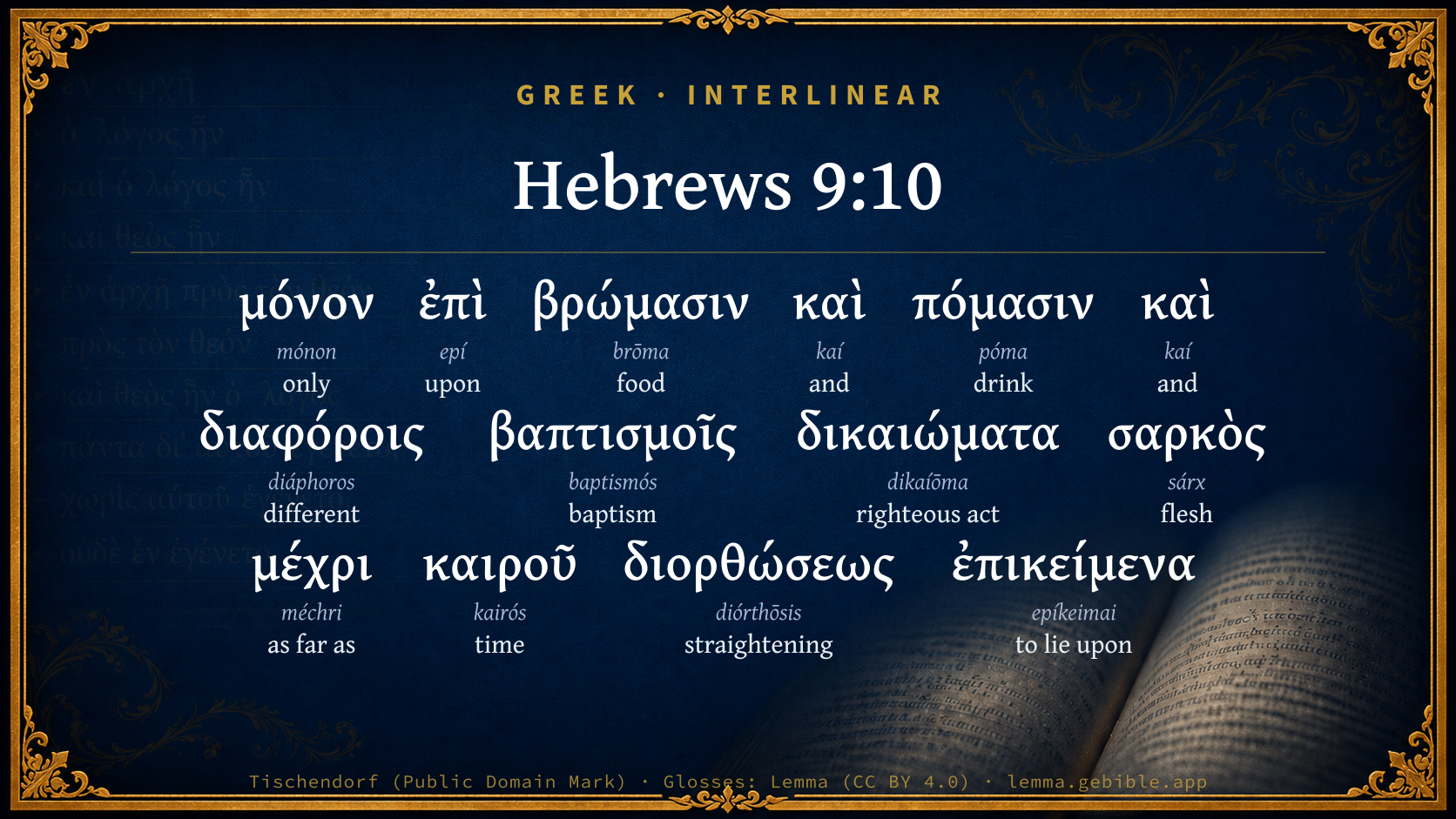
being only (with meats and drinks and various washings) fleshly ordinances, imposed until a time of reformation.
Download a study sheet
One document with this verse’s original text, its word-by-word gloss line, the meaning frame, cross-references with their text, attributed commentary, and full source and license credits — printable, and it pastes into notes with its structure intact.
This verse Autodidact and up
A passage Seminary Student
Up to 50 verses in one chapter. A passage sheet keeps up to 6 commentary sources and 12 cross-references per verse, in the order this page ranks them, and says so on the sheet whenever that leaves anything out. Ask for a single verse and you get the Autodidact verse sheet above.
Everything on this page stays free to read, with no account — the sheet is a download of what is already on screen, not access to it.
Compare translations 3
The same verse in 3 English versions, stacked beneath the original-language interlinear above. Click any original word for its lexicon entry.
Each is an independent rendering of the whole verse — the interlinear is not word-aligned to these translations.
Highlighted words mark where these versions differ — a whole-verse word diff, not a word-by-word alignment.
-
World English Bible Public Domain
being only (with meats and drinks and various washings) fleshly ordinances, imposed until a time of reformation.
-
King James Version Public Domain
Which stood only in meats and drinks, and divers washings, and carnal ordinances, imposed on them until the time of reformation.
-
unfoldingWord Literal Text CC BY-SA 4.0
only concerning foods and drinks and different baptisms, regulations of the body, being imposed until a time of new order.
unfoldingWord Literal Text — © unfoldingWord, licensed CC BY-SA 4.0. Word-aligned USFM3 via Door43 (git.door43.org/unfoldingWord/en_ult).
Show all 19 translations
Every available English version of this verse, each an independent rendering of the whole verse.
-
World English Bible Public Domain
being only (with meats and drinks and various washings) fleshly ordinances, imposed until a time of reformation.
-
Berean Standard Bible Public Domain
They consist only in food and drink and special washings—external regulations imposed until the time of reform.
-
Majority Standard Bible Public Domain
They consist only in food and drink and special washings and external regulations imposed until the time of reform.
-
King James Version Public Domain
Which stood only in meats and drinks, and divers washings, and carnal ordinances, imposed on them until the time of reformation.
-
American Standard Version (1901) Public Domain
`being' only (with meats and drinks and divers washings) carnal ordinances, imposed until a time of reformation.
-
Revised Version (1885) Public Domain
being only (with meats and drinks and divers washings) carnal ordinances, imposed until a time of reformation.
-
Geneva Bible (1599) Public Domain
Which only stood in meates and drinkes, and diuers washings, and carnal rites, which were inioyned, vntill the time of reformation.
-
Douay-Rheims (1899) Public Domain
And divers washings, and justices of the flesh laid on them until the time of correction.
-
Young's Literal Translation Public Domain
only in victuals, and drinks, and different baptisms, and fleshly ordinances -- till the time of reformation imposed upon `them'.
-
Literal Standard Version CC BY-SA 4.0
only on the basis of food, and drinks, and different immersions, and fleshly ordinances—until the time of reformation imposed on [them].
-
Unlocked Literal Bible CC BY-SA 4.0
They are only concerned with food and drink and various ceremonial washings, regulations for the body until the time of the new order.
-
unfoldingWord Literal Text CC BY-SA 4.0
only concerning foods and drinks and different baptisms, regulations of the body, being imposed until a time of new order.
-
Darby Bible Public Domain
[consisting] only of meats and drinks and divers washings, ordinances of flesh, imposed until [the] time of setting things right.
-
World Messianic Bible Public Domain
being only (with foods and drinks and various washings) fleshly ordinances, imposed until a time of reformation.
-
Webster's Bible Public Domain
Which stood only in meats and drinks, and divers washings, and carnal ordinances, imposed on them until the time of reformation.
-
Free Bible Version CC BY-SA 4.0
They're just religious regulations—about food and drink, and various ceremonies involving washing—which were put in place until the time of God's new way of relating to him.
-
Bible in Basic English Public Domain
Because they are only rules of the flesh, of meats and drinks and washings, which have their place till the time comes when things will be put right.
-
Text-Critical English NT CC BY 4.0
but deal only with food and drink, and various washings and regulations for the flesh, imposed until the time of reformation.
-
Tyndale New Testament (1534) Public Domain
with only meates and drinkes and divers wesshynges and iustifyinges of the flesshe which were ordeyned vntyll the tyme of reformacion.
Literal Standard Version (2020), Covenant Press — licensed CC BY-SA 4.0. Text via the HelloAO Bible API (eBible.org). Unlocked Literal Bible (unfoldingWord) — licensed CC BY-SA 4.0. Text via the HelloAO Bible API (eBible.org). unfoldingWord Literal Text — © unfoldingWord, licensed CC BY-SA 4.0. Word-aligned USFM3 via Door43 (git.door43.org/unfoldingWord/en_ult). Free Bible Version, Dr. Jonathan Gallagher — licensed CC BY-SA 4.0. Text via the HelloAO Bible API (eBible.org).
Word by word
More ways to search: Search by grammar → Find every occurrence → Compare this word →
Practice this passage: Drill this verse → Learn its vocabulary →
- Appears 2× in the Greek New Testament
- First appears at 1 Corinthians 10:4
- Part of Speech
- Noun
- Case
- Dative
- Number
- Plural
- Gender
- Neuter
Full Thayer's Definition
- μόνον mónon G3440 “only” Adverb
- ἐπὶ epí G1909 “upon” Preposition
- βρώμασιν brōma G1033 “food” Noun, Dative, Plural, Neuter
- καὶ kaí G2532 “and” Conjunction
- πόμασιν póma G4188 “drink” Noun, Dative, Plural, Neuter
- καὶ kaí G2532 “and” Conjunction
- διαφόροις diáphoros G1313 “different” Adjective, Dative, Plural, Masculine
- βαπτισμοῖς baptismós G909 “baptism” Noun, Dative, Plural, Masculine
- δικαιώματα dikaíōma G1345 “righteous act” Noun, Nominative, Plural, Neuter
- σαρκὸς sárx G4561 “flesh” Noun, Genitive, Singular, Feminine
- μέχρι méchri G3360 “as far as” Adverb
- καιροῦ kairós G2540 “time” Noun, Genitive, Singular, Masculine
- διορθώσεως diórthōsis G1357 “straightening” Noun, Genitive, Singular, Feminine
- ἐπικείμενα epíkeimai G1945 “to lie upon” Verb, Present, Middle or Passive deponent, Participle, Nominative, Plural, Neuter
About this verse
These counts appear in no published source. They are computed here, from the morphology-tagged text and Lemma’s own curated glosses. What Lemma adds →
- 14
- words
- 13
- distinct lemmas
- General Epistles
- section
Cross-references
29Topical passages linked to Hebrews 9:10 in the Treasury of Scripture Knowledge — connected by theme and wording, ordered by reader-vote popularity; previews shown in the World English Bible.
- Ephesians 2:15 having abolished in the flesh the hostility, the law of commandments contained in ordinances, that he might create in himself one new man of the two, making peace;
- Colossians 2:16 Let no man therefore judge you in eating, or in drinking, or with respect to a feast day or a new moon or a Sabbath day,
- Leviticus 11:2–47 "Speak to the children of Israel, saying, 'These are the living things which you may eat among all the animals that are on the earth.
- Hebrews 7:16 who has been made, not after the law of a fleshly commandment, but after the power of an endless life:
- Exodus 30:19–21 Aaron and his sons shall wash their hands and their feet in it.
- Exodus 40:12 You shall bring Aaron and his sons to the door of the tent of meeting, and shall wash them with water.
- Leviticus 16:4 He shall put on the holy linen coat, and he shall have the linen breeches on his body, and shall put on the linen sash, and he shall be dressed with the linen turban. They are the holy garments. He shall bathe his body in water, and put them on.
- Leviticus 16:24 Then he shall bathe himself in water in a holy place, and put on his garments, and come out and offer his burnt offering and the burnt offering of the people, and make atonement for himself and for the people.
- Deuteronomy 21:6 All the elders of that city, who are nearest to the slain man, shall wash their hands over the heifer whose neck was broken in the valley;
- Deuteronomy 23:11 but it shall be, when evening comes on, he shall bathe himself in water; and when the sun is down, he shall come within the camp.
- Ezekiel 4:14 Then said I, Ah Lord Yahweh! behold, my soul has not been polluted; for from my youth up even until now have I not eaten of that which dies of itself, or is torn of animals; neither came there abominable flesh into my mouth.
- Galatians 4:3–4 So we also, when we were children, were held in bondage under the elements of the world.
- Ephesians 1:10 to an administration of the fullness of the times, to sum up all things in Christ, the things in the heavens, and the things on the earth, in him;
- Hebrews 2:5 For he didn't subject the world to come, of which we speak, to angels.
- Hebrews 6:5 and tasted the good word of God, and the powers of the age to come,
- Hebrews 9:1 Now indeed even the first covenant had ordinances of divine service, and an earthly sanctuary.
- Hebrews 10:22 let's draw near with a true heart in fullness of faith, having our hearts sprinkled from an evil conscience, and having our body washed with pure water,
- Exodus 29:4 You shall bring Aaron and his sons to the door of the tent of meeting, and shall wash them with water.
- Leviticus 17:15–16 "'Every person that eats what dies of itself, or that which is torn by animals, whether he is native-born or a foreigner, he shall wash his clothes, and bathe himself in water, and be unclean until the evening: then he shall be clean.
- Leviticus 22:6 the person that touches any such shall be unclean until the evening, and shall not eat of the holy things, unless he bathe his body in water.
- Numbers 19:7–21 Then the priest shall wash his clothes, and he shall bathe his flesh in water, and afterward he shall come into the camp, and the priest shall be unclean until the even.
- Deuteronomy 14:3–21 You shall not eat any abominable thing.
- Mark 7:4 They don't eat when they come from the marketplace, unless they bathe themselves, and there are many other things, which they have received to hold to: washings of cups, pitchers, bronze vessels, and couches.)
- Acts 10:13–15 A voice came to him, "Rise, Peter, kill and eat!"
- Galatians 4:9 But now that you have come to know God, or rather to be known by God, why do you turn back again to the weak and miserable elements, to which you desire to be in bondage all over again?
- Colossians 2:20–22 If you died with Christ from the elements of the world, why, as though living in the world, do you subject yourselves to ordinances,
- Hebrews 6:2 of the teaching of baptisms, of laying on of hands, of resurrection of the dead, and of eternal judgment.
- Hebrews 13:9 Don't be carried away by various and strange teachings, for it is good that the heart be established by grace, not by food, through which those who were so occupied were not benefited.
- Leviticus 14:8–9 "He who is to be cleansed shall wash his clothes, and shave off all his hair, and bathe himself in water; and he shall be clean. After that he shall come into the camp, but shall dwell outside his tent seven days.
Cross-references courtesy of OpenBible.info (CC BY 4.0).
Lesson kit
Teaching starters — assembled from the data on this page, not authored interpretation. Every prompt links to the verse data it draws on. Edit before teaching.
Hebrews, in the General Epistles, opens this verse with 14 words (13 distinct Greek lemmas). Its most distinctive word is póma (“drink”). A historical commentator’s framing appears above. Read the whole chapter for the surrounding context.
Discussion questions
- What does “drink” (póma) contribute to the verse as a whole?
- 1 Corinthians 10:4 shares the word «drink» with this verse. How do the two illuminate each other?
- “and” occurs 2× in this one verse. What is the effect of the repetition?
- These translations render this verse differently; the difference is in the English rendering, not the original. What questions does that raise?
- Reading how The Biblical Illustrator and Tyndale Open Study Notes read this verse, where do the two commentators agree and where do they part?
Things to notice
- These translations choose different wording for 19 words in this verse.
- “and” occurs 2× in this single verse.
- 13 distinct Greek lemmas span 14 words in this verse.
Commentary
Notes on Hebrews 9:10 from classic Christian and Jewish commentators (each source and its license shown beneath its notes). The classic Christian expositions comment on the surrounding passage and are grouped to its opening verse, so a note may address several verses; the Jewish commentaries on the Tanakh (Rashi and others) are per-verse, so they appear only where the commentator wrote on this verse.
Lemma curates 59 commentaries, every one of them public domain or Creative Commons licensed, each selected and text-cleaned for this edition rather than reprinted as found. About our sources →
The Biblical Illustrator
Joseph S. Exell
The Biblical Illustrator, edited by Joseph S. Exell (c. 1880s–1900s) — public domain. Text from a community e-Sword module.
Tyndale Open Study Notes
Tyndale Open Resources
Tyndale Open Study Notes — © Tyndale Open Resources, licensed CC BY-SA 4.0. Text via the HelloAO Bible API.
Bengel's Gnomon
Johann Albrecht Bengel
Bengel's Gnomon of the New Testament — English translation (T&T Clark, Edinburgh, 1860) — public domain. Text from a community e-Sword module.
Meyer's Critical & Exegetical Commentary
Heinrich August Wilhelm Meyer
Meyer — Critical and Exegetical Commentary on the New Testament — English translation by Peter Christie, edited by Frederick Crombie (T&T Clark, 1880) — public domain. Text from a community e-Sword module.
Expositor's Greek Testament
ed. W. Robertson Nicoll
The Expositor's Greek Testament, edited by W. Robertson Nicoll (1897–1910) — public domain. Text from a community e-Sword module.
Geneva Bible (1599)
Geneva Bible translators
Geneva Bible (1599) marginal notes — public domain. Text via Bolls.life.
Jamieson, Fausset & Brown
Robert Jamieson, A. R. Fausset & David Brown
Jamieson, Fausset & Brown — Commentary Critical and Explanatory on the Whole Bible (1871) — public domain (CC PDM 1.0). Text via the HelloAO Bible API.
Adam Clarke's Commentary
Adam Clarke's Commentary on the Bible (1810–1826) — public domain. Text from a community e-Sword/MySword module.
John Calvin's Commentaries
John Calvin's Commentaries (1540-1563) — public domain. Text from the Calvin Translation Society English edition (1840s-50s) via the Christian Classics Ethereal Library (ccel.org). Calvin's coverage is partial (roughly two-thirds of the Bible); uncommented books and verses are honest gaps, never fabricated. The 19th-century editor's footnotes and remarks are omitted so the notes are faithfully Calvin's own voice.
Ellicott's Commentary for English Readers
A Bible Commentary for English Readers, edited by Charles John Ellicott (1878–1897) — public domain. Text from a community e-Sword module.
The Cambridge Bible for Schools and Colleges
gen. ed. J. J. S. Perowne
The Cambridge Bible for Schools and Colleges (gen. ed. J. J. S. Perowne; Cambridge University Press, 1878–1918) — public domain. Text from a community e-Sword module.
John Gill's Exposition
John Gill's Exposition of the Whole Bible (1746–1763) — public domain (CC PDM 1.0). Text via the HelloAO Bible API.
Trapp's Complete Commentary
John Trapp
John Trapp, A Commentary or Exposition upon All the Books of the Old and New Testament (1647–1656) — public domain. Text from a community e-Sword module.
Albert Barnes' Notes on the Bible
Albert Barnes' Notes on the Bible (1834–1885) — public domain. Text from a community e-Sword/MySword module.
Matthew Poole's English Annotations
Matthew Poole's English Annotations on the Holy Bible (1683–1685) — public domain. Text from a community e-Sword/MySword module.
Whedon's Commentary on the Bible
Daniel D. Whedon
Daniel D. Whedon (gen. ed.), Commentary on the Old and New Testaments (1874–1909) — public domain. Text from a community e-Sword module.
The Pulpit Commentary
The Pulpit Commentary (1880–1919), ed. H.D.M. Spence-Jones & Joseph S. Exell — public domain. Text from a community e-Sword module.
John Wesley's Explanatory Notes
John Wesley, Explanatory Notes Upon the Whole Bible (1754–1765) — public domain. Text via the GEBible commentary corpus.
The People's New Testament
B. W. Johnson
B. W. Johnson's The People's New Testament with Notes (1889–1891) — public domain. Electronic text from the Christian Classics Ethereal Library (CCEL) ThML edition.
Cambridge Greek Testament for Schools and Colleges
Cambridge Greek Testament for Schools and Colleges (Cambridge University Press, 1896; 21 vols, various authors incl. Carr, Maclear, Plummer, Farrar, Lumby, Moule, M. R. James, Simcox) — public domain. Text from a community e-Sword module.
Alford’s Greek Testament
Henry Alford
Henry Alford, The Greek Testament (1849–1861) — public domain. Text from a community e-Sword module.
Vincent's Word Studies in the New Testament
Marvin R. Vincent
Marvin R. Vincent, Word Studies in the New Testament (1887–1900) — public domain. Text from a community e-Sword/MySword module.
Westcott on Hebrews & the Epistles of John
Brooke Foss Westcott
Brooke Foss Westcott (1825–1901), The Epistle to the Hebrews (1889) and The Epistles of St John (1883) — public domain (pre-1929). Text recovered from Internet Archive / Google Books OCR scans. Westcott’s Gospel of John commentary is not included (its OCR lost the chapter running-heads required for reliable verse-keying). Some Greek quoted in the Hebrews volume is imperfectly rendered by the OCR.