

Hebrews 12:5
Greek (Tischendorf 8th ed.) Hebrews 12:5 appears in the Greek New Testament. The text above is from the Tischendorf 8th edition. Each word links to its Strong’s number and a concise gloss. Click any word for its full Thayer’s Greek Lexicon entry.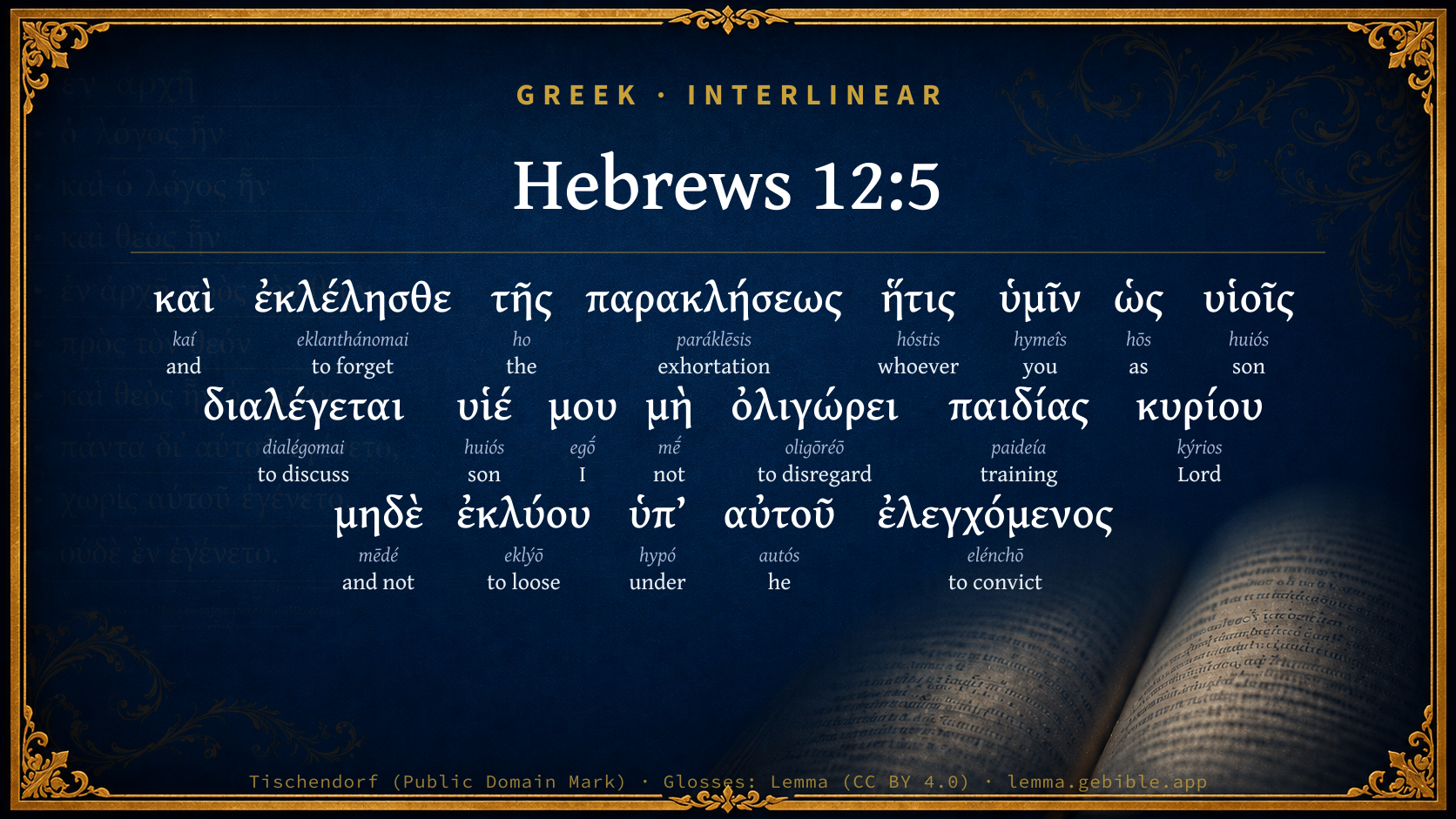
and you have forgotten the exhortation which reasons with you as with children, "My son, don't take lightly the chastening of the Lord, Nor faint when you are reproved by him;
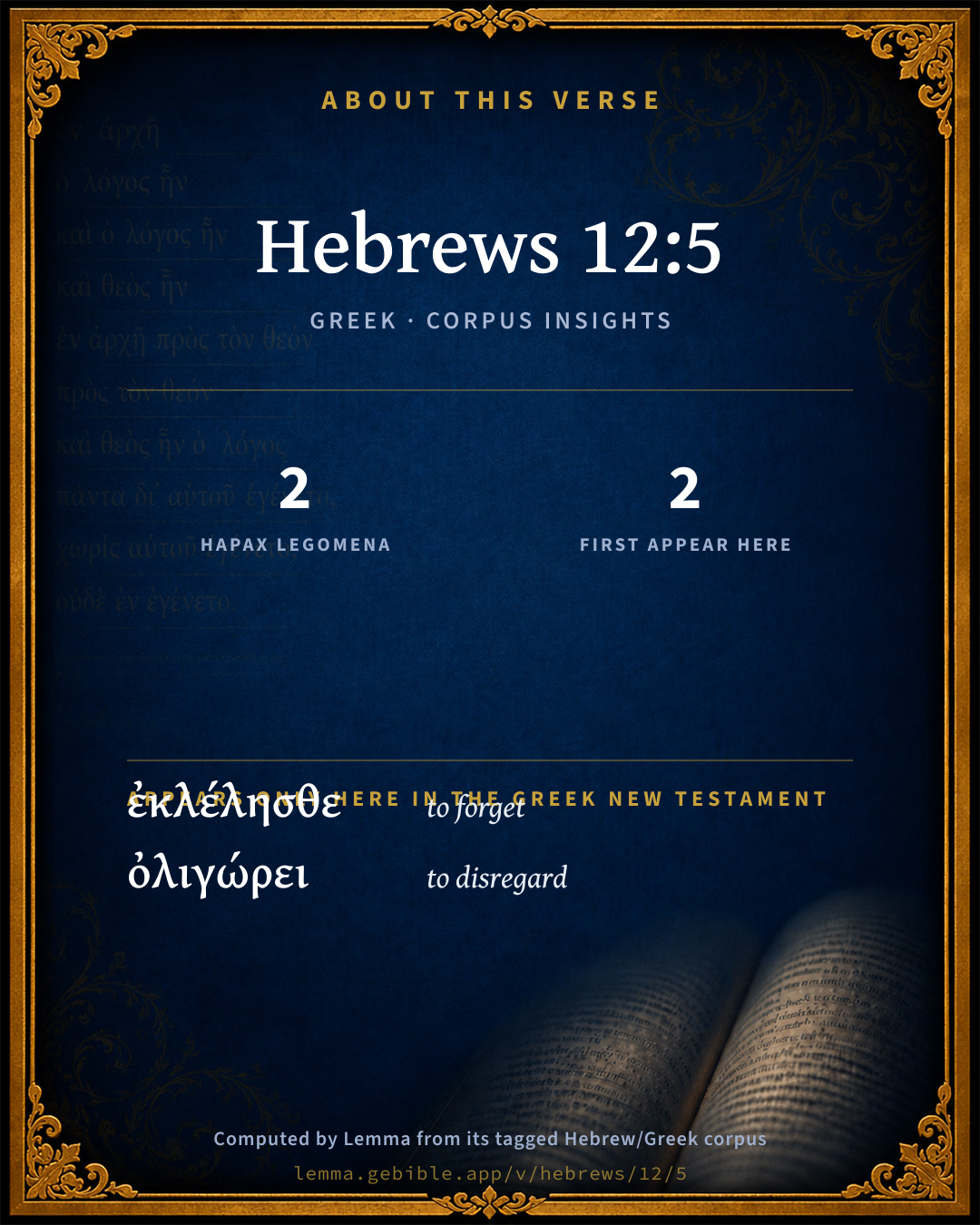
- 2 hapax legomena — only here in the Greek New Testament
- 2 first appearances in the Greek New Testament
Download a study sheet
One document with this verse’s original text, its word-by-word gloss line, the meaning frame, cross-references with their text, attributed commentary, and full source and license credits — printable, and it pastes into notes with its structure intact.
This verse Autodidact and up
A passage Seminary Student
Up to 50 verses in one chapter. A passage sheet keeps up to 6 commentary sources and 12 cross-references per verse, in the order this page ranks them, and says so on the sheet whenever that leaves anything out. Ask for a single verse and you get the Autodidact verse sheet above.
Everything on this page stays free to read, with no account — the sheet is a download of what is already on screen, not access to it.
Compare translations 3
The same verse in 3 English versions, stacked beneath the original-language interlinear above. Click any original word for its lexicon entry.
Each is an independent rendering of the whole verse — the interlinear is not word-aligned to these translations.
Highlighted words mark where these versions differ — a whole-verse word diff, not a word-by-word alignment.
-
World English Bible Public Domain
and you have forgotten the exhortation which reasons with you as with children, "My son, don't take lightly the chastening of the Lord, Nor faint when you are reproved by him;
-
King James Version Public Domain
And ye have forgotten the exhortation which speaketh unto you as unto children, My son, despise not thou the chastening of the Lord, nor faint when thou art rebuked of him:
-
unfoldingWord Literal Text CC BY-SA 4.0
and you have completely forgotten the exhortation that instructs you as sons: “My son, do not make light of the discipline of the Lord, nor become weary being reproved by him;
unfoldingWord Literal Text — © unfoldingWord, licensed CC BY-SA 4.0. Word-aligned USFM3 via Door43 (git.door43.org/unfoldingWord/en_ult).
Show all 19 translations
Every available English version of this verse, each an independent rendering of the whole verse.
-
World English Bible Public Domain
and you have forgotten the exhortation which reasons with you as with children, "My son, don't take lightly the chastening of the Lord, Nor faint when you are reproved by him;
-
Berean Standard Bible Public Domain
And you have forgotten the exhortation that addresses you as sons: “My son, do not take lightly the discipline of the Lord, and do not lose heart when He rebukes you.
-
Majority Standard Bible Public Domain
And you have forgotten the exhortation that addresses you as sons: “My son, do not take lightly the discipline of the Lord, and do not lose heart when He rebukes you.
-
King James Version Public Domain
And ye have forgotten the exhortation which speaketh unto you as unto children, My son, despise not thou the chastening of the Lord, nor faint when thou art rebuked of him:
-
American Standard Version (1901) Public Domain
and ye have forgotten the exhortation which reasoneth with you as with sons, My son, regard not lightly the chastening of the Lord, Nor faint when thou art reproved of him;
-
Revised Version (1885) Public Domain
and ye have forgotten the exhortation, which reasoneth with you as with sons, My son, regard not lightly the chastening of the Lord, Nor faint when thou art reproved of him;
-
Geneva Bible (1599) Public Domain
And ye haue forgotten the consolation, which speaketh vnto you as vnto children, My sonne, despise not the chastening of the Lord, neither faint when thou art rebuked of him.
-
Douay-Rheims (1899) Public Domain
And you have forgotten the consolation, which speaketh to you, as unto children, saying: My son, neglect not the discipline of the Lord; neither be thou wearied whilst thou art rebuked by him.
-
Young's Literal Translation Public Domain
and ye have forgotten the exhortation that doth speak fully with you as with sons, `My son, be not despising chastening of the Lord, nor be faint, being reproved by Him,
-
Literal Standard Version CC BY-SA 4.0
and you have forgotten the exhortation that speaks fully to you as to sons, “My son, do not despise [the] discipline of [the] LORD, nor be faint, being reproved by Him,
-
Unlocked Literal Bible CC BY-SA 4.0
and you have forgotten the encouragement that instructs you as sons: “My son, do not think lightly of the Lord's discipline, nor grow weary when you are corrected by him.”
-
unfoldingWord Literal Text CC BY-SA 4.0
and you have completely forgotten the exhortation that instructs you as sons: “My son, do not make light of the discipline of the Lord, nor become weary being reproved by him;
-
Darby Bible Public Domain
And ye have quite forgotten the exhortation which speaks to you as to sons: My son, despise not [the] chastening of [the] Lord, nor faint [when] reproved by him;
-
World Messianic Bible Public Domain
You have forgotten the exhortation which reasons with you as with children, “My son, don’t take lightly the chastening of the Lord, nor faint when you are reproved by him;
-
Webster's Bible Public Domain
And ye have forgotten the exhortation which speaketh to you as to children, My son, despise not thou the chastening of the Lord, nor faint when thou art rebuked by him:
-
Free Bible Version CC BY-SA 4.0
Have you forgotten God's appeal to you when he reasons with you as his children? He says, “My child, don't treat the Lord's discipline lightly, and don't give up when he corrects you either.
-
Bible in Basic English Public Domain
And you have not kept in mind the word which says to you as to sons, My son, do not make little of the Lord's punishment, and do not give up hope when you are judged by him;
-
Text-Critical English NT CC BY 4.0
And you have completely forgotten the exhortation that addresses you as sons: “My son, do not think lightly of the discipline of the Lord, and do not lose heart when he rebukes you.
-
Tyndale New Testament (1534) Public Domain
And ye have forgotten the consolacion which speaketh vnto you as vnto chyldren: My sonne despyse not the chastenynge of the Lorde nether faynt when thou arte rebuked of him:
Literal Standard Version (2020), Covenant Press — licensed CC BY-SA 4.0. Text via the HelloAO Bible API (eBible.org). Unlocked Literal Bible (unfoldingWord) — licensed CC BY-SA 4.0. Text via the HelloAO Bible API (eBible.org). unfoldingWord Literal Text — © unfoldingWord, licensed CC BY-SA 4.0. Word-aligned USFM3 via Door43 (git.door43.org/unfoldingWord/en_ult). Free Bible Version, Dr. Jonathan Gallagher — licensed CC BY-SA 4.0. Text via the HelloAO Bible API (eBible.org).
Word by word
More ways to search: Search by grammar → Find every occurrence → Compare this word →
Practice this passage: Drill this verse → Learn its vocabulary →
- Appears 1× in the Greek New Testament
- First appears here
- Part of Speech
- Verb
- Tense
- Perfect
- Voice
- Passive
- Mood
- Indicative
- Person
- 2nd person
- Number
- Plural
Full Thayer's Definition
- καὶ kaí G2532 “and” Conjunction
- ἐκλέλησθε eklanthánomai G1585 “to forget” Verb, Perfect, Passive, Indicative, 2nd person, Plural
- τῆς ho G3588 “the” Article, Genitive, Singular, Feminine
- παρακλήσεως paráklēsis G3874 “exhortation” Noun, Genitive, Singular, Feminine
- ἥτις hóstis G3748 “whoever” Relative pronoun, Nominative, Singular, Feminine
- ὑμῖν hymeîs G5210 “you” Personal pronoun, 2nd person, Dative, Plural
- ὡς hōs G5613 “as” Adverb
- υἱοῖς huiós G5207 “son” Noun, Dative, Plural, Masculine
- διαλέγεται dialégomai G1256 “to discuss” Verb, Present, Middle or Passive deponent, Indicative, 3rd person, Singular
- υἱέ huiós G5207 “son” Noun, Vocative, Singular, Masculine
- μου egṓ G1473 “I” Personal pronoun, 1st person, Genitive, Singular
- μὴ mḗ G3361 “not” Particle, Negative
- ὀλιγώρει oligōréō G3643 “to disregard” Verb, Present, Active, Imperative, 2nd person, Singular
- παιδίας paideía G3809 “training” Noun, Genitive, Singular, Feminine
- κυρίου kýrios G2962 “Lord” Noun, Genitive, Singular, Masculine
- μηδὲ mēdé G3366 “and not” Conjunction, Negative
- ἐκλύου eklýō G1590 “to loose” Verb, Present, Passive, Imperative, 2nd person, Singular
- ὑπ’ hypó G5259 “under” Preposition
- αὐτοῦ autós G846 “he” Personal pronoun, Genitive, Singular, Masculine
- ἐλεγχόμενος elénchō G1651 “to convict” Verb, Present, Passive, Participle, Nominative, Singular, Masculine
About this verse
These counts appear in no published source. They are computed here, from the morphology-tagged text and Lemma’s own curated glosses. What Lemma adds →
- 20
- words
- 19
- distinct lemmas
- General Epistles
- section
Notable vocabulary
2 hapax legomena — words that appear only here in the entire Greek New Testament:
First appearance in Scripture
These words make their first canonical appearance in the Greek New Testament here:
Shared distinctive vocabulary
ἐκλύου to loose G1590 occurs in 5 verses of the Greek New Testament. Also found in:
Repetition
A word recurs within this verse:
- υἱοῖς son G5207 ×2
Cross-references
23Topical passages linked to Hebrews 12:5 in the Treasury of Scripture Knowledge — connected by theme and wording, ordered by reader-vote popularity; previews shown in the World English Bible.
- Proverbs 3:11–12 My son, don't despise Yahweh's discipline, Neither be weary of his reproof:
- Job 5:17–18 "Behold, happy is the man whom God corrects: Therefore do not despise the chastening of the Almighty.
- Revelation 3:19 As many as I love, I reprove and chasten. Be zealous therefore, and repent.
- 1 Corinthians 11:32 But when we are judged, we are punished by the Lord, that we may not be condemned with the world.
- Psalms 94:12 Blessed is the man whom you discipline, Yah, And teach out of your law;
- James 1:12 Blessed is the man who endures temptation, for when he has been approved, he will receive the crown of life, which the Lord promised to those who love him.
- 2 Corinthians 4:8–9 We are pressed on every side, yet not crushed; perplexed, yet not to despair;
- Psalms 118:18 Yah has punished me severely, But he has not given me over to death.
- Psalms 119:109 My soul is continually in my hand, Yet I won't forget your law.
- Psalms 119:75 Yahweh, I know that your judgments are righteous, That in faithfulness you have afflicted me.
- Jeremiah 31:18 I have surely heard Ephraim bemoaning himself [thus], You have chastised me, and I was chastised, as a calf unaccustomed [to the yoke]: turn you me, and I shall be turned; for you are Yahweh my God.
- Hebrews 12:3–4 For consider him who has endured such contradiction of sinners against himself, that you don't grow weary, fainting in your souls.
- Hebrews 12:7 It is for discipline that you endure. God deals with you as with children, for what son is there whom his father doesn't discipline?
- Deuteronomy 4:9–10 Only take heed to yourself, and keep your soul diligently, lest you forget the things which your eyes saw, and lest they depart from your heart all the days of your life; but make them known to your children and your children's children;
- Joshua 7:7–11 Joshua said, Alas, Lord Yahweh, why have you at all brought this people over the Jordan, to deliver us into the hand of the Amorites, to cause us to perish? would that we had been content and lived beyond the Jordan!
- 2 Samuel 6:7–10 The anger of Yahweh was kindled against Uzzah; and God struck him there for his error; and there he died by the ark of God.
- Psalms 6:1–2 Yahweh, don't rebuke me in your anger, Neither discipline me in your wrath.
- Proverbs 3:1 My son, don't forget my teaching; But let your heart keep my commandments:
- 1 Chronicles 15:12–13 and said to them, You are the heads of the fathers' [houses] of the Levites: sanctify yourselves, both you and your brothers, that you may bring up the ark of Yahweh, the God of Israel, to [the place] that I have prepared for it.
- Job 34:31 "For has any said to God, 'I am guilty, but I will not offend any more.
- Psalms 119:16 I will delight myself in your statutes. I will not forget your word.
- Proverbs 4:5 Get wisdom. Get understanding. Don't forget, neither swerve from the words of my mouth.
- 2 Corinthians 12:9–10 He has said to me, "My grace is sufficient for you, for my power is made perfect in weakness." Most gladly therefore I will rather glory in my weaknesses, that the power of Christ may rest on me.
Cross-references courtesy of OpenBible.info (CC BY 4.0).
Lesson kit
Teaching starters — assembled from the data on this page, not authored interpretation. Every prompt links to the verse data it draws on. Edit before teaching.
Hebrews, in the General Epistles, opens this verse with 20 words (19 distinct Greek lemmas). Its most distinctive word is eklanthánomai (“to forget”). A historical commentator’s framing appears above. Read the whole chapter for the surrounding context.
Discussion questions
- What does “to forget” (eklanthánomai) contribute to the verse as a whole?
- This verse holds 2 words here found nowhere else in the Greek New Testament. What might the rare words draw attention to?
- 2 words here appear for the first time in Scripture. What is being introduced at this debut?
- Matthew 15:32 shares the word «to loose» with this verse. How do the two illuminate each other?
- “son” occurs 2× in this one verse. What is the effect of the repetition?
- These translations render this verse differently. What is at stake in choosing one wording over another?
- Reading how The Biblical Illustrator and Joseph Benson's Commentary read this verse, where do the two commentators agree and where do they part?
Things to notice
- 2 words in this verse appear nowhere else in the Greek New Testament.
- 2 words make their first canonical appearance in Scripture here.
- These translations choose different wording for 23 words in this verse.
- “son” occurs 2× in this single verse.
- 19 distinct Greek lemmas span 20 words in this verse.
Commentary
Notes on Hebrews 12:5 from classic Christian and Jewish commentators (each source and its license shown beneath its notes). The classic Christian expositions comment on the surrounding passage and are grouped to its opening verse, so a note may address several verses; the Jewish commentaries on the Tanakh (Rashi and others) are per-verse, so they appear only where the commentator wrote on this verse.
Lemma curates 59 commentaries, every one of them public domain or Creative Commons licensed, each selected and text-cleaned for this edition rather than reprinted as found. About our sources →
The Biblical Illustrator
Joseph S. Exell
The Biblical Illustrator, edited by Joseph S. Exell (c. 1880s–1900s) — public domain. Text from a community e-Sword module.
Joseph Benson's Commentary
Joseph Benson's Commentary on the Old and New Testaments (1811–1818) — public domain. Text from a community e-Sword module.
Tyndale Open Study Notes
Tyndale Open Resources
Tyndale Open Study Notes — © Tyndale Open Resources, licensed CC BY-SA 4.0. Text via the HelloAO Bible API.
Bengel's Gnomon
Johann Albrecht Bengel
Bengel's Gnomon of the New Testament — English translation (T&T Clark, Edinburgh, 1860) — public domain. Text from a community e-Sword module.
Meyer's Critical & Exegetical Commentary
Heinrich August Wilhelm Meyer
Meyer — Critical and Exegetical Commentary on the New Testament — English translation by Peter Christie, edited by Frederick Crombie (T&T Clark, 1880) — public domain. Text from a community e-Sword module.
Expositor's Greek Testament
ed. W. Robertson Nicoll
The Expositor's Greek Testament, edited by W. Robertson Nicoll (1897–1910) — public domain. Text from a community e-Sword module.
Geneva Bible (1599)
Geneva Bible translators
Geneva Bible (1599) marginal notes — public domain. Text via Bolls.life.
Jamieson, Fausset & Brown
Robert Jamieson, A. R. Fausset & David Brown
Jamieson, Fausset & Brown — Commentary Critical and Explanatory on the Whole Bible (1871) — public domain (CC PDM 1.0). Text via the HelloAO Bible API.
Adam Clarke's Commentary
Adam Clarke's Commentary on the Bible (1810–1826) — public domain. Text from a community e-Sword/MySword module.
John Calvin's Commentaries
John Calvin's Commentaries (1540-1563) — public domain. Text from the Calvin Translation Society English edition (1840s-50s) via the Christian Classics Ethereal Library (ccel.org). Calvin's coverage is partial (roughly two-thirds of the Bible); uncommented books and verses are honest gaps, never fabricated. The 19th-century editor's footnotes and remarks are omitted so the notes are faithfully Calvin's own voice.
Ellicott's Commentary for English Readers
A Bible Commentary for English Readers, edited by Charles John Ellicott (1878–1897) — public domain. Text from a community e-Sword module.
The Cambridge Bible for Schools and Colleges
gen. ed. J. J. S. Perowne
The Cambridge Bible for Schools and Colleges (gen. ed. J. J. S. Perowne; Cambridge University Press, 1878–1918) — public domain. Text from a community e-Sword module.
John Gill's Exposition
John Gill's Exposition of the Whole Bible (1746–1763) — public domain (CC PDM 1.0). Text via the HelloAO Bible API.
Trapp's Complete Commentary
John Trapp
John Trapp, A Commentary or Exposition upon All the Books of the Old and New Testament (1647–1656) — public domain. Text from a community e-Sword module.
Albert Barnes' Notes on the Bible
Albert Barnes' Notes on the Bible (1834–1885) — public domain. Text from a community e-Sword/MySword module.
Haydock's Catholic Bible Commentary
George Leo Haydock (1774–1849), Haydock's Catholic Family Bible and Commentary, 1859 edition — public domain. Excludes Psalms (Douay-Rheims chapter numbering differs from Protestant) and Deuterocanonical books (Catholic canon only).
Matthew Poole's English Annotations
Matthew Poole's English Annotations on the Holy Bible (1683–1685) — public domain. Text from a community e-Sword/MySword module.
Whedon's Commentary on the Bible
Daniel D. Whedon
Daniel D. Whedon (gen. ed.), Commentary on the Old and New Testaments (1874–1909) — public domain. Text from a community e-Sword module.
The Pulpit Commentary
The Pulpit Commentary (1880–1919), ed. H.D.M. Spence-Jones & Joseph S. Exell — public domain. Text from a community e-Sword module.
John Wesley's Explanatory Notes
John Wesley, Explanatory Notes Upon the Whole Bible (1754–1765) — public domain. Text via the GEBible commentary corpus.
Scofield Reference Notes
C. I. Scofield
The Scofield Reference Bible (1917 edition), notes by C. I. Scofield — public domain. Text from a community e-Sword module.
Burkitt's Expository Notes on the New Testament
William Burkitt
William Burkitt's Expository Notes on the New Testament (1700–1703) — public domain. Text from a community e-Sword module.
The People's New Testament
B. W. Johnson
B. W. Johnson's The People's New Testament with Notes (1889–1891) — public domain. Electronic text from the Christian Classics Ethereal Library (CCEL) ThML edition.
Cambridge Greek Testament for Schools and Colleges
Cambridge Greek Testament for Schools and Colleges (Cambridge University Press, 1896; 21 vols, various authors incl. Carr, Maclear, Plummer, Farrar, Lumby, Moule, M. R. James, Simcox) — public domain. Text from a community e-Sword module.
Alford’s Greek Testament
Henry Alford
Henry Alford, The Greek Testament (1849–1861) — public domain. Text from a community e-Sword module.
Vincent's Word Studies in the New Testament
Marvin R. Vincent
Marvin R. Vincent, Word Studies in the New Testament (1887–1900) — public domain. Text from a community e-Sword/MySword module.