Hebrews 9:7

Greek (Tischendorf 8th ed.) Hebrews 9:7 appears in the Greek New Testament. The text above is from the Tischendorf 8th edition. Each word links to its Strong’s number and a concise gloss. Click any word for its full Thayer’s Greek Lexicon entry.
Download image
Cite this verse

Hebrews 9:7 (World English Bible). Public Domain. Lemma interlinear Bible study tool, https://lemma.gebible.app/v/hebrews/9/7.

Show BibTeX & RIS
BibTeX
RIS
English Translation
but into the second the high priest alone, once in the year, not without blood, which he offers for himself, and for the errors of the people.
World English Bible · Public Domain
Highlights
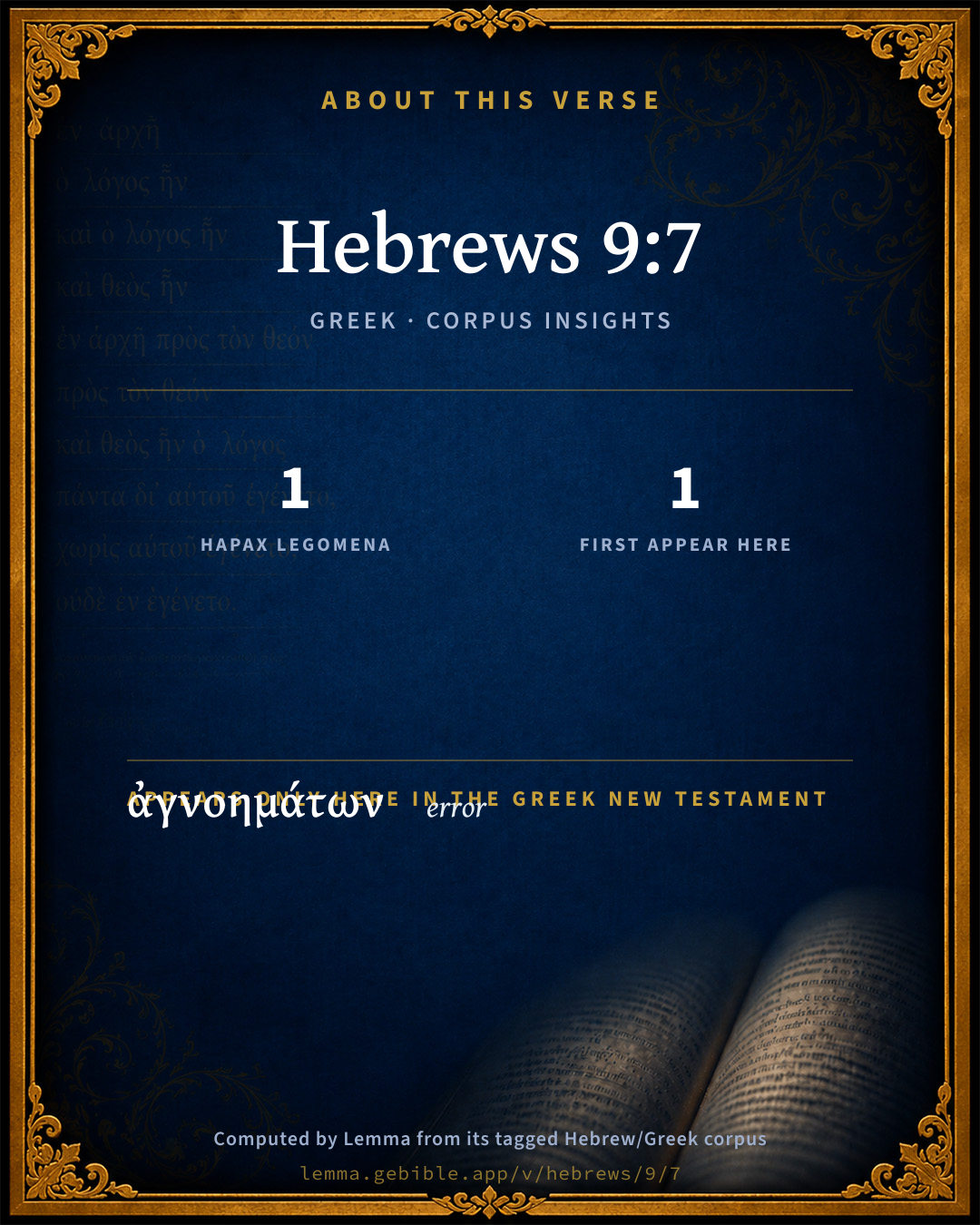
  • 1 hapax legomenon — only here in the Greek New Testament
  • 1 first appearance in the Greek New Testament
Full analysis ↓
Download a study sheet

One document with this verse’s original text, its word-by-word gloss line, the meaning frame, cross-references with their text, attributed commentary, and full source and license credits — printable, and it pastes into notes with its structure intact.

This verse Autodidact and up

Study sheet (.html) Plain text (.txt)

A passage Seminary Student

Up to 50 verses in one chapter. A passage sheet keeps up to 6 commentary sources and 12 cross-references per verse, in the order this page ranks them, and says so on the sheet whenever that leaves anything out. Ask for a single verse and you get the Autodidact verse sheet above.

Everything on this page stays free to read, with no account — the sheet is a download of what is already on screen, not access to it.

Want to remove ads? Support Godless Engineer
Compare translations 3

The same verse in 3 English versions, stacked beneath the original-language interlinear above. Click any original word for its lexicon entry.

Each is an independent rendering of the whole verse — the interlinear is not word-aligned to these translations.

Highlighted words mark where these versions differ — a whole-verse word diff, not a word-by-word alignment.

  • World English Bible Public Domain
    but into the second the high priest alone, once in the year, not without blood, which he offers for himself, and for the errors of the people.
  • King James Version Public Domain
    But into the second went the high priest alone once every year, not without blood, which he offered for himself, and for the errors of the people:
  • unfoldingWord Literal Text CC BY-SA 4.0
    but into the second, once the year only the high priest, not without blood that he offers on behalf of himself and of the unintentional sins of the people.

unfoldingWord Literal Text — © unfoldingWord, licensed CC BY-SA 4.0. Word-aligned USFM3 via Door43 (git.door43.org/unfoldingWord/en_ult).

Versions to compare (up to 4)

3 of 4 selected

Show all 19 translations

Every available English version of this verse, each an independent rendering of the whole verse.

  • World English Bible Public Domain
    but into the second the high priest alone, once in the year, not without blood, which he offers for himself, and for the errors of the people.
  • Berean Standard Bible Public Domain
    But only the high priest entered the second room, and then only once a year, and never without blood, which he offered for himself and for the sins the people had committed in ignorance.
  • Majority Standard Bible Public Domain
    But only the high priest entered the second room, and then only once a year, and never without blood, which he offered for himself and for the sins the people had committed in ignorance.
  • King James Version Public Domain
    But into the second went the high priest alone once every year, not without blood, which he offered for himself, and for the errors of the people:
  • American Standard Version (1901) Public Domain
    but into the second the high priest alone, once in the year, not without blood, which he offereth for himself, and for the errors of the people:
  • Revised Version (1885) Public Domain
    but into the second the high priest alone, once in the year, not without blood, which he offereth for himself, and for the errors of the people:
  • Geneva Bible (1599) Public Domain
    But into the second went the hie Priest alone, once euery yere, not without blood which hee offered for himselfe, and for the ignorances of the people.
  • Douay-Rheims (1899) Public Domain
    But into the second, the high priest alone, once a year: not without blood, which he offereth for his own, and the people's ignorance:
  • Young's Literal Translation Public Domain
    and into the second, once in the year, only the chief priest, not apart from blood, which he doth offer for himself and the errors of the people,
  • Literal Standard Version CC BY-SA 4.0
    and into the second, once in the year, only the chief priest, not apart from blood, which he offers for himself and the errors of the people.
  • Unlocked Literal Bible CC BY-SA 4.0
    But only the high priest entered the second room once each year, and not without blood that he offered for himself and for the people's unintentional sins.
  • unfoldingWord Literal Text CC BY-SA 4.0
    but into the second, once the year only the high priest, not without blood that he offers on behalf of himself and of the unintentional sins of the people.
  • Darby Bible Public Domain
    but into the second, the high priest only, once a year, not without blood, which he offers for himself and for the errors of the people:
  • World Messianic Bible Public Domain
    but into the second the high priest alone, once in the year, not without blood, which he offers for himself and for the errors of the people.
  • Webster's Bible Public Domain
    But into the second went the high priest alone once every year, not without blood, which he offered for himself, and for the errors of the people:
  • Free Bible Version CC BY-SA 4.0
    But only the high priest went into the second room, and only once a year. Even then he had to make a sacrifice involving blood, which he offered for himself and for the people's sins of ignorance.
  • Bible in Basic English Public Domain
    But only the high priest went into the second, once a year, not without making an offering of blood for himself and for the errors of the people:
  • Text-Critical English NT CC BY 4.0
    But into the second room, the high priest alone entered only once a year, and never without blood, which he offered for himself and for the unintentional sins of the people.
  • Tyndale New Testament (1534) Public Domain
    But into the seconde went the hye prest alone once every yeare: and not with out bloud which he offered for him silfe and for the ignoraunce of the people.

Literal Standard Version (2020), Covenant Press — licensed CC BY-SA 4.0. Text via the HelloAO Bible API (eBible.org). Unlocked Literal Bible (unfoldingWord) — licensed CC BY-SA 4.0. Text via the HelloAO Bible API (eBible.org). unfoldingWord Literal Text — © unfoldingWord, licensed CC BY-SA 4.0. Word-aligned USFM3 via Door43 (git.door43.org/unfoldingWord/en_ult). Free Bible Version, Dr. Jonathan Gallagher — licensed CC BY-SA 4.0. Text via the HelloAO Bible API (eBible.org).

Word by word

More ways to search: Search by grammar → Find every occurrence → Compare this word →

Practice this passage: Drill this verse → Learn its vocabulary →

ἀγνοημάτων
agnóēma
G51
“error”
Noun, Genitive, Plural, Neuter
Part of Speech
Noun
Case
Genitive
Number
Plural
Gender
Neuter
Full Thayer's Definition

Origin: from G50

TDNT: 02:55,2

1. a sin committed through ignorance or thoughtlessness
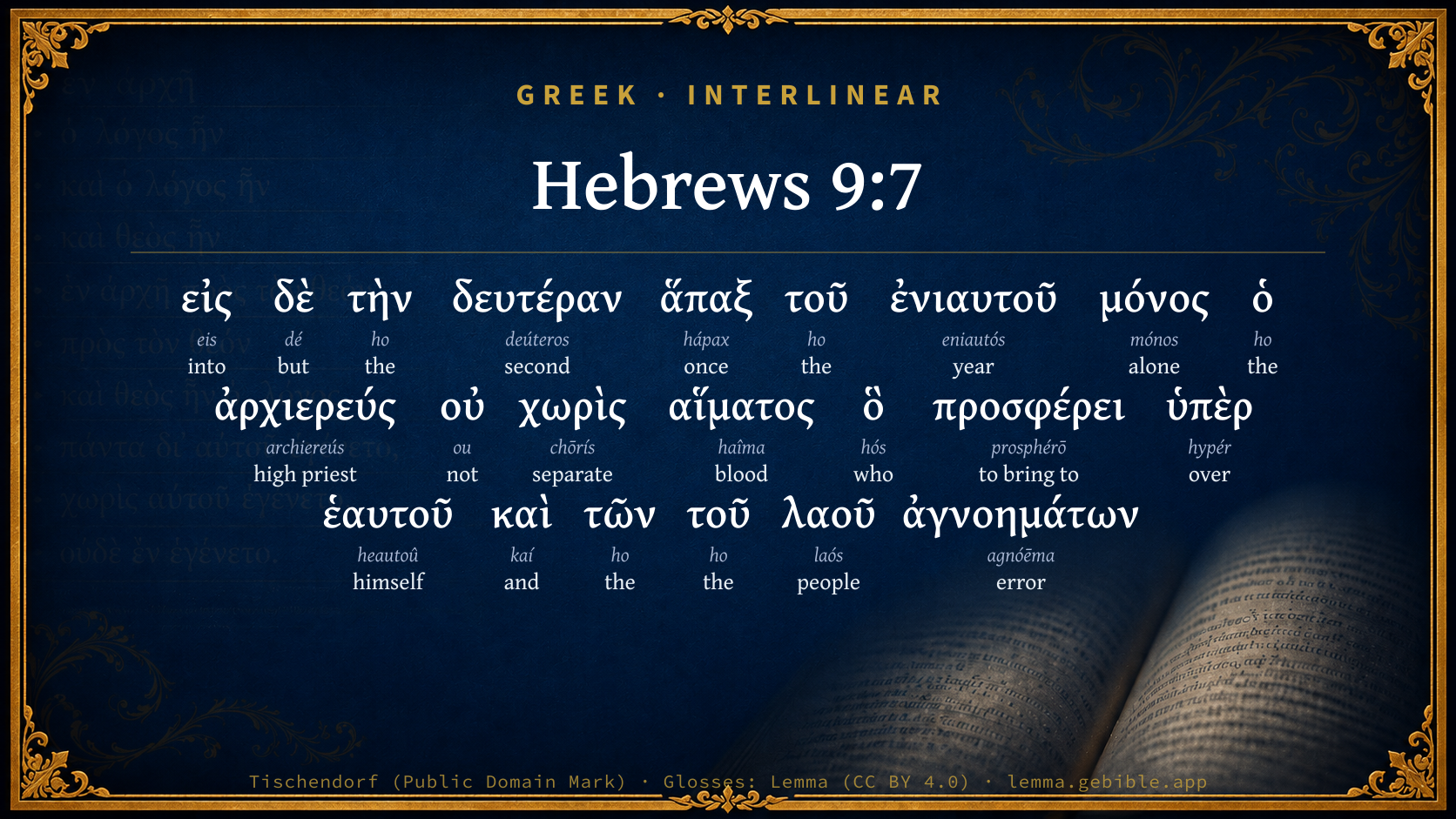
  1. εἰς eis G1519 “into” Preposition
  2. δὲ dé G1161 “but” Conjunction
  3. τὴν ho G3588 “the” Article, Accusative, Singular, Feminine
  4. δευτέραν deúteros G1208 “second” Adjective, Accusative, Singular, Feminine
  5. ἅπαξ hápax G530 “once” Adverb
  6. τοῦ ho G3588 “the” Article, Genitive, Singular, Masculine
  7. ἐνιαυτοῦ eniautós G1763 “year” Noun, Genitive, Singular, Masculine
  8. μόνος mónos G3441 “alone” Adjective, Nominative, Singular, Masculine
  9. ὁ ho G3588 “the” Article, Nominative, Singular, Masculine
  10. ἀρχιερεύς archiereús G749 “high priest” Noun, Nominative, Singular, Masculine
  11. οὐ ou G3756 “not” Particle, Negative
  12. χωρὶς chōrís G5565 “separate” Adverb
  13. αἵματος haîma G129 “blood” Noun, Genitive, Singular, Neuter
  14. ὃ hós G3739 “who” Relative pronoun, Accusative, Singular, Neuter
  15. προσφέρει prosphérō G4374 “to bring to” Verb, Present, Active, Indicative, 3rd person, Singular
  16. ὑπὲρ hypér G5228 “over” Preposition
  17. ἑαυτοῦ heautoû G1438 “himself” Reflexive pronoun, 3rd person, Genitive, Singular, Masculine
  18. καὶ kaí G2532 “and” Conjunction
  19. τῶν ho G3588 “the” Article, Genitive, Plural, Neuter
  20. τοῦ ho G3588 “the” Article, Genitive, Singular, Masculine
  21. λαοῦ laós G2992 “people” Noun, Genitive, Singular, Masculine

About this verse

These counts appear in no published source. They are computed here, from the morphology-tagged text and Lemma’s own curated glosses. What Lemma adds →

22
words
18
distinct lemmas
General Epistles
section

Notable vocabulary

1 hapax legomenon — a word that appears only here in the entire Greek New Testament:

  • ἀγνοημάτων error G51

First appearance in Scripture

This word makes its first canonical appearance in the Greek New Testament here:

  • ἀγνοημάτων error G51

Shared distinctive vocabulary

ἅπαξ once G530 occurs in 14 verses of the Greek New Testament. Also found in:

Repetition

A word recurs within this verse:

Cross-references

18

Topical passages linked to Hebrews 9:7 in the Treasury of Scripture Knowledge — connected by theme and wording, ordered by reader-vote popularity; previews shown in the World English Bible.

  • Leviticus 16:34 "This shall be an everlasting statute for you, to make atonement for the children of Israel once in the year because of all their sins." It was done as Yahweh commanded Moses.
  • Leviticus 5:18 He shall bring a ram without blemish from of the flock, according to your estimation, for a trespass offering, to the priest; and the priest shall make atonement for him concerning the thing in which he sinned and didn't know it, and he will be forgiven.
  • Exodus 30:10 Aaron shall make atonement on its horns once in the year; with the blood of the sin offering of atonement once in the year he shall make atonement for it throughout your generations. It is most holy to Yahweh."
  • Hebrews 7:27 who doesn't need, like those high priests, to daily offer up sacrifices, first for his own sins, and then for the sins of the people. For this he did once for all, when he offered up himself.
  • Hebrews 10:19–20 Having therefore, brothers, boldness to enter into the holy place by the blood of Jesus,
  • Isaiah 3:12 As for my people, children are their oppressors, And women rule over them. My people, those who lead you cause you to err, And destroy the way of your paths.
  • Isaiah 9:16 For those who lead this people cause them to err; and those who are led of them are destroyed.
  • Isaiah 28:7 Even these reel with wine, and stagger with strong drink; the priest and the prophet reel with strong drink, they are swallowed up of wine, they stagger with strong drink; they err in vision, they stumble in judgment.
  • Hosea 4:12 My people consult with their wooded idol, And answer to a stick of wood. Indeed the spirit of prostitution has led them astray, And they have been unfaithful to their God.
  • Hebrews 9:24–25 For Christ hasn't entered into holy places made with hands, which are representations of the true, but into heaven itself, now to appear in the presence of God for us;
  • Leviticus 16:2–20 and Yahweh said to Moses, "Tell Aaron your brother, not to come at all times into the Most Holy Place within the veil, before the mercy seat which is on the ark; lest he die: for I will appear in the cloud on the mercy seat.
  • 2 Chronicles 33:9 Manasseh seduced Judah and the inhabitants of Jerusalem, so that they did evil more than did the nations whom Yahweh destroyed before the children of Israel.
  • Psalms 19:12 Who can discern his errors? Forgive me from hidden errors.
  • Psalms 95:10 Forty long years I was grieved with that generation, And said, "It is a people that errs in their heart. They have not known my ways."
  • Isaiah 29:14 therefore, behold, I will proceed to do a marvelous work among this people, even a marvelous work and a wonder; and the wisdom of their wise men shall perish, and the understanding of their prudent men shall be hid.
  • Amos 2:14 Flight will perish from the swift; And the strong won't strengthen his force; Neither shall the mighty deliver himself;
  • Hebrews 5:2–3 The high priest can deal gently with those who are ignorant and going astray, because he himself is also surrounded with weakness.
  • Hebrews 10:3 But in those sacrifices there is yearly reminder of sins.

Cross-references courtesy of OpenBible.info (CC BY 4.0).

Commentary

Notes on Hebrews 9:7 from classic Christian and Jewish commentators (each source and its license shown beneath its notes). The classic Christian expositions comment on the surrounding passage and are grouped to its opening verse, so a note may address several verses; the Jewish commentaries on the Tanakh (Rashi and others) are per-verse, so they appear only where the commentator wrote on this verse.

Lemma curates 59 commentaries, every one of them public domain or Creative Commons licensed, each selected and text-cleaned for this edition rather than reprinted as found. About our sources →

Albert Barnes' Notes on the Bible

But into the second - The second apartment or room, called the most holy place; Heb 9:3.

Went the high priest alone once every year - On the great day of atonement; Exo 30:10. On that day he probably entered the Holy of Holies three or four times, first to burn incense, Lev 16:12; then to sprinkle the blood of the bullock on the mercy-seat, Lev 16:14; then he was to kill the goat of the sin-offering, and bring that blood within the Veil and sprinkle it also on the mercy-seat, and then, perhaps, he entered again to bring out the golden censer. The Jewish tradition is, that he entered the Holy of Holies four times on that day. After all, however, the number of times is not certain, nor is it material, the only important point being that he entered it only on one day of the year, while the holy place was entered every day.

Not without blood - That is, he bare with him blood to sprinkle on the mercy-seat. This was the blood of the bullock and of the goat - borne in at two different times.

Which he offered for himself - The blood of the bullock was offered for himself and for his house or family - thus keeping impressively before his own mind and the mind of the people the fact that the priests even of the highest order were sinners, and needed expiation like others; Lev 9:7.

And for the errors of the people - The blood of the goat was offered for them; Lev 16:15. The word rendered “errors” - ἀγνόημα agnoēma - denotes properly “ignorance, involuntary error;” and then error or fault in general - the same as the Hebrew משׁגה mishgeh - from שׁגה shaagah - “to err.” The object was to make expiation for all the errors and sins of the people, and this occurred once in the year. The repetition of these sacrifices was a constant remembrancer of sin, and the design was that neither the priests nor the people should lose sight of the fact that they were violators of the Law of God.

Albert Barnes' Notes on the Bible (1834–1885) — public domain. Text from a community e-Sword/MySword module.

Joseph Benson's Commentary

Heb 9:7. But into the second — The holy of holies; went the high-priest alone — And no other person; and he was to be so alone as that none were to attend in order to assist him in any part of the service; yea, no one was allowed to be in the other part of the sanctuary where he might so much as see the veil opened, but all the priests, as well as the people, were kept without the sanctuary, Lev 16:2; Lev 16:17; Lev 16:32. Hence it was always provided, in case of the sickness or occasional pollutions of the actual high-priest, the next in succession should perform this office, who was therefore called the second priest. From whence, in times of disorder and confusion, they had two high-priests at once. This entrance was a type, both of the entrance of Christ into heaven, and of our entrance by him to the throne of grace, Heb 9:24; Heb 10:19-20. And this was the veil which, in the temple, was rent from top to bottom upon the death of our Lord. For by his death the way was laid open to the most holy place, and the gracious presence of God discovered to all that come to God by him. Once every year — That is, on one day only, namely, the day of expiation, Lev 16:2; but on that day he went in several times: not without blood — To signify that there is no entrance into God’s gracious presence but by the blood of Christ. After the high-priest had filled the holy place with a cloud of incense, he returned to the altar of burnt-offerings without the tabernacle, where the sacrifice had been newly slain; and while the blood of the beasts was fresh, and, as it were, living, he took of it in his hand, and entering again into the most holy place, sprinkled it seven times with his finger toward the mercy-seat. Which he offered — Where or when he offered it is not expressed: in the holy place there was no use of blood but for the sprinkling of it, but the sprinkling of blood was always consequential to the offering properly so called. Probably by the word προσφερει, here used, he intends only bringing, and not properly offering. For himself and the errors of the people — The apostle refers to the distinct sacrifices that were to be offered on that day, the first of which was of a bullock and a ram, which were offered for the high-priest himself; such being the imperfection of their state, that they could have no priests to offer sacrifices for the sins of the people, but he must first offer for himself. By the errors of the people, are meant their sins of ignorance, to which only, and not to sins presumptuously committed, those atonements extended. They were offered for the whole nation, to make atonement for the sins which they had ignorantly committed during the preceding year, and to open the tabernacle for their acts of worship during the succeeding year. And to show this, the high-priest carried the blood of these sacrifices into the inward tabernacle, and sprinkled it before the symbol of the divine presence.

Joseph Benson's Commentary on the Old and New Testaments (1811–1818) — public domain. Text from a community e-Sword module.

Tyndale Open Study Notes

Tyndale Open Resources

9:7 The yearly duty was carried out on the Day of Atonement, when the high priest offered sacrifices for the sins not covered by other sacrifices during the previous year (Lev 16:1-25).

Tyndale Open Study Notes — © Tyndale Open Resources, licensed CC BY-SA 4.0. Text via the HelloAO Bible API.

Bengel's Gnomon

Johann Albrecht Bengel

Heb 9:7. Ἅπαξ τοῦ ἐνιαυτοῦ) So LXX., Lev 16:34, once every year; on one day of the year, and on that same day but once. See A. A. Hochstetteri Ex. de Ingressu Summi Pontificis in Sanctum Sanctorum, pp. 19–24.—ὑπὲρ ἑαυτοῦ) for himself. The Vulgate has pro sua, for his own, viz. error of ignorance; I do not think, however, that ὑπὲρ τῶν ἑαυτοῦ was in the Greek copy from which it was translated. Although the priest was exempt from the errors or ignorance of the people, yet he was not without sin, and therefore stood in need of sacrifices, ch. Heb 7:27.—ἀγνοημάτων, ignorance, errors) This term has a very extensive meaning, as; on the contrary, ἐπίγνωσις, knowledge. See Num 15:22-31.

Bengel's Gnomon of the New Testament — English translation (T&T Clark, Edinburgh, 1860) — public domain. Text from a community e-Sword module.

Meyer's Critical & Exegetical Commentary

Heinrich August Wilhelm Meyer

Heb_9:7. Ἡ δευτέρα] sc. σκηνή, the Most Holy Place.

ἅπαξ τοῦ ἐνιαυτοῦ] once in the year, i.e. only on a single day of the year, namely, on the tenth of the seventh month (Tisri), on the great solemnity of atonement. The supposition that the high priest on this day more than once entered the Most Holy Place is not excluded by the expression, and the disputed question as to how many times this took place has no bearing on our passage. That the high priest was obliged to enter the Most Holy Place at least twice on this day, follows from Lev_16:12-16. That he entered into it as many as four times is the teaching of the Talmud (tract. Joma, v. 1, vii. 4) and Rabbins.

μόνος ὁ ἀρχιερεύς] sc. εἴσεισι.

προσφέρει] is not to be explained, as by Calov and others, of the sacrifices outside of the Most Holy Place. For in this case we should have to expect the aorist. It is employed of the blood of the victim before slain, which blood the high priest carries into the Most Holy Place, and here in the Most Holy Place presents to God (the Socinians, Grotius, Bleek).

ὑπὲρ ἑαυτοῦ καὶ τῶν τοῦ λαοῦ ἀγνοημάτων] for himself and the transgressions of the people. To make ἑαυτοῦ likewise depend upon ἀγνοημάτων (for his own sins and those of the people: Vulgate, Luther (?), Calvin, Piscator, Schlichting, Jac. Cappellus, Grotius, Storr, Stuart, Paulus, and others), is, although the thought is not thereby altered (comp. Heb_7:27), grammatically false; because in that case the article τῶν could not have been wanting before ἑαυτοῦ.

ἀγνοημάτων] see at Heb_5:2, p. 198.

Meyer — Critical and Exegetical Commentary on the New Testament — English translation by Peter Christie, edited by Frederick Crombie (T&T Clark, 1880) — public domain. Text from a community e-Sword module.

Expositor's Greek Testament

ed. W. Robertson Nicoll

Heb 9:7 . εἰς δὲ τὴν δευτέραν ἅπαξ τοῦ ἐνιαυτοῦ … The law is given in Lev 16 , both negatively and positively; negatively in Lev 16:2 μὴ εἰσπορευέσθω πᾶσαν ὥραν εἰς τὸ ἅγιον ἐσώτερον τ . καταπετάσματος promiscuous or continuous, daily entrance was forbidden; and positively, in Lev 16:34 ἅπαξ τοῦ ἐνιαυτοῦ , i.e. , one day each year, viz. , on the day of Atonement, the tenth of the seventh month the High Priest is to enter. On that day the High Priest was to enter the Holiest at least thrice , first with the incense, then with the blood of the bullock which atoned for his own sins and those of his house, and finally with the blood of the goat for the sins of the people. μόνος ὁ ἀρχιερεύς in contrast with οἱ ἱερεῖς of Heb 9:6 . This point is also emphasised by Philo, De Mon. , p. 821 E., where he says that the things inside the veil were hidden from everyone πλὴν ἑνὶ τῷ ἀρχιερεῖ , and by Josephus ( Bell . Jud . ver. 5; ver. 7) εἰσῄει ἅπαξ κατʼ ἐνιαυτὸν μόνος . See also Lev 16:17 . The law was emphasised by the destruction of Nadab and Abhu, Lev 10:1 . The Holiness of the Presence and the difficulty of access was further illustrated and enforced by the demand that sacrifice should open the way οὐ χωρὶς αἵματος . This blood was offered, i.e. , sprinkled with the finger on the ἱλαστήριον , first, the blood of the calf to cleanse from his own sins, and then, the blood of the goat to atone for the people’s sins. [ ἑαυτοῦ is manifestly under the direct government of ὑπὲρ and does not follow ἀγνοημάτων . This word does not occur in Lev 16 ; on the contrary the strongest words are used, ἀνομία , ἁμαρτία , ἀδικία , but cf. Heb 5:2 .] These three points, then, bring out the impossibility of free access to the Presence; not διαπαντὸς but ἅπαξ τ . ἐνιαυτοῦ ; not οἱ ἱερεῖς promiscuously, but μόνος ὁ ἀρχιερεύς ; not freely, but οὐ χωρὶς αἵματος . This was the δικαίωμα λατρείας which could not be neglected under pain of death. What did it signify? τοῦτο δηλοῦντος τ . πνεύματος … “ this the Holy Spirit signifying, that the way into the Holy of Holies has not yet been made manifest, while the fore-tent has still a place”. δηλοῦντος , the Holy Spirit is viewed as the author of the ritual and as meaning to teach by every part of it. Vaughan compares 1Pe 1:11 and adds, “As there O.T. prophecy , so here O.T. ritual , is ascribed to the Holy Spirit.” τὴν τ . ἁγίων ὁδὸν “the way into the Holiest” as in Heb 8:2 . Access to the Holy of Holies being thus barred was an intimation that the true access to God had not yet been furnished and that therefore worship and fellowship with God (that is, religion) were not yet perfect. [ Cf. Theoph. ἡ τ . ἁγίων ὁδός , τουτέστιν ἡ εἰς τ . οὐρανὸν εἴσοδος . Weiss, “der Weg zum himmlischen Heiligthum”.] So long as the fore-tent ( τῆς πρώτης σκηνῆς ) has an appointed place as part of the Divine arrangements for worship ( ἐχούσης στάσιν as in Polyb . Heb 9:5 ; Heb 9:3 ) this signifies that the very Presence of God is inaccessible. The very object of the division of the Tabernacle into two rooms, an outer and an inner, was to impress men with the fact that the way of access had not actually been disclosed ( πεφανερῶσθαι ). Hence the appropriateness of the rending of the veil as the Symbol that by the perfected work and sacrifice of Christ the new and living way (Heb 10:20 ) was opened.

The Expositor's Greek Testament, edited by W. Robertson Nicoll (1897–1910) — public domain. Text from a community e-Sword module.

Geneva Bible (1599)

Geneva Bible translators

For the sins. See Heb. 5:2.

Geneva Bible (1599) marginal notes — public domain. Text via Bolls.life.

Jamieson, Fausset & Brown

Robert Jamieson, A. R. Fausset & David Brown

once every year--the tenth day of the seventh month. He entered within the veil on that day twice at least. Thus "once" means here on the one occasion only. The two, or possibly more, entrances on that one day were regarded as parts of the one whole.

not without blood-- (Heb 8:3).

offered--Greek, "offers."

errors--Greek, "ignorances": "inadvertent errors." They might have known, as the law was clearly promulged, and they were bound to study it; so that their ignorance was culpable (compare Act 3:17; Eph 4:18; Pe1 1:14). Though one's ignorance may mitigate one's punishment (Luk 12:48), it does not wholly exempt from punishment.

Jamieson, Fausset & Brown — Commentary Critical and Explanatory on the Whole Bible (1871) — public domain (CC PDM 1.0). Text via the HelloAO Bible API.

Adam Clarke's Commentary

Verse 7. But into the second] That is, the holy of holies, or second part of the tabernacle, the high priest alone, once every year, that is, on one day in the year only, which was the day on which the general atonement was made. The high priest could enter into this place only on one day in the year; but on that day he might enter several times. See Lev. 16.

Not without blood] The day prescribed by the law for this great solemnity was the tenth of the month Tisri, in which the high priest brought in the incense or perfumes, which he placed on the golden censer; he brought also the blood of the bullock; and sprinkled some portion of it seven times before the ark, and the veil which separated the holy place from the holy of holies. See Le 16:14. He then came out, and, taking some of the blood of the goat which had been sacrificed, he sprinkled it between the veil and the ark of the covenant, Le 16:15.

Which he offered for himself, and for the errors of the people] Ὑπερ των του λαου αγνοηματων· For transgressions of which they were not conscious: there were so many niceties in the ritual worship of the Jews, and so many ways in which they might offend against the law and incur guilt, that it was found necessary to institute sacrifices to atone for these sins of ignorance. And as the high priest was also clothed with infirmity, he required to have an interest in the same sacrifice, on the same account. This was a national sacrifice; and by it the people understood that they were absolved from all the errors of the past year, and that they now had a renewed right of access to the mercy-seat.

Adam Clarke's Commentary on the Bible (1810–1826) — public domain. Text from a community e-Sword/MySword module.

John Calvin's Commentaries

7. For himself and for the errors of the people, or for his own and the ignorances of the people. As the verb |shagag|, means in Hebrew to err, to mistake, so |shgagah|, derived from it, properly denotes error, or mistake; but yet it is generally taken for any kind of sin; and doubtless we never sin except when deceived by the allurements of Satan. The Apostle does not understand by it mere ignorance, as they say, but, on the contrary, he includes also voluntary sins; but as I have already said, no sin is free from error or ignorance; for however knowingly and willfully any one may sin, yet it must be that he is blinded by his lust, so that he does not judge rightly, or rather he forgets himself and God; for men never deliberately rush headlong into ruin, but being entangled in the deceptions of Satan, they lose the power of judging rightly.

John Calvin's Commentaries (1540-1563) — public domain. Text from the Calvin Translation Society English edition (1840s-50s) via the Christian Classics Ethereal Library (ccel.org). Calvin's coverage is partial (roughly two-thirds of the Bible); uncommented books and verses are honest gaps, never fabricated. The 19th-century editor's footnotes and remarks are omitted so the notes are faithfully Calvin's own voice.

Ellicott's Commentary for English Readers

(7) Went . . . offered.—Rather, entereth . . . offereth.

Errors.—Literally, ignorances. (See Heb_5:2-3; Heb_7:27.) By “once in the year” we must of course understand on one day of the year, viz., the tenth day of Tisri. On that day, according to Leviticus 16, it was the duty of the high priest to enter the Holy of Holies twice: (1) with the incense and with the blood of the bullock, his own sin-offering (Lev_16:12-14); (2) with the blood of the same bullock and that of the goat, the sin-offering for the people (Heb_9:15-19). In the ritual described in the tract “Joma” of the Talmud, he is said to enter four times; the first ministration being separated into its two parts (offering incense, sprinkling the blood of the bullock), and a fourth entering (to bring out the censer) being added.

A Bible Commentary for English Readers, edited by Charles John Ellicott (1878–1897) — public domain. Text from a community e-Sword module.

The Cambridge Bible for Schools and Colleges

gen. ed. J. J. S. Perowne

7. But into the second] i.e. “the inner,” “the Holiest.” There was a graduated sanctity in the Tabernacle and in the Temple. In the Temple any one might go into the Outer Court or Court of the Gentiles; Jews into the Second Court; men only into the Third; priests only in their robes into the Holy Place; and only the High Priest into the inmost shrine (Jos. c. Apion. ii. 8).

once every year] i.e. only on one day of the whole year, viz. on the tenth day of the seventh month Tisri, the Day of Atonement. In the course of that day he had to enter it at least three, and possibly four times, namely (1) with the incense, (2) with the blood of the bullock offered for his own sins, (3) with the blood of the goat for the sins of the people, and perhaps (4) to remove the censer (Lev_16:12-16; Yoma, Heb_5:2). But these entrances were practically one.

offered] The present “offers” is here used, as before.

for the errors of the people] Lit. “for the ignorances,” but the word seems to be used in the LXX. to include sins as well as errors (Heb_5:2-3; Exo_34:7; Lev_16:2; Lev_16:11; Lev_16:34; Num_15:27-31).

The Cambridge Bible for Schools and Colleges (gen. ed. J. J. S. Perowne; Cambridge University Press, 1878–1918) — public domain. Text from a community e-Sword module.

John Gill's Exposition

Though this is not expressed in so many words in Lev 16:2 only it is said that "Aaron came not at all times into the holy place within the vail"; yet it is the constant and generally received sense of the Jewish writers, in agreement with the apostle here, that the high priest went into the holy of holies but once a year (q), on the day of atonement, which was on the tenth of the month Tisri, and answers to part of September; not but that he went in more than once on that day, for he went in no less than four times (r); the first time he went in to offer incense; the second time with the blood of the bullock, to sprinkle it; the third time with the blood of the goat; and the fourth time to bring out the censer (s); and if he entered a fifth time, they say he was worthy of death; wherefore Philo the Jew (t) seems to be mistaken when he affirms that, if he went in three or four times on the same day, he suffered death, nor was there any pardon for him; and as it was but one day in a year he might enter, so when he did, no other man, either Israelite or priest, might go in along with him; he went in alone without any attendance: the Jews say (u), that a cord or thong was bound to the feet of the high priest when he went into the holy of holies, that if he died there, the rest might be able to draw him out; for it was not lawful for another priest to go in, no, not an high priest, none besides him on the day of atonement. Pausanias (w) makes mention of a temple of Minerva into which the priests entered once every year; which very likely was observed in imitation of this custom of the Jewish high priest; who in it was a type of Christ, and of his entrance into heaven, and of his constant and continued intercession there:

not without blood; for he went in with the blood of the bullock and the blood of the goat; which was typical of the blood of Christ, by which he entered in once into the holy place, into heaven, when he had obtained eternal redemption by it, Heb 9:12 which he offered for himself and for the errors of the people; the bullock was offered by the high priest for himself and his family; and the goat for the sins of the people of Israel, even all their iniquities, transgressions, and sins, Lev 16:11, but Christ the antitype having no sin, had no need to offer for himself, only for the sins of the people; See Gill on Heb 7:27.

(q) T. Hieros. Yoma, fol. 42. 4. & 43. 1. Bab. Pesachim, fol. 86. 1. (r) Bemidbar Rabba, sect 7. fol. 188. 4. Maimon. Biath Hamikdash, c. 2. sect. 3. Moses Kotsensis Mitzvot Tora, pr. neg. 303. (s) Maimon. & Bartenora in Misna Celim, c. 1. sect. 9. (t) De Legatione ad Caium, p. 1035. (u) Zohar in Lev. fol. 43. 3. & Imre Binah in ib. (w) Arcadica, sive l. 8. p. 531.

John Gill's Exposition of the Whole Bible (1746–1763) — public domain (CC PDM 1.0). Text via the HelloAO Bible API.

Trapp's Complete Commentary

John Trapp

7 But into the second went the high priest alone once every year, not without blood, which he offered for himself, and for the errors of the people:

Ver. 7. For the errors] Gr. αγνοηματα, The not knowings of the people; those errors that they could not help, and yet must else have answered for. Ignorat sane improbus omnis, saith Aristotle. Ignorance is the source of all sin, the very well spring from which all wickedness doth ooze and issue. What will not an ignorant man do, who knows not but he may do anything? "The dark places of the earth are full of the habitations of cruelty," Psa 74:20. Christ therefore expiated the ignorances of his people.

John Trapp, A Commentary or Exposition upon All the Books of the Old and New Testament (1647–1656) — public domain. Text from a community e-Sword module.

Haydock's Catholic Bible Commentary

Into the second part of the sanctuary, (i.e. the holy of holies) no one entered but the high priest, and he but once a year, on the feast called of expiation, to make an aspersion of blood upon the ark and round about, which he offereth for his own and the people’s ignorance, or ignorances, as in the Greek; that is, for all his and their sins. See Leviticus x. (Witham) --- He offered that blood of a calf for his own sins and those of his family, and the blood of a goat for the sins of the people. (Leviticus xvi.)

George Leo Haydock (1774–1849), Haydock's Catholic Family Bible and Commentary, 1859 edition — public domain. Excludes Psalms (Douay-Rheims chapter numbering differs from Protestant) and Deuterocanonical books (Catholic canon only).

Matthew Poole's English Annotations

This verse contains the special anniversary of the high priest alone in the inward tabernacle, the holy of holiest, of which you have the law, Exo 30:14; Lev 16:2, &c.

But into the second went the high priest alone once every year; into this place the high priest was to enter once a year only, and every year to repeat it, as Exo 30:10, upon the atonement day, being the tenth day of the month Tisri, the seventh month in their ecclesiastical year, and the first of their civil: that day was he to enter several times into that place, first for himself, Lev 16:11-14, and then for the people, Lev 16:15,16, &c., carrying in the blood first within the veil, and then coming out again, and carrying in the incense on the golden censer: none of the other priests were to enter into the holy place while he was ministering, but him alone, as Lev 16:17.

Not without blood: when he first entered into the holiest of all, it was with the blood of a young bull, of a ram, Lev 16:3,14, with the blood of the he-goat, Heb 9:15,27. After he had offered the incense on his golden censer, Heb 9:4, he must sprinkle the blood upon the mercy-seat and before it, by which expiatory blood there was made an atonement, Heb 9:12-14.

Which he offered for himself, and for the errors of the people; first, for his sinful self and family, Lev 16:11, and then for the ignorances, incogitancies, errors, and all sorts of sins committed by the people, Heb 9:16; Heb 7:27; all of them being committed with some error of the understanding. Which type, in all its parts, was perfectly fulfilled in Christ, the gospel High Priest, as is shown in the following verses; whereby not only his office, but his services, are transcendently set above, and preferred to, all the Aaronical ones.

Matthew Poole's English Annotations on the Holy Bible (1683–1685) — public domain. Text from a community e-Sword/MySword module.

Whedon's Commentary on the Bible

Daniel D. Whedon

7. Second—The most holy.

Once every year—On the great day of atonement, the tenth day of the month Tisri. On that day he really entered more than literally once; but there was but one service, and the whole was but one proper ritual entrance.

Not without blood—The details are given in Lev_16:2-19. A bullock was slain for the sins of the high priest, and a goat for the sins of the people.

Errors—A softened term for sins. All sins are errors, and all transgressions which are not presumptuous sins are here included.

Daniel D. Whedon (gen. ed.), Commentary on the Old and New Testaments (1874–1909) — public domain. Text from a community e-Sword module.

The Pulpit Commentary

Vers. 7, 8. But into the second the high priest alone, once in the year, not without blood, which he offereth for himself and for the errors (literally, ignorances; cf. ver. 2) of the people. For the ceremonies on the Day of Atonement, see Leviticus 16. They may be summarized, in their main characteristics, thus:

(1) The high priest brought to the door of the tabernacle a bullock as a sin offering for himself, and two goats as a sin offering for the people; also a ram as a burnt offering for himself, and a ram as a burnt offering for the people.

(2) After washing and arraying himself in white linen garments (not the ordinary official dress), he cast lots on the two goats which were for the people"s sin offering one lot being "for the LORD," the other "for Azazel;" that on which the former lot fell being for sacrifice, the other to be set free.

(3) He sacrificed his own sin offering, entered the holy place with the blood thereof, filled a censer with burning coals from the golden altar, went with it within the veil, sprinkling incense on the coals, "that the cloud of the incense may cover the mercy-seat, that he die not;" took also the blood within the veil, and sprinkled the mercy-seat therewith.

(4) He returned outside the tabernacle, sacrificed the people"s sin offering, i.e. the goat that was "for the LORD," entered the holy place with its blood, and proceeded as before; sprinkling also the altar of incense, as well as the mercy-seat, with the blood of both sacrifices, to "hallow it from the uncleanness of the children of Israel.

(5) He again returned outside the tabernacle, laid his hands on the head of the goat "for Azazel," confessing over him "all the iniquities of the children of Israel, putting them on the head of the goat," and sent him away to the wilderness, where he was to be let go.

(6) He again entered the tabernacle, where he put off his linen garments, and left them there, and then, after washing again, and putting on his ordinary official dress, sacrificed his own and the people"s burnt offering.

(7) The bodies of the two sin offerings (the bullock and the slain goat) were taken outside the camp, and there entirely consumed by fire. The points in this ceremonial here especially noted are:

(1) That the entrance within the veil was only "once in the year," i.e. on one only day in the year; for on that day the high priest entered more than once. The meaning is that ordinarily, except on that single day, approach to the innermost shrine was closed to all.

(2) That even on that day the high priest alone entered; neither the people, nor even the priesthood generally, ever had approach to the holiest of all.

(3) That even he could not enter "without blood;" neither the daily sacrifices nor all the ordinary ceremonial of the Law availed for his access: he must take with him the blood of special sin offerings, or he still could not enter and live.

(4) This blood he offered "for himself and for the ignorances of the people;" for himself, since he too was "compassed with infirmity," and required atonement (ver. 2), and also for the people"s ignorances. There is a significance in this word. It was not the sins done with a high hand that had to be atoned for on that day; these were either visited by cutting off," or atoned for in ways appointed for the purpose: it was the less definite and undetected sinfulness, infecting the whole community, and remaining after all ceremonial cleansing, so as to debar them from coming "boldly to the throne of grace," that was yearly kept in remembrance on the Day of Atonement. Hence before even the high priest could enter and not die, the mercy-seat over "the testimony" which was within the ark must be enveloped with the cloud of incense and sprinkled with the blood which "covereth sin" (the verb translated "make atonement for" means properly "cover"). The sin was still not taken away, only "covered" for the time; for the holy of holies after the ceremony remained closed as before, and the same rites had to be repeated at each yearly entrance. All that was expressed was an ever-recurring need of atonement, not yet effected truly, though symbolically prefigured. The Holy Ghost this signifying, that the way into the holiest of all (so the A.V, giving the idea correctly, though the expression is simply twn agiwn , which might denote only the holy place, as in ver. 2, if we there read agia and not agia , but is used for the holy of holies in vers. 24, 25, and for its heavenly antitype in ver. 13. This last, as typified in the earthly sanctuary, is what is intended here) hath not yet been made manifest, while as the first tabernacle is yet standing (or rather, has standing (ecoushv stasin); has a place in the symbolical representation). The "first tabernacle" here spoken of certainly does not mean the earthly one as opposed to the heavenly, but what the expression denotes throughout the chapter, the holy place in distinction from the holy of holies. How, then, is the continued existence of this a sign that the way to the heavenly holy of holies has not yet been made manifest? Obviously because it intervenes between the congregation and the holy of holies of the earthly tabernacle, debarring all approach to the latter, and even hiding it from their view. This debarring intervention signifies that there is no approach for them as yet to what the holy of holies symbolizes. Further, the ordinary ministry of the priests themselves did not extend beyond this "first tabernacle:" this alone was the sphere of the services which they accomplished daily; and so the very fact of its existing for this purpose expressed that even their mediation was not availing for access to the inner mercy-seat. And that this was so is intimated with peculiar significance by the direction that, when the high priest alone entered within the veil, none even of them should be in the holy place at all, so as to see beyond it: "And there shall be no man in the tabernacle of the congregation when he goeth in to make an atonement in the holy place". (Lev_16:17)

The Pulpit Commentary (1880–1919), ed. H.D.M. Spence-Jones & Joseph S. Exell — public domain. Text from a community e-Sword module.

John Wesley's Explanatory Notes

Errors - That is, sins of ignorance, to which only those atonements extended.

John Wesley, Explanatory Notes Upon the Whole Bible (1754–1765) — public domain. Text via the GEBible commentary corpus.

Burkitt's Expository Notes on the New Testament

William Burkitt

Observe here, 1. The person administering described, The high priest alone; none of the priests were permitted to be so near him as the sanctuary, when he administered in the most holy place. Thus sacredly was the presence of God, in the holy of holies, made inaccessible not only to the people, but even to all the priests themselves. The great truth which was represented and shadowed forth was, that there was no entrance into the gracious presence of God, but by our great High Priest the Holy Jesus. The high priest alone, and no other person, entered into the holy of holies.

Observe, 2. The high priest engaging in his service. He entered through the vail into the holy place. This was a type both of the entrance by him into the throne of grace. We read,Mat 27:15. Of the rending of this vail, at the death of our Saviour, from top to bottom: Signifying thereby, that the way was laid open into the holy place, and the gracious presence of God discovered, and made accessible to all that come unto him by Jesus Christ.

Observe, 3. The time of this service expressed, it was once only every year; and the day, the precise day of the year, determined, Lev 16:29, to wit, the tenth day of the month Tizri, answering our September called the great day of atonement; on which day such a complete atonement was made for sin, that the Jews had a saying, "That on the day of expiation all Israel was made as innocent as in the day of creation."

Observe, 4. The nature of this service; the apostle tells us, it was not without blood, that is, he did it by blood, sprinkling it seven times with his finger towards the mercy-seat, Lev 26:11-12. There is an emphasis in the expression, not without blood, to manifest the necessity of the death and blood-shedding of Jesus Christ our great High Priest, and the impossibility of our entering into the gracious presence of God without the blood of the reconciling sacrifice Christ Jesus.

Observe, 5. For whom this blood was offered; first, for himself, then for the people; that is, for his own sins, and the sins of the people: This argued the great imperfection of that state; whereas Christ our great High Priest, was not to offer up the blood of goats, but his own blood, not for himself at all, but for others only; not once a year, but once for all; by one offering he hath for ever perfected them that are sanctified.

William Burkitt's Expository Notes on the New Testament (1700–1703) — public domain. Text from a community e-Sword module.

The People's New Testament

B. W. Johnson

7. But into the second. Into the second part, the Most Holy Place, none entered but the high priest alone, he only once a year at the feast of the atonement, and then carrying the blood of the atonement, which he offered for his own sins as well as those of the people. See Lev. 16:11–15; Exod. 30:10–25. The errors of the people. Their sins of ignorance and mistakes. High handed, open defiance of God's law was not atoned for.

B. W. Johnson's The People's New Testament with Notes (1889–1891) — public domain. Electronic text from the Christian Classics Ethereal Library (CCEL) ThML edition.

Cambridge Greek Testament for Schools and Colleges

7. τὴν δευτέραν, i.e. “the inner,” “the Holiest.” There was a graduated sanctity in the Tabernacle and in the Temple. In the Temple any one might go into the Outer Court or Court of the Gentiles; Jews into the Second Court; men only into the Third; priests only in their robes into the Holy Place; and only the High Priest into the inmost shrine (Jos. c. Apion. II. 8).

ἅπαξ τοῦ ἐνιαυτοῦ, i.e. only on one day of the whole year, viz. on the tenth day of the seventh month Tisri, the Day of Atonement. In the course of that day he had to enter it at least three, and possibly four times, namely (1) with the incense, (2) with the blood of the bullock offered for his own sins, (3) with the blood of the goat for the sins of the people, and perhaps (4) to remove the censer (Lev 16:12-16; Yoma, Heb 5:2). But these entrances were practically one.

προσφέρει. A vivid present.

ὑπὲρ … ἀγνοημάτων. Lit., “for the ignorances,” but the word seems to be used in the LXX. to include sins as well as errors (Heb 5:2-3; Exo 34:7; Lev 16:2; Lev 16:11; Lev 16:34; Num 15:27-31).

Cambridge Greek Testament for Schools and Colleges (Cambridge University Press, 1896; 21 vols, various authors incl. Carr, Maclear, Plummer, Farrar, Lumby, Moule, M. R. James, Simcox) — public domain. Text from a community e-Sword module.

Alford’s Greek Testament

Henry Alford

7.] We now have that whereunto the above details have been tending, viz. the use made of the sanctuary by the high priest on the day of atonement.

7.] but into the second (innermost, the Holy of holies) once in the year (i. e. on the day of atonement, the 10th day of the 7th month: the same expression is used in reff. Exod. and Levit. The entrance took place, on that day, twice at least, from Lev 16:12-16: the Mischna says, four (three?) times, Joma v. 1; vii. 4. Much trouble has been spent by antiquarians on the question: see the whole treated in Bleek, if it be thought worth while: it may suffice here to say that the Writer follows the ordinary way of speaking among the Jews and ourselves, meaning by ‘once,’ on one occasion. No one would think, if I said I was in the habit of seeing a certain person but once in every year, of asking how long I spent in his company during that day, and how often I looked upon him. Cf. Philo, Leg. ad Cai. § 39, vol. ii. p. 591, εἰς ἃ (ἄδυτα) ἅπαξ τοῦ ἐνιαυτοῦ ὁ μέγας ἱερεὺς εἰσέρχεται τῇ νηστείᾳ λεγομένῃ μόνον ἐπιθυμιάσων. So ἅπαξ διʼ ἔτους, id. de Monarch. ii. 2, p. 223: ἅπαξ κατʼ ἐνιαυτόν, Jos. B. J. v. 5. 7: and 3 Macc. 1:11) the high priest alone, not without (see ch. 7:20) blood, which he offers (see ch. 8:3) on behalf of himself and the ignorances (sins of ignorance, see ch. 5:2: cf. Philo, Plant. Noë, § 25, vol. i. p. 345, αἱ … θυσίαι … ὑπομιμνήσκουσαι τὰς ἑκάστων ἀγνοίας τε κ. διαμαρτίας. See Schweighäuser’s Lexicon Polybianum, where he gives as the sense of ἄγνοια, “peccatum, delictum, præsertim errore et per imprudentiam commissum:” giving numerous instances. But further on, he says, “Nonnunquam tamen de graviori culpa et deliberato crimine usurpatur:” giving also examples. And similarly under ἀγνοέω, “nude, peccare: πολεμεῖν τοῖς ἀγνοήσασι, bellum gerere cum eis qui peccarunt, deliquerunt, v. 11. 5: τὰ ἠγνοημένα, errata, peccata, xxxviii. 1. 5.” So that here the word may have a wider meaning than mere sins of ignorance) of the people (it has been a question, whether ἑαυτοῦ can be taken as dependent on ἀγνοημάτων—“on behalf of his own sins and those of the people.” So vulg. (“pro sua et populi ignorantia”), Luth., Calv. (vers.), Schlichting, Limborch (vers.), al.: but as above Syr., D-lat. (“pro se et populi delictis”), Faber Stap., Vatabl., Erasm. (vers.), Beza (vers.), Calov., Bengel, Schulz, Böhme, De Wette, al. And no doubt grammatically this latter is in strictness right: the other rendering requiring τῶν before ἑαυτοῦ. The question however in all such cases is not whether the sense would not be better expressed by a more elegant construction, but whether the N. T. dialect was likely to have expressed it without that more elegant construction. And here, though I prefer the more strictly grammatical rendering, I am by no means sure that the other is absolutely excluded. The parallel of ch. 7:27, πρότερον ὑπὲρ τῶν ἰδίων ἁμαρτιῶν, … ἔπειτα τῶν τοῦ λαοῦ, is very strong: and we have a similar irregularity of grammatical construction in 1Jn 2:2, ἱλασμὸς περὶ τῶν ἁμαρτιῶν ἡμῶν, οὐ περὶ ἡμετέρων δὲ μόνον, ἀλλὰ καὶ περὶ ὅλου τοῦ κόσμου):

Henry Alford, The Greek Testament (1849–1861) — public domain. Text from a community e-Sword module.

Vincent's Word Studies in the New Testament

Marvin R. Vincent

Errors [αγνοηματων] . Lit. ignorances. See on ch. Heb 5:2.

Marvin R. Vincent, Word Studies in the New Testament (1887–1900) — public domain. Text from a community e-Sword/MySword module.

Westcott on Hebrews & the Epistles of John

Brooke Foss Westcott

7. els δὲ τὴν ὃ... ἀρχιερεύς) bast into the second tabernaclio, the tubernacle beyond ‘the second veil’ (z. 3), the symbol of the immediate Divine Presence, the High-priest alone, once tn the year, that is, on one day in the yoar, though on that day he entered twice (Lev. xvi. 12 ff), or, according to tradition, four times (Mishnah

(c) 8---ἰο. The restrictions which limited the approach of priests and High-priest to God contained an obvious losson. There was no way to God opened by the Law. The Law had a symbolical, disciplinary, value and looked forward to a moro perfect systom.

Brooke Foss Westcott (1825–1901), The Epistle to the Hebrews (1889) and The Epistles of St John (1883) — public domain (pre-1929). Text recovered from Internet Archive / Google Books OCR scans. Westcott’s Gospel of John commentary is not included (its OCR lost the chapter running-heads required for reliable verse-keying). Some Greek quoted in the Hebrews volume is imperfectly rendered by the OCR.

Lesson kit

Teaching starters — assembled from the data on this page, not authored interpretation. Every prompt links to the verse data it draws on. Edit before teaching.

Hebrews, in the General Epistles, opens this verse with 22 words (18 distinct Greek lemmas). Its most distinctive word is agnóēma (“error”). A historical commentator’s framing appears above. Read the whole chapter for the surrounding context.

Discussion questions

  1. The word agnóēma carries the sense “error.” How does it shape the verse?
  2. This verse holds 1 word here found nowhere else in the Greek New Testament. What might the rare word draw attention to?
  3. The word “error” first appears here in Scripture. What is being introduced at this debut?
  4. 2 Corinthians 11:25 shares the word «once» with this verse. How do the two illuminate each other?
  5. “the” occurs 5× in this one verse. What is the effect of the repetition?
  6. These translations render this verse differently; the difference is in the English rendering, not the original. What questions does that raise?
  7. Reading how Albert Barnes' Notes on the Bible and Joseph Benson's Commentary read this verse, where do the two commentators agree and where do they part?

Things to notice

  • 1 word in this verse appears nowhere else in the Greek New Testament.
  • 1 word makes its first canonical appearance in Scripture here.
  • These translations choose different wording for 11 words in this verse.
  • “the” occurs 5× in this single verse.
  • 18 distinct Greek lemmas span 22 words in this verse.

Reading settings

Reading text

Shown beneath each verse's original-language words.

Old Testament
Old Testament edition

Read the OT as the Masoretic Hebrew (MT) or the Greek Septuagint (LXX).

English shown for the Greek Septuagint (in the Hebrew ↔ Greek comparison).

Comparing translations? Open the Compare panel on any verse page to stack up to four side by side.