

Hebrews 11:6
Greek (Tischendorf 8th ed.) Hebrews 11:6 appears in the Greek New Testament. The text above is from the Tischendorf 8th edition. Each word links to its Strong’s number and a concise gloss. Click any word for its full Thayer’s Greek Lexicon entry.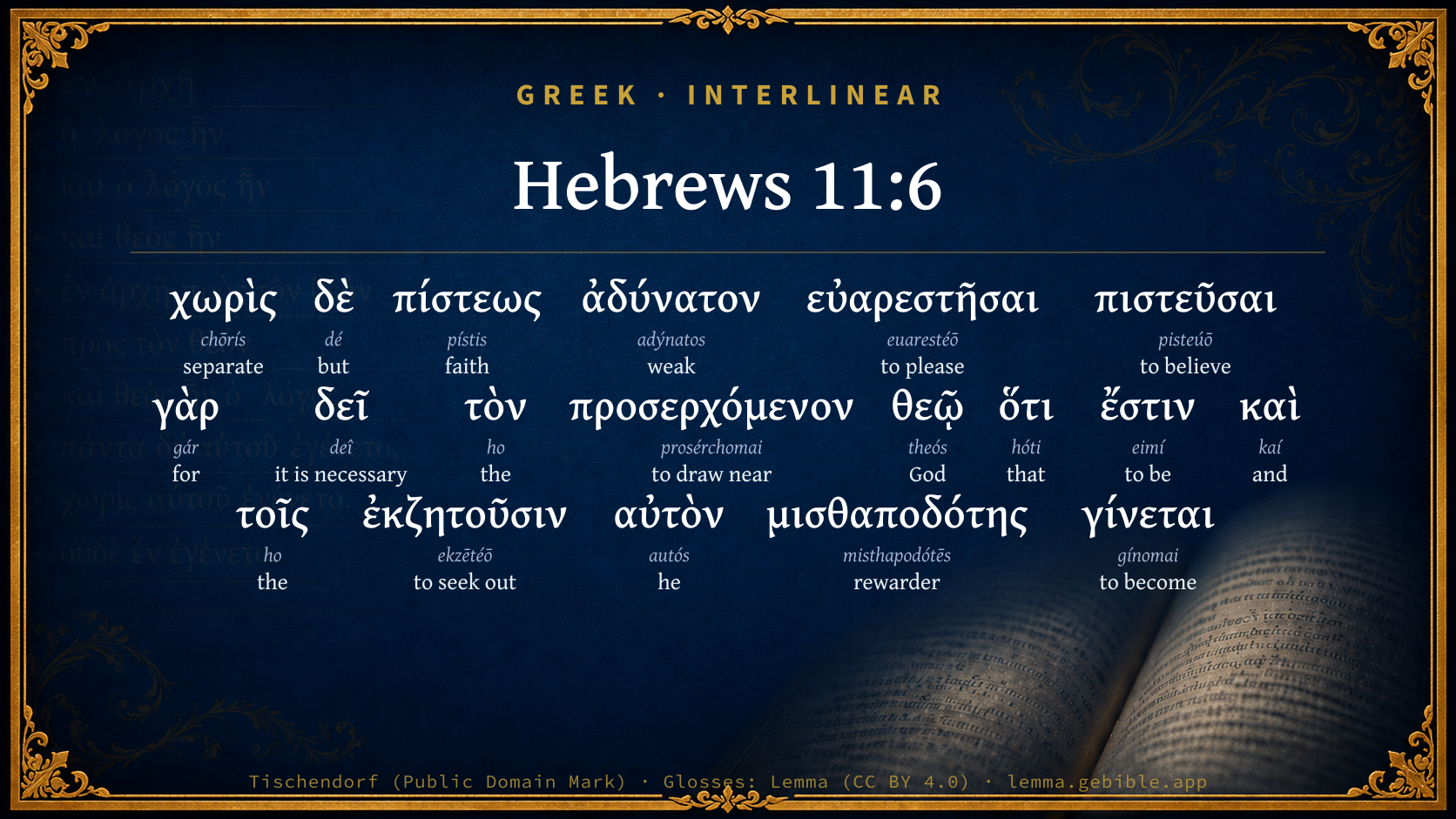
Without faith it is impossible to be well pleasing to him, for he who comes to God must believe that he exists, and that he is a rewarder of those who seek him.
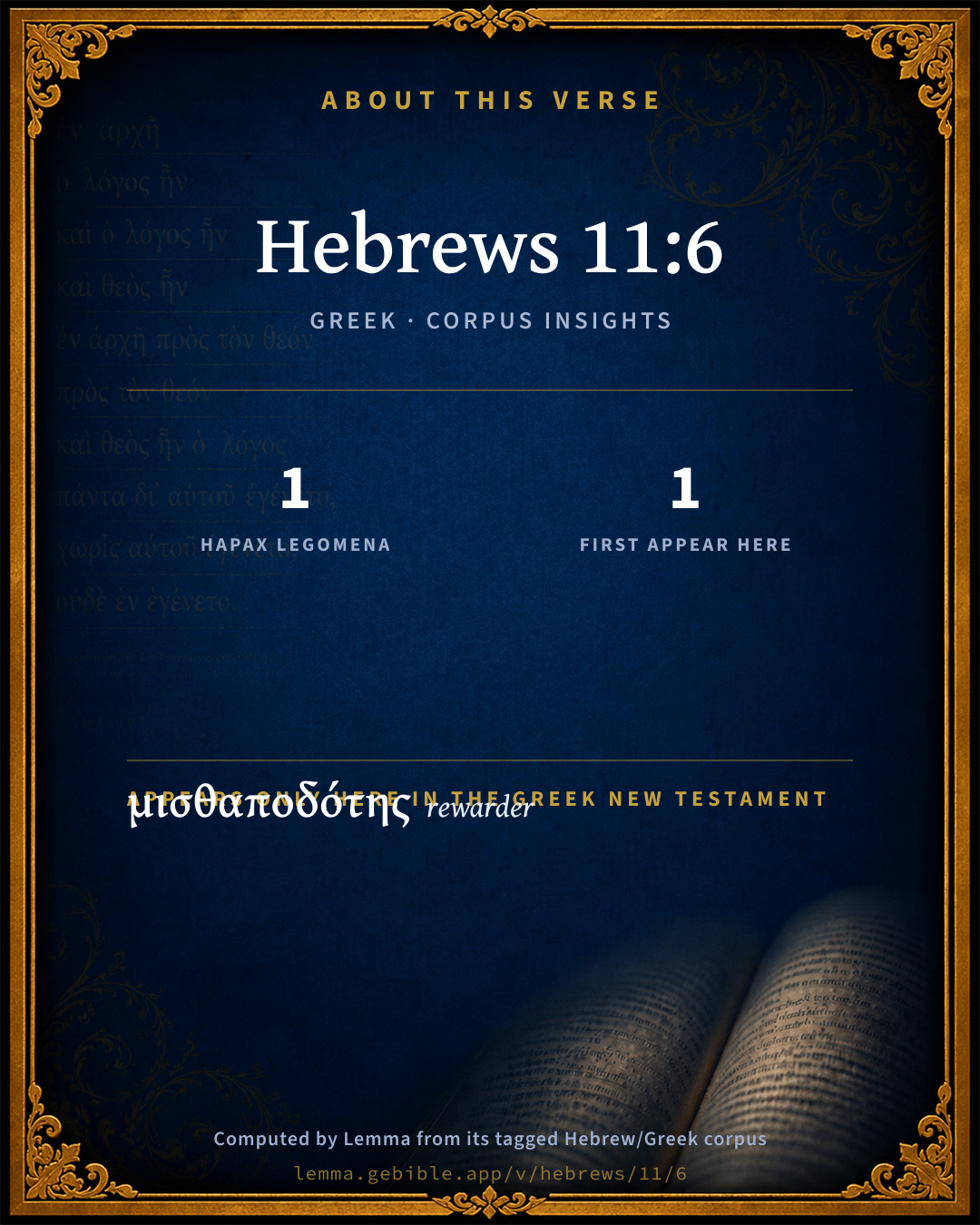
- 1 hapax legomenon — only here in the Greek New Testament
- 1 first appearance in the Greek New Testament
Download a study sheet
One document with this verse’s original text, its word-by-word gloss line, the meaning frame, cross-references with their text, attributed commentary, and full source and license credits — printable, and it pastes into notes with its structure intact.
This verse Autodidact and up
A passage Seminary Student
Up to 50 verses in one chapter. A passage sheet keeps up to 6 commentary sources and 12 cross-references per verse, in the order this page ranks them, and says so on the sheet whenever that leaves anything out. Ask for a single verse and you get the Autodidact verse sheet above.
Everything on this page stays free to read, with no account — the sheet is a download of what is already on screen, not access to it.
Compare translations 3
The same verse in 3 English versions, stacked beneath the original-language interlinear above. Click any original word for its lexicon entry.
Each is an independent rendering of the whole verse — the interlinear is not word-aligned to these translations.
Highlighted words mark where these versions differ — a whole-verse word diff, not a word-by-word alignment.
-
World English Bible Public Domain
Without faith it is impossible to be well pleasing to him, for he who comes to God must believe that he exists, and that he is a rewarder of those who seek him.
-
King James Version Public Domain
But without faith it is impossible to please him: for he that cometh to God must believe that he is, and that he is a rewarder of them that diligently seek him.
-
unfoldingWord Literal Text CC BY-SA 4.0
Now without faith impossible to be well-pleasing, for it is necessary for the one coming to God to believe that he exists and is a rewarder of the ones seeking him.
unfoldingWord Literal Text — © unfoldingWord, licensed CC BY-SA 4.0. Word-aligned USFM3 via Door43 (git.door43.org/unfoldingWord/en_ult).
Show all 19 translations
Every available English version of this verse, each an independent rendering of the whole verse.
-
World English Bible Public Domain
Without faith it is impossible to be well pleasing to him, for he who comes to God must believe that he exists, and that he is a rewarder of those who seek him.
-
Berean Standard Bible Public Domain
And without faith it is impossible to please God, because anyone who approaches Him must believe that He exists and that He rewards those who earnestly seek Him.
-
Majority Standard Bible Public Domain
And without faith it is impossible to please God, because anyone who approaches Him must believe that He exists and that He rewards those who earnestly seek Him.
-
King James Version Public Domain
But without faith it is impossible to please him: for he that cometh to God must believe that he is, and that he is a rewarder of them that diligently seek him.
-
American Standard Version (1901) Public Domain
And without faith it is impossible to be well-pleasing `unto him'; for he that cometh to God must believe that he is, and `that' he is a rewarder of them that seek after him.
-
Revised Version (1885) Public Domain
And without faith it is impossible to be well-pleasing unto him: for he that cometh to God must believe that he is, and that he is a rewarder of them that seek after him.
-
Geneva Bible (1599) Public Domain
But without faith it is vnpossible to please him: for he that commeth to God, must beleeue that God is, and that he is a rewarder of them that seeke him.
-
Douay-Rheims (1899) Public Domain
But without faith it is impossible to please God. For he that cometh to God, must believe that he is, and is a rewarder to them that seek him.
-
Young's Literal Translation Public Domain
and apart from faith it is impossible to please well, for it behoveth him who is coming to God to believe that He is, and to those seeking Him He becometh a rewarder.
-
Literal Standard Version CC BY-SA 4.0
and apart from faith it is impossible to please [Him], for it is required of him who is coming to God to believe that He exists and [that] He becomes a rewarder to those seeking Him.
-
Unlocked Literal Bible CC BY-SA 4.0
Now without faith it is impossible to please him. For it is necessary that anyone coming to God must believe that he exists and that he is a rewarder of those who seek him.
-
unfoldingWord Literal Text CC BY-SA 4.0
Now without faith impossible to be well-pleasing, for it is necessary for the one coming to God to believe that he exists and is a rewarder of the ones seeking him.
-
Darby Bible Public Domain
But without faith [it is] impossible to please [him]. For he that draws near to God must believe that he is, and [that] he is a rewarder of them who seek him out.
-
World Messianic Bible Public Domain
Without faith it is impossible to be well pleasing to him, for he who comes to God must believe that he exists, and that he is a rewarder of those who seek him.
-
Webster's Bible Public Domain
But without faith it is impossible to please him: for he that cometh to God must believe that he is, and that he is a rewarder of them that diligently seek him.
-
Free Bible Version CC BY-SA 4.0
You can't expect God to be pleased with you if you don't trust him! Anyone who comes to God must believe that God exists, and that he rewards those who are searching for him.
-
Bible in Basic English Public Domain
And without faith it is not possible to be well-pleasing to him, for it is necessary for anyone who comes to God to have the belief that God is, and that he is a rewarder of all those who make a serious search for him.
-
Text-Critical English NT CC BY 4.0
And without faith it is impossible to please God, for anyone who comes to him must believe that God exists and that he rewards those who earnestly seek him.
-
Tyndale New Testament (1534) Public Domain
but with out fayth it is vnpossible to please him. For he that commeth to God must beleve that God is and that he is a rewarder of them that seke him.
Literal Standard Version (2020), Covenant Press — licensed CC BY-SA 4.0. Text via the HelloAO Bible API (eBible.org). Unlocked Literal Bible (unfoldingWord) — licensed CC BY-SA 4.0. Text via the HelloAO Bible API (eBible.org). unfoldingWord Literal Text — © unfoldingWord, licensed CC BY-SA 4.0. Word-aligned USFM3 via Door43 (git.door43.org/unfoldingWord/en_ult). Free Bible Version, Dr. Jonathan Gallagher — licensed CC BY-SA 4.0. Text via the HelloAO Bible API (eBible.org).
Word by word
More ways to search: Search by grammar → Find every occurrence → Compare this word →
Practice this passage: Drill this verse → Learn its vocabulary →
- Appears 1× in the Greek New Testament
- First appears here
- Part of Speech
- Noun
- Case
- Nominative
- Number
- Singular
- Gender
- Masculine
Full Thayer's Definition
- χωρὶς chōrís G5565 “separate” Adverb
- δὲ dé G1161 “but” Conjunction
- πίστεως pístis G4102 “faith” Noun, Genitive, Singular, Feminine
- ἀδύνατον adýnatos G102 “weak” Adjective, Nominative, Singular, Neuter
- εὐαρεστῆσαι euarestéō G2100 “to please” Verb, Aorist, Active, Infinitive
- πιστεῦσαι pisteúō G4100 “to believe” Verb, Aorist, Active, Infinitive
- γὰρ gár G1063 “for” Conjunction
- δεῖ deî G1163 “it is necessary” Verb, Present, Active, Indicative, 3rd person, Singular
- τὸν ho G3588 “the” Article, Accusative, Singular, Masculine
- προσερχόμενον prosérchomai G4334 “to draw near” Verb, Present, Middle or Passive deponent, Participle, Accusative, Singular, Masculine
- θεῷ theós G2316 “God” Noun, Dative, Singular, Masculine
- ὅτι hóti G3754 “that” Conjunction
- ἔστιν eimí G1510 “to be” Verb, Present, Active, Indicative, 3rd person, Singular
- καὶ kaí G2532 “and” Conjunction
- τοῖς ho G3588 “the” Article, Dative, Plural, Masculine
- ἐκζητοῦσιν ekzētéō G1567 “to seek out” Verb, Present, Active, Participle, Dative, Plural, Masculine
- αὐτὸν autós G846 “he” Personal pronoun, Accusative, Singular, Masculine
- μισθαποδότης misthapodótēs G3406 “rewarder” Noun, Nominative, Singular, Masculine
- γίνεται gínomai G1096 “to become” Verb, Present, Middle or Passive deponent, Indicative, 3rd person, Singular
About this verse
These counts appear in no published source. They are computed here, from the morphology-tagged text and Lemma’s own curated glosses. What Lemma adds →
- 19
- words
- 18
- distinct lemmas
- General Epistles
- section
Notable vocabulary
1 hapax legomenon — a word that appears only here in the entire Greek New Testament:
- μισθαποδότης rewarder G3406
First appearance in Scripture
This word makes its first canonical appearance in the Greek New Testament here:
- μισθαποδότης rewarder G3406
Shared distinctive vocabulary
εὐαρεστῆσαι to please G2100 occurs in 3 verses of the Greek New Testament. Also found in:
Repetition
A word recurs within this verse:
- τὸν the G3588 ×2
Cross-references
46Topical passages linked to Hebrews 11:6 in the Treasury of Scripture Knowledge — connected by theme and wording, ordered by reader-vote popularity; previews shown in the World English Bible.
- Proverbs 8:17 I love those who love me. Those who seek me diligently will find me.
- Jeremiah 29:13–14 You shall seek me, and find me, when you shall search for me with all your heart.
- Matthew 6:33 But seek first God's Kingdom, and his righteousness; and all these things will be given to you as well.
- 1 Chronicles 28:9 You, Solomon my son, know the God of your father, and serve him with a perfect heart and with a willing mind; for Yahweh searches all hearts, and understands all the imaginations of the thoughts: if you seek him, he will be found of you; but if you forsake him, he will cast you off forever.
- Psalms 105:3–4 Glory in his holy name. Let the heart of those who seek Yahweh rejoice.
- Luke 12:31 But seek God's Kingdom, and all these things will be added to you.
- Psalms 119:10 With my whole heart, I have sought you. Don't let me wander from your commandments.
- Hebrews 7:25 Therefore he is also able to save to the uttermost those who draw near to God through him, seeing he ever lives to make intercession for them.
- Hebrews 3:12 Beware, brothers, lest perhaps there be in any one of you an evil heart of unbelief, in falling away from the living God;
- Romans 10:14 How then will they call on him in whom they have not believed? How will they believe in him whom they have not heard? How will they hear without a preacher?
- Psalms 73:28 But it is good for me to come close to God. I have made the Lord Yahweh my refuge, That I may tell of all your works.
- John 14:6 Jesus said to him, "I am the way, the truth, and the life. No one comes to the Father, except through me.
- John 3:18–19 He who believes in him is not judged. He who doesn't believe has been judged already, because he has not believed in the name of the one and only Son of God.
- Hebrews 4:6 Seeing therefore it remains that some should enter therein, and they to whom the good news was before preached failed to enter in because of disobedience,
- 2 Peter 1:5 Yes, and for this very cause adding on your part all diligence, in your faith supply moral excellence; and in moral excellence, knowledge;
- John 8:24 I said therefore to you that you will die in your sins; for unless you believe that I am he, you will die in your sins."
- Galatians 5:6 For in Christ Jesus neither circumcision amounts to anything, nor uncircumcision, but faith working through love.
- Numbers 14:11 Yahweh said to Moses, How long will this people despise me? and how long will they not believe in me, for all the signs which I have worked among them?
- Hebrews 3:18–19 To whom did he swear that they wouldn't enter into his rest, but to those who were disobedient?
- 2 Peter 1:10 Therefore, brothers, be more diligent to make your calling and election sure. For if you do these things, you will never stumble.
- 2 Peter 3:14 Therefore, beloved, seeing that you look for these things, be diligent to be found in peace, without blemish and blameless in his sight.
- Hebrews 7:19 (for the law made nothing perfect), and a bringing in thereupon of a better hope, through which we draw near to God.
- Proverbs 11:18 Wicked people earn deceitful wages, But one who sows righteousness reaps a sure reward.
- Numbers 20:12 Yahweh said to Moses and Aaron, Because you didn't believe in me, to sanctify me in the eyes of the children of Israel, therefore you shall not bring this assembly into the land which I have given them.
- Hebrews 11:26 accounting the reproach of Christ greater riches than the treasures of Egypt; for he looked to the reward.
- Psalms 78:32 For all this they still sinned, And didn't believe in his wondrous works.
- Psalms 106:21–22 They forgot God, their Savior, Who had done great things in Egypt,
- Revelation 21:8 But for the cowardly, unbelieving, sinners, abominable, murderers, sexually immoral, sorcerers, idolaters, and all liars, their part is in the lake that burns with fire and sulfur, which is the second death."
- Isaiah 55:3 Turn your ear, and come to me; hear, and your soul shall live: and I will make an everlasting covenant with you, even the sure mercies of David.
- Hebrews 4:2 For indeed we have had good news preached to us, even as they also did, but the word they heard didn't profit them, because it wasn't mixed with faith by those who heard.
- Song of Solomon 3:1–4 By night on my bed, I sought him whom my soul loves. I sought him, but I didn't find him.
- Isaiah 7:9 and the head of Ephraim is Samaria, and the head of Samaria is Remaliah's son. If you will not believe, surely you shall not be established.'"
- Matthew 10:41–42 He who receives a prophet in the name of a prophet will receive a prophet's reward: and he who receives a righteous man in the name of a righteous man will receive a righteous man's reward.
- Mark 16:17 These signs will accompany those who believe: in my name they will cast out demons; they will speak with new languages;
- Genesis 15:1 After these things the word of Yahweh came to Abram in a vision, saying, "Don't be afraid, Abram. I am your shield, your exceedingly great reward."
- Psalms 58:11 So that men shall say, "Most assuredly there is a reward for the righteous. Most assuredly there is a God who judges the earth."
- Job 21:14 They tell God, 'Depart from us, For we don't want to know about your ways.
- Psalms 78:22 Because they didn't believe in God, And didn't trust in his salvation.
- Psalms 106:24 Yes, they despised the pleasant land. They didn't believe his word,
- Luke 6:35 But love your enemies, and do good, and lend, expecting nothing back; and your reward will be great, and you will be children of the Most High; for he is kind toward the unthankful and evil.
- Jeremiah 2:31 Generation, see the word of Yahweh. Have I been a wilderness to Israel? or a land of thick darkness? why say my people, We are broken loose; we will come no more to you?
- Ruth 2:12 Yahweh recompense your work, and a full reward be given you of Yahweh, the God of Israel, under whose wings you are come to take refuge.
- Matthew 6:1–2 "Be careful that you don't do your charitable giving before men, to be seen by them, or else you have no reward from your Father who is in heaven.
- Matthew 6:5 "When you pray, you shall not be as the hypocrites, for they love to stand and pray in the synagogues and in the corners of the streets, that they may be seen by men. Most assuredly, I tell you, they have received their reward.
- Matthew 6:16 "Moreover when you fast, don't be like the hypocrites, with sad faces. For they disfigure their faces, that they may be seen by men to be fasting. Most assuredly I tell you, they have received their reward.
- Matthew 5:12 Rejoice, and be exceedingly glad, for great is your reward in heaven. For that is how they persecuted the prophets who were before you.
Cross-references courtesy of OpenBible.info (CC BY 4.0).
Lesson kit
Teaching starters — assembled from the data on this page, not authored interpretation. Every prompt links to the verse data it draws on. Edit before teaching.
Hebrews, in the General Epistles, opens this verse with 19 words (18 distinct Greek lemmas). Its most distinctive word is misthapodótēs (“rewarder”). A historical commentator’s framing appears above. Read the whole chapter for the surrounding context.
Discussion questions
- The word misthapodótēs carries the sense “rewarder.” How does it shape the verse?
- This verse holds 1 word here found nowhere else in the Greek New Testament. What might the rare word draw attention to?
- The word “rewarder” first appears here in Scripture. What is being introduced at this debut?
- Hebrews 11:5 shares the word «to please» with this verse. How do the two illuminate each other?
- “the” occurs 2× in this one verse. What is the effect of the repetition?
- These translations render this verse differently; the difference is in the English rendering, not the original. What questions does that raise?
- Reading how The Biblical Illustrator and MacLaren's Expositions of Holy Scripture read this verse, where do the two commentators agree and where do they part?
Things to notice
- 1 word in this verse appears nowhere else in the Greek New Testament.
- 1 word makes its first canonical appearance in Scripture here.
- These translations choose different wording for 17 words in this verse.
- “the” occurs 2× in this single verse.
- 18 distinct Greek lemmas span 19 words in this verse.
Commentary
Notes on Hebrews 11:6 from classic Christian and Jewish commentators (each source and its license shown beneath its notes). The classic Christian expositions comment on the surrounding passage and are grouped to its opening verse, so a note may address several verses; the Jewish commentaries on the Tanakh (Rashi and others) are per-verse, so they appear only where the commentator wrote on this verse.
Lemma curates 59 commentaries, every one of them public domain or Creative Commons licensed, each selected and text-cleaned for this edition rather than reprinted as found. About our sources →
The Biblical Illustrator
Joseph S. Exell
The Biblical Illustrator, edited by Joseph S. Exell (c. 1880s–1900s) — public domain. Text from a community e-Sword module.
MacLaren's Expositions of Holy Scripture
Alexander MacLaren
Alexander MacLaren, Expositions of Holy Scripture (1904–1910) — public domain. Text from a community e-Sword module.
Tyndale Open Study Notes
Tyndale Open Resources
Tyndale Open Study Notes — © Tyndale Open Resources, licensed CC BY-SA 4.0. Text via the HelloAO Bible API.
Bengel's Gnomon
Johann Albrecht Bengel
Bengel's Gnomon of the New Testament — English translation (T&T Clark, Edinburgh, 1860) — public domain. Text from a community e-Sword module.
Geneva Bible (1599)
Geneva Bible translators
Geneva Bible (1599) marginal notes — public domain. Text via Bolls.life.
Jamieson, Fausset & Brown
Robert Jamieson, A. R. Fausset & David Brown
Jamieson, Fausset & Brown — Commentary Critical and Explanatory on the Whole Bible (1871) — public domain (CC PDM 1.0). Text via the HelloAO Bible API.
Adam Clarke's Commentary
Adam Clarke's Commentary on the Bible (1810–1826) — public domain. Text from a community e-Sword/MySword module.
John Calvin's Commentaries
John Calvin's Commentaries (1540-1563) — public domain. Text from the Calvin Translation Society English edition (1840s-50s) via the Christian Classics Ethereal Library (ccel.org). Calvin's coverage is partial (roughly two-thirds of the Bible); uncommented books and verses are honest gaps, never fabricated. The 19th-century editor's footnotes and remarks are omitted so the notes are faithfully Calvin's own voice.
Ellicott's Commentary for English Readers
A Bible Commentary for English Readers, edited by Charles John Ellicott (1878–1897) — public domain. Text from a community e-Sword module.
The Cambridge Bible for Schools and Colleges
gen. ed. J. J. S. Perowne
The Cambridge Bible for Schools and Colleges (gen. ed. J. J. S. Perowne; Cambridge University Press, 1878–1918) — public domain. Text from a community e-Sword module.
John Gill's Exposition
John Gill's Exposition of the Whole Bible (1746–1763) — public domain (CC PDM 1.0). Text via the HelloAO Bible API.
Trapp's Complete Commentary
John Trapp
John Trapp, A Commentary or Exposition upon All the Books of the Old and New Testament (1647–1656) — public domain. Text from a community e-Sword module.
Albert Barnes' Notes on the Bible
Albert Barnes' Notes on the Bible (1834–1885) — public domain. Text from a community e-Sword/MySword module.
Haydock's Catholic Bible Commentary
George Leo Haydock (1774–1849), Haydock's Catholic Family Bible and Commentary, 1859 edition — public domain. Excludes Psalms (Douay-Rheims chapter numbering differs from Protestant) and Deuterocanonical books (Catholic canon only).
Matthew Poole's English Annotations
Matthew Poole's English Annotations on the Holy Bible (1683–1685) — public domain. Text from a community e-Sword/MySword module.
Whedon's Commentary on the Bible
Daniel D. Whedon
Daniel D. Whedon (gen. ed.), Commentary on the Old and New Testaments (1874–1909) — public domain. Text from a community e-Sword module.
The Pulpit Commentary
The Pulpit Commentary (1880–1919), ed. H.D.M. Spence-Jones & Joseph S. Exell — public domain. Text from a community e-Sword module.
John Wesley's Explanatory Notes
John Wesley, Explanatory Notes Upon the Whole Bible (1754–1765) — public domain. Text via the GEBible commentary corpus.
Burkitt's Expository Notes on the New Testament
William Burkitt
William Burkitt's Expository Notes on the New Testament (1700–1703) — public domain. Text from a community e-Sword module.
The People's New Testament
B. W. Johnson
B. W. Johnson's The People's New Testament with Notes (1889–1891) — public domain. Electronic text from the Christian Classics Ethereal Library (CCEL) ThML edition.
Cambridge Greek Testament for Schools and Colleges
Cambridge Greek Testament for Schools and Colleges (Cambridge University Press, 1896; 21 vols, various authors incl. Carr, Maclear, Plummer, Farrar, Lumby, Moule, M. R. James, Simcox) — public domain. Text from a community e-Sword module.
Alford’s Greek Testament
Henry Alford
Henry Alford, The Greek Testament (1849–1861) — public domain. Text from a community e-Sword module.