Hebrews 5:14

Greek (Tischendorf 8th ed.) Hebrews 5:14 appears in the Greek New Testament. The text above is from the Tischendorf 8th edition. Each word links to its Strong’s number and a concise gloss. Click any word for its full Thayer’s Greek Lexicon entry.
Download image
Cite this verse

Hebrews 5:14 (World English Bible). Public Domain. Lemma interlinear Bible study tool, https://lemma.gebible.app/v/hebrews/5/14.

Show BibTeX & RIS
BibTeX
RIS
English Translation
But solid food is for those who are full grown, who by reason of use have their senses exercised to discern good and evil.
World English Bible · Public Domain
Highlights
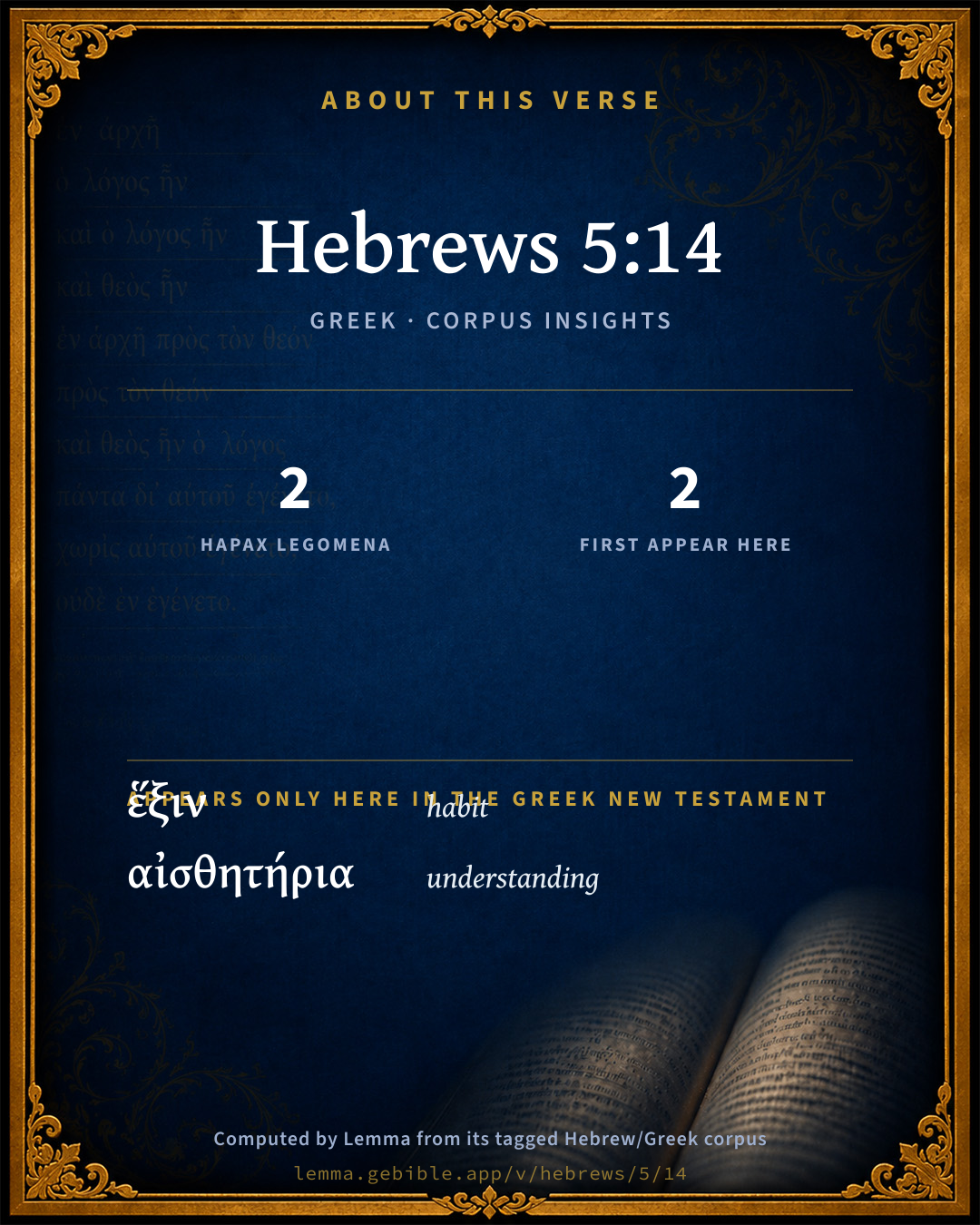
  • 2 hapax legomena — only here in the Greek New Testament
  • 2 first appearances in the Greek New Testament
Full analysis ↓
Download a study sheet

One document with this verse’s original text, its word-by-word gloss line, the meaning frame, cross-references with their text, attributed commentary, and full source and license credits — printable, and it pastes into notes with its structure intact.

This verse Autodidact and up

Study sheet (.html) Plain text (.txt)

A passage Seminary Student

Up to 50 verses in one chapter. A passage sheet keeps up to 6 commentary sources and 12 cross-references per verse, in the order this page ranks them, and says so on the sheet whenever that leaves anything out. Ask for a single verse and you get the Autodidact verse sheet above.

Everything on this page stays free to read, with no account — the sheet is a download of what is already on screen, not access to it.

Want to remove ads? Support Godless Engineer
Compare translations 3

The same verse in 3 English versions, stacked beneath the original-language interlinear above. Click any original word for its lexicon entry.

Each is an independent rendering of the whole verse — the interlinear is not word-aligned to these translations.

Highlighted words mark where these versions differ — a whole-verse word diff, not a word-by-word alignment.

  • World English Bible Public Domain
    But solid food is for those who are full grown, who by reason of use have their senses exercised to discern good and evil.
  • King James Version Public Domain
    But strong meat belongeth to them that are of full age, even those who by reason of use have their senses exercised to discern both good and evil.
  • unfoldingWord Literal Text CC BY-SA 4.0
    But this solid food is for the mature ones, having through habit trained their senses for distinguishing both good and evil.

unfoldingWord Literal Text — © unfoldingWord, licensed CC BY-SA 4.0. Word-aligned USFM3 via Door43 (git.door43.org/unfoldingWord/en_ult).

Versions to compare (up to 4)

3 of 4 selected

Show all 19 translations

Every available English version of this verse, each an independent rendering of the whole verse.

  • World English Bible Public Domain
    But solid food is for those who are full grown, who by reason of use have their senses exercised to discern good and evil.
  • Berean Standard Bible Public Domain
    But solid food is for the mature, who by constant use have trained their senses to distinguish good from evil.
  • Majority Standard Bible Public Domain
    But solid food is for the mature, who by constant use have trained their senses to distinguish good from evil.
  • King James Version Public Domain
    But strong meat belongeth to them that are of full age, even those who by reason of use have their senses exercised to discern both good and evil.
  • American Standard Version (1901) Public Domain
    But solid food is for fullgrown men, `even' those who by reason of use have their senses exercised to discern good and evil.
  • Revised Version (1885) Public Domain
    But solid food is for fullgrown men, even those who by reason of use have their senses exercised to discern good and evil.
  • Geneva Bible (1599) Public Domain
    But strong meate belongeth to them that are of age, which through long custome haue their wits exercised, to discerne both good and euill.
  • Douay-Rheims (1899) Public Domain
    But strong meat is for the perfect; for them who by custom have their senses exercised to the discerning of good and evil.
  • Young's Literal Translation Public Domain
    and of perfect men is the strong food, who because of the use are having the senses exercised, unto the discernment both of good and of evil.
  • Literal Standard Version CC BY-SA 4.0
    and the strong food is of perfect men, who because of the use are having the senses exercised, to both the discernment of good and of evil.
  • Unlocked Literal Bible CC BY-SA 4.0
    But solid food is for adults. These are those who because of their maturity have their understanding trained for distinguishing good from evil.
  • unfoldingWord Literal Text CC BY-SA 4.0
    But this solid food is for the mature ones, having through habit trained their senses for distinguishing both good and evil.
  • Darby Bible Public Domain
    but solid food belongs to full-grown men, who, on account of habit, have their senses exercised for distinguishing both good and evil.
  • World Messianic Bible Public Domain
    But solid food is for those who are full grown, who by reason of use have their senses exercised to discern good and evil.
  • Webster's Bible Public Domain
    But strong food belongeth to them that are of full age, even those who by reason of use have their senses exercised to discern both good and evil.
  • Free Bible Version CC BY-SA 4.0
    Solid food is for grown-ups—those who by always using their brains have learned to tell the difference between good and evil.
  • Bible in Basic English Public Domain
    But solid food is for men of full growth, even for those whose senses are trained by use to see what is good and what is evil.
  • Text-Critical English NT CC BY 4.0
    But solid food is for the mature, whose faculties have been trained by practice to distinguish between good and evil.
  • Tyndale New Testament (1534) Public Domain
    But stronge meate belongeth to them that are parfecte which thorow custome have their wittes exercised to iudge both good and evyll also.

Literal Standard Version (2020), Covenant Press — licensed CC BY-SA 4.0. Text via the HelloAO Bible API (eBible.org). Unlocked Literal Bible (unfoldingWord) — licensed CC BY-SA 4.0. Text via the HelloAO Bible API (eBible.org). unfoldingWord Literal Text — © unfoldingWord, licensed CC BY-SA 4.0. Word-aligned USFM3 via Door43 (git.door43.org/unfoldingWord/en_ult). Free Bible Version, Dr. Jonathan Gallagher — licensed CC BY-SA 4.0. Text via the HelloAO Bible API (eBible.org).

Word by word

More ways to search: Search by grammar → Find every occurrence → Compare this word →

Practice this passage: Drill this verse → Learn its vocabulary →

ἕξιν
héxis
G1838
“habit”
Noun, Accusative, Singular, Feminine
Part of Speech
Noun
Case
Accusative
Number
Singular
Gender
Feminine
Full Thayer's Definition

Origin: from G2192

TDNT: None

1. a habit whether of body or mind 2. a power acquired by custom, practice, use
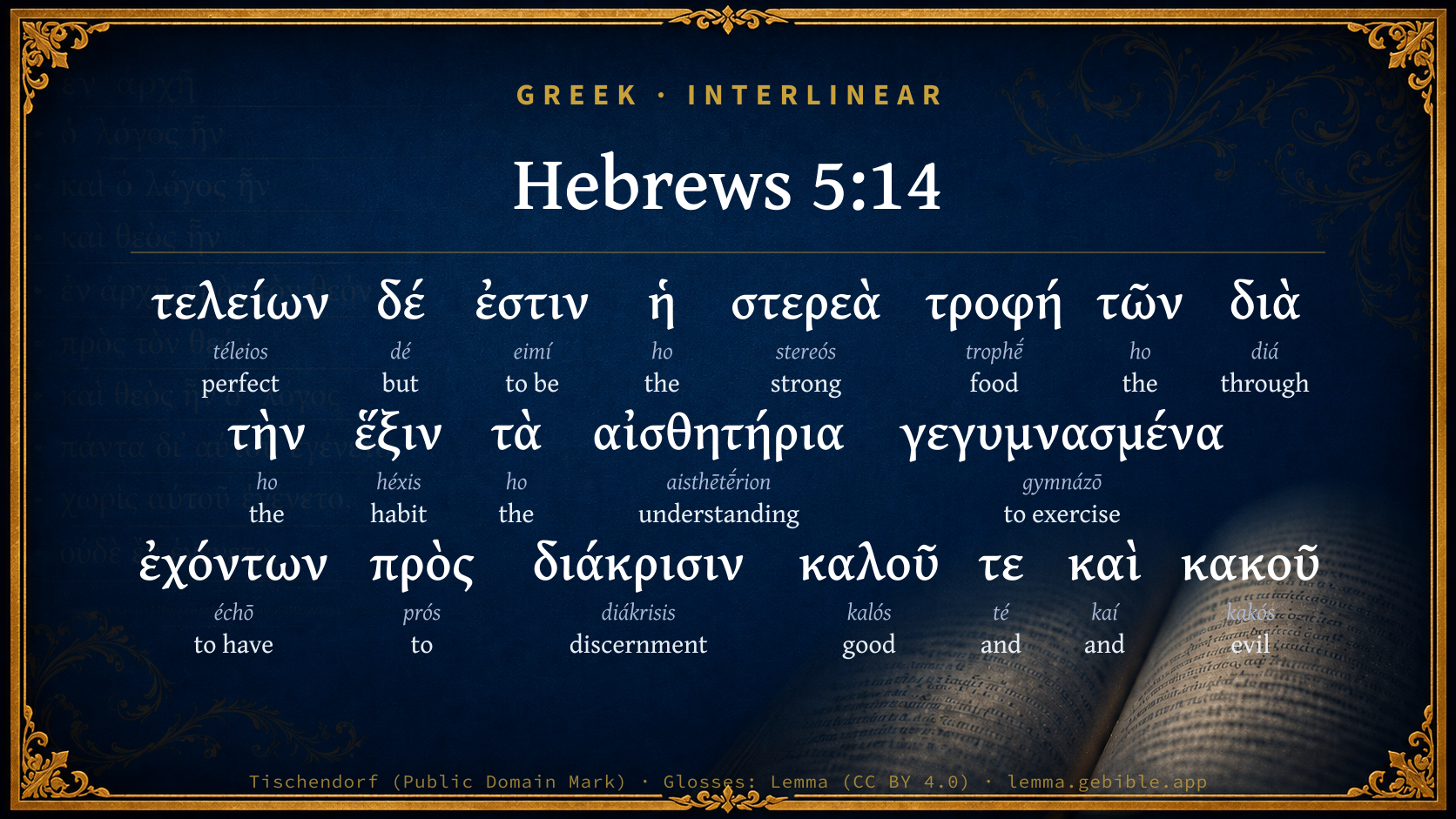
  1. τελείων téleios G5046 “perfect” Adjective, Genitive, Plural, Masculine
  2. δέ dé G1161 “but” Conjunction
  3. ἐστιν eimí G1510 “to be” Verb, Present, Active, Indicative, 3rd person, Singular
  4. ἡ ho G3588 “the” Article, Nominative, Singular, Feminine
  5. στερεὰ stereós G4731 “strong” Adjective, Nominative, Singular, Feminine
  6. τροφή trophḗ G5160 “food” Noun, Nominative, Singular, Feminine
  7. τῶν ho G3588 “the” Article, Genitive, Plural, Masculine
  8. διὰ diá G1223 “through” Preposition
  9. τὴν ho G3588 “the” Article, Accusative, Singular, Feminine
  10. τὰ ho G3588 “the” Article, Accusative, Plural, Neuter
  11. αἰσθητήρια aisthētḗrion G145 “understanding” Noun, Accusative, Plural, Neuter
  12. γεγυμνασμένα gymnázō G1128 “to exercise” Verb, Perfect, Passive, Participle, Accusative, Plural, Neuter
  13. ἐχόντων échō G2192 “to have” Verb, Present, Active, Participle, Genitive, Plural, Masculine
  14. πρὸς prós G4314 “to” Preposition
  15. διάκρισιν diákrisis G1253 “discernment” Noun, Accusative, Singular, Feminine
  16. καλοῦ kalós G2570 “good” Adjective, Genitive, Singular, Neuter
  17. τε té G5037 “and” Particle
  18. καὶ kaí G2532 “and” Conjunction
  19. κακοῦ kakós G2556 “evil” Adjective, Genitive, Singular, Neuter

About this verse

These counts appear in no published source. They are computed here, from the morphology-tagged text and Lemma’s own curated glosses. What Lemma adds →

20
words
17
distinct lemmas
General Epistles
section

Notable vocabulary

2 hapax legomena — words that appear only here in the entire Greek New Testament:

  • ἕξιν habit G1838
  • αἰσθητήρια understanding G145

First appearance in Scripture

These words make their first canonical appearance in the Greek New Testament here:

  • ἕξιν habit G1838
  • αἰσθητήρια understanding G145

Shared distinctive vocabulary

διάκρισιν discernment G1253 occurs in 3 verses of the Greek New Testament. Also found in:

Repetition

A word recurs within this verse:

Cross-references

22

Topical passages linked to Hebrews 5:14 in the Treasury of Scripture Knowledge — connected by theme and wording, ordered by reader-vote popularity; previews shown in the World English Bible.

  • 1 Corinthians 2:14–15 Now the natural man doesn't receive the things of God's Spirit, for they are foolishness to him, and he can't know them, because they are spiritually discerned.
  • 1 Thessalonians 5:21 Test all things, and hold firmly that which is good.
  • Philippians 1:9–10 This I pray, that your love may abound yet more and more in knowledge and all discernment;
  • Isaiah 7:15 He shall eat butter and honey when he knows to refuse the evil, and choose the good.
  • 1 Corinthians 2:6 We speak wisdom, however, among those who are full grown; yet a wisdom not of this world, nor of the rulers of this world, who are coming to nothing.
  • Ephesians 1:18 having the eyes of your hearts enlightened, that you may know what is the hope of his calling, and what are the riches of the glory of his inheritance in the saints,
  • Matthew 6:22–23 "The lamp of the body is the eye. If therefore your eye is sound, your whole body will be full of light.
  • Ephesians 4:13 until we all attain to the unity of the faith, and of the knowledge of the Son of God, to a full grown man, to the measure of the stature of the fullness of Christ;
  • 1 Kings 3:9 Give your servant therefore an understanding heart to judge your people, that I may discern between good and evil; for who is able to judge this your great people?
  • Philippians 3:15 Let us therefore, as many as are perfect, think this way. If in anything you think otherwise, God will also reveal that to you.
  • Romans 14:1 Now receive one who is weak in faith, but not for disputes over opinions.
  • Genesis 3:5 for God knows that in the day you eat it, your eyes will be opened, and you will be like God, knowing good and evil."
  • 2 Samuel 14:17 Then your handmaid said, Please let the word of my lord the king be comfortable; for as an angel of God, so is my lord the king to discern good and bad: and Yahweh your God be with you.
  • 1 Kings 3:11 God said to him, Because you have asked this thing, and have not asked for yourself long life, neither have asked riches for yourself, nor have asked the life of your enemies, but have asked for yourself understanding to discern justice;
  • Job 12:11 Doesn't the ear try words, Even as the palate tastes its food?
  • Psalms 119:103 How sweet are your promises to my taste, More than honey to my mouth!
  • Matthew 5:48 Therefore you shall be perfect, just as your Father in heaven is perfect.
  • Job 6:30 Is there injustice on my tongue? Can't my taste discern mischievous things?
  • Job 34:3 For the ear tries words, As the palate tastes food.
  • Song of Solomon 1:3 Your oils have a pleasing fragrance. Your name is oil poured forth, Therefore the virgins love you.
  • Song of Solomon 2:3 As the apple tree among the trees of the wood, So is my beloved among the sons. I sat down under his shadow with great delight, His fruit was sweet to my taste.
  • James 3:2 For in many things we all stumble. If anyone doesn't stumble in word, the same is a perfect man, able to bridle the whole body also.

Cross-references courtesy of OpenBible.info (CC BY 4.0).

Commentary

Notes on Hebrews 5:14 from classic Christian and Jewish commentators (each source and its license shown beneath its notes). The classic Christian expositions comment on the surrounding passage and are grouped to its opening verse, so a note may address several verses; the Jewish commentaries on the Tanakh (Rashi and others) are per-verse, so they appear only where the commentator wrote on this verse.

Lemma curates 59 commentaries, every one of them public domain or Creative Commons licensed, each selected and text-cleaned for this edition rather than reprinted as found. About our sources →

Tyndale Open Study Notes

Tyndale Open Resources

5:14 Being able to recognize the difference between right and wrong is a defining characteristic of spiritual maturity.

Tyndale Open Study Notes — © Tyndale Open Resources, licensed CC BY-SA 4.0. Text via the HelloAO Bible API.

Bengel's Gnomon

Johann Albrecht Bengel

Heb 5:14. Τελείων, of them that are perfect) τελειότητα, perfection, ch. Heb 6:1, is the conjugate term. Τέλειοι καὶ μανθάνοντες are opposed to each other, 1Ch 25:8, מבין עם־תלמיד.—ἔστιν, is [belongeth to]) They who are perfect both desire and take solid meat.—διὰ) by reason of.—τὴν ἕξιν, habitual strength of understanding[37] [‘use’]) The LXX. use this word, Jdg 14:9; 1Sa 16:7; Dan 7:15; and also Wis 13:14. It is said of a whole, in which the parts have themselves and are had in turn, hold and are held in turn; and here it denotes the strength of the faculty of perception (discernment) arising from the maturity of the spiritual age: not habit acquired by practice, διὰ τὴν ἕξιν, because they are possessed of more habitual strength of understanding. Exercise follows habit (habitual faculty); and strength makes a man put his faculty in exercise with alacrity, dexterity, profit, without affectation or the perverse imitation of others.—τὰ αἰσθητήρια) properly the organs of the senses, for example, the tongue, the organ of tasting: comp. αἰσθήσει, in perception, sense, Php 1:9, note.

[37] Latin habitum, Th. habeo: as ἕξις from ἕχω.—ED.

—————

Bengel's Gnomon of the New Testament — English translation (T&T Clark, Edinburgh, 1860) — public domain. Text from a community e-Sword module.

Meyer's Critical & Exegetical Commentary

Heinrich August Wilhelm Meyer

Heb_5:14. The opposition: for perfect or more matured Christians, on the other hand (and only for them), is the solid food.

τελείων is with emphasis preposed.

τῶν διὰ τὴν ἕξιν κ.τ.λ.] more precise characterizing of the τέλειοι: for those who, etc.

ἕξις] like the following αἰσθητήριον, in the N. T. a ἅπαξ λεγόμενον. It corresponds to the Latin habitus, and is used in particular of the condition produced by use and wont. Here it denotes the capacity or dexterity acquired by practice. Comp. Quintil. Heb_10:1. 1 : firma quaedam facilitas, quae apud Graecos ἕξις nominatur.

τὰ αἰσθητήρια] the organs of the senses; transferred to that which is spiritual: the power of apprehension. Comp. LXX. Jer_4:19 : τὰ αἰσθητήρια τῆς ψυχῆς μου.

γεγυμνασμένα] Predicate; literally: as exercised. On the whole turn of discourse, comp. Galen, De dignot. puls. 3 (in Wetstein): ὅς μὲν γὰρ … τὸ αἰσθητήριον ἔχει γεγυμνασμένον ἱκανῶς … οὗτος ἄριστος ἄν εἴν γυώμων.

πρὸς διάκρισιν κ.τ.λ.] for the distinguishing of good and bad. The words may be taken with γεγυμνασμένα, or they may be taken with the whole expression γεγυμνασμένα ἐχόντων. The καλόν τε καὶ κακόν, however, is to be understood of the right and the wrong, or of the wholesome and the pernicious, not, with Stein, of that which is morally good or evil. Chrysostom: νῦν οὐ περὶ βίου αὐτῷ ὁ λόγος, ὅταν λέγῃ· πρὸς διάκρισιν καλοῦ καὶ κακοῦ (τοῦτο γὰρ παντὶ ἀνθρώπῳ δυνατὸν εἰδέναι καὶ εὔκολον) ἀλλὰ περὶ δογμάτων ὑγιῶν καὶ ὑψηλῶν, διεφθαρμένων τε καὶ ταπεινῶν.

Meyer — Critical and Exegetical Commentary on the New Testament — English translation by Peter Christie, edited by Frederick Crombie (T&T Clark, 1880) — public domain. Text from a community e-Sword module.

Expositor's Greek Testament

ed. W. Robertson Nicoll

Heb 5:14 . τελείων δὲ .… “But solid food is for the mature, those who, by reason of their mental habits, have their senses exercised to discern good and evil.” τέλειος commonly opposed in classical and Biblical Greek to νήπιος ; as in Polyb. 5:29, 2, ἐλπίσαντες ὡς παιδίῳ νηπίῳ χρήσασθαι τῷ Φιλίππῳ , εὗρον αὐτὸν τέλειον ἄνδρα . Cf. Eph 4:13 ; and Xen., Cyr. , viii. 7, 3. They are here further defined as τῶν … κακοῦ . ἕξις [from ἔχω , as habitus from habeo], a habit of body, or of mind; as in Plato, Laws (p. 666), τὴν ἐμμανῆ ἕξιν τῶν νέων . Also, p. 966, Ἀνδραπόδου γάρ τινα σὺ λέγεις ἕξιν . Aristotle ( Nic. Eth . ii. 5) determines that virtue is neither a δύναμις nor a πάθος , but a ἕξις , a faculty being something natural and innate, while virtue is not. Plutarch ( Moral. , 443), following him, defines ἕξις as ἰσχὺς … ἐξ ἔθους ἐγγινομένη , which resembles Quintilian’s definition (x. 1, 1), “firma quaedam facilitas, quae apud Graecos ἕξις nominatur”. Aristotle ( Categor. , viii. 1) distinguishes ἕξις from διάθεσις , τῷ πολὺ χρονιώτερον εἶναι καὶ μονιμώτερον , but elsewhere he uses the words as equivalents. Longinus (xliv. 4) uses it of faculty. ἕξις , then, is the habitual or normal condition, the disposition or character; and the expression in the text means that the mature, by reason of their maturity or mental habit, have their senses exercised, etc. αἰσθητήρια : “senses”. Bleek quotes the definition of the Greek lexicographers and of Damascene τὰ ὄργανα ἢ τὰ μέλη διʼ ὧν αἰσθανόμεθα . So Galen in Wetstein, “organs of sense”. Here the reference is to spiritual faculties of perception and taste. γεγυμνασμένα … πρὸς διάκρισιν …, “exercised so as to discriminate between good and evil,” i.e. , between what is wholesome and what is hurtful in teaching. [Wetstein quotes from Galen, De Dignot. Puls. , ὃς μὲν γὰρ τὸ αἰσθητήριον ἔχει γεγυμνασμένον ἱκανῶς οὗτος ἄριστος ἂν εἴη γνώμων .] The child must eat what is given to it; the boy is warned what to eat and what to avoid; as he grows, his senses are exercised by a various experience, so that when he reaches manhood he does not need a nurse or a priest to teach him what is nutritious and what is poisonous. The first evidence of maturity which the writer cites is ability to teach; the second, trained discernment of what is wholesome in doctrine. The one implies the other. Cf. Isa 7:16 , πρὶν γνῶναι τὸ παιδίον ἀγαθὸν ἢ κακόν , and Deu 1:39 . Chrysostom says οὐ περὶ βίου ὁ λόγος … ἀλλὰ περὶ δογμάτων ὑγιῶν καὶ ὑψηλῶν διεφθαρμένων τε καὶ ταπεινῶν ; the whole passage should be consulted.

The Expositor's Greek Testament, edited by W. Robertson Nicoll (1897–1910) — public domain. Text from a community e-Sword module.

Geneva Bible (1599)

Geneva Bible translators

All their power whereby they understand and judge.

Geneva Bible (1599) marginal notes — public domain. Text via Bolls.life.

Jamieson, Fausset & Brown

Robert Jamieson, A. R. Fausset & David Brown

strong meat--"solid food."

them . . . of full age--literally, "perfect": akin to "perfection" (Heb 6:1).

by reason of use--Greek, "habit."

senses--organs of sense.

exercised--similarly connected with "righteousness" in Heb 12:11.

to discern both good and evil--as a child no longer an infant (Isa 7:16): so able to distinguish between sound and unsound doctrine. The mere child puts into its mouth things hurtful and things nutritious, without discrimination: but not so the adult. Paul again alludes to their tendency not to discriminate, but to be carried about by strange doctrines, in Heb 13:9.

Next: Hebrews Chapter 6

Jamieson, Fausset & Brown — Commentary Critical and Explanatory on the Whole Bible (1871) — public domain (CC PDM 1.0). Text via the HelloAO Bible API.

Adam Clarke's Commentary

Verse 14. But strong meat] The high and sublime doctrines of Christianity; the atonement, justification by faith, the gift of the Holy Ghost, the fulness of Christ dwelling in the souls of men, triumph in and over death, the resurrection of the body, the glorification of both body and soul in the realms of blessedness, and an endless union with Christ in the throne of his glory. This is the strong food which the genuine Christian understands, receives, digests, and by which he grows.

By reason of use] Who, by constant hearing, believing, praying, and obedience, use all the graces of God's Spirit; and, in the faithful use of them, find every one improved, so that they daily grow in grace, and in the knowledge of Jesus Christ our Lord.

Have their senses exercised] The word αισθητηρια signifies the different organs of sense, as the eyes, ears, tongue, and palate, nose, and finger ends, and the nervous surface in general, through which we gain the sensations called seeing, hearing, tasting, smelling, and feeling. These organs of sense, being frequently exercised or employed on a variety of subjects, acquire the power to discern the various objects of sense: viz. all objects of light; difference of sounds; of tastes or savours; of odours or smelling; and of hard, soft, wet, dry, cold, hot, rough, smooth, and all other tangible qualities.

There is something in the soul that answers to all these senses in the body. And as universal nature presents to the other senses their different and appropriate objects, so religion presents to these interior senses the objects which are suited to them. Hence in Scripture we are said, even in spiritual things, to see, hear, taste, smell, and touch or feel. These are the means by which the soul is rendered comfortable, and through which it derives its happiness and perfection.

In the adult Christian these senses are said to be γεγυμνασμενα, exercised, a metaphor taken from the athletae or contenders in the Grecian games, who were wont to employ all their powers, skill, and agility in mock fights, running, wrestling, c., that they might be the better prepared for the actual contests when they took place. So these employ and improve all their powers, and in using grace get more grace and thus, being able to discern good from evil, they are in little danger of being imposed on by false doctrine, or by the pretensions of hypocrites; or of being deceived by the subtleties of Satan. They feel that their security depends, under God, on this exercise-on the proper use which they make of the grace already given them by God. Can any reader be so dull as not to understand this?

Adam Clarke's Commentary on the Bible (1810–1826) — public domain. Text from a community e-Sword/MySword module.

John Calvin's Commentaries

14. Of full age, or perfect, etc. He calls those perfect who are adults; he mentions them in opposition to babes, as it is done in 1 Corinthians 2:6; 14:20; Ephesians 4:13. For the middle and manly age is the full age of human life; but he calls those by a figure men in Christ; who are spiritual. And such he would have all Christians to be, such as have attained by continual practice a habit to discern between good and evil. For he cannot have been otherwise taught aright in the truth, except we are fortified by his protection against all the falsehoods and delusions of Satan; for on this account it is called the sword of the Spirit. And Paul points out this benefit conferred by sound doctrine when he says, “That we may not be carried about by every wind of doctrine.” (Ephesians 4:14.) And truly what sort of faith is that which doubts, being suspended between truth and falsehood? Is it not in danger of coming to nothing every moment?

But not satisfied to mention in one word the mind, he mentions all the senses, in order to show that we are ever to strive until we be in every way furnished by God’s word, and be so armed for battle, that Satan may by no means steal upon us with his fallacies.

It hence appears what sort of Christianity there is under the Papacy, where not only the grossest ignorance is commended under the name of simplicity, but where the people are also most rigidly prevented from seeking real knowledge; nay, it is easy to judge by what spirit they are influenced, who hardly allow that to be touched which the Apostle commands us to handle continually, who imagine that a laudable neglect which the Apostle here so severely reproves, who take away the word of God, the only rule of discerning rightly, which discerning he declares to be necessary for all Christians! But among those who are freed from this diabolical prohibition and enjoy the liberty of learning, there is yet often no less indifference both as to hearing and reading. When thus we exercise not our powers, we are stupidly ignorant and void of all discernment.

John Calvin's Commentaries (1540-1563) — public domain. Text from the Calvin Translation Society English edition (1840s-50s) via the Christian Classics Ethereal Library (ccel.org). Calvin's coverage is partial (roughly two-thirds of the Bible); uncommented books and verses are honest gaps, never fabricated. The 19th-century editor's footnotes and remarks are omitted so the notes are faithfully Calvin's own voice.

Ellicott's Commentary for English Readers

(14) Strong meat.—“Solid food belongs to full-grown men.” If they occupied themselves with the rudiments alone, their spiritual senses could not be trained by use (or, habit) in distinguishing between good and evil, truth and falsehood, in the various systems of teaching which men offered as the doctrine of Christ.

A Bible Commentary for English Readers, edited by Charles John Ellicott (1878–1897) — public domain. Text from a community e-Sword module.

The Cambridge Bible for Schools and Colleges

gen. ed. J. J. S. Perowne

14. belongeth to them that are of full age] The solid food of more advanced instruction pertains to the mature or “perfect.”

by reason of use] “Because of their habit,” i.e. from being habituated to it. This is the only place in the N.T. where this important word ἕξις habitus occurs.

their senses] Their spiritual faculties (αἰσθητήρια. It does not occur elsewhere in the N.T.)

exercised] Trained, or disciplined by spiritual practice.

to discern both good and evil] Lit., “the discrimination of good and evil.” By “good and evil” is not meant “right and wrong” because there is no question here of moral distinctions; but excellence and inferiority in matters of instruction. To the natural man the things of the spirit are foolishness; it is only the spiritual man who can “distinguish between things that differ” and so “discriminate the transcendent” (1Co_2:14-15; Rom_2:18; Php_1:9-10). The phrase “to know good and evil” is borrowed from Hebrew (Gen_2:17, &c), and is used to describe the first dawn of intelligence (Isa_7:15-16).

The Cambridge Bible for Schools and Colleges (gen. ed. J. J. S. Perowne; Cambridge University Press, 1878–1918) — public domain. Text from a community e-Sword module.

Trapp's Complete Commentary

John Trapp

14 But strong meat belongeth to them that are of full age, even those who by reason of use have their senses exercised to discern both good and evil.

Ver. 14. To them that are of full age] Or that are perfect, τελειων, comparatively perfect, not only past the spoon, but full grown.

Who by reason of use] Gr. By reason of habit, got by continual custom and long practice, as in an expert artist.

Have their senses exercised] αισθητηοια, their inward senses, for the soul also hath her senses, as the body hath. Instead of seeing, faith; of hearing, obedience; of smelling, hope; of tasting, charity; of touching, humility. These are exercised in the saints with such an exercise as wrestlers use, or such as contend for victory, put forth to the utmost, as that which they have been trained up to, and can therefore very well skill of.

To discern good and evil] "Doth not the ear try words? and the mouth taste his meat?" Job 12:11. "Eye hath not seen," &c., 1Co 2:9. Where the carcase is the eagles will be. Saints have a spiritual sagacity, and they lay hold on eternal life.

John Trapp, A Commentary or Exposition upon All the Books of the Old and New Testament (1647–1656) — public domain. Text from a community e-Sword module.

Albert Barnes' Notes on the Bible

Strong meat - Solid food pertains to those of maturer years. So it is with the higher doctrines of Christianity. They can be understood and appreciated only by those who are advanced in Christian experience.

Of full age - Margin, “Perfect.” The expression refers to those who are grown up.

Who by reason of use - Margin, Or, “an habit,” or, “perfection.” Coverdale and Tyndale render it, “through custom.” The Greek word means “habit, practice.” The meaning is, that by long use and habit they had arrived to that state in which they could appreciate the more elevated doctrines of Christianity. The reference in the use of this word is not to those who “eat food” - meaning that by long use they are able to distinguish good from bad - but it is to experienced Christians, who by long experience are able to distinguish what is useful in pretended religious instruction from what is injurious. It refers to the delicate taste which an experienced Christian has in regard to those doctrines which impart most light and consolation. Experience will thus enable one to discern what is suited to the soul of man; what elevates and purifies the affections, and what tends to draw the heart near to God.

Have their senses - The word used here means properly “the senses” - as we use the term; the seat of sensation, the smell, taste, etc. Then it means “the internal sense,” the faculty of perceiving truth; and this is the idea here. The meaning is, that by long experience Christians come to be able to understand the more elevated doctrines of Christianity; they see their beauty and value, and they are able carefully and accurately to distinguish them from error; compare the notes at Joh 7:17.

To discern both good and evil - That is, in doctrine. They will appreciate and understand what is true; they will reject what is false.

Remarks

1. Let us rejoice that we have a High Priest who is duly called to take upon himself the functions of that great office, and who lives forever: Heb 5:1. True, he was not of the tribe of Levi; he was not a descendant of Aaron; but he had a more noble elevation, and a more exalted rank. He was the Son of God, and was called to his office by special divine designation. He did not obtrude himself into the work; he did not unduly exalt himself, but he was directly called to it by the appointment of God. When, moreover, the Jewish high priests could look back on the long line of their ancestors, and trace the succession up to Aaron, it was in the power of the great High Priest; of the Christian faith to look further back still, and to be associated in the office with one of higher antiquity than Aaron, and of higher rank - one of the most remarkable men of all ancient times - he whom Abraham acknowledged as his superior, and from whom Abraham received the benediction.

2. It is not unmanly to weep; Heb 5:7. The Son of God poured out prayers and supplications with strong crying and tears. He wept at the grave of Lazarus, and he wept over Jerusalem. If the Redeemer wept, it is not unmanly to weep; and we should not be ashamed to have tears seen streaming down our cheeks. Tears are appointed by God to be the natural expression of sorrow, and often to furnish a relief to a burdened soul. We instinctively honor the man whom we see weeping when there is occasion for grief. We sympathize with him in his sorrow, and we love him the more. When we see a father who could face the cannon’s mouth without shrinking, yet weeping over the open grave of a daughter, we honor him more than we could otherwise do. He shows that he has a heart that can love and feel, as well as courage that can meet danger without alarm. Washington wept when he signed the death-warrant of Major Andre; and who ever read the affecting account without feeling that his character was the more worthy of our love? There is enough in the world to make us weep. Sickness, calamity, death, are around us. They come into our dwellings, and our dearest objects of affection are taken away, and “God intends” that we shall deeply feel. Tears here will make heaven more sweet; and our sorrows on earth are intended to prepare us for the joy of that day when it shall be announced to us that” all tears shall be wiped away from every face.”

3. We see the propriety of prayer in view of approaching death; Heb 5:7. The Redeemer prayed when he felt that he must die. We know, also, that we must die. True, we shall not suffer as he did. He had pangs on the cross which no other dying man ever bore. But death to us is an object of dread. The hour of death is a fearful hour. The scene when a man dies is a gloomy scene. The sunken eye, the pallid cheek, the clammy sweat, the stiffened corpse, the coffin, the shroud, the grave, are all sad and gloomy things. We know not, too, what severe pangs we may have when we die. Death may come to us in some especially fearful form; and in view of his approach in any way, we should pray. Pray, dying man, that you may be prepared for that sad hour; pray, that you may not be left to complain, and rebel, and murmur then; pray that you may lie down in calmness and peace; pray that you may be enabled to “honor God even in death.”

4. It is not sinful to dread death; Heb 5:7. The Redeemer dreaded it. His human nature, though perfectly holy, shrank back from the fearful agonies of dying. The fear of death, therefore, in itself is not sinful. Christians are often troubled because they have not that calmness in the prospect of death which they suppose they ought to have, and because their nature shrinks back from the dying pang. They suppose that such feelings are inconsistent with religion, and that they who have them cannot be true Christians. But they forget their Redeemer and his sorrows; they forget the earnestness with which he pleaded that the cup might be removed. Death is in itself fearful, and it is a part of our nature to dread it, and even in the best of minds sometimes the fear of it is not wholly taken away until the hour comes, and God gives them “dying grace.” There are probably two reasons why God made death so fearful to man:

(1) One is, to impress him with the importance of being prepared for it. Death is to him the entrance on an endless being, and it is an object of God to keep the attention fixed on that as a most momentous and solemn event. The ox, the lamb, the robin, the dove, have no immortal nature; no conscience; no responsibility, and no need of making preparation for death - and hence - except in a very slight degree - they seem to have no dread of dying. But not so with man. He has an undying soul. His main business here is to prepare for death and for the world beyond, and hence, by all the fear of the dying pang, and by all the horror of the grave, God would fix the attention of man on his own death as a most momentous event, and lead him to seek that hope of immortality which alone can lay the foundation for any proper removal of the fear of dying.

(2) The other reason is, to deter man from taking his own life. To keep him from this, he is made so as to start back from death. He fears it; it is to him an object of deepest dread, and even when pressed down by calamity and sadness, as a general law, he “had rather bear the ills he has, than fly to others that he knows not of.” Man is the only creature in reference to whom this danger exists. There is no one of the brute creation, unless it be the scorpion, that will take its own life, and hence, they have not such a dread of dying. But we know how it is with man. Weary of life; goaded by a guilty conscience; disappointed and heart-broken, he is under strong temptation to commit the enormous crime of self-murder, and to rush uncalled to the bar of God. As one of the means of deterring from this, God has so made us that we fear to die; and thousands are kept from this enormous crime by this fear, when nothing else would save them. It is benevolence, therefore, to the world, that man is afraid to die - and in every pang of the dying struggle, and everything about death that makes us turn pale and tremble at its approach, there is in some way the manifestation of goodness to mankind.

5. We may be comforted in the prospect of death by looking to the example of the Redeemer; Heb 5:7. Much as we may fear to die, and much as we may be left to suffer then, of one thing we may be sure. It is, that he has gone beyond us in suffering. The sorrows of our dying will never equal his. We shall never go through such scenes as occurred in the garden of Gethsemane and on the cross. It may be some consolation that human nature has endured greater pangs than we shall, and that there is one who has surpassed us even in our keenest sufferings. It “should” be to us a source of consolation, also of the highest kind, that he did it that he might alleviate our sorrows, and that he might drive away the horrors of death from us by “bringing life and immortality to light,” and that as the result of his sufferings our dying moments may be calm and peaceful.

6. It often occurs that people are true Christians, and yet are ignorant of some of the elementary principles of religion; Heb 5:12. This is owing to such things as the following; a want of early religious instruction; the faults of preachers who fail to teach their people; a want of inquiry on the part of Christians, and the interest which they feel in other things above what they feel in religion. It is often surprising what vague and unsettled opinions many professed Christians have on some of the most important points of Christianity, and how little qualified they are to defend their opinions when they are attacked. Of multitudes in the Church even now it might be said, that they “need some one to teach them what are the very first principles of true religion.” To some of the “elementary” doctrines of Christianity about deadness to the world, about self-denial, about prayer, about doing good, and about spirituality, they are utter strangers. So of forgiveness of injuries, and charity, and love for a dying world. These are the “elements” of Christianity - rudiments which children in righteousness should learn; and yet they are not learned by multitudes who bear the Christian name.

7. All Christians ought to be “teachers;” Heb 5:12. I do not mean that they should all be “preachers;” but they should all so live as to “teach” others the true nature of religion. This they should do by their example, and by their daily conversation. Any Christian is qualified to impart useful instruction to others. The servant of lowest rank may teach his master how a Christian should live. A child may thus teach a parent how he should live, and his daily walk may furnish to the parent lessons of inestimable value. Neighbors may thus teach neighbors; and strangers may learn of strangers. Every Christian has a knowledge of the way to be saved which it would be of the highest value to others to know, and is qualified to tell the rich, and proud, and learned sinner, that about himself and of the final destiny of man of which he is now wholly ignorant. Let it be remembered, also, that the world derives its views of the nature of religion from the lives and conduct of its professed friends. It is not from the Bible, or from the pulpit, or from books, that people learn what Christianity is; it is from the daily walk of those who profess to be its friends; and every day we live, a wife, a child, a neighbor, or a stranger, is forming some view of the nature of religion from what they see in us. How important, therefore, it is that we so live as to communicate to them just views of what constitutes religion!

Albert Barnes' Notes on the Bible (1834–1885) — public domain. Text from a community e-Sword/MySword module.

Matthew Poole's English Annotations

But strong meat belongeth to them that are of full age; but those great, deep, and high mysteries of the gospel concerning Christ’s natures, their hypostatical union, his offices, his actual fulfilling all his types in the Old Testament both personal and mystical, with the prophecies of his gospel church state, and his mediatory kingdom, &c., these are the strong meat and food of grown Christians, who have reached some maturity in the knowledge of these gospel mysteries, and are of a full age in understanding, 1Co 2:6; 1Co 14:20; Phi 3:15; reaching on to the measure of the stature of the fulness of Christ in knowledge and grace, Eph 4:13.

Even those who by reason of use; even those who δια την εζιν, by a gracious habit of wisdom and knowledge infused and perfected by long study, practice, and exercise of themselves in the word of righteousness, by which they are able to apprehend and improve the highest doctrines of the mystery of Christ.

Have their senses: τα αισθητηρια are, strictly, organs or instruments of sense, as the eye, the tongue, and the hand, by a metonymy, express seeing, tasting, and feeling; and so is by analogy applied to the inward senses and faculties of the soul, whereby they discern and relish gospel doctrines.

Exercised: γεγυμνασμενα strictly notes such an exercise as wrestlers use for a victory with all their might and strength, being trained up to it by long exercise. The spiritual organs or faculties of Christians are well instructed, practised, made apt and ready, as the external ones are, for their proper work.

To discern both good and evil: προς διακρισιν, for the discerning and differencing things, so as the mind discerns what doctrine is true and what is false by the word of righteousness, and the will chooseth what is good and refuseth what is evil, the affections love good and hate evil. As the senses external can by exercise discern what food is gustful, pleasing, and wholesome for the person, and what is nauseous and unwholesome; so the grown Christian is improved by the exercise of his spiritual senses, that can by his enlightened mind discern higher gospel doctrines, and by his renewed will relish the sublimer mysteries of Christ as they are revealed to him. Such the Christian Hebrews ought to have been, so able proficients in the school of Christ.

Matthew Poole's English Annotations on the Holy Bible (1683–1685) — public domain. Text from a community e-Sword/MySword module.

Whedon's Commentary on the Bible

Daniel D. Whedon

14. Strong meat belongeth… full age—The strong meat comes after Heb_7:1, and consists in starting from Melchizedek, and evolving the whole priesthood of Christ as based in the Old Testament, and superstructured in the New.

Good and evil—In religious doctrine.

Here we may note that,

1. These elements, though depreciated in rank as compared with further and higher truths, are of the very first importance. They are to commencement of spiritual life what milk is to early bodily life.

2. Our apostle identifies advancement in Christian knowledge as one with advancement in Christian life. Low attainments in Christian knowledge, arising from want of interest in Christian truth, is one with a feeble, infantile Christian life. Deep interest in Christian verities, arising from their vivifying and controlling power, is identified with Christian vitality, integrity, and activity. 3. The apostle does not recognise, in the present passage, this perfection of Christian life as being attained at a spring. He does seem to presuppose that, ordinarily, powerful Christian character is progressively attained by study, experience, and growth.

Daniel D. Whedon (gen. ed.), Commentary on the Old and New Testaments (1874–1909) — public domain. Text from a community e-Sword module.

The Pulpit Commentary

But solid food is for them that are of full age, (teleiwn , equivalent to "perfect;" but in the sense of maturity of age or growth, in contrast with nhpioi ; as in 1Co_14:20; of Eph_4:13 Php_3:15) those who by reason of use have their senses exercised to discern good and evil. Here the comparison is carried out with peculiar aptness. Ta aisyhthria in the illustration are the organs of sense. In the infant the digestive organs, in the first place, exercised in the beginning on milk, acquire through that exercise the power of assimilating more solid and more complex food, while at the same time its sensitive organs generally, also through exercise, become consciously discriminative of "good and evil". (cf. Isa_7:15, Isa_7:16, where "to know to refuse the evil and choose the good" denotes, as if proverbially, the age after early childhood) So, in the spiritual sphere, the mental faculties, exercised at first on simple truths, should acquire by practice the power of apprehending and distinguishing" between higher and more recondite ones. It was because the Hebrew Christians had failed thus to bring out their faculties that they were open to the charge of being still in a state of infancy.

The Pulpit Commentary (1880–1919), ed. H.D.M. Spence-Jones & Joseph S. Exell — public domain. Text from a community e-Sword module.

John Wesley's Explanatory Notes

But strong meat - These sublimer truths relating to "perfection," chap. vi, 1. Belong to them of full age, who by habit - Habit here signifies strength of spiritual understanding, arising from maturity of spiritual age. By, or in consequence of, this habit they exercise themselves in these things with ease, readiness, cheerfulness, and profit.

John Wesley, Explanatory Notes Upon the Whole Bible (1754–1765) — public domain. Text via the GEBible commentary corpus.

The People's New Testament

B. W. Johnson

14. Strong meat belongeth to them that are of full age. When one has reached manhood we do not expect him to live on the food of babes. So a church member, as time goes on, ought to feed on strong meat, the higher teaching of religion. There should be growth in knowledge. Their senses exercised. The reference here is to the faculties of the soul. A Christian ought to study, to gain a thorough knowledge of the Scriptures and especially of the New Testament, to become able to teach others, and to explain the higher principles of our religion. In addition he ought to be able to discern the moral character of the environments of life, to know not only what to accept and what to reject, but how to warn his less instructed brethren.

B. W. Johnson's The People's New Testament with Notes (1889–1891) — public domain. Electronic text from the Christian Classics Ethereal Library (CCEL) ThML edition.

Cambridge Greek Testament for Schools and Colleges

14. τελείων. The solid food of more advanced instruction pertains to the mature or “perfect.”

διὰ τὴν ἕξιν, “because of their habit,” i.e. from being habituated to it. This is the only place in the N. T. where this important word ἕξις habitus occurs.

τὰ αἰσθητήρια, “their spiritual faculties.” It does not occur elsewhere in the N. T.

γεγυμνασμένα, trained or disciplined by spiritual practice. The same phrase occurs in Galen De dignit. pulv. 3.

διάκρισιν καλοῦ τε καὶ κακοῦ. Lit., “the discrimination of good and evil.” By “good and evil” is not meant “right and wrong,” because there is no question here of moral distinctions; but excellence and inferiority in matters of instruction. To the natural man the things of the Spirit are foolishness; it is only the spiritual man who can “distinguish between things that differ” and so “discriminate the transcendent” (1Co 2:14-15; Rom 2:18; Php 1:9-10). The phrase “to know good and evil” is borrowed from Hebrew (Gen 2:17, &c.), and is used to describe the first dawn of intelligence (Isa 7:15-16).

Cambridge Greek Testament for Schools and Colleges (Cambridge University Press, 1896; 21 vols, various authors incl. Carr, Maclear, Plummer, Farrar, Lumby, Moule, M. R. James, Simcox) — public domain. Text from a community e-Sword module.

Alford’s Greek Testament

Henry Alford

14.] but (continuation of and contrast to ver. 13) solid food belongs to (is the portion of) the grown up (so τέλειος often: e. g. Xen. Cyr. viii. 7. 3, ἐγὼ γὰρ παῖς τε ὢν τὰ ἐν παισὶ νομιζόμενα καλὰ δοκῶ κεκαρπῶσθαι· ἐπεὶ δὲ ἤβησα, τὰ ἐν νεανίσκοις· τέλειός τε ἀνὴρ γενόμενος, τὰ ἐν ἀνδράσι: Polyb. v. 29. 2, ἐλπίσαντες ὡς παιδίῳ νηπίῳ χρήσασθαι τῷ Φιλίππῳ, εὗρον αὐτὸν τέλειον ἄνδρα. The spiritual sense is found in reff.: Thl. says, ὁρᾷς νηπιότητα ἑτέραν, ἣν καὶ γέροντες ἔχουσι, τὴν τῶν φρενῶν, καὶ τελειότητα, ἣν καὶ νέους ἔχειν οὐδὲν ἐμποδίζει. Then the qualification of τελείων follows), to those who by virtue of their (long) habit (ἕξις from ἔχω, as ‘habitus’ from ‘habeo.’ Quintil. lnst. x. 1 init., “Sed hæc eloquendi præcepta, sicut cognitioni sunt necessaria, ita non satis ad vim dicendi valent, nisi illis firma quædam facilitas, quae apud Græcos ἕξις vocatur, acceperit: quam scribendo plus, an legendo, an dicendo, consequamur, solere quæri scio.” Aristot. Rhet. i. 1, οἱ μὲν εἰκῆ ταῦτα δρῶσιν, οἱ δὲ διὰ συνήθειαν ἀπὸ ἕξεως. Observe, on account of this meaning of the word as well as the accus. after διὰ, it is not, “by means of skill acquired in practice,” as Œc. (τὴν ἕξιν λέγει τὴν τελειότητα, so also Thl., adding, καὶ τὴν παγιότητα τῶν ἐθῶν), Bengel (“ἕξις notat h. 1. robur facultatis cognoscentis ex maturitate ætatis spiritualis existens”): but, ‘on account of (their) long usage,’ so that ἕξις stands in a causal, not in an instrumental relation to the result. Notice also that διὰ τὴν ἕξιν is not = διʼ ἕξιν, ‘by virtue of habit’ (abstract),—and that, on account of its position, it belongs not to γεγυμνασμένα, but to the whole sentence) have their organs of sense (not, their senses themselves. Wetst. quotes a definition ascribed to Galen, τὸ αἰσθητήριον, τὸ αἴσθησίν τινα ἐμπεπιστευμένον ὄργανον.… ἤτοι ὀφθαλμός, ἢ ῥίς, ἢ γλῶττα, ἃ καὶ ὄργανα αἰσθητικὰ προσαγορεύεται. Here again there manifestly is a mixture of the figure and the thing signified: on account of what follows, we must necessarily understand these αἰσθητήρια of the inner organs of the soul: as Œc., τὰ τῆς ψυχῆς αἰσθητήρια λέγει) exercised (reff.) with a view to (so in ref. 1 Tim., γύμαναζε δὲ σεαυτὸν πρὸς εὐσέβειαν: see also reff. here. πρός most likely belongs to γεγυμνασμένα, not to the whole τῶν.… ἐχόντων, because of the art. τά, which makes γεγυμνασμένα a predicate, not an epithet. See the very similar passage of Galen in reff.) distinction of good and evil (this puts us in mind, as Bleek remarks, of the common O. T. expression in describing childhood: e. g. Deu 1:39, πᾶν παιδίον νέον, ὅστις οὐκ οἶδεν σήμερον ἀγαθὸν ἢ κακόν: Isa 7:16, πρὶν γνῶναι τὸ παιδίον ἀγαθὸν ἢ κακόν. Cf. Sext. Empir. Hyp. Pyrrh. iii. 19, λείπεται δὲ τὸ ἠθικόν, ὅπερ δοκεῖ περὶ τὴν διάκρισιν τῶν τε καλῶν καὶ κακῶν καὶ ἀδιαφόρων καταγίγνεσθαι. The reference here of good and evil is manifestly not to moral qualities, but to excellence and inferiority, wholesomeness and corruptness in doctrine. Chrys. explains it well: νῦν οὐ περὶ βίου ὁ λόγος, ὅταν λέγῃ· πρὸς διάκρ. καλοῦ κ. κακοῦ· τοῦτο γὰρ παντὶ ἀνθρώπῳ δυνατὸν εἰδέναι κ. εὔκολον· ἀλλὰ περὶ δογμάτων ὑγιῶν κ. ὑψηλῶν διεφθαρμένων τε καὶ ταπεινῶν. τὸ παιδίον οὐκ οἶδε τὴν φαύλην κ. τὴν δόκιμον τροφὴν διαιρεῖν· πολλάκις γοῦν καὶ χοῦν ἐνέβαλεν εἰς τὸ στόμα, καὶ τὸ βλαβερὸν ἐδέξατο, καὶ πάντα ἀδιακρίτως ποιεῖ· ἀλλʼ οὐ τὸ τέλειον τοιοῦτον. τοιοῦτοί εἰσιν οἱ πᾶσιν ἁπλῶς προσέχοντες, κ. ἀδιακρίτως τὰς ἀκοὰς ἐκδιδόντες ἀδοκίμοις. καὶ τούτους αἰτιᾶται ὡς ἁπλῶς περιφερομένους, κ. νῦν μὲν τούτοις νῦν δὲ ἐκείνοις διδόντας ἑαυτούς· ὃ καὶ πρὸς τῷ τελει ᾐνίξατο λέγων· διδαχαῖς ποικίλαις κ. ξέναις μὴ παραφέρεσθε. τοῦτό ἐστι πρὸς διάκρισιν καλοῦ τε καὶ κακοῦ· λάρυγξ μὲν γὰρ σῖτα γεύεται, ψυχὴ δὲ δοκιμάζει λογους. But we must beware of the mistake to which Chrys. gives some countenance, and which Œe. and Thl. repeat, that the καλόν represents δόγματα ὑψηλά, and κακόν, and, δόγματα ταπεινά).

Henry Alford, The Greek Testament (1849–1861) — public domain. Text from a community e-Sword module.

Vincent's Word Studies in the New Testament

Marvin R. Vincent

Strong meat belongeth to them that are of full age [τελειων δε εστιν η στερεα τροφη] . This rendering is clumsy. Rend. solid food is for full - grown men. For teleiwn full - grown, see on 1Co 2:6. Often by Paul, as here, in contrast with nhpioi immature Christians. See 1Co 2:6; 1Co 3:1; 1Co 13:11; Eph 4:4. Paul has the verb nhpiazein to be a child in 1Co 14:20.

By reason of use [δια την εξιν] . For use rend. habitude. N. T. o. It is the condition produced by past exercise. Not the process as A. V., but the result.

Their senses [τα αισθητηρια] . N. T. o. Organs of perception; perceptive faculties of the mind. In LXX see Jer 4:19; 4 Macc. 2 22. Exercised [γεγυμνασμενα] . See on 2Pe 2:14, and 1Ti 4:7. Good and evil. Not moral good and evil, but wholesome and corrupt doctrine. The implication is that the readers' condition is such as to prevent them from making this distinction. ===Heb6

CHAPTER VI

Some difficulty attaches to the first three verses, because the writer combines two thoughts : his own intention to proceed from elementary to more advanced teachings, and his readers' advance to that higher grade of spiritual receptiveness on which the effectiveness of his teaching must depend. The mistake in interpretation has been in insisting that the three verses treat only the one or the other thought. Observe that dio wherefore is connected with the rebuke in ch. 5 11, 12; and that that rebuke is directly connected with the announcement of the doctrine of the Melchisedec priesthood of Christ. The course of thought is as follows : Christ is a priest after the order of Melchisedec (ch. 5 10). There is much to be said on this subject, and it is hard to explain, because you have become dull, and need elementary teaching, whereas, by reason of your long Christian standing, you ought to be teachers yourselves (ch. 5 11, 12). For you all recognize the principle that baby - food is for babes, and solid food only for men, whose powers have been trained by habitual exercise (ch. 5 13, 14). Wherefore, in order that you may be aroused from your sluggishness and have your perceptions brought up to the matured condition which befits men in Christ, and in order that I may, at the same time, complete the development of my theme, I propose that we together move forward to completion : I to the full exposition of the subject of Christ 's high - priesthood, and you to that maturity of discernment which becomes you. This will require us both to leave the rudimentary stage of teaching concerning Christ.

Marvin R. Vincent, Word Studies in the New Testament (1887–1900) — public domain. Text from a community e-Sword/MySword module.

Lesson kit

Teaching starters — assembled from the data on this page, not authored interpretation. Every prompt links to the verse data it draws on. Edit before teaching.

Hebrews, in the General Epistles, opens this verse with 20 words (17 distinct Greek lemmas). Its most distinctive word is héxis (“habit”). A historical commentator’s framing appears above. Read the whole chapter for the surrounding context.

Discussion questions

  1. How does “habit” (héxis) shape what this verse is saying?
  2. This verse holds 2 words here found nowhere else in the Greek New Testament. What might the rare words draw attention to?
  3. 2 words here appear for the first time in Scripture. What is being introduced at this debut?
  4. Romans 14:1 shares the word «discernment» with this verse. How do the two illuminate each other?
  5. “the” occurs 4× in this one verse. What is the effect of the repetition?
  6. The translations on this page render this verse differently — a whole-verse word diff, not a word-by-word alignment. What might account for the different wordings?
  7. Reading how Tyndale Open Study Notes and Bengel's Gnomon read this verse, where do the two commentators agree and where do they part?

Things to notice

  • 2 words in this verse appear nowhere else in the Greek New Testament.
  • 2 words make their first canonical appearance in Scripture here.
  • These translations choose different wording for 23 words in this verse.
  • “the” occurs 4× in this single verse.
  • 17 distinct Greek lemmas span 20 words in this verse.

Reading settings

Reading text

Shown beneath each verse's original-language words.

Old Testament
Old Testament edition

Read the OT as the Masoretic Hebrew (MT) or the Greek Septuagint (LXX).

English shown for the Greek Septuagint (in the Hebrew ↔ Greek comparison).

Comparing translations? Open the Compare panel on any verse page to stack up to four side by side.