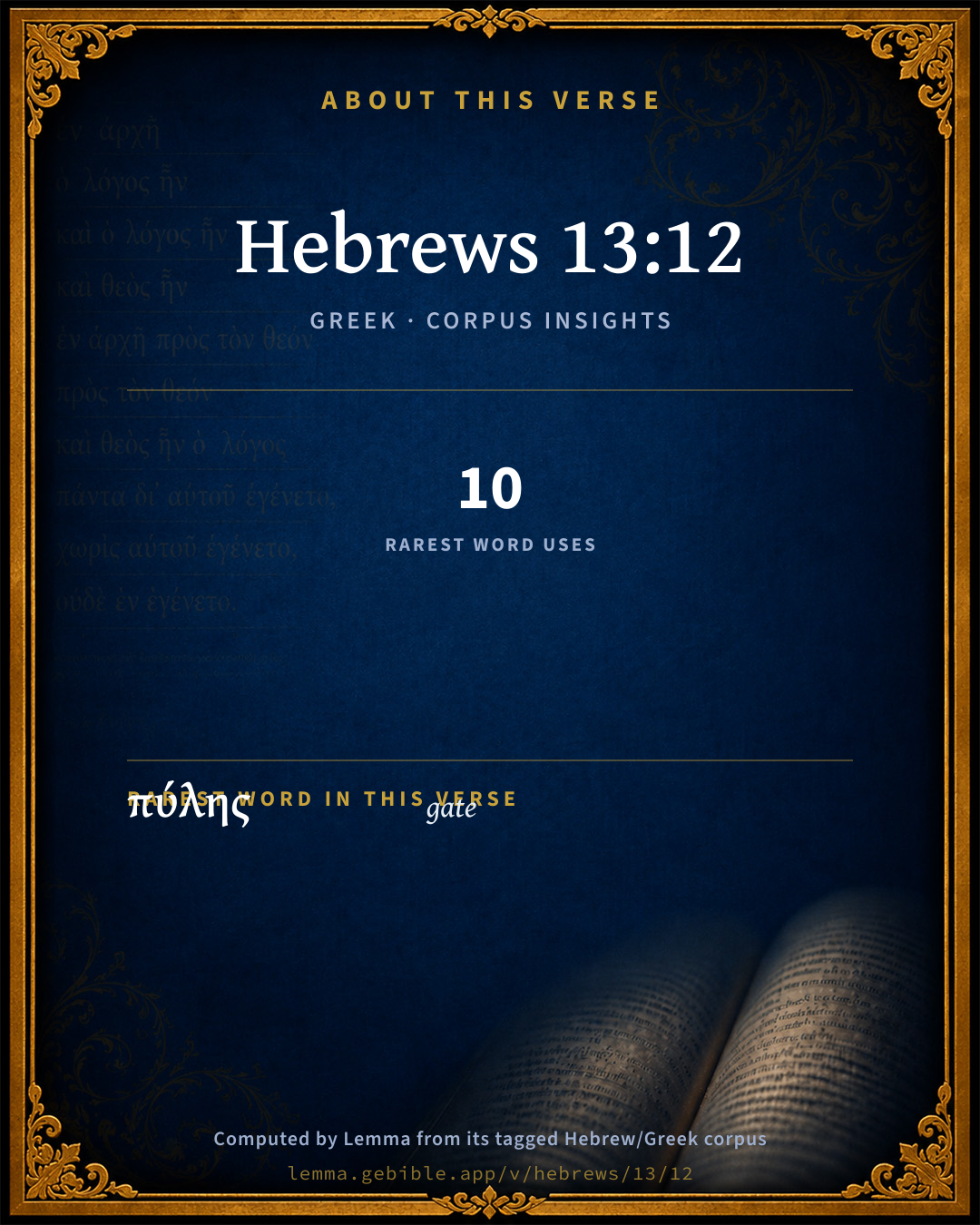
Hebrews 13:12

Greek (Tischendorf 8th ed.) Hebrews 13:12 appears in the Greek New Testament. The text above is from the Tischendorf 8th edition. Each word links to its Strong’s number and a concise gloss. Click any word for its full Thayer’s Greek Lexicon entry.
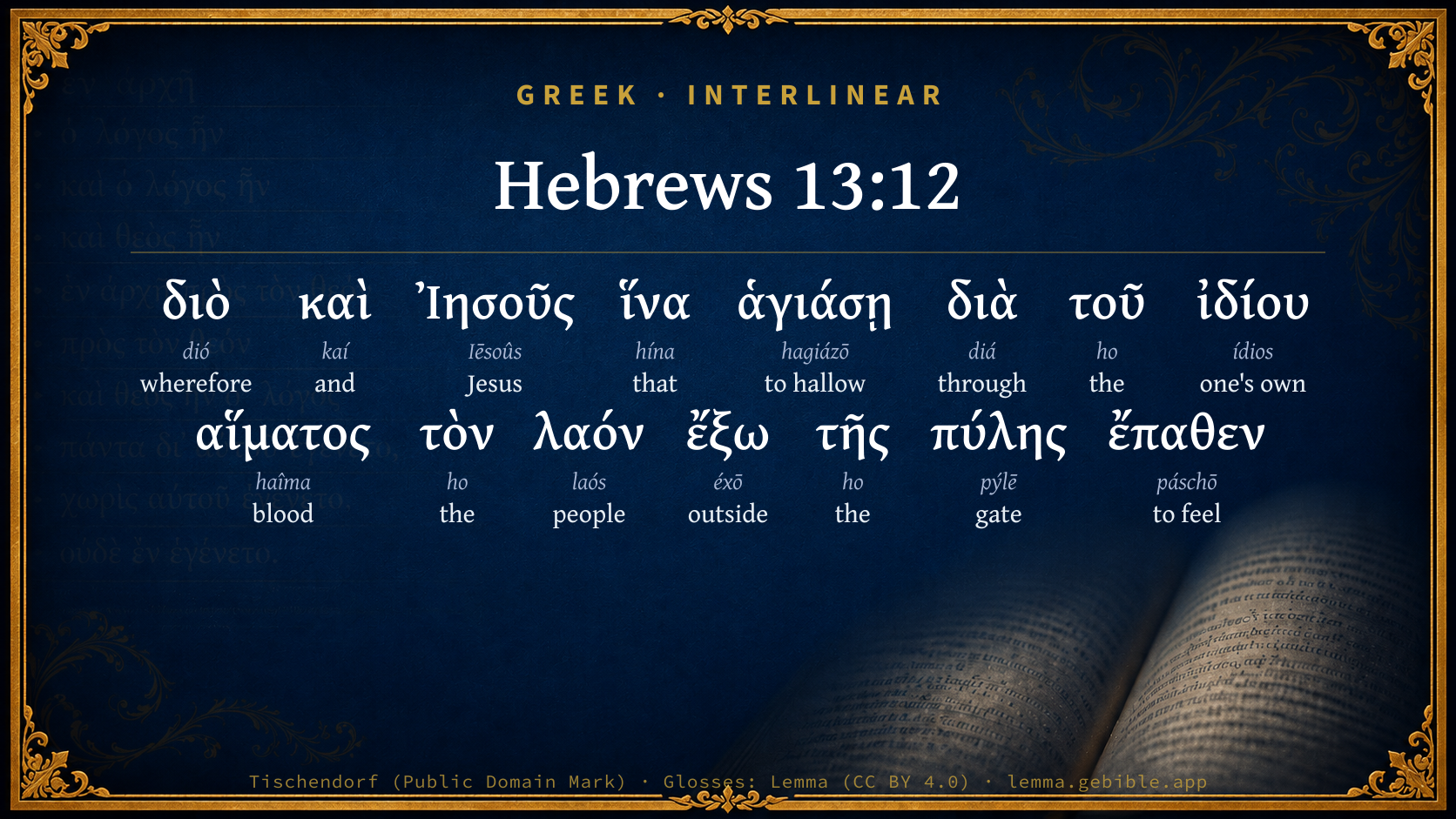
Download image
Cite this verse

Hebrews 13:12 (World English Bible). Public Domain. Lemma interlinear Bible study tool, https://lemma.gebible.app/v/hebrews/13/12.

Show BibTeX & RIS
BibTeX
RIS
English Translation
Therefore Jesus also, that he might sanctify the people through his own blood, suffered outside of the gate.
World English Bible · Public Domain
Download a study sheet

One document with this verse’s original text, its word-by-word gloss line, the meaning frame, cross-references with their text, attributed commentary, and full source and license credits — printable, and it pastes into notes with its structure intact.

This verse Autodidact and up

Study sheet (.html) Plain text (.txt)

A passage Seminary Student

Up to 50 verses in one chapter. A passage sheet keeps up to 6 commentary sources and 12 cross-references per verse, in the order this page ranks them, and says so on the sheet whenever that leaves anything out. Ask for a single verse and you get the Autodidact verse sheet above.

Everything on this page stays free to read, with no account — the sheet is a download of what is already on screen, not access to it.

Want to remove ads? Support Godless Engineer
Compare translations 3

The same verse in 3 English versions, stacked beneath the original-language interlinear above. Click any original word for its lexicon entry.

Each is an independent rendering of the whole verse — the interlinear is not word-aligned to these translations.

Highlighted words mark where these versions differ — a whole-verse word diff, not a word-by-word alignment.

  • World English Bible Public Domain
    Therefore Jesus also, that he might sanctify the people through his own blood, suffered outside of the gate.
  • King James Version Public Domain
    Wherefore Jesus also, that he might sanctify the people with his own blood, suffered without the gate.
  • unfoldingWord Literal Text CC BY-SA 4.0
    So Jesus also suffered outside the gate, so that he might sanctify the people through his own blood.

unfoldingWord Literal Text — © unfoldingWord, licensed CC BY-SA 4.0. Word-aligned USFM3 via Door43 (git.door43.org/unfoldingWord/en_ult).

Versions to compare (up to 4)

3 of 4 selected

Show all 19 translations

Every available English version of this verse, each an independent rendering of the whole verse.

  • World English Bible Public Domain
    Therefore Jesus also, that he might sanctify the people through his own blood, suffered outside of the gate.
  • Berean Standard Bible Public Domain
    And so Jesus also suffered outside the city gate, to sanctify the people by His own blood.
  • Majority Standard Bible Public Domain
    And so Jesus also suffered outside the city gate, to sanctify the people by His own blood.
  • King James Version Public Domain
    Wherefore Jesus also, that he might sanctify the people with his own blood, suffered without the gate.
  • American Standard Version (1901) Public Domain
    Wherefore Jesus also, that he might sanctify the people through his own blood, suffered without the gate.
  • Revised Version (1885) Public Domain
    Wherefore Jesus also, that he might sanctify the people through his own blood, suffered without the gate.
  • Geneva Bible (1599) Public Domain
    Therefore euen Iesus, that he might sanctifie the people with his owne blood, suffered without the gate.
  • Douay-Rheims (1899) Public Domain
    Wherefore Jesus also, that he might sanctify the people by his own blood, suffered without the gate.
  • Young's Literal Translation Public Domain
    Wherefore, also Jesus -- that he might sanctify through `his' own blood the people -- without the gate did suffer;
  • Literal Standard Version CC BY-SA 4.0
    For this reason, also Jesus—that He might sanctify the people through [His] own blood—suffered outside the gate;
  • Unlocked Literal Bible CC BY-SA 4.0
    So Jesus also suffered outside the city gate, in order to sanctify the people through his own blood.
  • unfoldingWord Literal Text CC BY-SA 4.0
    So Jesus also suffered outside the gate, so that he might sanctify the people through his own blood.
  • Darby Bible Public Domain
    Wherefore also Jesus, that he might sanctify the people by his own blood, suffered without the gate:
  • World Messianic Bible Public Domain
    Therefore Yeshua also, that he might sanctify the people through his own blood, suffered outside of the gate.
  • Webster's Bible Public Domain
    Wherefore Jesus also, that he might sanctify the people with his own blood, suffered without the gate.
  • Free Bible Version CC BY-SA 4.0
    In the same way Jesus also died outside the city gate so that he could make God's people holy through his own blood.
  • Bible in Basic English Public Domain
    For this reason Jesus was put to death outside the walls, so that he might make the people holy by his blood.
  • Text-Critical English NT CC BY 4.0
    So Jesus also suffered outside the city gate in order to sanctify the people by his own blood.
  • Tyndale New Testament (1534) Public Domain
    Therfore Iesus to sanctifye the people with his awne bloud suffered with out the gate.

Literal Standard Version (2020), Covenant Press — licensed CC BY-SA 4.0. Text via the HelloAO Bible API (eBible.org). Unlocked Literal Bible (unfoldingWord) — licensed CC BY-SA 4.0. Text via the HelloAO Bible API (eBible.org). unfoldingWord Literal Text — © unfoldingWord, licensed CC BY-SA 4.0. Word-aligned USFM3 via Door43 (git.door43.org/unfoldingWord/en_ult). Free Bible Version, Dr. Jonathan Gallagher — licensed CC BY-SA 4.0. Text via the HelloAO Bible API (eBible.org).

Word by word

More ways to search: Search by grammar → Find every occurrence → Compare this word →

Practice this passage: Drill this verse → Learn its vocabulary →

πύλης
pýlē
G4439
“gate”
Noun, Genitive, Singular, Feminine
Part of Speech
Noun
Case
Genitive
Number
Singular
Gender
Feminine
Full Thayer's Definition

Origin: apparently a primary word

TDNT: 21:22,0

1. a gate a. of the larger sort 1. in the wall of either a city 2. a palace 3. a town 4. the temple 5. a prison 2. the gates of hell (likened to a vast prison) 3. metaph. the access or entrance into any state
  1. διὸ dió G1352 “wherefore” Conjunction
  2. καὶ kaí G2532 “and” Conjunction
  3. Ἰησοῦς Iēsoûs G2424 “Jesus” Noun, Nominative, Singular, Masculine
  4. ἵνα hína G2443 “that” Conjunction
  5. ἁγιάσῃ hagiázō G37 “to hallow” Verb, Aorist, Active, Subjunctive, 3rd person, Singular
  6. διὰ diá G1223 “through” Preposition
  7. τοῦ ho G3588 “the” Article, Genitive, Singular, Neuter
  8. ἰδίου ídios G2398 “one's own” Adjective, Genitive, Singular, Neuter
  9. αἵματος haîma G129 “blood” Noun, Genitive, Singular, Neuter
  10. τὸν ho G3588 “the” Article, Accusative, Singular, Masculine
  11. λαόν laós G2992 “people” Noun, Accusative, Singular, Masculine
  12. ἔξω éxō G1854 “outside” Adverb
  13. τῆς ho G3588 “the” Article, Genitive, Singular, Feminine
  14. ἔπαθεν páschō G3958 “to feel” Verb, Aorist, Active, Indicative, 3rd person, Singular

About this verse

These counts appear in no published source. They are computed here, from the morphology-tagged text and Lemma’s own curated glosses. What Lemma adds →

15
words
13
distinct lemmas
General Epistles
section

Notable vocabulary

The rarest word here is πύλης gate G4439 — appearing just 10 times in the whole Greek New Testament.

Shared distinctive vocabulary

πύλης gate G4439 occurs in 9 verses of the Greek New Testament. Also found in:

Repetition

A word recurs within this verse:

Cross-references

15

Topical passages linked to Hebrews 13:12 in the Treasury of Scripture Knowledge — connected by theme and wording, ordered by reader-vote popularity; previews shown in the World English Bible.

  • Hebrews 9:12–14 nor yet through the blood of goats and calves, but through his own blood, entered in once for all into the Holy Place, having obtained eternal redemption.
  • John 19:17–18 He went out, bearing his cross, to the place called "The Place of a Skull," which is called in Hebrew, "Golgotha,"
  • Mark 15:20–24 When they had mocked him, they took the purple off of him, and put his own garments on him. They led him out to crucify him.
  • Acts 7:58 They threw him out of the city, and stoned him. The witnesses placed their garments at the feet of a young man named Saul.
  • 1 Corinthians 6:11 Such were some of you, but you were washed. But you were sanctified. But you were justified in the name of the Lord Jesus, and in the Spirit of our God.
  • Leviticus 24:23 Moses spoke to the children of Israel; and they brought forth him who had cursed out of the camp, and stoned him with stones. The children of Israel did as Yahweh commanded Moses.
  • Numbers 15:36 All the congregation brought him outside of the camp, and stoned him to death with stones; as Yahweh commanded Moses.
  • John 19:34 However one of the soldiers pierced his side with a spear, and immediately blood and water came out.
  • Ephesians 5:26 that he might sanctify it, having cleansed it by the washing of water with the word,
  • Hebrews 10:29 How much worse punishment, do you think, will he be judged worthy of, who has trodden under foot the Son of God, and has counted the blood of the covenant with which he was sanctified an unholy thing, and has insulted the Spirit of grace?
  • Joshua 7:24 Joshua, and all Israel with him, took Achan the son of Zerah, and the silver, and the mantle, and the wedge of gold, and his sons, and his daughters, and his oxen, and his donkeys, and his sheep, and his tent, and all that he had: and they brought them up to the valley of Achor.
  • John 17:19 For their sakes I sanctify myself, that they themselves also may be sanctified in truth.
  • 1 John 5:6–8 This is he who came by water and blood, Jesus Christ; not with the water only, but with the water and the blood. It is the Spirit who testifies, because the Spirit is the truth.
  • Hebrews 2:11 For both he who sanctifies and those who are sanctified are all from one, for which cause he is not ashamed to call them brothers,
  • Hebrews 9:18–19 Therefore even the first covenant has not been dedicated without blood.

Cross-references courtesy of OpenBible.info (CC BY 4.0).

Commentary

Notes on Hebrews 13:12 from classic Christian and Jewish commentators (each source and its license shown beneath its notes). The classic Christian expositions comment on the surrounding passage and are grouped to its opening verse, so a note may address several verses; the Jewish commentaries on the Tanakh (Rashi and others) are per-verse, so they appear only where the commentator wrote on this verse.

Lemma curates 59 commentaries, every one of them public domain or Creative Commons licensed, each selected and text-cleaned for this edition rather than reprinted as found. About our sources →

Joseph Benson's Commentary

Heb 13:12-14. Wherefore Jesus also — Who was typified by these sin- offerings; that he might sanctify — Might make atonement for, and consecrate to God; the people — His church, the spiritual Israel of God; with his own blood — Carried into the heavenly sanctuary, and presented before the throne of God as a sin-offering; suffered without the gate — Of Jerusalem, as the bodies of the sin-offerings were burned without the camp of Israel in the wilderness, signifying hereby that those carnal Jews, who still adhered to the Mosaical way of worship, had no interest in, nor communion with Christ, nor partook of the benefits of his atonement. The Israelites having cities to live in at the time our Lord suffered, the expression, without the gate, was of the same import as without the camp in the wilderness. Wherefore criminals, being regarded as unclean, were always put to death without the gates of their cities. Let us, &c. — As if he had said, And this consideration, as it shows it to be our duty to leave the Jewish sacrifices, so it should undoubtedly engage us willingly to suffer all extremities in his cause; Let us therefore break through all attachments, and go forth unto him without the camp — The terrestrial Jerusalem; the Jewish Church, with its ceremonious services; let us cleave to him and his doctrine, and openly profess ourselves his disciples; bearing his reproach — Patiently enduring all manner of shame, obloquy, and contempt, and whatever other suffering may await us, for his sake. And we have the more reason to do this; for here we have no continuing city — No settled condition, no lasting place of abode; all things here are but for a moment; and the interests of this mortal life, as they are very uncertain, and of short duration, so they are very trivial, when compared with those that relate to eternity. It is thought by some, that in this the apostle had the destruction of Jerusalem in his eyes which happened about seven or eight years after this epistle was written; but we seek one to come — Namely, the city of the living God; a city prepared for us, and promised to us, as the place of our everlasting abode.

Joseph Benson's Commentary on the Old and New Testaments (1811–1818) — public domain. Text from a community e-Sword module.

Bengel's Gnomon

Johann Albrecht Bengel

Heb 13:12. Ἵνα ἁγιάσῃ) that He might sanctify, might cleanse from sins, might lead (bring) from the world to GOD. This corresponds to ἅγια, Heb 13:11.—ἰδίον, His own) An antithesis to, of animals.—αἵματος, blood) The mention of the body is implied in the verb, He suffered; and accordingly the 11th verse, respecting the blood of animals and their bodies, has its Apodosis here, in the 12th verse.—τὸν λαὸν, the people) ch. Heb 2:17.—ἔξω τῆς πύλης, without the gate) as if He had been deemed unworthy of the companionship of men; Mat 27:32. Comp. Lev 24:13. He suffered without the gate of the city (although the apostle purposely (skilfully) abstains from the use of the word, city), which city itself was like the camp in the wilderness, and had the temple, as the camp had the tabernacle.—ἔπαθε, He suffered) The type of the passion was the burning of the victims. The passion, properly, is that on the cross, without the gate.

Bengel's Gnomon of the New Testament — English translation (T&T Clark, Edinburgh, 1860) — public domain. Text from a community e-Sword module.

Jamieson, Fausset & Brown

Robert Jamieson, A. R. Fausset & David Brown

Wherefore Jesus--In order that the Antitype might fulfil the type.

sanctify--Though not brought into the temple "sanctuary" (Heb 13:11) His blood has been brought into the heavenly sanctuary, and "sanctifies the people" (Heb 2:11, Heb 2:17), by cleansing them from sin, and consecrating them to God.

his own--not blood of animals.

without the gate--of Jerusalem; as if unworthy of the society of the covenant-people. The fiery ordeal of His suffering on the cross, answers to the burning of the victims; thereby His mere fleshly life was completely destroyed, as their bodies were; the second part of His offering was His carrying His blood into the heavenly holiest before God at His ascension, that it should be a perpetual atonement for the world's sin.

Jamieson, Fausset & Brown — Commentary Critical and Explanatory on the Whole Bible (1871) — public domain (CC PDM 1.0). Text via the HelloAO Bible API.

Adam Clarke's Commentary

Verse 12. That he might sanctify the people] That he might consecrate them to God, and make an atonement for their sins, he suffered without the gate at Jerusalem, as the sin-offering was consumed without the camp when the tabernacle abode in the wilderness. Perhaps all this was typical of the abolition of the Jewish sacrifices, and the termination of the whole Levitical system of worship. He left the city, denounced its final destruction, and abandoned it to its fate; and suffered without the gate to bring the Gentiles to God.

Adam Clarke's Commentary on the Bible (1810–1826) — public domain. Text from a community e-Sword/MySword module.

Ellicott's Commentary for English Readers

(12) The sin-offering was burned without the camp. Jesus who in all other points fulfilled the law of atonement fulfilled it in this point also, in that He suffered “without the gate” (Mat_27:32; Joh_19:20). The two expressions answer to one another, each denoting that which lay beyond the sacred precincts, outside the special dwelling-place of God’s people. “The people,” see Heb_2:17; “sanctify,” Heb_2:11; Heb_9:13; Heb_10:10.

A Bible Commentary for English Readers, edited by Charles John Ellicott (1878–1897) — public domain. Text from a community e-Sword module.

The Cambridge Bible for Schools and Colleges

gen. ed. J. J. S. Perowne

12. that he might sanctify the people with his own blood] Lit. “through,” or “by means of His own blood.” The thought is the same as that of Tit_2:14, “Who gave Himself for us that He might redeem us from all iniquity, and purify unto Himself a peculiar people.” This sanctification or purifying consecration of His people by the blood of His own voluntary sacrifice corresponds to the sprinkling of the atoning blood on the Propitiatory by the High Priest. For “the people,” see Heb_2:16.

suffered without the gate] Heb_9:26; Mat_27:32; Joh_19:17-18.

The Cambridge Bible for Schools and Colleges (gen. ed. J. J. S. Perowne; Cambridge University Press, 1878–1918) — public domain. Text from a community e-Sword module.

John Gill's Exposition

Wherefore Jesus also,.... In order to answer the type of him;

that he might sanctify the people with his own blood: by "the people" are meant the people who are the objects of divine love and favour; a chosen and covenant people; a distinct and peculiar people; Christ's own special people, by the gift of his Father to him: and the sanctification of them does not design the internal sanctification of them, though this is from Christ, and in consequence of his blood; nor does it so much regard the cleansing of the filth of sin, though Christ's blood sanctifies, in this sense; but rather the expiation of the guilt of sin, which Christ has fully took away; complete pardon being procured, and a perfect righteousness brought in: and this by "his own blood"; the priests sanctified, to the purifying of the flesh, with the blood of others, with the blood of bulls and goats; but Christ with his own blood, which he was, really, a partaker of; and his human nature, being in union with his divine person, as the Son of God, it had a virtue in it, to sanctify and cleanse from all sin, and to make full expiation of it; in shedding of which, and sanctifying with it, he has shown great love to his people: and, that he might do this agreeably to the types of him on the day of atonement, he

suffered without the gate; that is, of Jerusalem: the Syriac version reads, "without the city"; meaning Jerusalem; which answered to the camp of Israel, in the wilderness; without which, the bodies of beasts were burnt, on the day of atonement: for so say (z) the Jews;

"as was the camp in the wilderness, so was the camp in Jerusalem; from Jerusalem to the mountain of the house, was the camp of Israel; from the mountain of the house to the gate of Nicanor, was the camp of the Levites; and from thence forward, the camp of the Shechinah, or the divine Majesty:''

and so Josephus (a) renders the phrase, without the camp, in Lev 16:27 by ; "in the suburbs"; that is, of Jerusalem, where Christ suffered,

(z) T. Bab. Zebachim, fol. 116. 2. Bemidbar Rabba, sect. 7. fol. 188. 3. 4. Maimon. Beth Habbechira, c. 7. sect. 11. (a) Antiqu. l. 3. c. 10. sect. 3.

John Gill's Exposition of the Whole Bible (1746–1763) — public domain (CC PDM 1.0). Text via the HelloAO Bible API.

Trapp's Complete Commentary

John Trapp

12 Wherefore Jesus also, that he might sanctify the people with his own blood, suffered without the gate.

Ver. 12. Without the gate] See how punctually the Old Testament is fulfilled in the New. Hardly could those before Christ divine what this meant, till he had suffered it, and the apostle had opened it. Event is the best key to types and prophecies.

John Trapp, A Commentary or Exposition upon All the Books of the Old and New Testament (1647–1656) — public domain. Text from a community e-Sword module.

Albert Barnes' Notes on the Bible

Wherefore, Jesus also, that he might sanctify the people with his own blood - That there might be a conformity between his death for sin and the sacrifices which typified it. It is implied here that it was voluntary on the part of Jesus that he suffered out of the city; that is, it was so ordered by Providence that it should be so. This was secured by his being put to death as the result of a judicial trial, and not by popular tumult; see the notes on Isa 53:8. If he had been killed in a tumult, it is possible that it might have been done as in other cases (compare the case of Zacharias son of Barachias, Mat 23:35), even at the altar. As he was subjected, however, to a judicial process, his death was effected with more deliberation, and in the usual form. Hence, he was conducted out of the city, because no criminal was executed within the walls of Jerusalem.

Without the gate - Without the gate of Jerusalem; Joh 19:17-18. The place where he was put to death was called Golgotha, the place of a skull, and hence, the Latin word which we commonly use in speaking of it, Calvary, Luk 23:33; compare notes on Mat 27:33. Calvary, as it is now shown, is within the walls of Jerusalem, but there is no reason to believe that this is the place where the Lord Jesus was crucified, for that was outside of the walls of the city. The precise direction from the city is not designated by the sacred writers, nor are there any historical records, or traditional marks by which it can now be known where the exact place was. All that we know on the subject from the New Testament is, that the name was Golgotha; that the place of the crucifixion and sepulchre were near each other; that they were without the gate and nigh to the city, and that they were in a frequented spot; Joh 19:20. “This would favor the conclusion that the place was probably upon a great road leading from one of the gates: and such a spot would only be found upon the western or northern sides of the city, on the roads leading toward Joppa or Damascus.” See the question about the place of the crucifixion examined at length in Robinson’s Bibli. Research., vol. ii. pp. 69-80, and Bibliotheca Sacra, No. 1.

Albert Barnes' Notes on the Bible (1834–1885) — public domain. Text from a community e-Sword/MySword module.

Matthew Poole's English Annotations

Because that sacrifice for sin was burnt without the camp, therefore Jesus, to fulfil the type,

suffered without the gate; and as they might not eat of that expiatory sacrifice, so neither of this. Jesus, therefore, to fulfil this type, suffered without the gates of Jerusalem, upon Mount Calvary, where skulls and bones of cursed creatures were scattered; as the expiatory sacrifices were burnt without the camp, when Israel was tabernacling within it; without the gates, when Israel dwelt in cities. As the high priest carried the expiatory blood into the holiest of all, on the day of atonement; so Christ with his own blood entered the holiest in heaven, and by it obtained pardon of sin, peace of conscience, and renewing by the Holy Ghost, for all people who repent, believe, and will come unto God by him. Therefore those who will still Judaize, have no right to eat of his sacrifice, no more than of the expiatory one, which was wholly burnt: so that they were not to be justified by meats and ceremonies, but by the blood of Christ alone, the truth of all the sacrifices, Rom 3:25; 5:9; Joh 1:29.

Matthew Poole's English Annotations on the Holy Bible (1683–1685) — public domain. Text from a community e-Sword/MySword module.

Whedon's Commentary on the Bible

Daniel D. Whedon

12. Jesus, the antitype, in like manner suffered without the gate. Herein was pictured the divine secession from Judaism. The true sacrifice was limited by no city walls; was housed into no tabernacle or temple; was universal as the sky beneath which it was transacted.

Daniel D. Whedon (gen. ed.), Commentary on the Old and New Testaments (1874–1909) — public domain. Text from a community e-Sword module.

John Wesley's Explanatory Notes

Wherefore Jesus also - Exactly answering those typical sin- offerings. Suffered without the gate - Of Jerusalem, which answered to the old camp of Israel. That he might sanctify - Reconcile and consecrate to God. The people - Who believe in him. By his own blood - Not those shadowy sacrifices, which are now of no further use.

John Wesley, Explanatory Notes Upon the Whole Bible (1754–1765) — public domain. Text via the GEBible commentary corpus.

The People's New Testament

B. W. Johnson

12. Wherefore Jesus also. In order to cleanse his people by becoming the complete atonement he was willing, as an accursed thing, a sin offering, to be led without the gate and to suffer there.

B. W. Johnson's The People's New Testament with Notes (1889–1891) — public domain. Electronic text from the Christian Classics Ethereal Library (CCEL) ThML edition.

unfoldingWord translationNotes

Door43 World Missions Community

Connecting Statement:

There is a comparison here between Jesus' sacrifice and the tabernacle sacrifices of the Old Testament.

So

"In the same way" or "Because the bodies of the sacrifices were burned outside the camp" (Hebrews 13:11)

outside the city gate

This stands for "outside the city." (See: Metonymy)

Let us therefore go to him outside the camp

Obeying Jesus is spoken of as if a person were leaving the camp to go out where Jesus is. (See: Metaphor)

bearing his shame

Disgrace is spoken of as if it were an object that had to be carried in one's hands or on one's back. AT: "while allowing others to insult us just like people insulted him" (See: Metaphor)

looking for

"waiting for"

translationWords

Jesus

suffer

gate

sanctify

blood

shame

unfoldingWord translationNotes — © Distant Shores Media and the Door43 World Missions Community, licensed CC BY-SA 4.0. Source: git.door43.org/Door43/en_tn.

Cambridge Greek Testament for Schools and Colleges

12. διὰ τοῦ ἰδίου αἵματος. Lit., “through,” or “by means of His own blood.” The thought is the same as that of Tit 2:14, “Who gave Himself for us that He might redeem us from all iniquity, and purify unto Himself a peculiar people.” This sanctification or purifying consecration of His people by the blood of His own voluntary sacrifice corresponds to the sprinkling of the atoning blood on the propitiatory by the High-priest. For “the people,” see Heb 2:17.

ἔξω τῆς πύλης. Heb 9:26; Mat 27:32; Joh 19:17-18.

Cambridge Greek Testament for Schools and Colleges (Cambridge University Press, 1896; 21 vols, various authors incl. Carr, Maclear, Plummer, Farrar, Lumby, Moule, M. R. James, Simcox) — public domain. Text from a community e-Sword module.

Alford’s Greek Testament

Henry Alford

12.] Wherefore (as being the antitype of the sin-offering on the day of atonement: “ut ille typus veteris testamenti impleretur, illa figura quæ est de carnibus extra castra comburendis,” Est.) Jesus also, that He might sanctify (see on ch. 2:11) the people (see on ch. 2:17) through His own blood, suffered (see on ch. 9:26 on the absolute meaning of παθεῖν) outside the gate (ἔξω τῆς πόλεως Ἱερουσαλήμ, Œc. It is necessary in order to understand this rightly, to trace with some care the various steps of the symbolism. The offering of Christ consists of two parts: 1. His offering on earth, which was accomplished on the cross, and answered to the slaying of the legal victim and the destruction of its body by fire, the annihilation of the fleshly life; and, 2. His offering in the holy place above, which consisted in His entering heaven, the abode of God, through the veil, that is to say His flesh, and carrying His blood there as a standing atonement for the world’s sin. This, the sanctifying of the people through His own blood, was the ulterior end of that sacrifice on earth: and therefore whatever belonged to that sacrifice on earth is said to have been done in order to that other. This will sufficiently account for the telic clause here, without making it seem as if the ultimate end, the sanctification of God’s people, depended on the subordinate circumstance of Christ’s having suffered outside the gate. It did depend on the entire fulfilment by Him of all things written of Him in the law: and of them this was one).

Henry Alford, The Greek Testament (1849–1861) — public domain. Text from a community e-Sword module.

Vincent's Word Studies in the New Testament

Marvin R. Vincent

That he might sanctify the people [ινα αγιαση τον λαον] . Agiazein to sanctify had a peculiar significance to Jews. It meant to set them apart as holy. Hence, the Israelites were called agioi, as separated from other nations and consecrated to God. Our writer extends the application of the word to Christians. For Christ 's work he claims the same efficacy which the Jew claimed for the special call of God to Israel, and for the operation of the Jewish sacrificial system. The office of his atoning work is to sanctify; to make for himself a holy nation [εθνος αγιον] , a people "prepared for the Lord" (Luk 1:17); a true Israel of God. O laov the people, or laov my people, occurs constantly in O. T. as a designation of Israel, and also in N. T. See, in this epistle, ch. Heb 5:3; Heb 7:5, 11, 27; Heb 9:7, 19. The N. T. extends the title to all who, under the new dispensation, occupy the position of Israel. See 1Pe 2:10; Mt 1:21; Luk 2:10; Heb 4:9; Heb 8:10; Heb 10:30; Heb 11:25.

With his own blood [δια του ιδιου αιματος] . In contrast with the blood of animal - sacrifices. Comp. ch. Heb 9:12, 28.

Suffered [επαθεν] . Used of Christ in Hebrews, 1st Peter, and Acts, but not in Paul, who, however, has paqhmata tou Cristou sufferings of Christ, 2Co 1:5; Phi 3:10 [αυτου] .

Without the gate [εξω της πυλης] . Gate is substituted for camp (ver. 11), as more appropriate to a city.

Marvin R. Vincent, Word Studies in the New Testament (1887–1900) — public domain. Text from a community e-Sword/MySword module.

Westcott on Hebrews & the Epistles of John

Brooke Foss Westcott

12. διὸ καὶ “Incots] Wherefore Jesus also—the Lord truly man—the sin-offoring for humanity—in ordor that 119 might so fulfil the symbolism of tho Law and sanctify the pooplo by Ilis Blood, suffered without the gate. Evon as the Levitical Highpriest entered into the Sanctuary through the blood of the atoning victims while their bodies were burnt without, Jesus as our High-priest entered through His own Blood into heaven; and His mortal Body, laid in the grave, was glorified, consumod, so to speak, by the divine fire which transfigured it. In both respects He satisfied completely the thoughts suggostod by tho typo.

ἵνα ἀγ....τὸν λαόν] that fe might sanctify the people, those who are truly Israel (c. ii. 17 note), through His own blood as contrasted with the blood of victims: o ix. 12. By His death on the Cross Christ not only ‘made purification of sins’ (i. 3), but He also ‘sanctified’ His people. In the offering of Himself, He offered them also, as wholly devoted to God. His blood became the blood of a New Oovenant (x. 29) by which the privilege of sonship was restored to men in the Son through His offered life (x. 10); and the Oovenant sacrifice became the groundwork of a feast (comp. Ex. xxiv. 8, 11),

which occurs immediately before and after, is remarkable. Πύλη suggests the idea of ‘the city,’ rather than that of the camp, and so points to the fatal error of later Judaism, which by seeking to give permanence to that which was clesigned to be transitory marred the conception of the Law. In this

the variant πόλεως (comp. Tert. ado. Jud. 14) is of interest.

The fact that the Lord suffered ‘without the gate’ (Lev. xxiv. 14; Num. xv. 35) is implied in John xix. 17, but it is not expressly stated.

The work of Christ, so far as it was wrought on earth, found its consummation outside the limits of the symbolical dwelling-place of the chosen people. It had a meaning confined within no such boundaries. The whole earth was the scene of ite efficacy. So also in tho new Jerusalom thoro is no sanctuary (Apoc. xxi. 22) The whole city is αὶ Temple and God Himself is present there.

13,14. Christ—not a dead victim merely but the living leader—is represented as ‘outside thecamp,’ outside the old limite of Israel, waiting to receive His people, consumed and yet unconsumed. Therefore, the Apostle concludes, even now let us be on our way to Him, carrying His reproach,

and abandoning not only the ‘city,’ which mon made as the permancnt homo for God, but aleo moving to something better than ‘the camp,’ in which Israel was organised. No Jew could partake of that typical sacrifice which Ohrist fulfilled: and Christians therefore must abandon Judaism to realise the full power of His work. In this sense ‘it is oxpedient’ that they also ‘ should go away,’ in order to realise the fulness of their spiritual heritage.

It is worthy of notice that the first tabernacle which Moses set up was ‘outside the camp’ (Ex. xxxiii. 7): ‘and it came to pase that every one which sought the Lord went out unto the tabernacle of the congregation which was without the camp.’ The history is obscure, but as it stands it is significant in connexion with the language of the Epistle.

Brooke Foss Westcott (1825–1901), The Epistle to the Hebrews (1889) and The Epistles of St John (1883) — public domain (pre-1929). Text recovered from Internet Archive / Google Books OCR scans. Westcott’s Gospel of John commentary is not included (its OCR lost the chapter running-heads required for reliable verse-keying). Some Greek quoted in the Hebrews volume is imperfectly rendered by the OCR.

Lesson kit

Teaching starters — assembled from the data on this page, not authored interpretation. Every prompt links to the verse data it draws on. Edit before teaching.

Hebrews, in the General Epistles, opens this verse with 15 words (13 distinct Greek lemmas). Its most distinctive word is pýlē (“gate”). A historical commentator’s framing appears above. Read the whole chapter for the surrounding context.

Discussion questions

  1. What does “gate” (pýlē) contribute to the verse as a whole?
  2. How does Matthew 7:13, which shares the word «gate», read alongside this verse?
  3. What does the repetition of “the” (3× in this one verse) do in this verse?
  4. These translations render this verse differently. What is at stake in choosing one wording over another?
  5. Compare how Joseph Benson's Commentary and Bengel's Gnomon read this verse. Where do they agree or differ?

Things to notice

Reading settings

Reading text

Shown beneath each verse's original-language words.

Old Testament
Old Testament edition

Read the OT as the Masoretic Hebrew (MT) or the Greek Septuagint (LXX).

English shown for the Greek Septuagint (in the Hebrew ↔ Greek comparison).

Comparing translations? Open the Compare panel on any verse page to stack up to four side by side.