

Hebrews 6:8
Greek (Tischendorf 8th ed.) Hebrews 6:8 appears in the Greek New Testament. The text above is from the Tischendorf 8th edition. Each word links to its Strong’s number and a concise gloss. Click any word for its full Thayer’s Greek Lexicon entry.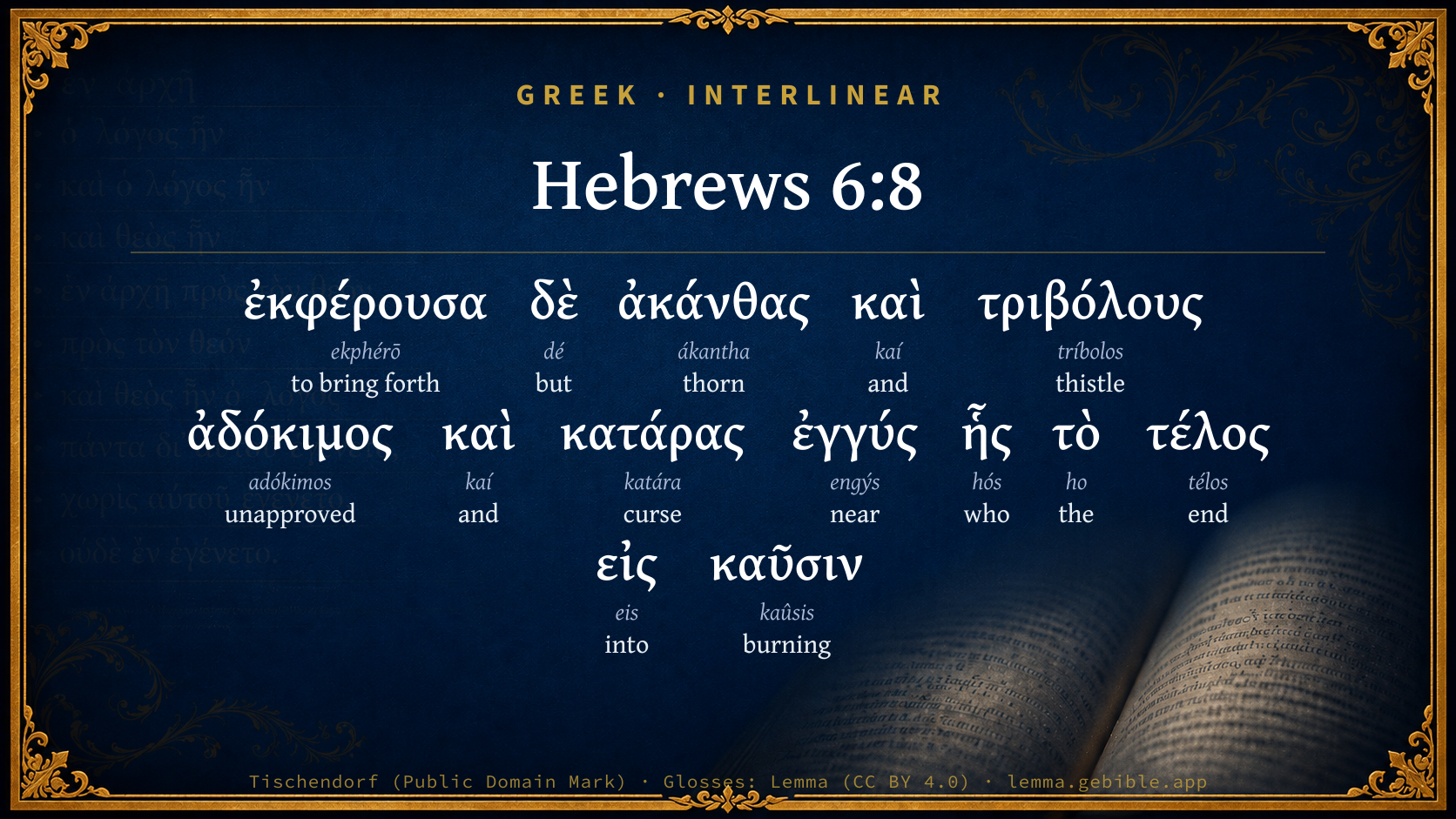
but if it bears thorns and thistles, it is rejected and near being cursed, whose end is to be burned.
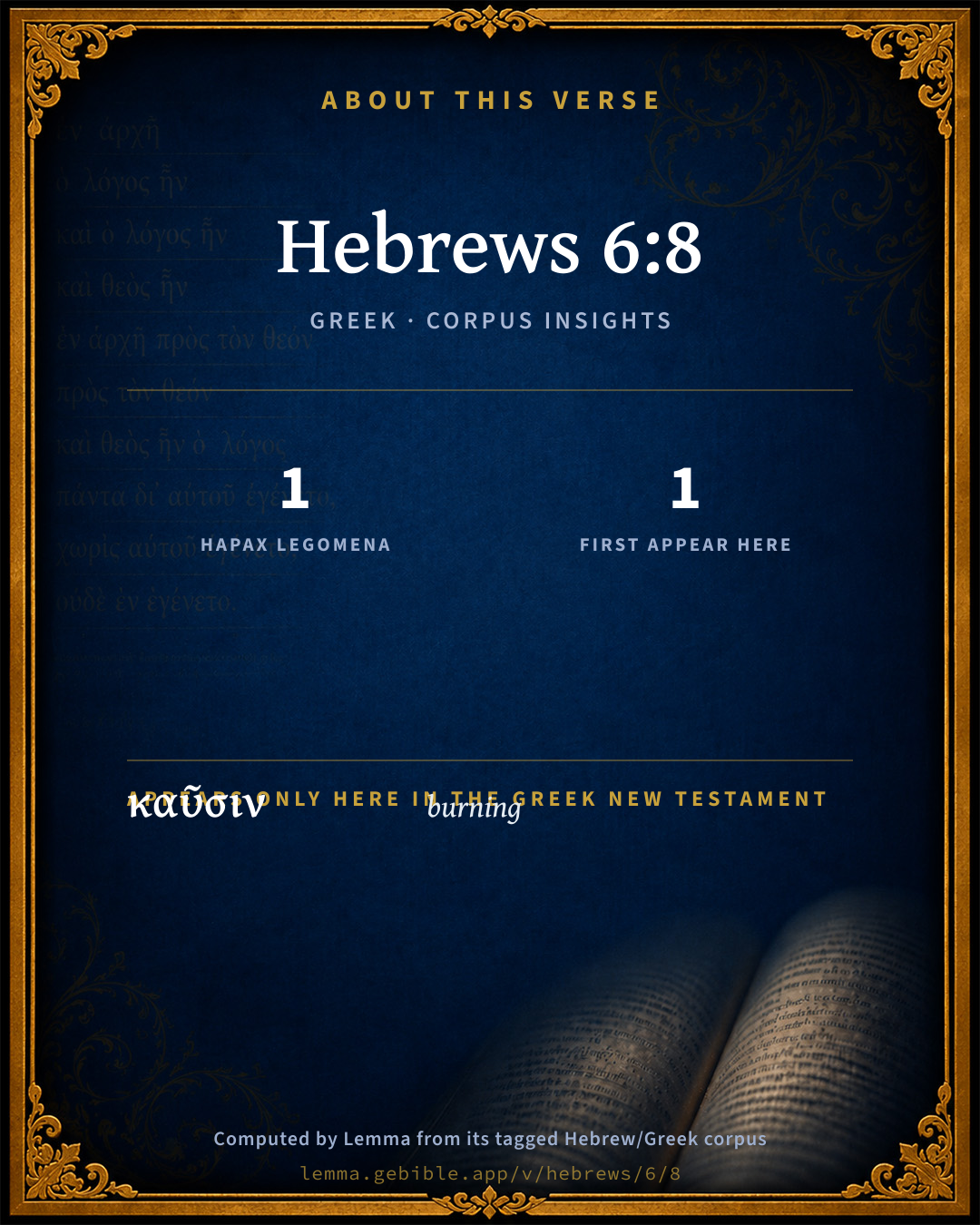
- 1 hapax legomenon — only here in the Greek New Testament
- 1 first appearance in the Greek New Testament
Download a study sheet
One document with this verse’s original text, its word-by-word gloss line, the meaning frame, cross-references with their text, attributed commentary, and full source and license credits — printable, and it pastes into notes with its structure intact.
This verse Autodidact and up
A passage Seminary Student
Up to 50 verses in one chapter. A passage sheet keeps up to 6 commentary sources and 12 cross-references per verse, in the order this page ranks them, and says so on the sheet whenever that leaves anything out. Ask for a single verse and you get the Autodidact verse sheet above.
Everything on this page stays free to read, with no account — the sheet is a download of what is already on screen, not access to it.
Compare translations 3
The same verse in 3 English versions, stacked beneath the original-language interlinear above. Click any original word for its lexicon entry.
Each is an independent rendering of the whole verse — the interlinear is not word-aligned to these translations.
Highlighted words mark where these versions differ — a whole-verse word diff, not a word-by-word alignment.
-
World English Bible Public Domain
but if it bears thorns and thistles, it is rejected and near being cursed, whose end is to be burned.
-
King James Version Public Domain
But that which beareth thorns and briers is rejected, and is nigh unto cursing; whose end is to be burned.
-
unfoldingWord Literal Text CC BY-SA 4.0
but producing thorns and thistles, worthless and close to a curse, the end of which for burning.
unfoldingWord Literal Text — © unfoldingWord, licensed CC BY-SA 4.0. Word-aligned USFM3 via Door43 (git.door43.org/unfoldingWord/en_ult).
Show all 19 translations
Every available English version of this verse, each an independent rendering of the whole verse.
-
World English Bible Public Domain
but if it bears thorns and thistles, it is rejected and near being cursed, whose end is to be burned.
-
Berean Standard Bible Public Domain
But land that produces thorns and thistles is worthless, and its curse is imminent. In the end it will be burned.
-
Majority Standard Bible Public Domain
But land that produces thorns and thistles is worthless, and its curse is imminent. In the end it will be burned.
-
King James Version Public Domain
But that which beareth thorns and briers is rejected, and is nigh unto cursing; whose end is to be burned.
-
American Standard Version (1901) Public Domain
but if it beareth thorns and thistles, it is rejected and nigh unto a curse; whose end is to be burned.
-
Revised Version (1885) Public Domain
but if it beareth thorns and thistles, it is rejected and nigh unto a curse; whose end is to be burned.
-
Geneva Bible (1599) Public Domain
But that which beareth thornes and briars, is reproued, and is neere vnto cursing, whose end is to be burned.
-
Douay-Rheims (1899) Public Domain
But that which bringeth forth thorns and briers, is reprobate, and very near unto a curse, whose end is to be burnt.
-
Young's Literal Translation Public Domain
and that which is bearing thorns and briers `is' disapproved of, and nigh to cursing, whose end `is' for burning;
-
Literal Standard Version CC BY-SA 4.0
but that which is bearing thorns and briers [is] disapproved of, and near to cursing, whose end [is] for burning;
-
Unlocked Literal Bible CC BY-SA 4.0
But if it bears thorns and thistles, it is worthless and is near to a curse. Its end is in burning.
-
unfoldingWord Literal Text CC BY-SA 4.0
but producing thorns and thistles, worthless and close to a curse, the end of which for burning.
-
Darby Bible Public Domain
but bringing forth thorns and briars, it is found worthless and nigh to a curse, whose end [is] to be burned.
-
World Messianic Bible Public Domain
but if it bears thorns and thistles, it is rejected and near being cursed, whose end is to be burned.
-
Webster's Bible Public Domain
But that which beareth thorns and briers is rejected, and is nigh to cursing; whose end is to be burned.
-
Free Bible Version CC BY-SA 4.0
But land that only produces weeds and thorns is worthless, and is about to be condemned. In the end all that can be done is to burn it.
-
Bible in Basic English Public Domain
But if it sends up thorns and evil plants, it is of no use and is ready to be cursed; its only end is to be burned.
-
Text-Critical English NT CC BY 4.0
But land that bears thorns and thistles is worthless and on the verge of being cursed; its end is to be burned.
-
Tyndale New Testament (1534) Public Domain
But that grounde which beareth thornes and bryars is reproved and is nye vnto cursynge: whose ende is to be burned.
Literal Standard Version (2020), Covenant Press — licensed CC BY-SA 4.0. Text via the HelloAO Bible API (eBible.org). Unlocked Literal Bible (unfoldingWord) — licensed CC BY-SA 4.0. Text via the HelloAO Bible API (eBible.org). unfoldingWord Literal Text — © unfoldingWord, licensed CC BY-SA 4.0. Word-aligned USFM3 via Door43 (git.door43.org/unfoldingWord/en_ult). Free Bible Version, Dr. Jonathan Gallagher — licensed CC BY-SA 4.0. Text via the HelloAO Bible API (eBible.org).
Word by word
More ways to search: Search by grammar → Find every occurrence → Compare this word →
Practice this passage: Drill this verse → Learn its vocabulary →
- Appears 1× in the Greek New Testament
- First appears here
- Part of Speech
- Noun
- Case
- Accusative
- Number
- Singular
- Gender
- Feminine
Full Thayer's Definition
- ἐκφέρουσα ekphérō G1627 “to bring forth” Verb, Present, Active, Participle, Nominative, Singular, Feminine
- δὲ dé G1161 “but” Conjunction
- ἀκάνθας ákantha G173 “thorn” Noun, Accusative, Plural, Feminine
- καὶ kaí G2532 “and” Conjunction
- τριβόλους tríbolos G5146 “thistle” Noun, Accusative, Plural, Masculine
- ἀδόκιμος adókimos G96 “unapproved” Adjective, Nominative, Singular, Masculine
- καὶ kaí G2532 “and” Conjunction
- κατάρας katára G2671 “curse” Noun, Genitive, Singular, Feminine
- ἐγγύς engýs G1451 “near” Adverb
- ἧς hós G3739 “who” Relative pronoun, Genitive, Singular, Feminine
- τὸ ho G3588 “the” Article, Nominative, Singular, Neuter
- τέλος télos G5056 “end” Noun, Nominative, Singular, Neuter
- εἰς eis G1519 “into” Preposition
- καῦσιν kaûsis G2740 “burning” Noun, Accusative, Singular, Feminine
About this verse
These counts appear in no published source. They are computed here, from the morphology-tagged text and Lemma’s own curated glosses. What Lemma adds →
- 14
- words
- 13
- distinct lemmas
- General Epistles
- section
Notable vocabulary
1 hapax legomenon — a word that appears only here in the entire Greek New Testament:
- καῦσιν burning G2740
First appearance in Scripture
This word makes its first canonical appearance in the Greek New Testament here:
- καῦσιν burning G2740
Shared distinctive vocabulary
τριβόλους thistle G5146 occurs in 2 verses of the Greek New Testament. Also found in:
Repetition
A word recurs within this verse:
- καὶ and G2532 ×2
Cross-references
24Topical passages linked to Hebrews 6:8 in the Treasury of Scripture Knowledge — connected by theme and wording, ordered by reader-vote popularity; previews shown in the World English Bible.
- Genesis 3:17–18 To Adam he said, "Because you have listened to your wife's voice, and have eaten of the tree, of which I commanded you, saying, 'You shall not eat of it,' cursed is the ground for your sake. In toil you will eat of it all the days of your life.
- John 15:6 If a man doesn't remain in me, he is thrown out as a branch, and is withered; and they gather them, throw them into the fire, and they are burned.
- Deuteronomy 29:28 and Yahweh rooted them out of their land in anger, and in wrath, and in great indignation, and cast them into another land, as at this day.
- Luke 13:7–9 He said to the vine dresser, 'Behold, these three years I have come looking for fruit on this fig tree, and found none. Cut it down. Why does it waste the soil?'
- Isaiah 5:1–7 Let me sing for my well beloved a song of my beloved about his vineyard. My beloved had a vineyard on a very fruitful hill.
- Jeremiah 44:22 so that Yahweh could no longer bear, because of the evil of your doings, and because of the abominations which you have committed; therefore is your land become a desolation, and an astonishment, and a curse, without inhabitant, as it is this day.
- Hebrews 10:27 but a certain fearful expectation of judgment, and a fierceness of fire which will devour the adversaries.
- Hebrews 12:17 For you know that even when he afterward desired to inherit the blessing, he was rejected, for he found no place for a change of mind though he sought it diligently with tears.
- Genesis 4:11 Now you are cursed because of the ground, which has opened its mouth to receive your brother's blood from your hand.
- Genesis 5:29 and he named him Noah, saying, "This same will comfort us in our work and in the toil of our hands, because of the ground which Yahweh has cursed."
- Deuteronomy 29:22–23 The generation to come, your children who shall rise up after you, and the foreigner who shall come from a far land, shall say, when they see the plagues of that land, and the sicknesses with which Yahweh has made it sick;
- Job 31:40 Let briars grow instead of wheat, And stinkweed instead of barley." The words of Job are ended.
- Psalms 107:34 And a fruitful land into a salt waste, For the wickedness of those who dwell in it.
- Isaiah 27:10–11 For the fortified city is solitary, a habitation deserted and forsaken, like the wilderness: there shall the calf feed, and there shall he lie down, and consume the branches of it.
- Jeremiah 17:6 For he shall be like the heath in the desert, and shall not see when good comes, but shall inhabit the parched places in the wilderness, a salt land and not inhabited.
- Ezekiel 15:2–7 Son of man, what is the vine tree more than any tree, the vine-branch which is among the trees of the forest?
- Ezekiel 20:47 and tell the forest of the South, Hear the word of Yahweh: Thus says the Lord Yahweh, Behold, I will kindle a fire in you, and it shall devour every green tree in you, and every dry tree: the flaming flame shall not be quenched, and all faces from the south to the north shall be burnt thereby.
- Malachi 4:1 "For, behold, the day comes, it burns as a furnace; and all the proud, and all who work wickedness, will be stubble; and the day that comes will burn them up," says Yahweh of Hosts, "that it shall leave them neither root nor branch.
- Matthew 3:10 "Even now the axe lies at the root of the trees. Therefore, every tree that doesn't bring forth good fruit is cut down, and cast into the fire.
- Matthew 7:19 Every tree that doesn't grow good fruit is cut down, and thrown into the fire.
- Mark 11:14 Jesus told it, "May no one ever eat fruit from you again!" and his disciples heard it.
- Mark 11:21 Peter, remembering, said to him, "Rabbi, look! The fig tree which you cursed has withered away."
- Revelation 20:15 If anyone was not found written in the book of life, he was cast into the lake of fire.
- Matthew 25:41 Then he will say also to those on the left hand, 'Depart from me, you cursed, into the eternal fire which is prepared for the devil and his angels;
Cross-references courtesy of OpenBible.info (CC BY 4.0).
Lesson kit
Teaching starters — assembled from the data on this page, not authored interpretation. Every prompt links to the verse data it draws on. Edit before teaching.
Hebrews, in the General Epistles, opens this verse with 14 words (13 distinct Greek lemmas). Its most distinctive word is kaûsis (“burning”). A historical commentator’s framing appears above. Read the whole chapter for the surrounding context.
Discussion questions
- The word kaûsis carries the sense “burning.” How does it shape the verse?
- This verse holds 1 word here found nowhere else in the Greek New Testament. What might the rare word draw attention to?
- The word “burning” first appears here in Scripture. What is being introduced at this debut?
- Matthew 7:16 shares the word «thistle» with this verse. How do the two illuminate each other?
- “and” occurs 2× in this one verse. What is the effect of the repetition?
- The translations on this page render this verse differently — a whole-verse word diff, not a word-by-word alignment. What might account for the different wordings?
- Reading how Bengel's Gnomon and Meyer's Critical & Exegetical Commentary read this verse, where do the two commentators agree and where do they part?
Things to notice
- 1 word in this verse appears nowhere else in the Greek New Testament.
- 1 word makes its first canonical appearance in Scripture here.
- These translations choose different wording for 18 words in this verse.
- “and” occurs 2× in this single verse.
- 13 distinct Greek lemmas span 14 words in this verse.
Commentary
Notes on Hebrews 6:8 from classic Christian and Jewish commentators (each source and its license shown beneath its notes). The classic Christian expositions comment on the surrounding passage and are grouped to its opening verse, so a note may address several verses; the Jewish commentaries on the Tanakh (Rashi and others) are per-verse, so they appear only where the commentator wrote on this verse.
Lemma curates 59 commentaries, every one of them public domain or Creative Commons licensed, each selected and text-cleaned for this edition rather than reprinted as found. About our sources →
Bengel's Gnomon
Johann Albrecht Bengel
Bengel's Gnomon of the New Testament — English translation (T&T Clark, Edinburgh, 1860) — public domain. Text from a community e-Sword module.
Meyer's Critical & Exegetical Commentary
Heinrich August Wilhelm Meyer
Meyer — Critical and Exegetical Commentary on the New Testament — English translation by Peter Christie, edited by Frederick Crombie (T&T Clark, 1880) — public domain. Text from a community e-Sword module.
Expositor's Greek Testament
ed. W. Robertson Nicoll
The Expositor's Greek Testament, edited by W. Robertson Nicoll (1897–1910) — public domain. Text from a community e-Sword module.
Jamieson, Fausset & Brown
Robert Jamieson, A. R. Fausset & David Brown
Jamieson, Fausset & Brown — Commentary Critical and Explanatory on the Whole Bible (1871) — public domain (CC PDM 1.0). Text via the HelloAO Bible API.
Adam Clarke's Commentary
Adam Clarke's Commentary on the Bible (1810–1826) — public domain. Text from a community e-Sword/MySword module.
Ellicott's Commentary for English Readers
A Bible Commentary for English Readers, edited by Charles John Ellicott (1878–1897) — public domain. Text from a community e-Sword module.
The Cambridge Bible for Schools and Colleges
gen. ed. J. J. S. Perowne
The Cambridge Bible for Schools and Colleges (gen. ed. J. J. S. Perowne; Cambridge University Press, 1878–1918) — public domain. Text from a community e-Sword module.
John Gill's Exposition
John Gill's Exposition of the Whole Bible (1746–1763) — public domain (CC PDM 1.0). Text via the HelloAO Bible API.
Trapp's Complete Commentary
John Trapp
John Trapp, A Commentary or Exposition upon All the Books of the Old and New Testament (1647–1656) — public domain. Text from a community e-Sword module.
Albert Barnes' Notes on the Bible
Albert Barnes' Notes on the Bible (1834–1885) — public domain. Text from a community e-Sword/MySword module.
Matthew Poole's English Annotations
Matthew Poole's English Annotations on the Holy Bible (1683–1685) — public domain. Text from a community e-Sword/MySword module.
Whedon's Commentary on the Bible
Daniel D. Whedon
Daniel D. Whedon (gen. ed.), Commentary on the Old and New Testaments (1874–1909) — public domain. Text from a community e-Sword module.
John Wesley's Explanatory Notes
John Wesley, Explanatory Notes Upon the Whole Bible (1754–1765) — public domain. Text via the GEBible commentary corpus.
Cambridge Greek Testament for Schools and Colleges
Cambridge Greek Testament for Schools and Colleges (Cambridge University Press, 1896; 21 vols, various authors incl. Carr, Maclear, Plummer, Farrar, Lumby, Moule, M. R. James, Simcox) — public domain. Text from a community e-Sword module.
Alford’s Greek Testament
Henry Alford
Henry Alford, The Greek Testament (1849–1861) — public domain. Text from a community e-Sword module.
Vincent's Word Studies in the New Testament
Marvin R. Vincent
Marvin R. Vincent, Word Studies in the New Testament (1887–1900) — public domain. Text from a community e-Sword/MySword module.
Westcott on Hebrews & the Epistles of John
Brooke Foss Westcott
Brooke Foss Westcott (1825–1901), The Epistle to the Hebrews (1889) and The Epistles of St John (1883) — public domain (pre-1929). Text recovered from Internet Archive / Google Books OCR scans. Westcott’s Gospel of John commentary is not included (its OCR lost the chapter running-heads required for reliable verse-keying). Some Greek quoted in the Hebrews volume is imperfectly rendered by the OCR.