Hebrews 10:4

Greek (Tischendorf 8th ed.) Hebrews 10:4 appears in the Greek New Testament. The text above is from the Tischendorf 8th edition. Each word links to its Strong’s number and a concise gloss. Click any word for its full Thayer’s Greek Lexicon entry.
Download image
Cite this verse

Hebrews 10:4 (World English Bible). Public Domain. Lemma interlinear Bible study tool, https://lemma.gebible.app/v/hebrews/10/4.

Show BibTeX & RIS
BibTeX
RIS
English Translation
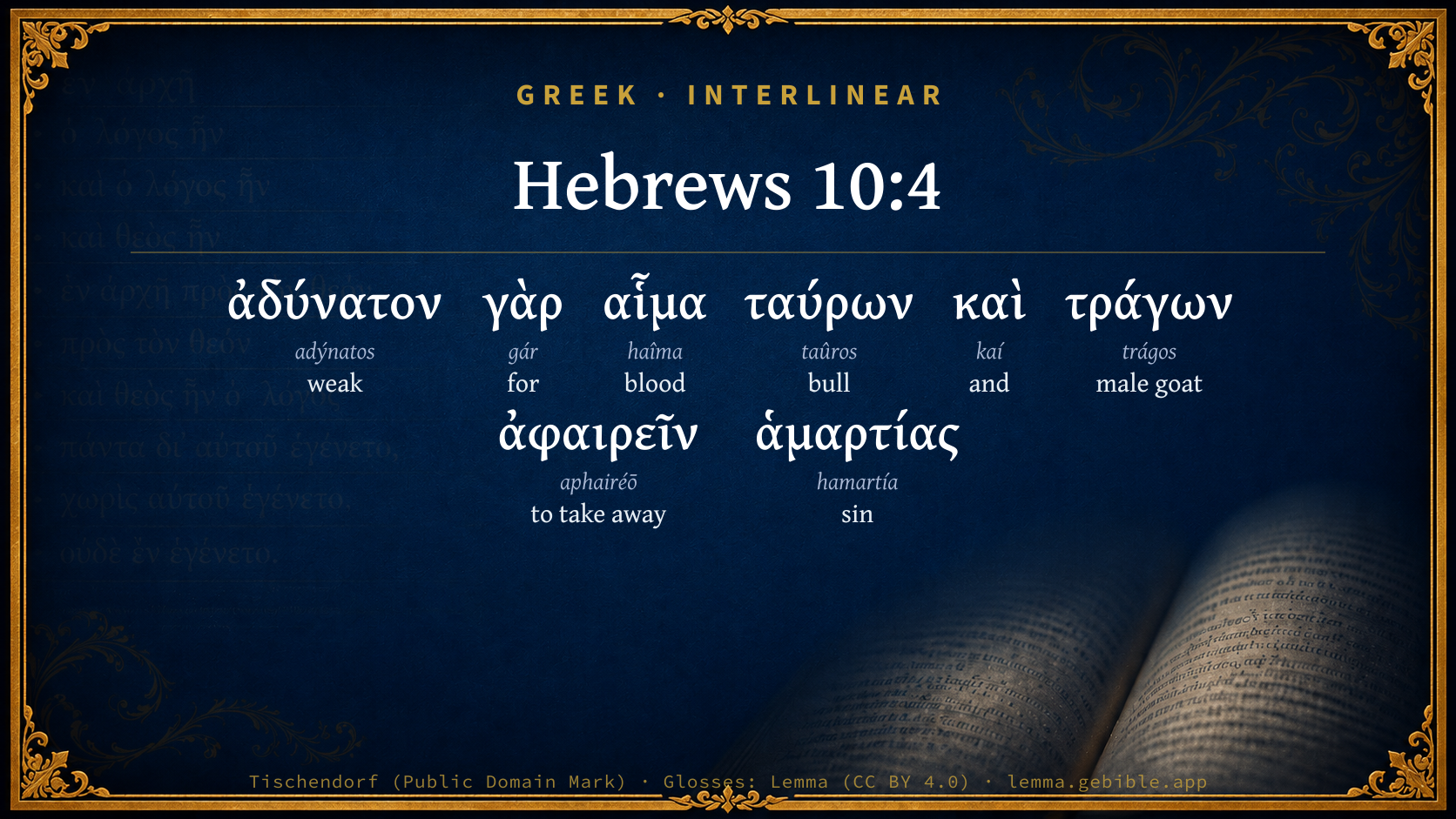
For it is impossible that the blood of bulls and goats should take away sins.
World English Bible · Public Domain
Download a study sheet

One document with this verse’s original text, its word-by-word gloss line, the meaning frame, cross-references with their text, attributed commentary, and full source and license credits — printable, and it pastes into notes with its structure intact.

This verse Autodidact and up

Study sheet (.html) Plain text (.txt)

A passage Seminary Student

Up to 50 verses in one chapter. A passage sheet keeps up to 6 commentary sources and 12 cross-references per verse, in the order this page ranks them, and says so on the sheet whenever that leaves anything out. Ask for a single verse and you get the Autodidact verse sheet above.

Everything on this page stays free to read, with no account — the sheet is a download of what is already on screen, not access to it.

Want to remove ads? Support Godless Engineer
Compare translations 3

The same verse in 3 English versions, stacked beneath the original-language interlinear above. Click any original word for its lexicon entry.

Each is an independent rendering of the whole verse — the interlinear is not word-aligned to these translations.

Highlighted words mark where these versions differ — a whole-verse word diff, not a word-by-word alignment.

  • World English Bible Public Domain
    For it is impossible that the blood of bulls and goats should take away sins.
  • King James Version Public Domain
    For it is not possible that the blood of bulls and of goats should take away sins.
  • unfoldingWord Literal Text CC BY-SA 4.0
    For impossible blood of bulls and goats to take away sins.

unfoldingWord Literal Text — © unfoldingWord, licensed CC BY-SA 4.0. Word-aligned USFM3 via Door43 (git.door43.org/unfoldingWord/en_ult).

Versions to compare (up to 4)

3 of 4 selected

Show all 19 translations

Every available English version of this verse, each an independent rendering of the whole verse.

  • World English Bible Public Domain
    For it is impossible that the blood of bulls and goats should take away sins.
  • Berean Standard Bible Public Domain
    because it is impossible for the blood of bulls and goats to take away sins.
  • Majority Standard Bible Public Domain
    because it is impossible for the blood of bulls and goats to take away sins.
  • King James Version Public Domain
    For it is not possible that the blood of bulls and of goats should take away sins.
  • American Standard Version (1901) Public Domain
    For it is impossible that the blood of bulls and goats should take away sins.
  • Revised Version (1885) Public Domain
    For it is impossible that the blood of bulls and goats should take away sins.
  • Geneva Bible (1599) Public Domain
    For it is vnpossible that the blood of bulles and goates should take away sinnes.
  • Douay-Rheims (1899) Public Domain
    For it is impossible that with the blood of oxen and goats sin should be taken away.
  • Young's Literal Translation Public Domain
    for it is impossible for blood of bulls and goats to take away sins.
  • Literal Standard Version CC BY-SA 4.0
    for it is impossible for blood of bulls and goats to take away sins.
  • Unlocked Literal Bible CC BY-SA 4.0
    For it is impossible for the blood of bulls and goats to take away sins.
  • unfoldingWord Literal Text CC BY-SA 4.0
    For impossible blood of bulls and goats to take away sins.
  • Darby Bible Public Domain
    For blood of bulls and goats [is] incapable of taking away sins.
  • World Messianic Bible Public Domain
    For it is impossible that the blood of bulls and goats should take away sins.
  • Webster's Bible Public Domain
    For it is not possible that the blood of bulls and of goats should take away sins.
  • Free Bible Version CC BY-SA 4.0
    because it's impossible for the blood of bulls and goats to remove sins.
  • Bible in Basic English Public Domain
    Because it is not possible for the blood of oxen and goats to take away sins.
  • Text-Critical English NT CC BY 4.0
    For it is impossible for the blood of bulls and goats to take away sins.
  • Tyndale New Testament (1534) Public Domain
    For it is vnpossible that the bloud of oxen and of gotes shuld take awaye synnes.

Literal Standard Version (2020), Covenant Press — licensed CC BY-SA 4.0. Text via the HelloAO Bible API (eBible.org). Unlocked Literal Bible (unfoldingWord) — licensed CC BY-SA 4.0. Text via the HelloAO Bible API (eBible.org). unfoldingWord Literal Text — © unfoldingWord, licensed CC BY-SA 4.0. Word-aligned USFM3 via Door43 (git.door43.org/unfoldingWord/en_ult). Free Bible Version, Dr. Jonathan Gallagher — licensed CC BY-SA 4.0. Text via the HelloAO Bible API (eBible.org).

Word by word

More ways to search: Search by grammar → Find every occurrence → Compare this word →

Practice this passage: Drill this verse → Learn its vocabulary →

About this verse

These counts appear in no published source. They are computed here, from the morphology-tagged text and Lemma’s own curated glosses. What Lemma adds →

8
words
8
distinct lemmas
General Epistles
section

Notable vocabulary

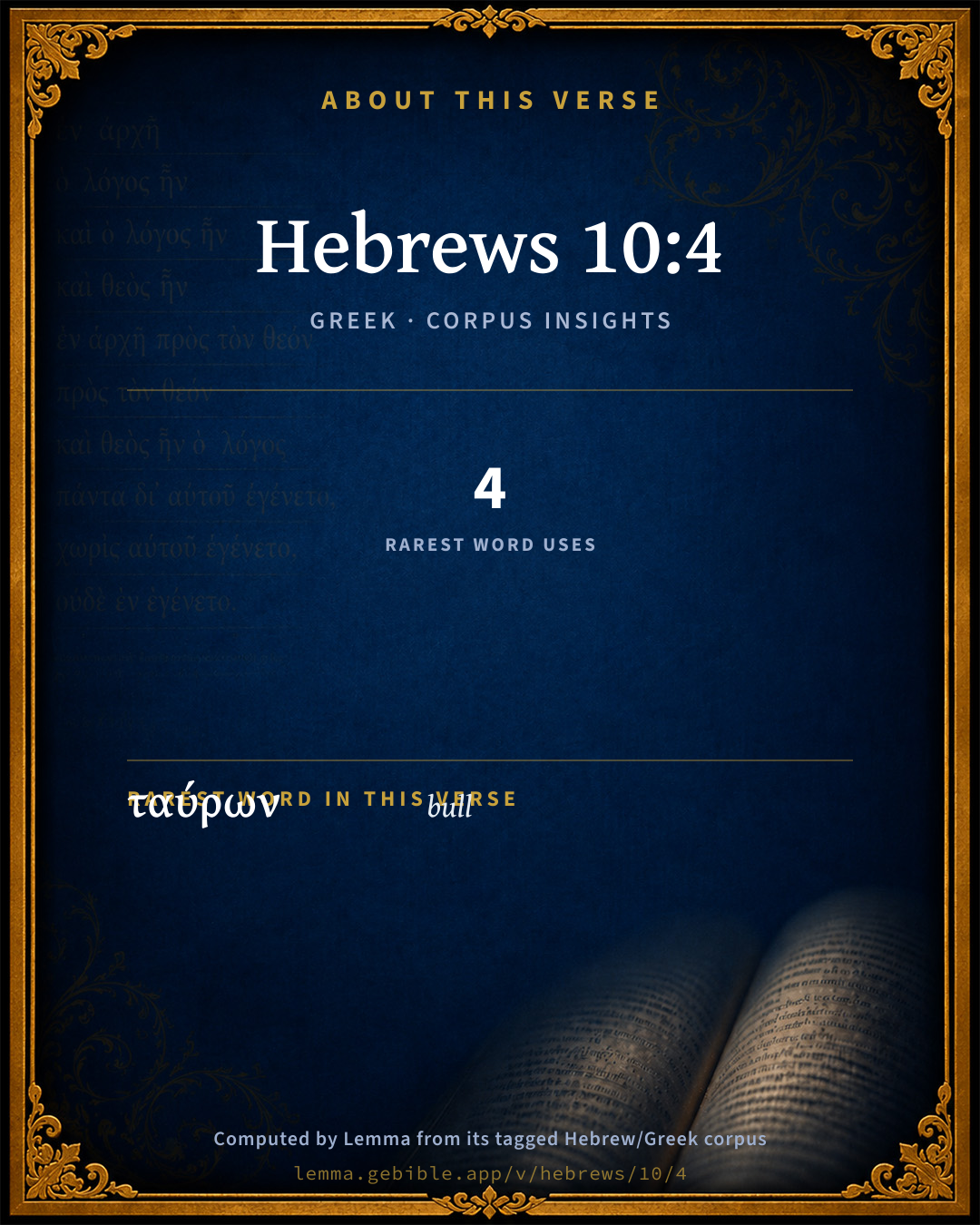
The rarest word here is ταύρων bull G5022 — appearing just 4 times in the whole Greek New Testament.

Shared distinctive vocabulary

ταύρων bull G5022 occurs in 4 verses of the Greek New Testament. Also found in:

Cross-references

18

Topical passages linked to Hebrews 10:4 in the Treasury of Scripture Knowledge — connected by theme and wording, ordered by reader-vote popularity; previews shown in the World English Bible.

  • Hebrews 10:11 Every priest indeed stands day by day ministering and often offering the same sacrifices, which can never take away sins,
  • Isaiah 1:11–15 "What are the multitude of your sacrifices to me?," says Yahweh. "I have had enough of the burnt offerings of rams, And the fat of fed animals. I don't delight in the blood of bulls, Or of lambs, Or of male goats.
  • Micah 6:6–8 How shall I come before Yahweh, And bow myself before the exalted God? Shall I come before him with burnt offerings, With calves a year old?
  • Romans 11:27 This is my covenant to them, When I will take away their sins."
  • 1 John 3:5 You know that he was revealed to take away our sins, and in him is no sin.
  • Mark 12:33 and to love him with all the heart, and with all the understanding, with all the soul, and with all the strength, and to love his neighbor as himself, is more important than all whole burnt offerings and sacrifices."
  • Hebrews 10:8 Previously saying, "Sacrifices and offerings and whole burnt offerings and sacrifices for sin you didn't desire, neither had pleasure in them" (those which are offered according to the law),
  • Psalms 51:16 For you don't delight in sacrifice, or else I would give it. You have no pleasure in burnt offering.
  • Hosea 6:6 For I desire mercy, and not sacrifice; And the knowledge of God more than burnt offerings.
  • Amos 5:21–22 I hate, I despise your feasts, And I can't stand your solemn assemblies.
  • John 1:29 The next day, he saw Jesus coming to him, and said, "Behold, the Lamb of God, who takes away the sin of the world!
  • Hebrews 9:9 which is a symbol of the present age, where gifts and sacrifices are offered that are incapable, concerning the conscience, of making the worshipper perfect;
  • Hebrews 9:12–13 nor yet through the blood of goats and calves, but through his own blood, entered in once for all into the Holy Place, having obtained eternal redemption.
  • Jeremiah 7:21–22 Thus says Yahweh of Hosts, the God of Israel: Add your burnt offerings to your sacrifices, and eat you flesh.
  • Hosea 14:2 Take words with you, and return to Yahweh. Tell him, "Forgive all our sins, And accept that which is good: So we offer like bulls our lips.
  • Psalms 50:8–12 I don't rebuke you for your sacrifices. Your burnt offerings are continually before me.
  • Isaiah 66:3 He who kills an ox is as he who kills a man; he who sacrifices a lamb, as he who breaks a dog's neck; he who offers an offering, [as he who offers] pig's blood; he who burns frankincense, as he who blesses an idol. Yes, they have chosen their own ways, and their soul delights in their abominations:
  • Jeremiah 6:20 To what purpose comes there to me frankincense from Sheba, and the sweet cane from a far country? your burnt offerings are not acceptable, nor your sacrifices pleasing to me.

Cross-references courtesy of OpenBible.info (CC BY 4.0).

Commentary

Notes on Hebrews 10:4 from classic Christian and Jewish commentators (each source and its license shown beneath its notes). The classic Christian expositions comment on the surrounding passage and are grouped to its opening verse, so a note may address several verses; the Jewish commentaries on the Tanakh (Rashi and others) are per-verse, so they appear only where the commentator wrote on this verse.

Lemma curates 59 commentaries, every one of them public domain or Creative Commons licensed, each selected and text-cleaned for this edition rather than reprinted as found. About our sources →

The Biblical Illustrator

Joseph S. Exell

Heb_10:4

The blood of bulls and Of goats

The insufficiency of Mosaic sacrifices

I.

IT IS POSSIBLE THAT THINGS MAY USEFULLY REPRESENT WHAT IT IS IMPOSSIBLE THAT IN AND BY THEMSELVES THEY SHOULD EFFECT. This is the fundamental rule of all institutions of the Old Testament.

II. THERE MAY RE GREAT AND EMINENT USES OF DIVINE ORDINANCES AND INSTITUTIONS, ALTHOUGH IT BE IMPOSSIBLE THAT BY THEMSELVES, IN THEIR MOST EXACT AND DILIGENT USE, THEY SHOULD WORK OUT OUR ACCEPTANCE WITH GOD. And it belongs to the wisdom of faith to use them to their proper end, not to trust to them, as to what they cannot of themselves effect.

III. IT WAS UTTERLY IMPOSSIBLE THAT SIN SHOULD BE TAKEN AWAY BEFORE GOD AND FROM THE CONSCIENCE OF THE SINNER BUT BY THE BLOOD OF CHRIST. Other ways men are apt to betake themselves to for this end, but in vain. It is the blood of Jesus Christ alone that cleanseth us from all our sins, for He alone was the propitiation for them.

IV. THE DECLARATION OF THE INSUFFICIENCY OF ALL OTHER WAYS FOR THE EXPIATION OF SIN IS AN EVIDENCE OF THE HOLINESS, RIGHTEOUSNESS, AND SEVERITY OF GOD AGAINST SIN, WITH THE UNAVOIDABLE RUIN OF ALL UNBELIEVERS.

V. HEREIN ALSO CONSISTS THE GREAT DEMONSTRATION OF THE LOVE, MERCY, AND GRACE OF GOD, WITH AN ENCOURAGEMENT TO FAITH, in that when the old sacrifices neither would nor could perfectly expiate sin, He would not suffer the work itself to fail, but provided a way that should be infallibly effective of it, as is declared in the following verses. (John Owen, D. D.)

The inability of the legal sacrifices

As the legal sacrifices did not of themselves take away sins, so it was impossible that they should. There was an essential defect in them.

1. They were not of the same nature with us that sinned.

2. They were not of sufficient value to make satisfaction for the affronts done to the justice and government of God.

3. The beasts offered up under the law could not consent to put themselves in the sinners room and place. The atoning sacrifice must be one capable of consenting, and must voluntarily substitute himself in the sinners stead. Christ did so. (Matthew Henry.)

The Biblical Illustrator, edited by Joseph S. Exell (c. 1880s–1900s) — public domain. Text from a community e-Sword module.

Joseph Benson's Commentary

Heb 10:4. For it is not possible that the blood of bulls and goats — Or of any brute animals; should take away sins — Should make full satisfaction and atonement for them, so as to procure the pardon of them on its own account. To understand the apostle, we must remember, that though remission of sins be originally from mere grace and mercy, yet it is not to be accomplished by sovereign grace alone, which would be inconsistent with God’s truth, holiness, and righteous government of the world. Hence shedding of blood has been the appointed means of obtaining it in all ages; and the psalmist, Psa 50:5, represents all God’s true people as making a covenant with him by sacrifice. And for this appointment much may be said on the principles of reason. For as the most ancient way of teaching was by symbols, emblems, or hieroglyphics, God, by requiring sacrifices of mankind in order to the pardon of their sins, intended hereby to teach them, 1st, Their guilt, and desert of death and destruction: 2d, The great evil of sin, its odious nature, and destructive consequences, in that it could not be expiated without blood: 3d, The necessity of mortifying it, and the carnal principle whence it proceeds: 4th, Hereby to lay a foundation for the confidence and hope of the sinner, with respect to pardon, as the substitution, by divine appointment, of the life of the animal in the stead of the life of the sinner, manifested grace and promised forgiveness: 5th, Hereby also provision was made both for condemning and pardoning sin, both which things, in order to the glory of God and the salvation of mankind, were absolutely necessary to be done. Now, though these ends might be answered, in some faint degree, or, to speak more properly, though a shadow of them might be exhibited in the sacrifices of brute animals, yet they could not be accomplished in an adequate manner, nor the very images of the things be exhibited thereby. For, 1st, These sacrifices could not fully manifest the great evil of sin, and its destructive nature. For what great evil was there in it, if only the death of an inferior creature, or of a number of inferior creatures, was required in order to the expiation of it? Nor, 2d, For the same reason could the sacrifice of these animals adequately manifest the great guilt of mankind in committing sin, and the punishment they thereby deserved: nor, 3d, God’s infinite hatred to it, and the infinite rectitude of his nature, and dignity of his government. Add to this, as the sacrificed animals were not of the same nature with man, who had sinned, their death could not dissolve the debt of death and destruction which the human nature had contracted. Nay, being irrational, they were of an inferior nature, and the lives of ten thousands of them were not worth the life of one man, even if man were no more immortal than they. “In satisfaction to justice, by way of compensation for injuries, there must be a proportion between the injury and the reparation, that justice may be as much exalted and glorified in the one, as it is depressed and debased in the other. But there could be no such proportion between the affront put on the righteousness of God by sin, and the reparation by the blood of bulls, &c.” If a nobleman forfeit his head by high treason, his giving up his flocks and herds would not expiate his offence, and satisfy the law. And if the blood of thousands of them would not be an adequate ransom for the life of one man, much less for the lives of all men. They are in their own nature mortal; man is immortal; and surely the sacrifice of their temporal, yea, short lives, could be no adequate price for men’s everlasting lives. The appointment of these sacrifices, however, was not made in vain. Though they could not take away sin, they had their use. 1st, They purified the flesh from ceremonial defilement, and gave, or restored, to those that offered them, a right to the benefits of the Mosaic dispensation, namely, access to God in his worship, and life and prosperity in the land of Canaan; although they did not purify their conscience so as to procure them admission into the heavenly Canaan. 2d, They continually represented to sinners the curse and sentence of the law, or that death was the wages of sin. For although there was allowed in them a commutation, namely, that the sinner himself should not die, but the beast sacrificed in his stead; yet they all bore testimony to the sacred truth, that, in the judgment of God, they who commit sin are worthy of death. 3d, They were intended, as we have repeatedly seen, to be typical of the sacrifice of Christ; and the temporal benefits obtained for the Israelites by them were emblematical of the everlasting blessings procured for believers by his sacrifice.

Joseph Benson's Commentary on the Old and New Testaments (1811–1818) — public domain. Text from a community e-Sword module.

Tyndale Open Study Notes

Tyndale Open Resources

10:4 The blood of bulls and goats in the sacrifices of the old covenant offered a degree of cleansing (9:13, 23), but that cleansing was limited in that it could not take away sins. It could not eradicate sin in a way that would offer permanent cleansing and peace with God (see Acts 10:36; Rom 5:1; 11:26-27).

Tyndale Open Study Notes — © Tyndale Open Resources, licensed CC BY-SA 4.0. Text via the HelloAO Bible API.

Bengel's Gnomon

Johann Albrecht Bengel

Heb 10:4. Ἀφαιρεῖν, to take away) περιελεῖν,[58] to remove entirely; Heb 10:11. In the writings of Moses, great effects are ascribed to these elementary ordinances of worship, in order that it might appear that it is not in themselves that these have so great efficacy.

[58] Περιαιρεῖν is to remove on every side (περί) and in every respect: prorsus tollere. Ἀφαιρεῖν, to take off or away.—ED.

Bengel's Gnomon of the New Testament — English translation (T&T Clark, Edinburgh, 1860) — public domain. Text from a community e-Sword module.

Meyer's Critical & Exegetical Commentary

Heinrich August Wilhelm Meyer

Heb_10:4. Proof that it cannot be otherwise, drawn from the matter itself which is under consideration. By a rudely sensuous means we cannot attain to a high spiritual good.

Meyer — Critical and Exegetical Commentary on the New Testament — English translation by Peter Christie, edited by Frederick Crombie (T&T Clark, 1880) — public domain. Text from a community e-Sword module.

Jamieson, Fausset & Brown

Robert Jamieson, A. R. Fausset & David Brown

For, &c.--reason why, necessarily, there is a continually recurring "remembrance of sins" in the legal sacrifices (Heb 10:3). Typically, "the blood of bulls," &c., sacrificed, had power; but it was only in virtue of the power of the one real antitypical sacrifice of Christ; they had no power in themselves; they were not the instrument of perfect vicarious atonement, but an exhibition of the need of it, suggesting to the faithful Israelite the sure hope of coming redemption, according to God's promise.

take away--"take off." The Greek, Heb 10:11, is stronger, explaining the weaker word here, "take away utterly." The blood of beasts could not take away the sin of man. A MAN must do that (see on Heb 9:12-14).

Jamieson, Fausset & Brown — Commentary Critical and Explanatory on the Whole Bible (1871) — public domain (CC PDM 1.0). Text via the HelloAO Bible API.

Adam Clarke's Commentary

Verse 4. For it is not possible] Common sense must have taught them that shedding the blood of bulls and goats could never satisfy Divine justice, nor take away guilt from the conscience; and God intended that they should understand the matter so: and this the following quotation from the Psalmist sufficiently proves.

Adam Clarke's Commentary on the Bible (1810–1826) — public domain. Text from a community e-Sword/MySword module.

John Calvin's Commentaries

4. For it is not possible, etc. He confirms the former sentiment with the same reason which he had adduced before, that the blood of beasts could not cleanse souls from sin. The Jews, indeed, had in this a symbol and a pledge of the real cleansing; but it was with reference to another, even as the blood of the calf represented the blood of Christ. But the Apostle is speaking here of the efficacy of the blood of beasts in itself. He therefore justly takes away from it the power of cleansing. There is also to be understood a contrast which is not expressed, as though he had said, “It is no wonder that the ancient sacrifices were insufficient, so that they were to be offered continually, for they had nothing in them but the blood of beasts, which could not reach the conscience; but far otherwise is the power of Christ’s blood: It is not then right to measure the offering which he has made by the former sacrifices.”

John Calvin's Commentaries (1540-1563) — public domain. Text from the Calvin Translation Society English edition (1840s-50s) via the Christian Classics Ethereal Library (ccel.org). Calvin's coverage is partial (roughly two-thirds of the Bible); uncommented books and verses are honest gaps, never fabricated. The 19th-century editor's footnotes and remarks are omitted so the notes are faithfully Calvin's own voice.

Ellicott's Commentary for English Readers

(4) This verse explains those which precede. No inconsistency really belonged to these sacrifices and this ceremonial, though so often repeated; for it was impossible that any such sacrifice should really remove sin. The offering was necessary, and it answered its purpose; but it could not remove the necessity for another and a better offering.

A Bible Commentary for English Readers, edited by Charles John Ellicott (1878–1897) — public domain. Text from a community e-Sword module.

The Cambridge Bible for Schools and Colleges

gen. ed. J. J. S. Perowne

4. it is not possible …] This plain statement of the nullity of sacrifices in themselves, and regarded as mere outward acts, only expresses what had been deeply felt by many a worshipper under the Old Covenant. It should be compared with the weighty utterances on this subject in the O.T., 1Sa_15:22; Isa_1:11-17; Jer_6:20; Jer_7:21-23; Amo_5:21-24; Mic_6:6-8; Psa_40:6-8 (quoted in the next verses), and Pss. 50. and 51; and above all Hos_6:6, which, being a pregnant summary of the principle involved, was a frequent quotation of our Lord. Any value which the system of sacrifices possessed was not theirs intrinsically (propriâ virtute) but relatively and typically (per accidens). “By a rudely sensuous means,” says Lünemann, “we cannot attain to a high spiritual good.” Philo in one of his finest passages shews how deeply he had realised that sacrifices were valueless apart from holiness, and that no mere external acts can cleanse the soul from moral guilt. He adds that God accepts the innocent even when they offer no sacrifices, and delights in unkindled altars if the virtues dance around them (De plant. Noe). The heathen had learnt the same high truths. Horace (Od. iii. 23) sings,

“Immunis aram si tetigit manus

Non sumptuosâ blandior hostiâ

Mollivit aversos Penates

Farre pio et saliente micâ.”

The Cambridge Bible for Schools and Colleges (gen. ed. J. J. S. Perowne; Cambridge University Press, 1878–1918) — public domain. Text from a community e-Sword module.

John Gill's Exposition

For it is not possible,.... There is a necessity of sin being taken away, otherwise it will be remembered; and there will be a conscience of it, and it must be answered for, or it will remain marked, and the curse and penalty of the law must take place: but it is impossible

that the blood of bulls and goats should take away sins; which was shed on the day of atonement: sin is a breach of the moral law, but these sacrifices belong to, the ceremonial law, which are less acceptable to God than moral duties; sin is committed against God, and has an objective infiniteness in it, and therefore can never be atoned for by the blood of such creatures; it leaves a stain on the mind and conscience, which this blood cannot reach; besides, this is not the same blood, nor of the same kind with the person that has sinned; yea, if this could take away sin, it would do more than the blood of the man himself could do; such blood shed can never answer the penalty of the law, satisfy divine justice, or secure the honour of divine holiness: but what the blood of these creatures could not do, the blood of Christ has done, and does: that takes away sin from the sight of justice, and from the consciences of the saints. Compare with this the Septuagint version of Jer 11:15.

"what, has the beloved committed abomination in my house? shall prayers, and the holy flesh take away thy wickednesses from thee, or by these shall thou escape?''

John Gill's Exposition of the Whole Bible (1746–1763) — public domain (CC PDM 1.0). Text via the HelloAO Bible API.

Trapp's Complete Commentary

John Trapp

4 For it is not possible that the blood of bulls and of goats should take away sins.

Ver. 4. Should take away sins] And so pacify conscience; for sin is to the conscience as a mote to the eye, as a dagger to the heart, 2Sa 24:10, as an adder’s sting to the flesh, Pro 23:32.

John Trapp, A Commentary or Exposition upon All the Books of the Old and New Testament (1647–1656) — public domain. Text from a community e-Sword module.

Albert Barnes' Notes on the Bible

For it is not possible that the blood of bulls and of goats should take away sins - The reference here is to the sacrifices which were made on the great day of the atonement, for on that day the blood of bulls and of goats alone was offered; see the notes on Heb 9:7. Paul here means to say, doubtless, that it was not possible that the blood of these animals should make a complete expiation so as to purify the conscience, and so as to save the sinner from deserved wrath. According to the divine arrangement, expiation was made by those sacrifices for offences of various kinds against the ritual law of Moses, and pardon for such offences was thus obtained. But the meaning here is, that there was no efficacy in the blood of a mere animal to wash away a “moral” offence. It could not repair the Law; it could not do anything to maintain the justice of God; it had no efficacy to make the heart pure. The mere shedding of the blood of an animal never could make the soul pure. This the apostle states as a truth which must be admitted at once as indisputable, and yet it is probable that many of the Jews had imbibed the opinion that there was such efficacy in blood shed according to the divine direction, as to remove all stains of guilt from the soul; see the notes, Heb 9:9-10.

Albert Barnes' Notes on the Bible (1834–1885) — public domain. Text from a community e-Sword/MySword module.

Matthew Poole's English Annotations

For gives a reason of the precedent proof, that the legal sacrifices did keep sins in remembrance; for they were of such matter as could not have any causal power to take them away.

It is not possible: this is equivalent to a universal negative, the impossibility being absolute as to the things themselves in their very nature; they being corporeal, can have no influence upon a spiritual evil in the soul, Mic 6:6,7; and by God’s constitution they were to lead them to better things, God being not pleased with flesh and blood, Psa 50:13; Isa 1:11.

That the blood of bulls and of goats should take away sins; the blood of these were only carried into the holy of holiest on the atonement day, yearly, Lev 16:1-34, to which this is chiefly applied; nor could the blood of all the other sacrifices by expiation pardon their offerers, nor by sanctification cleanse them, nor by removing the sense of them comfort the soul; they could neither pacify God, nor the sinner’s conscience, having no virtue or power to satisfy God’s justice, or merit his grace, only it had by his constitution a power to typify that blood which could do both.

Matthew Poole's English Annotations on the Holy Bible (1683–1685) — public domain. Text from a community e-Sword/MySword module.

Whedon's Commentary on the Bible

Daniel D. Whedon

4. For—Reason why they do not abolish sin. The death of an animal is no real atonement for the sins of a man. There is no rational adequacy in the case. A sacrifice of a higher nature is demanded.

Daniel D. Whedon (gen. ed.), Commentary on the Old and New Testaments (1874–1909) — public domain. Text from a community e-Sword module.

The Pulpit Commentary

For it is not possible that the blood of bulls and of goats (specified as being the offerings of the Day of Atonement) should take away sins. The principle of the insufficiency of animal sacrifices having been thus expressed, confirmation of it is now further adduced from the Old Testament itself, together with a prophetic anticipation of the great self-oblation which was to take their place.

The Pulpit Commentary (1880–1919), ed. H.D.M. Spence-Jones & Joseph S. Exell — public domain. Text from a community e-Sword module.

John Wesley's Explanatory Notes

It is impossible the blood of goats should take away sins - Either the guilt or the power of them.

John Wesley, Explanatory Notes Upon the Whole Bible (1754–1765) — public domain. Text via the GEBible commentary corpus.

Burkitt's Expository Notes on the New Testament

William Burkitt

The intendment of our apostle in these words, is to prove that the sacrifices of the law could not expiate sin, nor make reconciliation with God, wich the sacrifice of Christ alone was ordained and appointed to.

Here observe, 1. The subject-matter spoken of, The blood of bulls and goats: They were accompanied with great solemnity and pomp of ceremony in their celebration; and the people had a great esteem and veneration of them in their minds; but when all was done, that which was offered was no more than the blood was done, that which was offered was no more than the blood of bulls and goats.

Observe, 2. That which is denied of these sacrifices, namely, the taking away of sins: To take away sin, is to make atonement for sin, to expiate the guilt of it before God, by a satisfaction given, or price paid, that it shall never bind over the penitent sinner unto punishment.

Observe, 3. The manner of the negation; It was impossible that the blood of bulls and of goats should take away sins. Impossible from divine institution; they were never designed for that end therefore could never effect it; for the virtue of every institution depends upon its designation to its end.

Now the blood of bulls was only designed to represent the taking away of sin, but never by itself to effect it. And it was also impossible from the nature of the thing; for how could the blood of a beast expiate the sin of a man? Satisfaction must be made for sin in and by the same nature that had sinned.

Learn hence, That it was utterly impossible that sin should be taken away before God, and from the conscience of a sinner by any other blood than the blood of Christ: It is this alone that cleanseth us from all sin, for he alone was the propitiation for them.

William Burkitt's Expository Notes on the New Testament (1700–1703) — public domain. Text from a community e-Sword module.

The People's New Testament

B. W. Johnson

4. For it is not possible. The blood of bulls and goats, the animals offered in the sacrifices, had no power to cleanse from sin. In their essence the only real efficacy of the bloody sacrifices of the altar was the moral effect upon the people and the fact that they pointed forward to the Lamb of God.

B. W. Johnson's The People's New Testament with Notes (1889–1891) — public domain. Electronic text from the Christian Classics Ethereal Library (CCEL) ThML edition.

Cambridge Greek Testament for Schools and Colleges

4. ἀδύνατον γάρ. This plain statement of the nullity of sacrifices in themselves, and regarded as mere outward acts, only expresses what had been deeply felt by many a worshipper under the Old Covenant. It should be compared with the weighty utterances on this subject in the O.T., 1Sa 15:22; Isa 1:11-17; Jer 6:20; Jer 7:21-23; Amo 5:21-24; Mic 6:6-8; Psa 40:6-8 (quoted in the next verses), and Psalms 50, 51; and above all Hos 6:6, which, being a pregnant summary of the principle involved, was a frequent quotation of our Lord. Any value which the system of sacrifices possessed was not theirs intrinsically (propriâ virtute) but relatively and typically (per accidens). “By a rudely sensuous means,” says Lünemann, “we cannot attain to a high spiritual good.” Philo in one of his finest passages shews how deeply he had realised that sacrifices were valueless apart from holiness, and that no mere external acts can cleanse the soul from moral guilt. He adds that God accepts the innocent even when they offer no sacrifices, and delights in unkindled altars if the virtues dance around them (De plant. Noe). The heathen had learnt the same high truths. Horace (Od. III. 23) sings,

“Immunis aram si tetigit manus

Non sumptuosâ blandior hostiâ

Mollivit aversos Penates

Farre pio et saliente micâ.”

Cambridge Greek Testament for Schools and Colleges (Cambridge University Press, 1896; 21 vols, various authors incl. Carr, Maclear, Plummer, Farrar, Lumby, Moule, M. R. James, Simcox) — public domain. Text from a community e-Sword module.

Alford’s Greek Testament

Henry Alford

4.] And that on account of inherent defect in the sacrifices themselves: for it is impossible, that the blood of bulls and of goats should take away sin (the Writer by no means denies the typical virtue of the O. T. sacrifices, but asserts that which the schoolmen explained by saying that they wrought remission of sin not ‘propria virtute,’ but ‘per accidens,’ viz. by means of the grace of the true Propitiation which was to come, and of faith directed to it. And thus only is it said, Lev 17:11, that the blood upon the altar makes an atonement for the soul: it was shed, as Ebrard well observes, not as the instrument of complete vicarious propitiation, but as an exhibition of the postulate of vicarious propitiation).

Henry Alford, The Greek Testament (1849–1861) — public domain. Text from a community e-Sword module.

Westcott on Hebrews & the Epistles of John

Brooke Foss Westcott

4. ἀδύνατον.. ἀφαιρεῖν] Vulg. impossibile est...sanguine...auferrt V.; O.L. diffcile...est...

The spiritual inofficacy of the Levitical sacrifices, which was indicated by their repetition, is patent also from their very nature. The physical suffering and death of an irrational creature—unwilling and unconscious —can make no atonement for man’s sin. Man can have no true fellowship with such beings. Such a sacrifice cannot be more than a symbol, a sign. The sacrifices of the Day οἵ Atonement still suggest the general language. Comp. Pa, L 13.

ἀφαιρεῖν dp.) Is. i. τό ἀφέλετε τὰς πονηρίας ἀπὸ τῶν ψυχῶν (ἸΌΠ). Ex. xxxiv. 7, 9 ἀφελεῖς σὺ τὰς ἁμαρτίας ἡμῶν (N20). _ Lev. x. 17 ἵνα ἀφέλητε τὴν ἁμαρτίαν. Num. xiv. 18 ἀφαιρῶν ἀνομίας καὶ ἀδικίας καὶ ἁμαρτίας. Koclus. xivii. 11 κύρ. ἀφεῖλε τὰς dy. αὐτοῦ.

The phrase does not occur elsewhere in the N. T. except in a quotation : Rom. xi. 27 ὅταν ἀφέλωμαι ἁμαρτίας (Is. xxvii.9g Lxx.). It is not unfrequent in the LxXX. The image appears to be that of the removal of a load bound upon the sinner. Compare Jor. xi. 15; Zech. fii. 4.

Contrast v.11 περιελεῖν, both in form and tense.

Tho limited yet real power of the Levitical sacrifices has been recognised in c. ix. 13.

(2) 5—10. The one valid sacrifice of the porfect fulfilmont of the Will of God offerod by Christ.

In the last paragraph the inofficacy of the Lovitical sacrificos has been brought out. In this paragraph Ohrist’s efficacious sacrifice of Himself is placed in contrast with them.

The argument is expressed in the language of a Davidic Psalm.

The Christ coming into the world gives utterance to the conviction of man that the only sacrifice which he can offer to God is perfect obedience (ov. 5—7). In doing this He contrasts the fulfilment of the will of God with the Levitical sacrifices so as to abolish the latter by the former (ev. 8, 9). He obeys perfectly; and of the fruits of His obedience men are made partakers (e. 10).

Psalm xi. is regarded with probability as an expression of David's feeling

towards the close of his persecution by Saal, when the promised kingdom was now in near view. The present text of the Psalm consists of two parts which differ widely in general tone. The second part (ev. 13-18) cannot be applied to the Messiah (v. 13); and most of it (wz. 14—18) occurs again in the Psalter, with slight variations, as Ps. Ixx.

Tho first part (ve. 1—12) stands out from the writings of tho Old Testament as giving not only a viow of the essential inadequacy of external sacrifices but also a clear indication of that which they represont and of that which fulfils the idea to which thoy bear witness. In the contemplation of God’s mercies, and in the doclaration of God's rightoousness, the Psalmist, feels that no offoring of that which is without the worshipper can rightly convey the return of gratitude or make atonement (sin-offering). Nothing but perfect solf-devotion answers to the claims of God and man’s desire.

Such a confession, which embodies the aspiration of man, and rises above his power of fulfilment, describes what Christ has done as the Son of man, through whom man’s ideal has been realised (oc. ii. 6 £; Ps. viii). Thus the words are rightly applied to Him. His power to do tho will of God corresponded with His purpose to do it. That will being once accomplished for humanity by its perfect representative, the use of sacrifices was done away.

The words in their original context gain fresh force from a comparison with 1 Sam. xv. 22. David, the true divine type of a king, spontaneously embodied the principle which Saul, the haman type of a king, violated to his own overthrow.

The writer of the Epistle follows the rendering of the Lxx. with somo slight differences, ὁλοκαυτώματα (LXX.,

κατηρτίσω pot. There can be no question that this is the truo roading of the Greok. Tho conjecture that cwma is an early blunder for wria (the reading of the other Greek vorsions) cannot be maintained in the fuce of tho evidence. Tho rondoring must thereforo be considered to be a free interprotation of the original text. In this respect it extends and emphasises tho fundamental idoa. The ‘body’ is the instrument for fulfilling the divine command, just as the ‘ear’ is tho instrument for receiving it. God originally fashioned for man in his framo the organ for hearing His voice, aud by this Ile plaiuly shewod that ho was mado to oboy it. 5 Wherefore when He entereth into the world, He saith Sacrifice and offering Thou would - est not, But a body didst Thou prepare Sor me; ‘In whole burnt-oferings and sacryices for sin Thou hadst no θὲ 1 Then said I, Lo, Tam come (in the roll of the book ἐξ te written of me) to do, O God, Thy witli. ®* Saying above, Sacrifices and offertings and whole burnt-oferings and offerings for sin Thou wouldecst not (the which are offered according to the Law), %then hath He said, Lo, I am come to do Thy will. He removeth the first that He may establish the second. “In which will we have been sanctified through the offering μ᾿ the body of Jesus Christ once for

Brooke Foss Westcott (1825–1901), The Epistle to the Hebrews (1889) and The Epistles of St John (1883) — public domain (pre-1929). Text recovered from Internet Archive / Google Books OCR scans. Westcott’s Gospel of John commentary is not included (its OCR lost the chapter running-heads required for reliable verse-keying). Some Greek quoted in the Hebrews volume is imperfectly rendered by the OCR.

Lesson kit

Teaching starters — assembled from the data on this page, not authored interpretation. Every prompt links to the verse data it draws on. Edit before teaching.

Hebrews, in the General Epistles, opens this verse with 8 words (8 distinct Greek lemmas). Its most distinctive word is taûros (“bull”). A historical commentator’s framing appears above. Read the whole chapter for the surrounding context.

Discussion questions

  1. The word taûros carries the sense “bull.” How does it shape the verse?
  2. How does Matthew 22:4, which shares the word «bull», read alongside this verse?
  3. The translations on this page render this verse differently — a whole-verse word diff, not a word-by-word alignment. What might account for the different wordings?
  4. Compare how The Biblical Illustrator and Joseph Benson's Commentary read this verse. Where do they agree or differ?

Things to notice

Reading settings

Reading text

Shown beneath each verse's original-language words.

Old Testament
Old Testament edition

Read the OT as the Masoretic Hebrew (MT) or the Greek Septuagint (LXX).

English shown for the Greek Septuagint (in the Hebrew ↔ Greek comparison).

Comparing translations? Open the Compare panel on any verse page to stack up to four side by side.