Hebrews 6:5

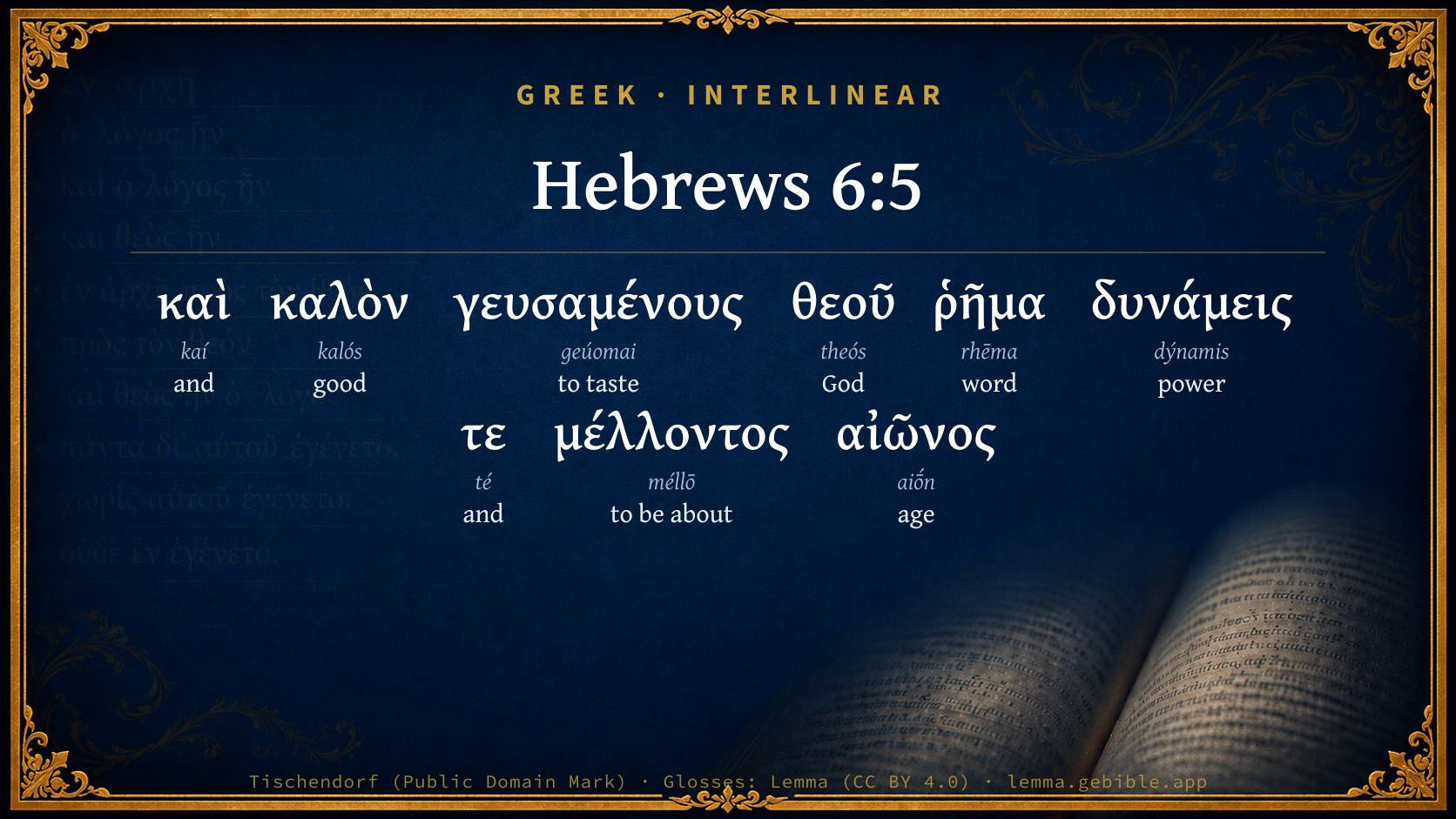
Greek (Tischendorf 8th ed.) Hebrews 6:5 appears in the Greek New Testament. The text above is from the Tischendorf 8th edition. Each word links to its Strong’s number and a concise gloss. Click any word for its full Thayer’s Greek Lexicon entry.
Download image
Cite this verse

Hebrews 6:5 (World English Bible). Public Domain. Lemma interlinear Bible study tool, https://lemma.gebible.app/v/hebrews/6/5.

Show BibTeX & RIS
BibTeX
RIS
English Translation
and tasted the good word of God, and the powers of the age to come,
World English Bible · Public Domain
Download a study sheet

One document with this verse’s original text, its word-by-word gloss line, the meaning frame, cross-references with their text, attributed commentary, and full source and license credits — printable, and it pastes into notes with its structure intact.

This verse Autodidact and up

Study sheet (.html) Plain text (.txt)

A passage Seminary Student

Up to 50 verses in one chapter. A passage sheet keeps up to 6 commentary sources and 12 cross-references per verse, in the order this page ranks them, and says so on the sheet whenever that leaves anything out. Ask for a single verse and you get the Autodidact verse sheet above.

Everything on this page stays free to read, with no account — the sheet is a download of what is already on screen, not access to it.

Want to remove ads? Support Godless Engineer
Compare translations 3

The same verse in 3 English versions, stacked beneath the original-language interlinear above. Click any original word for its lexicon entry.

Each is an independent rendering of the whole verse — the interlinear is not word-aligned to these translations.

Highlighted words mark where these versions differ — a whole-verse word diff, not a word-by-word alignment.

  • World English Bible Public Domain
    and tasted the good word of God, and the powers of the age to come,
  • King James Version Public Domain
    And have tasted the good word of God, and the powers of the world to come,
  • unfoldingWord Literal Text CC BY-SA 4.0
    and having tasted the good word of God and the powers of the age to come

unfoldingWord Literal Text — © unfoldingWord, licensed CC BY-SA 4.0. Word-aligned USFM3 via Door43 (git.door43.org/unfoldingWord/en_ult).

Versions to compare (up to 4)

3 of 4 selected

Show all 19 translations

Every available English version of this verse, each an independent rendering of the whole verse.

  • World English Bible Public Domain
    and tasted the good word of God, and the powers of the age to come,
  • Berean Standard Bible Public Domain
    who have tasted the goodness of the word of God and the powers of the coming age—
  • Majority Standard Bible Public Domain
    who have tasted the goodness of the word of God and the powers of the coming age—
  • King James Version Public Domain
    And have tasted the good word of God, and the powers of the world to come,
  • American Standard Version (1901) Public Domain
    and tasted the good word of God, and the powers of the age to come,
  • Revised Version (1885) Public Domain
    and tasted the good word of God, and the powers of the age to come,
  • Geneva Bible (1599) Public Domain
    And haue tasted of the good word of God, and of the powers of the world to come,
  • Douay-Rheims (1899) Public Domain
    Have moreover tasted the good word of God, and the powers of the world to come,
  • Young's Literal Translation Public Domain
    and did taste the good saying of God, the powers also of the coming age,
  • Literal Standard Version CC BY-SA 4.0
    and tasted the good saying of God, also the powers of the coming age,
  • Unlocked Literal Bible CC BY-SA 4.0
    and who tasted God's good word and the powers of the age to come,
  • unfoldingWord Literal Text CC BY-SA 4.0
    and having tasted the good word of God and the powers of the age to come
  • Darby Bible Public Domain
    and have tasted the good word of God, and [the] works of power of [the] age to come,
  • World Messianic Bible Public Domain
    and tasted the good word of God and the powers of the age to come,
  • Webster's Bible Public Domain
    And have tasted the good word of God, and the powers of the world to come,
  • Free Bible Version CC BY-SA 4.0
    who had known God's good word and the power of the coming age—
  • Bible in Basic English Public Domain
    With knowledge of the good word of God, and of the powers of the coming time,
  • Text-Critical English NT CC BY 4.0
    who have tasted the good word of God and the powers of the coming age,
  • Tyndale New Testament (1534) Public Domain
    and have tasted of the good worde of God and of the power of the worlde to come:

Literal Standard Version (2020), Covenant Press — licensed CC BY-SA 4.0. Text via the HelloAO Bible API (eBible.org). Unlocked Literal Bible (unfoldingWord) — licensed CC BY-SA 4.0. Text via the HelloAO Bible API (eBible.org). unfoldingWord Literal Text — © unfoldingWord, licensed CC BY-SA 4.0. Word-aligned USFM3 via Door43 (git.door43.org/unfoldingWord/en_ult). Free Bible Version, Dr. Jonathan Gallagher — licensed CC BY-SA 4.0. Text via the HelloAO Bible API (eBible.org).

Word by word

More ways to search: Search by grammar → Find every occurrence → Compare this word →

Practice this passage: Drill this verse → Learn its vocabulary →

About this verse

These counts appear in no published source. They are computed here, from the morphology-tagged text and Lemma’s own curated glosses. What Lemma adds →

9
words
9
distinct lemmas
General Epistles
section

Notable vocabulary

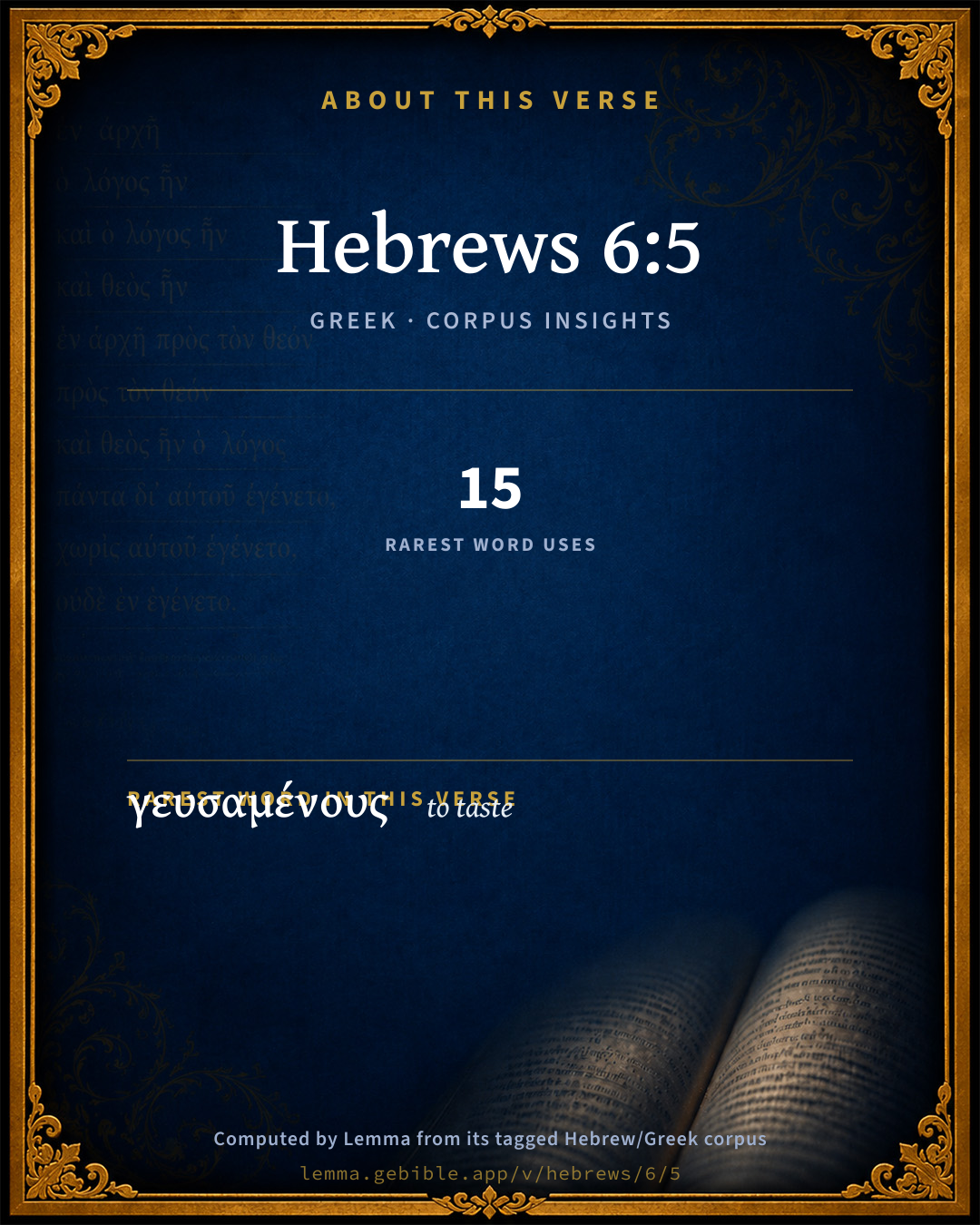
The rarest word here is γευσαμένους to taste G1089 — appearing just 15 times in the whole Greek New Testament.

Shared distinctive vocabulary

γευσαμένους to taste G1089 occurs in 15 verses of the Greek New Testament. Also found in:

Cross-references

7

Topical passages linked to Hebrews 6:5 in the Treasury of Scripture Knowledge — connected by theme and wording, ordered by reader-vote popularity; previews shown in the World English Bible.

  • Luke 8:13 Those on the rock are they who, when they hear, receive the word with joy; but these have no root, who believe for a while, then fall away in time of temptation.
  • 1 Peter 2:3 if indeed you have tasted that the Lord is gracious:
  • Matthew 13:20–21 What was sown on the rocky places, this is he who hears the word, and immediately with joy receives it;
  • Mark 4:16–17 These in like manner are those who are sown on the rocky places, who, when they have heard the word, immediately receive it with joy.
  • 2 Peter 2:20 For if, after they have escaped the defilement of the world through the knowledge of the Lord and Savior Jesus Christ, they are again entangled therein and overcome, the last state has become worse with them than the first.
  • Hebrews 2:5 For he didn't subject the world to come, of which we speak, to angels.
  • Mark 6:20 for Herod feared John, knowing that he was a righteous and holy man, and kept him safe. When he heard him, he did many things, and he heard him gladly.

Cross-references courtesy of OpenBible.info (CC BY 4.0).

Commentary

Notes on Hebrews 6:5 from classic Christian and Jewish commentators (each source and its license shown beneath its notes). The classic Christian expositions comment on the surrounding passage and are grouped to its opening verse, so a note may address several verses; the Jewish commentaries on the Tanakh (Rashi and others) are per-verse, so they appear only where the commentator wrote on this verse.

Lemma curates 59 commentaries, every one of them public domain or Creative Commons licensed, each selected and text-cleaned for this edition rather than reprinted as found. About our sources →

Whedon's Commentary on the Bible

Daniel D. Whedon

5. The last couplet connecting the word and the powers.

Tasted— Implying again the rich enjoyment; and here without the of, because this now grown Christian may taste and enjoy not a part but the whole good word. Excellent is Whitby’s note on this good word: “So the promise of bringing the children of Israel into the land of Canaan is styled הדבד הדם, ρημα καλον, a good word, [English unliteral translation “thing,”] Jos_21:45; Jos_23:15. The word of God for bringing his people out of captivity is styled, דבדי השׂוב, my good word. Jer_29:10. The words of consolation which the angel spake to Jerusalem are, ρηματα καλα, good words. Zec_1:13. The promise made to God’s people of remission of sins, and peace and truth in the days of the Messiah, is a good word. And the prophet, speaking of the Messiah, saith, My heart meditateth a good word. Psa_45:1.” The good word of our apostle here is, then, the evangelium, the good message, of the New Testament. A word, as spoken by the incarnate Son, (Heb_2:1-2;) good, as revealing a heavenly Canaan, “glory, and honor, and immortality—eternal life.” This blessed word this class had tasted—enjoyed its rich flavor in its full entirety.

Powers of the world to come—Closely coupled with the good word of the New Testament are the powers of the new dispensation. Note on Heb_2:5. The word and the powers go together. These Hebrews had witnessed and enjoyed these powers. For the word powers (δυναμεις) is often, in the Greek, put for miracles and mighty supernatural works. Mat_7:22; Mat_11:20-21; Mat_11:23; Mat_13:54; Mat_13:58; Mat_14:2; Mar_6:2; Mar_6:5; Mar_6:14; Mar_9:39; Luk_10:13; Luk_19:37; Act_2:22; Act_8:13; Act_19:11; 1Co_12:10; 2Co_12:12; Gal_3:5. An examination of these texts would show that the word is more frequently used for the supernaturalisms of Christ and the early Church in the upbuilding of Christianity than the English reader would imagine. Here it is used generically for every form of aggressive supernatural energy in the new dispensation. Of those in the apostolic age we seem to have a pretty full enumeration in 1Co_12:10. As these sensible powers disappeared there still remained the normal spiritual powers blended with the good word, the ordinary aggressive forces of Christianity. These are the energies of the Spirit in quickening the soul, in the active conversion of men, in the building of the kingdom of Christ, and the gathering of the world within its dominion.

Daniel D. Whedon (gen. ed.), Commentary on the Old and New Testaments (1874–1909) — public domain. Text from a community e-Sword module.

Tyndale Open Study Notes

Tyndale Open Resources

6:5 tasted the goodness of the word of God: These people had heard the word of God preached (2:3-4; 4:1-2) and had seen its effects. • the power of the age to come: They had witnessed signs and wonders when they heard the Good News (2:4; cp. Exod 7:3-4; Deut 7:19; Pss 66:3; 77:15-20; 78:9-16; 1 Cor 10:1-13).

Tyndale Open Study Notes — © Tyndale Open Resources, licensed CC BY-SA 4.0. Text via the HelloAO Bible API.

Bengel's Gnomon

Johann Albrecht Bengel

Heb 6:5. Γευσαμένους, who have tasted) A new taste, likewise involving more than the knowledge of the resurrection of the dead and of eternal judgment.—καλὸν ῥῆμα, the good word) Jer 33:14, את הדבר הטוב, the Gospel.—δυνάμεις, powers) of the most exquisite taste. The plural is highly significant. The same word occurs, ch. Heb 2:4; comp. Heb 11:34. Both passages show the emphasis of the word, δυνάμεις.—μέλλοντος αἰῶνος, of the world to come) Eternal glory is principally intended; comp. Heb 6:2, at the end; as the city to come is spoken of, ch. Heb 13:14; but the present time is not excluded under the New Testament, for in this sense things to come are also mentioned, ch. Heb 9:11, Heb 10:1, Heb 2:5, note.

Bengel's Gnomon of the New Testament — English translation (T&T Clark, Edinburgh, 1860) — public domain. Text from a community e-Sword module.

Meyer's Critical & Exegetical Commentary

Heinrich August Wilhelm Meyer

Heb_6:5. Καὶ καλὸν γευσαμένους θεοῦ ῥῆμα] and have tasted the refreshing word of God. That the author already makes use afresh in this place of the verb γεύεσθαι, after he has only just before employed it Heb_6:4, Bleek ascribes, not wrongly, to a certain perplexity on the part of the writer about finding for the idea to be expressed another term of the same import. For the supposition of Delitzsch, that the repetition of the same expression is to be explained from the design of bringing out so much the more strongly the reality of the experiences made and of their objects, would be admissible only if the second γευσαμένους, like the first, were placed emphatically at the beginning of its clause, and there were not already another verb inserted between the two γευσαμένους. γεύεσθαι is here, as Joh_2:9, construed with the accusative, which occurs only in the Hellenistic, never with the Greek classic writers. To assume, however, a different signification in the case of the two constructions,

Bengel: alter (genitivus) partem denotat; nam gustum Christi, doni coelestis, non exhaurimus in hac vita; alter (accusativus) plus dicit, quatenus verbi Dei praedicati gustus totus ad banc vitam pertinet, quanquam eidem verbo futuri virtutes seculi annectuntur; Bloomfield: here (Heb_6:4) γεύσασθαι signifies to have experience of a thing, by having received and possessed it; whereas in the clause following it signifies to know a thing by experience of its value and benefit; Delitzsch (comp. also Moll): with γευσαμένους τῆς δωρ. τῆς ἐπουρ. is combined the conception that the heavenly gift is destined for all men, and is of inexhaustible fulness of intent; with καλὸν γευσαμένους θεοῦ ῥῆμα, however, the conception that Gods precious word was, as it were, the daily bread of those thus described,is already forbidden by the homogeneity of the statements, Heb_6:4 and Heb_6:5.

The expression ῥήματα καλά serves, LXX. Jos_21:45; Jos_23:15, Zec_1:13, for the rendering of the Hebrew הַדָּבָר הַטו̇ב and דְּבָרִים טו̇בִים, and is used of words of consolation and promise spoken by God or the angel of God. In accordance therewith, we shall best also here refer καλὸν θεοῦ ῥῆμα to the gospel, inasmuch as God thereby gives promises, and fulfils the promises given. So Theodoret (τὴν ὑπόσχεσιν τῶν ἀγαθῶν), Estius, Schlichting, Grotius, Limborch, Owen, Whitby, Abresch, Böhme, Kuinoel, Klee, de Wette, Stengel, Tholuck, Ebrard, Bloomfield, Bisping, Delitzsch, Maier, Kurtz.

Others, as Chrysostom, Oecumenius, Theophylact, Primasius, Faber Stapulensis, Jac. Cappellus, Piscator, Bengel, Peirce, Heinrichs, Alford, understand the expression of the gospel in general; in connection with which some, as Calvin and Braun, see denoted in καλόν a contrast with the Mosaic law, the characteristic of which was judicial severity. According to Bleek, finally, we have to think of a personified attribute of God; which is supposed to be here mentioned because the gospel, with its consolatory message, is an efflux from the same,an interpretation, however, which finds no sort of support in the context.

δυνάμεις τε μέλλοντος αἰῶνος] and powers of the world to come. What is intended is the extraordinary miraculous powers wrought by the Holy Ghost, as these were called forth by the new order of the world founded by Christ. The αἰὼν μέλλων, namely (comp. οἰκουμένη ἡ μέλλουσα, Heb_2:5), is for the author nothing purely future,so that we have not, with Jac. Cappellus, Schlichting, Böhme, Kurtz, and others, to think of the everlasting life, or of the glory coming in with the Parousia of Christ, of which believers have received a foretaste here upon earth,but already begins, according to his view, with the appearing of Christ upon earth, in that only its consummation still belongs to the future, namely, the time of Christs return.

Meyer — Critical and Exegetical Commentary on the New Testament — English translation by Peter Christie, edited by Frederick Crombie (T&T Clark, 1880) — public domain. Text from a community e-Sword module.

Expositor's Greek Testament

ed. W. Robertson Nicoll

Heb 6:5 . καὶ καλὸν γευσαμένους … “and tasted God’s word that it is good”. ῥήματα καλά in LXX ( vide Jos 21:43 ) are the rich and encouraging promises of God, cf. Zec 1:13 , ῥήματα καλὰ καὶ λόγους παρακλητικούς . Here it probably means the Gospel in which all promise is comprehended; cf. 1Pe 1:25 , ῥῆμα Κυρίου … τοῦτο δέ ἐστι τὸ ῥῆμα τὸ εὐαγγελισθὲν εἰς ὑμᾶς . Persons then are here described who have not only heard God’s promise, but have themselves tasted or made trial of it and found it good. They have experienced that what God proclaims finds them, in their conscience with its resistless truth, in their best desires by quickening and satisfying them. The change from the genitive, δωρεᾶς , to the accusative, ῥῆμα , after γευσ . is variously accounted for. Commonly, verbs of sense take the accusative of the nearer, the genitive of the remoter source of the sensation; but probably the indiscriminate use of the two cases in LXX and N.T. arises from the tendency of the accusative in later Greek to usurp the place of the other cases. Yet it is not likely that so careful a stylist as our author should have altered the case without a reason. That reason is best given by Simcox ( Gram. , p. 87), “ γεὐεσθαι in Heb 6:4-5 , has the genitive, where it is merely a verb of sense, the accusative where it is used of the recognition of a fact καλόν being (as its position shows) a predicate”. With this expression may be compared Pro 31:18 , ἐγεύσατο ὅτι καλόν ἐστι τὸ ἐργάζεσθαι . Bengel’s idea that the genitive indicates that a part, while accusative that the whole was tasted, may be put aside. Also Hofmann’s idea, approved by Weiss, that the accusative is employed to avoid an accumulation of genitives. δυνάμεις τε μέλλοντος αἰῶνος “and [tasted] the powers of the age to come” [that they were good, for καλάς may be supplied out of the καλόν of the preceding clause; or the predicate indicating the result of the tasting may be taken for granted]. δυνάμεις is so frequently used of the powers to work miracle imparted by the Holy Spirit (see Heb 2:4 , 1Co 12:28 ; 2Co 12:12 ; and in the Gospels passim ) that this meaning is generally accepted as appropriate here. See Lunemann. αἰὼν μέλλων is therefore here used not exactly as in Mat 12:32 , Eph 1:21 where it is contrasted with this present age or world, but rather as the temporal equivalent of the οἰκουμένη ἡ μέλλουσα of chap. Heb 2:5 , cf. also Heb 9:11 , Heb 10:1 .; and Bengel’s note. It is the Messianic age begun by the ministry of Christ, but only consummated in His Second Advent. A wider reference is sometimes found in the words, as by Davidson: “Though the realising of the promises be yet future, it is not absolutely so; the world to come projects itself in many forms into the present life, or shows its heavenly beauty and order rising up amidst the chaos of the present. This it does in the powers of the world to come, which are like laws of a new world coming in to cross and by and by to supersede those of this world. Those “powers,” being mainly still future, are combined with the good word of promise, and elevated into a distinct class, corresponding to the third group above, viz .: resurrection and judgment (Heb 6:2 ).” The persons described have so fully entered into the spirit of the new time and have so admitted into their life the powers which Christ brings to bear upon men, that they can be said to have “tasted” or experienced the spiritual forces of the new era.

The Expositor's Greek Testament, edited by W. Robertson Nicoll (1897–1910) — public domain. Text from a community e-Sword module.

Jamieson, Fausset & Brown

Robert Jamieson, A. R. Fausset & David Brown

tasted the good word of God--distinct from "tasted OF (genitive) the heavenly gift"; we do not yet enjoy all the fulness of Christ, but only have a taste OF Him, the heavenly gift now; but believers may taste the whole word (accusative case) of God already, namely, God's "good word of promise." The Old Testament promise of Canaan to Israel typified "the good word of God's" promise of the heavenly rest (Heb. 4:1-16). Therefore, there immediately follows the clause, "the powers of the world to come." As "enlightening" and "tasting of the heavenly gift," Christ, the Bread of Life, answers to FAITH: so "made partakers of the Holy Ghost," to CHARITY, which is the first-fruit of the Spirit: and "tasted the good word of God, and the powers of the world to come," to HOPE. Thus the triad of privileges answers to the Trinity, the Father, Son, and Spirit, in their respective works toward us. "The world to come," is the Christian dispensation, viewed especially in its future glories, though already begun in grace here. The world to come thus stands in contrast to course of this world, altogether disorganized because God is not its spring of action and end. By faith, Christians make the world to come a present reality, though but a foretaste of the perfect future. The powers of this new spiritual world, partly exhibited in outward miracles at that time, and then, as now, especially consisting in the Spirit's inward quickening influences are the earnest of the coming inheritance above, and lead the believer who gives himself up to the Spirit to seek to live as the angels, to sit with Christ in heavenly places, to set the affections on things above, and not on things on earth, and to look for Christ's coming and the full manifestation of the world to come. This "world to come," in its future aspect, thus corresponds to "resurrection of the dead and eternal life" (Heb 6:2), the first Christian principles which the Hebrew believers had been taught, by the Christian light being thrown back on their Old Testament for their instruction (see on Heb 6:1-2). "The world to come," which, as to its "powers," exists already in the redeemed, will pass into a fully realized fact at Christ's coming (Col 3:4).

Jamieson, Fausset & Brown — Commentary Critical and Explanatory on the Whole Bible (1871) — public domain (CC PDM 1.0). Text via the HelloAO Bible API.

Adam Clarke's Commentary

Verse 5. And have tasted the good word of God] Have had this proof of the excellence of the promise of God in sending the Gospel, the Gospel being itself the good word of a good God, the reading and preaching of which they find sweet to the taste of their souls. Genuine believers have an appetite for the word of God; they taste it, and then their relish for it is the more abundantly increased. The more they get, the more they wish to have.

The powers of the world to come] Δυναμεις τε μελλοντος αιωνος. These words are understood two ways:

1. The powers of the world to come may refer to the stupendous miracles wrought in confirmation of the Gospel, the Gospel dispensation being the world to come in the Jewish phraseology, as we have often seen; and that δυναμις is often taken for a mighty work or miracle, is plain from various parts of the gospels. The prophets had declared that the Messiah, when he came, should work many miracles, and should be as mighty in word and deed as was Moses; see De 18:15-19. And they particularly specify the giving sight to the blind, hearing to the deaf, strength to the lame, and speech to the dumb; Isa 35:5; Isa 35:6. All these miracles Jesus Christ did in the sight of this very people; and thus they had the highest evidence they could have that Jesus was this promised Messiah, and could have no pretence to doubt his mission, or apostatize from the Christian faith which they had received; and hence it is no wonder that the apostle denounces the most awful judgments of God against those who had apostatized from the faith, which they had seen thus confirmed.

2. The words have been supposed to apply to those communications and foretastes of eternal blessedness, or of the joys of the world to come, which they who are justified through the blood of the covenant, and walk faithfully with their God, experience; and to this sense the word γευσαμενους have tasted, is thought more properly to apply. But γευομαι, to taste, signifies to experience or have full proof of a thing. Thus, to taste death, Mt 16:28, is to die, to come under the power of death, fully to experience its destructive nature as far as the body is concerned. See also Lu 9:27; Joh 8:52. And it is used in the same sense in Heb 2:9 of this epistle, where Christ is said to taste death for every man; for notwithstanding the metaphor, which the reader will see explained in the note on the above place, the word necessarily means that he did actually die, that he fully experienced death; and had the fullest proof of it and of its malignity he could have, independently of the corruption of his flesh; for over this death could have no power. And to taste that the Lord is gracious, 1Pet 2:3, is to experience God's graciousness thoroughly, in being made living stones, built up into a spiritual house, constituted holy priests to offer spiritual sacrifices acceptable to God; see 1Pet 2:5. And in this sense it is used by the purest Greek writers. See several examples in Schleusner.

It seems, therefore, that the first opinion is the best founded.

Adam Clarke's Commentary on the Bible (1810–1826) — public domain. Text from a community e-Sword/MySword module.

Ellicott's Commentary for English Readers

(5) Tasted the good word of God.—There is a change of construction in the Greek which suggests that the words rather mean, tasted that God’s word is goody—tasted the excellence of God’s word, and of the powers, &c. God’s word was “spoken through the Lord” (Heb_2:3); the Hebrew Christians had heard and received this word, and had proved for themselves its excellence. (Comp. 1Pe_2:3.)

Powers of the world to come.—Literally, powers of a coming (or, future) age. As has been before remarked, the last word is different from that which we find in Heb_2:5, the one relating to time, the other to the world as inhabited by man. Perhaps we may say that this is the only difference; the same future is contemplated in both places, namely, the age of the Messianic reign. We have seen (see Heb_1:2) that in the earliest days of the Church little account was taken of the period separating the pre-Christian age from that of the full manifestation of the kingdom of God; the “powers” received from God by those who believed (Heb_2:4) belonged to no earthly state, but were as truly anticipations of a future age of glory as was the “heavenly gift” an anticipation of the “heavenly fatherland” (Heb_11:16).

A Bible Commentary for English Readers, edited by Charles John Ellicott (1878–1897) — public domain. Text from a community e-Sword module.

The Cambridge Bible for Schools and Colleges

gen. ed. J. J. S. Perowne

5. and have tasted the good word of God] Rather, “that the word of God is good.” The verb “taste,” which in the previous verse is constructed with the genitive (as in classical Greek), is here followed by an accusative, as is more common in Hellenistic Greek. It is difficult to establish any difference in meaning between the constructions, though the latter may imply something which is more habitual—“feeding on.” But possibly the accusative is only used to avoid any entanglement with the genitive “of God” which follows it. There is however no excuse for the attempt of Calvin and others, in the interests of their dogmatic bias, to make “taste of” mean only “have an inkling of” without any deep or real participation; and to make the preciousness of the “word of God” in this place only imply its contrast to the rigour of the Mosaic Law. The metaphor means “to partake of,” and “enjoy,” as in Philo, who speaks of one “who has quaffed much pure wine of God’s benevolent power, and banqueted upon sacred words and doctrines” (De proem. et poen. Opp. i. 428). Philo also speaks of the utterance (rhema) of God, and God, and of its nourishing the soul like manna (Opp. i. 120, 564). The references to Philo are always to Mangey’s edition. The names of the special tracts and chapters may be found in my Early Days of Christianity, 11. 541–543, and passim.

the powers of the world to come] Here again it is not easy to see what is exactly intended by “the powers of the Future Age.” If the Future Age be the Olam habba of the Jews, i.e. the Messianic Age, then its “powers” may be as St Chrysostom said, “the earnest of the Spirit,” or the powers mentioned in Heb_2:4; Gal_3:5. If on the other hand it mean “the world to come” its “powers” bring the foretaste of its glorious fruition.

It will then be seen that we cannot attach a definitely certain or exact meaning to the separate expressions; on the other hand nothing can be clearer than the fact that, but for dogmatic prepossessions, no one would have dreamed of explaining them to mean anything less than full conversion.

The Cambridge Bible for Schools and Colleges (gen. ed. J. J. S. Perowne; Cambridge University Press, 1878–1918) — public domain. Text from a community e-Sword module.

John Gill's Exposition

If they shall fall away,.... This is not supposed of true believers, as appears from Heb 6:9 nor is it to be supposed of them that they may fall totally and finally; they may indeed fall, not only into afflictions and temptations, but into sin; and from a lively and comfortable exercise of grace, and from a degree of steadfastness in the Gospel; but not irrecoverably: for they are held and secured by a threefold cord, which can never be broken; by God the Father, who has loved them with an everlasting love, has chosen them in Christ, secured them in the covenant of grace, keeps them by his power, has given them grace, and will give them glory; and by the Son, who has undertook for them, redeemed and purchased them, prays and makes preparations in heaven for them, they are built on him, united to him, and are his jewels, whom he will preserve; and by the Holy Ghost, whose grace is incorruptible, whose personal indwelling is for ever, who himself is the earnest and seal of the heavenly inheritance, and who having begun, will finish the good work of grace: but falling away, so as to perish, may be supposed, and is true of many professors of religion; who may fall from the profession of the Gospel they have made, and from the truth of it, and into an open denial of it; yea, into an hatred and persecution of what they once received the external knowledge of; and so shall fall short of heaven, and into condemnation: for,

to renew them again unto repentance, is a thing impossible: by "repentance" is meant, not baptism of repentance; nor admission to a solemn form of public repentance in the church; nor a legal repentance, but an evangelical one: and so to be "renewed" unto it is not to be baptized again, or to be restored anew to the church by repentance, and absolution; but must be understood either of renovation of the soul, in order to repentance; or of the reforming of the outward conversation, as an evidence of it; or of a renewing of the exercise of the grace of repentance and to be renewed "again" to repentance does not suppose that persons may have true repentance and lose it; for though truly penitent persons may lose the exercise of this grace for a time, yet the grace itself can never be lost: moreover, these apostates before described had only a show of repentance, a counterfeit one; such as Cain, Pharaoh, and Judas had; and consequently, the renewing of them again to repentance, is to that which they only seemed to have, and to make pretensions unto; now to renew them to a true repentance, which they once made a profession of, the apostle says is a thing "impossible": the meaning of which is not only that it is difficult; or that it is rare and unusual; or that it is unsuitable and improper; but it is absolutely impossible: it is impossible to these men to renew themselves to repentance; renovation is the work of the Holy Ghost, and not of man; and repentance is God's gift, and not in man's power; and it is impossible for ministers to renew them, to restore and bring them back, by true repentance; yea, it is impossible to God himself, not through any impotence in him, but from the nature of the sin these men are guilty of; for by the high, though outward attainments they arrive unto, according to the description of them, their sin is the sin against the Holy Ghost, for which no sacrifice can be offered up, and of which there is no remission, and so no repentance; for these two go together, and for which prayer is not to be made; see Mat 12:32 and chiefly because to renew such persons to repentance, is repugnant to the determined will of God, who cannot go against his own purposes and resolutions; and so the Jews (l) speak of repentance being withheld by God from Pharaoh, and, from the people of Israel; of which they understand Exo 9:16 and say, that when the holy blessed God withholds repentance from a sinner, , "he cannot repent"; but must die in his wickedness which he first committed of his own will; and they further observe (m), that he that profanes the name of God has it not in his power to depend on repentance, nor can his iniquity be expiated on the day of atonement, or be removed by chastisement:

seeing they crucify to themselves the Son of God afresh; who is truly and properly God, begotten of the Father, and of the same nature with him, in whom he greatly delights; this is Christ's highest name and title; and it was for asserting himself to be the Son of God that he was crucified; and his being so puts an infinite virtue in his sufferings and death; and it heightens the sin of the Jews, and of these apostates, in crucifying him. He was once crucified, and it is both impossible and unnecessary that he should be, properly speaking, "crucified afresh", or "again"; it is impossible, because he is risen from the dead, and will never die more; it is unnecessary, because he has finished and completed what he suffered the death of the cross for; but men may be said to crucify him again, when, by denying him to be the Son of God, they justify the crucifixion of him on that account; and when they lessen and vilify the virtue of his blood and sacrifice; and when both by errors and immoralities they cause him to be blasphemed, and evil spoken of; and when they persecute him in his members: and this may be said to be done "to themselves afresh"; not that Christ was crucified for them before, but that they now crucify him again, as much as in them lies; or "with themselves", in their own breasts and minds, and to their own destruction. Now this being the case, it makes their renewal to repentance impossible; because, as before observed, the sin they commit is unpardonable; it is a denial of Christ, who gives repentance; and such who sin it must arrive to such hardness of heart as to admit of no repentance; and it is just with God to give up such to a final impenitence, as those, who knowingly and out of malice and envy crucified Christ, had neither pardon nor repentance; and besides, this sin of denying Christ to be the Son of God, and Saviour of men, after so much light and knowledge, precludes the way of salvation, unless Christ was to be crucified again, which is impossible; for so the Syriac version connects this clause with the word "impossible", as well as a foregoing one, rendering it, "it is impossible to crucify the Son of God again, and to put him to shame"; and so the Arabic version. Christ was put to open shame at the time of his apprehension, prosecution, and crucifixion; and so he is by such apostates, who, was he on earth, would treat him in the same manner the Jews did; and who do traduce him as an impostor and a deceiver, and give the lie to his doctrines, and expose him by their lives, and persecute him in his saints.

(l) Maimon. Hilchot. Teshuba, c. 6. sect. 3. (m) Vid. R. David Kimchi in Isa. xxii. 14.

John Gill's Exposition of the Whole Bible (1746–1763) — public domain (CC PDM 1.0). Text via the HelloAO Bible API.

Trapp's Complete Commentary

John Trapp

5 And have tasted the good word of God, and the powers of the world to come,

Ver. 5. And have tasted the good word] Catching at the promises, as children do at sweetmeats, rejoicing therein, as the stony ground hearers did, conceiving a rolling opinion, as Haman did, that they are the men whom the King of heaven will honour.

And the powers of the world to come] i.e. The wonderful works of the world to come, as glorification, resurrection, last judgment, whereinto a hypocrite may see far, and have a glimpse of heaven, or a flash of hell upon his conscience, as Balaam, Spira.

John Trapp, A Commentary or Exposition upon All the Books of the Old and New Testament (1647–1656) — public domain. Text from a community e-Sword module.

Albert Barnes' Notes on the Bible

And have tasted the good word of God - That is, either the doctrines which he teaches, and which are good, or pleasant to the soul; or the Word of God which is connected with good, that is, which promises good. The former seems to me to be the correct meaning - that the Word of God, or the truth which he taught, was itself a good. It was what the soul desired, and in which it found comfort and peace; compare Psa 119:103; Psa 141:6. The meaning here is, that they had experienced the excellency of the truth of God; they had seen and enjoyed its beauty. This is language which cannot be applied to an impenitent sinner. He has no relish for the truth of God; sees no beauty in it; derives no comfort from it. It is only the true Christian who has pleasure in its contemplation, and who can be said to “taste” and enjoy it. This language describes a state of mind of which every sincere Christian is conscious. It is that of pleasure in the Word of God. He loves the Bible; he loves the truth of God that is preached. He sees an exquisite beauty in that truth. It is not merely in its poetry; in its sublimity; in its argument; but he has now a “taste” or “relish” for the truth itself, which he had not before his conversion. Then he might have admired the Bible for its beauty of language or for its poetry; he might have been interested in preaching for its eloquence or power of argument; but now his love is for “the truth;” compare Psa 19:10. There is no book that he so much delights in as the Bible; and no pleasure is so pure as what he has in contemplating the truth; compare Jos 21:45; Jos 23:15.

And the powers of the world to come - Or of the “coming age.” “The age to come” was a phrase in common use among the Hebrews, to denote the future dispensation, the times of the Messiah. The same idea was expressed by the phrases “the last times,” “the end of the world,” etc. which are of so frequent occurrence in the Scriptures. They all denoted an age which was to succeed the old dispensation; the time of the Messiah; or the period in which the affairs of the world would be wound up; see the notes on Isa 2:2. Here it evidently refers to that period, and the meaning is, that they had participated in the special blessings to be expected in that dispensation - to wit, in the clear views of the way of salvation, and the influences of the Holy Spirit on the soul. The word “powers” here implies that in that time there would be some extraordinary manifestation of the “power” of God. An unusual energy would be put forth to save people, particularly as evinced by the agency of the Holy Spirit on the heart. Of this “power” the apostle here says they of whom he spake had partaken. They had been brought under the awakening and renewing energy which God put forth under the Messiah. in saving the soul. They had experienced the promised blessings of the new and last dispensation; and the language here is such as appropriately describes Christians, and as indeed can be applicable to no other. It may be remarked respecting the various expressions used here Heb 6:4-5,

(1) That they are such as properly denote a renewed state. They obviously describe the condition of a Christian; and though it may be not certain that any one of them if taken by itself would prove that the person to whom it was applied was truly converted, yet taken together it is clear that they are designed to describe such a state. If they are not, it would be difficult to find any language which would be properly descriptive of the character of a sincere Christian. I regard the description here, therefore, as what is clearly designed to denote the state of those who were born again, and were the true children of God; and it seems plain to me that no other interpretation would have ever been thought of if this view had not seemed to conflict with the doctrine of the “perseverance of the saints.”

(2) There is a regular gradation here from the first elements of piety in the soul to its highest developments; and, whether the apostle so designed it or not, the language describes the successive steps by which a true Christian advances to the highest stage of Christian experience. The mind is:

(a)Enlightened; then.

(b)Tastes the gift of heaven, or has some experience of it; then.

(c)It is made to partake of the influences of the Holy Spirit; then.

(d)There is experience of the excellence and loveliness of the Word of God; and,

(e)Finally there is a participation of the full “powers” of the new dispensation; of the extraordinary energy which God puts forth in the gospel to sanctify and save the soul.

Albert Barnes' Notes on the Bible (1834–1885) — public domain. Text from a community e-Sword/MySword module.

Matthew Poole's English Annotations

And have tasted the good word of God; so as to relish comfort and sweetness in the doctrine and promises of the gospel through self-flattery; for these hearing of pardon of sin, and crediting it, are filled with joy by it; as a condemned malefactor, hearing of a general pardon, believeth himself to be one of the pardoned, and rejoiceth in it: see Mat 13:20,21; Lu 8:13. So did many of the Jews rejoice in John’s doctrine, Joh 5:35.

And the powers of the world to come; thus some of them were affected with the powerful doctrines of the gospel, concerning the final judgment, as their natural conscience was wrought on by the Spirit in the word, that they feel it as it were begun in them, the sparks of the wrath of God having set their consciences in a light flame for their sins, as in a Felix, Act 24:25. As on the other hand, being acquainted by the Spirit in the word, of Christ’s being a Redeemer, to save them from the wrath to come, and to instate them into happiness, beyond what is attainable on earth; self-love doth externally close with the revelation and apply it to itself, as Balaam did, Num 23:10. All these five instances are the workings of the Holy Spirit on corrupt nature for its improvement, and in their falling from these supernatural operations, they do sin in tanto against the Holy Ghost.

Matthew Poole's English Annotations on the Holy Bible (1683–1685) — public domain. Text from a community e-Sword/MySword module.

John Wesley's Explanatory Notes

And have tasted the good word of God - Have had a relish for, and a delight in it. And the powers of the world to come - Which every one tastes, who has an hope full of immortality. Every child that is naturally born, first sees the light, then receives and tastes proper nourishment, and partakes of the things of this world. In like manner, the apostle, comparing spiritual with natural things, speaks of one born of the Spirit, as seeing the light, tasting the sweetness, and partaking of the things "of the world to come."

John Wesley, Explanatory Notes Upon the Whole Bible (1754–1765) — public domain. Text via the GEBible commentary corpus.

The People's New Testament

B. W. Johnson

5. And have tasted the good word of God. Fed on that word which is food for the soul. The powers of the world to come. The miraculous gifts of the Spirit. The world to come is used in the sense of the Christian dispensation.

B. W. Johnson's The People's New Testament with Notes (1889–1891) — public domain. Electronic text from the Christian Classics Ethereal Library (CCEL) ThML edition.

Cambridge Greek Testament for Schools and Colleges

5. καλὸν γευσαμένους θεοῦ ῥῆμα. “That the word of God is good.” The verb “taste,” which in the previous verse is constructed with the genitive (as in the classical Greek), is here followed by an accusative, as is more common in Hellenistic Greek. It is difficult to establish any difference in meaning between the constructions, though the latter may imply something which is more habitual—“feeding on.” But possibly the accusative is only used to avoid any entanglement with the genitive “of God” which follows it. There is however no excuse for the attempt of Calvin and others, in the interests of their dogmatic bias, to make “taste of” mean only “have an inkling of” without any deep or real participation; and to make the beauty (καλόν) of the “utterance of God” in this place only imply its contrast to the rigour of the Mosaic Law. The metaphor means “to partake of,” and “enjoy,” as in Philo, who speaks of one “who has quaffed much pure wine of God’s benevolent power, and banqueted upon sacred words and doctrines” (De proem. et poen. Opp. I. 428). Philo also speaks of the utterance (ῥῆμα) of God, and of its nourishing the soul like manna (Opp. I. 120, 564). The references to Philo are always to Mangey’s edition. The names of the special tracts and chapters may be found in my Early Days of Christianity, II. 541–543, and passim.

δυνάμεις τε μέλλοντος αἰῶνος. Here again it is not easy to see what is exactly intended by “the powers of the Future Age.” If the Future Age be the Olam habba of the Jews, i.e. the Messianic age, then its “powers” may be as St Chrysostom said, “the earnest of the Spirit,” or the powers mentioned in Heb 2:4; Gal 3:5. If on the other hand it mean “the world to come” its “powers” bring the foretaste of its glorious fruition.

It will, then, be seen that we cannot attach a definitely certain or exact meaning to the separate expressions; on the other hand nothing can be clearer than the fact that, but for dogmatic prepossessions, no one would have dreamed of explaining them to mean anything less than full conversion.

Cambridge Greek Testament for Schools and Colleges (Cambridge University Press, 1896; 21 vols, various authors incl. Carr, Maclear, Plummer, Farrar, Lumby, Moule, M. R. James, Simcox) — public domain. Text from a community e-Sword module.

Alford’s Greek Testament

Henry Alford

5.] and have tasted (see above: γευς. is not emphatic here, as before, but having once borne its emphatic meaning, carries it again, in its repetition. On the government, see below) the good word of God and the powers of the world to come (Bengel, al. wish to establish a distinction here between the senses of the accus. and gen. government by γεύεσθαι. “Alter partem denotat: nam gustum Christi, doni cœlestis, non exhaurimus in hac vita: alter plus dicit, quatenus verbi Dei prædicati gustus totus ad hanc vitam pertinet, quanquam eidem verbo futuri virtutes sæculi annectuntur.” But thus even Bengel’s own account of the distinction halts on one foot; and moreover the distinction itself is untenable, witness ὡς δὲ ἐγεύσατο τὸ ὕδωρ οἶνον γεγενημένον, ref. John: this being merely as it would appear a Hellenistic impropriety, not found in good Greek. (Another distinction is made by Delitzsch, h. l., from Kühner, § 526, Anm. 3, al.; that words of bodily partaking take a gen. in a partitive sense, but an acc. where the object partaken is either considered as a whole, or is designated materially, or as an accustomed means of nourishment. But this also fails in the above instance, however true in general.) Here, as Bleek, after Böhme, suggests, the acc. perhaps was adopted to avoid the ambiguity which would have arisen, in καλοῦ γευσαμένους θεοῦ ῥήματος, as to whether καλοῦ agreed with θεοῦ or with ῥήματος. But now, what are the things spoken of? What is καλὸν θεοῦ ῥῆμα? The epithet is frequently applied to the word of God: see reff.: and usually with reference to its quickening, comforting, strengthening power, as sent or spoken by God to men. And in consequence it has been taken here to signify the comforting portion of the gospel, its promises: so Thdrt., τὴν ὑπόσχεσιν τῶν ἀγαθῶν: Est., Schlicht., Grot., Kuinoel, Thol., and many others. Others understand it more generally, as Chrys. (τὴν διδασκαλίαν ἐνταῦθα λέγει), Thl. (περὶ πάσης πνευματικῆς διδασκαλίας τοῦτό φησι), Œc. (τὴν περὶ τοῦ χριστοῦ διδασκαλίαν), Primas., Faber Stapul., Corn. a-Lap., Bengel, al. This latter, or that modification of it which understands by ῥῆμα θεοῦ the wholesome and soul-preserving utterance of God in the gospel, seems to me better than the meaning taken by Bleek, who thinks ῥῆμα to be a personified attribute of God, as λόγος τοῦ θ. ch. 4:12, and the gospel, with its comforting message, an emanation from it, on which the soul feeds. Certainly the passage which he cites from Philo is much to the point: ζητήσαντες καὶ τί τὸ τρέφον ἐστὶ τὴν ψυχὴν … εὗρον μαθόντες ῥῆμα θεοῦ καὶ λόγον θεοῦ, ἀφʼ οὗ πᾶσαι παιδεῖαι καὶ σοφίαι ῥέουσιν ἀένναοι, De Profug. § 25, vol. i. p. 566, said of the Israelites in the wilderness. See also Allegor. iii. § 60 f. p. 121 f., where the manna is said to be designated by the ῥῆμα θεοῦ and λόγος θεοῦ, with reference to Exo 16:16, and to Deu 8:3. It certainly is not improbable that in using the expression τὸ καλὸν γευσαμένους θεοῦ ῥῆμα, the Writer may have had in view this latter text, ἐπὶ παντὶ ῥήματι τῷ ἐκπορευομένῳ διὰ στόματος θεοῦ ζήσεται ὁ ἄνθρωπος: but the supposed personification does not seem to suit the context.

Then it is a far more debated question, what is meant by δυνάμεις μέλλοντος αἰῶνος. Some have said, those powerful foretastes of glory which belong indeed to the future state in their fulness, but are vouchsafed to believers here: so Schlichting, interpreting γεύσασθαι of this foretaste; so Primas., Seb. Schmidt, al. But most Commentators, and rightly, take αἰὼν μέλλων as equivalent to οἰκουμένη μέλλουσα ch. 2:5 (where see note), and as designating the Christian times, agreeably to that name of Christ in ref. Isa., πατὴρ τοῦ μέλλοντος αἰῶνος. Then the δυνάμεις of this ‘world to come’ will be as in ch. 2:4, where we have ποικίλαι δυνάμεις enumerated with σημείοις τε καὶ τέρασιν and πνεύματος ἁγίου μερισμοῖς, as God’s testimonies to the gospel. Thus they would mean the χαρίσματα, given by the Spirit in measure to all who believed, “distributing severally to every man as He will.” We need not necessarily limit these to external miraculous powers, or even προφητεία and the like: but surely may include in them spiritual powers bestowed in virtue of the indwelling Spirit to arm the Christian for his conflict with sin, the world, and the devil.

The ancients were very uncertain in their exegesis of the words: Chrys., τίνας λέγει δυνάμεις; ἢ τὸ θαύματα ἐπιτελεῖν, ἢ τὸν ἀῤῥαβῶνα τοῦ πνεύματος. And some way on, he says, εἰπὼν δὲ Καλ. γευς. θεοῦ ῥ. δυνάμ. τε αἰῶνος μέλλ., οὐκ ἀποκαλύπτει αὐτό, ἀλλʼ αἰνίττεται, καὶ μονονουχὶ ταῦτα λέγει· ὅτι τὸ ζῆν ὡς ἀγγέλους, τὸ μηδενὸς δεῖσθαι τῶν ἐνταῦθα, τὸ εἰδέναι ὅτι τῆς τῶς μελλόντων αἰώνων ἀπολαύσεως πρόξενος ἡμῖν ἡ υἱοθεσία γίνεται, τὸ εἰς τὰ ἄδυτα ἐκεῖνα εἰσελθεῖν προσδοκᾶν, διὰ τοῦ πνεύματός ἐστι ταῦτα μαθεῖν. τί ἐστι, δυνάμεις τε τοῦ μέλλοντος αἰῶνος; ἡ ζωὴ ἡ αἰώνιος, ἡ ἀγγελικὴ διαγωγή. τούτων ἤδη τὸν ἀῤῥαβῶνα ἐλάβομεν διὰ τῆς πίστεως παρὰ τοῦ πνεύματος. Thdrt., δυνάμεις δὲ μ. αἰ. τὸ βάπτισμα προσηγόρευσε κ. τὴν χάριν τοῦ πνεύματος· διὰ τούτων γὰρ δυνατὸν τῶν ἐπηγγελμένων τυχεῖν ἀγαθῶν. Photius, ἀντὶ τοῦ, ἃ δύναται ὁ μέλλων αἰὼν ἐκμαθόντας, by catechesis, for so he interprets γευσαμένους),

Henry Alford, The Greek Testament (1849–1861) — public domain. Text from a community e-Sword module.

Vincent's Word Studies in the New Testament

Marvin R. Vincent

The good word of God [καλον θεου ρημα] . The gospel of Christ as preached. Comp. ch. Heb 2:3. To the word are attached life (Act 5:20); spirit and life (Joh 6:63); salvation (Act 11:14); cleansing (Eph 5:26); especially the impartation of the Spirit (John 3; 34; Act 5:32; Act 10:44; Eph 6:17; Heb 2:4).

Powers of the world to come [δυναμεις μελλοντος αιωνος] . Not foretastes of heavenly bliss. The world to come is the world of men under the new order which is to enter with the fulfillment of Christ 's work. See on these last days, ch. 1 2. These powers are characteristic of that period, and in so far as that dispensation is inaugurated here and now, they assert and manifest themselves.

Marvin R. Vincent, Word Studies in the New Testament (1887–1900) — public domain. Text from a community e-Sword/MySword module.

Lesson kit

Teaching starters — assembled from the data on this page, not authored interpretation. Every prompt links to the verse data it draws on. Edit before teaching.

Hebrews, in the General Epistles, opens this verse with 9 words (9 distinct Greek lemmas). Its most distinctive word is geúomai (“to taste”). A historical commentator’s framing appears above. Read the whole chapter for the surrounding context.

Discussion questions

  1. What does “to taste” (geúomai) contribute to the verse as a whole?
  2. How does Matthew 16:28, which shares the word «to taste», read alongside this verse?
  3. These translations render this verse differently. What is at stake in choosing one wording over another?
  4. Compare how Whedon's Commentary on the Bible and Tyndale Open Study Notes read this verse. Where do they agree or differ?

Things to notice

Reading settings

Reading text

Shown beneath each verse's original-language words.

Old Testament
Old Testament edition

Read the OT as the Masoretic Hebrew (MT) or the Greek Septuagint (LXX).

English shown for the Greek Septuagint (in the Hebrew ↔ Greek comparison).

Comparing translations? Open the Compare panel on any verse page to stack up to four side by side.