Hebrews 8:3

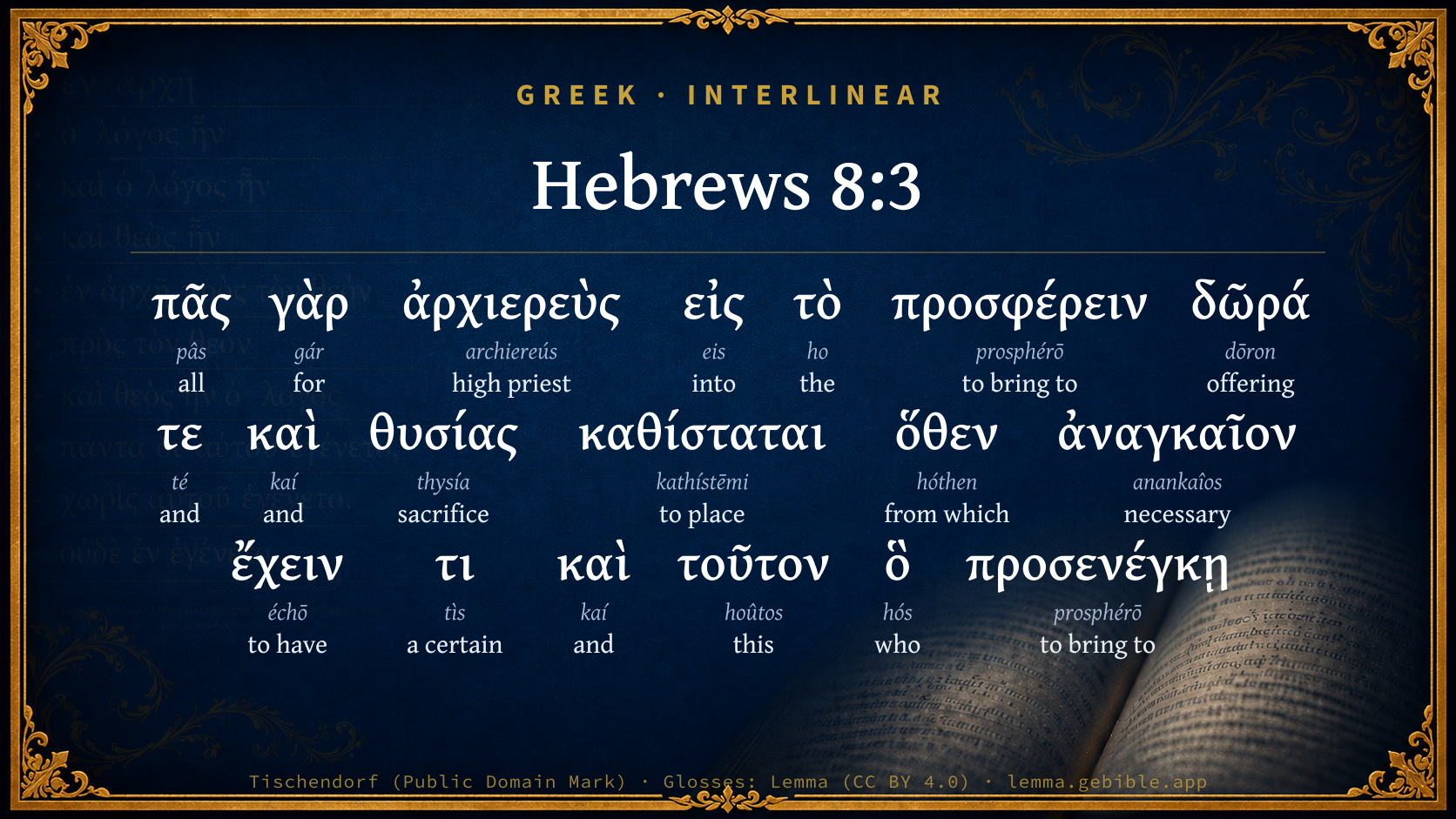
Greek (Tischendorf 8th ed.) Hebrews 8:3 appears in the Greek New Testament. The text above is from the Tischendorf 8th edition. Each word links to its Strong’s number and a concise gloss. Click any word for its full Thayer’s Greek Lexicon entry.
Download image
Cite this verse

Hebrews 8:3 (World English Bible). Public Domain. Lemma interlinear Bible study tool, https://lemma.gebible.app/v/hebrews/8/3.

Show BibTeX & RIS
BibTeX
RIS
English Translation
For every high priest is appointed to offer both gifts and sacrifices. Therefore it is necessary that this high priest also have something to offer.
World English Bible · Public Domain
Download a study sheet

One document with this verse’s original text, its word-by-word gloss line, the meaning frame, cross-references with their text, attributed commentary, and full source and license credits — printable, and it pastes into notes with its structure intact.

This verse Autodidact and up

Study sheet (.html) Plain text (.txt)

A passage Seminary Student

Up to 50 verses in one chapter. A passage sheet keeps up to 6 commentary sources and 12 cross-references per verse, in the order this page ranks them, and says so on the sheet whenever that leaves anything out. Ask for a single verse and you get the Autodidact verse sheet above.

Everything on this page stays free to read, with no account — the sheet is a download of what is already on screen, not access to it.

Want to remove ads? Support Godless Engineer
Compare translations 3

The same verse in 3 English versions, stacked beneath the original-language interlinear above. Click any original word for its lexicon entry.

Each is an independent rendering of the whole verse — the interlinear is not word-aligned to these translations.

Highlighted words mark where these versions differ — a whole-verse word diff, not a word-by-word alignment.

  • World English Bible Public Domain
    For every high priest is appointed to offer both gifts and sacrifices. Therefore it is necessary that this high priest also have something to offer.
  • King James Version Public Domain
    For every high priest is ordained to offer gifts and sacrifices: wherefore it is of necessity that this man have somewhat also to offer.
  • unfoldingWord Literal Text CC BY-SA 4.0
    For every high priest is appointed to offer both gifts and sacrifices, because of which necessary also for this one to have something that he might offer.

unfoldingWord Literal Text — © unfoldingWord, licensed CC BY-SA 4.0. Word-aligned USFM3 via Door43 (git.door43.org/unfoldingWord/en_ult).

Versions to compare (up to 4)

3 of 4 selected

Show all 19 translations

Every available English version of this verse, each an independent rendering of the whole verse.

  • World English Bible Public Domain
    For every high priest is appointed to offer both gifts and sacrifices. Therefore it is necessary that this high priest also have something to offer.
  • Berean Standard Bible Public Domain
    And since every high priest is appointed to offer both gifts and sacrifices, it was necessary for this One also to have something to offer.
  • Majority Standard Bible Public Domain
    And since every high priest is appointed to offer both gifts and sacrifices, it was necessary for this One also to have something to offer.
  • King James Version Public Domain
    For every high priest is ordained to offer gifts and sacrifices: wherefore it is of necessity that this man have somewhat also to offer.
  • American Standard Version (1901) Public Domain
    For every high priest is appointed to offer both gifts and sacrifices: wherefore it is necessary that this `high priest' also have somewhat to offer.
  • Revised Version (1885) Public Domain
    For every high priest is appointed to offer both gifts and sacrifices: wherefore it is necessary that this high priest also have somewhat to offer.
  • Geneva Bible (1599) Public Domain
    For euery high Priest is ordeined to offer both giftes and sacrifices: wherefore it was of necessitie, that this man shoulde haue somewhat also to offer.
  • Douay-Rheims (1899) Public Domain
    For every high priest is appointed to offer gifts and sacrifices: wherefore it is necessary that he also should have some thing to offer.
  • Young's Literal Translation Public Domain
    for every chief priest to offer both gifts and sacrifices is appointed, whence `it is' necessary for this one to have also something that he may offer;
  • Literal Standard Version CC BY-SA 4.0
    for every chief priest is appointed to offer both gifts and sacrifices, from where [it is] necessary for this One to also have something that He may offer;
  • Unlocked Literal Bible CC BY-SA 4.0
    For every high priest is appointed to offer both gifts and sacrifices. Therefore it is necessary to have something to offer.
  • unfoldingWord Literal Text CC BY-SA 4.0
    For every high priest is appointed to offer both gifts and sacrifices, because of which necessary also for this one to have something that he might offer.
  • Darby Bible Public Domain
    For every high priest is constituted for the offering both of gifts and sacrifices; whence it is needful that this one also should have something which he may offer.
  • World Messianic Bible Public Domain
    For every high priest is appointed to offer both gifts and sacrifices. Therefore it is necessary that this high priest also have something to offer.
  • Webster's Bible Public Domain
    For every high priest is ordained to offer gifts and sacrifices: wherefore it is of necessity that this man should have somewhat also to offer.
  • Free Bible Version CC BY-SA 4.0
    Since it's the responsibility of every high priest to offer gifts and sacrifices, this high priest must also have something to offer.
  • Bible in Basic English Public Domain
    Now every high priest is given authority to take to God the things which are given and to make offerings; so that it is necessary for this man, like them, to have something for an offering.
  • Text-Critical English NT CC BY 4.0
    For every high priest is appointed to offer gifts and sacrifices; therefore, it was necessary for this priest also to have something to offer.
  • Tyndale New Testament (1534) Public Domain
    For every hye prest is ordeyned to offer gyftes and sacryfises wherfore it is of necessitie that this man have somewhat also to offer.

Literal Standard Version (2020), Covenant Press — licensed CC BY-SA 4.0. Text via the HelloAO Bible API (eBible.org). Unlocked Literal Bible (unfoldingWord) — licensed CC BY-SA 4.0. Text via the HelloAO Bible API (eBible.org). unfoldingWord Literal Text — © unfoldingWord, licensed CC BY-SA 4.0. Word-aligned USFM3 via Door43 (git.door43.org/unfoldingWord/en_ult). Free Bible Version, Dr. Jonathan Gallagher — licensed CC BY-SA 4.0. Text via the HelloAO Bible API (eBible.org).

Word by word

More ways to search: Search by grammar → Find every occurrence → Compare this word →

Practice this passage: Drill this verse → Learn its vocabulary →

ἀναγκαῖον
anankaîos
G316
“necessary”
Adjective, Nominative, Singular, Neuter
Part of Speech
Adjective
Case
Nominative
Number
Singular
Gender
Neuter
Full Thayer's Definition

Origin: from G318

TDNT: 06:44,6

1. necessary a. what one can not do without, indispensable b. connected by bonds of nature or friendship c. what ought according to the law of duty be done, what is required by the circumstances
  1. πᾶς pâs G3956 “all” Adjective, Nominative, Singular, Masculine
  2. γὰρ gár G1063 “for” Conjunction
  3. ἀρχιερεὺς archiereús G749 “high priest” Noun, Nominative, Singular, Masculine
  4. εἰς eis G1519 “into” Preposition
  5. τὸ ho G3588 “the” Article, Accusative, Singular, Neuter
  6. προσφέρειν prosphérō G4374 “to bring to” Verb, Present, Active, Infinitive
  7. δῶρά dōron G1435 “offering” Noun, Accusative, Plural, Neuter
  8. τε té G5037 “and” Particle
  9. καὶ kaí G2532 “and” Conjunction
  10. θυσίας thysía G2378 “sacrifice” Noun, Accusative, Plural, Feminine
  11. καθίσταται kathístēmi G2525 “to place” Verb, Present, Passive, Indicative, 3rd person, Singular
  12. ὅθεν hóthen G3606 “from which” Adverb
  13. ἔχειν échō G2192 “to have” Verb, Present, Active, Infinitive
  14. τι tìs G5100 “a certain” Indefinite pronoun, Accusative, Singular, Neuter
  15. καὶ kaí G2532 “and” Conjunction
  16. τοῦτον hoûtos G3778 “this” Demonstrative pronoun, Accusative, Singular, Masculine
  17. ὃ hós G3739 “who” Relative pronoun, Accusative, Singular, Neuter
  18. προσενέγκῃ prosphérō G4374 “to bring to” Verb, Aorist, Active, Subjunctive, 3rd person, Singular

About this verse

These counts appear in no published source. They are computed here, from the morphology-tagged text and Lemma’s own curated glosses. What Lemma adds →

19
words
17
distinct lemmas
General Epistles
section

Notable vocabulary

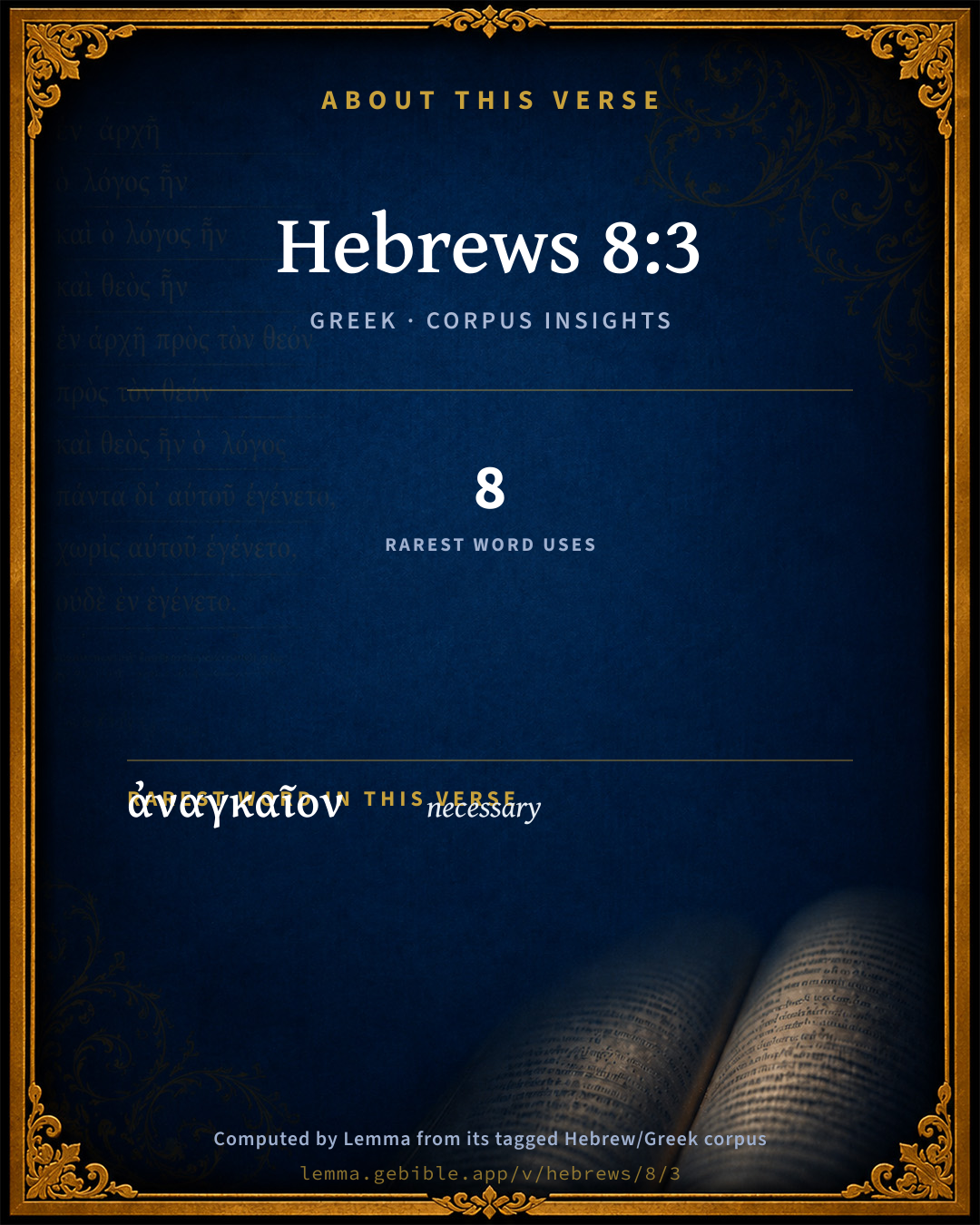
The rarest word here is ἀναγκαῖον necessary G316 — appearing just 8 times in the whole Greek New Testament.

Shared distinctive vocabulary

ἀναγκαῖον necessary G316 occurs in 8 verses of the Greek New Testament. Also found in:

Repetition

Words recur within this verse:

  • προσφέρειν to bring to G4374 ×2
  • καὶ and G2532 ×2

Cross-references

7

Topical passages linked to Hebrews 8:3 in the Treasury of Scripture Knowledge — connected by theme and wording, ordered by reader-vote popularity; previews shown in the World English Bible.

  • Ephesians 5:2 Walk in love, even as Christ also loved you, and gave himself up for us, an offering and a sacrifice to God for a sweet-smelling fragrance.
  • Hebrews 5:1 For every high priest, being taken from among men, is appointed for men in things pertaining to God, that he may offer both gifts and sacrifices for sins.
  • Hebrews 9:14 how much more will the blood of Christ, who through the eternal Spirit offered himself without blemish to God, cleanse your conscience from dead works to serve the living God?
  • Hebrews 10:9–12 then he has said, "Behold, I have come to do your will." He takes away the first, that he may establish the second,
  • Titus 2:14 who gave himself for us, that he might redeem us from all iniquity, and purify for himself a people for his own possession, zealous for good works.
  • Hebrews 7:27 who doesn't need, like those high priests, to daily offer up sacrifices, first for his own sins, and then for the sins of the people. For this he did once for all, when he offered up himself.
  • John 6:51 I am the living bread which came down out of heaven. If anyone eats of this bread, he will live forever. Yes, the bread which I will give for the life of the world is my flesh."

Cross-references courtesy of OpenBible.info (CC BY 4.0).

Commentary

Notes on Hebrews 8:3 from classic Christian and Jewish commentators (each source and its license shown beneath its notes). The classic Christian expositions comment on the surrounding passage and are grouped to its opening verse, so a note may address several verses; the Jewish commentaries on the Tanakh (Rashi and others) are per-verse, so they appear only where the commentator wrote on this verse.

Lemma curates 59 commentaries, every one of them public domain or Creative Commons licensed, each selected and text-cleaned for this edition rather than reprinted as found. About our sources →

Ellicott's Commentary for English Readers

(3) This verse and the three following confirm and illustrate the importance of the statement just made. The general course of thought appears to be as follows:—That which stands “at the head” of what we are saying, and gives completeness to the whole, is, that we have a High Priest who ministers in heaven itself (Heb_8:1-2). For, whereas the very conception of high-priestly duty would, were He on earth, exclude Him from being a priest at all (Heb_8:3-4), like those who “serve a copy of the heavenly things” (Heb_8:5), He in heaven holds and exercises that more excellent ministry of which their service was a shadow and a type (Heb_8:6).

That this man have . . .—Better, that this High Priest also have somewhat to offer. If these words refer to the continued ministration in the heavenly sanctuary, the explanation is found in Heb_9:24; but the meaning may simply be that every high priest, and therefore the Lord Jesus, must have some sacrifice to present to God, this being (Heb_5:1) the very object of his appointment to the office.

A Bible Commentary for English Readers, edited by Charles John Ellicott (1878–1897) — public domain. Text from a community e-Sword module.

The Biblical Illustrator

Joseph S. Exell

Heb_8:3

To offer gifts and sacrifices

Sacrifices

I.

GODS ORDINATION OR APPOINTMENT GIVES RULES, MEASURES, AND ENDS UNTO ALL SACRED OFFICES AND EMPLOYMENTS. Whoever undertakes anything in religion or divine worship, without it, besides it, beyond it, is a transgressor, and therein worshippeth God in vain.

II. THERE IS NO APPROACH UNTO GOD WITHOUT CONTINUAL RESPECT UNTO SACRIFICE AND ATONEMENT. The principal end of sacrifices was to make atonement for sin. And so necessary was this to be done, that the office of the priesthood was appointed for it.

III. THERE WAS NO SALVATION TO BE HAD FOR US, NO NOT BY JESUS CHRIST HIMSELF, WITHOUT HIS SACRIFICE AND OBLATION. It was of necessity that He should have somewhat to offer, as well as those priests had of old according to the law.

IV. As GOD DESIGNED UNTO THE LORD CHRIST, THE WORK WHICH HE HAD TO DO, SO HE PROVIDED FOR HIM, AND FURNISHED HIM WITH, WHATEVER WAS NECESSARY THEREUNTO.

V. THE LORD JESUS CHRIST BEING TO SAVE THE CHURCH IN THE WAY OF OFFICE, HE WAS NOT TO BE SPARED IN ANYTHING NECESSARY THEREUNTO.

VI. WHATEVER STATE OR CONDITION WE ARE CALLED UNTO, WHAT IS NECESSARY UNTO THAT STATE IS INDISPENSABLY REQUIRED OF US. So is holiness and obedience required unto a state of reconciliation and peace with God. (John Owen, D. D.)

Somewhat to offer.

The great Offering

Somewhat to offer is a very happy rendering. What He offers is not meantime of importance, He has an offering. Neither is there any reference to the time when He offers, though the word perhaps implies that the offering is one that is made once for all. But of course it is implied by the connection that the place of the offering is in the true tabernacle, for this is just the gist of the whole passage. The authors chief point is that the Melchisedec high priest is a ministering high priest in the heavenly sanctuary, and to support this point by saying that this priest must have an offering which he offers somewhere else would be peculiar reasoning. No doubt the high priest is described generally as appointed to offer gifts and sacrifices, but that offering of the high priest to which Christs corresponds is expressly defined to be blood which he offered for himself and for the errors of the people in the most holy place Heb_9:7). The somewhat to offer which Christ has is somewhat which He offers in the sanctuary on high. (A. B. Davidson, LL. D.)

Heb_8:3

If He were on earth, Be should not be a priest

Jesus limitations, His power and glory

The fact which the writer of the Epistle here cites, bears witness to the truth that there will be earthly aspects of limitation to the character of Christ, and tells us how they are to be looked at, so as to lead to His ultimate elevation.

Jesus is always falling short of mens ideal. There arose the ideal of the ascetic: that was the holiest, the best, the noblest life, to mens minds; and that man whose life was open to all the influences of His fellow-men, that man who was reproached by the malicious distortions of enemies as a glutton and winebibber, could no more fit that character than He could that of the sacrificing priest of the ancient temple. The time of chivalry and of crusades exalted the warrior; and He who sent forth His disciples without sword, and healed the ear of Malchus, was no figure to vie with the bold knights in their valorous reputations, any more than the plain garments of the humble Galilean could shine beside the imposing vestments of Jewish priests. Or, some down to modern days, and take the standards of any class in life to-day. The scientific thinker asks for facts, for analysis, for knowledge of the structure of earth and heaven: and those beautiful parables and wonderful miracles enter into no such details; and Jesus in a scientific assembly to-day would be as completely out of place as He would have been beside the high priest in the holy of holies. And the business, the commercial, ideal of life, does not look for its leader to Him who said, Lend, hoping for nothing again, and Take no thought for the morrow, any more than priest and Levite consulted Christ as to the best mode of offering sacrifices. Polities and society would find it equally impossible to discover their ideal in Him who originated no new system of Government, and associated always with the lowly. The words of Isaiahs prophecy have a real meaning: And when we shall see Him, there is no beauty that we should desire Him. All this causes difficulty. We need not inveigh against the earnestness of pursuits which have erected such ideals, any more than this writer found it necessary to heap reproaches on the Jewish system of priesthood because it found no place for Christ within it. Would Jesus lead the life of the modern clergyman to-day? is the taunt which, from the outsider, may be thrown at the preaching of His gospel. Better than to answer it by asking whether He would find it possible to lead the life of the modern merchant, or statesman, or scholar, better is it for all of us to recognize that He would lead the life of no one of us. No forms or modes of action, which we find it necessary to observe, could hold the power of Divine life, any more than the life of an ordinary Jewish priest, God-ordained as he was, could be the measure of the life of the Saviour of the world. And as we say that, we reach the ground of the solution which is given to this difficulty. Jesus was not a priest of the old covenant, because He was the Mediator of a new and better covenant, He was not a priest in descent from Aaron, because He was a priest for ever after the order of Melchisedec. The limitations of Jesus are His glory; the fact that He does not claim any of these ideals of earthly greatness is because He sets up a greater ideal, to which they all belong. We can find an illustration in our common life. A king steps down among his people; he mingles with them, and sees them at their work. And there is not one of those workmen that cannot do something better than he can. If they should bring their difficulties of work to him, he could not answer one of them; he fulfils the ideal of no one of their positions. And yet all those interests are his, and are strong and healthy through his power and character. His kingly character remains untouched by the superiority of any one of those who are eminent in their departments, and the carelessness and scorn of some man who thinks a man no king who does not know his secrets, never moves his mien of royal dignity. The lifting-up of every one of those subjects to the higher conception of the nation over which he rules, is a work truly his as no mechanical knowledge or minute practice can ever be. Such was Christs position as king; and so He stands far above, though never apart from, every standard of human attainment. He helps every one of them, as He brings them all into connection with the very centre of life. He set forth for ever the truth, that the life of the lower is to be found in the higher. Low and compromised mortal life comes from narrow views; from fixing our minds on some immediate object, and making that the measure of all our existence. He who sees such an object only as a part of something greater is the man who will cease sacrificing nobleness of character and purity of life, which are treasures that will lash to eternity, for ends that must be limited and transient. Is not that precisely the kind of assistance which we need? We men must be priests in our own temples, and we are made to aspire to the highest places in the region of life where God has placed us. That earnestness, as it limits our sight, may be destroying our character and hope of eternal life. We plead as an excuse that we are doing our best, and cannot be expected to see the full Divine meaning of all our work. But when that is showed to us, when, through such a life as that of Jesus, we see that our little pursuit is not the end of our being, then with that revelation goodness stands forth as a real power in life, and we hold to it in spite of every sacrifice for which it may call, in the name and spirit of Him who has thus consecrated it for us. Our pursuit shall still be vigorous and successful; but, by connection with Him, character, too, shall be purified and elevated by it. That is one advantage of Christs position outside of our special pursuits. We find another in the way in which it draws us all together. He is for all, because no special pursuit causes Him to belong specially to any. Is not the way that Christian worship calls us together, men, women, and children, without distinction, a part of Christs greatest blessing in telling us of our manhood which is beneath all our pursuits and greater than them all? We all come from our different pursuits; but it is the same take of mingled joy and sorrow, success and discouragement, struggle and triumph, sin and holiness, which we bring. It is the same word of love, forgiveness, hope, and strength that we want to hear. The bands of life are strengthened in the presence of Him who belongs to us all. We feel the influence in deepened friendship, widened sympathy, enriched family feeling. It will be harder for our variety of pursuits to separate us when in truth we recognise our relation to Him who is the common Lord and Saviour of us all. (Arthur Brooks.)

The Biblical Illustrator, edited by Joseph S. Exell (c. 1880s–1900s) — public domain. Text from a community e-Sword module.

Joseph Benson's Commentary

Heb 8:3-4. For every high-priest, &c. — As if the apostle had said, And it appears that Christ is a minister, or priest, of the true tabernacle, because he offers sacrifice, which none but the priests might do. Wherefore — Greek, οθεν, whence; the whole force of this inference depends on this supposition — that all the old typical institutions did represent what was really to be accomplished in Christ; it is of necessity that this man have somewhat to offer — For whatever otherwise this glorious person might be, yet a high-priest he could not be, unless he had in his possession somewhat to offer in sacrifice to God, and that was his whole human nature, soul and body. For, or, rather, but, if he were on earth — If his priesthood terminated here; he should, or, rather, could, not be a priest — Consistently with the Jewish institutions; seeing that there are priests, other priests, that offer according to the law — To whom alone this office is allotted. As if he had said, It appears further that Christ was a minister of the heavenly sanctuary, and was to execute his office in heaven; 1st, Because he did not execute it on earth. For though his priesthood may be considered as being in some sense begun on earth, by his offering the sacrifice of himself upon the cross, yet the continuance and consummation of all is in heaven, by his representing there the merit of his sacrifice, and his making continual intercession. 2d, Because there was a priesthood settled on earth already, and there could not be two orders of priesthood divinely appointed officiating on earth together.

Joseph Benson's Commentary on the Old and New Testaments (1811–1818) — public domain. Text from a community e-Sword module.

Burkitt's Expository Notes on the New Testament

William Burkitt

That the Lord Jesus Christ is our great High Priest under the gospel, the apostle had sufficiently demonstrated and confirmed before.

Observe here, How he next declares what is the nature, duty and office of Christ as our High Priest; namely, to offer gifts and sacrifice. A priest that has nothing to offer is no priest at all, Christ therefore offered as well as other high priests; but what! Bullocks and rams? In no wise: he offered himself his whole human nature, soul and body. As to the typical sacrifices he did not, could not offer them, were he upon earth, because he was not of the tribe of Levi, whose proper office it was to meddle with those offerings; therefore leaving the shadow to them, he offered the substance, himself; that is, his own body, signified by those shadows.

Learn hence, That there was not salvation to be had for us, no, not by Jesus Christ himself, without his sacrifice and oblation; It was of necessity that he should have somewhat to offer, as well as those priests had of old, according to the law. No salvation without atonement for sin but by sacrifice; no sacrifice sufficient for atonement but the death of Christ; and whoever looks for salvation otherwise than in the faith and virtue of that sacrifice, will be disappointed and deceived. But although applicaiton of its efficacy to the souls of belivers is made by Christ now in heaven; without which, neither their access to God nor their peace with God could be maintained, Heb 8:3-4.

In the fifth verse, , the apostle asserts, that the Levitical priests here below did perform those administrations which were but shadows of heavenly things above. Who serve unto the example and shadow of heavenly things.

Where to serve, is to officiate as priests, in offering gifts and sacrifices: But this their service was not spiritual and heavenly, but carnal and earthly: Yet a shadow and imitation of heavenly things.

Learn hence, That God alone limits the signification and us of all his own institutions. The ministry of the priests of old was only in and about earthly things, not having a resemblance and shadow of heavenly things. We must not take any thing out of God’s insitutions which he has put in them, nor must we put more in them than God has furnished them withal. To expect that from any ordinance or institution of God which he never intended or designed, is to make an idol of the ordinance, and the way to render it useless, yea, pernicious and perilous to us; to put that into an ordinance which God never put into it, and to expect more from an ordinance, than God ever promised, is to overthrow it.

-"As Moses admonished of God, when he was about to make the tabernacle. for See, (saith he), that thou make all things according to the pattern showed to thee in the mount."

The words imply, that divine institution is the only pure rule of religious worship: Moses did nothing of his own head when he built the tabernacle, but had his directions in every thing from God. If persons will carve out the worship of God according to their own fancies, they may please themselves perhaps, but they never can please their Maker; for nothing is pleasing to God, as to the substance of religious worship, but what is of his own prescribing; consequently all that theatrical pomp which is found in the church of Rome, and makes the worship of God a dead thing, is a mere fornication in religion, and an abomination in the sight of God.

All their human inventions are intolerable presumptions. And as Moses was bound to give directions according to the pattern given him, so the priests, in their administrations, were bound to follow Moses’ directions. Yet after all, the things which Moses was concerned about, were carnal things; the tabernacle was earthly, the offerings carnal, yet shadows of better things, even of heavenly; for the sanctuary was a shadow of a heavenly sanctuary; the priest of a better priest; the service, of a far better service: This seems to be the intention of our apostle.

William Burkitt's Expository Notes on the New Testament (1700–1703) — public domain. Text from a community e-Sword module.

Tyndale Open Study Notes

Tyndale Open Resources

8:3 every high priest is required to offer gifts and sacrifices: Making offerings is a general requirement of priests, so Jesus also had to offer a sacrifice. • This verse reiterates what is stated in the first verse of the previous discussion (5:1), indicating another major movement in the book.

Tyndale Open Study Notes — © Tyndale Open Resources, licensed CC BY-SA 4.0. Text via the HelloAO Bible API.

Bengel's Gnomon

Johann Albrecht Bengel

Heb 8:3. Γὰρ, for) The reason why he called Him λειτουργὸν, Heb 8:2.—ἀναγκαῖον, necessary) viz. was; for the aorist follows, προσενέγκῃ, should offer.

Bengel's Gnomon of the New Testament — English translation (T&T Clark, Edinburgh, 1860) — public domain. Text from a community e-Sword module.

Meyer's Critical & Exegetical Commentary

Heinrich August Wilhelm Meyer

Heb_8:3. Subsidiary remark in justification of the expression λειτουργός, Heb_8:2. The λειτουργεῖν, or the presenting of sacrifices, is just something essential in the fulfilment of the office of every high priest; a λειτουργός, or sacrificing priest, must thus Christ also be.

By the statement, Heb_8:3, the argument itself is not interrupted. For enclosing the verse within a parenthesis, with Cameron, Stengel, and others, there exists therefore no reason.

γάρ] the explanatory namely.

On πᾶς γὰρ … καθίσταται, comp. Heb_8:1 : πᾶς γὰρ ἀρχιερεὺς … καθίσταται τὰ πρὸς τὸν θεόν, ἵνα προσφέρῃ δῶρά τε καὶ θυσίας.

ὅθεν ἀναγκαῖον] sc. ἦν (Syriac, Beza, Piscator, Owen, Bengel, Bleek, de Wette, Hofmann, Komm. p. 306; Woerner), not ἐστίν (Vulgate, Luther, Calvin, Schlichting, Schulz, Böhme, Stuart, Kuinoel, Hofmann, Schriftbew. II. 1, 2 Aufl. p. 407; Riehm, Lehrbegr. des Hebräerbr. p. 505; Alford, Maier, Moll, Ewald, MCaul, al.). For the author knows only one single sacrificial act of Christ, an act performed once for all (not one continually repeated), as is evident partly from the parallel passages, Heb_7:27, Heb_9:12; Heb_9:25; Heb_9:28, Heb_10:10; Heb_10:12; Heb_10:14, partly from the preterite προσενέγκῃ in our passage.

ἔχειν τι καὶ τοῦτον, ὃ προσενέγκῃ] that also this (High Priest) should have somewhat that He might offer up. By the τί the author understands Christs own body, which He gave up to death as a propitiatory sacrifice for the sinful world. The indefinite mode of expression by τί, however, was chosen just because the reference to the sacrifice in this place was only an incidental one, and that which was intended could the less be misunderstood by the readers, in that immediately before, Heb_7:27, it had been declared by means of ἑαυτὸν ἀνενέγκας in what the sacrifice of Christ consisted.

Meyer — Critical and Exegetical Commentary on the New Testament — English translation by Peter Christie, edited by Frederick Crombie (T&T Clark, 1880) — public domain. Text from a community e-Sword module.

Expositor's Greek Testament

ed. W. Robertson Nicoll

Heb 8:3 . πᾶς γὰρ ἀρχιερεὺς .… “For every High Priest is appointed for the offering of gifts and sacrifices, and therefore it was necessary that this man also have something to offer”. That Christ is in heaven as a λειτουργός , as an active minister in holy things, is proved by the universal law, that every High Priest is appointed to offer gifts and sacrifices. Christ is not idle in heaven, but being there as High Priest He must be offering something; what that is, He has told us in Heb 7:27 , but here no emphasis is on the what , but merely on the fact that He must be offering something, must be actively ministering in heaven as a λειτουργός . [Bruce therefore overlooks Heb 7:27 in his interpretation: “He is content for the present to throw out the remark: ‘This man must have something to offer,’ and to leave his readers for a while to puzzle over the question, What is it?”] With ἀναγκαῖον some have understood ἦν rather than ἐστὶ “necesse fuit habere quod offerret” (Beza) followed by Westcott, etc., on the ground that the reference is to our Lord’s presentation to the Father of His finished sacrifice. But it is better to give the word a merely logical and subjective force; it is a necessary inference that this man, etc. Behind and beyond this lies no doubt the reference to Christ’s sacrifice. As the High Priest could not enter into the Holiest without the blood of the victim (Heb 9:7 ), so must Jesus accomplish His priestly office by offering His own blood (Heb 9:12 ). For the words of the former part of the verse see note on Heb 6:1 .

The Expositor's Greek Testament, edited by W. Robertson Nicoll (1897–1910) — public domain. Text from a community e-Sword module.

Geneva Bible (1599)

Geneva Bible translators

He bringeth a reason why it must needs be that Christ should have a body (which he calleth a tabernacle which the Lord pight and not man) to wit, that he might have what to offer: for otherwise he could not be an high Priest. And the selfsame body is both the tabernacle and the sacrifice.

Geneva Bible (1599) marginal notes — public domain. Text via Bolls.life.

Jamieson, Fausset & Brown

Robert Jamieson, A. R. Fausset & David Brown

For--assigning his reason for calling him "minister of the sanctuary" (Heb 8:2).

somewhat--He does not offer again His once for all completed sacrifice. But as the high priest did not enter the Holy Place without blood, so Christ has entered the heavenly Holy Place with His own blood. That "blood of sprinkling" is in heaven. And is thence made effectual to sprinkle believers as the end of their election (Pe1 1:2). The term "consecrate" as a priest, is literally, to fill the hand, implying that an offering is given into the hands of the priest, which it is his duty to present to God. If a man be a priest, he must have some gift in his hands to offer. Therefore, Christ, as a priest, has His blood as His oblation to offer before God.

Jamieson, Fausset & Brown — Commentary Critical and Explanatory on the Whole Bible (1871) — public domain (CC PDM 1.0). Text via the HelloAO Bible API.

Adam Clarke's Commentary

Verse 3. Every high priest is ordained] καθισταται, Is set apart, for this especial work.

Gifts and sacrifices] δωρα τε και θυσιας. Eucharistic offerings, and sacrifices for sin. By the former, God's government of the universe, and his benevolence to his creatures in providing for their support, were acknowledged. By the latter, the destructive and ruinous nature of sin, and the necessity of an atonement, were confessed.

Wherefore-of necessity] If Christ be a high priest, and it be essential to the office of a high priest to offer atoning sacrifices to God, Jesus must offer such. Now it is manifest that, as he is the public minister, officiating in the true tabernacle as high priest, he must make an atonement; and his being at the right hand of the throne shows that he has offered, and continues to offer, such an atonement.

Adam Clarke's Commentary on the Bible (1810–1826) — public domain. Text from a community e-Sword/MySword module.

John Calvin's Commentaries

3. For every high priest, etc. The Apostle intends to show, that Christ’s priesthood cannot coexist with the Levitical priesthood. He proves it in this way, — “The Law appointed priests to offer sacrifices to God; it hence appears that the priesthood is an empty name without a sacrifice. But Christ had no sacrifice, such as was offered under the Law; it hence follows, that his priesthood is not earthly or carnal, but one of a more excellent character.”

Let us now examine every clause. The first thing that deserves notice, is that which he teaches that no priest is appointed except to offer gifts; it is hence evident, that no favor from God can be obtained for men except through the interposition of a sacrifice. Hence, that our prayers may be heard, they must be founded on a sacrifice; their audacity, therefore, is altogether pernicious and fatal, who pass by Christ and forget his death, and yet rush into the presence of God. Now, if we wish to pray in a profitable manner, we must learn ever to set before us the death of Christ, which alone sanctifies our prayers. For God will never hear us unless he is reconciled; but he must be first pacified, for our sins cause him to be displeased with us. Sacrifice must necessarily precede, in order that there may be any benefit from prayer.

We may hence further conclude, that no one either among men or angels is qualified for pacifying God, for all are without any sacrifice of their own which they can offer to appease God. And hereby is abundantly exposed the effrontery of the Papists who make Apostles and martyrs to share with Christ as mediators in the work of intercession; for in vain do they assign them such an office, except they supply them with sacrifices.

John Calvin's Commentaries (1540-1563) — public domain. Text from the Calvin Translation Society English edition (1840s-50s) via the Christian Classics Ethereal Library (ccel.org). Calvin's coverage is partial (roughly two-thirds of the Bible); uncommented books and verses are honest gaps, never fabricated. The 19th-century editor's footnotes and remarks are omitted so the notes are faithfully Calvin's own voice.

The Cambridge Bible for Schools and Colleges

gen. ed. J. J. S. Perowne

3. is ordained] Rather, “is appointed.”

gifts and sacrifices] See note on Heb_5:1.

that this man] It would be better as in the R. V. to avoid introducing the word “man” which is not in the original, and to say “that this High Priest.”

have somewhat also to offer] Namely, the Blood of His one sacrifice. The point is one of the extremest importance, and though the writer does not pause to explain what was the sacrifice which Christ offered as High Priest, he purposely introduces the subject here to prepare for his subsequent development of it in Heb_9:12, Heb_10:5-7; Heb_10:11-12. Similarly St Paul tells us “Christ … hath given Himself for us, an offering and a sacrifice to God for a sweet-smelling savour” (Eph_5:2).

The Cambridge Bible for Schools and Colleges (gen. ed. J. J. S. Perowne; Cambridge University Press, 1878–1918) — public domain. Text from a community e-Sword module.

John Gill's Exposition

For every high priest is ordained to offer gifts and sacrifices,.... See Gill on Heb 5:1.

wherefore it is of necessity that this man have somewhat also to offer; or this person; for the word "man" is not in the text, and seems not so proper a word to be supplied, since it was his human nature that it was necessary he should have to offer; he was a person, and existed as a divine person antecedent to his assumption of human nature: as God, he had nothing to offer, or that was capable of being offered; something to offer as a sacrifice was necessary to him as a priest, but not any thing was proper to him; Levitical sacrifices would not do, these could not take away sin; besides, the great high priest was not of the tribe of Levi, nor of the order of Aaron, and therefore could not offer these. An angelic nature would have been improper, that is not capable of dying; and the offering up of such an one would have been of no service to men, for whom priests are ordained; but an human nature is meant, and which it was necessary Christ should have, and offer, for it is for men that he became an high priest; it was human nature that had offended God, and satisfaction must be made in that nature; and this was capable of suffering and dying; yet not human nature under any consideration was necessary for him to have and offer; not merely as in a state of innocence, without any infirmity, nor as sinful, yet as perfect as to parts and qualities; and a nature, and not a person, was necessary to be had, and to be taken into close and inseparable union to his divine person; and of this there was a necessity, not absolute, or a necessity of coaction and force: Christ was not forced unto it; but on the foot of his suretyship engagements, and because of making satisfaction for the sin of man, it was necessary; otherwise Christ voluntarily engaged to be a priest, and willingly became man, and freely offered himself, soul and body, in the room and stead of his people.

John Gill's Exposition of the Whole Bible (1746–1763) — public domain (CC PDM 1.0). Text via the HelloAO Bible API.

Trapp's Complete Commentary

John Trapp

3 For every high priest is ordained to offer gifts and sacrifices: wherefore it is of necessity that this man have somewhat also to offer.

Ver. 3. Somewhat also to offer] To wit, his own body, "an offering and a sacrifice to God for a sweet smelling savour," Eph 5:2. By Mount Olivet stood the garden of Gethsemane, where Christ was taken and led into the city through the sheep gate to be offered up like an innocent sheep, on the altar of his cross, for the sins of his people.

John Trapp, A Commentary or Exposition upon All the Books of the Old and New Testament (1647–1656) — public domain. Text from a community e-Sword module.

Albert Barnes' Notes on the Bible

For every high priest is ordained to offer gifts and sacrifices - This is a general statement about the functions of the high priest. It was the uniqueness of the office; it constituted its essence, that some gift or sacrifice was to be presented. This was indisputable in regard to the Jewish high priest, and this is involved in the nature of the priestly office everywhere. A “priest” is one who offers sacrifice, mainly in behalf of others. The principles involved in the office are:

(1)That there is need that some offering or atonement should be made for sin; and,

(2)That there is a fitness or propriety that some one should be designated to do it.

If this idea that a priest must offer sacrifice be correct, then it follows that the name priest should not be given to any one who is not appointed to offer sacrifice. It should not therefore be given to the ministers of the gospel, for it is no part of their work to offer sacrifice - the great sacrifice for sin having been once offered by the Lord Jesus, and not being again to be repeated. Accordingly the writers in the New Testament are perfectly uniform and consistent on this point. The name priest is never once given to the ministers of the gospel there. They are called ministers, ambassadors, pastors, bishops, overseers, etc., but never priests. Nor should they be so called in the Christian church. The name priest as applied to Christian ministers, has been derived from the “papists.” They hold that the priest does offer as a sacrifice the real body and blood of Christ in the mass, and holding this, the name priest is given to the minister who does it “consistently.” It is not indeed “right or Scriptural” - for the whole doctrine on which it is based is absurd and false, but while that doctrine is held the name is consistent. But with what show of consistency or propriety can the name be given to a Protestant minister of the gospel?

Wherefore it is of necessity that this man have somewhat also to offer - That the Lord Jesus should make an offering. That is, since he is declared to be a priest, and since it is essential to the office that a priest should make an offering, it is indispensable that he should bring a sacrifice to God. He could not be a priest on the acknowledged principles on which that office is held, unless he did it. What the offering was which the Lord Jesus made, the apostle specifies more fully in Heb 9:11-14, Heb 9:25-26.

Albert Barnes' Notes on the Bible (1834–1885) — public domain. Text from a community e-Sword/MySword module.

Haydock's Catholic Bible Commentary

For every high priest, &c. That is, as all priests are ordained to offer up to God some gifts and sacrifices; so Christ, a priest for ever, has now in heaven something to offer to his eternal Father; to wit, the infinite merits and satisfactions of his death and passion. This he doth in heaven, and also by the ministry of his priests on earth, who offer the same in his name. (Witham) --- This is the daily sacrifice of Christians, foretold plainly by Malachias, chap. i. 10. 11. This is also clearly mentioned in St. Justin Martyr, Dia. cum Tryphone.; Tertullian, co. M. lib. iii. chap. 21.; St. Irenæus, lib. iv. chap. 32.; St. Cyprian, lib. i. adv. Jud.; Eusebius, lib. i. Dem. Evan.; St. John Chrysostom, in Psalm xcv.; St. Augustine, lib. xviii. de civ. Dei. chap. 35, &c. &c. For authorities see annotations on chapter x. of this epistle. The apostate Courayer, who pretending to remain a Catholic, ended by becoming a Socinian or Unitarian, taught that persons were at liberty to deny the real presence, and admit with Catholics a commemorative or representative sacrifice, but a true and real offering of a victim, really present, and actually offered to God by the priest. "By his last sentiments, (published by Dr. Bell) it appears, says the New Gen. Biogr. Dict. edited by Chalmers, an. 1814 [the year A.D. 1814], vol. lxxx. art. Courayer, that although he professed to die a member of the Roman Catholic Church, he could not well be accounted a member of that, or of any other established Church. In rejecting the doctrine of the Trinity, he became nearly, if not quite, a Socinian, or modern Unitarian; he denied also the inspiration of the holy Scriptures, as to matters of fact; and as to baptism, seems to wish to confine it to adults. In 1811 a more full exposure of his sentiments was published by Dr. Bell, in a posthumous work of Courayer, on the Divinity of Jesus Christ, 8vo. a publication we have little hesitation in saying ought never to have appeared. It could not be wanting to illustrate the wavering, unsettled character of the author. The creed of innovators is never fixed; and when once they cast off the authority of the Church, they are carried about, like children, with every wind of doctrine." [See Ephesians iv. 11-14.]

George Leo Haydock (1774–1849), Haydock's Catholic Family Bible and Commentary, 1859 edition — public domain. Excludes Psalms (Douay-Rheims chapter numbering differs from Protestant) and Deuterocanonical books (Catholic canon only).

Matthew Poole's English Annotations

For every High Priest is ordained to offer gifts and sacrifices: in Christ’s administration for his in heaven, as he is a King, so he is a High Priest; and as such must have service and ministration suitable to himself there, as the Aaronical high priests had on earth; every of which was constituted to stand and minister at God’s altar, and were to offer sacrifices and gifts, as cleared before, Heb 5:1.

Wherefore it is of necessity that this man have somewhat also to offer; seeing these earthly priests had such service, it would follow thence, if he were earthly and of their order, he should need such too. ’ Anagkaion having no verb expressly joined to it, is variously supplied: some, by

it is; but those who would make the tabernacle his body, do not allow it, that being offered before this, and therefore add, it was, or hath been: but it is best supplied potentially, it would be necessary for this High Priest, if he were so low as those priests, to have something of the like nature or kind of gifts and sacrifices, that he might offer as they did. Now such he needed not, as being utterly inconsistent with his priesthood, as is proved after.

Matthew Poole's English Annotations on the Holy Bible (1683–1685) — public domain. Text from a community e-Sword/MySword module.

Whedon's Commentary on the Bible

Daniel D. Whedon

3. For—To show the true reality, nay, the sole reality, of Christ’s high priesthood, of which the earthly high priesthood is a shadow. That completeness consisted in the fact that he had a divine somewhat… to offer, a point slightly opened here, and completely developed at Heb_9:26; Heb_10:5-17.

Daniel D. Whedon (gen. ed.), Commentary on the Old and New Testaments (1874–1909) — public domain. Text from a community e-Sword module.

The Pulpit Commentary

Vers. 3, 4. For every high priest is appointed to offer gifts and sacrifices: wherefore it is of necessity that this one also have somewhat to offer. For (rather, nay; the reading me being better supported than the Textus Receptus mer) if he were on earth, he would not even be a priest, seeing there are those who offer the gifts according to the Law. These verses are in proof of the assertion of ver. 2, viz. that Christ has his ministry in the heavenly tabernacle. He has been shown to be a High Priest: therefore he must make some offering, this being the very purpose of a high priest"s office. (cf. Heb_5:1) But where? Not certainly in the earthly tabernacle, this being served already, and exclusively served, by the sons of Aaron. Therefore it must be in the heavenly sphere symbolized by the earthly tabernacle. And then, in ver. 5, that there is a heavenly reality, of which the earthly tabernacle is but a shadow, is shown by what was said of the latter when it was made. (What Christ offers in the heavenly sphere is surely his own atoning sacrifice. Some commentators have found a difficulty in this conception on the ground that this his sacrifice had been completed once for all before his ascension. True; but he is regarded as carrying its efficacy with him to the mercy-seat above, and so for ever offering it; even as it is continually commemorated and pleaded in the Eucharist by the Church below. And thus, be it observed, the symbolism of the Day of Atonement is accurately fulfilled. For the high priest did not sacrifice within the tabernacle; he only carried to the holy of holies the blood, representing the atoning efficacy of the sacrifice made outside before his entrance.)

The high priest for what appointed.

I THE STATEMENT AS TO HIGH PRIESTLY FUNCTION IN GENERAL. All high priests, whether they be Aaronic priests or Jesus himself, are appointed to offer gifts and sacrifices. Thus the classification is made of offerings for God. There are gifts, the expressions of thankfulness and devotion, which may be offered, which ought to be offered, but which can only have value as they come spontaneously and of free-will. To give them only in response to a Divine commandment would be to alter their character altogether. Their very name indicates this, as being not simply things given, but dwra , things given freely. Then there are also sacrifices, the purpose of which is more particularly defined in ver. 1, where they are mentioned as sacrifices for sin. And all this volume of gratitude and penitence, instead of being scattered about in individual manifestations, left to each one"s own time and place and manner, was reduced to order, and made a national proceeding. As to gifts, a man was free to settle in his own mind whether he would give or not; but if he gave, he must give in a particular way.

II THE SPECIAL APPLICATION TO JESUS. How can he now discharge a priestly office in respect of gifts and sacrifices? With respect to sacrifices the answer is given plainly, not only in this Epistle, but in all apostolic teaching. A reference to Heb_9:14 may be enough to illustrate this. Jesus, the true High Priest, offered up himself as the true Sacrifice. But what about the gifts? These, be it remembered, we still have to provide. A sacrifice for sin we cannot provide, but it is provided for us. Gifts, however, we are bound to bestow gifts, more in quantity than ever, and better in quality, seeing that our obligations are added to by Christ"s provision of a sacrifice for sins. And we lay these gifts on God"s altar when most of all we serve the needy. As it is true that he who gives to the poor lends to the Lord, so he who gives to the needy because of their need, hoping for nothing again, makes an offering to the Lord. It is by the Spirit of Jesus Christ that we are led into that sort of gratitude which is acceptable to God. The gifts which are most acceptable for God to receive are those which indicate our appreciation of his spiritual mercies. It is a poor business if we have not received more from God than the things which he bestows equally on the good and the evil, the just and the unjust. Our best gifts are those which promote the cause of Christ, which are offered with a distinct intention towards the progress of that cause. Y.

The Pulpit Commentary (1880–1919), ed. H.D.M. Spence-Jones & Joseph S. Exell — public domain. Text from a community e-Sword module.

The People's New Testament

B. W. Johnson

3–7. For every high priest is ordained, etc. It is his appointment to offer gifts and sacrifices. That is his office. Hence, if Jesus is a High Priest, he must have an offering, but his offering must be presented in the true Holy of Holies above.

B. W. Johnson's The People's New Testament with Notes (1889–1891) — public domain. Electronic text from the Christian Classics Ethereal Library (CCEL) ThML edition.

unfoldingWord translationNotes

Door43 World Missions Community

For every high priest is appointed

This can be stated in active form. AT: "For God appoints every priest" (See: Active or Passive)

Now

This does not mean "at this moment," but is used to draw attention to the important point that follows.

according to the law

"as God requires in the law"

a copy and shadow

These words have similar meanings to emphasize that the tabernacle was merely an image of the real tabernacle in heaven. AT: "a vague image" (See: Doublet)

shadow of the heavenly things

The author speaks of the earthly temple, which is a copy of the heavenly temple, as if it were a shadow. (See: Metaphor)

It is just as Moses was warned by God when he was

This can be stated in active form. AT: "It is just as God warned Moses when Moses was" (See: Active or Passive)

was about to construct the tabernacle

Moses did not construct the tabernacle himself. He ordered the people to construct it. AT: "was about to command the people to construct the tabernacle" (See: Assumed Knowledge and Implicit Information)

See that

"Make sure that"

to the pattern

"to the design"

that was shown to you

This can be stated in active form. AT: "that I showed you" (See: Active or Passive)

on the mountain

You can make explicit that "mountain" refers to Mount Sinai. AT: "on Mount Sinai" (See: Assumed Knowledge and Implicit Information)

translationWords

high priest

appoint

gift

sacrifice

Christ

earth

priest

law

servant

heaven

Moses

tabernacle

unfoldingWord translationNotes — © Distant Shores Media and the Door43 World Missions Community, licensed CC BY-SA 4.0. Source: git.door43.org/Door43/en_tn.

Cambridge Greek Testament for Schools and Colleges

3. καθίσταται. “Is appointed.”

δῶρά τε καὶ θυσίας. See note on Heb 5:1.

καὶ τοῦτον. “That He too.” It would be better as in the R.V. to avoid introducing the word “man” which is not in the original, and to say “that this High Priest.”

ὃ προσενέγκῃ. In Attic prose relatives with the conj. mood usually have ἂν, but this is sometimes omitted in the N.T., Jas 2:10, ὅστις … τηρήσῃ; Mat 10:33, ὅστις ἀρνήσηταί με. It is essential to the conception of a priest that he should have an offering,—the aorist denotes the one past act, not that there is a continual offering, or representation of the offering. Christ’s offering is mainly the blood of this one sacrifice, i.e. His vivifying life outpoured for, and imparted to, His people. The point is one of the extremest importance, and though the writer does not pause to explain what was the sacrifice which Christ offered as High Priest, he purposely introduces the subject here to prepare for his subsequent development of it in Heb 9:12, Heb 10:5-7; Heb 10:11-12. Similarly St Paul tells us “Christ … hath given Himself for us, an offering and a sacrifice to God for a sweet-smelling savour” (Eph 5:2).

Cambridge Greek Testament for Schools and Colleges (Cambridge University Press, 1896; 21 vols, various authors incl. Carr, Maclear, Plummer, Farrar, Lumby, Moule, M. R. James, Simcox) — public domain. Text from a community e-Sword module.

Alford’s Greek Testament

Henry Alford

3-6.] This heavenly office and work our High Priest must have, if He be veritably a High Priest.

3.] For every high priest is appointed to offer gifts and sacrifices (see the very similar passage, ch. 5:1, and note there): whence it is necessary that this (High Priest) also have somewhat which he may offer (there is here considerable difficulty. For the Writer is evidently, from what follows, laying the stress on the heavenly λειτουργία of Christ: and this ὃ προσενέγκῃ applies therefore to His work not on earth, but in heaven. If so, how comes it to be said that He has somewhat to offer in heaven, seeing that His offering, of Himself, was made once for all, in contradistinction to those of the Levitical priests which were being constantly offered? See especially ch. 10:11, 12, which, on this view, brings the Writer here into direct contradiction to himself. In order to avoid this, Lünemann and Hofmann (Schriftb. ii. 1. 288) attempt to make the aor. προσενέγκῃ retrospective: “it is necessary for Him to have (there, in heaven) somewhat (viz. His body) which he may have offered.” But surely this is a view of the aorist which cannot be admitted. In such sentences, the uses of the aor. and pres. seem to regard not the time, objectively, of the act expressed, but its nature, subjectively, as an act rapidly passing in each case, or enduring. The straightforward construction of our sentence makes it necessary that προσενέγκῃ should refer to an act done in the state pointed out by the ἔχειν, however the nature of that act may be, in each case of its being done, such as to be accomplished at the moment, and not enduring onwards: which latter, expressed by ὃ προσφέρῃ, would certainly involve the contradiction above spoken of. Thus regarded then, what is it which our High Priest in heaven has to offer? In ch. 5:7, He is described as προσενέγκας prayers and supplications in the days of His flesh: and it might be thought that His ἐντυγχάνειν ὑπὲρ ἡμῶν, ch. 7:25, might be here meant, the offering being those intercessions. But this would hardly satisfactorily give the τι, which as Delitzsch remarks, is too concrete for such an interpretation. It must be something with which and by virtue of which, and as offering and applying which, our High Priest enters and ministers in the Holy of Holies above. Now if we look to the analogy of ch. 9:7, 12, we see, 1. that the high priest entered the holy place οὺ χωρὶς αἵματος, ὃ προσφέρει ὑπὲρ ἑαυτοῦ κ. τῶν τοῦ λαοῦ ἀγνοημάτων,—2. that Christ is entered into the ἅγια of heaven οὐ διʼ αἵματος τράγων καὶ μόσχων, διὰ δὲ τοῦ ἰδίου αἵματος: see also ib. ver. 25. This blood of the one offering, Christ is represented as bearing into the Holy Place, and its application is ever set forth to us as a continuing and constantly repeated one. Thus this blood of sprinkling is regarded as being in heaven, ch. 12:24: as being sprinkled on the believer as the end of his election, 1Pe 1:2: as cleansing us from all sin, 1Jn 1:7: as that wherein the saints wash their robes and make them white, Rev 7:14. Still, as Delitzsch also remarks, this is not the place to enlarge on this matter, seeing that it is merely incidentally introduced here, the present object being to shew that it is in heaven, and not on earth, that our High Priest ministers. The Roman Catholic interpretation of this place, as represented by Corn. a-Lapide, is worth noticing, if only to remark how absolutely inconsistent it is with the argument of the Epistle: “Ergo Christus in cœlo suas hostias et munera offert, scilicet suum in cruce sacrificium, quod olim in monte Calvariæ obtulit, nunc quoque id ipsum per continuam commemorationem Patri in cœlo offert. Secundo, et proprie, Christus in cœlo offert sacrificia missæ, quæ toto orbe quotidie celebrantur; in his enim primus et primarius sacerdos qui consecrat, offert, et transubstantiationem peragit, est Christus.” Estius, more cautiously, “Probabile est apostolum loqui de ea oblatione qua se ipsum quondam in cruce passum et oblatum, continuo nunc repræsentat Patri in cœlis. Nam de altera (Christum, etsi in cœlo regnantem, offerre quotidie se ipsum adhuc in terris per ministros et vicarios suos sacerdotes) apostolus prorsus tacet, quia mysterium est, quod intelligendum relinquit fidelibus mysteriorum consciis.” This last would make a curious canon of interpretation).

Henry Alford, The Greek Testament (1849–1861) — public domain. Text from a community e-Sword module.

Vincent's Word Studies in the New Testament

Marvin R. Vincent

A priest is appointed to offer gifts and sacrifices. Therefore Christ, a high priest, must have gifts and sacrifices to offer, and a sanctuary in which to offer them.

Wherefore it is of necessity [οεν αναγκαιον] . Rend. wherefore it is necessary.

Somewhat to offer [ο προσενεγκη] . Lit. what he may offer. The construction is unusual. Comp. Act 21:16. The statement is a truism, unless it be assumed that the Hebrew Christians were ignorant of the doctrine of Christ 's priesthood.

Marvin R. Vincent, Word Studies in the New Testament (1887–1900) — public domain. Text from a community e-Sword/MySword module.

Westcott on Hebrews & the Epistles of John

Brooke Foss Westcott

3. was yap apy.] Compare 6. v. 1. The fact that the Lord is High-priest —a minister of the sanctuary—involves of necessity and rests upon His performance of High-priestly functions ; for every High-priest is appointed to offer both gifte and sacrifices. Hic must therefore havo both an offering and a place of approach to God: an offering that in the virtue of the blood He might find entrance to the Presence of God, as the Aaronic High-priost on the Day of Atonement; a place of approach fulfilling the typo of tho Holy of IIolies, not on earth (5. 4) and consequently in heaven.

els ro προσφ. ὃ. καὶ θ.] Comp. 6. v. 1 (ta προσφέρῃ) note.

ὅθεν...ὃ προσενέγκῃ] whence tt was necessary that thie ligh-priest also should have something to offer, Vulg. unde necesse est ef hunc habere aliquid quod oferat. This offering is described as made once for all (προσενέγκῃ contrasted with προσφέρῃ ix. 25; comp. c vii. 27). The ono sufficient offoring was made by Christ as the condition of entrance into the sanctuary through Hie own blood (c. ix. 12). On this His intercession is based. That intercession knows no end or interruption; and therefore no second offering is required, as in the case of the Levitical High-priest, who made a fresh offering every yoar in ordor that he might agnin ontor and ropent tho intercession which had been mado before.

The necessary condition of the entrance of our High-priest into the

‘ei μὲν οὖν ἦν ἐπὶ γῆς, οὐδ᾽ av ἦν ἱερεύς,

Presence of God throws light upon the difficulty which the Hebrows felt as to His death. Through no less an offering than that of Himself could He come before God for His people.

It-has been debated whether ἦν or ἐστίν should be supplied with ἀναγxatov. If the reference is to the offering on the Cross, as seems to be required by the type and the context, then ἦν must be supplied.

ἔχειν τι] that is ‘Himself’ (vii 27 His ‘Body’ (x. 10 προσφοράλ It seems necessary to supply that object which is elsewhere used with προσφέρειν in the same connexion. Many have intorpreted the τι of ‘the Blood. But the Blood was not properly ‘offered’ in the Holy of Holies on the Day of Atonement (yet see 6. ix. 7). It was used as the means of entrance and purification. Even so Christ entered into the Divine Presence ‘through (διά) Hia own Blood’ (c. ix. 12), and by that purifies ‘the heavenly things’ (ix. 23) and the people (c. xiii. 12); but we do not read that He ‘offered’ it. The indefinite pronoun, as contrasted with δῶρα καὶ θυσίας, indicates the mysteriousness of the offering.

ὃ προσενέγκῃ] For the construction, which is rare in classical prose, see Acts xxi. 16.

Brooke Foss Westcott (1825–1901), The Epistle to the Hebrews (1889) and The Epistles of St John (1883) — public domain (pre-1929). Text recovered from Internet Archive / Google Books OCR scans. Westcott’s Gospel of John commentary is not included (its OCR lost the chapter running-heads required for reliable verse-keying). Some Greek quoted in the Hebrews volume is imperfectly rendered by the OCR.

Lesson kit

Teaching starters — assembled from the data on this page, not authored interpretation. Every prompt links to the verse data it draws on. Edit before teaching.

Hebrews, in the General Epistles, opens this verse with 19 words (17 distinct Greek lemmas). Its most distinctive word is anankaîos (“necessary”). A historical commentator’s framing appears above. Read the whole chapter for the surrounding context.

Discussion questions

  1. What does “necessary” (anankaîos) contribute to the verse as a whole?
  2. How does Acts 10:24, which shares the word «necessary», read alongside this verse?
  3. What does the repetition of “to bring to” (2× in this one verse) do in this verse?
  4. These translations render this verse differently. What is at stake in choosing one wording over another?
  5. Compare how Ellicott's Commentary for English Readers and The Biblical Illustrator read this verse. Where do they agree or differ?

Things to notice

  • These translations choose different wording for 14 words in this verse.
  • “to bring to” occurs 2× in this single verse.
  • 17 distinct Greek lemmas span 19 words in this verse.

Reading settings

Reading text

Shown beneath each verse's original-language words.

Old Testament
Old Testament edition

Read the OT as the Masoretic Hebrew (MT) or the Greek Septuagint (LXX).

English shown for the Greek Septuagint (in the Hebrew ↔ Greek comparison).

Comparing translations? Open the Compare panel on any verse page to stack up to four side by side.