Hebrews 12:24

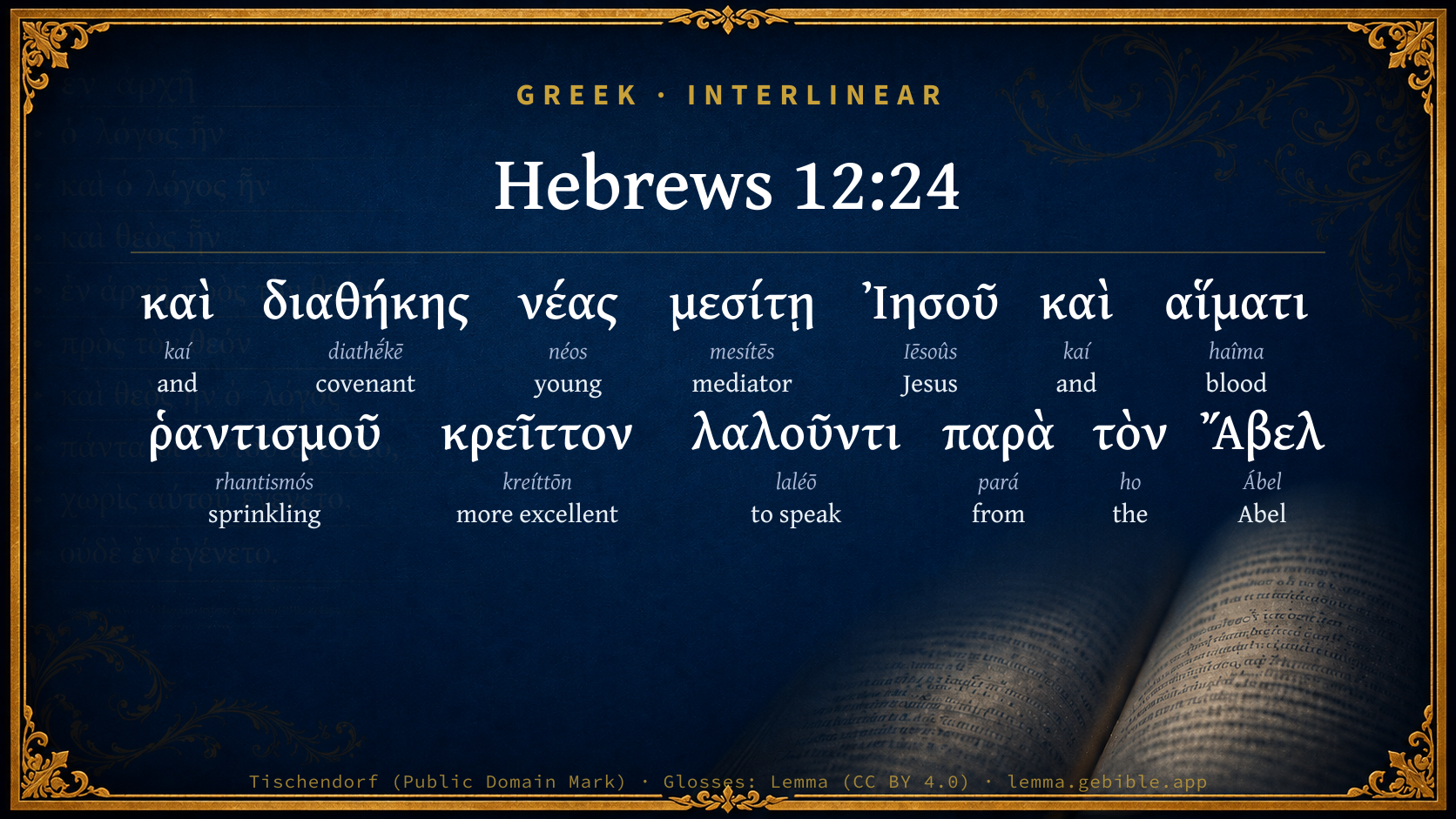
Greek (Tischendorf 8th ed.) Hebrews 12:24 appears in the Greek New Testament. The text above is from the Tischendorf 8th edition. Each word links to its Strong’s number and a concise gloss. Click any word for its full Thayer’s Greek Lexicon entry.
Download image
Cite this verse

Hebrews 12:24 (World English Bible). Public Domain. Lemma interlinear Bible study tool, https://lemma.gebible.app/v/hebrews/12/24.

Show BibTeX & RIS
BibTeX
RIS
English Translation
to Jesus, the mediator of a new covenant, and to the blood of sprinkling that speaks better than that of Abel.
World English Bible · Public Domain
Highlights
  • 1 first appearance in the Greek New Testament
Full analysis ↓
Download a study sheet

One document with this verse’s original text, its word-by-word gloss line, the meaning frame, cross-references with their text, attributed commentary, and full source and license credits — printable, and it pastes into notes with its structure intact.

This verse Autodidact and up

Study sheet (.html) Plain text (.txt)

A passage Seminary Student

Up to 50 verses in one chapter. A passage sheet keeps up to 6 commentary sources and 12 cross-references per verse, in the order this page ranks them, and says so on the sheet whenever that leaves anything out. Ask for a single verse and you get the Autodidact verse sheet above.

Everything on this page stays free to read, with no account — the sheet is a download of what is already on screen, not access to it.

Want to remove ads? Support Godless Engineer
Compare translations 3

The same verse in 3 English versions, stacked beneath the original-language interlinear above. Click any original word for its lexicon entry.

Each is an independent rendering of the whole verse — the interlinear is not word-aligned to these translations.

Highlighted words mark where these versions differ — a whole-verse word diff, not a word-by-word alignment.

  • World English Bible Public Domain
    to Jesus, the mediator of a new covenant, and to the blood of sprinkling that speaks better than that of Abel.
  • King James Version Public Domain
    And to Jesus the mediator of the new covenant, and to the blood of sprinkling, that speaketh better things that that of Abel.
  • unfoldingWord Literal Text CC BY-SA 4.0
    and to Jesus, the mediator of a new covenant, and to the sprinkled blood speaking better than Abel.

unfoldingWord Literal Text — © unfoldingWord, licensed CC BY-SA 4.0. Word-aligned USFM3 via Door43 (git.door43.org/unfoldingWord/en_ult).

Versions to compare (up to 4)

3 of 4 selected

Show all 19 translations

Every available English version of this verse, each an independent rendering of the whole verse.

  • World English Bible Public Domain
    to Jesus, the mediator of a new covenant, and to the blood of sprinkling that speaks better than that of Abel.
  • Berean Standard Bible Public Domain
    to Jesus the mediator of a new covenant, and to the sprinkled blood that speaks a better word than the blood of Abel.
  • Majority Standard Bible Public Domain
    to Jesus the mediator of a new covenant, and to the sprinkled blood that speaks a better word than the blood of Abel.
  • King James Version Public Domain
    And to Jesus the mediator of the new covenant, and to the blood of sprinkling, that speaketh better things that that of Abel.
  • American Standard Version (1901) Public Domain
    and to Jesus the mediator of a new covenant, and to the blood of sprinkling that speaketh better than `that of' Abel.
  • Revised Version (1885) Public Domain
    and to Jesus the mediator of a new covenant, and to the blood of sprinkling that speaketh better than that of Abel.
  • Geneva Bible (1599) Public Domain
    And to Iesus the Mediatour of the new Testament, and to the blood of sprinkling that speaketh better things then that of Abel.
  • Douay-Rheims (1899) Public Domain
    And to Jesus the mediator of the new testament, and to the sprinkling of blood which speaketh better than that of Abel.
  • Young's Literal Translation Public Domain
    and to a mediator of a new covenant -- Jesus, and to blood of sprinkling, speaking better things than that of Abel!
  • Literal Standard Version CC BY-SA 4.0
    and to a mediator of a new covenant—Jesus, and to blood of sprinkling, speaking better things than that of Abel!
  • Unlocked Literal Bible CC BY-SA 4.0
    You have come to Jesus, the mediator of a new covenant, and to the sprinkled blood that speaks better than Abel's blood.
  • unfoldingWord Literal Text CC BY-SA 4.0
    and to Jesus, the mediator of a new covenant, and to the sprinkled blood speaking better than Abel.
  • Darby Bible Public Domain
    and to Jesus, mediator of a new covenant; and to [the] blood of sprinkling, speaking better than Abel.
  • World Messianic Bible Public Domain
    to Yeshua, the mediator of a new covenant, and to the blood of sprinkling that speaks better than that of Abel.
  • Webster's Bible Public Domain
    And to Jesus the mediator of the new covenant, and to the blood of sprinkling, that speaketh better things than that of Abel.
  • Free Bible Version CC BY-SA 4.0
    You have come to Jesus, who shares with us the new agreed relationship, to the sprinkled blood that means more than that of Abel.
  • Bible in Basic English Public Domain
    And to Jesus by whom the new agreement has been made between God and man, and to the sign of the blood which says better things than Abel's blood.
  • Text-Critical English NT CC BY 4.0
    And you have come to Jesus, the mediator of a new covenant, and to the sprinkled blood that speaks a better word than the blood of Abel.
  • Tyndale New Testament (1534) Public Domain
    and to Iesus the mediator of the newe testament and to the spryncklynge of bloud that speaketh better then the bloud of Abell.

Literal Standard Version (2020), Covenant Press — licensed CC BY-SA 4.0. Text via the HelloAO Bible API (eBible.org). Unlocked Literal Bible (unfoldingWord) — licensed CC BY-SA 4.0. Text via the HelloAO Bible API (eBible.org). unfoldingWord Literal Text — © unfoldingWord, licensed CC BY-SA 4.0. Word-aligned USFM3 via Door43 (git.door43.org/unfoldingWord/en_ult). Free Bible Version, Dr. Jonathan Gallagher — licensed CC BY-SA 4.0. Text via the HelloAO Bible API (eBible.org).

Word by word

More ways to search: Search by grammar → Find every occurrence → Compare this word →

Practice this passage: Drill this verse → Learn its vocabulary →

About this verse

These counts appear in no published source. They are computed here, from the morphology-tagged text and Lemma’s own curated glosses. What Lemma adds →

13
words
12
distinct lemmas
General Epistles
section

Notable vocabulary

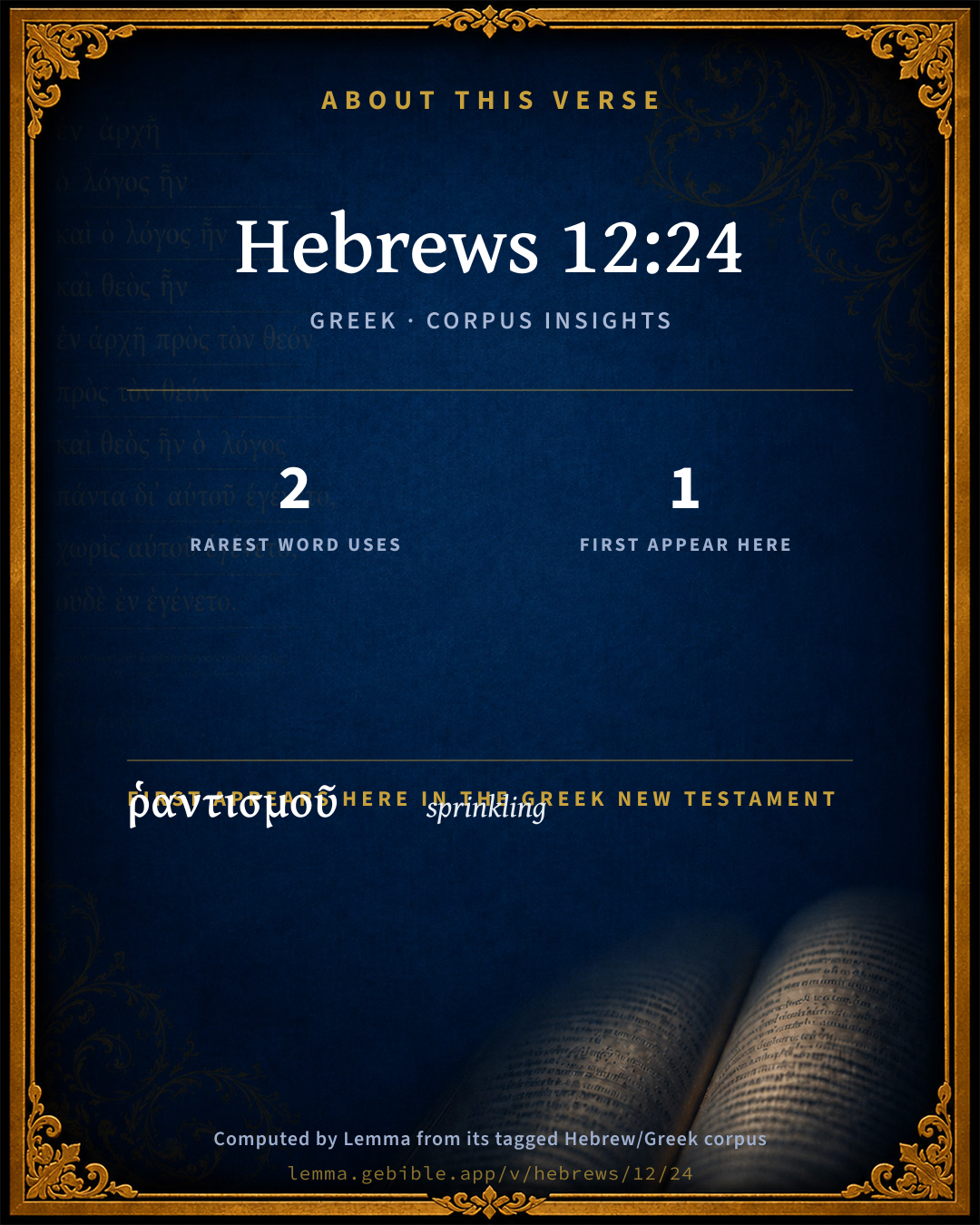
The rarest word here is ῥαντισμοῦ sprinkling G4473 — appearing just 2 times in the whole Greek New Testament.

First appearance in Scripture

This word makes its first canonical appearance in the Greek New Testament here:

  • ῥαντισμοῦ sprinkling G4473

Shared distinctive vocabulary

ῥαντισμοῦ sprinkling G4473 occurs in 2 verses of the Greek New Testament. Also found in:

Repetition

A word recurs within this verse:

Cross-references

20

Topical passages linked to Hebrews 12:24 in the Treasury of Scripture Knowledge — connected by theme and wording, ordered by reader-vote popularity; previews shown in the World English Bible.

  • Hebrews 9:15 For this reason he is the mediator of a new covenant, since a death has occurred for the redemption of the transgressions that were under the first covenant, that those who have been called may receive the promise of the eternal inheritance.
  • Hebrews 11:28 By faith, he kept the Passover, and the sprinkling of the blood, that the destroyer of the firstborn should not touch them.
  • Hebrews 8:6 But now he has obtained a more excellent ministry, by so much as he is also the mediator of a better covenant, which has been enacted on better promises.
  • Hebrews 11:4 By faith, Abel offered to God a more excellent sacrifice than Cain, through which he had testimony given to him that he was righteous, God bearing witness with respect to his gifts; and through it he, being dead, still speaks.
  • Genesis 4:10 Yahweh said, "What have you done? The voice of your brother's blood cries to me from the ground.
  • Matthew 23:35 that on you may come all the righteous blood shed on the earth, from the blood of righteous Abel to the blood of Zachariah son of Barachiah, whom you killed between the sanctuary and the altar.
  • Matthew 26:28 for this is my blood of the new covenant, which is poured out for many for the remission of sins.
  • 1 Timothy 2:5 For there is one God, and one mediator between God and men, the man Christ Jesus,
  • Exodus 24:8 Moses took the blood, and sprinkled it on the people, and said, "Look, this is the blood of the covenant, which Yahweh has made with you concerning all these words."
  • Luke 22:20 Likewise, he took the cup after supper, saying, "This cup is the new covenant in my blood, which is poured out for you.
  • 1 Peter 1:2 according to the foreknowledge of God the Father, in sanctification of the Spirit, that you may obey Jesus Christ and be sprinkled in his blood: Grace to you and peace be multiplied.
  • Hebrews 10:22 let's draw near with a true heart in fullness of faith, having our hearts sprinkled from an evil conscience, and having our body washed with pure water,
  • Hebrews 9:21 Moreover he sprinkled the tabernacle and all the vessels of the ministry in like manner with the blood.
  • Jeremiah 31:31–33 Behold, the days come, says Yahweh, that I will make a new covenant with the house of Israel, and with the house of Judah:
  • Mark 14:24 He said to them, "This is my blood of the new covenant, which is poured out for many.
  • Luke 11:51 from the blood of Abel to the blood of Zachariah, who perished between the altar and the sanctuary.' Yes, I tell you, it will be required of this generation.
  • Hebrews 7:22 By so much has Jesus become the collateral of a better covenant.
  • Hebrews 13:20 Now may the God of peace, who brought again from the dead the great shepherd of the sheep with the blood of an eternal covenant, our Lord Jesus,
  • Isaiah 55:3 Turn your ear, and come to me; hear, and your soul shall live: and I will make an everlasting covenant with you, even the sure mercies of David.
  • Hebrews 8:8 For finding fault with them, he said, "Behold, the days come," says the Lord, "That I will make a new covenant with the house of Israel and with the house of Judah;

Cross-references courtesy of OpenBible.info (CC BY 4.0).

Where the printed editions differ

1 variant

Places in this verse where the major printed Greek editions disagree on the wording in a way that affects the translation — a comparison of editions, not a manuscript-by-manuscript collation. The editions are the modern critical texts (Nestlé-Aland 28/27, SBL, Westcott-Hort, Tregelles, Tyndale House) and the traditional texts behind the KJV (the Textus Receptus and the Byzantine/Majority text). It is not a claim about which reading is original.

  1. Different wording
    κρεῖττον

    “better thing”

    In NA28NA27TynSBLWHTregByz Not in TR

    κρείττονα (kreittona) 'better things' occurs in traditional manuscripts (TR) instead of κρεῖττον (kreitton) 'better thing' in older manuscripts (NA28+NA27+Tyn+SBL+WH+Treg+Byz)

Textual data: Translators Amalgamated Greek New Testament (STEPBible TAGNT) · CC BY 4.0.

Commentary

Notes on Hebrews 12:24 from classic Christian and Jewish commentators (each source and its license shown beneath its notes). The classic Christian expositions comment on the surrounding passage and are grouped to its opening verse, so a note may address several verses; the Jewish commentaries on the Tanakh (Rashi and others) are per-verse, so they appear only where the commentator wrote on this verse.

Lemma curates 59 commentaries, every one of them public domain or Creative Commons licensed, each selected and text-cleaned for this edition rather than reprinted as found. About our sources →

MacLaren's Expositions of Holy Scripture

Alexander MacLaren

Hebrews

THE MESSENGER OF THE COVENANT AND ITS SEAT

Heb 12:24

IN previous sermons on the preceding context, we have had frequent occasion to remark on the parallel and contrast between Sinai and Zion, as expressive of the difference between the genius of Judaism and Christianity, which shapes the whole of this section That contrast and parallel are most obvious at its beginning and here at its close.

In the beginning we had the mountain of the Law, swathed in darkness, lit by flashing flame, contrasted with the sunny slopes of Zion, palace- crowned, and the wild desert set in opposition to the city of peace that clustered round the foot of Zion’s Mount. Here at the close we have the key-words of the old revelation laid hold of and applied to the new. Judaism was a covenant in the form of a law, of which the terms were these: ‘Do, and thou shalt live!’ The gospel is a covenant in the form of a promise, of which the tenor is ‘Believe and live; live and do!’ The ancient covenant had Moses for its mediator, passing between the mountain and the plain. The gospel has a better and a truer link of union between God and man than any mere man, however exalted, can be. The ancient system had its sprinkled blood, by which the men on whom it fell entered into the covenant, and were ceremonially sanctified. The new covenant has its blood. An awful voice rolled amongst the peaks of Sinai. That ‘blood of sprinkling’ speaks too. And then the writer blends with that allusion another, to the voice of the blood of the first martyr, every drop of which cried to God for retribution, and points to the blood of the more innocent Abel, every drop of which appeals to the Father’s heart for pardon.

Now it may be said that thus to present Christian truth under the guise of the symbols of an ancient ceremonial and external system is a retrograde step. And some people, who think themselves very enlightened, tell us that the time is past for looking at Christianity from such a point of view. One great man has let himself talk about ‘Hebrew old clothes.’ I am very much mistaken if these old clothes will not turn out to be something like the raiment that the Hebrews. wore in the wilderness, ‘which waxed not old for forty years,’ and outlasted a great many suits that other people had cut for themselves. We have only to ponder upon these emblems until they become significant to us, in order to see that, instead of being antiquated and effete, they are throbbing with life, and fit as close to the needs of to- lay u ever they did. They came with a special message, no doubt, to these men to whom this letter was first addressed, who were by descent and habit Hebrews, and saturated with the law. But their message is quite as much to you and me; and I desire now simply to bring out the large and permanent meanings which lie beneath them.

I. First, then, note that God’s revelation to us is in the form of a covenant.

Now, of course, when we talk about a covenant or compact between two men, we mean a matter of bargaining on the terms of which both have been consulted, and which has assumed its final form after negotiations and perhaps compromise. But there are necessarily limitations to the transference of all human ideas to divine relations. One such limitation is expressed in the very language of the original. The word rendered ‘covenant’ suppresses the idea of conjunction, and emphasises that of appointment. By which we are to learn that the covenant which God makes with man is of His own settling and is not the result of mutual giving and taking; that men have nothing to do with the determining of these conditions; that He Himself has made them, and that He is bound by them, not because we have arranged them with Him, but because He has announced them to us. With that limitation we can take the idea and apply it to the relation between God and us, established in the great message of the gospel.

For what is the notion that underlies the old-fashioned, and to some of you obsolete and unwelcome word? Why, simply this, it is a definite disclosure of God’s purpose as affecting you and me, by which disclosure He is prepared to stand and to be bound. It is a revelation, but a revelation that obliges the Revealer to a certain course of conduct; or, if you would rather have a less theological word, it is a system of promise under which God mercifully has willed that we should live. And just as when a king gives forth a proclamation, he is bound by the fact that he gave it forth, so God, out of all the infinite possibilities of His action, condescends to tell us what His line is to be, and He will adhere to it. He lets us see the works of the clock, if I may so say, not wholly, but in so far as we are affected by His action.

What, then, are the terms of this covenant? We have them drawn out, first, in the words of Jeremiah, who apprehended, when he was dwelling in the midst of that eternal system, that it could not be a final system; and next, by the writer of this letter quoting the prophet, who, in the midst of the vanishing of that which could be shaken, saw emerging, like the fairy form of the fabled goddess out of the sea-foam, the vast and permanent outlines of a nobler system. The promises of the covenant are, then, full forgiveness as the foundation of all, and built upon that, a knowledge of God inwardly illuminating and making a man independent of external helps, though he may sometimes be grateful for them; then a mutual possession which is based upon these, whereby I, even I, can venture to say, God is mine, and, more ‘wonderful still, I, even I, can venture to believe that He bends down from heaven and says: ‘And thou, thou art Mine!’ and then, as the result of all - named first, but coming last in the order of nature - the law of His commandment will be So written upon the heart that delight and duty are spelt with the same letters, and His will is our will. These are the elements, or you can gather them all up into one, namely, the promise of eternal life- based upon forgiveness, operating through the knowledge of God, and issuing in perfect conformity to His blessed will.

If these, then, be the articles of the paction, think for a moment of the blessedness that lies hived in this ancient, and to some of us musty, thought of a covenant of God’s. It gives a basis for knowledge. Unless He audibly and articulately and verifiably utters His mind and will, I know not There men are to go to get it. Without an actual revelation from heaven, of other nature, of clearer contents, of more solid certitude than the revelations that may have been written upon the tablets of our hearts, over which we have too often scrawled the devil’s message, and over and above the ambiguous articles that may be picked out and pieced together, from reflection upon providence and nature, we need something better and firmer, more comprehensively and more manifestly authoritative, before we are entitled to say, ‘Behold! I know that God loves me, and that I may put my trust in Him.’ Brethren! I for my part believe that between agnosticism on that side, and the full evangeliced faith of the New Testament in a supernatural revelation on this side, all forms of so-called Christianity which shy at the idea of a supernatural ‘revelation are destined to have the life squeezed out of them, and that what will be left will be the two logical positions; first, God, if there be a God, never spoke, and we do not know anything about Him; and, second, ‘God, who at sundry times and in divers manners spake in time past unto the fathers by the prophets, hath in these last days spoken unto us by His Son.’ If there be a God at all, and if there be in Him any love and any righteousness, it is infinitely more reasonable to suppose that He should have spoken His mind and heart to men, and given them a covenant on which they can reckon, than that He has been from the beginning a dumb God, that never opened His mouth with a word of guidance or of sympathy for the sons of men. Believe that who may; I cannot believe in a pure theism, which has no place for a supernatural revelation.

And then, again, let me remind you how here is the one foothold, if I may so say, for confidence. If God hath not spoken there is nothing to reckon upon. There are perhaps, probabilities if you like, possibilities, but nothing beyond, and no man can build a faith on a peradventure. There must be solid ground on which to rest; and here is solid ground: ‘I make a covenant with you.’ ‘God is not a man that He should lie, nor the Son of Man that He should repent.’ And armed with that great thought that He has verily rent the darkness and spoken words which commit Him and assure us, we, even the weakest of us, may venture to go to Him, and plead with Him that He cannot and dare not alter the thing that has gone forth out of His mouth; and so, in deepest reverence, can approach Him and plead the necessity of a great Must under which He has placed Himself by His own word. God is faithful, the covenant-making and the covenant- keeping God.

II. Secondly, mark that Jesus Christ is the Executor of this covenant.

Moses, of course, was a go-between, in a mere external sense; from the mountain to the plain and from the plain to the mountain, he passed, and in either case simply carried a message bearing God’s will to man or man’s submission to God. But we have to dig far deeper into the idea than that of a mere outward messenger who carries what is entrusted to him, as an errand boy might, if we are to get the notion of Christ’s relation to these great promises, which, massed together, are God’s covenant with us. Observe that the emphasis is here laid on the manhood of the Lord. It is Jesus who is the ‘Mediator of the covenant’: and observe, too, that that idea passes into the wider notion of His place as the link uniting God and man. The depth of the thought is only reached whoa we recognise His divinity and His humanity. He is the ladder with its foot on earth and its top in heaven.

Because God dwells in Him, and the word became flesh, He is able to lay His hand upon both, and to bring God to man and man to God.

He brings God to man. If what I have been saying is at all true, that for all solid faith we must have an articulate declaration of the divine mind and heart, it seems to me to be equally irrefragable that for any such declaration of the divine heart and mind we must have a human vehicle. God speaks through men. It is His highest way of making Himself known to mere And Jesus Christ in His Manhood declares God to us. Not by the mere words which He speaks, as a teacher and a wise man, a religious genius and a saint, a philosopher and a poet, a moralist and a judge; but by these, and also by His life, by His emotions of pity and gentleness and patience, and by everything that He does and everything that He endures, He speaks to us of God.

Brethren, where shall a poor man rest his soul outside of the direct or indirect influences of the revelation of God in Jesus Christ? Why I the very men who reject Him to-day, on the plea that they have learnt a nobler conception of God than they can find in Christianity, owe their conception of Him to the gospel which they reject. Where else is there certitude solid enough to resist the pressure of sorrow and of sin; confidence enough to maintain faith in the face of difficulty and conscious evil and death; or energy enough in a creed to make religion an all-controlling influence and an all-gladdening stay except in Jesus Christ? I venture to say, nowhere I Nowhere beyond the limits to which either the river of the water of life has manifestly flowed; or some rills and rivulets from it have crept underground to give strange verdure to some far-off pasture; nowhere else is there found the confidence in the Father’s heart which is the property of the Christian man, and the result of the Christian covenant. Jesus Christ brings God to man by the declaration of His nature incarnate in humanity.

And, on the other hand, He brings man to God: for He stands to each of us as our true Brother, and-united to us by such close and real bends as that all which He has been and done may be ours if we join ourselves to Him by faith. And He brings men to God, because in Him only do we find the drawings that incline wayward and wandering hearts to the Father. And He seals for us that great Covenant in His own person and work, in so far as what He in manhood has done has made it possible that such promises should be given to us. And, still further, He is the Mediator of the covenant, in so far as He Himself possesses in His humanity all the blessings which manhood is capable of deriving from the Father, and He has them all in order that He may give them all. There is the great reservoir from which all men may fill their tiny cups.

Men tell us that they want no Mediator between them and God. Ah, my brother! go down into your own hearts; try to understand what sin is; and then go up as near as you can to the dazzling white light, and try partially to conceive of what God’s holiness is, and tell us, Do you think you, as you are, could walk in that light and not be consumed? It seems to me that no man who has any deep knowledge of his own heart, and any, though it be inadequate, yet true, conception of the divine nature, dare take upon his lips that boast that we often hear, ‘We need none to come between us and God.’

For me, I thankfully hear Him say, ‘No man cometh to the Father but by Me’; and pray for grace to tread in that only way that leadeth unto God. III. Note the sprinkling of the blood which seals the covenant.

There is an allusion there, as I have already suggested, to the ceremonial at Sinai, when, in token of their entrance into the covenant, the Blood of the sacrifice was sprinkled upon the crowd; and also an allusion to the voice of the blood of the innocent Abel, which ‘cried to God from the ground.’ The writer has already referred to that in the earlier part of the letter; and here he weaves the two together because, with whatever differences of representation, the substantial meaning of both images is the same. The blood shed establishes the covenant; and the blood sprinkled brings us into it.

If Jesus had not died, there would have been no promises for us, beginning in forgiveness and ending in wills delighting in God’s law. It is ‘the new covenant in His blood.’ The death of Christ is ever present to the divine mind and determines the divine action.

Hence the allusion to the voice, in contrast both to the dread voice that echoed among the grim peaks of Sinai, and to that which, as if each drop had a tongue, called from Abel’s innocent blood for retribution. Christ’s, too, has a voice, and that an all-powerful one. It cries for pardon with the same authority of intercession as we hear in His wondrous high-priestly prayer: ‘Father, I will.’

Further, that sprinkling, which introduced technically and formally these people into that covenant, represents for us the personal application to ourselves of the power of His death and of His life by which we may make all God’s promises our own, and be cleansed from all sin. It is ‘sprinkled.’ Then it is capable of division into indefinitely small portions, and of the closest contact with individuals. That is but a highly metaphorical way of saying that Jesus Christ has died for each of us, that each of us may find acceptance and cleansing, and the inheritance of all the promises, if we put our trust in Him.

For remember, these words of my text are the end of a great sentence, which begins, ‘Ye are come.’

Faith is that coming. What did Christ say? ‘He that cometh unto Me shall never hunger. He that believeth on Me shall never thirst.’ There is His own interpretation of the metaphor. Whosoever trusts Him, comes to Him. If I put my tremulous faith on that dear Lord, though He be on the throne of the universe, and I down here, in this far-away dim corner of His creation, I am with Him where He is, and no film of distance need separate us. If we trust Him we come to Him. If we rest upon Him as our advocate and hope, then the loud voice of our sins will not be heard, accusing-tongued though they be, above the voice of His pleading blood.

And they who come to Christ, therein and thereby, come to all other glorious and precious persons and things in the universe. For, as I have already said, my text is the end of a long sentence, and is last named as being the foundation of all that precedes, and the condition of our finding ourselves in touch with all the other glories of which the writer has been speaking. He that comes to Christ is in the city. He that comes to Christ is - not will be - in the palace. He that comes to Christ is in the presence of the Judge. He that comes to Christ touches angels and perfected spirits, and is knit to all that are knit to the same Lord. He that comes to Christ comes to cleansing, and enters into the fulness of the promise, and lives in the presence and companionship of his present-absent Lord. If we come to Jesus by faith, Jesus will come at last to us to receive us to Himself; and join us to the choirs of the perfected spirits who ‘have washed their robes and made them white in the blood of the Lamb.’

Alexander MacLaren, Expositions of Holy Scripture (1904–1910) — public domain. Text from a community e-Sword module.

Tyndale Open Study Notes

Tyndale Open Resources

12:24 Jesus is the mediator of the new covenant (8:7-13; 9:11-14; 10:15-18). His sprinkled blood, used as the sacrifice for sins, speaks of forgiveness. • The blood of Abel cried out to God from the ground, demanding vengeance for his murder by Cain (Gen 4:10). By contrast, Jesus’ blood cries out that the price for sins has been paid for those in the new covenant (Heb 10:16-18).

Tyndale Open Study Notes — © Tyndale Open Resources, licensed CC BY-SA 4.0. Text via the HelloAO Bible API.

Bengel's Gnomon

Johann Albrecht Bengel

Heb 12:24. Διαθήκης νέας, of the new covenant) It is elsewhere called καινή, νέα here: νέος denotes the newness of that which is native or born, or even that which is living: comp. ch. Heb 8:13, note,[82] and ch. Heb 10:20; Isa 43:19.—Μεσίτῃ, to the Mediator) Formerly Moses, himself the mediating messenger, feared and trembled: now access has been granted to the Mediator of the New Testament.—αἵματι ῥαντισμοῦ, to the blood of sprinkling) A remarkable connection to Jesus the Mediator of the new covenant, AND to the blood of sprinkling. The blood is looked upon in this passage, as it is in heaven, in the same way as the Mediator is looked upon, and God, and the ten thousands, etc. Attend, reader, to what is now to be said, by distinct positions.

[82] Νέος, the opposite of γέρων; as καινὸς is of πάλαιος, Νέος, recent or lately originated, young. Καινὸς, new, that which comes in place of what was formerly. So καινὴ διαθήκη, the New Testament, as opposed to the Old covenant or Testament: but νέα διαθήκη, the recently established covenant, of which the Jews were now partakers.—

§ 1. The blood of Jesus Christ was most abundantly shed in His suffering and after His death.

In the sacrifices of the Old Testament, αἱματεκχυσία, the shedding of blood, was requisite; and the blood was to be entirely poured out, so that nothing should remain in the veins and vessels of the bodies. This was accomplished also in the one oblation of the New Testament—the oblation of the body of Jesus. Shedding of this most precious blood in every way then took place: in the garden, by sweat; in the palace, by scourging; on the cross, by the nails; and after death, by the spear. Thus Christ was manifestly put to death in the flesh, 1Pe 3:18. I do not know whether he who has duly weighed the words of Psa 22:15-16, can say, that even a drop of the whole mass of blood remained in His most holy body: I am poured out like WATER. My strength IS DRIED UP as a potsherd, and my tongue has cleaved to my jaws; and Thou hast brought me unto THE DUST of death. Truly the Lamb of God ἐσφάγη, was sacrificed. It does not mean, that one part of His blood was shed, another part not shed: but, as His whole body was delivered up, so His whole blood was shed: Mat 26:28. The shedding of the blood and the death of Christ are concomitant: the one is not the cause of the other. He truly laid down His blood and His life; but not for natural causes, on account of which ordinarily they die, who perish by a violent death. This arises from the surpassing excellence of the Subject.

§ 2. The state of the shed blood followed the actual shedding of that blood.

The actual shedding of the blood was, while it was being shed; we call the state of the shed blood the whole period of its continuance out of the body of the Lord, whether that be short or long.

§ 3. That blood, even in its state of being shed, was free from all corruption.

We were redeemed NOT WITH CORRUPTIBLE THINGS, such as silver or gold, but with the PRECIOUS blood of Christ, as of a Lamb without blemish and without spot; 1Pe 1:18-19. The preciousness of that blood excludes all corruption. This remains firm and sure; nor do we in any way approve of the unworthy opinions of some respecting the shed blood of Christ, whom Hoepfner expressly confutes, especially in Tract. de S. C., p. 55.

§ 4. It cannot be affirmed, that the blood, which was shed, was again put into the veins of our Lord’s body.

Human reason comprehends nothing but what refers to this life: wherefore we only put our trust in Scripture, which very often refers to the shedding of the blood and to the death of Jesus Christ; and it too does not less celebrate His resurrection and eternal life. But it gives no direct intimation of the putting of the blood again into the body; nor is that fact to be deduced from Scripture by fair inference. Certainly this mode of reasoning makes a large leap: The blood of Christ is incorruptible; therefore it returned into His veins. If the body without the blood, and the blood out of the body, were uncorrupted during the three days of His death, each of them remains also more uncorrupted, after death was fully accomplished, without the other. Let us hear what Scripture suggests.

§ 5. At the time of the ascension the blood separated from the body was carried into heaven.

The entrance of the Priest of the New Testament into the true sanctuary was His Ascension into heaven; and indeed, at the death of Christ, the veil of the earthly temple was rent asunder, and then the true sanctuary, heaven, was opened; but the entrance itself was made by ascending into heaven. The resurrection took place on the third day after His death; His ascension, forty days after the resurrection. Moreover Christ entered into the sanctuary by His own blood; not merely after the blood was shed, and by the force of its being shed, nor with the blood taken back into the body, but BY the blood: therefore this Priest Himself carried into the sanctuary His own blood separately from His body (Scherzerus, in Syst., p. 390, accuses one of rashness, who thought that the particles of Christ’s blood which adhered to the lash, to the crown of thorns, and to the nails, and the drops of blood shed, were miraculously preserved on the earth, and were multiplied in the Eucharist); and at the very time of His entrance or ascension Christ had His blood separate from His body. His body was bloodless; yet not lifeless, but alive. The blood in His body would not have agreed with the type of the priest under the Old Testament, who entered into the sanctuary with the blood of animals. See ch. Heb 9:7; Heb 9:25, and especially Heb 12:12, where διʼ and διὰ entirely correspond to each other with the same meaning. Witsius, in Diss. de sacerdotio Aaronis et Christi, T. I. Misc., p. 510, where he treats of the passage Heb 13:11, acknowledges, that the analogy between the type and the antitype should be preserved; but he at the same time interprets the blood of Christ to be His soul, not correctly: for blood, properly so called, is denoted, as in the type, so in the antitype. Comp. Exx. in Symb. ap., p. 171. Moreover there is a still weaker explanation given by Sibrandus Lubbertus, lib. ii. c. Socin. de J. C. Servatore, c. 21: “We read concerning the annual sacrifice, Leviticus 16, that its blood was carried into the most holy place; but there is a great difference between this blood and the blood of Christ. For the material blood, that was shed when the animal victim was slain, was carried into the sanctuary; but the material blood of Christ, which was shed when He was slain for us, was NOT carried into heaven. What then was done? As the priest under the law appeared in the Levitical sanctuary with the blood of the victim slain for himself and the people, so Christ appears for us in heaven, not with the material blood that was shed, but by the power and efficacy of the blood shed for us.” The apostle does not say, the power and efficacy of the blood, but Christ’s own (proper) blood (ch. Heb 9:12), by which an entrance was made into the sanctuary: nor does he call it MATERIAL blood, but the blood of Him, who through the eternal Spirit offered Himself without spot unto God. The discourses of excellent interpreters and commentators often imitate this emphasis, which is given to this subject by the apostle. Chrysost. Hom. 33, on Hebrews 13 : “The actual economy of the suffering was without—I say, without; but the blood was carried up INTO heaven. You observe, that we are partakers of the blood that was carried into the sanctuary—the true sanctuary—the blood of the sacrifice in which He alone, the High Priest, delighted.” Some refer certain words of this passage to one thing, others to another; but all agree in giving the same meaning to ἀλλʼ εἰς τὸν, κ.τ.λ. The above translation is that which I am inclined to adopt. Conr. Pellicanus on Hebrews 9 : “Christ brought the price of His blood for redeeming us to the Father, into heaven.” Calvin on Hebrews 10.: “Since the blood of cattle became soon corrupted, it could not long retain its efficacy; but the blood of Christ, which has no foul corruption, but always flows with untainted colour, will be sufficient for us to the end of the world. We cannot wonder, if the sacrifices of cattle that had been slain had no power to give life, as they were dead; but Christ, who rose from the dead, to confer life upon us, diffuses His own life into us. This consecration of the way is perpetual, because the blood of Christ is always in a manner dropping before the Father’s face for the purpose of bedewing heaven and earth.” And on ch. 13: “Christ carried His own blood INTO the heavenly sanctuary, to make atonement for the sins of the world.” Again: “The apostle (Heb 13:20) seems to me to mean, that Christ so rose from the dead, that His death notwithstanding is not effaced, but retains eternal freshness and efficacy; as if he had said, God raised His Son, but in such a way, that the blood which He shed once for all in His death, for the ratification of the eternal covenant, still retains its efficacy (vigour) after the resurrection, and brings forth its own fruit, as if it were continually flowing.” Hunnius on Hebrews 13 : “Christ carried His own blood into the Holy of Holies.” Dorscheus, P. I. Theol. Zach., p. 51, etc., says on Zec 9:11: “The blood is considered under that aspect of profusion and effusion, but not as it is in its natural state and within its ordinary vessels. 1. Because the manner (nature) of the type requires this: for the blood, under the Old Testament or Covenant, was considered as extravasated and shed, and by this very circumstance it was the shadow of the profusion and effusion of blood which was to take place under the New Testament. 2. Because the nature of the Divine covenant requires this, which demands shedding of blood. 3. Because in this aspect of the blood [i.e. by the effusion of the blood] an act of satisfactory obedience due to God for sin is performed, etc.” Sal. Deylingius: “Christ having ascended into heaven, and sitting at the right hand of GOD, commits our affairs to GOD, and shows to the Father His blood that was shed for us, and His wounds.” Again, quoting Rappoltus, he says: “He presents (shows) to His Father His own blood as the ransom and price of redemption for us, and teaches that by the shedding of it Divine justice has been satisfied.” Observ. Miscell., pp. 571, 572. I do not maintain that these interpreters show the present condition of the blood that has been shed; but I say, that their statements, if such a condition be kept in mind, are more consistent with the texts of which they treat.

§ 6. The blood of Jesus Christ always remains blood shed.

If the return of the blood of Jesus Christ into His body ever could or should have happened, it could or should have happened at least at the very moment of the resurrection, and not later. But that this did not happen before the ascension is evident from the preceding section. Therefore it did not happen at the resurrection; and therefore no time can be found, to which we may ascribe that return. The condition of the blood shed is perpetual. Jesus Himself is in heaven, and His body is also there: so too is His blood in heaven; but His blood is not for that reason now in His body. I am not inclined to refer to this the vision in Rev 1:14, concerning the whiteness of the head of Jesus Christ, as if it were bloodless; for it has respect to the hair white as snow; but the face is compared to the exceeding brightness of the sun in his greatest strength, ibid. v. 16. Nor do we allege what is found at Luk 24:39, which has been alleged by Augustine, as bearing on this point; for the blood, although it be in the body, is less felt and seen than the flesh and bones. There are other indications given of the blood being separate from the body. The sacred writings present the body and blood under the aspect of things divided, not only in the sufferings and death of our Lord, but also in the supper instituted in remembrance of His death. Examine ch. Heb 13:9, etc., Heb 10:10; Heb 10:29; 1Co 11:24-25. The mode of predicating follows the mode of existence; for this very reason the body and blood of Christ are considered as quite distinct, because there is a distinction or separation existing in respect (on the part) of the subject. Therefore the blood, as shed, is still in heaven before the eyes of God; it still speaks for us; it is still the blood of sprinkling: 1Pe 1:2. The blood of Abel, which the earth, having opened its mouth, drank from the hand of Cain, cried out apart from the body; so the blood of Jesus Christ speaks, likewise apart, in heaven, with greater power and benignity. For this reason mention is here properly made of the blood of sprinkling apart from Jesus Himself, as in ch. Heb 10:19; Heb 10:21, the entrance into the sanctuary in the blood of Jesus, and this same High Priest, are praised (spoken of) apart; and ch. Heb 13:12, the blood of Jesus is considered apart from His body (comp. Heb 12:11); and ch. Heb 13:20, the very raising of the great Shepherd of the sheep from the dead is said to have been accomplished through the blood of the eternal covenant. Comp. Rev. Riegeri. Hist. Frr. Boh., vol. ii., p. 68, etc., where, following the footsteps of Pfaffius, a very wide field of old and more recent opinions is so spread out before us, that this single opinion, which he skilfully states, comes forth without any of the disadvantages attending on the rest. The blood itself shed, not the shedding of the blood, is the ransom, the price of eternal redemption. That price, paid to God, remains paid, without being restored to the body of the Redeemer. The redemption is eternal; the value of the price is eternal, just as if the Redeemer hung on the cross daily and expired daily for us. In His death there was the power of a life that was not to be dissolved. In His life there is the value of His death, which is perpetual. The death of the Lord itself swept away the weakness of His life in the world, in which (weakness), for the sake of undergoing death, He became a partaker of flesh and blood, ch. Heb 2:14: and so the same death, as a passage to a glorious life, had something forthwith suited to a glorious life. Comp. 1Ti 3:16, note. Hence the annunciation (“showing forth”) of the Lord’s death comprises His whole history, even that of His burial and resurrection (with which latter the burial is closely connected, 1Co 15:4), that of His ascension, that of His sitting at the right hand of God until He come: 1Co 11:26. The great Shepherd of the sheep was brought from the dead, but the covenant, in the blood of which He was brought, is eternal, ch. Heb 13:20. From this it is plain, that John has described with great propriety the Lamb, seen by him in His life and glory, as slain.

§ 7. This same fact was acknowledged by the ancient Doctors of the Church.

The fathers generally agreed, that the body of the Lord is now bloodless, nay, even aërial: see Magnif. Pfaffii diss. c. Roger, p. 50; and from this point some have descended even to too great subtlety. The author of the questions among the works of Athanasius, T. ii., f. 433, qu. 128, says, “The men of old themselves, and the ancient prophets, were baptized with that blood and water which flowed from the side of Christ. And how? Listen: Since the human body consists of four elements, it is again resolved into the same after death. So it happened also with Christ: because His holy side gave forth its blood and water, they were resolved, as those of the prophets were resolved, namely, into elements; and He thus baptized these (the elements of the prophets, etc.) when found, etc. Theodorus Abucaras has furnished a paraphrase to this philosophic observation, to whom alone Ittigius ascribes it in the Exercitation, in which he both publishes and refutes the little work of Abucaras. To be resolved into elements,—what is that, but to be subjected to corruption? But away with any thought of this kind concerning the blood of the Lord. These writers would not have fallen into this mistake, if they had learned from older authors, that the blood was put into His body when He rose from the dead. I know not whether this restoration of the blood was even acknowledged by the fathers (the proof [onus probandi] lies with him who maintains the acknowledgment), or at least that it is to be found brought forward before that communion in one kind (at length in the 13th and 14th cent.) began to prevail; to the defenders of which dogma, the Schoolmen, the excuse of concomitancy was convenient. The restoration of the blood was not universally maintained even in the age of Gerson, as is evident from his sermons on the day of the Lord’s circumcision, and from the Josephini, dist. 8. After the Reformation many admitted and propagated that opinion without any controversy, and therefore, as it happens usually, without any doubt. But the grounds on which they rest, evince that the blood of the Lord remained free from corruption, and that His remains (relics), accompanied with miracles, do not continue in the earth; both of which we heartily acknowledge; but by these same arguments it is not positively defined what is the present condition of that precious blood. Sec. I. Gerhard’s dispp., p. 789, 1426, seq.; J. Meisneri. exam. catech. Pal., p. 596, etc. It will be thy duty, Christian reader, to compare together the several opinions on this subject, and decide on them according to the rule of sacred Scripture.

§ 8. The personal union and the state of the shed blood well agree (are quite compatible with one another).

These two are not at variance with each other during the three days of His death: and much less is there any opposition ever afterwards. This whole consideration admits nothing Nestorian, nothing Eutychian.

§ 9. The resurrection and glorious life of Jesus Christ does not set aside the state of the shed blood.

If any one were to suppose that a small quantity of blood remained in the body of the Saviour even after His side was pierced, the restoration of the blood shed to the body might seem on that account the less necessary to the natural reason. But the whole blood was indeed shed, and yet it was not again restored; for the natural or animal life consists in the blood and its circulation, and is supported by bread; but the word of God without bread feeds the bodies of the saints. See concerning Moses, Exo 24:18; Exo 34:28; also concerning Elias, 1Ki 19:8; but chiefly concerning Jesus Christ, Mat 4:2; Mat 4:4. For His whole mode of living is known to have exceeded in purity that of all men even from the suitableness of his raiment, Joh 19:23, note. But if the power of God effects that on the earth, how much more is that done and will be done in heaven? Mat 22:29 (and for this reason the reader should by the way, but seriously, be reminded, that blood newly produced in the place of that which was shed, was never even dreamt of being ascribed by us to the risen Redeemer): His glorified life does not require the circulation of the blood. The whole is of God, Rom 4:4; Rom 4:10; 1Co 6:13; 1Co 15:44; 1Co 15:50. Our body, our blood, are subject to corruption. What will happen in regard to our blood, I know not; (even in the animal life itself we consider a very great loss of blood, provided life be not endangered, as a matter of less importance than the maiming of a finger or a joint:) The Saviour will certainly make the body conformable to His glorious body. Comp. Samml. von A. und N. 1739; I. Beytr. art. 8; Vales. philos. sacr., p. 81; Melch. I. 712. “We think it quite clear, that the battle fought by Michael, Revelation 12, did not take place immediately after Christ’s ascension into heaven, whither THE BLOOD OF THE LAMB being introduced, took away the dragon’s right to accuse.” Pfaff. Syst. germ., p. 307; Heding. ad Heb 9:24; Heb 10:14; Kraft Nachr. I. Band, p. 878. The hole in the side (such as a deadly wound would be in the natural body) is the never-failing proof and ornament of His glorified life: Eze 37:6; Eze 37:8. The veins are not mentioned, but גידים are nerves or muscles.

§ 10. The state of the shed blood very strongly confirms communion in both kinds.

The defenders of communion in one kind have no more specious pretence than the concomitancy of the body and blood. But the relation of the body and of the blood of the Lord in the sacred Supper is most distinct [the footing or aspect of the one is quite distinct from that of the other]. First, He says, This is My body: then next, This is My blood. Therefore the body is not exhibited by the blood, but by itself; the blood is not exhibited by the body, but by itself. Lightfoot, in Chron. of the Old Testament, compares Gen 9:4 with this passage. But the language of Dannhawerus is much to the purpose, who writes as follows: “The blood of Jesus Christ, shed for His disciples and for many, is a heavenly thing, as it is drunk in the sacred Eucharist, and because it is incorruptible, it still exists, 1Pe 1:19, and was carried by Christ into the sanctuary not made with hands; and yet (the blood spiritually received in the Eucharist) it is the very blood shed in the time of His passion. We must not enter here into scholastic disputes, truly scholastic and trifling, about the remains of Christ’s blood, and its being taken back, concerning which Baron. should be consulted, etc.” Hodos. p. 1202. At the death of Christ the blood was drawn out of the body: the “showing forth” of that death (1Co 11:26) demands that the bread, after having been blessed, should be eaten in remembrance of the Lord, and that the cup, after having been blessed, should be drunk in like manner in remembrance of the Lord; 1Co 11:24-25. Thomas Bromley has a profound Answer, published in ten treatises, on the different nature of enjoying the body and blood of Christ.

§ 11. The same cause [reason] admirably supports our faith.

The same Bromley, in the Revelation of Paradise, writes thus: “The blood of the eternal covenant is sprinkled in the sanctuary, which was in a peculiar manner performed once for all by the Lord Jesus after His ascension, according to Heb 9:12, By His own blood He entered once into the sanctuary, after He had obtained eternal redemption. But that is still continued at certain times by our great High Priest, for the purpose of allaying the wrath of God occasioned by sin; and it is therefore called the blood of sprinkling, on account of its use, which is continued in heaven, and in the consciences of the saints upon the earth.” Heb 9:14. They who are strong in spiritual judgment may decide such matters as these. Truly, believers, in the whole exercise of their faith, and especially in the sacred Supper, as much enjoy the efficacy of the blood of Jesus Christ, as if they had been established (placed) at the moment at which His blood was shed.

§ 12. This circumstance demands more ample consideration from the lovers of Christ.

We may transfer to the present discussion what Andreas Adamus Hochstetterus, P. M., has written in his Exercitation on the entrance of the High Priest into the Holy of Holies. “We do not doubt that the reader will perceive, from the discussion of an argument so perplexed, and omitted by even great interpreters, how much is still left to our own investigation (searching of the Scriptures), and will apply to the glory of the Saviour the labour which we have taken in searching out the hidden truth,” pp. 20, 21. I confess, I find this field but little cultivated, and on such a subject few in general are brought to stop and direct their attention to its consideration. But he who will not straightway shrink from that which seems at first a paradox (something contrary to what would be thought), will soon after taste its sweetness with the progress of faith. Notwithstanding, I obtrude nothing on any man; I merely ask the wise to condescend religiously to examine the whole subject, not according to the rule of human, but Divine judgment. Carnal curiosity has no place here, but the desire of knowing the Redeemer, so far as He has chosen to make known His glory by the rays of the apostolic testimony to them who love Him.

In commentaries and systems, indeed, this subject is not found to be well or fully treated; it is only slightly touched upon; and this perhaps arises from the following reasons: 1. In the passages concerning applicatory grace [applying to us redemption], it is said: The operating cause terminatively[83] is the Holy Spirit, which is true; but the mention of Christ and His merits is only made in relation to the question respecting the external impulsive cause. It so happens that the efficacious operation of Christ and His blood cannot come into consideration either in the one place or the other. 2. The proper (strict) consideration of Christ’s blood is sparingly introduced, and many have straightway recourse to a figure, whereby they understand under this word, blood, either the whole merit of Christ or His life, i.e. the living principle or soul. 3. In serious treatises, the writers directly refer rather to the holy and blessed fruits, than to the mode of the operations themselves, from which these fruits take their rise; comp., for example, the writing of an Anonymous author, die reinigende Kraft des Gottes—Blutes Jesu Christi (ed. A. 1745, Prenzl.), p. 49. When I was young, I anxiously meditated a solid disquisition on the bearing of the merit of Christ on our salvation; but after much thinking, I never proceeded so far as to write a special treatise on that subject. May the Lord Jesus, for His own name’s sake, now and henceforth bestow upon us the bright ray of His own light. Amen.

[83] As opposed to the external impulsive cause.

Bengel's Gnomon of the New Testament — English translation (T&T Clark, Edinburgh, 1860) — public domain. Text from a community e-Sword module.

Meyer's Critical & Exegetical Commentary

Heinrich August Wilhelm Meyer

Heb_12:24. Νέας] characterizes the covenant as new in regard to the time of its existence (foedus recens), whereas καινή, Heb_8:8; Heb_8:13, Heb_9:15, described it as new in respect of its quality (foedus novum). Wrongly Böhme, Kuinoel, and others (de Wette likewise wavers): νέας is here to be taken as of the same import with καινῆς.

καὶ αἵματι ῥαντισμοῦ] Jesus atoning blood is called blood of sprinkling, inasmuch as those who believe in Him, in spirit sprinkled therewith, are cleansed from their sins and sanctified to God. Comp. Heb_9:13 f., Heb_10:22, Heb_13:12.

κρεῖττον] is an adverb. Comp. 1Co_7:38. Needlessly will Kurtz have it taken as a substantive adjective. Better does the blood of Christ speak than Abel with his blood; since the latter calls for the divine vengeance, the former, on the other hand, for Gods grace upon sinners.

παρά] See at Heb_1:4.

παρὰ τὸν Ἄβελ] may be looked upon as a well-known brachylogy for παρὰ τὸ αἷμα τοῦ Ἄβελ. This is not, however, at all necessary, seeing that, at Heb_11:4 likewise, Abel himself is represented as speaking after his death (by means of his blood which was shed).

Meyer — Critical and Exegetical Commentary on the New Testament — English translation by Peter Christie, edited by Frederick Crombie (T&T Clark, 1880) — public domain. Text from a community e-Sword module.

Jamieson, Fausset & Brown

Robert Jamieson, A. R. Fausset & David Brown

new--not the usual term (kaine) applied to the Christian covenant (Heb 9:15), which would mean new as different from, and superseding the old; but Greek, "nea," "recent," "lately established," having the "freshness of youth," as opposed to age. The mention of Jesus, the Perfecter of our faith (Heb 12:2), and Himself perfected through sufferings and death, in His resurrection and ascension (Heb 2:10; Heb 5:9), is naturally suggested by the mention of "the just made perfect" at their resurrection (compare Heb 7:22). Paul uses "Jesus," dwelling here on Him as the Person realized as our loving friend, not merely in His official character as the Christ.

and to the blood of sprinkling--here enumerated as distinct from "Jesus." BENGEL reasonably argues as follows: His blood was entirely "poured out" of His body by the various ways in which it was shed, His bloody sweat, the crown of thorns, the scourging, the nails, and after death the spear, just as the blood was entirely poured out and extravasated from the animal sacrifices of the law. It was incorruptible (Pe1 1:18-19). No Scripture states it was again put into the Lord's body. At His ascension, as our great High Priest, He entered the heavenly holiest place "BY His own blood" (not after shedding His blood, nor with the blood in His body, but), carrying it separately from his body (compare the type, Heb 9:7, Heb 9:12, Heb 9:25; Heb 13:11). Paul does not say, by the efficacy of His blood, but, "by His own proper blood" (Heb 9:12); not MATERIAL blood, but "the blood of Him who, through the eternal Spirit, offered Himself without spot unto God" (Heb 9:14). So in Heb 10:29, the Son of God and the blood of the covenant wherewith he (the professor) was sanctified, are mentioned separately. Also in Heb 13:12, Heb 13:20; also compare Heb 10:19, with Heb 10:21. So in the Lord's Supper (Co1 10:16; Co1 11:24-26), the body and blood are separately represented. The blood itself, therefore, continues still in heaven before God, the perpetual ransom price of "the eternal covenant" (Heb 13:20). Once for all Christ sprinkled the blood peculiarly for us at His ascension (Heb 9:12). But it is called "the blood of sprinkling," on account also of its continued use in heaven, and in the consciences of the saints on earth (Heb 9:14; Heb 10:22; Isa 52:15). This sprinkling is analogous to the sprinkled blood of the Passover. Compare Rev 5:6, "In the midst of the throne, a Lamb as it had been slain." His glorified body does not require meat, nor the circulation of the blood. His blood introduced into heaven took away the dragon's right to accuse. Thus Rome's theory of concomitancy of the blood with the body, the excuse for giving only the bread to the laity, falls to the ground. The mention of "the blood of sprinkling" naturally follows the mention of the "covenant," which could not be consecrated without blood (Heb 9:18, Heb 9:22).

speaketh better things than that of Abel--namely, than the sprinkling (the best manuscripts read the article masculine, which refers to "sprinkling," not to "blood," which last is neuter) of blood by Abel in his sacrifice spake. This comparison between two things of the same kind (namely, Christ's sacrifice, and Abel's sacrifice) is more natural, than between two things different in kind and in results (namely, Christ's sacrifice, and Abel's own blood [ALFORD], which was not a sacrifice at all); compare Heb 11:4; Gen 4:4. This accords with the whole tenor of the Epistle, and of this passage in particular (Heb 12:18-22), which is to show the superiority of Christ's sacrifice and the new covenant, to the Old Testament sacrifices (of which Abel's is the first recorded; it, moreover, was testified to by God as acceptable to Him above Cain's), compare Heb. 9:1-10:39. The word "better" implies superiority to something that is good: but Abel's own blood was not at all good for the purpose for which Christ's blood was efficacious; nay, it cried for vengeance. So ARCHBISHOP MAGEE, HAMMOND, and KNATCHBULL. BENGEL takes "the blood of Abel" as put for all the blood shed on earth crying for vengeance, and greatly increasing the other cries raised by sin in the world; counteracted by the blood of Christ calmly speaking in heaven for us, and from heaven to us. I prefer MAGEE'S view. Be this as it may, to deny that Christ's atonement is truly a propitiation, overthrows Christ's priesthood, makes the sacrifices of Moses' law an unmeaning mummery, and represents Cain's sacrifice as good as that of Abel.

Jamieson, Fausset & Brown — Commentary Critical and Explanatory on the Whole Bible (1871) — public domain (CC PDM 1.0). Text via the HelloAO Bible API.

Adam Clarke's Commentary

Verse 24. And to Jesus the mediator of the new covenant] The old covenant and its mediator, Moses, are passed away. See Heb 8:13. The new covenant, i.e. the Gospel, is now in force, and will be to the end of the world; and Jesus, the Son of God, the brightness of the Father's glory, the Maker and Preserver of all things, the Saviour and the Judge of all men, is its mediator. Both the covenant and its mediator are infinitely superior to those of the Jews, and they are very properly set down here among the superior benefits and glories of Christianity.

To the blood of sprinkling] This is an allusion, as was before observed, to the sprinkling of the blood of the covenant sacrifice upon the people, when that covenant was made upon Mount Sinai; to the sprinkling of the blood of the sin-offerings before the mercy-seat; and probably to the sprinkling of the blood of the paschal lamb on their houses, to prevent their destruction by the destroying angel. But all these sprinklings were partial and inefficacious, and had no meaning but as they referred to this: the blood of sprinkling under the new covenant is ever ready; all may have it applied; it continues through ages; and is the highest glory of Christianity, because by it we draw nigh to God, and through it get our hearts sprinkled from an evil conscience; and, in a word, have an entrance unto the holiest by the blood of Jesus.

Better things than that of Abel.] God accepted Abel's sacrifice, and, was well pleased with it; for Abel was a righteous man, and offered his sacrifice by faith in the great promise. But the blood of Christ's sacrifice was infinitely more precious than the blood of Abel's sacrifice, as Jesus is infinitely greater than Abel; and the blood of Christ avails for the sins of the whole world, whereas the blood of Abel's sacrifice could avail only for himself.

Many have supposed that the blood of Abel means here the blood that was shed by Cain in the murder of this holy man, and that the blood of Jesus speaks better things than it does, because the blood of Abel called for vengeance, but the blood of Christ for pardon; this interpretation reflects little credit on the understanding of the apostle. To say that the blood of Christ spoke better things than that of Abel is saying little indeed; it might speak very little good to any soul of man, and yet speak better things than that blood of Abel which spoke no kind of good to any human creature, and only called for vengeance against him that shed it. The truth is, the sacrifice offered by Abel is that which is intended; that, as we have already seen, was pleasing in the sight of God, and was accepted in behalf of him who offered it: but the blood of Christ is infinitely more acceptable with God; it was shed for the whole human race, and cleanses all who believe from all unrighteousness.

Adam Clarke's Commentary on the Bible (1810–1826) — public domain. Text from a community e-Sword/MySword module.

John Calvin's Commentaries

24. And to Jesus the Mediator, etc. He adds this in the last place, because it is he alone through whom the Father is reconciled to us, and who renders his face serene and lovely to us, so that we may come to him without fear. At the same time he shows how Christ becomes our Mediator, even through his own blood, which after the Hebrew mode of speaking he calls the blood of sprinkling, which means sprinkled blood; for as it was once for all shed to make an atonement for us, so our souls must be now cleansed by it through faith. At the same time the Apostle alludes to the ancient rite of the Law, which has been before mentioned.

That speaketh better things, etc. There is no reason why better may not be rendered adverbially in the following manner, — “Christ’s blood cries more efficaciously, and is better heard by God than the blood of Abel.” It is, however, preferable to take the words literally: the blood of Christ is said to speak better things, because it avails to obtain pardon for our sins. The blood of Abel did not properly cry out; for it was his murder that called for vengeance before God. But the blood of Christ cries out, and the atonement made by it is heard daily.

John Calvin's Commentaries (1540-1563) — public domain. Text from the Calvin Translation Society English edition (1840s-50s) via the Christian Classics Ethereal Library (ccel.org). Calvin's coverage is partial (roughly two-thirds of the Bible); uncommented books and verses are honest gaps, never fabricated. The 19th-century editor's footnotes and remarks are omitted so the notes are faithfully Calvin's own voice.

Ellicott's Commentary for English Readers

(24) And to Jesus the mediator of the new covenant.—Rather, a new covenant. There is another change in the Greek which it is not easy to-express. In all other places in which we read of the New Covenant (Heb_8:8; Heb_8:13; Heb_9:15; Luk_22:20; 1Co_11:25; 2Co_3:6) a word is used which implies newness of kind and quality; here it is a covenant which is newly made—literally “young,” having all the freshness of youth in comparison with that which long since was waxing old (Heb_8:13). Here also if we follow the order of the original (see Heb_2:9; Heb_3:1; Heb_12:2, et al.), the description precedes, and the name “Jesus” follows, thus standing between the words which describe His covenant and those which speak of His blood.

And to the blood of sprinkling.—Rather, and to blood of sprinkling that speaketh better (or, more powerfully) than Abel. Jesus is Mediator of a new covenant (Heb_8:6; Heb_9:15) through the shedding of His blood (Heb_9:15-17; Heb_10:29). This is “blood of sprinkling,” blood which cleanseth the conscience from dead works to serve a living God (Heb_9:14): it was typified by the blood of the covenant with which Moses sprinkled all the people (Heb_9:19-20). Abel being dead yet speaketh (Heb_11:4), for his. blood crieth for vengeance. This blood speaks with greater power, and speaks not for wrath but for purification and atonement. 1Jn_2:1-2, completes the contrast: God was the Avenger of “righteous Abel,” but Jesus Christ the righteous is our Advocate with the Father, and He is the propitiation for our sins.

It does not seem probable that the writer designs a detailed contrast between the several particulars of these verses and of Heb_12:18-21. The number in each case is the same (six), and in the case of the first and last some analogy may be traced; but this is all that can be said with safety. If our interpretation of these verses is correct, there is no mention of the Church on earth. But can we wonder at this? It is to that living Church that the words themselves are from age to age addressed. They describe the blessed heavenly fellowship to which each servant of Christ now toiling on earth is joined: when he has run the race set before him, he will, through the blood of sprinkling and through Jesus the Mediator, reach the company of the just made perfect, and stand before the “God of all.”

A Bible Commentary for English Readers, edited by Charles John Ellicott (1878–1897) — public domain. Text from a community e-Sword module.

The Cambridge Bible for Schools and Colleges

gen. ed. J. J. S. Perowne

24. the mediator of the new covenant] Rather, “Mediator of a New Covenant.” The word for “new” is here νέας (“new in time”), not καινῆς (“fresh in quality”), implying not only that it is “fresh” or “recent,” but also young and strong (Mat_26:27-29; Heb_9:15; Heb_10:22).

that speaketh better things than that of Abel] The allusion is explained by Heb_9:13, Heb_10:22, Heb_11:4, Heb_13:12. “The blood of Abel cried for vengeance; that of Christ for remission” (Erasmus). In the original Hebrew it is (Gen_4:10) “The voice of thy brother’s bloods crieth from the ground,” and this was explained by the Rabbis of his blood “sprinkled on the trees and stones.” It was a curious Jewish Hagadah that the dispute between Cain and Abel rose from Cain’s denial that God was a Judge. The “sprinkling” of the blood of Jesus, an expression borrowed from the blood-sprinklings of the Old Covenant (Exo_24:8), is also alluded to by St Peter (1Pe_1:2).

The Cambridge Bible for Schools and Colleges (gen. ed. J. J. S. Perowne; Cambridge University Press, 1878–1918) — public domain. Text from a community e-Sword module.

John Gill's Exposition

See that ye refuse not him that speaketh,.... Jesus, the Mediator of the new covenant, whose blood speaks better things than Abel, or than his blood and sacrifice: he was the speaker in the council and covenant of grace, that spoke for the elect; in the creation of all things out of nothing, that said, and it was done; in giving the law to the Israelites, in the wilderness, for he is the angel which spake to Moses in Mount Sinai, he spoke to God for the Old Testament saints, and was the angel of God's presence to them; he spoke in his own person, as the prophet of the church, in the days of his flesh; and he now speaks in heaven, by appearing in the presence of God for his people, and by presenting his blood, righteousness, and sacrifice; he speaks by his Spirit, in and to the hearts of his saints; and by his ministers in the Gospel, and the ordinances of it: nor should he be refused, as he is, when his Gospel is made light of, and neglected; when men excuse themselves from an attendance on it; when they will not hear it; or, when they do, and contradict and blaspheme, despise and reproach it, or leave off hearing it. Care should be taken that Christ is not refused in the ministry of the word; which may be enforced from the greatness and excellency of the person speaking, who is God, and not a mere man; from the excellency of the matter spoken, the great salvation: and the rather diligent heed should be had unto him, since there is a backwardness to everything that is spiritual and heavenly; and since Satan is vigilant and industrious to put off persons from hearing the Gospel, or to steal the word from them:

for if they escaped not who refused him that spake on earth: the Ethiopic version renders it, "who appeared to them on the mount"; that is, on Mount Sinai; meaning either God himself, who descended on the mount, and spoke the ten commandments to the children of Israel; or Christ, the Angel that spoke to Moses in it; or rather Moses himself, who was on the earth, and of the earth, earthly; who spake from God to the people, being their mediator; him the Jews refused, would not obey him, but thrust him away, Act 7:39, though they promised to hear and do all that was said to them; wherefore they did not escape divine vengeance and punishment; their carcasses fell in the wilderness at several times, in great numbers, and were not suffered to enter into Canaan's land: much more

shall not we escape, if we turn away from him that speaketh from heaven; that is, Christ, who came from heaven originally; is the Lord from heaven; whose doctrine is from heaven; and who, having done his work, is gone to heaven; where he now is, and from whence he speaks; and from hence he will come a second time, as Judge of all. There have been, and are some, that turn away from him; from a profession of him, and his Gospel and ordinances, and draw back unto perdition; such shall not escape divine wrath and vengeance; the sorest punishment shall be inflicted on them; see Heb 10:29.

John Gill's Exposition of the Whole Bible (1746–1763) — public domain (CC PDM 1.0). Text via the HelloAO Bible API.

Trapp's Complete Commentary

John Trapp

24 And to Jesus the mediator of the new covenant, and to the blood of sprinkling, that speaketh better things than that of Abel.

Ver. 24. That speaketh better things] Every drop whereof had a tongue to cry for vengeance; whence it is called bloods, in the plural, Gen 4:10. But the blood of sprinkling (so Christ’s blood is here called, either in allusion to the blood of the paschal lamb sprinkled on the door posts, Exo 12:7, or else to the sprinkling of that blood, of the covenant described Exo 24:8, with Heb 9:18) speaketh reconciliation, peace, and eternal life.

John Trapp, A Commentary or Exposition upon All the Books of the Old and New Testament (1647–1656) — public domain. Text from a community e-Sword module.

Albert Barnes' Notes on the Bible

And to Jesus the Mediator of the new covenant - This was the crowning excellence of the new dispensation in contradistinction from the old. They had been made acquainted with the true Messiah; they were united to him by faith; they had been sprinkled with his blood; see the notes on Heb 7:22, and Heb 8:6. The highest consideration which can be urged to induce anyone to persevere in a life of piety is the fact that the Son of God has come into the world and died to save sinners; compare notes on Heb 12:2-4 of this chapter.

And to the blood of sprinkling - The blood which Jesus shed, and which is sprinkled upon us to ratify the covenant; see notes on Heb 9:18-23.

That speaketh better things than that of Abel - Greek “Than Abel;” the words “that of” being supplied by the translators. In the original there is no reference to the blood of Abel shed by Cain, as our translators seem to have supposed, but the allusion is to the faith of Abel, or to the testimony which he bore to a great and vital truth of religion. The meaning here is, that the blood of Jesus speaks better things than Abel did; that is, that the blood of Jesus is the “reality” of which the offering of Abel was a “type.” Abel proclaimed by the sacrifice which he made the great truth that salvation could be only by a bloody offering - but he did this only in a typical and obscure manner; Jesus proclaimed it in a more distinct and better manner by the reality. The object here is to compare the Redeemer with Abel, not in the sense that the blood shed in either case calls for vengeance, but that salvation by blood is more clearly revealed in the Christian plan than in the ancient history; and hence illustrating, in accordance with the design of this Epistle, the superior excellency of the Christian scheme over all which had preceded it.

There were other points of resemblance between Abel and the Redeemer, but on them the apostle does not insist. Abel was a martyr, and so was Christ; Abel was cruelly murdered, and so was Christ; there was aggravated guilt in the murder of Abel by his brother, and so there was in that of Jesus by his brethren - his own countrymen; the blood of Abel called for vengeance, and was followed by a fearful penalty on Cain, and so was the death of the Redeemer on his murderers - for they said, “his blood be on us and on our children,” and are yet suffering under the fearful malediction then invoked; but the point of contrast here is, that the blood of Jesus makes a more full, distinct, and clear proclamation of the truth that salvation is by blood than the offering made by Abel did. The apostle alludes here to what he had said in Heb 11:4; see the notes on that verse. Such is the contrast between the former and the latter dispensations; and such the motives to perseverance presented by both.

In the former, the Jewish, all was imperfect, terrible, and alarming. In the latter, everything was comparatively mild, winning, alluring, animating. Terror was not the principal element, but heaven was opened to the eye of faith, and the Christian was permitted to survey the Mount Zion; the New Jerusalem; the angels; the redeemed; the blessed God; the glorious Mediator, and to feel that that blessed abode was to be his home. To that happy world he was tending; and with all these pure and glorious beings he was identified. Having stated and urged this argument, the apostle in the remainder of the chapter warns those whom he addressed in a most solemn manner against a renunciation of their Christian faith.

Albert Barnes' Notes on the Bible (1834–1885) — public domain. Text from a community e-Sword/MySword module.

Matthew Poole's English Annotations

And to Jesus the mediator of the new covenant: the Mediator of the Sion covenant is better than the mediator at Sinai, and more able to promote the holiness required by it. Believers have not now access unto, or dependence on, a Moses, a mere man, and a servant, declaring God’s will, only a sinner himself, trembling in his office, and weary of his clients, and whose ministry is vanishing, as his person dying; but unto God the Son himself incarnate, a Son-mediator, making sons, and bringing them nearer to God, satisfying the law for them, and writing it on their hearts; above all sin himself, though a sacrifice for it, who is able to save to the uttermost, for that he ever liveth to intercede for them, Heb 1:1-3; Heb 3:6; 7:26; Rev 1:13. He is the Mediator, not of a literal, dark, terrible, charging and condemning, temporary and vanishing, covenant; but of the most spiritual, lightsome, gracious, justifying, sanctifying, and everlasting testamental dispensation of God, more effectually influencing souls to holiness than the old, Heb 8:10,11; 2Co 3:6; 5:19.

And to the blood of sprinkling, that speaketh better things than that of Abel: the sacrifice ratifying the Sion covenant is unexpressibly better than all the typical sacrifices confirming that at Sinai, it eminently purchasing and securing holiness to those interested in it. The blood of the immaculate Lamb of God, sprinkled on penitent, believing sinners, which hath purchased pardon for them, and, as follows, the Spirit, to sanctify them throughout, and perfect holiness in them, Heb 9:12; 1Pe 1:18; 1Jo 1:7,9; and so they are freed from access to the sprinkling of the blood of sacrificed beasts, which was only typical and weak to purge the conscience, calling sin to remembrance yearly and daily, which was now forbidden and rejected as of no worth, and which, like Abel’s, crieth for revenge and condemnation, Gen 4:10; since their blood now offered when Christ had split his, was accounted of God as the blood of innocents slain, as Isa 66:3. Others render the blood of Abel, for the blood of sprinkling of the sacrifice that Abel offered unto God, Gen 4:4, which was sprinkled upon him; and so prefer Christ’s sacrifice, not only to the Mosaical sacrifices, but to all that have been from the beginning of the world, which though accepted by God, yet not like Christ, of which they were the types. The sum of all these comparisons, is to show the greater helps, motives, and encouragements that Christians have to pursue and perfect holiness than all the Old Testament church had before them.

Matthew Poole's English Annotations on the Holy Bible (1683–1685) — public domain. Text from a community e-Sword/MySword module.

Whedon's Commentary on the Bible

Daniel D. Whedon

24. Jesus—As Moses at Sinai was the mediator of the old covenant, so Jesus at Zion is the mediator of the new. Centrally, this mediator stands in the picture amid the spirits made perfect by the blood.

The blood of sprinkling—The true cleansing efficacy of the atoning death figured as a sprinkled blood. Bengel has several pages on the physical blood of Jesus, (dubiously followed by Alford in a few lines,) which strike us as a most repulsive superstition.

Speaketh—The blood of Christ, like the blood of Abel, has a voice; and it speaks better things; for as the blood of Abel spoke wrath on his murderer, the blood of Jesus speaks pardon and salvation. The true reading seems to be, not better things, but simply better than. That of not being in the Greek, the true reading is, that speaketh better than Abel.

In 18-24 we have a contrastive picture showing the gloom of the Judaistic and the glory of the Christian dispensation. It is introduced to show the fatal folly of the Hebrews’ selling their birthright, by apostatizing from the former to the latter. Our author now (25-29) emphasizes that folly by showing that Zion has its terrors on impenitence as terrible as those of Sinai. There is a law in the gospel, a penalty upon unbelief. God is a consuming fire (Heb_12:29) under every dispensation.

In the Zionic dispensation there is a Speaker who speaks from heaven, as there was one in the Sinaitic who spoke from earth, 25. It is the same Speaker as he who shook the ground at Sinai; and he promises that once more he will shake the sky as well as ground. This Speaker, through both dispensations, is, therefore, the same, namely, Jesus-Jehovah, 26. And this promise of a greater shaking than that of Sinai signifieth a removing of the shaken things, namely, the old covenant; which removable things are thereby seen to be transient, yet implying an underlying permanent domain that is irremovable and eternal—the Messianic kingdom, Heb_12:27. We, accepting this irremovable and eternal kingdom, should serve God with godly fear, (28,) for the refuser to hear the earthly-heavenly Speaker will find a consuming fire in our God.

Daniel D. Whedon (gen. ed.), Commentary on the Old and New Testaments (1874–1909) — public domain. Text from a community e-Sword module.

John Wesley's Explanatory Notes

To Jesus, the mediator - Through whom they had been perfected. And to the blood of sprinkling - To all the virtue of his precious blood shed for you, whereby ye are sprinkled from an evil conscience. This blood of sprinkling was the foundation of our Lord's mediatorial office. Here the gradation is at the highest point. Which speaketh better things than that of Abel - Which cried for vengeance.

John Wesley, Explanatory Notes Upon the Whole Bible (1754–1765) — public domain. Text via the GEBible commentary corpus.

The People's New Testament

B. W. Johnson

24. To Jesus. To fellowship with Jesus, the Mediator of the New Covenant as Moses was of the Old. To the blood of sprinkling. To Christ's atoning blood by which our hearts are “sprinkled from an evil conscience.” That speaketh better things than that of Abel. Abel's blood cried for vengeance; Christ's pleads for mercy.

B. W. Johnson's The People's New Testament with Notes (1889–1891) — public domain. Electronic text from the Christian Classics Ethereal Library (CCEL) ThML edition.

Cambridge Greek Testament for Schools and Colleges

24. διαθήκης νέας μεσίτῃ. “Mediator of a New Covenant.” The word for “new” is here νέας (“new in time”), not καινῆς (“fresh in quality”), implying not only that it is “fresh” or “recent,” but also young and strong (Mat 26:27-29; Heb 9:15; Heb 10:22).

παρὰ τὸν Ἄβελ. Better things “than Abel” is a comparatio compendiaria for “than the blood of Abel.” The allusion is explained by Heb 9:13, Heb 10:22, Heb 11:4, Heb 13:12. “The blood of Abel cried for vengeance; that of Christ for remission” (Erasmus). In the original Hebrew it is (Gen 4:10) “The voice of thy brother’s bloods crieth from the ground,” and this was explained by the Rabbis of his blood “sprinkled on the trees and stones.” It was a curious Jewish Haggadah that the dispute between Cain and Abel rose from Cain’s denial that God was a Judge. The “sprinkling” of the blood of Jesus, an expression borrowed from the blood-sprinklings of the Old Covenant (Exo 24:8), is also alluded to by St Peter (1Pe 1:2).

Cambridge Greek Testament for Schools and Colleges (Cambridge University Press, 1896; 21 vols, various authors incl. Carr, Maclear, Plummer, Farrar, Lumby, Moule, M. R. James, Simcox) — public domain. Text from a community e-Sword module.

Alford’s Greek Testament

Henry Alford

24.] and to the mediator of the latter covenant (νέας, not = καινῆς. νέος is recens: καινός, novus: νέος, the more objective word, καινός, the more subjective. But this must not be taken exclusively. νέος carries with it the freshness of youth, and is the livelier, more graphic word. See reff., esp. Col. In ch. 9:15 our Lord is characterized as διαθήκης καινῆς μεσίτης), Jesus (the mention of the δίκαιοι τετελειωμένοι at once introduces that of Him who was Himself τετελειωμένος, ch. 2:10, and who is the τελειωτὴς τῆς πίστεως, ver. 2. Cf. ch. 7:22. Our Writer especially loves to use the name Jesus. To Christ, all that is predicated of our Lord belonged officially: but when it is predicated of Jesus, it becomes personal fact, realized in one whom we know and who loves us. That Christ is the mediator of the new covenant, is a theological truth: that Jesus is, is a glorious token of God’s love manifested to us men), and to the blood of sprinkling (naturally following on the mention of διαθήκη, for no διαθήκη is consecrated without blood, ch. 9:18, 22. And if Moses had blood wherewith to sprinkle the people, much more Jesus, of whom Moses was a shadow. And therefore the Writer, enumerating the great differences of our Sion from their Sinai, though he has not recounted their blood of sprinkling, as not being worthy of mention in the face of the terrors of God’s law, mentions ours, by which we were redeemed unto God, and assigns it a place in the heavenly city, next to, but separate from, Jesus Himself in His glorified state. If we come to enquire how this can be, we enter on an interesting but high and difficult subject, on which learned and holy men have been much divided. Our Lord’s Blood was shed from Him on the Cross. And as His Body did not see corruption, it is obvious to suppose, that His Blood did not corrupt as that of ordinary men, being as it is so important a portion of the body. Hence, and because His resurrection Body seems to have been bloodless,—see Luk 24:39: Joh 20:27, and notes,—some have supposed that the Blood of the Lord remains, as it was poured out, incorruptible, in the presence of God. On such a matter I would neither affirm nor deny, but mention, with all reverence, that which seems to suit the requirements of the words before us. By that Blood we live, wherever it is: but as here it is mentioned separately from the Lord Himself, as an item in the glories of the heavenly city, and as “yet speaking,” it seems to require some such view to account for the words used. Bengel has here a long excursus on the point, in which he takes strongly the above view. Chrys. also seems to have done so, Hom. xxxiii. on Heb. 13., vol. xii. p. 229, where the text is in some confusion, but Mutianus seems to have expressed the sense (p. 447): “Foris quippe passus est, sed ad cœlum sanguis sublatus est” (εἰς τὸν οὐρανὸν τὸ αἷμα ἀνηνέχθη). The blood of Christ is called αἷμα ῥαντισμοῦ, inasmuch as, like that sacrificial blood of old materially, it is spiritually sprinkled on the conscience of those who come unto God by Him, cf. ch. 9:13 ff.; 10:22; 13:12) speaking better (κρεῖττον adverbially: as in 1Co 7:38, κρεῖσσον ποιεῖν is opposed to καλῶς ποιεῖν. And the adverb refers not to the manner of the speaking (as Thdrt., διὰ τῶν πραγμάτων φθεγγόμενον: Chrys., τοῦτο γὰρ πάντας ἐκάθηρε, καὶ φωνὴν ἀφίησι λαμπροτέραν καὶ εὐσημοτέραν, ὅσῳ μείζονα τὴν μαρτυρίαν ἔχει τὴν διὰ τῶν πραγμάτων: and Schol.-Matthæi, τὸ μὲν γὰρ τοῦ Ἀβὲλ ᾄδεται μόνον, τοῦτο δὲ ἐνεργεῖ τὴν τῶν ἀνθρώπων σωτηρίαν. This accords with their understanding of λαλεῖ above in ch. 11:4), but to the matter spoken. So, after Cyr.-alex. de Adorat. in Spir., and ver. xv., vol. i. p. 528, Œc., τὸ μὲν γὰρ Ἀβὲλ αἷμα κατακεκράγει τοῦ φονευτοῦ, τὸ δὲ χριστοῦ ὑπὲρ ἡμῶν λαλεῖ πρὸς τὸν πατέρα: “ille flagitabat ultionem, hic impetrat remissionem,” Erasm. (par.). And so most later Commentators. Delitzsch unites both views) than Abel (not, “than that of Abel:” for in ch. 11:4, it is Abel himself who speaks, in his blood: see note there).

Henry Alford, The Greek Testament (1849–1861) — public domain. Text from a community e-Sword module.

Westcott on Hebrews & the Epistles of John

Brooke Foss Westcott

24. καὶ διαθ. ν. μεσ. ᾽Ἶ. xad..."ABer] For some the struggle of life is over: by some it has still to be borne. In these last two clauses the spiritual covenant is shewn in relation to those whose work has yet to be completed.

Their assuranco lica in the facts that Ile through Whom the covenant is established has porfect sympathy . with thom as true man; and that the blood through which it was ratifiod is an cnorgotic powor of purifying life.

The work of Jesus, the author and perfecter of faith (Ὁ. 2), is placed in these respects in significant connexion with that of Moses, the mediator of the first covenant, the deliverer from Egyptian bondage, and that of Abel the first martyr of faith (xi. 4).

dad. νέας μεσίτῃ '1.] This is the only place in which διαθήκη νέα occurs

For the contrast of νέος and καινός see Col. ili. 10 (and Lightfoot’s note).

The Covenant is spoken of as νέα in regard of its recent establishment, and not as καινή in rogard of its charactor.

Ww. H.?

The Covenant was in relation to the Hebrews ‘new’ in timo and not only ‘new’ in substance. Christians had just entered on the possession of privileges which the elder Church had not enjoyed.

For μεσίτης compare c. vili. 6 note; and for the force of the human name order α. ii, 9 note; v. 2.

καὶ αἷμ. ῥαντ... λαλοῦντι] Vulg. of sanguinie sparsionem loquentem. There is a voice to be heard here also as at Sinai (σ. 19), but not terrible like that.

The blood—‘the life’—is regarded as still living. This thought finds expression in the first record of death (Gen. iv. 10), but the voice ‘of the blood of Jesus’ is doubly contrasted with the voice of the blood of Abel. That, appealing to God, called for v ce, and making iteelf heard in the heart of Cain, brought despair; but the blood of Christ pleads with God for forgiveness and spoaks peace to man.

Pet. i. 2 ῥαντισμὸν αἵματος ‘Incoi. Barn. v. 1 ἵνα τῇ ἀφέσει τῶν ἁμαρτιῶν ἁγνισθῶμεν ὅ ἐστιν ἐν τῷ αἵματι τοῦ ῥαντίσματος αὐτοῦ. For tho idea of Blood in Scripture see Addit. Note on 1 John i. 7.

παρὰ τὸν “A.] better than Abel. Comp. c. xi. 4 ἀποθανὼν ἔτι λαλεῖ. It seems more natural to take the words thus quite simply than to render them ‘better than that (the blood) & Abel’ (παρὰ τὸ Α. L and some mas.).

Κρεῖττον is an adverb as in 1 Cor. vii. 38 (Winer, p. 580). For ep. παρά see 6. ix. 23; i. 4 note.

(ὃ The duties of Christians which flow from their position (25—29).

The picture of the position of Ohristians has beon drawn. Its dan-

παρὰ τὸν “Αβελ.

signifieth the removal of the things which are shaken, as Of things that have been made, that the things may abide which are not shaken.

* Wherefore let us, as receiving a kingdom that cannot be shaken, feel thankfulness (or have grace), whereby we may Ofer service to God, as te well-pleasing, with reverence and awe; » for our God ts a consuming Sire.

(a) 25——27. The punishment of the Israclites may remind Christians of their responsibility. They rejected an earthly dispensation. He who Γ to us is ‘from heaven’ (25). The shaking of the earth then was but a symbol of the shaking of carth aud beaven now (26), which is final, as introducing an order which cannot be shaken (27).

Brooke Foss Westcott (1825–1901), The Epistle to the Hebrews (1889) and The Epistles of St John (1883) — public domain (pre-1929). Text recovered from Internet Archive / Google Books OCR scans. Westcott’s Gospel of John commentary is not included (its OCR lost the chapter running-heads required for reliable verse-keying). Some Greek quoted in the Hebrews volume is imperfectly rendered by the OCR.

Lesson kit

Teaching starters — assembled from the data on this page, not authored interpretation. Every prompt links to the verse data it draws on. Edit before teaching.

Hebrews, in the General Epistles, opens this verse with 13 words (12 distinct Greek lemmas). Its most distinctive word is rhantismós (“sprinkling”). A historical commentator’s framing appears above. Read the whole chapter for the surrounding context.

Discussion questions

  1. What does “sprinkling” (rhantismós) contribute to the verse as a whole?
  2. This is the first place “sprinkling” appears in Scripture (first appears here). What does its debut here establish?
  3. How does 1 Peter 1:2, which shares the word «sprinkling», read alongside this verse?
  4. What does the repetition of “and” (2× in this one verse) do in this verse?
  5. The translations on this page render this verse differently — a whole-verse word diff, not a word-by-word alignment. What might account for the different wordings?
  6. Compare how MacLaren's Expositions of Holy Scripture and Tyndale Open Study Notes read this verse. Where do they agree or differ?

Things to notice

  • 1 word makes its first canonical appearance in Scripture here.
  • These translations choose different wording for 6 words in this verse.
  • “and” occurs 2× in this single verse.
  • 12 distinct Greek lemmas span 13 words in this verse.

Reading settings

Reading text

Shown beneath each verse's original-language words.

Old Testament
Old Testament edition

Read the OT as the Masoretic Hebrew (MT) or the Greek Septuagint (LXX).

English shown for the Greek Septuagint (in the Hebrew ↔ Greek comparison).

Comparing translations? Open the Compare panel on any verse page to stack up to four side by side.