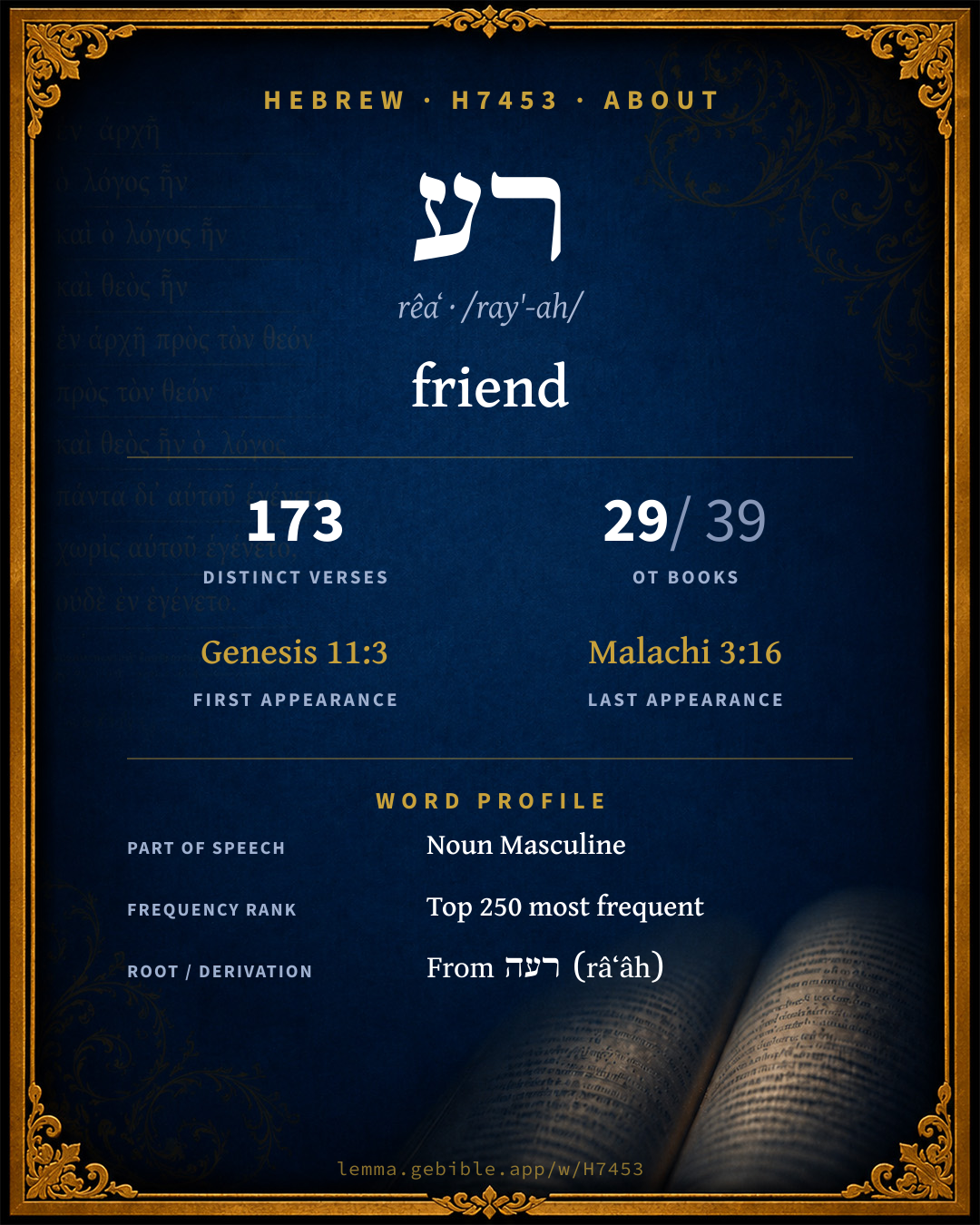
רֵעַ
friend
also: companion, fellow, another person fuller range ↓
Full lexicon entry — Brown-Driver-Briggs (BDB)
From Brown-Driver-Briggs (BDB)
Where this word appears
See every Construct-state word in the Hebrew Bible →
Grammar key — what these labels mean
Part of speech
- Noun
- A naming word — a person, place, thing, or idea.
Noun type
- Common
- A common noun — a general class of person, place, or thing (“king,” “city,” “water”), not a specific name.
State
- Construct
- A noun bound to a following noun in a possessive / “of” relationship (the construct chain).
- Absolute
- The independent form of a noun, not bound to a following word.
Gender
- Masculine
- Grammatically masculine.
Number
- Singular
- One.
- Plural
- More than one (in Hebrew, generally three or more).
Grammatical forms
- Noun, Common, Masculine, Singular, Construct 158 times (84%)
- Noun, Common, Masculine, Plural, Construct 17 times (9%)
- Noun, Common, Masculine, Singular, Absolute 9 times (5%)
- Noun, Common, Masculine, Plural, Absolute 5 times (3%)
Parsed forms decoded from the imported morphology (morphhb / Westminster Leningrad Codex — WLC text public domain, morphhb tagging CC BY 4.0), counted across 189 parsed occurrences — not distinct verses.
Every verse where H7453 appears — 173 distinct verses across 29 books. Click any verse to open its interlinear word-by-word view. Verse text shown in the World English Bible for context — . Each verse’s Hebrew form is shown with its reference; the English is not keyword-highlighted, since the data carries no word-level English alignment. Use “Compare translations” on any verse to read it across multiple English versions. This concordance covers the Hebrew Bible; Septuagint (Greek Old Testament) occurrences are not indexed here.
Genesis 7 verses
- Genesis 11:3 רֵעֵ֗/הוּ n c ms cs + sfx pers 3ms They said one to another, "Come, let's make brick, and burn them thoroughly." They had brick for stone, and they used tar for mortar.
- Genesis 11:7 רֵעֵֽ/הוּ n c ms cs + sfx pers 3ms Come, let's go down, and there confuse their language, that they may not understand one another's speech."
- Genesis 15:10 רֵעֵ֑/הוּ n c ms cs + sfx pers 3ms He took him all these, and divided them in the middle, and laid each half opposite the other; but he didn't divide the birds.
- Genesis 31:49 מֵ/רֵעֵֽ/הוּ prep + n c ms cs + sfx pers 3ms and Mizpah, for he said, "Yahweh watch between me and you, when we are absent one from another.
- Genesis 38:12 רֵעֵ֥/הוּ n c ms cs + sfx pers 3ms After many days, Shua's daughter, the wife of Judah, died. Judah was comforted, and went up to his sheep-shearers to Timnah, he and his friend Hirah, the Adullamite.
- Genesis 38:20 רֵעֵ֣/הוּ n c ms cs + sfx pers 3ms Judah sent the kid of the goats by the hand of his friend, the Adullamite, to receive the pledge from the woman's hand, but he didn't find her.
- Genesis 43:33 רֵעֵֽ/הוּ n c ms cs + sfx pers 3ms They sat before him, the firstborn according to his birthright, and the youngest according to his youth, and the men marveled one with another.
Exodus 18 verses
- Exodus 2:13 רֵעֶֽ/ךָ n c ms cs + sfx pers 2ms He went out the second day, and, behold, two men of the Hebrews were fighting with each other. He said to him who did the wrong, "Why do you strike your fellow?"
- Exodus 11:2 רֵעֵ֗/הוּ n c ms cs + sfx pers 3ms Speak now in the ears of the people, and let them ask every man of his neighbor, and every woman of her neighbor, jewels of silver, and jewels of gold."
- Exodus 18:7 לְ/רֵעֵ֖/הוּ prep + n c ms cs + sfx pers 3ms Moses went out to meet his father-in-law, and bowed and kissed him. They asked each other of their welfare, and they came into the tent.
- Exodus 18:16 רֵעֵ֑/הוּ n c ms cs + sfx pers 3ms When they have a matter, they come to me, and I judge between a man and his neighbor, and I make them know the statutes of God, and his laws."
- Exodus 20:16 בְ/רֵעֲ/ךָ֖ prep + n c ms cs + sfx pers 2ms "You shall not give false testimony against your neighbor.
- Exodus 20:17 רֵעֶ֑/ךָ רֵעֶ֗/ךָ לְ/רֵעֶֽ/ךָ n c ms cs + sfx pers 2ms n c ms cs + sfx pers 2ms prep + n c ms cs + sfx pers 2ms "You shall not covet your neighbor's house. You shall not covet your neighbor's wife, nor his man-servant, nor his maid-servant, nor his ox, nor his donkey, nor anything that is your neighbor's."
- Exodus 21:14 רֵעֵ֖/הוּ n c ms cs + sfx pers 3ms If a man schemes and comes presumptuously on his neighbor to kill him, you shall take him from my altar, that he may die.
- Exodus 21:18 רֵעֵ֔/הוּ n c ms cs + sfx pers 3ms "If men quarrel and one strikes the other with a stone, or with his fist, and he doesn't die, but is confined to bed;
- Exodus 21:35 רֵעֵ֖/הוּ n c ms cs + sfx pers 3ms "If one man's bull injures another's, so that it dies, then they shall sell the live bull, and divide its price; and they shall also divide the dead animal.
- Exodus 22:7 רֵעֵ֜/הוּ n c ms cs + sfx pers 3ms "If a man delivers to his neighbor money or stuff to keep, and it is stolen out of the man's house; if the thief is found, he shall pay double.
- Exodus 22:8 רֵעֵֽ/הוּ n c ms cs + sfx pers 3ms If the thief isn't found, then the master of the house shall come near to God, to find out if he hasn't put his hand to his neighbor's goods.
- Exodus 22:9 לְ/רֵעֵֽ/הוּ prep + n c ms cs + sfx pers 3ms For every matter of trespass, whether it be for ox, for donkey, for sheep, for clothing, or for any kind of lost thing, about which one says, 'This is mine,' the cause of both parties shall come before God. He whom God condemns shall pay double to his neighbor.
- Exodus 22:10 רֵעֵ֜/הוּ n c ms cs + sfx pers 3ms "If a man delivers to his neighbor a donkey, an ox, a sheep, or any animal to keep, and it dies or is injured, or driven away, no man seeing it;
- Exodus 22:11 רֵעֵ֑/הוּ n c ms cs + sfx pers 3ms the oath of Yahweh shall be between them both, whether he hasn't put his hand to his neighbor's goods; and the owner of it shall accept it, and he shall not make restitution.
- Exodus 22:14 רֵעֵ֖/הוּ n c ms cs + sfx pers 3ms "If a man borrows anything of his neighbor's, and it is injured, or dies, the owner of it not being with it, he shall surely make restitution.
- Exodus 22:26 רֵעֶ֑/ךָ n c ms cs + sfx pers 2ms If you take your neighbor's garment as collateral, you shall restore it to him before the sun goes down,
- Exodus 32:27 רֵעֵ֖/הוּ n c ms cs + sfx pers 3ms He said to them, "Thus says Yahweh, the God of Israel, 'Every man put his sword on his thigh, and go back and forth from gate to gate throughout the camp, and every man kill his brother, and every man his companion, and every man his neighbor."
- Exodus 33:11 רֵעֵ֑/הוּ n c ms cs + sfx pers 3ms Yahweh spoke to Moses face to face, as a man speaks to his friend. He turned again into the camp, but his servant Joshua, the son of Nun, a young man, didn't depart out of the Tent.
Leviticus 4 verses
- Leviticus 19:13 רֵֽעֲ/ךָ֖ n c ms cs + sfx pers 2ms "'You shall not oppress your neighbor, nor rob him. The wages of a hired servant shall not remain with you all night until the morning.
- Leviticus 19:16 רֵעֶ֑/ךָ n c ms cs + sfx pers 2ms "'You shall not go up and down as a slanderer among your people; neither shall you stand against the life of your neighbor. I am Yahweh.
- Leviticus 19:18 לְ/רֵעֲ/ךָ֖ prep + n c ms cs + sfx pers 2ms You shall not take vengeance, nor bear any grudge against the children of your people; but you shall love your neighbor as yourself. I am Yahweh.
- Leviticus 20:10 רֵעֵ֑/הוּ n c ms cs + sfx pers 3ms "'The man who commits adultery with another man's wife, even he who commits adultery with his neighbor's wife, the adulterer and the adulteress shall surely be put to death.
Deuteronomy 16 verses
- Deuteronomy 4:42 רֵעֵ֨/הוּ֙ n c ms cs + sfx pers 3ms that the manslayer might flee there, who kills his neighbor unawares, and didn't hate him in time past; and that fleeing to one of these cities he might live:
- Deuteronomy 5:20 בְ/רֵֽעֲ/ךָ֖ prep + n c ms cs + sfx pers 2ms "Neither shall you give false testimony against your neighbor.
- Deuteronomy 5:21 רֵעֶ֑/ךָ רֵעֶ֗/ךָ לְ/רֵעֶֽ/ךָ n c ms cs + sfx pers 2ms n c ms cs + sfx pers 2ms prep + n c ms cs + sfx pers 2ms "Neither shall you covet your neighbor's wife; neither shall you desire your neighbor's house, his field, or his man-servant, or his maid-servant, his ox, or his donkey, or anything that is your neighbor's."
- Deuteronomy 13:6 רֵֽעֲ/ךָ֛ n c ms cs + sfx pers 2ms If your brother, the son of your mother, or your son, or your daughter, or the wife of your bosom, or your friend, who is as your own soul, entice you secretly, saying, Let us go and serve other gods, which you have not known, you, nor your fathers;
- Deuteronomy 15:2 בְּ/רֵעֵ֑/הוּ רֵעֵ֨/הוּ֙ prep + n c ms cs + sfx pers 3ms n c ms cs + sfx pers 3ms This is the manner of the release: every creditor shall release that which he has lent to his neighbor; he shall not exact it of his neighbor and his brother; because Yahweh's release has been proclaimed.
- Deuteronomy 19:4 רֵעֵ֨/הוּ֙ n c ms cs + sfx pers 3ms This is the case of the manslayer, that shall flee there and live: whoever kills his neighbor unawares, and didn't hate him in time past;
- Deuteronomy 19:5 רֵעֵ֥/הוּ רֵעֵ֖/הוּ n c ms cs + sfx pers 3ms n c ms cs + sfx pers 3ms as when a man goes into the forest with his neighbor to hew wood, and his hand fetches a stroke with the axe to cut down the tree, and the head slips from the handle, and lights on his neighbor, so that he dies; he shall flee to one of these cities and live:
- Deuteronomy 19:11 לְ/רֵעֵ֔/הוּ prep + n c ms cs + sfx pers 3ms But if any man hate his neighbor, and lie in wait for him, and rise up against him, and strike him mortally so that he dies, and he flee into one of these cities;
- Deuteronomy 19:14 רֵֽעֲ/ךָ֔ n c ms cs + sfx pers 2ms You shall not remove your neighbor's landmark, which they of old time have set, in your inheritance which you shall inherit, in the land that Yahweh your God gives you to possess it.
- Deuteronomy 22:24 רֵעֵ֑/הוּ n c ms cs + sfx pers 3ms then you shall bring them both out to the gate of that city, and you shall stone them to death with stones; the lady, because she didn't cry, being in the city; and the man, because he has humbled his neighbor's wife: so you shall put away the evil from the midst of you.
- Deuteronomy 22:26 רֵעֵ֨/הוּ֙ n c ms cs + sfx pers 3ms but to the lady you shall do nothing; there is in the lady no sin worthy of death: for as when a man rises against his neighbor, and kills him, even so is this matter;
- Deuteronomy 23:24 רֵעֶ֔/ךָ n c ms cs + sfx pers 2ms When you come into your neighbor's vineyard, then you may eat of grapes your fill at your own pleasure; but you shall not put any in your vessel.
- Deuteronomy 23:25 רֵעֶ֔/ךָ רֵעֶֽ/ךָ n c ms cs + sfx pers 2ms n c ms cs + sfx pers 2ms When you come into your neighbor's standing grain, then you may pluck the ears with your hand; but you shall not move a sickle to your neighbor's standing grain.
- Deuteronomy 24:10 בְ/רֵֽעֲ/ךָ prep + n c ms cs + sfx pers 2ms When you do lend your neighbor any manner of loan, you shall not go into his house to get his pledge.
- Deuteronomy 27:17 רֵעֵ֑/הוּ n c ms cs + sfx pers 3ms Cursed be he who removes his neighbor's landmark. All the people shall say, Amen.
- Deuteronomy 27:24 רֵעֵ֖/הוּ n c ms cs + sfx pers 3ms Cursed be he who strikes his neighbor in secret. All the people shall say, Amen.
Joshua 1 verse
Judges 5 verses
- Judges 6:29 רֵעֵ֔/הוּ n c ms cs + sfx pers 3ms They said one to another, Who has done this thing? When they inquired and asked, they said, Gideon the son of Joash has done this thing.
- Judges 7:13 לְ/רֵעֵ֖/הוּ prep + n c ms cs + sfx pers 3ms When Gideon had come, behold, there was a man telling a dream to his fellow; and he said, Behold, I dreamed a dream; and, behold, a cake of barley bread tumbled into the camp of Midian, and came to the tent, and struck it so that it fell, and turned it upside down, so that the tent lay flat.
- Judges 7:14 רֵעֵ֤/הוּ n c ms cs + sfx pers 3ms His fellow answered, This is nothing else save the sword of Gideon the son of Joash, a man of Israel: into his hand God has delivered Midian, and all the host.
- Judges 7:22 בְּ/רֵעֵ֖/הוּ prep + n c ms cs + sfx pers 3ms They blew the three hundred trumpets, and Yahweh set every man's sword against his fellow, and against all the host; and the host fled as far as Beth-shittah toward Zererah, as far as the border of Abel Meholah, by Tabbath.
- Judges 10:18 רֵעֵ֔/הוּ n c ms cs + sfx pers 3ms The people, the princes of Gilead, said one to another, What man is he who will begin to fight against the children of Ammon? he shall be head over all the inhabitants of Gilead.
Ruth 2 verses
- Ruth 3:14 רֵעֵ֑/הוּ n c ms cs + sfx pers 3ms She lay at his feet until the morning. She rose up before one could discern another. For he said, Let it not be known that the woman came to the threshing floor.
- Ruth 4:7 לְ/רֵעֵ֑/הוּ prep + n c ms cs + sfx pers 3ms Now this was [the custom] in former time in Israel concerning redeeming and concerning exchanging, to confirm all things: a man drew off his shoe, and gave it to his neighbor; and this was the [manner of] attestation in Israel.
1 Samuel 6 verses
- 1 Samuel 10:11 רֵעֵ֗/הוּ n c ms cs + sfx pers 3ms It happened, when all who knew him before saw that, behold, he prophesied with the prophets, then the people said one to another, What is this that is come to the son of Kish? Is Saul also among the prophets?
- 1 Samuel 14:20 בְּ/רֵעֵ֔/הוּ prep + n c ms cs + sfx pers 3ms Saul and all the people who were with him were gathered together, and came to the battle: and, behold, every man's sword was against his fellow, [and there was] a very great confusion.
- 1 Samuel 15:28 לְ/רֵעֲ/ךָ֖ prep + n c ms cs + sfx pers 2ms Samuel said to him, Yahweh has torn the kingdom of Israel from you this day, and has given it to a neighbor of yours who is better than you.
- 1 Samuel 20:41 רֵעֵ֗/הוּ רֵעֵ֔/הוּ n c ms cs + sfx pers 3ms n c ms cs + sfx pers 3ms As soon as the boy was gone, David arose out of [a place] toward the South, and fell on his face to the ground, and bowed himself three times: and they kissed one another, and wept one with another, until David exceeded.
- 1 Samuel 28:17 לְ/רֵעֲ/ךָ֥ prep + n c ms cs + sfx pers 2ms Yahweh has done to you, as he spoke by me: and Yahweh has torn the kingdom out of your hand, and given it to your neighbor, even to David.
- 1 Samuel 30:26 לְ/רֵעֵ֣/הוּ prep + n c ms cs + sfx pers 3ms When David came to Ziklag, he sent of the spoil to the elders of Judah, even to his friends, saying, Behold, a present for you of the spoil of the enemies of Yahweh:
2 Samuel 4 verses
- 2 Samuel 2:16 רֵעֵ֗/הוּ רֵעֵ֔/הוּ n c ms cs + sfx pers 3ms n c ms cs + sfx pers 3ms They caught everyone his fellow by the head, and [thrust] his sword in his fellow's side; so they fell down together: therefore that place was called Helkath Hazzurim, which is in Gibeon.
- 2 Samuel 12:11 לְ/רֵעֶ֑י/ךָ prep + n c mp cs + sfx pers 2ms This is what Yahweh says: 'Behold, I will raise up evil against you out of your own house; and I will take your wives before your eyes, and give them to your neighbor, and he will lie with your wives in the sight of this sun.
- 2 Samuel 13:3 רֵ֗עַ n c ms But Amnon had a friend, whose name was Jonadab, the son of Shimeah, David's brother; and Jonadab was a very subtle man.
- 2 Samuel 16:17 רֵעֶ֑/ךָ רֵעֶֽ/ךָ n c ms cs + sfx pers 2ms n c ms cs + sfx pers 2ms Absalom said to Hushai, Is this your kindness to your friend? Why didn't you go with your friend?
1 Kings 3 verses
- 1 Kings 8:31 לְ/רֵעֵ֔/הוּ prep + n c ms cs + sfx pers 3ms If a man sin against his neighbor, and an oath be laid on him to cause him to swear, and he come [and] swear before your altar in this house;
- 1 Kings 16:11 וְ/רֵעֵֽ/הוּ conj + n c ms cs + sfx pers 3ms It happened, when he began to reign, as soon as he sat on his throne, that he struck all the house of Baasha: he didn't leave him a single man-child, neither of his relatives, nor of his friends.
- 1 Kings 20:35 רֵעֵ֛/הוּ n c ms cs + sfx pers 3ms A certain man of the sons of the prophets said to his fellow by the word of Yahweh, Please strike me. The man refused to strike him.
2 Kings 3 verses
- 2 Kings 3:23 רֵעֵ֑/הוּ n c ms cs + sfx pers 3ms and they said, This is blood; the kings are surely destroyed, and they have struck each man his fellow: now therefore, Moab, to the spoil.
- 2 Kings 7:3 רֵעֵ֔/הוּ n c ms cs + sfx pers 3ms Now there were four leprous men at the entrance of the gate: and they said one to another, Why sit we here until we die?
- 2 Kings 7:9 רֵעֵ֜/הוּ n c ms cs + sfx pers 3ms Then they said one to another, We aren't doing right. This day is a day of good news, and we hold our peace: if we wait until the morning light, punishment will overtake us; now therefore come, let us go and tell the king's household.
1 Chronicles 1 verse
2 Chronicles 2 verses
- 2 Chronicles 6:22 לְ/רֵעֵ֔/הוּ prep + n c ms cs + sfx pers 3ms If a man sin against his neighbor, and an oath is laid on him to cause him to swear, and he comes and swears before your altar in this house;
- 2 Chronicles 20:23 בְּ/רֵעֵ֖/הוּ prep + n c ms cs + sfx pers 3ms For the children of Ammon and Moab stood up against the inhabitants of Mount Seir, utterly to kill and destroy them: and when they had made an end of the inhabitants of Seir, everyone helped to destroy another.
Esther 2 verses
- Esther 9:19 לְ/רֵעֵֽ/הוּ prep + n c ms cs + sfx pers 3ms Therefore do the Jews of the villages, who dwell in the unwalled towns, make the fourteenth day of the month Adar [a day of] gladness and feasting, and a good day, and of sending portions one to another.
- Esther 9:22 לְ/רֵעֵ֔/הוּ prep + n c ms cs + sfx pers 3ms as the days in which the Jews had rest from their enemies, and the month which was turned to them from sorrow to gladness, and from mourning into a good day; that they should make them days of feasting and gladness, and of sending portions one to another, and gifts to the needy.
Job 14 verses
- Job 2:11 רֵעֵ֣י n c mp cs Now when Job's three friends heard of all this evil that had come on him, they each came from his own place: Eliphaz the Temanite, Bildad the Shuhite, and Zophar the Naamathite, and they made an appointment together to come to sympathize with him and to comfort him.
- Job 6:14 מֵרֵעֵ֣/הוּ n c ms cs + sfx pers 3ms "To him who is ready to faint, kindness should be shown from his friend; Even to him who forsakes the fear of the Almighty.
- Job 6:27 רֵֽיעֲ/כֶֽם n c ms cs + sfx pers 2mp Yes, you would even cast lots for the fatherless, And make merchandise of your friend.
- Job 12:4 לְ/רֵעֵ֨/הוּ prep + n c ms cs + sfx pers 3ms I am like one who is a joke to his neighbor, I, who called on God, and he answered. The just, the blameless man is a joke.
- Job 16:20 רֵעָ֑/י n c mp cs + sfx pers 1cs My friends scoff at me. My eyes pour out tears to God,
- Job 16:21 לְ/רֵעֵֽ/הוּ prep + n c ms cs + sfx pers 3ms That he would maintain the right of a man with God, Of a son of man with his neighbor!
- Job 17:5 רֵעִ֑ים n c mp He who denounces his friends for a prey, Even the eyes of his children shall fail.
- Job 19:21 רֵעָ֑/י n c mp cs + sfx pers 1cs "Have pity on me, have pity on me, you my friends; For the hand of God has touched me.
- Job 30:29 וְ֝/רֵ֗עַ conj + n c ms I am a brother to jackals, And a companion to ostriches.
- Job 31:9 רֵעִ֣/י n c ms cs + sfx pers 1cs "If my heart has been enticed to a woman, And I have laid wait at my neighbor's door;
- Job 32:3 רֵעָי/ו֮ n c mp cs + sfx pers 3ms Also his wrath was kindled against his three friends, because they had found no answer, and yet had condemned Job.
- Job 35:4 רֵעֶ֥י/ךָ n c mp cs + sfx pers 2ms I will answer you, And your companions with you.
- Job 42:7 רֵעֶ֔י/ךָ n c mp cs + sfx pers 2ms It was so, that after Yahweh had spoken these words to Job, Yahweh said to Eliphaz the Temanite, "My wrath is kindled against you, and against your two friends; for you have not spoken of me the thing that is right, as my servant Job has.
- Job 42:10 רֵעֵ֑/הוּ n c mp cs + sfx pers 3ms Yahweh turned the captivity of Job, when he prayed for his friends. Yahweh gave Job twice as much as he had before.
Psalms 8 verses
- Psalms 12:2 רֵ֫עֵ֥/הוּ n c ms cs + sfx pers 3ms Everyone lies to his neighbor. They speak with flattering lips, and with a double heart.
- Psalms 15:3 לְ/רֵעֵ֣/הוּ prep + n c ms cs + sfx pers 3ms He who doesn't slander with his tongue, Nor does evil to his friend, Nor casts slurs against his fellow man;
- Psalms 28:3 רֵֽעֵי/הֶ֑ם n c mp cs + sfx pers 3mp Don't draw me away with the wicked, With the workers of iniquity who speak peace with their neighbors, But mischief is in their hearts.
- Psalms 35:14 כְּ/רֵֽעַ prep + n c ms I behaved myself as though it had been my friend or my brother. I bowed down mourning, as one who mourns his mother.
- Psalms 38:11 וְ/רֵעַ֗/י conj + n c mp cs + sfx pers 1cs My lovers and my friends stand aloof from my plague. My kinsmen stand far away.
- Psalms 88:18 וָ/רֵ֑עַ conj + n c ms You have put lover and friend far from me, And my friends into darkness.
- Psalms 101:5 רֵעֵ/הוּ֮ n c ms cs + sfx pers 3ms I will silence whoever secretly slanders his neighbor. I won't tolerate one who is haughty and conceited.
- Psalms 122:8 וְ/רֵעָ֑/י conj + n c mp cs + sfx pers 1cs For my brothers' and companions' sakes, I will now say, "Peace be within you."
Proverbs 30 verses
- Proverbs 3:28 ל/רעי/ך לְ/רֵֽעֲ/ךָ֨ prep + n c mp cs + sfx pers 2ms prep + n c ms cs + sfx pers 2ms Don't say to your neighbor, "Go, and come again, Tomorrow I will give it to you," When you have it by you.
- Proverbs 3:29 רֵעֲ/ךָ֣ n c ms cs + sfx pers 2ms Don't devise evil against your neighbor, Seeing he dwells securely by you.
- Proverbs 6:1 לְ/רֵעֶ֑/ךָ prep + n c ms cs + sfx pers 2ms My son, if you have become collateral for your neighbor, If you have struck your hands in pledge for a stranger;
- Proverbs 6:3 רֵעֶ֑/ךָ רֵעֶֽי/ךָ n c ms cs + sfx pers 2ms n c mp cs + sfx pers 2ms Do this now, my son, and deliver yourself, Seeing you have come into the hand of your neighbor. Go, humble yourself. Press your plea with your neighbor.
- Proverbs 6:29 רֵעֵ֑/הוּ n c ms cs + sfx pers 3ms So is he who goes in to his neighbor's wife. Whoever touches her will not be unpunished.
- Proverbs 11:9 רֵעֵ֑/הוּ n c ms cs + sfx pers 3ms With his mouth the godless man destroys his neighbor, But the righteous will be delivered through knowledge.
- Proverbs 11:12 לְ/רֵעֵ֥/הוּ prep + n c ms cs + sfx pers 3ms One who despises his neighbor is void of wisdom, But a man of understanding holds his peace.
- Proverbs 12:26 מֵ/רֵעֵ֣/הוּ prep + n c ms cs + sfx pers 3ms A righteous person is cautious in friendship, But the way of the wicked leads them astray.
- Proverbs 14:20 לְ֭/רֵעֵ/הוּ prep + n c ms cs + sfx pers 3ms The poor person is shunned even by his own neighbor, But the rich person has many friends.
- Proverbs 14:21 לְ/רֵעֵ֥/הוּ prep + n c ms cs + sfx pers 3ms He who despises his neighbor sins, But blessed is he who has pity on the poor.
- Proverbs 16:29 רֵעֵ֑/הוּ n c ms cs + sfx pers 3ms A man of violence entices his neighbor, And leads him in a way that is not good.
- Proverbs 17:17 הָ/רֵ֑עַ ptcl def.art + n c ms A friend loves at all times; And a brother is born for adversity.
- Proverbs 17:18 רֵעֵֽ/הוּ n c ms cs + sfx pers 3ms A man void of understanding strikes hands, And becomes collateral in the presence of his neighbor.
- Proverbs 18:17 רֵ֝עֵ֗/הוּ n c ms cs + sfx pers 3ms He who pleads his cause first seems right; Until another comes and questions him.
- Proverbs 18:24 רֵ֭עִים n c mp A man of many companions may be ruined, But there is a friend who sticks closer than a brother.
- Proverbs 19:4 רֵעִ֣ים מֵרֵ֥ע/הוּ n c mp n c ms cs + sfx pers 3ms Wealth adds many friends, But the poor is separated from his friend.
- Proverbs 19:6 הָ֝/רֵ֗עַ ptcl def.art + n c ms Many will entreat the favor of a ruler, And everyone is a friend to a man who gives gifts.
- Proverbs 21:10 רֵעֵֽ/הוּ n c ms cs + sfx pers 3ms The soul of the wicked desires evil; His neighbor finds no mercy in his eyes.
- Proverbs 22:11 רֵעֵ֥/הוּ n c ms cs + sfx pers 3ms He who loves purity of heart and speaks gracefully Is the king's friend.
- Proverbs 24:28 בְּ/רֵעֶ֑/ךָ prep + n c ms cs + sfx pers 2ms Don't be a witness against your neighbor without cause. Don't deceive with your lips.
- Proverbs 25:8 רֵעֶֽ/ךָ n c ms cs + sfx pers 2ms Don't be hasty in bringing charges to court. What will you do in the end when your neighbor shames you?
- Proverbs 25:9 רֵעֶ֑/ךָ n c ms cs + sfx pers 2ms Debate your case with your neighbor, And don't betray the confidence of another;
- Proverbs 25:17 רֵעֶ֑/ךָ n c ms cs + sfx pers 2ms Let your foot be seldom in your neighbor's house, Lest he be weary of you, and hate you.
- Proverbs 25:18 בְ֝/רֵעֵ֗/הוּ prep + n c ms cs + sfx pers 3ms A man who gives false testimony against his neighbor Is like a club, a sword, or a sharp arrow.
- Proverbs 26:19 רֵעֵ֑/הוּ n c ms cs + sfx pers 3ms Is the man who deceives his neighbor and says, "Am I not joking?"
- Proverbs 27:9 רֵ֝עֵ֗/הוּ n c ms cs + sfx pers 3ms Perfume and incense bring joy to the heart; So does earnest counsel from a man's friend.
- Proverbs 27:10 רֵֽעֲ/ךָ֨ וְ/רֵ֪עַ n c ms cs + sfx pers 2ms conj + n c ms cs Don't forsake your friend and your father's friend. Don't go to your brother's house in the day of your disaster: Better is a neighbor who is near than a distant brother.
- Proverbs 27:14 רֵעֵ֨/הוּ n c ms cs + sfx pers 3ms He who blesses his neighbor with a loud voice early in the morning, It will be taken as a curse by him.
- Proverbs 27:17 רֵעֵֽ/הוּ n c ms cs + sfx pers 3ms Iron sharpens iron; So a man sharpens his friend's countenance.
- Proverbs 29:5 רֵעֵ֑/הוּ n c ms cs + sfx pers 3ms A man who flatters his neighbor, Spreads a net for his feet.
Ecclesiastes 1 verse
Song of Solomon 2 verses
- Song of Solomon 5:1 רֵעִ֔ים n c mp I have come into my garden, my sister, my bride. I have gathered my myrrh with my spice; I have eaten my honeycomb with my honey; I have drunk my wine with my milk. Friends Eat, friends! Drink, yes, drink abundantly, beloved. Beloved
- Song of Solomon 5:16 רֵעִ֔/י n c ms cs + sfx pers 1cs His mouth is sweetness; Yes, he is altogether lovely. This is my beloved, and this is my friend, Daughters of Jerusalem. Friends
Isaiah 5 verses
- Isaiah 3:5 בְּ/רֵעֵ֑/הוּ prep + n c ms cs + sfx pers 3ms The people will be oppressed, Everyone by another, And everyone by his neighbor. The child will behave himself proudly against the old man, And the base against the honorable.
- Isaiah 13:8 רֵעֵ֨/הוּ֙ n c ms cs + sfx pers 3ms and they shall be dismayed; pangs and sorrows shall take hold [of them]; they shall be in pain as a woman in travail: they shall look in amazement one at another; their faces [shall be] faces of flame.
- Isaiah 19:2 בְּ/רֵעֵ֑/הוּ prep + n c ms cs + sfx pers 3ms I will stir up the Egyptians against the Egyptians: and they shall fight everyone against his brother, and everyone against his neighbor; city against city, [and] kingdom against kingdom.
- Isaiah 34:14 רֵעֵ֣/הוּ n c ms cs + sfx pers 3ms The wild animals of the desert shall meet with the wolves, and the wild goat shall cry to his fellow; yes, the night-monster shall settle there, and shall find her a place of rest.
- Isaiah 41:6 רֵעֵ֖/הוּ n c ms cs + sfx pers 3ms They help everyone his neighbor; and [every one] says to his brother, Be of good courage.
Jeremiah 20 verses
- Jeremiah 3:1 רֵעִ֣ים n c mp They say, If a man put away his wife, and she go from him, and become another man's, will he return to her again? Won't that land be greatly polluted? But you have played the prostitute with many lovers; yet return again to me, says Yahweh.
- Jeremiah 3:20 מֵ/רֵעָ֑/הּ prep + n c ms cs + sfx pers 3fs Surely as a wife treacherously departs from her husband, so have you dealt treacherously with me, house of Israel, says Yahweh.
- Jeremiah 5:8 רֵעֵ֖/הוּ n c ms cs + sfx pers 3ms They were as fed horses roaming at large; everyone neighed after his neighbor's wife.
- Jeremiah 6:21 וְ/רֵע֖/וֹ conj + n c ms cs + sfx pers 3ms Therefore thus says Yahweh, Behold, I will lay stumbling-blocks before this people; and the fathers and the sons together shall stumble against them; the neighbor and his friend shall perish.
- Jeremiah 7:5 רֵעֵֽ/הוּ n c ms cs + sfx pers 3ms For if you thoroughly amend your ways and your doings; if you thoroughly execute justice between a man and his neighbor;
- Jeremiah 9:4 מֵ/רֵעֵ֨/הוּ֙ רֵ֖עַ prep + n c ms cs + sfx pers 3ms n c ms Take you heed everyone of his neighbor, and don't you trust in any brother; for every brother will utterly supplant, and every neighbor will go about with slanders.
- Jeremiah 9:5 בְּ/רֵעֵ֨/הוּ֙ prep + n c ms cs + sfx pers 3ms They will deceive everyone his neighbor, and will not speak the truth: they have taught their tongue to speak lies; they weary themselves to commit iniquity.
- Jeremiah 9:8 רֵעֵ֨/הוּ֙ n c ms cs + sfx pers 3ms Their tongue is a deadly arrow; it speaks deceit: one speaks peaceably to his neighbor with his mouth, but in his heart he lays wait for him.
- Jeremiah 19:9 רֵעֵ֖/הוּ n c ms cs + sfx pers 3ms I will cause them to eat the flesh of their sons and the flesh of their daughters; and they shall eat everyone the flesh of his friend, in the siege and in the distress, with which their enemies, and those who seek their life, shall distress them.
- Jeremiah 22:8 רֵעֵ֔/הוּ n c ms cs + sfx pers 3ms Many nations shall pass by this city, and they shall say every man to his neighbor, Why has Yahweh done thus to this great city?
- Jeremiah 22:13 בְּ/רֵעֵ֨/הוּ֙ prep + n c ms cs + sfx pers 3ms Woe to him who builds his house by unrighteousness, and his chambers by injustice; who uses his neighbor's service without wages, and doesn't give him his hire;
- Jeremiah 23:27 לְ/רֵעֵ֑/הוּ prep + n c ms cs + sfx pers 3ms who think to cause my people to forget my name by their dreams which they tell every man to his neighbor, as their fathers forgot my name for Baal.
- Jeremiah 23:30 רֵעֵֽ/הוּ n c ms cs + sfx pers 3ms Therefore, behold, I am against the prophets, says Yahweh, who steal my words everyone from his neighbor.
- Jeremiah 23:35 רֵעֵ֖/הוּ n c ms cs + sfx pers 3ms Thus shall you say everyone to his neighbor, and everyone to his brother, What has Yahweh answered? and, What has Yahweh spoken?
- Jeremiah 29:23 רֵֽעֵי/הֶ֔ם n c mp cs + sfx pers 3mp because they have worked folly in Israel, and have committed adultery with their neighbors' wives, and have spoken words in my name falsely, which I didn't command them; and I am he who knows, and am witness, says Yahweh.
- Jeremiah 31:34 רֵעֵ֜/הוּ n c ms cs + sfx pers 3ms and they shall teach no more every man his neighbor, and every man his brother, saying, Know Yahweh; for they shall all know me, from the least of them to the greatest of them, says Yahweh: for I will forgive their iniquity, and their sin will I remember no more.
- Jeremiah 34:15 לְ/רֵעֵ֑/הוּ prep + n c ms cs + sfx pers 3ms You were now turned, and had done that which is right in my eyes, in proclaiming liberty every man to his neighbor; and you had made a covenant before me in the house which is called by my name:
- Jeremiah 34:17 לְ/רֵעֵ֑/הוּ prep + n c ms cs + sfx pers 3ms Therefore thus says Yahweh: you have not listened to me, to proclaim liberty, every man to his brother, and every man to his neighbor: behold, I proclaim to you a liberty, says Yahweh, to the sword, to the pestilence, and to the famine; and I will make you to be tossed back and forth among all the kingdoms of the earth.
- Jeremiah 36:16 רֵעֵ֑/הוּ n c ms cs + sfx pers 3ms Now it happened, when they had heard all the words, they turned in fear one toward another, and said to Baruch, We will surely tell the king of all these words.
- Jeremiah 46:16 רֵעֵ֗/הוּ n c ms cs + sfx pers 3ms He made many to stumble, yes, they fell one on another: and they said, Arise, and let us go again to our own people, and to the land of our birth, from the oppressing sword.
Lamentations 1 verse
Ezekiel 6 verses
- Ezekiel 18:6 רֵעֵ֨/הוּ֙ n c ms cs + sfx pers 3ms and has not eaten on the mountains, neither has lifted up his eyes to the idols of the house of Israel, neither has defiled his neighbor's wife, neither has come near to a woman in her impurity,
- Ezekiel 18:11 רֵעֵ֖/הוּ n c ms cs + sfx pers 3ms and who does not any of those [duties], but even has eaten on the mountains, and defiled his neighbor's wife,
- Ezekiel 18:15 רֵעֵ֖/הוּ n c ms cs + sfx pers 3ms who has not eaten on the mountains, neither has lifted up his eyes to the idols of the house of Israel, has not defiled his neighbor's wife,
- Ezekiel 22:11 רֵעֵ֗/הוּ n c ms cs + sfx pers 3ms One has committed abomination with his neighbor's wife; and another has lewdly defiled his daughter-in-law; and another in you has humbled his sister, his father's daughter.
- Ezekiel 22:12 רֵעַ֨יִ/ךְ֙ n c mp cs + sfx pers 2fs In you have they taken bribes to shed blood; you have taken interest and increase, and you have greedily gained of your neighbors by oppression, and have forgotten me, says the Lord Yahweh.
- Ezekiel 33:26 רֵעֵ֖/הוּ n c ms cs + sfx pers 3ms You stand on your sword, you work abomination, and you defile everyone his neighbor's wife: and shall you possess the land?
Hosea 1 verse
Jonah 1 verse
Micah 1 verse
Habakkuk 1 verse
Zechariah 7 verses
- Zechariah 3:8 וְ/רֵעֶ֨י/ךָ֙ conj + n c mp cs + sfx pers 2ms Hear now, Joshua the high priest, you and your fellows who sit before you; for they are men who are a sign: for, behold, I will bring forth my servant, the Branch.
- Zechariah 3:10 לְ/רֵעֵ֑/הוּ prep + n c ms cs + sfx pers 3ms In that day,' says Yahweh of hosts, 'you will invite every man his neighbor under the vine and under the fig tree.'"
- Zechariah 8:10 בְּ/רֵעֵֽ/הוּ prep + n c ms cs + sfx pers 3ms For before those days there was no wages for man, nor any wages for an animal; neither was there any peace to him who went out or came in, because of the adversary. For I set all men everyone against his neighbor.
- Zechariah 8:16 רֵעֵ֔/הוּ n c ms cs + sfx pers 3ms These are the things that you shall do: speak every man the truth with his neighbor. Execute the judgment of truth and peace in your gates,
- Zechariah 8:17 רֵעֵ֗/הוּ n c ms cs + sfx pers 3ms and let none of you devise evil in your hearts against his neighbor, and love no false oath: for all these are things that I hate," says Yahweh.
- Zechariah 11:6 רֵעֵ֨/הוּ֙ n c ms cs + sfx pers 3ms For I will no more pity the inhabitants of the land," says Yahweh; "but, behold, I will deliver the men everyone into his neighbor's hand, and into the hand of his king. They will strike the land, and out of their hand I will not deliver them."
- Zechariah 14:13 רֵעֵ֔/הוּ רֵעֵֽ/הוּ n c ms cs + sfx pers 3ms n c ms cs + sfx pers 3ms It will happen in that day, that a great panic from Yahweh will be among them; and they will lay hold everyone on the hand of his neighbor, and his hand will rise up against the hand of his neighbor.
Malachi 1 verse
About this entry
At a glance — auto-summarized from this page’s data, not written by a person. Every figure links to its source below. This summary describes the numbers; it doesn’t interpret them.
At its core, רע (rêaʻ) means “friend.” Older and newer Bibles part ways — “neighbour” in the King James Version, “neighbor” (Berean Standard Bible) in modern versions. See the renderings breakdown. It appears 173 verses across 29 books of the Hebrew Bible, among its common vocabulary. Scripture first uses it in Genesis 11:3. Ranging over 4 senses, its meaning includes “companion”, “fellow”, and “another person”. Dig into 173-verse concordance and the renderings breakdown below.
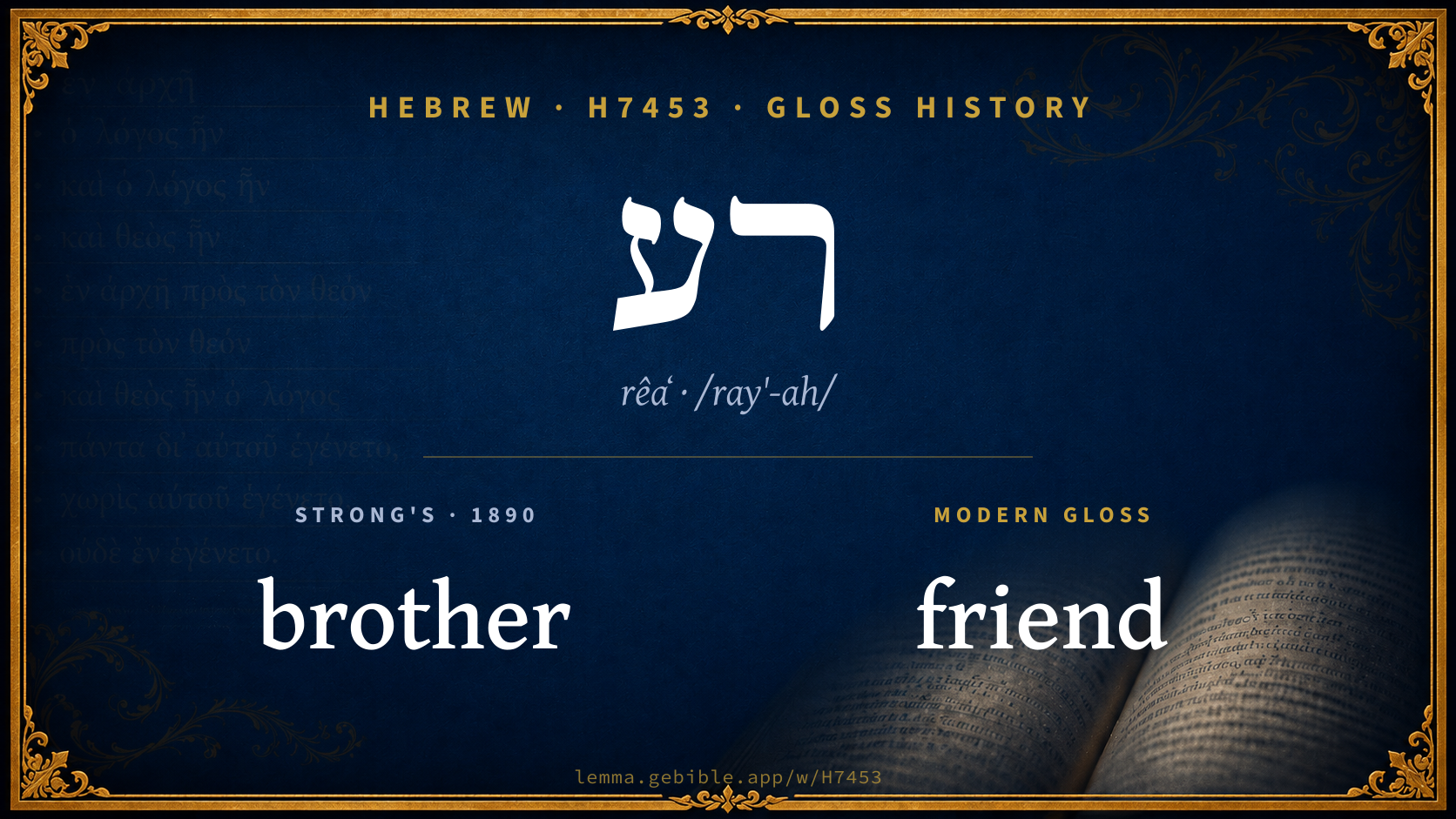
Gloss history
Strong's 1890 vs modern scholarship
About this word
Strong's H7453 catalogs a Hebrew word from the Hebrew Old Testament.
These counts are not copied from any lexicon or concordance. They are computed here, from the morphology-tagged Hebrew Old Testament. What Lemma adds →
- 173
- distinct verses
- The word appears in 173 distinct verses.
- 29 / 39
- OT books
- The word appears in 29 of 39 Old Testament books.
- #248
- by frequency
- Top 250 most frequent Hebrew words (rank 248 of 8,640 Hebrew words by occurrence).
View all 173 occurrences in the concordance →
By section of the Old Testament
By traditional corpus
Conventional, traditional groupings — biblical authorship is debated, so this is a traditional corpus grouping, not an authorship claim. Each share is this word’s portion of its verses in that division of the Hebrew canon. Each figure is a share of the word’s 173 distinct verses.
- Prophets (Nevi'im) 65 verses · 38%
- Writings (Ketuvim) 63 verses · 36%
- Torah (Pentateuch) 45 verses · 26%
How translations render this word
Counts come from each version’s own published word-to-Strong’s tagging or interlinear alignment — an approximate guide to how each version renders this word, not a word-level alignment the data otherwise carries. Because each total is that version’s own tagged count, the per-version totals vary from one another and need not match the appearance or distinct-verse counts above. These counts may also differ from a printed concordance because Lemma counts each distinctly tagged rendering and does not collapse phrase taggings into a single head-word total. This is a fixed set of word-tagged versions (KJV, ASV, BSB, ULT) and does not change with the reading translation you choose elsewhere. Each version’s license is shown beside its name below (and on Sources).
BDB lists this Strong’s number as 3 distinct words (homographs). Each count above pools all of them and is not split by sense — see the Senses section below. A low-frequency rendering may belong to a different one of those words, not the primary meaning.
- King James Version†: Neighbour 55×, Neighbour's 22×, Another 21×
- American Standard Version†: Neighbor 80×, Another 20×, Friend 12×
- Berean Standard Bible†: Neighbor 49×, Another 26×, Friend 22×
- unfoldingWord Literal Text†: Neighbor 87×, Friend 22×, Fellow 10×
King James Version Public Domain
Renders H7453 across 187† tagged occurrences — most commonly:
Plus 38 renderings that appear only once — usually multi-word phrases or single function words the recovered tagging swept in, not distinct renderings. Not rendered by a distinct English word in 1 further occurrence.
American Standard Version Public Domain
Renders H7453 across 187† tagged occurrences — most commonly:
Plus 34 renderings that appear only once — usually multi-word phrases or single function words the recovered tagging swept in, not distinct renderings.
Berean Standard Bible Public Domain
Renders H7453 across 185† tagged occurrences — most commonly:
Plus other, less common renderings. Plus 20 renderings that appear only once — usually multi-word phrases or single function words the recovered tagging swept in, not distinct renderings. Not rendered by a distinct English word in 2 further occurrences.
unfoldingWord Literal Text CC BY-SA 4.0
Renders H7453 across 188† tagged occurrences — most commonly:
Plus 27 renderings that appear only once — usually multi-word phrases or single function words the recovered tagging swept in, not distinct renderings.
Senses in the full BDB
What do BDB’s symbols mean?
BDB uses these scholarly abbreviations:
| Symbol | Meaning |
|---|---|
| 𝔊 | the Septuagint (the ancient Greek translation, LXX) |
| 𝔙 | the Vulgate (the Latin translation) |
| 𝔖 | the Syriac version (the Peshitta) |
| 𝔗 | the Targum (the Aramaic translation) |
| ψ | the Psalms |
| √ | root (the underlying root or stem) |
| ‖ | parallel passage (a synonymous or contrasted parallel) |
| † | the dagger: every passage where the word occurs is cited |
The 0 senses and sub-senses the full Brown-Driver-Briggs lexicon distinguishes for this word, in lexicon order (not ranked by frequency), with BDB’s own verbatim wording and sub-sense lettering. Shown in Hebrew script with BDB’s own scholarly abbreviations. The condensed entry is in the Lexicon Entry tab. See also the Forms in the corpus table below.
רע I verb. shouting, roar, but dub.
רע II [m.] purpose, aim
Senses from the full Brown-Driver-Briggs lexicon (Brown, Driver, Briggs; Oxford 1906 — public domain), digitized via Sefaria, supplemented by the OpenScriptures HebrewLexicon (CC BY 4.0). Full attribution on Sources.
Word origin
I. n.verb. shouting, roar, but dub.;—קוֹל הָעָם בְּרֵעֹה֯ Ex 32:17 (E) sound of the people as they shouted (read Inf. cstr. בָּרִעֹה for בְּהָרִיעוֹ cf. √ 5); יַגִּיד עָלָיו רֵע֑וֹ Jb 36:33 the roar thereof telleth of him (רַעְמוֹ his thunder, so Bu); לָמָּה תָרִיעִי רֵעַ Mi 4:9 why criest thou out with a crying? (butv. √ 6). ii, iii. רֵעַ v. ii, iii. רעה; רַע, רֹעַ v. דעע.
II. v. II, III. רעה.
IV. n. [m.] purpose, aim;—sf. רֵעִי ψ 139:2 (of man), pl. sf. רֵעֶיךָ v 17 (of E†l).
— Brown-Driver-Briggs (Oxford 1906, public domain), digitized via Sefaria, supplemented by the OpenScriptures HebrewLexicon (CC BY 4.0). See Sources.
Derived from רעה (râʻâh) (H7462) — to shepherd.
Jastrow Dictionary
A second Hebrew/Aramaic lexicon for comparison, covering Aramaic and post-biblical (Talmudic, Targumic, Midrashic) usage that the biblical-Hebrew BDB does not. Matched by lemma rather than by Strong’s number, so a lemma may carry more than one Jastrow headword (shown separately below), and the entries cover usage well beyond the Bible.
רַע I
- [shaken,] weak, sick; bad; (noun) evil. Ber. 7ᵃ מפני מה … ורע לו why is there a righteous man who fares well, and another righteous man who fares badly? Ib. 23ᵃ (ref. to Koh. IV, 17) בין טוב לרע וכ׳ they cannot distinguish between good and evil, and want to offer a sacrifice before me? Kidd. 40ᵃ (ref. to Is. III, 11) וכי יש רשע רע ויש שאינו רע is there a bad wicked man and a wicked man that is not bad?; רע לשמים ורע לבריות וכ׳ one bad in his relation to heaven (irreligious) and bad to men is a bad wicked man &c. Ohol. XVIII, 6 שכחן רע whose strength is feeble, v. כֹּחַ. Ab. II, 9 חבר רע a bad companion; לב רע a bad heart; a. v. fr.—Fem. רָעָה bad; (noun) evil. Ib., a. fr. עין ר׳, v. עַיִן. Sabb. 11ᵃ כל ד׳ ולא אשה ר׳ any evil, only not a bad wife. Ber. 61ᵃ אחת … ואחת יועצתו לר׳ one (kidney) counsels for good, the other for evil. Y. Shek. I, beg. 45ᵈ לטובה … לר׳ וכ׳ for a good purpose—‘every liberal-hearted’ (Ex. XXXV, 22), for a bad purpose—‘the whole people’ (ib. XXXII, 3). Hor. 10ᵇ אפי׳ טובתם … ר׳ היא וכ׳ even the good which wicked men do is an evil with the righteous (they do not enjoy it); Yeb. 103ᵃ sq. Koh. R. to V, 12, v. חוֹלָה I. Ber. l. c. (ref. to Koh. IV, 17) אל תהי … אם על ר׳ הם מביאים be not like the fools who sin and offer a sacrifice, not knowing whether they offer it for the good they have done or for the evil; a. v. fr.—Pl. רָעִים; רָעוֹת. Keth. 110ᵇ (quot. fr. Ben Sira) כל ימי עני ר׳ all the days of a poor man are bad; Snh. 101ᵃ. Y. Ber. V, 8ᵈ bot., v. חָצַף. Ex. R. s. 42 (ref. to Jer. II, 13) ושתי ר׳ עשו לבד have they committed no more than two evils?; a. v. fr. e.g. Ecclesiastes 4:17
רַע II
- to be evil, v. רָעַע.
רַע III
- ch. = אֲרַע, v. לרַע
רֵעַ
- , v. רֵיעַ
A Dictionary of the Targumim, the Talmud Babli and Yerushalmi, and the Midrashic Literature (Marcus Jastrow; London, Luzac, 1903) — Public Domain. Digitized via Sefaria. Digitized via Sefaria. Full attribution on Sources.
Forms in the corpus
The 88 distinct written forms H7453 takes in the Hebrew Bible, most frequent first — each parse links to that state’s occurrences in the concordance. Hebrew forms include their vowel points and cantillation, so a single lemma takes many written forms.
The 60 most common forms are shown; 28 rarer forms follow in the full concordance.
Same root — word family
Other BDB entries built from the same root as H7453, grouped by Strong’s listed origin. These share a root / origin per the lexicon — not necessarily a shared meaning. Each links to that word’s own entry.
Derives from
Shares the same root
- מרע mêrêaʻ H4828 friend
- מרעה mirʻeh H4829 pasture
- מרעית mirʻîyth H4830 pasturage
- רע rêaʻ H7454 thought
- רעה rêʻeh H7463 friend
- רעות rᵉʻûwth H7468 companion
- רעות rᵉʻûwth H7469 longing
- רעי rᵉʻîy H7471 pasture
- רעי rôʻîy H7473 shepherd
- רעיון raʻyôwn H7475 longing
Derived from this word
Proper names from this root
People and places named from this root — a name, not an additional meaning of the word.
Compare all same-root words → Showing 4 of 15 — not the complete family. 1 of the same-root words is a proper name (a person or place). They share a root, not necessarily a meaning.
Septuagint verse parallels
This word appears in 165 verses that also exist in the Greek Old Testament (Septuagint), out of the 173 Hebrew verses it occurs in. You can read those verses in Greek by switching the Old Testament edition to the Septuagint.
Read these verses in the Septuagint
- Genesis 11:3
- Exodus 2:13
- Leviticus 19:13
- Deuteronomy 4:42
- Joshua 20:5
- Judges 6:29
- Ruth 3:14
- 1 Samuel 10:11
- 2 Samuel 2:16
- 1 Kings 8:31
- 2 Kings 3:23
- 1 Chronicles 27:33
This is a verse-level parallel only — the same verses exist in both the Hebrew and Greek Old Testaments. No word-level Hebrew↔Greek correspondence is claimed: the data carries no such alignment, so no Greek word is shown as this Hebrew word’s translation. Coverage is not total — the Septuagint omits the deuterocanon and renumbers the Psalms, so some Hebrew verses have no direct Greek parallel.