
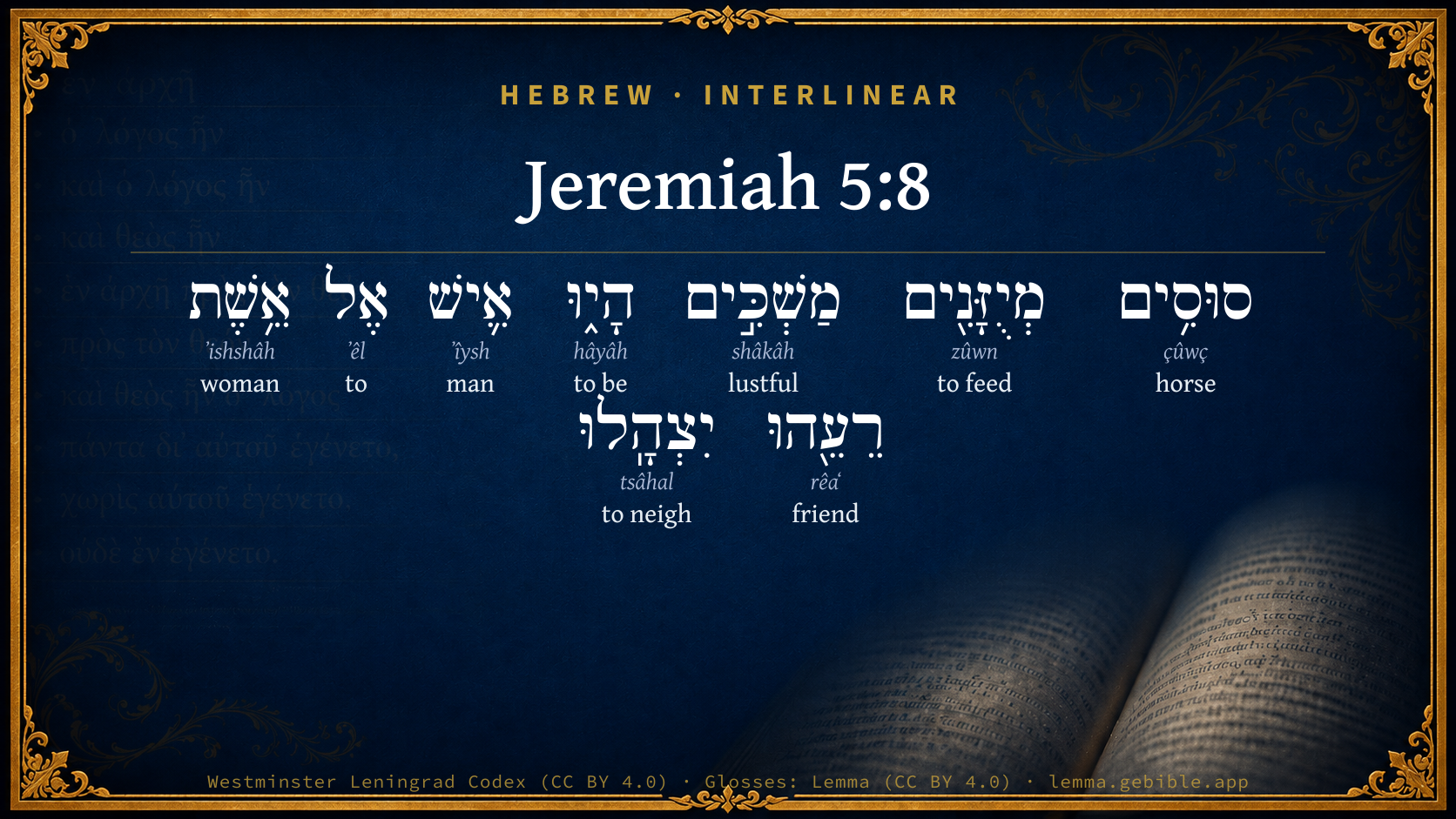
Jeremiah 5:8

Hebrew (Westminster Leningrad Codex) Jeremiah 5:8 appears in the Hebrew Old Testament. The text above is from the Westminster Leningrad Codex. Each word links to its Strong’s number, a concise gloss, and parsing drawn from the Open Scriptures Hebrew Bible morphology. Click any word for its full Brown-Driver-Briggs (BDB) entry.
Download image
Cite this verse

Jeremiah 5:8 (World English Bible). Public Domain. Lemma interlinear Bible study tool, https://lemma.gebible.app/v/jeremiah/5/8.

Show BibTeX & RIS
BibTeX
RIS
English Translation
They were as fed horses roaming at large; everyone neighed after his neighbor's wife.
World English Bible · Public Domain
Highlights
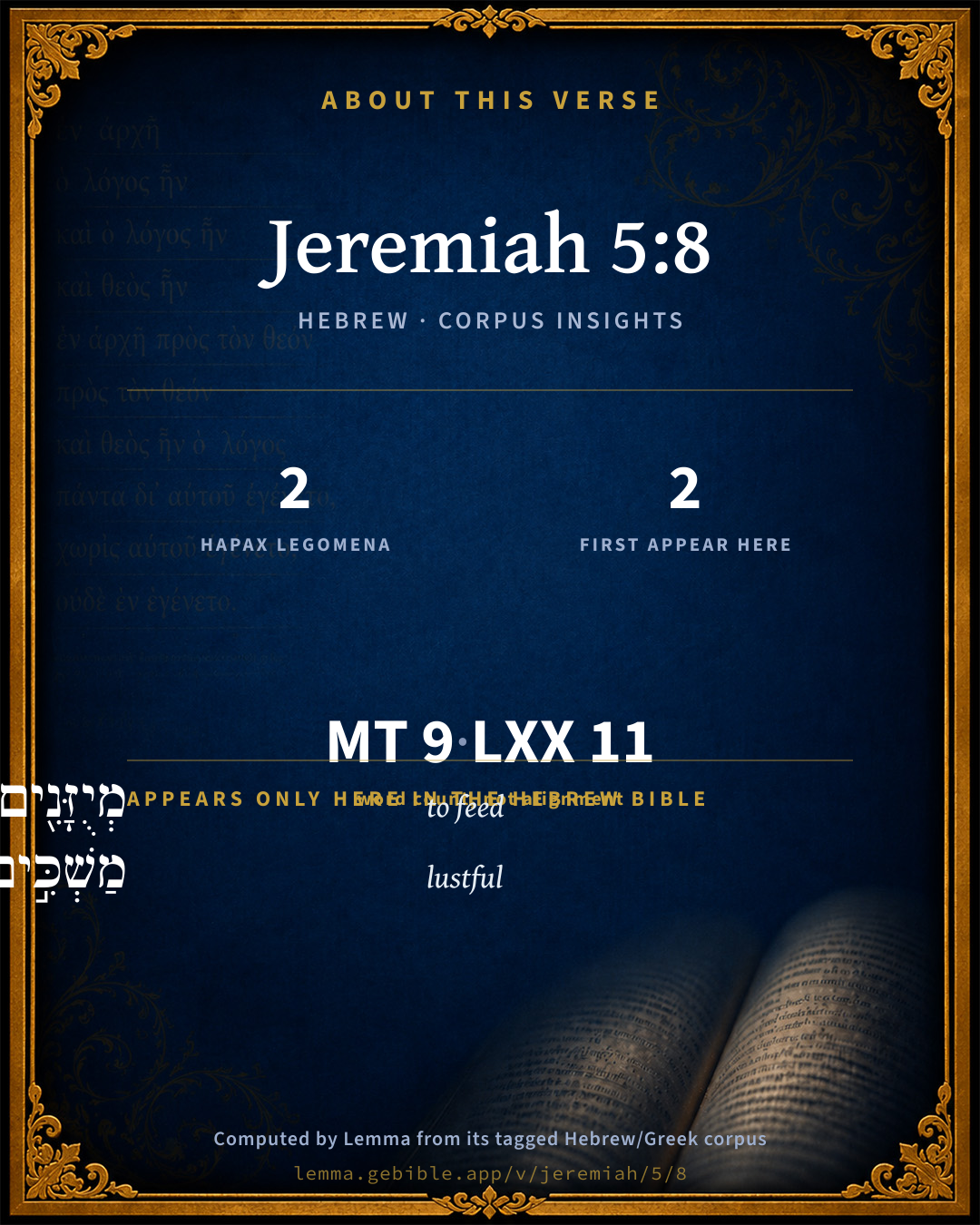
  • 2 hapax legomena — only here in the Hebrew Bible
  • 2 first appearances in the Hebrew Bible
Full analysis ↓
Download a study sheet

One document with this verse’s original text, its word-by-word gloss line, the meaning frame, cross-references with their text, attributed commentary, and full source and license credits — printable, and it pastes into notes with its structure intact.

This verse Autodidact and up

Study sheet (.html) Plain text (.txt)

A passage Seminary Student

Up to 50 verses in one chapter. A passage sheet keeps up to 6 commentary sources and 12 cross-references per verse, in the order this page ranks them, and says so on the sheet whenever that leaves anything out. Ask for a single verse and you get the Autodidact verse sheet above.

Everything on this page stays free to read, with no account — the sheet is a download of what is already on screen, not access to it.

Want to remove ads? Support Godless Engineer
Compare translations 3

The same verse in 3 English versions, stacked beneath the original-language interlinear above. Click any original word for its lexicon entry.

Each is an independent rendering of the whole verse — the interlinear is not word-aligned to these translations.

Highlighted words mark where these versions differ — a whole-verse word diff, not a word-by-word alignment.

  • World English Bible Public Domain
    They were as fed horses roaming at large; everyone neighed after his neighbor's wife.
  • King James Version Public Domain
    They were as fed horses in the morning: every one neighed after his neighbour's wife.
  • unfoldingWord Literal Text CC BY-SA 4.0
    They were well-fed, lusty stallions. man neighing to the wife of his neighbor.

unfoldingWord Literal Text — © unfoldingWord, licensed CC BY-SA 4.0. Word-aligned USFM3 via Door43 (git.door43.org/unfoldingWord/en_ult).

Versions to compare (up to 4)

3 of 4 selected

Show all 18 translations

Every available English version of this verse, each an independent rendering of the whole verse.

  • World English Bible Public Domain
    They were as fed horses roaming at large; everyone neighed after his neighbor's wife.
  • Berean Standard Bible Public Domain
    They are well-fed, lusty stallions, each neighing after his neighbor’s wife.
  • Majority Standard Bible Public Domain
    They are well-fed, lusty stallions, each neighing after his neighbor’s wife.
  • King James Version Public Domain
    They were as fed horses in the morning: every one neighed after his neighbour's wife.
  • American Standard Version (1901) Public Domain
    They were as fed horses roaming at large; every one neighed after his neighbor's wife.
  • Revised Version (1885) Public Domain
    They were as fed horses in the morning: every one neighed after his neighbour’s wife.
  • Geneva Bible (1599) Public Domain
    They rose vp in the morning like fed horses: for euery man neyed after his neighbours wife.
  • Douay-Rheims (1899) Public Domain
    They are become as amorous horses and stallions, every one neighed after his neighbor's wife.
  • Young's Literal Translation Public Domain
    Fed horses -- they have been early risers, Each to the wife of his neighbour they neigh.
  • Literal Standard Version CC BY-SA 4.0
    Fed horses—they have been early risers, || They each neigh to the wife of his neighbor.
  • Unlocked Literal Bible CC BY-SA 4.0
    They were horses in heat. They roamed about wanting to mate. Each man neighed to his neighbor's wife.
  • unfoldingWord Literal Text CC BY-SA 4.0
    They were well-fed, lusty stallions. man neighing to the wife of his neighbor.
  • Darby Bible Public Domain
    [As] well fed horses, they roam about, every one neigheth after his neighbour's wife.
  • World Messianic Bible Public Domain
    They were as fed horses roaming at large. Everyone neighed after his neighbor’s wife.
  • Webster's Bible Public Domain
    They were as fed horses in the morning: every one neighed after his neighbor's wife.
  • Free Bible Version CC BY-SA 4.0
    They're like virile stallions wanting sex, each of them neighing with lust after his neighbor's wife.
  • Bible in Basic English Public Domain
    They were full of desire, like horses after a meal of grain: everyone went after his neighbour's wife.
  • JPS Tanakh (1917) Public Domain
    They are become as well-fed horses, lusty stallions; every one neigheth after his neighbour's wife.

Literal Standard Version (2020), Covenant Press — licensed CC BY-SA 4.0. Text via the HelloAO Bible API (eBible.org). Unlocked Literal Bible (unfoldingWord) — licensed CC BY-SA 4.0. Text via the HelloAO Bible API (eBible.org). unfoldingWord Literal Text — © unfoldingWord, licensed CC BY-SA 4.0. Word-aligned USFM3 via Door43 (git.door43.org/unfoldingWord/en_ult). Free Bible Version, Dr. Jonathan Gallagher — licensed CC BY-SA 4.0. Text via the HelloAO Bible API (eBible.org).

Word by word

More ways to search: Search by grammar → Find every occurrence → Compare this word →

Practice this passage: Drill this verse → Learn its vocabulary →

About this verse

These counts appear in no published source. They are computed here, from the morphology-tagged text and Lemma’s own curated glosses. What Lemma adds →

9
words
9
distinct lemmas
Prophets
section

Notable vocabulary

2 hapax legomena — words that appear only here in the entire Hebrew Bible:

  • מְיֻזָּנִ֖ים to feed H2109
  • מַשְׁכִּ֣ים lustful H7904

First appearance in Scripture

These words make their first canonical appearance in the Hebrew Bible here:

  • מְיֻזָּנִ֖ים to feed H2109
  • מַשְׁכִּ֣ים lustful H7904

Shared distinctive vocabulary

יִצְהָֽלוּ to neigh H6670 occurs in 9 verses of the Hebrew Bible. Also found in:

Grammatical profile

  • 4 verbs
  • 4 nouns
  • 1 preposition

Verb forms

  • מְיֻזָּנִ֖ים Pual · Participle Passive
  • מַשְׁכִּ֣ים Hiphil · Participle Active
  • הָי֑וּ Qal · Perfect
  • יִצְהָֽלוּ Qal · Imperfect

Hebrew & Septuagint length

In the original languages it is 9 Hebrew tokens and 11 Greek tokens — but the two are counted differently (Hebrew bundles its prefixes and suffixes into one token; the Greek is in lemma form), so that isn’t a like-for-like length.

Cross-references

11

Topical passages linked to Jeremiah 5:8 in the Treasury of Scripture Knowledge — connected by theme and wording, ordered by reader-vote popularity; previews shown in the World English Bible.

  • Jeremiah 13:27 I have seen your abominations, even your adulteries, and your neighing, the lewdness of your prostitution, on the hills in the field. Woe to you, Jerusalem! you will not be made clean; how long shall it yet be?
  • Deuteronomy 5:18 "Neither shall you commit adultery.
  • 2 Samuel 11:2–4 It happened at evening, that David arose from off his bed, and walked on the roof of the king's house: and from the roof he saw a woman bathing; and the woman was very beautiful to look on.
  • Ezekiel 22:11 One has committed abomination with his neighbor's wife; and another has lewdly defiled his daughter-in-law; and another in you has humbled his sister, his father's daughter.
  • Genesis 39:9 He isn't greater in this house than I, neither has he kept back anything from me but you, because you are his wife. How then can I do this great wickedness, and sin against God?"
  • Exodus 20:14 "You shall not commit adultery.
  • Exodus 20:17 "You shall not covet your neighbor's house. You shall not covet your neighbor's wife, nor his man-servant, nor his maid-servant, nor his ox, nor his donkey, nor anything that is your neighbor's."
  • Deuteronomy 5:21 "Neither shall you covet your neighbor's wife; neither shall you desire your neighbor's house, his field, or his man-servant, or his maid-servant, his ox, or his donkey, or anything that is your neighbor's."
  • Job 31:9 "If my heart has been enticed to a woman, And I have laid wait at my neighbor's door;
  • Jeremiah 29:23 because they have worked folly in Israel, and have committed adultery with their neighbors' wives, and have spoken words in my name falsely, which I didn't command them; and I am he who knows, and am witness, says Yahweh.
  • Matthew 5:27–28 "You have heard that it was said, 'You shall not commit adultery;'

Cross-references courtesy of OpenBible.info (CC BY 4.0).

Hebrew and Greek witnesses Masoretic Hebrew ↔ Greek Septuagint

The same verse in the two great witnesses to the Old Testament, shown verse-for-verse.

These are two independent witnesses, not word-aligned to each other, and the Septuagint is shown in lemma (dictionary) form.

Hebrew Jeremiah 5:8 Masoretic · Westminster Leningrad Codex

סוּסִ֥ים מְיֻזָּנִ֖ים מַשְׁכִּ֣ים הָי֑וּ אִ֛ישׁ אֶל אֵ֥שֶׁת רֵעֵ֖הוּ יִצְהָֽלוּ

They were as fed horses roaming at large; everyone neighed after his neighbor's wife.

World English Bible · Public Domain

Greek LXX Structure differs

In the Septuagint, Jeremiah is about an eighth shorter than the Hebrew and arranges its material differently — the Oracles Against the Nations (Hebrew chapters 46–51) appear in the middle of the Greek book, after 25:13. Because the chapter and verse boundaries do not line up, a verse-for-verse comparison with the Hebrew is not shown.

A verse-for-verse comparison isn’t shown here because the chapters and verses don’t line up. Switch to the LXX edition with the MT / LXX toggle above to read the Greek directly.

On this verse, Trapp's Complete Commentary discusses the Septuagint’s reading. Read the note in Commentary ↓

Hebrew: Westminster Leningrad Codex (CC BY 4.0). Greek: Septuagint (public domain); English from a public-domain English Septuagint. How the Septuagint differs from the Hebrew →

Targum (Aramaic paraphrase)

1

The Targum is the ancient Jewish Aramaic paraphrase of the Hebrew Scriptures — an interpretive translation, not the Hebrew text itself. Onkelos (literal) and Pseudo-Jonathan (expansive) render the Torah, and Jonathan the Prophets. Coverage is partial: where no permissively-licensed English translation exists for a verse, only the Aramaic is shown. This is verse-level text, not a word-by-word alignment to the Hebrew.

  1. Targum Jonathan Prophets (Joshua–Malachi)
    סוּסְוָן אַגִירִיסִין אָחֲרִין הֲווֹ גְבַר עַל אִתַּת חַבְרֵיהּ מְצַוְחִין:

    (no public-domain English translation for this verse)

    Targum Jonathan — Aramaic: “Mikraot Gedolot” (public domain). English: “Sefaria Community Translation” (CC0 1.0 (public-domain dedication)); “London "Chaldee Paraphrase," 1871” (public domain). Text via Sefaria.

Commentary

Notes on Jeremiah 5:8 from classic Christian and Jewish commentators (each source and its license shown beneath its notes). The classic Christian expositions comment on the surrounding passage and are grouped to its opening verse, so a note may address several verses; the Jewish commentaries on the Tanakh (Rashi and others) are per-verse, so they appear only where the commentator wrote on this verse.

Lemma curates 59 commentaries, every one of them public domain or Creative Commons licensed, each selected and text-cleaned for this edition rather than reprinted as found. About our sources →

Trapp's Complete Commentary

John Trapp

Jer 5:8 They were [as] fed horses in the morning: every one neighed after his neighbour’s wife.

Ver. 8. They were as fed horses,] {a} As stallions and stone horses, that are ιππομανεις, mare mad, as the Septuagint have it.

{a} Libido effrons et plus quam pecuina.

John Trapp, A Commentary or Exposition upon All the Books of the Old and New Testament (1647–1656) — public domain. Text from a community e-Sword module.

Jamieson, Fausset & Brown

Robert Jamieson, A. R. Fausset & David Brown

in the morning-- (Isa 5:11). "Rising early in the morning" is a phrase for unceasing eagerness in any pursuit; such was the Jews' avidity after idol-worship. MAURER translates from a different Hebrew root, "continually wander to and fro," inflamed with lust (Jer 2:23). But English Version is simpler (compare Jer 13:27; Eze 22:11).

Jamieson, Fausset & Brown — Commentary Critical and Explanatory on the Whole Bible (1871) — public domain (CC PDM 1.0). Text via the HelloAO Bible API.

Adam Clarke's Commentary

Verse 8. After his neighbour's wife.] This may have been literally true, as the abominations of idolatry, in which they were so deeply practised, would necessarily produce such a state of things as that here mentioned.

Adam Clarke's Commentary on the Bible (1810–1826) — public domain. Text from a community e-Sword/MySword module.

John Calvin's Commentaries

Jeremiah comes now, I think, to the second table, and mentions one kind of evil; but his object was to shew that there was no chastity, no faithfulness, no honesty in that people. He therefore compares them to wanton and lustful horses, and thus exposes their infamous conduct. Had he said that every one did lie in wait for the bed of his neighbor, it would have been a heinous crime; but when he calls their lust neighing, and calls them horses, and those well fed, and who rise early after they are filled, he doubtless shews that such was their incontinence, that they were not only wanton and adulterous, but that they were worse and more base, for they differed nothing from lustful horses, and horses well fed. Some read the last word “armed, “deducing it from יוןizan, which means to be armed; and others derive it from זון, zun, which signifies to eat, and hence they take מוזן, muzan, for food. There is indeed no doubt but that it means here “fed, “or fat; for why should he call them armed horses? What some say, that they rose early after having committed adultery, in order to exhibit their disgrace, and to boast of their vices, is too far-fetched. What is meant is, that they were strong horses, and active, and that they rose up early after having been well fed.

We now then understand the Prophet’s object: the sum of the whole is, — that there was no chastity among the Jews, for they gave themselves up to wanton lusts, not only like adulterers and whoremongers, but like lascivious horses. Nevertheless, as we have said, he includes here, under incontinency, thefts, frauds, rapines, and all vices of this kind; for he no doubt charges the Jews as guilty of transgressing against the second table of the law. He afterwards adds —

John Calvin's Commentaries (1540-1563) — public domain. Text from the Calvin Translation Society English edition (1840s-50s) via the Christian Classics Ethereal Library (ccel.org). Calvin's coverage is partial (roughly two-thirds of the Bible); uncommented books and verses are honest gaps, never fabricated. The 19th-century editor's footnotes and remarks are omitted so the notes are faithfully Calvin's own voice.

Ellicott's Commentary for English Readers

(8) They were as fed horses in the morning.—Better, As fed stallion horses they rove about. The animal passion is taken, as in Eze_23:20, (1) as answering to the same passion in man; (2) as symbolical of the lust for idolatrous ritual. (Comp. Jer_2:24.)

A Bible Commentary for English Readers, edited by Charles John Ellicott (1878–1897) — public domain. Text from a community e-Sword module.

The Cambridge Bible for Schools and Colleges

gen. ed. J. J. S. Perowne

8. The Hebrew of the first clause is obscure. The reading “fed horses,” which is to be preferred, represents the consonants of MT. (K’thibh), though the verb which they form is found elsewhere only in cognate languages (meaning to feed). The mg. of MT. (Ḳ’ri) is of uncertain signification, but probably is from a root giving a sense equivalent to the word dealt with in the next note.

in the morning] Hebrew grammar forbids this rendering, while mg. roaming at large connects it with a root from which it cannot, strictly speaking, be drawn. It is best, with a slight change in MT., to take it as meaning stallions. See Dr. p. 345.

The Cambridge Bible for Schools and Colleges (gen. ed. J. J. S. Perowne; Cambridge University Press, 1878–1918) — public domain. Text from a community e-Sword module.

John Gill's Exposition

They were as fed horses in the morning,.... Adulterers are compared to horses, because they are very salacious and lustful creatures; wherefore the Septuagint renders the word: "horses are become mad after the females"; or, "as horses mad after the females are they become"; and especially to such as are well kept and are fat, and who, having much food given them in the night, and being full in the morning, go forth neighing, as Kimchi observes; and are the more salacious in the morning, by being so well fed all night, as those persons were, as is expressed in the preceding verse; though some render the word translated "in the morning", (for which sense of it see Hos 6:4) "drawing out" (u); that is, the genital member, as lascivious horses do. The word is difficult of interpretation. The Targum calls them field or wood horses; horses that run in fields and woods, and are very vicious and wanton:,

everyone neighed after his neighbour's wife; coveted and lusted after her, signified his lustful desires, and sought an opportunity to defile her. Neighing is a sign of lust, and keeps up the metaphor of the horse.

(u) "trahentes", Aquila, Symmachus & Theodotion in Bootius, l. 3. c. 5. sect. 3. Aben Ezra and Abendana interpret it of horses that come from Meshec; see Psal. cxx. 5. which were the strongest and most lascivious.

John Gill's Exposition of the Whole Bible (1746–1763) — public domain (CC PDM 1.0). Text via the HelloAO Bible API.

Albert Barnes' Notes on the Bible

In the morning - Render, they rove about. Some prefer, “(horses) from Mesech.”

Albert Barnes' Notes on the Bible (1834–1885) — public domain. Text from a community e-Sword/MySword module.

Haydock's Catholic Bible Commentary

Stallions. Hebrew mashcim, (Haydock) "stretching out," as others translate, Ezechiel xxiii. 20. (St. Jerome) --- The horse is the most intemperate of all animals but man. (Aristotle, Hist. vi. 22.)

George Leo Haydock (1774–1849), Haydock's Catholic Family Bible and Commentary, 1859 edition — public domain. Excludes Psalms (Douay-Rheims chapter numbering differs from Protestant) and Deuterocanonical books (Catholic canon only).

Matthew Poole's English Annotations

Fed horses, to note the greatness and unruliness of their lust, pampered horses being most wanton, like that Deu 32:15.

In the morning: it is questioned whether morning relates to horses or to men; if to horses, then they are compared to stallions, that having been fed to the full over-night, and lain at ease, in the morning they are most lusty; but rather it seems to relate to men, showing that they were very early in going about their filthinesses, Zep 3:7, following their uncleanness with as great eagerness as it is said that drunkards follow strong drink, Isa 5:11.

Every one neighed after his neighbour’s wife, i.e. with an impetuous earnestness and unwearied hunting, they sought after the adulteresses to satisfy their beastly lusts. It notes,

1. The strength of their lust, a thing in horses much taken notice of by authors.

2. The unbridledness and uncontrollableness of it, as is seen in the pampered horses hunting after the mare, of which neighing is a sign, thus expressed Jer 13:27. Thus the Grecians would express men extremely libidinous by the word ιπποβινοι, and ιπποπορνοι, and that they do ιππομανειν, so the LXX., and thus described Eze 22:11.

Matthew Poole's English Annotations on the Holy Bible (1683–1685) — public domain. Text from a community e-Sword/MySword module.

Whedon's Commentary on the Bible

Daniel D. Whedon

8. Fed horses — The lechery of horses is alluded to in many passages, for example, Eze_23:20. In Eze_22:11, the thing stated in this verse is brought out more plainly and fully.

In the morning — Many suggestions have been made as to the meaning of the original word thus translated, as “from meshech,” “stallions,” “draught horses,” “lustful,” etc. The least doubtful thing is, that the sense of the word is missed in the Authorized Version, though some are still disposed to defend it. The view which best commends itself is, that the word is a Hiphil participle, from the root which means to wander, and hence should be rendered, as in the Ethiopic, they roam about.

Daniel D. Whedon (gen. ed.), Commentary on the Old and New Testaments (1874–1909) — public domain. Text from a community e-Sword module.

The Pulpit Commentary

As fed horses in the morning. The rendering fed horses has considerable authority. "Lustful horses" is also possible; this represents the reading of the Hebrew margin. The following word in the Hebrew is extremely difficult. "In the morning" cannot be right, as it is against grammar; but it is not easy to furnish a substitute. Most modems render "roving about;" Furst prefers "stallions."

The Pulpit Commentary (1880–1919), ed. H.D.M. Spence-Jones & Joseph S. Exell — public domain. Text from a community e-Sword module.

Rashi

Rabbi Shlomo Yitzchaki (Rashi)

Like armed stallions they would arise early Like these stallions who are armed with erect membra, every morning they would arise at daybreak.

they would neigh Heb. יצהלו. This too is an expression appropriate for horses. Comp. (8:16) “From the sound of the neighing (מצהלות) of his steeds,” an expression of shouting (esjodement in O.F.).

Rashi on the Tanakh — English translations: “The Judaica Press complete Tanach with Rashi, translated by A. J. Rosenberg” (CC BY 4.0); “Pentateuch with Rashi's commentary by M. Rosenbaum and A.M. Silbermann, 1929-1934” (public domain); “The Metsudah Tanach series, Lakewood, N.J” (CC BY 4.0); and “The Book of Joshua, Metsudah Publications, 1997” (CC BY 4.0). Text via Sefaria.

Lesson kit

Teaching starters — assembled from the data on this page, not authored interpretation. Every prompt links to the verse data it draws on. Edit before teaching.

Jeremiah, in the Prophets, opens this verse with 9 words (9 distinct Hebrew lemmas). Its most distinctive word is zûwn (“to feed”). A historical commentator’s framing appears above. Read the whole chapter for the surrounding context.

Discussion questions

  1. The word zûwn carries the sense “to feed.” How does it shape the verse?
  2. This verse holds 2 words here found nowhere else in the Hebrew Bible. What might the rare words draw attention to?
  3. 2 words here appear for the first time in Scripture. What is being introduced at this debut?
  4. Esther 8:15 shares the word «to neigh» with this verse. How do the two illuminate each other?
  5. The translations on this page render this verse differently — a whole-verse word diff, not a word-by-word alignment. What might account for the different wordings?
  6. The verb «מְיֻזָּנִ֖ים» is Pual Participle Passive. How does its form color the action?
  7. Reading how Trapp's Complete Commentary and Jamieson, Fausset & Brown read this verse, where do the two commentators agree and where do they part?

Things to notice

Reading settings

Reading text

Shown beneath each verse's original-language words.

Old Testament
Old Testament edition

Read the OT as the Masoretic Hebrew (MT) or the Greek Septuagint (LXX).

English shown for the Greek Septuagint (in the Hebrew ↔ Greek comparison).

Comparing translations? Open the Compare panel on any verse page to stack up to four side by side.