
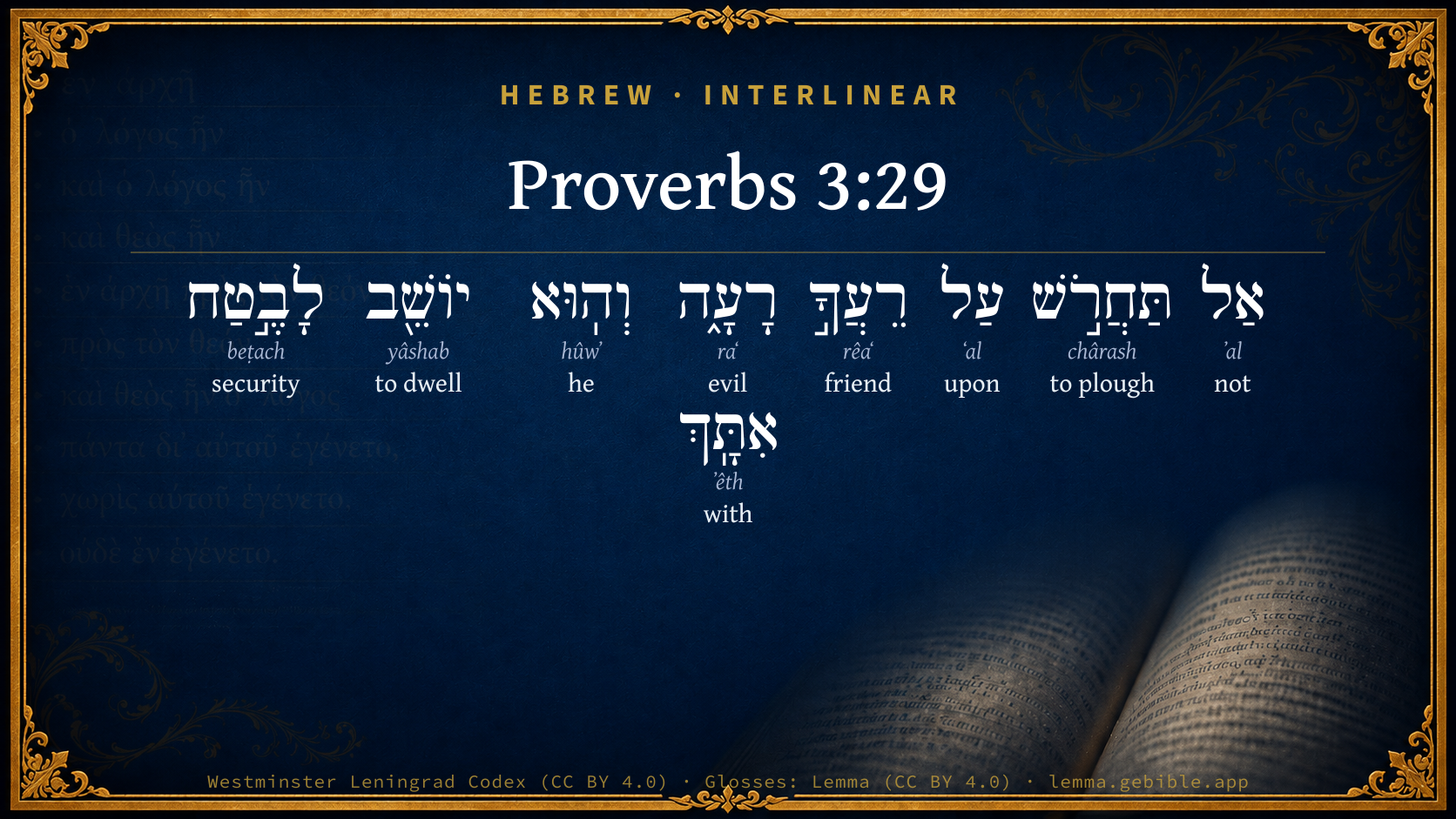
Proverbs 3:29

Hebrew (Westminster Leningrad Codex) Proverbs 3:29 appears in the Hebrew Old Testament. The text above is from the Westminster Leningrad Codex. Each word links to its Strong’s number, a concise gloss, and parsing drawn from the Open Scriptures Hebrew Bible morphology. Click any word for its full Brown-Driver-Briggs (BDB) entry.
Download image
Cite this verse

Proverbs 3:29 (World English Bible). Public Domain. Lemma interlinear Bible study tool, https://lemma.gebible.app/v/proverbs/3/29.

Show BibTeX & RIS
BibTeX
RIS
English Translation
Don't devise evil against your neighbor, Seeing he dwells securely by you.
World English Bible · Public Domain
Download a study sheet

One document with this verse’s original text, its word-by-word gloss line, the meaning frame, cross-references with their text, attributed commentary, and full source and license credits — printable, and it pastes into notes with its structure intact.

This verse Autodidact and up

Study sheet (.html) Plain text (.txt)

A passage Seminary Student

Up to 50 verses in one chapter. A passage sheet keeps up to 6 commentary sources and 12 cross-references per verse, in the order this page ranks them, and says so on the sheet whenever that leaves anything out. Ask for a single verse and you get the Autodidact verse sheet above.

Everything on this page stays free to read, with no account — the sheet is a download of what is already on screen, not access to it.

Want to remove ads? Support Godless Engineer
Compare translations 3

The same verse in 3 English versions, stacked beneath the original-language interlinear above. Click any original word for its lexicon entry.

Each is an independent rendering of the whole verse — the interlinear is not word-aligned to these translations.

Highlighted words mark where these versions differ — a whole-verse word diff, not a word-by-word alignment.

  • World English Bible Public Domain
    Don't devise evil against your neighbor, Seeing he dwells securely by you.
  • King James Version Public Domain
    Devise not evil against thy neighbour, seeing he dwelleth securely by thee.
  • unfoldingWord Literal Text CC BY-SA 4.0
    Do not plot evil against your neighbor, and he is dwelling securely with you.

unfoldingWord Literal Text — © unfoldingWord, licensed CC BY-SA 4.0. Word-aligned USFM3 via Door43 (git.door43.org/unfoldingWord/en_ult).

Versions to compare (up to 4)

3 of 4 selected

Show all 18 translations

Every available English version of this verse, each an independent rendering of the whole verse.

  • World English Bible Public Domain
    Don't devise evil against your neighbor, Seeing he dwells securely by you.
  • Berean Standard Bible Public Domain
    Do not devise evil against your neighbor, for he trustfully dwells beside you.
  • Majority Standard Bible Public Domain
    Do not devise evil against your neighbor, for he trustfully dwells beside you.
  • King James Version Public Domain
    Devise not evil against thy neighbour, seeing he dwelleth securely by thee.
  • American Standard Version (1901) Public Domain
    Devise not evil against thy neighbor, Seeing he dwelleth securely by thee.
  • Revised Version (1885) Public Domain
    Devise not evil against thy neighbour, seeing he dwelleth securely by thee.
  • Geneva Bible (1599) Public Domain
    Intend none hurt against thy neighbour, seeing he doeth dwell without feare by thee.
  • Douay-Rheims (1899) Public Domain
    Practise not evil against thy friend, when he hath confidence in thee.
  • Young's Literal Translation Public Domain
    Devise not against thy neighbour evil, And he sitting confidently with thee.
  • Literal Standard Version CC BY-SA 4.0
    Do not devise evil against your neighbor, || And he sitting confidently with you.
  • Unlocked Literal Bible CC BY-SA 4.0
    Do not make a plan to harm your neighbor— the one who lives close and trusts you.
  • unfoldingWord Literal Text CC BY-SA 4.0
    Do not plot evil against your neighbor, and he is dwelling securely with you.
  • Darby Bible Public Domain
    Devise not evil against thy neighbour, seeing he dwelleth securely by thee.
  • World Messianic Bible Public Domain
    Don’t devise evil against your neighbor, since he dwells securely by you.
  • Webster's Bible Public Domain
    Devise not evil against thy neighbor, seeing he dwelleth securely by thee.
  • Free Bible Version CC BY-SA 4.0
    Don't plan to harm your neighbor who lives nearby and trusts you.
  • Bible in Basic English Public Domain
    Do not make evil designs against your neighbour, when he is living with you without fear.
  • JPS Tanakh (1917) Public Domain
    Devise not evil against thy neighbour, seeing he dwelleth securely by thee.

Literal Standard Version (2020), Covenant Press — licensed CC BY-SA 4.0. Text via the HelloAO Bible API (eBible.org). Unlocked Literal Bible (unfoldingWord) — licensed CC BY-SA 4.0. Text via the HelloAO Bible API (eBible.org). unfoldingWord Literal Text — © unfoldingWord, licensed CC BY-SA 4.0. Word-aligned USFM3 via Door43 (git.door43.org/unfoldingWord/en_ult). Free Bible Version, Dr. Jonathan Gallagher — licensed CC BY-SA 4.0. Text via the HelloAO Bible API (eBible.org).

Word by word

More ways to search: Search by grammar → Find every occurrence → Compare this word →

Practice this passage: Drill this verse → Learn its vocabulary →

About this verse

These counts appear in no published source. They are computed here, from the morphology-tagged text and Lemma’s own curated glosses. What Lemma adds →

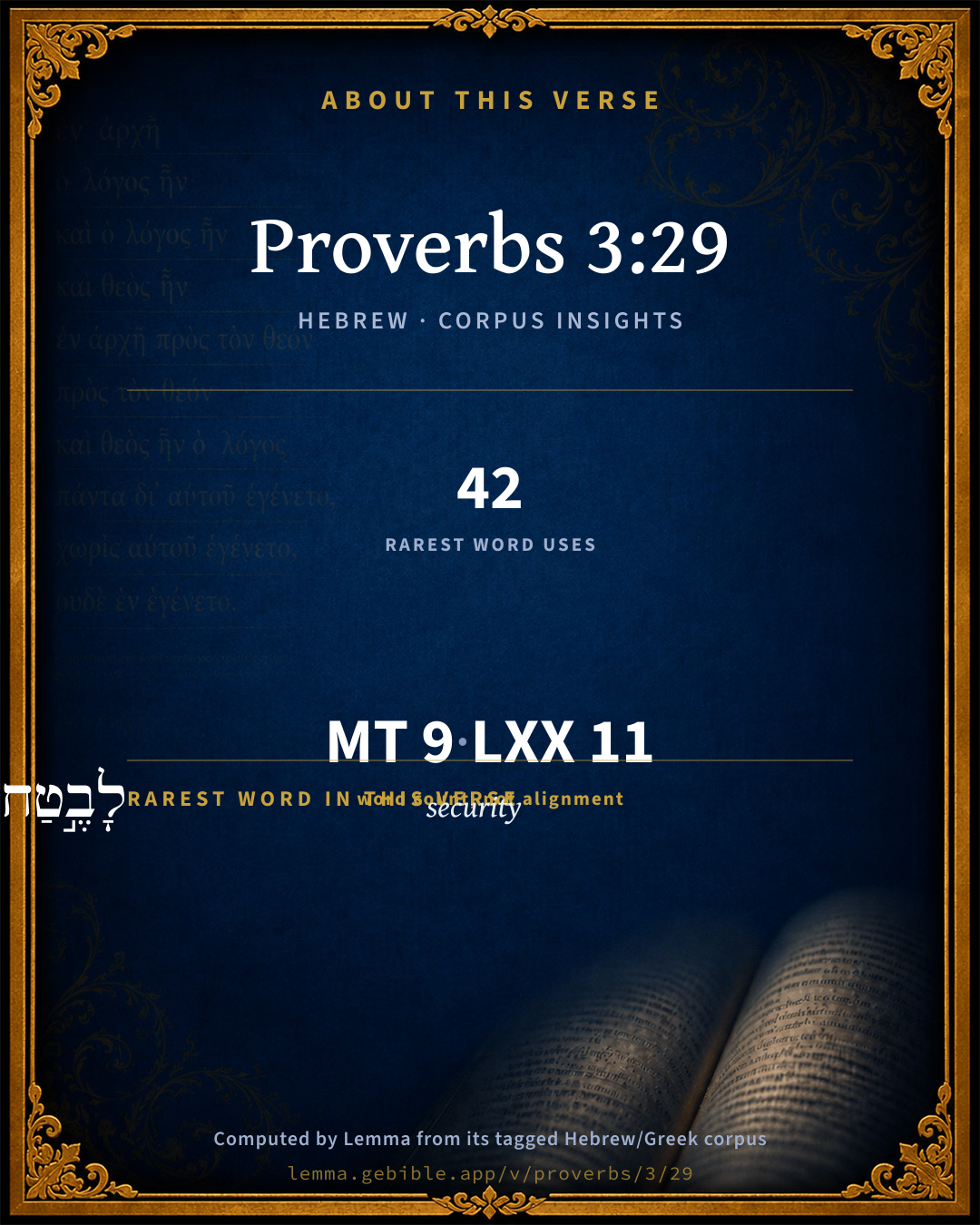
9
words
9
distinct lemmas
Wisdom
section

Shared distinctive vocabulary

לָבֶ֣טַח security H983 occurs in 41 verses of the Hebrew Bible. Also found in:

Grammatical profile

  • 2 verbs
  • 3 nouns
  • 1 pronoun
  • 2 prepositions
  • 1 particle

Verb forms

  • תַּחֲרֹ֣שׁ Qal · Jussive
  • יוֹשֵׁ֖ב Qal · Participle Active

Hebrew & Septuagint length

In English translation the verse runs 12 words from the Hebrew and 13 from the Septuagint (LXX English) — closely comparable.

A rough comparison of the two English renderings, which tokenize alike — not a word-level alignment.

Word counts can differ between the Hebrew and the Greek without any difference in meaning — e.g. the Hebrew direct-object marker אֵת has no separate Greek word, and Greek often adds the article ὁ.

In the original languages it is 9 Hebrew tokens and 11 Greek tokens — but the two are counted differently (Hebrew bundles its prefixes and suffixes into one token; the Greek is in lemma form), so that isn’t a like-for-like length.

Cross-references

9

Topical passages linked to Proverbs 3:29 in the Treasury of Scripture Knowledge — connected by theme and wording, ordered by reader-vote popularity; previews shown in the World English Bible.

  • Proverbs 6:14 In whose heart is perverseness, Who devises evil continually, Who always sows discord.
  • Psalms 35:20 For they don't speak peace, But they devise deceitful words against those who are quiet in the land.
  • Psalms 55:20 He raises his hands against his friends. He has violated his covenant.
  • Psalms 59:3 For, behold, they lie in wait for my soul. The mighty gather themselves together against me, Not for my disobedience, nor for my sin, Yahweh.
  • Proverbs 16:29–30 A man of violence entices his neighbor, And leads him in a way that is not good.
  • Micah 2:1–2 Woe to those who devise iniquity And work evil on their beds! When the morning is light, they practice it, Because it is in the power of their hand.
  • Proverbs 6:18 A heart that devises wicked schemes, Feet that are swift in running to mischief,
  • Jeremiah 18:18–20 Then said they, Come, and let us devise devices against Jeremiah; for the law shall not perish from the priest, nor counsel from the wise, nor the word from the prophet. Come, and let us strike him with the tongue, and let us not give heed to any of his words.
  • Proverbs 14:22 Don't they go astray who plot evil? But love and faithfulness belong to those who plan good.

Cross-references courtesy of OpenBible.info (CC BY 4.0).

Hebrew and Greek witnesses Masoretic Hebrew ↔ Greek Septuagint

The same verse in the two great witnesses to the Old Testament, shown verse-for-verse.

These are two independent witnesses, not word-aligned to each other, and the Septuagint is shown in lemma (dictionary) form.

Hebrew Proverbs 3:29 Masoretic · Westminster Leningrad Codex

אַל תַּחֲרֹ֣שׁ עַל רֵעֲךָ֣ רָעָ֑ה וְהֽוּא יוֹשֵׁ֖ב לָבֶ֣טַח אִתָּֽךְ

Don't devise evil against your neighbor, Seeing he dwells securely by you.

World English Bible · Public Domain

Greek LXX Proverbs 3:29 Septuagint · lemma form

μή τεκταίνω ἐπί σός φίλος κακός παραοἰκέω καί πείθω ἐπί σύ

Devise not evil against your friend, living near you and trusting in you.

LXX2012 (modern English Septuagint) · Public Domain

On this verse, The Pulpit Commentary discusses the Septuagint’s reading. Read the note in Commentary ↓

Hebrew: Westminster Leningrad Codex (CC BY 4.0). Greek: Septuagint (public domain); English from LXX2012 (modern English Septuagint) (Public Domain). How the Septuagint differs from the Hebrew →

Commentary

Notes on Proverbs 3:29 from classic Christian and Jewish commentators (each source and its license shown beneath its notes). The classic Christian expositions comment on the surrounding passage and are grouped to its opening verse, so a note may address several verses; the Jewish commentaries on the Tanakh (Rashi and others) are per-verse, so they appear only where the commentator wrote on this verse.

Lemma curates 59 commentaries, every one of them public domain or Creative Commons licensed, each selected and text-cleaned for this edition rather than reprinted as found. About our sources →

Trapp's Complete Commentary

John Trapp

Pro 3:29 Devise not evil against thy neighbour, seeing he dwelleth securely by thee.

Ver. 29. Devise not evil against thy neighbour.] Heb. Plow not evil - i.e., plot not. One of the Rabbis renders it, suspect not; shun "evil surmises." {1Ti 6:4} Most unkindnesses among friends grow upon mistakes, misprisions; charity is candid, and takes everything in the best sense, and by the right handle. {1Co 13:1-13}

John Trapp, A Commentary or Exposition upon All the Books of the Old and New Testament (1647–1656) — public domain. Text from a community e-Sword module.

Joseph Benson's Commentary

Pro 3:29. Devise not evil, &c. — Any thing injurious or hurtful; against thy neighbour — Against any child of man. Having commanded the doing of good, (Pro 3:27-28,) he here forbids the doing or designing any evil. Seeing he dwelleth securely by thee — Relying upon thy integrity: do not, therefore, deceive his trust, and cause him to repent of the confidence which he places in thee, which would be an iniquity hateful even to heathen.

Joseph Benson's Commentary on the Old and New Testaments (1811–1818) — public domain. Text from a community e-Sword module.

Tyndale Open Study Notes

Tyndale Open Resources

3:29 Because we have frequent contact with those who live nearby, we must not take advantage of them.

Tyndale Open Study Notes — © Tyndale Open Resources, licensed CC BY-SA 4.0. Text via the HelloAO Bible API.

Geneva Bible (1599)

Geneva Bible translators

That is, putteth his trust in thee.

Geneva Bible (1599) marginal notes — public domain. Text via Bolls.life.

Jamieson, Fausset & Brown

Robert Jamieson, A. R. Fausset & David Brown

Do not abuse confidence and avoid litigation.

Jamieson, Fausset & Brown — Commentary Critical and Explanatory on the Whole Bible (1871) — public domain (CC PDM 1.0). Text via the HelloAO Bible API.

John Gill's Exposition

Devise not evil against thy neighbour,.... Or, "plough not evil" (i); turn not up thy heart to find evil against thy neighbour, as the earth is turned up by the plough; see Hos 10:13. Do not contrive and form schemes in thy mind and thoughts to do him any injury, in his name and character, in his person, property, or family: a good man should devise all the good he can to his fellow creatures, but not evil to any; especially to his neighbour, and as described in the next clause;

seeing he dwelleth securely by thee; having a good opinion of thee, and not suspecting any ill design against him, thinks himself, goods, and family, in safety; and is under no concern to provide for his security, placing his confidence in thee, and perhaps to such a degree as to entrust with his secrets. Now to project evil against such a man is exceeding base; it is doubly sinful; this is an aggravation of the iniquity.

(i) "ne ares", Amama.

John Gill's Exposition of the Whole Bible (1746–1763) — public domain (CC PDM 1.0). Text via the HelloAO Bible API.

Matthew Poole's English Annotations

Devise not evil; any thing injurious or hurtful. Having commanded doing of good, Pro 3:27,28, he here forbids doing or designing any evil.

Dwelleth securely by thee; relying upon thine integrity: do not therefore betray thy trust, which is hateful even to heathens.

Matthew Poole's English Annotations on the Holy Bible (1683–1685) — public domain. Text from a community e-Sword/MySword module.

Whedon's Commentary on the Bible

Daniel D. Whedon

29. Devise not evil — Design no violation of good faith or of kindness towards thy friend or neighbour who dwells unsuspectingly beside thee. The word also means, Be not silent. It may signify that we are to give our neighbour the advantage of our knowledge; not to keep silent to his injury when we know of evil threatening him, or of some good he might enjoy by the help of our intelligence. Comp. Php_2:4. Securely — With full trust. Compare Jdg_18:7; Jdg_18:27.

Daniel D. Whedon (gen. ed.), Commentary on the Old and New Testaments (1874–1909) — public domain. Text from a community e-Sword module.

The Pulpit Commentary

Devise not evil against thy neighbour. This precept is directed against abuse of confidence. Devise not evil (al takharosh raah). The meaning of this expression lies between "fabricating evil" and "ploughing evil." The radical meaning of kharash, from which takharosh, is "to cut into," "to inscribe" letters on a tablet, cognate with the Greek carassein , "to cut into." But it is used in the sense of "to plough" in Job_4:18, "They that plough iniquity (khar"shey aven)," and Psa_129:3, "The ploughers ploughed (khar"shim khar"shim) upon my back". (Hos_10:13) This also appears from the context to be the meaning in Pro_6:14. With these we may compare such expressions as "to plough a lie" (mh arotria qeudov , rendered in the Authorized Version, "Devise not a lie"); see Pro_7:12, and "to sow iniquity," cf. Pro_22:8 a cognate figure. "To plough evil" is to devise evil, to prepare for it, just in the same way as a ploughman prepares the land for sowing. In this sense the verb is understood by the older commentators and by Ewald and Delitzsch. On the other hand, the verb may be used in its other signification, "to fabricate," and hence "to contrive." The noun kharash is an artificer of iron, etc. (Exo_35:35 Deu_27:15) "To fabricate evil" is, of course, as the Authorized Version "to devise evil." The LXX, mh tekthnh , from tekteinomai , "to build," inclines to this sense. The Vulgate, ne moliaris, does not clear up the point, though moliri, usually "to contrive," is used by Virgil, "Georg.," 1:494, "moliri terrain," of working or tilling the ground. The verb also occurs in Pro_6:19 Pro_12:20 Pro_14:22. Seeing he dwelleth securely by thee; i.e. as the Vulgate, cure ille in te habet fiduciam, "when he has confidence in thee;" so the LXX; or, as the Targum and Syriac, "when he dwells with thee in peace." To dwell (yashar) is in Psa_1:1 "to sit with any one," i.e. to associate familiarly with him; (cf. Psa_26:4, Psa_26:5) but it also has the meaning, "to dwell," and the participle yoshev, here used; in Gen_19:23 Jud_1:6:21, means "an inhabitant, a dweller." Securely (lavetah); i.e. with full trust (see on ver. 23). Devising evil against a friend is at any time reprehensible, but to do so when he confides in and is altogether unsuspicious of you, is an act of the greatest treachery, and an outrage on all law. human and Divine. It implies dissimulation. It is the very sin by which "the devil beguiled Eve through his subtlety" (Wardlaw).

Vers. 29-31. Odious passions.

Let them he held up in the clear exposure of Wisdom, that their very mention may suggest their hideousness.

I MALICE AND ITS DEVICES. (Ver. 29) Literally, "Forge not ill against thy neighbour.

1. Malice, like love, is all-inventive. But as the devices of the latter are the very instruments of progress and good, so those of the former are pernicious burglar"s tools, cunning instruments of torture.

2. Directed against unsuspecting objects, malice is truly Satanic, an inspiration from hell. We have to beware of indulgence in curiosity about our neighbours; it is seldom free from some taint of malice in thought, which may pass over at any moment into action. Something in our neighbour"s life may rebuke us and rouse the latent passion. How near are the angel and the devil to one another in the heart!

II UNPROVOKED CONTENTIOUSNESS. (Ver. 30) In other words, quarrelsomeness. The vicious habit and disposition to "pick quarrels," to invent occasions for faultfinding, for the exercise of pugnacity, and so on. The man of whom it is said that if left alone in the world he would fight with his own shadow. Let him contend with his own vices, of which this temper is a symptom, and expend his pugnacity upon the evils of society. There are men before whose presence all the sleeping germs of wrath start up into chaotic life. Could they but see themselves as others see them!

III ENVY OF THE WICKED GREAT. (Ver. 31) As emulation of the virtuous great is a noble passion, this, the reverse side of it, is correspondingly base. Imitation, again, is a powerful passion, the source of "fashion." The pure spirit knows nothing of fashion as such; and immoral fashion, born of mere imitation, it must avoid and. denounce.

1. Every passion has its obverse and its reverse, its good and its evil side; malice may be turned to benevolence; idle quarrelsomeness to noble pugnacity; immoral envy to pure emulation.

2. Religion intensifies, purifies, directs, the passions to noble ends. J.

The Pulpit Commentary (1880–1919), ed. H.D.M. Spence-Jones & Joseph S. Exell — public domain. Text from a community e-Sword module.

John Wesley's Explanatory Notes

Securely - Relying upon thine integrity.

John Wesley, Explanatory Notes Upon the Whole Bible (1754–1765) — public domain. Text via the GEBible commentary corpus.

Keil & Delitzsch

C. F. Keil & F. Delitzsch

A second illustration of neighbourly love is harmlessness:

Devise not evil against thy neighbour,

While he dwelleth securely by thee.

The verb חרשׁ, χαράσσειν, signifies to cut into, and is used of the faber ferrarius as well as of the τιγναριυς (Isaiah, p. 463), who with a cutting instrument (חרשׁ, Gen 4:22) works with metal or wood, and from his profession is called חרשׁ. But the word means as commonly to plough, i.e., to cut with the plough, and חרשׁ is used also of a ploughman, and, without any addition to it, it always has this meaning. It is then a question whether the metaphorical phrase רעה חרשׁ signifies to fabricate evil, cf. dolorum faber, mendacia procudere, ψευδῶν καὶ ἀπατῶν τέκτων, and the Homeric κακὰ φρεὶ βυσσοδομεύειν (Fleischer and most others), or to plough evil (Rashi, Ewald, etc.). The Targ., Syriac, and Jerome translate חשׁב, without deciding the point, by moliri; but the lxx and Graecus Venet. by τεκταίνειν. The correctness of these renderings is not supported by Ezek. 21:36, where חרשׁי משׁחית are not such as fabricate destruction, but smiths who cause destruction; also מחרישׁ, Sa1 23:9, proves nothing, and probably does not at all appertain to חרשׁ incidere (Keil), but to חרשׁ silere, in the sense of dolose moliri. On the one hand, it is to be observed from Job 4:8; Hos 10:13, cf. Psa 129:3, that the meaning arare malum might connect itself with חרשׁ רעה; and the proverb of Sirach 7:12, μὴ ἀροτρία ψεῦδος ἐπ ̓ ἀδελφῷ σου, places this beyond a doubt. Therefore in this phrase, if one keeps before him a clear perception of the figure, at one time the idea of fabricating, at another that of ploughing, is presented before us. The usage of the language in the case before us is more in favour of the latter than of the former. Whether ישׁב את means to dwell together with, or as Bttcher, to sit together with, after Psa 1:1; Psa 26:4., need not be a matter of dispute. It means in general a continued being together, whether as sitting, Job 2:13, or as dwelling, Jdg 17:11.

(Note: Accentuate והוא־יושׁב לבטח. It is thus in correct texts. The Rebia Mugrash is transformed, according to the Accentuationssystem, xviii. 2.)

To take advantage of the regardlessness of him who imparts to us his confidence is unamiable. Love is doubly owing to him who resigns himself to it because he believes in it.

Keil & Delitzsch — Biblical Commentary on the Old Testament (1861–1891) — public domain (CC PDM 1.0). Text via the HelloAO Bible API. (Old Testament only.)

Bridges on Proverbs

Charles Bridges

The command — withhold not good — is naturally followed by the forbidding to do evil. The treachery here rebuked was a scandal even to a heathen.†1 It is generally abhorred by the world, and should be doubly hated by a godly man. With him all should be clear and open as the day. An evil device against a neighbour, from whatever cause, is a cursed sin. (Pro 6:14-18 . Deu 27:24 . Psa 35:20 ; Psa 55:20 . Jer 18:18-20 .) But to take occasion from confidence reposed, betrays "the wisdom that descendeth not from above — devilish." (Jas 3:15 .) Such was the craft of Jacob’s sons against the unsuspecting Shechemites (Gen 34:13-29 ; Gen 49:5-7 ); Saul’s malice against David, when under his protection (1Sa 18:22-26 ); Joab’s murder of Abner and Amasa (2Sa 3:27 ; 2Sa 20:9-10 ); Ishmael’s of Gedaliah. (Jer 41:1-2 .) No trial cuts so keenly. (Psa 55:12-14 .) This was one of the bitters in the Savior’s cup of suffering. (Joh 13:21, with Psa 41:9 ; Mat 26:46-50 ). And many a wounded spirit has been cheered by his sympathy with this poignant sorrow. (Heb 4:15 .)

Yet we must guard not only against secret malice, but against causeless strivings. A propensity to embroil ourselves in quarrels (Pro 17:14 ; Pro 18:6 ; Pro 25:8-9 ) kindles strife, instead of following the rule of peace. (Rom 12:18 .) This spirit is a great hindrance to holiness (Heb 12:14 . Col 3:12-15 ), and inconsistent with a true servant of God. (2Ti 2:24 .) Irritable persons strongly insist upon their rights, or what they conceive to be due to them from others. "Is there not" — say they — "a cause?" But impartial observers frequently judge it to be striving without cause; that no harm has been done; none at least to justify the breach of love; that more love on one hand, and more forbearance on the other, would have prevented the breach; that "there is utterly a fault — Why do ye not rather take wrong?" (1Co 6:1-7 .) How valuable is a close application of the self-denying law of Christ! (Such as Mat 5:39-41 .) How earnestly should we seek from himself his own meek and loving spirit! (1Pe 2:21-23 .) ’O Lord, pour into our hearts that most excellent gift of charity, the very bond of peace, and of all virtues; without which, whosoever liveth is counted dead before thee.’†2

Footnotes

†1 ’Fallere eum, qui læsus non esset, nisi credidisset.’ — Cicero pro Roscio.

†2 Collect for Quinquagesima Sunday. 1Co 13:4-7 .

Charles Bridges, An Exposition of the Book of Proverbs (1846) — public domain. Text from a community e-Sword module.

unfoldingWord translationNotes

Door43 World Missions Community

translationWords

neighbor

trust

unfoldingWord translationNotes — © Distant Shores Media and the Door43 World Missions Community, licensed CC BY-SA 4.0. Source: git.door43.org/Door43/en_tn.

Rashi

Rabbi Shlomo Yitzchaki (Rashi)

Devise no harm against your fellow Heb. אל תחרש, do not think—but it does not deviate from the meaning of plowing (חרישה); just as it is customary for the plower to prepare a place for the time of sowing, so does one who devises harm prepare a place for devices in his heart, how he will get up and execute it.

Rashi on the Tanakh — English translations: “The Judaica Press complete Tanach with Rashi, translated by A. J. Rosenberg” (CC BY 4.0); “Pentateuch with Rashi's commentary by M. Rosenbaum and A.M. Silbermann, 1929-1934” (public domain); “The Metsudah Tanach series, Lakewood, N.J” (CC BY 4.0); and “The Book of Joshua, Metsudah Publications, 1997” (CC BY 4.0). Text via Sefaria.

Lesson kit

Teaching starters — assembled from the data on this page, not authored interpretation. Every prompt links to the verse data it draws on. Edit before teaching.

Proverbs, in the Wisdom, opens this verse with 9 words (9 distinct Hebrew lemmas). Its most distinctive word is beṭach (“security”). A historical commentator’s framing appears above. Read the whole chapter for the surrounding context.

Discussion questions

  1. What does “security” (beṭach) contribute to the verse as a whole?
  2. How does Genesis 34:25, which shares the word «security», read alongside this verse?
  3. These translations render this verse differently. What is at stake in choosing one wording over another?
  4. «תַּחֲרֹ֣שׁ» is a Qal Jussive verb. How does that grammatical form shape the action described?
  5. Compare how Trapp's Complete Commentary and Joseph Benson's Commentary read this verse. Where do they agree or differ?

Things to notice

Reading settings

Reading text

Shown beneath each verse's original-language words.

Old Testament
Old Testament edition

Read the OT as the Masoretic Hebrew (MT) or the Greek Septuagint (LXX).

English shown for the Greek Septuagint (in the Hebrew ↔ Greek comparison).

Comparing translations? Open the Compare panel on any verse page to stack up to four side by side.