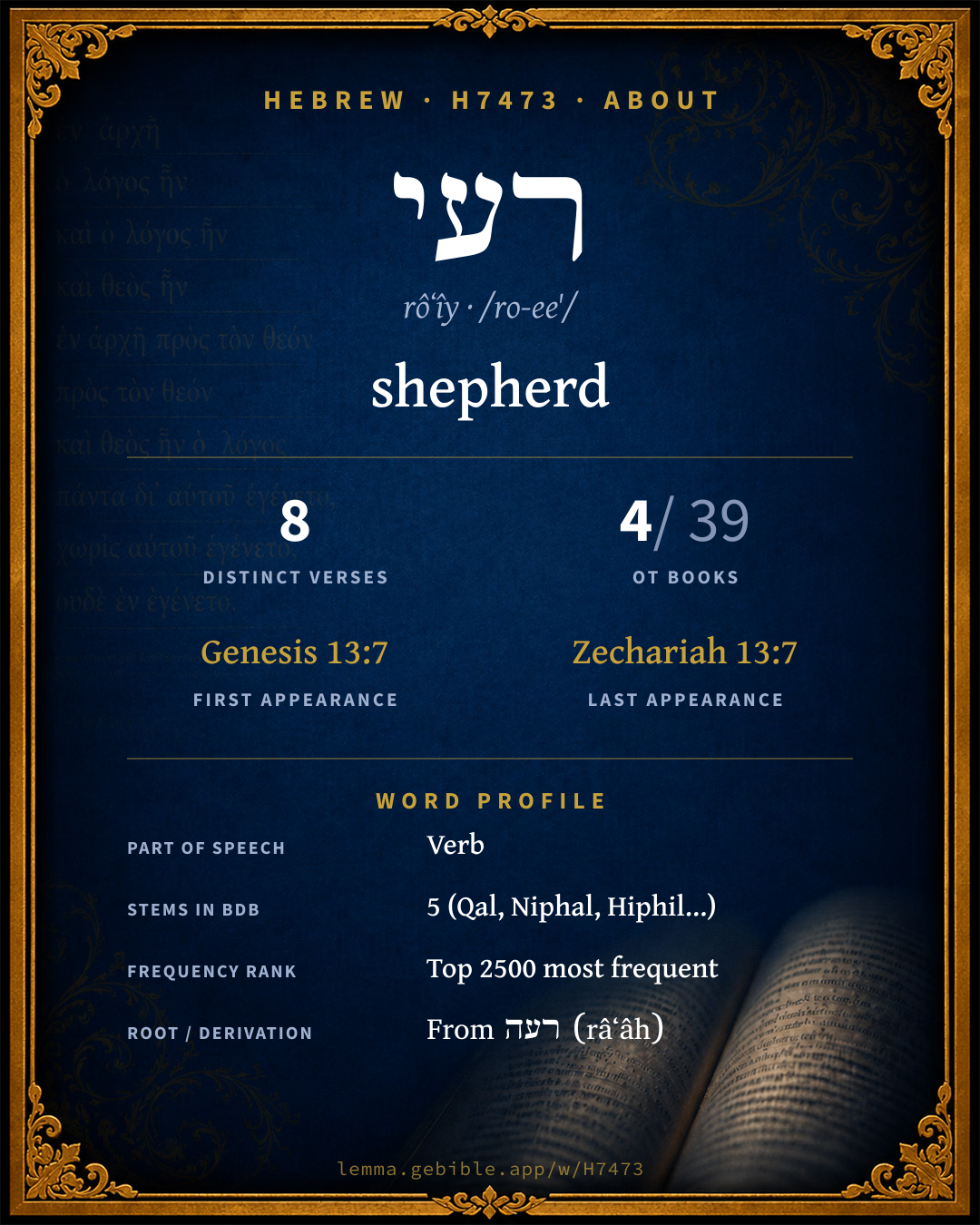
רֹעִי
shepherd
Full lexicon entry — Brown-Driver-Briggs (BDB)
From Brown-Driver-Briggs (BDB)
Where this word appears
Grammar key — what these labels mean
Part of speech
- Verb
- An action or state-of-being word.
Stem
- Qal
- The basic, simple active stem — the plain form of the verb (“he wrote”). Here: ‘trans.’
Form
- Participle Active
- A verbal adjective expressing ongoing or characteristic action (“writing / one who writes”).
State
- Construct
- A noun bound to a following noun in a possessive / “of” relationship (the construct chain).
- Absolute
- The independent form of a noun, not bound to a following word.
Gender
- Masculine
- Grammatically masculine.
Number
- Plural
- More than one (in Hebrew, generally three or more).
- Singular
- One.
Grammatical forms
- Verb, Qal, Participle Active, Masculine, Plural, Construct 6 times (55%)
- Verb, Qal, Participle Active, Masculine, Singular, Construct 4 times (36%)
- Verb, Qal, Participle Active, Masculine, Plural, Absolute 1 time (9%)
Parsed forms decoded from the imported morphology (morphhb / Westminster Leningrad Codex — WLC text public domain, morphhb tagging CC BY 4.0), counted across 11 parsed occurrences — not distinct verses.
Every verse where H7473 appears — 8 distinct verses across 4 books. Click any verse to open its interlinear word-by-word view. Verse text shown in the World English Bible for context — . Each verse’s Hebrew form is shown with its reference; the English is not keyword-highlighted, since the data carries no word-level English alignment. Use “Compare translations” on any verse to read it across multiple English versions. This concordance covers the Hebrew Bible; Septuagint (Greek Old Testament) occurrences are not indexed here.
Genesis 3 verses
- Genesis 13:7 רֹעֵ֣י רֹעֵ֣י Qal ptcp.act mp cs Qal ptcp.act mp cs There was a strife between the herdsmen of Abram's cattle and the herdsmen of Lot's cattle: and the Canaanite and the Perizzite lived then in the land.
- Genesis 13:8 רֹעַ֖/י רֹעֶ֑י/ךָ Qal ptcp.act mp cs + sfx pers 1cs Qal ptcp.act mp cs + sfx pers 2ms Abram said to Lot, "Please, let there be no strife between me and you, and between my herdsmen and your herdsmen; for we are relatives.
- Genesis 26:20 רֹעֵ֣י רֹעֵ֥י Qal ptcp.act mp cs Qal ptcp.act mp cs The herdsmen of Gerar argued with Isaac's herdsmen, saying, "The water is ours." He called the name of the well Esek, because they contended with him.
1 Samuel 1 verse
Isaiah 2 verses
- Isaiah 38:12 רֹעִ֑/י Qal ptcp.act ms cs + sfx pers 1cs My dwelling is removed, and is carried away from me as a shepherd's tent: I have rolled up, like a weaver, my life; he will cut me off from the loom: From day even to night will you make an end of me.
- Isaiah 44:28 רֹעִ֔/י Qal ptcp.act ms cs + sfx pers 1cs Who says of Cyrus, [He is] my shepherd, and shall perform all my pleasure, even saying of Jerusalem, She shall be built; and of the temple, Your foundation shall be laid.
Zechariah 2 verses
- Zechariah 11:17 רֹעִ֤י Qal ptcp.act ms cs Woe to the worthless shepherd who leaves the flock! The sword will be on his arm, and on his right eye. His arm will be completely withered, and his right eye will be totally blinded!"
- Zechariah 13:7 רֹעִ/י֙ Qal ptcp.act ms cs + sfx pers 1cs "Awake, sword, against my shepherd, And against the man who is close to me," says Yahweh of Hosts. Strike the shepherd, and the sheep will be scattered; And I will turn my hand against the little ones.
About this entry
At a glance — auto-summarized from this page’s data, not written by a person. Every figure links to its source below. This summary describes the numbers; it doesn’t interpret them.
“shepherd” is the headline sense of the Hebrew verb רעי (rôʻîy). Different stems carry different senses — BDB groups them under 5 stems, among them Qal and Niphal. It turns up in 8 verses across 4 books, an uncommon footprint. It concentrates in Genesis, which alone accounts for 38% of its uses. First canonically at Genesis 13:7, it enters the text early. See the sense tree, 8-verse concordance, and the renderings breakdown below.
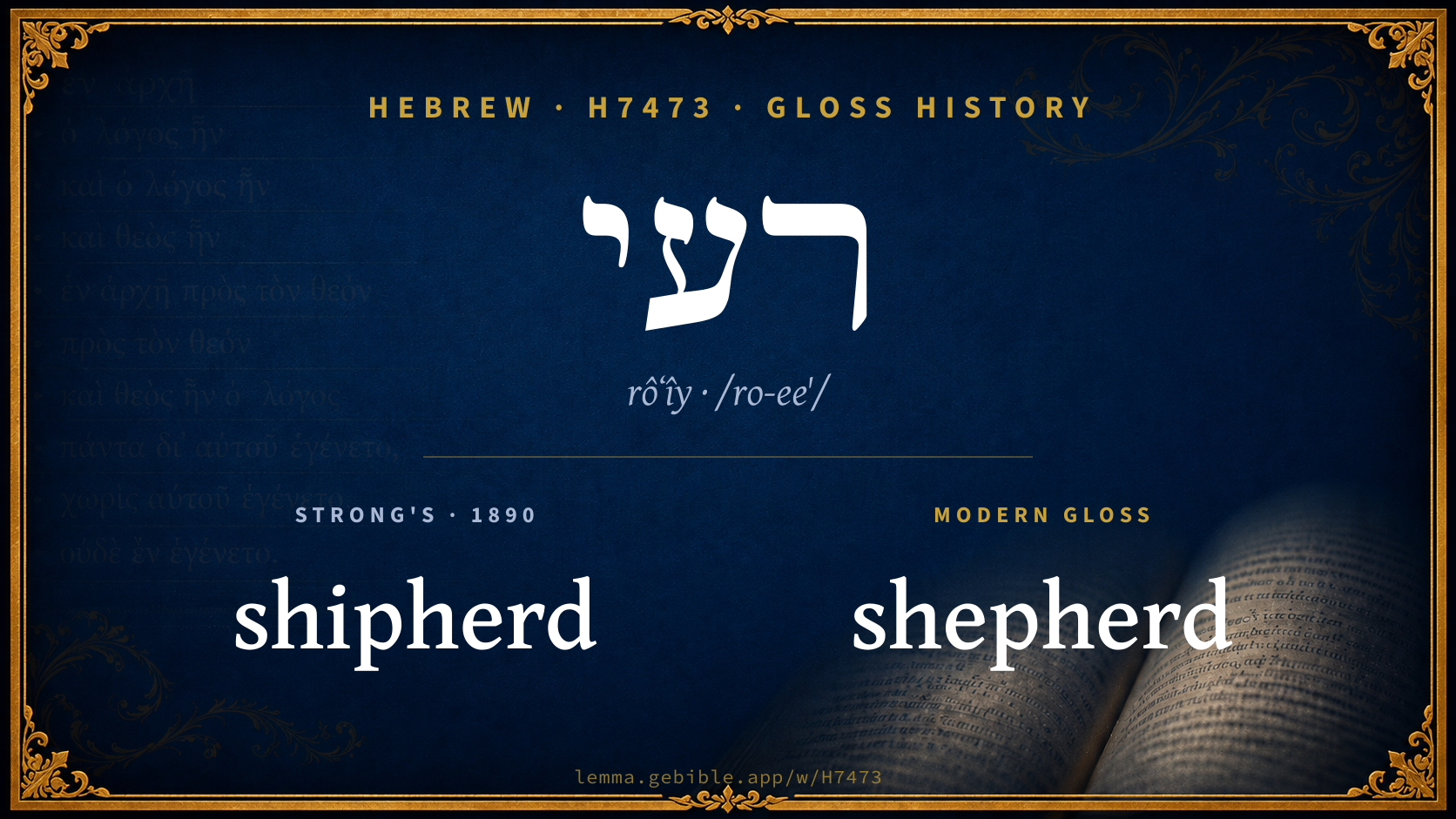
Gloss history
Strong's 1890 vs modern scholarship
About this word
Strong's H7473 catalogs a Hebrew word from the Hebrew Old Testament.
These counts are not copied from any lexicon or concordance. They are computed here, from the morphology-tagged Hebrew Old Testament. What Lemma adds →
- 8
- distinct verses
- The word appears in 8 distinct verses.
- 4 / 39
- OT books
- The word appears in 4 of 39 Old Testament books.
- #2,210
- by frequency
- Top 2500 most frequent Hebrew words (rank 2,210 of 8,640 Hebrew words by occurrence).
View all 8 occurrences in the concordance →
By section of the Old Testament
By traditional corpus
Conventional, traditional groupings — biblical authorship is debated, so this is a traditional corpus grouping, not an authorship claim. Each share is this word’s portion of its verses in that division of the Hebrew canon. Each figure is a share of the word’s 8 distinct verses.
- Prophets (Nevi'im) 5 verses · 63%
- Torah (Pentateuch) 3 verses · 38%
How translations render this word
Counts come from each version’s own published word-to-Strong’s tagging or interlinear alignment — an approximate guide to how each version renders this word, not a word-level alignment the data otherwise carries. Because each total is that version’s own tagged count, the per-version totals vary from one another and need not match the appearance or distinct-verse counts above. These counts may also differ from a printed concordance because Lemma counts each distinctly tagged rendering and does not collapse phrase taggings into a single head-word total. This is a fixed set of word-tagged versions (KJV, ASV, BSB, ULT) and does not change with the reading translation you choose elsewhere. Each version’s license is shown beside its name below (and on Sources).
BDB lists this Strong’s number as 4 distinct words (homographs). Each count above pools all of them and is not split by sense — see the Senses section below. A low-frequency rendering may belong to a different one of those words, not the primary meaning.
- King James Version†: Shepherd 1×, Shepherd's 1×
- American Standard Version†: Away from me as a shepherd 1×, Shepherd 1×
- unfoldingWord Literal Text†: Herdsmen of 4×, Shepherd 4×, Herdsmen 2×
King James Version Public Domain
Renders H7473 across 2† tagged occurrences — most commonly:
American Standard Version Public Domain
Renders H7473 across 2† tagged occurrences — most commonly:
unfoldingWord Literal Text CC BY-SA 4.0
Renders H7473 across 11† tagged occurrences — most commonly:
Plus 1 rendering that appears only once — usually multi-word phrases or single function words the recovered tagging swept in, not distinct renderings.
19 senses and sub-senses in the full BDB
Hebrew verbs can shift meaning by stem (binyan): Qal is the basic action, Niphal is often passive or reflexive, Piel often intensifies or makes it factitive, and Hiphil is typically causative. The senses below are grouped under the stem BDB assigns to each. This entry also uses Hithpael (reflexive or reciprocal).
What do BDB’s symbols mean?
BDB uses these scholarly abbreviations:
| Symbol | Meaning |
|---|---|
| 𝔊 | the Septuagint (the ancient Greek translation, LXX) |
| 𝔙 | the Vulgate (the Latin translation) |
| 𝔖 | the Syriac version (the Peshitta) |
| 𝔗 | the Targum (the Aramaic translation) |
| ψ | the Psalms |
| √ | root (the underlying root or stem) |
| ‖ | parallel passage (a synonymous or contrasted parallel) |
| † | the dagger: every passage where the word occurs is cited |
The 19 senses and sub-senses the full Brown-Driver-Briggs lexicon distinguishes for this word, in lexicon order (not ranked by frequency), with BDB’s own verbatim wording and sub-sense lettering. Shown in Hebrew script with BDB’s own scholarly abbreviations. The condensed entry is in the Lexicon Entry tab. See also the Forms in the corpus table below.
רעי I pasture, tend, graze (Assyrian rêʾû vb. pasture, n. ruler, TelAm. ruh̬i (as Canaanism) WklNo. 181, 11
Qal
- Pf. 3 ms. consec. וְרָעָה Mi 5:3 +, 1 s. sf. consec. וּרְעִיתִים Ez 34:13, 3 pl. sf. consec. וְרָעוּם Je 23:4, etc.; Impf. 3 ms. יִרְעֶה Is 27:10 +, juss. יֵרַע Jb 20:26, sf. יִעֶנָּה ψ 80:14, וַיִּרְעֵם ψ 78:72 (וַיִּר׳ Hiph. van d. H.), etc.; Imv. ms. רְעֵה Mi 7:14 +, sf. רְעֵם ψ 28:9; fs. רְעִי Ct 1:8; mpl. רְעוּ Gn 29:7; Inf. cstr. לִרְעוֹת 37:12 +, etc.; Pt. רֹעֶה 30:36 +, sf. רֹעִי ψ 23:1 +; fs. רֹעָה Gn 29:9 Pr 25:19, etc.;— e.g. Micah 5:3
- 1. trans.
- a. pasture, tend (pascere), lit., c. acc. צֹאן Gn 30:31, 36; 37:12 (all J), Ex 3:1 (E), 1 S 17:15; 25:16 Is 61:5, acc. of asses Gn 36:24 (P), kids Ct 1:8; acc. (צפּאן) om. Gn 29:7; 37:13 (ב loc.) v 16 (all J), Ct 1:7 (‖ חִרְבִּיץ), Jb 24:2 (𝔊 Me Siegf Bu וְרֹעוֹ);—metaph. גֹּרֶן וָיֶקֶב לֹא יִרְעֵם Ho 9:2, but read יֵדָעֵם 𝔊 We Now GASm; מָוֶת יִרְעֵם ψ 49:15. e.g. Genesis 30:31
- b. fig. of י׳, acc. pers., Gn 48:15 (E) God, who shepherded me; c. acc. of people, as flock Ho 4:16 Is 40:11 Mi 7:14 (בְּשִׁבְטֶ֑ן), Ez 34:13 (pregn., c. אֶל loc.), v 14, 15 (+ הִרְבִּיץ), v 16 ψ 28:9. e.g. Genesis 48:15
- c. fig. of ruler, and teacher, acc. of people, as flock, 2 S 5:2 = 1 Ch 11:2; 2 S 7:7 = 1 Ch 17:6, ψ 78:72 Je 3:15; 23:2, 4; Ez 34:2, 3, 8, 10, 23(×2); Zc 11:4, 7(×2), 9; of guiding, שִׂפְתֵי צַדִּיק יִרְעוּ רַבִּים Pr 10:21; c. ב of people ψ 78:71; abs. Mi 5:3; c. acc. pers. reflex. pastured (fed, enriched) themselves Ez 34:2, 8, 10 e.g. 2 Samuel 5:2
- d. especially pt. רֹעֶח, etc., as subst. = shepherd, herdsman: (1) lit., רֹעֵה צֹאן Gn 4:2; 46:32, 34; 47:3 (all J), רֹעֶח בַּצּ׳ 37:2 (E), 1 S 16:11; 17:34; רֹעֵי מִקְנֶה Gn 13:7(×2) (J); (ה)ר׳ alone, sg. Am 3:12 + 7 times (all in sim.); רֹעָה shepherdess, Gn 29:9 (J); כִּלִי רֹעֶה אֱוִילִי Zc 11:15 (v. כְּלִי 2 c), as symbol; pl. (הָ)רֹעִים Am 1:2; Ex 2:17, 19 (J), 1 S 21:8 (אַבִּיר הָר׳; Gr Dr Bu Kit Löhr א׳ הָרָצִים; 𝔊 LagBN 45 HPS אֹבִּיל הָעֲיָרִים, but cf. We) + 8 times + Is 31:4 (sim.), 38:12 (read רֹעִים for רֹעִי Perles29 Du CheHpt cf. Di), cf. (sf.) Gn 13:8(×2) (J); כְּלִי הָרֹעִים 1 S 17:40 (v. כְּלִי 3);—בֵּית־עֵקֶד הָרֹעִים, v. p. 112. (2) fig. of ruler (as often Assyrian; cf. Gk. (Homer) ποιμένα λαῶν), abs. sg. Je 17:16 fig. of prophet (but Aq Symm 𝔖 Gie Du Co מֵרָעָה). Zc 10:2; 11:16; 13:7b + 8 times Je Ez; sf. of י׳, דֹעִי Is 44:28 (of Cyrus), Zc 13:7a (read רֹעִי הָאֱוִילִי We Now GASm); abs. pl. Is 56:11; Je 2:8; 3:15; Mi 5:4 Zc 10:3; 11:5, 8 + 18 times Je Ez 34, + (of Assyrian leaders) Na 3:18; רֹעֵי יִשׂ׳ Ez 34:2; רֹעֵי צֹאנוֹ Is 63:11 (but read רֹעֵה [of Moses] 𝔊 𝔗 Di Du al.). (3) epith. of י׳: י׳ רֹעִי ψ 23:1, רֹעֵה יִשׂ׳ 80:2, רֹעֶה אֶבֶן יִשׂ׳, Gn 49:24 (poem in J; read cstr. רֹעֵה, cf. Comm.); מֵרֹעֶה אֶחָד Ec 12:11 DeWild, president of assembly of sages Siegf SS e.g. Genesis 4:2
- 2. intrans. feed, graze:
- a. lit. of cows, sheep, etc.: c. ב loc. Gn 41:2, 18 (E), 1 Ch 27:29; c. acc. of pasture Is 30:23; c. עַל loc. Zp 2:7 (עֲלֵי הַיָּם for MT עֲלֵיהֶם, v. Now); אֶל־מוּל loc. Ex 34:3 (J); abs. Is 5:17; 11:7 (‖ רבץ; but v. II. רעה infr.) 27:10 (‖ id.), 65:25 Jon 3:7; Jb 1:14. e.g. Genesis 41:2
- b. fig. of idolater, Is 44:20 he feedeth on ashes (acc.); cf. Ho 12:2 Ephr. feedeth on wind (acc.); פִּי כְסִילִים יִר׳ אִוֶּלֶת Pr 15:14 (so Vrss Qr; Kt פני for פי) the mouth of fools feeds on folly (Toy; Buhl √ II. רעה, Gerber 162 sub III. רעה); in Ct, c. ב loc., fig. of lover Ct 2:16; 6:2, 3; of breasts (like gazelles) 4:5. e.g. Isaiah 44:20
- c. fig., of Isr. as flock Is 14:30 (‖ רבץ), read (י—ַ)בְּכָרִי in my pasture(s), for MT בְּכוֹרֵי, Koppe Ew Di Du (otherwise CheHpt., cf. Marti); Zp 3:13 (‖ id.); c. עַל־דְּרָכִים Is 49:9; c. acc. of pasture-land Je 50:19; Mi 7:14; Ez 34:14b (+ אֶל loc.), v 18, 19; hence crop, strip, i.e. devastate, of conqueror, c. acc. of land Mi 5:5, cf. אֶת־יָדוֹ Je 6:3; so יִרְעוּךְ קָדְקֹד 2:16; acc. of Isr. under fig. of vine (subj. foes, as beasts) ψ 80:14. e.g. Isaiah 14:30
- d. subj. wind, c. acc. pers. Je 22:22, i.e. drive them away; subj. fire, c. acc. rei, יֵרַע Jb 20:26, but read perhaps יֵרָע, Niph. (Ol Di Hoffm Siegf Bu; otherwise Du).—רֹעֶה עֲקָרָה 24:21 is difficult; Bu הֵרַע for ר׳; more radical conj. in Du. e.g. Jeremiah 22:22
Niphal
- poss. Jb 20:26, v. 2 d supr. e.g. Job 20:26
Hiphil
- ψ 78:72 van d. H., v. 1 c supr. e.g. Psalms 78:72
רעי II ob. associate with (cf. Schulthess69 ff. but also NöZMG liv (1900), 154 f.
Qal
- Imv. ms. וּרְעֵה אֱמוּנָה ψ 37:3 cherish faithfulness (Hup-Now RV Che Du Dr); > feed securely (Bae; i. רעה; feed on (his) faithfulness Am RV); Pt. רֹעֶה כְסִילִים Pr 13:20 one associating with fools, so ר׳ זֹלְלִים 28:7, ר׳ זוֹנוֹת 29:3 (Thes al. think these fig. from I. רעה, v. 2 b). e.g. Psalms 37:3
Hithpael
- 2 ms. אַל־תִּתְרַע אֶת־בַּעַל אָ֑ף Pr 22:24 do not make companionship with a bad-tempered man; perhaps also 3 fpl. תִּתְרָעֶינָה Is 11:7 (LagOr i. 21; Deceased Wife’s Sister 399 Brd Du CheHpt) cow and bear shall be each other’s companions; + Inf. cstr. הִתְרָעֹת Pr 18:24 (Toy, for MT הִתְרֹעֵעַ) there are [יֵשׁ for אִישׁ] friends (merely) to be companions (v. II. רעע ad fin.). e.g. Proverbs 22:24
רעי III denom.
Piel
- be a special friend;—Pf. 3 ms. מֵרֵעֵהוּ אֲשֶׁר רֵעָה לוֹ Ju 14:20 his comrade who had been ‘best man’ (GFM) to him. e.g. Judges 14:20
רעי IV evil, misery, distress, injury
- 1. evil, misery, distress: פַּחַד רָעָה Pr 1:33, באה (ה)רעה Ez 7:5(×2); c. עַל Is 47:11 (read באה for בא), Je 5:12 + 5 times; c. אֶל Je 2:3; 51:60; †הביא רעה Je 4:6 1 K 21:29; + אֶל 2 S 17:14 + 8 times K Je; + עַל 1 K 9:9 = 2 Ch 7:22, Je 19:3 + 6 times Je + 8 times; + אֶל et על Je 19:15; 36:31; יוֹם רעה 17:17, 18 + 5 times; יְמֵי הרעה †Ec 12:1 (i.e., spring days, fatal to old people, Wetzst in De Koh. 447); רָעוֹת evils Dt 31:17(×2), 21 (JE), 32:23 (poem), ψ 34:20; 40:13; 88:4; עֵת רָעָה Am 5:13; Je 2:27, 28 + 5 times; †ראה ברעה Nu 11:15 (JE) Ob 13; Est 8:6; †ראה רעה Je 44:17 ψ 90:15; Pr 22:3 = 27:12; †יפול ברעה 17:20; 28:14; †בְּרָעָה Je 44:29 (J) Pr 14:32; 24:16; Ne 1:3; 1 Ch 7:23 ψ 107:26; ברעותיכם 141:5; נִחַם עַל רָעָה Ex 32:12, 14 (J) Je 8:6 + 6 times; c. אֶל 2 S 24:16; Je 26:3, 13, 19; 42:10. e.g. Proverbs 1:33
- 2. evil, injury, wrong: †עשׂה רעה 2 S 12:18; Je 26:19; 41:11; c. עִם Gn 26:29 (J) Ju 15:3; 2 S 13:16; c. את Ju 11:27; c. ל 1 S 6:9; 1 K 2:44 + 4 times; c. אֶל Je 44:7; obj. of vbs. חשׁב Gn 50:20 (E) Je 36:3; 48:2 + 7 times; †חרשׁ 1 S 23:9; Pr 3:29; הֵשִׁיב Gn 50:15 (E) Ju 9:56, 57 + 4 times; †גמל Gn 50:17 (E) 1 S 24:18 (17); Is 3:9; Pr 3:30; בקשׁ Nu 35:23 (P); 1 S 24:10 (9); 25:26 + 4 times; †שׁלּם Gn 44:4 (J); Je 18:20; 51:24 ψ 35:12; 38:21; לְרָעָה for harm Gn 31:52; Ex 23:2 (E); Dt 29:20; Ju 2:15; 2 S 18:32; Je 21:10 + 8 times Je, Am 9:4; Zc 1:15; Pr 6:18; Ec 5:12; בְּרָעָתֶ֑ךָ 2 S 16:8 in thy mischief; בְּרָעָה Ex 32:12 (J) for mischief; רָעָה רַבָּה Ec 2:21; רָעָה חוֹלָה Ec 5:12, 15. e.g. 2 Samuel 12:18
- 3. ethical evil, 1 S 12:17, 19; 24:12; 26:18; Is 47:10; Je 2:19 + 13 times Je, + 18 times, + foll.: עָשָׂה (הָ)רָעָה Gn 39:9; Dt 31:18 (J) + 5 times + Je 18:10 (Kt, but Qr רע); מַעֲשֵׂה רעה Ec 8:11; אהב רעה Mi 3:2 (Kt); שׁוּב מרעה Je 18:8; 23:14; 44:5; בִּעֵר רעה מ׳ Ju 20:13 (v ii. רַע 3); מִפְּנֵי רָעָה Je 7:12; 44:3; מפני רָעַת רעתכם Ho 10:15; בגלל ר׳ Je 11:17; על כל ר׳ 1:16; 32:32; 33:5; מֵר׳ ψ 107:34 Je 12:4; אַנְשֵׁי רָעָה Pr 24:1. e.g. 1 Samuel 12:17
Senses from the full Brown-Driver-Briggs lexicon (Brown, Driver, Briggs; Oxford 1906 — public domain), digitized via Sefaria, supplemented by the OpenScriptures HebrewLexicon (CC BY 4.0). Full attribution on Sources.
Word origin
I. vb. pasture, tend, graze (Assyrian rêʾû vb. pasture, n. ruler, TelAm. ruh̬i (as Canaanism) WklNo. 181, 11; Arabic رَدَى, Ethiopic ርዕየ Aramaic רְעָא, ܪܥܳܐ, all = BH);—
II. vb. prob. associate with (cf. Schulthess69 ff. but also NöZMG liv (1900), 154 f.; Assyrian ruʾa, ruttu, neighbour, fellow (m. et f.; cf. JägerBAS i.483, 486); so Bed. أُرْعُوَّةٌ master, owner, WallinZMG v (1851), 9 JayakarJA xxi. 851; Ethiopic መርዓ: marriage; Arabic رَاعِى, راعيها, Ethiopic አርዑት: yoke; NH רֵעוּת friendship is from BH רֵעַ);—
IV. n.f. evil, misery, distress, injury;—abs. ר׳ Gn 26:29 +; cstr. רָעַת 6:5 +; sf. רָֽעָתִי ψ 35:4 +; רָעָֽתְךָ 1 K 2:44 +; רָֽעָתֵכִי Je 11:15 (text dub.); רָֽעַתְכֶם 1 S 12:17, etc.; pl. רָעוֹת Dt 31:17 +; רָעֹת Je 44:9 Ex 23:2; sf. רָעוֹתֵיכֶם 1 S 10:19 +, etc.;—
— Brown-Driver-Briggs (Oxford 1906, public domain), digitized via Sefaria, supplemented by the OpenScriptures HebrewLexicon (CC BY 4.0). See Sources.
Derived from רעה (râʻâh) (H7462) — to shepherd.
Jastrow Dictionary
A second Hebrew/Aramaic lexicon for comparison, covering Aramaic and post-biblical (Talmudic, Targumic, Midrashic) usage that the biblical-Hebrew BDB does not. Matched by lemma rather than by Strong’s number, so a lemma may carry more than one Jastrow headword (shown separately below), and the entries cover usage well beyond the Bible.
רעי
- (b. h.) [to join, arrange, cmp. דבר,] to lead, pasture, feed; (neut. verb) to graze. Ex. R. s. 2 כשהיה משה … רוֹעֶה צאנו וכ׳ when Moses … was feeding Jethro’s flock in the desert &c.; חייך אתה תִרְעֶה וכ׳ as thou livest, thou shalt lead my flock, Israel. Ib. והיה מוציא הקטנים לִרְעוֹת כדי שיִרְעוּ וכ׳ he (David) took out the young first that they might eat the tender grass &c. Yoma VI, 1 יִרְעֶה עד שיסתאב, v. סָאַב; Bekh. II, 9 ירעו עד וכ׳; a. fr.
- to lead to pasture, feed. Erub. 17ᵃ; B. Kam. 81ᵃ top שיהו מַרְעִין וכ׳, v. חוֹרֶשׁ; a. e.
- (v. Jud. XIV, 20) to associate, make a friend, companion. Cant. R. to II, 9 (ref. to רעיתי, ib. 10) בתו של יצחק שריעה אותי וייפה אותי וכ׳ the daughter of Isaac who declared me (the Lord) his friend and beautified me (the faith in God) on the altar. Lam. R. introd. (R. Josh. 1) שתָּרֵיעַ לקבל וכ׳ (some ed. שתָּרֵיעוּ; from רעע, v. רֵיעַ) that thou (you) form a partnership &c., v. שָׂרַע. e.g. Judges 14:20
רְעֵי
- , to feed; to graze. Targ. Gen. XXX, 31; 36. Targ. Ex. XXXIV, 3; a. fr.—Ber. 56ᵃ ורַעֲיֵי וכ׳, v. שָׁקְצָא.
רְעֵי ²
- (preced.; cmp. צְבֵי) = h. רָצָה, [to join in,] to desire, take delight in; to welcome (cmp. חָפֵץ &c.). Targ. Ps. XL, 7 Ms. (ed. צבי). Ib. LXXXV, 2. Targ. I Sam. XX, 30 (h. text בחר). Targ. Y. Lev. XXVI, 34 (O. Af.). Targ. Ez. XVIII, 23; a. fr.—Yalk. Koh. 972 מאן דרחמנא רָעֵי ליה whom the Lord favors. Y. Snh. I, 19ᵃ לא רָעֵינָא ביה I do not like him; Y. M. Kat. III, 82ᵃ bot. רעיינא (corr. acc.); a. e.
- 1. to favor, welcome. Targ. O. Lev. l. c.—Part. pass. מַרְעֵי. Targ. Y. Deut. XXXIII, 24 (h. text רצוי).—[Targ. Y. II, Ex. XV, 9 אַרְעֵי, v. אֲרַע I.]
- 2. to reconcile. Num. R. s. 920 ומַרְעֲיִין ליה לאינתיה and (we should) have made him live with his wife.
- 1. to be pleasing, acceptable; to delight in, choose. Targ. Lev. I, 4. Targ. Koh. IX, 7. Targ. Gen. XXXIV, 3 (h. text דבק). Targ. Job XXXIV, 4 נִתְרְעֵי לנא (h. text נבחרה); a. fr.—[Targ. Y. Lev. XXIII, 14 יתרעון, read: תארעין, v. אֲרַע II.]
- 2. to be reconciled. Targ. Ps. LXXVII, 8.
- 3. to offer one’s self willingly, volunteer. Targ. Is. LXIV, 6 (h. text מתעורר!).—[Ḥull. 10ᵃ איתרעאי, v. רְעַע.]
רְעִי
- a grazing animal. Pesik. R. s. 16 (expl. רעי, I Kings V, 3) מן המרעה from the pasture ground; Yalk. Kings 176. Sabb. XX, 4 גורפין מלפני הפטם … מפני הר׳ (Y. ed. הריעי) you may (on the Sabbath) sweep the crib before the stall-ox, and move (the remnants) aside for the sake of the grazing animal (which is ordinarily fed on the pasture); Y. ib. 17ᶜ bot. מפני (ש)מה שהפטם מותיר הר׳ אוכל because the grazing animal eats what the stall-ox leaves over.—[Comment. erroneously: מפני הר׳ on account of soiled matter, v. next w.] e.g. 1 Kings 5:3
רְעִי ²
- (רעה = רוה, v. רֵיאָה a. רֳאִי II; cmp. דִּבְיוֹנִים) secretion, excrements. Bekh. 7ᵇ דרך הר׳ (Rashi דרך בית הר׳) in the secretory channel (instead of in the womb). Kel. XVII, 2 בית הר׳ … מקבל את הר׳ (ed. Dehr. הראי) a night chamber which is too defective to retain liquid matter, although it retains solid excrements. Cant. R. to III, 4 בית הר׳ privy. Tosef. Ber. II, 16; Ber. 25ᵇ גרף של ר׳ a vessel for excrements; Sabb. 47ᵃ; a. fr.
רֵעִי
- Targ. Ps. LXXXIII, 11 (ed. Wil. רְעִי; ed. Lag. ריעיא). Targ. Job XX, 7 רַעְיֵה (ed. Lag. רַעְיֵיה). Targ. Esth. V, 1, v. אֲצִיצָא. Targ. Y. Deut. XXIII, 14. Targ. Y. Lev. IV, 11; a. fr.
רְעִי III
- (v. רְעִי I) pasture. Targ. II Esth. IV, 1. Targ. I Kings V, 3. Targ. Gen. XLVII, 4 (O. ed. Berl. רִעְ׳). Targ. Ex. III, 1; a. e.
A Dictionary of the Targumim, the Talmud Babli and Yerushalmi, and the Midrashic Literature (Marcus Jastrow; London, Luzac, 1903) — Public Domain. Digitized via Sefaria. Digitized via Sefaria. Full attribution on Sources.
Forms in the corpus
The 9 distinct written forms H7473 takes in the Hebrew Bible, most frequent first — each parse links to that stem’s occurrences in the concordance. Hebrew forms include their vowel points and cantillation, so a single lemma takes many written forms.
| Form | Parsing | Example | Uses |
|---|---|---|---|
| רֹעֵ֣י | Verb, Qal, Participle Active, Masculine, Plural, Construct | Genesis 13:7 | 3 |
| הָ/רֹעִ֖ים | Verb, Qal, Participle Active, Masculine, Plural, Absolute | 1 Samuel 21:7 | 1 |
| רֹעִ/י֙ | Verb, Qal, Participle Active, Masculine, Singular, Construct | Zechariah 13:7 | 1 |
| רֹעִ֑/י | Verb, Qal, Participle Active, Masculine, Singular, Construct | Isaiah 38:12 | 1 |
| רֹעִ֔/י | Verb, Qal, Participle Active, Masculine, Singular, Construct | Isaiah 44:28 | 1 |
| רֹעִ֤י | Verb, Qal, Participle Active, Masculine, Singular, Construct | Zechariah 11:17 | 1 |
| רֹעֵ֥י | Verb, Qal, Participle Active, Masculine, Plural, Construct | Genesis 26:20 | 1 |
| רֹעֶ֑י/ךָ | Verb, Qal, Participle Active, Masculine, Plural, Construct | Genesis 13:8 | 1 |
| רֹעַ֖/י | Verb, Qal, Participle Active, Masculine, Plural, Construct | Genesis 13:8 | 1 |
Same root — word family
Other BDB entries built from the same root as H7473, grouped by Strong’s listed origin. These share a root / origin per the lexicon — not necessarily a shared meaning. Each links to that word’s own entry.
Derives from
Shares the same root
- מרע mêrêaʻ H4828 friend
- מרעה mirʻeh H4829 pasture
- מרעית mirʻîyth H4830 pasturage
- רע rêaʻ H7453 friend
- רע rêaʻ H7454 thought
- רעה rêʻeh H7463 friend
- רעות rᵉʻûwth H7468 companion
- רעות rᵉʻûwth H7469 longing
- רעי rᵉʻîy H7471 pasture
- רעיון raʻyôwn H7475 longing
Compare all same-root words → Showing 4 of 12 — not the complete family. They share a root, not necessarily a meaning.
Septuagint verse parallels
This word appears in 8 verses that also exist in the Greek Old Testament (Septuagint), out of the 8 Hebrew verses it occurs in. You can read those verses in Greek by switching the Old Testament edition to the Septuagint.
Read these verses in the Septuagint
This is a verse-level parallel only — the same verses exist in both the Hebrew and Greek Old Testaments. No word-level Hebrew↔Greek correspondence is claimed: the data carries no such alignment, so no Greek word is shown as this Hebrew word’s translation. Coverage is not total — the Septuagint omits the deuterocanon and renumbers the Psalms, so some Hebrew verses have no direct Greek parallel.