Jeremiah 9:5

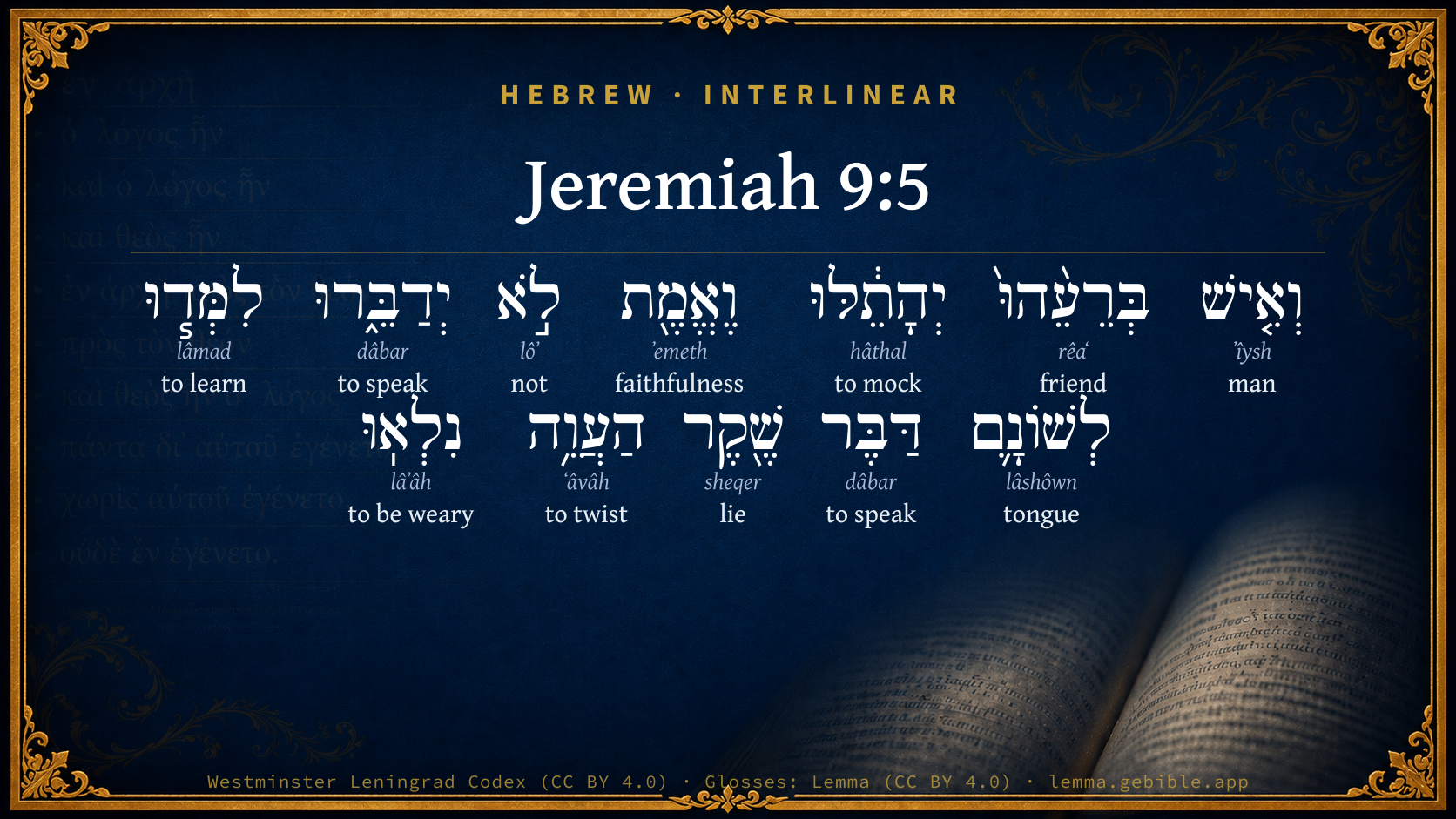
Hebrew (Westminster Leningrad Codex) Jeremiah 9:5 appears in the Hebrew Old Testament. The text above is from the Westminster Leningrad Codex. Each word links to its Strong’s number, a concise gloss, and parsing drawn from the Open Scriptures Hebrew Bible morphology. Click any word for its full Brown-Driver-Briggs (BDB) entry.
Download image
Cite this verse

Jeremiah 9:5 (World English Bible). Public Domain. Lemma interlinear Bible study tool, https://lemma.gebible.app/v/jeremiah/9/5.

Show BibTeX & RIS
BibTeX
RIS
English Translation
They will deceive everyone his neighbor, and will not speak the truth: they have taught their tongue to speak lies; they weary themselves to commit iniquity.
World English Bible · Public Domain
Download a study sheet

One document with this verse’s original text, its word-by-word gloss line, the meaning frame, cross-references with their text, attributed commentary, and full source and license credits — printable, and it pastes into notes with its structure intact.

This verse Autodidact and up

Study sheet (.html) Plain text (.txt)

A passage Seminary Student

Up to 50 verses in one chapter. A passage sheet keeps up to 6 commentary sources and 12 cross-references per verse, in the order this page ranks them, and says so on the sheet whenever that leaves anything out. Ask for a single verse and you get the Autodidact verse sheet above.

Everything on this page stays free to read, with no account — the sheet is a download of what is already on screen, not access to it.

Want to remove ads? Support Godless Engineer
Compare translations 3

The same verse in 3 English versions, stacked beneath the original-language interlinear above. Click any original word for its lexicon entry.

Each is an independent rendering of the whole verse — the interlinear is not word-aligned to these translations.

Highlighted words mark where these versions differ — a whole-verse word diff, not a word-by-word alignment.

  • World English Bible Public Domain
    They will deceive everyone his neighbor, and will not speak the truth: they have taught their tongue to speak lies; they weary themselves to commit iniquity.
  • King James Version Public Domain
    And they will deceive every one his neighbour, and will not speak the truth: they have taught their tongue to speak lies, and weary themselves to commit iniquity.
  • unfoldingWord Literal Text CC BY-SA 4.0
    And each one deceives his neighbor, and they do not speak the truth; they have taught their tongue to speak deceitful things; they weary themselves committing iniquity.

unfoldingWord Literal Text — © unfoldingWord, licensed CC BY-SA 4.0. Word-aligned USFM3 via Door43 (git.door43.org/unfoldingWord/en_ult).

Versions to compare (up to 4)

3 of 4 selected

Show all 18 translations

Every available English version of this verse, each an independent rendering of the whole verse.

  • World English Bible Public Domain
    They will deceive everyone his neighbor, and will not speak the truth: they have taught their tongue to speak lies; they weary themselves to commit iniquity.
  • Berean Standard Bible Public Domain
    Each one betrays his friend; no one tells the truth. They have taught their tongues to lie; they wear themselves out committing iniquity.
  • Majority Standard Bible Public Domain
    Each one betrays his friend; no one tells the truth. They have taught their tongues to lie; they wear themselves out committing iniquity.
  • King James Version Public Domain
    And they will deceive every one his neighbour, and will not speak the truth: they have taught their tongue to speak lies, and weary themselves to commit iniquity.
  • American Standard Version (1901) Public Domain
    And they will deceive every one his neighbor, and will not speak the truth: they have taught their tongue to speak lies; they weary themselves to commit iniquity.
  • Revised Version (1885) Public Domain
    And they will deceive every one his neighbour, and will not speak the truth: they have taught their tongue to speak lies; they weary themselves to commit iniquity.
  • Geneva Bible (1599) Public Domain
    And euery one wil deceiue his friende, and wil not speake the trueth: for they haue taught their tongues to speake lies, and take great paynes to do wickedly.
  • Douay-Rheims (1899) Public Domain
    And a man shall mock his brother, and they will not speak the truth: for they have taught their tongue to speak lies: they have laboured to commit iniquity.
  • Young's Literal Translation Public Domain
    And each at his friend they mock, And truth they do not speak, They taught their tongue to speak falsehood, To commit iniquity they have laboured.
  • Literal Standard Version CC BY-SA 4.0
    And they each mock at his friend, || And they do not speak truth, || They taught their tongue to speak falsehood, || They have labored to commit iniquity.
  • Unlocked Literal Bible CC BY-SA 4.0
    Each man mocks his neighbor and does not speak the truth. Their tongues teach deceitful things. They are exhausted from committing iniquity.
  • unfoldingWord Literal Text CC BY-SA 4.0
    And each one deceives his neighbor, and they do not speak the truth; they have taught their tongue to speak deceitful things; they weary themselves committing iniquity.
  • Darby Bible Public Domain
    And they act deceitfully every one with his neighbour, and speak not the truth: they teach their tongue to speak falsehood, they weary themselves with perverse dealing.
  • World Messianic Bible Public Domain
    Friends deceive each other, and will not speak the truth. They have taught their tongue to speak lies. They weary themselves committing iniquity.
  • Webster's Bible Public Domain
    And they will deceive every one his neighbor, and will not speak the truth: they have taught their tongue to speak lies, and weary themselves to commit iniquity.
  • Free Bible Version CC BY-SA 4.0
    Everyone betrays their friends; no one tells the truth. They've made themselves into expert liars; they tire themselves out doing wrong.
  • Bible in Basic English Public Domain
    Everyone will make sport of his neighbour with deceit, not saying what is true: their tongues have been trained to say false words; they are twisted, hating to come back.
  • JPS Tanakh (1917) Public Domain
    (9-4) And they deceive every one his neighbour, and truth they speak not; they have taught their tongue to speak lies, they weary themselves to commit iniquity.

Literal Standard Version (2020), Covenant Press — licensed CC BY-SA 4.0. Text via the HelloAO Bible API (eBible.org). Unlocked Literal Bible (unfoldingWord) — licensed CC BY-SA 4.0. Text via the HelloAO Bible API (eBible.org). unfoldingWord Literal Text — © unfoldingWord, licensed CC BY-SA 4.0. Word-aligned USFM3 via Door43 (git.door43.org/unfoldingWord/en_ult). Free Bible Version, Dr. Jonathan Gallagher — licensed CC BY-SA 4.0. Text via the HelloAO Bible API (eBible.org).

Word by word

More ways to search: Search by grammar → Find every occurrence → Compare this word →

Practice this passage: Drill this verse → Learn its vocabulary →

יְהָתֵ֔לּוּ
hâthal
H2048
“to mock”
Verb, Hiphil, Imperfect, 3rd Person, Masculine, Plural
Part of Speech
Verb
Stem
Hiphil
Form
Imperfect
Person
3rd Person
Gender
Masculine
Number
Plural
Full BDB Definition

Origin: a primitive root

TWOT: 518

(Piel) to mock, deceive - (Pual) deceive
  1. וְאִ֤ישׁ ʼîysh H376 “and · man” Conjunction + Noun, Common, Masculine, Singular, Absolute
  2. בְּרֵעֵ֨הוּ֙ rêaʻ H7453 “in/at · friend · his” Preposition + Noun, Common, Masculine, Singular, Construct + Suffix, Personal, 3rd Person, Masculine, Singular
  3. וֶאֱמֶ֖ת ʼemeth H571 “and · faithfulness” Conjunction + Noun, Common, Feminine, Singular, Absolute
  4. לֹ֣א lôʼ H3808 “not” Particle, Negative
  5. יְדַבֵּ֑רוּ dâbar H1696 “to speak” Verb, Piel, Imperfect, 3rd Person, Masculine, Plural
  6. לִמְּד֧וּ lâmad H3925 “to learn” Verb, Piel, Perfect, 3rd Person, Common, Plural
  7. לְשׁוֹנָ֛ם lâshôwn H3956 “tongue · their” Noun, Common, Both, Singular, Construct + Suffix, Personal, 3rd Person, Masculine, Plural
  8. דַּבֶּר dâbar H1696 “to speak” Verb, Piel, Infinitive Construct
  9. שֶׁ֖קֶר sheqer H8267 “lie” Noun, Common, Masculine, Singular, Absolute
  10. הַעֲוֵ֥ה ʻâvâh H5753 “to twist” Verb, Hiphil, Infinitive Absolute
  11. נִלְאֽוּ lâʼâh H3811 “to be weary” Verb, Niphal, Perfect, 3rd Person, Common, Plural

About this verse

These counts appear in no published source. They are computed here, from the morphology-tagged text and Lemma’s own curated glosses. What Lemma adds →

12
words
11
distinct lemmas
Prophets
section

Notable vocabulary

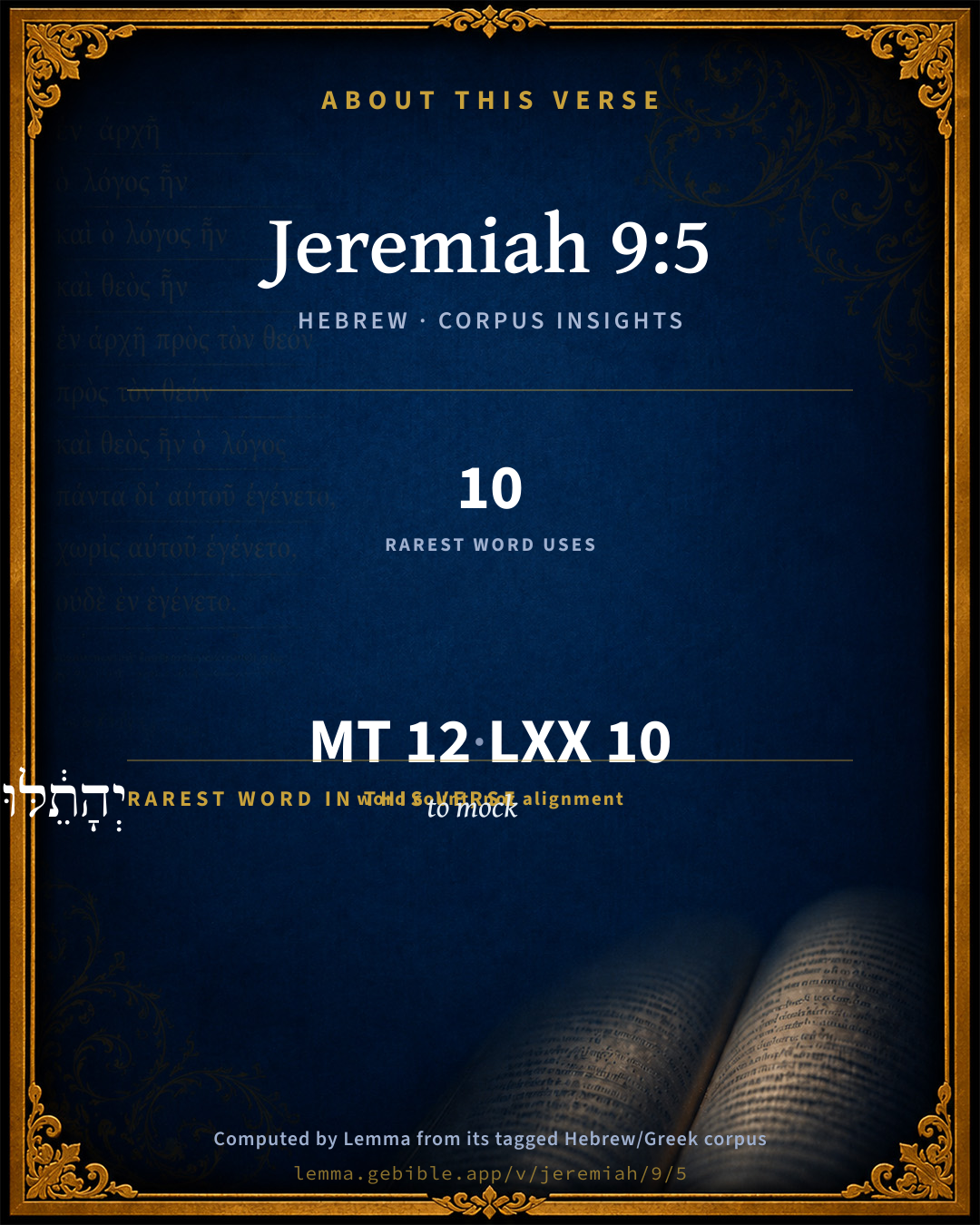
The rarest word here is יְהָתֵ֔לּוּ to mock H2048 — appearing just 10 times in the whole Hebrew Bible.

Shared distinctive vocabulary

יְהָתֵ֔לּוּ to mock H2048 occurs in 9 verses of the Hebrew Bible. Also found in:

Grammatical profile

  • 6 verbs
  • 5 nouns
  • 1 particle

Verb forms

  • יְהָתֵ֔לּוּ Hiphil · Imperfect
  • יְדַבֵּ֑רוּ Piel · Imperfect
  • לִמְּד֧וּ Piel · Perfect
  • דַּבֶּר Piel · Infinitive Construct
  • הַעֲוֵ֥ה Hiphil · Infinitive Absolute
  • נִלְאֽוּ Niphal · Perfect

Repetition

A word recurs within this verse — often emphatic in Hebrew:

  • יְדַבֵּ֑רוּ to speak H1696 ×2

Hebrew & Septuagint length

In the original languages it is 12 Hebrew tokens and 10 Greek tokens — but the two are counted differently (Hebrew bundles its prefixes and suffixes into one token; the Greek is in lemma form), so that isn’t a like-for-like length.

Cross-references

21

Topical passages linked to Jeremiah 9:5 in the Treasury of Scripture Knowledge — connected by theme and wording, ordered by reader-vote popularity; previews shown in the World English Bible.

  • Job 15:5 For your iniquity teaches your mouth, And you choose the language of the crafty.
  • Isaiah 57:10 You were wearied with the length of your way; yet you didn't say, It is in vain: you found a reviving of your strength; therefore you weren't faint.
  • Isaiah 59:13–15 transgressing and denying Yahweh, and turning away from following our God, speaking oppression and revolt, conceiving and uttering from the heart words of falsehood.
  • Micah 6:12 Her rich men are full of violence, Her inhabitants speak lies, And their tongue is deceitful in their speech.
  • Habakkuk 2:13 Behold, isn't it of Yahweh of Hosts that the peoples labor for the fire, and the nations weary themselves for vanity?
  • Job 11:3 Should your boastings make men hold their peace? When you mock, shall no man make you ashamed?
  • Psalms 7:14 Behold, he travails with iniquity; Yes, he has conceived mischief, And brought forth falsehood.
  • Psalms 50:19 "You give your mouth to evil. You harnesses your tongue for deceit.
  • Psalms 64:3 Who sharpen their tongue like a sword, And aim their arrows, deadly words,
  • Psalms 140:3 They have sharpened their tongues like a serpent. Viper's poison is under their lips. Selah.
  • Proverbs 4:16 For they don't sleep, unless they do evil. Their sleep is taken away, unless they make someone fall.
  • Isaiah 5:18 Woe to those who draw iniquity with cords of falsehood, And wickedness as with cart rope;
  • Isaiah 41:6–7 They help everyone his neighbor; and [every one] says to his brother, Be of good courage.
  • Isaiah 44:12–14 The smith [makes] an axe, and works in the coals, and fashions it with hammers, and works it with his strong arm: yes, he is hungry, and his strength fails; he drinks no water, and is faint.
  • Jeremiah 9:3 They bend their tongue, [as it were] their bow, for falsehood; and they are grown strong in the land, but not for truth: for they proceed from evil to evil, and they don't know me, says Yahweh.
  • Jeremiah 9:8 Their tongue is a deadly arrow; it speaks deceit: one speaks peaceably to his neighbor with his mouth, but in his heart he lays wait for him.
  • Ezekiel 24:12 She has wearied [herself] with toil; yet her great rust doesn't go forth out of her; her rust doesn't [go forth] by fire.
  • Micah 6:3 My people, what have I done to you? How have I burdened you? Answer me!
  • Ephesians 4:25 Therefore, putting away falsehood, speak truth each one with his neighbor. For we are members one of another.
  • 1 Timothy 4:2 through the hypocrisy of men who speak lies, branded in their own conscience as with a hot iron;
  • Genesis 19:11 They struck the men who were at the door of the house with blindness, both small and great, so that they wearied themselves to find the door.

Cross-references courtesy of OpenBible.info (CC BY 4.0).

Hebrew and Greek witnesses Masoretic Hebrew ↔ Greek Septuagint

The same verse in the two great witnesses to the Old Testament, shown verse-for-verse.

These are two independent witnesses, not word-aligned to each other, and the Septuagint is shown in lemma (dictionary) form.

Hebrew Jeremiah 9:5 Masoretic · Westminster Leningrad Codex

וְאִ֤ישׁ בְּרֵעֵ֨הוּ֙ יְהָתֵ֔לּוּ וֶאֱמֶ֖ת לֹ֣א יְדַבֵּ֑רוּ לִמְּד֧וּ לְשׁוֹנָ֛ם דַּבֶּר שֶׁ֖קֶר הַעֲוֵ֥ה נִלְאֽוּ

They will deceive everyone his neighbor, and will not speak the truth: they have taught their tongue to speak lies; they weary themselves to commit iniquity.

World English Bible · Public Domain

Greek LXX Structure differs

In the Septuagint, Jeremiah is about an eighth shorter than the Hebrew and arranges its material differently — the Oracles Against the Nations (Hebrew chapters 46–51) appear in the middle of the Greek book, after 25:13. Because the chapter and verse boundaries do not line up, a verse-for-verse comparison with the Hebrew is not shown.

A verse-for-verse comparison isn’t shown here because the chapters and verses don’t line up. Switch to the LXX edition with the MT / LXX toggle above to read the Greek directly.

On this verse, The Cambridge Bible for Schools and Colleges discusses the Septuagint’s reading. Read the note in Commentary ↓

Hebrew: Westminster Leningrad Codex (CC BY 4.0). Greek: Septuagint (public domain); English from a public-domain English Septuagint. How the Septuagint differs from the Hebrew →

Targum (Aramaic paraphrase)

1

The Targum is the ancient Jewish Aramaic paraphrase of the Hebrew Scriptures — an interpretive translation, not the Hebrew text itself. Onkelos (literal) and Pseudo-Jonathan (expansive) render the Torah, and Jonathan the Prophets. Coverage is partial: where no permissively-licensed English translation exists for a verse, only the Aramaic is shown. This is verse-level text, not a word-by-word alignment to the Hebrew.

  1. Targum Jonathan Prophets (Joshua–Malachi)
    יָתְבִין בְּבֵית כְּנִשְׁתְּהוֹן וּמִשְׁתָּעַן עַל עַוְיָתְהוֹן בִּנְכִילוּ מְסָרְבִין לְמֵידַע דְחַלְתִּי אֲמַר יְיָ:

    (no public-domain English translation for this verse)

    Targum Jonathan — Aramaic: “Mikraot Gedolot” (public domain). English: “Sefaria Community Translation” (CC0 1.0 (public-domain dedication)); “London "Chaldee Paraphrase," 1871” (public domain). Text via Sefaria.

Commentary

Notes on Jeremiah 9:5 from classic Christian and Jewish commentators (each source and its license shown beneath its notes). The classic Christian expositions comment on the surrounding passage and are grouped to its opening verse, so a note may address several verses; the Jewish commentaries on the Tanakh (Rashi and others) are per-verse, so they appear only where the commentator wrote on this verse.

Lemma curates 59 commentaries, every one of them public domain or Creative Commons licensed, each selected and text-cleaned for this edition rather than reprinted as found. About our sources →

The Cambridge Bible for Schools and Colleges

gen. ed. J. J. S. Perowne

5. Here, and in Jer_9:4, the verbs had best be rendered by present tenses.

deceive] better (as mg.) mock.

5, 6. The MT. has apparently suffered some corruption. The LXX yield a fairly good sense. Dividing the four consonants of the Hebrew word rendered “thine habitation,” so as to end Jer_9:5 with the first two, which thus yield the meaning of turn, and then taking the second pair, which will thus mean oppression (as in Psa_10:7; Psa_55:11), they render the whole “they committed iniquity and Ceased not to turn aside. (Jer_9:6) Oppression on oppression and deceit on deceit, etc.,” the latter pair of identical words suggesting the parallel preceding. As Gi. points out, this does not obviate the objection that the verb rendered “weary themselves” always elsewhere (e.g. Isa_16:12; Isa_47:13) means to do so to no purpose, which is unsuitable here. Hence, and for other reasons, he rejects Jer_9:4-5.

The Cambridge Bible for Schools and Colleges (gen. ed. J. J. S. Perowne; Cambridge University Press, 1878–1918) — public domain. Text from a community e-Sword module.

Trapp's Complete Commentary

John Trapp

Jer 9:5 And they will deceive every one his neighbour, and will not speak the truth: they have taught their tongue to speak lies, [and] weary themselves to commit iniquity.

Ver. 5. They have taught their tongues to speak lies.] They are artists at it, and can tack one lie to another very handsomely. {Psa 119:69} {See Trapp on "Psa 119:69"}

John Trapp, A Commentary or Exposition upon All the Books of the Old and New Testament (1647–1656) — public domain. Text from a community e-Sword module.

The Biblical Illustrator

Joseph S. Exell

Jer_9:5

And weary themselves to commit iniquity.

The uneasiness of a sinful life

Though these words were spoken of the Jews more than two thousand years ago, yet I shall endeavour to show that it may be said of all wicked men; that a wicked life is full of weariness and difficulties; that virtue is more easy than vice, and piety than wickedness.

1. Vice oppresses our nature, and consequently, it must be uneasy: whereas virtue improves, exalts, and perfects our nature; therefore virtue is a more natural operation than vice; and that which is most natural must be most easy. Thus, when we would express anything to be easy to a person or nation, we say it is natural to them. Moreover, all vices are unreasonable, and what is against reason must be against nature. And why is it that laws are so severe against vice, but because it destroys and corrupts the members of the commonwealth? So that the punishments which public justice in all countries inflicts upon criminals, are a plain proof how great an enemy vice is to nature, under whose ill conduct, and for whose errors, it suffers sometimes the most inexpressible torments. Every vice also has its own peculiar disease, to which it inevitably leads. Envy brings men to leanness; the envious man, like the viper, is killed by his own offspring. Lust brings on consuming and painful diseases. Drunkenness, catarrhs and gouts, and poverty beside. Rage produces fevers and frenzies. It is owned by all, that nature is satisfied with little, and desires nothing that is superfluous; by this rule all these vices are unnatural which consist in excess, or stretch themselves to superfluity; such as oppression, injustice, luxury, drunkenness, gluttony, covetousness, and the like.

2. Vice is more unpleasant than virtue; and therefore it must be more uneasy and wearisome; for we soon weary of anything which is not attended with pleasure, even though it should bring us some advantage. Without pleasure there is no happiness or ease. There are indeed some vices which promise a great deal of pleasure in the commission of them, but then at best it is but short-lived and transient, a sudden flash presently extinguished. It perishes in the very enjoyment, and quickly passes away like the crackling of thorns under a pot. Thus sinners are like the troubled sea, tossed to and fro, and yet can find no rest or satisfaction. They ramble on in one kind of debauchery until they are obliged to try another for a sort of diversion; they go round from one sin to another, so that their whole life is a course of uneasiness, and vanity in the strictest sense. Nor is this all, the pleasure of sin being exhausted in a moment, leaves a sting behind it, that cannot be so soon plucked out; these pleasures wound the conscience, and occasion uneasy and painful reflections. A thousand instances of the unpleasantness of vice are everywhere obvious. Envy is a perfect torment; it cannot fail to make the man whom it possesses miserable, and fill him with distracting pain and grievous vexation. It never leaves off murmuring and fretting, while there is one man happier, richer, or greater than the envious man himself. It is contrary to all goodness, and consequently to pleasure. Revenge is most painful and uneasy, both in persuading us that these are affronts, which of their own nature are none, and then in involving us in more troubles and dangers than the pleasure of revenge can compensate. Hatred and malice are the most restless tormenting passions that can possess the mind of man; they keep men perpetually contriving and studying how to effect their mischievous purposes; they break their rest, and disturb their very sleep. Covetousness is a most painful and uneasy vice, it makes the covetous man sit up late and rise early, and spend all his time and pains in hoarding up worldly things. Covetousness is unsatiable, the more it gets, the more it craves; it grows faster than riches can do. From all which it is evident, that all vicious persons live the most slavish and unpleasant lives in the world, and this every vicious man acknowledges in anothers case; he thinks the vice he sees another addicted to, most unpleasant and uneasy.

3. The horror of conscience makes vice uneasy. I might show you that no man sins deliberately without reluctancy. But though there were no such disadvantage attending the commission of sin, yet the natural horror which is consequent upon it, is great enough to render it unaccountable, that any man should he vicious. Conscience can condemn us without witnesses; and the arm of that executioner cannot be stopped. And if we consider, that neither the attendance of friends, nor the enjoyment of all outward pleasures, can comfort those whose conscience is once awakened, and begins to accuse them, we cannot but conclude, that vice is to be pitied as well as shunned; and that this alone makes it more uneasy than virtue, which sweetens the greatest misfortunes. The greatest punishment that a wicked man can suffer in this world, is to be obliged to converse with himself. Diversion or non-attention is his only security; he fears nothing so much as reflection: for if he once begins to reflect, and fix his thoughts to the consideration of his by-past life and actions, he anticipates hell himself, he needs no infernal furies to lash him; he becomes his own tormentor.

4. Vicious persons must in many cases dissemble virtue, which is more difficult than to be really virtuous. All men who design either honour, riches, or to live happily in the world, do either propose to be virtuous, or at least pretend it. Now such pretenders and hypocrites have certainly a very difficult part to act; for they must not only be at all that pains which is requisite in being virtuous, but they must superadd to these all the troubles that dissimulation requires, which is also a new and greater task than the other. Not only so, but they must overact virtue, with a design to take off that jealousy, which because they are conscious of deserving, they therefore vex themselves to remove.

5. Vice makes the vicious man fear all men; even as many as he injures, or are witnesses to his vices. (T. Wetherspoon.)

The sinners mental war

This is a suffering world in more senses than one. We are subject to toil and labour in consequence of the apostasy, and to perpetual vexation of mind, in consequence of our opposition to the Divine will. The sinner, therefore, is compelled, if he will continue in sin, to maintain a mental war which devours and exterminates from his breast all the elements of vital joy.

I. The sinner must sustain morality without piety. Disgrace; loss of property; of all real friendship; of domestic affection; of the health and life; of self-respect and elevated companionship; all wait around a course of vice. The vicious man sinks deeper and deeper in the mire. He must be moral or miserable. It is hard work, however, to maintain morality without religion. The passions are strong; the world is full of temptation; the soul is liable to be beat off from its hold on morality, unless recovered by grace; its course will be tremendous, the progress of its depravity vehement, and great the fall of it.

II. He must feel secure without a promise. Even the hardest incrustations of sin cannot prepare the soul to look fully at eternal wailing undaunted. There it stands, that never ceasing view; that vivid painting of the future; that dark, shadowy, but distinct, and fearful representation of utter ruin; it is hung out before the soul by the stem truth of God, from behind every scene of guilt, and along every winding of the souls weary path. How can he feel secure? Yet how can he bear to face that vision? If he looks to nature, it warns him; to his companions, they are falling into the arms of the monster.

III. He must hope for heaven, while forming a character for perdition. He must hope, and will hope, even if he knows his hope will do no good. Heaven is the only place of final rest; if he miss it he is lost, undone forever. Holy as it is, and much as he hates holiness, he must enter there, or eternally be an undone man. No man can bear the idea of confessed, manifest, public, and hopeless, irrecoverable disgrace. Every man, therefore, clings to the idea of a final heaven, as long as he can. But here the sinner has a hard task.

IV. He must resist Christ without a cause. The claims of Christ are not only just, but compassionate and benevolent. If he will sin, he must contend against the Saviour in the very interpositions of His astonishing, overwhelming, agonising mercy. This is hard work for the conscience the wheels of probation drag heavily; their voice grates fearfully; their cry of retribution waxes loud.

V. He must try to be happy while guilty. This he cannot accomplish, yet he must try. He will choose a thousand phantoms; he will grasp after every shadow; he will be stung a thousand times, yet will he renew the toil, till wearied, hopeless, and sullen, he lies down to die.

VI. He must have enough of the world to supply the place of God in his heart. The heart must have a supreme object; God is able to fill it. On Him the intellect may dwell, and around the ever-expanding developments of His character, the affections, like generous vines, may climb, and gather, and blossom, and hang the ripe cluster of joy forever; but the sinner shuts out God, every vision of His character is torment, and he turns away to fill the demands of his heart with the world.

VII. He must arrange matters for deaths while he is afraid to think of dying. He must work to get property for his children when he is gone. He must put his business in a train, so that it may be settled advantageously when he is gone. He must do all this on the strength and under the impulse of an idea at which he trembles.

VIII. He must read the Bible, whilst he is afraid to think or pray. This is especially true of the worldly-minded professor. If he keeps up the form of family worship, or attends at the house of God, the Bible, the holy and accusing book, is in his way. Its truths lie across his path. He cannot turn aside, he must trample over them, while he beholds them under his feet. He knows that his footsteps are heard around the retributive throne. If driven to console himself by the promises of error, the sinner has to pervert and wrestle with the Bible. Its denunciations catch his eye, and burn him while he tries to explain them away. Concluding thoughts--

1. Have we no compassion for a suffering world?

2. Can we do nothing to relieve this miserable condition of our fellow men? The time for Gods people to pray, and awake, and endeavour mightily, is now--and with most of us, now or never. (D. A. Clark.)

The Biblical Illustrator, edited by Joseph S. Exell (c. 1880s–1900s) — public domain. Text from a community e-Sword module.

Geneva Bible (1599)

Geneva Bible translators

They have so practiced deceit, that they cannot forsake it.

Geneva Bible (1599) marginal notes — public domain. Text via Bolls.life.

Jamieson, Fausset & Brown

Robert Jamieson, A. R. Fausset & David Brown

weary themselves--are at laborious pains to act perversely [MAURER]. Sin is a hard bondage (Hab 2:13).

Jamieson, Fausset & Brown — Commentary Critical and Explanatory on the Whole Bible (1871) — public domain (CC PDM 1.0). Text via the HelloAO Bible API.

Adam Clarke's Commentary

Verse 5. And weary themselves to commit iniquity.] O, what a drudgery is sin! and how much labour must a man take in order to get to hell! The tenth part of it, in working together with God, would bring him to the gate of glory.

Adam Clarke's Commentary on the Bible (1810–1826) — public domain. Text from a community e-Sword/MySword module.

John Calvin's Commentaries

Jeremiah goes on with the same subject. He says that fidelity had so disappeared among the Jews, that every one endeavored to deceive his neighbor. Hence it followed, that they were withhout any shame. Some sense of shame at least remains among men, when they have to do with their own friends; for though they may be wholly given to gain, and to indulge in falsehoods, yet when they transact business with friends, they retain some regard for equity, and shame checks their wickedness: but when there is no difference made between friends and strangers, it follows that their character is become altogether brutal. This is what the Prophet meant.

And he adds, that they spoke not the truth He now says that they were liars, not in this or that particular business; but that they were perfidious and deceitful in everything. This clause then is not to be limited to some special acts of fraud; but it is the same as though he had said, that they knew not what truth was, or what it was to act with good faith and to speak honestly to their neighhours; for they were wholly imbued with deceits, and no truth could come out of their mouth.

And for the same purpose he says, that they had taught their tongues to speak falsehood. The expression in this clause is stronger; for he means that they were wholly given to deceit, as by long use they had formed their tongues for this work. The tongue ought to be the representative of the mind, according to the old saying; for why was the tongue formed, but in order that men may communicate with one another? For the thoughts are hidden, and they come forth when we speak with each other. But the Prophet says that the order of nature was by them inverted, for they had taught their tongues to lie We also hence learn that they had no fidelity whatever; for their very tongues had been taught to deceive: as when one by practice has learnt anything, it is what he does readily; so when the tongues are formed by continual use and inured to lying, they can do nothing else.

He says at last, that they wearied themselves with evil deeds. This is indeed an hyperbolical language; but yet the Prophet very fitly sets forth the deplorable state of the people, — that they practiced the doing of evil even to weariness. As when any one is seized with some foolish lust, he spares no labor and does himself much harm, but feels not his wearied state as long as he is engaged, for his ardor dementares him: so he says now, that they were wearied in doing evil. When a hunter pursues the game, he undergoes much more labor than any common workman, or any husbandman. We see that even kings and courtiers, while hunting, are so blinded, that they see no danger nor feel any weariness. So we find that men given to pleasure, when lust draws them here and there, feel no concern for the greatest weariness. According to this sense then the Prophet says, that they were wearied in doing evil, as though he had said, that they were so devoted to wickedness, that the pleasure of doing evil wholly blinded them and made them mad.

We now perceive the Prophet’s meaning: He confirms, as I have said, what he had stated before. He had threatened the people with utter ruin; they were secure and heedless, and despised all his denuncitations. He now shews, from God’s nature and office, that ruin was nigh them, though they feared it not and thought themselves abundantly safe. But if God be the judge of the world, as it will be hereafter proved, how is it possible for him to connive perpetually at so great wickedness? And to shew this he also adds —

John Calvin's Commentaries (1540-1563) — public domain. Text from the Calvin Translation Society English edition (1840s-50s) via the Christian Classics Ethereal Library (ccel.org). Calvin's coverage is partial (roughly two-thirds of the Bible); uncommented books and verses are honest gaps, never fabricated. The 19th-century editor's footnotes and remarks are omitted so the notes are faithfully Calvin's own voice.

Ellicott's Commentary for English Readers

(5) Deceive.—The word is commonly translated, as in the margin, mock. (So in 1Ki_18:27; Jdg_16:10; Jdg_16:13; Jdg_16:15.) The context here shows, however, that the kind of mockery is that which at once deludes and derides; and as the former meaning is predominant, the text of the English version had better stand as it is.

To commit iniquity.—Literally, to go crookedly, or, in the strict sense of the word, to do wrong.

A Bible Commentary for English Readers, edited by Charles John Ellicott (1878–1897) — public domain. Text from a community e-Sword module.

John Gill's Exposition

And they will deceive everyone his neighbour,.... In conversation, with lying words; and in trade and commerce, by art and tricking:

and will not speak the truth; with respect to facts they report, or goods they sell:

they have taught their tongue to speak lies; and become so accustomed to lying that they cannot do otherwise; it is as it were natural to them:

and weary themselves to commit iniquity; spared no pains to come at it, nor any in it, and go on even to weariness; are more laborious and indefatigable in committing sin than good men are in doing good; which shows great folly and stupidity. The Targum is,

"they are become foolish, they have erred.''

John Gill's Exposition of the Whole Bible (1746–1763) — public domain (CC PDM 1.0). Text via the HelloAO Bible API.

Haydock's Catholic Bible Commentary

Iniquity. It is become natural to them. (St. Jerome) --- They cannot lay the blame on the violence of passion. They sin on purpose. (Calmet) --- Septuagint, "they have not left off, (6.) in order to be converted. Usury upon usury; fraud upon fraud; they," &c. (Haydock)

George Leo Haydock (1774–1849), Haydock's Catholic Family Bible and Commentary, 1859 edition — public domain. Excludes Psalms (Douay-Rheims chapter numbering differs from Protestant) and Deuterocanonical books (Catholic canon only).

Matthew Poole's English Annotations

They will deceive, Heb. mock, or deride; they are scoffers. They have taught their tongue to speak lies; they have so framed their tongues to it by custom and constant use, that lying is become so familiar to them that they cannot leave it. The same word is applied to the wild ass, used or taught to the wilderness, Jer 2:24; 13:23.

Weary themselves to commit iniquity; they use a great deal of industry, diligence, and contrivance in it, Psa 7:14; Isa 5:18. They spare for no labour and feel no weariness in it, whereby they are become expert.

Matthew Poole's English Annotations on the Holy Bible (1683–1685) — public domain. Text from a community e-Sword/MySword module.

The Pulpit Commentary

They have taught their tongue, etc.; again an intimation of the unnaturalness (in the higher sense) of vice. (comp. on Jer_2:33)

The Pulpit Commentary (1880–1919), ed. H.D.M. Spence-Jones & Joseph S. Exell — public domain. Text from a community e-Sword module.

John Wesley's Explanatory Notes

Weary - They use industry, and contrivance in it, they spare no labour.

John Wesley, Explanatory Notes Upon the Whole Bible (1754–1765) — public domain. Text via the GEBible commentary corpus.

Rashi

Rabbi Shlomo Yitzchaki (Rashi)

Your habitation is in the midst of deceit When they sit, they devise plans of deceit, and with deceit they have exchanged fear of Me and refused to know Me.

because of deceit Heb. בּמרמה.

Rashi on the Tanakh — English translations: “The Judaica Press complete Tanach with Rashi, translated by A. J. Rosenberg” (CC BY 4.0); “Pentateuch with Rashi's commentary by M. Rosenbaum and A.M. Silbermann, 1929-1934” (public domain); “The Metsudah Tanach series, Lakewood, N.J” (CC BY 4.0); and “The Book of Joshua, Metsudah Publications, 1997” (CC BY 4.0). Text via Sefaria.

Lesson kit

Teaching starters — assembled from the data on this page, not authored interpretation. Every prompt links to the verse data it draws on. Edit before teaching.

Jeremiah, in the Prophets, opens this verse with 12 words (11 distinct Hebrew lemmas). Its most distinctive word is hâthal (“to mock”). A historical commentator’s framing appears above. Read the whole chapter for the surrounding context.

Discussion questions

  1. How does “to mock” (hâthal) shape what this verse is saying?
  2. How does Genesis 31:7, which shares the word «to mock», read alongside this verse?
  3. What does the repetition of “to speak” (2× in this one verse) do in this verse?
  4. The translations on this page render this verse differently — a whole-verse word diff, not a word-by-word alignment. What might account for the different wordings?
  5. «יְהָתֵ֔לּוּ» is a Hiphil Imperfect verb. How does that grammatical form shape the action described?
  6. Compare how The Cambridge Bible for Schools and Colleges and Trapp's Complete Commentary read this verse. Where do they agree or differ?

Things to notice

Reading settings

Reading text

Shown beneath each verse's original-language words.

Old Testament
Old Testament edition

Read the OT as the Masoretic Hebrew (MT) or the Greek Septuagint (LXX).

English shown for the Greek Septuagint (in the Hebrew ↔ Greek comparison).

Comparing translations? Open the Compare panel on any verse page to stack up to four side by side.