

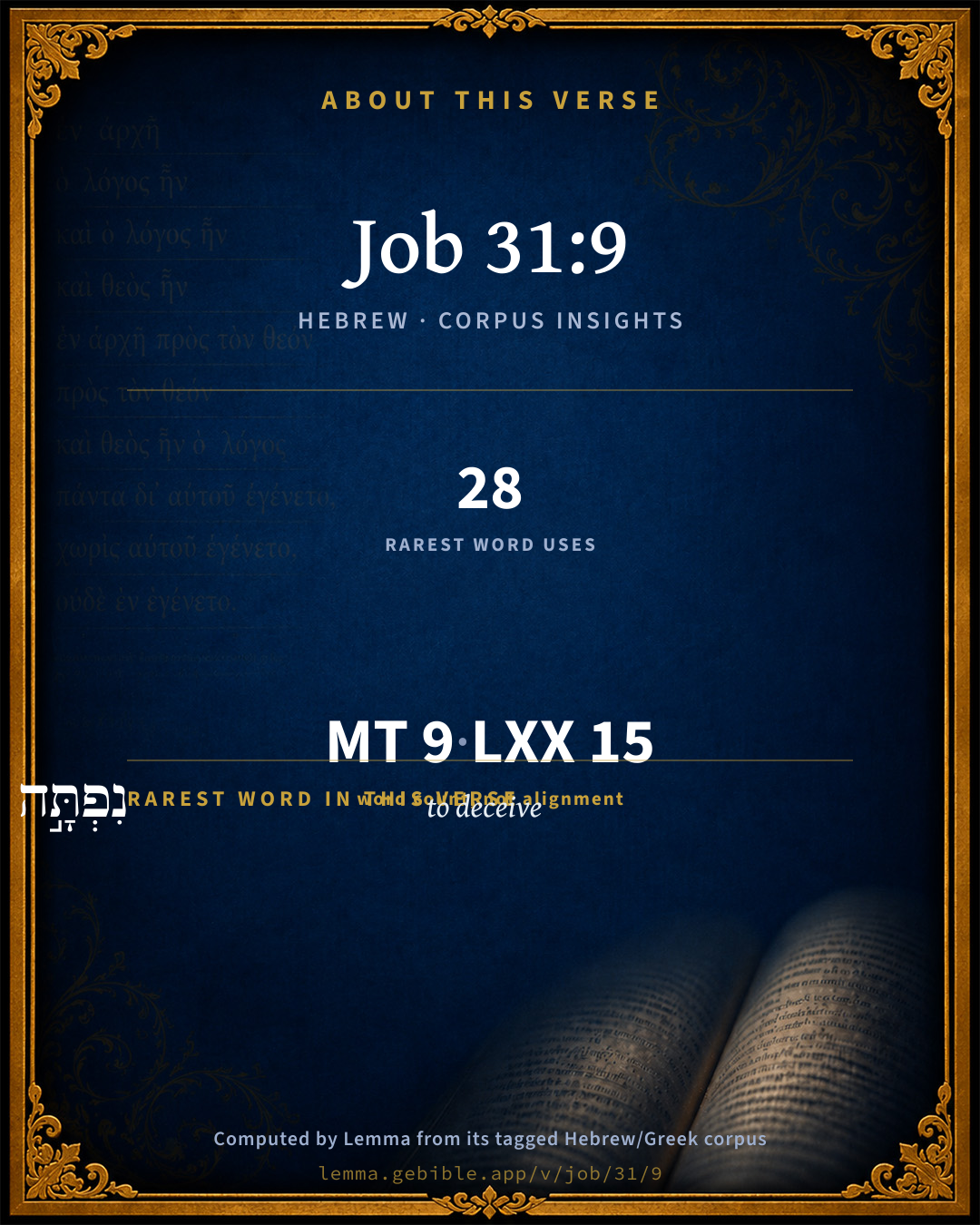
Job 31:9

Hebrew (Westminster Leningrad Codex) Job 31:9 appears in the Hebrew Old Testament. The text above is from the Westminster Leningrad Codex. Each word links to its Strong’s number, a concise gloss, and parsing drawn from the Open Scriptures Hebrew Bible morphology. Click any word for its full Brown-Driver-Briggs (BDB) entry.
Download image
Cite this verse

Job 31:9 (World English Bible). Public Domain. Lemma interlinear Bible study tool, https://lemma.gebible.app/v/job/31/9.

Show BibTeX & RIS
BibTeX
RIS
English Translation
"If my heart has been enticed to a woman, And I have laid wait at my neighbor's door;
World English Bible · Public Domain
Download a study sheet

One document with this verse’s original text, its word-by-word gloss line, the meaning frame, cross-references with their text, attributed commentary, and full source and license credits — printable, and it pastes into notes with its structure intact.

This verse Autodidact and up

Study sheet (.html) Plain text (.txt)

A passage Seminary Student

Up to 50 verses in one chapter. A passage sheet keeps up to 6 commentary sources and 12 cross-references per verse, in the order this page ranks them, and says so on the sheet whenever that leaves anything out. Ask for a single verse and you get the Autodidact verse sheet above.

Everything on this page stays free to read, with no account — the sheet is a download of what is already on screen, not access to it.

Want to remove ads? Support Godless Engineer
Compare translations 3

The same verse in 3 English versions, stacked beneath the original-language interlinear above. Click any original word for its lexicon entry.

Each is an independent rendering of the whole verse — the interlinear is not word-aligned to these translations.

Highlighted words mark where these versions differ — a whole-verse word diff, not a word-by-word alignment.

  • World English Bible Public Domain
    "If my heart has been enticed to a woman, And I have laid wait at my neighbor's door;
  • King James Version Public Domain
    If mine heart have been deceived by a woman, or if I have laid wait at my neighbour's door;
  • unfoldingWord Literal Text CC BY-SA 4.0
    If my heart has been opened by a woman and I have lurked at the door of my neighbor,

unfoldingWord Literal Text — © unfoldingWord, licensed CC BY-SA 4.0. Word-aligned USFM3 via Door43 (git.door43.org/unfoldingWord/en_ult).

Versions to compare (up to 4)

3 of 4 selected

Show all 18 translations

Every available English version of this verse, each an independent rendering of the whole verse.

  • World English Bible Public Domain
    "If my heart has been enticed to a woman, And I have laid wait at my neighbor's door;
  • Berean Standard Bible Public Domain
    If my heart has been enticed by my neighbor’s wife, or I have lurked at his door,
  • Majority Standard Bible Public Domain
    If my heart has been enticed by my neighbor’s wife, or I have lurked at his door,
  • King James Version Public Domain
    If mine heart have been deceived by a woman, or if I have laid wait at my neighbour's door;
  • American Standard Version (1901) Public Domain
    If my heart hath been enticed unto a woman, And I have laid wait at my neighbor's door;
  • Revised Version (1885) Public Domain
    If mine heart have been enticed unto a woman, and I have laid wait at my neighbour’s door:
  • Geneva Bible (1599) Public Domain
    If mine heart hath bene deceiued by a woman, or if I haue layde wayte at the doore of my neighbour,
  • Douay-Rheims (1899) Public Domain
    If my heart hath been deceived upon a woman, and if I have laid wait at my friend's door:
  • Young's Literal Translation Public Domain
    If my heart hath been enticed by woman, And by the opening of my neighbour I laid wait,
  • Literal Standard Version CC BY-SA 4.0
    If my heart has been enticed by a woman, || And I laid wait by the opening of my neighbor,
  • Unlocked Literal Bible CC BY-SA 4.0
    If my heart has been deceived by a woman, if I have lain in wait at my neighbor's door,
  • unfoldingWord Literal Text CC BY-SA 4.0
    If my heart has been opened by a woman and I have lurked at the door of my neighbor,
  • Darby Bible Public Domain
    If my heart have been enticed unto a woman, so that I laid wait at my neighbour's door,
  • World Messianic Bible Public Domain
    “If my heart has been enticed to a woman, and I have laid wait at my neighbor’s door,
  • Webster's Bible Public Domain
    If my heart hath been deceived by a woman, or if I have laid wait at my neighbor's door;
  • Free Bible Version CC BY-SA 4.0
    If a woman has seduced me, or if I have looked for an opportunity to sleep with my neighbor's wife,
  • Bible in Basic English Public Domain
    If my heart went after another man's wife, or if I was waiting secretly at my neighbour's door;
  • JPS Tanakh (1917) Public Domain
    If my heart have been enticed unto a woman, and I have lain in wait at my neighbour's door;

Literal Standard Version (2020), Covenant Press — licensed CC BY-SA 4.0. Text via the HelloAO Bible API (eBible.org). Unlocked Literal Bible (unfoldingWord) — licensed CC BY-SA 4.0. Text via the HelloAO Bible API (eBible.org). unfoldingWord Literal Text — © unfoldingWord, licensed CC BY-SA 4.0. Word-aligned USFM3 via Door43 (git.door43.org/unfoldingWord/en_ult). Free Bible Version, Dr. Jonathan Gallagher — licensed CC BY-SA 4.0. Text via the HelloAO Bible API (eBible.org).

Word by word

More ways to search: Search by grammar → Find every occurrence → Compare this word →

Practice this passage: Drill this verse → Learn its vocabulary →

נִפְתָּ֣ה
pâthâh
H6601
“to deceive”
Verb, Niphal, Perfect, 3rd Person, Masculine, Singular
Part of Speech
Verb
Stem
Niphal
Form
Perfect
Person
3rd Person
Gender
Masculine
Number
Singular
Full BDB Definition

Origin: a primitive root

TWOT: 1853

to be spacious, be open, be wide - (Qal) to be spacious or open or wide - (Hiphil) to make spacious, make open - to be simple, entice, deceive, persuade - (Qal) - to be open-minded, be simple, be naive - to be enticed, be deceived - (Niphal) to be deceived, be gullible - (Piel) - to persuade, seduce - to deceive - (Pual) - to be persuaded - to be deceived
  1. אִם ʼim H518 “if” Conjunction
  2. לִ֭בִּי lêb H3820 “heart · my” Noun, Common, Masculine, Singular, Construct + Suffix, Personal, 1st Person, Common, Singular
  3. עַל ʻal H5921 “upon” Preposition
  4. אִשָּׁ֑ה ʼishshâh H802 “woman” Noun, Common, Feminine, Singular, Absolute
  5. וְעַל ʻal H5921 “and · upon” Conjunction + Preposition
  6. פֶּ֖תַח pethach H6607 “doorway of” Noun, Common, Masculine, Singular, Construct
  7. רֵעִ֣י rêaʻ H7453 “friend · my” Noun, Common, Masculine, Singular, Construct + Suffix, Personal, 1st Person, Common, Singular
  8. אָרָֽבְתִּי ʼârab H693 “to lie in wait” Verb, Qal, Perfect, 1st Person, Common, Singular

About this verse

These counts appear in no published source. They are computed here, from the morphology-tagged text and Lemma’s own curated glosses. What Lemma adds →

9
words
8
distinct lemmas
Wisdom
section

Shared distinctive vocabulary

נִפְתָּ֣ה to deceive H6601 occurs in 26 verses of the Hebrew Bible. Also found in:

Grammatical profile

  • 2 verbs
  • 4 nouns
  • 2 prepositions
  • 1 conjunction

Verb forms

  • נִפְתָּ֣ה Niphal · Perfect
  • אָרָֽבְתִּי Qal · Perfect

Repetition

A word recurs within this verse — often emphatic in Hebrew:

Hebrew & Septuagint length

In English translation the verse runs 18 words from the Hebrew and 18 from the Septuagint (LXX English) — the same length.

A rough comparison of the two English renderings, which tokenize alike — not a word-level alignment.

Word counts can differ between the Hebrew and the Greek without any difference in meaning — e.g. the Hebrew direct-object marker אֵת has no separate Greek word, and Greek often adds the article ὁ.

In the original languages it is 9 Hebrew tokens and 15 Greek tokens — but the two are counted differently (Hebrew bundles its prefixes and suffixes into one token; the Greek is in lemma form), so that isn’t a like-for-like length.

Cross-references

12

Topical passages linked to Job 31:9 in the Treasury of Scripture Knowledge — connected by theme and wording, ordered by reader-vote popularity; previews shown in the World English Bible.

  • 1 Kings 11:4 For it happened, when Solomon was old, that his wives turned away his heart after other gods; and his heart was not perfect with Yahweh his God, as was the heart of David his father.
  • Judges 16:5 The lords of the Philistines came up to her, and said to her, Entice him, and see in which his great strength lies, and by what means we may prevail against him, that we may bind him to afflict him: and we will each give you of us eleven hundred [pieces] of silver.
  • Ecclesiastes 7:26 I find more bitter than death the woman whose heart is snares and traps, whose hands are chains. Whoever pleases God shall escape from her; but the sinner will be ensnared by her.
  • Nehemiah 13:26 Did not Solomon king of Israel sin by these things? yet among many nations was there no king like him, and he was beloved of his God, and God made him king over all Israel: nevertheless even him did foreign women cause to sin.
  • Job 24:15–16 The eye also of the adulterer waits for the twilight, Saying, 'No eye shall see me.' He disguises his face.
  • Proverbs 2:16–19 To deliver you from the strange woman, Even from the foreigner who flatters with her words;
  • Proverbs 6:25 Don't lust after her beauty in your heart, Neither let her captivate you with her eyelids.
  • Proverbs 22:14 The mouth of an adulteress is a deep pit: He who is under Yahweh's wrath will fall into it.
  • Jeremiah 5:8 They were as fed horses roaming at large; everyone neighed after his neighbor's wife.
  • Hosea 7:4 They are all adulterers. They are burning like an oven that the baker stops stirring, From the kneading of the dough, until it is leavened.
  • Proverbs 5:3–23 For the lips of an adulteress drip honey. Her mouth is smoother than oil,
  • Proverbs 7:21 With persuasive words, she led him astray. With the flattering of her lips, she seduced him.

Cross-references courtesy of OpenBible.info (CC BY 4.0).

Hebrew and Greek witnesses Masoretic Hebrew ↔ Greek Septuagint

The same verse in the two great witnesses to the Old Testament, shown verse-for-verse.

These are two independent witnesses, not word-aligned to each other, and the Septuagint is shown in lemma (dictionary) form.

Hebrew Job 31:9 Masoretic · Westminster Leningrad Codex

אִם נִפְתָּ֣ה לִ֭בִּי עַל אִשָּׁ֑ה וְעַל פֶּ֖תַח רֵעִ֣י אָרָֽבְתִּי

"If my heart has been enticed to a woman, And I have laid wait at my neighbor's door;

World English Bible · Public Domain

Greek LXX Job 31:9 Septuagint · lemma form

εἰ ἐκἀκολουθέω ὁ καρδία ἐγώ γυνή ἀνήρ ἕτερος εἰ καί ἐγκάθετος γίγνομαι ἐπί θύρα αὐτός

If my heart has gone forth after another man's wife, and if I laid wait at her doors;

LXX2012 (modern English Septuagint) · Public Domain

On this verse, Keil & Delitzsch discusses the Septuagint’s reading. Read the note in Commentary ↓

Hebrew: Westminster Leningrad Codex (CC BY 4.0). Greek: Septuagint (public domain); English from LXX2012 (modern English Septuagint) (Public Domain). How the Septuagint differs from the Hebrew →

Commentary

Notes on Job 31:9 from classic Christian and Jewish commentators (each source and its license shown beneath its notes). The classic Christian expositions comment on the surrounding passage and are grouped to its opening verse, so a note may address several verses; the Jewish commentaries on the Tanakh (Rashi and others) are per-verse, so they appear only where the commentator wrote on this verse.

Lemma curates 59 commentaries, every one of them public domain or Creative Commons licensed, each selected and text-cleaned for this edition rather than reprinted as found. About our sources →

Matthew Henry's Commentary

Two more instances we have here of Job's integrity: -

I. That he had a very great abhorrence of the sin of adultery. As he did not wrong his own marriage bed by keeping a concubine (he did not so much as think upon a maid, v. 1), so he was careful not to offer any injury to his neighbour's marriage bed. Let us see here, 1. How clear he was from this sin, Job 31:9. (1.) He did not so much as covet his neighbour's wife; for even his heart was not deceived by a woman. The beauty of another man's wife did not kindle in him any unchaste desires, nor was he ever moved by the allurements of an adulterous woman, such as is described, Pro 7:6, etc. See the original of all the defilements of the life; they come from a deceived heart. Every sin is deceitful, and none more so than the sin of uncleanness. (2.) He never compassed or imagined any unchaste design. He never laid wait at his neighbour's door, to get an opportunity to debauch his wife in his absence, when the good man was not at home, Pro 7:19. See Job 24:15. 2. What a dread he had of this sin, and what frightful apprehensions he had concerning the malignity of it - that it was a heinous crime (Job 31:11), one of the greatest vilest sins a man can be guilty of, highly provoking to God, and destructive to the prosperity of the soul. With respect to the mischievousness of it, and the punishment it deserved, he owns that, if he were guilty of that heinous crime, (1.) His family might justly be made infamous in the highest degree (Job 31:10): Let my wife grind to another. Let her be a slave (so some), a harlot, so others. God often punishes the sins of one with the sin of another, the adultery of the husband with the adultery of the wife, as in David's case (Sa2 12:11), which does not in the least excuse the treachery of the adulterous wife; but, how unrighteous soever she is, God is righteous. See Hos 4:13, Your spouses shall commit adultery. Note, Those who are not just and faithful to their relations must not think it strange if their relations be unjust and unfaithful to them. (2.) He himself might justly be made a public example: For it is an iniquity to be punished by the judges; yea, though those who are guilty of it are themselves judges, as Job was. Note, Adultery is a crime which the civil magistrate ought to take cognizance of and punish: so it was adjudged even in the patriarchal age, before the law of Moses made it capital. It is an evil work, to which the sword of justice ought to be a terror. (3.) It might justly become the ruin of his estate; nay, he knew it would be so (Job 31:12): It is a fire. Lust is a fire in the soul: those that indulge it are said to burn. It consumes all that is good there (the convictions, the comforts), and lays the conscience waste. It kindles the fire of God's wrath, which, if not extinguished by the blood of Christ, will burn to the lowest hell. It will consume even to that eternal destruction. It consumes the body, Pro 5:11. It consumes the substance; it roots out all the increase. Burning lusts bring burning judgments. Perhaps it alludes to the burning of Sodom, which was intended for an example to those who should afterwards, in like manner, live ungodly.

II. That he had a very great tenderness for his servants and ruled them with a gentle hand. He had a great household and he managed it well. By this he evidenced his sincerity that he had grace to govern his passion as well as his appetite; and he that in these two things has the rule of his own spirit is better than the mighty, Pro 16:32. Here observe, 1. What were Job's condescensions to his servants (Job 31:13): He did not despise the cause of his man-servant, no, nor of his maid-servant, when they contended with him. If they contradicted him in any thing, he was willing to hear their reasons. If they had offended him, or were accused to him, he would patiently hear what they had to say for themselves, in their own vindication or excuse. Nay, if they complained of any hardship he put upon them, he did not browbeat them, and bid them hold their tongues, but gave them leave to tell their story, and redressed their grievances as far as it appeared they had right on their side. He was tender of them, not only when they served and pleased him, but even when they contended with him. Herein he was a great example to masters, to give to their servants that which is just and equal; nay, to do the same things to them that they expect from them (Col 4:1, Eph 6:9), and not to rule them with rigour, and carry it with a high hand. Many of Job's servants were slain in his service (Job 1:15-17); the rest were unkind and undutiful to him, and despised his cause, though he never despised theirs (Job 19:15, Job 19:16); but he had this comfort that in his prosperity he had behaved well towards them. Note, When relations are either removed from us or embittered to us the testimony of our consciences that we have done our duty to them will be a great support and comfort to us. 2. What were the considerations that moved him to treat his servants thus kindly. He had, herein, an eye to God, both as his Judge and their Maker. (1.) As his Judge. He considered, "If I should be imperious and severe with my servants, what then shall I do when God riseth up?" He considered that he had a Master in heaven, to whom he was accountable, who will rise up and will visit; and we are concerned to consider what we shall do in the day of his visitation (Isa 10:3), and, considering that we should be undone if God should then be strict and severe with us, we ought to be very mild and gentle towards all with whom we have to do. Consider what would become of us if God should be extreme to mark what we do amiss, should take all advantages against us and insist upon all his just demands from us - if he should visit every offence, and take every forfeiture - if he should always chide, and keep his anger for ever. And let not us be rigorous with our inferiors. Consider what will become of us if we be cruel and unmerciful to our brethren. The cries of the injured will be heard; the sins of the injurious will be punished. Those that showed no mercy shall find none; and what shall we do then? (2.) As his and his servants' Creator, Job 31:15. When he was tempted to be harsh with his servants, to deny them their right and turn a deaf ear to their reasonings, this thought came very seasonably into his mind, "Did not he that made me in the womb make him? I am a creature as well as he, and my being is derived and depending as well as his. He partakes of the same nature that I do and is the work of the same hand: Have we not all one Father?" Note, Whatever difference there is among men in their outward condition, in their capacity of mind, or strength of body, or place in the world, he that made the one made the other also, which is a good reason why we should not mock at men's natural infirmities, nor trample upon those that are in any way our inferiors, but, in every thing, do as we would be done by. It is a rule of justice, Parium par sit ratio - Let equals be equally estimated and treated; and therefore since there is so great a parity among men, they being all made of the same mould, by the same power, for the same end, notwithstanding the disparity of our outward condition, we are bound so far to set ourselves upon the level with those we deal with as to do to them, in all respects, as we would they should do to us.

Matthew Henry's Commentary on the Whole Bible (1708–1710) — public domain (CC PDM 1.0). Text via the HelloAO Bible API.

Trapp's Complete Commentary

John Trapp

Job 31:9 If mine heart have been deceived by a woman, or [if] I have laid wait at my neighbour’s door;

Ver. 9. If my heart hath been deceived by a woman] By a female sinner, as they call such, a strange woman (as the Scripture), whose lips are snares, whose hands are bands, whose words are cords to draw a man in, as an ox to the slaughter, Pro 7:21, whose face is as a glass, wherein while larks gaze they are taken in a day net ( פחה, Hinc πειθω, persuadeo). Here Job disavoweth and disclaimeth the sin of adultery, purging himself, as it were, by oath, as before he had done of fornication, and of wrong dealing. These sins he reckoneth up, either as they came to mind, or else in such order as men are many times tempted to them. Young people are prone to fornication; Job, when young, had kept himself clear from that iniquity. When men have got some years over their heads, and are entered into the world, as they call it, they usually grow greedy and gripple; they are set upon it, and will be rich, however they come by it. Job was none such either, Job 31:5; Job 31:7. Afterwards, when married, they are sick of a pleurisy; and as the devil, who sets them to work, they long to be sowing another man’s ground, Mat 13:25. The temptation to fornication is strong, but to adultery stronger, Adulterium quasi ad alterius torum. God doth often punish fornication, unrepented of, with strong and vexing honings and hankerings after strange flesh. But Job either was never troubled in this way; or else, when the temptation came, he was sure to be ever out of the way. The devil’s fire fell upon wet tinder; and if he knocked at Job’s door, there was no one at home to look out at the window and let him in; for he considered the punishment both human, Job 31:11, and divine, Job 31:12, due to this great wickedness.

Or if I have laid wait at my neighbour’s door] Either as waiting the opportunity of his absence, as Pro 7:19, or as insinuating myself into her familiarity, while she was standing in her door. Of the Italian women one giveth this character, That though witty in speech, and modest in outward appearance, yet they are magpies at the door, goats in the garden, devils in the house, angels in the streets, and syrens in the windows. Job’s heart was not deceived by any such; neither sought he to defraud his brother in any such matter, 1Th 4:5-6. {See Trapp on "Joh 8:4"}

John Trapp, A Commentary or Exposition upon All the Books of the Old and New Testament (1647–1656) — public domain. Text from a community e-Sword module.

Joseph Benson's Commentary

Job 31:9-10. If my heart have been deceived by a woman — Namely, by a strange woman, or rather, by my neighbour’s wife, as the next words limit the clause; for of a maid he had spoken before. If I have laid wait at my neighbour’s door — Watching for his absence, or some fair opportunity to enter his house and defile his bed. Then let my wife grind unto another — Let another take away my wife from me, make her the vilest slave, and use her at his pleasure. Not as if Job desired this, but that if God should give up his wife to such wickedness, he would acknowledge his justice in it.

Joseph Benson's Commentary on the Old and New Testaments (1811–1818) — public domain. Text from a community e-Sword module.

Whedon's Commentary on the Bible

Daniel D. Whedon

Second strophe — Job affirms that he has practised righteousness in all the relationships of DOMESTIC life; and at the same time protests, first, with contempt and detestation, that he had never been be-fooled by a woman, and thus led away into adultery; and again, that he had never despised the cause of his servant, whose rights were co-equal with his own in the sight of God, Job_31:9-15.

9. Deceived — Enticed or befooled. At the root of the Hebrew lies the idea of simplicity. Compare Job_31:27; Pro_7:7; Pro_9:4. He now declares himself guiltless of adultery, as he had before of fornication, (Job_31:1.)

Daniel D. Whedon (gen. ed.), Commentary on the Old and New Testaments (1874–1909) — public domain. Text from a community e-Sword module.

Keil & Delitzsch

C. F. Keil & F. Delitzsch

9 If my heart has been befooled about a woman,

And if I lay in wait at my neighbour's door:

10 Let my wife grind unto another,

And let others bow down over her.

11 For this is an infamous act,

And this is a crime to be brought before judges;

12 Yea, it is a fire that consumeth to the abyss,

And should root out all my increase.

As he has guarded himself against defiling virgin innocence by lascivious glances, so is he also conscious of having made no attempt to trespass upon the marriage relationship of his neighbour (רע as in the Decalogue, Exo 20:17): his heart was not persuaded, or he did not allow his heart to be persuaded (נפתּה like πείθεσθαι), i.e., misled, on account of a woman (אשּׁה as אשׁת אישׁ, in post-bibl. usage, of another's wife), and he lay not in wait (according to the manner of adulterous lovers described at Job 24:15, which see) at his neighbour's door. We may here, with Wetzstein, compare the like-minded confession in a poem of Muhdi ibn-Muhammel: Arab. mâ nabb klb 'l-jâr mnâ ẇlâ ‛awâ, i.e., "The neighbour's dog never barked (נב, Beduin equivalent to נבח in the Syrian towns and villages) on our account (because we have gone by night with an evil design to his tent), and it never howled (being beaten by us, to make it cease its barking lest it should betray us)." In Job 31:10 follows the punishment which he wishes might overtake him in case he had acted thus: "may my wife grind to another," i.e., may she become his "maid behind the mill," Exo 11:5, comp. Isa 47:2, who must allow herself to be used for everything; ἀλετρίς and a common low woman (comp. Plutarch, non posse suav. viv. c. 21, καὶ παχυσκελὴς ἀλετρὶς πρὸς μύλην κινουμένη) are almost one and the same. On the other hand, the Targ. (coeat cum alio), lxx (euphemistically ἀρέσαι ἑτέρῳ, not, as the Syr. Hexapl. shows, ἀλέσαι), and Jer. (scortum sit alterius), and in like manner Saad., Gecat., understand תּטחן directly of carnal surrender; and, in fact, according to the traditional opinion, b. Sota 10a: אין טחינה אלא לשׁון עבירה, i.e., "טחן everywhere in Scripture is intended of (carnal) trespass." With reference to Jdg 16:21 and Lam 5:13 (where טחון, like Arab. ṭaḥûn, signifies the upper mill-stone, or in gen. the mill), this is certainly incorrect; the parallel, as well as Deu 28:30, favours this rendering of the word in the obscene sense of μύλλειν, molere, in this passage, which also is seen under the Arab. synon. of grinding, Arab. dahaka (trudere); according to which it would have to be interpreted: let her grind to another, i.e., serve him as it were as a nether mill-stone. The verb טחן, used elsewhere (in Talmud.) of the man, would here be transferred to the woman, like as it is used of the mill itself as that which grinds. This rendering is therefore not refuted by its being תּטחן and not תּטּחן. Moreover, the word thus understood is not unworthy of the poet, since he designedly makes Job seize the strongest expressions. Among moderns, תטחן is thus tropically explained by Ew., Umbr., Hahn, and a few others, but most expositors prefer the proper sense, in connection with which molat certainly, especially with respect to Job 31:9, is also equivalent to fiat pellex. It is hard to decide; nevertheless the preponderance of reasons seems to us to be on the side of the traditional tropical rendering, by the side of which Job 31:10 is not attached in progressive, but in synonymous parallelism: et super ea incurvent se alii, כּרע of the man, as in the phrase Arab. kr‛t 'l-mrât 'lâ 'l-rjl (curvat se mulier ad virum) of the acquiescence of the woman; אחרין is a poetical Aramaism, Ew. 177, a. The sin of adultery, in case he had committed it, ought to be punished by another taking possession of his own wife, for that (הוּא a neutral masc., Keri היא in accordance with the fem. of the following predicate, comp. Lev 18:17) is an infamous act, and that (היא referring back to זמּה, Keri הוּא in accordance with the masc. of the following predicate) is a crime for the judges. On this wavering between הוא and היא vid., Gesenius, Handwrterbuch, 1863, s. v. הוּא, S. 225. זמּה is the usual Thora-word for the shameless subtle encroachments of sensual desires (vid., Saalschtz, Mosaisches Recht, S. 791f.), and פּלילים עון (not עון), according to the usual view equivalent to crimen et crimen quidem judicum (however, on the form of connection intentionally avoided here, where the genitival relation might easily give an erroneous sense, vid., Ges. 116, rem.), signifies a crime which falls within the province of the penal code, for which in Job 31:28 it is less harshly עון פּלילי: a judicial, i.e., criminal offence. פּלילים is, moreover, not the plur. of פּלילי (Kimchi), but of פּליל, an arbitrator (root פל, findere, dirimere).

The confirmatory clause, Job 31:12, is co-ordinate with the preceding: for it (this criminal, adulterous enterprise) is a fire, a fire consuming him who allows the sparks of sinful desire to rise up within him (Pro 6:27.; Sir. 9:8), which devours even to the bottom of the abyss, not resting before it has dragged him whom it has seized down with it into the deepest depth of ruin, and as it were melted him away, and which ought to root out all my produce (all the fruit of my labour).

(Note: It is something characteristically Semitic to express the notion of destruction by the figure of burning up with fire [vid. supra, p. 449, note], and it is so much used in the present day as a natural inalienable form of thought, that in curses and imprecations everything, without distinction of the object, is to be burned; e.g., juhrik, may (God) burn up, or juhrak, ought to burn, bilâduh, his native country, bedenuh, his body, ‛ênuh, his eye, shawâribuh, his moustache (i.e., his honour), nefesuh, his breath, ‛omruh, his life, etc. - Wetzst.)

The function of ב is questionable. Ew. (217, f) explains it as local: in my whole revenue, i.e., throughout my whole domain. But it can also be Beth objecti, whether it be that the obj. is conceived as the means of the action (vid., on Job 16:4-5, Job 16:10; Job 20:20), or that, "corresponding to the Greek genitive, it does not express an entire full coincidence, but an action about and upon the object" (Ew. 217, S. 557). We take it as Beth obj. in the latter sense, after the analogy of the so-called pleonastic Arab. b (e.g., qaraa bi-suwari, he has practised the act of reading upon the Suras of the Koran); and which ought to undertake the act of outrooting upon my whole produce.

(Note: On this pleonastic Beth obj. (el-Bâ el-mezı̂de) vid., Samachschari's Mufassal, ed. Broch, pp. 125, 132 (according to which it serves "to give intensity and speciality"), and Beidhwi's observation on Sur. ii. 191. The most usual example for it is alqa bi-jedeihi ila et-tahlike, he has plunged his hands, i.e., himself, into ruin. The Bâ el-megâz (the metaphorical Beth obj.) is similar; it is used where the verb has not its most natural signification but a metaphorical one, e.g., ashada bidhikrihi, he has strengthened his memory: comp. De Sacy, Chrestomathie Arabe, i. 397.)

Keil & Delitzsch — Biblical Commentary on the Old Testament (1861–1891) — public domain (CC PDM 1.0). Text via the HelloAO Bible API. (Old Testament only.)

Tyndale Open Study Notes

Tyndale Open Resources

31:9-10 Whether she seduced him or he waited for her (24:15-16), if Job lusted for his neighbor’s wife he would break the seventh (Deut 5:18, Matt 5:27-28) and tenth (Deut 5:21) commandments. • serve: Literally grind for. This might refer to servitude (Exod 11:5) or to sexual intercourse.

Tyndale Open Study Notes — © Tyndale Open Resources, licensed CC BY-SA 4.0. Text via the HelloAO Bible API.

Jamieson, Fausset & Brown

Robert Jamieson, A. R. Fausset & David Brown

Job asserts his innocence of adultery.

deceived--hath let itself be seduced (Pro 7:8; Gen 39:7-12).

laid wait--until the husband went out.

Jamieson, Fausset & Brown — Commentary Critical and Explanatory on the Whole Bible (1871) — public domain (CC PDM 1.0). Text via the HelloAO Bible API.

Adam Clarke's Commentary

Verse 9. If mine heart have been deceived by a woman] The Septuagint add, ανδρος ετερου, another man's wife.

Adam Clarke's Commentary on the Bible (1810–1826) — public domain. Text from a community e-Sword/MySword module.

The Cambridge Bible for Schools and Colleges

gen. ed. J. J. S. Perowne

9–12. The grossest sensual sin, adultery.

heart have been deceived] Or, befooled, infatuated.

The Cambridge Bible for Schools and Colleges (gen. ed. J. J. S. Perowne; Cambridge University Press, 1878–1918) — public domain. Text from a community e-Sword module.

John Gill's Exposition

Then let my wife grind unto another,.... Which some understand literally, of her being put to the worst of drudgery and slavery, to work at a mill, and grind corn for the service of a stranger, and be exposed to the company of the meanest of persons, and to their insults and abuses; as we find such as were taken captives and made prisoners by an enemy were put unto, as Samson, Jdg 16:21; and it may be observed, that to grind in a mill was also the work of women, Exo 11:5; as it was in early times; Homer (c) speaks of it as in times before him; but others take the words in a figurative sense, as if he imprecated that she lie with another man, and be defiled by him, as the Targum, Aben Ezra, and others (d); see Isa 47:1; and in like manner the following clause:

and let others bow down upon her; both which phrases are euphemisms, or clean and decent expressions, signifying what otherwise is not to be named; the Scriptures hereby directing, as to avoid unchaste thoughts, inclinations, and desires, and impure actions, so obscene words and filthy talking, as becometh saints: but there is some difficulty in Job's imprecating or wishing such a thing might befall his wife; it could not be lawful, if he had sinned, to wish his wife might sin also; or, if he was an adulterer, that she should be an adulteress; the sense is not, that Job really wished such a thing; but he uses such a way of speaking, to show how remote he was from the sin of uncleanness, there being nothing more disagreeable to a man than for his wife to defile his bed; it is the last thing he would wish for: and moreover Job suggests hereby, that had he been guilty of this sin, he must own and acknowledge that he would be righteously served, and it would be a just retaliation upon him, should his wife use him, or she be used, in such a manner; likewise, though a man may not wish nor commit a sin for the punishment of another; yet God sometimes punishes sin with sin, and even with the same kind of sin, and with this; so David's sin with Bathsheba was punished with Absalom lying with his wives and concubines before the sun, Sa2 12:11; see Deu 28:30.

(c) Odyss. 7. v. 107. & Odyss. 20. v. 109. (d) So T. Bab Sotah, fol. 10. 1. & Luther, Schmidt apud Stockium, p. 414.

John Gill's Exposition of the Whole Bible (1746–1763) — public domain (CC PDM 1.0). Text via the HelloAO Bible API.

Albert Barnes' Notes on the Bible

If mine heart have been deceived by a woman - If I have been enticed by her beauty. The word rendered “deceived” פתה pâthâh means to open, to expand. It is then applied to that which is open or ingenuous; to that which is unsuspicious - like a youth; and thence is used in the sense of being deceived, or enticed; Deu 11:16; Exo 22:16; Pro 1:10; Pro 16:29. The word “woman” here probably means a married woman, and stands opposed to “virgin” in ver. 1. The crime which he here disclaims is adultery, and he says that his heart had never been allured from conjugal fidelity by the charms or the arts of a woman.

Or if I have laid wait at my neighbor’s door - That is, to watch when he would be absent from home. This was a common practice with those who were guilty of the crime referred to here; compare Pro 7:8-9.

Albert Barnes' Notes on the Bible (1834–1885) — public domain. Text from a community e-Sword/MySword module.

Haydock's Catholic Bible Commentary

Door, to seduce his wife. (Calmet) (Menochius)

George Leo Haydock (1774–1849), Haydock's Catholic Family Bible and Commentary, 1859 edition — public domain. Excludes Psalms (Douay-Rheims chapter numbering differs from Protestant) and Deuterocanonical books (Catholic canon only).

Matthew Poole's English Annotations

By a woman, to wit, by a strange woman, or rather by my neighbour’s wife, as the next words limit it; for of a maid he spoke before, Job 31:1, and this cannot be meant of his own wife. He saith, by a woman, i.e. either by gazing upon her beauty, so as to be enamoured with it, and to lust after her; or by her persuasions or allurements. Or, concerning a woman, i.e. concerning impure conversation with a forbidden woman. The phrase is very emphatical, taking from himself and others the vain excuses wherewith men use to palliate their sins, by pretending that they did not design the wickedness, but were merely drawn in and seduced by the strong enticements and provocations of others; all which Job supposeth, and yet nevertheless owns the great guilt of such practices even in that case, as well knowing that temptation to sin is no justification of it.

Laid wait at my neighbour’s door; watching for a fit opportunity to defile his wife. Compare Pr 7; Pr 9.

Matthew Poole's English Annotations on the Holy Bible (1683–1685) — public domain. Text from a community e-Sword/MySword module.

The Pulpit Commentary

If mine heart have been deceived by a woman; rather, enticed, or allured unto a woman. If, that is, I have suffered myself at any time to be enticed by the wiles of a "strange woman", (Pro_5:3 Pro_6:24, etc.) and have so far yielded as to go after her; and if I have laid wait at my neighbour"s door watching for an opportunity to enter unseen, while the goodman is away (Pro_7:19) Job is not speaking of what he has done, but of what men may suspect him of having done.

The Pulpit Commentary (1880–1919), ed. H.D.M. Spence-Jones & Joseph S. Exell — public domain. Text from a community e-Sword module.

unfoldingWord translationNotes

Door43 World Missions Community

General Information:

Job continues describing situations in which he would deserve God's punishment, but he knows they are not true. (See: Hypothetical Situations)

If my heart has been deceived by a woman

Here "my heart" represents Job. Here the word "deceived" expresses the idea of "enticed." The word "woman" expresses the idea of "another man's wife." This can be stated in active form. AT: "If another man's wife has enticed me" or "If I have desired another man's wife" (See: Synecdoche and Active or Passive)

if I have lain in wait at my neighbor's door

It can be stated clearly why he was waiting at his neighbor's door. AT: "if I have waited at my neighbor's door so I could sleep with his wife" (See: Assumed Knowledge and Implicit Information)

then let my wife grind grain for another

Possible meanings are 1) this is an euphemism which means Job is saying may his wife sleep with another man or 2) it means she will become a slave and work for another man. (See: Euphemism)

translationWords

heart

grain

unfoldingWord translationNotes — © Distant Shores Media and the Door43 World Missions Community, licensed CC BY-SA 4.0. Source: git.door43.org/Door43/en_tn.

Rashi

Rabbi Shlomo Yitzchaki (Rashi)

and if I lurked at my neighbor’s doorway for his wife, He should requite me...

Rashi on the Tanakh — English translations: “The Judaica Press complete Tanach with Rashi, translated by A. J. Rosenberg” (CC BY 4.0); “Pentateuch with Rashi's commentary by M. Rosenbaum and A.M. Silbermann, 1929-1934” (public domain); “The Metsudah Tanach series, Lakewood, N.J” (CC BY 4.0); and “The Book of Joshua, Metsudah Publications, 1997” (CC BY 4.0). Text via Sefaria.

Lesson kit

Teaching starters — assembled from the data on this page, not authored interpretation. Every prompt links to the verse data it draws on. Edit before teaching.

Job, in the Wisdom, opens this verse with 9 words (8 distinct Hebrew lemmas). Its most distinctive word is pâthâh (“to deceive”). A historical commentator’s framing appears above. Read the whole chapter for the surrounding context.

Discussion questions

  1. The word pâthâh carries the sense “to deceive.” How does it shape the verse?
  2. Genesis 9:27 shares the word «to deceive» with this verse. How do the two illuminate each other?
  3. “upon” occurs 2× in this one verse. What is the effect of the repetition?
  4. The translations on this page render this verse differently — a whole-verse word diff, not a word-by-word alignment. What might account for the different wordings?
  5. The verb «נִפְתָּ֣ה» is Niphal Perfect. How does its form color the action?
  6. Reading how Matthew Henry's Commentary and Trapp's Complete Commentary read this verse, where do the two commentators agree and where do they part?

Things to notice

Reading settings

Reading text

Shown beneath each verse's original-language words.

Old Testament
Old Testament edition

Read the OT as the Masoretic Hebrew (MT) or the Greek Septuagint (LXX).

English shown for the Greek Septuagint (in the Hebrew ↔ Greek comparison).

Comparing translations? Open the Compare panel on any verse page to stack up to four side by side.