
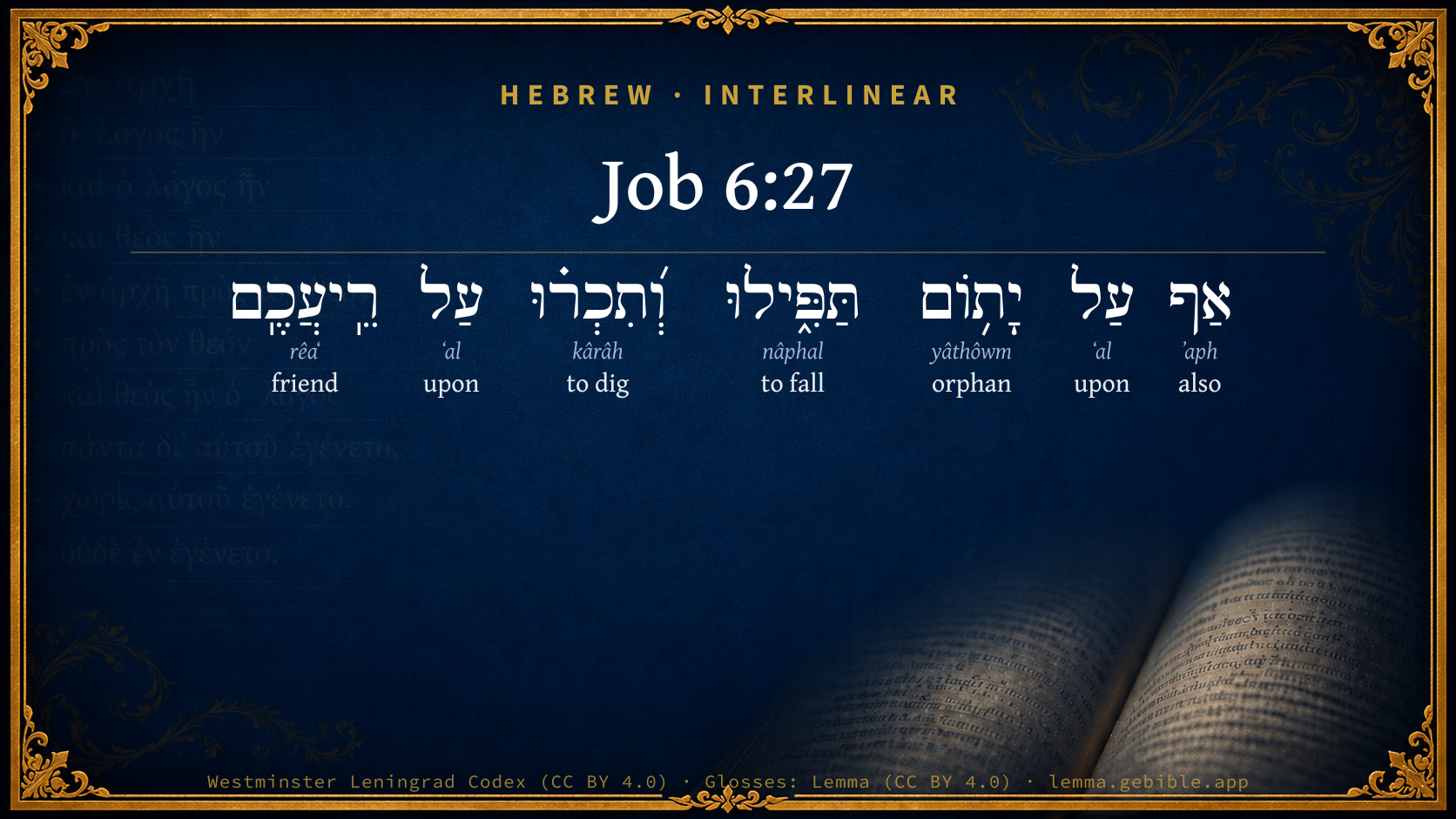
Job 6:27

Hebrew (Westminster Leningrad Codex) Job 6:27 appears in the Hebrew Old Testament. The text above is from the Westminster Leningrad Codex. Each word links to its Strong’s number, a concise gloss, and parsing drawn from the Open Scriptures Hebrew Bible morphology. Click any word for its full Brown-Driver-Briggs (BDB) entry.
Download image
Cite this verse

Job 6:27 (World English Bible). Public Domain. Lemma interlinear Bible study tool, https://lemma.gebible.app/v/job/6/27.

Show BibTeX & RIS
BibTeX
RIS
English Translation
Yes, you would even cast lots for the fatherless, And make merchandise of your friend.
World English Bible · Public Domain
Download a study sheet

One document with this verse’s original text, its word-by-word gloss line, the meaning frame, cross-references with their text, attributed commentary, and full source and license credits — printable, and it pastes into notes with its structure intact.

This verse Autodidact and up

Study sheet (.html) Plain text (.txt)

A passage Seminary Student

Up to 50 verses in one chapter. A passage sheet keeps up to 6 commentary sources and 12 cross-references per verse, in the order this page ranks them, and says so on the sheet whenever that leaves anything out. Ask for a single verse and you get the Autodidact verse sheet above.

Everything on this page stays free to read, with no account — the sheet is a download of what is already on screen, not access to it.

Want to remove ads? Support Godless Engineer
Compare translations 3

The same verse in 3 English versions, stacked beneath the original-language interlinear above. Click any original word for its lexicon entry.

Each is an independent rendering of the whole verse — the interlinear is not word-aligned to these translations.

Highlighted words mark where these versions differ — a whole-verse word diff, not a word-by-word alignment.

  • World English Bible Public Domain
    Yes, you would even cast lots for the fatherless, And make merchandise of your friend.
  • King James Version Public Domain
    Yea, ye overwhelm the fatherless, and ye dig a pit for your friend.
  • unfoldingWord Literal Text CC BY-SA 4.0
    Indeed, you cast for the fatherless, and you haggle over your friend.

unfoldingWord Literal Text — © unfoldingWord, licensed CC BY-SA 4.0. Word-aligned USFM3 via Door43 (git.door43.org/unfoldingWord/en_ult).

Versions to compare (up to 4)

3 of 4 selected

Show all 18 translations

Every available English version of this verse, each an independent rendering of the whole verse.

  • World English Bible Public Domain
    Yes, you would even cast lots for the fatherless, And make merchandise of your friend.
  • Berean Standard Bible Public Domain
    You would even cast lots for an orphan and barter away your friend.
  • Majority Standard Bible Public Domain
    You would even cast lots for an orphan and barter away your friend.
  • King James Version Public Domain
    Yea, ye overwhelm the fatherless, and ye dig a pit for your friend.
  • American Standard Version (1901) Public Domain
    Yea, ye would cast `lots' upon the fatherless, And make merchandise of your friend.
  • Revised Version (1885) Public Domain
    Yea, ye would cast lots upon the fatherless, and make merchandise of your friend.
  • Geneva Bible (1599) Public Domain
    Ye make your wrath to fall vpon the fatherlesse, and dig a pit for your friende.
  • Douay-Rheims (1899) Public Domain
    You rush in upon the fatherless, and you endeavour to overthrow your friend.
  • Young's Literal Translation Public Domain
    Anger on the fatherless ye cause to fall, And are strange to your friend.
  • Literal Standard Version CC BY-SA 4.0
    You cause anger to fall on the fatherless, || And are strange to your friend.
  • Unlocked Literal Bible CC BY-SA 4.0
    Indeed, you cast lots for a fatherless child, and haggle over your friend like merchandise.
  • unfoldingWord Literal Text CC BY-SA 4.0
    Indeed, you cast for the fatherless, and you haggle over your friend.
  • Darby Bible Public Domain
    Yea, ye overwhelm the fatherless, and dig [a pit] for your friend.
  • World Messianic Bible Public Domain
    Yes, you would even cast lots for the fatherless, and make merchandise of your friend.
  • Webster's Bible Public Domain
    Yes, ye overwhelm the fatherless, and ye dig a pit for your friend.
  • Free Bible Version CC BY-SA 4.0
    You would play dice to win an orphan; you would bargain away your friend!
  • Bible in Basic English Public Domain
    Truly, you are such as would give up the child of a dead man to his creditors, and would make a profit out of your friend.
  • JPS Tanakh (1917) Public Domain
    Yea, ye would cast lots upon the fatherless, and dig a pit for your friend.

Literal Standard Version (2020), Covenant Press — licensed CC BY-SA 4.0. Text via the HelloAO Bible API (eBible.org). Unlocked Literal Bible (unfoldingWord) — licensed CC BY-SA 4.0. Text via the HelloAO Bible API (eBible.org). unfoldingWord Literal Text — © unfoldingWord, licensed CC BY-SA 4.0. Word-aligned USFM3 via Door43 (git.door43.org/unfoldingWord/en_ult). Free Bible Version, Dr. Jonathan Gallagher — licensed CC BY-SA 4.0. Text via the HelloAO Bible API (eBible.org).

Word by word

More ways to search: Search by grammar → Find every occurrence → Compare this word →

Practice this passage: Drill this verse → Learn its vocabulary →

About this verse

These counts appear in no published source. They are computed here, from the morphology-tagged text and Lemma’s own curated glosses. What Lemma adds →

7
words
6
distinct lemmas
Wisdom
section

Notable vocabulary

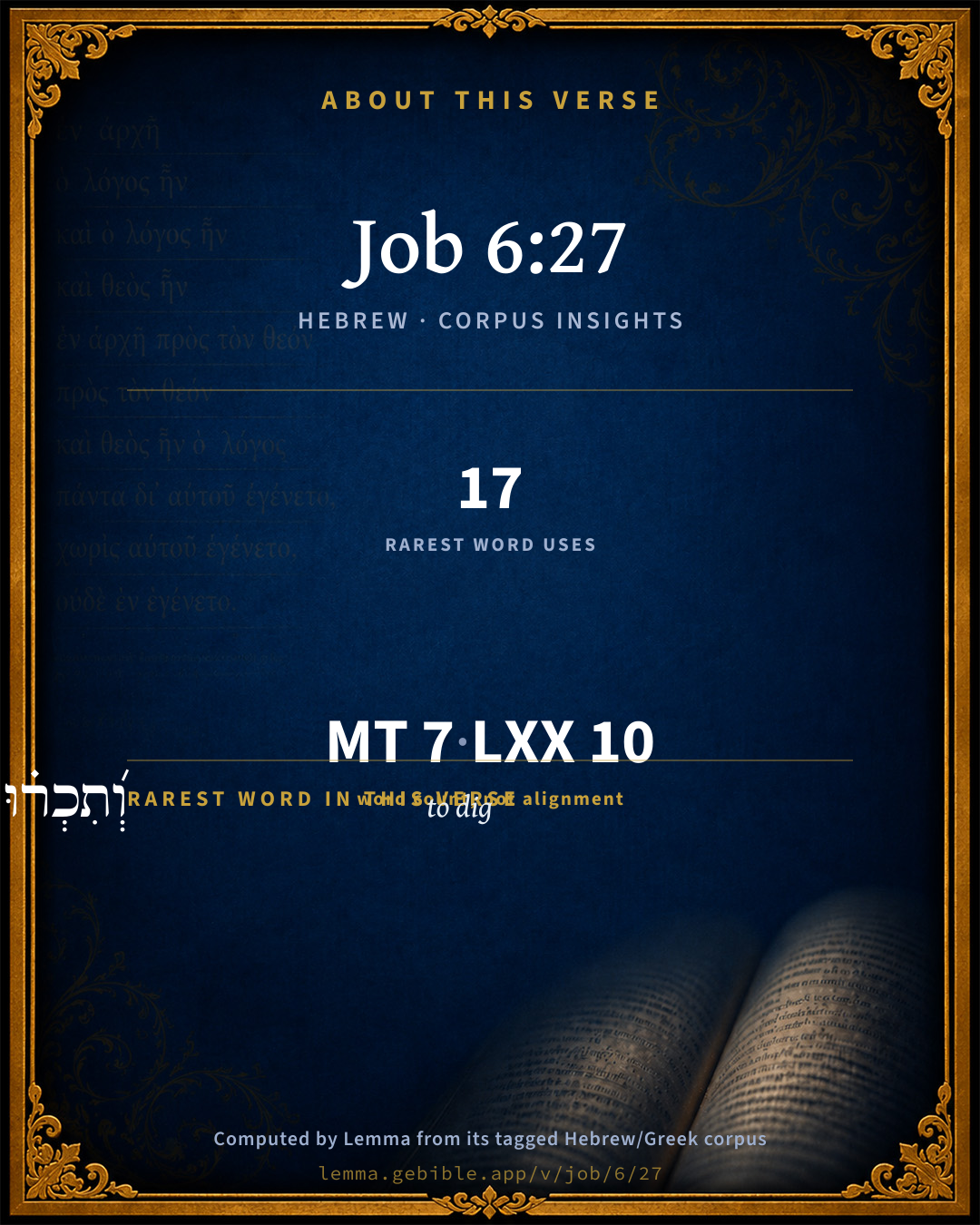
The rarest word here is וְ֝תִכְר֗וּ to dig H3738 — appearing just 17 times in the whole Hebrew Bible.

Shared distinctive vocabulary

וְ֝תִכְר֗וּ to dig H3738 occurs in 17 verses of the Hebrew Bible. Also found in:

Grammatical profile

  • 2 verbs
  • 2 nouns
  • 2 prepositions
  • 1 particle

Verb forms

  • תַּפִּ֑ילוּ Hiphil · Imperfect
  • וְ֝תִכְר֗וּ Qal · Imperfect

Repetition

A word recurs within this verse — often emphatic in Hebrew:

Hebrew & Septuagint length

In English translation the verse runs 15 words from the Hebrew and 10 from the Septuagint (LXX English) — the Septuagint runs noticeably shorter here. See the side-by-side →

A rough comparison of the two English renderings, which tokenize alike — not a word-level alignment.

Word counts can differ between the Hebrew and the Greek without any difference in meaning — e.g. the Hebrew direct-object marker אֵת has no separate Greek word, and Greek often adds the article ὁ.

In the original languages it is 7 Hebrew tokens and 10 Greek tokens — but the two are counted differently (Hebrew bundles its prefixes and suffixes into one token; the Greek is in lemma form), so that isn’t a like-for-like length.

Cross-references

19

Topical passages linked to Job 6:27 in the Treasury of Scripture Knowledge — connected by theme and wording, ordered by reader-vote popularity; previews shown in the World English Bible.

  • Job 22:9 You have sent widows away empty, And the arms of the fatherless have been broken.
  • Job 24:3 They drive away the donkey of the fatherless, And they take the widow's ox for a pledge.
  • Job 24:9 There are those who pluck the fatherless from the breast, And take a pledge of the poor,
  • Psalms 7:15 He has dug a hole, And has fallen into the pit which he made.
  • Joel 3:3 And have cast lots for my people, And have given a boy for a prostitute, And sold a girl for wine, that they may drink.
  • Nahum 3:10 Yet was she carried away. She went into captivity. Her young children also were dashed in pieces at the head of all the streets, and they cast lots for her honorable men, and all her great men were bound in chains.
  • James 1:27 Pure religion and undefiled before our God and Father is this: to visit the fatherless and widows in their affliction, and to keep oneself unstained by the world.
  • 2 Peter 2:3 In covetousness they will exploit you with deceptive words: whose sentence now from of old doesn't linger, and their destruction will not slumber.
  • Exodus 22:22–24 "You shall not take advantage of any widow or fatherless child.
  • Job 29:12 Because I delivered the poor who cried, And the fatherless also, who had none to help him.
  • Job 31:17 Or have eaten my morsel alone, And the fatherless has not eaten of it
  • Job 31:21 If I have lifted up my hand against the fatherless, Because I saw my help in the gate:
  • Psalms 57:6 They have prepared a net for my steps. My soul is bowed down. They dig a pit before me. They fall into the midst of it themselves. Selah.
  • Psalms 82:3 "Defend the weak, the poor, and the fatherless. Maintain the rights of the poor and oppressed.
  • Proverbs 23:10–11 Don't move the ancient boundary stone. Don't encroach on the fields of the fatherless:
  • Jeremiah 18:20 Shall evil be recompensed for good? for they have dug a pit for my soul. Remember how I stood before you to speak good for them, to turn away your wrath from them.
  • Jeremiah 18:22 Let a cry be heard from their houses, when you shall bring a troop suddenly on them; for they have dug a pit to take me, and hid snares for my feet.
  • Ezekiel 22:7 In you have they set light by father and mother; in the midst of you have they dealt by oppression with the foreigner; in you have they wronged the fatherless and the widow.
  • Malachi 3:5 I will come near to you to judgment; and I will be a swift witness against the sorcerers, and against the adulterers, and against the perjurers, and against those who oppress the hireling in his wages, the widow, and the fatherless, and who deprive the foreigner of justice, and don't fear me," says Yahweh of Hosts.

Cross-references courtesy of OpenBible.info (CC BY 4.0).

Hebrew and Greek witnesses Masoretic Hebrew ↔ Greek Septuagint

The same verse in the two great witnesses to the Old Testament, shown verse-for-verse.

Here the Septuagint runs noticeably shorter than the Hebrew — LXX2012 (modern English Septuagint) 10 words vs World English Bible 15. A rough length comparison of the two English translations, not a word-level alignment — read both below.

These are two independent witnesses, not word-aligned to each other, and the Septuagint is shown in lemma (dictionary) form.

Hebrew Job 6:27 Masoretic · Westminster Leningrad Codex

אַף עַל יָת֥וֹם תַּפִּ֑ילוּ וְ֝תִכְר֗וּ עַל רֵֽיעֲכֶֽם

Yes, you would even cast lots for the fatherless, And make merchandise of your friend.

World English Bible · Public Domain

Greek LXX Job 6:27 Septuagint · lemma form

πλήν ὅτι ἐπί ὀρφανός ἐπιπίπτω ἐνἅλλομαι δέ ἐπί φίλος σύ

Even because you⌃ attack the fatherless, and insult your friend.

LXX2012 (modern English Septuagint) · Public Domain

On this verse, Jamieson, Fausset & Brown discusses the Septuagint’s reading. Read the note in Commentary ↓

Hebrew: Westminster Leningrad Codex (CC BY 4.0). Greek: Septuagint (public domain); English from LXX2012 (modern English Septuagint) (Public Domain). How the Septuagint differs from the Hebrew →

Commentary

Notes on Job 6:27 from classic Christian and Jewish commentators (each source and its license shown beneath its notes). The classic Christian expositions comment on the surrounding passage and are grouped to its opening verse, so a note may address several verses; the Jewish commentaries on the Tanakh (Rashi and others) are per-verse, so they appear only where the commentator wrote on this verse.

Lemma curates 59 commentaries, every one of them public domain or Creative Commons licensed, each selected and text-cleaned for this edition rather than reprinted as found. About our sources →

Trapp's Complete Commentary

John Trapp

Job 6:27 Yea, ye overwhelm the fatherless, and ye dig [a pit] for your friend.

Ver. 27. Yea, you overwhelm the fatherless] Heb. Ye throw yourselves upon the fatherless, that is, upon miserable me, who am helpless, friendless, comfortless: see Gen 43:18, that he may roll himself upon us, say they there, as hunters and wild beasts fall upon their prey.

And you dig a pit for your friend] Who had better deserved of you, and expected better usage from you. Here he taxeth them for craft, as before for cruelty, and this to his friend, whom they sought to circumvent, and to drive into desperation. Some read the words thus, You make a feast upon your friend; you banquet upon your companion, and make great cheers, being glad of my calamity, which you make an argument of mine impiety. See Job 41:6 2Ki 6:23.

John Trapp, A Commentary or Exposition upon All the Books of the Old and New Testament (1647–1656) — public domain. Text from a community e-Sword module.

Joseph Benson's Commentary

Job 6:27. Ye overwhelm the fatherless — Your words are not only vain, useless, and uncomfortable to me, but also grievous and pernicious. Hebrew, תפילו, tappilu, you rush, or throw yourselves upon him. You fall upon him with all your might, and say all that you can devise to charge and grieve him. You load him with censures and calumnies. The word יתום, jathom, here rendered fatherless, means a solitary person in distress, as well as an orphan; or one desolate. Job intends himself by the expression, being deprived of all his children, and of all his estate, and forsaken by his friends. And you dig a pit for your friend — You insult and triumph over me, whom once you owned for your friend. I spoke all I thought, as to my friends, and you from thence take occasion to cast me down. There is nothing in the Hebrew for the word pit: it is literally, You dig for your friend; or as Heath and Houbigant render it, make a mock of your friend.

Joseph Benson's Commentary on the Old and New Testaments (1811–1818) — public domain. Text from a community e-Sword module.

Tyndale Open Study Notes

Tyndale Open Resources

6:27 even send an orphan into slavery: Job, the former protector of orphans (31:17, 21), used a proverbial example of his counselors’ hard-heartedness toward the defenseless (see 17:5).

Tyndale Open Study Notes — © Tyndale Open Resources, licensed CC BY-SA 4.0. Text via the HelloAO Bible API.

Jamieson, Fausset & Brown

Robert Jamieson, A. R. Fausset & David Brown

literally, "ye cause" (supply, "your anger") [UMBREIT], a net, namely, of sophistry [NOYES and SCHUTTENS], to fall upon the desolate (one bereft of help, like the fatherless orphan);

and ye dig (a pit) for your friend--that is, try to ensnare him, to catch him in the use of unguarded language [NOYES]. (Psa 57:6); metaphor from hunters catching wild beasts in a pit covered with brushwood to conceal it. UMBREIT from the Syriac, and answering to his interpretation of the first clause, has, "Would you be indignant against your friend?" The Hebrew in Job 41:6, means to "feast upon." As the first clause asks, "Would you catch him in a net?" so this follows up the image, "And would you next feast upon him, and his miseries?" So the Septuagint.

Jamieson, Fausset & Brown — Commentary Critical and Explanatory on the Whole Bible (1871) — public domain (CC PDM 1.0). Text via the HelloAO Bible API.

Adam Clarke's Commentary

Verse 27. Ye overwhelm the fatherless] Ye see that I am as destitute as the most miserable orphan; would ye overwhelm such a one? and would you dig a pit for your friend - do ye lay wait for me, and endeavour to entangle me in my talk? I believe this to be the spirit of Job's words.

Adam Clarke's Commentary on the Bible (1810–1826) — public domain. Text from a community e-Sword/MySword module.

Ellicott's Commentary for English Readers

(27) Yea, ye overwhelm the fatherless.—Rather, probably, Ye would cast lots upon the fatherless, and make merchandise of your friend. This is more

in accordance with the language, and preserves the parallelism.

A Bible Commentary for English Readers, edited by Charles John Ellicott (1878–1897) — public domain. Text from a community e-Sword module.

The Cambridge Bible for Schools and Colleges

gen. ed. J. J. S. Perowne

27. This verse probably reads,

Yea, ye would cast lots upon the fatherless,

And bargain over your friend.

A strong invective against their unfeeling behaviour. The words are severe; the preceding passage, however, in which their refusal of sympathy (Job_6:22-23), and their petty faultfinding with Job’s language (Job_6:25-26), are referred to, naturally leads up to the idea. The same phrase to cast lots occurs 1Sa_14:42, and the phrase, bargain over or make merchandise of, occurs again, Job_41:6 (Heb. 40:30), “will the partners bargain over him?” The “fatherless” is probably the child of the debtor. After his death the ruthless creditors cast lots for possession of the child as a slave.

The Cambridge Bible for Schools and Colleges (gen. ed. J. J. S. Perowne; Cambridge University Press, 1878–1918) — public domain. Text from a community e-Sword module.

John Gill's Exposition

Now therefore be content,.... Or, "may it now please you" (f); Job addresses them in a respectful manner, and entreats them they would be so kind as to look favourably on him, and entertain better thoughts of him; and give a fresh and friendly hearing of his case, when he doubted not he should be acquitted by them of the charge of iniquity, and that his cause would appear to be a righteous one:

look upon me: upon my countenance; and see if you can find any traces of fear and falsehood, of dishonesty and hypocrisy, of shame and blushing; and observe if there is not all the appearance of an honest mind, of a good conscience within, that has nothing to fear from the strictest examination; or look upon my body, covered all over with boils and ulcers, and see if there is not occasion for those expressions of grief, and those heavy complaints that I have made; or rather, look upon me with an eye of pity and compassion, with affection, favour, and benevolence, and not bear so hard upon me:

for it is evident unto you if I lie; or, it is "before your faces" (g); should I attempt to deceive you by telling you a parcel of lies, you would soon discern the falsehood in my countenance; you would easily find it out in my words, which would issue in my shame and confusion; I could not expect to go undetected by men of such sagacity and penetration; but I am not afraid of the most diligent scrutiny that can be made into my words and actions.

(f) "sed nunc placeat vebis", Schmidt. (g) "coram facie vestra", Bolducius, Schultens; Ben Melech interprets it, "by your life if I lie", as being an oath.

John Gill's Exposition of the Whole Bible (1746–1763) — public domain (CC PDM 1.0). Text via the HelloAO Bible API.

Albert Barnes' Notes on the Bible

Yea, ye overwhelm the fatherless - Job undoubtedly means that this should be applied to himself. He complains that they took advantage of his words, that they were disposed to pervert his meaning, and unkindly distorted what he said. The word rendered” fatherless” יתום yâthôm properly denotes an orphan; Exo 22:22; Deu 10:18; Deu 14:29. But it is possible that it is not to be taken in this limited signification here. The word is still retained in the Arabic language - the language spoken in the country where Job lived, - where the word יתום yâthôm means to be lonely, bereaved, etc. It may be that this idea occurs under the form of the word used here, that Job was lonely and bereaved; that he was as desolate and helpless as a fatherless child; and especially that they manifested a spirit like that of those who would oppress an orphan. The word “overwhelm” תפילוּ tapı̂ylû means properly, “ye fall upon;” that is, you deal with him violently. Or, it may mean here, in the Hiphil, “you cause to fall upon,” referring to a net, and meaning, that they sprung a net for the orphan. So Rosenmuller and Noyes understand it. To do this was, in Oriental countries, regarded as a crime of special enormity, and is often so spoken of in the Bible; see the notes at Isa 1:17.

And ye dig a pit for your friend - You act toward your friend as hunters do toward wild beasts. They dig a pit and cover it over with brushwood to conceal it, and the hunted animal, deceived, falls into it unawares. So you endeavor to entrap your friend. You lay a plan for it. You conceal your design. You contrive to drive him into the pit that you have made, and urge him on until you have caught him in the use of unguarded language, or driven him to vent expressions that cover him with confusion. Instead of throwing a mantle of charity over his frailties and infirmities, you make the most of every word, take it out of its proper connection, and attempt to overwhelm him in shame and disgrace. On the method of hunting in ancient times, see the notes at –Job 18:8-10.

Albert Barnes' Notes on the Bible (1834–1885) — public domain. Text from a community e-Sword/MySword module.

Haydock's Catholic Bible Commentary

CHAPTER VI.

George Leo Haydock (1774–1849), Haydock's Catholic Family Bible and Commentary, 1859 edition — public domain. Excludes Psalms (Douay-Rheims chapter numbering differs from Protestant) and Deuterocanonical books (Catholic canon only).

Matthew Poole's English Annotations

Yea; your words are not only vain, and useless, and uncomfortable to me, but also grievous and pernicious.

Ye overwhelm, Heb. you rush or throw yourselves upon him. For words in hiphil are oft put reciprocally as Hebricians know. You fall upon him with all your might, and say all that you can devise to charge and grieve him. A metaphor from wild beasts, that fall upon their prey to hold it fast and devour it. You load him with censures and calumnies.

The fatherless, or, the desolate, i.e. me, who am deprived of all my dear children, and of all my estate; forsaken by my friends, and by my heavenly Father; which should have procured me your pity rather than your censure.

Ye dig a pit for your friend; or, you feed or feast (for so this Hebrew word is oft used, as 2Sa 3:35; 2Ki 6:23; Job 40:15) upon your friend, i.e. you insult and triumph over me whom sometimes you owned for your friend.

Matthew Poole's English Annotations on the Holy Bible (1683–1685) — public domain. Text from a community e-Sword/MySword module.

Whedon's Commentary on the Bible

Daniel D. Whedon

27. Overwhelm — Literally, Cause to fall upon, (as in the margin,) here used elliptically. Accordingly, most moderns render the clause, Ye would even cast lots for the fatherless, in allusion to a custom by which the prey was divided by lot. (See 1Sa_14:42; Jon_1:7.) This is the cruelest charge that Job makes. Carey, however, would supply the word net — and read, “ye spring a net.” The ancient Egyptians, as is still seen on the monuments, ensnared birds with a net. The former rendering is better.

Dig a pit — כרה. Karah, also bears the meaning of traffic; thus, Ye would traffic in your friend; (Ewald, Furst, etc.;) for instance, as the brethren of Joseph trafficked in him. (Comp. Job_41:6.) According to Hitzig, Job sees in his friends a firm conviction that he has been guilty of some unknown offense. In their uncertainty as to its nature they leave (he says) its determination to chance. Serious objections to this view lie on the surface. Hirtzel and Dillmann suggest a painful thought — that the traffic alluded to was in the children of deceased friends, who were sold into captivity to pay the debts of their fathers. (2Ki_4:1.) The reading of the English version is preferred by Rosenmuller and Gesenius. To the present day, among wild nations, the mode mentioned in the text is followed for entrapping wild beasts. The “pit” that has been dug is covered with brushwood and earth. The spot selected is on the wonted path of the animal. Even the elephant falls into such traps. Job, we think, does not mean by this harsh language to charge his friends with having perpetrated these acts; but that their treatment of him contained all the elements of such cruelty.

Daniel D. Whedon (gen. ed.), Commentary on the Old and New Testaments (1874–1909) — public domain. Text from a community e-Sword module.

The Pulpit Commentary

Yea, ye overwhelm the fatherless; rather, on the fatherless would ye east lots. (comp. Joe_3:3 Oba_1:11 Nah_3:10) Job means to say they are so pitiless that they would cast lots for the children of an insolvent debtor condemned to become slaves at his death. (2Ki_4:1 Neh_5:5) And ye dig a pit for your friend; or, ye would make merchandise of your friend"as in the Revised Version. Job does not speak of what his friends had done, but of what he deems them capable of doing.

The Pulpit Commentary (1880–1919), ed. H.D.M. Spence-Jones & Joseph S. Exell — public domain. Text from a community e-Sword module.

John Wesley's Explanatory Notes

Overwhelm - You load with censures and calumnies. Desolate - Me who am deprived of all my children, my estate, and my friends. I spoke all I thought, as to my friends, and you thence occasion to cast me down.

John Wesley, Explanatory Notes Upon the Whole Bible (1754–1765) — public domain. Text via the GEBible commentary corpus.

Rashi

Rabbi Shlomo Yitzchaki (Rashi)

You cast with your judgment, you cast wrath upon a poor man like me, with the line of judgment; and you dig a pit for your friend into which to cast him.

Rashi on the Tanakh — English translations: “The Judaica Press complete Tanach with Rashi, translated by A. J. Rosenberg” (CC BY 4.0); “Pentateuch with Rashi's commentary by M. Rosenbaum and A.M. Silbermann, 1929-1934” (public domain); “The Metsudah Tanach series, Lakewood, N.J” (CC BY 4.0); and “The Book of Joshua, Metsudah Publications, 1997” (CC BY 4.0). Text via Sefaria.

Lesson kit

Teaching starters — assembled from the data on this page, not authored interpretation. Every prompt links to the verse data it draws on. Edit before teaching.

Job, in the Wisdom, opens this verse with 7 words (6 distinct Hebrew lemmas). Its most distinctive word is kârâh (“to dig”). The Greek Septuagint runs shorter here. A historical commentator’s framing appears above. Read the whole chapter for the surrounding context.

Discussion questions

  1. What does “to dig” (kârâh) contribute to the verse as a whole?
  2. Genesis 26:25 shares the word «to dig» with this verse. How do the two illuminate each other?
  3. “upon” occurs 2× in this one verse. What is the effect of the repetition?
  4. Compared with the Hebrew, the Septuagint runs shorter here. What questions does that raise?
  5. These translations render this verse differently. What is at stake in choosing one wording over another?
  6. The verb «תַּפִּ֑ילוּ» is Hiphil Imperfect. How does its form color the action?
  7. Reading how Trapp's Complete Commentary and Joseph Benson's Commentary read this verse, where do the two commentators agree and where do they part?

Things to notice

Reading settings

Reading text

Shown beneath each verse's original-language words.

Old Testament
Old Testament edition

Read the OT as the Masoretic Hebrew (MT) or the Greek Septuagint (LXX).

English shown for the Greek Septuagint (in the Hebrew ↔ Greek comparison).

Comparing translations? Open the Compare panel on any verse page to stack up to four side by side.