
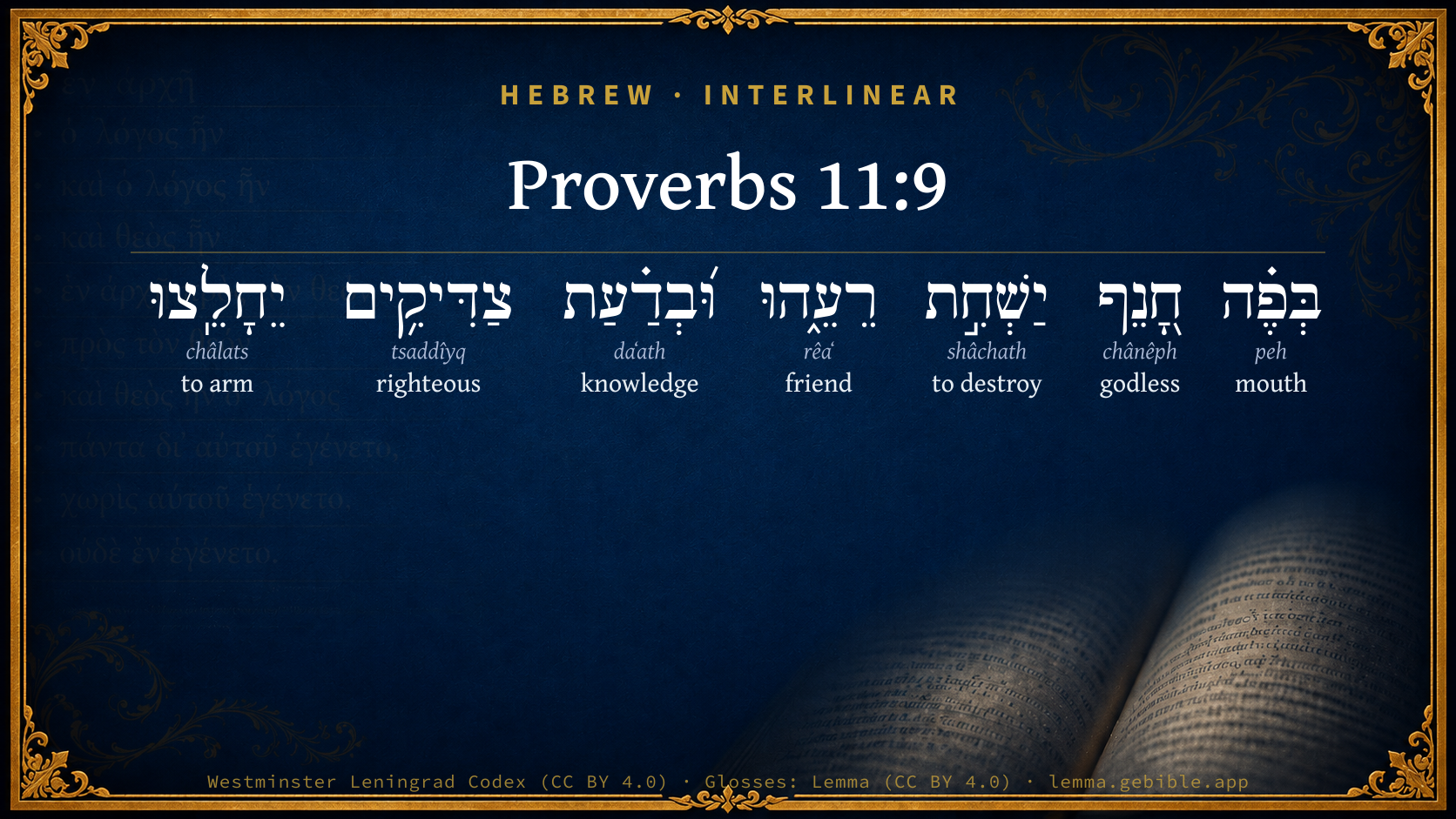
Proverbs 11:9

Hebrew (Westminster Leningrad Codex) Proverbs 11:9 appears in the Hebrew Old Testament. The text above is from the Westminster Leningrad Codex. Each word links to its Strong’s number, a concise gloss, and parsing drawn from the Open Scriptures Hebrew Bible morphology. Click any word for its full Brown-Driver-Briggs (BDB) entry.
Download image
Cite this verse

Proverbs 11:9 (World English Bible). Public Domain. Lemma interlinear Bible study tool, https://lemma.gebible.app/v/proverbs/11/9.

Show BibTeX & RIS
BibTeX
RIS
English Translation
With his mouth the godless man destroys his neighbor, But the righteous will be delivered through knowledge.
World English Bible · Public Domain
Download a study sheet

One document with this verse’s original text, its word-by-word gloss line, the meaning frame, cross-references with their text, attributed commentary, and full source and license credits — printable, and it pastes into notes with its structure intact.

This verse Autodidact and up

Study sheet (.html) Plain text (.txt)

A passage Seminary Student

Up to 50 verses in one chapter. A passage sheet keeps up to 6 commentary sources and 12 cross-references per verse, in the order this page ranks them, and says so on the sheet whenever that leaves anything out. Ask for a single verse and you get the Autodidact verse sheet above.

Everything on this page stays free to read, with no account — the sheet is a download of what is already on screen, not access to it.

Want to remove ads? Support Godless Engineer
Compare translations 3

The same verse in 3 English versions, stacked beneath the original-language interlinear above. Click any original word for its lexicon entry.

Each is an independent rendering of the whole verse — the interlinear is not word-aligned to these translations.

Highlighted words mark where these versions differ — a whole-verse word diff, not a word-by-word alignment.

  • World English Bible Public Domain
    With his mouth the godless man destroys his neighbor, But the righteous will be delivered through knowledge.
  • King James Version Public Domain
    An hypocrite with his mouth destroyeth his neighbour: but through knowledge shall the just be delivered.
  • unfoldingWord Literal Text CC BY-SA 4.0
    With a mouth a godless destroys his neighbor, but with knowledge, the righteous will be delivered.

unfoldingWord Literal Text — © unfoldingWord, licensed CC BY-SA 4.0. Word-aligned USFM3 via Door43 (git.door43.org/unfoldingWord/en_ult).

Versions to compare (up to 4)

3 of 4 selected

Show all 18 translations

Every available English version of this verse, each an independent rendering of the whole verse.

  • World English Bible Public Domain
    With his mouth the godless man destroys his neighbor, But the righteous will be delivered through knowledge.
  • Berean Standard Bible Public Domain
    With his mouth the ungodly man destroys his neighbor, but through knowledge the righteous are rescued.
  • Majority Standard Bible Public Domain
    With his mouth the ungodly man destroys his neighbor, but through knowledge the righteous are rescued.
  • King James Version Public Domain
    An hypocrite with his mouth destroyeth his neighbour: but through knowledge shall the just be delivered.
  • American Standard Version (1901) Public Domain
    With his mouth the godless man destroyeth his neighbor; But through knowledge shall the righteous be delivered.
  • Revised Version (1885) Public Domain
    With his mouth the godless man destroyeth his neighbour: but through knowledge shall the righteous be delivered.
  • Geneva Bible (1599) Public Domain
    An hypocrite with his mouth hurteth his neighbour: but the righteous shall be deliuered by knowledge.
  • Douay-Rheims (1899) Public Domain
    The dissembler with his mouth deceiveth his friend: but the just shall be delivered by knowledge.
  • Young's Literal Translation Public Domain
    With the mouth a hypocrite corrupteth his friend, And by knowledge the righteous are drawn out.
  • Literal Standard Version CC BY-SA 4.0
    A hypocrite corrupts his friend with the mouth, || And the righteous are drawn out by knowledge.
  • Unlocked Literal Bible CC BY-SA 4.0
    With his mouth the godless person destroys his neighbor, but through knowledge righteous people are kept safe.
  • unfoldingWord Literal Text CC BY-SA 4.0
    With a mouth a godless destroys his neighbor, but with knowledge, the righteous will be delivered.
  • Darby Bible Public Domain
    With his mouth a hypocrite destroyeth his neighbour; but through knowledge are the righteous delivered.
  • World Messianic Bible Public Domain
    With his mouth the godless man destroys his neighbor, but the righteous will be delivered through knowledge.
  • Webster's Bible Public Domain
    A hypocrite with his mouth destroyeth his neighbor: but through knowledge shall the just be delivered.
  • Free Bible Version CC BY-SA 4.0
    Godless people mouth off and destroy their neighbors, but the good are saved by wisdom.
  • Bible in Basic English Public Domain
    With his mouth the evil man sends destruction on his neighbour; but through knowledge the upright are taken out of trouble.
  • JPS Tanakh (1917) Public Domain
    With his mouth the impious man destroyeth his neighbour; but through knowledge shall the righteous be delivered.

Literal Standard Version (2020), Covenant Press — licensed CC BY-SA 4.0. Text via the HelloAO Bible API (eBible.org). Unlocked Literal Bible (unfoldingWord) — licensed CC BY-SA 4.0. Text via the HelloAO Bible API (eBible.org). unfoldingWord Literal Text — © unfoldingWord, licensed CC BY-SA 4.0. Word-aligned USFM3 via Door43 (git.door43.org/unfoldingWord/en_ult). Free Bible Version, Dr. Jonathan Gallagher — licensed CC BY-SA 4.0. Text via the HelloAO Bible API (eBible.org).

Word by word

More ways to search: Search by grammar → Find every occurrence → Compare this word →

Practice this passage: Drill this verse → Learn its vocabulary →

About this verse

These counts appear in no published source. They are computed here, from the morphology-tagged text and Lemma’s own curated glosses. What Lemma adds →

7
words
7
distinct lemmas
Wisdom
section

Notable vocabulary

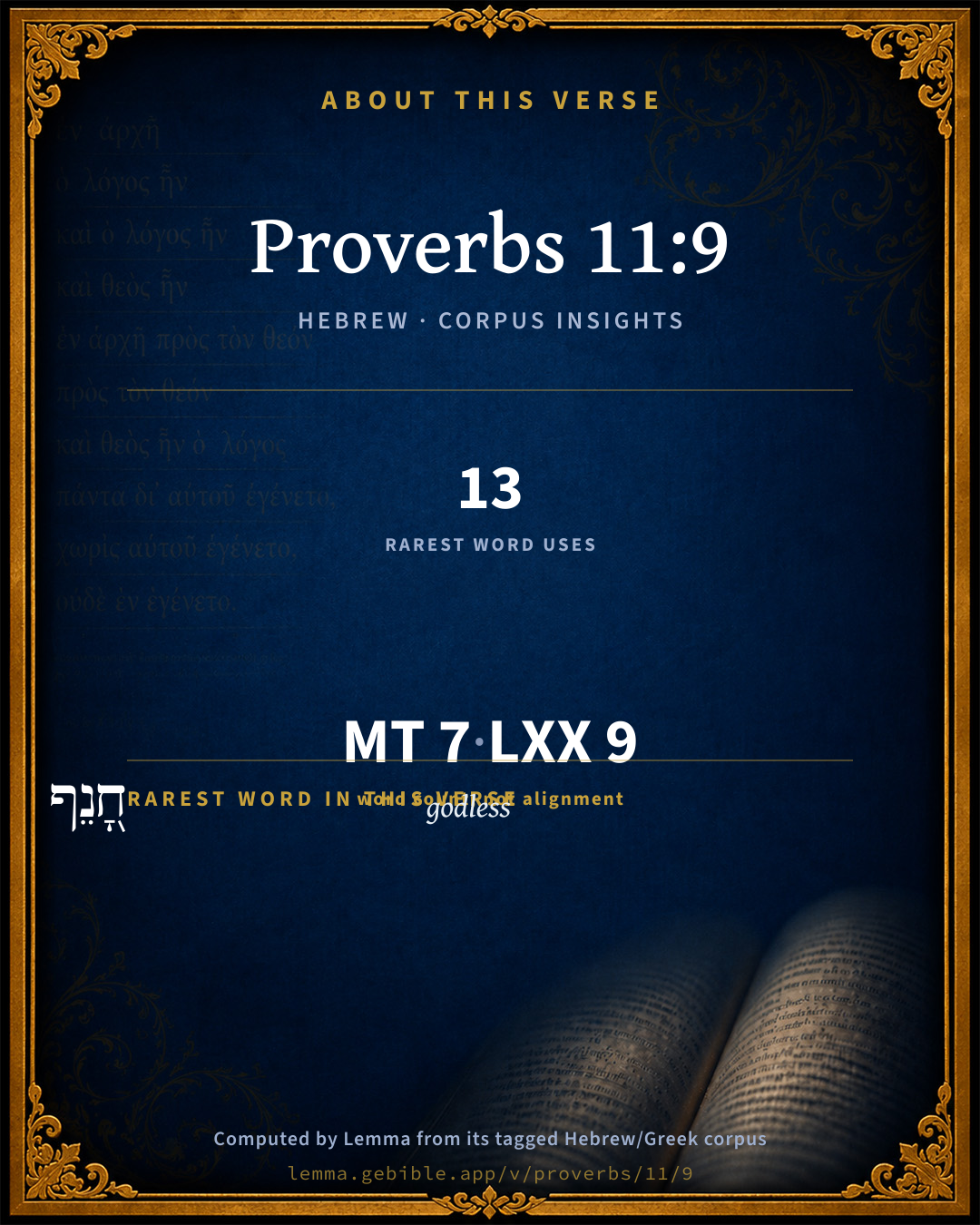
The rarest word here is חָ֭נֵף godless H2611 — appearing just 13 times in the whole Hebrew Bible.

Shared distinctive vocabulary

חָ֭נֵף godless H2611 occurs in 13 verses of the Hebrew Bible. Also found in:

Grammatical profile

  • 2 verbs
  • 3 nouns
  • 2 adjectives

Verb forms

  • יַשְׁחִ֣ת Hiphil · Imperfect
  • יֵחָלֵֽצוּ Niphal · Imperfect

Hebrew & Septuagint length

In English translation the verse runs 17 words from the Hebrew and 19 from the Septuagint (LXX English) — closely comparable.

A rough comparison of the two English renderings, which tokenize alike — not a word-level alignment.

Word counts can differ between the Hebrew and the Greek without any difference in meaning — e.g. the Hebrew direct-object marker אֵת has no separate Greek word, and Greek often adds the article ὁ.

In the original languages it is 7 Hebrew tokens and 9 Greek tokens — but the two are counted differently (Hebrew bundles its prefixes and suffixes into one token; the Greek is in lemma form), so that isn’t a like-for-like length.

Cross-references

23

Topical passages linked to Proverbs 11:9 in the Treasury of Scripture Knowledge — connected by theme and wording, ordered by reader-vote popularity; previews shown in the World English Bible.

  • Proverbs 2:10–16 For wisdom will enter into your heart. Knowledge will be pleasant to your soul.
  • Proverbs 4:5–6 Get wisdom. Get understanding. Don't forget, neither swerve from the words of my mouth.
  • 1 John 2:27 As for you, the anointing which you received from him remains in you, and you don't need for anyone to teach you. But as his anointing teaches you concerning all things, and is true, and is no lie, and even as it taught you, you will remain in him.
  • Job 8:13 So are the paths of all who forget God. The hope of the godless man shall perish,
  • Psalms 55:12 For it was not an enemy who insulted me, Then I could have endured it. Neither was it he who hated me who raised himself up against me, Then I would have hid myself from him.
  • Psalms 55:20–21 He raises his hands against his friends. He has violated his covenant.
  • Proverbs 6:23–24 For the commandment is a lamp, And the law is light. Reproofs of instruction are the way of life,
  • Acts 20:30 Men will arise from among your own selves, speaking perverse things, to draw away the disciples after them.
  • 2 Corinthians 11:13–15 For such men are false apostles, deceitful workers, masquerading as Christ's apostles.
  • 1 Timothy 4:1–3 But the Spirit says expressly that in later times some will fall away from the faith, paying attention to seducing spirits and doctrines of demons,
  • 2 Peter 2:1–3 But there also arose false prophets among the people, as among you also there will be false teachers, who will secretly bring in destructive heresies, denying even the Master who bought them, bringing on themselves swift destruction.
  • 2 Peter 3:16–18 as also in all of his letters, speaking in them of these things. In those are some things hard to be understood, which the ignorant and unsettled twist, as they also do to the other Scriptures, to their own destruction.
  • 1 John 2:21 I have not written to you because you don't know the truth, but because you know it, and because no lie is of the truth.
  • 1 Kings 22:6 Then the king of Israel gathered the prophets together, about four hundred men, and said to them, Shall I go against Ramoth-gilead to battle, or shall I forbear? They said, Go up; for the Lord will deliver it into the hand of the king.
  • 1 Kings 22:20–23 Yahweh said, Who shall entice Ahab, that he may go up and fall at Ramoth-gilead? One said on this manner; and another said on that manner.
  • Job 34:30 That the godless man may not reign, That there be no one to ensnare the people.
  • Matthew 7:15 "Beware of false prophets, who come to you in sheep's clothing, but inwardly are ravening wolves.
  • Matthew 15:5–14 But you say, 'Whoever may tell his father or his mother, "Whatever help you might otherwise have gotten from me is a gift devoted to God,"
  • Ephesians 4:13–14 until we all attain to the unity of the faith, and of the knowledge of the Son of God, to a full grown man, to the measure of the stature of the fullness of Christ;
  • 1 Kings 13:18–22 He said to him, I also am a prophet as you are; and an angel spoke to me by the word of Yahweh, saying, Bring him back with you into your house, that he may eat bread and drink water. [But] he lied to him.
  • Mark 13:14 But when you see the abomination of desolation, spoken of by Daniel the prophet, standing where it ought not (let the reader understand), then let those who are in Judea flee to the mountains,
  • Mark 13:22–23 For there will arise false christs and false prophets, and will show signs and wonders, that they may lead astray, if possible, even the chosen ones.
  • 2 Thessalonians 2:8–10 Then the lawless one will be revealed, whom the Lord will kill with the breath of his mouth, and bring to nothing by the brightness of his coming;

Cross-references courtesy of OpenBible.info (CC BY 4.0).

Hebrew and Greek witnesses Masoretic Hebrew ↔ Greek Septuagint

The same verse in the two great witnesses to the Old Testament, shown verse-for-verse.

These are two independent witnesses, not word-aligned to each other, and the Septuagint is shown in lemma (dictionary) form.

Hebrew Proverbs 11:9 Masoretic · Westminster Leningrad Codex

בְּפֶ֗ה חָ֭נֵף יַשְׁחִ֣ת רֵעֵ֑הוּ וּ֝בְדַ֗עַת צַדִּיקִ֥ים יֵחָלֵֽצוּ

With his mouth the godless man destroys his neighbor, But the righteous will be delivered through knowledge.

World English Bible · Public Domain

Greek LXX Proverbs 11:9 Septuagint · lemma form

ἐν στόμα ἀσεβής παγίς πολίτης αἴσθησις δέ δίκαιος εὔοδος

In the mouth of ungodly men is a snare to citizens: but the understanding of righteous men is prosperous.

LXX2012 (modern English Septuagint) · Public Domain

On this verse, The Cambridge Bible for Schools and Colleges discusses the Septuagint’s reading. Read the note in Commentary ↓

Hebrew: Westminster Leningrad Codex (CC BY 4.0). Greek: Septuagint (public domain); English from LXX2012 (modern English Septuagint) (Public Domain). How the Septuagint differs from the Hebrew →

Commentary

Notes on Proverbs 11:9 from classic Christian and Jewish commentators (each source and its license shown beneath its notes). The classic Christian expositions comment on the surrounding passage and are grouped to its opening verse, so a note may address several verses; the Jewish commentaries on the Tanakh (Rashi and others) are per-verse, so they appear only where the commentator wrote on this verse.

Lemma curates 59 commentaries, every one of them public domain or Creative Commons licensed, each selected and text-cleaned for this edition rather than reprinted as found. About our sources →

Trapp's Complete Commentary

John Trapp

Pro 11:9 An hypocrite with [his] mouth destroyeth his neighbour: but through knowledge shall the just be delivered.

Ver. 9. An hypocrite with his mouth destroyeth.] That is, The flatterer, slanderer, evil counsellor, but especially the heretic, as the Valentinians, qui artificium habuerunt, quo prius persuaderent quam docerent, {a} by their Pythanology. "By good words and fair speeches they deceive the hearts of the simple." {Rom 16:18} They bring men into the lion’s mouth, as that old seducer did, by telling them of an angel that spoke to them, and so make prize of them, {Col 2:8} and "drag disciples after them." {Act 20:30}

But through knowledge shall the just be delivered.] He is too wise to be flattered, and too knowing to be plucked away with the error of the wicked. {1Pe 3:17-18} Zanchius was set upon by Socinus, but the heretic lost his labour. {b} Wherefore add to your virtue knowledge, {2Pe 1:5} and have your senses exercised to discern good and evil. {Heb 5:14}

{a} Tertullian.

{b} Zanch., Misc.

John Trapp, A Commentary or Exposition upon All the Books of the Old and New Testament (1647–1656) — public domain. Text from a community e-Sword module.

The Biblical Illustrator

Joseph S. Exell

Pro_11:9

An hypocrite with his mouth destroyeth his neighbour: but through knowledge shall the just be delivered.

Hypocrisy and knowledge

The hypocrite is one who feigns to be what he is not--one whose life is a lie. Selfish, he wears the costume of benevolence; false, he speaks the language of sincerity and truth.

I. Hypocrisy is destructive. The hypocrite, by his deception, has often destroyed the reputation, the peace, end the soul of his neighbour. Hypocrisy--

1. Implies the pernicious. A consciousness of wrongness within is the cause of all hypocrisy.

2. Employs the pernicious. Misrepresentations are its instruments.

II. Knowledge is restorative. Knowledge here is in antithesis with hypocrisy. Real knowledge is truth, reality. It scatters the clouds of ignorance and error, and raises the soul to light, freedom, purity and blessedness. (D. Thomas, D.D.)

The insincere

This verse may be understood with a reference to all insincere professions of friendship and good intentions--to all insinuating and flattering pretensions, adopted for the purpose of affecting a particular end. How many are there who, for objects of their own deceive others; no matter what the result may be to the deceived, provided the deceiver but accomplish his selfish aim. In religion, the hypocrite has a purpose. His religion is not real. He assumes the cloak to cover some secret design. The verse itself suggests the design--the undermining of the principles of others. He insinuates himself into confidence. The confidence increasing, he becomes by degrees more and more bold, till, by slow steps, he unsettles the principles, shakes the faith, dissipates the seriousness, and ruins the souls of others. Hypocrites are awful stumbling blocks. (R. Wardlaw.)

The Biblical Illustrator, edited by Joseph S. Exell (c. 1880s–1900s) — public domain. Text from a community e-Sword module.

Joseph Benson's Commentary

Pro 11:9. A hypocrite with his mouth — By his corrupt communication; destroyeth his neighbour — Draws him into error or sin; but through knowledge — Namely, of God and of his word, which, making men wise, discovers and so prevents the frauds of deceivers; shall the just be delivered — From the infection of the evil and crafty counsel of hypocrites.

Joseph Benson's Commentary on the Old and New Testaments (1811–1818) — public domain. Text from a community e-Sword module.

The Preacher's Complete Homiletical Commentary

Joseph S. Exell (gen. ed.)

CRITICAL NOTES.—

Pro_11:9. Zӧckler here reads, “The hypocrite with his mouth destroyeth his neighbour, but by the knowledge of the righteous shall they (the neighbours) be delivered.”

MAIN HOMILETICS OF Pro_11:9

THE JUST MAN DELIVERED FROM THE MOUTH OF THE HYPOCRITE

I. We have here—

1. A character most difficult to maintain. The actor cannot always be playing his part, he must have times when his own individuality asserts itself—when he appears the man he really is. The man most in love with the dramatic art finds a few hours’ practice at a time enough for him, and feels it a relief to throw off his stage character and be himself again. He cannot, if he would, be ever trying to live in an experience that does not belong to him—be ever assuming an individuality which is not his own property. It would be an intolerable burden to be always endeavouring to sustain a part. A hypocrite has set himself a hard task. He has undertaken to pretend to be living a life which he knows does not belong to him, and which he never can possess unless his whole nature is regenerated. Now to keep up the deportment and to use the language that belong to a true nature must be as difficult as for a professional actor always to be playing the part of a king. The hypocrite must sometimes feel that his life is a sort of treadmill, and must sometimes be overcome by his real self in spite of all efforts to prevent nature from asserting her rights. No hypocrite can be always in his stage dress. The character is difficult to sustain.

2. A character most injurious to mankind and most miserable for the man who owns it. The actor plays his part by assuming the character of another man, but he does this without necessarily injuring himself or any of his fellow-creatures. But it is not so with the hypocrite. If a bad man assumes the garb of a good man he tends to lessen the estimation of real goodness in the minds of men. The existence of false coin makes us suspicious of genuine gold. The hypocrite must be conscious that he is a living lie, and so a living curse to his fellow-creatures, and this consciousness can but make him miserable.

3. A character in danger of becoming irreclaimable. A man who tries to pass for a scholar when he is utterly ignorant is the most difficult person to change into a scholar. The man who desires to be always first among his fellows is the least likely to become a qualified leader of men. We have it on the best authority that whatever such a man may desire, that “whosoever will be chief shall be a servant” (Mat_20:27). He is only fit for a low position who is ever straining every nerve after a high one. The hypocrite is ever desiring to pass for what he is not—he is ever desiring to fill a place for which he is utterly unfit. He is less likely than the most openly vicious man ever to become in reality that which he is ever seeming to be. This was the judgment of the Son of God concerning the hypocrites of His day: “Verily I say unto you that the publicans and the harlots go into the kingdom of God before you” (Mat_21:31).

4. A character most hateful to God and to man. A hypocrite must be disliked by those whose character he endeavours to personify. The good must hate hypocrisy because, as we said before, it lessens the power of goodness in the world by making men suspect the really good. A hypocrite is hated by other hypocrites. If a man wants to utter false coin himself, he prefers to enjoy a monopoly of the business. The more of it there is in circulation the less likely people are to be deceived by it. A hypocrite is hateful to God. No sin is so denounced under both the old and new dispensations as the sin of hypocrisy. “Incense is an abomination unto Me; the new moons and Sabbaths, the calling of assemblies, I cannot away with it.… Your new moons and your appointed feasts my soul hateth” (Isa_1:13-14). The God of Israel reserves these burning words for His own people, who were drawing near to Him with their lips, while their hearts were far from Him. The most terrible denunciations of the Son of God were uttered against those who were guilty of this sin. “Woe unto you, Scribes and Pharisees, hypocrites,” is repeated again and again in one discourse (Matthew 23).

II. The chief instrument used by the hypocrite. “The mouth.” The power of speech is a most precious gift of God, and is intended by Him to be an instrument of blessing to the human race. It is this most precious instrument of good that the hypocrite is here represented as turning into an all-devouring weapon of destruction. He is like a man who gives potent poison for healing medicine. He may have disguised its deadly nature under an unknown and high-sounding name, but this will not lessen its deadly effects. The hypocrite is the man who above all others is skilful in making words the means of concealing thoughts—who speaks so plausibly that men believe they are drinking a healthful draught when they are imbibing a deadly poison. The tongue of the hypocrite destroys his neighbour because he makes him believe that he has his welfare at heart when he is really plotting his destruction. He makes him believe that some utterly worthless commercial speculation is sound and profitable, and so involves him in material destruction. Or he persuades him that a certain course of dishonest conduct is without moral danger, and so brings him into spiritual destruction. His neighbour’s destruction is certain in proportion to the strength of his confidence in the words of the hypocrite.

III. The means of deliverance from the hypocrite’s mouth. “Through knowledge shall the just be delivered.” The just man possesses a knowledge of God, and thus has a correct standard of character by which to judge men. If a man walks in the light of the sun he will be able to avoid pitfalls and open graves. A just man has an acquaintance with the character and the laws of God. He “walks in the light” (1Jn_1:7). And this gives him an insight into character—this furnishes him with a test to “try the spirits whether they are of God” (1Jn_4:1). The more men come into contact with reality the more quick will they be to detect unreality. The more men know God the more correct will be the estimate they form of their fellow-men. The Spirit of wisdom is a Spirit of “enlightenment” on this point as on all others (Eph_1:18). The law of the Lord “makes wise the simple” or the unwary (Psa_19:7). That scripture which is the “inspiration of God” “furnishes the man of God” with a means of escape from the snare of the hypocrite’s mouth (2Ti_3:16). The knowledge which is derived from its study is a foil for the attacks of the most subtle seducer.

OUTLINES AND SUGGESTIVE COMMENTS

Haman, under the pretence of loyalty, would have destroyed a whole nation (Est_3:8; Est_3:13). Ziba, under the same false cover, would have destroyed his neighbour (2Sa_16:1; 2Sa_16:4). The lying prophet, from mere wilfulness, ruined his brother (1 Kings 13).

Then look at the hypocrite in the church—“a ravening wolf in sheep’s clothing,” devouring the flock (Mat_7:15); “making merchandise with feigned words” (2Pe_2:1; 2Pe_2:3); an “apostle of Satan,” so diligent is he in his master’s work of destruction (2Co_11:3; 2Co_11:13). “These false Christs,” we are warned, “deceive many,” if it were possible the very elect (Mat_24:24).… Learn the value of solid knowledge. Feeling, excitement, imagination, expose us to an unsteady profession. (Such as Eph_4:14) Knowledge supplies principle and steadfastness. “Add to your faith knowledge” (2Pe_1:5).—Bridges.

Hypocrites are awful stumbling blocks. Full many has the detection of their true character hardened in sin and worldliness, and established in infidelity. Full many have they thus destroyed.—Wardlaw.

When God converts a soul, He gives it light. That light makes it invulnerable. All things afterward help it. “Virtue may be assailed, but never hurt.” Satan is one of the blessings of a Christian.—Miller.

It was an ordinary prayer of King Antigonus, “Deliver me from the hands of my friends.” When asked why he did not rather pray for preservation from his enemies, he answered, “That he guarded against his enemies, but could not guard against false friends.”—Lawson.

How to detect a hypocrite. To make a man a good man all parts of goodness must concur, but any one way of wickedness is sufficient to denominate a bad man.—Tillotson.

A hypocrite is hated of the world for seeming to be a Christian, and hated of God for not being one.—Mason.

The meaning of the verse as a whole is, “By the protective power of that knowledge that serves righteousness, they are delivered who were endangered by the artifices of that shrewdness which is the instrument of wickedness.”—Elster.

The just man is too wise to be flattered, and too knowing to be plucked away with the error of the wicked (1Pe_3:17-18).—Trapp.

Beware of carrying deadly weapons. An untrue man is a moral murderer, his mouth the lethal weapon, and his neighbour the victim.—Arnot.

“Neither man nor angels can discern

Hypocrisy, the only evil that walks

Invisible, except to God alone,

By His permissive will, thro’ heaven and earth:

And oft though Wisdom wake, suspicion sleeps

At Wisdom’s gate, and to simplicity

Resigns her charge, while goodness

Thinks no ill

Where no ill seems.”

Paradise Lost. Book iii.

The Preacher's Complete Homiletical Commentary (gen. ed. Joseph S. Exell; Funk & Wagnalls, c. 1892) — public domain (pre-1929). A full-Bible homiletical/sermon-outline anthology covering 65 of 66 books (2 John is absent from the source module). Text from a community e-Sword module.

Geneva Bible (1599)

Geneva Bible translators

A dissembler that pretendeth friendship, but is a privy enemy.

Geneva Bible (1599) marginal notes — public domain. Text via Bolls.life.

Matthew Henry's Commentary

Here is, 1. Hypocrisy designing ill. It is not only the murderer with his sword, but the hypocrite with his mouth, that destroys his neighbour, decoying him into sin, or into mischief, by the specious pretences of kindness and good-will. Death and life are in the power of the tongue, but no tongue more fatal than the flattering tongue. 2. Honesty defeating the design and escaping the snare: Through knowledge of the devices of Satan shall the just be delivered from the snares which the hypocrite has laid for him; seducers shall not deceive the elect. By the knowledge of God, and the scriptures, and their own hearts, shall the just be delivered from those that lie in wait to deceive, and so to destroy, Rom 16:18, Rom 16:19.

Matthew Henry's Commentary on the Whole Bible (1708–1710) — public domain (CC PDM 1.0). Text via the HelloAO Bible API.

Jamieson, Fausset & Brown

Robert Jamieson, A. R. Fausset & David Brown

(Compare Psa 35:16; Dan 11:32). The just is saved by superior discernment.

Jamieson, Fausset & Brown — Commentary Critical and Explanatory on the Whole Bible (1871) — public domain (CC PDM 1.0). Text via the HelloAO Bible API.

Adam Clarke's Commentary

Verse 9. A hypocrite with his mouth] חנף chaneph might be better translated infidel than hypocrite. The latter is one that pretends to religion; that uses it for secular purposes. The former is one who disbelieves Divine revelation, and accordingly is polluted, and lives in pollution. This is properly the force of the original word. Such persons deal in calumny and lies, and often thus destroy the character of their neighbour. Besides, they are very zealous in propagating their own infidel notions; and thus, by this means, destroy their neighbour; but the experimental knowledge which the just have of God and his salvation prevents them from being ensnared.

Adam Clarke's Commentary on the Bible (1810–1826) — public domain. Text from a community e-Sword/MySword module.

Ellicott's Commentary for English Readers

(9) An hypocrite.—Rather, the impure, profane.

Through knowledge.—The just, by the knowledge given them by God, shall see through the fraud.

A Bible Commentary for English Readers, edited by Charles John Ellicott (1878–1897) — public domain. Text from a community e-Sword module.

The Cambridge Bible for Schools and Colleges

gen. ed. J. J. S. Perowne

9. be delivered] i.e. from the destruction wrought by the “mouth of the hypocrite, (or godless man R.V.)”. His knowledge will enable him to see and avoid the snare (παγὶς, LXX.).

Some, however, would render, “through the knowledge of the righteous shall they (i.e. the neighbour of the first clause, which as a noun of multitude may have a plural verb) be delivered.” This may be intended by the LXX.: ἐν στόματι ἀσεβῶν παγὶς πολίταις, αἴσθησις δὲ δικαίων εὔοδος (sc. πολίταις).

The Cambridge Bible for Schools and Colleges (gen. ed. J. J. S. Perowne; Cambridge University Press, 1878–1918) — public domain. Text from a community e-Sword module.

John Gill's Exposition

An hypocrite with his mouth destroyeth his neighbour,.... Deceives him with his flatteries and lies, and draws him into destructive schemes and practices; or "corrupts" him, as the word (i) signifies, and as the Targum renders it, with false doctrines; so, with fair words and good speeches, such who lie in wait to deceive impose upon the simple and credulous; and false teachers, with their damnable heresies, bring swift destruction on men; and particularly antichrist and his emissaries, through speaking lies in hypocrisy, corrupt and destroy many, Ti1 4:1;

but through knowledge shall the just be delivered; from the hypocrite and deceitful worker, and from being corrupted and destroyed by the words of his mouth: Jarchi says, through the knowledge of the law, which warns against him; but rather through the knowledge of the Gospel, which the just man has; for as by this such escape the pollutions of the world, so likewise they are delivered, are kept and secured, from the error of the wicked: through a man's knowledge of himself, of his descent from Adam, of the corruption of his nature, of the plague of his heart, and the exceeding sinfulness of sin; of his lost and undone state; of his impotency to that which is good, of his incapacity to fulfil the law, and atone for sin; and of the insufficiency of his own righteousness to justify him before God; he is delivered and preserved from giving into the notions of the purity of human nature, the power of free will, and the doctrine of justification by works: through his knowledge of the person of Christ; of his offices and relations; of him as a Saviour; of the efficacy of his blood, the excellency of his righteousness, and the completeness of his sacrifice; and through the knowledge of God in Christ, and of the Spirit and of his operations of grace, as well as of the sacred Scriptures in general; he is safe from being carried away with any errors concerning any of the divine Persons, particularly concerning the deity, sonship, and satisfaction of Christ; in short, as ignorance is the mother of devotion, superstition, and error, in the church of Rome, spiritual experimental knowledge of the above things is the best preservative from all errors and heresies which corrupt and destroy the souls of men, to be found in that apostate church, or elsewhere.

(i) "corrumpet", Schultens; so Pagninus, Montanus; "corrumpit", Vatablus, Junius & Tremellius, Piscator, Mercerus, Gejerus.

John Gill's Exposition of the Whole Bible (1746–1763) — public domain (CC PDM 1.0). Text via the HelloAO Bible API.

Albert Barnes' Notes on the Bible

Through knowledge - Better, By the knowledge of the just, shall they (i. e., the neighbors) be delivered.

Albert Barnes' Notes on the Bible (1834–1885) — public domain. Text from a community e-Sword/MySword module.

Matthew Poole's English Annotations

With his mouth; by his corrupt communication, whereby he endeavours to draw him to error or wickedness.

Through knowledge, to wit, of God, and of his word, which makes men wise, and discovers, and so prevents, the frauds of deceivers.

Be delivered from the infection of the hypocrite’s evil and crafty counsel.

Matthew Poole's English Annotations on the Holy Bible (1683–1685) — public domain. Text from a community e-Sword/MySword module.

Whedon's Commentary on the Bible

Daniel D. Whedon

9. A hypocrite — Literally, a profane, or godless man.

Neighbour — By the mouth of an impure wretch his neighbour is (often) destroyed; but by the intelligence of the righteous he — the neighbour — shall be delivered; that is, from his calamities. Another construction of the latter clause is, By the knowledge of the just shall he (the neighbour) be delivered.

Daniel D. Whedon (gen. ed.), Commentary on the Old and New Testaments (1874–1909) — public domain. Text from a community e-Sword module.

The Pulpit Commentary

A hypocrite (chaneph); simulator, Vulgate. So translated continually in Job, e.g. Job_8:13 Job_13:16, etc. Others take it to mean "profane," "godless." Such a man, by his falsehoods, insinuations, and slanders, destroys his neighbour as far as he is able. (Pro_12:6) Septuagint, "In the mouth of the wicked is a snare for fellow citizens." Through knowledge. By the knowledge which the just possess, and which they display by judicious counsel, peace and safety are secured. Septuagint, "Knowledge affords an easy path (euodov ) for the just."

The Pulpit Commentary (1880–1919), ed. H.D.M. Spence-Jones & Joseph S. Exell — public domain. Text from a community e-Sword module.

John Wesley's Explanatory Notes

Delivered - From the infection of the hypocrite's evil counsel.

John Wesley, Explanatory Notes Upon the Whole Bible (1754–1765) — public domain. Text via the GEBible commentary corpus.

Keil & Delitzsch

C. F. Keil & F. Delitzsch

9 The wicked with his mouth prepareth destruction for his neighbour;

But by knowledge the righteous are delivered from it.

The lxx translate, ἐν στόματι ἀσεβῶν παγὶς (רשׁת?) πολίταις, αἴσθησις δὲ δικαίοις εὔοδος, (יצלחו). There is no reason for changing (with Hitzig and Ewald) the text, which in the form in which it is here translated was before all other translators (Aq., Symmachus, Theodotion, Syr., Targ., Jerome). The accentuation, which separates the two instrumental statements by greater disjunctives from that which follows, is correct. The "three" Greek versions viz. of Aquila, Theodotion, and Symmachus translate חנף by ὑποκριτής, which it means in the modern idiom; but in the ancient Hebr. it signifies, him who is resolved upon evil, as in Arab. ḥanyf, him who is resolved upon that which is right: he who turns aside to evil enters on a path far removed from that which is right. In ישׁחית one is reminded (without any etymological reason) of שׁחת (pit), and so in יחלצוּ of משּׁחיתותם (Psa 107:20) or a similar word; but בּדּעת contains the reference, in this connection not easy to be mistaken, to the hostile purposes of the wicked masked by the words of the mouth, which are seen through by the righteous by virtue of knowledge which makes them acquainted with men. This penetrating look is their means of deliverance.

Keil & Delitzsch — Biblical Commentary on the Old Testament (1861–1891) — public domain (CC PDM 1.0). Text via the HelloAO Bible API. (Old Testament only.)

Bridges on Proverbs

Charles Bridges

Haman under the pretence of loyalty would have destroyed a whole nation. (Est 3:8-13 .) Ziba under the same false cover would have destroyed his neighbour. (2Sa 16:1-4 .) The lying prophet from mere willfulness ruined his brother.†1 Such is the hypocrite’s mouth! "a little member;" but "a world of iniquity: set on fire of hell." (Jas 3:5-6 .)

Then look at him in the church — "a ravening wolf in sheep’s clothing," devouring the flock (Mat 7:15 ); "making merchandize with feigned words" (2Pe 2:1-3 ); an apostle of Satan, so diligent is he in his Master’s work of destruction! (2Co 11:3, 2Co 11:13 .) "These false Christs" — we are warned — "deceive many; if it were possible the very elect." (Mat 24:24 .) But they — the just — are delivered through knowledge — ’by the light and direction of the Holy Ghost, and by the lively knowledge of God’s word, which giveth unto the faithful man wisdom sufficient for his preservation.’†2 Learn the value of solid knowledge. Feeling, excitement, imagination, expose us to an unsteady profession.†3 Knowledge supplies principle and steadfastness. "Add to your faith knowledge." (2Pe 1:5 .) Guard against plausible error, usually built upon some single truth, separated from its connection, and pressed beyond its due proportion. Do not the many delusions of our day give force to the earnest exhortation — "Take fast hold of instruction; let her not go; keep her, for she is thy life"? (Pro 4:13 .)

Footnotes:

†1 No reference or footnote is given here in the book, but Mr. Bridges seems to be alluding to 1Ki 13:11-30 .

†2 Diodati. Compare Heb 5:14 . 1Jn 2:20, 1Jn 2:27 . 2Pe 3:17-18 .

†3 Such as Eph 4:14 .

Charles Bridges, An Exposition of the Book of Proverbs (1846) — public domain. Text from a community e-Sword module.

Kretzmann's Popular Commentary

Paul E. Kretzmann

v. 9. An hypocrite with his mouth destroyeth his neighbor, for with his flattering he hides his real intention until he accomplishes his evil purpose; but through knowledge shall the just be delivered, his shrewdness enables him to unveil the schemes of the flatterer and to escape their evil effect.

Paul E. Kretzmann, Popular Commentary of the Bible (1921–1924) — public domain. Text from a community e-Sword module.

unfoldingWord translationNotes

Door43 World Missions Community

With his mouth the godless

"Mouth" represents what a person says. AT: "The words of the godless" (See: Metonymy)

the city becomes great

"City" represents the community or people group. AT: "the people group prospers" or "the community becomes prosperous" (See: Metonymy)

by the mouth of the wicked

"Mouth" represents what a person says. AT: "the words of evil people" (See: Metonymy)

translationWords

godly

neighbor

know

joy

evil

perish

joy

God

unfoldingWord translationNotes — © Distant Shores Media and the Door43 World Missions Community, licensed CC BY-SA 4.0. Source: git.door43.org/Door43/en_tn.

Rashi

Rabbi Shlomo Yitzchaki (Rashi)

With his mouth, the flatterer The flatterer who entices his friend on an evil way, destroys him with his mouth.

but with knowledge, righteous men are extricated But the righteous man is extricated from [the flatterer] with the knowledge of the Torah, which warned concerning him (Deut. 13: 9): “You shall not consent to him, etc.”

Rashi on the Tanakh — English translations: “The Judaica Press complete Tanach with Rashi, translated by A. J. Rosenberg” (CC BY 4.0); “Pentateuch with Rashi's commentary by M. Rosenbaum and A.M. Silbermann, 1929-1934” (public domain); “The Metsudah Tanach series, Lakewood, N.J” (CC BY 4.0); and “The Book of Joshua, Metsudah Publications, 1997” (CC BY 4.0). Text via Sefaria.

Lesson kit

Teaching starters — assembled from the data on this page, not authored interpretation. Every prompt links to the verse data it draws on. Edit before teaching.

Proverbs, in the Wisdom, opens this verse with 7 words (7 distinct Hebrew lemmas). Its most distinctive word is chânêph (“godless”). A historical commentator’s framing appears above. Read the whole chapter for the surrounding context.

Discussion questions

  1. How does “godless” (chânêph) shape what this verse is saying?
  2. Job 8:13 shares the word «godless» with this verse. How do the two illuminate each other?
  3. These translations render this verse differently; the difference is in the English rendering, not the original. What questions does that raise?
  4. The verb «יַשְׁחִ֣ת» is Hiphil Imperfect. How does its form color the action?
  5. Reading how Trapp's Complete Commentary and The Biblical Illustrator read this verse, where do the two commentators agree and where do they part?

Things to notice

Reading settings

Reading text

Shown beneath each verse's original-language words.

Old Testament
Old Testament edition

Read the OT as the Masoretic Hebrew (MT) or the Greek Septuagint (LXX).

English shown for the Greek Septuagint (in the Hebrew ↔ Greek comparison).

Comparing translations? Open the Compare panel on any verse page to stack up to four side by side.