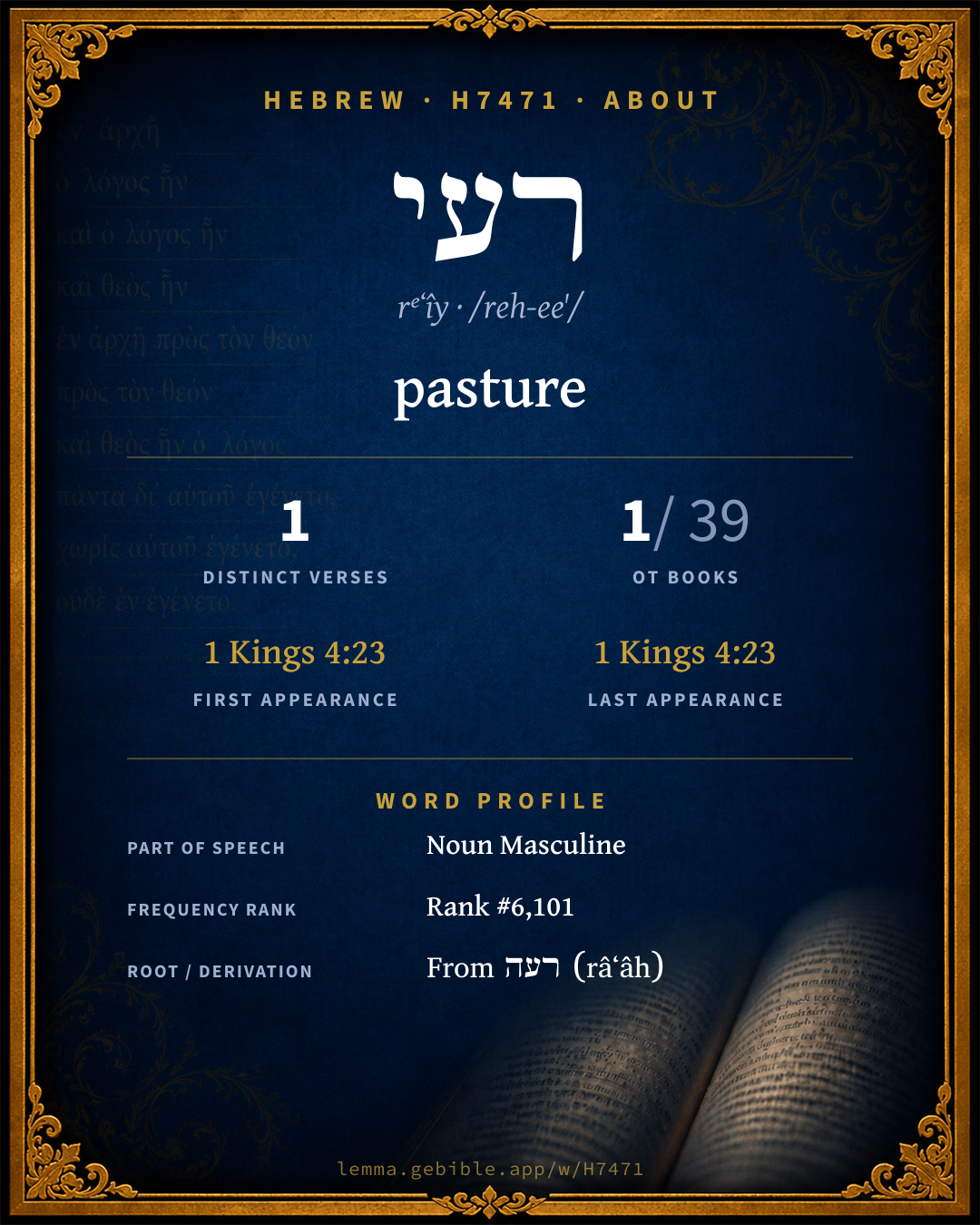
רְעִי
pasture
Full lexicon entry — Brown-Driver-Briggs (BDB)
From Brown-Driver-Briggs (BDB)
Where this word appears
Grammar key — what these labels mean
Part of speech
- Noun
- A naming word — a person, place, thing, or idea.
Noun type
- Common
- A common noun — a general class of person, place, or thing (“king,” “city,” “water”), not a specific name.
State
- Absolute
- The independent form of a noun, not bound to a following word.
Gender
- Masculine
- Grammatically masculine.
Number
- Singular
- One.
Every verse where H7471 appears — 1 distinct verse across 1 book. Click any verse to open its interlinear word-by-word view. Verse text shown in the World English Bible for context — . Each verse’s Hebrew form is shown with its reference; the English is not keyword-highlighted, since the data carries no word-level English alignment. Use “Compare translations” on any verse to read it across multiple English versions. This concordance covers the Hebrew Bible; Septuagint (Greek Old Testament) occurrences are not indexed here.
1 Kings 1 verse
About this entry
At a glance — auto-summarized from this page’s data, not written by a person. Every figure links to its source below. This summary describes the numbers; it doesn’t interpret them.
At its core, רעי (rᵉʻîy) means “pasture.” It occurs a mere 1 verse across Scripture. The word gravitates to 1 Kings (100%). A true hapax — its single appearance is 1 Kings 4:23. It clusters with רעה, מרע and מרעה under a shared root. Each statement above links to its evidence; the full detail follows below.
Gloss history
Strong's 1890 vs modern scholarship
About this word
Strong's H7471 catalogs a Hebrew word from the Hebrew Old Testament.
These counts are not copied from any lexicon or concordance. They are computed here, from the morphology-tagged Hebrew Old Testament. What Lemma adds →
- 1
- distinct verses
- The word appears in 1 distinct verse.
- 1 / 39
- OT books
- The word appears in 1 of 39 Old Testament books.
- #6,101
- by frequency
- Rank #6,101 (rank 6,101 of 8,640 Hebrew words by occurrence).
View all 1 occurrence in the concordance →
Most concentrated in
- 1 Kings 1 verse 100%
By section of the Old Testament
By traditional corpus
Conventional, traditional groupings — biblical authorship is debated, so this is a traditional corpus grouping, not an authorship claim. Each share is this word’s portion of its verses in that division of the Hebrew canon. Each figure is a share of the word’s 1 distinct verse.
- Prophets (Nevi'im) 1 verse · 100%
How translations render this word
Counts come from each version’s own published word-to-Strong’s tagging or interlinear alignment — an approximate guide to how each version renders this word, not a word-level alignment the data otherwise carries. Because each total is that version’s own tagged count, the per-version totals vary from one another and need not match the appearance or distinct-verse counts above. These counts may also differ from a printed concordance because Lemma counts each distinctly tagged rendering and does not collapse phrase taggings into a single head-word total. This is a fixed set of word-tagged versions (KJV, ASV, BSB, ULT) and does not change with the reading translation you choose elsewhere. Each version’s license is shown beside its name below (and on Sources).
- King James Version: Pastures 1×
- American Standard Version: Pastures 1×
- Berean Standard Bible: Range 1×
- unfoldingWord Literal Text: Pasture 1×
King James Version Public Domain
Renders H7471 across 1 tagged occurrence — most commonly:
American Standard Version Public Domain
Renders H7471 across 1 tagged occurrence — most commonly:
Berean Standard Bible Public Domain
Renders H7471 across 1 tagged occurrence — most commonly:
unfoldingWord Literal Text CC BY-SA 4.0
Renders H7471 across 1 tagged occurrence — most commonly:
Senses in BDB
The 1 sense BDB distinguishes for this word, in lexicon order (not ranked by frequency or importance). The full entry — with sub-senses — is in the Lexicon Entry tab.
- pasture
Word origin
n.[m.] pasture;—עֶשְׂרִים בָּקָר ר׳ 1 K 5:3 twenty cattle (from) pasture (v. Ges§ 131 c; Kit בְּקַר).
— Brown-Driver-Briggs (Oxford 1906, public domain), digitized via Sefaria, supplemented by the OpenScriptures HebrewLexicon (CC BY 4.0). See Sources.
Derived from רעה (râʻâh) (H7462) — to shepherd.
Jastrow Dictionary
A second Hebrew/Aramaic lexicon for comparison, covering Aramaic and post-biblical (Talmudic, Targumic, Midrashic) usage that the biblical-Hebrew BDB does not. Matched by lemma rather than by Strong’s number, so a lemma may carry more than one Jastrow headword (shown separately below), and the entries cover usage well beyond the Bible.
רעי
- (b. h.) [to join, arrange, cmp. דבר,] to lead, pasture, feed; (neut. verb) to graze. Ex. R. s. 2 כשהיה משה … רוֹעֶה צאנו וכ׳ when Moses … was feeding Jethro’s flock in the desert &c.; חייך אתה תִרְעֶה וכ׳ as thou livest, thou shalt lead my flock, Israel. Ib. והיה מוציא הקטנים לִרְעוֹת כדי שיִרְעוּ וכ׳ he (David) took out the young first that they might eat the tender grass &c. Yoma VI, 1 יִרְעֶה עד שיסתאב, v. סָאַב; Bekh. II, 9 ירעו עד וכ׳; a. fr.
- to lead to pasture, feed. Erub. 17ᵃ; B. Kam. 81ᵃ top שיהו מַרְעִין וכ׳, v. חוֹרֶשׁ; a. e.
- (v. Jud. XIV, 20) to associate, make a friend, companion. Cant. R. to II, 9 (ref. to רעיתי, ib. 10) בתו של יצחק שריעה אותי וייפה אותי וכ׳ the daughter of Isaac who declared me (the Lord) his friend and beautified me (the faith in God) on the altar. Lam. R. introd. (R. Josh. 1) שתָּרֵיעַ לקבל וכ׳ (some ed. שתָּרֵיעוּ; from רעע, v. רֵיעַ) that thou (you) form a partnership &c., v. שָׂרַע. e.g. Judges 14:20
רְעֵי
- , to feed; to graze. Targ. Gen. XXX, 31; 36. Targ. Ex. XXXIV, 3; a. fr.—Ber. 56ᵃ ורַעֲיֵי וכ׳, v. שָׁקְצָא.
רְעֵי ²
- (preced.; cmp. צְבֵי) = h. רָצָה, [to join in,] to desire, take delight in; to welcome (cmp. חָפֵץ &c.). Targ. Ps. XL, 7 Ms. (ed. צבי). Ib. LXXXV, 2. Targ. I Sam. XX, 30 (h. text בחר). Targ. Y. Lev. XXVI, 34 (O. Af.). Targ. Ez. XVIII, 23; a. fr.—Yalk. Koh. 972 מאן דרחמנא רָעֵי ליה whom the Lord favors. Y. Snh. I, 19ᵃ לא רָעֵינָא ביה I do not like him; Y. M. Kat. III, 82ᵃ bot. רעיינא (corr. acc.); a. e.
- 1. to favor, welcome. Targ. O. Lev. l. c.—Part. pass. מַרְעֵי. Targ. Y. Deut. XXXIII, 24 (h. text רצוי).—[Targ. Y. II, Ex. XV, 9 אַרְעֵי, v. אֲרַע I.]
- 2. to reconcile. Num. R. s. 920 ומַרְעֲיִין ליה לאינתיה and (we should) have made him live with his wife.
- 1. to be pleasing, acceptable; to delight in, choose. Targ. Lev. I, 4. Targ. Koh. IX, 7. Targ. Gen. XXXIV, 3 (h. text דבק). Targ. Job XXXIV, 4 נִתְרְעֵי לנא (h. text נבחרה); a. fr.—[Targ. Y. Lev. XXIII, 14 יתרעון, read: תארעין, v. אֲרַע II.]
- 2. to be reconciled. Targ. Ps. LXXVII, 8.
- 3. to offer one’s self willingly, volunteer. Targ. Is. LXIV, 6 (h. text מתעורר!).—[Ḥull. 10ᵃ איתרעאי, v. רְעַע.]
רְעִי
- a grazing animal. Pesik. R. s. 16 (expl. רעי, I Kings V, 3) מן המרעה from the pasture ground; Yalk. Kings 176. Sabb. XX, 4 גורפין מלפני הפטם … מפני הר׳ (Y. ed. הריעי) you may (on the Sabbath) sweep the crib before the stall-ox, and move (the remnants) aside for the sake of the grazing animal (which is ordinarily fed on the pasture); Y. ib. 17ᶜ bot. מפני (ש)מה שהפטם מותיר הר׳ אוכל because the grazing animal eats what the stall-ox leaves over.—[Comment. erroneously: מפני הר׳ on account of soiled matter, v. next w.] e.g. 1 Kings 5:3
רְעִי ²
- (רעה = רוה, v. רֵיאָה a. רֳאִי II; cmp. דִּבְיוֹנִים) secretion, excrements. Bekh. 7ᵇ דרך הר׳ (Rashi דרך בית הר׳) in the secretory channel (instead of in the womb). Kel. XVII, 2 בית הר׳ … מקבל את הר׳ (ed. Dehr. הראי) a night chamber which is too defective to retain liquid matter, although it retains solid excrements. Cant. R. to III, 4 בית הר׳ privy. Tosef. Ber. II, 16; Ber. 25ᵇ גרף של ר׳ a vessel for excrements; Sabb. 47ᵃ; a. fr.
רֵעִי
- Targ. Ps. LXXXIII, 11 (ed. Wil. רְעִי; ed. Lag. ריעיא). Targ. Job XX, 7 רַעְיֵה (ed. Lag. רַעְיֵיה). Targ. Esth. V, 1, v. אֲצִיצָא. Targ. Y. Deut. XXIII, 14. Targ. Y. Lev. IV, 11; a. fr.
רְעִי III
- (v. רְעִי I) pasture. Targ. II Esth. IV, 1. Targ. I Kings V, 3. Targ. Gen. XLVII, 4 (O. ed. Berl. רִעְ׳). Targ. Ex. III, 1; a. e.
A Dictionary of the Targumim, the Talmud Babli and Yerushalmi, and the Midrashic Literature (Marcus Jastrow; London, Luzac, 1903) — Public Domain. Digitized via Sefaria. Digitized via Sefaria. Full attribution on Sources.
Same root — word family
Other BDB entries built from the same root as H7471, grouped by Strong’s listed origin. These share a root / origin per the lexicon — not necessarily a shared meaning. Each links to that word’s own entry.
Derives from
Shares the same root
- מרע mêrêaʻ H4828 friend
- מרעה mirʻeh H4829 pasture
- מרעית mirʻîyth H4830 pasturage
- רע rêaʻ H7453 friend
- רע rêaʻ H7454 thought
- רעה rêʻeh H7463 friend
- רעות rᵉʻûwth H7468 companion
- רעות rᵉʻûwth H7469 longing
- רעי rôʻîy H7473 shepherd
- רעיון raʻyôwn H7475 longing
Proper names from this root
People and places named from this root — a name, not an additional meaning of the word.
Compare all same-root words → Showing 4 of 13 — not the complete family. 1 of the same-root words is a proper name (a person or place). They share a root, not necessarily a meaning.