Deuteronomy 23:25

Hebrew (Westminster Leningrad Codex) Deuteronomy 23:25 appears in the Hebrew Old Testament. The text above is from the Westminster Leningrad Codex. Each word links to its Strong’s number, a concise gloss, and parsing drawn from the Open Scriptures Hebrew Bible morphology. Click any word for its full Brown-Driver-Briggs (BDB) entry.
Download image
Cite this verse

Deuteronomy 23:25 (World English Bible). Public Domain. Lemma interlinear Bible study tool, https://lemma.gebible.app/v/deuteronomy/23/25.

Show BibTeX & RIS
BibTeX
RIS
English Translation
When you come into your neighbor's standing grain, then you may pluck the ears with your hand; but you shall not move a sickle to your neighbor's standing grain.
World English Bible · Public Domain
Highlights
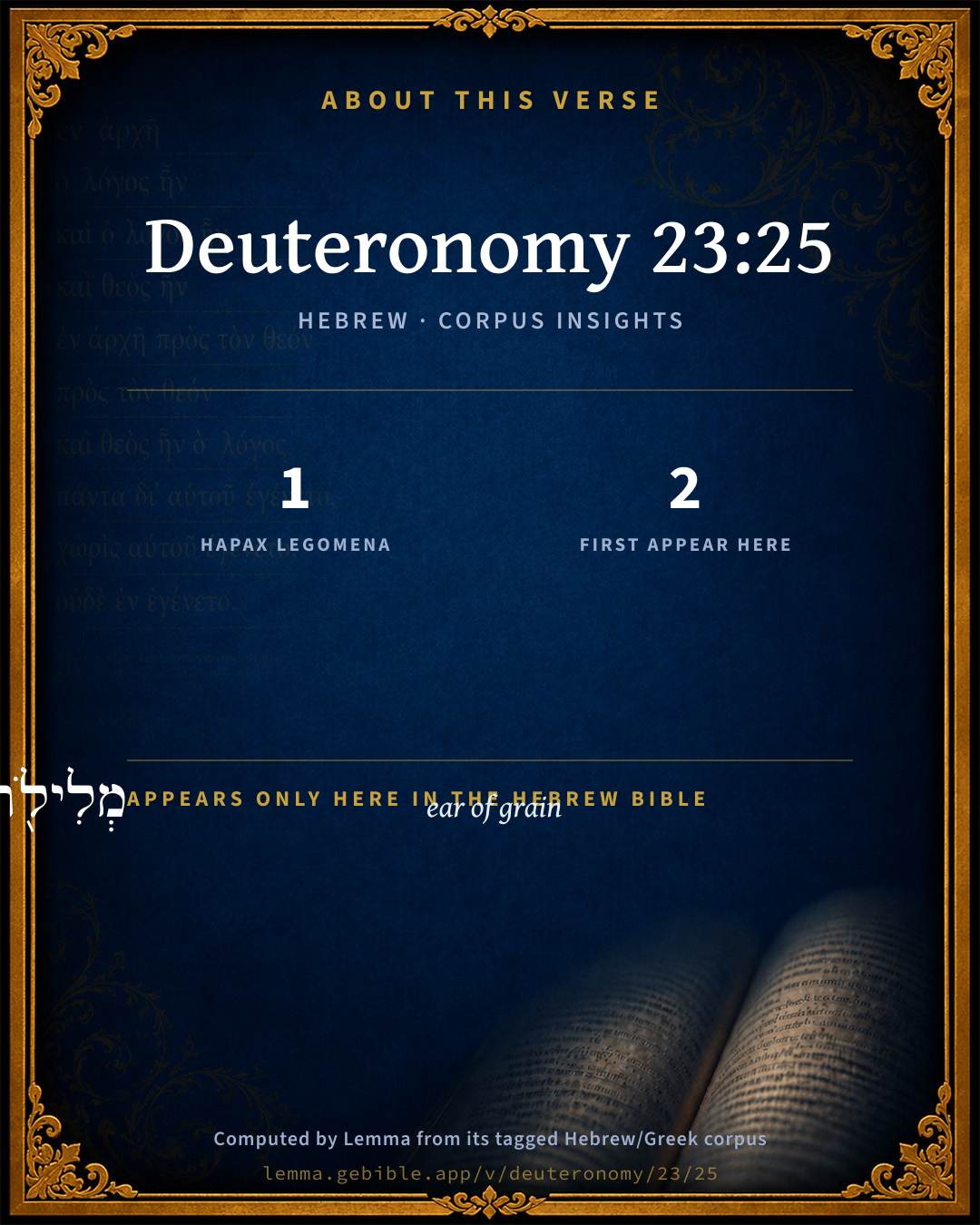
  • 1 hapax legomenon — only here in the Hebrew Bible
  • 2 first appearances in the Hebrew Bible
Full analysis ↓
Download a study sheet

One document with this verse’s original text, its word-by-word gloss line, the meaning frame, cross-references with their text, attributed commentary, and full source and license credits — printable, and it pastes into notes with its structure intact.

This verse Autodidact and up

Study sheet (.html) Plain text (.txt)

A passage Seminary Student

Up to 50 verses in one chapter. A passage sheet keeps up to 6 commentary sources and 12 cross-references per verse, in the order this page ranks them, and says so on the sheet whenever that leaves anything out. Ask for a single verse and you get the Autodidact verse sheet above.

Everything on this page stays free to read, with no account — the sheet is a download of what is already on screen, not access to it.

Want to remove ads? Support Godless Engineer
Compare translations 3

The same verse in 3 English versions, stacked beneath the original-language interlinear above. Click any original word for its lexicon entry.

Each is an independent rendering of the whole verse — the interlinear is not word-aligned to these translations.

Highlighted words mark where these versions differ — a whole-verse word diff, not a word-by-word alignment.

  • World English Bible Public Domain
    When you come into your neighbor's standing grain, then you may pluck the ears with your hand; but you shall not move a sickle to your neighbor's standing grain.
  • King James Version Public Domain
    When thou comest into the standing corn of thy neighbor, then thou mayest pluck the ears with thine hand; but thou shalt not move a sickle unto thy neighbor's standing corn.
  • unfoldingWord Literal Text CC BY-SA 4.0
    When you go in the stalks of your neighbor, then you may pluck ears of wheat with your hand, but you shall not wave a sickle on the stalks of your neighbor.

unfoldingWord Literal Text — © unfoldingWord, licensed CC BY-SA 4.0. Word-aligned USFM3 via Door43 (git.door43.org/unfoldingWord/en_ult).

Versions to compare (up to 4)

3 of 4 selected

Show all 18 translations

Every available English version of this verse, each an independent rendering of the whole verse.

  • World English Bible Public Domain
    When you come into your neighbor's standing grain, then you may pluck the ears with your hand; but you shall not move a sickle to your neighbor's standing grain.
  • Berean Standard Bible Public Domain
    When you enter your neighbor’s grainfield, you may pluck the heads of grain with your hand, but you must not put a sickle to your neighbor’s grain.
  • Majority Standard Bible Public Domain
    When you enter your neighbor’s grainfield, you may pluck the heads of grain with your hand, but you must not put a sickle to your neighbor’s grain.
  • King James Version Public Domain
    When thou comest into the standing corn of thy neighbor, then thou mayest pluck the ears with thine hand; but thou shalt not move a sickle unto thy neighbor's standing corn.
  • American Standard Version (1901) Public Domain
    When thou comest into thy neighbor's standing grain, then thou mayest pluck the ears with thy hand; but thou shalt not move a sickle unto thy neighbor's standing grain.
  • Revised Version (1885) Public Domain
    When thou comest into thy neighbour’s standing corn, then thou mayest pluck the ears with thine hand; but thou shalt not move a sickle unto thy neighbour’s standing corn.
  • Geneva Bible (1599) Public Domain
    When thou commest into thy neighbours corne thou mayest plucke the eares with thine hand, but thou shalt not moue a sickle to thy neighbours corne.
  • Douay-Rheims (1899) Public Domain
    If thou go into thy friend's corn, thou mayst break the ears, and rub them in thy hand: but not reap them with a sickle.
  • Young's Literal Translation Public Domain
    When thou comest in among the standing-corn of thy neighbour, then thou hast plucked the ears with thy hand, but a sickle thou dost not wave over the standing-corn of thy neighbour.
  • Literal Standard Version CC BY-SA 4.0
    When you come in among the standing grain of your neighbor, then you have plucked the ears with your hand, but you do not wave a sickle over the standing grain of your neighbor.”
  • Unlocked Literal Bible CC BY-SA 4.0
    When you go into your neighbor's ripe grain, you may pluck the heads of grain with your hand, but do not put a sickle to your neighbor's ripe grain.
  • unfoldingWord Literal Text CC BY-SA 4.0
    When you go in the stalks of your neighbor, then you may pluck ears of wheat with your hand, but you shall not wave a sickle on the stalks of your neighbor.
  • Darby Bible Public Domain
    When thou comest into the standing corn of thy neighbour, thou mayest pluck ears with thy hand; but thou shalt not wave the sickle against thy neighbour's standing corn.
  • World Messianic Bible Public Domain
    When you come into your neighbor’s standing grain, then you may pluck the ears with your hand; but you shall not use a sickle on your neighbor’s standing grain.
  • Webster's Bible Public Domain
    When thou comest into the standing-corn of thy neighbor, then thou mayest pluck the ears with thy hand: but thou shalt not move a sickle to thy neighbor's standing-corn.
  • Free Bible Version CC BY-SA 4.0
    When you walk through your neighbor's grainfield, you may pick the ears of grain with your hand, but you must not use a sickle to harvest it.
  • Bible in Basic English Public Domain
    When you go into your neighbour's field, you may take the heads of grain with your hand; but you may not put your blade to his grain.
  • JPS Tanakh (1917) Public Domain
    (23-26) When thou comest into thy neighbour's standing corn, then thou mayest pluck ears with thy hand; but thou shalt not move a sickle unto thy neighbour's standing corn.

Literal Standard Version (2020), Covenant Press — licensed CC BY-SA 4.0. Text via the HelloAO Bible API (eBible.org). Unlocked Literal Bible (unfoldingWord) — licensed CC BY-SA 4.0. Text via the HelloAO Bible API (eBible.org). unfoldingWord Literal Text — © unfoldingWord, licensed CC BY-SA 4.0. Word-aligned USFM3 via Door43 (git.door43.org/unfoldingWord/en_ult). Free Bible Version, Dr. Jonathan Gallagher — licensed CC BY-SA 4.0. Text via the HelloAO Bible API (eBible.org).

Word by word

More ways to search: Search by grammar → Find every occurrence → Compare this word →

Practice this passage: Drill this verse → Learn its vocabulary →

מְלִילֹ֖ת
mᵉlîylâh
H4425
“ears of grain”
Noun, Common, Feminine, Plural, Absolute
Part of Speech
Noun
Type
Common
Gender
Feminine
Number
Plural
State
Absolute
Full BDB Definition

Origin: from H4449 (in the sense of cropping [compare H4135 ])

TWOT: 1202a

ear (of wheat), head (of wheat)
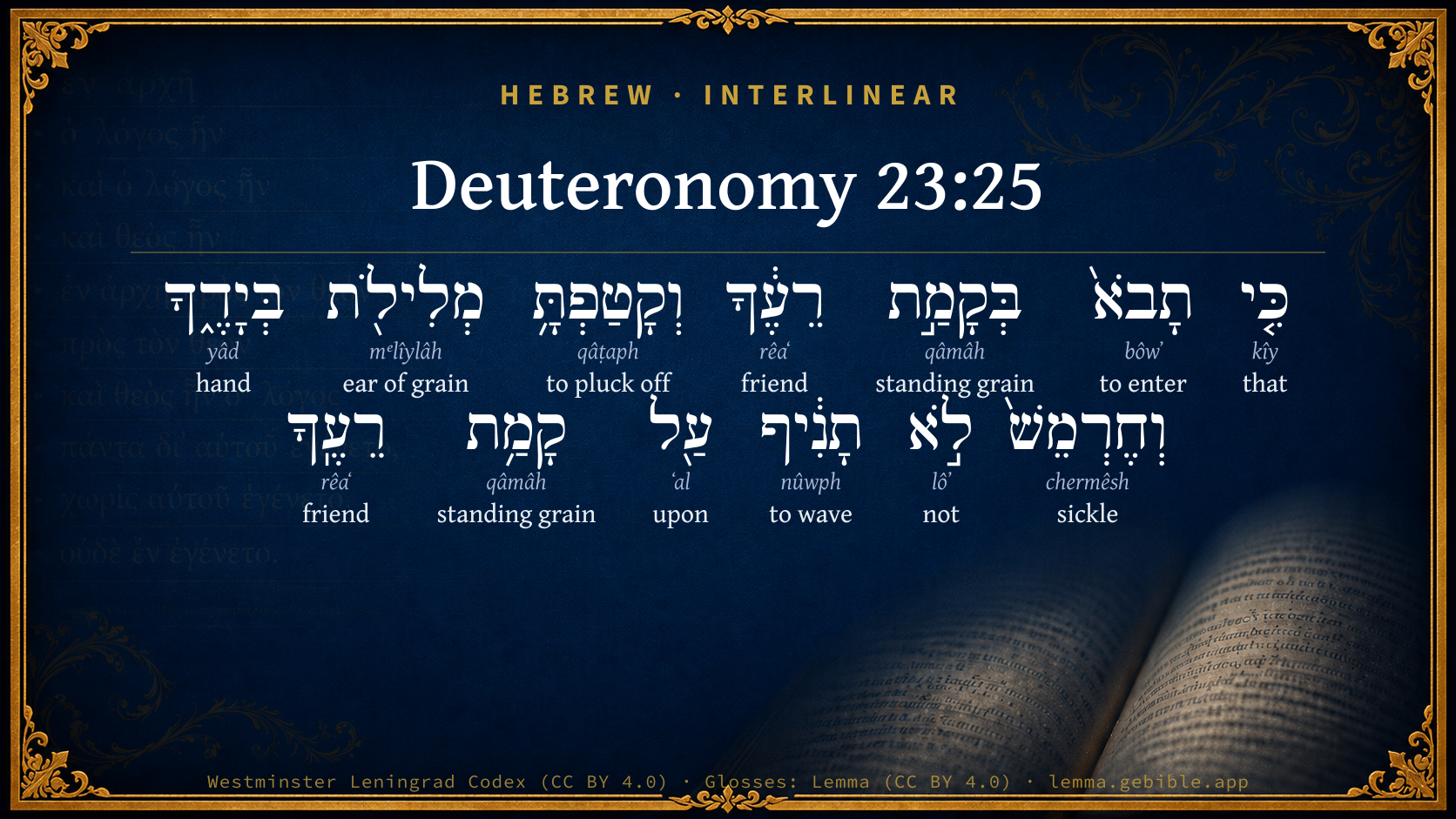
  1. כִּ֤י kîy H3588 “that” Conjunction
  2. תָבֹא֙ bôwʼ H935 “to enter” Verb, Qal, Imperfect, 2nd Person, Masculine, Singular
  3. בְּקָמַ֣ת qâmâh H7054 “in/at · standing grain of” Preposition + Noun, Common, Feminine, Singular, Construct
  4. רֵעֶ֔ךָ rêaʻ H7453 “friend · your” Noun, Common, Masculine, Singular, Construct + Suffix, Personal, 2nd Person, Masculine, Singular
  5. וְקָטַפְתָּ֥ qâṭaph H6998 “and · to pluck off” Conjunction + Verb, Qal, Sequential Perfect, 2nd Person, Masculine, Singular
  6. בְּיָדֶ֑ךָ yâd H3027 “in/at · hand · your” Preposition + Noun, Common, Both, Singular, Construct + Suffix, Personal, 2nd Person, Masculine, Singular
  7. וְחֶרְמֵשׁ֙ chermêsh H2770 “and · sickle” Conjunction + Noun, Common, Masculine, Singular, Absolute
  8. לֹ֣א lôʼ H3808 “not” Particle, Negative
  9. תָנִ֔יף nûwph H5130 “to wave” Verb, Hiphil, Imperfect, 2nd Person, Masculine, Singular
  10. עַ֖ל ʻal H5921 “upon” Preposition
  11. קָמַ֥ת qâmâh H7054 “standing grain of” Noun, Common, Feminine, Singular, Construct
  12. רֵעֶֽךָ rêaʻ H7453 “friend · your” Noun, Common, Masculine, Singular, Construct + Suffix, Personal, 2nd Person, Masculine, Singular

About this verse

These counts appear in no published source. They are computed here, from the morphology-tagged text and Lemma’s own curated glosses. What Lemma adds →

13
words
11
distinct lemmas
Pentateuch
section

Notable vocabulary

1 hapax legomenon — a word that appears only here in the entire Hebrew Bible:

  • מְלִילֹ֖ת ear of grain H4425

First appearance in Scripture

These words make their first canonical appearance in the Hebrew Bible here:

  • וְקָטַפְתָּ֥ to pluck off H6998
  • מְלִילֹ֖ת ear of grain H4425

Shared distinctive vocabulary

וְחֶרְמֵשׁ֙ sickle H2770 occurs in 2 verses of the Hebrew Bible. Also found in:

Grammatical profile

  • 3 verbs
  • 7 nouns
  • 1 preposition
  • 1 conjunction
  • 1 particle

Verb forms

  • תָבֹא֙ Qal · Imperfect
  • וְקָטַפְתָּ֥ Qal · Sequential Perfect
  • תָנִ֔יף Hiphil · Imperfect

Repetition

Words recur within this verse — often emphatic in Hebrew:

  • בְּקָמַ֣ת standing grain H7054 ×2
  • רֵעֶ֔ךָ friend H7453 ×2

Cross-references

3

Topical passages linked to Deuteronomy 23:25 in the Treasury of Scripture Knowledge — connected by theme and wording, ordered by reader-vote popularity; previews shown in the World English Bible.

  • Matthew 12:1–2 At that time, Jesus went on the Sabbath day through the grain fields. His disciples were hungry and began to pluck heads of grain and to eat.
  • Mark 2:23 It happened that he was going on the Sabbath day through the grain fields, and his disciples began, as they went, to pluck the ears of grain.
  • Luke 6:1–2 Now it happened on the second Sabbath after the first, that he was going through the grain fields. His disciples plucked the heads of grain, and ate, rubbing them in their hands.

Cross-references courtesy of OpenBible.info (CC BY 4.0).

Hebrew and Greek witnesses Masoretic Hebrew ↔ Greek Septuagint

The same verse in the two great witnesses to the Old Testament, shown verse-for-verse.

These are two independent witnesses, not word-aligned to each other, and the Septuagint is shown in lemma (dictionary) form.

Hebrew Deuteronomy 23:25 Masoretic · Westminster Leningrad Codex

כִּ֤י תָבֹא֙ בְּקָמַ֣ת רֵעֶ֔ךָ וְקָטַפְתָּ֥ מְלִילֹ֖ת בְּיָדֶ֑ךָ וְחֶרְמֵשׁ֙ לֹ֣א תָנִ֔יף עַ֖ל קָמַ֥ת רֵעֶֽךָ

When you come into your neighbor's standing grain, then you may pluck the ears with your hand; but you shall not move a sickle to your neighbor's standing grain.

World English Bible · Public Domain

Greek LXX Deuteronomy 23:25 Septuagint · lemma form

ἐάν δέ εἰςἔρχομαι εἰς ἀμητός ὁ πλησίον σύ καί συνλέγω ἐν ὁ χείρ σύ στάχυς καί δρέπανον οὐ μή ἐπιβάλλω ἐπί ὁ ἀμητός ὁ πλησίον σύ

No English rendering of this Greek verse — the small residue in the structurally divergent books.

Hebrew: Westminster Leningrad Codex (CC BY 4.0). Greek: Septuagint (public domain); English from a public-domain English Septuagint. How the Septuagint differs from the Hebrew →

Targum (Aramaic paraphrase)

2

The Targum is the ancient Jewish Aramaic paraphrase of the Hebrew Scriptures — an interpretive translation, not the Hebrew text itself. Onkelos (literal) and Pseudo-Jonathan (expansive) render the Torah, and Jonathan the Prophets. Coverage is partial: where no permissively-licensed English translation exists for a verse, only the Aramaic is shown. This is verse-level text, not a word-by-word alignment to the Hebrew.

  1. Targum Onkelos Torah (Genesis–Deuteronomy)
    אֲרֵי תִתָּגַר בְּכַרְמָא דְחַבְרָךְ וְתֵיכוּל עִנְבִין כְּנַפְשָׁךְ שִׂבְעָךְ וּלְמָאנָךְ לָא תִתֵּן

    (no public-domain English translation for this verse)

    Targum Onkelos — Aramaic: “Onkelos Genesis” (public domain); “Onkelos Exodus” (public domain); “Onkelos Leviticus” (public domain); “Onkelos Numbers” (public domain); “Onkelos Deuteronomy” (public domain). English: “Sefaria Community Translation” (CC0 1.0 (public-domain dedication)); “J.W. Etheridge. The Targums of Onkelos and Jonathan Ben Uzziel on the Pentateuch. London: Longmans, Green, 1862” (public domain). Text via Sefaria.

  2. Targum Pseudo-Jonathan Torah (Genesis–Deuteronomy)
    אֲרוּם תֵּיעוּל לְמֵיסַב אַגְרָא כְּפוֹעֵל בְּכַרְמָא דְחַבְרָךְ וְתֵיכוּל כְּרַעֲוַות נַפְשָׁךְ עַד דְּתִסְבַּע וּלְוַות צַנָךְ לָא תִתֵּן

    When thou hast come for hire into thy neighbour’s vineyard, thou mayest eat there as thou wilt, till thou art satisfied; but thou mayest not put any into thy basket.

    Targum Pseudo-Jonathan — Aramaic: “Targum Jonathan on Genesis” (public domain); “Targum Jonathan on Exodus” (public domain); “Targum Jonathan on Leviticus” (public domain); “Targum Jonathan on Numbers” (public domain); “Targum Jonathan on Deuteronomy” (public domain). English: “The Targum of Jonathan ben Uzziel, trans. J. W. Etheridge, London, 1862” (public domain). Text via Sefaria.

Commentary

Notes on Deuteronomy 23:25 from classic Christian and Jewish commentators (each source and its license shown beneath its notes). The classic Christian expositions comment on the surrounding passage and are grouped to its opening verse, so a note may address several verses; the Jewish commentaries on the Tanakh (Rashi and others) are per-verse, so they appear only where the commentator wrote on this verse.

Lemma curates 59 commentaries, every one of them public domain or Creative Commons licensed, each selected and text-cleaned for this edition rather than reprinted as found. About our sources →

Trapp's Complete Commentary

John Trapp

Deu 23:25 When thou comest into the standing corn of thy neighbour, then thou mayest pluck the ears with thine hand; but thou shalt not move a sickle unto thy neighbour’s standing corn.

Ver. 25. But thou shalt not move a sickle.] Here God reserveth the right and property of the owner, which no man might invade or infringe.

John Trapp, A Commentary or Exposition upon All the Books of the Old and New Testament (1647–1656) — public domain. Text from a community e-Sword module.

Adam Clarke's Commentary

Verse 25. Thou mayest pluck the ears with thine hand] It was on the permission granted by this law that the disciples plucked the ears of corn, as related Mt 12:1. This was both a considerate and humane law, and is no dishonour to the Jewish code.

Adam Clarke's Commentary on the Bible (1810–1826) — public domain. Text from a community e-Sword/MySword module.

John Gill's Exposition

When thou comest into the standing corn of thy neighbour,.... Passest through it to go to some other place, the road lying through it, as it often does through standing corn; so Christ and his disciples are said to go through the corn, Mat 12:1; but Jarchi says this Scripture speaks of a workman also, and so the Targum of Jonathan,"when thou goest in to take thine hire according to work in thy neighbour's standing corn;''but the other sense is best, and is confirmed and illustrated by the instance given, as well as best agrees with what follows:

then thou mayest pluck the ears with thine hand; the ears of wheat, and rub them, to separate the grain from the husk or beard, and eat it, as did the disciples of Christ; Luk 6:1; to satisfy hunger: but thou shall not move a sickle unto thy neighbour's standing corn to cut it down and carry any of it off; which would have been an unjust thing.

Next: Deuteronomy Chapter 24

John Gill's Exposition of the Whole Bible (1746–1763) — public domain (CC PDM 1.0). Text via the HelloAO Bible API.

Rashi

Rabbi Shlomo Yitzchaki (Rashi)

כי תבא בכרם רעך WHEN THOU COMEST INTO THE VINEYARD OF THY FELLOW MAN, [THEN THOU MAYEST EAT GRAPES AT THY FILL] — Scripture is speaking of a laborer (who is engaged in gathering in the grapes, but not of one who is doing other work in the vineyard, nor of one who enters the vineyard with no intention to do work; cf. Rashi in the next passage) (Bava Metzia 87b).

כנפשך means as much as you like.

שבעך AT THY FILL — but not excessive eating (Bava Metzia 87b).

ואל כליך לא תתן BUT THOU SHALT NOT PUT ANY IN THY VESSEL — From here we may derive that Scripture is referring only to the period of the vintage, to the time when thou puttest grapes into the owner’s vessel, — then thou mayest eat but not put any into thy vessel; but if he comes to hoe or to weed (i.e. to do other work than harvesting) he must not eat of the grapes (Bava Metzia 89b).

Rashi on the Tanakh — English translations: “The Judaica Press complete Tanach with Rashi, translated by A. J. Rosenberg” (CC BY 4.0); “Pentateuch with Rashi's commentary by M. Rosenbaum and A.M. Silbermann, 1929-1934” (public domain); “The Metsudah Tanach series, Lakewood, N.J” (CC BY 4.0); and “The Book of Joshua, Metsudah Publications, 1997” (CC BY 4.0). Text via Sefaria.

Lesson kit

Teaching starters — assembled from the data on this page, not authored interpretation. Every prompt links to the verse data it draws on. Edit before teaching.

Deuteronomy, in the Pentateuch, opens this verse with 13 words (11 distinct Hebrew lemmas). Its most distinctive word is mᵉlîylâh (“ear of grain”). A historical commentator’s framing appears above. Read the whole chapter for the surrounding context.

Discussion questions

  1. The word mᵉlîylâh carries the sense “ear of grain.” How does it shape the verse?
  2. 1 word here appears nowhere else in the Hebrew Bible. Why might the author reach for such rare wording?
  3. 2 words make their first appearance in Scripture here. What does this debut establish?
  4. How does Deuteronomy 16:9, which shares the word «sickle», read alongside this verse?
  5. What does the repetition of “standing grain” (2× in this one verse) do in this verse?
  6. These translations render this verse differently. What is at stake in choosing one wording over another?
  7. «תָבֹא֙» is a Qal Imperfect verb. How does that grammatical form shape the action described?
  8. Compare how Trapp's Complete Commentary and Adam Clarke's Commentary read this verse. Where do they agree or differ?

Things to notice

  • 1 word in this verse appears nowhere else in the Hebrew Bible.
  • 2 words make their first canonical appearance in Scripture here.
  • These translations choose different wording for 17 words in this verse.
  • “standing grain” occurs 2× in this single verse.
  • 11 distinct Hebrew lemmas span 13 words in this verse.

Reading settings

Reading text

Shown beneath each verse's original-language words.

Old Testament
Old Testament edition

Read the OT as the Masoretic Hebrew (MT) or the Greek Septuagint (LXX).

English shown for the Greek Septuagint (in the Hebrew ↔ Greek comparison).

Comparing translations? Open the Compare panel on any verse page to stack up to four side by side.