

Job 19:21

Hebrew (Westminster Leningrad Codex) Job 19:21 appears in the Hebrew Old Testament. The text above is from the Westminster Leningrad Codex. Each word links to its Strong’s number, a concise gloss, and parsing drawn from the Open Scriptures Hebrew Bible morphology. Click any word for its full Brown-Driver-Briggs (BDB) entry.
Download image
Cite this verse

Job 19:21 (World English Bible). Public Domain. Lemma interlinear Bible study tool, https://lemma.gebible.app/v/job/19/21.

Show BibTeX & RIS
BibTeX
RIS
English Translation
"Have pity on me, have pity on me, you my friends; For the hand of God has touched me.
World English Bible · Public Domain
Download a study sheet

One document with this verse’s original text, its word-by-word gloss line, the meaning frame, cross-references with their text, attributed commentary, and full source and license credits — printable, and it pastes into notes with its structure intact.

This verse Autodidact and up

Study sheet (.html) Plain text (.txt)

A passage Seminary Student

Up to 50 verses in one chapter. A passage sheet keeps up to 6 commentary sources and 12 cross-references per verse, in the order this page ranks them, and says so on the sheet whenever that leaves anything out. Ask for a single verse and you get the Autodidact verse sheet above.

Everything on this page stays free to read, with no account — the sheet is a download of what is already on screen, not access to it.

Want to remove ads? Support Godless Engineer
Compare translations 3

The same verse in 3 English versions, stacked beneath the original-language interlinear above. Click any original word for its lexicon entry.

Each is an independent rendering of the whole verse — the interlinear is not word-aligned to these translations.

Highlighted words mark where these versions differ — a whole-verse word diff, not a word-by-word alignment.

  • World English Bible Public Domain
    "Have pity on me, have pity on me, you my friends; For the hand of God has touched me.
  • King James Version Public Domain
    Have pity upon me, have pity upon me, O ye my friends; for the hand of God hath touched me.
  • unfoldingWord Literal Text CC BY-SA 4.0
    Pity me, pity me, you my friends, for the hand of God has touched me.

unfoldingWord Literal Text — © unfoldingWord, licensed CC BY-SA 4.0. Word-aligned USFM3 via Door43 (git.door43.org/unfoldingWord/en_ult).

Versions to compare (up to 4)

3 of 4 selected

Show all 18 translations

Every available English version of this verse, each an independent rendering of the whole verse.

  • World English Bible Public Domain
    "Have pity on me, have pity on me, you my friends; For the hand of God has touched me.
  • Berean Standard Bible Public Domain
    Have pity on me, my friends, have pity, for the hand of God has struck me.
  • Majority Standard Bible Public Domain
    Have pity on me, my friends, have pity, for the hand of God has struck me.
  • King James Version Public Domain
    Have pity upon me, have pity upon me, O ye my friends; for the hand of God hath touched me.
  • American Standard Version (1901) Public Domain
    Have pity upon me, have pity upon me, O ye my friends; For the hand of God hath touched me.
  • Revised Version (1885) Public Domain
    Have pity upon me, have pity upon me, O ye my friends; for the hand of God hath touched me.
  • Geneva Bible (1599) Public Domain
    Haue pitie vpon me: haue pitie vpon me, (O yee my friendes) for the hande of God hath touched me.
  • Douay-Rheims (1899) Public Domain
    Have pity on me, have pity on me, at least you my friends, because the hand of the Lord hath touched me.
  • Young's Literal Translation Public Domain
    Pity me, pity me, ye my friends, For the hand of God hath stricken against me.
  • Literal Standard Version CC BY-SA 4.0
    Pity me, pity me, you my friends, || For the hand of God has struck against me.
  • Unlocked Literal Bible CC BY-SA 4.0
    Have pity upon me, have pity upon me, my friends, for the hand of God has touched me.
  • unfoldingWord Literal Text CC BY-SA 4.0
    Pity me, pity me, you my friends, for the hand of God has touched me.
  • Darby Bible Public Domain
    Have pity upon me, have pity upon me, ye my friends; for the hand of +God hath touched me.
  • World Messianic Bible Public Domain
    “Have pity on me. Have pity on me, you my friends, for the hand of God has touched me.
  • Webster's Bible Public Domain
    Have pity upon me, have pity upon me, O ye my friends; for the hand of God hath touched me.
  • Free Bible Version CC BY-SA 4.0
    Have pity on me, my friends, have pity on me, because God has struck me down!
  • Bible in Basic English Public Domain
    Have pity on me, have pity on me, O my friends! for the hand of God is on me.
  • JPS Tanakh (1917) Public Domain
    Have pity upon me, have pity upon me, O ye my friends; for the hand of God hath touched me.

Literal Standard Version (2020), Covenant Press — licensed CC BY-SA 4.0. Text via the HelloAO Bible API (eBible.org). Unlocked Literal Bible (unfoldingWord) — licensed CC BY-SA 4.0. Text via the HelloAO Bible API (eBible.org). unfoldingWord Literal Text — © unfoldingWord, licensed CC BY-SA 4.0. Word-aligned USFM3 via Door43 (git.door43.org/unfoldingWord/en_ult). Free Bible Version, Dr. Jonathan Gallagher — licensed CC BY-SA 4.0. Text via the HelloAO Bible API (eBible.org).

Word by word

More ways to search: Search by grammar → Find every occurrence → Compare this word →

Practice this passage: Drill this verse → Learn its vocabulary →

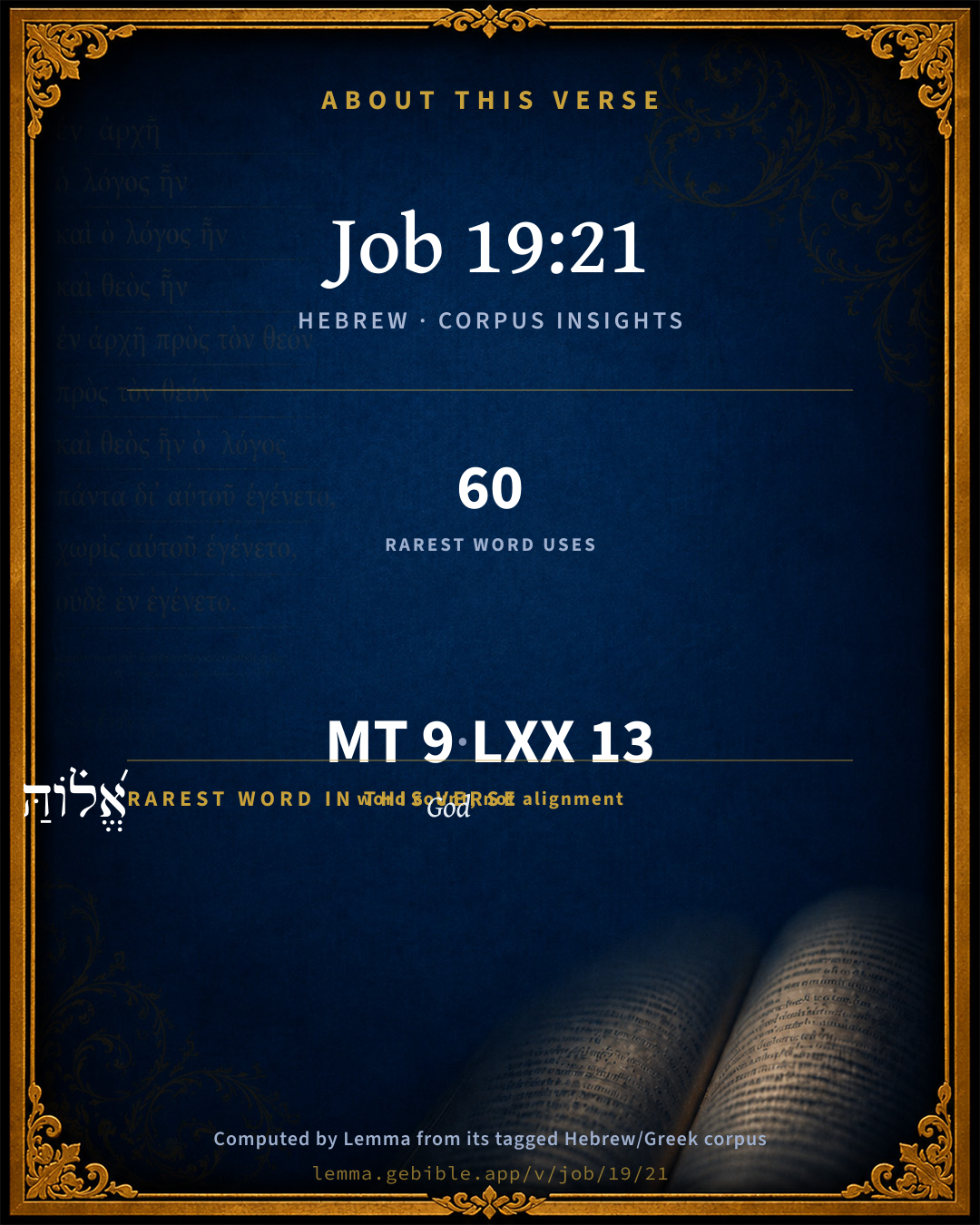
About this verse

These counts appear in no published source. They are computed here, from the morphology-tagged text and Lemma’s own curated glosses. What Lemma adds →

9
words
7
distinct lemmas
Wisdom
section

Shared distinctive vocabulary

אֱ֝ל֗וֹהַּ God H433 occurs in 59 verses of the Hebrew Bible. Also found in:

Grammatical profile

  • 3 verbs
  • 3 nouns
  • 1 pronoun
  • 1 preposition
  • 1 conjunction

Verb forms

  • חָנֻּ֬נִי Qal · Imperative
  • חָנֻּ֣נִי Qal · Imperative
  • נָ֣גְעָה Qal · Perfect

Repetition

A word recurs within this verse — often emphatic in Hebrew:

  • חָנֻּ֬נִי to be gracious H2603 ×2

Hebrew & Septuagint length

In English translation the verse runs 19 words from the Hebrew and 18 from the Septuagint (LXX English) — closely comparable.

A rough comparison of the two English renderings, which tokenize alike — not a word-level alignment.

Word counts can differ between the Hebrew and the Greek without any difference in meaning — e.g. the Hebrew direct-object marker אֵת has no separate Greek word, and Greek often adds the article ὁ.

In the original languages it is 9 Hebrew tokens and 13 Greek tokens — but the two are counted differently (Hebrew bundles its prefixes and suffixes into one token; the Greek is in lemma form), so that isn’t a like-for-like length.

Cross-references

9

Topical passages linked to Job 19:21 in the Treasury of Scripture Knowledge — connected by theme and wording, ordered by reader-vote popularity; previews shown in the World English Bible.

  • Job 1:11 But put forth your hand now, and touch all that he has, and he will renounce you to your face."
  • Psalms 38:2 For your arrows have pierced me, Your hand presses hard on me.
  • Job 2:5 But put forth your hand now, and touch his bone and his flesh, and he will renounce you to your face."
  • Job 2:10 But he said to her, "You speak as one of the foolish women would speak. What? Shall we receive good at the hand of God, and shall we not receive evil?" In all this Job didn't sin with his lips.
  • Job 6:4 For the arrows of the Almighty are within me, My spirit drinks up their poison. The terrors of God set themselves in array against me.
  • Job 6:14 "To him who is ready to faint, kindness should be shown from his friend; Even to him who forsakes the fear of the Almighty.
  • Romans 12:15 Rejoice with those who rejoice. Weep with those who weep.
  • 1 Corinthians 12:26 When one member suffers, all the members suffer with it. Or when one member is honored, all the members rejoice with it.
  • Hebrews 13:3 Remember those who are in bonds, as bound with them; and those who are ill-treated, since you are also in the body.

Cross-references courtesy of OpenBible.info (CC BY 4.0).

Hebrew and Greek witnesses Masoretic Hebrew ↔ Greek Septuagint

The same verse in the two great witnesses to the Old Testament, shown verse-for-verse.

These are two independent witnesses, not word-aligned to each other, and the Septuagint is shown in lemma (dictionary) form.

Hebrew Job 19:21 Masoretic · Westminster Leningrad Codex

חָנֻּ֬נִי חָנֻּ֣נִי אַתֶּ֣ם רֵעָ֑י כִּ֥י יַד אֱ֝ל֗וֹהַּ נָ֣גְעָה בִּֽי

"Have pity on me, have pity on me, you my friends; For the hand of God has touched me.

World English Bible · Public Domain

Greek LXX Job 19:21 Septuagint · lemma form

ἐλεέω ἐγώ ἐλεέω ἐγώ ὦ φίλος χείρ γάρ κύριος ὁ ἅπτομαι ἐγώ εἰμί

Pity me, pity me, O friends; for it is the hand of the Lord that has touched me.

LXX2012 (modern English Septuagint) · Public Domain

On this verse, Keil & Delitzsch discusses the Septuagint’s reading. Read the note in Commentary ↓

Hebrew: Westminster Leningrad Codex (CC BY 4.0). Greek: Septuagint (public domain); English from LXX2012 (modern English Septuagint) (Public Domain). How the Septuagint differs from the Hebrew →

Commentary

Notes on Job 19:21 from classic Christian and Jewish commentators (each source and its license shown beneath its notes). The classic Christian expositions comment on the surrounding passage and are grouped to its opening verse, so a note may address several verses; the Jewish commentaries on the Tanakh (Rashi and others) are per-verse, so they appear only where the commentator wrote on this verse.

Lemma curates 59 commentaries, every one of them public domain or Creative Commons licensed, each selected and text-cleaned for this edition rather than reprinted as found. About our sources →

Trapp's Complete Commentary

John Trapp

Job 19:21 Have pity upon me, have pity upon me, O ye my friends; for the hand of God hath touched me.

Ver. 21. Have pity upon me, have pity upon me, &c.] To him that is afflicted pity should be showed from his friends; and to do otherwise is to forsake the fear of the Almighty, Job 6:14; {See Trapp on "Job 6:14"} There was little either fear of God or mercy to men in that barbarous bishop of Spire, who denied to Henry IV, emperor of Germany (deposed after ten years’ reign, and hardly bestead), a poor clerkship there in a monastery of his own foundation; which caused the miserable emperor to break out into these words of Job, "Have pity upon me, have pity upon me, O my friends; for the hand of God hath touched me." The Papists tell us that the souls in purgatory cry out to their friends on earth for help on this manner, and in these terms. But this is as much a fiction as purgatory itself is the pope’s invention; who must needs be extremely pitiless to suffer so many souls to lie in such great torments, when he hath power to fetch them out at his pleasure.

John Trapp, A Commentary or Exposition upon All the Books of the Old and New Testament (1647–1656) — public domain. Text from a community e-Sword module.

The Biblical Illustrator

Joseph S. Exell

Job_19:21

Have pity upon me, for the hand of God hath touched me.

Christs passion

Apt illustration of a more perfect sufferer--one more holy than Job, and one involved in deeper sorrow.

I. In many respects there is an analogy between the sufferers.

1. Christ was an innocent and benevolent sufferer.

2. But when was He not a sufferer?

3. How His sufferings increased as He approached His end.

4. It was the hand of God that had touched Him.

5. Job suffered for himself, and for his own benefit; Christ, not for Himself, but for us, and in our stead.

II. How our pity should be evinced.

1. By the ordinary movement of our feelings.

2. We should awaken these feelings by the use of all means.

3. Our pity should be evinced by hatred of sin.

4. If our compassion is sincere, we shall feel a deep interest in the result of his sufferings. (F. Close, A. M.)

Compassion a human duty

Afflictions like Jobs were sufficient, one would have imagined, to have extorted a tear of pity from his most implacable foe. It would surely require none of the warm attachments and tender sensibilities of friendship to awaken compassion in the heart on such an occasion as this. With the common feelings of humanity, one would imagine it impossible to behold the afflictions of Job, and not to weep over them. These so-called friends, however, turned a deaf ear to his entreaties, and under the cloak of friendship continued to wound him by the most ungenerous and inhuman treatment. The world in which we live is full of misery. Distress appears before us in a thousand different forms; and in every shape she supplicates our notice, with an importunity which the humane and generous heart is unable to resist. Of all others, the most affecting scene of calamity which we can behold is, when a fellow creature is at once oppressed with the difficulties of want, and tormented with the pains of bodily affliction. Every man should consider himself as immediately addressed in supplications like this; for every man is, or ought to be, a friend to the wretched. Compassion is a debt which one human creature owes to another; a debt which no distinction of sect or party, no imperfection of character, no degree of ingratitude, unkindness, or cruelty will cancel, Compassion is a plant which flourishes in the human heart, as in its native soil. So great is the satisfaction which results from the sentiments of humanity, that there is scarcely any consideration which more fully vindicates the wisdom and goodness of the Supreme Being, in permitting the numerous ills of human life, than this, that they afford us an opportunity of exercising the most amiable affections, and partaking of the noblest pleasures. The exercise of this disposition is, likewise, necessary to gain the esteem and love of our brethren. And to show compassion to such as are in distress is the way to qualify ourselves for the Divine acceptance at the great day. Let us remember that to be compassionate is not merely to feel and cherish the emotions of pity in our hearts, but to embrace every opportunity of expressing them by our actions. (W. Enfield.)

Hindrances to sympathy

Sympathy is peculiarly liable to inhibition from other instincts which its stimulus may call forth. The traveller whom the Good Samaritan rescued may well have prompted such instinctive fear or disgust in the priest and Levite who passed in front of him, that their sympathy could not come to the front. Then, of course, habits, reasoned reflections, and calculations may either check or reinforce ones sympathy, as may also the instincts of love or hate, if these exist, for the suffering individual. The hunting and pugnacious instincts, when aroused, also inhibit our sympathy absolutely. This accounts for the cruelty of collections of men hounding each other on to bait or torture a victim. The blood mounts to the eyes, and sympathys chance is gone. (James, Psychology.)

The Biblical Illustrator, edited by Joseph S. Exell (c. 1880s–1900s) — public domain. Text from a community e-Sword module.

Joseph Benson's Commentary

Job 19:21. Have pity, have pity upon me, O ye my friends — For such you have been, and still pretend to be; and, therefore, fulfil that relation; and, if you will not help me, yet, at least, pity me. “Nothing can be more pathetic,” says Dr. Dodd, “than the repetition in this passage, as well as the immediate application to his friends; as if he had said, ‘You, at least, with whom I have enjoyed so intimate and friendly a correspondence; you, who more especially should exert the tender office of consolation, do you have some pity upon me, since the hand of God hath so fearfully afflicted me.’“

Joseph Benson's Commentary on the Old and New Testaments (1811–1818) — public domain. Text from a community e-Sword module.

Whedon's Commentary on the Bible

Daniel D. Whedon

Second division — THE PITEOUS APPEAL JOB MAKES TO HIS FRIENDS FOR SYMPATHY OPENS UP AN EXTREMITY OF DISTRESS, OUT OF WHICH, AS IS SO COMMON IN THE ECONOMY OF GRACE, SPRINGS A MOST TRIUMPHANT ASSURANCE OF FAITH IN GOD’S PURPOSES OF ETERNAL GOOD TOWARDS HIM, Job_19:21-27.

The intensified storm of doubts, fears, griefs, and desolation quickly retires along the sky, and discloses a bow of peace, in beauty far transcending that of nature. Taylor Lewis supposes that a pause ensued after the repeated prayer for pity.

21. Touched me — נגע, naga’h. The leprosy was called the stroke (nega’h) of God. (See note Job_2:8.) The most touching appeal of the leper is, even at the present day, in vain. Though he be the greatest personage, he is removed at least a mile or two from the encampment, where a small black hair tent is put up for him, while an old woman who has no relations living is given him for a nurse until he dies. No one visits him, not oven his nearest relations. He is cast off as muqatal Allah, “slain of God.” — Wetzstein.

Daniel D. Whedon (gen. ed.), Commentary on the Old and New Testaments (1874–1909) — public domain. Text from a community e-Sword module.

Keil & Delitzsch

C. F. Keil & F. Delitzsch

21 Have pity upon me, have pity upon me,

O ye my friends, For the hand of Eloah hath touched me.

22 Wherefore do ye persecute me as God,

And are never satisfied with my flesh?

23 Oh that my words were but written,

That they were recorded in a book,

24 With an iron pen, filled in with lead,

Graven in the rock for ever!

25 And I know: my Redeemer liveth,

And as the last One will He arise from the dust.

In Job 19:21 Job takes up a strain we have not heard previously. His natural strength becomes more and more feeble, and his voice weaker and weaker. It is a feeling of sadness that prevails in the preceding description of suffering, and now even stamps the address to the friends with a tone of importunate entreaty which shall, if possible, affect their heart. They are indeed his friends, as the emphatic רעי אתּם affirms; impelled towards him by sympathy they are come, and at least stand by him while all other men flee from him. They are therefore to grant him favour (חנן, prop. to incline to) in the place of right; it is enough that the hand of Eloah has touched him (in connection with this, one is reminded that leprosy is called נגע, and is pre-eminently accounted as plaga divina; wherefore the suffering Messiah also bears the significant name חוּרא דבי רבּי, "the leprous one from the school of Rabbi," in the Talmud, after Isa 53:4, Isa 53:8), they are not to make the divine decree heavier to him by their uncharitableness. Wherefore do ye persecute me - he asks them in Job 19:22 - like as God (כּמו־אל, according to Saad. and Ralbag = כמו־אלּה, which would be very tame); by which he means not merely that they add their persecution to God's, but that they take upon themselves God's work, that they usurp to themselves a judicial divine authority, they act towards him as if they were superhuman (vid., Isa 31:3), and therefore inhumanly, since they, who are but his equals, look down upon him from an assumed and false elevation. The other half of the question: wherefore are ye not full of my flesh (de ma chair, with מן, as Job 31:31), but still continue to devour it? is founded upon a common Semitic figurative expression, with which may be compared our Germ. expression, "to gnaw with the tooth of slander" comp. Engl. "backbiting". In Chaldee, אכל קרצוהי די, to eat the pieces of (any one), is equivalent to, to slander him; in Syriac, ochelqarsso is the name of Satan, like διάβολος. The Arabic here, as almost everywhere in the book of Job, presents a still closer parallel; for Arab. 'kl lḥm signifies to eat any one's flesh, then (different from אכל בשׂר, Psa 27:2) equivalent to, to slander,

(Note: Vid., Schultens' ad Prov. Meidanii, p. 7 (where "to eat his own flesh," equivalent to "himself," without allowing others to do it, signifies to censure his kinsmen), and comp. the phrase Arab. aclu-l-a‛râdhi in the signification arrodere existimationem hominum in Makkari, i. 541, 13.)

since an evil report is conceived of as a wild beast, which delights in tearing a neighbour to pieces, as the friends do not refrain from doing, since, from the love of their assumption that his suffering must be the retributive punishment of heinous sins, they lay sins to his charge of which he is not conscious, and which he never committed. Against these uncharitable and groundless accusations he wishes (Job 19:23) that the testimony of his innocence, to which they will not listen, might be recorded in a book for posterity, or because a book may easily perish, graven in a rock (therefore not on leaden plates) with an iron style, and the addition of lead, with which to fill up the engraved letters, and render them still more imperishable. In connection with the remarkable fidelity with which the poet throws himself back into the pre-Israelitish patriarchal time of his hero, it is of no small importance that he ascribes to him an acquaintance not only with monumental writing, but also with book and documentary writing (comp. Job 31:35).

The fut., which also elsewhere (Job 6:8; Job 13:5; Job 14:13, once the praet., Job 23:3, noverim) follows מי־יתּן, quis dabat = utinam, has Waw consec. here (as Deu 5:26 the praet.); the arrangement of the words is extremely elegant, בּסּפר stands per hyperbaton emphatically prominent. כּתב and חקק (whence fut. Hoph. יחקוּ with Dag. implicitum in the ח, comp. Job 4:20, and the Dag. of the ק omitted, for יוּחקּוּ, according to Ges. 67, rem. 8) interchange also elsewhere, Isa 30:8. ספר, according to its etymon, is a book formed of the skin of an animal, as Arab. sufre, the leathern table-mat spread on the ground instead of a table. It is as unnecessary to read לעד (comp. Job 16:8, lxx, εἰς μαρτύριον) instead of לעד here, as in Isa 30:8. He wishes that his own declaration, in opposition to his accusers, may be inscribed as on a monument, that it may be immortalized,

(Note: לעד is differently interpreted by Jerome: evermore hewn in the rock; for so it seems his vel certe (instead of which celte is also read, which is an old northern name for a chisel) sculpantur in siliece must be explained.)

in order that posterity may behold it, and, it is to be hoped, judge him more justly than his contemporaries. He wishes this, and is certain that his wish is not vain. His testimony to his innocence will not descend to posterity without being justified to it by God, the living God.

Thus is ואני ידעתּי connected with what precedes. yd`ty is followed, as in Job 30:23, Ps. 9:21, by the oratio directa. The monosyllable tone-word חי (on account of which go'aliy has the accent drawn back to the penult.) is 3 praet.: I know: my redeemer liveth; in connection with this we recall the name of God, חי העולם, Dan 12:7, after which the Jewish oath per Anchialum in Martial is to be explained. גּאל might (with Umbr. and others), in comparison with Job 16:18, as Num 35:12, be equivalent to גּאל הדּם: he who will redeem, demand back, avenge the shedding of his blood and maintain his honour as of blood that has been innocently shed; in general, however, g'l signifies to procure compensation for the down-trodden and unjustly oppressed, Pro 23:11; Lam 3:58; Psa 119:154. This Rescuer of his honour lives and will rise up as the last One, as one who holds out over everything, and therefore as one who will speak the final decisive word. To אחרון have been given the significations Afterman in the sense of vindex (Hirz., Ewald), or Rearman in the sense of a second [lit. in a duel,] (Hahn), but contrary to the usage of the language: the word signifies postremus, novissimus, and is to be understood according to Isa 44:6; Isa 48:12, comp. Job 41:4. But what is the meaning of על־עפר? Is it: upon the dust of the earth, having descended from heaven? The words may, according to Job 41:25 [Hebr., Engl. Job 41:33], be understood thus (without the accompanying notion, formerly supposed by Umbreit, of pulvis or arena = palaestra, which is Classic, not Hebraic); but looking to the process of destruction going on in his body, which has been previously the subject of his words, and is so further on, it is far more probable that על־עפר is to be interpreted according to Job 17:16; Job 20:11; Job 21:26; Psa 30:10. Moreover, an Arab would think of nothing else but the dust of the grave if he read Arab. ‛alâ turâbin in this connection.

(Note: In Arabic ‛fr belongs only to the ancient language (whence ‛afarahu, he has cast him into the dust, placed him upon the sand, inf. ‛afr); Arab. gbâr (whence the Ghobar, a peculiar secret-writing, has its name) signifies the dry, flying dust; Arab. trâb, however, is dust in gen., and particularly the dust of the grave, as e.g., in the forcible proverb: nothing but the turâb fills the eyes of man. So common is this signification, that a tomb is therefore called turbe.)

Besides, it is unnecessary to connect קום על, as perhaps Ch2 21:4, and the Arab. qâm ‛alâ (to stand by, help): על־עפר is first of all nothing more than a defining of locality. To affirm that if it refer to Job it ought to be עפרי, is unfounded. Upon the dust in which he is now soon to be laid, into which he is now soon to be changed, will He, the Rescuer of his honour, arise (קוּם, as in Deu 19:15; Psa 27:12; Psa 35:11, of the rising up of a witness, and as e.g., Psa 12:6, comp. Psa 94:16, Isa 33:10, of the rising up and interposing of a rescuer and help) and set His divine seal to Job's own testimony thus made permanent in the monumental inscription. Oetinger's interpretation is substantially the same: "I know that He will at last come, place himself over the dust in which I have mouldered away, pronounce my cause just, and place upon me the crown of victory."

A somewhat different connection of the thought is obtained, if ואני is taken not progressively, but adversatively: "Yet I know," etc. The thought is then, that his testimony of his innocence need not at all be inscribed in the rock; on the contrary, God, the ever living One, will verify it. It is difficult to decide between them; still the progressive rendering seems to be preferable, because the human vindication after death, which is the object of the wish expressed in Job 19:23, is still not essentially different from the divine vindication hoped for in Job 19:25, which must not be regarded as an antithesis, but rather as a perfecting of the other designed for posterity. Job 19:25 is, however, certainly a higher hope, to which the wish in Job 19:23. forms the stepping-stone. God himself will avenge Job's blood, i.e., against his accusers, who say that it is the blood of one who is guilty; over the dust of the departed He will arise, and by His majestic testimony put to silence those who regard this dust of decay as the dust of a sinner, who has received the reward of his deeds.

But is it perhaps this his hope of God's vindication, expressed in Job 19:25, which (as Schlottmann and Hahn,

(Note: Hahn, after having in his pamphlet, de spe immortalitatis sub V.T. gradatim exculta, 1845, understood Job's confession distinctly of a future beholding in this world, goes further in his Commentary, and entirely deprives this confession of the character of hope, and takes all as an expression of what is present. We withhold our further assent.)

though in other respects giving very different interpretations, think) is, according to Job's wish, to be permanently inscribed on the monument, in order to testify to posterity with what a stedfast and undismayed conviction he had died? The high-toned introitus, Job 19:23, would be worthy of the important inscription it introduces. But (1) it is improbable that the inscription would begin with ואני, consequently with Waw, - a difficulty which is not removed by the translation, "Yea, I know," but only covered up; the appeal to Psa 2:6; Isa 3:14, is inadmissible, since there the divine utterance, which begins with Waw, per aposiopesin continues a suppressed clause; כי אני would be more admissible, but that which is to be written down does not even begin with כי in either Hab 2:3 or Jer 30:3. (2.) According to the whole of Job's previous conduct and habitual state of mind, it is to be supposed that the contents of the inscription would be the expression of the stedfast consciousness of his innocence, not the hope of his vindication, which only here and there flashes through the darkness of the conflict and temptation, but is always again swallowed up by this darkness, so that the thought of a perpetual preservation, as on a monument, of this hope can by no means have its origin in Job; it forms everywhere only, so to speak, the golden weft of the tragic warp, which in itself even resists the tension of the two opposites: Job's consciousness of innocence, and the dogmatic postulate of the friends; and their intensity gradually increases with the intensity of this very tension. So also here, where the strongest expression is given both to the confession of his innocence as a confession which does not shun, but even desires, to be recorded in a permanent form for posterity, and also at the same time in connection with this to the confidence that to him, who is misunderstood by men, the vindication from the side of God, although it may be so long delayed that he even dies, can nevertheless not be wanting. Accordingly, by מלּי we understand not what immediately follows, but the words concerning his innocence which have already been often repeated by him, and which remain unalterably the same; and we are authorized in closing one strophe with Job 19:25, and in beginning a new one with Job 19:26, which indeed is commended by the prevalence of the decastich in this speech, although we do not allow to this observance of the strophe division any influence in determining the exposition. It is, however, of use in our exposition. The strophe which now follows develops the chief reason of believing hope which is expressed in Job 19:25; comp. the hexastich Job 12:11-13, also there in Job 12:14 is the expansion of Job 12:13, which expresses the chief thought as in the form of a thema.

Keil & Delitzsch — Biblical Commentary on the Old Testament (1861–1891) — public domain (CC PDM 1.0). Text via the HelloAO Bible API. (Old Testament only.)

Tyndale Open Study Notes

Tyndale Open Resources

19:21 The hand of God had struck Job through the permission he gave to Satan (1:11; 2:5).

Tyndale Open Study Notes — © Tyndale Open Resources, licensed CC BY-SA 4.0. Text via the HelloAO Bible API.

Geneva Bible (1599)

Geneva Bible translators

Seeing I have these just causes to complain, condemn me not as an hypocrite, specially ye which should comfort me.

Geneva Bible (1599) marginal notes — public domain. Text via Bolls.life.

Jamieson, Fausset & Brown

Robert Jamieson, A. R. Fausset & David Brown

When God had made him such a piteous spectacle, his friends should spare him the additional persecution of their cruel speeches.

Jamieson, Fausset & Brown — Commentary Critical and Explanatory on the Whole Bible (1871) — public domain (CC PDM 1.0). Text via the HelloAO Bible API.

Adam Clarke's Commentary

Verse 21. Have pity upon me] The iteration here strongly indicates the depth of his distress, and that his spirit was worn down with the length and severity of his suffering.

Adam Clarke's Commentary on the Bible (1810–1826) — public domain. Text from a community e-Sword/MySword module.

Ellicott's Commentary for English Readers

(21) Have pity upon me.—Now comes once more an exceeding great and bitter cry. (Comp. Job_16:20.)

A Bible Commentary for English Readers, edited by Charles John Ellicott (1878–1897) — public domain. Text from a community e-Sword module.

The Cambridge Bible for Schools and Colleges

gen. ed. J. J. S. Perowne

21, 22. Overcome by his sense of the terrible enmity of God, Job piteously cries out for the compassion of men. There is a strong antithesis between “ye my friends” and the “hand of God,” “God” (Job_19:22). The whole speech, even when the enmity of men is referred to (Job_19:13 seq.), is occupied with the thought of God, He is regarded as the cause of men’s abhorrence. Job for a moment seeks refuge with men from God’s severity.

The Cambridge Bible for Schools and Colleges (gen. ed. J. J. S. Perowne; Cambridge University Press, 1878–1918) — public domain. Text from a community e-Sword module.

John Gill's Exposition

Why do ye persecute me as God,.... As if they were in his stead, or had the same power and authority over him, who is a sovereign Being, and does what he pleases with his creatures, and is not accountable to any for what he does; but this is not the case of men, nor are they to imitate God in all things; what he does is not in all things a warrant to do the like, or to be pleaded and followed as a precedent by them; they should be merciful as he is merciful, but they are not to afflict and distress his people because he does, and which he does for wise ends and reasons; for such a conduct is resented by him, see Zac 1:15. God persecuted or pursued and followed Job with one affliction after another, and hunted him as a fierce lion does his prey, Job 10:16; but this was not a reason why they should do the same. Some read the words, "why do ye persecute me as those?" (p) you that profess to be my friends, why do ye persecute me as those before mentioned, as those wicked men? or "with those", with such reproaches and calumnies; but the original will not bear it:

and are not satisfied with my flesh? It was not enough that he was afflicted in his body, and his flesh was ulcerated from head to feet, and was clothed with worms and clods of dust; they were not content that his children, which were his own flesh, were tore away from him, and destroyed; and that his substance, which is sometimes called the flesh of men, see Mic 3:3; was devoured, and he was spoiled and plundered of it; but they sought to afflict his mind, to wound his spirit, by their heavy charges and accusations, by their calumnies and reproaches, and hard censures of him; he suggests, that they dealt with him more cruelly than savage beasts, who, when they have got their prey, are satisfied with their flesh; but they, who would be thought to be his friends, were not satisfied with his.

(p) Ben Gersom.

John Gill's Exposition of the Whole Bible (1746–1763) — public domain (CC PDM 1.0). Text via the HelloAO Bible API.

Albert Barnes' Notes on the Bible

Have pity on me - A tender, pathetic cry for sympathy. “God has afflicted me, and stripped me of all my comforts, and I am left a poor, distressed, forsaken man. I make my appeal to you, my friends, and entreat you to have pity; to sympathize with me, and to sustain me by the words of consolation.” One would have supposed that these words would have gone to the heart, and that we should hear no more of their bitter reproofs. But far otherwise was the fact.

The hand of God hath touched me - Hath smitten me; or is heavy upon me. The meaning is, that he had been subjected to great calamities by God, and that it was right to appeal now to his friends, and to expect their sympathy and compassion. On the usual meaning of the word here rendered, “hath touched” (נגעה nâga‛âh from נגע nâga‛ ), see the notes at Isa 53:4.

Albert Barnes' Notes on the Bible (1834–1885) — public domain. Text from a community e-Sword/MySword module.

Matthew Poole's English Annotations

O ye my friends; for such you have been, and still pretend to be; and therefore fulfil that relation; and if you will not help me, yet at least pity me.

Hath touched me, i.e. smitten or afflicted me sorely, as this word is oft used; as Job 1:11; Psa 104:32.

Matthew Poole's English Annotations on the Holy Bible (1683–1685) — public domain. Text from a community e-Sword/MySword module.

The Pulpit Commentary

Have pity upon me, have pity upon me, O my friends. On the enumeration of his various woes, Job"s appeal for pity follows. We must not regard it as addressed merely to the three so-called "friends" (Job_2:11) or "comforters", (Job_16:2) Eliphaz, Bildad, and Zophar. It is an appeal to all those who are around him and about him, whose sympathies have been hitherto estranged (vers. 13-19), but whose regard he does not despair of winning back. Will they not, when they perceive the extremity and variety of his sufferings, be moved to compassion by them, and commiserate him in his day of calamity? For the hand of God hath touched me. To the "comforters" this is no argument. They deem him unworthy of pity on the very ground that he is "smitten of God, and afflicted"; (Isa_53:4) since they hold that, being so smitten, he must have" deserved his calamity. But to unprejudiced persons, not wedded to a theory, such an aggravation of his woe would naturally seem to render him a greater object of pity and compassion.

Touched by the hand of God.

Job appealed to the commiseration of his friends. His was no ordinary trouble coming from external circumstances. The hand of God was upon him. Therefore his case was most pitiable.

I THE HAND OF GOD MAY HURT. His hand holds his children even in the depths of trouble. (Psa_139:10) It is a creative, sustaining, blessing hand. Yet it may also be used to smite and bruise. The coming of God is not always for the happiness of his children. He must chastise their sin and folly. Then the trouble is irresistible and overwhelming. It is the contemplation of the Divine source of his trouble that makes Job appeal to his friends as from the depths of an unfathomable misery.

II GREAT EFFECTS ARE PRODUCED BY THE MERE TOUCH OF GOD"S HAND. Job does not say that God"s hand had stricken him; he only complains that it had touched him. But that was enough to plunge him into an agony of soul. A touch of the "Traveller unknown" put Jacob"s thigh out of joint. (Gen_32:25) God is so strong and great that his slightest action is irresistible, and pregnant with tremendous consequences. But if his touch is so powerful, how terrible must be his wrathful smiting! A man could not exist for one moment if God really roused himself in anger against him.

III THE TOUCH OF GOD"S HAND SHOULD HOUSE OUR COMPASSION. The trouble is so great that all thoughts of blame should be swallowed up in a deep feeling of sympathy. Job here seems to reverse his previous conduct. Before this he had appealed from the unfairness of man to the justice of God. Now he appeals from the heavy hand of God to the brotherly compassion of a fellow-creature. Even if the contention of the three friends had been well founded, and Job had been the great sinner they assumed him to be, his sufferings were now so severe that all other thoughts should have been swallowed up in commiseration for them. It is only human to feel sympathy with suffering. The censure that hardens itself against the distresses that it regards as the just punishment of sin is harsh and cruel, and unworthy of any disciple of Jesus Christ.

IV THE HAND THAT HURTS HEALS. Even the touch of chastisement is meant in love, and if it is received in a right spirit, it will be followed by quite another touch. We ought not to be afraid of the hand of God. As it has sheltered us from the first, so it will protect and save us at last. Job was ultimately blessed by the hand of God. We have God with us in Christ, and Christ"s hands bear the nail-prints that tell of love unto death. When he touches us it is with a pierced hand. We may feel pain, but he felt more for us, and the record of his suffering is the pledge of the saving grace which he extends to all who truly seek him. When John was dismayed at his vision of the glorified Christ, the Lord laid his hand on him, and that gracious touch of sympathy dispelled his fears. (Rev_1:17) The healing touch of Christ is with us now, and it really conies from the same hand as that which hurts in our trouble. God only hurts to heal. W.F.A.

The Pulpit Commentary (1880–1919), ed. H.D.M. Spence-Jones & Joseph S. Exell — public domain. Text from a community e-Sword module.

John Wesley's Explanatory Notes

Touched me - My spirit is touched with a sense of his wrath, a calamity of all others the most grievous.

John Wesley, Explanatory Notes Upon the Whole Bible (1754–1765) — public domain. Text via the GEBible commentary corpus.

Lesson kit

Teaching starters — assembled from the data on this page, not authored interpretation. Every prompt links to the verse data it draws on. Edit before teaching.

Job, in the Wisdom, opens this verse with 9 words (7 distinct Hebrew lemmas). Its most distinctive word is ʼĕlôwahh (“God”). A historical commentator’s framing appears above. Read the whole chapter for the surrounding context.

Discussion questions

  1. How does “God” (ʼĕlôwahh) shape what this verse is saying?
  2. Deuteronomy 32:15 shares the word «God» with this verse. How do the two illuminate each other?
  3. “to be gracious” occurs 2× in this one verse. What is the effect of the repetition?
  4. The translations on this page render this verse differently — a whole-verse word diff, not a word-by-word alignment. What might account for the different wordings?
  5. The verb «חָנֻּ֬נִי» is Qal Imperative. How does its form color the action?
  6. Reading how Trapp's Complete Commentary and The Biblical Illustrator read this verse, where do the two commentators agree and where do they part?

Things to notice

Reading settings

Reading text

Shown beneath each verse's original-language words.

Old Testament
Old Testament edition

Read the OT as the Masoretic Hebrew (MT) or the Greek Septuagint (LXX).

English shown for the Greek Septuagint (in the Hebrew ↔ Greek comparison).

Comparing translations? Open the Compare panel on any verse page to stack up to four side by side.