2 Samuel 13:3

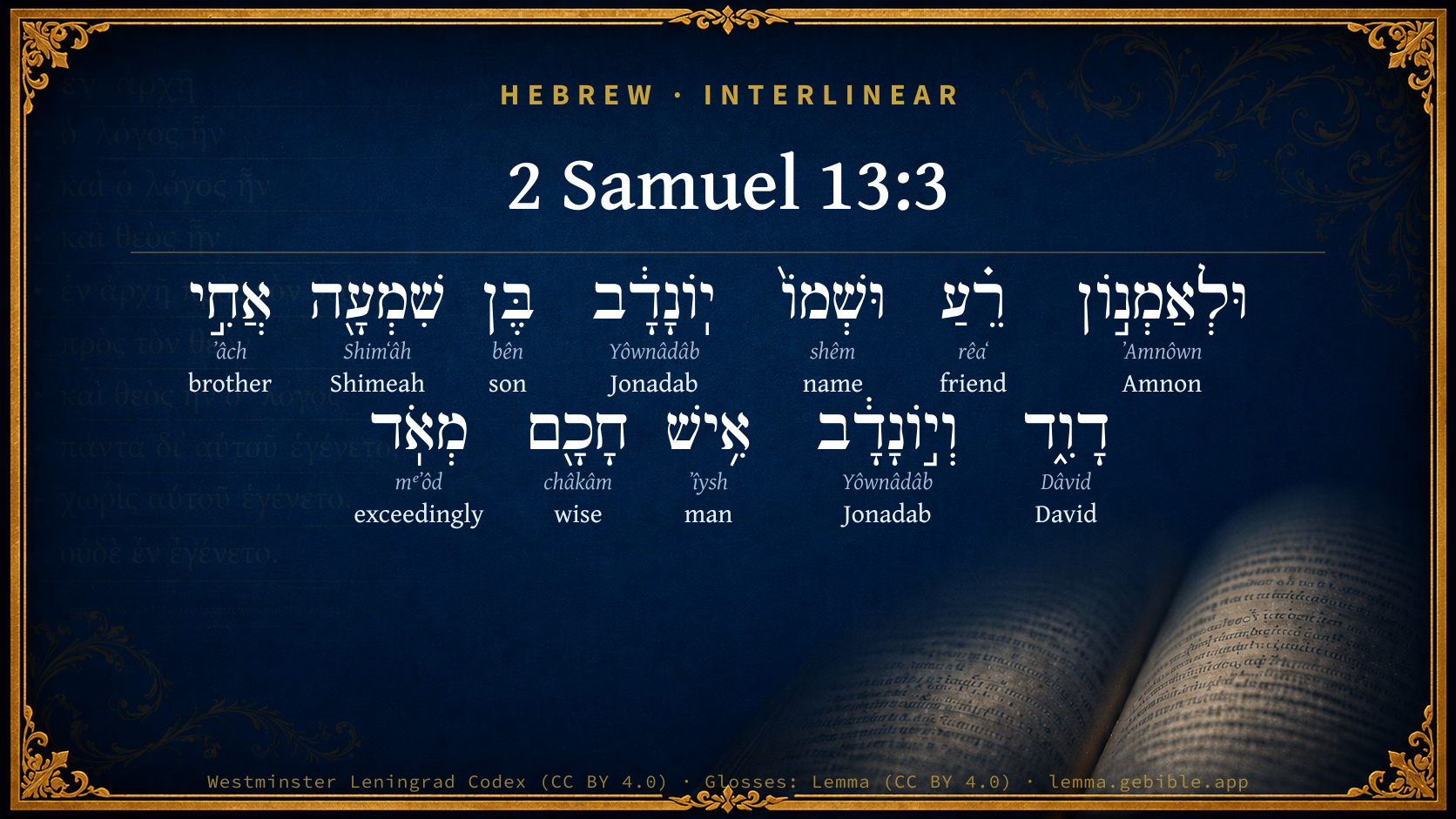
Hebrew (Westminster Leningrad Codex) 2 Samuel 13:3 appears in the Hebrew Old Testament. The text above is from the Westminster Leningrad Codex. Each word links to its Strong’s number, a concise gloss, and parsing drawn from the Open Scriptures Hebrew Bible morphology. Click any word for its full Brown-Driver-Briggs (BDB) entry.
Download image
Cite this verse

2 Samuel 13:3 (World English Bible). Public Domain. Lemma interlinear Bible study tool, https://lemma.gebible.app/v/2-samuel/13/3.

Show BibTeX & RIS
BibTeX
RIS
English Translation
But Amnon had a friend, whose name was Jonadab, the son of Shimeah, David's brother; and Jonadab was a very subtle man.
World English Bible · Public Domain
Highlights
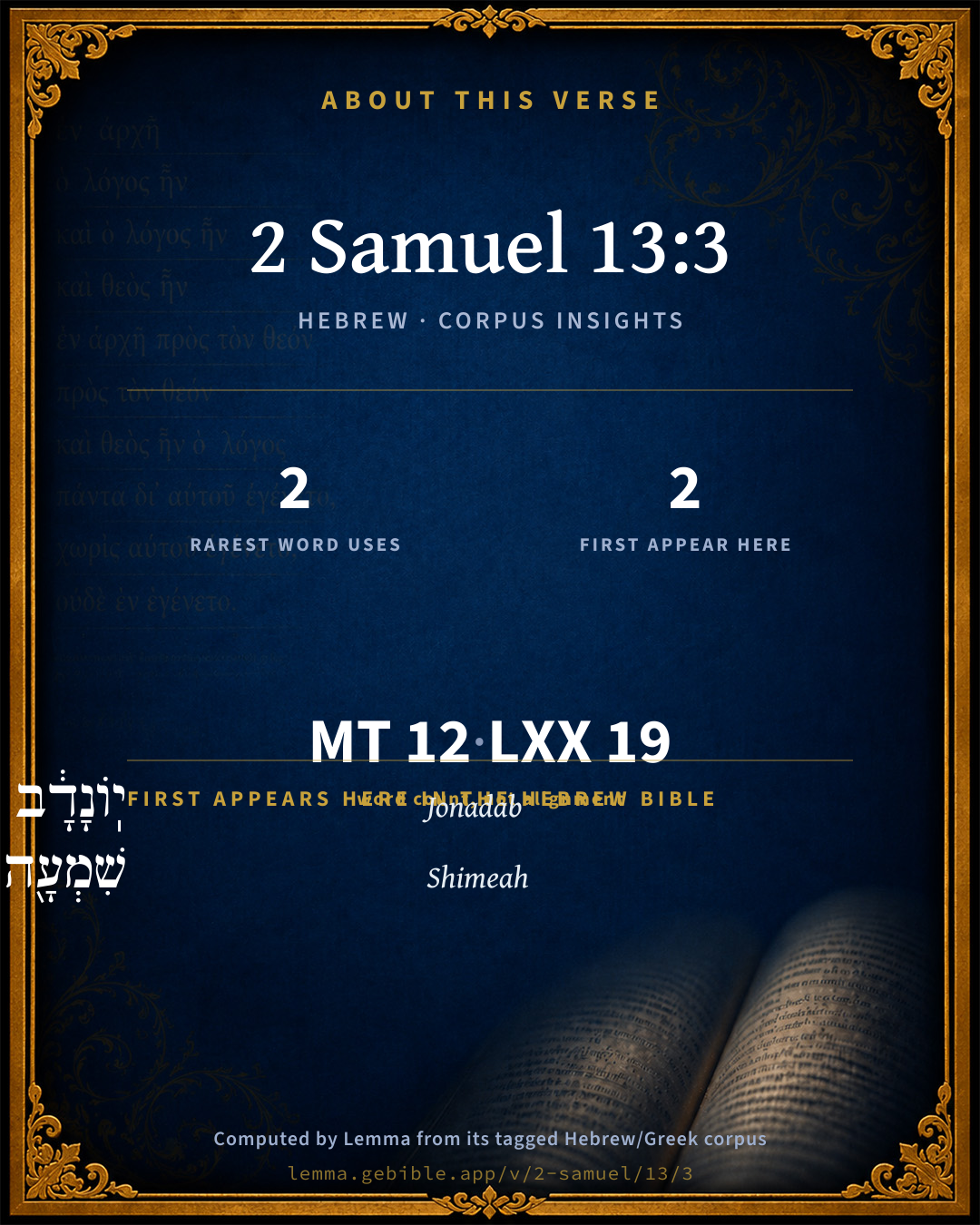
  • 2 first appearances in the Hebrew Bible
Full analysis ↓
Download a study sheet

One document with this verse’s original text, its word-by-word gloss line, the meaning frame, cross-references with their text, attributed commentary, and full source and license credits — printable, and it pastes into notes with its structure intact.

This verse Autodidact and up

Study sheet (.html) Plain text (.txt)

A passage Seminary Student

Up to 50 verses in one chapter. A passage sheet keeps up to 6 commentary sources and 12 cross-references per verse, in the order this page ranks them, and says so on the sheet whenever that leaves anything out. Ask for a single verse and you get the Autodidact verse sheet above.

Everything on this page stays free to read, with no account — the sheet is a download of what is already on screen, not access to it.

Want to remove ads? Support Godless Engineer
Compare translations 3

The same verse in 3 English versions, stacked beneath the original-language interlinear above. Click any original word for its lexicon entry.

Each is an independent rendering of the whole verse — the interlinear is not word-aligned to these translations.

Highlighted words mark where these versions differ — a whole-verse word diff, not a word-by-word alignment.

  • World English Bible Public Domain
    But Amnon had a friend, whose name was Jonadab, the son of Shimeah, David's brother; and Jonadab was a very subtle man.
  • King James Version Public Domain
    But Amnon had a friend, whose name was Jonadab, the son of Shimeah David's brother: and Jonadab was a very subtil man.
  • unfoldingWord Literal Text CC BY-SA 4.0
    Now to Amnon a friend, and his name Jonadab, the son of Shimeah the brother of David. And Jonadab a very cunning man.

unfoldingWord Literal Text — © unfoldingWord, licensed CC BY-SA 4.0. Word-aligned USFM3 via Door43 (git.door43.org/unfoldingWord/en_ult).

Versions to compare (up to 4)

3 of 4 selected

Show all 18 translations

Every available English version of this verse, each an independent rendering of the whole verse.

  • World English Bible Public Domain
    But Amnon had a friend, whose name was Jonadab, the son of Shimeah, David's brother; and Jonadab was a very subtle man.
  • Berean Standard Bible Public Domain
    Now Amnon had a friend named Jonadab, the son of David’s brother Shimeah. Jonadab was a very shrewd man,
  • Majority Standard Bible Public Domain
    Now Amnon had a friend named Jonadab, the son of David’s brother Shimeah. Jonadab was a very shrewd man,
  • King James Version Public Domain
    But Amnon had a friend, whose name was Jonadab, the son of Shimeah David's brother: and Jonadab was a very subtil man.
  • American Standard Version (1901) Public Domain
    But Amnon had a friend, whose name was Jonadab, the son of Shimeah, David's brother; and Jonadab was a very subtle man.
  • Revised Version (1885) Public Domain
    But Amnon had a friend, whose name was Jonadab, the son of Shimeah David’s brother: and Jonadab was a very subtil man.
  • Geneva Bible (1599) Public Domain
    But Amnon had a friend called Ionadab, the sonne of Shimeah Dauids brother: and Ionadab was a very subtile man.
  • Douay-Rheims (1899) Public Domain
    Now Amnon had a friend, named Jonadab the son of Semmaa the brother of David, a very wise man:
  • Young's Literal Translation Public Domain
    And Amnon hath a friend, and his name `is' Jonadab, son of Shimeah, David's brother, and Jonadab `is' a very wise man,
  • Literal Standard Version CC BY-SA 4.0
    And Amnon has a friend, and his name [is] Jonadab, son of Shimeah, David’s brother, and Jonadab [is] a very wise man,
  • Unlocked Literal Bible CC BY-SA 4.0
    But Amnon had a friend whose name was Jonadab son of Shimeah, David's brother. Jonadab was a very shrewd man.
  • unfoldingWord Literal Text CC BY-SA 4.0
    Now to Amnon a friend, and his name Jonadab, the son of Shimeah the brother of David. And Jonadab a very cunning man.
  • Darby Bible Public Domain
    And Amnon had a friend whose name was Jonadab, the son of Shimeah David's brother; and Jonadab was a very shrewd man.
  • World Messianic Bible Public Domain
    But Amnon had a friend whose name was Jonadab the son of Shimeah, David’s brother; and Jonadab was a very subtle man.
  • Webster's Bible Public Domain
    But Amnon had a friend, whose name was Jonadab, the son of Shimeah David's brother: and Jonadab was a very subtil man.
  • Free Bible Version CC BY-SA 4.0
    However, Amnon had a friend named Jonadab, and he was the son of David's brother Shimeah. Jonadab was a very cunning man.
  • Bible in Basic English Public Domain
    But Amnon had a friend whose name was Jonadab, the son of Shimeah, David's brother: and Jonadab was a very wise man.
  • JPS Tanakh (1917) Public Domain
    But Amnon had a friend, whose name was Jonadab, the son of Shimeah David's brother; and Jonadab was a very subtle man.

Literal Standard Version (2020), Covenant Press — licensed CC BY-SA 4.0. Text via the HelloAO Bible API (eBible.org). Unlocked Literal Bible (unfoldingWord) — licensed CC BY-SA 4.0. Text via the HelloAO Bible API (eBible.org). unfoldingWord Literal Text — © unfoldingWord, licensed CC BY-SA 4.0. Word-aligned USFM3 via Door43 (git.door43.org/unfoldingWord/en_ult). Free Bible Version, Dr. Jonathan Gallagher — licensed CC BY-SA 4.0. Text via the HelloAO Bible API (eBible.org).

Word by word

More ways to search: Search by grammar → Find every occurrence → Compare this word →

Practice this passage: Drill this verse → Learn its vocabulary →

About this verse

These counts appear in no published source. They are computed here, from the morphology-tagged text and Lemma’s own curated glosses. What Lemma adds →

12
words
11
distinct lemmas
Historical
section

Notable vocabulary

The rarest word here is שִׁמְעָ֖ה Shimeah H8093 — appearing just 2 times in the whole Hebrew Bible.

First appearance in Scripture

These words make their first canonical appearance in the Hebrew Bible here:

  • יֽוֹנָדָ֔ב Jonadab H3122
  • שִׁמְעָ֖ה Shimeah H8093

Shared distinctive vocabulary

שִׁמְעָ֖ה Shimeah H8093 occurs in 2 verses of the Hebrew Bible. Also found in:

Grammatical profile

  • 10 nouns
  • 1 adjective
  • 1 adverb

Repetition

A word recurs within this verse — often emphatic in Hebrew:

  • יֽוֹנָדָ֔ב Jonadab H3122 ×2

Hebrew & Septuagint length

In English translation the verse runs 22 words from the Hebrew and 25 from the Septuagint (LXX English) — closely comparable.

A rough comparison of the two English renderings, which tokenize alike — not a word-level alignment.

Word counts can differ between the Hebrew and the Greek without any difference in meaning — e.g. the Hebrew direct-object marker אֵת has no separate Greek word, and Greek often adds the article ὁ.

In the original languages it is 12 Hebrew tokens and 19 Greek tokens — but the two are counted differently (Hebrew bundles its prefixes and suffixes into one token; the Greek is in lemma form), so that isn’t a like-for-like length.

Cross-references

15

Topical passages linked to 2 Samuel 13:3 in the Treasury of Scripture Knowledge — connected by theme and wording, ordered by reader-vote popularity; previews shown in the World English Bible.

  • 1 Samuel 16:9 Then Jesse made Shammah to pass by. He said, Neither has Yahweh chosen this.
  • 1 Corinthians 3:19 For the wisdom of this world is foolishness with God. For it is written, "He has taken the wise in their craftiness."
  • Genesis 3:1 Now the serpent was more subtle than any animal of the field which Yahweh God had made. He said to the woman, "Yes, has God said, 'You shall not eat of any tree of the garden?'"
  • Genesis 38:1 It happened at that time, that Judah went down from his brothers, and visited a certain Adullamite, whose name was Hirah.
  • Genesis 38:20 Judah sent the kid of the goats by the hand of his friend, the Adullamite, to receive the pledge from the woman's hand, but he didn't find her.
  • Judges 14:20 But Samson's wife was [given] to his companion, whom he had used as his friend.
  • 2 Samuel 13:32 Jonadab, the son of Shimeah, David's brother, answered, Don't let my lord suppose that they have killed all the young men the king's sons; for Amnon only is dead; for by the appointment of Absalom this has been determined from the day that he forced his sister Tamar.
  • 2 Samuel 14:2 Joab sent to Tekoa, and fetched there a wise woman, and said to her, please act like a mourner, and put on mourning clothing, Please, and don't anoint yourself with oil, but be as a woman who has a long time mourned for the dead:
  • 2 Samuel 14:19–20 The king said, Is the hand of Joab with you in all this? The woman answered, As your soul lives, my lord the king, none can turn to the right hand or to the left from anything that my lord the king has spoken; for your servant Joab, he bade me, and he put all these words in the mouth of your handmaid;
  • Esther 5:10 Nevertheless Haman refrained himself, and went home; and he sent and fetched his friends and Zeresh his wife.
  • Esther 5:14 Then said Zeresh his wife and all his friends to him, Let a gallows be made fifty cubits high, and in the morning speak you to the king that Mordecai may be hanged thereon: then go you in merrily with the king to the banquet. The thing pleased Haman; and he caused the gallows to be made.
  • Esther 6:13 Haman recounted to Zeresh his wife and all his friends everything that had happened to him. Then his wise men and Zeresh his wife said to him, If Mordecai, before whom you have begun to fall, be of the seed of the Jews, you shall not prevail against him, but shall surely fall before him.
  • Proverbs 19:6 Many will entreat the favor of a ruler, And everyone is a friend to a man who gives gifts.
  • Jeremiah 4:22 For my people are foolish, they don't know me; they are foolish children, and they have no understanding; they are wise to do evil, but to do good they have no knowledge.
  • James 3:15 This wisdom is not that which comes down from above, but is earthly, sensual, and demonic.

Cross-references courtesy of OpenBible.info (CC BY 4.0).

Hebrew and Greek witnesses Masoretic Hebrew ↔ Greek Septuagint

The same verse in the two great witnesses to the Old Testament, shown verse-for-verse.

These are two independent witnesses, not word-aligned to each other, and the Septuagint is shown in lemma (dictionary) form.

Hebrew 2 Samuel 13:3 Masoretic · Westminster Leningrad Codex

וּלְאַמְנ֣וֹן רֵ֗עַ וּשְׁמוֹ֙ יֽוֹנָדָ֔ב בֶּן שִׁמְעָ֖ה אֲחִ֣י דָוִ֑ד וְי֣וֹנָדָ֔ב אִ֥ישׁ חָכָ֖ם מְאֹֽד

But Amnon had a friend, whose name was Jonadab, the son of Shimeah, David's brother; and Jonadab was a very subtle man.

World English Bible · Public Domain

Greek LXX 2 Samuel 13:3 Septuagint · lemma form

καί εἰμί ὁ αμνων ἑταῖρος καί ὄνομα αὐτός ιωναδαβ υἱός σαμαα ὁ ἀδελφός δαυίδ καί ιωναδαβ ἀνήρ σοφός σφόδρα

And Amnon had a friend, and his name was Jonadab, the son of Samaa the brother of David: and Jonadab was a very cunning man.

LXX2012 (modern English Septuagint) · Public Domain

Hebrew: Westminster Leningrad Codex (CC BY 4.0). Greek: Septuagint (public domain); English from LXX2012 (modern English Septuagint) (Public Domain). How the Septuagint differs from the Hebrew →

Targum (Aramaic paraphrase)

1

The Targum is the ancient Jewish Aramaic paraphrase of the Hebrew Scriptures — an interpretive translation, not the Hebrew text itself. Onkelos (literal) and Pseudo-Jonathan (expansive) render the Torah, and Jonathan the Prophets. Coverage is partial: where no permissively-licensed English translation exists for a verse, only the Aramaic is shown. This is verse-level text, not a word-by-word alignment to the Hebrew.

  1. Targum Jonathan Prophets (Joshua–Malachi)
    וּלְאַמְנוֹן שׁוֹשְׁבִינָא וּשְׁמֵיהּ יוֹנָדָב בַּר שִׁמְעָה אֲחוֹהִי דְדָוִד וְיוֹנָדָב גְבַר חַכִּים לַחֲדָא:

    (no public-domain English translation for this verse)

    Targum Jonathan — Aramaic: “Mikraot Gedolot” (public domain). English: “Sefaria Community Translation” (CC0 1.0 (public-domain dedication)); “London "Chaldee Paraphrase," 1871” (public domain). Text via Sefaria.

Commentary

Notes on 2 Samuel 13:3 from classic Christian and Jewish commentators (each source and its license shown beneath its notes). The classic Christian expositions comment on the surrounding passage and are grouped to its opening verse, so a note may address several verses; the Jewish commentaries on the Tanakh (Rashi and others) are per-verse, so they appear only where the commentator wrote on this verse.

Lemma curates 59 commentaries, every one of them public domain or Creative Commons licensed, each selected and text-cleaned for this edition rather than reprinted as found. About our sources →

Trapp's Complete Commentary

John Trapp

2Sa 13:3 But Amnon had a friend, whose name [was] Jonadab, the son of Shimeah David’s brother: and Jonadab [was] a very subtil man.

Ver. 3. But Amnon had a friend.] A friend no friend; a carnal friend, but a spiritual enemy, who advised, for the recovery of his body, the ruin of his soul. Such a false friend to Antiochus was Erasistratus, the physician, who, finding him lovesick, persuaded his father Seleucus to part with his wife Stratonice to him, for the saving of his life.

And Jonadab was a very subtle man.] Ingeniose nequam, witty, but wicked; and therefore a fit tool for the devil to work with. Good natural parts abused prove to be as press money to impiety, - auctoramentum maioris infidelitatis, as one well phraseth it, - and their wisdom culpae suasoria, as Ambrose speaketh. Augustine, writing to such another as this Jonadab, telleth him that the devil desired to be tricked up by him. {a}

{a} Diabolus cupit a te ornari.

John Trapp, A Commentary or Exposition upon All the Books of the Old and New Testament (1647–1656) — public domain. Text from a community e-Sword module.

Joseph Benson's Commentary

2Sa 13:3. Amnon had a friend — Say rather an enemy; for surely he proved himself to be such in a high degree, by the evil counsel he gave, issuing in Amnon’s utter ruin of soul, as is too probable, as well as body. “He plainly perceived that Amnon’s disease was some strong desire ungratified; and insinuated to him that he who was the king’s son might give a loose to his desires, and despise the restraint of ordinary men! How vile was this advice! and how lamentable it is that the heirs of royalty, whose virtue is of much more consequence than that of meaner men, should yet be under more temptation to taint it from the poison of infectious flatterers.” — Delaney.

Joseph Benson's Commentary on the Old and New Testaments (1811–1818) — public domain. Text from a community e-Sword module.

Tyndale Open Study Notes

Tyndale Open Resources

13:3 crafty (literally wise): Jonadab’s “wisdom” was akin to the serpent’s shrewdness (Gen 3:1). • In the context of a royal court, the Hebrew term for friend is closer to “counselor” or “adviser.”

Tyndale Open Study Notes — © Tyndale Open Resources, licensed CC BY-SA 4.0. Text via the HelloAO Bible API.

Jamieson, Fausset & Brown

Robert Jamieson, A. R. Fausset & David Brown

Jonadab, the son of Shimeah--or Shammah (Sa1 16:9). By the counsel and contrivance of this scheming cousin a plan was devised for obtaining an unrestricted interview with the object of his attachment.

Jamieson, Fausset & Brown — Commentary Critical and Explanatory on the Whole Bible (1871) — public domain (CC PDM 1.0). Text via the HelloAO Bible API.

Adam Clarke's Commentary

Verse 3. Jonadab was a very subtle man.] And most diabolic advice did he give to his cousin. We talk of the simplicity and excellence of primitive times! "Say not thou what is the cause that the former days were better than these." Take them altogether, we may thank God that they are past, and pray him that they may never return.

Adam Clarke's Commentary on the Bible (1810–1826) — public domain. Text from a community e-Sword/MySword module.

Ellicott's Commentary for English Readers

(3) Jonadab, the son of Shimeah.—In 1Sa_16:9, Shimeah is called Shammah, and appears there as the third son of Jesse. He had another son, Jonathan, mentioned in 2Sa_21:21, as the conqueror of one of the giants. The word subtil is used simply to indicate sagacity and wisdom, whether rightly or wrongly exercised.

A Bible Commentary for English Readers, edited by Charles John Ellicott (1878–1897) — public domain. Text from a community e-Sword module.

The Cambridge Bible for Schools and Colleges

gen. ed. J. J. S. Perowne

3. a friend] This narrative is a strong warning against the danger of evil companions. The clever but unprincipled friend is more likely to provide means for gratifying evil passions than help in resisting them.

Jonadab, the son of Shimeah] Shimeah is called Shammah in 1Sa_16:9. He had another son Jonathan (ch. 2Sa_21:21).

subtil] The word means simply wise, and pronounces no judgment on the way in which Jonadab misused his sagacity. Cp. Job_5:13; Jer_4:22.

The Cambridge Bible for Schools and Colleges (gen. ed. J. J. S. Perowne; Cambridge University Press, 1878–1918) — public domain. Text from a community e-Sword module.

John Gill's Exposition

But Amnon had a friend,.... Though in the issue his friendship proved his ruin:

whose name was Jonadab, the son of Shimeah, David's brother; so that they were own cousins, the same with Shammah, Sa1 16:9,

and Jonadab was a very subtle man; a very penetrating man into the dispositions of men, and could judge by their countenances what they were, and the affections of their minds, and had a talent in forming schemes; he was wise to do evil and was wickedly cunning.

John Gill's Exposition of the Whole Bible (1746–1763) — public domain (CC PDM 1.0). Text via the HelloAO Bible API.

Albert Barnes' Notes on the Bible

Shimeah - Called Shamma (marginal reference), was Jesse’s third son.

Subtil - literally, wise. The word is generally used in a good sense, but here, and in Job 5:13, it means crafty.

Albert Barnes' Notes on the Bible (1834–1885) — public domain. Text from a community e-Sword/MySword module.

Haydock's Catholic Bible Commentary

A very wise man. That is, a crafty and subtle man: for the counsel he gave on this occasion shews that his wisdom was but carnal and worldly. (Challoner) --- Jonadab seems to be styled Jonathan, chap. xxi. 21. (Calmet)

George Leo Haydock (1774–1849), Haydock's Catholic Family Bible and Commentary, 1859 edition — public domain. Excludes Psalms (Douay-Rheims chapter numbering differs from Protestant) and Deuterocanonical books (Catholic canon only).

Matthew Poole's English Annotations

Shimeah, called also Shammah, 1Sa 16:9.

Matthew Poole's English Annotations on the Holy Bible (1683–1685) — public domain. Text from a community e-Sword/MySword module.

Whedon's Commentary on the Bible

Daniel D. Whedon

3. A friend… a very subtile man — “One of those characters,” says Stanley, “who in great houses pride themselves on being acquainted and on dealing with all the secrets of the family.” Compare his acts and words in 2Sa_13:32-35.

Daniel D. Whedon (gen. ed.), Commentary on the Old and New Testaments (1874–1909) — public domain. Text from a community e-Sword module.

The Pulpit Commentary

Jonadab, the son of Shimeah. He is called Shammah in 1Sa_16:9, and is there described as Jesse"s third son. A brother of Jonadab, named Jonathan, is mentioned in 2Sa_21:21 as a valiant soldier who slew one of the Philistine giants. Subtil is not used in a bad sense, but means clever, ready in devising means.

Ver. 3. (JERUSALEM.)

A false friend.

Jonadab was a very subtil man." Every virtue has its counterfeit. As there is a friendship which is true and beneficial, so there is what appears to be such but is false and injurious. Of the former we have an instance in David and Jonathan, (1Sa_18:1-4) of the latter in Amnon and Jonadab (his cousin, a son of Shammah, (1Sa_16:9; 2Sa_21:21) "one of those characters who in great houses pride themselves on being acquainted and on dealing with all the secrets of the family" (Stanley). In Jonadab, the daily companion of Amnon (ver. 4), we see the kind of friend that should not be chosen.

1. He is distinguished for subtlety, not for virtue and piety. "In the choice of a friend, let him be virtuous; for vice is contagious, and there is no trusting of the sound and the sick together" (Seneca). "Friendship is nothing else but benevolence or charity, under some modifications, viz. that it be in a special manner intense, that it be mutual, and that it be manifest or mutually known. It cannot be but between good men, because an ill man cannot have any true charity, much less such an intense degree of it as is requisite to friendship" (J. Norris, "Miscellanies"). A companion is sometimes chosen solely for his cleverness and insinuating address; but his superior intelligence (however desirable in itself), unless it be combined with moral excellence, enables him to do all the greater mischief. (Jer_4:22)

1. In professing concern for another"s welfare he seeks only to serve his own interests; his own pleasure, gain, influence, and advancement (ver. 4). True friendship is disinterested. Jonadab appears to have cared only for himself. Hence (to avoid getting himself into trouble) he gave no warning to others of what he foresaw (ver. 32). "This young man, who probably desired to make himself of some importance as David"s nephew, was clever

2. enough to guess the truth from the first; but it is sad to think that his thought and his advice were never founded on anything but a knowledge of the devil in man" (Ewald).

3. When he is acquainted with the secret thoughts of another, he fails to give him faithful counsel. (Ver. 5.) Such acquaintance is often obtained by flattery a king"s son and frequent questioning; but it is not followed, in the case of improper desires and purposes, by admonition. "No flatterer can be a true friend." "Had he been a true friend, he had bent all the forces of his dissuasion against the wicked motions of that sinful lust" (Hall). "Faithful are the wounds of a friend.

4. Whilst he devises means for another"s gratification, he smoothes his way to destruction. His aim is only to please. He advises what is agreeable, but what is morally wrong; and thus incites to sin; for which, with all its consequences, he is, in part, responsible. "In wise counsel two things must be considered that both the end be good, and the means honest and lawful. Jonadab"s counsel failed in both." "The rapacious friend, the insincere friend, the friend who speaks only to please, and he who is a companion in vicious pleasures, recognizing these four to be false friends, the wise man flies far from them, as he would from a road beset by danger" (Contemporary Review, 27:421). "A companion of fools shall be destroyed". D. (Pro_13:20 Pro_1:10)

HOMILIES BY G. WOOD Ver. 3.

A diabolical friend: a homily for young men.

This chapter contains a dreadful story. The unnatural lust of Amnon, the vile counsels of Jonadab, the unsuspiciousness of the king, the confiding innocence of Tamar, her unavailing remonstrances and resistance, the hardened villainy of her half-brother, his hatred and cruel expulsion of his innocent victim, her bitter anguish and lamentations, the unjust leniency of David towards the offender (although "very wroth"), the vengeance so quietly prepared and so sternly executed by Absalom, the king"s lamentations over the death of Amnon, his subsequent longing after the fugitive Absalom, present a picture of horrible wickedness, of helpless misery, of weak negligence, of fierce and deadly revenge, which moves us with alternate detestation and pity, as well as wonder that so much depravity should have been found in the family of a man so godly and devout, until we remember the unfavourableness of polygamy to the right training of families, the foolish indulgence of David towards his children, and his own evil conduct, which weakened his authority. Passing by, however, all other particulars, let us consider awhile this statement, "Amnon had a friend, whose name was Jonadab... a very subtil man.

I A KIND OF FRIENDSHIP TO BE ABHORRED AND AVOIDED. At first view the friendship of Jonadab and Amnon seems natural and proper. They were first cousins; Jonadab was a man of intelligence ("subtil," equivalent to "wise," not necessarily "subtle" in the bad sense); he "showed himself friendly" by noticing his friend"s doleful appearance and inquiring the cause. Not until we observe the advice he gave, and see how it was accepted and followed, do we discover how base he was, how base they both were. Amnon"s vileness appears, indeed, earlier, in his indulgence of a passion for his beautiful half-sister, and that so violent, while so seemingly hopeless, that it affected his health. A case, surely, calling for pity and sympathy! No wonder that his dear friend so feelingly inquired after his health, and employed his subtlety to find a remedy! They must have known each other very well for one to acknowledge so disreputable a cause of his ill looks, and the other to suggest so infamous a restorative. What a real friend would have advised is obvious. He would have urged Amnon, by every consideration of morality and religion, of regard for the honour of his family and nation, the happiness of his father, and the duty he owed to his sister, to conquer his guilty passion. But Amnon knew well that he was in no peril of being troubled with such counsel, or he would not have acknowledged his shameful lust. Observe, too, how utterly this pair of friends, like all their tribe, disregarded the ruin and misery which they were plotting for the innocent Tamar. They seem to have been tolerably sure that the offence would not be thought very serious by "society," and that the law would not be put in force by David. His own sins of a similar kind would give them confidence of impunity. Even after committing the foul crime, Amnon does not seem to have thought it necessary, for the sake either of safety or decency, to retire for at least a time from Jerusalem until the affair had "blown over." What a contrast between this friendship and that of David and Jonathan! Many such friends, alas! are to be found in the world; men who are counselling and aiding and hardening each other in licentiousness, whose delight is to ruin the innocent, and bring dishonour and misery on their families; and who are preparing each other for well-merited damnation. Yet their debauchery is overlooked by "society," especially if they be of high rank, while their victims receive no pity. It would be of little use to address such wretches, even if we could gain access to them. But we may warn young men who have not yet come under their deadly influence, but who may be in danger of doing so. For in all classes of society persons are to be found who, corrupt themselves, delight in corrupting others. Young men coming from the country to great cities, where at present they have no friends, are in peril, not only from prostitutes or sometimes from loose married women, but from men of the class referred to. These will test them by using double entendres, advancing to outspoken ribaldry and freer conversation about sexual indulgences. If discouraged, they will laugh at the "innocence" and "squeamishness" of the youth they would corrupt. If he at all encourage them, they will introduce him to indecent books, or offer themselves as guides to the places where he may safely indulge his passions. To an inexperienced youth, not yet well grounded in Christian principles, such approaches present very powerful temptations. The assault from without meets with auxiliaries within, in the awakening passions themselves, and in a curiosity "to see a little life." The manner in which such temptations are met at the beginning is likely to determine the character of the youth"s whole future life. To yield is to be undone; to resist and conquer is to gain new strength for future conflict and victory. Let, then, those who are thus tempted shrink back from their tempter as from a viper. At the first indication of such depravity let them "cut" those who display it, however related to them by blood, however agreeable as companions (the more agreeable the more dangerous), however able to help them in their worldly career. If their counsel be not followed, yet friendly association with them in any degree must exercise a debasing influence. It may not be possible to avoid them altogether; they may be employed in the same establishment, and indulge themselves in loose language in the hearing of their fellows; but let a loathing of them be cherished, and every practicable effort be made to silence and suppress them.

II THE SUREST SAFEGUARDS AGAINST SUCH FRIENDSHIP.

1. Close and decided friendship with Christ. Begun early, cultivated diligently by daily communion with him in secret, through devout study of his Word, believing meditation, fervent prayer. Thus the heart will become filled with the purest and noblest affections, leaving no room for the vile; and thus will the youth become "strong in the Lord, and in the power of his might," and "be able to withstand in the evil day". (Eph_6:10, Eph_6:13)

1. Friendship with the best Christians. Union and communion with them in Church fellowship, in Divine ordinances, in Christian work, in social life and its pure enjoyments. Christian people should interest themselves in the young (especially young men from home), and welcome them to their

2. confidence, their friendship, their homes. For the young must have friends; and if there be difficulty in associating with the good, they are in so much greater danger of contenting themselves with the evil or the doubtful. But if they form Christian friendships, these will be as an impassable barrier against the advances of such as would lead them.astray.

3. Constant watchfulness and prayer. Against everything that, if indulged, would make the society of the wicked welcome. Guard the heart, for out of it springs the life. (Pro_4:23) Seek of God a clean heart. (Psa_51:10) Suppress every impure thought and feeling (see, (Mat_5:28) and every impulse to utter impure words. (Eph_4:29 Eph_5:3) Let the psalmist"s prayers (Psa_141:3, 4 139:23, 24) be yours. Ever cherish the thought, "Thou God scent me". (Gen_16:13)

4. Consideration of the certain result of following evil counsellors. "A companion of fools shall be destroyed". (Pro_13:20) Amnon found it so. Let the young man think, when sinners entice him, "They are inviting me to misery, death, hell!

Finally, it is not only those who are unchaste, and the abettors of unchastity whose close acquaintance and counsel are to be avoided, but the irreligious and immoral in general; all who are "lovers of pleasure rather than lovers of God"; (2Ti_3:4, Revised Version) all who adopt, practice, and tempt to infidelity, sabbath breaking, intemperance, gambling, untruthfulness, dishonesty, or any other form of evil. "Be not deceived: evil company" of any kind "doth corrupt good manners". G.W. (1Co_15:33, Revised Version)

The Pulpit Commentary (1880–1919), ed. H.D.M. Spence-Jones & Joseph S. Exell — public domain. Text from a community e-Sword module.

unfoldingWord translationNotes

Door43 World Missions Community

Jonadab son of Shimeah, David's brother

These are the names of men. Shimeah was David's brother. (See: How to Translate Names)

shrewd

crafty or deceptive

depressed

in an emotional state of extreme unhappiness

Will you not tell me?

It is understood that he is asking him about his depression, which can be stated clearly. Also, this rhetorical question is a request for Jehonadab to tell him why he is depressed. It may be written as a statement. AT: "Will you not tell me why you are depressed?" or "Please, tell me why you are depressed." (See: Ellipsis and Rhetorical Question)

translationWords

name

king

love

unfoldingWord translationNotes — © Distant Shores Media and the Door43 World Missions Community, licensed CC BY-SA 4.0. Source: git.door43.org/Door43/en_tn.

Rashi

Rabbi Shlomo Yitzchaki (Rashi)

Smart man. For wickedness.

Rashi on the Tanakh — English translations: “The Judaica Press complete Tanach with Rashi, translated by A. J. Rosenberg” (CC BY 4.0); “Pentateuch with Rashi's commentary by M. Rosenbaum and A.M. Silbermann, 1929-1934” (public domain); “The Metsudah Tanach series, Lakewood, N.J” (CC BY 4.0); and “The Book of Joshua, Metsudah Publications, 1997” (CC BY 4.0). Text via Sefaria.

Lesson kit

Teaching starters — assembled from the data on this page, not authored interpretation. Every prompt links to the verse data it draws on. Edit before teaching.

2 Samuel, in the Historical, opens this verse with 12 words (11 distinct Hebrew lemmas). Its most distinctive word is Shimʻâh (“Shimeah”). A historical commentator’s framing appears above. Read the whole chapter for the surrounding context.

Discussion questions

  1. What does “Shimeah” (Shimʻâh) contribute to the verse as a whole?
  2. 2 words here appear for the first time in Scripture. What is being introduced at this debut?
  3. 2 Samuel 13:32 shares the word «Shimeah» with this verse. How do the two illuminate each other?
  4. “Jonadab” occurs 2× in this one verse. What is the effect of the repetition?
  5. These translations render this verse differently. What is at stake in choosing one wording over another?
  6. Reading how Trapp's Complete Commentary and Joseph Benson's Commentary read this verse, where do the two commentators agree and where do they part?

Things to notice

Reading settings

Reading text

Shown beneath each verse's original-language words.

Old Testament
Old Testament edition

Read the OT as the Masoretic Hebrew (MT) or the Greek Septuagint (LXX).

English shown for the Greek Septuagint (in the Hebrew ↔ Greek comparison).

Comparing translations? Open the Compare panel on any verse page to stack up to four side by side.