Ezekiel 33:26

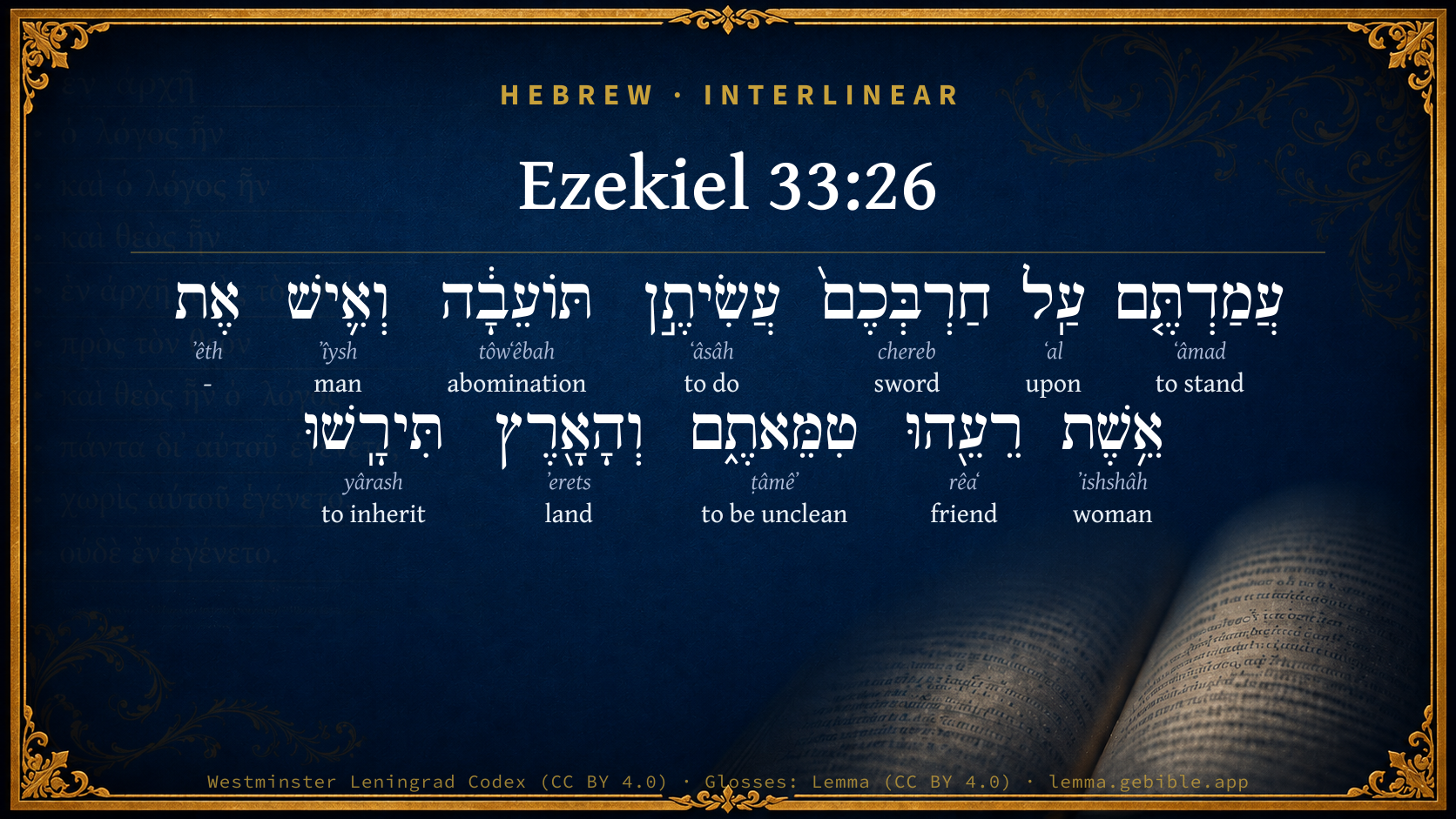
Hebrew (Westminster Leningrad Codex) Ezekiel 33:26 appears in the Hebrew Old Testament. The text above is from the Westminster Leningrad Codex. Each word links to its Strong’s number, a concise gloss, and parsing drawn from the Open Scriptures Hebrew Bible morphology. Click any word for its full Brown-Driver-Briggs (BDB) entry.
Download image
Cite this verse

Ezekiel 33:26 (World English Bible). Public Domain. Lemma interlinear Bible study tool, https://lemma.gebible.app/v/ezekiel/33/26.

Show BibTeX & RIS
BibTeX
RIS
English Translation
You stand on your sword, you work abomination, and you defile everyone his neighbor's wife: and shall you possess the land?
World English Bible · Public Domain
Download a study sheet

One document with this verse’s original text, its word-by-word gloss line, the meaning frame, cross-references with their text, attributed commentary, and full source and license credits — printable, and it pastes into notes with its structure intact.

This verse Autodidact and up

Study sheet (.html) Plain text (.txt)

A passage Seminary Student

Up to 50 verses in one chapter. A passage sheet keeps up to 6 commentary sources and 12 cross-references per verse, in the order this page ranks them, and says so on the sheet whenever that leaves anything out. Ask for a single verse and you get the Autodidact verse sheet above.

Everything on this page stays free to read, with no account — the sheet is a download of what is already on screen, not access to it.

Want to remove ads? Support Godless Engineer
Compare translations 3

The same verse in 3 English versions, stacked beneath the original-language interlinear above. Click any original word for its lexicon entry.

Each is an independent rendering of the whole verse — the interlinear is not word-aligned to these translations.

Highlighted words mark where these versions differ — a whole-verse word diff, not a word-by-word alignment.

  • World English Bible Public Domain
    You stand on your sword, you work abomination, and you defile everyone his neighbor's wife: and shall you possess the land?
  • King James Version Public Domain
    Ye stand upon your sword, ye work abomination, and ye defile every one his neighbour's wife: and shall ye possess the land?
  • unfoldingWord Literal Text CC BY-SA 4.0
    You have depended on your swords and have done disgusting things; each man defiles his neighbor’s wife. Should you really possess the land?’

unfoldingWord Literal Text — © unfoldingWord, licensed CC BY-SA 4.0. Word-aligned USFM3 via Door43 (git.door43.org/unfoldingWord/en_ult).

Versions to compare (up to 4)

3 of 4 selected

Show all 18 translations

Every available English version of this verse, each an independent rendering of the whole verse.

  • World English Bible Public Domain
    You stand on your sword, you work abomination, and you defile everyone his neighbor's wife: and shall you possess the land?
  • Berean Standard Bible Public Domain
    You have relied on your swords, you have committed detestable acts, and each of you has defiled his neighbor’s wife. Should you then possess the land?’
  • Majority Standard Bible Public Domain
    You have relied on your swords, you have committed detestable acts, and each of you has defiled his neighbor’s wife. Should you then possess the land?’
  • King James Version Public Domain
    Ye stand upon your sword, ye work abomination, and ye defile every one his neighbour's wife: and shall ye possess the land?
  • American Standard Version (1901) Public Domain
    Ye stand upon your sword, ye work abomination, and ye defile every one his neighbor's wife: and shall ye possess the land?
  • Revised Version (1885) Public Domain
    Ye stand upon your sword, ye work abomination, and ye defile every one his neighbour’s wife: and shall ye possess the land?
  • Geneva Bible (1599) Public Domain
    Ye leane vpon your swordes: ye worke abomination, and yee defile euery one his neighbours wife: should ye then possesse the land?
  • Douay-Rheims (1899) Public Domain
    You stood on your swords, you have committed abominations, and every one hath defiled his neighbour's wife; and shall you possess the land by inheritance?
  • Young's Literal Translation Public Domain
    Ye have stood on your sword, Ye have done abomination, Each the wife of his neighbour ye have defiled, And the land ye possess!
  • Literal Standard Version CC BY-SA 4.0
    You have stood on your sword, || You have done abomination, || You have each defiled the wife of his neighbor, || Should you then possess the land?
  • Unlocked Literal Bible CC BY-SA 4.0
    You have depended on your swords and have done disgusting things; each man defiles his neighbor's wife. Should you really possess the land?'
  • unfoldingWord Literal Text CC BY-SA 4.0
    You have depended on your swords and have done disgusting things; each man defiles his neighbor’s wife. Should you really possess the land?’
  • Darby Bible Public Domain
    Ye stand upon your sword, ye work abomination, and ye defile every one his neighbour's wife; and shall ye possess the land?
  • World Messianic Bible Public Domain
    You stand on your sword, you work abomination, and every one of you defiles his neighbor’s wife. So should you possess the land?”’
  • Webster's Bible Public Domain
    Ye stand upon your sword, ye work abomination, and ye defile every one his neighbor's wife: and shall ye possess the land?
  • Free Bible Version CC BY-SA 4.0
    You rely on your swords to get your way. You have done some disgusting things. You're all having sex with each other's wives. Should the country belong to you?
  • Bible in Basic English Public Domain
    You put your faith in your swords, you do disgusting things, everyone takes his neighbour's wife: are you to have the land for your heritage?
  • JPS Tanakh (1917) Public Domain
    Ye stand upon your sword, ye work abomination, and ye defile every one his neighbour's wife; and shall ye possess the land?

Literal Standard Version (2020), Covenant Press — licensed CC BY-SA 4.0. Text via the HelloAO Bible API (eBible.org). Unlocked Literal Bible (unfoldingWord) — licensed CC BY-SA 4.0. Text via the HelloAO Bible API (eBible.org). unfoldingWord Literal Text — © unfoldingWord, licensed CC BY-SA 4.0. Word-aligned USFM3 via Door43 (git.door43.org/unfoldingWord/en_ult). Free Bible Version, Dr. Jonathan Gallagher — licensed CC BY-SA 4.0. Text via the HelloAO Bible API (eBible.org).

Word by word

More ways to search: Search by grammar → Find every occurrence → Compare this word →

Practice this passage: Drill this verse → Learn its vocabulary →

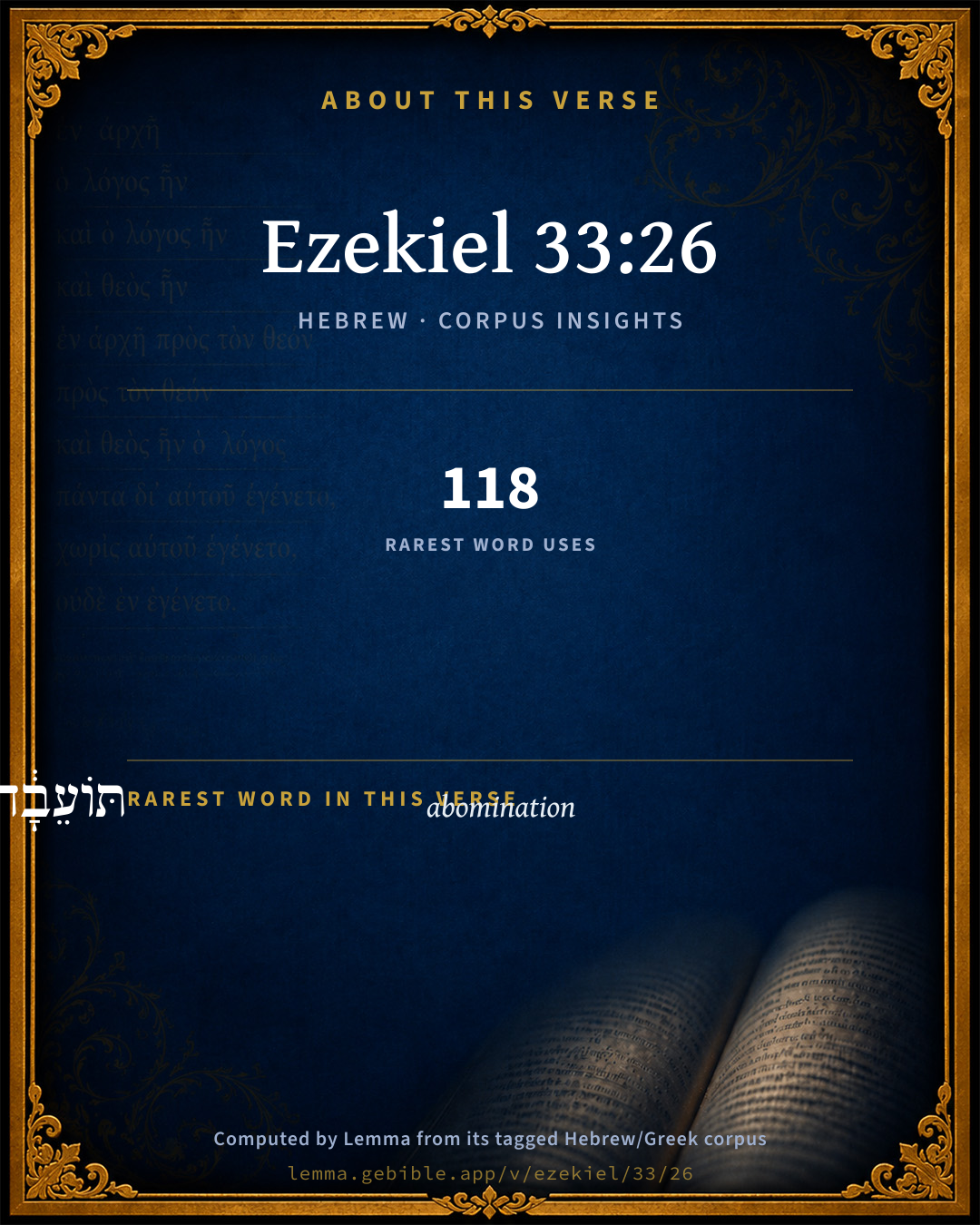
תּוֹעֵבָ֔ה
tôwʻêbah
H8441
“abomination”
Noun, Common, Feminine, Singular, Absolute
Part of Speech
Noun
Type
Common
Gender
Feminine
Number
Singular
State
Absolute
Full BDB Definition

Origin: act part of H8581

TWOT: 2530a

a disgusting thing, abomination, abominable - in ritual sense (of unclean food, idols, mixed marriages) - in ethical sense (of wickedness etc)
  1. עֲמַדְתֶּ֤ם ʻâmad H5975 “to stand” Verb, Qal, Perfect, 2nd Person, Masculine, Plural
  2. עַֽל ʻal H5921 “upon” Preposition
  3. חַרְבְּכֶם֙ chereb H2719 “sword · your” Noun, Common, Feminine, Singular, Construct + Suffix, Personal, 2nd Person, Masculine, Plural
  4. עֲשִׂיתֶ֣ן ʻâsâh H6213 “to do” Verb, Qal, Perfect, 2nd Person, Feminine, Plural
  5. וְאִ֛ישׁ ʼîysh H376 “and · man” Conjunction + Noun, Common, Masculine, Singular, Absolute
  6. אֶת ʼêth H853 “-” Particle, Direct Object
  7. אֵ֥שֶׁת ʼishshâh H802 “woman of” Noun, Common, Feminine, Singular, Construct
  8. רֵעֵ֖הוּ rêaʻ H7453 “friend · his” Noun, Common, Masculine, Singular, Construct + Suffix, Personal, 3rd Person, Masculine, Singular
  9. טִמֵּאתֶ֑ם ṭâmêʼ H2930 “to be unclean” Verb, Piel, Perfect, 2nd Person, Masculine, Plural
  10. וְהָאָ֖רֶץ ʼerets H776 “and · the · land” Conjunction + Particle, Definite Article + Noun, Common, Both, Singular, Absolute
  11. תִּירָֽשׁוּ yârash H3423 “to inherit” Verb, Qal, Imperfect, 2nd Person, Masculine, Plural

About this verse

These counts appear in no published source. They are computed here, from the morphology-tagged text and Lemma’s own curated glosses. What Lemma adds →

12
words
12
distinct lemmas
Prophets
section

Grammatical profile

  • 4 verbs
  • 6 nouns
  • 1 preposition
  • 1 particle

Verb forms

  • עֲמַדְתֶּ֤ם Qal · Perfect
  • עֲשִׂיתֶ֣ן Qal · Perfect
  • טִמֵּאתֶ֑ם Piel · Perfect
  • תִּירָֽשׁוּ Qal · Imperfect

Cross-references

21

Topical passages linked to Ezekiel 33:26 in the Treasury of Scripture Knowledge — connected by theme and wording, ordered by reader-vote popularity; previews shown in the World English Bible.

  • Genesis 27:40 By your sword will you live, and you will serve your brother. It will happen, when you will break loose, That you shall shake his yoke from off your neck."
  • Micah 2:1–2 Woe to those who devise iniquity And work evil on their beds! When the morning is light, they practice it, Because it is in the power of their hand.
  • Zephaniah 3:3 Her princes in the midst of her are roaring lions. Her judges are evening wolves. They leave nothing until the next day.
  • Leviticus 18:25–30 The land was defiled: therefore I punished its iniquity, and the land vomitted out her inhabitants.
  • Leviticus 20:13 If a man lies with a male, as with a woman, both of them have committed an abomination: they shall surely be put to death; their blood shall be upon them.
  • Leviticus 20:22 "'You shall therefore keep all my statutes, and all my ordinances, and do them; that the land, where I am bringing you to dwell, may not vomit you out.
  • Deuteronomy 4:25–26 When you shall father children, and children's children, and you shall have been long in the land, and shall corrupt yourselves, and make an engraved image in the form of anything, and shall do that which is evil in the sight of Yahweh your God, to provoke him to anger;
  • Deuteronomy 29:18–23 lest there should be among you man, or woman, or family, or tribe, whose heart turns away this day from Yahweh our God, to go to serve the gods of those nations; lest there should be among you a root that bears gall and wormwood;
  • Joshua 23:15–16 It shall happen, that as all the good things are come on you of which Yahweh your God spoke to you, so will Yahweh bring on you all the evil things, until he have destroyed you from off this good land which Yahweh your God has given you.
  • 1 Samuel 2:30 Therefore Yahweh, the God of Israel, says, I said indeed that your house, and the house of your father, should walk before me forever: but now Yahweh says, Be it far from me; for those who honor me I will honor, and those who despise me shall be lightly esteemed.
  • 1 Kings 11:5–7 For Solomon went after Ashtoreth the goddess of the Sidonians, and after Milcom the abomination of the Ammonites.
  • Psalms 50:16–20 But to the wicked God says, "What right do you have to declare my statutes, That you have taken my covenant on your lips,
  • Psalms 94:20–21 Shall the throne of wickedness have fellowship with you, Which brings about mischief by statute?
  • Jeremiah 5:8–9 They were as fed horses roaming at large; everyone neighed after his neighbor's wife.
  • Ezekiel 18:6 and has not eaten on the mountains, neither has lifted up his eyes to the idols of the house of Israel, neither has defiled his neighbor's wife, neither has come near to a woman in her impurity,
  • Ezekiel 18:11–12 and who does not any of those [duties], but even has eaten on the mountains, and defiled his neighbor's wife,
  • Ezekiel 18:15 who has not eaten on the mountains, neither has lifted up his eyes to the idols of the house of Israel, has not defiled his neighbor's wife,
  • Ezekiel 22:9–11 Slanderous men have been in you to shed blood; and in you they have eaten on the mountains: in the midst of you they have committed lewdness.
  • 1 Peter 4:3 For we have spent enough of our past time doing the desire of the Gentiles, and having walked in lewdness, lusts, drunken binges, orgies, carousings, and abominable idolatries.
  • Revelation 21:8 But for the cowardly, unbelieving, sinners, abominable, murderers, sexually immoral, sorcerers, idolaters, and all liars, their part is in the lake that burns with fire and sulfur, which is the second death."
  • Revelation 21:27 There will in no way enter into it anything profane, or one who causes an abomination or a lie, but only those who are written in the Lamb's book of life.

Cross-references courtesy of OpenBible.info (CC BY 4.0).

Hebrew and Greek witnesses Masoretic Hebrew ↔ Greek Septuagint

The same verse in the two great witnesses to the Old Testament, shown verse-for-verse.

These are two independent witnesses, not word-aligned to each other, and the Septuagint is shown in lemma (dictionary) form.

Hebrew Ezekiel 33:26 Masoretic · Westminster Leningrad Codex

עֲמַדְתֶּ֤ם עַֽל חַרְבְּכֶם֙ עֲשִׂיתֶ֣ן תּוֹעֵבָ֔ה וְאִ֛ישׁ אֶת אֵ֥שֶׁת רֵעֵ֖הוּ טִמֵּאתֶ֑ם וְהָאָ֖רֶץ תִּירָֽשׁוּ

You stand on your sword, you work abomination, and you defile everyone his neighbor's wife: and shall you possess the land?

World English Bible · Public Domain

On this verse, The Cambridge Bible for Schools and Colleges discusses the Septuagint’s reading. Read the note in Commentary ↓

Hebrew: Westminster Leningrad Codex (CC BY 4.0). Greek: Septuagint (public domain); English from a public-domain English Septuagint. How the Septuagint differs from the Hebrew →

Targum (Aramaic paraphrase)

1

The Targum is the ancient Jewish Aramaic paraphrase of the Hebrew Scriptures — an interpretive translation, not the Hebrew text itself. Onkelos (literal) and Pseudo-Jonathan (expansive) render the Torah, and Jonathan the Prophets. Coverage is partial: where no permissively-licensed English translation exists for a verse, only the Aramaic is shown. This is verse-level text, not a word-by-word alignment to the Hebrew.

  1. Targum Jonathan Prophets (Joshua–Malachi)
    וְאִתְעַתַּדְתּוּן עַל תּוּקְפֵיכוֹן עֲבַדְתּוּן תּוֹעֵיבָא וּגְבַר יַת אִתַּת חַבְרֵיהּ סְאֵיבְתּוּן וְאַרְעָא אַתּוּן מְדַמָן לְמֵירְתָהּ:

    (no public-domain English translation for this verse)

    Targum Jonathan — Aramaic: “Mikraot Gedolot” (public domain). English: “Sefaria Community Translation” (CC0 1.0 (public-domain dedication)); “London "Chaldee Paraphrase," 1871” (public domain). Text via Sefaria.

Commentary

Notes on Ezekiel 33:26 from classic Christian and Jewish commentators (each source and its license shown beneath its notes). The classic Christian expositions comment on the surrounding passage and are grouped to its opening verse, so a note may address several verses; the Jewish commentaries on the Tanakh (Rashi and others) are per-verse, so they appear only where the commentator wrote on this verse.

Lemma curates 59 commentaries, every one of them public domain or Creative Commons licensed, each selected and text-cleaned for this edition rather than reprinted as found. About our sources →

Trapp's Complete Commentary

John Trapp

Eze 33:26 Ye stand upon your sword, ye work abomination, and ye defile every one his neighbour’s wife: and shall ye possess the land?

Ver. 26. Ye stand upon your sword.] Vivitur ex rapto. He that hath the longest sword carrieth it among you: ye are also very revengeful, ready to say with him in the poet,

“ Virtus mihi numeri, et ensis

Quem teneo.

Dextra mihi deus, et telum quod missile libro. ”{ a}

Ye work abomination.] This R. Solomon understandeth de venere obscaeniore. It is in the original, Ye women work abomination, as prostituting yourselves to an unnatural filthiness, as the casuists complain still of some Spanish courtezans. {b}

And shall ye possess the land,] q.d., Ye shall be set up: what should you expect better than exilium et excitium, banishment and destruction?

{a} Caparene ap. Statum. Theb., 2. Mezent. ap. Virg. Aeneid, 10.

{b} Martin Vivald., in Candelab.

John Trapp, A Commentary or Exposition upon All the Books of the Old and New Testament (1647–1656) — public domain. Text from a community e-Sword module.

Geneva Bible (1599)

Geneva Bible translators

As they that are ready still to shed blood.

Geneva Bible (1599) marginal notes — public domain. Text via Bolls.life.

Jamieson, Fausset & Brown

Robert Jamieson, A. R. Fausset & David Brown

Ye stand upon your sword--Your dependence is, not on right and equity, but on force and arms.

every one--Scarcely anyone refrains from adultery.

Jamieson, Fausset & Brown — Commentary Critical and Explanatory on the Whole Bible (1871) — public domain (CC PDM 1.0). Text via the HelloAO Bible API.

Adam Clarke's Commentary

Verse 26. Ye stand upon your sword] Ye live by plunder, rapine, and murder. Ye are every way impure; and shall ye possess the land? No.

Adam Clarke's Commentary on the Bible (1810–1826) — public domain. Text from a community e-Sword/MySword module.

Ellicott's Commentary for English Readers

(26) Ye stand upon your sword.—Not to engage in war, which cannot here be thought of, but to take part in individual crimes of violence.

A Bible Commentary for English Readers, edited by Charles John Ellicott (1878–1897) — public domain. Text from a community e-Sword module.

The Cambridge Bible for Schools and Colleges

gen. ed. J. J. S. Perowne

26. stand upon your sword] Hardly means, the footing on which ye deal with men is the sword; but probably, ye occupy yourselves with the sword, cf. Eze_44:24.

work abomination] The term is mostly applied to religious practices contrary to the pure religion of Jehovah. On the other sin named cf. Eze_18:6, Eze_22:11. Eze_33:25-26 are wanting in LXX. The passage is vigorous and apart from the anomalous form “ye work” (where fem. n is due to following t) altogether unsuspicious. The omission in LXX. may have arisen from the eye of the translator straying from the words “Lord God” Eze_33:25 to the same words Eze_33:27.

The Cambridge Bible for Schools and Colleges (gen. ed. J. J. S. Perowne; Cambridge University Press, 1878–1918) — public domain. Text from a community e-Sword module.

John Gill's Exposition

For I will lay the land most desolate,.... Or, "desolation" and "desolation" (n); one desolating judgment shall follow upon another, until it is completely desolate; it was very desolate already, through the ravages of the Chaldean army; but it should become more so, through other judgments here threatened them:

and the pomp of her strength shall cease; some understand this of the temple, which was the most pompous building in the land, and in which they placed their strength and confidence: but this was destroyed already: it is rather to be interpreted of whatsoever riches, power, and glory, were yet remaining, which should be removed:

and the mountains of Israel shall be desolate; which used to abound with vines and olives, with flocks and pastures:

that none shall pass through; not only there should be no inhabitant, but no traveller in it, or very few, because of the sword in one part, the pestilence in another, and wild beasts in other places, and a general barrenness and unfruitfulness; so that a traveller would be both in great danger, and in want of provisions to supply himself and cattle.

(n) "desolationem et solitudiem", Montanus; "vastitatem et solitudinem", Starckius.

John Gill's Exposition of the Whole Bible (1746–1763) — public domain (CC PDM 1.0). Text via the HelloAO Bible API.

Haydock's Catholic Bible Commentary

Swords, thinking to live thereby, (Genesis xxvii. 40.) and to be secure. But I will disarm you. The pestilence shall find out those in the rocks, ver. 27.

George Leo Haydock (1774–1849), Haydock's Catholic Family Bible and Commentary, 1859 edition — public domain. Excludes Psalms (Douay-Rheims chapter numbering differs from Protestant) and Deuterocanonical books (Catholic canon only).

Matthew Poole's English Annotations

Ye stand upon your sword; you trust to your sword, and stand with it as it were drawn ready to kill and slay, you do all with violence and force, not regarding what is right and equal, and fear no restraints or punishments.

Abomination; idolatry, or other wickedness not to be named.

Ye defile every one his neighbour’s wife: adultery is so common among you, that it is no bold hyperbole to say every one defiles his neighbour’s wife.

Shall ye possess the land? Can such sinners flatter themselves that they shall inherit the land promised to a holy and good father, and to the like seed? Will not the land spew Jewish sinners out, as it did spew out such Canaanitish sinners?

Matthew Poole's English Annotations on the Holy Bible (1683–1685) — public domain. Text from a community e-Sword/MySword module.

The Pulpit Commentary

Ye stand upon your sword. The words point to the open assertion of the law that might is right. Men relied on the sword, and on that only, for their support. Assassinations, as in Jeremiah 41., were, so to speak, as the order of the day. Ye work abomination. The noun, Ezekiel"s ever-recurring word, indicates both the act of idolatry and the foul orgiastic rites that accompanied it. The verb, curiously enough, has the feminine suffix. Was it used intentionally, either as pointing to the prominence of women in those rites, (Jer_44:15) or to the degrading vices which involved the loss of true manhood? (2Ki_23:7) So some have thought; but I agree with Keil, Smend, and others, in seeing only an error of transcription. Once more, after heaping up his accusations, Ezekiel asks the question, "Shall ye possess the land?" "Are you the seed of Abraham?"

The Pulpit Commentary (1880–1919), ed. H.D.M. Spence-Jones & Joseph S. Exell — public domain. Text from a community e-Sword module.

John Wesley's Explanatory Notes

Ye stand - You trust to your sword; you do all with violence. Abominations - Idolatry.

John Wesley, Explanatory Notes Upon the Whole Bible (1754–1765) — public domain. Text via the GEBible commentary corpus.

Rashi

Rabbi Shlomo Yitzchaki (Rashi)

You stood on your sword i.e., all your trust. You strengthened yourself on your sword.

you committed abominations homosexual acts.

Rashi on the Tanakh — English translations: “The Judaica Press complete Tanach with Rashi, translated by A. J. Rosenberg” (CC BY 4.0); “Pentateuch with Rashi's commentary by M. Rosenbaum and A.M. Silbermann, 1929-1934” (public domain); “The Metsudah Tanach series, Lakewood, N.J” (CC BY 4.0); and “The Book of Joshua, Metsudah Publications, 1997” (CC BY 4.0). Text via Sefaria.

Lesson kit

Teaching starters — assembled from the data on this page, not authored interpretation. Every prompt links to the verse data it draws on. Edit before teaching.

Ezekiel, in the Prophets, opens this verse with 12 words (12 distinct Hebrew lemmas). Its most distinctive word is tôwʻêbah (“abomination”). A historical commentator’s framing appears above. Read the whole chapter for the surrounding context.

Discussion questions

  1. The word tôwʻêbah carries the sense “abomination.” How does it shape the verse?
  2. How does Genesis 27:40, which shares this passage’s theme, read alongside this verse?
  3. The translations on this page render this verse differently — a whole-verse word diff, not a word-by-word alignment. What might account for the different wordings?
  4. «עֲמַדְתֶּ֤ם» is a Qal Perfect verb. How does that grammatical form shape the action described?
  5. Compare how Trapp's Complete Commentary and Geneva Bible (1599) read this verse. Where do they agree or differ?

Things to notice

Reading settings

Reading text

Shown beneath each verse's original-language words.

Old Testament
Old Testament edition

Read the OT as the Masoretic Hebrew (MT) or the Greek Septuagint (LXX).

English shown for the Greek Septuagint (in the Hebrew ↔ Greek comparison).

Comparing translations? Open the Compare panel on any verse page to stack up to four side by side.