
Exodus 20:16

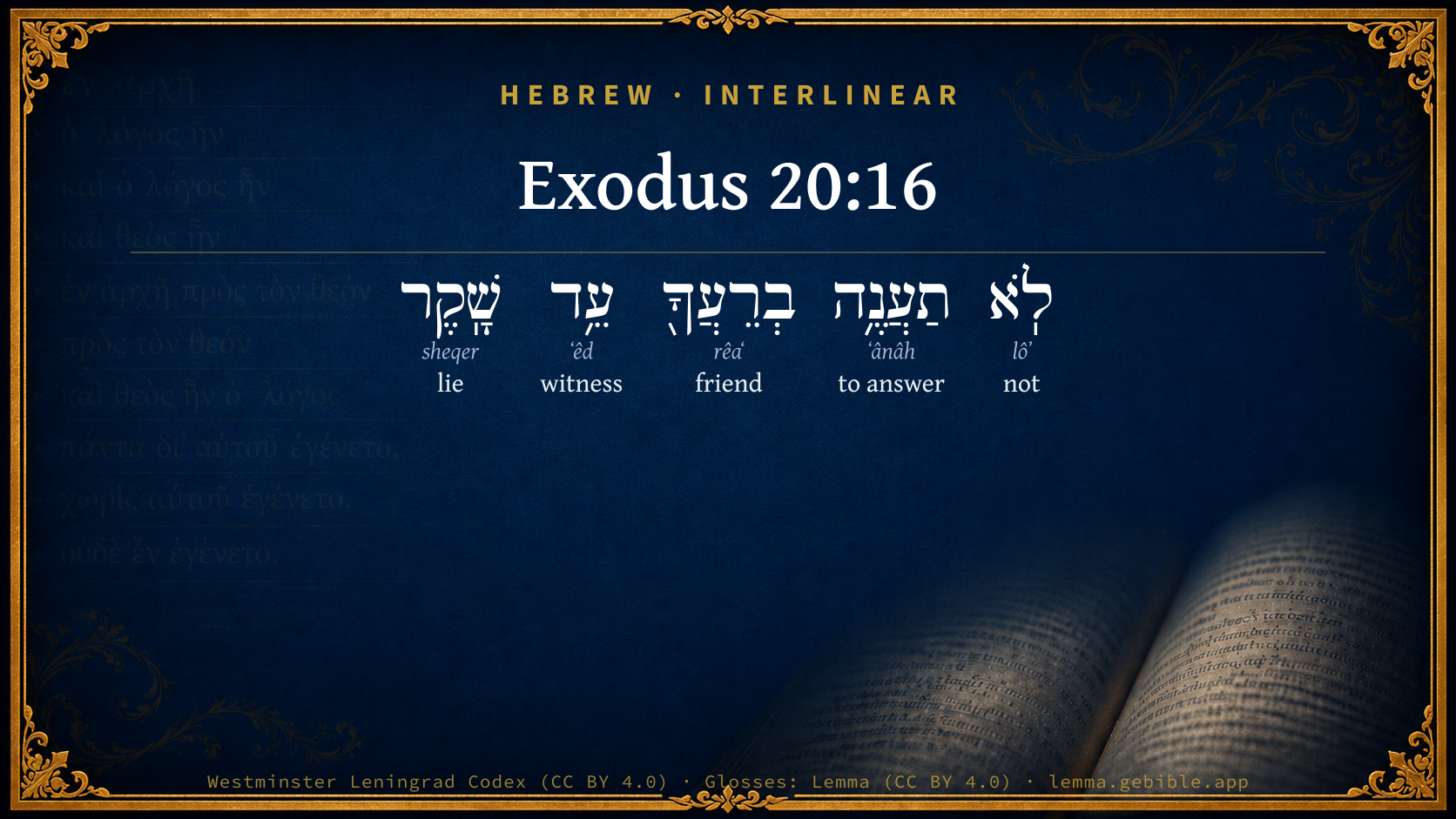
Hebrew (Westminster Leningrad Codex) Exodus 20:16 appears in the Hebrew Old Testament. The text above is from the Westminster Leningrad Codex. Each word links to its Strong’s number, a concise gloss, and parsing drawn from the Open Scriptures Hebrew Bible morphology. Click any word for its full Brown-Driver-Briggs (BDB) entry.
Download image
Cite this verse

Exodus 20:16 (World English Bible). Public Domain. Lemma interlinear Bible study tool, https://lemma.gebible.app/v/exodus/20/16.

Show BibTeX & RIS
BibTeX
RIS
English Translation
"You shall not give false testimony against your neighbor.
World English Bible · Public Domain
Download a study sheet

One document with this verse’s original text, its word-by-word gloss line, the meaning frame, cross-references with their text, attributed commentary, and full source and license credits — printable, and it pastes into notes with its structure intact.

This verse Autodidact and up

Study sheet (.html) Plain text (.txt)

A passage Seminary Student

Up to 50 verses in one chapter. A passage sheet keeps up to 6 commentary sources and 12 cross-references per verse, in the order this page ranks them, and says so on the sheet whenever that leaves anything out. Ask for a single verse and you get the Autodidact verse sheet above.

Everything on this page stays free to read, with no account — the sheet is a download of what is already on screen, not access to it.

Want to remove ads? Support Godless Engineer
Compare translations 3

The same verse in 3 English versions, stacked beneath the original-language interlinear above. Click any original word for its lexicon entry.

Each is an independent rendering of the whole verse — the interlinear is not word-aligned to these translations.

Highlighted words mark where these versions differ — a whole-verse word diff, not a word-by-word alignment.

  • World English Bible Public Domain
    "You shall not give false testimony against your neighbor.
  • King James Version Public Domain
    Thou shalt not bear false witness against thy neighbor.
  • unfoldingWord Literal Text CC BY-SA 4.0
    You shall not testify false testimony against your neighbor.

unfoldingWord Literal Text — © unfoldingWord, licensed CC BY-SA 4.0. Word-aligned USFM3 via Door43 (git.door43.org/unfoldingWord/en_ult).

Versions to compare (up to 4)

3 of 4 selected

Show all 18 translations

Every available English version of this verse, each an independent rendering of the whole verse.

  • World English Bible Public Domain
    "You shall not give false testimony against your neighbor.
  • Berean Standard Bible Public Domain
    You shall not bear false witness against your neighbor.
  • Majority Standard Bible Public Domain
    You shall not bear false witness against your neighbor.
  • King James Version Public Domain
    Thou shalt not bear false witness against thy neighbor.
  • American Standard Version (1901) Public Domain
    Thou shalt not bear false witness against thy neighbor.
  • Revised Version (1885) Public Domain
    Thou shalt not bear false witness against thy neighbour.
  • Geneva Bible (1599) Public Domain
    Thou shalt not beare false witnes against thy neighbour.
  • Douay-Rheims (1899) Public Domain
    Thou shalt not bear false witness against thy neighbour.
  • Young's Literal Translation Public Domain
    `Thou dost not answer against thy neighbour a false testimony.
  • Literal Standard Version CC BY-SA 4.0
    You do not answer [with] a false testimony against your neighbor.
  • Unlocked Literal Bible CC BY-SA 4.0
    You must not give false testimony against your neighbor.
  • unfoldingWord Literal Text CC BY-SA 4.0
    You shall not testify false testimony against your neighbor.
  • Darby Bible Public Domain
    Thou shalt not bear false witness against thy neighbour.
  • World Messianic Bible Public Domain
    “You shall not give false testimony against your neighbor.
  • Webster's Bible Public Domain
    Thou shalt not bear false witness against thy neighbor.
  • Free Bible Version CC BY-SA 4.0
    You must not give false evidence against others.
  • Bible in Basic English Public Domain
    Do not give false witness against your neighbour.
  • JPS Tanakh (1917) Public Domain
    (20-13) Thou shalt not bear false witness against thy neighbour.

Literal Standard Version (2020), Covenant Press — licensed CC BY-SA 4.0. Text via the HelloAO Bible API (eBible.org). Unlocked Literal Bible (unfoldingWord) — licensed CC BY-SA 4.0. Text via the HelloAO Bible API (eBible.org). unfoldingWord Literal Text — © unfoldingWord, licensed CC BY-SA 4.0. Word-aligned USFM3 via Door43 (git.door43.org/unfoldingWord/en_ult). Free Bible Version, Dr. Jonathan Gallagher — licensed CC BY-SA 4.0. Text via the HelloAO Bible API (eBible.org).

Word by word

More ways to search: Search by grammar → Find every occurrence → Compare this word →

Practice this passage: Drill this verse → Learn its vocabulary →

About this verse

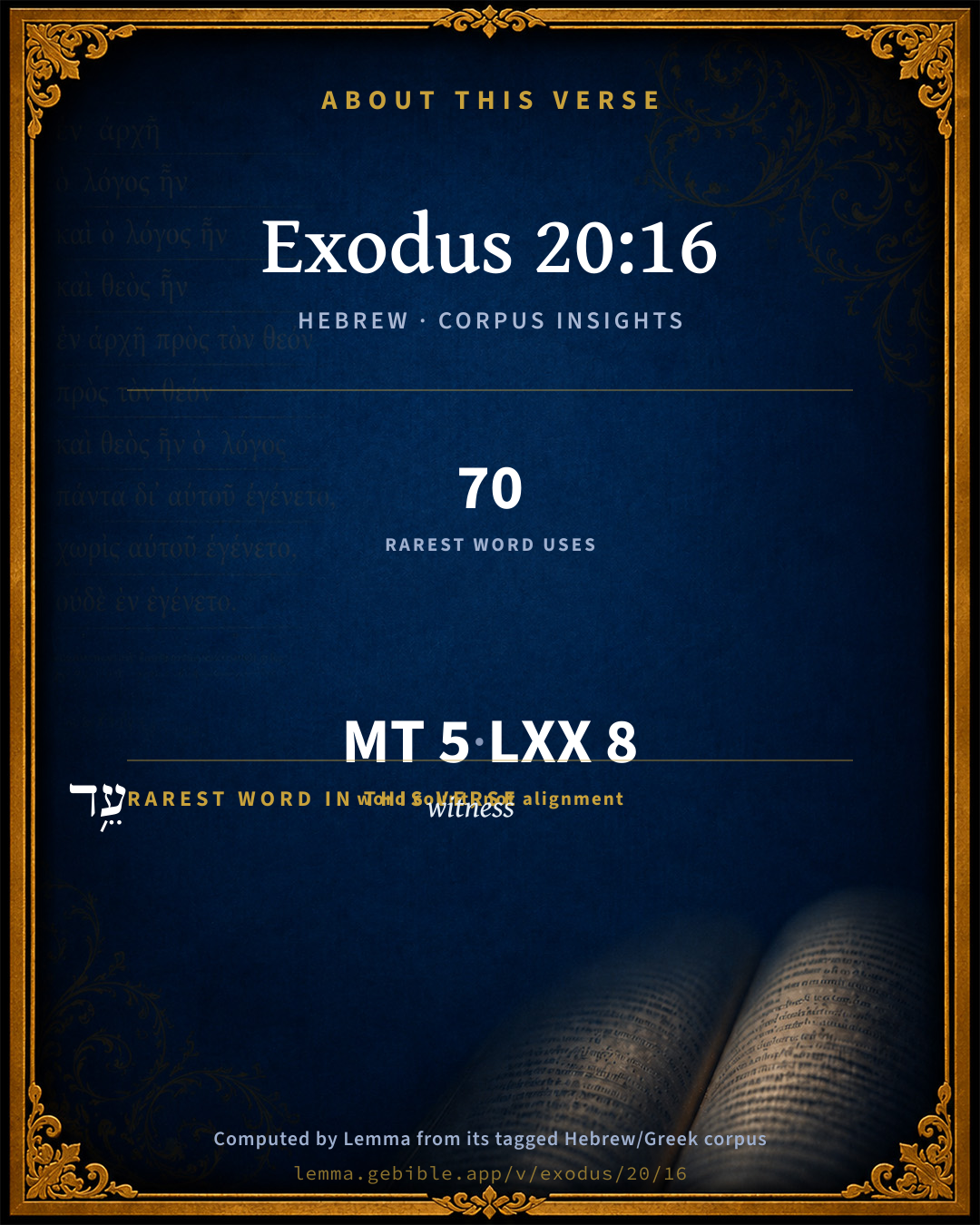
These counts appear in no published source. They are computed here, from the morphology-tagged text and Lemma’s own curated glosses. What Lemma adds →

5
words
5
distinct lemmas
Pentateuch
section

Grammatical profile

  • 1 verb
  • 3 nouns
  • 1 particle

Verb forms

  • תַעֲנֶ֥ה Qal · Imperfect

Hebrew & Septuagint length

In English translation the verse runs 9 words from the Hebrew and 9 from the Septuagint (LXX English) — the same length.

A rough comparison of the two English renderings, which tokenize alike — not a word-level alignment.

Word counts can differ between the Hebrew and the Greek without any difference in meaning — e.g. the Hebrew direct-object marker אֵת has no separate Greek word, and Greek often adds the article ὁ.

In the original languages it is 5 Hebrew tokens and 8 Greek tokens — but the two are counted differently (Hebrew bundles its prefixes and suffixes into one token; the Greek is in lemma form), so that isn’t a like-for-like length.

Cross-references

19

Topical passages linked to Exodus 20:16 in the Treasury of Scripture Knowledge — connected by theme and wording, ordered by reader-vote popularity; previews shown in the World English Bible.

  • Proverbs 19:5 A false witness shall not be unpunished. He who pours out lies shall not go free.
  • Matthew 19:18 He said to him, "Which ones?" Jesus said, "'You shall not murder.' 'You shall not commit adultery.' 'You shall not steal.' 'You shall not offer false testimony.'
  • Psalms 15:3 He who doesn't slander with his tongue, Nor does evil to his friend, Nor casts slurs against his fellow man;
  • Exodus 23:1 "You shall not spread a false report. Don't join your hand with the wicked to be a malicious witness.
  • Deuteronomy 19:15–21 One witness shall not rise up against a man for any iniquity, or for any sin, in any sin that he sins: at the mouth of two witnesses, or at the mouth of three witnesses, shall a matter be established.
  • Matthew 26:59–60 Now the chief priests, the elders, and the whole council sought false testimony against Jesus, that they might put him to death;
  • Proverbs 10:18 He who hides hatred has lying lips. He who utters a slander is a fool.
  • Acts 6:13 and set up false witnesses who said, "This man never stops speaking blasphemous words against this holy place and the law.
  • Exodus 23:6–7 "You shall not deny justice to your poor people in their lawsuits.
  • Leviticus 19:11 "'You shall not steal; neither shall you deal falsely, nor lie to one another.
  • Psalms 101:5–7 I will silence whoever secretly slanders his neighbor. I won't tolerate one who is haughty and conceited.
  • Ephesians 4:31 Let all bitterness, wrath, anger, outcry, and slander, be put away from you, with all malice.
  • Leviticus 19:16 "'You shall not go up and down as a slanderer among your people; neither shall you stand against the life of your neighbor. I am Yahweh.
  • 1 Samuel 22:8–19 that all of you have conspired against me, and there is none who discloses to me when my son makes a league with the son of Jesse, and there is none of you who is sorry for me, or discloses to me that my son has stirred up my servant against me, to lie in wait, as at this day?
  • Proverbs 11:13 One who brings gossip betrays a confidence, But one who is of a trustworthy spirit is one who keeps a secret.
  • 1 Timothy 1:10 for the sexually immoral, for homosexuals, for slave-traders, for liars, for perjurers, and for any other thing contrary to the sound doctrine;
  • 2 Timothy 3:3 without natural affection, unforgiving, slanderers, without self-control, fierce, no lovers of good,
  • James 4:11 Don't speak against one another, brothers. He who speaks against a brother and judges his brother, speaks against the law and judges the law. But if you judge the law, you are not a doer of the law, but a judge.
  • 1 Kings 21:10–13 and set two men, base fellows, before him, and let them testify against him, saying, You did curse God and the king. Then carry him out, and stone him to death.

Cross-references courtesy of OpenBible.info (CC BY 4.0).

Hebrew and Greek witnesses Masoretic Hebrew ↔ Greek Septuagint

The same verse in the two great witnesses to the Old Testament, shown verse-for-verse.

These are two independent witnesses, not word-aligned to each other, and the Septuagint is shown in lemma (dictionary) form.

Hebrew Exodus 20:16 Masoretic · Westminster Leningrad Codex

לֹֽא תַעֲנֶ֥ה בְרֵעֲךָ֖ עֵ֥ד שָֽׁקֶר

"You shall not give false testimony against your neighbor.

World English Bible · Public Domain

Greek LXX Exodus 20:16 Septuagint · lemma form

οὐ ψευδομαρτυρέω κατά ὁ πλησίον σύ μαρτυρία ψευδής

You shall not bear false witness against your neighbor.

LXX2012 (modern English Septuagint) · Public Domain

Hebrew: Westminster Leningrad Codex (CC BY 4.0). Greek: Septuagint (public domain); English from LXX2012 (modern English Septuagint) (Public Domain). How the Septuagint differs from the Hebrew →

Targum (Aramaic paraphrase)

2

The Targum is the ancient Jewish Aramaic paraphrase of the Hebrew Scriptures — an interpretive translation, not the Hebrew text itself. Onkelos (literal) and Pseudo-Jonathan (expansive) render the Torah, and Jonathan the Prophets. Coverage is partial: where no permissively-licensed English translation exists for a verse, only the Aramaic is shown. This is verse-level text, not a word-by-word alignment to the Hebrew.

  1. Targum Onkelos Torah (Genesis–Deuteronomy)
    וַאֲמָרוּ לְמשֶׁה מַלֵל אַתְּ עִמָנָא וּנְקַבֵּל וְלָא יִתְמַלֵל עִמָנָא מִן קֳדָם יְיָ דִילְּמָא נְמוּת:

    (no public-domain English translation for this verse)

    Targum Onkelos — Aramaic: “Onkelos Genesis” (public domain); “Onkelos Exodus” (public domain); “Onkelos Leviticus” (public domain); “Onkelos Numbers” (public domain); “Onkelos Deuteronomy” (public domain). English: “Sefaria Community Translation” (CC0 1.0 (public-domain dedication)); “J.W. Etheridge. The Targums of Onkelos and Jonathan Ben Uzziel on the Pentateuch. London: Longmans, Green, 1862” (public domain). Text via Sefaria.

  2. Targum Pseudo-Jonathan Torah (Genesis–Deuteronomy)
    וַאֲמָרוּ לְמשֶׁה מַלֵּיל אַנְתְּ עִמָּנָא וּנְקַבֵּיל וְלָא יִתְמַלֵּל עִמָּנָא תּוּב מִן קֳדָם יְיָ דִלְמָא נְמוּת

    And they said to Mosheh, Speak thou with us, and we can hear; but let it not be spoken with us any more from before the Lord, lest we die.

    Targum Pseudo-Jonathan — Aramaic: “Targum Jonathan on Genesis” (public domain); “Targum Jonathan on Exodus” (public domain); “Targum Jonathan on Leviticus” (public domain); “Targum Jonathan on Numbers” (public domain); “Targum Jonathan on Deuteronomy” (public domain). English: “The Targum of Jonathan ben Uzziel, trans. J. W. Etheridge, London, 1862” (public domain). Text via Sefaria.

Commentary

Notes on Exodus 20:16 from classic Christian and Jewish commentators (each source and its license shown beneath its notes). The classic Christian expositions comment on the surrounding passage and are grouped to its opening verse, so a note may address several verses; the Jewish commentaries on the Tanakh (Rashi and others) are per-verse, so they appear only where the commentator wrote on this verse.

Lemma curates 59 commentaries, every one of them public domain or Creative Commons licensed, each selected and text-cleaned for this edition rather than reprinted as found. About our sources →

Trapp's Complete Commentary

John Trapp

Exo 20:16 Thou shalt not bear false witness against thy neighbour.

Ver. 16. Thou shalt not bear false witness.] Neither bear it, nor hear it; raise, nor receive wrong reports of another; {Deu 19:16} make a lie, nor love it when it is made. {Rev 22:15} The truth must be spoken, and that in love. Doeg had a false tongue, though he spoke nothing but truth against David. {Psa 120:3} {See Trapp (for summary of Law) on "Exo 20:17"}

John Trapp, A Commentary or Exposition upon All the Books of the Old and New Testament (1647–1656) — public domain. Text from a community e-Sword module.

The Biblical Illustrator

Joseph S. Exell

Exo_20:16

Thou shalt not hear false witness.

The Ninth Commandment

I. This Commandment is a recognition of those tribunals which are necessary to the peace and to the very existence of the State.

II. In this Commandment there is a Divine recognition of the importance of the moral judgments which men pronounce on each other: the judgments which individual men form of other men as the result of the testimony to which they have listened, whether it was true or false; the judgments which large classes of men or whole communities form of individuals, and which constitute what we call the opinion of society concerning them.

III. Many ways might be mentioned in which we may avoid bearing false witness against our neighbour.

1. We should try to form a true and just judgment of other people before we say anything against them.

2. We have no right to give our mere inferences from what we know about the conduct and principles of others as though they were facts.

3. We have no right to spread an injurious report merely because somebody brought it to us. (R. W. Dale, D. D.)

The law of truth

1. There is no engine by which we help or harm one another more than by our speech. In one aspect words are mere counters, but he who supposes them to be only that is greatly mistaken; more often they are very children of our inner selves, out-growing quickly the control of their parents, and entering upon an independent career which may be full as sunshine is of blessing, or more destructive than a prairie-fire.

2. What is truth? It stands for the relation which God has established between things, the relation in which their harmony consists. It expresses conformity to fact--what really is seen as it is. It accords with, and is, the constitution of all things. It is of the essential substance of God; for if God were not true He would not be God. The more we think about this sublime theme, the more we see its ineffable dignity, and that the law which guards truth must be of supreme importance.

I. Consider this law in relation to courts of justice.

1. The literal form of the precept implies the existence of a court of justice. Here is a definite acknowledgment, at least by implication, of the principle of state tribunals; and if of tribunals, then also of governments, and of the necessary machinery of government.

2. Courts of justice exist, as their name implies, in order that justice may be done; and justice can only be done in proportion as truth prevails. The supreme business of every member of the court, from the judge to the humblest official, is with truth.

II. Consider this law in relation to public opinion.

1. It is not by any means an ideal bar, this of public opinion: inconsistent in much, inconsequent in more; not patient in sifting evidence, nor impartial in hearing both sides, nor cautious in coming to conclusions; liable also to bursts of impulse, when, as in a wind-swept cornfield, all heads are bowed one way only to bend back again at the next breath: often its judgments are hasty, not seldom warped, sometimes cruelly unjust. Nevertheless, public opinion is a great natural assize, where every one of us passes judgment upon others, and where others pass judgment upon every one of us--a court with wider jurisdiction than any other in the world, a court always sitting, a court everywhere present. The special moment and consequence of its decisions lies in the fact that they affect our reputation. This being so, every man has a right to demand of every other man, and every man is bound to accord to every other man, a true and righteous witness.

2. In glancing at the more conspicuous forms of false witness in the court of public opinion, one dark and monstrous shape demands immediate notice. I mean slander, the deliberate invention of a lie to injure a neighbour. All forms of wilful misrepresentation, base insinuation, wanton detraction, damning with faint praise, and guilty silence that does the work of open defamation, belong to this category. Next to slander, I must mention tale-bearing, which signifies the spreading of evil reports. We ought not to carry stories to our neighbours discredit, even if they are true (Lev_19:16).

III. Consider this law in relation to the personal conscience.

1. When the Commandment says, Thy neighbour must not be wronged by untruthful words, it manifestly says also, Thou shalt not be a liar. Unless we are true, how can our witness be true? And if we are true, how can our witness be other than true? Three elements enter into a falsehood. It is a statement of what is not true; it is intended to deceive, and it violates a promise or obligation to speak the truth.

2. In this view of the obligation of every man to put away lying and speak truth with his neighbour, the paramount importance of the law of truth stands forth conspicuous. Equivocation is seen to be nothing but a lie complicated with the meanness of evasion. Mental reservations are detected as lies blackened by breach of contract. Exaggerations and extenuations, fibs and white lies, are shown to be inexcusable. Pious frauds are branded as fraudulent piety. And the one only course open to a Christian man in his dealings with his neighbour is to speak truth. Dare to be true; nothing can need a lie! (W. J. Woods, B. A.)

The Ninth Commandment

This Commandment hath a prohibitory, and a mandatory part: the first is set down in plain words, the other is clearly implied.

1. The prohibitory part of the Commandment, or, what it forbids in general. It forbids anything which may tend to the disparagement or prejudice of our neighbour. More particularly, two things are forbidden in this Commandment.

(1) Slandering our neighbour. The scorpion carries his poison in his tail; the slanderer carries his poison in his tongue. Slandering is to report things of others unjustly; they laid things to my charge which I knew not. Eminency is commonly blasted by slander. Holiness itself is no shield from slander. The lambs innocency will not preserve it from the wolf. We must not only not raise a false report, but not take it up. He that raiseth a slander, carries the devil in his tongue: and he that receives it, carries the devil in his ear.

(2) The second thing forbidden in this Commandment is false witness. Here three sins are condemned:

(a) Speaking that which is false; lying lips are an abomination to the Lord. There is nothing more contrary to God than a lie. Imitate God who is the pattern of truth. Pythagoras being asked what made men like God answered, When they speak truth. It is made the character of a man that shall go to heaven; he speaketh the truth in his heart.

(b) That which is condemned in the Commandment is witnessing that which is false; thou shalt not bear false witness. There is a bearing of false witness for another, and a bearing false witness against another.

(c) That which is condemned in the Commandment is swearing that which is false. When men take a false oath, and by that, take away the life of another. The Scythians made a law, when a man did bind two sins together, a lie with an oath, he was to lose his head, because this sin did take away all truth and faith from among men. The devil hath taken great possession of such who dare swear to a lie.

2. The mandatory part of this Commandment: that is, that we stand up for others and vindicate them, when they are injured by lying lips. A man may wrong another as well by silence as by slander when he knows him to be wrongfully accused, yet doth not speak in his behalf. If others cast false aspersions on any, we should wipe them off. When the primitive Christians were falsely accused for incest, and killing their children, Tertullian made a famous apology in their vindication. This is to act the part both of a friend and of a Christian, to be an advocate for another, when he is wronged in his good name. (T. Watson.)

The scope of the Ninth Commandment

This Commandment checks all propensities to lying, and commands truthfulness of speech to and about our neighbour. It is very difficult to over-estimate the value of truth or the importance of being truthful in character and speech. There is a reality to the things and the laws which surround us and are within us which we call truth. When our thoughts exactly correspond with this reality we have apprehended truth. When we conform ourselves to this we are true. If our thought does not exactly correspond with this reality we are in error, and error is a mischief to us. We disobey the laws, we abuse the things about us, we are like blind men striking against obstacles, falling into pits. The nature of things remains unchanged, the laws are immutable, but we are false to them. Truth is not merely to be known, it is to be transmitted into life. Man is to be so hearty in his allegiance to the truth he knows, that he lives it and speaks it. The man who knows the truth and disobeys it, is false in his nature. He may not deceive his neighbours as to himself. Every one may know he is a false man, but his whole life is bearing false witness as to the truth, and as to it may deceive many. The greater part of the truth we possess we have derived from others. There is an exchange of truth. Men who search in one realm give the truth they find to their fellows who are searching in other realms, and receive truth from them in return, and each generation leaves its rich legacy of inherited and acquired truth to the following, and thus the race advances in the knowledge of truth. Wide is the realm of truth, in earth and sky, in matter and spirit, in time and eternity. Man should not shut his fellow out from any portion of it. If any one bears false witness to any part of the wide realm of truth, it is always against his neighbour, depriving him wrongfully of that which is of the greatest importance to his well-being. Great is the difference between truth and falsehood. Infinity and eternity cannot measure it. Of God it is said; He is light. He is the truth. Of the devil it is said: There is no truth in him. He is a liar and the father of it. Hell is the home of universal falsehood and distrust. Each one there is alone in the midst of others, deceiving and being deceived, distrusting and being distrusted. Heaven is the home of universal truth and confidence. The more we follow truth, the nearer we advance to God. The truths in nature are His thoughts, written on the heavens in light, on the earth in beauty, on our souls in virtue. As we express truth we help others to advance to Him, by small steps or large, according to the importance of the truths we speak. The Commandment requires truth in ordinary conversation. Conjecture and partial information must be spoken of as such, not made to pass for complete knowledge. We must strive to know fully, that we may speak clearly. Vivid, sprightliness, and colour may be employed to interest in and set forth the truth, not to gain applause, and all exaggeration must be avoided. Our aim must not be selfish, to be considered as having had a wonderful experience, or as having fine descriptive powers, or as being well informed, but simply to convey truth to our neighbour. In all those cases in which we speak to our neighbour with intent to lead him to a desired line of conduct, our self-interest may be aroused against our loyalty to truth. Mental reservation, double meaning, significant silence, the end justifies the means, and all kindred evasions, may quiet a confused conscience, but will never do to plead before a truth-loving God. But, says the business man, must I reveal the defects in the property I am trying to sell? Must I reveal the fact I have skilfully acquired, that prices in the market will be much lower tomorrow? Certainly, you must, or you will both lie and steal in one act. We are to speak truth, again, not only to our neighbour, but about him. This Commandment guards a mans reputation--gives each man a right to have his reputation the exact expression of his character. We should guard against secret prejudice against our neighbour, or envy of him, and should cultivate such love for him that we will rejoice in his good qualities and in his good name, that we will sorrow over the faults in him we cannot help seeing, and throw over them the garment of Christian charity, rather than exulting to proclaim them to the world. This Commandment should govern not only our tongues, but our hearts and ears as well. It forbids an appetite for gossip, a desire to hear detraction, and a tendency to form unfavourable opinions of others. By holding our peace when we have it in our power to defend, by failing to mention the good when the evil is spoken of, by encouraging the telling of evil by eager listening, we assault the reputation of our neighbour by the assent of our silence. There is a modern statue of Truth, instinct with the fire of genius, which strongly incites an opposite spirit and action. A stately woman in pure white marble, with beautiful and firm face, wears on her head a helmet and carries a sword in her hand. At her feet lies a mask touched by the point of her sword. She has just smitten it from the face of Slander, and now she proudly draws her robe away from its polluting touch. (F. S. Schenck.)

The Ninth Commandment

I. This command prohibits lying.

1. What a lie is.

(1) A lie, according to St. Austins definition of it, is a voluntary speaking of an untruth, with an intent to deceive.

(2) Lies are usually distinguished into three kinds.

(a) There is a jocular lie: a lie, framed to excite mirth and laughter; not to deceive the hearer, only to please and divert him.

(b) There is an officious lie: which is told for anothers benefit and advantage; and seems to make an abundant compensation for its falsehood, by its use and profit.

(c) There is a malicious and pernicious lie: a lie, devised on purpose for the hurt and damage of my neighbour.

2. Now, for the aggravations of this sin, consider--

(1) It is a sin, that makes you most like unto the devil.

(2) Consider, that it is a sin most contrary to the nature of God, who is truth itself.

(3) Consider, that it is a sin, that gives in fearful evidence against us, that we belong to the devil, and are his children.

(4) Consider, how dreadfully God hath threatened it with eternal death (Rev_22:15).

(5) A lie showeth a most degenerous and cowardly fear of men, and a most daring contempt of the great God.

(6) Mankind generally account it the most infamous and reproachful sin of all others.

(7) It is a sin that God will detect; and exposeth those who are guilty of it to shame and contempt (Pro_12:19).

II. There remain two other violations of this Commandment: the one is, by slander and detraction; the other, by base flattery and soothing. And both these may respect either ourselves or others.

1. Indeed slander and detraction seem somewhat to differ. For slander, properly, is a false imputation of vice; but detraction is a causeless, diminishing report of virtue.

(1) If thou wouldst keep thyself from being a slanderer of others, addict not thyself violently to any one party or persuasion of men.

(2) If thou wouldst not be guilty of slander, be not busy in other mens affairs.

(3) If thou wouldst not be guilty of slander, be frequent in reflecting upon thine own miscarriages; or thy proneness to fall into the same, or greater faults.

(4) If you would not be guilty of slander, listen not unto those who are slanderers and detractors.

(5) If you would not be slanderers of others be not self-lovers. For self-love always causeth envy; and envy detraction.

(6) Be not too easy and facile to entertain suspicious and evil surmises against others.

III. The third sin against this Commandment is base flattery and soothing; which is a quite opposite extreme to the other, as both are opposite to truth. Now this is, either self-flattery, or the flattering of others.

1. There is a self-flattery. Learn, therefore, O Christian, to take the just measure of thyself.

2. There is a sinful flattering of others: and that, either by an immoderate extolling of their virtues; or, what is worse, by a wicked commendation even of their very vices. This is a sin most odious unto God, who hath threatened to cut off all flattering lips (Psa_12:3). (Bp. E. Hopkins.)

Slander

A man of overweening curiosity who looked down his neighbours chimney to see what he was cooking for supper, not only failed to find out what he desired to know, but was nearly blinded by the smoke. Somebody has conveyed a well-deserved rebuke to such unamiable people, who said, If we would sit down by our neighbours fire occasionally, instead of looking down his chimney, we would see many good points in his character that smoke will certainly obscure. There are so many ways of kindling a flame by the poisonous breath of slander, that only a few of them can now be referred to.

I. Perverting ones words or actions is an every-day occurrence.

II. Another way by which flames are often kindled to the damage of ones good name, is the habit of jumping to conclusions without sufficient evidence to sustain them. While Wilberforce occupied his prominent place in the British parliament he was exceedingly annoyed by finding himself chronicled in opposition papers as St. Wilberforce. He was lately seen, said the slanderous print, walking up and down in the pump-room at Bath, reading his prayers, like his predecessors of old, who prayed at the corners of the streets to be seen of men! Mr. Wilberforce, who was not more distinguished for his brilliant mental gifts than for his unobtrusive goodness, remarked upon this wanton falsehood: As there is generally some slight circumstance which perverse-ness turns into a charge or reproach, I began to reflect, and I soon found the occasion of the calumny. I was walking in the pump-room, in conversation with a friend; a passage from Horace was quoted, the accuracy of which was questioned, and as I had a copy of the Latin poet in my pocket, I took it out and read the words. This was the plain bit of wire which factious malignity sharpened into a pin to pierce my reputation. It is pitiful to think how many ugly pins have been fashioned out of smaller bits of wire than that l

III. The cruel purposes of slander may also be accomplished by sly insinuations and crafty questions calculated to arouse serious and damaging suspicions. When any one spoke evil of another in the presence of Peter the Great, he would promptly stop him and say, Well, now; but has he not got a bright side? Come, tell me what good you know of him. It is easy to splash mud; but I would rather help a man to keep his coat clean l

IV. Slander is encouraged by those who patiently listen to it, and who prompt the cruel person to vent his venom on the innocent. (J. H. Norton, D. D.)

Violations of the law of truth

I. Misrepresentation. It is an ingenious method to class an opponent with those whom the world has already condemned as heterodox. It is still another to make his truth responsible for all the folly that unwise minds have added to it.

II. Insinuation. A whisper dropped carelessly in some corner among the combustibles, a look, a shrug of the shoulders, a sneer, a laugh may serve the purpose. Rumour with most minds is presumptive evidence, and they will say with a knowing air, There must be some fire in so much smoke.

III. Detraction. If we be unable to find evil in the opinions or actions of another, we can attribute his good to doubtful motives.

IV. Talebearing. Is there, I pray you, a creature more contemptible than this, who fattens on the griefs of others, and passes day and night in such petty larceny? How few dream of their responsibility in this! We know the power of strychnine or arsenic, but not of a word. What undesigned phrases we drop in conversation, and forget as soon as passed, yet they are never forgotten! What insignificant insects may have a fatal sting! (E. A. Washburn, D. D.)

The Ninth Commandment

This Commandment requires us, as the Catechism says, to keep our tongues from evil-speaking, lying, and slandering. Slandering means saying anything that will injure the character of another person. There was a company of ladies once at the house of a clergyman. As he entered the room he heard them speaking in a low voice of an absent friend. Shes very odd, says one. Yes, very singular indeed, says another. Do you know, she often does so and so? says a third, mentioning certain things to her discredit. The clergyman asked who it was. When told, he said, Oh yes, she is odd; shes very odd; shes remarkably singular. Why, would you believe it? he added, in a slow, impressive manner; she was never heard to speak ill of any absent friends! A clergyman was once examining the children of an infant school upon the Commandments. He put his hand on the head of a little boy, and said, My little man, can you tell me what the Ninth Commandment means by bearing false witness against thy neighbour? The boy hesitated a while, and then said, It means telling lies, sir. The minister didnt exactly like this answer, so looking at a little girl who stood next to him, he asked, What do you say? Without waiting a moment, she replied, Its when nobody does nothing, and somebody goes and tells of it. Very good, said the minister. The little girls answer was a very funny one; but the little boys was true. Bearing false witness is telling lies, and telling lies is bearing false witness. We break the Ninth Commandment every time we tell a lie.

I. The first reason why we should never bear false witness or tell a lie is, because it is a mean thing. Who was the first person of whom we know that ever told a lie? Satan. Where was this lie told? In the garden of Eden. Satan bore false witness against God. He contradicted God. This was mean of Satan. He did it out of spite. A gentleman once sent his servant to market with the direction to bring home the best thing he could find. He carried home a tongue. He was sent again with the direction to bring home the worst thing he could find. Again he brought home a tongue. This was right; for the tongue is the best thing in the world when properly used, or the worst when not so used.

II. The second reason why we should not do it is, because it is aa unprofitable thing. People generally expect to make something when they tell a lie.

III. The third reason why we ought not to do this is, because it is dangerous. Lying is like letting water through a bank. When it once begins to run, there is no telling where it will stop. Now, suppose it were possible all at once to draw every bolt and fastening out of that ship as she sails over the ocean, what would become of her? She would fall to pieces directly, and all her cargo would be lost. Well, every family, every village or town, is like such a ship. It is made up of a number of persons bound together. And what binds them together? Why, truth or confidence. Truth among people in society is like the bolt in the ship. If nobody told the truth, and people had no confidence in one another, they could no more live together in families or communities, and do business together, than a number of pieces of timber without bolts to fasten them together could make a ship. Would it not be very dangerous to have a person on board a ship who had a machine for drawing the bolts out, and who was trying to use it all the time? Certainly it would. Well, lying is such a machine.

IV. Our fourth and last reason is, we ought not to do it because it is a wicked thing. This is shown by--

1. What God says of liars (see Pro_6:19; Pro_12:5).

2. What God does with liars (see Rev_21:8). (R. Newton, D. D.)

On the sin of bearing false witness

I. First, what are the different senses in which a man may be said to bear false witness against his neighbour.

II. The enormity of the sin of bearing false witness. The malignity of an offence arises either from the motives that prompted it or the consequences produced by it. The most usual incitement to defamation is envy, or impatience of the merit, or success of other; a malice raised not by any injury received, but merely by the sight of that happiness which we cannot attain. Calumnies are sometimes the offspring of resentment. When a man is opposed in a design which he cannot justify, and defeated in the prosecution of schemes of tyranny, extortion, or oppression, he seldom fails to revenge his overthrow by blackening that integrity which effected it. The consequences of this crime, whatever be the inducement to commit it, are equally pernicious. He that attacks the reputation of another, invades the most valuable part of his property, and perhaps the only part which he can call his own. (Bp. J. Taylor, D. D.)

Breaches of the Ninth Commandment

I. In heart a man may fail--

1. By suspecting others unjustly, this is called evil surmising (1Ti_6:4), which is when men are suspected of some evil without ground, as Potiphar suspected Joseph.

2. By rash judging, and unjust concluding concerning a mans state, as Jobs friends did; or his actions, as Eli did of Hannah, saying, that she was drunk, because of the moving of her lips.

3. By hasty judging, too often passing sentence in our mind from some seeming evidence of that which is only in the heart, and not in the outward practice; this is but to judge before the time, and hastily (Mat_7:1).

4. There is light judging, laying the weight of conclusions upon arguments that will not bear it, as Jobs friends did, and as the barbarians suspected Paul, when they saw the viper on his hand, to be a murderer (Act_25:4).

5. The breach of this command in the heart may be when suspicion of our neighbours failing is kept up, and means not used to be satisfied about it, contrary to that (Mat_18:15). If thy brother offend thee, etc., and when we seek not to be satisfied, but rest on presumptions, when they seem probable.

II. In gesture this command may be broken, by nodding, winking, or such like (and even sometimes by silence), when these import in our accustomed way some tacit sinistrous insinuation, especially when either they are purposed for that end, or when others are known to mistake because of them, and we suffer them to continue under this mistake.

III. By writing this command may be broken, as Ezr_5:6.; Neh_6:5, where calumniating rebels are written, and sent by their enemies against the Jews and Nehemiah; in which respect many fail in these days.

IV. But words are most properly the seat wherein this sin is subjected, whether they be only or merely words, or also put in writing, because in these our conformity or disconformity to truth doth most appear. (James Durham.)

Slander

The false witness which was born against the Puritans by the profligate wits of the court of Charles II., produced in the mind of this country a strong antagonism to the great principles for which the Puritans contended. The calumnies which, during the first two centuries, were flung at the Christians, made many upright heathen believe that Christianity itself was an execrable superstition. Slander a clergyman and you help to make the principle of an Established Church odious, and you try to win the cause of ecclesiastical freedom before the tribunal of public opinion by false witness against your neighbour. Slander a Nonconformist and you help to make Nonconformity odious, and you try by false witness against your neighbour to induce the tribunal of public opinion to pronounce in favour of religious establishments. Pick up and circulate any scandal you may happen to hear--no matter how untrustworthy the authority for it--to the dishonour of a religious man, and you do what lies in your power to create a conviction in the public mind that all religious men are hypocrites, and that religion itself is an imposture. It is by the opinion which society forms on individuals that its general opinions on all questions, moral, religious, and political, are to a very large extent created; and to bear false witness either for or against any man is to attempt to deceive and to mislead that great Tribunal--whose decisions affect not merely the happiness and the reputation of particular men, but the formation of the conscience and the judgment of the whole nation. (R. W. Dale, D. D.)

False witness

There was a boy of the name of John Busby. He said once, What a wicked man Mr. Bradburry is. A gentleman said to him, I do not think he is wicked; I think he is very good; he is always on the line of his duty. I only know, said John, that he went to church last Sunday, and he slept all through the sermon. The other was very much surprised, because he thought Mr. Bradburry was a very good man; so he said to the boy, Can you tell me what the text was? No, I cant, said John; but I can tell you Mr. Bradburry was asleep all the time. Then, said the gentleman to him, I happen to know the text; for Mr. Bradburry told me not only the text, but all about the sermon. You say he was fast asleep; but I can tell you he has got very weak eyes, and there is a gas lamp between him and the pulpit; and he is obliged to shut his eyes because he cannot stand the light. Do you see, that was bearing false witness on the part of John Busby; that was slander, taking away his character. We must not bear false witness. We used sometimes to play a game called Scandal. It is a very good game. You all sit round in a circle, and somebody tells a person at one end a story he has heard about something or somebody--anything you like. He whispers it to the next one, and he again whispers it to the next, and he to the next, and to the next. When it comes to the last person, he is to say aloud what he has had whispered to him, and the first is to say what he had said. Often the act of repeating it all around makes it seem quite a different story. That is called Scandal or Slander. You try that game some day, and it will teach you the importance of being very exact in repeating what you hear, if you would not bear false witness. (J. Vaughan.)

A cure for backbiting

A gentleman writes that he once saw the title Slander Book, printed on the back of a small ledger in a friends house. On examining it, he found that the various members of the household were charged so much for every piece of slander they were found uttering. The accounts were very neatly and correctly kept, credits entered, etc., as in a merchants office. The plan originated with a good young girl, who had observed the wretched effects of evil-speaking in families and in the neighbourhood.

Scandal

The story is told of a woman who freely used her tongue to the scandal of others, and made confession to the priest of what she had done. He gave her a ripe thistle top, and told her to go out in various directions and scatter the seeds, one by one. Wondering at the penance, she obeyed, and then returned and told her confessor. To her amazement, he bade her go back and gather the scattered seeds; and when she objected that it would be impossible, he replied, that it would be still more difficult to gather up and destroy all evil reports which she had circulated about others. Any thoughtless, careless child can scatter a handful of thistle-seed before the wind in a moment, but the strongest and wisest man cannot gather them again.

The Biblical Illustrator, edited by Joseph S. Exell (c. 1880s–1900s) — public domain. Text from a community e-Sword module.

Joseph Benson's Commentary

Exo 20:16. Thou shalt not bear false witness — This forbids, 1st, Speaking falsely in any matter, lying, equivocating, and any way devising and designing to deceive our neighbour. 2d, Speaking unjustly against our neighbour, to the prejudice of his reputation. And, 3d, (which is the highest offence of both these put together,) Bearing false witness against him, laying to his charge things that he knows not, either upon oath, by which the third commandment, the sixth, or eighth, as well as this, are broken, or in common converse, slandering, backbiting, tale-bearing, aggravating what is done amiss, and any way endeavouring to raise our own reputation upon the ruin of our neighbour’s.

Joseph Benson's Commentary on the Old and New Testaments (1811–1818) — public domain. Text from a community e-Sword module.

Whedon's Commentary on the Bible

Daniel D. Whedon

THE NINTH COMMANDMENT, Exo_20:16.

16. Thou shalt not bear false witness against thy neighbour — The law which guards the property of a man is appropriately followed by one which guards his good name. it concerns the words rather than deeds or acts of men. The most direct and flagrant example is that of one who swears to a known falsehood before a judicial tribunal. This is perjury, and is properly punishable as a great crime. Comp. Deu_19:16-19. But this law also comprehends such whispering, slandering, backbiting, lying, and evil speaking generally as is contemplated in Lev_19:16 : “Thou shalt not go up and down as a talebearer among thy people;” also Exo_20:11 of the same chapter: “Ye shall not lie one to another.” “Lying lips are an abomination to the Lord.” Pro_12:22. It is a high and holy law which requires us “to speak evil of no man,” (Tit_3:2,) and to put away from us “all bitterness, and wrath, and anger, and clamour, and evil speaking, with all malice.” Eph_4:31. Comp. also Jas_4:11. Only when it is necessary to defend innocence and promote the public good should one bear true testimony against his fellow-man to blight his character and expose his wrong; but never should one, at any place or under any circumstances, utter a false word against him. Jehovah abhors the deceitful man as he does those who are guilty of capital crime. Psa_5:6.

Daniel D. Whedon (gen. ed.), Commentary on the Old and New Testaments (1874–1909) — public domain. Text from a community e-Sword module.

The Preacher's Complete Homiletical Commentary

Joseph S. Exell (gen. ed.)

MAIN HOMILETICS OF THE PARAGRAPH.—Exo_20:16

THE NINTH COMMANDMENT: THE POWER OF THE TONGUE FOR EVIL

Human codes take cognisance of theft and of murder, and seek to repress them by severe punishment; but they do not punish for theft and murder committed by the tongue. We acknowledge the power of the human hand, but too often forget the power for evil of the human tongue. In this the Divine code is for the most part superior to human codes. The tongue can steal and can murder. It may kill a neighbour’s reputation. It may rob of that the loss of which makes him poor indeed and does not enrich the thief.

I. The violation of this command destroys the witnesser’s moral manhood. This is a species of lying. All falsehood is base. It is the outcome of baseness. and increases the baseness. Every man who bears false witness does himself more moral damage than he does to the neighbour of whom the false testimony is given.

II. The violation of this command does injustice to our neighbour. It may do him no moral harm, but does him great social damage. It places him in a false position. The court may disbelieve and reject the false testimony, but the man has been injured by being subjected to an examination. It is extremely difficult for a man to clear away all the dirt which has been thrown by the false-witness bearer. Many a man’s reputation has been darkened all his life by the malicious tales of the bearer of false-witness.

III. The violation of this command prevents the course of justice. The administrators of law cannot move with certainty when witnesses are not reliable. Witnesses are not likely to tell a false tale, if appearances are not against the accused. It requires great sagacity to separate the true from the false, to get above mere appearances, and discover the correct state of the case.

IV. More generally notice that the violation of this command degrades. The tale-bearer revealeth secrets; and depraved human nature loves to hear evil secrets revealed. The slanderer may be welcomed, but is not respected. And ultimately his tales are received with suspicion. He is in danger of being cast out as an evil spirit. The man who to me slanders my neighbour, will in turn slander me to my neighbour; and if we are wise we shall not lend him our ears.

V. The violation of this command robs the slanderer of his capital. In modern society especially reputation is as much capital as the current coin of the realm. It is true that character remains when reputation is destroyed. This may be some consolation to the man sitting amid the ruins; but when reputation is gone a man’s social position is gone. It may also be true that a man’s well-known character will tend to preserve his reputation; but if sufficient dirt is thrown some of it is sure to stick. Slanderers are the bane of society. What suffering they inflict! They have embittered the lives of the purest and the holiest. We must pray God to hide us safe in His pavilion from the strife of unruly tongues.—W. Burrows, B.A.

Bearing false witness covers the whole case of those sins which transgress more or less of the whole truth; and one who fails in a given case to tell the whole truth is more or less amenable to this law. Observe apart from deliberate lying—

I. That we may bear false witness by equivocation.

II. That we may bear false witness by the suppression of any essential element that goes to make up the whole truth; e.g., in revealing an incident which affects our neighbour’s character.

III. That we may bear false witness by putting a wrong connection on and giving a wrong emphasis to the words of another.

IV. That we may bear false witness without the utterance of a word.

(1.) By neglecting to defend a slandered character, silence implying consent.

(2.) By a shrug of the shoulders, a compression of the lips, a motion of the hand, is quite enough to ruin a reputation or a soul. To avoid this and its heavy condemnation; (i.) Seek to become like Him who is “the Truth;” (ii.) be open and candid in all your ways; and (iii.) give others credit for what you demand for yourself.—J. W. Burn.

ILLUSTRATIONS

BY

THE REV. WILLIAM ADAMSON

False-Witness! Exo_20:16. This commandment requires us to keep our tongues from evil-speaking, lying, and slandering. In the garden of Eden, Satan bore false witness against God by telling Eve that she would not die if she ate of the forbidden fruit. Every one, therefore, who lies, slanders, or speaks evil of his neighbour, is becoming like Satan. It is said that there is one place in India where, when a person is found guilty of false witness, he is taken to a public place, and in the presence of a multitude of people his mouth is sewed up. It is to be feared that such a penalty inflicted impartially on such offenders in England would produce startling stillness of speech. Still greater would be the silence, were the mouths of all who gave ear

“With greediness, or wittingly their tongues

Made herald to his lies, around him sewed.”

—Pollock.

Scandal-Seed! Exo_20:16. The story is told of a woman who freely used her tongue to the scandal of others, and made confessions to the priest of what she had done. He gave her a ripe thistle-top, and told her to go out in various directions and scatter the seeds one by one. Wondering at the penance, she obeyed, and returned and told her confessor. To her amazement, he bade her go back and gather the scattered seeds; and when she objected that it would be impossible, he replied that it would be still more difficult to gather up and destroy all the evil reports she had circulated about others. Any thoughtless, careless child, can scatter a handful of thistle-seeds before the wind in a moment, but the strongest and wisest man cannot gather them again. And the “thistle-seeds” need not be of the tongue. False witness is too often borne by

“The hint malevolent, the look oblique,

The obvious satire, or implied dislike,

The sneer equivocal, the harsh reply,

And all the cruel language of the eye.”

—More.

The Preacher's Complete Homiletical Commentary (gen. ed. Joseph S. Exell; Funk & Wagnalls, c. 1892) — public domain (pre-1929). A full-Bible homiletical/sermon-outline anthology covering 65 of 66 books (2 John is absent from the source module). Text from a community e-Sword module.

Tyndale Open Study Notes

Tyndale Open Resources

20:16 Not telling a lie can be a very individual act, and even a prideful one. But refusing to testify falsely against your neighbor is an unselfish act, in which your neighbor’s reputation and well-being is more important to you than your own.

Tyndale Open Study Notes — © Tyndale Open Resources, licensed CC BY-SA 4.0. Text via the HelloAO Bible API.

Geneva Bible (1599)

Geneva Bible translators

But further his good name, and speak truth.

Geneva Bible (1599) marginal notes — public domain. Text via Bolls.life.

Adam Clarke's Commentary

THE NINTH COMMANDMENT

Against false testimony, perjury, c.

Verse 16. Thou shalt not bear false witness, &c.] Not only false oaths, to deprive a man of his life or of his right, are here prohibited, but all whispering, tale-bearing, slander, and calumny in a word, whatever is deposed as a truth, which is false in fact, and tends to injure another in his goods, person, or character, is against the spirit and letter of this law. Suppressing the truth when known, by which a person may be defrauded of his property or his good name, or lie under injuries or disabilities which a discovery of the truth would have prevented, is also a crime against this law. He who bears a false testimony against or belies even the devil himself, comes under the curse of this law, because his testimony is false. By the term neighbour any human being is intended, whether he rank among our enemies or friends.

Adam Clarke's Commentary on the Bible (1810–1826) — public domain. Text from a community e-Sword/MySword module.

Ellicott's Commentary for English Readers

(16) Thou shalt not bear false witness against thy neighbour.—Our fourth duty to our neighbour is not to injure his character. Our great poet has said—

“Who steals my purse, steals trash,

But he who filches from me my good name,

Robs me of that which not enriches him,

Yet leaves me poor indeed,”—

Thus indicating the fact that calumny may injure a man more than robbery. False witness is, of course, worst when given in a court of justice; and this offence has generally been made punishable by law. It was peculiar to the Hebrew legislation that it not only forbade and punished (Deu_19:16-20) false testimony of this extreme kind, but denounced also the far commoner, yet scarcely less injurious, practice of spreading untrue reports about others, thus injuring them in men’s esteem. The ninth commandment is broad enough in its terms to cover both forms of the sin, though pointing especially to the form which is of the more heinous character. Lest its wider bearing should be overlooked, the Divine legislator added later a distinct prohibition of calumny in the words. “Thou shalt not raise a false report” (Exo_23:1).

A Bible Commentary for English Readers, edited by Charles John Ellicott (1878–1897) — public domain. Text from a community e-Sword module.

The Cambridge Bible for Schools and Colleges

gen. ed. J. J. S. Perowne

16. The ninth commandment. Against bearing false witness, primarily in a court of law,—a specially common crime in the East,—but also more generally by taking away the character of a neighbour by false imputations (cf. Exo_23:1).

bear false witness] lit. answer (in a forensic sense, in a court of law, Deu_19:16; Deu_19:18, Num_35:30 [EVV. testify], but also more generally, 1Sa_12:3 [‘witness’], Deu_31:21 al. [‘testify’]) as a false witness: Deu_5:20 has ‘as an empty, insincere, witness’ (the word explained on v. 7). For the penalty for false witness, see Deu_19:16-21. Cf. Pro_14:5; Pro_19:5; Pro_25:18 (same Heb. as here).

The Cambridge Bible for Schools and Colleges (gen. ed. J. J. S. Perowne; Cambridge University Press, 1878–1918) — public domain. Text from a community e-Sword module.

John Gill's Exposition

And all the people saw the thunderings, and the lightnings,.... That is, they heard the one, and saw the other; they heard the dreadful volleys of thunder, and saw the amazing flashes of lightning, which were like lamps and torches, as the word used signifies; by a communication of senses, one sense is put for another, and the sense of sight being the principal, as Ben Melech observes, it is put for the rest, and so in the following. It is an observation of Austin's (o) that to "see" is used of all of the five senses, seeing, hearing, tasting, smelling, and feeling:

and the noise the trumpet, and the mountain smoking: they the sound of the trumpet, which made them tremble and saw the mountain all in a smoke, which made it look very terrible. Though the words may be rendered, as they are by some, "they perceived the thunders", &c. (p); had a sensible perception of them with their eyes ears, which greatly affected them, and made strong impressions upon their minds, and filled them with fear and dread:

and when the people saw it, they removed, and stood afar off; their minds were not only terrified and distressed, and their bodies shook with fear; but they could not stand their ground, but were obliged to retreat, who but just before were curious to draw near, and gaze and see what they could, to prevent which bounds were set; but now these were needless, what they saw and heard were sufficient to keep them at a distance, nay, obliged them to quit their places; they were at the lower part of the mount before, and now they removed a good way from it, even to their camp, and to their tents in it, see Deu 5:30. The Targum of Jonathan says, they removed twelve miles; and so Jarchi, who observes, that this was according to the length of their camp.

(o) Confess. l. 10. c. 35. (p) "percipiebant", Junius & Tremellius, "intelligebant"; so some in Drusius.

John Gill's Exposition of the Whole Bible (1746–1763) — public domain (CC PDM 1.0). Text via the HelloAO Bible API.

Haydock's Catholic Bible Commentary

False. Calumniators were subjected to the law of retaliation, and were forced, by the Egyptians and others, to undergo the same punishment, which they would have inflicted upon others. This law is the guardian of good faith and honesty in all our dealings. It is explained more in detail [in] chap. xxiii. 1, and Leviticus xix. 11.

George Leo Haydock (1774–1849), Haydock's Catholic Family Bible and Commentary, 1859 edition — public domain. Excludes Psalms (Douay-Rheims chapter numbering differs from Protestant) and Deuterocanonical books (Catholic canon only).

Matthew Poole's English Annotations

Heb. not answer, viz. when thou art asked in judgment, Lev 5:1; 19:16; or, not speak a false testimony, or as a false witness; which doth not only forbid perjury in judgment, but also all unjust censure, slander, backbiting, scorning, false accusation, and the like; and also requires a just and candid judgment of him, and of his words and actions, speaking well of him, as far as truth and justice will permit, and defending his good name against the calumnies and detractions of others.

Against thy neighbour; no, nor for thy neighbours; but he saith against, both because such perjuries, slanders, &c. are most commonly designed against them, and because this is a great aggravation of the sin, when a man not only speaks evil and falsehood, but doth this from malice and ill-will. But under this kind are contained other sins of a like, though less sinful, nature, as in the other commands.

A man’s

neighbour here is not only the Israelite, as some would have it, but any man; as plainly appears,

1. Because that word is frequently used in that sense, not only in the New, as all agree, but also in the Old Testament, as Gen 11:3; Lev 20:10; Est 1:19; Pro 18:17.

2. Because it is so explained, Luk 10:29,36; Ro 13:9, compared with Mat 22:39.

3. From the reason of the thing, which is common to all; unless a man will be so hardy to say that he may bear false witness against a stranger, though not against an Israelite; and, in like manner, that when God forbids a man to commit adultery with his neighbour’s wife, Lev 20:10, he may do it with a stranger’s wife; and that though a man be commanded to speak the truth to his neighbour, Zec 8:16, he may tell lies to a stranger.

4. Because the great law of love and charity, which is the life and soul of this and all the commands, and binds us to all; binds us, and bound the Israelites, to strangers, as appears from Exo 23:4; Lev 19:33,34.

Matthew Poole's English Annotations on the Holy Bible (1683–1685) — public domain. Text from a community e-Sword/MySword module.

The Pulpit Commentary

Thou shalt not bear false witness against thy neighbour. False witness is of two kinds, public and private. We may either seek to damage our neighbour by giving false evidence against him in a court of justice, or simply calumniate him to others in our social intercourse with them. The form of the expression here used points especially to false witness of the former kind, but does not exclude the latter, which is expressly forbidden in Exo_23:1. The wrong done to a man by false evidence in a court may be a wrong of the very extremest kind may be actual murder. (1Ki_21:13) More often, however, it results in an injury to his property or his character. As fatal to the administration of justice, false witness in courts has been severely visited by penalties in all well-regulated states. At Athens the false witness was liable to a heavy fine, and if thrice convicted lost all his civil rights. At Rome, by a law of the Twelve Tables, he was hurled headlong from the Tarpeian rock. In Egypt, false witness was punished by amputation of the nose and ears (Records of the Past, vol. 8. p. 65). Private calumny may sometimes involve as serious consequences to individuals as false witness in a court. It may ruin a man; it may madden him; it may drive him to suicide. But it does not disorganise the whole framework of society, like perjured evidence before a tribunal; and states generally are content to leave the injured party to the remedy of an action-at-law. The Mosaic legislation was probably the first wherein it was positively forbidden to circulate reports to the prejudice of another, and where consequently this was a criminal offence.

Connect with the preceding commandment. That guards the property, what belongs to a man outside himself. This guards the character, what belongs to a man inside himself. To steal the purse may be only to steal trash, but to defraud a man of his good name is to do him an irreparable injury.

I COMMONEST FORM OF THE OFFENCE. Most often committed against comparative strangers. We calculate the effect of our words when speaking of people whom we know the consequences may be unpleasant to ourselves if we fail to use due care. As regards others, we are far too ready to catch up and publish some prejudicial opinion; it is so much easier to speak evil than to keep silence and say nothing. Take, e.g. , the language current with regard to politicians of an opposite party; what disgraceful imputation of unworthy motives is constantly permitted without a protest! We have a right to our own opinion, if we have taken due pains to form it, as to the public acts of public men; we have no right to go beneath those acts and assume that the actors are less honourable than we are. Partisans of the platform and the correspondence column would seem to care nothing for the sanctity of truth, their one aim is to blacken the character of their opponents, so as to emphasise by contrast their own purity.

II How HABIT STRENGTHENS BY PRACTICE. Bear false witness against a stranger and it will be easier to bear false witness against a friend; the use of unmeasured language in the one case will lead to less measured language in the other. As a fact this is the case. People who express themselves so strongly when speaking of political opponents, are just the people who behind your back will speak of you with inaccurate unkindness. They misrepresent and misinterpret from the mere pleasure of lowering a man in the eyes of others:

Low desire Not to feel lowest makes them level all; Yea they would pare the mountain to the plain. To leave an equal baseness.

We are all mirrors in which our neighbours" characters must be in some sort reflected; let us take care lest we reflect falsely, distorting, through flaws in our own character, the character which is reflected through us. Two special cases should be noted:

1. False witness embodied in accurate speech. We may use true words and yet create a false impression; e.g. , a remark made and repeated verbatim. The way, however, in which it is repeated, the special setting, the peculiar intonation; these things give it a very different meaning to that intended by the original speaker. The words are accurate, the testimony is false. (New music alters the character of a song.)

2. False witness may be borne by silence. In discussing a man"s character, silence, with or without significant looks, is eloquent. "He could have spoken," it is argued, "had he been able to say anything favourable." Silent acquiescence in the charges made is quite sufficient confirmation of their truth!

Conclusion. The character of our neighbour, whatever his rank or position, whether the neighbour be a Prime Minister or only a domestic servant, ought to be as precious to us as our own character. It is easy enough to injure a man"s good name by thoughtless speech or cowardly silence. We cannot rid ourselves of the responsibility which attaches to our carelessness or cowardice. By speech or silence we give our testimony, whether the testimony be true or false. G.

HOMILIES BY H. T. ROBJOHNS Vers. 16-21. The ten words.

God stake all these words." "And the people stood afar off: and Moses drew near unto the thick darkness where God was." (Exo_20:1, Exo_20:21) Our subject is the law of the ten commandments, and

I The NAMES of the code, for names are oft the keys to things. There are five chief names; four in the Old Testament and one in the New.

1. The ten words." "The ten commandments" is an unscriptural phrase. (Exo_34:28; Deu_4:13 Deu_10:4 See Hebrews) This name implies that the code was in a very special sense the distinct utterance of God. The utterance touched that which was central in human life, viz., duty.

1. The law," i.e. , the heart and core of the Mosaic legislation. All the rest was as the fringe to the robe of righteousness.

2. The testimony." God"s attestation of his mind as to our moral carriage through life.

3. The covenant." But care should be exercised as to the putting of this. Israel was not to keep the ten words in order to salvation, but because Israel had been saved. Spiritual obedience springs from gratitude cannot be given as the price of salvation.

4. The commandments". (Mat_18:17) The names of the code stamp it as unique. The Mosaic legislation stands out like a mountain range from all other codes historic in the world; but the "ten words" are the ten peaks of that mighty range.

II THE MOMENT when God gave the "ten" was critical and significant.

1. Subsequent to salvation. (Exo_20:1) Trace the evangelical parallel, show that this is the order of the divine love, first deliverance, and then direction for life.

2. Before ritual. Hence the subordination, even for the Jew, of ritual to morals. For us the symbolic ritual is no more. Our prerogative is that of unveiled gaze upon the spiritual.

III THE DELIVERY of the "ten words." The object here should be so to describe the incidents of the delivery, on the basis of the sacred narrative, aided by topographical illustration, as to exhibit the unique character of this code. The following hints may be of service: The great plain north of Sinai; Sinai to the south; the barren character of this huge natural temple Stanley"s "J. C." 1:128; on the third day every eye turned to the mountain; mists rising like smoke; lightning; thunder like ten thousand trumpets; reverberation; earth-trembling. The people would have drawn away, but Moses led them near the base. He ascended; but returned, that he, as one of the people, and with them, might hear the code. God alone. Then the very voice of very God, possibly pronouncing the "ten" in their shortest form. Ewald: "Israel," 2:163, Eng. tr. The cry of the people for a mediator. If we had to-day a phonogram even of that awful voice, some would still say, "It is the voice of a man, and not of a god.

IV THE PRESERVATION. The "ten" were

1. Graven by God. The record supernatural, like the delivery. On granite; not too large for a man to carry; graven on both sides; symbol of the completeness, inviolability, and perpetuity of the Divine law. Note the seven or eight weeks" delay ere the tables were given, and the intervening incidents.

2. Kept in the ark. In that which was a memorial of the desert life; the wood, acacia of the wilderness. In that which was central to the life of Israel. In Israel a sanctuary, a holiest of all, the ark, and in the deep recesses of that the idea of duty enshrined. The tables last seen at Solomon"s dedication. Are they now lying with the wreck of Babylon in the valley of the Euphrates?

V THE ORDER AND THE ARRANGEMENT.

1. There were five words on each table. So we think. Great diversity of opinion as to the division and the throwing of the "ten words" on the two tables. According to the division we adopt, the first table concerned itself with Godhis existence, worship, name, day, and representative. But if the parent is the representative of God, then there are suggestions for the character and the administration of the parent; as well as for the intelligent obedience of the child.

2. The five words concerning duty to God come first. Religion ever comesbefore morality, and morality without that foundation must be partial and imperfect. Man must first be in right relation with the Father in heaven, then he will come to be right with all the children.

VI THE COMPREHENSIVENESS. Passages like Jos_1:7, Jos_1:8; Psa_119:18, Psa_119:72, imply a great depth and breadth in these "ten." Are they really so comprehensive as is implied?

1. Glance at the ten." We have seen how comprehensive are the first five. See above, Exo_5:1. Note the comprehensiveness of the second. We are not to assault the life, the family, the property, the reputation, the peace (by coveting and threatening what they have), of our fellow-men.

2. Pierce into the spirit of the ten," and note!

(1) The negative must include the positive; e.g. , we are bound to conserve life, lest by neglect we kill.

(2) The absolute form covers all cases; e.g. , the sixth commandment stands absolute, unless dispensed with by the supervention of a higher law. There may be things more sacred even than life.

(3) The external includes the internal. (Mat_5:27, Mat_5:25) Given the lust, its gratification does not depend upon the man, but upon circumstances out of his control; therefore he is guilty. Besides, what we are is of more moment than what we do.

(4) The principle of obedience in all is love.

VIII THE PRESENT USE AND OFFICE OF "THE TEN." For detailed exposition of each of "the ten," in relation to our own time and circumstances, see "The Ten Commandments," by R. W. Dale, M.A. On the use and office the following positions may be firmly laid down:

1. The law of" the ten words" was, and is, something absolutely unique. Of the unique character all that has been previously said is illustration. It may, then, be reasonably inferred that "the ten" will have some special bearing on our moral life.

2. It implies that God claims authority over the moral life of man. On this see valuable observations on the decay of the sense of authority, its evil effects, etc., Dale"s "Ten Commandments," pp. 6-13.

3. It was not intended to afford man an opportunity for winning salvation. That is God"s free gift.

4. Salvation given, God means the law to be obeyed. On this see also Dale, pp. 13-16.

1. The effort to obey will deepen mans sense of the need of Gods delivering mercy. The effort brings a deeper acquaintance with the law, and so we come to know more of

1. the righteousness of God

2. the depravity of man.

2. A growing conformity is, however, blessedly possible.

3. There comes with growing conformity freedom from law, Love dispenses with the literal precept. This is the ideal of the New Testament. Still." the ten words" have ever their use for those on the low planes of spiritual life.

4. And even with those free from the law, it will still have the following offices:

(1) To keep the Christian under grace as the source of all his serenity and bliss.

(2) To restrain from sin in the presence of temptation.

(3) To keep before the aspiring saint the fair ideal of righteousness. R.

The Pulpit Commentary (1880–1919), ed. H.D.M. Spence-Jones & Joseph S. Exell — public domain. Text from a community e-Sword module.

John Wesley's Explanatory Notes

Thou shalt not bear false witness - This forbids,

1. Speaking falsely in any matter, lying, equivocating, and any way devising and designing to deceive our neighbour.

2. Speaking unjustly against our neighbour, to the prejudice of his reputation; And

3. (which is the highest offense of both these kinds put together) Bearing false witness against him, laying to his charge things that he knows not, either upon oath, by which the third commandment, the sixth or eighth, as well as this, are broken, or in common converse, slandering, backbiting, tale-bearing, aggravating what is done amiss, and any way endeavouring to raise our own reputation upon the ruin of our neighbour's.

John Wesley, Explanatory Notes Upon the Whole Bible (1754–1765) — public domain. Text via the GEBible commentary corpus.

Ramban (Nachmanides)

Rabbi Moshe ben Nachman (Ramban / Nachmanides)

BUT LET NOT G-D SPEAK WITH US. The Rabbi [Moshe ben Maimon] noted in the Moreh Nebuchim that Onkelos translated but let not G-d speak with us as, “Let not aught be spoken to us from before G-d.” However, he did not paraphrase in [a similar manner] in other such places, for he translated literally, And G-d spoke all these words, and so also in all places where it says, And the Eternal spoke unto Moses!, 6:10, etc. Now the reason for Onkelos’ paraphrasing it here, [according to Maimonides], was that even though all Israel heard the first commandment, their capacity for comprehending it was unlike that of Moses our teacher., for Moses achieved the highest comprehension humanly possible in prophecy, and therefore he received the word of G-d directly. But where the people were concerned, since their comprehension was of a far lesser degree, Onkelos translated, “from before G-d.” But if [Maimonides’ opinion is correct], why did Onkelos translate literally, For I have talked with you from heaven, when he should have rendered it, “It was spoken to you from before Me!” Similarly in the Book of Deuteronomy, he translated literally: These words the Eternal spoke unto all your assembly, [and he did not paraphrase it]! So also he translated literally their words, and we have heard His Voice, Verse 21. which he rendered as follows: “we have heard the voice of His word; this day we have seen that G-d speaks with man!” Likewise he translated literally, The Eternal spoke with you face to face., Verse 5. Moreover, [with reference to Moses] he translated, And G-d answered him by a voice as “and from before G-d he was answered by a voice!” [Here Onkelos paraphrased it with regard to Moses himself, which according to Maimonides he should have translated literally!] In fact, such usage already occurs in the Torah with reference to Moses himself! Thus: And he heard the Voice speaking, not m’dabeir (speaking), and Rashi markedly comments that it means “uttering itself” and Moses heard it of himself. It is out of reverence for G-d that this expression is used. unto him, which Onkelos translated as “being spoken.” So also in the verse, The pillar of the cloud descended, and stood at the door of the Tent, and He spoke with Moses, which Onkelos translated, “and it was spoken!”But the reason for Onkelos’ translating here, [“Let not aught be spoken to us from before G-d”], is clear. In the entire Revelation, we find Israel hearing G-d’s word only out of the midst of the fire, Verse 21. and this is what they comprehended. Similarly, that I have talked with you from heaven means, by way of the Truth, “from out of the midst of heaven,” and it is identical with out of the midst of the fire., Verse 21. The purport thereof has already been explained. Now when Onkelos saw here the expression, but let not G-d speak with us, [which indicates direct revelation], and no “partition” is mentioned, he did not deem it fit to translate literally. [That would have implied that in their comprehension of the Revelation, they were equal to Moses], and since in his language [i.e., Aramaic] there is no epithet for the word Elokim, and the Tetragrammaton. He translates both alike: Ado-noy. he therefore negated here any direct communication to them, [and translated, “Let not aught be spoken to us from before G-d”].Now the amazing thing in Onkelos’ wisdom is that in the Revelation on Mount Sinai, he did not mention “the Glory of G-d,” or “the word of G-d,” but instead translated: “Behold, I will reveal Myself to you;”. “G-d will reveal Himself in the sight of all the people upon Mount Sinai;”, Verse 11. the verse reads: the Eternal will come down. “because He revealed Himself upon it;”, Verse 18. The verse reads: because the Eternal descended upon it. “And G-d revealed Himself upon Mount Sinai.”, Verse 20. The verse reads: And the Eternal came down. He did not translate, “and the Glory of G-d revealed itself,” as he translated the expression, the mountain of G-d, at the beginning [of this book] as “the mountain upon which the Glory of G-d revealed itself.” Likewise, Onkelos did so regarding this descent [upon Mount Sinai]; wherever the Proper Name of G-d [i.e., the Tetragrammaton] is mentioned, [he did not translate “the Glory of G-d”]. But when Scripture mentioned Elokim, such as towards ‘ha’Elokim,’, 19:17. he translated “towards the word of G-d.” Similarly, he translated ‘ha’Elokim’ is come as “the Glory of G-d has revealed itself to you,” and he did not render it “G-d has revealed Himself to you.” Likewise, [he translated where ‘ha’Elokim’ was as] “where the Glory of G-d was.” And so also he translated [‘v’ha’Elokim’ answered him by a voice as] “and from before G-d, he was answered with a voice.” All this is clear and lucid to him who comprehends our words explained above., Verse 20. Also in Vol. I, pp. 550-552. Similarly, I have seen in carefully-edited texts of Onkelos that he translated literally the verse, And Moses went up into ‘har’ha’Elokim’ (the mount of G-d). Since it was after the Giving of the Torah, [he translated even the name Elokim literally, and he did not render it, “and Moses went up into the mountain upon which the Glory of G-d revealed itself”], and so it is written, And they set forward from the mount of the Eternal.

Ramban (Nachmanides) on the Tanakh — English translation: “Commentary on the Torah by Ramban (Nachmanides). Translated and annotated by Charles B. Chavel. New York, Shilo Pub. House, 1971-1976” (CC BY 4.0). Text via Sefaria.

Ibn Ezra

Rabbi Abraham ibn Ezra

They said to Moshe. The kohanim and the leaders of the tribes spoke with Moshe at the conclusion of the proclaiming of the Ten Commandments. This experience was so terrifying that they thought that if Hashem would speak with them any further they might die, to which Moshe responded, “Do not be afraid, etc.”

Ibn Ezra on the Tanakh — English translations: “Sefaria Community Translation” (CC0 1.0 (public-domain dedication)); “Yalkut, Sifsei Chachomim Chumash, Metsudah Publications, 2009” (CC BY 4.0); and “Commentary of Ibn Ezra on Isaiah - trans. by M. Friedlander, 1873” (public domain). Text via Sefaria.

Lesson kit

Teaching starters — assembled from the data on this page, not authored interpretation. Every prompt links to the verse data it draws on. Edit before teaching.

Exodus, in the Pentateuch, opens this verse with 5 words (5 distinct Hebrew lemmas). Its most distinctive word is ʻêd (“witness”). A historical commentator’s framing appears above. Read the whole chapter for the surrounding context.

Discussion questions

  1. What does “witness” (ʻêd) contribute to the verse as a whole?
  2. How does Proverbs 19:5, which shares this passage’s theme, read alongside this verse?
  3. These translations render this verse differently. What is at stake in choosing one wording over another?
  4. «תַעֲנֶ֥ה» is a Qal Imperfect verb. How does that grammatical form shape the action described?
  5. Compare how Trapp's Complete Commentary and The Biblical Illustrator read this verse. Where do they agree or differ?

Things to notice

Reading settings

Reading text

Shown beneath each verse's original-language words.

Old Testament
Old Testament edition

Read the OT as the Masoretic Hebrew (MT) or the Greek Septuagint (LXX).

English shown for the Greek Septuagint (in the Hebrew ↔ Greek comparison).

Comparing translations? Open the Compare panel on any verse page to stack up to four side by side.