Job 12:4

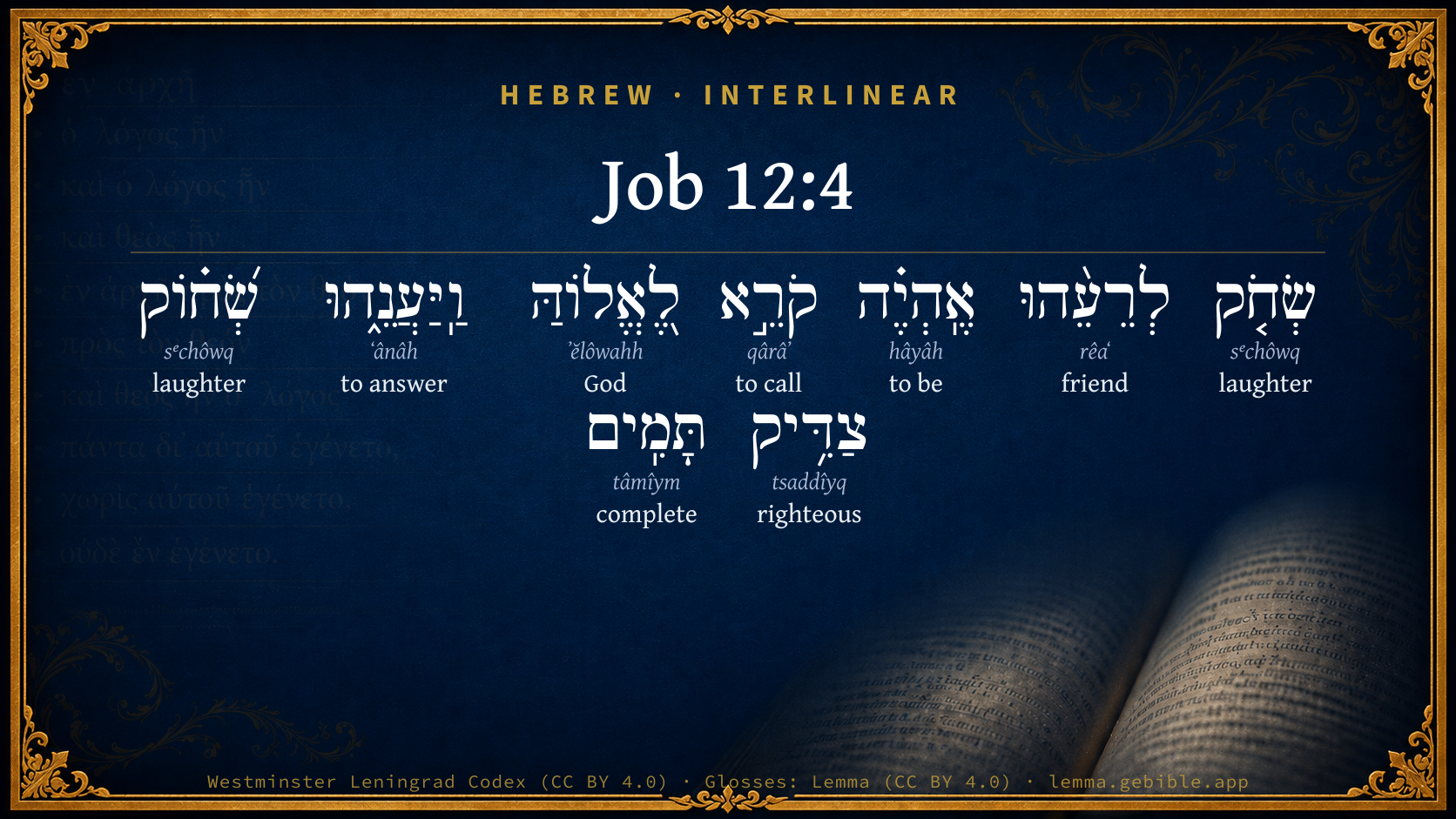
Hebrew (Westminster Leningrad Codex) Job 12:4 appears in the Hebrew Old Testament. The text above is from the Westminster Leningrad Codex. Each word links to its Strong’s number, a concise gloss, and parsing drawn from the Open Scriptures Hebrew Bible morphology. Click any word for its full Brown-Driver-Briggs (BDB) entry.
Download image
Cite this verse

Job 12:4 (World English Bible). Public Domain. Lemma interlinear Bible study tool, https://lemma.gebible.app/v/job/12/4.

Show BibTeX & RIS
BibTeX
RIS
English Translation
I am like one who is a joke to his neighbor, I, who called on God, and he answered. The just, the blameless man is a joke.
World English Bible · Public Domain
Download a study sheet

One document with this verse’s original text, its word-by-word gloss line, the meaning frame, cross-references with their text, attributed commentary, and full source and license credits — printable, and it pastes into notes with its structure intact.

This verse Autodidact and up

Study sheet (.html) Plain text (.txt)

A passage Seminary Student

Up to 50 verses in one chapter. A passage sheet keeps up to 6 commentary sources and 12 cross-references per verse, in the order this page ranks them, and says so on the sheet whenever that leaves anything out. Ask for a single verse and you get the Autodidact verse sheet above.

Everything on this page stays free to read, with no account — the sheet is a download of what is already on screen, not access to it.

Want to remove ads? Support Godless Engineer
Compare translations 3

The same verse in 3 English versions, stacked beneath the original-language interlinear above. Click any original word for its lexicon entry.

Each is an independent rendering of the whole verse — the interlinear is not word-aligned to these translations.

Highlighted words mark where these versions differ — a whole-verse word diff, not a word-by-word alignment.

  • World English Bible Public Domain
    I am like one who is a joke to his neighbor, I, who called on God, and he answered. The just, the blameless man is a joke.
  • King James Version Public Domain
    I am as one mocked of his neighbour, who calleth upon God, and he answereth him: the just upright man is laughed to scorn.
  • unfoldingWord Literal Text CC BY-SA 4.0
    I, the one calling on God and he answered him, have become laughter to his neighbor: just, blameless—laughter!

unfoldingWord Literal Text — © unfoldingWord, licensed CC BY-SA 4.0. Word-aligned USFM3 via Door43 (git.door43.org/unfoldingWord/en_ult).

Versions to compare (up to 4)

3 of 4 selected

Show all 18 translations

Every available English version of this verse, each an independent rendering of the whole verse.

  • World English Bible Public Domain
    I am like one who is a joke to his neighbor, I, who called on God, and he answered. The just, the blameless man is a joke.
  • Berean Standard Bible Public Domain
    I am a laughingstock to my friends, though I called on God, and He answered. The righteous and upright man is a laughingstock.
  • Majority Standard Bible Public Domain
    I am a laughingstock to my friends, though I called on God, and He answered. The righteous and upright man is a laughingstock.
  • King James Version Public Domain
    I am as one mocked of his neighbour, who calleth upon God, and he answereth him: the just upright man is laughed to scorn.
  • American Standard Version (1901) Public Domain
    I am as one that is a laughing-stock to his neighbor, I who called upon God, and he answered: The just, the perfect man is a laughing-stock.
  • Revised Version (1885) Public Domain
    I am as one that is a laughing-stock to his neighbour, a man that called upon God, and he answered him: the just, the perfect man is a laughing-stock.
  • Geneva Bible (1599) Public Domain
    I am as one mocked of his neighbour, who calleth vpon God, and he heareth him: the iust and the vpright is laughed to scorne.
  • Douay-Rheims (1899) Public Domain
    He that is mocked by his friends as I, shall call upon God and he will hear him: for the simplicity of the just man is laughed to scorn.
  • Young's Literal Translation Public Domain
    A laughter to his friend I am: `He calleth to God, and He answereth him,' A laughter `is' the perfect righteous one.
  • Literal Standard Version CC BY-SA 4.0
    I am a laughter to his friend: He calls to God, and He answers him, || A laughter [is] the perfect righteous one.
  • Unlocked Literal Bible CC BY-SA 4.0
    I am something for my neighbor to laugh at— I, one who called on God and who was answered by him! I, a just and blameless man—I am now something to laugh at.
  • unfoldingWord Literal Text CC BY-SA 4.0
    I, the one calling on God and he answered him, have become laughter to his neighbor: just, blameless—laughter!
  • Darby Bible Public Domain
    I am to be one that is a derision to his friend, I who call upon +God, and whom he will answer: a derision is the just upright [man].
  • World Messianic Bible Public Domain
    I am like one who is a joke to his neighbor, I, who called on God, and he answered. The just, the blameless man is a joke.
  • Webster's Bible Public Domain
    I am as one mocked by his neighbor, who calleth upon God, and he answereth him: the just upright man is derided.
  • Free Bible Version CC BY-SA 4.0
    But my friends laugh at me because I called on God and he answered me: the innocent man who does right has become an object of derision.
  • Bible in Basic English Public Domain
    It seems that I am to be as one who is a cause of laughing to his neighbour, one who makes his prayer to God and is answered! the upright man who has done no wrong is to be made sport of!
  • JPS Tanakh (1917) Public Domain
    I am as one that is a laughing-stock to his neighbour, a man that called upon God, and He answered him; the just, the innocent man is a laughing-stock,

Literal Standard Version (2020), Covenant Press — licensed CC BY-SA 4.0. Text via the HelloAO Bible API (eBible.org). Unlocked Literal Bible (unfoldingWord) — licensed CC BY-SA 4.0. Text via the HelloAO Bible API (eBible.org). unfoldingWord Literal Text — © unfoldingWord, licensed CC BY-SA 4.0. Word-aligned USFM3 via Door43 (git.door43.org/unfoldingWord/en_ult). Free Bible Version, Dr. Jonathan Gallagher — licensed CC BY-SA 4.0. Text via the HelloAO Bible API (eBible.org).

Word by word

More ways to search: Search by grammar → Find every occurrence → Compare this word →

Practice this passage: Drill this verse → Learn its vocabulary →

שְׂחֹ֤ק
sᵉchôwq
H7814
“laughter”
Noun, Common, Masculine, Singular, Absolute
Part of Speech
Noun
Type
Common
Gender
Masculine
Number
Singular
State
Absolute
Full BDB Definition

Origin: from H7832

TWOT: 1905d

laughter, laughing stock, mocking, derision - laughter - joyful - hollow - derision (of object) - sport
  1. לְרֵעֵ֨הוּ rêaʻ H7453 “to/for · friend · his” Preposition + Noun, Common, Masculine, Singular, Construct + Suffix, Personal, 3rd Person, Masculine, Singular
  2. אֶֽהְיֶ֗ה hâyâh H1961 “to be” Verb, Qal, Imperfect, 1st Person, Common, Singular
  3. קֹרֵ֣א qârâʼ H7121 “calling” Verb, Qal, Participle Active, Masculine, Singular, Absolute
  4. לֶ֭אֱלוֹהַּ ʼĕlôwahh H433 “to/for · God” Preposition + Noun, Common, Masculine, Singular, Absolute
  5. וַֽיַּעֲנֵ֑הוּ ʻânâh H6030 “and · to answer · him” Conjunction + Verb, Qal, Sequential Imperfect, 3rd Person, Masculine, Singular + Suffix, Personal, 3rd Person, Masculine, Singular
  6. שְׂ֝ח֗וֹק sᵉchôwq H7814 “laughter” Noun, Common, Masculine, Singular, Absolute
  7. צַדִּ֥יק tsaddîyq H6662 “righteous” Adjective, Adjective, Masculine, Singular, Absolute
  8. תָּמִֽים tâmîym H8549 “complete” Adjective, Adjective, Masculine, Singular, Absolute

About this verse

These counts appear in no published source. They are computed here, from the morphology-tagged text and Lemma’s own curated glosses. What Lemma adds →

9
words
8
distinct lemmas
Wisdom
section

Notable vocabulary

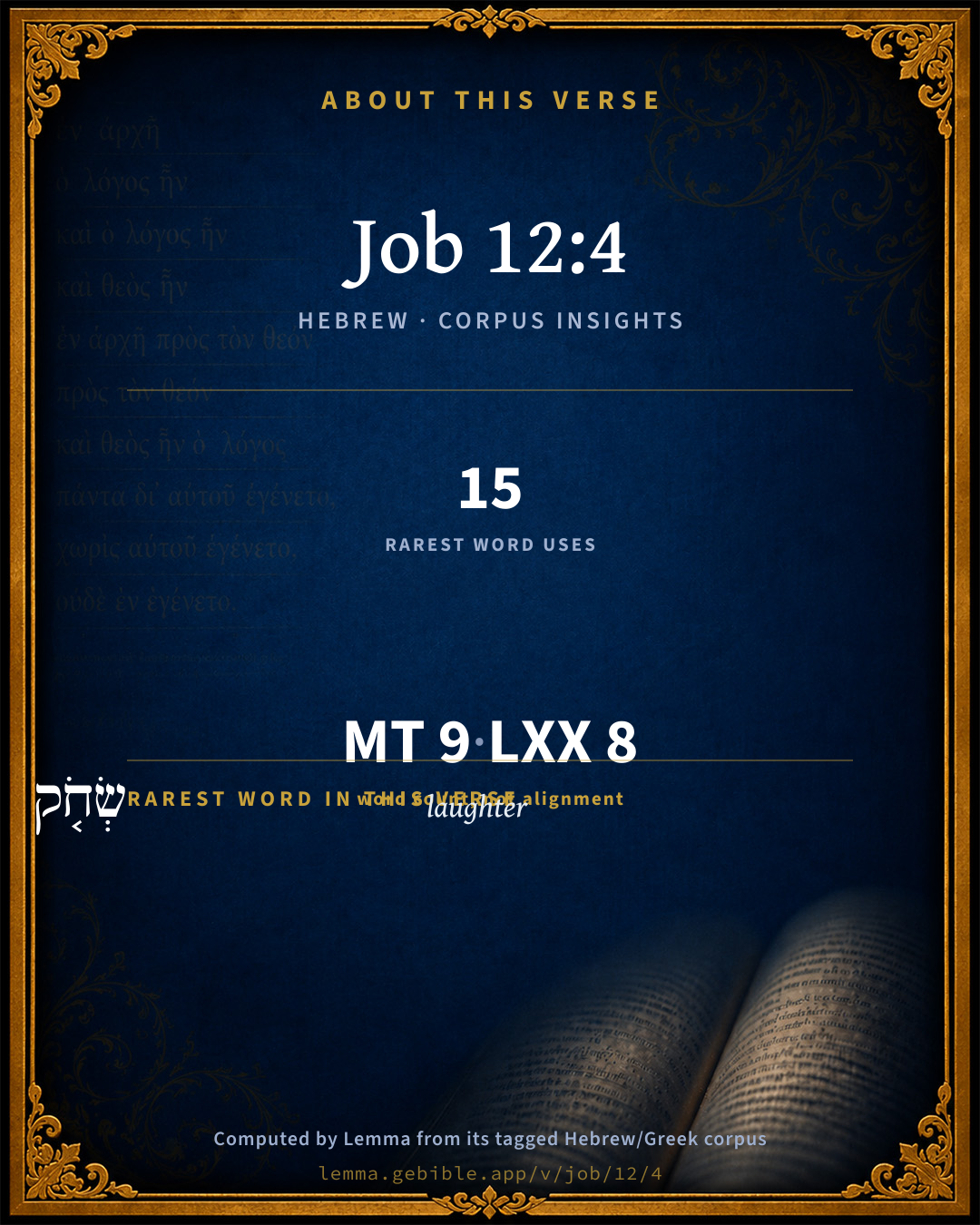
The rarest word here is שְׂחֹ֤ק laughter H7814 — appearing just 15 times in the whole Hebrew Bible.

Shared distinctive vocabulary

שְׂחֹ֤ק laughter H7814 occurs in 14 verses of the Hebrew Bible. Also found in:

Grammatical profile

  • 3 verbs
  • 4 nouns
  • 2 adjectives

Verb forms

  • אֶֽהְיֶ֗ה Qal · Imperfect
  • קֹרֵ֣א Qal · Participle Active
  • וַֽיַּעֲנֵ֑הוּ Qal · Sequential Imperfect

Repetition

A word recurs within this verse — often emphatic in Hebrew:

  • שְׂחֹ֤ק laughter H7814 ×2

Hebrew & Septuagint length

In English translation the verse runs 27 words from the Hebrew and 12 from the Septuagint (LXX English) — the Septuagint runs noticeably shorter here. See the side-by-side →

A rough comparison of the two English renderings, which tokenize alike — not a word-level alignment.

Word counts can differ between the Hebrew and the Greek without any difference in meaning — e.g. the Hebrew direct-object marker אֵת has no separate Greek word, and Greek often adds the article ὁ.

In the original languages it is 9 Hebrew tokens and 8 Greek tokens — but the two are counted differently (Hebrew bundles its prefixes and suffixes into one token; the Greek is in lemma form), so that isn’t a like-for-like length.

Cross-references

19

Topical passages linked to Job 12:4 in the Treasury of Scripture Knowledge — connected by theme and wording, ordered by reader-vote popularity; previews shown in the World English Bible.

  • Job 30:1 "But now those who are younger than I, have me in derision, Whose fathers I would have disdained to put with my sheep dogs.
  • Job 17:6 "But he has made me a byword of the people. They spit in my face.
  • Job 21:3 Allow me, and I also will speak; After I have spoken, mock on.
  • Psalms 91:15 He will call on me, and I will answer him. I will be with him in trouble. I will deliver him, and honor him.
  • Job 16:10 They have gaped on me with their mouth; They have struck me on the cheek reproachfully. They gather themselves together against me.
  • Job 17:2 Surely there are mockers with me, My eye dwells on their provocation.
  • Psalms 22:7–8 All those who see me mock me. They insult me with their lips. They shake their heads, saying,
  • Jeremiah 33:3 Call to me, and I will answer you, and will show you great things, and difficult, which you don't know.
  • Job 6:29 Please return. Let there be no injustice; Yes, return again, my cause is righteous.
  • Job 11:3 Should your boastings make men hold their peace? When you mock, shall no man make you ashamed?
  • Job 16:20 My friends scoff at me. My eyes pour out tears to God,
  • Psalms 35:16 Like the profane mockers in feasts, They gnashed their teeth at me.
  • Proverbs 14:2 He who walks in his uprightness fears Yahweh, But he who is perverse in his ways despises him.
  • Micah 7:7 But as for me, I will look to Yahweh. I will wait for the God of my salvation. My God will hear me.
  • Matthew 27:29 They braided a crown of thorns and put it on his head, and a reed in his right hand; and they kneeled down before him, and mocked him, saying, "Hail, King of the Jews!"
  • Mark 5:40 They ridiculed him. But he, having put them all out, took the father of the child and her mother and those who were with him, and went in where the child was lying.
  • Luke 16:14 The Pharisees, who were lovers of money, also heard all these things, and they scoffed at him.
  • Acts 17:32 Now when they heard of the resurrection of the dead, some mocked; but others said, "We want to hear you again concerning this."
  • Hebrews 11:36 Others were tried by mocking and scourging, yes, moreover by bonds and imprisonment.

Cross-references courtesy of OpenBible.info (CC BY 4.0).

Hebrew and Greek witnesses Masoretic Hebrew ↔ Greek Septuagint

The same verse in the two great witnesses to the Old Testament, shown verse-for-verse.

Here the Septuagint runs noticeably shorter than the Hebrew — LXX2012 (modern English Septuagint) 12 words vs World English Bible 27. A rough length comparison of the two English translations, not a word-level alignment — read both below.

These are two independent witnesses, not word-aligned to each other, and the Septuagint is shown in lemma (dictionary) form.

Hebrew Job 12:4 Masoretic · Westminster Leningrad Codex

שְׂחֹ֤ק לְרֵעֵ֨הוּ אֶֽהְיֶ֗ה קֹרֵ֣א לֶ֭אֱלוֹהַּ וַֽיַּעֲנֵ֑הוּ שְׂ֝ח֗וֹק צַדִּ֥יק תָּמִֽים

I am like one who is a joke to his neighbor, I, who called on God, and he answered. The just, the blameless man is a joke.

World English Bible · Public Domain

Greek LXX Job 12:4 Septuagint · lemma form

δίκαιος γάρ ἀνήρ καί ἄμεμπτος γίγνομαι εἰς χλεύασμα

For a righteous and blameless man has become a subject for mockery.

LXX2012 (modern English Septuagint) · Public Domain

On this verse, Keil & Delitzsch discusses the Septuagint’s reading. Read the note in Commentary ↓

Hebrew: Westminster Leningrad Codex (CC BY 4.0). Greek: Septuagint (public domain); English from LXX2012 (modern English Septuagint) (Public Domain). How the Septuagint differs from the Hebrew →

Commentary

Notes on Job 12:4 from classic Christian and Jewish commentators (each source and its license shown beneath its notes). The classic Christian expositions comment on the surrounding passage and are grouped to its opening verse, so a note may address several verses; the Jewish commentaries on the Tanakh (Rashi and others) are per-verse, so they appear only where the commentator wrote on this verse.

Lemma curates 59 commentaries, every one of them public domain or Creative Commons licensed, each selected and text-cleaned for this edition rather than reprinted as found. About our sources →

Trapp's Complete Commentary

John Trapp

Job 12:4 I am [as] one mocked of his neighbour, who calleth upon God, and he answereth him: the just upright [man is] laughed to scorn.

Ver. 4. Iam as one mocked of his neighbour] Those that should countenance and comfort me contemn and scorn me. I am their laughter and pastime; so he took it, since they sat so heavily upon the skirts of his conscience, and would not weigh his reasons brought in his own defence.

Who calleth upon God, and he answereth him] i.e. I, Job, do make God my refuge when these jeering neighbours of mine do shame my counsel, Psa 14:6, and would mock me out of my religion; but God favoureth me though men frown; and where human help faileth Divine appeareth. Or thus rather: I am derided by those who profess to call upon God, and to hear often from heaven. They are hard hearted to me, though themselves have liberally tasted of God’s tenderness; and they pull up the bridge of mercy before me, which themselves have oft gone over.

The just upright man is laughed to scorn] "Shame shall be the promotion of fools," Pro 3:35, and such a dissembler as Doeg may well be derided, Psa 52:6-7. But what hath the righteous done? And why should just, upright Job be laughed to scorn? But this is no news. Christ and his people have ever been for signs and for wonders in this mad world, always beside itself in point of salvation. "He that departeth from evil maketh himself a prey," or is accounted mad, Isa 59:15. If he will needs be a just upright man, if he will live godly in Christ Jesus (if he be so set upon it, that none shall hinder him), he shall suffer persecution, this of the tongue howsoever, 2Ti 3:12. A wolf flieth not upon a painted sheep. We can look upon a painted toad with delight; it is the reality of godliness that is hated.

John Trapp, A Commentary or Exposition upon All the Books of the Old and New Testament (1647–1656) — public domain. Text from a community e-Sword module.

The Biblical Illustrator

Joseph S. Exell

Job_12:4

I am as one mocked of his neighbour, who calleth upon God, and He answereth.

The man who gets answers may mock him who gets none

The antecedent to who seems to be uncertain. It may be Job; it may be the neighbour about whom Job speaks. They who have had experience of Gods tenderness to help them and hear their prayers, should be very tender to others, when they call to them, and seek their help. Learn--

1. It is the privilege of the saints, when men fail and reject them, to make God their refuge and their recourse to heaven.

2. The repulses which we meet with in the world, should drive us nearer to God.

3. Prayer and seeking unto God are not in vain or fruitless.

4. As it is sinful, so it is extremely dangerous to mock those who have the ear of God, or acceptance with God in prayer. (Joseph Caryl.)

The Biblical Illustrator, edited by Joseph S. Exell (c. 1880s–1900s) — public domain. Text from a community e-Sword module.

Joseph Benson's Commentary

Job 12:4. I am as one mocked of his neighbour — שׂחק לרעהו אהיה, sechok leregnehu ehjeh, literally, a jest to his friend, I am. Thus Jeremiah complains, I was a derision to all my people, Lam 3:14. Who calleth upon God, and he answereth him — This is applied by Sol. Jarchi, and the commentators in general, to Job’s neighbour or friend; intimating that such a one, addressing himself to God, received a favourable answer; when Job himself had no satisfactory return paid to his loud cries and importunate complaints. But the words are capable of a very different construction if we refer them to Job, and not to his friend, and as containing the mocking words thrown out against him: Thus, He calleth (say they) upon God; but doth he answer him? — He is loud and importunate in protesting his innocence; in clearing and vindicating himself; in appealing to the tribunal of Heaven. But to what purpose? Are his importunities and clamours received, his solemn protestations heard or admitted? His trust and confidence (he would have us to believe) are entirely on God; but is he eased of his troubles; is he delivered from his miseries? Thus the Jews mocked our Lord Jesus: “He trusted in God; (said they;) let him deliver him now, if he will have him.” “This man calleth for Elias; let us see whether Elias will come and save him.” The just upright man is laughed to scorn — The words have a peculiar beauty, being spoken with much religious concern and modesty; for Job does not say, I, a just and upright man, am made a laughing-stock; but he delivers himself in general terms; the just and upright man, &c. His meaning however is, that, notwithstanding all their hard censures and reproaches, he must still believe himself to be, through God’s grace, a just and upright man; and must say that, as such, he was derided by them.

Joseph Benson's Commentary on the Old and New Testaments (1811–1818) — public domain. Text from a community e-Sword module.

Geneva Bible (1599)

Geneva Bible translators

The which neighbor being a mocker and a wicked man, thinketh that no man is in God’s favor but he, because he hath all things that he desireth.

He reproveth these his friends of two faults: the one that they thought they had better knowledge than indeed they had: and the other, that instead of true consolation, they did deride and despise their friend in his adversity.

Geneva Bible (1599) marginal notes — public domain. Text via Bolls.life.

Jamieson, Fausset & Brown

Robert Jamieson, A. R. Fausset & David Brown

The unfounded accusations of Job's friends were a "mockery" of him. He alludes to Zophar's word, "mockest" (Job 11:3).

neighbour, who calleth, &c.--rather, "I who call upon God that he may answer me favorably" [UMBREIT].

Jamieson, Fausset & Brown — Commentary Critical and Explanatory on the Whole Bible (1871) — public domain (CC PDM 1.0). Text via the HelloAO Bible API.

Adam Clarke's Commentary

Verse 4. I am as one mocked of his neighbour] Though I am invoking God for help and salvation, yet my friends mock me in this most solemn and sacred work. But God answereth me.

The just upright man is laughed to scorn] This is a very difficult verse, on which no two critics seem to be agreed. Mr. Good translates the fourth and fifth verses thus: -

"Thus brother is become a laughing-stock to his companions,

While calling upon God that he would succour him.

The just, the perfect man, is a laughing-stock to the proud,

A derision amidst the sunshine of the prosperous,

While ready to slip with his foot.

For a vindication of this version, I must refer to his notes. Coverdale gives at least a good sense. Thus he that calleth upon God, and whom God heareth, is mocked of his neighboure: the godly and innocent man is laughed to scorne. Godlynesse is a light despysed in the hertes of the rich; and is set for them to stomble upon. The fifth verse is thus rendered by Mr. Parkhurst: "A torch of contempt, or contemptible link, (see Isa 7:4; Isa 40:2, Isa 40:3), לעשתות leashtoth, to the splendours of the prosperous (is he who is) ready (נכון nachon, Job 15:23; Job 18:12; Ps 38:17) to slip with his foot." The general sense is tolerably plain; but to emendations and conjectures there is no end.

Adam Clarke's Commentary on the Bible (1810–1826) — public domain. Text from a community e-Sword/MySword module.

Ellicott's Commentary for English Readers

(4) I am as one mocked of his neighbour.—The laughing-stock of his companion—he who called on God, and He answered him. This is either the character Job claims for himself, or it is the supposed taunt of his friends—the righteous and the perfect a laughing-stock, or, the righteous and the perfect might be a laughing-stock. Ridicule is no test of truth or of merit.

A Bible Commentary for English Readers, edited by Charles John Ellicott (1878–1897) — public domain. Text from a community e-Sword module.

The Cambridge Bible for Schools and Colleges

gen. ed. J. J. S. Perowne

4. I am to be one that is a laughing-stock to his friends,

I, who called on God and he answered me:

A laughing-stock the just and perfect man!

4, 5. Job laments how low he had fallen when men thought to instruct him, a man of God, with such primary truths regarding God’s operation in the world. Yet it was but an illustration of the general truth—righteousness when unfortunate was held in contempt. The verses read,

The Cambridge Bible for Schools and Colleges (gen. ed. J. J. S. Perowne; Cambridge University Press, 1878–1918) — public domain. Text from a community e-Sword module.

John Gill's Exposition

He that is ready to slip with his feet,.... Not into sin, though this is often the case of good men, but into calamities and afflictions; and Job means himself, and every just upright man in the like circumstances: or he that is "prepared" or "destined" to be among them, that "totter" and stagger in their "feet" (i); that cannot stand upon their feet, but fall to the ground; which may describe man in declining and distressing circumstances; or that is appointed to be the laughing stock of such as are unstable in the word and ways of God; double minded men, hypocrites, and formal professors, that totter and stagger at everything they meet with disagreeable to the flesh: with such, a poor afflicted saint is laughed to scorn; he

is as a lamp despised in the thought of him that is at ease; who are in affluent circumstances, enjoy great prosperity, live in plenty, and are not in trouble as others; their hearts are at ease: now with such, poor good men are had in great contempt; they are despised at heart, in the thoughts of such persons, if they do not in words express it; they are like a lamp just going out, which is neglected, and looked upon as useless; or like a torch burnt to the end, when it is thrown away; and thus it is with men, while the lamp of prosperity burns clear and bright, they are valued and had in esteem, but when their lamp becomes dim, and is almost, or quite extinguished, they are despised, see Psa 123:3; some apply this to Christ, who was a lamp or light, a great one, but despised of men, and even as a light; they loved darkness rather than light; and especially by the Pharisees, who were at ease, settled on their lees, that trusted in themselves that they were righteous, and despised others; and this is true of Gospel ministers, though bright and burning lights, and even of every good man, in whom the true light of grace, and of the Gospel, shines, and especially when under afflictive circumstances. Some, instead of a "lamp despised", read, "for" or "because of calamity despised" (k); so Aben Ezra, which conveys the same sense, that an afflicted man is despised for his affliction; and this being the case of good men confutes the notion of Job's friends, that it always goes well with such; and their other notion of its going ill with bad men is refuted in Job 12:6.

(i) "destinatus vacillantibus pede", Schmidt; so Michaelis. (k) "ad calamitatem contumelia", Cocceius; "ad infortunium vilis habetur", Gussetius, p. 674.

John Gill's Exposition of the Whole Bible (1746–1763) — public domain (CC PDM 1.0). Text via the HelloAO Bible API.

Albert Barnes' Notes on the Bible

I am as one mocked of his neighbour - There has been considerable variety in the interpretation of this verse. The general sense is, that Job felt himself to be a mere laughing-stock for his neighbors. They treated him as if he were not worth regarding. They had no sympathy for him in his sorrows, and they showed no respect for his opinions. Dr. Good understands this and the following verses as a part of the controversy in which Job proposes to show his skill in debate, and to adduce proverbs after the manner of his friends. But it is more probably an allusion to himself, and is designed to state that he felt that he was not treated with the respect which was due to him. Much difficulty has been felt in understanding the connection. Reiske contends that Job 12:2 has no connection with Job 12:3, and that Job 12:11-12, should be interposed between them. The connection seems to me to be this: Job complains that he was not treated with due deference. They had showed no respect for his understanding and rank. They had urged the most common-place topics; advanced stale and trite apothegms, as if he had never heard them; dwelt on maxims familiar even to the meanest persons; and had treated him in this manner as if he were a mere child in knowledge. Thus, to be approached with vague common-places, and with remarks such as would be used in addressing children, he regarded as insult and mockery.

Who calleth upon God, and he answereth him - This phrase has given occasion to great variety in the interpretation. Umbreit renders it, “I, who once called upon God, and he answered me;” that is, I, who once was a happy man, and blessed of God. Schultens renders it, “I, who call upon God,” that is, for trial, “and am ready to answer him.’ Rosenmuller supposes that Job has reference to the assurances of his friends, that if he would call upon God, he would answer him, and that in view of that suggestion he exclaims, “Shall a man who is a laughing-stock to his neighbor call upon God, and will he answer him!’ The probable meaning is, that he had been a man who had had constant communion with God. He had been a favorite of the Almighty, for he had lent a listening ear to his supplications. It was now a thing of which he might reasonably complain, that a man who had enjoyed such manifest tokens of the divine favor, was treated with reproach and scorn.

Albert Barnes' Notes on the Bible (1834–1885) — public domain. Text from a community e-Sword/MySword module.

Haydock's Catholic Bible Commentary

Mocked. He retaliates on Sophar, (chap. xi. 3.; Haydock) who had very seriously exhorted Job to call on God, as if he had been ignorant of this duty. (Calmet) --- God will one day force the wicked to retract their false notion, in despising his servants, Wisdom v. 3. (Worthington)

George Leo Haydock (1774–1849), Haydock's Catholic Family Bible and Commentary, 1859 edition — public domain. Excludes Psalms (Douay-Rheims chapter numbering differs from Protestant) and Deuterocanonical books (Catholic canon only).

Matthew Poole's English Annotations

As one mocked of his neighbour, Heb. I am a derision (the infinitive being put for a noun, as is usual both in the Hebrew and other languages) to my neighbour, i.e. to these three, who have pretended and would be thought to be my friends and neighbours; whom therefore such carriage doth very ill become. Instead of supporting and comforting me, they make a sport and scorn of me.

Who calleth upon God, and he answereth him. This who belongs either,

1. To Job, who here declares his own practice in this case: When you mock me, I go to God with my complaints and prayers, and he hears me, though you will not. But this seems not to agree either with the context, or with other passages of Job; in which he constantly complains that God did not hear nor regard his prayers, nor pity and help him. Or,

2. To Job’s friends; and so this is either,

1. An aggravation of their crime, that they should mock him who made a great profession of religion, who used duly to call upon God, and to receive answers from him, and therefore should have carried themselves more piously, and charitably, and compassionately towards their miserable brother. Or,

2. As the reason of their mockage of Job, because God, who neglected Job’s prayers, heard theirs, and gave them those mercies for which they prayed; and therefore being themselves well and at ease, they were hard-hearted towards their poor afflicted brother, as the manner of men is. This seems to suit well with the following verse. Or,

3. As all argument against their scorning or slighting of him: God hears you when you pray, therefore you should turn your mocks of me into prayers for me; and you should pity me, whom God doth not hear when I pray; and as God hears you, so you should hear and comfort me, when I pour out my complaints to you. But these words may be brought in mimetically, as being some of their scoffing words: They say of me, Let him call upon God, and God will hear him; for so they had suggested to Job, Job 5:8; 8:5; 11:13. But this, saith Job, I take for a piece of mockery, and insulting over my miseries; for I know by sad experience, and they see the contrary, that though I call and cry again and again, yet God hath no regard to me.

The just, upright man is laughed to scorn, i.e. I, who, notwithstanding all their hard censures and reproaches, must and dare still own it, that through God’s grace I am a just and upright man, am derided by them. This he repeats again, because it was very grievous and burdensome to him.

Matthew Poole's English Annotations on the Holy Bible (1683–1685) — public domain. Text from a community e-Sword/MySword module.

Whedon's Commentary on the Bible

Daniel D. Whedon

4. I am one mocked — Literally, A mockery to his friend, am I; [I] who railed upon God and he answered him: a mockery is the just, upright man.

Answereth him — As if it were too great a thing for Job to say that God had heard and answered his prayer, he passes from the first to the third person. What appears to be a solecism, is really the humility of true greatness. If we truly appreciate the significance of prayer we shall not wonder at this; for prayer assumes that the invisible God is near to hearken to, and consciously answer, the cry of mortals. Its privilege confers on the mind of man the greatest conceivable exercise of might — none the less than to move the Divine Being to the exertion of his power for our good. The secret of this lies in the parental affection of God. No attainment of greatness raises the Father above the touching appeal of an infant’s cry. “When ye pray, say, Our Father.”

Daniel D. Whedon (gen. ed.), Commentary on the Old and New Testaments (1874–1909) — public domain. Text from a community e-Sword module.

The Pulpit Commentary

I am as one mocked of his neighbour. You have accused me of mockery: (Job_11:3) but it is I that have been mocked of you. The allusion is probably to Job_11:2, Job_11:3, Job_11:11, Job_11:12, Job_11:20. Who calleth upon God, and he answereth him. You mock me, though I have always clung to religion, have called upon God in prayer, and from time to time had my prayers answered by him. Thus it is the just upright man that is laughed to scorn.

The Pulpit Commentary (1880–1919), ed. H.D.M. Spence-Jones & Joseph S. Exell — public domain. Text from a community e-Sword module.

John Wesley's Explanatory Notes

Upon God - Even by my religious neighbours, by those who call upon God, and not in vain; whose prayers therefore I covet, not their reproaches. The just - I, who, notwithstanding all their hard censures dare still own it, that through God's grace I am an upright man.

John Wesley, Explanatory Notes Upon the Whole Bible (1754–1765) — public domain. Text via the GEBible commentary corpus.

Keil & Delitzsch

C. F. Keil & F. Delitzsch

4 I must be a mockery to my own friend,

I who called on Eloah and He heard me;

A mockery - the just, the godly man.

5 Contempt belongs to misfortune, according to the ideas of the prosperous;

It awaits those who are ready to slip.

6 Tents of the destroyer remain in peace,

And those that defy God are prosperous,

Who taketh Eloah into his hand.

The synallage of לרעהוּ for לרעי is not nearly so difficult as many others: a laughing-stock to his own friend; comp. Isa 2:8, they worship the work of their (his) own hands (ידיו). "One who called on Eloah (לאלוהּ, for which לאלוהּ is found in lxx at Job 36:2) and He heard him" is in apposition to the subject; likewise תמים צדיק, which is to be explained according to Pro 11:5, צדיק (from צדק, Arab. ṣdq, to be hard, firm, stiff, straight), is one who in his conduct rules himself strictly according to the will of God; תמים, one whose thoughts are in all respects and without disguise what they should be-in one word: pure. Most old translators (Targ., Vulg., Luther) give לפּיד the signification, a torch. Thus e.g., Levi v. Gerson explains: "According to the view of the prosperous and carnally secure, he who is ready for falterings of the feet, i.e., likely to fall, is like a lighted torch which burns away and destroys whatever comes in contact with it, and therefore one keeps aloof from him; but it is also more than this: he is an object of contempt in their eyes." Job might not inappropriately say, that in the eyes of the prosperous he is like a despised, cast-away torch (comp. the similar figure, Isa 14:19, like a branch that is rejected with contempt); and Job 12:5 would be suitably connected with this if למועדי could be derived from a substantive מעד, vacillatio, but neither the usage of the language nor the scriptio plena (after which Jerome translates tempus statutum, and consequently has in mind the מועדים, times of festal pilgrimages, which are also called ררלים in later times), nor the vowel pointing (instead of which מעדי would be expected), is favourable to this. רגל מועדי signifies vacillantes pede, those whose prosperity is shaken, and who are in danger of destruction that is near at hand. We therefore, like Abenezra and modern expositors, who are here happily agreed, take לפיד as composed of ל and פּיד, a word common to the books of Job (Job 30:24; Job 31:29) and Proverbs (ch. Pro 24:22), which is compared by the Jewish lexicographers, according both to form and meaning, to כּיד (Job 21:20) and איד, and perhaps signifies originally dissolution (comp. פדה), decease (Syr. f'jodo, escape; Arab. faid, dying), fall, then generally calamity, misfortune: contempt (befits) misfortune, according to the thoughts (or thinking), idea of the prosperous. The pointing wavers between לעשׁתּות and the more authorized לעשׁתּוּת, with which Parchon compares the nouns עבדוּת and מרדּוּת; the ת, like ד in the latter word, has Dag. lene, since the punctuation is in this respect not quite consistent, or follows laws at present unknown (comp. Ges. 21, rem. 2). Job 12:5 is now suitably connected: ready (with reference to בוז) for those who stumble, i.e., contempt certainly awaits such, it is ready and waiting for them, נכון, ἕτοιμος, like Exo 34:2.

While the unfortunate, in spite of his innocence, has thus only to expect contempt, the tents, i.e., dwellings and possessions, of the oppressor and the marauder remain in prosperity; ישׁליוּ for ישׁלוּ, an intensive form used not only in pause (Psa 36:8; comp. Deu 32:37) and with greater distinctives (Num 34:6; Psa 122:6), but also in passages where it receives no such accent (Psa 36:9; Psa 57:2; Psa 73:2). On אהלים, instead of אהלים, vid., Ges. 93, 6, 3. The verbal clause (Job 12:6) is followed by a substantival clause (Job 12:6). בּטּחות is an abstract plural from בּטּוּח, perfectly secure; therefore: the most care-less security is the portion of those who provoke God (lxx περοργίζουσι);

(Note: Luther takes בטחות as the adverb to מרגיזי: und toben wider Gott thrstiglich (vid., Vilmar, Pastoraltheolog. Bltter, 1861, S. 110-112); according to the Vulg., et audacter provocant Deum.)

and this is continued in an individualizing form: him who causes Eloah to go into his hand. Seb. Schmid explains this passage in the main correctly: qui Deum in manu fert h.e. qui manum aut potentiam suam pro Deo habet et licitum sibi putat quodlibet; comp. Hab 1:11 : "this his strength becomes God to him," i.e., he deifies his own power, and puts it in the place of God. But הביא signifies, in this connection with לידו (not בידו), neither to carry, nor to lead (Gesenius, who compares Psa 74:5, where, however, it signifies to cause to go into = to strike into); it must be translated: he who causes Eloah to enter into his hand; from which translation it is clear that not the deification of the hand, but of that which is taken into the hand, is meant. This which is taken into the hand is not, however, an idol (Abenezra), but the sword; therefore: him who thinks after the manner of Lamech,

(Note: [Comp Pentateuch, at Gen 4:25, Clark's Foreign Theological Library. - Tr.])

as he takes the iron weapon of attack and defence into his hand, that he needs no other God.

Keil & Delitzsch — Biblical Commentary on the Old Testament (1861–1891) — public domain (CC PDM 1.0). Text via the HelloAO Bible API. (Old Testament only.)

unfoldingWord translationNotes

Door43 World Missions Community

I am something for my neighbor to laugh at—I, one who called on God and who was answered by him!

The relationship between these phrases can be made clear with the words "even though." AT: "I am something for my neighbor to laugh at—even though I am one who called on God and he answered me!" (See: Connecting Words)

I, a just and blameless man—I am now something to laugh at

The relationship between these phrases can be made clear with the words "even though." AT: "Even though I am a just and blameless man, people now laugh at me" (See: Connecting Words)

In the thought of someone who is at ease, there is contempt for misfortune

The abstract nouns "thought," "ease," "contempt," and "misfortune" can be expressed with other phrases. AT: "A person who lives an easy life despises a person who suffers" (See: Abstract Nouns)

brings more misfortune

Bringing misfortune represents causing it to happen. AT: "causes more bad things to happen" (See: Metaphor)

to those whose foot is slipping

The foot slipping represents being in danger or trouble. AT: "to those who are already in trouble" (See: Metaphor)

The tents of robbers prosper

Their tents prospering represents the robbers prospering in their tents. AT: "Robbers live in prosperity in their own tents" (See: Metonymy)

their own hands are their gods

Here "their own hands" is a metonym for strength, and "their gods" is a metaphor for their pride. AT: "they are extremely proud of their own abilities" (See: Metonymy and Metaphor)

translationWords

neighbor

call

God

just

blameless

contempt

tent

provoke

unfoldingWord translationNotes — © Distant Shores Media and the Door43 World Missions Community, licensed CC BY-SA 4.0. Source: git.door43.org/Door43/en_tn.

Rashi

Rabbi Shlomo Yitzchaki (Rashi)

a laughingstock to his friend He calls to the Holy One, blessed be He, and He answers him concerning the pain of their provocation. Now what does He answer him? To give the righteous laughter. completely Heb. תָּמִים, perfectly.

that the completely righteous will have laughter That is the answer that He will reply with, and I know that it is as you said (8:21), (“He will yet fill your mouth with laughter,”) for...

Rashi on the Tanakh — English translations: “The Judaica Press complete Tanach with Rashi, translated by A. J. Rosenberg” (CC BY 4.0); “Pentateuch with Rashi's commentary by M. Rosenbaum and A.M. Silbermann, 1929-1934” (public domain); “The Metsudah Tanach series, Lakewood, N.J” (CC BY 4.0); and “The Book of Joshua, Metsudah Publications, 1997” (CC BY 4.0). Text via Sefaria.

Lesson kit

Teaching starters — assembled from the data on this page, not authored interpretation. Every prompt links to the verse data it draws on. Edit before teaching.

Job, in the Wisdom, opens this verse with 9 words (8 distinct Hebrew lemmas). Its most distinctive word is sᵉchôwq (“laughter”). The Greek Septuagint runs shorter here. A historical commentator’s framing appears above. Read the whole chapter for the surrounding context.

Discussion questions

  1. How does “laughter” (sᵉchôwq) shape what this verse is saying?
  2. Job 8:21 shares the word «laughter» with this verse. How do the two illuminate each other?
  3. “laughter” occurs 2× in this one verse. What is the effect of the repetition?
  4. Compared with the Hebrew, the Septuagint runs shorter here. What questions does that raise?
  5. The translations on this page render this verse differently — a whole-verse word diff, not a word-by-word alignment. What might account for the different wordings?
  6. The verb «אֶֽהְיֶ֗ה» is Qal Imperfect. How does its form color the action?
  7. Reading how Trapp's Complete Commentary and The Biblical Illustrator read this verse, where do the two commentators agree and where do they part?

Things to notice

Reading settings

Reading text

Shown beneath each verse's original-language words.

Old Testament
Old Testament edition

Read the OT as the Masoretic Hebrew (MT) or the Greek Septuagint (LXX).

English shown for the Greek Septuagint (in the Hebrew ↔ Greek comparison).

Comparing translations? Open the Compare panel on any verse page to stack up to four side by side.