Job 32:3

Hebrew (Westminster Leningrad Codex) Job 32:3 appears in the Hebrew Old Testament. The text above is from the Westminster Leningrad Codex. Each word links to its Strong’s number, a concise gloss, and parsing drawn from the Open Scriptures Hebrew Bible morphology. Click any word for its full Brown-Driver-Briggs (BDB) entry.
Download image
Cite this verse

Job 32:3 (World English Bible). Public Domain. Lemma interlinear Bible study tool, https://lemma.gebible.app/v/job/32/3.

Show BibTeX & RIS
BibTeX
RIS
English Translation
Also his wrath was kindled against his three friends, because they had found no answer, and yet had condemned Job.
World English Bible · Public Domain
Highlights Full analysis ↓
Download a study sheet

One document with this verse’s original text, its word-by-word gloss line, the meaning frame, cross-references with their text, attributed commentary, and full source and license credits — printable, and it pastes into notes with its structure intact.

This verse Autodidact and up

Study sheet (.html) Plain text (.txt)

A passage Seminary Student

Up to 50 verses in one chapter. A passage sheet keeps up to 6 commentary sources and 12 cross-references per verse, in the order this page ranks them, and says so on the sheet whenever that leaves anything out. Ask for a single verse and you get the Autodidact verse sheet above.

Everything on this page stays free to read, with no account — the sheet is a download of what is already on screen, not access to it.

Want to remove ads? Support Godless Engineer
Compare translations 3

The same verse in 3 English versions, stacked beneath the original-language interlinear above. Click any original word for its lexicon entry.

Each is an independent rendering of the whole verse — the interlinear is not word-aligned to these translations.

Highlighted words mark where these versions differ — a whole-verse word diff, not a word-by-word alignment.

  • World English Bible Public Domain
    Also his wrath was kindled against his three friends, because they had found no answer, and yet had condemned Job.
  • King James Version Public Domain
    Also against his three friends was his wrath kindled, because they had found no answer, and yet had condemned Job.
  • unfoldingWord Literal Text CC BY-SA 4.0
    And against the three of his friends his nose burned upon that they had not found an answer but they had declared Job wrong.

unfoldingWord Literal Text — © unfoldingWord, licensed CC BY-SA 4.0. Word-aligned USFM3 via Door43 (git.door43.org/unfoldingWord/en_ult).

Versions to compare (up to 4)

3 of 4 selected

Show all 18 translations

Every available English version of this verse, each an independent rendering of the whole verse.

  • World English Bible Public Domain
    Also his wrath was kindled against his three friends, because they had found no answer, and yet had condemned Job.
  • Berean Standard Bible Public Domain
    and he burned with anger against Job’s three friends because they had failed to refute Job, and yet had condemned him.
  • Majority Standard Bible Public Domain
    and he burned with anger against Job’s three friends because they had failed to refute Job, and yet had condemned him.
  • King James Version Public Domain
    Also against his three friends was his wrath kindled, because they had found no answer, and yet had condemned Job.
  • American Standard Version (1901) Public Domain
    Also against his three friends was his wrath kindled, because they had found no answer, and yet had condemned Job.
  • Revised Version (1885) Public Domain
    Also against his three friends was his wrath kindled, because they had found no answer, and yet had condemned Job.
  • Geneva Bible (1599) Public Domain
    Also his anger was kindled against his three friends, because they could not finde an answere, and yet condemned Iob.
  • Douay-Rheims (1899) Public Domain
    And he was angry with his friends because they had not found a reasonable answer, but only had condemned Job.
  • Young's Literal Translation Public Domain
    and against his three friends hath his anger burned, because that they have not found an answer, and condemn Job.
  • Literal Standard Version CC BY-SA 4.0
    and his anger has burned against his three friends, because that they have not found an answer, and condemn Job.
  • Unlocked Literal Bible CC BY-SA 4.0
    Elihu's anger was also kindled against his three friends because they had found no answer to Job, and yet they had condemned Job.
  • unfoldingWord Literal Text CC BY-SA 4.0
    And against the three of his friends his nose burned upon that they had not found an answer but they had declared Job wrong.
  • Darby Bible Public Domain
    and against his three friends was his anger kindled, because they found no answer, and [yet] condemned Job.
  • World Messianic Bible Public Domain
    Also his wrath was kindled against his three friends, because they had found no answer, and yet had condemned Job.
  • Webster's Bible Public Domain
    Also against his three friends was his wrath kindled, because they had found no answer, and yet had condemned Job.
  • Free Bible Version CC BY-SA 4.0
    Elihu was also angry at Job's three friends because they made it seem that God was wrong, because they had not been able to answer Job.
  • Bible in Basic English Public Domain
    And he was angry with his three friends, because they had been unable to give him an answer, and had not made Job's sin clear.
  • JPS Tanakh (1917) Public Domain
    Also against his three friends was his wrath kindled, because they had found no answer, and yet had condemned Job.

Literal Standard Version (2020), Covenant Press — licensed CC BY-SA 4.0. Text via the HelloAO Bible API (eBible.org). Unlocked Literal Bible (unfoldingWord) — licensed CC BY-SA 4.0. Text via the HelloAO Bible API (eBible.org). unfoldingWord Literal Text — © unfoldingWord, licensed CC BY-SA 4.0. Word-aligned USFM3 via Door43 (git.door43.org/unfoldingWord/en_ult). Free Bible Version, Dr. Jonathan Gallagher — licensed CC BY-SA 4.0. Text via the HelloAO Bible API (eBible.org).

Word by word

More ways to search: Search by grammar → Find every occurrence → Compare this word →

Practice this passage: Drill this verse → Learn its vocabulary →

מַעֲנֶ֑ה
maʻăneh
H4617
“answer”
Noun, Common, Masculine, Singular, Absolute
Part of Speech
Noun
Type
Common
Gender
Masculine
Number
Singular
State
Absolute
Full BDB Definition

Origin: from H6030

TWOT: 1650f

answer, response - (TWOT) place for task
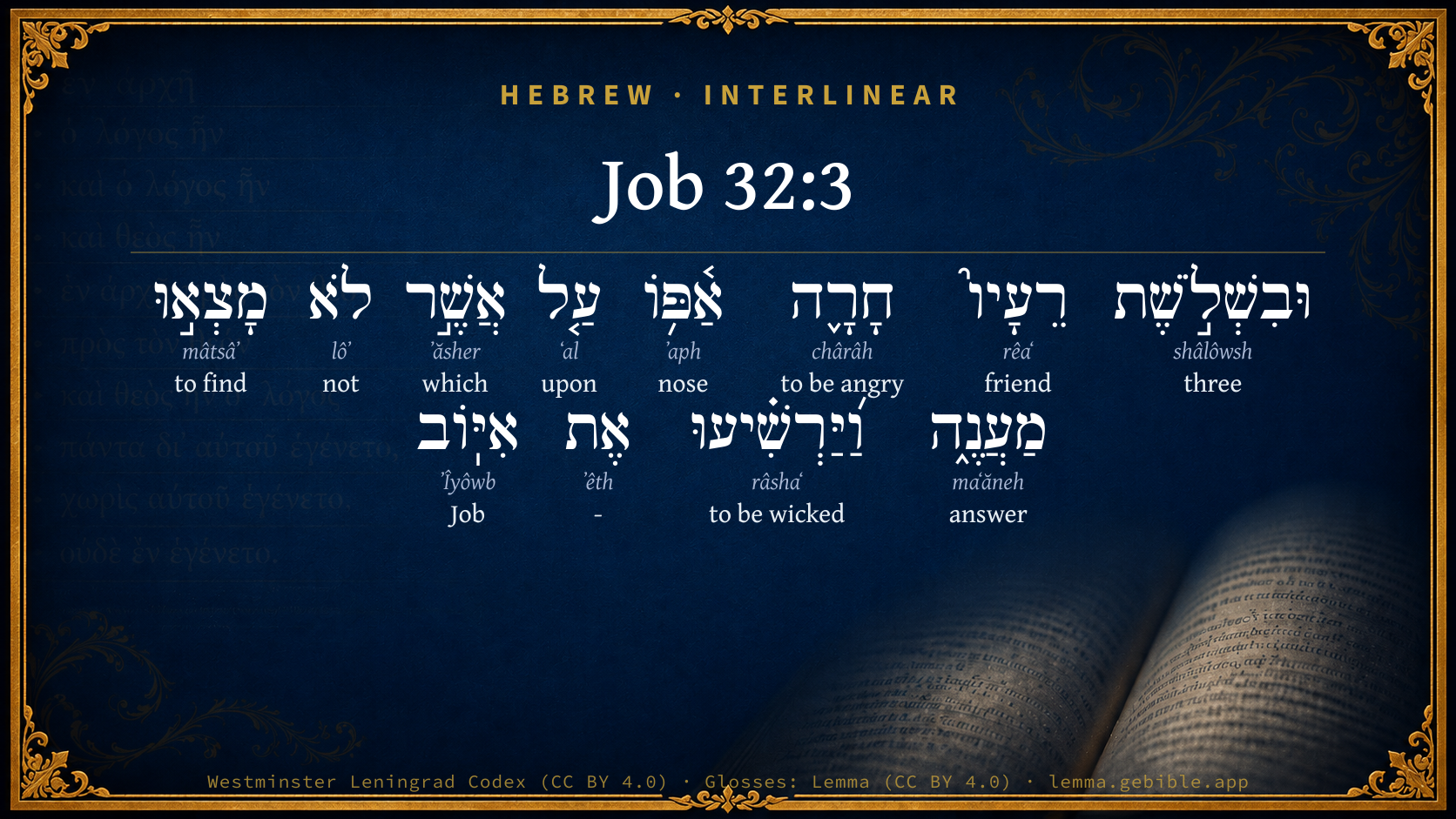
  1. וּבִשְׁלֹ֣שֶׁת shâlôwsh H7969 “and · in/at · three” Conjunction + Preposition + Adjective, Cardinal number, Masculine, Singular, Construct
  2. רֵעָיו֮ rêaʻ H7453 “friends · his” Noun, Common, Masculine, Plural, Construct + Suffix, Personal, 3rd Person, Masculine, Singular
  3. חָרָ֪ה chârâh H2734 “to be angry” Verb, Qal, Perfect, 3rd Person, Masculine, Singular
  4. אַ֫פּ֥וֹ ʼaph H639 “nose · his” Noun, Common, Masculine, Singular, Construct + Suffix, Personal, 3rd Person, Masculine, Singular
  5. עַ֤ל ʻal H5921 “upon” Preposition
  6. אֲשֶׁ֣ר ʼăsher H834 “which” Particle, Relative
  7. לֹא lôʼ H3808 “not” Particle, Negative
  8. מָצְא֣וּ mâtsâʼ H4672 “to find” Verb, Qal, Perfect, 3rd Person, Common, Plural
  9. וַ֝יַּרְשִׁ֗יעוּ râshaʻ H7561 “and · to be wicked” Conjunction + Verb, Hiphil, Sequential Imperfect, 3rd Person, Masculine, Plural
  10. אֶת ʼêth H853 “-” Particle, Direct Object
  11. אִיּֽוֹב ʼÎyôwb H347 “Job” Noun, Proper

About this verse

These counts appear in no published source. They are computed here, from the morphology-tagged text and Lemma’s own curated glosses. What Lemma adds →

12
words
12
distinct lemmas
Wisdom
section

Notable vocabulary

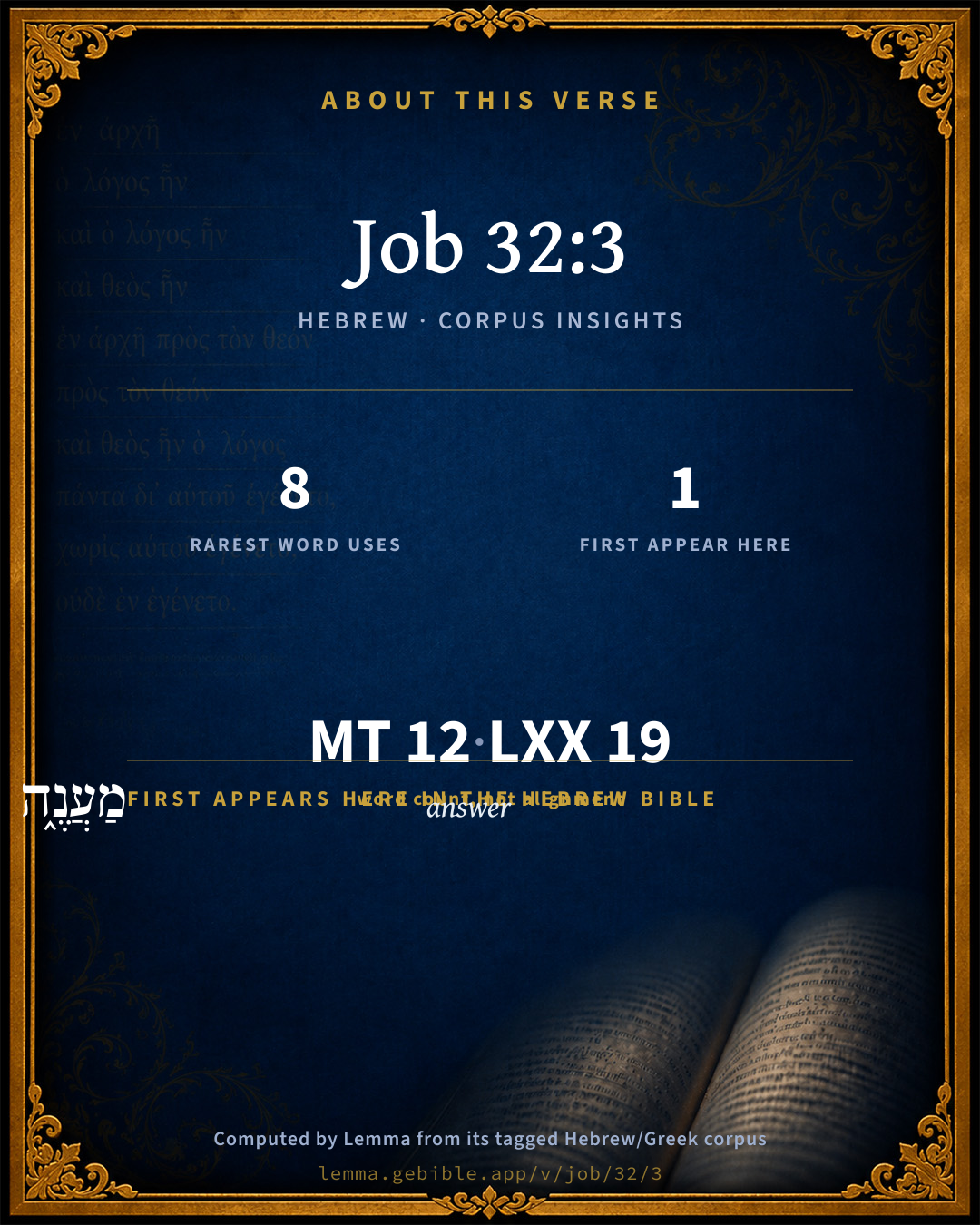
The rarest word here is מַעֲנֶ֑ה answer H4617 — appearing just 8 times in the whole Hebrew Bible.

First appearance in Scripture

This word makes its first canonical appearance in the Hebrew Bible here:

  • מַעֲנֶ֑ה answer H4617

Shared distinctive vocabulary

מַעֲנֶ֑ה answer H4617 occurs in 8 verses of the Hebrew Bible. Also found in:

Grammatical profile

  • 3 verbs
  • 4 nouns
  • 1 adjective
  • 1 preposition
  • 3 particles

Verb forms

  • חָרָ֪ה Qal · Perfect
  • מָצְא֣וּ Qal · Perfect
  • וַ֝יַּרְשִׁ֗יעוּ Hiphil · Sequential Imperfect

Hebrew & Septuagint length

In English translation the verse runs 20 words from the Hebrew and 28 from the Septuagint (LXX English) — the Septuagint runs noticeably longer here. See the side-by-side →

A rough comparison of the two English renderings, which tokenize alike — not a word-level alignment.

Word counts can differ between the Hebrew and the Greek without any difference in meaning — e.g. the Hebrew direct-object marker אֵת has no separate Greek word, and Greek often adds the article ὁ.

In the original languages it is 12 Hebrew tokens and 19 Greek tokens — but the two are counted differently (Hebrew bundles its prefixes and suffixes into one token; the Greek is in lemma form), so that isn’t a like-for-like length.

Cross-references

9

Topical passages linked to Job 32:3 in the Treasury of Scripture Knowledge — connected by theme and wording, ordered by reader-vote popularity; previews shown in the World English Bible.

  • Job 8:6 If you were pure and upright, Surely now he would awaken for you, And make the habitation of your righteousness prosperous.
  • Job 22:5–30 Isn't your wickedness great? Neither is there any end to your iniquities.
  • Job 24:25 If it isn't so now, who will prove me a liar, And make my speech worth nothing?"
  • Job 15:34 For the company of the godless shall be barren, And fire shall consume the tents of bribery.
  • Job 25:2–6 "Dominion and fear are with him; He makes peace in his high places.
  • Job 26:2–4 "How have you helped him who is without power! How have you saved the arm that has no strength!
  • Job 32:1 So these three men ceased to answer Job, because he was righteous in his own eyes.
  • Acts 24:5 For we have found this man to be a plague, an instigator of insurrections among all the Jews throughout the world, and a ringleader of the sect of the Nazarenes.
  • Acts 24:13 Nor can they prove to you the things of which they now accuse me.

Cross-references courtesy of OpenBible.info (CC BY 4.0).

Hebrew and Greek witnesses Masoretic Hebrew ↔ Greek Septuagint

The same verse in the two great witnesses to the Old Testament, shown verse-for-verse.

Here the Septuagint runs noticeably longer than the Hebrew — LXX2012 (modern English Septuagint) 28 words vs World English Bible 20. A rough length comparison of the two English translations, not a word-level alignment — read both below.

These are two independent witnesses, not word-aligned to each other, and the Septuagint is shown in lemma (dictionary) form.

Hebrew Job 32:3 Masoretic · Westminster Leningrad Codex

וּבִשְׁלֹ֣שֶׁת רֵעָיו֮ חָרָ֪ה אַ֫פּ֥וֹ עַ֤ל אֲשֶׁ֣ר לֹא מָצְא֣וּ מַעֲנֶ֑ה וַ֝יַּרְשִׁ֗יעוּ אֶת אִיּֽוֹב

Also his wrath was kindled against his three friends, because they had found no answer, and yet had condemned Job.

World English Bible · Public Domain

Greek LXX Job 32:3 Septuagint · lemma form

καί κατά ὁ τρεῖς δέ φίλος ὀργίζω σφόδρα διότι οὐ δύναμαι ἀποκρίνω ἀντίθετος ιωβ καί τίθημι αὐτός εἰμί ἀσεβής

And he was also very angry with his three friends, because they were not able to return answers to Job, yet set him down for an ungodly man.

LXX2012 (modern English Septuagint) · Public Domain

On this verse, Haydock's Catholic Bible Commentary discusses the Septuagint’s reading. Read the note in Commentary ↓

Hebrew: Westminster Leningrad Codex (CC BY 4.0). Greek: Septuagint (public domain); English from LXX2012 (modern English Septuagint) (Public Domain). How the Septuagint differs from the Hebrew →

Commentary

Notes on Job 32:3 from classic Christian and Jewish commentators (each source and its license shown beneath its notes). The classic Christian expositions comment on the surrounding passage and are grouped to its opening verse, so a note may address several verses; the Jewish commentaries on the Tanakh (Rashi and others) are per-verse, so they appear only where the commentator wrote on this verse.

Lemma curates 59 commentaries, every one of them public domain or Creative Commons licensed, each selected and text-cleaned for this edition rather than reprinted as found. About our sources →

Trapp's Complete Commentary

John Trapp

Job 32:3 Also against his three friends was his wrath kindled, because they had found no answer, and [yet] had condemned Job.

Ver. 3. Also against his three friends was his wrath kindled] True zeal is of a most masculine, disengaged, courageous nature; like fire, it catcheth on every side, and is impartial. Elihu was a man made all of fire, walking among stubble, as Chrysostom saith of Peter. And, surely, he that is not angry against sin, whether in himself or others, it is because either he knows it not or hates it not as he ought. He also kept within the bounds of modesty and moderation, and expressed himself without bitterness. We read of Idacius, that he would needs be doing with Salvianus and Instantius, both Priscillianists. But by his passionate and intemperate language he not only did not convert them, but made them worse (Sulp. Sever. l. ii., p. 171).

Because they had found no answer] They were gravelled and nonplussed, as the Popish doctors were oft by the martyrs, Philpot, Ridley, &c., yea, by those of the weaker sort, as Anne Askew, Alice Driver, &c. The prolocutor in convocation, A. D. 1553, confessed that those dejected ministers (afterwards martyrs) had the word on their side, but the prelates in place the possession of the sword, and that was their best answer to the others’ arguments.

And yet had condemned Job] Condemned him for a wicked man, as the word signifieth. So the Popish doctors did innocent Cranmer of adultery, heresy, and treason; Philpot, of parricide, heresy, &c. To accuse was easy, but how shamefully failed they in the proof! These three, after they had also interested God himself in their rash accusation of Job, were forced to give him over.

John Trapp, A Commentary or Exposition upon All the Books of the Old and New Testament (1647–1656) — public domain. Text from a community e-Sword module.

Jamieson, Fausset & Brown

Robert Jamieson, A. R. Fausset & David Brown

Though silenced in argument, they held their opinion still.

Jamieson, Fausset & Brown — Commentary Critical and Explanatory on the Whole Bible (1871) — public domain (CC PDM 1.0). Text via the HelloAO Bible API.

Adam Clarke's Commentary

Verse 3. They had found no answer] They had condemned Job; and yet could not answer his arguments on the general subject, and in vindication of himself.

Adam Clarke's Commentary on the Bible (1810–1826) — public domain. Text from a community e-Sword/MySword module.

Ellicott's Commentary for English Readers

(3) They had found no answer.—They could not reply unto Job, nor deny that he had been in conduct such as he said he had been, and yet they concluded that he must be wicked because God had smitten him.

A Bible Commentary for English Readers, edited by Charles John Ellicott (1878–1897) — public domain. Text from a community e-Sword module.

The Cambridge Bible for Schools and Colleges

gen. ed. J. J. S. Perowne

3. had found no answer, and yet had condemned] Rather, had not found an answer and condemned, i. e. found no answer wherewith to condemn Job. Elihu’s anger was kindled against the three friends because they had not found such an answer as effectively to put Job in the wrong in his charges against God; comp. Job_32:5; Job_32:12. Elihu is more deeply pained and offended by Job’s charges against God than even the three friends were (ch. Job_34:7 seq., Job_34:35 seq.); he is far from blaming them for condemning Job; neither does he hold the balance between Job and them and blame them for condemning him without good reasons; he blames them for not finding such good reasons as effectively to condemn him, as he deserves. Coverdale: because they had found no reasonable answer to overcome him.

The Cambridge Bible for Schools and Colleges (gen. ed. J. J. S. Perowne; Cambridge University Press, 1878–1918) — public domain. Text from a community e-Sword module.

John Gill's Exposition

Also against his three friends was his wrath kindled,.... He did not take part with either side, but blamed both, and took upon him to be a moderator between them, and deal impartially with them: what highly displeased him, and raised his spirit against the three friends of Job, was,

because they had found no answer; they were at a loss for one, for a sufficient one; they had all of them been answering him in their turns again and again, but with nothing to the purpose, not with anything conclusive and convincing; and particularly they could find and give no answer to Job's last vindication of himself:

and yet had condemned Job; as a very wicked man, and an hypocrite, for no other reason but because he was afflicted; and they still persisted in their sentiment, though Job had so fully cleared himself, and put them to entire silence; this exasperated Elihu, to observe these men to retain so unreasonable a sentiment, to pronounce such a rash sentence, and yet could make no reply to Job's defence of himself. Jarchi says, this place is one of the corrections of the Scribes, it having been formerly written "God" instead of "Job"; as if the sense was, that Elihu was provoked with them, because by their silence they had condemned the Lord, not vindicating his honour and glory as became them; but Aben Ezra declares his ignorance of that correction, and observes, that they that say so knew what was hid from him.

John Gill's Exposition of the Whole Bible (1746–1763) — public domain (CC PDM 1.0). Text via the HelloAO Bible API.

Albert Barnes' Notes on the Bible

Because they had found no answer, and yet had condemned Job - They held Job to be guilty, and yet they were unable to adduce the proof of it, and to reply to what he had said. They still maintained their opinion, though silenced in the argument. They were in that state of mind, not uncommon, in which they obstinately held on to an opinion which they could not vindicate, and believed another to be guilty, though they could not prove it.

Albert Barnes' Notes on the Bible (1834–1885) — public domain. Text from a community e-Sword/MySword module.

Haydock's Catholic Bible Commentary

Found. Hebrew, "produced an answer, but had still condemned Job;" (Haydock) or, "had made Job wicked," by giving him occasion to blaspheme, in order to defend his own righteousness. (Calmet) --- Septuagint, "they took it for granted (or laid it down as a fact, Greek: ethento) that he was a wretch." This was not true: (Haydock) but they had also doe their best to prove it. (Calmet) --- Job. Almost all the Rabbins assert that the original copies read Jehova, "the Lord;" (Haydock) and that the Masorets changed it, to avoid the apparent blasphemy; as if the three friends had rendered themselves guilty by not answering Job. But the Chaldean, &c., are silent on this head, and Abenezra allows that the change is very doubtful. (Calmet)

George Leo Haydock (1774–1849), Haydock's Catholic Family Bible and Commentary, 1859 edition — public domain. Excludes Psalms (Douay-Rheims chapter numbering differs from Protestant) and Deuterocanonical books (Catholic canon only).

Matthew Poole's English Annotations

They had found no answer to Job’s allegations and arguments, as to the main cause.

Had condemned Job as a hypocrite or ungodly, man.

Matthew Poole's English Annotations on the Holy Bible (1683–1685) — public domain. Text from a community e-Sword/MySword module.

Whedon's Commentary on the Bible

Daniel D. Whedon

3. Condemned Job — The only way they could justify God’s ways was to condemn Job.

Daniel D. Whedon (gen. ed.), Commentary on the Old and New Testaments (1874–1909) — public domain. Text from a community e-Sword module.

The Pulpit Commentary

Also against his three friends was his wrath kindled, because they had found no answer. Elihu thought that Job"s reasonings and complaints admitted of being satisfactorily answered, and was vexed that the three "friends" had not made the right replied It is the main object of his speech to supply them. And yet had condemned Job. They had condemned him on wrong grounds and of sins that he had not committed. (Job_22:6-9) Elihu condemns him as much, (Job_33:9-12 Job_34:7-9, etc.) but for entirely different reasons.

The Pulpit Commentary (1880–1919), ed. H.D.M. Spence-Jones & Joseph S. Exell — public domain. Text from a community e-Sword module.

John Wesley's Explanatory Notes

No answer - To Job's arguments as to the main cause. Condemned - As a bad man.

John Wesley, Explanatory Notes Upon the Whole Bible (1754–1765) — public domain. Text via the GEBible commentary corpus.

unfoldingWord translationNotes

Door43 World Missions Community

Elihu's anger was also kindled against his three friends

This compares Elihu's anger to someone starting a fire. This can be stated in active form. AT: "Elihu also became very angry with his three friends" (See: Metaphor and Active or Passive)

Now

This word is used here to mark a break in the main story line. This tells background information about Elihu. (See: Background Information)

that there was no answer in the mouths of these three men

This means that the men were done speaking to Job. This speaks of the men possibly having an answer as if the answer were an object that would be in their mouths. AT: "that these three men had nothing else to say" or "that these three men had no more answers to give Job" (See: Metaphor)

his anger was kindled

This compares Elihu's anger to someone starting a fire. This can be stated in active form. AT: "he became very angry" (See: Metaphor and Active or Passive)

translationWords

condemn

unfoldingWord translationNotes — © Distant Shores Media and the Door43 World Missions Community, licensed CC BY-SA 4.0. Source: git.door43.org/Door43/en_tn.

Rashi

Rabbi Shlomo Yitzchaki (Rashi)

and condemned Job This is one of the verses wherein the Scribes rectified the language of the Scripture. “And they condemned,” as directed against the Omnipresent, by remaining silent, should have been written, but Scripture euphemized. Similarly (Num. 11:15), “and do not let me see my misfortune.” It should have been written: “and do not let me see their misfortune,” but Scripture euphemized, and so many [other] instances, in Sifrei (ad loc.) and in the Great Masorah.

Rashi on the Tanakh — English translations: “The Judaica Press complete Tanach with Rashi, translated by A. J. Rosenberg” (CC BY 4.0); “Pentateuch with Rashi's commentary by M. Rosenbaum and A.M. Silbermann, 1929-1934” (public domain); “The Metsudah Tanach series, Lakewood, N.J” (CC BY 4.0); and “The Book of Joshua, Metsudah Publications, 1997” (CC BY 4.0). Text via Sefaria.

Lesson kit

Teaching starters — assembled from the data on this page, not authored interpretation. Every prompt links to the verse data it draws on. Edit before teaching.

Job, in the Wisdom, opens this verse with 12 words (12 distinct Hebrew lemmas). Its most distinctive word is maʻăneh (“answer”). The Greek Septuagint runs longer here. A historical commentator’s framing appears above. Read the whole chapter for the surrounding context.

Discussion questions

  1. The word maʻăneh carries the sense “answer.” How does it shape the verse?
  2. This is the first place “answer” appears in Scripture (first appears here). What does its debut here establish?
  3. How does Job 32:5, which shares the word «answer», read alongside this verse?
  4. The Septuagint runs longer here than the Hebrew. What might account for the difference?
  5. The translations on this page render this verse differently — a whole-verse word diff, not a word-by-word alignment. What might account for the different wordings?
  6. «חָרָ֪ה» is a Qal Perfect verb. How does that grammatical form shape the action described?
  7. Compare how Trapp's Complete Commentary and Jamieson, Fausset & Brown read this verse. Where do they agree or differ?

Things to notice

Reading settings

Reading text

Shown beneath each verse's original-language words.

Old Testament
Old Testament edition

Read the OT as the Masoretic Hebrew (MT) or the Greek Septuagint (LXX).

English shown for the Greek Septuagint (in the Hebrew ↔ Greek comparison).

Comparing translations? Open the Compare panel on any verse page to stack up to four side by side.