
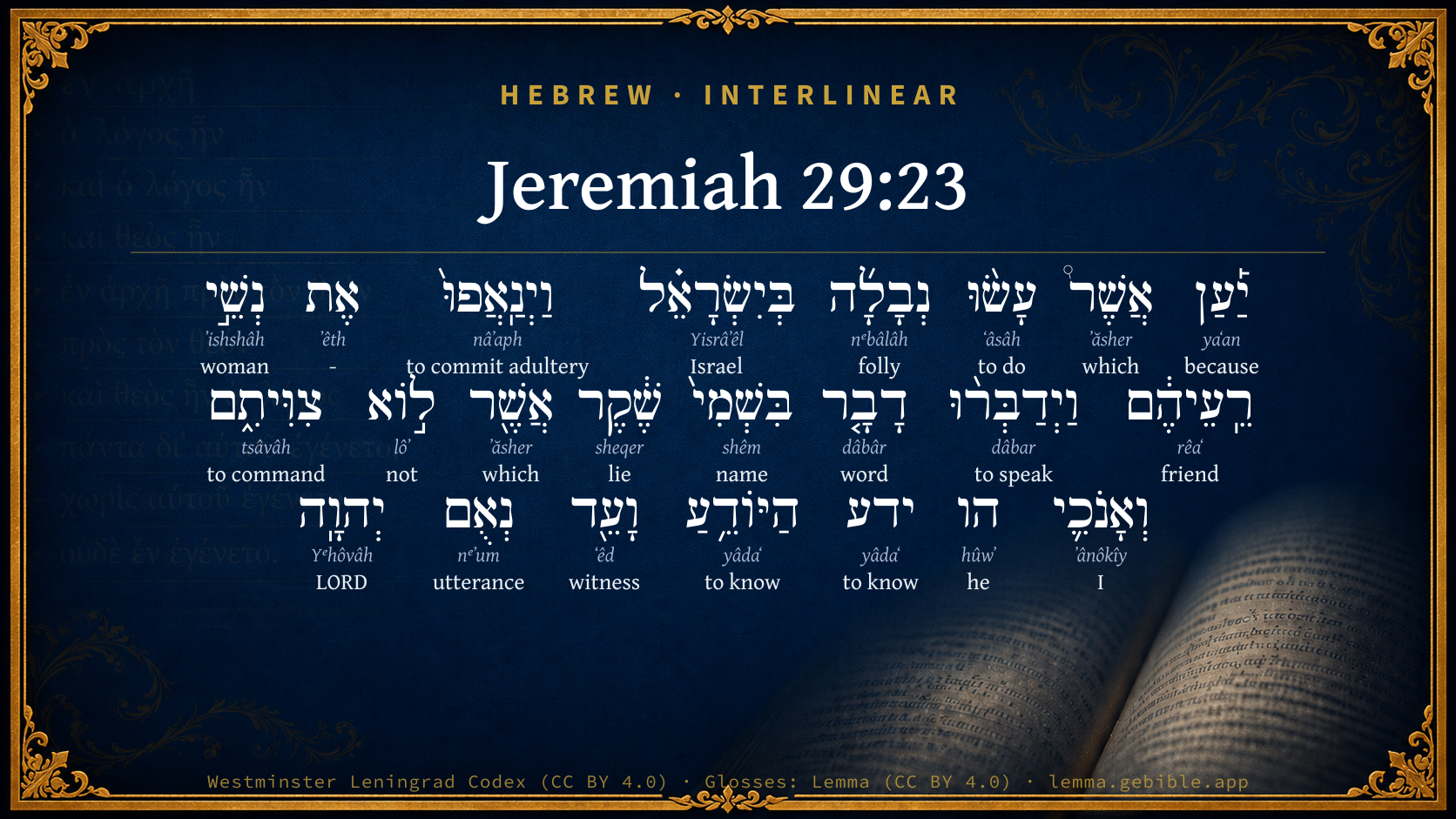
Jeremiah 29:23

Hebrew (Westminster Leningrad Codex) Jeremiah 29:23 appears in the Hebrew Old Testament. The text above is from the Westminster Leningrad Codex. Each word links to its Strong’s number, a concise gloss, and parsing drawn from the Open Scriptures Hebrew Bible morphology. Click any word for its full Brown-Driver-Briggs (BDB) entry.
Download image
Cite this verse

Jeremiah 29:23 (World English Bible). Public Domain. Lemma interlinear Bible study tool, https://lemma.gebible.app/v/jeremiah/29/23.

Show BibTeX & RIS
BibTeX
RIS
English Translation
because they have worked folly in Israel, and have committed adultery with their neighbors' wives, and have spoken words in my name falsely, which I didn't command them; and I am he who knows, and am witness, says Yahweh.
World English Bible · Public Domain
Download a study sheet

One document with this verse’s original text, its word-by-word gloss line, the meaning frame, cross-references with their text, attributed commentary, and full source and license credits — printable, and it pastes into notes with its structure intact.

This verse Autodidact and up

Study sheet (.html) Plain text (.txt)

A passage Seminary Student

Up to 50 verses in one chapter. A passage sheet keeps up to 6 commentary sources and 12 cross-references per verse, in the order this page ranks them, and says so on the sheet whenever that leaves anything out. Ask for a single verse and you get the Autodidact verse sheet above.

Everything on this page stays free to read, with no account — the sheet is a download of what is already on screen, not access to it.

Want to remove ads? Support Godless Engineer
Compare translations 3

The same verse in 3 English versions, stacked beneath the original-language interlinear above. Click any original word for its lexicon entry.

Each is an independent rendering of the whole verse — the interlinear is not word-aligned to these translations.

Highlighted words mark where these versions differ — a whole-verse word diff, not a word-by-word alignment.

  • World English Bible Public Domain
    because they have worked folly in Israel, and have committed adultery with their neighbors' wives, and have spoken words in my name falsely, which I didn't command them; and I am he who knows, and am witness, says Yahweh.
  • King James Version Public Domain
    Because they have committed villany in Israel, and have committed adultery with their neighbours' wives, and have spoken lying words in my name, which I have not commanded them; even I know, and am a witness, saith the LORD.
  • unfoldingWord Literal Text CC BY-SA 4.0
    This will happen because of the shameful things they did in Israel when they committed adultery with their neighbor’s wives and declared false words in my name, things that I never commanded them to say. For I am the one who knows; I am the witness—this is Yahweh’s declaration.’”

unfoldingWord Literal Text — © unfoldingWord, licensed CC BY-SA 4.0. Word-aligned USFM3 via Door43 (git.door43.org/unfoldingWord/en_ult).

Versions to compare (up to 4)

3 of 4 selected

Show all 18 translations

Every available English version of this verse, each an independent rendering of the whole verse.

  • World English Bible Public Domain
    because they have worked folly in Israel, and have committed adultery with their neighbors' wives, and have spoken words in my name falsely, which I didn't command them; and I am he who knows, and am witness, says Yahweh.
  • Berean Standard Bible Public Domain
    For they have committed an outrage in Israel by committing adultery with the wives of their neighbors and speaking lies in My name, which I did not command them to do. I am He who knows, and I am a witness, declares the LORD.”
  • Majority Standard Bible Public Domain
    For they have committed an outrage in Israel by committing adultery with the wives of their neighbors and speaking lies in My name, which I did not command them to do. I am He who knows, and I am a witness, declares the LORD.”
  • King James Version Public Domain
    Because they have committed villany in Israel, and have committed adultery with their neighbours' wives, and have spoken lying words in my name, which I have not commanded them; even I know, and am a witness, saith the LORD.
  • American Standard Version (1901) Public Domain
    because they have wrought folly in Israel, and have committed adultery with their neighbors' wives, and have spoken words in my name falsely, which I commanded them not; and I am he that knoweth, and am witness, saith Jehovah.
  • Revised Version (1885) Public Domain
    because they have wrought folly in Israel, and have committed adultery with their neighbours’ wives, and have spoken words in my name falsely, which I commanded them not; and I am he that knoweth, and am witness, saith the LORD.
  • Geneva Bible (1599) Public Domain
    Because they haue committed vilenie in Israel, and haue committed adulterie with their neighbours wiues, and haue spoken lying words in my Name, which I haue not commanded them, euen I knowe it, and testifie it, saith the Lord.
  • Douay-Rheims (1899) Public Domain
    Because they have acted folly in Israel, and have committed adultery with the wives of their friends, and have spoken lying words in my name, which I commanded them not: I am the judge and the witness, saith the Lord.
  • Young's Literal Translation Public Domain
    Because that they have done folly in Israel, and commit adultery with the wives of their neighbours, and speak a word in My name falsely that I have not commanded them, and I `am' He who knoweth and a witness -- an affirmation of Jehovah.
  • Literal Standard Version CC BY-SA 4.0
    because that they have done folly in Israel, and commit adultery with the wives of their neighbors, and falsely speak a word in My Name that I have not commanded them, and I [am] He who knows and a witness—a declaration of YHWH.
  • Unlocked Literal Bible CC BY-SA 4.0
    This will happen because of the shameful things they did in Israel when they committed adultery with their neighbor's wives and declared false words in my name, things that I never commanded them to say. For I am the one who knows; I am the witness—this is Yahweh's declaration.'”
  • unfoldingWord Literal Text CC BY-SA 4.0
    This will happen because of the shameful things they did in Israel when they committed adultery with their neighbor’s wives and declared false words in my name, things that I never commanded them to say. For I am the one who knows; I am the witness—this is Yahweh’s declaration.’”
  • Darby Bible Public Domain
    because they have committed infamy in Israel, and have committed adultery with their neighbours' wives, and have spoken words of falsehood in my name, which I had not commanded them: and I [am] he that knoweth, and [am] witness, saith Jehovah.
  • World Messianic Bible Public Domain
    because they have done foolish things in Israel, and have committed adultery with their neighbors’ wives, and have spoken words in my name falsely, which I didn’t command them. I am he who knows, and am witness,” says the LORD.
  • Webster's Bible Public Domain
    Because they have committed villainy in Israel, and have committed adultery with their neighbor's wives, and have spoken lying words in my name, which I have not commanded them; even I know, and am a witness, saith the LORD.
  • Free Bible Version CC BY-SA 4.0
    They did outrageous things in Israel—they committed adultery with their neighbors' wives and told lies in my name. I didn't tell them to say anything. I am the one who knows what they did, and I can witness to it, declares the Lord.
  • Bible in Basic English Public Domain
    Because they have done shame in Israel, and have taken their neighbours' wives, and in my name have said false words, which I did not give them orders to say; and I myself am the witness, says the Lord.
  • JPS Tanakh (1917) Public Domain
    because they have wrought vile deeds in Israel, and have committed adultery with their neighbours' wives, and have spoken words in My name falsely, which I commanded them not; but I am He that knoweth, and am witness, saith the LORD.

Literal Standard Version (2020), Covenant Press — licensed CC BY-SA 4.0. Text via the HelloAO Bible API (eBible.org). Unlocked Literal Bible (unfoldingWord) — licensed CC BY-SA 4.0. Text via the HelloAO Bible API (eBible.org). unfoldingWord Literal Text — © unfoldingWord, licensed CC BY-SA 4.0. Word-aligned USFM3 via Door43 (git.door43.org/unfoldingWord/en_ult). Free Bible Version, Dr. Jonathan Gallagher — licensed CC BY-SA 4.0. Text via the HelloAO Bible API (eBible.org).

Word by word

More ways to search: Search by grammar → Find every occurrence → Compare this word →

Practice this passage: Drill this verse → Learn its vocabulary →

נְבָלָ֜ה
nᵉbâlâh
H5039
“folly”
Noun, Common, Feminine, Singular, Absolute
Part of Speech
Noun
Type
Common
Gender
Feminine
Number
Singular
State
Absolute
Full BDB Definition

Origin: from H5036

TWOT: 1285b

senselessness, folly - disgraceful folly - of immorality, profane actions - disgrace, contumely disgrace
  1. יַ֡עַן yaʻan H3282 “because” Conjunction
  2. אֲשֶׁר֩ ʼăsher H834 “which” Particle, Relative
  3. עָשׂ֨וּ ʻâsâh H6213 “to do” Verb, Qal, Perfect, 3rd Person, Common, Plural
  4. בְּיִשְׂרָאֵ֗ל Yisrâʼêl H3478 “in/at · Israel” Preposition + Noun, Proper
  5. וַיְנַֽאֲפוּ֙ nâʼaph H5003 “and · to commit adultery” Conjunction + Verb, Piel, Sequential Imperfect, 3rd Person, Masculine, Plural
  6. אֶת ʼêth H853 “-” Particle, Direct Object
  7. נְשֵׁ֣י ʼishshâh H802 “women of” Noun, Common, Feminine, Plural, Construct
  8. רֵֽעֵיהֶ֔ם rêaʻ H7453 “friends · their” Noun, Common, Masculine, Plural, Construct + Suffix, Personal, 3rd Person, Masculine, Plural
  9. וַיְדַבְּר֨וּ dâbar H1696 “and · to speak” Conjunction + Verb, Piel, Sequential Imperfect, 3rd Person, Masculine, Plural
  10. דָבָ֤ר dâbâr H1697 “word” Noun, Common, Masculine, Singular, Absolute
  11. בִּשְׁמִי֙ shêm H8034 “in/at · name · my” Preposition + Noun, Common, Masculine, Singular, Construct + Suffix, Personal, 1st Person, Common, Singular
  12. שֶׁ֔קֶר sheqer H8267 “lie” Noun, Common, Masculine, Singular, Absolute
  13. אֲשֶׁ֖ר ʼăsher H834 “which” Particle, Relative
  14. ל֣וֹא lôʼ H3808 “not” Particle, Negative
  15. צִוִּיתִ֑ם tsâvâh H6680 “to command · them” Verb, Piel, Perfect, 1st Person, Common, Singular + Suffix, Personal, 3rd Person, Masculine, Plural
  16. וְאָנֹכִ֛י ʼânôkîy H595 “and · I” Conjunction + Pronoun, Personal, 1st Person, Common, Singular
  17. הו hûwʼ H1931 “he” Pronoun, Personal, 3rd Person, Masculine, Singular
  18. ידע yâdaʻ H3045 “knowing” Verb, Qal, Participle Active, Masculine, Singular, Absolute
  19. הַיּוֹדֵ֥עַ yâdaʻ H3045 “the · knowing” Particle, Definite Article + Verb, Qal, Participle Active, Masculine, Singular, Absolute
  20. וָעֵ֖ד ʻêd H5707 “and · witness” Conjunction + Noun, Common, Masculine, Singular, Absolute
  21. נְאֻם nᵉʼum H5002 “utterance of” Noun, Common, Masculine, Singular, Construct
  22. יְהוָֽה Yᵉhôvâh H3068 “LORD” Noun, Proper

About this verse

These counts appear in no published source. They are computed here, from the morphology-tagged text and Lemma’s own curated glosses. What Lemma adds →

23
words
21
distinct lemmas
Prophets
section

Notable vocabulary

The rarest word here is נְבָלָ֜ה folly H5039 — appearing just 13 times in the whole Hebrew Bible.

Shared distinctive vocabulary

נְבָלָ֜ה folly H5039 occurs in 13 verses of the Hebrew Bible. Also found in:

Grammatical profile

  • 6 verbs
  • 10 nouns
  • 2 pronouns
  • 1 conjunction
  • 4 particles

Verb forms

  • עָשׂ֨וּ Qal · Perfect
  • וַיְנַֽאֲפוּ֙ Piel · Sequential Imperfect
  • וַיְדַבְּר֨וּ Piel · Sequential Imperfect
  • צִוִּיתִ֑ם Piel · Perfect
  • ידע Qal · Participle Active
  • הַיּוֹדֵ֥עַ Qal · Participle Active

Repetition

Words recur within this verse — often emphatic in Hebrew:

  • ידע to know H3045 ×2
  • אֲשֶׁר֩ which H834 ×2

Cross-references

18

Topical passages linked to Jeremiah 29:23 in the Treasury of Scripture Knowledge — connected by theme and wording, ordered by reader-vote popularity; previews shown in the World English Bible.

  • Jeremiah 23:14 In the prophets of Jerusalem also I have seen a horrible thing: they commit adultery, and walk in lies; and they strengthen the hands of evil-doers, so that none does return from his wickedness: they are all of them become to me as Sodom, and the inhabitants of it as Gomorrah.
  • Malachi 3:5 I will come near to you to judgment; and I will be a swift witness against the sorcerers, and against the adulterers, and against the perjurers, and against those who oppress the hireling in his wages, the widow, and the fatherless, and who deprive the foreigner of justice, and don't fear me," says Yahweh of Hosts.
  • Hebrews 4:13 There is no creature that is hidden from his sight, but all things are naked and laid open before the eyes of him with whom we have to do.
  • Proverbs 5:21 For the ways of man are before the eyes of Yahweh. He examines all his paths.
  • Jeremiah 16:17 For my eyes are on all their ways; they are not hidden from my face, neither is their iniquity concealed from my eyes.
  • Jeremiah 29:8–9 For thus says Yahweh of hosts, the God of Israel: Don't let your prophets who are in the midst of you, and your diviners, deceive you; neither listen you to your dreams which you cause to be dreamed.
  • Jeremiah 29:21 Thus says Yahweh of Hosts, the God of Israel, concerning Ahab the son of Kolaiah, and concerning Zedekiah the son of Maaseiah, who prophesy a lie to you in my name: Behold, I will deliver them into the hand of Nebuchadrezzar king of Babylon; and he shall kill them before your eyes;
  • Psalms 50:16–18 But to the wicked God says, "What right do you have to declare my statutes, That you have taken my covenant on your lips,
  • Jeremiah 7:9–10 Will you steal, murder, and commit adultery, and swear falsely, and burn incense to Baal, and walk after other gods that you have not known,
  • Jeremiah 13:27 I have seen your abominations, even your adulteries, and your neighing, the lewdness of your prostitution, on the hills in the field. Woe to you, Jerusalem! you will not be made clean; how long shall it yet be?
  • Jeremiah 23:21 I sent not these prophets, yet they ran: I didn't speak to them, yet they prophesied.
  • Jeremiah 23:23–24 Am I a God at hand, says Yahweh, and not a God afar off?
  • Zephaniah 3:4 Her prophets are arrogant and treacherous people. Her priests have profaned the sanctuary. They have done violence to the law.
  • Malachi 2:14 Yet you say, 'Why?' Because Yahweh has been witness between you and the wife of your youth, against whom you have dealt treacherously, though she is your companion, and the wife of your covenant.
  • 2 Peter 2:10–19 but chiefly those who walk after the flesh in the lust of defilement, and despise authority. Daring, self-willed, they are not afraid to speak evil of dignitaries;
  • Jude 1:8–11 Yet in like manner these also in their dreaming defile the flesh, despise authority, and slander celestial beings.
  • Revelation 3:14 "To the angel of the assembly in Laodicea write: "The Amen, the Faithful and True Witness, the Head of God's creation, says these things:
  • Revelation 1:5 and from Jesus Christ, the faithful witness, the firstborn of the dead, and the ruler of the kings of the earth. To him who loves us, and washed us from our sins by his blood;

Cross-references courtesy of OpenBible.info (CC BY 4.0).

Hebrew and Greek witnesses Masoretic Hebrew ↔ Greek Septuagint

The same verse in the two great witnesses to the Old Testament, shown verse-for-verse.

These are two independent witnesses, not word-aligned to each other, and the Septuagint is shown in lemma (dictionary) form.

Hebrew Jeremiah 29:23 Masoretic · Westminster Leningrad Codex

יַ֡עַן אֲשֶׁר֩ עָשׂ֨וּ נְבָלָ֜ה בְּיִשְׂרָאֵ֗ל וַיְנַֽאֲפוּ֙ אֶת נְשֵׁ֣י רֵֽעֵיהֶ֔ם וַיְדַבְּר֨וּ דָבָ֤ר בִּשְׁמִי֙ שֶׁ֔קֶר אֲשֶׁ֖ר ל֣וֹא צִוִּיתִ֑ם וְאָנֹכִ֛י הו ידע הַיּוֹדֵ֥עַ וָעֵ֖ד נְאֻם יְהוָֽה

because they have worked folly in Israel, and have committed adultery with their neighbors' wives, and have spoken words in my name falsely, which I didn't command them; and I am he who knows, and am witness, says Yahweh.

World English Bible · Public Domain

Greek LXX Structure differs

In the Septuagint, Jeremiah is about an eighth shorter than the Hebrew and arranges its material differently — the Oracles Against the Nations (Hebrew chapters 46–51) appear in the middle of the Greek book, after 25:13. Because the chapter and verse boundaries do not line up, a verse-for-verse comparison with the Hebrew is not shown.

A verse-for-verse comparison isn’t shown here because the chapters and verses don’t line up. Switch to the LXX edition with the MT / LXX toggle above to read the Greek directly.

On this verse, The Cambridge Bible for Schools and Colleges discusses the Septuagint’s reading. Read the note in Commentary ↓

Hebrew: Westminster Leningrad Codex (CC BY 4.0). Greek: Septuagint (public domain); English from a public-domain English Septuagint. How the Septuagint differs from the Hebrew →

Targum (Aramaic paraphrase)

1

The Targum is the ancient Jewish Aramaic paraphrase of the Hebrew Scriptures — an interpretive translation, not the Hebrew text itself. Onkelos (literal) and Pseudo-Jonathan (expansive) render the Torah, and Jonathan the Prophets. Coverage is partial: where no permissively-licensed English translation exists for a verse, only the Aramaic is shown. This is verse-level text, not a word-by-word alignment to the Hebrew.

  1. Targum Jonathan Prophets (Joshua–Malachi)
    חֲלַף דַעֲבָדוּ קְלָנָא בְּיִשְׂרָאֵל וְזַנִיאוּ יַת נְשֵׁי חַבְרֵיהוֹן וּמַלִילוּ פִּתְגָמָא בִשְׁמִי שִׁקְרָא דְלָא פַקֵידְתִּינוּן וּקְדָמַי גְלֵי וּמֵימְרֵי סָהִיד אֲמַר יְיָ:

    (no public-domain English translation for this verse)

    Targum Jonathan — Aramaic: “Mikraot Gedolot” (public domain). English: “Sefaria Community Translation” (CC0 1.0 (public-domain dedication)); “London "Chaldee Paraphrase," 1871” (public domain). Text via Sefaria.

Commentary

Notes on Jeremiah 29:23 from classic Christian and Jewish commentators (each source and its license shown beneath its notes). The classic Christian expositions comment on the surrounding passage and are grouped to its opening verse, so a note may address several verses; the Jewish commentaries on the Tanakh (Rashi and others) are per-verse, so they appear only where the commentator wrote on this verse.

Lemma curates 59 commentaries, every one of them public domain or Creative Commons licensed, each selected and text-cleaned for this edition rather than reprinted as found. About our sources →

Trapp's Complete Commentary

John Trapp

Jer 29:23 Because they have committed villany in Israel, and have committed adultery with their neighbours’ wives, and have spoken lying words in my name, which I have not commanded them; even I know, and [am] a witness, saith the LORD.

Ver. 23. Because they have committed adultery with their neighbours’ wives.] As did Eli’s sons, {1Sa 2:22} those false prophets also at Jerusalem, {Jer 23:14} Hetser, the great Anabaptist in Germany, {a} who yet died penitently, and as do still the Imailers, an order of religious men among the Turks, {b} who call them the religious brothers of love, and the Brahmins, successors to the Brachmanni, among the Indians, who are extremely impure and libidinous, claiming the first night’s lodging of every bride, &c., having nothing of a man but the voice and shape, and yet these are their priests. {c}

Even I know, and am a witness, saith the Lord.] Let them carry their villany never so cleanly and closely, with their si non caste, saltem caute, yet I know all, am now an eyewitness, and will be one day a swift witness against them. Utinam animadverterent haec principes, et ille qui non in sede Petri sed in prostibulo Priapi Lampsaceni sedens fornieationes tegit, sancta coniuga vetat, mera sorenia vendit, et Dei oculos claudit, saith one.

{a} Scultet. Annal.

{b} Turk. Hist., 477.

{c} Heyl., Cosmog.

John Trapp, A Commentary or Exposition upon All the Books of the Old and New Testament (1647–1656) — public domain. Text from a community e-Sword module.

Geneva Bible (1599)

Geneva Bible translators

Which was adultery, and falsifying the word of God.

Geneva Bible (1599) marginal notes — public domain. Text via Bolls.life.

Jamieson, Fausset & Brown

Robert Jamieson, A. R. Fausset & David Brown

villainy--literally, "sinful folly" (Isa 32:6).

Jamieson, Fausset & Brown — Commentary Critical and Explanatory on the Whole Bible (1871) — public domain (CC PDM 1.0). Text via the HelloAO Bible API.

Adam Clarke's Commentary

Verse 23. Have committed adultery with their neighbours' wives] This is supposed to refer to the case of Susanna. See above.

Adam Clarke's Commentary on the Bible (1810–1826) — public domain. Text from a community e-Sword/MySword module.

John Calvin's Commentaries

We perceive why the Prophet mentions the cause of their death; it was, that the Jews might regard the event, not according to their own thoughts, but that they might feel assured that God took vengeance on the impiety of those who had falsely pretended his name. For we know that we always look here and there, and that when we find an immediate cause, we neglect and esteem as nothing the judgments of God. In order then to correct this evil, Jeremiah again repeats that Zedekiah and Ahab were not punished by the king of Babylon, but by God himself, because they committed villany in Israel. Some render, נבלה, nubele, enormity or abomination; but I am disposed to render it villany, or turpitude, or filthiness. They, then, committed a filthy thing He afterwards specifies two kinds, that they committed adultery with the wives of their friends, and that they falsely prophesied in the name of God

By the first clause we see how great was the stupidity of the people, for they did not consider what was the life of those who pretended to be witnesses for God, as though they were angels come down from heaven. Their wickedness might indeed have been concealed; but there is no doubt but that the Jews were extremely stupid, for they had willingly seized on the vain promises, which afforded them gratification. As, then, they were anxious to return, and wished to be restored to their own country as it were against the will of God, and sought to break through all obstacles by the force of their own obstinacy; it was a just punishment, that they were so blinded as not to see what was yet sufficiently manifest, even that these vaunting prophets were adulterers, and that the filthiness of their life was so great, that it was certain that they had nothing divine or heavenly in them.

Then there is another kind of evil added, that they prophesied falsely in God’s name. This was an atrocious crime; for as his truth is precious to God, so it is a sacrilege that he cannot bear, when his truth is turned into falsehood. But as the minds of them all were so corrupted, that no one would open his eyes, God testifies, that though their adulteries might be unknown to the people, that though their vanity in their false prophecies might not be perceived, yet it was enough that he knew and was a witness

Now this passage is worthy of special notice; for hypocrites, until they find that they are proved guilty before men, fear nothing, nay, they haughtily exalt themselves, even when things are justly laid to their charge. Since, then, the hardness and dishonesty of hypocrites are so great, it is necessary to summon them before God’s tribunal, that they may know that they may a hundred times be acquitted by the world, and yet that this derogates nothing from God’s judgment. It now follows —

John Calvin's Commentaries (1540-1563) — public domain. Text from the Calvin Translation Society English edition (1840s-50s) via the Christian Classics Ethereal Library (ccel.org). Calvin's coverage is partial (roughly two-thirds of the Bible); uncommented books and verses are honest gaps, never fabricated. The 19th-century editor's footnotes and remarks are omitted so the notes are faithfully Calvin's own voice.

Ellicott's Commentary for English Readers

(23) Because they have committed villany . . .—The Hebrew noun is almost always used for sins of impurity. It is more commonly rendered “folly” (comp. Gen_34:7; Deu_22:21; Jdg_19:23-24). The English word “villainy” is used definitely with this meaning by Bishop Hall (Sat. i. 9).

Even I know, and am a witness, saith the Lord.—The words find an echo in Mal_3:5. We are left to conjecture whether the prophet refers his own knowledge of the facts to a direct supernatural source, or had received private information from his friends at Babylon. The special stress laid on the Lord’s knowledge of their guilt suggests the thought that the false prophets with their restricted ideas of God had persuaded themselves that Jehovah the God of Israel hardly exercised his attributes of power in a distant place like Babylon. There they might sin without fear of detection or of punishment. They thought of him as a God not nigh at hand, but far off (Jer_23:23).

A Bible Commentary for English Readers, edited by Charles John Ellicott (1878–1897) — public domain. Text from a community e-Sword module.

The Cambridge Bible for Schools and Colleges

gen. ed. J. J. S. Perowne

23. folly] The Hebrew denotes more than this, viz. “a state of mind or an action, marked by utter disregard of moral or spiritual feeling.” Dr. who illustrates the kind of immorality here referred to in the word by its use in Gen_34:7; 2Sa_13:12. See further in his Parallel Psalter, p. 457. The punishment inflicted, while really the penalty for transgressions against Jehovah, was doubtless ostensibly for breaches of the religious or civil law of Babylon.

falsely] not in LXX, and probably introduced from Jer_29:21.

he that knoweth, and am witness] The Hebrew as it stands is awkward. Probably “he that knoweth” (absent from LXX) is a gloss.

The Cambridge Bible for Schools and Colleges (gen. ed. J. J. S. Perowne; Cambridge University Press, 1878–1918) — public domain. Text from a community e-Sword module.

John Gill's Exposition

Because they have committed villany in Israel,.... Or "folly" (f); as the sins of adultery, and prophesying falsely, are afterwards mentioned. This was not the reason why the king of Babylon put them to death; though the Jews (g) have a tradition that they attempted the chastity of Nebuchadnezzar's daughter, for which reason he case them into a furnace; but rather it was on account of their prophesying immediate destruction to Babylon; and telling the captives that they should be delivered in a short time; and stirring them up to prepare to go to their own land; but the reasons here given are those which moved the Lord to deliver them into the hands of the king of Babylon for their destruction:

and have committed adultery with their neighbours' wives; which was a piece of villany, as well as folly; and which abundantly showed that these men were not the prophets of the Lord, or were sent by him, being such impure wretches:

and have spoken lying words in my name, which I have not commanded them; as that the people should return to their own land in a short time; this was another part of their villany and folly, and for which they were given up into the hands of the king of Babylon, to be punished:

even I know, and am a witness, saith the Lord; for though their adulteries might be very secretly committed, and their lying prophecies were not seen to be such by the people in common; yet God, who is omniscient, saw all their impurity, and knew all their lies and falsehood, and was, and would be, a swift witness against them, here and hereafter. The Targum is,

"and before me it is manifest, and my word is a witness, saith the Lord.''

(f) "stultitiam", V. L. Schmidt. (g) T. Bab. Sanhedrin. fol. 93. 1.

John Gill's Exposition of the Whole Bible (1746–1763) — public domain (CC PDM 1.0). Text via the HelloAO Bible API.

Albert Barnes' Notes on the Bible

Villany - Elsewhere folly, in the sense of lewdness Jdg 20:6, unchastity.

Albert Barnes' Notes on the Bible (1834–1885) — public domain. Text from a community e-Sword/MySword module.

Haydock's Catholic Bible Commentary

Folly. A crime, Judges xix. 23., and 2 Kings xiii. 12. --- Witness, the sovereign truth. (Calmet)

George Leo Haydock (1774–1849), Haydock's Catholic Family Bible and Commentary, 1859 edition — public domain. Excludes Psalms (Douay-Rheims chapter numbering differs from Protestant) and Deuterocanonical books (Catholic canon only).

Matthew Poole's English Annotations

The reason here given must not be understood as the reason of the king of Babylon’s punishment of them, but why God gave them up into his hands, because they had committed villany or folly in Israel; which is expounded by the next words, they had

committed adultery with their neighbours’ wives. All sin is folly, and so called in Scripture, uncleanness particularly, Gen 34:7; here it is called villany, to denote the heinousness of it, especially in those whose office it was to teach others that they ought not to do it, Rom 2:22. Falsehood in discharge of a trust is ordinarily attended with debauchery of life, nor indeed can it be reasonably imagined that those who, to humour men, have debauched their consciences, and declared things as the will of God, which they know are not so, should be more true and honest in their conversation towards men. The second crime of these false prophets was, what gave them their denomination, teaching people what God never bid them speak. Now this, saith the Lord,

I know, and am a witness to; their adulteries are in secret, but I am a witness to them; the poor people do not know that they teach them lies, but I know it. God will deal with men not according to what men like themselves know of them, and can prove against them, but according to what he knows and can witness against them.

Matthew Poole's English Annotations on the Holy Bible (1683–1685) — public domain. Text from a community e-Sword/MySword module.

The Pulpit Commentary

An important and melancholy addition to our knowledge of these false prophets. They were not only misleading prophets, but immoral men in their private capacities. Villainy; rather, folly, as the word is always rendered elsewhere. The phrase "to commit folly in Israel" is always (except Jos_7:15) used of sins of unchastity.

The Pulpit Commentary (1880–1919), ed. H.D.M. Spence-Jones & Joseph S. Exell — public domain. Text from a community e-Sword module.

Rashi

Rabbi Shlomo Yitzchaki (Rashi)

and they committed adultery with the wives of their neighbors As is explained in Sanhedrin (93a), “So said the Holy One, blessed be He, ‘Lie with my friend.’”

and a witness an expression of testimony (עֵדוּת).

Rashi on the Tanakh — English translations: “The Judaica Press complete Tanach with Rashi, translated by A. J. Rosenberg” (CC BY 4.0); “Pentateuch with Rashi's commentary by M. Rosenbaum and A.M. Silbermann, 1929-1934” (public domain); “The Metsudah Tanach series, Lakewood, N.J” (CC BY 4.0); and “The Book of Joshua, Metsudah Publications, 1997” (CC BY 4.0). Text via Sefaria.

Lesson kit

Teaching starters — assembled from the data on this page, not authored interpretation. Every prompt links to the verse data it draws on. Edit before teaching.

Jeremiah, in the Prophets, opens this verse with 23 words (21 distinct Hebrew lemmas). Its most distinctive word is nᵉbâlâh (“folly”). A historical commentator’s framing appears above. Read the whole chapter for the surrounding context.

Discussion questions

  1. How does “folly” (nᵉbâlâh) shape what this verse is saying?
  2. How does Genesis 34:7, which shares the word «folly», read alongside this verse?
  3. What does the repetition of “to know” (2× in this one verse) do in this verse?
  4. The translations on this page render this verse differently — a whole-verse word diff, not a word-by-word alignment. What might account for the different wordings?
  5. «עָשׂ֨וּ» is a Qal Perfect verb. How does that grammatical form shape the action described?
  6. Compare how Trapp's Complete Commentary and Geneva Bible (1599) read this verse. Where do they agree or differ?

Things to notice

Reading settings

Reading text

Shown beneath each verse's original-language words.

Old Testament
Old Testament edition

Read the OT as the Masoretic Hebrew (MT) or the Greek Septuagint (LXX).

English shown for the Greek Septuagint (in the Hebrew ↔ Greek comparison).

Comparing translations? Open the Compare panel on any verse page to stack up to four side by side.