
Job 35:4

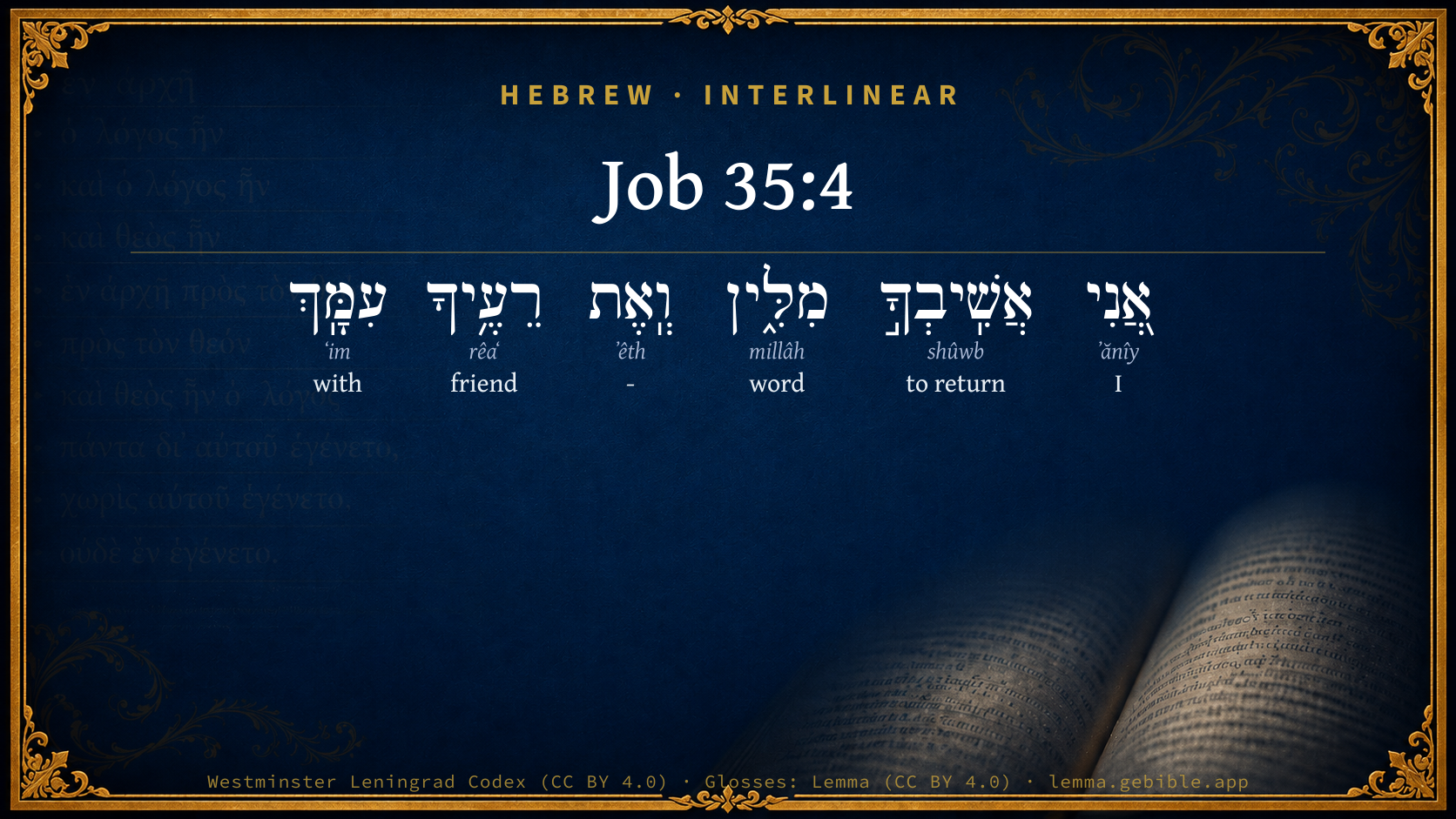
Hebrew (Westminster Leningrad Codex) Job 35:4 appears in the Hebrew Old Testament. The text above is from the Westminster Leningrad Codex. Each word links to its Strong’s number, a concise gloss, and parsing drawn from the Open Scriptures Hebrew Bible morphology. Click any word for its full Brown-Driver-Briggs (BDB) entry.
Download image
Cite this verse

Job 35:4 (World English Bible). Public Domain. Lemma interlinear Bible study tool, https://lemma.gebible.app/v/job/35/4.

Show BibTeX & RIS
BibTeX
RIS
English Translation
I will answer you, And your companions with you.
World English Bible · Public Domain
Download a study sheet

One document with this verse’s original text, its word-by-word gloss line, the meaning frame, cross-references with their text, attributed commentary, and full source and license credits — printable, and it pastes into notes with its structure intact.

This verse Autodidact and up

Study sheet (.html) Plain text (.txt)

A passage Seminary Student

Up to 50 verses in one chapter. A passage sheet keeps up to 6 commentary sources and 12 cross-references per verse, in the order this page ranks them, and says so on the sheet whenever that leaves anything out. Ask for a single verse and you get the Autodidact verse sheet above.

Everything on this page stays free to read, with no account — the sheet is a download of what is already on screen, not access to it.

Want to remove ads? Support Godless Engineer
Compare translations 3

The same verse in 3 English versions, stacked beneath the original-language interlinear above. Click any original word for its lexicon entry.

Each is an independent rendering of the whole verse — the interlinear is not word-aligned to these translations.

Highlighted words mark where these versions differ — a whole-verse word diff, not a word-by-word alignment.

  • World English Bible Public Domain
    I will answer you, And your companions with you.
  • King James Version Public Domain
    I will answer thee, and thy companions with thee.
  • unfoldingWord Literal Text CC BY-SA 4.0
    I will answer you words, and your friends with you.

unfoldingWord Literal Text — © unfoldingWord, licensed CC BY-SA 4.0. Word-aligned USFM3 via Door43 (git.door43.org/unfoldingWord/en_ult).

Versions to compare (up to 4)

3 of 4 selected

Show all 18 translations

Every available English version of this verse, each an independent rendering of the whole verse.

  • World English Bible Public Domain
    I will answer you, And your companions with you.
  • Berean Standard Bible Public Domain
    I will reply to you and to your friends as well.
  • Majority Standard Bible Public Domain
    I will reply to you and to your friends as well.
  • King James Version Public Domain
    I will answer thee, and thy companions with thee.
  • American Standard Version (1901) Public Domain
    I will answer thee, And thy companions with thee.
  • Revised Version (1885) Public Domain
    I will answer thee, and thy companions with thee.
  • Geneva Bible (1599) Public Domain
    Therefore will I answere thee, and thy companions with thee.
  • Douay-Rheims (1899) Public Domain
    Therefore I will answer thy words, and thy friends with thee.
  • Young's Literal Translation Public Domain
    I return thee words, and thy friends with thee,
  • Literal Standard Version CC BY-SA 4.0
    I return words, and your friends with you,
  • Unlocked Literal Bible CC BY-SA 4.0
    I will answer you, both you and your friends.
  • unfoldingWord Literal Text CC BY-SA 4.0
    I will answer you words, and your friends with you.
  • Darby Bible Public Domain
    I will reply to thee in words, and to thy companions with thee.
  • World Messianic Bible Public Domain
    I will answer you, and your companions with you.
  • Webster's Bible Public Domain
    I will answer thee, and thy companions with thee.
  • Free Bible Version CC BY-SA 4.0
    I'll tell you, and your friends too!
  • Bible in Basic English Public Domain
    I will make answer to you and to your friends:
  • JPS Tanakh (1917) Public Domain
    I will give thee answer, and thy companions with thee.

Literal Standard Version (2020), Covenant Press — licensed CC BY-SA 4.0. Text via the HelloAO Bible API (eBible.org). Unlocked Literal Bible (unfoldingWord) — licensed CC BY-SA 4.0. Text via the HelloAO Bible API (eBible.org). unfoldingWord Literal Text — © unfoldingWord, licensed CC BY-SA 4.0. Word-aligned USFM3 via Door43 (git.door43.org/unfoldingWord/en_ult). Free Bible Version, Dr. Jonathan Gallagher — licensed CC BY-SA 4.0. Text via the HelloAO Bible API (eBible.org).

Word by word

More ways to search: Search by grammar → Find every occurrence → Compare this word →

Practice this passage: Drill this verse → Learn its vocabulary →

About this verse

These counts appear in no published source. They are computed here, from the morphology-tagged text and Lemma’s own curated glosses. What Lemma adds →

6
words
6
distinct lemmas
Wisdom
section

Shared distinctive vocabulary

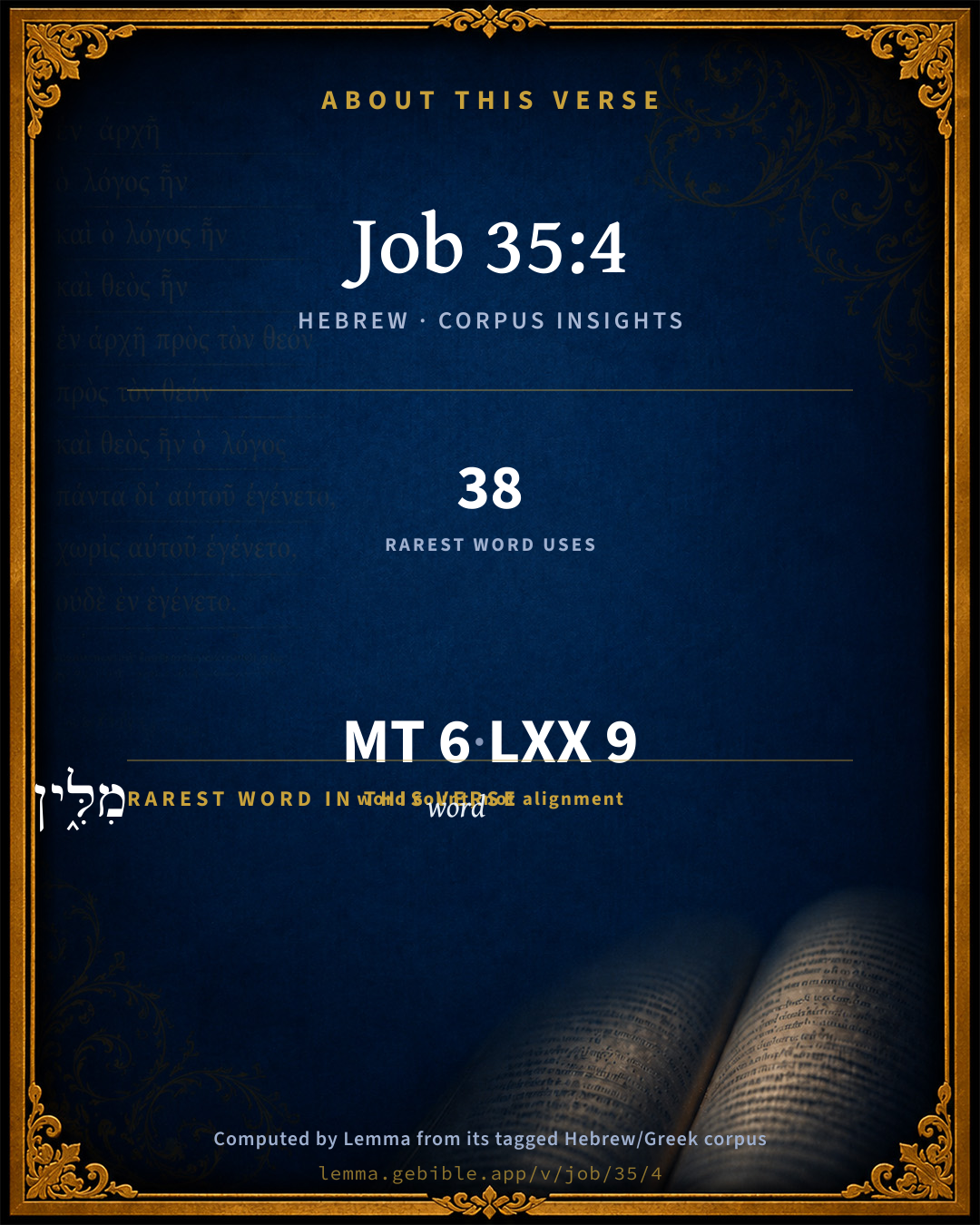
מִלִּ֑ין word H4405 occurs in 38 verses of the Hebrew Bible. Also found in:

Grammatical profile

  • 1 verb
  • 2 nouns
  • 1 pronoun
  • 1 preposition
  • 1 particle

Verb forms

  • אֲשִֽׁיבְךָ֣ Hiphil · Imperfect

Hebrew & Septuagint length

In English translation the verse runs 9 words from the Hebrew and 17 from the Septuagint (LXX English) — the Septuagint runs noticeably longer here. See the side-by-side →

A rough comparison of the two English renderings, which tokenize alike — not a word-level alignment.

Word counts can differ between the Hebrew and the Greek without any difference in meaning — e.g. the Hebrew direct-object marker אֵת has no separate Greek word, and Greek often adds the article ὁ.

In the original languages it is 6 Hebrew tokens and 9 Greek tokens — but the two are counted differently (Hebrew bundles its prefixes and suffixes into one token; the Greek is in lemma form), so that isn’t a like-for-like length.

Cross-references

2

Topical passages linked to Job 35:4 in the Treasury of Scripture Knowledge — connected by theme and wording, ordered by reader-vote popularity; previews shown in the World English Bible.

  • Job 34:8 Who goes in company with the workers of iniquity, And walks with wicked men?
  • Proverbs 13:20 One who walks with wise men grows wise, But a companion of fools suffers harm.

Cross-references courtesy of OpenBible.info (CC BY 4.0).

Hebrew and Greek witnesses Masoretic Hebrew ↔ Greek Septuagint

The same verse in the two great witnesses to the Old Testament, shown verse-for-verse.

Here the Septuagint runs noticeably longer than the Hebrew — LXX2012 (modern English Septuagint) 17 words vs World English Bible 9. A rough length comparison of the two English translations, not a word-level alignment — read both below.

These are two independent witnesses, not word-aligned to each other, and the Septuagint is shown in lemma (dictionary) form.

Hebrew Job 35:4 Masoretic · Westminster Leningrad Codex

אֲ֭נִי אֲשִֽׁיבְךָ֣ מִלִּ֑ין וְֽאֶת רֵעֶ֥יךָ עִמָּֽךְ

I will answer you, And your companions with you.

World English Bible · Public Domain

Greek LXX Job 35:4 Septuagint · lemma form

ἐγώ σύ δίδωμι ἀπόκρισις καί ὁ τρεῖς φίλος σύ

Look up to the sky and see; and consider the clouds, how high they are above you.

LXX2012 (modern English Septuagint) · Public Domain

Hebrew: Westminster Leningrad Codex (CC BY 4.0). Greek: Septuagint (public domain); English from LXX2012 (modern English Septuagint) (Public Domain). How the Septuagint differs from the Hebrew →

Commentary

Notes on Job 35:4 from classic Christian and Jewish commentators (each source and its license shown beneath its notes). The classic Christian expositions comment on the surrounding passage and are grouped to its opening verse, so a note may address several verses; the Jewish commentaries on the Tanakh (Rashi and others) are per-verse, so they appear only where the commentator wrote on this verse.

Lemma curates 59 commentaries, every one of them public domain or Creative Commons licensed, each selected and text-cleaned for this edition rather than reprinted as found. About our sources →

Trapp's Complete Commentary

John Trapp

Job 35:4 I will answer thee, and thy companions with thee.

Ver. 4. I will answer thee, and thy companions with thee] Thy three friends (who have not so well quit themselves in this controversy, as having answered little or nothing to this unsavoury saying of thine), and to the rest of the bystanders which approve of thine opinion, as people are apt to favour the weaker side, as it is reputed, and to encourage them. Thus it befell Luther, when he began first to reform.

John Trapp, A Commentary or Exposition upon All the Books of the Old and New Testament (1647–1656) — public domain. Text from a community e-Sword module.

Joseph Benson's Commentary

Job 35:4-8. I will answer thee, and thy companions — That is, those who are of thy opinion. Look unto the heavens, &c. — Cast up thine eyes to the heavens; look upon the clouds and the sky; and consider that, high as they are, they are not so much above thee, as God is above them. If thou sinnest, what doest thou against him? — Thy sins do him no hurt, and therefore thy righteousness brings him no benefit, as it follows. What receiveth he of thy hand? — He gaineth nothing by it, nor can indeed receive any good from thee, but all thy good comes from him: and therefore thou hast no reason to boast of, nor to upbraid God with, thy piety, which is much to thy advantage, but nothing to his. Thy wickedness may hurt a man as thou art — Thy wickedness will prove hurtful to thyself and others of mankind, and thy righteousness will do thee and them great service; but God, being an infinite, independent, and self-sufficient being, is far exalted above all thy good or evil.

Joseph Benson's Commentary on the Old and New Testaments (1811–1818) — public domain. Text from a community e-Sword module.

Tyndale Open Study Notes

Tyndale Open Resources

35:4-8 Elihu attempted to answer his own question (35:2), but his answer did not add to what Zophar (11:8-9), Eliphaz (22:12), Bildad (25:5-6), and Job (9:8-10) had already said. Elihu failed to recognize that all sin wrongs God (Gen 39:9; Matt 25:41-46; cp. Prov 19:17).

Tyndale Open Study Notes — © Tyndale Open Resources, licensed CC BY-SA 4.0. Text via the HelloAO Bible API.

Geneva Bible (1599)

Geneva Bible translators

Such as are in the like error.

Geneva Bible (1599) marginal notes — public domain. Text via Bolls.life.

Jamieson, Fausset & Brown

Robert Jamieson, A. R. Fausset & David Brown

companions--those entertaining like sentiments with thee (Job 34:8, Job 34:36).

Jamieson, Fausset & Brown — Commentary Critical and Explanatory on the Whole Bible (1871) — public domain (CC PDM 1.0). Text via the HelloAO Bible API.

Adam Clarke's Commentary

Verse 4. I will answer thee] I will show thee the evil of a sinful way, and the benefit of righteousness; and supply what thy friends have omitted in their discourses with thee.

Adam Clarke's Commentary on the Bible (1810–1826) — public domain. Text from a community e-Sword/MySword module.

Ellicott's Commentary for English Readers

(4) And thy companions.—Elihu professes to answer Job’s friends as well as himself, but what he says (Job_35:5, &c.) is very much what Eliphaz had said before (Job_15:14, &c., Job_22:3, &c., and Bildad in Job 25). It is indeed true that God is too high to be affected by man’s righteousness or unrighteousness, but it does not follow therefore that He is indifferent, for then He would not be a righteous judge. (See Note on Job_34:9.)

A Bible Commentary for English Readers, edited by Charles John Ellicott (1878–1897) — public domain. Text from a community e-Sword module.

The Cambridge Bible for Schools and Colleges

gen. ed. J. J. S. Perowne

4. The “companions” of Job referred to in this verse can hardly be the three friends, for Eliphaz (ch. Job_22:2) had advanced substantially the same answer to Job as is here given, which even Job himself had touched upon, ch. Job_7:20, though with a different purpose. Most probably Job is considered here the centre of a circle of persons who cherished the same irreligious doubts in regard to God’s providence as he did.

The Cambridge Bible for Schools and Colleges (gen. ed. J. J. S. Perowne; Cambridge University Press, 1878–1918) — public domain. Text from a community e-Sword module.

John Gill's Exposition

If thou sinnest, what dost thou against him?.... Sin is expressly said to be against God, Psa 51:4; it is contrary to his nature, as any opposites can be to each other: it is against his law, a breach and violation of it; and so against his supreme legislative power and authority, and a contempt of it; it is what he is angry with and is provoked by, being what he hates and abhors, and is abominable in his sight. But then he cannot be supposed to be so affected with it to be ruffled and discomposed, or his peace be disturbed, and his happiness in the least broke in upon; for affections are only attributed to him after the manner of men; much less is he so affected hereby as to be hurt or in danger of being destroyed, nor even of being dethroned: men can no more reach him by any hostile action of theirs, such as sin is, than they can reach the sun and stop its course, lessen its light or pluck it from its orbit. Or, "what canst thou work for him?" as Mr. Broughton; by way of atonement or satisfaction for sin? Nothing at all; see Job 7:20; but the other sense is best;

or if thy transgressions be multiplied, what dost thou unto him? As he is not hurt by a slight single sin, a failing or infirmity, an error or mistake, common to men, as the preceding word may signify; so not by greater sins, presumptuous ones, gross enormities, rebellions against God, overt acts of treason against the Almighty, and these multiplied and heaped up even unto heaven; for though by these the name of God is profaned and blasphemed, and he is dishonoured and despised, and his manifestative glory is eclipsed, or he has not the honour given him that is due unto him; yet his essential glory is untarnished, unsullied, and unhurt, no more than the sun by an eclipse; he is the same without any variableness or shadow of turning, as well as is over all blessed for ever. And, indeed, his manifestative glory in many instances receives a lustre, through his power, wisdom, and goodness, overruling the sins of men for the display of it; as the fall of the first Adam made way for the sending of Christ the Saviour, in which God has shown forth the exceeding riches of his grace; and as his mercy and grace are displayed in the pardon of sin, and his power and justice in the punishment of sin and sinners; and his patience and longsuffering in bearing with them.

John Gill's Exposition of the Whole Bible (1746–1763) — public domain (CC PDM 1.0). Text via the HelloAO Bible API.

Albert Barnes' Notes on the Bible

I will answer thee - Margin, “return to thee words.” Elihu meant to explain this more fully than it had been done by the friends of Job, and to show where Job was in error.

And thy companions with thee - Eliphaz, in Job 22:2, had taken up the same inquiry, and proposed to discuss the subject, but he had gone at once into severe charges against Job, and been drawn into language of harsh crimination, instead of making the matter clear, and Elihu now proposes to state just how it is, and to remove the objections of Job. It may be doubted, however, whether he was much more successful than Eliphaz had been. The doctrine of the future state, as it is revealed by Christianity, was needful to enable these speakers to comprehend and explain this subject.

Albert Barnes' Notes on the Bible (1834–1885) — public domain. Text from a community e-Sword/MySword module.

Haydock's Catholic Bible Commentary

Thee. I will shew that you are all wrong. (Haydock) --- I will supply what the three have left imperfect. (Calmet)

George Leo Haydock (1774–1849), Haydock's Catholic Family Bible and Commentary, 1859 edition — public domain. Excludes Psalms (Douay-Rheims chapter numbering differs from Protestant) and Deuterocanonical books (Catholic canon only).

Matthew Poole's English Annotations

Thy companions, i.e. those who are of thy opinion, or with whom thou dost associate thyself in those speeches and carriages; which seems to be meant not of Job’s three friends, (as many understand it, for their opinions were contrary to Job’s in this point,) but of wicked men, with whom Job is said to walk and go in company for this same opinion or assertion, Job 34:8,9. And these men he here calls Job’s companions, partly because they are very forward to harp upon the same string, and to accuse God and justify themselves upon all occasions; and partly that he might awaken Job to a more serious review of his former assertions, by representing to him whose cause he pleaded, and who were his confederates and colleagues in this opinion.

Matthew Poole's English Annotations on the Holy Bible (1683–1685) — public domain. Text from a community e-Sword/MySword module.

The Pulpit Commentary

I will answer thee, and thy companions with thee; i.e. "thy comforters, Eliphaz, Bildad, and Zophar." Elihu has pledged himself to confute their reasonings, no less than those of Job, (Job_32:5-20) andnow proposes to carry out this intention. But it is not very clear that he accomplish, s his purpose. In point of fact, he does little more than repeat and expand the argument of Eliphaz. (Job_22:2, Job_22:3)

The Pulpit Commentary (1880–1919), ed. H.D.M. Spence-Jones & Joseph S. Exell — public domain. Text from a community e-Sword module.

unfoldingWord translationNotes

Door43 World Missions Community

Connecting Statement:

Elihu continues speaking.

translationWords

heaven

unfoldingWord translationNotes — © Distant Shores Media and the Door43 World Missions Community, licensed CC BY-SA 4.0. Source: git.door43.org/Door43/en_tn.

Rashi

Rabbi Shlomo Yitzchaki (Rashi)

and your companions with you who remained silent at your words.

Rashi on the Tanakh — English translations: “The Judaica Press complete Tanach with Rashi, translated by A. J. Rosenberg” (CC BY 4.0); “Pentateuch with Rashi's commentary by M. Rosenbaum and A.M. Silbermann, 1929-1934” (public domain); “The Metsudah Tanach series, Lakewood, N.J” (CC BY 4.0); and “The Book of Joshua, Metsudah Publications, 1997” (CC BY 4.0). Text via Sefaria.

Lesson kit

Teaching starters — assembled from the data on this page, not authored interpretation. Every prompt links to the verse data it draws on. Edit before teaching.

Job, in the Wisdom, opens this verse with 6 words (6 distinct Hebrew lemmas). Its most distinctive word is millâh (“word”). The Greek Septuagint runs longer here. A historical commentator’s framing appears above. Read the whole chapter for the surrounding context.

Discussion questions

  1. How does “word” (millâh) shape what this verse is saying?
  2. How does 2 Samuel 23:2, which shares the word «word», read alongside this verse?
  3. The Septuagint runs longer here than the Hebrew. What might account for the difference?
  4. These translations render this verse differently. What is at stake in choosing one wording over another?
  5. «אֲשִֽׁיבְךָ֣» is a Hiphil Imperfect verb. How does that grammatical form shape the action described?
  6. Compare how Trapp's Complete Commentary and Joseph Benson's Commentary read this verse. Where do they agree or differ?

Things to notice

Reading settings

Reading text

Shown beneath each verse's original-language words.

Old Testament
Old Testament edition

Read the OT as the Masoretic Hebrew (MT) or the Greek Septuagint (LXX).

English shown for the Greek Septuagint (in the Hebrew ↔ Greek comparison).

Comparing translations? Open the Compare panel on any verse page to stack up to four side by side.