
1 Samuel 10:11

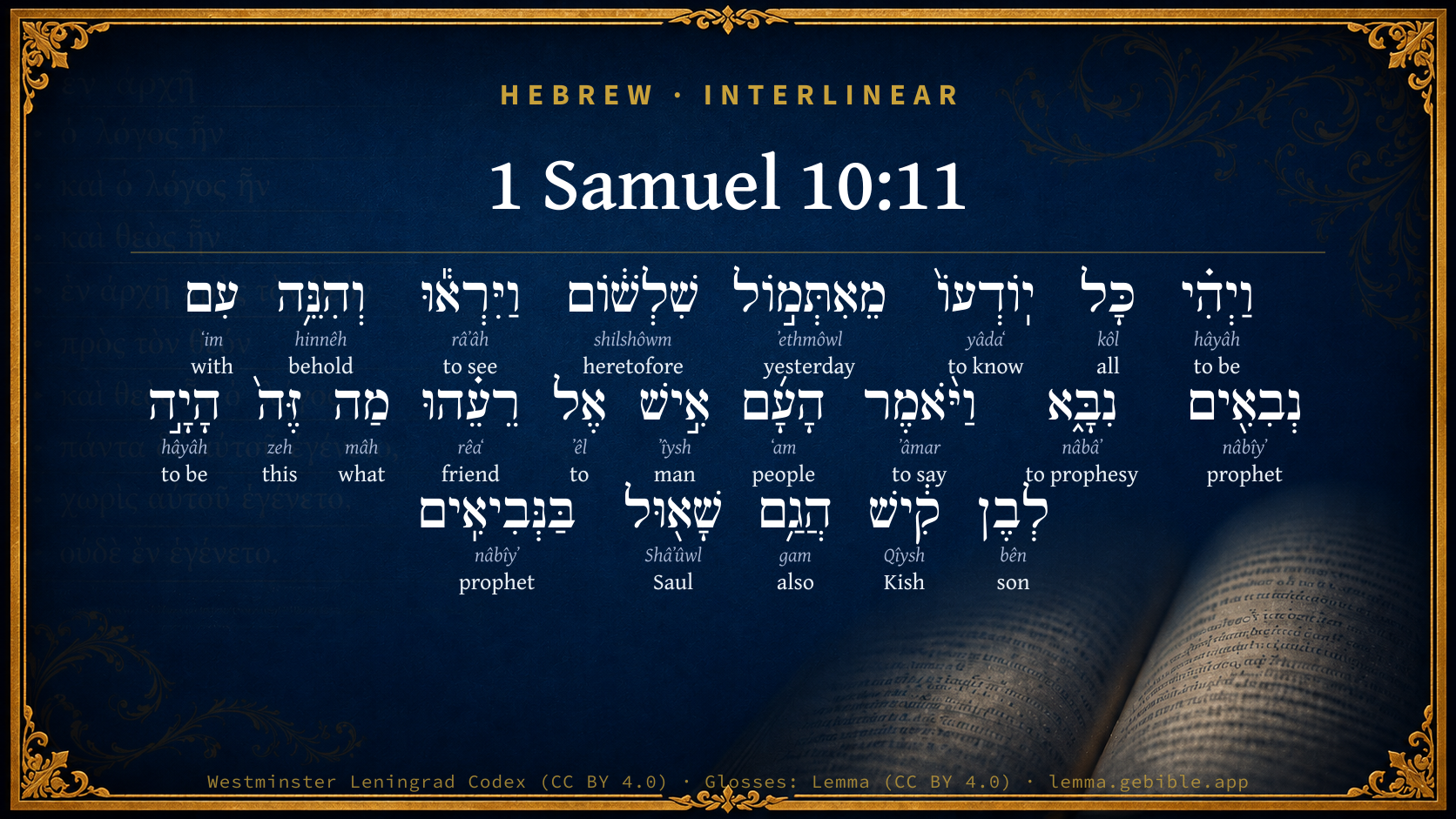
Hebrew (Westminster Leningrad Codex) 1 Samuel 10:11 appears in the Hebrew Old Testament. The text above is from the Westminster Leningrad Codex. Each word links to its Strong’s number, a concise gloss, and parsing drawn from the Open Scriptures Hebrew Bible morphology. Click any word for its full Brown-Driver-Briggs (BDB) entry.
Download image
Cite this verse

1 Samuel 10:11 (World English Bible). Public Domain. Lemma interlinear Bible study tool, https://lemma.gebible.app/v/1-samuel/10/11.

Show BibTeX & RIS
BibTeX
RIS
English Translation
It happened, when all who knew him before saw that, behold, he prophesied with the prophets, then the people said one to another, What is this that is come to the son of Kish? Is Saul also among the prophets?
World English Bible · Public Domain
Download a study sheet

One document with this verse’s original text, its word-by-word gloss line, the meaning frame, cross-references with their text, attributed commentary, and full source and license credits — printable, and it pastes into notes with its structure intact.

This verse Autodidact and up

Study sheet (.html) Plain text (.txt)

A passage Seminary Student

Up to 50 verses in one chapter. A passage sheet keeps up to 6 commentary sources and 12 cross-references per verse, in the order this page ranks them, and says so on the sheet whenever that leaves anything out. Ask for a single verse and you get the Autodidact verse sheet above.

Everything on this page stays free to read, with no account — the sheet is a download of what is already on screen, not access to it.

Want to remove ads? Support Godless Engineer
Compare translations 3

The same verse in 3 English versions, stacked beneath the original-language interlinear above. Click any original word for its lexicon entry.

Each is an independent rendering of the whole verse — the interlinear is not word-aligned to these translations.

Highlighted words mark where these versions differ — a whole-verse word diff, not a word-by-word alignment.

  • World English Bible Public Domain
    It happened, when all who knew him before saw that, behold, he prophesied with the prophets, then the people said one to another, What is this that is come to the son of Kish? Is Saul also among the prophets?
  • King James Version Public Domain
    And it came to pass, when all that knew him beforetime saw that, behold, he prophesied among the prophets, then the people said one to another, What is this that is come unto the son of Kish? Is Saul also among the prophets?
  • unfoldingWord Literal Text CC BY-SA 4.0
    And it happened that every knowing him from yesterday and the third day saw, and behold, prophesying with the prophets, and the people said, a man to his neighbor, “What this has happened to the son of Kish? Saul also among the prophets?”

unfoldingWord Literal Text — © unfoldingWord, licensed CC BY-SA 4.0. Word-aligned USFM3 via Door43 (git.door43.org/unfoldingWord/en_ult).

Versions to compare (up to 4)

3 of 4 selected

Show all 18 translations

Every available English version of this verse, each an independent rendering of the whole verse.

  • World English Bible Public Domain
    It happened, when all who knew him before saw that, behold, he prophesied with the prophets, then the people said one to another, What is this that is come to the son of Kish? Is Saul also among the prophets?
  • Berean Standard Bible Public Domain
    All those who had formerly known Saul and saw him prophesying with the prophets asked one another, “What has happened to the son of Kish? Is Saul also among the prophets?”
  • Majority Standard Bible Public Domain
    When all those who had formerly known Saul saw him prophesying with the prophets, they asked one another, “What has happened to the son of Kish? Is Saul also among the prophets?”
  • King James Version Public Domain
    And it came to pass, when all that knew him beforetime saw that, behold, he prophesied among the prophets, then the people said one to another, What is this that is come unto the son of Kish? Is Saul also among the prophets?
  • American Standard Version (1901) Public Domain
    And it came to pass, when all that knew him beforetime saw that, behold, he prophesied with the prophets, then the people said one to another, What is this that is come unto the son of Kish? Is Saul also among the prophets?
  • Revised Version (1885) Public Domain
    And it came to pass, when all that knew him beforetime saw that, behold, he prophesied with the prophets, then the people said one to another, What is this that is come unto the son of Kish? Is Saul also among the prophets?
  • Geneva Bible (1599) Public Domain
    Therefore all the people that knewe him before, when they saw that he prophecied among the Prophets, saide eche to other, What is come vnto the sonne of Kish? is Saul also among the Prophets?
  • Douay-Rheims (1899) Public Domain
    And all that had known him yesterday and the day before, seeing that he was with the prophets, and prophesied, said to each other: What is this that hath happened to the son of Cis? Is Saul also among the prophets?
  • Young's Literal Translation Public Domain
    And it cometh to pass, all his acquaintance heretofore, see, and lo, with prophets he hath prophesied, and the people say one unto another, `What `is' this hath happened to the son of Kish? is Saul also among the prophets?'
  • Literal Standard Version CC BY-SA 4.0
    And it comes to pass, all knowing him before, see, and behold, he has prophesied with prophets, and the people say to one another, “What [is] this [that] has happened to the son of Kish? Is Saul also among the prophets?”
  • Unlocked Literal Bible CC BY-SA 4.0
    When everyone who knew him before saw him prophesying with the prophets, the people said to each other, “What has happened to the son of Kish? Is Saul one of the prophets now?”
  • unfoldingWord Literal Text CC BY-SA 4.0
    And it happened that every knowing him from yesterday and the third day saw, and behold, prophesying with the prophets, and the people said, a man to his neighbor, “What this has happened to the son of Kish? Saul also among the prophets?”
  • Darby Bible Public Domain
    And it came to pass, when all that knew him before saw that, behold, he prophesied among the prophets, then the people said one to another, What is this that has happened to the son of Kish? Is Saul also among the prophets?
  • World Messianic Bible Public Domain
    When all who knew him before saw that, behold, he prophesied with the prophets, then the people said to one another, “What is this that has come to the son of Kish? Is Saul also among the prophets?”
  • Webster's Bible Public Domain
    And it came to pass when all that formerly knew him saw, that, behold, he prophesied among the prophets, then the people said one to another, What is this that hath come to the son of Kish? Is Saul also among the prophets?
  • Free Bible Version CC BY-SA 4.0
    Everyone who had known Saul and now saw him prophesying with the prophets said to each other, “What's going on with the son of Kish? Is Saul one of the prophets too?”
  • Bible in Basic English Public Domain
    Now when Saul's old friends saw him among the band of prophets, the people said to one another, What has come to Saul, the son of Kish? Is even Saul among the prophets?
  • JPS Tanakh (1917) Public Domain
    And it came to pass, when all that knew him beforetime saw that, behold, he prophesied with the prophets, then the people said one to another: 'What is this that is come unto the son of Kish? Is Saul also among the prophets?'

Literal Standard Version (2020), Covenant Press — licensed CC BY-SA 4.0. Text via the HelloAO Bible API (eBible.org). Unlocked Literal Bible (unfoldingWord) — licensed CC BY-SA 4.0. Text via the HelloAO Bible API (eBible.org). unfoldingWord Literal Text — © unfoldingWord, licensed CC BY-SA 4.0. Word-aligned USFM3 via Door43 (git.door43.org/unfoldingWord/en_ult). Free Bible Version, Dr. Jonathan Gallagher — licensed CC BY-SA 4.0. Text via the HelloAO Bible API (eBible.org).

Word by word

More ways to search: Search by grammar → Find every occurrence → Compare this word →

Practice this passage: Drill this verse → Learn its vocabulary →

מֵאִתְּמ֣וֹל
ʼethmôwl
H865
“from · yesterday”
Preposition + Noun, Common, Masculine, Singular, Absolute
Part of Speech
Preposition + Noun
Type
Common
Gender
Masculine
Number
Singular
State
Absolute
Full BDB Definition

Origin: probably from H853 or H854 and H4136

TWOT: 2521

yesterday, recently, formerly - yesterday - formerly (figuratively) - from yesterday, already (in phrase) - (TWOT +) before, before that time, before the time, heretofore, of late, of old, these days, time(s) past
  1. וַיְהִ֗י hâyâh H1961 “and · to be” Conjunction + Verb, Qal, Sequential Imperfect, 3rd Person, Masculine, Singular
  2. כָּל kôl H3605 “all of” Noun, Common, Masculine, Singular, Construct
  3. יֽוֹדְעוֹ֙ yâdaʻ H3045 “knowing · him” Verb, Qal, Participle Active, Masculine, Singular, Construct + Suffix, Personal, 3rd Person, Masculine, Singular
  4. שִׁלְשׁ֔וֹם shilshôwm H8032 “heretofore” Noun, Common, Masculine, Singular, Absolute
  5. וַיִּרְא֕וּ râʼâh H7200 “and · to see” Conjunction + Verb, Qal, Sequential Imperfect, 3rd Person, Masculine, Plural
  6. וְהִנֵּ֥ה hinnêh H2009 “and · behold” Conjunction + Particle, Demonstrative
  7. עִם ʻim H5973 “with” Preposition
  8. נְבִאִ֖ים nâbîyʼ H5030 “prophets” Noun, Common, Masculine, Plural, Absolute
  9. נִבָּ֑א nâbâʼ H5012 “prophesying” Verb, Niphal, Participle Active, Masculine, Singular, Absolute
  10. וַיֹּ֨אמֶר ʼâmar H559 “and · to say” Conjunction + Verb, Qal, Sequential Imperfect, 3rd Person, Masculine, Singular
  11. הָעָ֜ם ʻam H5971 “the · people” Particle, Definite Article + Noun, Common, Masculine, Singular, Absolute
  12. אִ֣ישׁ ʼîysh H376 “man” Noun, Common, Masculine, Singular, Absolute
  13. אֶל ʼêl H413 “to” Preposition
  14. רֵעֵ֗הוּ rêaʻ H7453 “friend · his” Noun, Common, Masculine, Singular, Construct + Suffix, Personal, 3rd Person, Masculine, Singular
  15. מַה mâh H4100 “what” Particle, Interrogative
  16. זֶּה֙ zeh H2088 “this” Pronoun, Demonstrative, Masculine, Singular
  17. הָיָ֣ה hâyâh H1961 “to be” Verb, Qal, Perfect, 3rd Person, Masculine, Singular
  18. לְבֶן bên H1121 “to/for · son of” Preposition + Noun, Common, Masculine, Singular, Construct
  19. קִ֔ישׁ Qîysh H7027 “Kish” Noun, Proper
  20. הֲגַ֥ם gam H1571 “also” Particle, Interrogative + Adverb
  21. שָׁא֖וּל Shâʼûwl H7586 “Saul” Noun, Proper
  22. בַּנְּבִיאִֽים nâbîyʼ H5030 “in/at the · prophets” Preposition, Determined + Noun, Common, Masculine, Plural, Absolute

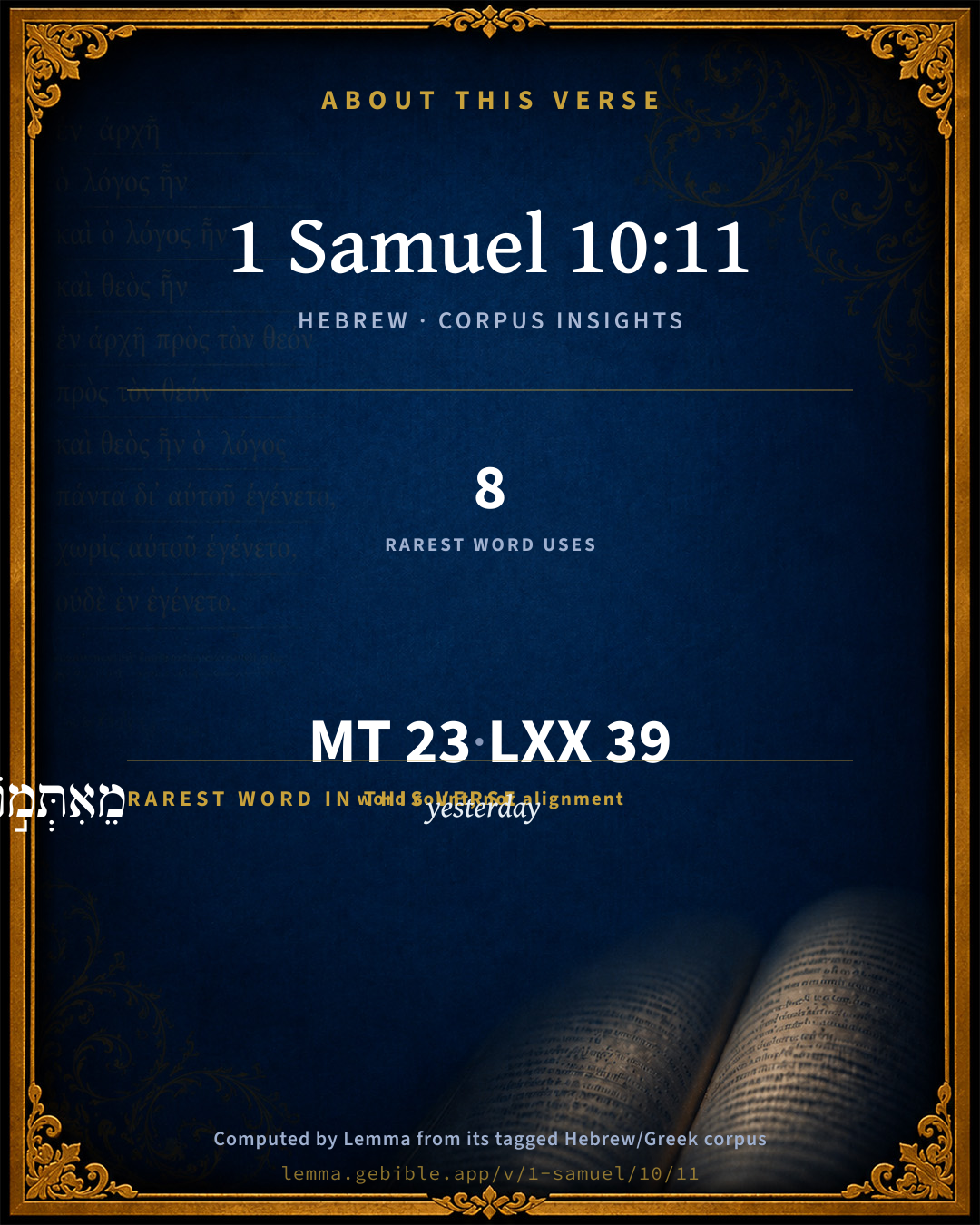
About this verse

These counts appear in no published source. They are computed here, from the morphology-tagged text and Lemma’s own curated glosses. What Lemma adds →

23
words
21
distinct lemmas
Historical
section

Notable vocabulary

The rarest word here is מֵאִתְּמ֣וֹל yesterday H865 — appearing just 8 times in the whole Hebrew Bible.

Shared distinctive vocabulary

מֵאִתְּמ֣וֹל yesterday H865 occurs in 8 verses of the Hebrew Bible. Also found in:

Grammatical profile

  • 6 verbs
  • 11 nouns
  • 1 pronoun
  • 2 prepositions
  • 1 adverb
  • 2 particles

Verb forms

  • וַיְהִ֗י Qal · Sequential Imperfect
  • יֽוֹדְעוֹ֙ Qal · Participle Active
  • וַיִּרְא֕וּ Qal · Sequential Imperfect
  • נִבָּ֑א Niphal · Participle Active
  • וַיֹּ֨אמֶר Qal · Sequential Imperfect
  • הָיָ֣ה Qal · Perfect

Repetition

Words recur within this verse — often emphatic in Hebrew:

  • וַיְהִ֗י to be H1961 ×2
  • נְבִאִ֖ים prophet H5030 ×2

Hebrew & Septuagint length

In English translation the verse runs 40 words from the Hebrew and 46 from the Septuagint (LXX English) — closely comparable.

A rough comparison of the two English renderings, which tokenize alike — not a word-level alignment.

Word counts can differ between the Hebrew and the Greek without any difference in meaning — e.g. the Hebrew direct-object marker אֵת has no separate Greek word, and Greek often adds the article ὁ.

In the original languages it is 23 Hebrew tokens and 39 Greek tokens — but the two are counted differently (Hebrew bundles its prefixes and suffixes into one token; the Greek is in lemma form), so that isn’t a like-for-like length.

Cross-references

8

Topical passages linked to 1 Samuel 10:11 in the Treasury of Scripture Knowledge — connected by theme and wording, ordered by reader-vote popularity; previews shown in the World English Bible.

  • 1 Samuel 19:24 He also stripped off his clothes, and he also prophesied before Samuel, and lay down naked all that day and all that night. Therefore they say, "Is Saul also among the prophets?"
  • John 7:15 The Jews therefore marveled, saying, "How does this man know letters, having never been educated?"
  • Matthew 13:54–55 Coming into his own country, he taught them in their synagogue, so that they were astonished, and said, "Where did this man get this wisdom, and these mighty works?
  • John 9:8–9 The neighbors therefore, and those who saw that he was blind before, said, "Isn't this he who sat and begged?"
  • Acts 2:7–8 They were all amazed and marveled, saying to one another, "Behold, aren't all these who speak Galileans?
  • Acts 3:10 They recognized him, that it was he who used to sit begging for gifts for the needy at the Beautiful Gate of the temple. They were filled with wonder and amazement at what had happened to him.
  • Acts 4:13 Now when they saw the boldness of Peter and John, and had perceived that they were unlearned and ignorant men, they marveled. They recognized that they had been with Jesus.
  • Acts 9:21 All who heard him were amazed, and said, "Isn't this he who in Jerusalem made havoc of those who called on this name? And he had come here intending to bring them bound before the chief priests!"

Cross-references courtesy of OpenBible.info (CC BY 4.0).

Hebrew and Greek witnesses Masoretic Hebrew ↔ Greek Septuagint

The same verse in the two great witnesses to the Old Testament, shown verse-for-verse.

These are two independent witnesses, not word-aligned to each other, and the Septuagint is shown in lemma (dictionary) form.

Hebrew 1 Samuel 10:11 Masoretic · Westminster Leningrad Codex

וַיְהִ֗י כָּל יֽוֹדְעוֹ֙ מֵאִתְּמ֣וֹל שִׁלְשׁ֔וֹם וַיִּרְא֕וּ וְהִנֵּ֥ה עִם נְבִאִ֖ים נִבָּ֑א וַיֹּ֨אמֶר הָעָ֜ם אִ֣ישׁ אֶל רֵעֵ֗הוּ מַה זֶּה֙ הָיָ֣ה לְבֶן קִ֔ישׁ הֲגַ֥ם שָׁא֖וּל בַּנְּבִיאִֽים

It happened, when all who knew him before saw that, behold, he prophesied with the prophets, then the people said one to another, What is this that is come to the son of Kish? Is Saul also among the prophets?

World English Bible · Public Domain

Greek LXX 1 Samuel 10:11 Septuagint · lemma form

καί γίγνομαι πᾶς ὁ ὁράω αὐτός χθές καί τρίτος καί ὁράω καί ἰδού αὐτός ἐν μέσος ὁ προφήτης καί εἶπον ὁ λαός ἕκαστος πρός ὁ πλησίον αὐτός τίς οὗτος ὁ γίγνομαι ὁ υἱός κις ἤ καί σαούλ ἐν προφήτης

And all that had known him before came, and saw, and behold, he was in the midst of the prophets: and the people said every one to his neighbor, What is this that has happened to the son of Kis? is Saul also among the prophets?

LXX2012 (modern English Septuagint) · Public Domain

On this verse, The Preacher's Complete Homiletical Commentary discusses the Septuagint’s reading. Read the note in Commentary ↓

Hebrew: Westminster Leningrad Codex (CC BY 4.0). Greek: Septuagint (public domain); English from LXX2012 (modern English Septuagint) (Public Domain). How the Septuagint differs from the Hebrew →

Targum (Aramaic paraphrase)

1

The Targum is the ancient Jewish Aramaic paraphrase of the Hebrew Scriptures — an interpretive translation, not the Hebrew text itself. Onkelos (literal) and Pseudo-Jonathan (expansive) render the Torah, and Jonathan the Prophets. Coverage is partial: where no permissively-licensed English translation exists for a verse, only the Aramaic is shown. This is verse-level text, not a word-by-word alignment to the Hebrew.

  1. Targum Jonathan Prophets (Joshua–Malachi)
    וַהֲוָה כָּל דִידַע לֵיהּ מֵאִתְמָלֵי וּמִדְקָמוֹהִי וַחֲזוֹ וְהָא עִם סַפְרַיָא מְשַׁבַּח וַאֲמַר עַמָא גְבַר לְחַבְרֵיהּ מָה דֵין הֲוָה לְבַר קִישׁ הֲאַף שָׁאוּל בְּסַפְרַיָא:

    (no public-domain English translation for this verse)

    Targum Jonathan — Aramaic: “Mikraot Gedolot” (public domain). English: “Sefaria Community Translation” (CC0 1.0 (public-domain dedication)); “London "Chaldee Paraphrase," 1871” (public domain). Text via Sefaria.

Commentary

Notes on 1 Samuel 10:11 from classic Christian and Jewish commentators (each source and its license shown beneath its notes). The classic Christian expositions comment on the surrounding passage and are grouped to its opening verse, so a note may address several verses; the Jewish commentaries on the Tanakh (Rashi and others) are per-verse, so they appear only where the commentator wrote on this verse.

Lemma curates 59 commentaries, every one of them public domain or Creative Commons licensed, each selected and text-cleaned for this edition rather than reprinted as found. About our sources →

Trapp's Complete Commentary

John Trapp

1Sa 10:11 And it came to pass, when all that knew him beforetime saw that, behold, he prophesied among the prophets, then the people said one to another, What [is] this [that] is come unto the son of Kish? [Is] Saul also among the prophets?

Ver. 11. What is this that is come unto the son of Kish?] Whence hath he all these things? as they said of our Saviour: {Mat 13:56} and as much wondering there was at Saul the persecutor, when he turned preacher. {Act 9:21}

“ Tertius e caelo cecidit Cato. ” Juvenal.

Is Saul also among the prophets?] This became a like proverb among the Hebrews, as those among the Latins, Anser inter olores, Asians inter apes, Corvus inter Musas.

John Trapp, A Commentary or Exposition upon All the Books of the Old and New Testament (1647–1656) — public domain. Text from a community e-Sword module.

The Biblical Illustrator

Joseph S. Exell

1Sa_10:11

Is Saul also among the prophets?

A Saul among the prophets

So they said in the wild irregular season of his obscure youth, before his accession to the throne, when the Spirit of the Lord, that bloweth where it listeth, suddenly arrested the young Saul, in the midst of his dissolute companions; they repeated their scornful outcry in after years, as recorded in 1Sa_19:24, when the spirit of repentance again seized the royal backslider, and brought him stripped and abased to the earth before Samuel at Naloth. The saying rightly interpreted may suggest some useful practical instruction.

I. What is meant by being among the prophets? By the company of prophets in 1Sa_19:5, or a company of scribes, says the Targum, are meant the scholars of the prophets, who were at that period the only accredited teachers of religion. Mr. Harmer thinks the following custom among the Mohammedans illustrates this passage: When the children have gone through the Koran their relations borrow a fine house and furniture and carry them about the town in procession, with the book in their hand, the rest of their companions following, and all sorts of music of the country going before. Eastern customs have little varied; they seem to abide immutable, and identical, as their sunny climes, and very probably, the procession of the school of the prophets in the context was on a similar occasion. Is Saul also among the prophets?--that is, is he turned psalm singer and a supplicant? Is the rough, riotous herdsman of Benjamin become a companion of prophets and an utterer of the solemn things of God? Are we to have no more merry songs together, nor the light dance and jocund festival? Saul, our old fellow reveller, become quaint and grim as a Levite? What is this that is come unto the son of Kish? Is Saul also among the prophets? That this is the general meaning of prophesying in this place; see also the sense in which the word is used in reference to the priests of Baal, 1Ki_18:29 : And it came to pass, when midday was put, and they prophesied until the time of the evening sacrifice--they prophesied, that is, were importunate in prayer to their God. Thus the phrase, Saul among the prophets, is equivalent to what the angels, in a holier and more charitable spirit, said of the Saul of Tarsus, when the Lord changed his heart, brought him to his knees, and they described his conversion to the truth by the terms, Behold he prayeth. A similar astonishment seized them who had known the apostle for a blasphemer and persecutor, and when they heard that he preached the faith which he once destroyed they too might have said, Is Saul also amongst the prophets, that is, among the praying people, the people of God? There was in Saul, at different times, the development of a different man, according as the law in his members, or the law in his mind, obtained the mastery. Saul did run well, but suffered something to hinder him. He began his reign in the Spirit, he ended it in the flesh. As a king he was weighed in the balances and found wanting; as a man, Mercy might have interposed and turned the scale. It is no unwarrantable stretch of Scriptural charity to imagine it possible that other tongues than those of living men might have talked of the departed Saul, as again among the prophets. I am not ashamed to think so of the man, whom the, inspired psalmist eulogised in his sepulchre. Only if it were so, his story illustrates the apostles case of those who are saved with difficulty pulling them out of the fire.

II. To the penitent sinner and returning backslider.

1. To the penitent sinner. Imagine his repentance genuine. The difference is so marked that his old companions scarcely recognise their former hail fellow, and insinuate at once a charge of hypocrisy and a sneer of contempt, whether or no in the scornful cry, Is Saul also among the prophets? Is so-and-so among the saints? Have they caught him with their psalm singing? or, Is he playing upon them with his guile? The penitent hears this; it is meant he should hear it, they take care of that; and his first feeling is, This is a penalty for my former association with them; Be sure your sin will find you out; it has found me out, even since I left it. The way of transgressors is hard, even after they abandon it. It is but natural that Satan should grumble at the loss of a servant, and his children only echo their fathers sentiment. They think it strange (and so it is) that ye run not with them to the same excess of riot, speaking evil of you. But you meet these people day after day. If you are a workman, you meet them at your work; if one of a higher class of the community, you meet them in business or society; and they repeat their scornful insinuations. They dont and they wont believe you to be sincere, for they are strangers to what has taken place within you, distinctly enough to your convictions, but a mystery to them. They hate you, as Ahab hated Micaiah, because the sacred contrast of your life, always, however, unconsciously, prophesies evil things concerning them, and they would visit, as the world always did, their anger at the prediction on the head of the prophet, and you will be called upon to bear many a heavy version of the contemptuous proverb, Is Saul also among the prophets?

2. But, further, let us suppose you have failed in maintaining your ground; that you did run well, but suffered something to hinder you; that you had followed your Saviour, like the youthful John, up to the very moment of His seizure for the crucifixion, but there your heart failed you, and like him you turned and fled away naked, leaving behind you all your better convictions and determinations. You have done this, and you have since lived a backslider; and may we ask, Is it well with thee? Are you happy in your apostasy? (J. B. Owen, M. A.)

One act does not make a saint

Saul was not a saint because he did once prophesy, nor is every one a believer that talks of faith. (T. Adams.)

Transient reformations

The snow today covered all the ground, and the black soil looked fair and white. It is thus with some men under transient reformations; they look as holy, and as heavenly, and as pure as though they were saints; but when the sun of trial arises, and a little heat of temptation cometh upon them, how soon do they reveal their true blackness, and all their surface goodliness melteth away! (C. H. Spurgeon.)

The Biblical Illustrator, edited by Joseph S. Exell (c. 1880s–1900s) — public domain. Text from a community e-Sword module.

Joseph Benson's Commentary

1Sa 10:11. Is Saul also among the prophets? — A man never instructed, nor exercised in, nor inclined to these matters. It begat wonder in all those who knew his education, that he should, on a sudden, be inspired as those were, who were bred up in the school of the prophets. For, though it was in the power of God alone to bestow the gift of prophecy upon men, yet it would seem that commonly he endowed none with it, but such as were trained up in those studies which might dispose them for it.

Joseph Benson's Commentary on the Old and New Testaments (1811–1818) — public domain. Text from a community e-Sword module.

The Preacher's Complete Homiletical Commentary

Joseph S. Exell (gen. ed.)

CRITICAL AND EXPOSITORY NOTES—

1Sa_10:11. “Is Saul also among the prophets?” “According to its origin, here given, this proverb does not merely express surprise at the sudden unexpected calling of a man to another calling in life, or to a high and honourable position. The personal and moral qualities of Saul, perhaps the religious-moral character of his family, or, at least, the mean opinion that was entertained of Saul’s qualities and capacities, intellectually, religiously, and morally, formed the ground of surprise at his sudden assumption of the prophetic character.” (Erdmann).

1Sa_10:12. “Who is their father?” A somewhat obscure phrase. The Septuagint and some other versions read, ‘Who is his father?’ i.e., Who would have expected the son of Kish to be found among the prophets? Other readings, as the authorised version, understand father to refer to the head of the prophets, and the question to reflect blame upon him for admitting such a person as Saul into the company of the prophets. Wordsworth paraphrases, ‘Who is the father of the prophets? Not man, but God. And God can make even Saul, whom ye despise, to be a prophet also.’ Kiel—‘Is their father a prophet, then?’ i.e., have they the prophetic spirit by virtue of their birth? ‘The speaker declares,’ says Bunsen, ‘against the contemptuous remark about the son of Kish, that the prophets, too, owed their gift to no peculiarly lofty lineage. Saul also might, therefore, receive this gift as a gift from God, not as a patrimony.”

MAIN HOMILETICS OF THE PARAGRAPH.—1Sa_10:11-12; 1Sa_10:27

SAUL AMONG THE PROPHETS

I. God often accomplishes his purposes by agencies both unlooked for and despised. That a Hebrew slave should be taken from a dungeon and made lord of Egypt was no doubt an event as undesired as it was unexpected by the nobles of Pharaoh’s court, and that this despised younger brother should be the instrument of saving all his house from starvation was as equally far from the desire and expectation of Jacob’s elder sons. That another Hebrew youth should be educated and fitted in Pharaoh’s court to become the axe which should be laid at the root of the tyranny of Egypt, was another event which men little expected to come to pass, and which crossed the wishes and desires of many. And it as little accorded with the expectation and wish of the majority of the Israelites who knew Saul the son of Kish that he should be found first among the prophets and then upon the throne. Those who had known the young man from his youth never expected to see him in any other position than that in which he had grown to manhood, and a larger number were as surprised as they were disappointed when they found that a member of the smallest tribe of Israel, and one who had given no proof of his power to rule, was to be elevated to the throne of the nation. But this has been the general method of the Divine working in the world. Not only in the establishment of the Gospel kingdom but in the accomplishment of most of His purposes, which are indeed all subservient to that one great Divine purpose—“God hath chosen the foolish things of the world to confound the wise; and God hath chosen the weak things of the world to confound the things which are mighty; and base things of the world, and things which are despised, hath God chosen, yea, and things which are not, to bring to nought things that are; that no flesh should glory in His presence” (1Co_1:27-29). Men look in the high places of the earth for those who are to do the great things of the world, but God puts His hand upon some obscure and despised and unlikely instrument and uses him for the work that “they may see, and know, and consider, that the hand of the Lord hath done this, and the Holy One of Israel hath created it” (Isa_41:20).

II. The way in which men ought to regard this method of the Divine working. There are many men among the teachers of the Church of God who have been raised from a much more lowly position. Yet when another from a similar position reveals that God has bestowed gifts and graces upon him also, those who can boast no higher origin exclaim with astonishment and scorn, “Is Saul also among the prophets?” It behoves all who ask such a question to consider the origin of all intellectual and spiritual endowments—to remember that they are all bestowed by the common Father, who is not accountable to them for the distribution of them. But the spirit which would exclude some from a participation in them manifested itself very early in the Church of God. When “the Lord took of the Spirit that was upon Moses, and gave it unto the seventy elders:” and “they prophesied and did not cease,” and “Eldad and Medad prophesied in the camp, there ran a young man and told Moses, and said, Eldad and Medad do prophesy in the camp. And Joshua the son of Nun, the servant of Moses, one of his young men, answered and said, My lord, Moses, forbid them” (Num_11:25-28). But Moses remembered and acknowledged “who hath made man’s mouth, and who maketh the dumb, or the seeing, or the blind” (Exo_4:11)—he knew whose was the Spirit which had rested so abundantly upon him, and that all the servants of God had one common Father, and he therefore answered, “Enviest thou for my sake? Would God that all the Lord’s people were prophets, and that the Lord would put his Spirit upon them” (Num_11:29). This is the attitude which becomes all God’s servants to take when they behold a Saul among the prophets—it behoves them all to ask the question asked by one in the days of Saul, “But who is their father?” It was as great a surprise to the disciples at Jerusalem to hear of the New Testament Saul among the preachers as it was for the inhabitants of Gibeah to see the Old Testament Saul among the prophets. But the surprise in both cases arose from forgetfulness of the truth contained in the heart-searching question afterwards put by that great apostle to the Corinthian church—“For who maketh thee to differ from one another? and what hast thou that thou didst not receive? now if thou didst receive it, why dost thou glory, as if thou hadst not received it?” (1Co_4:7).

OUTLINES AND SUGGESTIVE COMMENTS

1Sa_10:11-12. Let not the worst be despaired of, yet let not an external show of devotion, and a sudden change for the present, be too much relied on; for Saul among the prophets was Saul still.—Henry.

The Preacher's Complete Homiletical Commentary (gen. ed. Joseph S. Exell; Funk & Wagnalls, c. 1892) — public domain (pre-1929). A full-Bible homiletical/sermon-outline anthology covering 65 of 66 books (2 John is absent from the source module). Text from a community e-Sword module.

Tyndale Open Study Notes

Tyndale Open Resources

10:11 Those who knew Saul might have known him to be nonreligious and thus an unlikely candidate for prophet. Their surprise might indicate disappointment at receiving a prophet instead of a king (cp. John 6:14-15).

Tyndale Open Study Notes — © Tyndale Open Resources, licensed CC BY-SA 4.0. Text via the HelloAO Bible API.

Ellicott's Commentary for English Readers

(11) What is this?—The natural expression of extreme surprise at the sudden change which had come over one so well known at Gibeah as Saul evidently was, shows us that this was his home. The words, “What is this that is come unto the son of Kish?” seem to tell us that the life hitherto led by Saul was a life very different in all respects to the life led by the sons of the prophets in their schools. It need not be assumed that the youth and early manhood of the future king had been wild and dissolute, but simply that the way of life had been rough and uncultured—a life spent in what we should call “country pursuits,” in contradistinction to the pursuit of knowledge and of higher acquirements. It is evident from the statement here and in the following verse that a considerable respect for these schools had already grown up among the people.

Is Saul also among the prophets?—In 1Sa_19:23 we again find Saul, but under changed circumstances, under the influence of a Divine and coercing power, and uttering strange words, and singing hymns as one trained in the prophets’ schools. It was probably this recurrence of the same incident in the king’s life which gave rise to the saying, or proverb, which expresses amazement at the unexpected appearance of any man in a position which had hitherto been quite strange to him. “Is Saul among the preachers of Christ? Was a question of wonder asked by the friends of St. Paul” (Gal_1:23).—Wordsworth.

A Bible Commentary for English Readers, edited by Charles John Ellicott (1878–1897) — public domain. Text from a community e-Sword module.

The Cambridge Bible for Schools and Colleges

gen. ed. J. J. S. Perowne

11. all that knew him beforetime] An indication that Gibeah was Saul’s home. Cp. 1Sa_10:14; 1Sa_10:26.

11, 12. Saul’s neighbours were astonished that the son of Kish, the plain citizen, undistinguished save by his stalwart form and handsome countenance, should suddenly appear as a prophet in the midst of the trained recipients of divine inspiration. But one of their fellow-townsmen reproved them by asking. But who is their father? Was the parentage of these prophets such as to lead us to expect them to be thus specially gifted? The prophetic inspiration comes from God, and may therefore be bestowed even upon the son of Kish. See Amo_7:14-15. Compare the astonishment of the people of Capernaum at the words and works of Christ (Mat_13:54-57).

The Cambridge Bible for Schools and Colleges (gen. ed. J. J. S. Perowne; Cambridge University Press, 1878–1918) — public domain. Text from a community e-Sword module.

John Gill's Exposition

And it came to pass, that when all that knew him before time,.... As there must be many that personally knew him, and were acquainted with him, since Gibeah, the place he was near to, was his native place:

saw that, behold, he prophesied among the prophets; or praised among them, as the Targum, sung psalms and hymns with them:

what is this that is come unto the son of Kish? a rustic, a plebeian, that never was in the school of the prophets, or learned music, and yet is as dexterous at it as any of them:

is Saul also among the prophets? an husbandman, an herdsman that looked after his father's farms, fields, and cattle, and now among the prophets of the Lord, bearing his part with them, and performing it as well as any of them: this was matter of wonder to those who knew his person, family, and education; and so it was equally matter of admiration that Saul the persecutor, one of the same tribe, should be among the preachers of the Gospel, Act 9:20.

John Gill's Exposition of the Whole Bible (1746–1763) — public domain (CC PDM 1.0). Text via the HelloAO Bible API.

Haydock's Catholic Bible Commentary

Prophets. This proverb received a fresh confirmation, when Saul was going to seize David, and was forced by the Spirit to join with the college of prophets, in singing God’s praises, chap. xix. 24. (Haydock) --- It may be applied to those who are unexpectedly raised to a high dignity, or enabled to speak or to do extraordinary things, like the apostles, when they spoke various languages &c. (Delrio adag. 178.) (Calmet)

George Leo Haydock (1774–1849), Haydock's Catholic Family Bible and Commentary, 1859 edition — public domain. Excludes Psalms (Douay-Rheims chapter numbering differs from Protestant) and Deuterocanonical books (Catholic canon only).

Matthew Poole's English Annotations

What is this that is come unto the son of Kish? what means this strange and prodigious event? Saul; a man never instructed nor exercised in nor inclined to these matters; a man ever thought fitter to look to his father’s asses, than to bear a part in the sacred exercises of the prophets.

Matthew Poole's English Annotations on the Holy Bible (1683–1685) — public domain. Text from a community e-Sword/MySword module.

Whedon's Commentary on the Bible

Daniel D. Whedon

11. All that knew him — An his neighbours and acquaintances at once perceive the change, and, as he prophesies among the prophets, they ask, as in amazement: What is this that is come unto the son of Kish? Is Saul also among the prophets? Nothing of this kind had ever been known of him before, and all at once he seemed to be changed into a man of another heart and another life.

Daniel D. Whedon (gen. ed.), Commentary on the Old and New Testaments (1874–1909) — public domain. Text from a community e-Sword module.

The Pulpit Commentary

Vers. 11-13. (GIBEAH.)

Saul among the prophets.

Saul also among the prophets?" Of the three signs of which Saul was assured, the occurrence of the last alone is particularly described. "And the Spirit of God came upon him, and he prophesied among them." "Turned into another man" (ver. 6). It was "the most important for his inner life." "Through this sign his anointing as king was to be inwardly sealed." In what is here recorded we see an instance of

I SURPRISING TRANSFORMATION. The question was mainly one of surprise. The change was

1. Sudden. In what are called "sudden conversions," indeed, there is often a secret preparation of mind and heart. Even in the case of Saul the surprise would not have been so great if his recent interview with Samuel and its effect upon him had been known.

2. In extraordinary contrast to his previous life, wherein he had exhibited little interest in or aptitude for spiritual exercises. Four or five days ago among them wholly occupied with the care of oxen and asses dull, moody, and silent; now in a transport of religious emotion, and "speaking in a new tongue!

3. Supernatural. It was plainly due to the "Spirit of God," i.e. (in the Hebrew conception) the direct, invisible, operative energy of God, whether put forth in nature or in man, in imparting mental or physical force for great enterprises, in promoting moral improvement, in producing exalted states of feeling, or in acts of the highest inspiration (Gen_1:2; Exo_31:3; Num_24:2; Jud_1:13:25; 2Sa_23:2; Isa_11:2) and (according to the fuller revelation of the NewTestament) the holy, personal, Divine Spirit of God and of Christ. The expression (here used in this book for the first time) is not employed with respect to Samuel, whose intercourse with God is represented as more voluntary, self conscious, intimate, and continuous than that which it here denotes.

II SYMPATHETIC ENTHUSIASM. Saul was drawn into sympathy with the Divine enthusiasm of the "company of prophets.

1. The links which unite men are secret, subtle, and mysterious, and theinfluence which some men exert over others is extraordinary.

2. Human influence is a common condition of Divine.

3. The contagious power of strong emotion is often seen in religiousrevivals, and to some extent also in other public movements. "Ecstatic states have something infectious about them. The excitement spreads involuntarily, as in the American revivals and the preaching mania in Sweden, even to persons in whose state of mind there is no affinity to anything of the kind" (Tholuck). "As one coal kindles another, so it happens that where good is taught and heard hearts do not remain unmoved . Act_16:13, 14" (Hall)

III SPIRITUAL ENDOWMENT. "And one of the same place answered," in reply to the question (asked somewhat contemptuously and sceptically), "What has happened to the son of Kish? Is Saul also" (whose relationship and antecedents are so different) "among the prophets? and said, But who is their father?" "Who is he that teacheth these prophets, and causeth the spirit of prophecy to rest on them? Nor is there any cause for astonishment in this; for the same holy, blessed One who teacheth these prophets teacheth also this one" (Kimchi). "Prophetical perfection is not a matter that is conveyed from father to son. Under these circumstances the son may be a prophet, though the father is not so" (R. Levi Ben Gersom, quoted by Ed. of Smith"s "Sel. Dis.").

1. Spiritual gifts are not the result of natural relationship.

2. They are due to the free and sovereign operation of the Divine Spirit,"dividing to every man severally as he will.

3. When they are bestowed on ourselves they should be received withhumility, and when they are observed in others they should be regarded without envy, and with admiration and thankfulness.

IV PARTIAL CONVERSION. "And when he had made an end of prophesying, he came to the high place" (ver. 13). His inspiration was transitory, and the change which he had undergone, great as it was, and in the direction of a renewal of his heart in righteousness, did not involve such renewal. "This transformation is not to be regarded as regeneration in the Christian sense, but as a change resembling regeneration which affected the entire disposition of mind, and by which Saul was lifted out of his former modes of thought and feeling, which were confined within a narrow, earthly sphere, into a far higher sphere of his new royal calling, was filled with kingly thoughts in relation to the service of God, and received another heart ver. 9" (Keil).

1. Great spiritual gifts may be possessed without the possession of a new (Num_24:3-5 Num_31:8; Mat_7:22; 1Co_13:2)

2. There may be considerable moral reformation, much spiritual feeling,correct orthodox beliefs, outward profession of piety, and strict observance of religious ordinances, whilst the supreme affection or ruling purpose of the soul remains unchanged. (Mt 13)

3. A real renewal of the heart is manifested by its permanent fruits (Mat_7:20; Joh_15:16; Heb_3:14) "If Samuel is the great example of an ancient saint growing up from childhood to old age without a sudden conversion, Saul is the first direct example of the mixed character often produced by such a conversion He became "another man," yet not entirely. He was, as is so often the case, half converted, half roused His religion was never blended with his moral nature" (Stanley)

Let not the people be too swift to judge; As one who reckons on the blades in field Or e"er the crop be ripe. For I have seen The thorn frown rudely all the winter long, And after bear the rose upon its top; And bark, that all her way across the sea Ran straight and speedy, perish at the last E"en in the haven"s mouth. Seeing one steal, Another bring his offering to the priest, Let not Dame Birtha and Sir Martin thence Into Heaven"s counsels deem that they can pry; For one of these may rise, the other fall (Dante, Par. 13.). D.

The Pulpit Commentary (1880–1919), ed. H.D.M. Spence-Jones & Joseph S. Exell — public domain. Text from a community e-Sword module.

John Wesley's Explanatory Notes

Is Saul - A man never instructed, nor exercised in, nor inclined to these matters.

John Wesley, Explanatory Notes Upon the Whole Bible (1754–1765) — public domain. Text via the GEBible commentary corpus.

unfoldingWord translationNotes

Door43 World Missions Community

What has happened to the son of Kish?

Possible meanings are 1) the people are asking for information or 2) this is a rhetorical question that means Saul is not important. AT: "Kish is not an important person, so it cannot be true that his son has become a prophet!" (See: Rhetorical Question)

the son of Kish

"Saul, the son of Kish"

Then who is their father?

This man uses a rhetorical question to remind people that being a prophet has nothing to do with who one's parents are. The question can be translated as a statement. AT: "It does not matter who the parents of these other prophets are. What matters is that, amazingly, Saul is speaking messages from God." (See: Rhetorical Question)

Because of this, it became a saying, "Is Saul also one of the prophets?"

This became a proverb among the Israelites. Apparently people said this to express surprise when a person unexpectedly did something that he had not done before. The implied meaning of the question can be stated explicitly. AT: "And that is why, when people cannot believe some report, they think about what happened to Saul and say, 'Is Saul really one of the prophets?'" (See: Proverbs and Assumed Knowledge and Implicit Information)

translationWords

Saul (OT)

ancestor

high place

unfoldingWord translationNotes — © Distant Shores Media and the Door43 World Missions Community, licensed CC BY-SA 4.0. Source: git.door43.org/Door43/en_tn.

Lesson kit

Teaching starters — assembled from the data on this page, not authored interpretation. Every prompt links to the verse data it draws on. Edit before teaching.

1 Samuel, in the Historical, opens this verse with 23 words (21 distinct Hebrew lemmas). Its most distinctive word is ʼethmôwl (“yesterday”). A historical commentator’s framing appears above. Read the whole chapter for the surrounding context.

Discussion questions

  1. The word ʼethmôwl carries the sense “yesterday.” How does it shape the verse?
  2. How does 1 Samuel 4:7, which shares the word «yesterday», read alongside this verse?
  3. What does the repetition of “to be” (2× in this one verse) do in this verse?
  4. The translations on this page render this verse differently — a whole-verse word diff, not a word-by-word alignment. What might account for the different wordings?
  5. «וַיְהִ֗י» is a Qal Sequential Imperfect verb. How does that grammatical form shape the action described?
  6. Compare how Trapp's Complete Commentary and The Biblical Illustrator read this verse. Where do they agree or differ?

Things to notice

Reading settings

Reading text

Shown beneath each verse's original-language words.

Old Testament
Old Testament edition

Read the OT as the Masoretic Hebrew (MT) or the Greek Septuagint (LXX).

English shown for the Greek Septuagint (in the Hebrew ↔ Greek comparison).

Comparing translations? Open the Compare panel on any verse page to stack up to four side by side.