

Proverbs 27:17

Hebrew (Westminster Leningrad Codex) Proverbs 27:17 appears in the Hebrew Old Testament. The text above is from the Westminster Leningrad Codex. Each word links to its Strong’s number, a concise gloss, and parsing drawn from the Open Scriptures Hebrew Bible morphology. Click any word for its full Brown-Driver-Briggs (BDB) entry.
Download image
Cite this verse

Proverbs 27:17 (World English Bible). Public Domain. Lemma interlinear Bible study tool, https://lemma.gebible.app/v/proverbs/27/17.

Show BibTeX & RIS
BibTeX
RIS
English Translation
Iron sharpens iron; So a man sharpens his friend's countenance.
World English Bible · Public Domain
Highlights
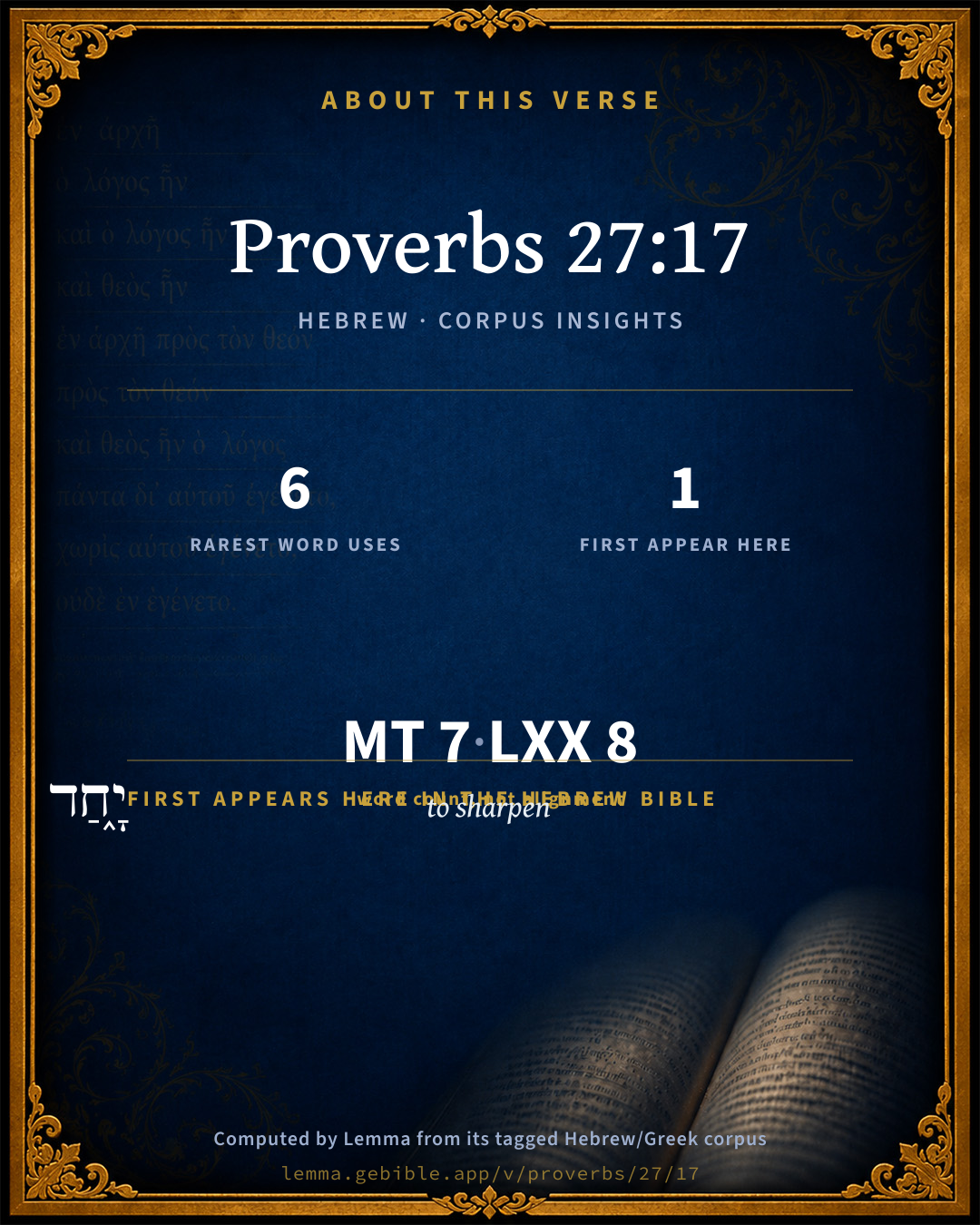
  • 1 first appearance in the Hebrew Bible
Full analysis ↓
Download a study sheet

One document with this verse’s original text, its word-by-word gloss line, the meaning frame, cross-references with their text, attributed commentary, and full source and license credits — printable, and it pastes into notes with its structure intact.

This verse Autodidact and up

Study sheet (.html) Plain text (.txt)

A passage Seminary Student

Up to 50 verses in one chapter. A passage sheet keeps up to 6 commentary sources and 12 cross-references per verse, in the order this page ranks them, and says so on the sheet whenever that leaves anything out. Ask for a single verse and you get the Autodidact verse sheet above.

Everything on this page stays free to read, with no account — the sheet is a download of what is already on screen, not access to it.

Want to remove ads? Support Godless Engineer
Compare translations 3

The same verse in 3 English versions, stacked beneath the original-language interlinear above. Click any original word for its lexicon entry.

Each is an independent rendering of the whole verse — the interlinear is not word-aligned to these translations.

Highlighted words mark where these versions differ — a whole-verse word diff, not a word-by-word alignment.

  • World English Bible Public Domain
    Iron sharpens iron; So a man sharpens his friend's countenance.
  • King James Version Public Domain
    Iron sharpeneth iron; so a man sharpeneth the countenance of his friend.
  • unfoldingWord Literal Text CC BY-SA 4.0
    Iron sharpens against iron, and a man sharpens the face of his neighbor.

unfoldingWord Literal Text — © unfoldingWord, licensed CC BY-SA 4.0. Word-aligned USFM3 via Door43 (git.door43.org/unfoldingWord/en_ult).

Versions to compare (up to 4)

3 of 4 selected

Show all 18 translations

Every available English version of this verse, each an independent rendering of the whole verse.

  • World English Bible Public Domain
    Iron sharpens iron; So a man sharpens his friend's countenance.
  • Berean Standard Bible Public Domain
    As iron sharpens iron, so one man sharpens another.
  • Majority Standard Bible Public Domain
    As iron sharpens iron, so one man sharpens another.
  • King James Version Public Domain
    Iron sharpeneth iron; so a man sharpeneth the countenance of his friend.
  • American Standard Version (1901) Public Domain
    Iron sharpeneth iron; So a man sharpeneth the countenance of his friend.
  • Revised Version (1885) Public Domain
    Iron sharpeneth iron; so a man sharpeneth the countenance of his friend.
  • Geneva Bible (1599) Public Domain
    Yron sharpeneth yron, so doeth man sharpen the face of his friend.
  • Douay-Rheims (1899) Public Domain
    Iron sharpeneth iron, so a man sharpeneth the countenance of his friend.
  • Young's Literal Translation Public Domain
    Iron by iron is sharpened, And a man sharpens the face of his friend.
  • Literal Standard Version CC BY-SA 4.0
    Iron is sharpened by iron, || And a man sharpens the face of his friend.
  • Unlocked Literal Bible CC BY-SA 4.0
    Iron sharpens iron; in the same way, a man sharpens his friend.
  • unfoldingWord Literal Text CC BY-SA 4.0
    Iron sharpens against iron, and a man sharpens the face of his neighbor.
  • Darby Bible Public Domain
    Iron is sharpened by iron; so a man sharpeneth the countenance of his friend.
  • World Messianic Bible Public Domain
    Iron sharpens iron; so a man sharpens his friend’s countenance.
  • Webster's Bible Public Domain
    Iron sharpeneth iron; so a man sharpeneth the countenance of his friend.
  • Free Bible Version CC BY-SA 4.0
    An iron blade is sharpened with an iron tool, and one person's mind is sharpened by another's.
  • Bible in Basic English Public Domain
    Iron makes iron sharp; so a man makes sharp his friend.
  • JPS Tanakh (1917) Public Domain
    Iron sharpeneth iron; so a man sharpeneth the countenance of his friend.

Literal Standard Version (2020), Covenant Press — licensed CC BY-SA 4.0. Text via the HelloAO Bible API (eBible.org). Unlocked Literal Bible (unfoldingWord) — licensed CC BY-SA 4.0. Text via the HelloAO Bible API (eBible.org). unfoldingWord Literal Text — © unfoldingWord, licensed CC BY-SA 4.0. Word-aligned USFM3 via Door43 (git.door43.org/unfoldingWord/en_ult). Free Bible Version, Dr. Jonathan Gallagher — licensed CC BY-SA 4.0. Text via the HelloAO Bible API (eBible.org).

Word by word

More ways to search: Search by grammar → Find every occurrence → Compare this word →

Practice this passage: Drill this verse → Learn its vocabulary →

About this verse

These counts appear in no published source. They are computed here, from the morphology-tagged text and Lemma’s own curated glosses. What Lemma adds →

7
words
5
distinct lemmas
Wisdom
section

Notable vocabulary

The rarest word here is יָ֑חַד to sharpen H2300 — appearing just 6 times in the whole Hebrew Bible.

First appearance in Scripture

This word makes its first canonical appearance in the Hebrew Bible here:

  • יָ֑חַד to sharpen H2300

Shared distinctive vocabulary

יָ֑חַד to sharpen H2300 occurs in 5 verses of the Hebrew Bible. Also found in:

Grammatical profile

  • 2 verbs
  • 5 nouns

Verb forms

  • יָ֑חַד Hiphil · Imperfect
  • יַ֣חַד Hiphil · Imperfect

Repetition

Words recur within this verse — often emphatic in Hebrew:

  • בַּרְזֶ֣ל iron H1270 ×2
  • יָ֑חַד to sharpen H2300 ×2

Hebrew & Septuagint length

In English translation the verse runs 10 words from the Hebrew and 10 from the Septuagint (LXX English) — the same length.

A rough comparison of the two English renderings, which tokenize alike — not a word-level alignment.

Word counts can differ between the Hebrew and the Greek without any difference in meaning — e.g. the Hebrew direct-object marker אֵת has no separate Greek word, and Greek often adds the article ὁ.

In the original languages it is 7 Hebrew tokens and 8 Greek tokens — but the two are counted differently (Hebrew bundles its prefixes and suffixes into one token; the Greek is in lemma form), so that isn’t a like-for-like length.

Cross-references

16

Topical passages linked to Proverbs 27:17 in the Treasury of Scripture Knowledge — connected by theme and wording, ordered by reader-vote popularity; previews shown in the World English Bible.

  • Hebrews 10:24 Let us consider how to provoke one another to love and good works,
  • Proverbs 27:9 Perfume and incense bring joy to the heart; So does earnest counsel from a man's friend.
  • Job 4:3–4 Behold, you have instructed many, You have strengthened the weak hands.
  • 1 Samuel 23:16 Jonathan, Saul's son, arose, and went to David into the wood, and strengthened his hand in God.
  • Isaiah 35:3–4 Strengthen you the weak hands, and confirm the feeble knees.
  • 2 Timothy 2:3 You therefore must endure hardship, as a good soldier of Christ Jesus.
  • 1 Peter 4:12–13 Beloved, don't be astonished at the fiery trial which has come upon you, to test you, as though a strange thing happened to you.
  • 2 Samuel 10:11–12 He said, If the Syrians be too strong for me, then you shall help me; but if the children of Ammon be too strong for you, then I will come and help you.
  • James 1:2 Count it all joy, my brothers, when you fall into various temptations,
  • 2 Timothy 1:8 Therefore don't be ashamed of the testimony of our Lord, nor of me his prisoner; but endure hardship for the Gospel according to the power of God,
  • 2 Timothy 2:9–13 in which I suffer hardship to the point of chains as a criminal. But God's word isn't chained.
  • 1 Thessalonians 3:3 that no one be moved by these afflictions. For you know that we are appointed to this task.
  • 2 Timothy 1:12 For this cause I suffer also these things. Yet I am not ashamed, for I know him whom I have believed, and I am persuaded that he is able to guard that which I have committed to him against that day.
  • 1 Samuel 11:9–10 They said to the messengers who came, Thus shall you tell the men of Jabesh Gilead, Tomorrow, by the time the sun is hot, you shall have deliverance. The messengers came and told the men of Jabesh; and they were glad.
  • Joshua 1:18 Whoever he be who shall rebel against your commandment, and shall not listen to your words in all that you command him, he shall be put to death: only be strong and of good courage.
  • 1 Samuel 13:20–21 but all the Israelites went down to the Philistines, to sharpen every man his plowshare, mattock, axe, and sickle;

Cross-references courtesy of OpenBible.info (CC BY 4.0).

Hebrew and Greek witnesses Masoretic Hebrew ↔ Greek Septuagint

The same verse in the two great witnesses to the Old Testament, shown verse-for-verse.

These are two independent witnesses, not word-aligned to each other, and the Septuagint is shown in lemma (dictionary) form.

Hebrew Proverbs 27:17 Masoretic · Westminster Leningrad Codex

בַּרְזֶ֣ל בְּבַרְזֶ֣ל יָ֑חַד וְ֝אִ֗ישׁ יַ֣חַד פְּנֵֽי רֵעֵֽהוּ

Iron sharpens iron; So a man sharpens his friend's countenance.

World English Bible · Public Domain

Greek LXX Proverbs 27:17 Septuagint · lemma form

σίδηρος σίδηρος ὀξύνω ἀνήρ δέ παραὀξύνω πρόσωπον ἑταῖρος

Iron sharpens iron; and a man sharpens his friend's countenance.

LXX2012 (modern English Septuagint) · Public Domain

On this verse, Adam Clarke's Commentary discusses the Septuagint’s reading. Read the note in Commentary ↓

Hebrew: Westminster Leningrad Codex (CC BY 4.0). Greek: Septuagint (public domain); English from LXX2012 (modern English Septuagint) (Public Domain). How the Septuagint differs from the Hebrew →

Commentary

Notes on Proverbs 27:17 from classic Christian and Jewish commentators (each source and its license shown beneath its notes). The classic Christian expositions comment on the surrounding passage and are grouped to its opening verse, so a note may address several verses; the Jewish commentaries on the Tanakh (Rashi and others) are per-verse, so they appear only where the commentator wrote on this verse.

Lemma curates 59 commentaries, every one of them public domain or Creative Commons licensed, each selected and text-cleaned for this edition rather than reprinted as found. About our sources →

Trapp's Complete Commentary

John Trapp

Pro 27:17 Iron sharpeneth iron; so a man sharpeneth the countenance of his friend.

Ver. 17. Iron sharpeneth iron.] One edge tool sharpeneth another; so doth the face of a man his friend. Ipse aspectus viri boni delectat, saith Seneca. Let us "whet one another to love and good works," saith Paul, {Heb 10:24} as boars whet their tusks, as mowers whet their scythes. Thus Paul was "pressed in spirit" by the coming of Timothy, {Act 18:5} and extimulates Timothy to "stir up (αναζωπυρειν) the gift of God that was in him." {2Ti 1:6} Thus Peter roused up (διεγειρειν) those to whom he wrote, ex veterno torporis et teporis, out of their spiritual lethargy. {1Pe 1:13} And thus those good souls "spake often one to another," for mutual quickening in dull and dead times. {Mal 3:16-17} {See Trapp on "Mal 3:16"} {See Trapp on "Mal 3:17"} As amber grease is nothing so sweet in itself as when compounded with other things; so godly and learned men are gainers by communicating themselves to others. Conference hath incredible profit in all sciences. Castalio renders this text thus: Ut ferrum ferro, sic heroines alii aliis coniuguntur; As iron is to iron, so are men joined and soldered to one another, - viz., in a very straight bond of love and friendship.

John Trapp, A Commentary or Exposition upon All the Books of the Old and New Testament (1647–1656) — public domain. Text from a community e-Sword module.

The Biblical Illustrator

Joseph S. Exell

Pro_27:17

Iron sharpeneth iron; so a man sharpeneth the countenance of his friend.

Friendship

Scripture instances of friendship are David and Jonathan; Ruth and Naomi; Paul and Timotheus; and our Lord and the Bethany sisters. In classical literature we see that friendship had a great part, both in the government of states and the lives of individuals. It is an aspect of politics and of human nature, and of all virtue. Partly owing to the different character of domestic life, the tie of friendship seems to have exercised s greater influence amongst the Greeks and Romans than among ourselves; and although these attachments may sometimes have degenerated into evil, we cannot doubt that much that was noble in the old life was also pure. See cases of Achilles and Patroclus, and of Pylades and Orestes. The school of Socrates was as much a circle of friends as a band of disciples. Roman friendships are illustrated in Scipio and Loelius, and in Cicero and Atticus. Shakespeare gives several types of friendship. In youth, when life is opening before us, we easily form friendships. A young man, even if he be poor in worldly goods, may reasonably hope to be rich in friends. Like draws towards like, and youth rejoices in youth. We cannot make friendships exactly as we please. Friendships are not made, but grow out of similar tastes, out of mutual respect, from the discovery of some hitherto unsuspected vein of sympathy. They depend also on our own power of inspiring friendship in others. Yet neither is the choice of friends altogether independent of ourselves. A man may properly seek for friends. He gets good, or he gets harm, out of the companionship of those with whom he lives. Such as they are he will be in some degree.

I. The character of true friendship. It should be simple, manly, unreserved; not weak, or fond, or extravagant, nor yet exacting more than human nature can fairly give; nor intrusive into the secrets of anothers soul, or curious about his circumstances. The greatest element in friendship is faithfulness. Friends learn from one another; they form the characters of one another; they bear one anothers burdens; they make up for each others defects. The ancients spoke of three kinds of friendship--one for the sake of the useful, one for the sake of the pleasant, and a third for the sake of the good or noble. The first is a contradiction in terms. It is a partnership, not a friendship. Every one knows the delight of having a friend. Is there a friendship for the sake of the noble and the good? Mankind are dependent beings, and we cannot help seeing how much, when connected together, they may do for the elevation of one anothers character and for the improvement of mankind.

II. Changing friendships. Like the other goods of life, friendship is commonly mixed and imperfect, and liable to be interrupted by changing circumstances or the tempers of men. Few have the same friends in youth as in age. Some youthful friendships are too violent to last; they have in them some element of weakness or sentimentalism, and the feelings pass away. Or, at some critical time of life, a friend has failed to stand by us, and then our love to him grows cold. But there are duties we owe to an extinct friend. We should never speak against him, or make use of our knowledge about him. A passing word should not be suffered to interrupt the friendship of years. It is a curious observation, that the most sensitive natures are also the most liable to pain the feelings of others.

III. Christian friendship. The spirit of a mans life may be more or less consciously Christian. Friendship may be based on religious motives, and may flow out of a religious principle. Human friendships constantly require to be purified and raised from earth to heaven. And yet they should not lose themselves in spiritual emotion or in unreal words. Better that friendship should have no element of religion than that it should degenerate into cant and insincerity. All of us may sometimes think of ourselves and our friends as living to God, and of human love as bearing the image of the Divine. There are some among us who have known what it is to lose a friend. Death is a gracious teacher. Who that has lost a friend would not wish to have done more for him now that he is taken away? The memory of them is still consecrated and elevating for our lives. (Professor Jowett.)

Friendship

This is what one friend should be to another; a whetstone, to give keenness to the edge of his energy. A friend can encourage his friend when duty is difficult, or wearisome, or painful; can comfort, can advise. But friendship is too often made the stepping-stone to the worst falls; and many a sinner has his friends to thank for his having fallen into sins which, left to himself, he would have shrunk from with horror. God has mercifully hedged round most sins with many barriers--the barrier of ignorance, of shame, and of affection. This latter, in a personal friend, may be especially helpful. A friend may aid us in both the right and the wrong. It is sometimes the duty of a true friend openly to find fault with a friend. But the occasion is very rare. In most cases all that is wanted is to hold to the right, and you will do more towards holding your friend to the right than by all manner of exhortations. Few things can give acuter pain to the soul in after-years than the memory of friends misled by our friendship. Friendship, and sympathy, and cheerful example ought to help us more than anything else to grow up soldiers and servants of Christ, and to fight His battle when we are grown up. Iron cannot sharpen iron more than we might sharpen each other. The very differences in our character might be such a help to us in making friendship valuable, because when one friend is much tempted the other is strong, and can uphold him, and yet, when another kind of temptation comes, will receive back as much support as he gave. (Frederick Temple, D.D.)

A friend in need is a friend indeed

Bacon says, To be without friends is to find the world a wilderness. It is only a mean man that can be contented alone. A trusty friend is one of earths greatest blessings. Alas, for the dire contagion of evil friendships! Washington said, Be courteous to all, intimate with few, and let those few be well tried before you give them your confidence. Stick to your friend. He can never have any true friends who is often changing them. Bring your friend to a proper understanding of himself. Persuade him of his follies. Phocion said truly to Antipater, I cannot be both your friend and flatterer. True friendship cannot exist between bad men. True friendship is tested in the hour of adversity. Wait until you are in trouble, and many a professed friend will be shy of you and give you the dead cut. Many people expect too much from their friends. There is an old saying that Friends, like fiddle-strings, must not be screwed too tight. Friendships are often productive of mischief because they are not governed by wisdom and prudence. He is our best friend who is a friend to our soul. Give a wide berth to the sneering sceptic. Have for your bosom friends men who will strengthen your hand in God, who will foster your piety and make you wiser, better, and holier men. In Christ alone the proverb at the heading of this outline finds its fullest verification. (M. C. Peters.)

Friendly converse

This proverb is described by Edward Irving as forcibly expressing the effect of religious converse and communion by a beautiful figure, which also not inaptly represents the way in which the effect is produced. Iron sharpeneth iron by removing the rust which has been contracted from their lying apart; so intercourse between friend and friend rubs down the prejudices which they have contracted in their separate state. And as the iron, having removed the rust which entered into the good stuff of the blade, and hindered its employment for husbandry or war, straightway applies itself to the metallic substance, brings it to a polish and to an edge, shows its proper temper, and fits it for its proper use, so the intercourse of friends having removed the prejudices which were foreign to the nature and good conditions of each, proceeds, in the next place, to bring out the slumbering spirit which lay hid, to kindle each other into brightness, and prepare each other for action. (Francis Jacox.)

The sharpening influence of religious intercourse

We are all well acquainted with the every-day fact that iron sharpeneth iron; we have all seen steel used to sharpen a blade, to give it an edge, and make it fit to do its work. We are also well aware that the blade, when sharpened, may be used for a good purpose, or abused for a bad one. The axe may be used to fell the timber of the temple, or to break down all the carved work thereof. The steel or the whetstone to sharpen, fits the blade for doing good or doing evil, according to circumstances. The act of sharpening increases its power, whether for good or evil; and so is it with regard to a mans friends--they stir him up, they excite him, but it is to good or to evil, according as they themselves are good or evil. We must take care who our friends are, lest we receive mischief; take care what kind of friends we are, lest we impart it. Those who countenance what is wrong are answerable for much of the evil their countenance leads to. For instance, all persons should take great care to what they are led by the countenance and encouragement of friends on occasions of public festivity or show. Many on such occasions have their countenances sharpened as they are not on other days. They are encouraged to say, to do, to boast, to indulge, as they never would do, and never do, when sitting at home in their own houses. It is a pleasing thought, however, that the man whose heart is right with God sharpeneth for good the countenance of his friend. There is nothing more false upon true religion than to imagine that it stunts our minds, that its design is to withdraw them from the genial warmth of social life, where it may blossom--where, like a healthy plant, it may open and expand, and place them alone, to become proud and selfish. True religion, like every other good sentiment, requires society to bring it to perfection. Now, if there be something so valuable in the intercourse of true Christians, they should seek it in the spirit best calculated to profit by such communion. They should seek it in Christian friendship. They should constantly be on the look-out for those who are willing to drink deep with them at the fountain of Divine truth. But our expectations from this truth are not to be limited to the exercise of private friendship. We cannot all be bound together by such ties, desirable as they are; but then, again, all real Christians are real friends. They may never have spoken; they may want introduction one to another; distance of situation may keep them apart; circumstances may keep them unacquainted though near in point of neighbourhood; yet have they, being all partakers of the same Spirit, that which is calculated, under altered circumstances, to make and keep them friends. All Christians, I repeat, are friends; and, therefore, we may expect many circumstances, short of strict and intimate friendship, calculated to bring into play the principle upon which I have been dwelling. I shall mention two circumstances under which this may happen.

1. I would recommend all persons to seek this means of improvement in their families. With his family is every Christian bound to share, and by sharing to increase, his devout affections. There are innumerable degrees of life among the members of our Lord: there are all the stages from simple consecration to Him, in baptism and profession, to the fullest union. To be helpers of each others faith throughout these several stages--to become by mutual communication joint partakers of one common Spirit--is one of the most effectual means of spiritual growth. He that watereth may hope to be watered also himself.

2. But this is not all: he is in the way to have his own countenance sharpened, his own motives quickened, his own soul stirred up to watchfulness, love, zeal, diligence, and an endeavour at being consistent. If we know ourselves, we know that we want every kind of motive, every sort of help. Then let every Christian try the power of meeting each morning and evening to pray together with his family. But, if so, how much more should we thank God for those further helps which He affords to us in the public assemblies of the congregation. Here especially the fellowship of kindred minds is like to that above. If we came to His house expecting much, imploring much, desiring much, we should gain much. Our God would enrich us, and that partly through the channel of our fellowship one with another. (J. H. A. Walsh, M.A.)

The Biblical Illustrator, edited by Joseph S. Exell (c. 1880s–1900s) — public domain. Text from a community e-Sword module.

Joseph Benson's Commentary

Pro 27:17. Iron sharpeneth iron — Iron tools are made sharp, and fit for use, by rubbing them against the file, or some other iron; so a man sharpeneth the countenance of his friend — Quickens his ingenuity, enlivens his affections, strengthens his judgment, excites him to virtuous and useful actions, and makes him, in all respects, a better man. The countenance is here put for the mind or spirit, the state and disposition of which are commonly visible in men’s countenances.

Joseph Benson's Commentary on the Old and New Testaments (1811–1818) — public domain. Text from a community e-Sword module.

The Preacher's Complete Homiletical Commentary

Joseph S. Exell (gen. ed.)

CRITICAL NOTES.—

Pro_27:17. Stuart and Noyes find here the idea of provocation. But most critics take the ordinary view. Miller translates “Iron is welded by iron; so, for a man, the tie is the face of a friend.”

MAIN HOMILETICS OF Pro_27:17

A SOCIAL WHETSTONE

I. This proverb may be applied to men’s general intercourse with each other. It is needful for a man to mingle with his fellow-creatures in order to have his faculties and capacities developed and fitted for action. Social intercourse is stimulating to the mind and refreshing to the spiritual nature, and is indeed indispensable to our happiness and usefulness. “A man by himself,” says Muffet, “is no man—he is dull, he is very blunt; but if his fellow come and quicken him by his presence, speech, and example, he is so whetted on by this means that he is much more skilful, comfortable, and better than when he was alone.” The human countenance, as the organ by which the soul of one man makes its presence felt by another, has a quickening influence even when no words are uttered, and this general friction of soul with soul preserves men from intellectual dulness and spiritual apathy.

II. It is especially applicable to intercourse with those whom we know and love. Above and beyond the general need of man to have constant intercourse with man, there are times and seasons when the face of a friend is especially helpful. The sword that has seen much hard service must come in contact with another steel instrument to restore its edge. The ploughshare that has pushed its way through hard and stony ground must be fitted for more work by friction with a whetstone, and the axe, after it has felled many trees, must be subjected to a similar process. So the intellectual and spiritual nature of man becomes at times in need of a stimulus from without which may fitly be compared with this sharpening of iron by iron. Hard mental toil, contact with uncongenial persons and things, disappointments, and even great spiritual emotions, have a tendency to exhaust our energies and depress our spirits, and render us for a time indisposed to exertion, and perhaps incapable of it. In such a condition a look of sympathy and encouragement from one who understands us is very serviceable indeed, and has power to arouse within us fresh hope, and therefore new life for renewed action.

OUTLINES AND SUGGESTIVE COMMENTS

As you can only sharpen iron by iron, you can only sharpen souls by souls. Neither dead matter, however majestic in aspect or thunderous in melody, nor irrational life, however graceful in form or mighty in force, can sharpen a blunted soul. Mind alone can quicken mind; it is in all cases the spirit that quickeneth.—Dr. David Thomas.

Iron is welded by iron. (This is Miller’s rendering.) That is, we must bring a “face” of “iron” (not of tin, or brass, or wood, but, by the very necessities of its nature, of iron), and strictly a face of it, so that face may meet face (as of the water in the 19th verse), or they cannot run or mould themselves together. Fit a face of iron, red hot, to a face of iron, also hot, and force them hard upon each other, and thus you weld them. Bring a man face to face with his neighbour, and let them be warmed by a common taste, and, though one of them be God Himself, this will weld them.—Miller.

We owe some of the most valuable discoveries of science to this active reciprocity. Useful hints were thrown out, which have issued in the opening of large fields of hitherto unexplored knowledge. The commanding word in the field of battle puts a keen edge upon the iron. (2Sa_10:11-13). The mutual excitation for evil is a solemn warning against “evil communications.” But most refreshing is it, when, as in the dark ages of the Church, “they that feared the Lord spake often one to another.” Sharpening indeed must have been the intercourse at Emmaus, when “the hearts of the disciples burned within them.” The apostle was often so invigorated by the countenance of his friends, that he longed to be “somewhat filled with their company.” Upon this principle—“Two are better than one”—our Lord sent His first preachers to their work. And the first Divine ordination in the Christian Church was after this precedent. (Act_13:2-4.)—Bridges.

The countenance of a friend is a wonderful work of God. It is a work as great and good as a sun in the heavens; and verily, He who spread it out and bade it shine did not intend that it should be covered by a pall.… He intends that it should shine upon hearts that have grown dark and cold.… The human countenance—oh, thou possessor of the treasure, never prostitute that gift of God! If you could, and should pluck down these greater and lesser lights that shine in purity from heaven, and trail them through the mire, you would be ashamed as one who had put out the eyes and marred the beauty of creation. Equal shame and sin are his who takes this terrestrial sun—blithe, bright, sparkling countenance—and with it fascinates his fellow into the old serpent’s filthy folds.—Arnot.

The Preacher's Complete Homiletical Commentary (gen. ed. Joseph S. Exell; Funk & Wagnalls, c. 1892) — public domain (pre-1929). A full-Bible homiletical/sermon-outline anthology covering 65 of 66 books (2 John is absent from the source module). Text from a community e-Sword module.

Tyndale Open Study Notes

Tyndale Open Resources

27:17 iron sharpens iron: Wisdom comes from interaction, often critical, with a good friend (see 27:6, 9).

Tyndale Open Study Notes — © Tyndale Open Resources, licensed CC BY-SA 4.0. Text via the HelloAO Bible API.

Geneva Bible (1599)

Geneva Bible translators

One hasty man provoketh another to anger.

Geneva Bible (1599) marginal notes — public domain. Text via Bolls.life.

Matthew Henry's Commentary

This intimates both the pleasure and the advantage of conversation. One man is nobody; nor will poring upon a book in a corner accomplish a man as the reading and studying of men will. Wise and profitable discourse sharpens men's wits; and those that have ever so much knowledge may by conference have something added to them. It sharpens men's looks, and, by cheering the spirits, puts a briskness and liveliness into the countenance, and gives a man such an air as shows he is pleased himself and makes him pleasing to those about him. Good men's graces are sharpened by converse with those that are good, and bad men's lusts and passions are sharpened by converse with those that are bad, as iron is sharpened by its like, especially by the file. Men are filed, made smooth, and bright, and fit for business (who were rough, and dull, and inactive), by conversation. This is designed, 1. To recommend to us this expedient for sharpening ourselves, but with a caution to take heed whom we choose to converse with, because the influence upon us is so great either for the better or for the worse. 2. To direct us what we must have in our eye in conversation, namely to improve both others and ourselves, not to pass away time or banter one another, but to provoke one another to love and to good works and so to make one another wiser and better.

Matthew Henry's Commentary on the Whole Bible (1708–1710) — public domain (CC PDM 1.0). Text via the HelloAO Bible API.

Jamieson, Fausset & Brown

Robert Jamieson, A. R. Fausset & David Brown

a man sharpeneth . . . friend--that is, conversation promotes intelligence, which the face exhibits.

Jamieson, Fausset & Brown — Commentary Critical and Explanatory on the Whole Bible (1871) — public domain (CC PDM 1.0). Text via the HelloAO Bible API.

Adam Clarke's Commentary

Verse 17. Iron sharpeneth iron] As hard iron, viz., steel, will bring a knife to a better edge when it is properly whetted against it: so one friend may be the means of exciting another to reflect, dive deeply into, and illustrate a subject, without which whetting or excitement, this had never taken place. Had Horace seen this proverb in the Septuagint translation when he wrote to the Pisos?

Ergo fungar vice cotis, acutum

Reddere quae ferrum valet, exors ipsa secandi.

HOR. ARS. POET., ver. 304.

"But let me sharpen others, as the hone

Gives edge to razors, though itself have none."

FRANCIS.

Adam Clarke's Commentary on the Bible (1810–1826) — public domain. Text from a community e-Sword/MySword module.

Ellicott's Commentary for English Readers

(17) So a man sharpeneth the countenance of his friend—i.e., the play of wit with wit sharpens and brightens up the face.

A Bible Commentary for English Readers, edited by Charles John Ellicott (1878–1897) — public domain. Text from a community e-Sword module.

The Cambridge Bible for Schools and Colleges

gen. ed. J. J. S. Perowne

17. sharpeneth] This has been understood to mean exasperates. Comp. Mine enemy sharpeneth his eyes upon me, Job_16:9 (where, however, the Hebrew word is different). But, as it is a friend that is spoken of here, it is better to take the proverb in a good sense. See for illustrations, 1Ki_10:1; 1Ki_10:3; Act_28:15.

The effect, however, is mutual, not like that of the whetstone to which Horace compares the critic,

acutum

Reddere quæ ferrum valet, exsors ipsa secandi.

De Art. Poet. 304, 5.

The Cambridge Bible for Schools and Colleges (gen. ed. J. J. S. Perowne; Cambridge University Press, 1878–1918) — public domain. Text from a community e-Sword module.

John Gill's Exposition

As in water face answereth to face,.... As water is as a looking glass, in which a man may behold his own face and another's; or as the face in the water answers to the face of a man, and there is a great likeness between them. All things through water appear greater, as Seneca (m) observes, and so more clear and plain;

so the heart of man to man; one man's heart may be seen and discerned in some measure by another, as by his countenance; for though, as the poet (n) says, "frontis nulla fides", yet the countenance is often the index of the mind, though not an infallible one; wrath and anger in the breast may be seen in the face, as were in Cain's; thus Jacob saw some resentment at him in the mind of Laban, and judged he had some design of mischief against him by the change of his countenance; also what is in the heart of man is discerned by what comes out of it, by his words, and also by his actions; yea, a man may know in a good measure what is in another man's heart, by what he finds in his own: the word of God is a glass, or medium of vision, and like water, in which a man's face is seen, through which a man sees his own heart; the law is a glass, in which an enlightened person sees not only the perfections of God, the nature of righteousness, but also his sin, and the sinfulness of it; this glass mother magnifies nor multiplies his sins, but sets them in a true light before him, by which he discerns heart sins, and sees and knows the plague of his heart; and the Gospel is a glass, wherein he beholds the glory of Christ, sees and can discern whether Christ is formed in him, and he has the grace of the Spirit of God wrought in his soul, as faith, hope, love, repentance, humility, self-denial, &c. moreover, as the face seen in the water is similar to a man's face, so the hearts of men are alike, not merely in a natural sense, see Psa 33:15; but in a moral and spiritual sense the hearts of unregenerate men are alike, and answer to each other; for they are all equally corrupted, one and depraved; the heart of every man is desperately wicked; the imaginations of the thoughts of the hearts or wicked men, one and all of them, are only evil, and that continually; their affections are inordinately the same, they love and hate the same persons and things; their minds and consciences are all defiled; their understandings are darkened; their wills are averse to that which is good, and bent on that which is evil: and so the hearts of good men are alike; they have all one heart and one way given them; their experiences agree as to the work of grace and conversion; they are all made sensible of sin, the evil of it, and danger by it; they are all brought off of their own righteousness, and are led to Christ to depend on him alone for righteousness, pardon, and eternal life; they are partakers of the same promises in the Gospel, and have the same enemies to grapple with, and the same temptations, trials, and exercises from sin, Satan, and the world; and they have the same things put into their hearts, the laws of God, the doctrines of Christ, and the several graces of the Spirit of Christ; so that there cannot be a greater likeness between a man's face and that seen in the water, than there is between the heart of one saint and another; the hearts of Old and New Testament saints, and of all in all ages and places, answer to one another. The Targum paraphrases it to a sense quite the reverse,

"as waters and as faces which are not like one to another, so the hearts of the children of men are not like one to another;''

and to the same sense are the Septuagint, Syriac, and Arabic versions.

(m) Nat. Quaest. l. 1. c. 6. (n) Juvenal. Satyr. 2. v. 8.

John Gill's Exposition of the Whole Bible (1746–1763) — public domain (CC PDM 1.0). Text via the HelloAO Bible API.

Albert Barnes' Notes on the Bible

The proverb expresses the gain of mutual counsel as found in clear, well-defined thoughts. Two minds, thus acting on each other, become more acute. This is better than to see in “sharpening” the idea of provoking, and the point of the maxim in the fact that the quarrels of those who have been friends are bitter in proportion to their previous intimacy.

Albert Barnes' Notes on the Bible (1834–1885) — public domain. Text from a community e-Sword/MySword module.

Haydock's Catholic Bible Commentary

Sharpeneth. Or instructeth. Fungar vice cotis. (Horace, Art.)

George Leo Haydock (1774–1849), Haydock's Catholic Family Bible and Commentary, 1859 edition — public domain. Excludes Psalms (Douay-Rheims chapter numbering differs from Protestant) and Deuterocanonical books (Catholic canon only).

Matthew Poole's English Annotations

Iron cutting tools are made bright, and sharp, and fit for use by rubbing them against the file, or some other iron. So a man, who being alone is sad, and dull, and unactive, by the company and conversation of his friend is greatly refreshed, his very wits are sharpened, and his spirit revived, and he is both fitted for and provoked to action.

The countenance is here put for the mind or spirit, whose temper or disposition is commonly visible in men’s countenances.

Matthew Poole's English Annotations on the Holy Bible (1683–1685) — public domain. Text from a community e-Sword/MySword module.

Whedon's Commentary on the Bible

Daniel D. Whedon

17. Iron sharpeneth iron; so, etc. — Men’s minds are excited to activity by contact. One wit whets another. One friend encourages another. One intellectual man stimulates another. Both good and bad emotions are excited by mutual conversation. It is probable that the wise man here chiefly refers to the enlivening and improving influence of good, intelligent society.

Countenance — פני (pene) may be used tropically for mind. Miller translates: “Iron is welded to iron, so for a man the tie is the face of his friend.” He takes the root to be יחד, (yahhadh,) instead of חדד, (hhadhadh:) his idea is not without plausibility.

Daniel D. Whedon (gen. ed.), Commentary on the Old and New Testaments (1874–1909) — public domain. Text from a community e-Sword module.

The Pulpit Commentary

Iron sharpeneth iron. The proverb deals with the influence which men have upon one another. So a man sharpeneth the countenance of his friend. So the Vulgate, Homo exacuit faciem amici sui. The action of the file is probably meant; (1Sa_13:21) and the writer names iron as the sharpener rather than the whetstone, because he wishes to denote that one man is of the same nature as another, and that this identity is that which makes mutual action possible and advantageous. Some have taken the proverb in a bad sense, as if it meant that one angry word leads to another, one man"s passion excites another"s rage. Thus Aben Ezra. The Septuagint perhaps supports this notion by rendering, Anh paroxunei proswpon etairou . But the best commentators understand the maxim to say that intercourse with other men influences the manner, appearance, deportment, and character of a man, sharpens his wits, controls his conduct, and brightens his very face. Horace uses the same figure of speech, "Ars Poet.," 304"Fungar vice cotis, acutum Reddere quae ferrum valet, exsors ipsa secaudi.

On the subject of mutual intercourse Euripides says, "Androm.," 683 d omulia Pantwn brotoisi gignetai didaskalov. "Companionship Is that which teaches mortals everything.

The advantages of society.

I OBSERVE IN WHAT THE ADVANTAGES OF SOCIETY CONSIST. We have ancient authority for the idea that it is not good for man to be alone. (Gen_2:18) Man is naturally a gregarious being. Though some people are more sociable than others, no one can be healthy in perpetual solitude. The isolation of the hermit engendered the wildest hallucinations of fanaticism together with the narrowest conception of the world. Prisoners of the Bastille, in solitary confinement, were reduced to a condition of semi-idiocy. Robinson Crusoe made the best of his situation, yet he could not live without the companionship of animal pets, and he was glad of the humble friendship of a poor savage.

1. Society quickens a man"s intelligence. Even Wordsworth was thought by some to have deteriorated mentally in his comparative seclusion at Rydal Mount, and yet there were other men of high mental power in his neighbourhood. Men"s thoughts are stimulated and sharpened by conversation.

2. Society rouses a mans energy. Empty society of mere pleasure seekers only dissipates a man"s powers in frivolity. But the society of earnest men stimulates by sympathy, emulation, and encouragement.

3. Society broadens a mans views. He is able to see how other men think and feel. They may not all have greater advantages than he possesses; but at least they are differently constituted and situated from himself. Thus he is lifted out of the narrowness of his own single vision. Such breadth gives strength when it is accompanied by an earnest love of truth and right.

II CONSIDER HOW THE ADVANTAGES OF SOCIETY MAY BE REALIZED.

1. They are dependent on a mans residence. Horace"s old dispute between the town and the country mouse has never been settled. Cowper wrote, "God made the country, man made the town;" and no doubt there is to be seen a certain restfulness, a purity, and a quiet power in nature that those men miss who reside in the heart of a wilderness of houses, Nevertheless, there are compensations for the disagreeable pressure of population in great cities. The mind is quickened. Still, as evils also result from this manner of living, it is certainly important that those who are able to select their own residences should consider wholesome society to be as important as a pure water supply.

2. They can be found in sympathetic friendship. One good, true friend is more helpful than a score of mere acquaintances. It is in the close intercourse of genuine friendship that the best results of the mutual play of thought and feeling can be obtained. Hence the supreme importance of cultivating friendship with the wise and good.

3. They should be obtained in the Christian Church. Christ not only called disciples to himself, one by one; he founded the Church, and his apostles established local Churches wherever they could gather together a few converts. Christian companionship should be a help to Christian life and thought. There was a time when they who feared the Lord spake often one to another. (Mal_3:16) Above this earthly friendship the Christian finds a mental and spiritual quickening in the friendship of Christ. (Luk_24:32)

Vers. 17-22. Wisdom for self and for others.

I THE BENEFIT OF INTELLIGENT SOCIETY. (Vers. 17, 19)

1. The collision of mind with mind elicits truth, strikes out flashes of new perception. A man may grow wiser by an hour"s discourse than by a day"s meditation. "Speech is like embroidered cloth opened and put abroad," said the mistochs to the King of Persia. In the collision of minds the man brings his own thoughts to light, and whets his wits against a stone that cuts not (Bacon).

2. The reflection of mind in mind. (Ver. 19) For we are all "like in difference," and never see so clearly what is in our own spirit as through the manifestation of another"s. As we have not eyes in the back of our head, so is introspection difficult perhaps, strictly speaking, impossible. Self knowledge is the reflection of the features of oilier minds in our own.

II SPIRITUAL LAWS.

1. Diligent husbandry is rewarded. (Ver. 18) Whether we cultivate the tree, the master, the friend, our own soul, this law must ever hold good. Everything in this world of God"s goes by law, not by luck; and what we sow we reap. Trust men, and they will be true to you; treat them justly, and they will show themselves just, though they make an exception in your favour to all their rules of conduct.

2. The quenchless thirst of the spirit. (Ver. 20) Who can set a limit to the human desire to know, to do, to be? The real does not satisfy us; we are ever in quest of the ideal or perfect. Evil excesses and extravagances of vicious passion are the reverse of this undying impulse of an infinite nature. God is our true Good; our insatiable curiosities are only to be satisfied by the knowledge of himself.

3. The criterion of character. (Ver. 21) According to the scale of that which a man boasts of, is he judged. If he boasts of praise, worthy things, he is recognized as a virtuous and honest man; if he boasts of vain or evil things, he is abhorred. "Show me what a man likes, and I will show you what he is" (this according to what seems the true rendering of this proverb).

4. Folly in grain. (Ver. 22) In the East the husk is beaten from the corn by braying in a mortar. But from the fool the husk of folly will not depart. It is possible to despise the lessons of affliction, to harden one"s back against the rod. Mere punishment cannot of itself correct or convert the soul. The will, the conscious spiritual activity, must cooperate with God. A great man speaks of "that worst of afflictions an affliction lost J.

The Pulpit Commentary (1880–1919), ed. H.D.M. Spence-Jones & Joseph S. Exell — public domain. Text from a community e-Sword module.

John Wesley's Explanatory Notes

Iron - Iron tools are made sharp and fit for use, by rubbing them against the file, or some other iron. The countenance - The company or conversation of his friend.

John Wesley, Explanatory Notes Upon the Whole Bible (1754–1765) — public domain. Text via the GEBible commentary corpus.

Keil & Delitzsch

C. F. Keil & F. Delitzsch

This proverb expresses the influence arising from the intercourse of man with man:

Iron is sharpened by iron,

And a man may sharpen the appearance of another.

When the Masora reads יחד, Ewald remarks, it interprets the word as denoting "at the same time," and the further meaning of the proverb must then accord therewith. Accordingly he translates: "iron together with iron! and one together with the face of another!" But then the prep. ב or עם is wanting after the second יחד - for יחד is, in spite of Ewald, 217h, never a prep. - and the "face," 17b, would be a perplexing superfluity. Hitzig already replies, but without doing homage to the traditional text-punctuation, that such a violence to the use of language, and such a darkening of the thought, is not at all to be accepted. He suggests four ways of interpreting יחד: (1) the adverb יחד, united, properly (taken accusat.) union; (2) יחד, Psa 86:11, imper. of the Piel יחד, unite; (3) יחדּ, Job 3:6, jussive of the Kal חדה, gaudeat; and (4) as Kimchi, in Michlol 126a, jussive of the Kal חדה (= חדד) acuere, after the form תחז, Mic 4:11. ויּחץ, Gen 32:8, etc. in p. יחד, after the form אחז, Job 23:9. ויּחל, Kg2 1:2 (= ויּחלא, Ch2 16:12). If we take יחד with בּרזל, then it is priori to be supposed that in יחד the idea of sharpening lies; in the Arab. iron is simply called hadyda = חדוּד, that which is sharpened, sharp; and a current Arab. proverb says: alḥadyd balḥadyd yuflah = ferrum ferro diffinditur (vid., Freytag under the word falah). But is the traditional text-punctuation thus understood to be rightly maintained? It may be easily changed in conformity with the meaning, but not so that with Bttcher we read יחד and יחד, the fut. Kal of חדד: "iron sharpeneth itself on iron, and a man sharpeneth himself over against his neighbour" - for פני after a verb to be understood actively, has to be regarded as the object - but since יחד is changed into יחד (fut. Hiph. of חדד), and יחד into יחד or יחד (fut. Hiph. of חדד, after the form אחל, incipiam, Deu 2:25, or אחל, profanabo, Eze 39:7; Num 30:3). The passive rendering of the idea 17a and the active of 17b thus more distinctly appear, and the unsuitable jussive forms are set aside: ferrum ferro exacuitur, et homo exacuit faciem amici sui (Jerome, Targ., the Venet.). But that is not necessary. As ויּעל may be the fut. of the Hiph. (he brought up) as well as of the Kal (he went up), so יחד may be regarded as fut. Kal, and יחד as fut. Hiph. Fleischer prefers to render יחד also as Hiph.: aciem exhibet, like יעשׁיר, divitias acquirit, and the like; but the jussive is not favourable to this supposition of an intransitive (inwardly transitive) Hiph. It may indeed be said that the two jussives appear to be used, according to poetic licence, with the force of indicatives (cf. under Pro 12:26), but the repetition opposes it. Thus we explain: iron is sharpened [gewetzt, Luther uses this appropriate word] by iron (ב of the means, not of the object, which was rather to be expected in 17b after Pro 20:30), and a man whets פני, the appearance, the deportment, the nature, and manner of the conduct of his neighbour. The proverb requires that the intercourse of man with man operate in the way of sharpening the manner and forming the habits and character; that one help another to culture and polish of manner, rub off his ruggedness, round his corners, as one has to make use of iron when he sharpens iron and seeks to make it bright. The jussive form is the oratorical form of the expression of that which is done, but also of that which is to be done.

Keil & Delitzsch — Biblical Commentary on the Old Testament (1861–1891) — public domain (CC PDM 1.0). Text via the HelloAO Bible API. (Old Testament only.)

Bridges on Proverbs

Charles Bridges

Man was framed not for solitude, but for society. (Gen 2:18 .) It is only as a social being, that his powers and affections are fully expanded. Iron sharpeneth iron. (1Sa 13:20-21 .) Steel, whetted against a knife, sharpens the edge. So the collision of different minds whets each the edge of the other.†1 We owe some of the most valuable discoveries of science to this active reciprocity. Useful hints were thrown out, which have issued in the opening of large fields of hitherto unexplored knowledge. In the sympathies of friendship, when the mind is dull, and the countenance overcast, a word from a friend puts an edge upon the blunted energy, and exhilarates the countenance. (Job 4:3-4 .) The commanding word in the field of battle puts a keen edge upon the iron. (2Sa 10:11-13 .) The mutual excitation for evil is a solemn warning against "evil communications."†2 But most refreshing is it, when, as in the dark ages of the Church, "they that feared the LORD spake often one to another."†3 Sharpening indeed must have been the intercourse at Emmaus, when "the hearts of the disciples burned within them."†4 The Apostle was often so invigorated by the countenance of his friends,†5 that he longed to be "somewhat filled with their company."†6 Upon this principle — "Two are better than one" — our Lord sent his first preachers to their work.†7 And the first Divine ordination in the Christian Church was after this precedent. (Act 13:2-4 .)

’The communion of saints’ is an Article in our Creed. But is it practically acknowledged in its high responsibility and Christian privilege? Gladly let us take up the bond of brotherhood. If a brother seems to walk alone, sharpen his iron by godly communication. Walk together in mutual "consideration" of each other’s infirmities, trials and temptations; and mutual "provocation"†8 of each other’s gifts and graces. "If the iron be blunt, the edge will thus be whetted." (Ecc 10:10 .) Were this high obligation and privilege more realized; were we walking with God more closely in this holy atmosphere (1Jn 1:7 ), we should not so often complain of social intercourse, where much might have been communicated, and yet all ended in barrenness and disappointment.

Footnotes:

†1 . . . . ’Ergo fungar vice cotis, acutum

Reddere quæ ferrum valet, exsors ipsa scandi.’ — Hor. Ars Poet. 304.

†2 Pro 1:10-13. 1Ki 21:25 . Isa 41:6, with 1Co 15:33 .

†3 Mal 3:16.

†4 Luk 24:32.

†5 Act 18:5; Act 28:15 . 2Co 7:6 .

†6 Rom 15:24. Even a Heathen could say — ’Ipse aspectus viri boni delectat.’ — Seneca.

†7 Luk 10:1-3, with Ecc 4:9-12 .

†8 Heb 10:24-25; also Heb 3:13 .

Charles Bridges, An Exposition of the Book of Proverbs (1846) — public domain. Text from a community e-Sword module.

unfoldingWord translationNotes

Door43 World Missions Community

Iron sharpens iron; in the same way, a man sharpens his friend.

These two phrases are comparing how iron and a man can be improved. AT: "As iron can sharpen another piece of iron, so a man's character is improved by contact with his friend" (See: Simile)

who tends

"who takes care of"

the one who protects his master will be honored

This can be stated in active form. AT: "a master will honor the one who protects him" (See: Active or Passive)

translationWords

fig

fruit

lord

honor

unfoldingWord translationNotes — © Distant Shores Media and the Door43 World Missions Community, licensed CC BY-SA 4.0. Source: git.door43.org/Door43/en_tn.

Rashi

Rabbi Shlomo Yitzchaki (Rashi)

sharpens the countenance of his friend Heb. יחד, sharpens. Torah scholars sharpen each other in halachah.

Rashi on the Tanakh — English translations: “The Judaica Press complete Tanach with Rashi, translated by A. J. Rosenberg” (CC BY 4.0); “Pentateuch with Rashi's commentary by M. Rosenbaum and A.M. Silbermann, 1929-1934” (public domain); “The Metsudah Tanach series, Lakewood, N.J” (CC BY 4.0); and “The Book of Joshua, Metsudah Publications, 1997” (CC BY 4.0). Text via Sefaria.

Lesson kit

Teaching starters — assembled from the data on this page, not authored interpretation. Every prompt links to the verse data it draws on. Edit before teaching.

Proverbs, in the Wisdom, opens this verse with 7 words (5 distinct Hebrew lemmas). Its most distinctive word is châdad (“to sharpen”). A historical commentator’s framing appears above. Read the whole chapter for the surrounding context.

Discussion questions

  1. How does “to sharpen” (châdad) shape what this verse is saying?
  2. The word “to sharpen” first appears here in Scripture. What is being introduced at this debut?
  3. Ezekiel 21:9 shares the word «to sharpen» with this verse. How do the two illuminate each other?
  4. “iron” occurs 2× in this one verse. What is the effect of the repetition?
  5. These translations render this verse differently. What is at stake in choosing one wording over another?
  6. The verb «יָ֑חַד» is Hiphil Imperfect. How does its form color the action?
  7. Reading how Trapp's Complete Commentary and The Biblical Illustrator read this verse, where do the two commentators agree and where do they part?

Things to notice

Reading settings

Reading text

Shown beneath each verse's original-language words.

Old Testament
Old Testament edition

Read the OT as the Masoretic Hebrew (MT) or the Greek Septuagint (LXX).

English shown for the Greek Septuagint (in the Hebrew ↔ Greek comparison).

Comparing translations? Open the Compare panel on any verse page to stack up to four side by side.