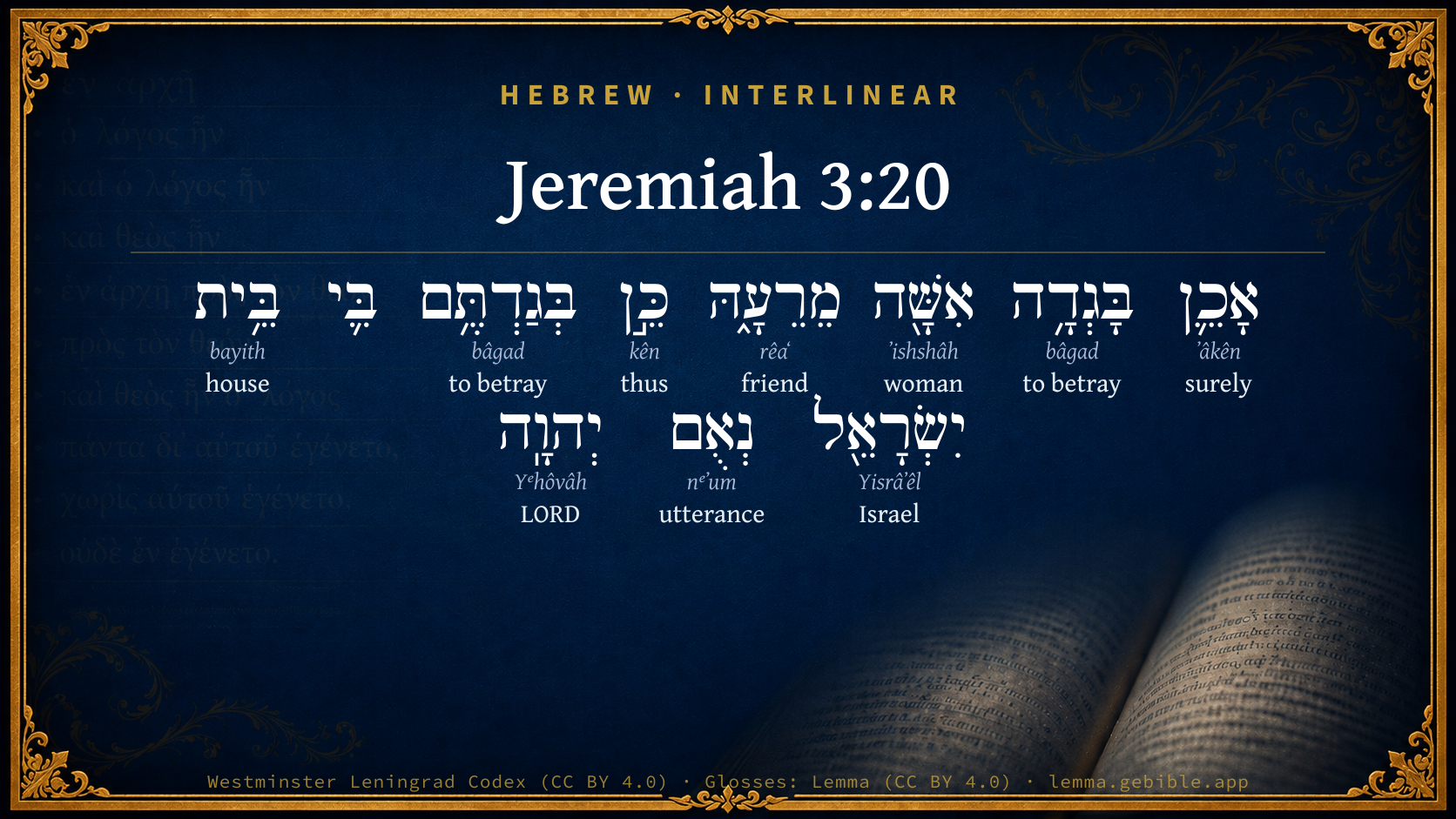
Jeremiah 3:20

Hebrew (Westminster Leningrad Codex) Jeremiah 3:20 appears in the Hebrew Old Testament. The text above is from the Westminster Leningrad Codex. Each word links to its Strong’s number, a concise gloss, and parsing drawn from the Open Scriptures Hebrew Bible morphology. Click any word for its full Brown-Driver-Briggs (BDB) entry.
Download image
Cite this verse

Jeremiah 3:20 (World English Bible). Public Domain. Lemma interlinear Bible study tool, https://lemma.gebible.app/v/jeremiah/3/20.

Show BibTeX & RIS
BibTeX
RIS
English Translation
Surely as a wife treacherously departs from her husband, so have you dealt treacherously with me, house of Israel, says Yahweh.
World English Bible · Public Domain
Download a study sheet

One document with this verse’s original text, its word-by-word gloss line, the meaning frame, cross-references with their text, attributed commentary, and full source and license credits — printable, and it pastes into notes with its structure intact.

This verse Autodidact and up

Study sheet (.html) Plain text (.txt)

A passage Seminary Student

Up to 50 verses in one chapter. A passage sheet keeps up to 6 commentary sources and 12 cross-references per verse, in the order this page ranks them, and says so on the sheet whenever that leaves anything out. Ask for a single verse and you get the Autodidact verse sheet above.

Everything on this page stays free to read, with no account — the sheet is a download of what is already on screen, not access to it.

Want to remove ads? Support Godless Engineer
Compare translations 3

The same verse in 3 English versions, stacked beneath the original-language interlinear above. Click any original word for its lexicon entry.

Each is an independent rendering of the whole verse — the interlinear is not word-aligned to these translations.

Highlighted words mark where these versions differ — a whole-verse word diff, not a word-by-word alignment.

  • World English Bible Public Domain
    Surely as a wife treacherously departs from her husband, so have you dealt treacherously with me, house of Israel, says Yahweh.
  • King James Version Public Domain
    Surely as a wife treacherously departeth from her husband, so have ye dealt treacherously with me, O house of Israel, saith the LORD.
  • unfoldingWord Literal Text CC BY-SA 4.0
    Surely, a woman dealing treacherously with her companion, so you have dealt treacherously with me, house of Israel —the declaration of Yahweh.” ts\*

unfoldingWord Literal Text — © unfoldingWord, licensed CC BY-SA 4.0. Word-aligned USFM3 via Door43 (git.door43.org/unfoldingWord/en_ult).

Versions to compare (up to 4)

3 of 4 selected

Show all 18 translations

Every available English version of this verse, each an independent rendering of the whole verse.

  • World English Bible Public Domain
    Surely as a wife treacherously departs from her husband, so have you dealt treacherously with me, house of Israel, says Yahweh.
  • Berean Standard Bible Public Domain
    But as a woman may betray her husband, so you have betrayed Me, O house of Israel,” declares the LORD.
  • Majority Standard Bible Public Domain
    But as a woman may betray her husband, so you have betrayed Me, O house of Israel,” declares the LORD.
  • King James Version Public Domain
    Surely as a wife treacherously departeth from her husband, so have ye dealt treacherously with me, O house of Israel, saith the LORD.
  • American Standard Version (1901) Public Domain
    Surely as a wife treacherously departeth from her husband, so have ye dealt treacherously with me, O house of Israel, saith Jehovah.
  • Revised Version (1885) Public Domain
    Surely as a wife treacherously departeth from her husband, so have ye dealt treacherously with me, O house of Israel, saith the LORD.
  • Geneva Bible (1599) Public Domain
    But as a woman rebelleth against her husband: so haue yee rebelled against me, O house of Israel, sayeth the Lord.
  • Douay-Rheims (1899) Public Domain
    But as a woman that despiseth her lover, so hath the house of Israel despised me, saith the Lord.
  • Young's Literal Translation Public Domain
    But -- a woman hath deceived her friend, So ye have dealt treacherously with Me, O house of Israel, an affirmation of Jehovah.
  • Literal Standard Version CC BY-SA 4.0
    But a woman has deceived her friend, || So you have dealt treacherously with Me, || O house of Israel,” || A declaration of YHWH.
  • Unlocked Literal Bible CC BY-SA 4.0
    But like a woman faithless to her husband, you have betrayed me, house of Israel—this is Yahweh's declaration.”
  • unfoldingWord Literal Text CC BY-SA 4.0
    Surely, a woman dealing treacherously with her companion, so you have dealt treacherously with me, house of Israel —the declaration of Yahweh.” ts\*
  • Darby Bible Public Domain
    Surely [as] a woman treacherously departeth from her companion, so have ye dealt treacherously with me, O house of Israel, saith Jehovah.
  • World Messianic Bible Public Domain
    “Surely as a wife treacherously departs from her husband, so you have dealt treacherously with me, house of Israel,” says the LORD.
  • Webster's Bible Public Domain
    Surely as a wife treacherously departeth from her husband, so have ye dealt treacherously with me, O house of Israel, saith the LORD.
  • Free Bible Version CC BY-SA 4.0
    But just like a wife might betray her husband, you have betrayed me, people of Israel, declares the Lord.
  • Bible in Basic English Public Domain
    Truly, as a wife is false to her husband, so have you been false to me, O Israel, says the Lord.
  • JPS Tanakh (1917) Public Domain
    Surely as a wife treacherously departeth from her husband, so have ye dealt treacherously with Me, O house of Israel, saith the LORD.

Literal Standard Version (2020), Covenant Press — licensed CC BY-SA 4.0. Text via the HelloAO Bible API (eBible.org). Unlocked Literal Bible (unfoldingWord) — licensed CC BY-SA 4.0. Text via the HelloAO Bible API (eBible.org). unfoldingWord Literal Text — © unfoldingWord, licensed CC BY-SA 4.0. Word-aligned USFM3 via Door43 (git.door43.org/unfoldingWord/en_ult). Free Bible Version, Dr. Jonathan Gallagher — licensed CC BY-SA 4.0. Text via the HelloAO Bible API (eBible.org).

Word by word

More ways to search: Search by grammar → Find every occurrence → Compare this word →

Practice this passage: Drill this verse → Learn its vocabulary →

About this verse

These counts appear in no published source. They are computed here, from the morphology-tagged text and Lemma’s own curated glosses. What Lemma adds →

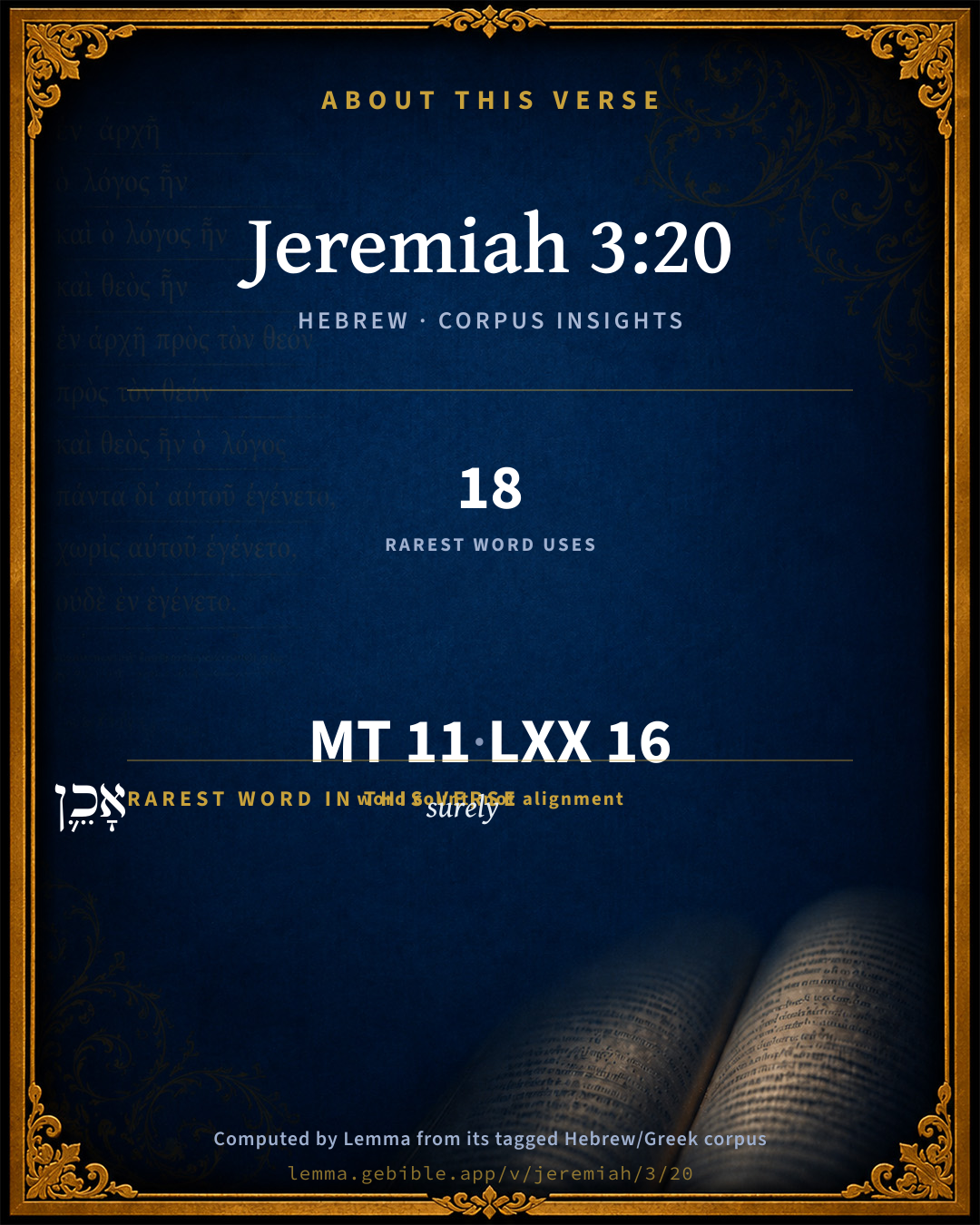
11
words
9
distinct lemmas
Prophets
section

Notable vocabulary

The rarest word here is אָכֵ֛ן surely H403 — appearing just 18 times in the whole Hebrew Bible.

Shared distinctive vocabulary

אָכֵ֛ן surely H403 occurs in 17 verses of the Hebrew Bible. Also found in:

Grammatical profile

  • 2 verbs
  • 6 nouns
  • 1 preposition
  • 1 adverb
  • 1 particle

Verb forms

  • בָּגְדָ֥ה Qal · Perfect
  • בְּגַדְתֶּ֥ם Qal · Perfect

Repetition

A word recurs within this verse — often emphatic in Hebrew:

  • בָּגְדָ֥ה to betray H898 ×2

Hebrew & Septuagint length

In the original languages it is 11 Hebrew tokens and 16 Greek tokens — but the two are counted differently (Hebrew bundles its prefixes and suffixes into one token; the Greek is in lemma form), so that isn’t a like-for-like length.

Cross-references

9

Topical passages linked to Jeremiah 3:20 in the Treasury of Scripture Knowledge — connected by theme and wording, ordered by reader-vote popularity; previews shown in the World English Bible.

  • Isaiah 48:8 Yes, you didn't hear; yes, you didn't know; yes, from of old your ear was not opened: for I knew that you did deal very treacherously, and was called a transgressor from the womb.
  • Jeremiah 5:11 For the house of Israel and the house of Judah have dealt very treacherously against me, says Yahweh.
  • Jeremiah 3:1–2 They say, If a man put away his wife, and she go from him, and become another man's, will he return to her again? Won't that land be greatly polluted? But you have played the prostitute with many lovers; yet return again to me, says Yahweh.
  • Jeremiah 3:8–10 I saw, when, for this very cause that backsliding Israel had committed adultery, I had put her away and given her a bill of divorce, yet treacherous Judah, her sister, didn't fear; but she also went and played the prostitute.
  • Ezekiel 16:15–52 But you did trust in your beauty, and played the prostitute because of your renown, and poured out your prostitution on everyone who passed by; his it was.
  • Hosea 3:1 Yahweh said to me, "Go again, love a woman loved by another, and an adulteress, even as Yahweh loves the children of Israel, though they turn to other gods, and love cakes of raisins."
  • Hosea 5:7 They are unfaithful to Yahweh; For they have borne illegitimate children. Now the new moon will devour them with their fields.
  • Hosea 6:7 But they, like Adam, have broken the covenant. They were unfaithful to me, there.
  • Malachi 2:11 Judah has dealt treacherously, and an abomination is committed in Israel and in Jerusalem; for Judah has profaned the holiness of Yahweh which he loves, and has married the daughter of a foreign god.

Cross-references courtesy of OpenBible.info (CC BY 4.0).

Hebrew and Greek witnesses Masoretic Hebrew ↔ Greek Septuagint

The same verse in the two great witnesses to the Old Testament, shown verse-for-verse.

These are two independent witnesses, not word-aligned to each other, and the Septuagint is shown in lemma (dictionary) form.

Hebrew Jeremiah 3:20 Masoretic · Westminster Leningrad Codex

אָכֵ֛ן בָּגְדָ֥ה אִשָּׁ֖ה מֵרֵעָ֑הּ כֵּ֣ן בְּגַדְתֶּ֥ם בִּ֛י בֵּ֥ית יִשְׂרָאֵ֖ל נְאֻם יְהוָֽה

Surely as a wife treacherously departs from her husband, so have you dealt treacherously with me, house of Israel, says Yahweh.

World English Bible · Public Domain

Greek LXX Structure differs

In the Septuagint, Jeremiah is about an eighth shorter than the Hebrew and arranges its material differently — the Oracles Against the Nations (Hebrew chapters 46–51) appear in the middle of the Greek book, after 25:13. Because the chapter and verse boundaries do not line up, a verse-for-verse comparison with the Hebrew is not shown.

A verse-for-verse comparison isn’t shown here because the chapters and verses don’t line up. Switch to the LXX edition with the MT / LXX toggle above to read the Greek directly.

Hebrew: Westminster Leningrad Codex (CC BY 4.0). Greek: Septuagint (public domain); English from a public-domain English Septuagint. How the Septuagint differs from the Hebrew →

Targum (Aramaic paraphrase)

1

The Targum is the ancient Jewish Aramaic paraphrase of the Hebrew Scriptures — an interpretive translation, not the Hebrew text itself. Onkelos (literal) and Pseudo-Jonathan (expansive) render the Torah, and Jonathan the Prophets. Coverage is partial: where no permissively-licensed English translation exists for a verse, only the Aramaic is shown. This is verse-level text, not a word-by-word alignment to the Hebrew.

  1. Targum Jonathan Prophets (Joshua–Malachi)
    בְּכֵן כְּמָה דִמְשַׁקְרָא אִתְּתָא בְּבַעֲלָה כֵּן שַׁקַרְתּוּן בְּמֵימְרִי בֵּית יִשְׂרָאֵל אֲמַר יְיָ:

    (no public-domain English translation for this verse)

    Targum Jonathan — Aramaic: “Mikraot Gedolot” (public domain). English: “Sefaria Community Translation” (CC0 1.0 (public-domain dedication)); “London "Chaldee Paraphrase," 1871” (public domain). Text via Sefaria.

Commentary

Notes on Jeremiah 3:20 from classic Christian and Jewish commentators (each source and its license shown beneath its notes). The classic Christian expositions comment on the surrounding passage and are grouped to its opening verse, so a note may address several verses; the Jewish commentaries on the Tanakh (Rashi and others) are per-verse, so they appear only where the commentator wrote on this verse.

Lemma curates 59 commentaries, every one of them public domain or Creative Commons licensed, each selected and text-cleaned for this edition rather than reprinted as found. About our sources →

Matthew Henry's Commentary

Here is, I. The charge God exhibits against Israel for their treacherous departures from him, Jer 3:20. As an adulterous wife elopes from her husband, so have they gone a whoring from God. They were joined to God by a marriage-covenant, but they broke that covenant, they dealt treacherously with God, who had always dealt kindly and faithfully with them. Treacherous dealing with men like ourselves is bad enough, but to deal treacherously with God is to deal treasonably.

II. Their conviction and confession of the truth of this charge, Jer 3:21. When God reproved them for their apostasy, there were some among them, even such as God would take and bring to Zion, whose voice was heard upon the high places weeping and praying, humbling themselves before the God of their fathers, lamenting their calamities, and their sins, the procuring cause of them; for this is that which they lament, for this they bemoan themselves, that they have perverted their way and forgotten the Lord their God. Note, 1. Sin is the perverting of our way, it is turning aside to crooked ways and perverting that which is right. 2. Forgetting the Lord our God is at the bottom of all sin. If men would remember God, his eye upon them and their obligation to him, they would not transgress as they do. 3. By sin we embarrass ourselves, and bring ourselves into trouble, for that also is the perverting of our way, Lam 3:9. 4. Prayers and tears well become those whose consciences tell them that they have perverted their way and forgotten their God. When the foolishness of man perverts his way his heart is apt to fret against the Lord (Pro 19:3), whereas it should be melted and poured out before him.

III. The invitation God gives them to return to him (Jer 3:22): Return, you backsliding children. He calls them children in tenderness and compassion to them, foolish and froward as children, yet his sons, whom though he corrects he will not disinherit; for, though they are refractory children (so some render it), yet they are children. God bears with such children, and so much parents. When they are convinced of sin (Jer 3:21), and humbled for that, then they are prepared and then they are invited to return, as Christ invites those to him that are weary and heavy-laden. The promise to those that return is, "I will heal your backslidings; I will comfort you under the grief you are in for your backslidings, deliver you out of the troubles you have brought yourselves into by your backslidings, and cure you of your refractoriness and tendency to backslide." God will heal our backslidings by his pardoning mercy, his quieting peace, and his renewing grace.

IV. The ready consent they give to this invitation, and their cheerful compliance with it: Behold, we come unto thee. This is an echo to God's call; as a voice returned from broken walls, so this from broken hearts. God says, Return; they answer, Behold, we come. It is an immediate speedy answer, without delay, not, "We will come hereafter," but, "We do come now; we need not take time to consider of it;" not, "We come towards thee," but, "We come to thee, we will make a thorough turn of it." Observe how unanimous they are: We come, one and all. 1. They come devoting themselves to God as theirs: "Thou art the Lord our God; we take thee to be ours, we give up ourselves to thee to be thine; whither shall we go but to thee? It is our sin and folly that we have gone from thee." It is very comfortable, in our returns to God after our backslidings, to look up to him as ours in covenant. 2. They come disclaiming all expectations of relief and succour but from God only: "In vain is salvation hoped for from the hills and from the multitude of the mountains; we now see our folly in relying upon creature-confidences, and will never so deceive ourselves any more." They worshipped their idols upon hills and mountains (Jer 3:6), and they had a multitude of idols upon their mountains, which they had sought unto and put a confidence in; but now they will have no more to do with them. In vain do we look for any thing that is good from them, while from God we may look for every thing that is good, even salvation itself. Therefore, 3. They come depending upon God only as their God: In the Lord our God is the salvation of Israel. He is the Lord, and he only can save; he can save when all other succours and saviours fail; and he is our God, and will in his own way and time work salvation for us. It is very applicable to the great salvation from sin, which Jesus Christ wrought out for us; that is the salvation of the Lord, his great salvation. 4. They come justifying God in their troubles and judging themselves for their sins, Jer 3:24, Jer 3:25. (1.) They impute all the calamities they had been under to their idols, which had not only done them no good, but had done them abundance of mischief, all the mischief that had been done them: Shame (the idol, that shameful thing) has devoured the labour of our fathers. Note, [1.] True penitents have learned to call sin shame; even the beloved sin which has been as an idol to them, which they have been most pleased with and proud of, even that they shall call a scandalous thing, shall put contempt upon it and be ashamed of it. [2.] True penitents have learned to call sin death and ruin, and to charge upon it all the mischiefs they suffer: "It has devoured all those good things which our fathers laboured for and left to us; we have found from our youth that our idolatry has been the destruction of our prosperity." Children often throw away upon their lusts that which their fathers took a great deal of pains for; and it is well if at length they are brought (as these here) to see the folly of it, and to call those vices their shame which have wasted their estates and devoured the labour of their fathers. Of the labour of their fathers, which their idols had devoured, they mention particularly their flocks and their herds, their sons and their daughters. First, their idolatries had provoked God to bring these desolating judgments upon them, which had ruined their country and families, and made their estates a prey and their children captives to the conquering enemy. They had procured these things to themselves. Or, rather, Secondly, These had been sacrificed to their idols, had been separated unto that shame (Hos 9:10), and they had devoured them without mercy; they did eat the fat of their sacrifices (Deu 32:38), even their human sacrifices. (2.) They take to themselves the shame of their sin and folly (Jer 3:25): "We lie down in our shame, being unable to bear up under it; our confusion covers us, that is, both our penal and our penitential shame. Sin has laid us under such rebukes of God's providence, and such reproaches of our own consciences, as surround us and fill us with shame. For we have sinned, and shame came in with sin and still attends upon it. We are sinners by descent; guilt and corruption are entailed upon us: We and our fathers have sinned. We were sinners betimes; we began early in a course of sin: We have sinned from our youth; we have continued in sin, have sinned even unto this day, though often called to repent and forsake our sins. That which is the malignity of sin, the worst thing in it, is the affront we have put upon God by it: We have not obeyed the voice of the Lord our God, forbidding us to sin and commanding us, when we have sinned, to repent." Now all this seems to be the language of the penitents of the house of Israel (Jer 3:20), of the ten tribes, either of those that were in captivity or those of them that remained in their own land. And the prophet takes notice of their repentance to provoke the men of Judah to a holy emulation. David used it as an argument with the elders of Judah that it would be a shame for those that were his bone and his flesh to be the last in bringing the king back, when the men of Israel appeared forward in it, Sa2 19:11, Sa2 19:12. So the prophet excites Judah to repent because Israel did: and well it were if the zeal of others less likely would provoke us to strive to get before them and go beyond them in that which is good.

Matthew Henry's Commentary on the Whole Bible (1708–1710) — public domain (CC PDM 1.0). Text via the HelloAO Bible API.

Trapp's Complete Commentary

John Trapp

Jer 3:20 Surely [as] a wife treacherously departeth from her husband, so have ye dealt treacherously with me, O house of Israel, saith the LORD.

Ver. 20. Surely as a treacherous wife, &c.] This ye have done, but that is your present grief, and now you look upon your former disloyalties with a lively hatred of them, holding that the time past of your life may suffice to have wrought the will of the Gentiles, &c. {1Pe 4:3}

John Trapp, A Commentary or Exposition upon All the Books of the Old and New Testament (1647–1656) — public domain. Text from a community e-Sword module.

Joseph Benson's Commentary

Jer 3:20-21. Surely, as a wife treacherously departeth, &c. — This may be rendered, As a woman is not faithful to her husband, or, her friend, as the Hebrew רעהsignifies. Here God returns to the carnal Israelites; so that the Jewish doctors seem to be right in calling the spirit of prophecy an abrupt spirit. So have you dealt treacherously with me — God, by thus reminding the Israelites of what they had formerly been, endeavours to bring them to repentance and new obedience for the time to come. A voice was heard, &c. — Here the prophet, foreseeing that some of them would at length be brought to true repentance for all their misdoings, represents them as bewailing themselves upon the high places, the scenes of their former idolatries. Compare Jer 31:9; Jer 50:4; Zec 12:10. Or, as some think, he alludes to the usual practice of praying upon the tops of houses in great calamities, Isa 15:3; and Isa 22:1; Jer 7:29. For they have perverted their way — This is that which they lament: for this they bemoan themselves. They have forgotten the Lord their God — Of this they were now sensible, and for this they were humbled, as being the first step toward their apostacy. Observe well, reader, 1st, Sin is the perverting of our way; it is turning aside to crooked paths, and perverting that which is right. By it we embarrass ourselves, and bring ourselves into trouble and misery. 2d, Forgetting the Lord our God is at the bottom of all sin: if men would remember God, and their obligations to him, and consider that his eye is upon them, they would not transgress as they do. 3d, Prayers and tears well become those whose consciences tell them that they have perverted their way and forgotten their God.

Joseph Benson's Commentary on the Old and New Testaments (1811–1818) — public domain. Text from a community e-Sword module.

Geneva Bible (1599)

Geneva Bible translators

The Hebrew word signifieth a friend or companion, and here may be taken for a husband, as it is used also, Hos. 3:1.

Geneva Bible (1599) marginal notes — public domain. Text via Bolls.life.

Jamieson, Fausset & Brown

Robert Jamieson, A. R. Fausset & David Brown

Surely--rather, "But."

husband--literally, "friend."

Jamieson, Fausset & Brown — Commentary Critical and Explanatory on the Whole Bible (1871) — public domain (CC PDM 1.0). Text via the HelloAO Bible API.

John Calvin's Commentaries

He confirms the first clause of the preceding verse: for he had said that it could hardly be that the Jews would recover what they had lost, and be formed again a new people; and he shews the reason, — because they were like an adulteress, as he had before stated. But he did not yet wish to take away every hope; only he insists on this, that they were seriously to consider their sins, in order that they might become displeased with themsalves, and flee to God’s mercy for refuge. Nor did he do this so much for their sake, as for the sake of the people among whom he dwelt. For he had respect, as it has been often stated, especially to the Jews, who had become so hardened in their vices as not to think that this example, by which God intended to terrify them, so as to bend their hard hearts to repentance, belonged to them. Hence it was for this reason that God so severely reproved Israel; for he had said before, that the Jews were still worse. He afterwards subjoins —

John Calvin's Commentaries (1540-1563) — public domain. Text from the Calvin Translation Society English edition (1840s-50s) via the Christian Classics Ethereal Library (ccel.org). Calvin's coverage is partial (roughly two-thirds of the Bible); uncommented books and verses are honest gaps, never fabricated. The 19th-century editor's footnotes and remarks are omitted so the notes are faithfully Calvin's own voice.

Ellicott's Commentary for English Readers

(20) Surely as a wife . . .—In the midst of the bright vision of the future there comes unbidden the thought of the dark present: the faithless wife is not yet restored to her true friend and husband. Her guilt must be again pressed home upon her, so as to lead her to repentance.

A Bible Commentary for English Readers, edited by Charles John Ellicott (1878–1897) — public domain. Text from a community e-Sword module.

The Cambridge Bible for Schools and Colleges

gen. ed. J. J. S. Perowne

20. O house of Israel] Israel as including Judah.

The Cambridge Bible for Schools and Colleges (gen. ed. J. J. S. Perowne; Cambridge University Press, 1878–1918) — public domain. Text from a community e-Sword module.

John Gill's Exposition

Surely as a wife treacherously departeth from her husband,.... Or, "her friend" (i); who loves her, takes care of her, and provides for her, and goes after another man, and cohabits with him; which is a violation of the marriage covenant, and acting a base and treacherous part unto him to whom she is married

so have you dealt treacherously with me, O house of Israel, saith the Lord; who was their Father, friend, and husband; who loved them and distinguished them from all other people, by a variety of blessings and privileges; and yet they departed from his commandments and ordinances, and held the traditions of the elders, and taught for doctrines the commandments of men, and rejected the Messiah, and still continue in their disbelief of him, and hatred to him; and therefore it need not be wondered at that he should make any difficulty about their adoption and inheritance; and a marvellous thing it must be to take such persons, and put them openly among his children, and give them a right and meetness for the goodly inheritance.

(i) "ab amico suo", Vatablus, Junius & Tremellius, Piscator; "a socio suo", Cocceius.

John Gill's Exposition of the Whole Bible (1746–1763) — public domain (CC PDM 1.0). Text via the HelloAO Bible API.

Albert Barnes' Notes on the Bible

Surely as - Rather: “Just as.”

Albert Barnes' Notes on the Bible (1834–1885) — public domain. Text from a community e-Sword/MySword module.

Matthew Poole's English Annotations

God hereby telling her what she had formerly been, endeavours to engage her to what she ought to be, namely, considering her former unfaithfulness in time past, how she ought to carry it for the future. See 1Pe 4:3.

Matthew Poole's English Annotations on the Holy Bible (1683–1685) — public domain. Text from a community e-Sword/MySword module.

Whedon's Commentary on the Bible

Daniel D. Whedon

20. Surely as — Rather, Just as.

Husband — Hebrew, friend. Israel has been false to the holiest obligations, and this would seem to close the door of hope for her return.

Daniel D. Whedon (gen. ed.), Commentary on the Old and New Testaments (1874–1909) — public domain. Text from a community e-Sword module.

The Pulpit Commentary

Surely. The word acquires an adversative sense from the context, as in Isa_53:4, and is virtually equivalent to "but surely." From her husband; literally, from her friend or companion. The choice of the word seems to indicate the inner hollowness of the married life. The woman only sees in her husband the companion, behind whoso back she can follow her own inclinations.

Ver. 20-Jer_4:2) we seem to have a telling of the experience of the restored one, a setting forth of how God had dealt with him. It is given in the form of a dialogue between God and Israel, and is an accurate description of the Divine process of restoration.

I THERE IS THE BRINGING HOME OF SIN TO THE CONSCIENCE. (Ver. 20) God charges upon lost Israel great and grievous sin. He likens the wrong he has suffered at the hands of Israel to the most grievous wrong it is possible for a man to suffer, and which of all others a man resents the most. The accusation is terrible. Thus sharply and sternly does God deal with the soul he would save. He does not gloss over, or palliate, or in any way make little of our sin, as we are apt to do; but he shows it to us so clearly that the sight of it is almost more than the heart can bear.

II THIS CONVICTION OF SIN IS FOLLOWED BY A DEEP REPENTANCE. (Ver. 21) Israel is represented as seeing her sin, and then from the very high places which had witnessed her guilt is heard her weeping and supplication. The soul that has never known the smart and pain of the conviction of sin will never earnestly turn to the Great Physician for the healing that is needed.

III THE PROCLAMATION OF MERCY FOLLOWS. Ver. 22, "Return, ye apostate children, I will heal your apostasies." Just as to the enraptured ears of the penitent who was weeping over the Savior"s feet there came the blessed sound of his pardoning word, assuring her, her sins were forgiven and that she might go in peace, so here God is represented as declaring his mercy to the weeping, supplicating Israel. And the heart the Lord hath dealt with knows that thus it is. A voice not audible, but real, is heard in the soul, assuring the contrite one of the forgiveness he needs and craves.

IV IN SUCH A HEART PROMPT BELIEF, INSTANT ACCEPTANCE OF THE OFFERED MERCY, FOLLOWS. Ver. 22, "Behold, we come unto thee; for," etc. As well might the steel filings refuse to be moved by the magnet that lies by them as the sin-convinced and contrite heart fail to lay hold on the promise set before it in the gospel. No sooner has God said, "Return, I will heal," than the answer is heard, "Behold, we come.

V Then follows THE CONFESSION AND REPENTANCE OF FAITH. (Vers. 23-25) There had been confession and repentance before the soul had heard and accepted the offer of pardon; but that which follows is more full, more deep than that which went before. We repent more deeply of sin after we have known God has pardoned us than before we had that blessed knowledge. See here:

1. Their confession of the utter vanity of all their idols (ver. 23).

2. Their confident assurance that God alone can be their salvation (ver. 23).

3. Their confession of the disgrace and infatuated folly which had characterized them as a people for so long a time (ver. 24). They call their idolatry "shame," and own how it has destroyed both their substance and themselves.

4. They acknowledge the complete righteousness of God"s judgment against their sin, and their own just exposure to his wrath (ver. 25). "Let us lie in our shame and our disgrace cover us, that we have sinned," etc. (Lange"s translation). And thus it ever is: the more we realize God"s pardoning love, the more intense will be our perception of the baseness and utter evil of the sin that has been forgiven.

VI This CONFESSION IS FOLLOWED BY FURTHER ASSURANCES OF GRACE. (Jer_4:1, Jer_4:2) Return to God shall be followed by return to their own land. "If thou returnest to me, thou shalt return (unto thy land), and if thou puttest away, etc., thou shalt not remove," i.e. into exile again. "And if thou shalt swear by Jehovah with sincere, righteous, and true heart," i.e. "if thou wilt truly give thyself up to God, then the heathen nations outside, seeing how thy God shall bless thee and shall heap his favors upon thee, shall come and bless themselves in him, and shall glory in him," i.e. they shall have done with their idolatries and be converted unto God. With such gracious promises would God encourage Israel in the new and better way in which they are represented as walking; with such gentleness would he make them, as he in like manner makes all who truly turn to him, great. C.

The Pulpit Commentary (1880–1919), ed. H.D.M. Spence-Jones & Joseph S. Exell — public domain. Text from a community e-Sword module.

Rashi

Rabbi Shlomo Yitzchaki (Rashi)

Truly But you did not live up to My expectations [lit., do My thought], but like a woman who betrays her beloved because he cannot provide her sustenance, so did you betray Me, Who provides you with all good. So is the Midrash Aggadah (Tanhuma Mishpatim 17).

Rashi on the Tanakh — English translations: “The Judaica Press complete Tanach with Rashi, translated by A. J. Rosenberg” (CC BY 4.0); “Pentateuch with Rashi's commentary by M. Rosenbaum and A.M. Silbermann, 1929-1934” (public domain); “The Metsudah Tanach series, Lakewood, N.J” (CC BY 4.0); and “The Book of Joshua, Metsudah Publications, 1997” (CC BY 4.0). Text via Sefaria.

Lesson kit

Teaching starters — assembled from the data on this page, not authored interpretation. Every prompt links to the verse data it draws on. Edit before teaching.

Jeremiah, in the Prophets, opens this verse with 11 words (9 distinct Hebrew lemmas). Its most distinctive word is ʼâkên (“surely”). A historical commentator’s framing appears above. Read the whole chapter for the surrounding context.

Discussion questions

  1. The word ʼâkên carries the sense “surely.” How does it shape the verse?
  2. Genesis 28:16 shares the word «surely» with this verse. How do the two illuminate each other?
  3. “to betray” occurs 2× in this one verse. What is the effect of the repetition?
  4. These translations render this verse differently. What is at stake in choosing one wording over another?
  5. The verb «בָּגְדָ֥ה» is Qal Perfect. How does its form color the action?
  6. Reading how Matthew Henry's Commentary and Trapp's Complete Commentary read this verse, where do the two commentators agree and where do they part?

Things to notice

Reading settings

Reading text

Shown beneath each verse's original-language words.

Old Testament
Old Testament edition

Read the OT as the Masoretic Hebrew (MT) or the Greek Septuagint (LXX).

English shown for the Greek Septuagint (in the Hebrew ↔ Greek comparison).

Comparing translations? Open the Compare panel on any verse page to stack up to four side by side.