

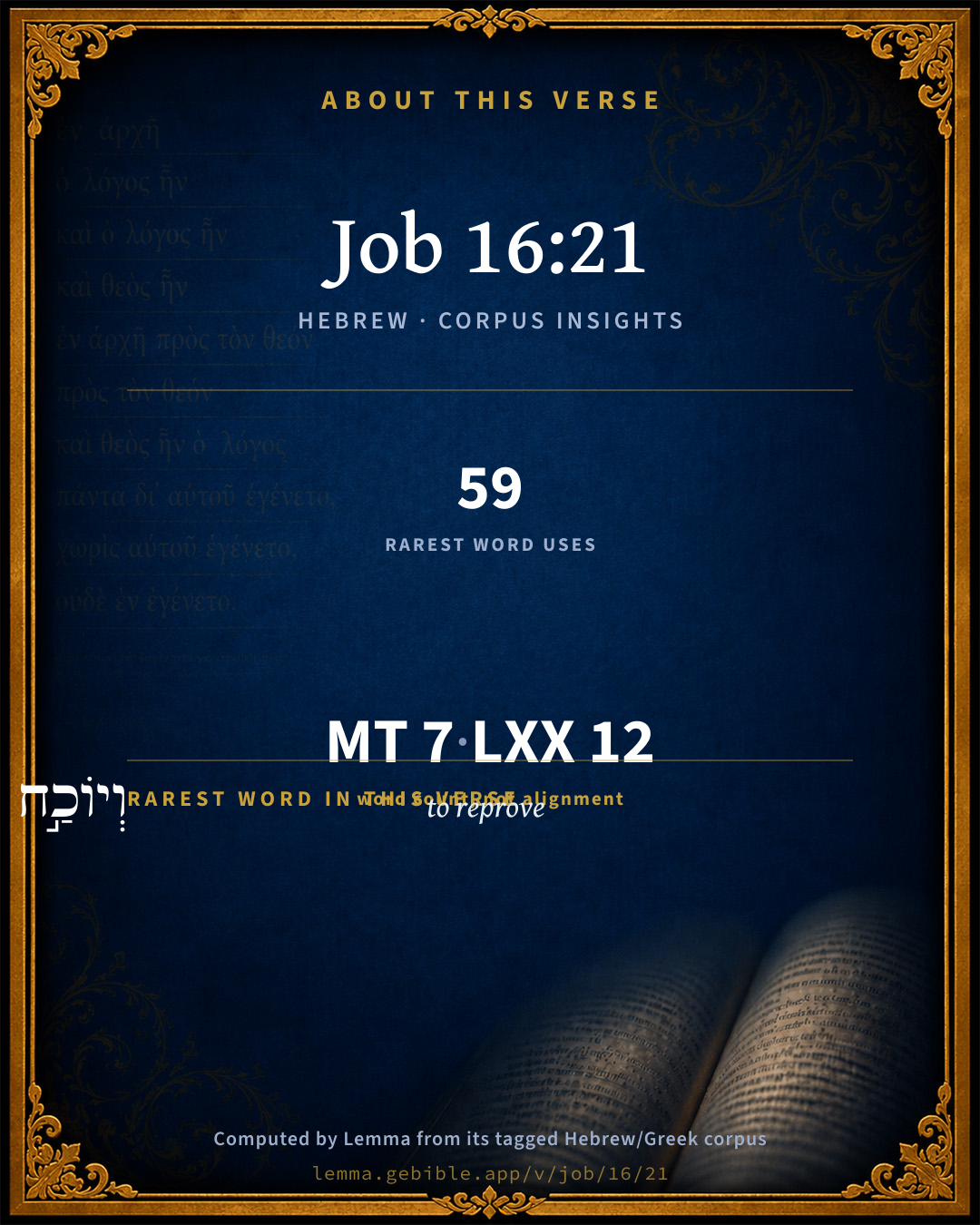
Job 16:21

Hebrew (Westminster Leningrad Codex) Job 16:21 appears in the Hebrew Old Testament. The text above is from the Westminster Leningrad Codex. Each word links to its Strong’s number, a concise gloss, and parsing drawn from the Open Scriptures Hebrew Bible morphology. Click any word for its full Brown-Driver-Briggs (BDB) entry.
Download image
Cite this verse

Job 16:21 (World English Bible). Public Domain. Lemma interlinear Bible study tool, https://lemma.gebible.app/v/job/16/21.

Show BibTeX & RIS
BibTeX
RIS
English Translation
That he would maintain the right of a man with God, Of a son of man with his neighbor!
World English Bible · Public Domain
Download a study sheet

One document with this verse’s original text, its word-by-word gloss line, the meaning frame, cross-references with their text, attributed commentary, and full source and license credits — printable, and it pastes into notes with its structure intact.

This verse Autodidact and up

Study sheet (.html) Plain text (.txt)

A passage Seminary Student

Up to 50 verses in one chapter. A passage sheet keeps up to 6 commentary sources and 12 cross-references per verse, in the order this page ranks them, and says so on the sheet whenever that leaves anything out. Ask for a single verse and you get the Autodidact verse sheet above.

Everything on this page stays free to read, with no account — the sheet is a download of what is already on screen, not access to it.

Want to remove ads? Support Godless Engineer
Compare translations 3

The same verse in 3 English versions, stacked beneath the original-language interlinear above. Click any original word for its lexicon entry.

Each is an independent rendering of the whole verse — the interlinear is not word-aligned to these translations.

Highlighted words mark where these versions differ — a whole-verse word diff, not a word-by-word alignment.

  • World English Bible Public Domain
    That he would maintain the right of a man with God, Of a son of man with his neighbor!
  • King James Version Public Domain
    O that one might plead for a man with God, as a man pleadeth for his neighbour!
  • unfoldingWord Literal Text CC BY-SA 4.0
    And he will argue for a man with God, and a son of man for his neighbor.

unfoldingWord Literal Text — © unfoldingWord, licensed CC BY-SA 4.0. Word-aligned USFM3 via Door43 (git.door43.org/unfoldingWord/en_ult).

Versions to compare (up to 4)

3 of 4 selected

Show all 18 translations

Every available English version of this verse, each an independent rendering of the whole verse.

  • World English Bible Public Domain
    That he would maintain the right of a man with God, Of a son of man with his neighbor!
  • Berean Standard Bible Public Domain
    Oh, that a man might plead with God as he pleads with his neighbor!
  • Majority Standard Bible Public Domain
    Oh, that a man might plead with God as he pleads with his neighbor!
  • King James Version Public Domain
    O that one might plead for a man with God, as a man pleadeth for his neighbour!
  • American Standard Version (1901) Public Domain
    That he would maintain the right of a man with God, And of a son of man with his neighbor!
  • Revised Version (1885) Public Domain
    That he would maintain the right of a man with God, and of a son of man with his neighbour!
  • Geneva Bible (1599) Public Domain
    Oh that a man might pleade with God, as man with his neighbour!
  • Douay-Rheims (1899) Public Domain
    My friends are full of words: my eye poureth out tears to God.
  • Young's Literal Translation Public Domain
    And he reasoneth for a man with God, And a son of man for his friend.
  • Literal Standard Version CC BY-SA 4.0
    And He reasons for a man with God, || As a son of man for his friend.
  • Unlocked Literal Bible CC BY-SA 4.0
    I ask for that witness in heaven to argue for this man with God as a man does with his neighbor!
  • unfoldingWord Literal Text CC BY-SA 4.0
    And he will argue for a man with God, and a son of man for his neighbor.
  • Darby Bible Public Domain
    Oh that there were arbitration for a man with +God, as a son of man for his friend!
  • World Messianic Bible Public Domain
    that he would maintain the right of a man with God, of a son of man with his neighbor!
  • Webster's Bible Public Domain
    O that one might plead for a man with God, as a man pleadeth for his neighbor!
  • Free Bible Version CC BY-SA 4.0
    I want my witness to speak for me with God as someone does for their friend.
  • Bible in Basic English Public Domain
    So that he may give decision for a man in his cause with God, and between a son of man and his neighbour.
  • JPS Tanakh (1917) Public Domain
    That He would set aright a man contending with God, as a son of man setteth aright his neighbour!

Literal Standard Version (2020), Covenant Press — licensed CC BY-SA 4.0. Text via the HelloAO Bible API (eBible.org). Unlocked Literal Bible (unfoldingWord) — licensed CC BY-SA 4.0. Text via the HelloAO Bible API (eBible.org). unfoldingWord Literal Text — © unfoldingWord, licensed CC BY-SA 4.0. Word-aligned USFM3 via Door43 (git.door43.org/unfoldingWord/en_ult). Free Bible Version, Dr. Jonathan Gallagher — licensed CC BY-SA 4.0. Text via the HelloAO Bible API (eBible.org).

Word by word

More ways to search: Search by grammar → Find every occurrence → Compare this word →

Practice this passage: Drill this verse → Learn its vocabulary →

וְיוֹכַ֣ח
yâkach
H3198
“and · to reprove”
Conjunction + Verb, Hiphil, Imperfect, 3rd Person, Masculine, Singular
Part of Speech
Conjunction + Verb
Stem
Hiphil
Form
Imperfect
Person
3rd Person
Gender
Masculine
Number
Singular
Full BDB Definition

Origin: a primitive root

TWOT: 865

to prove, decide, judge, rebuke, reprove, correct, be right - (Hiphil) - to decide, judge - to adjudge, appoint - to show to be right, prove - to convince, convict - to reprove, chide - to correct, rebuke - (Hophal) to be chastened - (Niphal) to reason, reason together - (Hithpael) to argue
  1. לְגֶ֣בֶר geber H1397 “to/for · man” Preposition + Noun, Common, Masculine, Singular, Absolute
  2. עִם ʻim H5973 “with” Preposition
  3. אֱל֑וֹהַּ ʼĕlôwahh H433 “God” Noun, Common, Masculine, Singular, Absolute
  4. וּֽבֶן bên H1121 “and · son of” Conjunction + Noun, Common, Masculine, Singular, Construct
  5. אָדָ֥ם ʼâdâm H120 “man” Noun, Common, Masculine, Singular, Absolute
  6. לְרֵעֵֽהוּ rêaʻ H7453 “to/for · friend · his” Preposition + Noun, Common, Masculine, Singular, Construct + Suffix, Personal, 3rd Person, Masculine, Singular

About this verse

These counts appear in no published source. They are computed here, from the morphology-tagged text and Lemma’s own curated glosses. What Lemma adds →

7
words
7
distinct lemmas
Wisdom
section

Shared distinctive vocabulary

וְיוֹכַ֣ח to reprove H3198 occurs in 55 verses of the Hebrew Bible. Also found in:

Grammatical profile

  • 1 verb
  • 5 nouns
  • 1 preposition

Verb forms

  • וְיוֹכַ֣ח Hiphil · Imperfect

Hebrew & Septuagint length

In English translation the verse runs 19 words from the Hebrew and 14 from the Septuagint (LXX English) — closely comparable.

A rough comparison of the two English renderings, which tokenize alike — not a word-level alignment.

Word counts can differ between the Hebrew and the Greek without any difference in meaning — e.g. the Hebrew direct-object marker אֵת has no separate Greek word, and Greek often adds the article ὁ.

In the original languages it is 7 Hebrew tokens and 12 Greek tokens — but the two are counted differently (Hebrew bundles its prefixes and suffixes into one token; the Greek is in lemma form), so that isn’t a like-for-like length.

Cross-references

9

Topical passages linked to Job 16:21 in the Treasury of Scripture Knowledge — connected by theme and wording, ordered by reader-vote popularity; previews shown in the World English Bible.

  • Ecclesiastes 6:10 Whatever has been, its name was given long ago; and it is known what man is; neither can he contend with him who is mightier than he.
  • Isaiah 45:9 Woe to him who strives with his Maker--a potsherd among the potsherds of the earth! Shall the clay ask him who fashions it, "What are you making?" or your work, "He has no hands?"
  • Romans 9:20 But indeed, O man, who are you to reply against God? Will the thing formed ask him who formed it, "Why did you make me like this?"
  • Job 9:34–35 Let him take his rod away from me, Let his terror not make me afraid:
  • Job 13:3 "Surely I would speak to the Almighty. I desire to reason with God.
  • Job 13:22 Then call, and I will answer; Or let me speak, and you answer me.
  • Job 23:3–7 Oh that I knew where I might find him! That I might come even to his seat!
  • Job 31:35 Oh that I had one to hear me! (Behold, here is my signature, let the Almighty answer me); Let the accuser write my indictment!

Cross-references courtesy of OpenBible.info (CC BY 4.0).

Hebrew and Greek witnesses Masoretic Hebrew ↔ Greek Septuagint

The same verse in the two great witnesses to the Old Testament, shown verse-for-verse.

These are two independent witnesses, not word-aligned to each other, and the Septuagint is shown in lemma (dictionary) form.

Hebrew Job 16:21 Masoretic · Westminster Leningrad Codex

וְיוֹכַ֣ח לְגֶ֣בֶר עִם אֱל֑וֹהַּ וּֽבֶן אָדָ֥ם לְרֵעֵֽהוּ

That he would maintain the right of a man with God, Of a son of man with his neighbor!

World English Bible · Public Domain

Greek LXX Job 16:21 Septuagint · lemma form

εἰμί δέ ἔλεγχος ἀνήρ ἔναντι κύριος καί υἱός ἄνθρωπος ὁ πλησίον αὐτός

Let my supplication come to the Lord, and let my eye weep before him.

LXX2012 (modern English Septuagint) · Public Domain

Hebrew: Westminster Leningrad Codex (CC BY 4.0). Greek: Septuagint (public domain); English from LXX2012 (modern English Septuagint) (Public Domain). How the Septuagint differs from the Hebrew →

Commentary

Notes on Job 16:21 from classic Christian and Jewish commentators (each source and its license shown beneath its notes). The classic Christian expositions comment on the surrounding passage and are grouped to its opening verse, so a note may address several verses; the Jewish commentaries on the Tanakh (Rashi and others) are per-verse, so they appear only where the commentator wrote on this verse.

Lemma curates 59 commentaries, every one of them public domain or Creative Commons licensed, each selected and text-cleaned for this edition rather than reprinted as found. About our sources →

Trapp's Complete Commentary

John Trapp

Job 16:21 O that one might plead for a man with God, as a man [pleadeth] for his neighbour!

Ver. 21. O that one might plead for a man with God] Heb. And he will plead for a man with God, and the Son of man for his friend; that is (say our late learned annotators, to whom we are greatly bound for this most sweet and spiritual exposition of the words), Christ, who is God and man, will plead my cause with his Father; he can prevail, because he is God equal to the Father; he will undertake it, because he will be man like to me. This interpretation agreeth best with the coherence and the words following. And it seemeth that Job knew the mystery of Christ’s incarnation, Job 19:25-27, where he speaketh of him both as God, and as a visible Redeemer. Christ is frequently called the Son of man in the New Testament, and believers are called his friends, Joh 15:13-15. By this text thus expounded we see that the doctrine of a mediator between God and man was known and believed in the world long before Christ came into the world. He is the Lamb of God slain from the foundation of the world, Rev 13:8, and to the Jews the ceremonial law was instead of a gospel.

John Trapp, A Commentary or Exposition upon All the Books of the Old and New Testament (1647–1656) — public domain. Text from a community e-Sword module.

Joseph Benson's Commentary

Job 16:21. O that one might plead for a man with God — O that either I or some faithful advocate might be admitted to plead my cause, either with God, or rather with you before God’s tribunal, God being witness and judge between us. A different translation of this verse is proposed by some, a translation which the Hebrew text will very well bear, namely, And he will plead (that is, there is one that will plead) for man with God, even the Son of man, for his friend or neighbour. Those who pour out tears before God, though they cannot plead for themselves by reason of their distance and defects, have a friend to plead for them, even the Son of man; and on this we must ground all our hopes of acceptance with God.

Joseph Benson's Commentary on the Old and New Testaments (1811–1818) — public domain. Text from a community e-Sword module.

Geneva Bible (1599)

Geneva Bible translators

Thus by his great torments he is carried away, and breaketh out into passions, and speaketh unadvisedly, as though God should entreat man more gently, seeing he hath but a short time here to live.

Geneva Bible (1599) marginal notes — public domain. Text via Bolls.life.

Jamieson, Fausset & Brown

Robert Jamieson, A. R. Fausset & David Brown

one--rather, "He" (God). "Oh, that He would plead for a man (namely, me) against God." Job quaintly says, "God must support me against God; for He makes me to suffer, and He alone knows me to be innocent" [UMBREIT]. So God helped Jacob in wrestling against Himself (compare Job 23:6; Gen 32:25). God in Jesus Christ does plead with God for man (Rom 8:26-27).

as a man--literally, "the Son of man." A prefiguring of the advocacy of Jesus Christ--a boon longed for by Job (Job 9:33), though the spiritual pregnancy of his own words, designed for all ages, was but little understood by him (Psa 80:17).

for his neighbour--Hebrew, "friend." Job himself (Job 42:8) pleaded as intercessor for his "friends," though "his scorners" (Job 16:20); so Jesus Christ the Son of man (Luk 23:34); "for friends" (Joh 15:13-15).

Jamieson, Fausset & Brown — Commentary Critical and Explanatory on the Whole Bible (1871) — public domain (CC PDM 1.0). Text via the HelloAO Bible API.

Adam Clarke's Commentary

Verse 21. O that one might plead] Let me only have liberty to plead with God, as a man hath with his fellow.

Adam Clarke's Commentary on the Bible (1810–1826) — public domain. Text from a community e-Sword/MySword module.

The Cambridge Bible for Schools and Colleges

gen. ed. J. J. S. Perowne

21. That he would maintain the right of a man with God,

And of a son of man against his neighbour.

The Cambridge Bible for Schools and Colleges (gen. ed. J. J. S. Perowne; Cambridge University Press, 1878–1918) — public domain. Text from a community e-Sword module.

John Gill's Exposition

When a few years are come,.... As the years of man's life are but few at most, and Job's years, which were yet to come, still fewer in his apprehension; or "years of number" (m), that are numbered by God, fixed and determined by him, Job 14:5; or being few are easily numbered:

then I shall go the way whence I shall not return; that is, go the way of all flesh, a long journey; death itself is meant, which is a going out of this world into another, from whence there is no return to this again, to the same place, condition, circumstances, estate, and employment as now; otherwise there will be a resurrection from the dead, the bodies will rise out of the earth, and souls will be brought again to be united with them, but not to be in the same situation here as now: this Job observes either as a kind of solace to him under all his afflictions on himself, and from his friends, that in a little time it would be all over with him; or as an argument to hasten the pleading of his cause, that his innocence might be cleared before he died; and if this was not done quickly, it would be too late.

(m) "anni numeri", Montanus, Vatablus, Bolducius; "numbered days", Broughton; so Tigurine version.

Next: Job Chapter 17

John Gill's Exposition of the Whole Bible (1746–1763) — public domain (CC PDM 1.0). Text via the HelloAO Bible API.

Albert Barnes' Notes on the Bible

Oh that one might plead for a man - A more correct rendering of this would be, “Oh that it might be for a man to contend with God;” that is, in a judicial controversy. It is the expression of an earnest desire to carry his cause at once before God, and to be permitted to argue it there. This desire Job had often expressed; see Job 13:3, note; Job 13:18-22, notes. On the grammatical construction of the passage, see Rosenmuller.

As a man pleadeth for his neighbour - Hebrew “the son of man;” that is, the offspring of man. Or, rather, as a man contendeth with his neighbor; as one man may carry on a cause with another. He desired to carry his cause directly before God, and to be permitted to argue the case with him, as one is permitted to maintain an argument with a man; see the notes at Job 13:20-21.

Albert Barnes' Notes on the Bible (1834–1885) — public domain. Text from a community e-Sword/MySword module.

Haydock's Catholic Bible Commentary

Full. Hebrew, "scorners." Therefore I appeal to inanimate things; and, above all, to God, who cannot give a wrong judgment.

George Leo Haydock (1774–1849), Haydock's Catholic Family Bible and Commentary, 1859 edition — public domain. Excludes Psalms (Douay-Rheims chapter numbering differs from Protestant) and Deuterocanonical books (Catholic canon only).

Matthew Poole's English Annotations

Oh that either I or some faithful advocate might be admitted to plead any cause, either with God, or rather with you, before God’s tribunal, God being witness and judge between us! But this verse is, and that very agreeably to the Hebrew text, otherwise translated and interpreted; either,

1. With respect to Christ, And he (i.e. God, last mentioned, to wit, God the Son, Christ Jesus) will plead for a man (i.e. for me, against whom you plead.) He modestly speaketh of himself in the third person, as is usual)

with God (to wit, with God the Father; and the Son of man (as Christ is oft called) will plead for his friend, or companion, or neighbour, i.e. for a man whom he hath taken into that relation to himself. It is plain that the mystery of man’s redemption by Christ was known to the ancient patriarchs, as hath been oft noted before; and to Job among others, Job 19:25. Or,

2. As the matter for which he prayed and cried to God, That (so the Hebrew vau is frequently used) he (i.e. God) would plead, or judge, or give sentence for a man (i.e. for me, or in my cause) with, God, (i.e. with himself, the noun being put for the pronoun, as Gen 2:20; 4:15; Lev 14:15,16, and elsewhere; or at his own tribunal, to which I have appealed,)

as a man pleadeth for his friend or neighbour with or before an earthly judge and tribunal. This seems most agreeable to the scope of the place, which was to maintain his own integrity against his friends before God.

Matthew Poole's English Annotations on the Holy Bible (1683–1685) — public domain. Text from a community e-Sword/MySword module.

Whedon's Commentary on the Bible

Daniel D. Whedon

21. Oh that one might plead — Better, O that He (God) would plead for man with God, as a son of man for his fellow. ויוכח, weyokahh, argue, plead, is rendered by Schlottmann, Ewald, and others, do justice; by Delitzsch, decide; by Wordsworth, Carey, etc., plead. See note Job_9:33. The German mind has caught a glimmering view, as “through a glass, darkly,” of the blessed purport of this passage, thus: “God is regarded as a twofold person, an adversary, and at the same time an umpire;” (Hirtzel;) and “Job appeals from God to God.” (Delitzsch.) “With melancholy quaintness [!!] Job says, God must support me against God.” — Umbreit. Melancholy there may be, but there is nothing quaint in human needs; for they are as deep as the soul and old as fallen man. Job’s burdened soul was not the first that has poured itself forth in sighs that God might plead with God in its behalf. In the falling tears of Job, germinant with words of hope, faith sees the bow of promise — an indirect prophecy of that advocacy which in after times was revealed as existing in Christ. The grand essential features of the Christian scheme are here in outline — man’s need of a superhuman mediator — that this mediator must be co-equal with God — and that our hope of mediation is in the Godhead itself — all based upon the postulate which appeals to the universal heart, that kindred nature is vital to successful mediation: “As a son of man pleads for his fellow.”

Daniel D. Whedon (gen. ed.), Commentary on the Old and New Testaments (1874–1909) — public domain. Text from a community e-Sword module.

The Pulpit Commentary

Oh that one might plead for a man with God! The original here is obscure. It may mean, Oh that he (i.e. God himself) would plead for a man with God! i.e. would become a Mediator between himself and man, plead for him, undertake his defence, and obtain for him merciful consideration. Or, nearly as in the Authorized Version, Oh that one might plead for man (i.e. mankind at large) with God! interest him on their behalf, and obtain a merciful judgment for them. The former rendering is to be preferred. As a man pleadeth for his neighbour; literally, as a son of man (or, as the Son of man) pleadeth for his neighbour. If we take the simpler rendering, "as a son of man," then the meaning is simply, "Oh that God would plead for man with himself, as a man is wont to plead for his fellow-man!" But if we prefer the other rendering, "as the Son of man," a Messianic interpretation will be necessary. (So Professor Lee and Dr. Stanley Leathes) But Messianic interpretations of passages that do not require them, and that have no such traditional interpretation, require extreme caution.

Pleading with God.

Job still maintains the higher strain of thought which he took up when he appealed to his Witness in heaven. The one desire of his heart is to be right with God, and he is persuaded that only God himself can make him so.

I OUR GREATEST NEED IS TO BE RIGHT WITH GOD. What is the use of the flattery of man if God, the one supreme Judge with whom we have to do, condemns us? But, then, where is the mischief of man"s censure when our Judge acquits us? Far too much is made of the opinion of the world, and far too little of the verdict of Heaven. We need to rise above the little hopes and tears of human favour to the great thought of God"s approval. When we think first of that, all else becomes insignificant. The reasons for doing so should be overwhelming.

1. God knows all.

2. He is Almighty able to bless us or to east us off.

3. He is our Father. And it is better for the child to stand well with his parent than with all the world.

II WE HAVE TO OWN THAT WE ARE NOT RIGHT WITH GOD.

1. This is apparent in the experience of life. Job felt there was something wrong between him and God, though the foolish error of his friends had confused his mind, so that he could not see where the wrong lay. The dark shadows that creep between us and God, and hide from us the joy of heaven, are felt in experience. They certainly bear witness to some condition of error or evil.

2. This is also confirmed by the testimony of conscience. A voice within interprets the dark scene without. We learn from Job"s distresses that calamities are not necessarily indicative of sin. But we must all own that nothing puts us so wrong with God as our own misconduct.

III WE NEED AN ADVOCATE TO SET US RIGHT WITH GOD. We cannot represent our own case aright, for we do not understand ourselves, and our "hearts are deceitful above all things." We certainly do not know the mind and will of God. How, then, can we find our way back to him? A trackless desert lies between, and the night is dark and stormy. Even if we were before him we could not answer him "one of a thousand." Thus there is a general feeling among men that some mediator, intercessor, advocate, priest, is required.

IV GOD IN CHRIST IS THE ADVOCATE WITH GOD THE FATHER. Job could not see as far as this; but he saw the essential truth, i.e. that God must provide the way of reconciliation. Only God can plead with God for man. Therefore we flee" from God to God." We escape from the lower experiences of the Divine in life which strike us as harsh, and even as unjust, to the higher vision of God which reveals him as all truth and goodness. We call upon God in his love to reconcile us with himself. This, the New Testament teaches, he does in Christ, who is the Revelation of God"s love. "We have an Advocate with the Father," etc. (1Jn_2:1) We want no human priest to plead our cause, for we have a great High Priest who "ever liveth to make intercession for us." When we truly pray in Christ"s Name we have a right to trust that he will plead for us. By all the merits of his cross and Passion his pleading is mighty to prevail for the sinner"s salvation. W.F.A.

The Pulpit Commentary (1880–1919), ed. H.D.M. Spence-Jones & Joseph S. Exell — public domain. Text from a community e-Sword module.

Rashi

Rabbi Shlomo Yitzchaki (Rashi)

Would that a man could reason If only He would do this for me, that He would give me a place so that a man could reason with God, to liken the two contentions: the contention of man with his Maker, and the contention of man with his fellow.

Rashi on the Tanakh — English translations: “The Judaica Press complete Tanach with Rashi, translated by A. J. Rosenberg” (CC BY 4.0); “Pentateuch with Rashi's commentary by M. Rosenbaum and A.M. Silbermann, 1929-1934” (public domain); “The Metsudah Tanach series, Lakewood, N.J” (CC BY 4.0); and “The Book of Joshua, Metsudah Publications, 1997” (CC BY 4.0). Text via Sefaria.

Lesson kit

Teaching starters — assembled from the data on this page, not authored interpretation. Every prompt links to the verse data it draws on. Edit before teaching.

Job, in the Wisdom, opens this verse with 7 words (7 distinct Hebrew lemmas). Its most distinctive word is yâkach (“to reprove”). A historical commentator’s framing appears above. Read the whole chapter for the surrounding context.

Discussion questions

  1. What does “to reprove” (yâkach) contribute to the verse as a whole?
  2. How does Genesis 20:16, which shares the word «to reprove», read alongside this verse?
  3. These translations render this verse differently. What is at stake in choosing one wording over another?
  4. «וְיוֹכַ֣ח» is a Hiphil Imperfect verb. How does that grammatical form shape the action described?
  5. Compare how Trapp's Complete Commentary and Joseph Benson's Commentary read this verse. Where do they agree or differ?

Things to notice

Reading settings

Reading text

Shown beneath each verse's original-language words.

Old Testament
Old Testament edition

Read the OT as the Masoretic Hebrew (MT) or the Greek Septuagint (LXX).

English shown for the Greek Septuagint (in the Hebrew ↔ Greek comparison).

Comparing translations? Open the Compare panel on any verse page to stack up to four side by side.