
Jeremiah 34:15

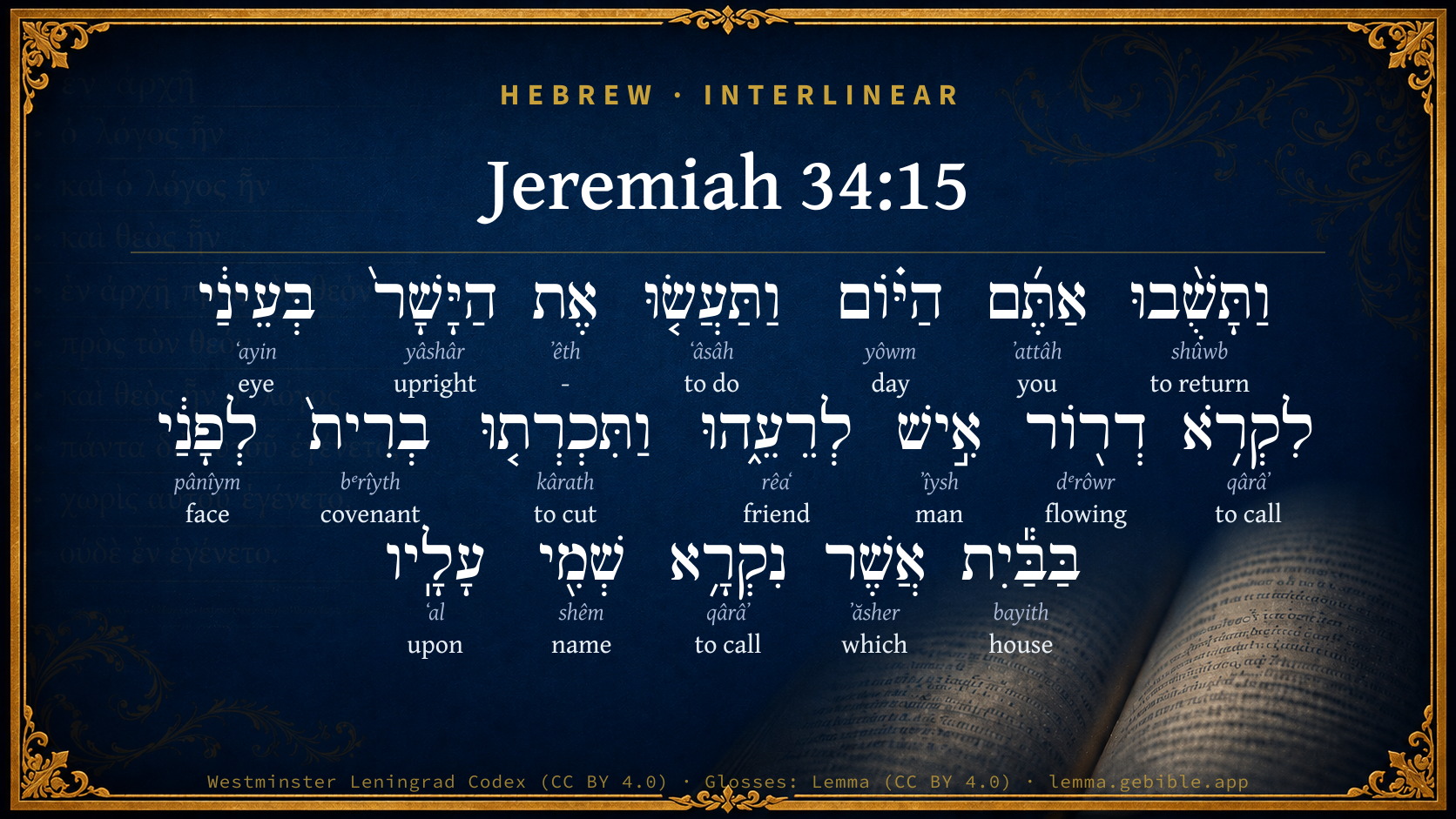
Hebrew (Westminster Leningrad Codex) Jeremiah 34:15 appears in the Hebrew Old Testament. The text above is from the Westminster Leningrad Codex. Each word links to its Strong’s number, a concise gloss, and parsing drawn from the Open Scriptures Hebrew Bible morphology. Click any word for its full Brown-Driver-Briggs (BDB) entry.
Download image
Cite this verse

Jeremiah 34:15 (World English Bible). Public Domain. Lemma interlinear Bible study tool, https://lemma.gebible.app/v/jeremiah/34/15.

Show BibTeX & RIS
BibTeX
RIS
English Translation
You were now turned, and had done that which is right in my eyes, in proclaiming liberty every man to his neighbor; and you had made a covenant before me in the house which is called by my name:
World English Bible · Public Domain
Download a study sheet

One document with this verse’s original text, its word-by-word gloss line, the meaning frame, cross-references with their text, attributed commentary, and full source and license credits — printable, and it pastes into notes with its structure intact.

This verse Autodidact and up

Study sheet (.html) Plain text (.txt)

A passage Seminary Student

Up to 50 verses in one chapter. A passage sheet keeps up to 6 commentary sources and 12 cross-references per verse, in the order this page ranks them, and says so on the sheet whenever that leaves anything out. Ask for a single verse and you get the Autodidact verse sheet above.

Everything on this page stays free to read, with no account — the sheet is a download of what is already on screen, not access to it.

Want to remove ads? Support Godless Engineer
Compare translations 3

The same verse in 3 English versions, stacked beneath the original-language interlinear above. Click any original word for its lexicon entry.

Each is an independent rendering of the whole verse — the interlinear is not word-aligned to these translations.

Highlighted words mark where these versions differ — a whole-verse word diff, not a word-by-word alignment.

  • World English Bible Public Domain
    You were now turned, and had done that which is right in my eyes, in proclaiming liberty every man to his neighbor; and you had made a covenant before me in the house which is called by my name:
  • King James Version Public Domain
    And ye were now turned, and had done right in my sight, in proclaiming liberty every man to his neighbour; and ye had made a covenant before me in the house which is called by my name:
  • unfoldingWord Literal Text CC BY-SA 4.0
    Now you yourselves repented and began to do what is right in my eyes. You proclaimed freedom, each man to his neighbor, and you made a covenant before me in the house that is called by my name.

unfoldingWord Literal Text — © unfoldingWord, licensed CC BY-SA 4.0. Word-aligned USFM3 via Door43 (git.door43.org/unfoldingWord/en_ult).

Versions to compare (up to 4)

3 of 4 selected

Show all 18 translations

Every available English version of this verse, each an independent rendering of the whole verse.

  • World English Bible Public Domain
    You were now turned, and had done that which is right in my eyes, in proclaiming liberty every man to his neighbor; and you had made a covenant before me in the house which is called by my name:
  • Berean Standard Bible Public Domain
    Recently you repented and did what pleased Me; each of you proclaimed freedom for his neighbor. You made a covenant before Me in the house that bears My Name.
  • Majority Standard Bible Public Domain
    Recently you repented and did what pleased Me; each of you proclaimed freedom for his neighbor. You made a covenant before Me in the house that bears My Name.
  • King James Version Public Domain
    And ye were now turned, and had done right in my sight, in proclaiming liberty every man to his neighbour; and ye had made a covenant before me in the house which is called by my name:
  • American Standard Version (1901) Public Domain
    And ye were now turned, and had done that which is right in mine eyes, in proclaiming liberty every man to his neighbor; and ye had made a covenant before me in the house which is called by my name:
  • Revised Version (1885) Public Domain
    And ye were now turned, and had done that which is right in mine eyes, in proclaiming liberty every man to his neighbour; and ye had made a covenant before me in the house which is called by my name:
  • Geneva Bible (1599) Public Domain
    And ye were nowe turned, and had done right in my sight in proclayming libertie, euery man to his neighbour, and ye had made a couenant before mee in the house, whereupon my Name is called.
  • Douay-Rheims (1899) Public Domain
    And you turned to day, and did that which was right in my eyes, in proclaiming liberty every one to his brother: and you made a covenant in my sight, in the house upon which my name is invocated.
  • Young's Literal Translation Public Domain
    `And ye turn back, ye to-day, and ye do that which is right in Mine eyes, to proclaim liberty each to his neighbour, and ye make a covenant before Me in the house over which My name is called.
  • Literal Standard Version CC BY-SA 4.0
    And today you turn back and you do that which is right in My eyes, to each proclaim liberty to his neighbor, and you make a covenant before Me in the house over which My Name is called.
  • Unlocked Literal Bible CC BY-SA 4.0
    Now you yourselves repented and began to do what is right in my eyes. You proclaimed freedom, each man to his neighbor, and you made a covenant before me in the house that is called by my name.
  • unfoldingWord Literal Text CC BY-SA 4.0
    Now you yourselves repented and began to do what is right in my eyes. You proclaimed freedom, each man to his neighbor, and you made a covenant before me in the house that is called by my name.
  • Darby Bible Public Domain
    And you, ye had this day turned, and had done right in my sight, in proclaiming liberty every man to his neighbour; and ye had made a covenant before me in the house which is called by my name:
  • World Messianic Bible Public Domain
    You had now turned, and had done that which is right in my eyes, in every man proclaiming liberty to his neighbor. You had made a covenant before me in the house which is called by my name;
  • Webster's Bible Public Domain
    And ye had now turned, and had done right in my sight, in proclaiming liberty every man to his neighbor; and ye had made a covenant before me in the house which is called by my name:
  • Free Bible Version CC BY-SA 4.0
    A little while ago you decided to do what's right, which made me happy. You all announced that you would free your slaves. You made an agreement before me in my Temple.
  • Bible in Basic English Public Domain
    And now, turning away from evil, you had done what is right in my eyes, giving a public undertaking for every man to make his neighbour free; and you had made an agreement before me in the house which is named by my name:
  • JPS Tanakh (1917) Public Domain
    And ye were now turned, and had done that which is right in Mine eyes, in proclaiming liberty every man to his neighbour; and ye had made a covenant before Me in the house whereon My name is called;

Literal Standard Version (2020), Covenant Press — licensed CC BY-SA 4.0. Text via the HelloAO Bible API (eBible.org). Unlocked Literal Bible (unfoldingWord) — licensed CC BY-SA 4.0. Text via the HelloAO Bible API (eBible.org). unfoldingWord Literal Text — © unfoldingWord, licensed CC BY-SA 4.0. Word-aligned USFM3 via Door43 (git.door43.org/unfoldingWord/en_ult). Free Bible Version, Dr. Jonathan Gallagher — licensed CC BY-SA 4.0. Text via the HelloAO Bible API (eBible.org).

Word by word

More ways to search: Search by grammar → Find every occurrence → Compare this word →

Practice this passage: Drill this verse → Learn its vocabulary →

דְר֖וֹר
dᵉrôwr
H1865
“flowing”
Noun, Common, Masculine, Singular, Absolute
Part of Speech
Noun
Type
Common
Gender
Masculine
Number
Singular
State
Absolute
Full BDB Definition

Origin: from an unused root (meaning to move rapidly)

TWOT: 454b

a flowing, free run, liberty - flowing (of myrrh) - liberty
  1. וַתָּשֻׁ֨בוּ shûwb H7725 “and · to return” Conjunction + Verb, Qal, Sequential Imperfect, 2nd Person, Masculine, Plural
  2. אַתֶּ֜ם ʼattâh H859 “you” Pronoun, Personal, 2nd Person, Masculine, Plural
  3. הַיּ֗וֹם yôwm H3117 “the · day” Particle, Definite Article + Noun, Common, Masculine, Singular, Absolute
  4. וַתַּעֲשׂ֤וּ ʻâsâh H6213 “and · to do” Conjunction + Verb, Qal, Sequential Imperfect, 2nd Person, Masculine, Plural
  5. אֶת ʼêth H853 “-” Particle, Direct Object
  6. הַיָּשָׁר֙ yâshâr H3477 “the · upright” Particle, Definite Article + Adjective, Adjective, Masculine, Singular, Absolute
  7. בְּעֵינַ֔י ʻayin H5869 “in/at · eyes · my” Preposition + Noun, Common, Both, Dual, Construct + Suffix, Personal, 1st Person, Common, Singular
  8. לִקְרֹ֥א qârâʼ H7121 “to call” Preposition + Verb, Qal, Infinitive Construct
  9. אִ֣ישׁ ʼîysh H376 “man” Noun, Common, Masculine, Singular, Absolute
  10. לְרֵעֵ֑הוּ rêaʻ H7453 “to/for · friend · his” Preposition + Noun, Common, Masculine, Singular, Construct + Suffix, Personal, 3rd Person, Masculine, Singular
  11. וַתִּכְרְת֤וּ kârath H3772 “and · to cut” Conjunction + Verb, Qal, Sequential Imperfect, 2nd Person, Masculine, Plural
  12. בְרִית֙ bᵉrîyth H1285 “covenant” Noun, Common, Feminine, Singular, Absolute
  13. לְפָנַ֔י pânîym H6440 “to/for · face(s) · my” Preposition + Noun, Common, Both, Plural, Construct + Suffix, Personal, 1st Person, Common, Singular
  14. בַּבַּ֕יִת bayith H1004 “in/at the · house” Preposition, Determined + Noun, Common, Masculine, Singular, Absolute
  15. אֲשֶׁר ʼăsher H834 “which” Particle, Relative
  16. נִקְרָ֥א qârâʼ H7121 “to call” Verb, Niphal, Perfect, 3rd Person, Masculine, Singular
  17. שְׁמִ֖י shêm H8034 “name · my” Noun, Common, Masculine, Singular, Construct + Suffix, Personal, 1st Person, Common, Singular
  18. עָלָֽיו ʻal H5921 “upon · him” Preposition + Suffix, Personal, 3rd Person, Masculine, Singular

About this verse

These counts appear in no published source. They are computed here, from the morphology-tagged text and Lemma’s own curated glosses. What Lemma adds →

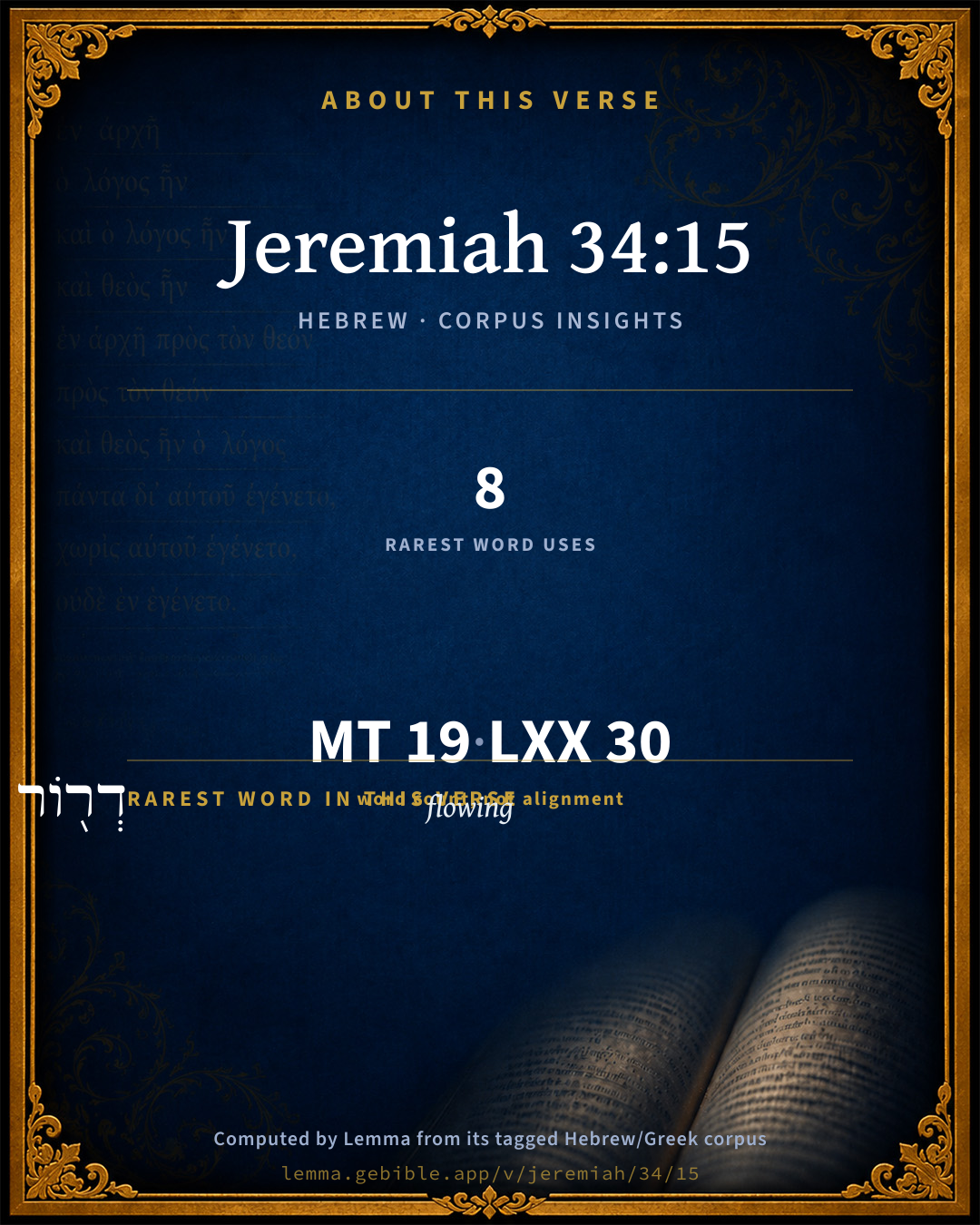
19
words
18
distinct lemmas
Prophets
section

Notable vocabulary

The rarest word here is דְר֖וֹר flowing H1865 — appearing just 8 times in the whole Hebrew Bible.

Shared distinctive vocabulary

דְר֖וֹר flowing H1865 occurs in 7 verses of the Hebrew Bible. Also found in:

Grammatical profile

  • 5 verbs
  • 9 nouns
  • 1 adjective
  • 1 pronoun
  • 1 preposition
  • 2 particles

Verb forms

  • וַתָּשֻׁ֨בוּ Qal · Sequential Imperfect
  • וַתַּעֲשׂ֤וּ Qal · Sequential Imperfect
  • לִקְרֹ֥א Qal · Infinitive Construct
  • וַתִּכְרְת֤וּ Qal · Sequential Imperfect
  • נִקְרָ֥א Niphal · Perfect

Repetition

A word recurs within this verse — often emphatic in Hebrew:

  • לִקְרֹ֥א to call H7121 ×2

Hebrew & Septuagint length

In the original languages it is 19 Hebrew tokens and 30 Greek tokens — but the two are counted differently (Hebrew bundles its prefixes and suffixes into one token; the Greek is in lemma form), so that isn’t a like-for-like length.

Cross-references

14

Topical passages linked to Jeremiah 34:15 in the Treasury of Scripture Knowledge — connected by theme and wording, ordered by reader-vote popularity; previews shown in the World English Bible.

  • Jeremiah 34:8 The word that came to Jeremiah from Yahweh, after that the king Zedekiah had made a covenant with all the people who were at Jerusalem, to proclaim liberty to them;
  • 2 Kings 23:3 The king stood by the pillar, and made a covenant before Yahweh, to walk after Yahweh, and to keep his commandments, and his testimonies, and his statutes, with all [his] heart, and all [his] soul, to confirm the words of this covenant that were written in this book: and all the people stood to the covenant.
  • Nehemiah 10:29 They joined with their brothers, their nobles, and entered into a curse, and into an oath, to walk in God's law, which was given by Moses the servant of God, and to observe and do all the commandments of Yahweh our Lord, and his ordinances and his statutes;
  • Jeremiah 7:10–11 and come and stand before me in this house, which is called by my name, and say, We are delivered; that you may do all these abominations?
  • 1 Kings 21:27–29 It happened, when Ahab heard those words, that he tore his clothes, and put sackcloth on his flesh, and fasted, and lay in sackcloth, and went softly.
  • 2 Kings 10:30–31 Yahweh said to Jehu, Because you have done well in executing that which is right in my eyes, [and] have done to the house of Ahab according to all that was in my heart, your sons of the fourth generation shall sit on the throne of Israel.
  • 2 Kings 12:2 Jehoash did that which was right in the eyes of Yahweh all his days in which Jehoiada the priest instructed him.
  • 2 Kings 14:3 He did that which was right in the eyes of Yahweh, yet not like David his father: he did according to all that Joash his father had done.
  • Psalms 76:11 Make vows to Yahweh your God, and fulfill them! Let all of his neighbors bring presents to him who is to be feared.
  • Psalms 119:106 I have sworn, and have confirmed it, That I will obey your righteous ordinances.
  • Isaiah 58:2 Yet they seek me daily, and delight to know my ways: as a nation that did righteousness, and didn't forsake the ordinance of their God, they ask of me righteous judgments; they delight to draw near to God.
  • Jeremiah 32:34 But they set their abominations in the house which is called by my name, to defile it.
  • Jeremiah 34:10–11 All the princes and all the people obeyed, who had entered into the covenant, that everyone should let his man-servant, and everyone his maid-servant, go free, that none should make bondservants of them any more; they obeyed, and let them go:
  • Matthew 15:8 'These people draw near to me with their mouth, And honor me with their lips; But their heart is far from me.

Cross-references courtesy of OpenBible.info (CC BY 4.0).

Hebrew and Greek witnesses Masoretic Hebrew ↔ Greek Septuagint

The same verse in the two great witnesses to the Old Testament, shown verse-for-verse.

These are two independent witnesses, not word-aligned to each other, and the Septuagint is shown in lemma (dictionary) form.

Hebrew Jeremiah 34:15 Masoretic · Westminster Leningrad Codex

וַתָּשֻׁ֨בוּ אַתֶּ֜ם הַיּ֗וֹם וַתַּעֲשׂ֤וּ אֶת הַיָּשָׁר֙ בְּעֵינַ֔י לִקְרֹ֥א דְר֖וֹר אִ֣ישׁ לְרֵעֵ֑הוּ וַתִּכְרְת֤וּ בְרִית֙ לְפָנַ֔י בַּבַּ֕יִת אֲשֶׁר נִקְרָ֥א שְׁמִ֖י עָלָֽיו

You were now turned, and had done that which is right in my eyes, in proclaiming liberty every man to his neighbor; and you had made a covenant before me in the house which is called by my name:

World English Bible · Public Domain

Greek LXX Structure differs

In the Septuagint, Jeremiah is about an eighth shorter than the Hebrew and arranges its material differently — the Oracles Against the Nations (Hebrew chapters 46–51) appear in the middle of the Greek book, after 25:13. Because the chapter and verse boundaries do not line up, a verse-for-verse comparison with the Hebrew is not shown.

A verse-for-verse comparison isn’t shown here because the chapters and verses don’t line up. Switch to the LXX edition with the MT / LXX toggle above to read the Greek directly.

Hebrew: Westminster Leningrad Codex (CC BY 4.0). Greek: Septuagint (public domain); English from a public-domain English Septuagint. How the Septuagint differs from the Hebrew →

Targum (Aramaic paraphrase)

1

The Targum is the ancient Jewish Aramaic paraphrase of the Hebrew Scriptures — an interpretive translation, not the Hebrew text itself. Onkelos (literal) and Pseudo-Jonathan (expansive) render the Torah, and Jonathan the Prophets. Coverage is partial: where no permissively-licensed English translation exists for a verse, only the Aramaic is shown. This is verse-level text, not a word-by-word alignment to the Hebrew.

  1. Targum Jonathan Prophets (Joshua–Malachi)
    וְתַבְתּוּן אַתּוּן יוֹמָא דֵין וַעֲבַדְתּוּן יַת דְכָשַׁר קֳדָמַי לְמִקְרֵי חֵירוּ גְבַר לְחַבְרֵיהּ וּגְזַרְתּוּן קְיָם קֳדָמַי בְּבֵיתָא דְאִתְקְרֵי שְׁמִי עֲלוֹהִי:

    (no public-domain English translation for this verse)

    Targum Jonathan — Aramaic: “Mikraot Gedolot” (public domain). English: “Sefaria Community Translation” (CC0 1.0 (public-domain dedication)); “London "Chaldee Paraphrase," 1871” (public domain). Text via Sefaria.

Commentary

Notes on Jeremiah 34:15 from classic Christian and Jewish commentators (each source and its license shown beneath its notes). The classic Christian expositions comment on the surrounding passage and are grouped to its opening verse, so a note may address several verses; the Jewish commentaries on the Tanakh (Rashi and others) are per-verse, so they appear only where the commentator wrote on this verse.

Lemma curates 59 commentaries, every one of them public domain or Creative Commons licensed, each selected and text-cleaned for this edition rather than reprinted as found. About our sources →

Trapp's Complete Commentary

John Trapp

Jer 34:15 And ye were now turned, and had done right in my sight, in proclaiming liberty every man to his neighbour; and ye had made a covenant before me in the house which is called by my name:

Ver. 15. And you were now turned.] Being frightened into a temporary reformation: but all was in hypocrisy, as now well appeareth. Falling stars were never but meteors.

In proclaiming liberty every one to his neighbour.] Your servants were your neighbours, and "their flesh as your flesh," {Neh 5:5} and should have been so considered. In the law the servant paid the half shekel as well as his master. And in the gospel, as there is "neither Jew nor Greek, so neither bond nor free, but all are one in Christ Jesus," {Gal 3:28} whether he be lord or lowlies. Servus est domini sui συναδελφος.

And ye had made a covenant before.] And have not all done so in baptism, that Beersheba, or Well of an oath?

John Trapp, A Commentary or Exposition upon All the Books of the Old and New Testament (1647–1656) — public domain. Text from a community e-Sword module.

Joseph Benson's Commentary

Jer 34:15-17. And ye were now turned — That is, reformed in this particular; and had done right in my sight — In proclaiming liberty to your servants. And ye had made a covenant before me — Had entered into solemn engagements in my presence and temple to that purpose. This was probably such a covenant as Josiah and all the people had made formerly, (2Ki 23:2-3,) whereby they obliged themselves to serve God, and obey his laws in general, and this concerning giving freedom to their servants in particular. But ye turned — Declined from these good beginnings; and polluted my name — That is, profaned it, in swearing, or solemnly promising in and by it, to do that which you have not done. Certainly, whoever uses the name of God, by way of sanction to his promises, that the greater confidence may be placed in them, and afterward does not perform them, profanes or pollutes the name of God. Therefore, behold I proclaim liberty for you to the sword, &c. — I now declare that I give free commission and liberty to my sore judgments, the sword, the famine, and the pestilence, to invade and destroy multitudes of you. See Jer 32:24; Jer 32:36. The expressions here used import, that these calamities come upon men by direction and commission from God, as the executioners of his justice. And to be removed into all the kingdoms of the earth — Those of you who escape destruction shall be dispersed through different nations, where you shall learn by experience how great are the hardships and miseries attendant on a state of servitude. See note on Jer 24:9.

Joseph Benson's Commentary on the Old and New Testaments (1811–1818) — public domain. Text from a community e-Sword module.

Tyndale Open Study Notes

Tyndale Open Resources

34:15-16 The slaveholders had done what was right in releasing their slaves; they had obeyed God’s command. But their covenant had been made in the Temple, and when they broke their covenant, they defiled God’s name and treated it with contempt (in violation of Deut 5:11).

Tyndale Open Study Notes — © Tyndale Open Resources, licensed CC BY-SA 4.0. Text via the HelloAO Bible API.

Geneva Bible (1599)

Geneva Bible translators

Meaning, in the Temple, to declare that it was a most solemn and straight covenant, made in the Name of the Lord.

Geneva Bible (1599) marginal notes — public domain. Text via Bolls.life.

Jamieson, Fausset & Brown

Robert Jamieson, A. R. Fausset & David Brown

in the house . . . called by my name--the usual place of making such covenants (Kg2 23:3; compare Kg1 8:31; Neh 10:29).

Jamieson, Fausset & Brown — Commentary Critical and Explanatory on the Whole Bible (1871) — public domain (CC PDM 1.0). Text via the HelloAO Bible API.

John Calvin's Commentaries

And ye now turned, and did what was right in my eyes, by proclaiming liberty every one to his neighbor: God seems at first to commend the people; and no doubt it ought to have been deemed praiseworthy, that the people, after having been reminded that they had perversely disregarded God’s law, willingly engaged in doing their duty; but as they gave but a false proof of repentance, and did not really perform what they had promised, it was, as I have said, a great aggravation of their crime. So then God commended the repentance of the people, in order to shew how detestable is hypocrisy; for they shewed for a short time some feeling of humanity, but soon after proved that it was nothing but dissimulation. He therefore says, that they did what was right by proclaiming liberty And hence it also appears that they had not gone astray through ignorance, for God had required this kindness from them, that is, to restore what had been wickedly taken away from servants and maids, and to let them free again: except they had been constrained by the clear testimony of the Law, they would have never thus given up their private advantages. But after having made a pretense that they wished to obey God, they again soon remanded their servants and their maids. It hence appears evident that they trifled with God, and that it was a mere fraud to set free their servant only for a short time.

He says that they made a covenant in the house on which his name had been called, and also, that they had profaned his name All this added to their wickedness; for not only liberty had been proclaimed and confirmed by an oath, but this had also been done in the Temple. Hence he aggravates the sin of the people by this circumstance, — that they had made the covenant which they afterwards violated in the presence of God. For though the eyes of God penetrate into the most hidden recesses, yet the wickedness of the people became greater, and it was an evidence of men lost to all shame, that they dared to violate their pledged faith, and thus to shew no regard for the Temple, as though they had lost all reverence for God and all fear. It is hence evident how profane they were become, that they dared to come to the Temple and to make an oath before God, and then immediately to forfeit their faith.

John Calvin's Commentaries (1540-1563) — public domain. Text from the Calvin Translation Society English edition (1840s-50s) via the Christian Classics Ethereal Library (ccel.org). Calvin's coverage is partial (roughly two-thirds of the Bible); uncommented books and verses are honest gaps, never fabricated. The 19th-century editor's footnotes and remarks are omitted so the notes are faithfully Calvin's own voice.

Ellicott's Commentary for English Readers

(15) Ye had made a covenant before me in the house which is called by my name.—The words point to the solemnity with which the new engagements had been contracted. It was not merely that the king had issued an edict, or that judges had given their decisions in accordance with the old law, but princes and people had met together in the courts of the Temple, and there, in the presence of Jehovah, had entered into this covenant, as did their descendants afterwards in the days of Nehemiah (Neh_5:12-13), with Him and with each other. Their sin in breaking their covenant was therefore a sin against Him as well as against their brethren.

A Bible Commentary for English Readers, edited by Charles John Ellicott (1878–1897) — public domain. Text from a community e-Sword module.

John Gill's Exposition

And ye were now turned,.... Or, "today indeed ye were turned" (r) some little time ago, indeed, it must be owned, that ye turned from the evil ways of your fathers, for which you were to be commended, as having acted a better part than they:

and had done right in my sight; what was acceptable to the Lord, approved of by him, being agreeably to his law; and it would have been well if they had continued so doing:

in proclaiming liberty every man to his neighbour; for a manservant, or maidservant, was his neighbour, and to be treated as such, and loved as himself, especially a Hebrew one, of the same nation and religion; and not to be used as a slave, or retained for ever in bondage:

and ye made a covenant before me in the house which is called by my name; this circumstance is mentioned as an aggravation of the breach of the covenant they had made, to dismiss their servants according to law; it was made in a very solemn manner, in the presence of God, appealing to him as a witness; it was done in the temple, a sacred place, devoted to him and his worship; which was called by his name, the temple of the Lord, and where his name was called upon, and where were the symbols of his presence.

(r) "jam, vel et quidem conversi fuistis hodie", Schmidt; "reversi quidem vos hodie", Junius & Tremellius, Piscator.

John Gill's Exposition of the Whole Bible (1746–1763) — public domain (CC PDM 1.0). Text via the HelloAO Bible API.

Matthew Poole's English Annotations

Ye were now turned; that is, reformed in this particular, in which you had done the thing which I commanded you,

proclaiming a liberty to your servants. And you

made a covenant in my presence to that purpose, and that in the temple, where it seemeth this covenant was made.

Matthew Poole's English Annotations on the Holy Bible (1683–1685) — public domain. Text from a community e-Sword/MySword module.

The Pulpit Commentary

Ye were now turned; or, ye returned (the primary meaning is simply "to turn;" hence

(1) to turn away, as in ver. 16;

(2) to return, as here; comp. (Jer_8:4)

The Pulpit Commentary (1880–1919), ed. H.D.M. Spence-Jones & Joseph S. Exell — public domain. Text from a community e-Sword module.

unfoldingWord translationNotes

Door43 World Missions Community

Now you yourselves repented

Here the word "now" is used to draw attention to the important point that follows.

right in my eyes

"Eyes" here is a metonym for someone's opinion or idea. AT: "what I consider to be right" (See: Metonymy)

the house that is called by my name

This can be translated in active form. AT: "the house that belongs to me" or "the building in which they worship me" (See: Active or Passive Metonymy)

turned and polluted my name

A person's name is a metonym for what people think of him. AT: "stopped doing what was right and did evil things that have made people think that I am evil" (See: Metonymy)

translationWords

repent

preach

neighbor

call

name

turn

unfoldingWord translationNotes — © Distant Shores Media and the Door43 World Missions Community, licensed CC BY-SA 4.0. Source: git.door43.org/Door43/en_tn.

Lesson kit

Teaching starters — assembled from the data on this page, not authored interpretation. Every prompt links to the verse data it draws on. Edit before teaching.

Jeremiah, in the Prophets, opens this verse with 19 words (18 distinct Hebrew lemmas). Its most distinctive word is dᵉrôwr (“flowing”). A historical commentator’s framing appears above. Read the whole chapter for the surrounding context.

Discussion questions

  1. How does “flowing” (dᵉrôwr) shape what this verse is saying?
  2. Exodus 30:23 shares the word «flowing» with this verse. How do the two illuminate each other?
  3. “to call” occurs 2× in this one verse. What is the effect of the repetition?
  4. These translations render this verse differently. What is at stake in choosing one wording over another?
  5. The verb «וַתָּשֻׁ֨בוּ» is Qal Sequential Imperfect. How does its form color the action?
  6. Reading how Trapp's Complete Commentary and Joseph Benson's Commentary read this verse, where do the two commentators agree and where do they part?

Things to notice

Reading settings

Reading text

Shown beneath each verse's original-language words.

Old Testament
Old Testament edition

Read the OT as the Masoretic Hebrew (MT) or the Greek Septuagint (LXX).

English shown for the Greek Septuagint (in the Hebrew ↔ Greek comparison).

Comparing translations? Open the Compare panel on any verse page to stack up to four side by side.